P
Reading edition
PALM.
Royal palms (Roystonea regia) are very abundant in Cuba and Porto Rico and are probably the most characteristic trees of those islands. They are also to be found to some extent in the southern portions of the United States. As sources of honey these trees are important in the West Indies, where they yield nectar abundantly.
The date palm (Phoenix dactylifera) has been planted to a limited extent in the desert regions of the Southwestern United States. This species is reputed to be a splendid source of nectar.
The cocoanut palm (Cocos nucifera) is the most important of all the palm trees, since the nuts furnish large quantities of food, much used in tropical countries. This species is common in the West Indies and in southern Florida. Although the source of considerable honey it is not equal to the foregoing species as a source of nectar. (See also Palmetto).
PALMETTO (Sabal).
The palmettos are the most conspicuous feature of the flora of the south half of Florida. (Fig. 104.) The cabbage palmetto is a tree, while the saw or scrub palmetto grows more like the underbrush in northern forests. To the man accustomed to dense forests, the open, park-like growth of the palmettos hardly seems like woodland. The illustration gives a good idea of the typical Florida landscape.
This group of plants is not important in America, outside of the State of Florida. A small area in lower Texas, about the mouth of the Rio Grande River, is covered by a species of palmetto closely resembling the cabbage palmetto, but it is thought to be a different species. An occasional tree is also found along the seacoast as far north as Charleston, S. C. They are to be found also as street trees in various southern cities along the Gulf Coast and in south Texas. The small saw palmetto (Serenoa serrulata) also extends its range into Georgia and the Carolinas, in open pine woodlands.
In Florida both forms are sufficiently abundant to furnish nectar in quantity worthy the attention of the commercial beekeeper. However, in too many localities there is little else available, so that the season between flows is too long to make beekeeping worth while. To take advantage of the palmetto flows and at the same time get good crops through the rest of the year, the late O. O. Poppleton practiced migratory beekeeping. His apiaries were moved several times during the year, so as to be near different sources in the period of bloom. The great drawback to beekeeping in Florida is the lack of a sufficient variety of honey plants in one location to support the bees profitably throughout the year. There are a few localities, of course, where this does not apply.
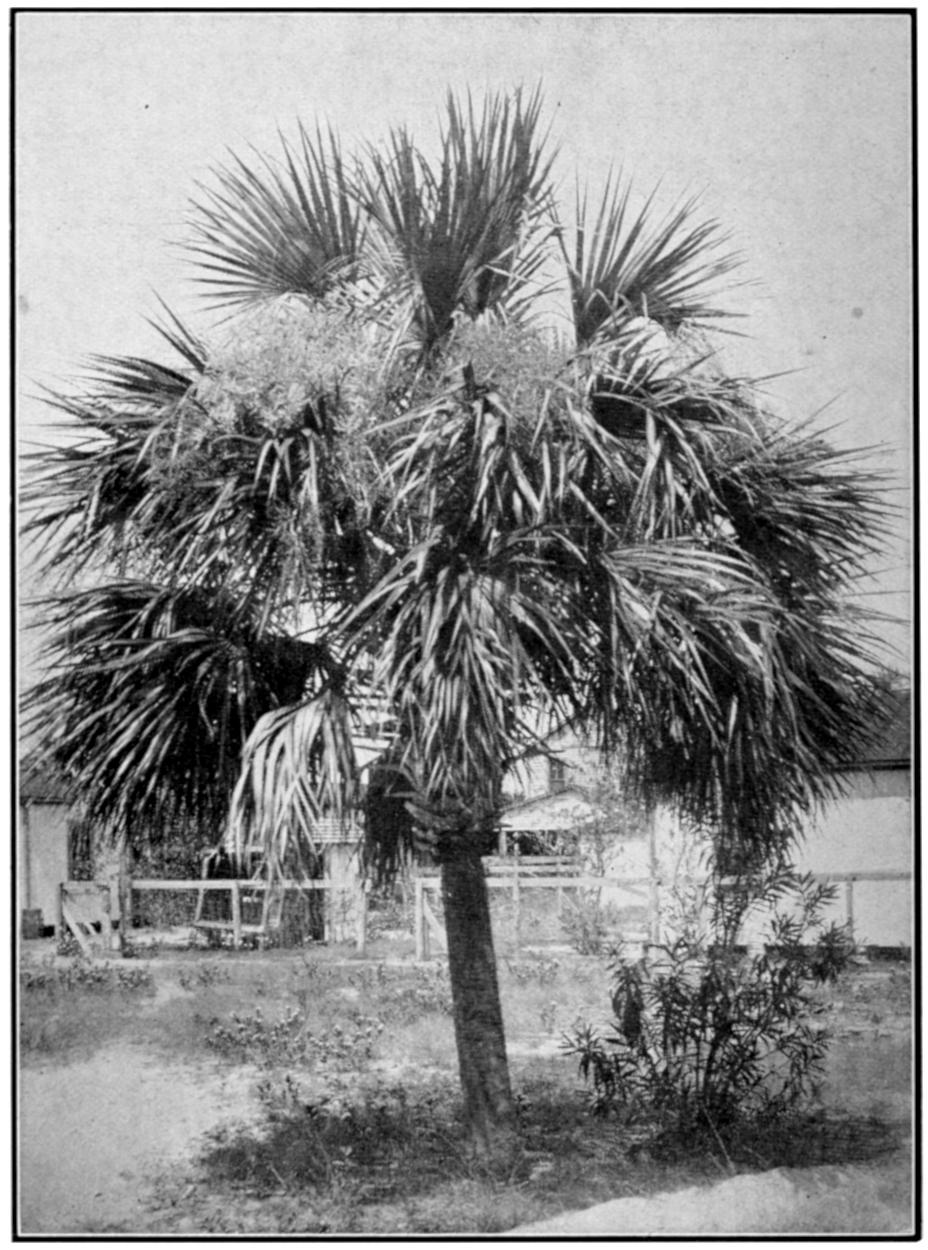
Fig. 102. Cabbage palmetto in bloom.
The cabbage palmetto (Sabal palmetto) (Fig. 102) gets its name from the cabbage-like formation in the bud at the top of the growing trunk. The tree grows 25 to 35 feet in height and has large fan-shaped leaves several feet long. It grows along the Atlantic Coast to the north line of Florida, but in the interior is not found in abundance more than about two-thirds of the way.
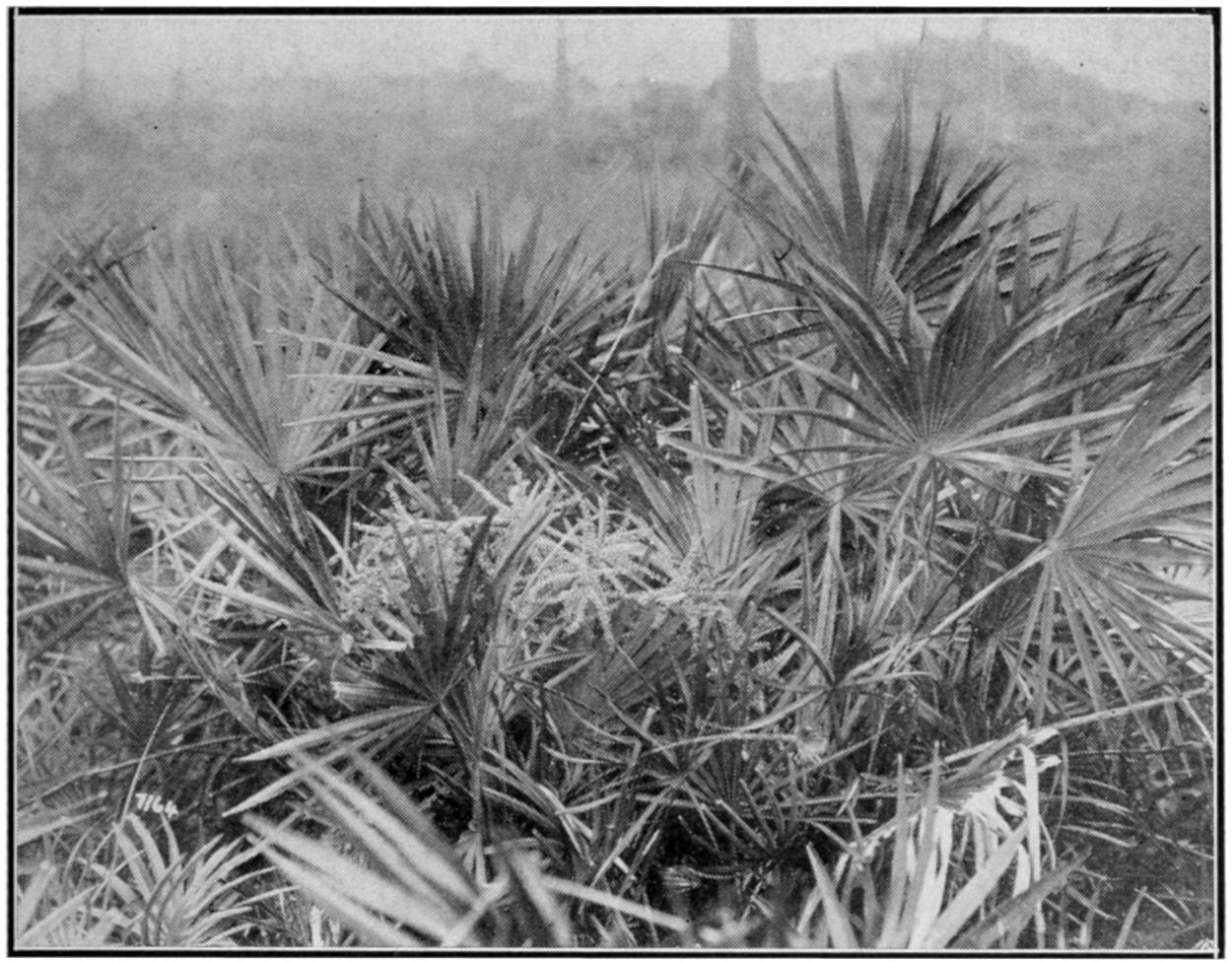
Fig. 103. The saw palmetto in bloom.
The tree blooms during July and August, the latter date applying to northern parts of the State. The blossoms are very delicate and have been likened by Professor Baldwin to a giant ostrich plume. (Fig. 105). According to his statement, the flowerlets are sensitive to weather conditions. Too much moisture blights them, while the opposite extreme blasts the delicate bloom. As a consequence, it does not yield abundantly more than about one year in three, although at times it yields very profusely.
“On the St. Lucie River, Mr. Hill extracted, barreled and shipped 3,500 pounds of palmetto honey from 55 colonies in two weeks.”—Page 489, American Bee Journal, 1899.
While palmetto honey is regarded as of very high quality, the honey from the cabbage tree is rather thin and requires some care in getting it properly ripened, as the following quotations will show:
“Cabbage palmetto honey, sealed or unsealed, will foam as though fermentation was in progress; that taken from the combs unsealed will ferment enough to deprive it of all the honey flavor, but the sealed only foams. Thin and acid and amber in color, it will flow bubbling from the cells behind the knife, and it is not a rare thing to see gas bubbles under the cappings of the sealed cells. Whether the colonies are strong or weak, it is always the same, when the bees work on the cabbage trees, as the common palm tree of Florida is called. The name comes from the fact that the bud in the head at the top is eaten in lieu of cabbage.
“The saw palmetto is decidedly different in the nectar it yields. Saw palmetto honey, even unsealed, may be called a good honey, and it is, too. When ripened it is a honey that makes a name for itself when enough care is taken by the producer to have it unmixed with other nectars.
“I write from personal experience on the east coast of Florida.”—L. K. Smith, Gleanings, page 39, 1909.
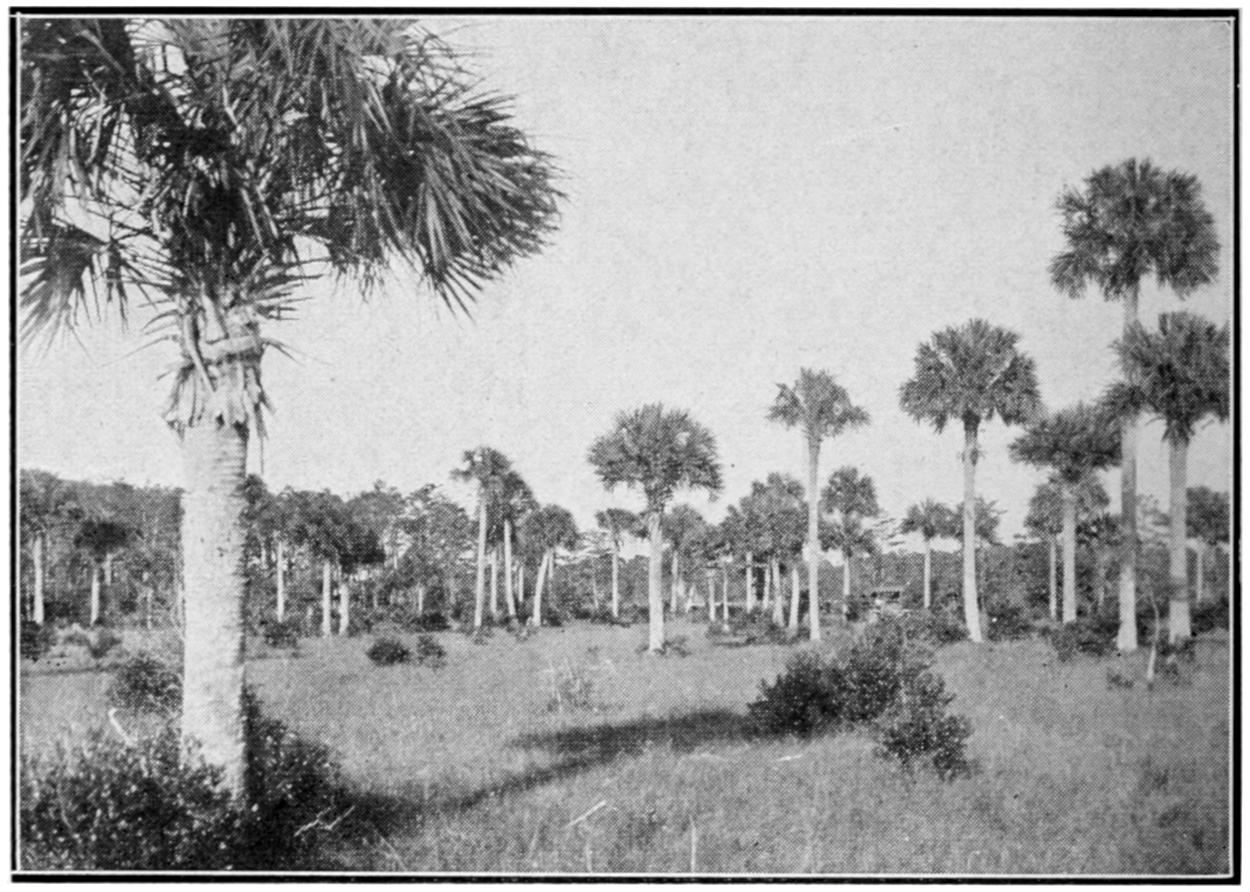
Fig. 104. The palmettos are a conspicuous feature of the Florida landscape.
The saw palmetto (Serenoa serrulata), often called scrub palmetto (Fig. 103), is a low growing little palm, found on dry soils in the Gulf Coast region. In the southern portion of its range, in peninsular Florida, it attains the proportions of a small tree. There it sometimes reaches a height of 20 feet, with erect or inclined trunk. Further north the stem is almost invariably underground. Large areas of pine lands are covered with it.
The blooming time is April and May. O. O. Poppleton wrote concerning his calendar of the year:
“April—Saw palmetto flow commences early in the month and continues until last of May. Our apiary work these two months is extracting, building up all colonies and replacing poor queens.”—Beekeepers’ Review, page 11, 1893.
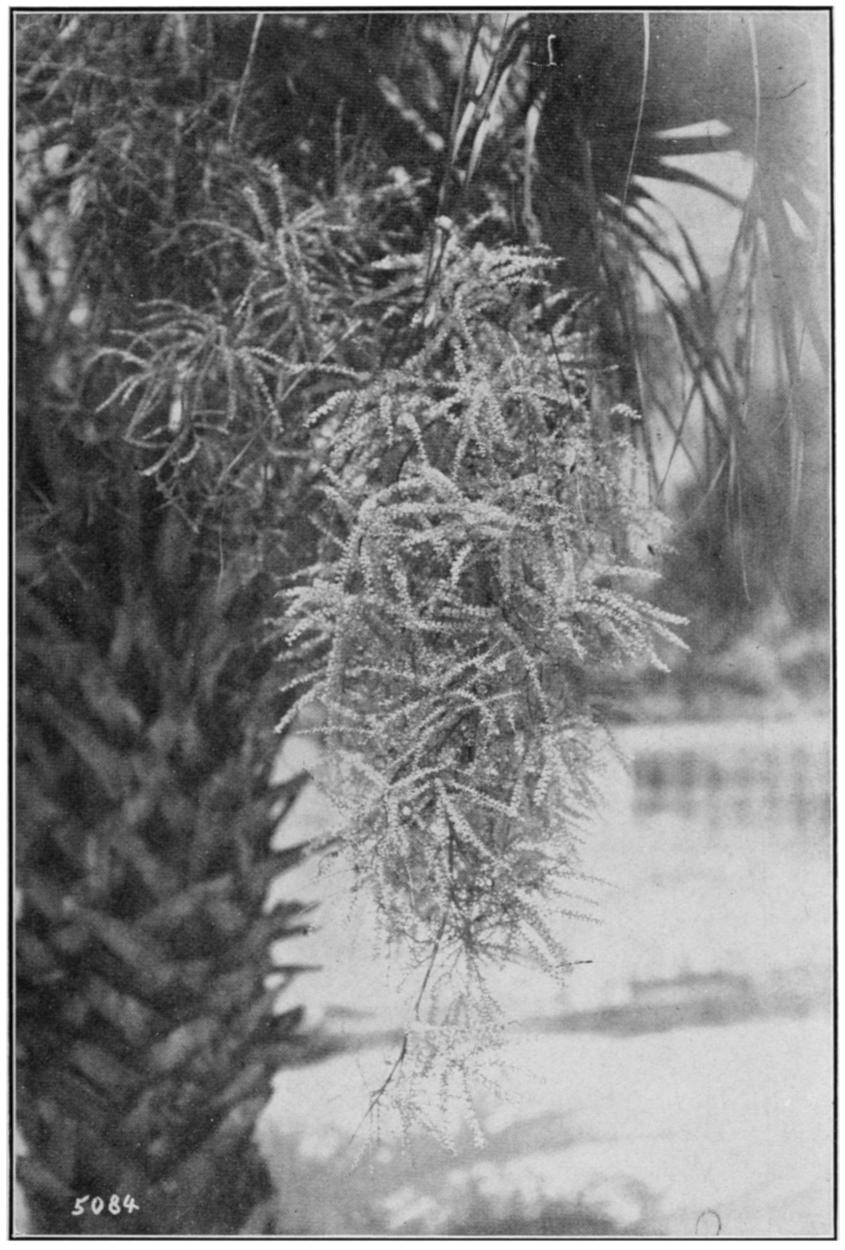
Fig. 105. Bloom of the cabbage palmetto.
Concerning the honey flow from saw palmetto we quote E. G. Baldwin as follows:
“The honey from saw palmetto is lemon-yellow in color, thick and waxy and of pronounced but delicious flavor. It is not quite so transparent as pure orange honey, but seldom candies, and makes a choice table article. Mr. O. O. Poppleton pronounces it the best honey in Florida, with the possible exception of tupelo. It is liked by almost everyone at first taste; is a trifle milder, even, than orange.”—Gleanings, page 177, 1911.
Forest fires frequently destroy many square miles of the saw palmetto, thus removing this source of nectar for one year. However, according to Baldwin, the burned-over portions usually produce the most honey the following year.
Concerning the flow from palmetto, E. B. Rood, of Bradentown, writes as follows:
“We have been having the heaviest honey flow from palmetto for ten years. One colony on scales brought in 50 pounds in four days, and 80 pounds in ten days. I expect 20,000 to 30,000 pounds. I have extracted 13,000 pounds now and am just starting on another round.”—Gleanings, page 703, 1908.
PARADISE FLOWER, see Acacia.
PARSNIP (Pastinaca sativa).
The cultivated parsnip is a valuable honey plant. In the seed belt of California, where it is grown largely for seed, it is important as a source of surplus. Writing in Gleanings (November, 1919) E. R. Root mentions having seen hives five and six stories high, jammed full of honey from parsnip and celery. He states that the honey is not of the best, and that honey from parsnip is inferior to that gathered from celery.
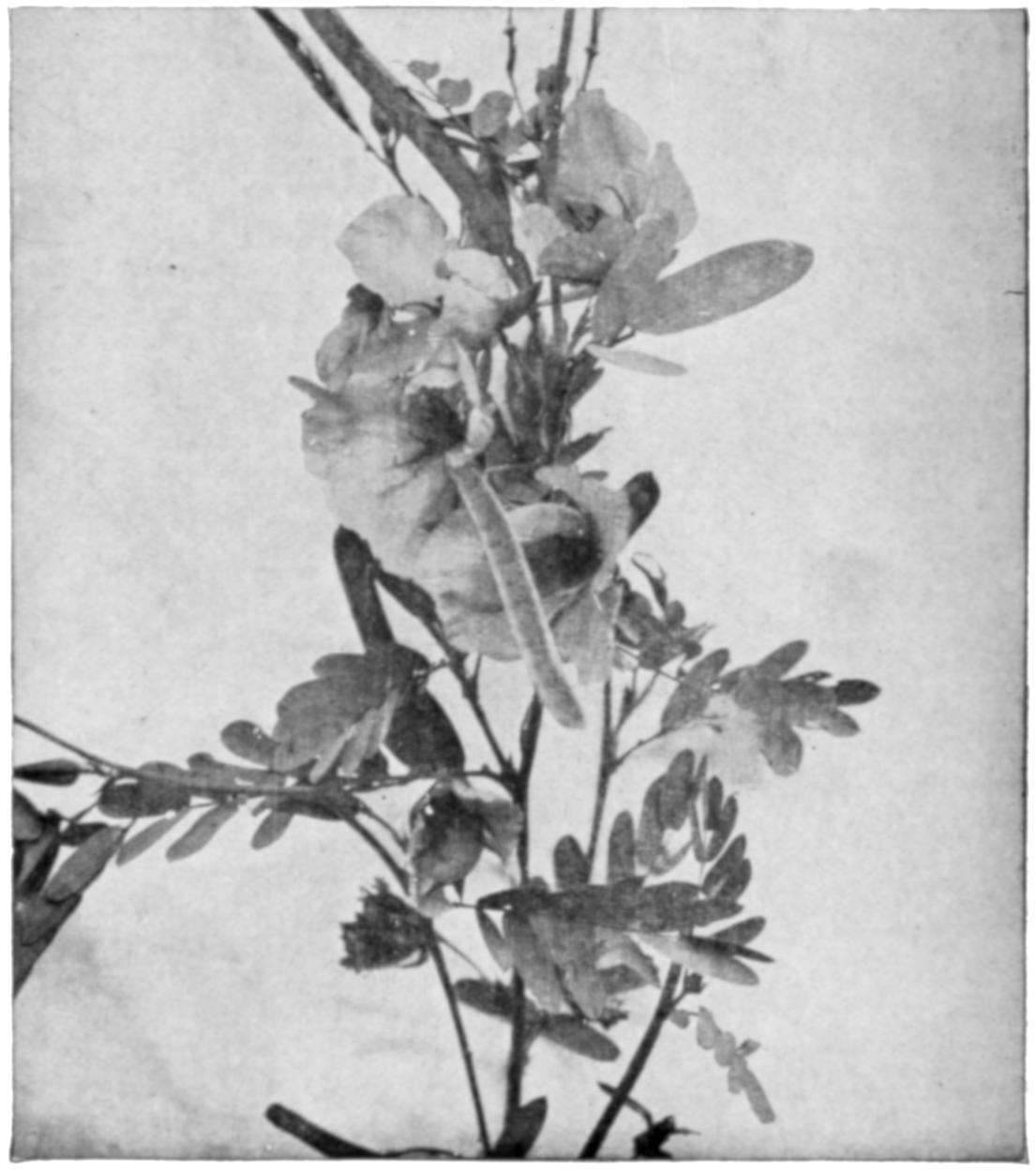
Fig. 106. Partridge pea.
PARTRIDGE PEA (Cassia Chamaechrista).
Partridge pea, known also as sensitive pea, is an important source of honey in Georgia and Florida. The flowers, of an attractive yellow color, are about the size shown in Figure 106, which displays blossom, seedpod and leaf. This plant is common along sandy roadsides in the Middle West, and may at times be found for miles at a stretch. It is seldom reported as an important source of surplus honey, except in the Southeastern States. While the bees visit it freely while in bloom in the Northern States, the honey stored from this source is seldom noticeable.
The plant is peculiar in that in addition to the flowers, nectar is secreted by extra floral nectaries at the base of the leaf stalk or petiole. The bloom lasts for several weeks in midsummer. As the bloom comes for the most part after the close of the clover harvest, its chief value in the North is to keep the bees occupied till the later flowers furnish a fall flow. The quality stored from this source is reported as poor in the North.
In contrast, the following report indicates that it is valuable in Georgia and Florida:
“Bees store from one to three supers, during its flow, of light honey. The flow begins in June and lasts until October.”—Wilder in American Bee Journal, page 369, 1912.
PEACH (Prunus persica).
The cultivated peach is an important source of nectar over a wide scope of country. In localities where large peach orchards are found, it is important for building up colonies in spring. Like most of the tree fruits, the blooming period comes early, before the bees are strong enough to profit to the fullest extent from the abundance of nectar.
PEAR (Pyrus).
The cultivated pear is old-world origin, but now widely distributed in America. Where grown commercially, it is the source of abundant nectar and pollen in early spring. Most varieties of the pear bloom ahead of the apple. Nearly all the tree fruits furnish nectar in abundance and all are valued highly by the beekeeper.
The pear is subject to blight, which destroys thousands of trees every year. For a time the honeybee was accused of spreading the blight by her visits from tree to tree. There is now serious doubt whether it is possible for the bee to spread this disease. Experiments by Dr. J. H. Merrill, at Kansas Agricultural College, indicate that the aphids are the carriers of the infection.
PENNSYLVANIA—Honey sources of.
Pennsylvania is in what is generally known as the white clover region. White and alsike clover are of first importance. Buckwheat, in some sections, is also a main source of surplus. In spring, the willows and maples, followed by dandelion and fruit bloom, furnish both nectar and pollen for early brood rearing. In the mountains, azalea and laurel furnish some honey. Black locust, tulip-poplar and sumac are valuable in certain localities. Basswood, goldenrod and asters should also be included as of local importance.
PENNYROYAL, see Wild Pennyroyal.
PEONY.
The cultivated peonies are introduced from Asia and are commonly grown for ornament. Most varieties are double and produce no pollen. The single varieties, however, produce pollen in abundance, and at times the bees seek them eagerly. The writer has seen as many as six to eight bees gathering pollen on a single blossom. The opening buds also seem to exude a nectar-like substance sought by ants and bees.
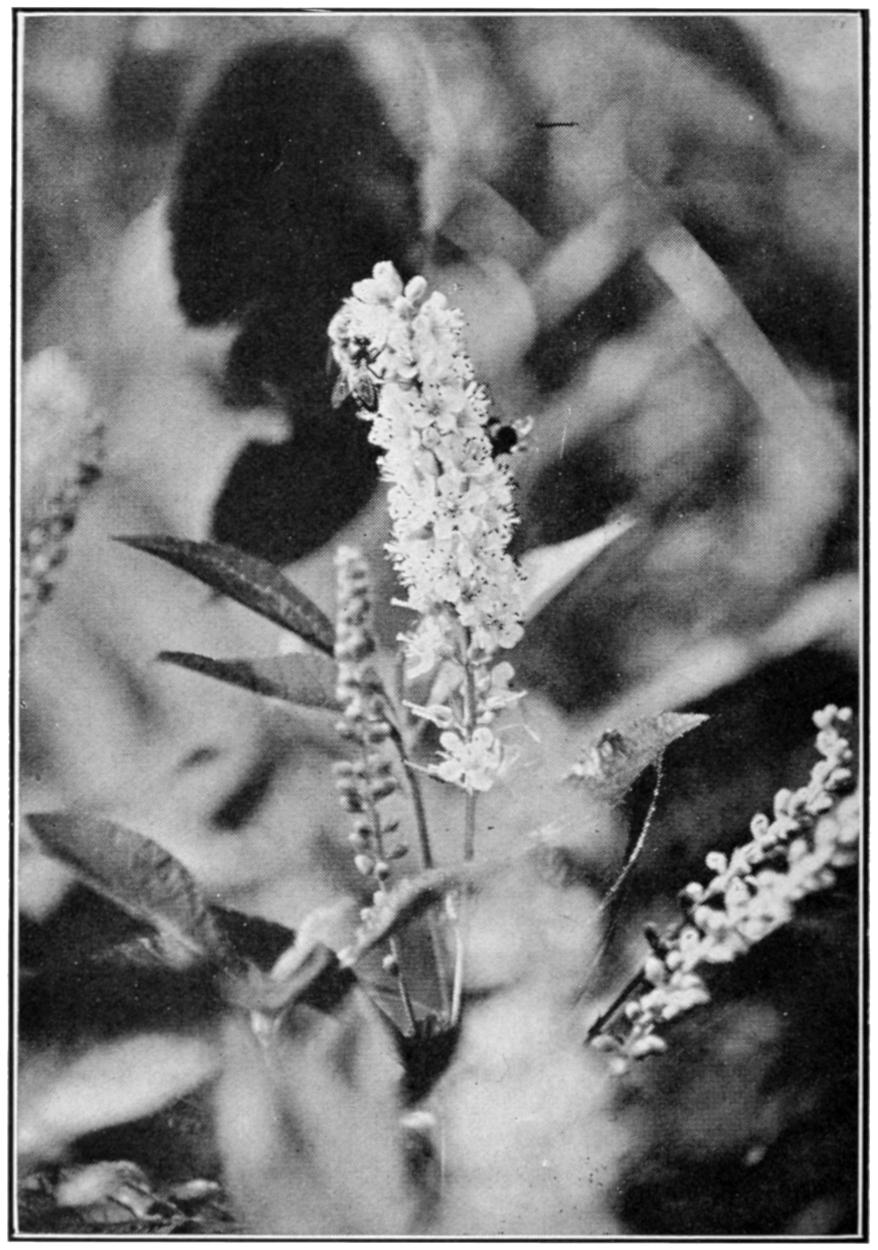
Fig. 107. Blossoms of Clethra, or sweet pepper bush.
PEPPERBUSH or WHITE ALDER (Clethra alnifolia).
The sweet pepperbush occurs from Maine along the coast to Florida and west to Louisiana. It is a small shrub with white flowers, as shown in Figure 107, which appear in midsummer. In Alabama, Georgia and north Florida, it is common in the coast plain, on swampy banks of streams and in low, wet thickets. It is very fragrant when in bloom and is often used for ornamental planting on lawns and in parks. The honey is thick, white and of fine flavor. In localities where the plant occurs abundantly, in the wild state, it seldom fails to bloom, since it grows in wet places and is unaffected by drought.
PEPPERIDGE, see Tupelo.
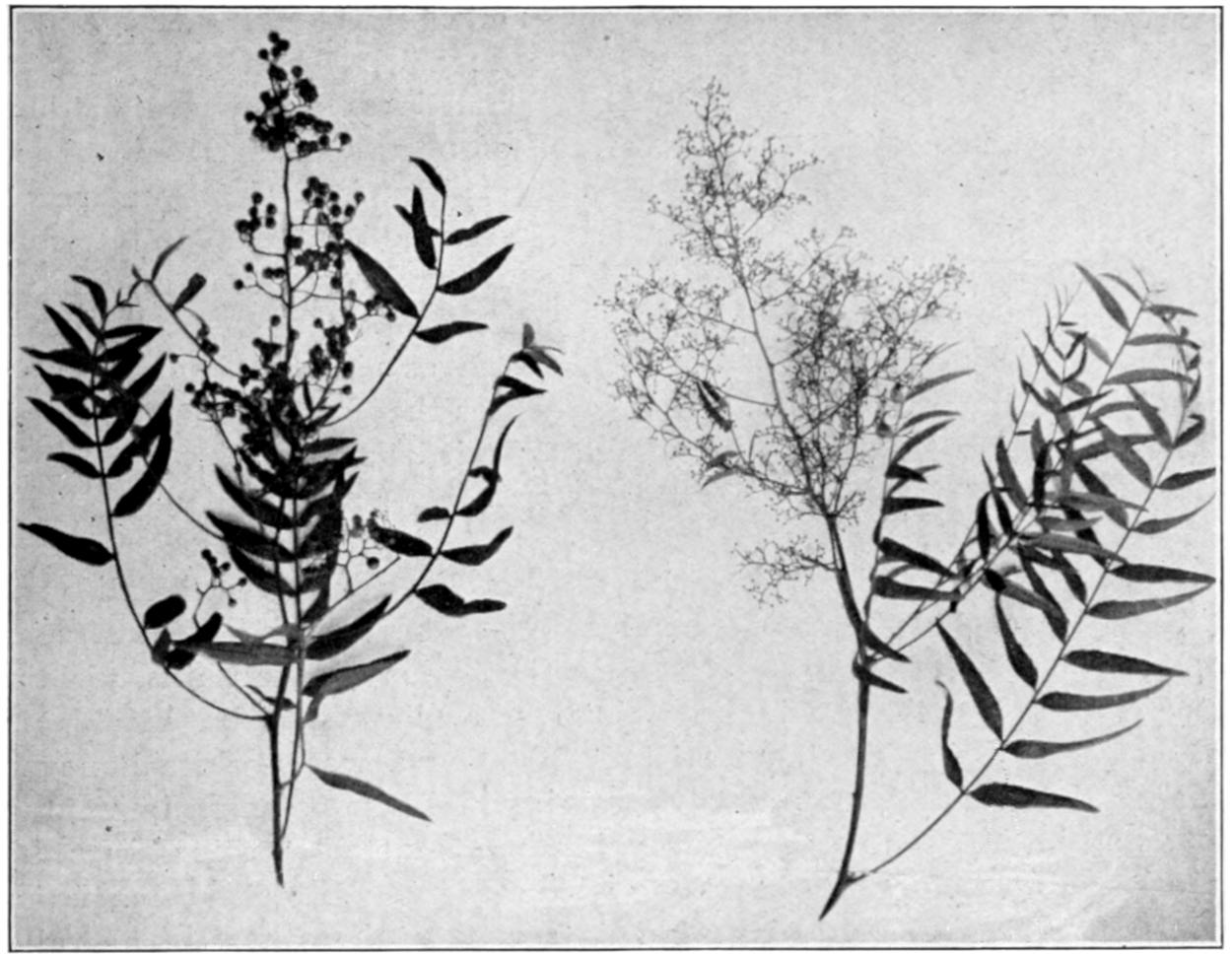
Fig. 108. Blossoms and fruits of pepper tree.
PEPPER-TREE (Schinus molle).
The pepper-tree, a native of western South America, has been widely planted in California for ornament and shade. Its bright red berries are a substitute for pepper, hence the name. It is a well-known tree on the Pacific coast, as far north as Martinez, on the Suisun Bay. It is grown in parks, on lawns and along the streets of nearly every Southern California city.
While a small amount of bloom may be seen at almost any time of the year, its principal period is in late summer when there is a scarcity of nectar-secreting blossoms (Fig. 108). The blossoms are rich in nectar and the bees gather some surplus from this source. The honey is amber in color, strong and rather peppery in flavor.
The flowers are small and of a greenish or yellowish color, in large sprays. The berries ripen in November and December.
PEPPER-VINE, see Snowvine.
PERSICARIA, see Heartsease.
PERSIMMON (Diospyros).
The persimmon, or possom-wood (Diospyros virginiana), grows from southern New England south and west to Missouri, Arkansas, Florida and along the gulf to Texas. It is a tree of medium size, reaching a height of 50 feet and rarely exceeding 12 inches in diameter. (Fig. 109). The fruit is composed of a rich and palatable pulp and a few large seeds. When green it is very astringent and very disagreeable. The flowers appear in May in the southern part of its range, and later northward. Where abundant, persimmon is a valuable source of nectar. The Mexican persimmon (Diospyros Texana), called also date plum, is a shrub or tree 10 to 30 feet in height. It thrives best in canyons and ravines, and is common over much of south Texas. It is frequently reported as an important source of early nectar in many parts of Texas.
Franklin Sherman, Jr., lists the persimmon as sixth in importance of the honey sources of North Carolina. He states that it is irregular in yield and lasts but a short time, but does well while it lasts.
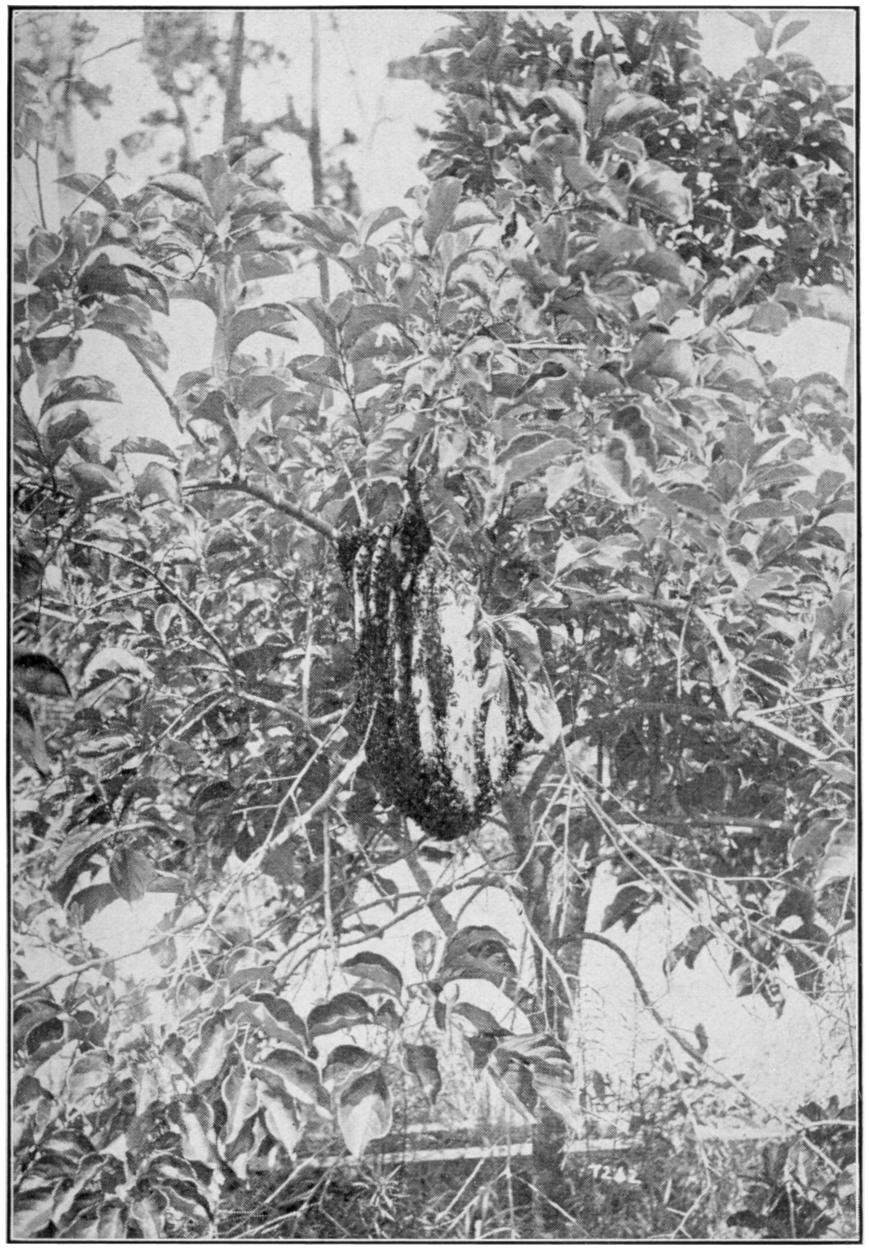
Fig. 109. Swarm of bees building comb in a persimmon tree.
PHACELIA (Phacelia).
Jepson described thirteen species of phacelia as native to California. Of these Richter lists four as of value to the beekeeper. Hill vervenia (Phacelia distans) he lists as common in the plains and foothills, yielding both nectar and pollen. The caterpillar phacelia (Phacelia hispida) is listed as common in the chaparral belt, yielding a water-white honey of fine flavor that candies soon after extracting. This is common in Ventura County, and M. H. Mendleson reports that he extracted a carload of honey from this source before the blooming of the sages. Phacelia ramosissima is reported as a fair honey plant, but not equal to the others. The valley vervenia, or fiddle neck (Phacelia tanacetifolia) is listed by Jepson (“Flora of Western Middle California”) as found in the Sacramento Valley and southward to southern California. It blooms in April and furnishes bee pasture in about six weeks from seed, and the bloom lasts about six weeks.
“The nectar flows all day. The honey is amber in color, sometimes light green and of a mild aromatic flavor. Cows fed on it show a marked increase in flow of milk, but will not eat it alone at first.”—Harry E. Horne, page 342 of above book.
This species was introduced into Germany and had quite a boom there in the early nineties. Much attention was given it in the German bee magazines and it was endorsed as valuable both for forage and for bee pasturage.
Scholl lists Phacelia congesta and Phacelia glabra as yielding sparingly in Texas. Thos. Wm. Cowan writes as follows, in American Bee Journal, in regard to the growing of phacelia in Europe:
“The one grown in Europe, Phacelia tanacetifolia, is literally covered with bees from morning till night. The species was introduced into Europe from California in 1832, and is called tanacetifolia (tansy-leaved) from the resemblance of its leaves to those of tansy. It is an annual with bluish pink flowers, racemes spike-formed, elongated, corymbose; height of plant two feet. It is grown in Europe as a bee plant for its nectar, and is the only one which produces an appreciable quantity of it.”—November 20, 1902, page 751.
A beekeeper from Indiana reports that Phacelia purshii grows freely in the wheat fields in his locality and that the bees work freely on the blue flowers. He states that in places it grows so abundantly that the wheat takes second place to the phacelia. On the 27th of May, 1919, strong colonies already had full depth extracting supers almost filled. The honey from this source is of good quality.
PHYSIOLOGY OF NECTAR SECRETION.
What we call individual plants are complex communities of real microscopic individuals, which biologists call cells. These are associated in numerous sub-communities differing from one another in structure and function. Their specialization results in a division of labor and a correspondingly large total efficiency, much as specialization and division of labor lead to efficiency and productive possibilities in a nation consisting of states, and these of smaller communities made up of trades, guilds and professions, which in co-operation follow the manifold activities that characterize a nation and collectively constitute the national life of its individuals, which is far more effective and greater than the individual life of any one person or class.
The active, living part of a cell is its protoplasm—the physical basis of life, as Huxley called it in animals and plants alike. Commonly this protoplasm encloses itself by a wall of cellulose, an organic substance manufactured by the protoplasm. Where two cells are in contact, they are usually flattened against one another. When men first began to use the microscope, only a little over two centuries ago, it was the walls and shapes of cells that attracted attention, and the resemblance to honey-comb on a small scale was so striking that the cavities were naturally called cells.
Protoplasm itself is a very complex substance, chemically, and even the much simpler cell-wall is far from being always really one identical substance. A considerable part of the thickening of matured cell-walls has been laid down on the original partition between two cells, and not only differs from this but is not alike in different kinds of cells, and in structures like wood and cork it is impregnated with other materials that affect the cell-wall very greatly in such respects as hardness and permeability to water.
The shells of nuts, for instance, are so impervious that they are commonly “stratified” by planters so that their hard shells may disintegrate more or less as a preliminary to germination, a process that not infrequently requires more than a year unless hastened by some expedient like that of passing haw fruits through the digestive mill of poultry as a means of softening their boney cores, of filing the hard envelope, which is a favorite trick of gardeners with nut-like fruits of the lotus or with canna seeds. (This is similar to the scarifying of sweet clover seed.—Editor.) This is the reason that several times as much clover seed—even good seed—must be used on an acre as seems necessary for securing the desired number of plants. One of these modifications is usual in the outer layers of cell-walls on the surface, and it is called cuticularization. Cuticularized walls are more or less completely water-proofed. When the cells that produce nectar are at the surface, their outer walls are cuticularized in this way; when they are within the nectary and the nectar passes out through stomata, this is scarcely, if at all, the case.
The greater part of nectar is water, which reaches the surface from within the plant cells. To do this it must pass through walls that are little, if at all, cuticularized, or it must break through the cuticle. This does not mean that it must break through the entire cell-wall; a small part if this is modified by the protoplasm into a gum or mucilage, or some similar substance, and the water accumulates in this layer and swells it until the overlying cuticle is burst. Some form of sugar is a frequent result of this disintegration of cellulose. Dissolved sugars pass through the ordinary cellulose wall, but they do not pass through the ordinary surface layer of protoplasm in the outer cells.
When water is separated from a solution like that of sugar by a filter of this sort, which allows water to pass but is not permeable to the dissolved substance, the action is set up that physicists call osmosis, and water accumulates on the side of the dissolved substance until it exercises a very considerable pressure. This action not only bursts the cuticle, when it starts beneath it, but results in a flow of water within the plant at that point.
The absorbing roots of plants show another result of this physical property, osmosis. They are not waterproofed; water is continuous through them, from the thin layer in which it occurs about particles of the soil, to the water which composes a great part of the weight of the protoplasm within the cells. This sap of the root cells contains dissolved sugar and other osmotic substances. Osmotic absorption by the roots results in a pressure of several atmospheres. This pressure, passed from cell to cell, gives the crispness to fresh celery. Its loss, through evaporation from the leaves, results in the loss of this crispness, or wilting.
When evaporation is slight, as in a saturated atmosphere, water exudes at the surface through pores such as occurs at the tip of a young grass or clover leaf. Water pores of this sort are common. They are regarded as pressure-valves by many botanists. The water that they eliminate is usually filtered by the protoplasm that it passes through, which does not allow the passage of substances dissolved in the cell sap; but some plants which grow where they absorb very “hard” water pass lime salts out through their water pores to such an extent that they are encrusted with lime as the water evaporates.
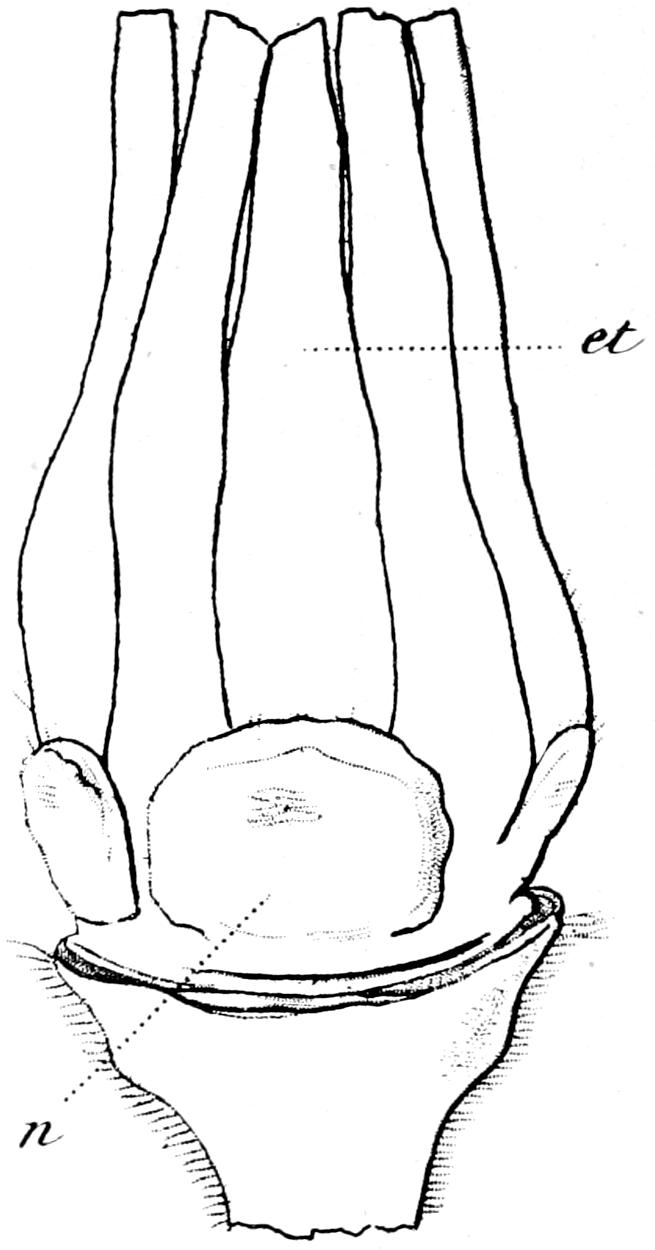
Part of flower of Geranium pyrenaicum. (n) nectaries; (et) stamens. Greatly magnified. Copied from Bonnier’s “Les Nectaires.”
The safety-valve elimination of water under strong internal pressure and lessened normal evaporation is hardly to be called excretion or accretion; the extruded-water is neither by-product nor manufactured output. The elimination of lime appears to be on the border line of excretion.
Nectar is not merely water; if it were its production would be more easily understood. To the taste, it is sweet; to the sense of smell, it is often fragrant; occasionally it is poisonous; often it is somewhat colored. Commonly it is very fluid, but in the nectar-cups of poinsettia it becomes very gummy. These properties come from substances—sugars, volatile oils, poisonous organic compounds—that were made by and in the plant, and they differ in different kinds of plants. Whatever bees or ants may do in changing nectar into honey, they do not entirely change or remove these substances, and the rank brown honey of the drug store is as easily run to its source as the popular white clover honey, the daintily flavored product of western alfalfa, the aromatic acid honey of the red raspberry, or the greenish product of the sweet clover with its delicate vanilla-like aroma, the cumarin source of which shows itself in an occasional head-ache, much as the minor organic constituents of some honeys derived from the heath family now and then prove seriously poisonous.
A fluid that contains these organic substances necessarily falls into the category of excretions or secretions, according as it represents waste or usable material. As either excretion or secretion it is the product of specialized organs, glands, and its appearance marks these glands as in action or performing their function. Whatever else may be involved, this depends upon the activity of their protoplasm, or is controlled by it. When this is killed, secretion or excretion stops.
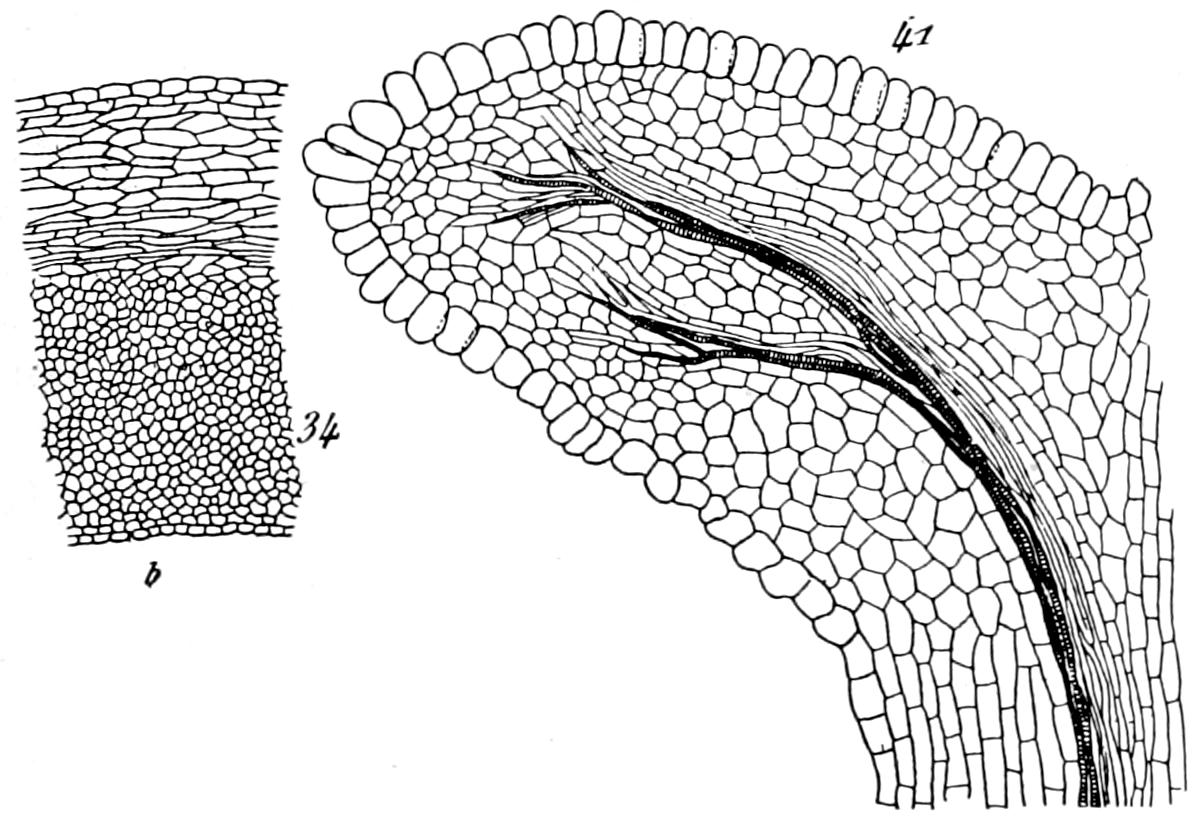
All parts of plants are composed of individual cells flattened against one another. This figure copied from Bonnier’s “Les Nectaires,” exhibits a longitudinal section of a stamen in Colinsia bicolor. Magnified.
At left (34) cross section of filament.
One result of the protean character of protoplasm is its different behavior in different plants, different organs of the same plant or different phases of the activity of an individual cell. In either case it can perform its functions only between certain limits of environment, and it performs them best somewhere between these limits. For each function and each condition there is what physiologists call a minimum—below which it is not carried on, a maximum—above which it has stopped, and an optimum—or most favorable. Just as in the efficient working of a human factory, power and raw materials are necessary, and workmen must be onto the job, however favorable the other conditions of manufacture may be.
The secretion of nectar and the storing of honey are consequently not quite comparable, for the activities of the honey plant are concerned with the first, and the activities of the bee are concerned with the second, though these are largely influenced by what the plant is or is not doing. This must be remembered always when comparing such records of honey-storing as Mr. Strong’s careful hive-weighings through a generation, with Mr. Kenoyer’s quantitative measurements of nectar secretion.
Nevertheless, the most favoring conditions of nectar secretion and honey storing agree in a number of respects. Vigorous early development or the plant puts it in condition to do its share of the work best; whatever conditions may prevail during what for most plants is a very short part of the growing season, when it is in bloom. Vigorous early development of the hive bears the same kind of relation to the final result. Early honey must be stored before the bees have reached the full strength of the season, which may have something to do-with the fact that the bulk of the harvest is gleaned from plants that flower later or continue to flower for a relatively long time.
Mr. Strong’s observations in Iowa show that over half of the net increase in honey storage in southern Iowa is made in June, and over four-fifths in June and July. These are the months when the most productive nectar plants flower, and the hives have reached the crest of their speculative activity and are undergoing division by that time.
Physiological studies show that the afternoon temperature for nectar secretion is high—between 90 and 100 degrees Fahrenheit. Observation on the hive shows that its workers are at their active best in moderately hot weather. Mr. Strong’s twenty-nine-year average shows that over half of the average honey for the year is stored when the daily maximum is between 80 and 90 degrees, and nine-tenths of it is stored when the high temperature of the day is between 80 and 90 degrees. Nectar is most abundantly secreted, other conditions being equal, in warm days following cool nights; bees do not seem usually to work more actively on such days, though a record day for heather honey in England began with a frost. Damp air increases the quantity of nectar, as of the expulsion of water through water pores; but dull, rainy weather lessens or stops the activity of the bees.
Nuptial nectar is secreted chiefly before or during the period of sexual maturity of the flowers. Many, like cotton, golden currant and horse-chestnut, change color as this period of sexual functioning and maximum nectar secretion passes, and bees often are quick to catch the signal. Extra-nuptial nectar is secreted in greatest quantity while the near-by flowers and foliage of the plant are young.
Nectar differs from time to time in quality as well as in quantity. In damp weather the increased quantity commonly causes a greater dilution of its content of sugar, and the bees have been shown to store a greater weight of honey several days after a rainy day than immediately following it. Though the greater part of nectar is water, its essential part, for the bee-man, is sugar, chiefly a mixture of two kinds of sugar, that possess a different molecular arrangement though containing the same number of carbon, hydrogen and starch atoms, which causes them to behave differently when examined by polarized light, and materially affects other of their physical properties.
The flow of the water of nectar seems to be like that of water through water pores, an infiltration under pressure when root-absorption is least active and leaf evaporation checked; but thoroughly and repeatedly washing the glands sometimes puts a stop to it. Beating rain does this as effectively as experimental washing. Change of position and closing in dark, rainy weather characterize some flowers, and keep the rain from washing away their accumulated nectar and checking its replenishment. This was Sprengel’s explanation of the fringe of hair on the petals of the wild geranium. In proportion as such nectar guards are effective, they preserve the supply and contribute to its continuance, in proportion as rain has opportunity to beat upon the nectar glands it wastes and may even check the production of nectar.
This stopping of nectar flow by washing away the secretion of the glands, is connected with the affinity for water of sugars. The flow of water appears to be started by the osmotic force of the disintegrated part of the walls of the secreting cells; it is stopped when the resulting substance has been removed from the outer surface of the secreting cells.
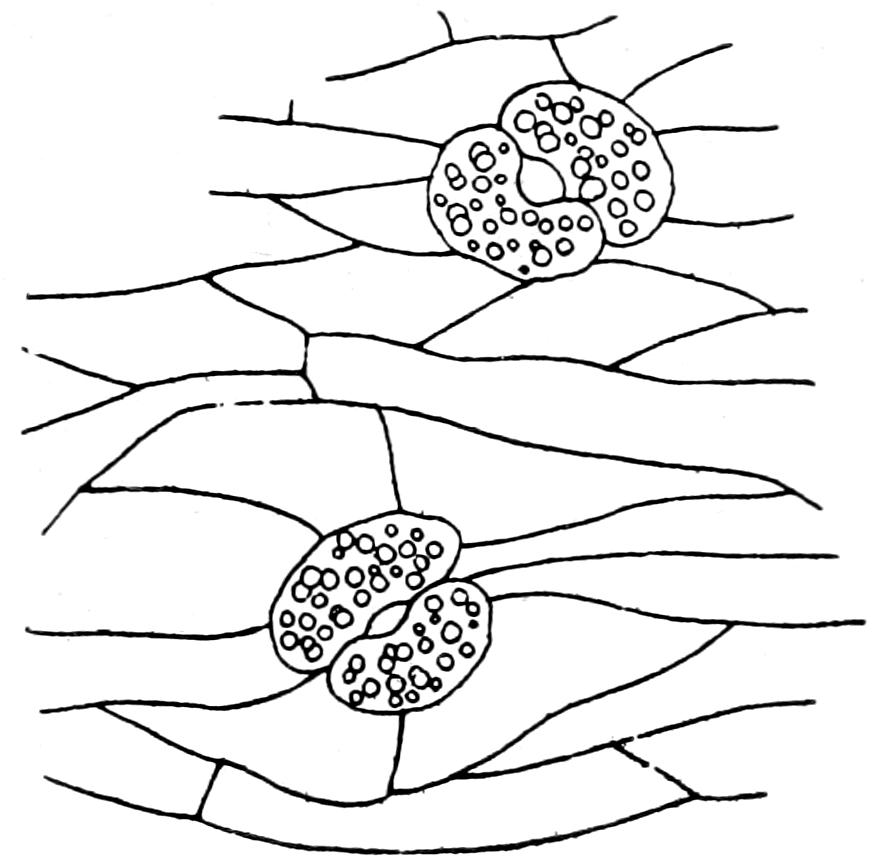
Stomata on nectariferous tissue of Xanthoceras sorbifolio. Greatly magnified. Copied from Bonnier’s “Les Nectaires.”
If this were all, unless the degenerating cellulose were replenished in sufficient quantity there would hardly be such a thing as honey production. Indeed, some extra-nuptial glands secrete a nectar containing so little sugar that even ants may not be attracted by it—as is said to be the case with climbing smartweeds cultivated in England, though it is not usually true of such plants growing wild here, where they are at home. Commonly, however, the sugar in nectar is replenished while the secretion of fluid continues.
The passage out of sugar from a living cell is very different from the escape of water; the latter may result from pressure on the one hand or osmotic draft on the other, because the outer protoplasm is permeable to water but not to sugar. When sugar is secreted, this protoplasmic layer becomes to a greater or less degree permeable to the escaping sugar. This is one phase of the activity of the living protoplasm, for secretion is a vital phenomenon. What greater or less permeability of protoplasm actually consists in is a matter of theory rather than observation, but the phenomenon is a subject of observation and experiment. Alternating warmth and cold, within limits, affect it; it has its optimum, at a rather high temperature, as well as its minimum and maximum. Through an adequately permeable membrane, the flow of either water or sugar may be outwards—as it is in normal secretion, or inwards—when the secretion is absorbed—as experiments show to be true under some conditions.
Water for nectar secretion is obtained in the first place through the roots of the plant and travels from the point of absorption to the point of secretion. Sugar for nectar secretion is manufactured within the plant, very close to the point where it is secreted. It is primarily a product of the carbon-fixing or photo-synthetic activity that marks green plants as the food-makers of the world. Sugars appear to be among the earliest-formed of such carbon-containing or organic substances in the plant; but usually they are changed into starch for storage, and this is subsequently digested or transformed into a soluble sugar when the time of its use comes. The cells about some nectar glands are storage repositories of, sugar; in other cases they accumulate a reserve of starch, as raw material, before their activities begin in supplying sugar.
Evidently, back of the nectar-production of a given day or season, very closely related to its own optimum conditions of temperature and humidity, lies the earlier vegetation of the nectar-producing plants. Strength and vigor of growth, a good reserve of stored food from the year before, or favorable spring season, these would seem logically to affect the activity of the plant in performing this as well as others of its functions. Kenoyer’s conclusions, from Strong’s honey-gathering statistics, give support to this expectation: “There is an evident alteration between good and poor years,” as in apple production; “a good year has a rainfall slightly above the average, preceded by an autumn, winter and spring with more than the average precipitation,” affording adequate and lasting soil moisture; “a rainy May scarcely fails to precede a good honey season,” for the same reason, “a cold winter has no detrimental effect on the yield of the succeeding season, but a cold March reduces it,” through preventing a fair early growth of the honey plants; “a winter of heavy snowfall, in the great majority of cases, is followed by a larger honey yield,” because of its contribution to the soil moisture and the protection afforded the plants during their hibernation.
Of these conclusions, most bear directly on the conditions favorable for nectar secretion by the plants; some bear as directly on those favorable for the wintering in prime condition of the bees. Honey production rests upon both, not only in June and July and on individual days in those months of greatest honey storage, but on preceding days and months of preparation. Perhaps the suggestion may be made, even that it goes much further back, through long centuries of selective evolution, side by side, of nectar-yielding plants and honey-storing insects, gradually coming into mutually helpful harmony.—William Trelease, University of Illinois. American Bee Journal, January, 1920.
PIGEON BERRY, see Buckthorn.
PIGEON CHERRY, see Wild Cherry.
PIN CLOVER or FILAREE (Erodium cicutarium).
The pin clover, or alfilaria, or filaree, is widely distributed in the Old World, and in this country has been naturalized from Europe. It is especially well known on the Pacific Coast from British Columbia to southern California. There it is said to be one of the most valuable wild pasture plants.
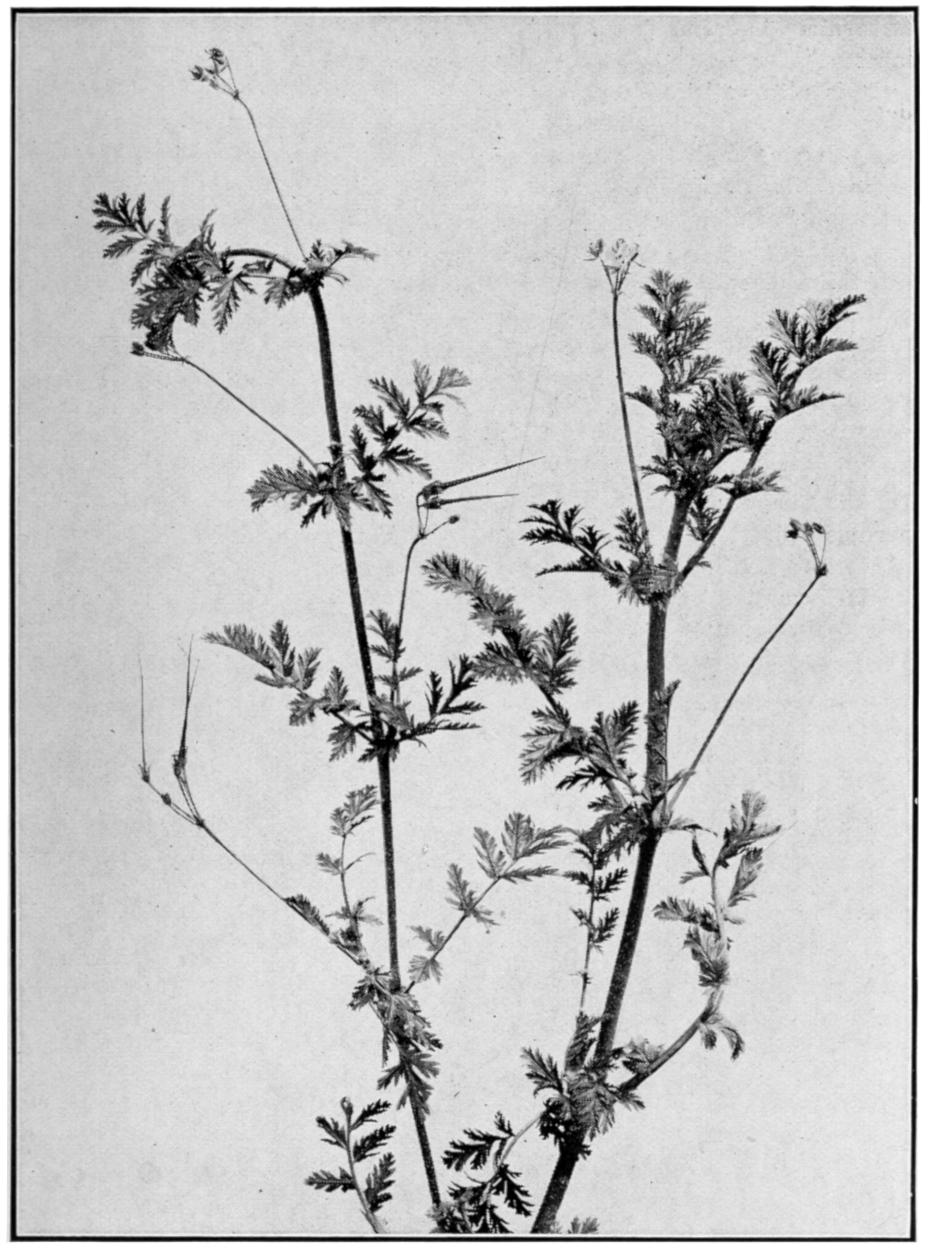
Fig. 110. Filaree or pin clover.
It is also called pin grass and heron’s bill. It has a long period of bloom, beginning in February or March in California, and in some places continuing through the summer. It produces an abundance of pollen and considerable honey of good quality. In Gray’s botany it is listed as “storksbill,” and is mentioned as scarce in New York and Pennsylvania. It is recorded as occurring in Alabama, where it apparently was carried with railroad ballast. June is given as the blooming period in the vicinity of Mobile.
It is also known in several places in Connecticut, where it is said to bloom in May and June. Professor Pammel states that it is abundant in the dry soils in the Salt Lake basin and from Colorado to Texas. The seeds cling to the wool of sheep and this aids in its wide distribution.
Figure 110 shows the plant with blossom and seed pod. It is from the peculiar shape of the latter that it gets the name of “storksbill” and “heron’s bill.”
PINE (Pinus).
Occasionally honeydew is reported from the pine trees. The following references are typical of those to be found in current literature:
“We are having a real flow of water-white honeydew from the pine here in Polk County. It has been on now for two weeks. Bees in general are in bad condition.”—Luther Presswood, Reliance, Tenn., Jan. 18, 1907. American Bee Journal, page 98, 1907.
“Large quantities of honey are often secured from pine woods in certain parts of Germany. The honey is nearly black in color, still it finds many admirers, and must, therefore, be of better quality than the honeydew gathered here at times. The Emmendingen Beekeepers’ Society furnishes all the honey for the Grand Duke’s table (in Karlsruhe), and it is specified that the honey must be this black honey of the pine woods.”—Bztg. für Schlesw.—Holstein. American Bee Journal, page 616, 1906.
Similar honeydew is harvested in Switzerland and appears to be also much prized by the consumers.
PLUM (Prunus).
Plums, both wild and cultivated, are important sources of nectar over most of the United States. There are twenty or more species which are native to North America and which are generally known as wild plums. The blooming period comes early and with other tree fruits they are of great value as the source of nectar and pollen at a season when the colonies most need stimulation. The nectar yield is sufficiently abundant for the bees to store surplus where colonies are strong and weather conditions favorable. In Sacramento County, California, surplus is sometimes reported from prunes. There are probably few places where bees are kept in America where plums of some variety are not present.
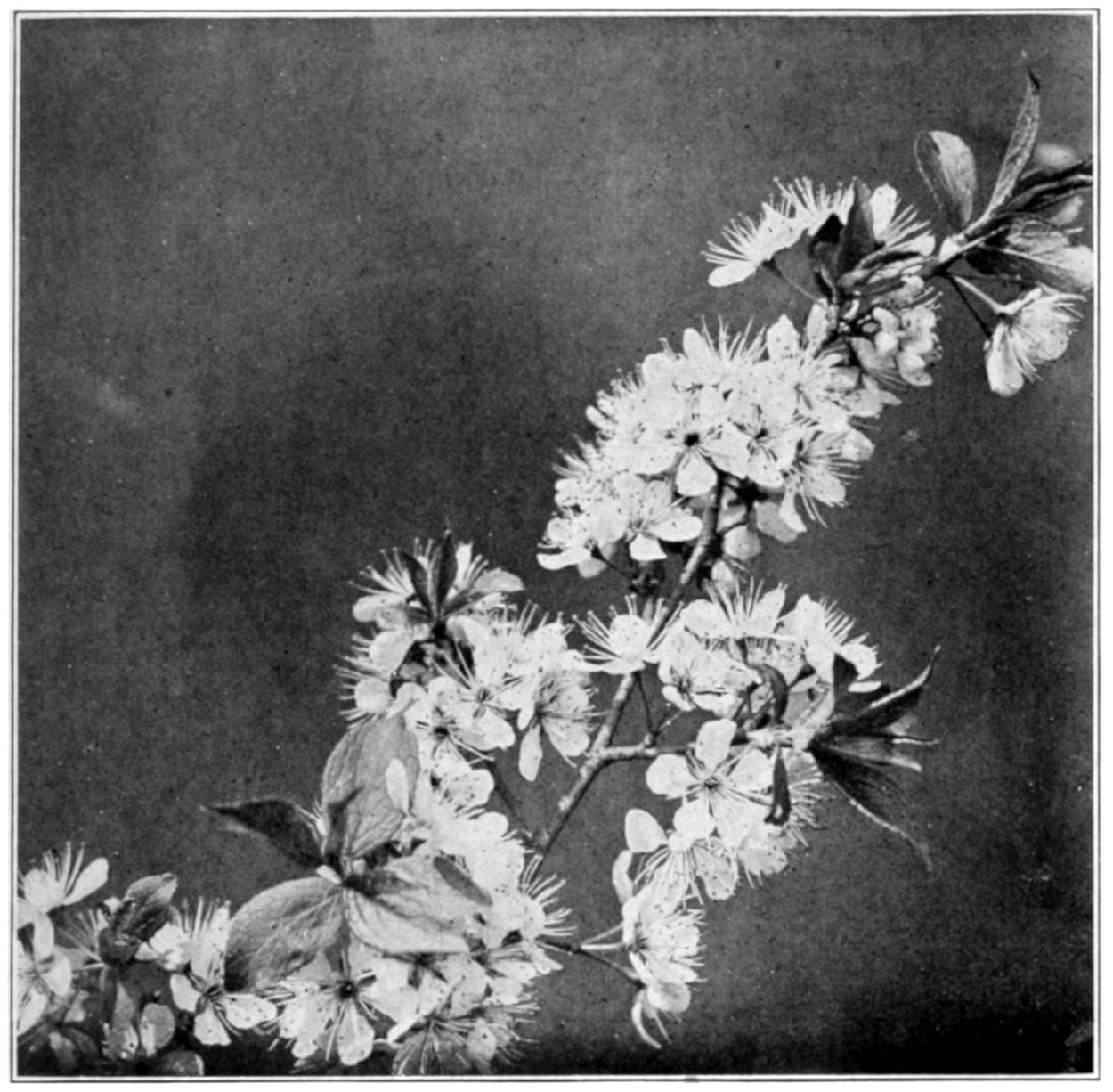
Fig. 111. Plum blossoms.
POINSETTIA (Euphorbia pulcherrima).
The poinsettia is a well-known ornamental plant. It is a shrub, native to tropical America, grown to a considerable extent for ornamental purposes in California. The blossoms are small and inconspicuous, but there is a striking cluster of brilliant red leaves, surrounding the flowers, which give an impression of flowers.
The nectaries are very conspicuous cups at the side of the blossoms. Nectar is secreted in abundance, and if the plant was sufficiently common it would be an important source. The nectar gathers in large drops.
POISON IVY, see Laurel; also Sumac.
POISON OAK, see Sumac.
POISONOUS HONEY.
Much has been written in regard to poisonous honey. Well authenticated cases of serious poisoning from honey are rare, so rare, indeed, that many persons doubt whether such cases occur. There are persons with a peculiar susceptibility to honey from any source. To such, honey may seem to be poisonous, which can be eaten by others without any ill effect. Prof. A. J. Cook, writing in the American Bee Journal (October 12, 1905, page 711), mentioned having on several occasions received samples of so-called poisonous honey, which he ate without inconvenience.
In December, 1880, issue of American Bee Journal, page 552, a case is mentioned where a native of New Zealand died from eating honey gathered from the wharangi bush (Melicope ternata), which is said to be one of the two poisonous plants to be found in New Zealand. The symptoms are reported similar to strychnine poisoning. A letter from New Zealand published in Gleanings, page 435, 1908, reads as follows:
“Some one, usually a native, gets poisoned every year about here through eating bush honey, usually not capped, and puka-puka usually gets the blame. Mr. Hopkins had a look at a case of Maoris honey poisoning last year, and I think puka-puka got the blame; but the fact is significant, nevertheless, that it is the Maoris only, or principally they, that get poisoned, and in that case the honey eaten is never capped.”—Stephen Anthony, Wastete, New Zealand.
The mountain laurel (Kalmia latifolia) is the plant most frequently reported as yielding poisonous honey. This shrub is common to the mountain regions of the Eastern States, and it would seem that cases of poisoning would be reported much more frequently if there was good reason to suspect the honey from this source. It is a well-known fact that disagreeable odors disappear from honey that is well ripened. In this connection a writer in American Bee Journal, page 664, 1884, suggests that there is no evidence of poisoning from well ripened honey. He further states that uncapped honey from the yellow jasmine is actually poisonous and has produced death, but that after it is capped there is no honey more wholesome. It should be noted that special emphasis was placed on the fact that the cases of poisoning in New Zealand were from eating uncapped honey.
Pammel states (Manual of Poisonous Plants) that honey obtained from Euphorbia marginata, the well-known snow-on-the-mountain, is poisonous and unfit for use. He also states that the Indians of Brazil use honey gathered by wasps from flowers of Serjonia lethalis for poisoning their arrows, and also as a fish poison. It contains a narcotic poison which causes death.
The following resume of the subject is copied entire from Pammel:
“Prof. Lyman F. Kebler, who has made a somewhat extended investigation with poisonous honey has given an excellent bibliography with reference to the early literature on the subject. It has been known for centuries that the honey collected from Ericaceae acts as a narcotic irritant, producing giddiness, vomiting and purging. Poisonous honey was described by Xenophon. He gives a fairly accurate description of how the soldiers of his army acted that ate honey that was poisoned. He states that they lost their senses, vomited and were affected with purging, and those who had eaten but little were intoxicated, but when they had eaten much they were like mad men. Strabo and Pliny spoke of poisonous honey, the latter writer, an early naturalist noted for his accurate observations, records poisonous honey, which he called “aegolethron” (goat’s death), which bees collected at Heraclea. He gives a description of the honey, which is said to have had a peculiar smell and produced sneezing. It is generally supposed that this honey came from a species of Rhododendron, the R. pontica. This and allied species are the chief source of poisonous honey in Asia and Asia Minor, but it may be said in this connection that honey collected from the heather in Scotland is not poisonous.
“Barton, an early American botanist, reported poisonous honey in New Jersey as early as 1794. Subsequently Coleman reported a large number of cases in 1852, and Gammer, in Gleanings in Bee Culture, and several writers in the American Bee Journal, reported poisonous honey. Other writers, like Chestnut and Crawford, have reported on the occurrence of poisonous honey in the United States, and Kebler reports no less than eight cases for New Jersey in 1896, and believes that it is much more common than the records seem to indicate. Kebler was fortunate enough to investigate some of the poisonous honey following a case of poisoning in New Jersey. He examined a part of the comb of the dark honey which had a light brown color and a nauseating odor, pungent taste, caused a burning sensation in the back of the mouth similar to that of aconite. Persons who partook of a small amount of this honey began to cough immediately. He also made a chemical analysis of the non-suspicious honey, digesting with alcohol, then evaporated, the residue was again treated to alcohol and evaporated and administered to two cats. One received a small dose and the other a large one. The results from the cats were so interesting that I quote from Professor Kebler:
“‘The small dose produced partial exhaustion, relaxation of the voluntary muscles and general depression. The large dose in a short time produced restlessness, vomiting, purging, prostration and almost complete loss of the voluntary muscles, showing that the honey contained a prompt and potent poison. The animal could scarcely be induced to move, and when motion was attempted, first the fore-limbs would fail, and then the back-limbs would give way. First one portion of the body would sway in one direction, then the other portion in another, reminding one of a highly intoxicated person. Had the entire dose been retained, death undoubtedly would have followed. As it was, the cat had regained her normal condition only at the end of twenty-four hours.’”
Along with this we may append the symptoms as reported by the physician who attended the persons who were poisoned:
“Mr. and Mrs. Chambers took but a small quantity, yet each noticed a peculiar, pungent, burning taste in the comb as soon as it had passed their lips. In fifteen or twenty minutes afterwards Mrs. C. was taken with nausea, abdominal pain and vomiting, soon followed by loss of consciousness, coldness of extremities, feebly acting heart, and complete collapse. While ministering to her, Mr. Chambers, who had also experienced the initiatory symptoms of pain and nausea, suddenly exclaimed, ‘I cannot see,’ and soon sank in a state of syncope to the floor. In each case the symptoms were similar. Retching, vomiting, purging, acute gastric and abdominal pain, and continued cramps for some hours, with surface coldness, and deadly pallor, and the general symptoms of collapse.
“Kebler was, however, unable to definitely locate the andromedo-toxin found by Plugge. This author recorded it for a large number of plants as follows: Andromeda japonica, A. polifolia, A. Catesbaei, A. calyculata, Kalmia latifolia, Monotropa uniflora, Pieris formosa, P. ovalifolia, Rhododendron grande, R. barbatum, and R. fulgens. It has been recorded for additional plants by Greshoff, who mentions the following plants which produce poisonous honey: Nerium Oleander, Cytisus Laburnum, Pieris ovalifolia, Callotropis procera, Daphne, Pontica, Buxus balearica, Clerodendron serratum, C. Bhramaramari, Sapindus emarginatus. (It is said that thousands of bees are killed by this honey.) Centaurea scabiosa, Carduus natans, Scabiosa succisa. A South African species of Euphorbia also produces a poisonous honey which was not noted by Greshoff.”
POISONWOOD (Metopium metopium).
The poisonwood is a tree found in southern Florida, the West Indies and Central America. It is known by a variety of names, bum-wood, hog-gum, coral sumac or doctor-gum. Its sap is dangerously poisonous, and some persons are affected by a near approach to the tree. The tree reaches a height of more than forty feet and in south Florida it is the source of large quantities of surplus honey of good quality. The honey is usually blended with that of other sources blooming during the same period.
The tree has a thin bark which splits into large scales as it grows older. These are of a reddish brown color, brighter on the inside. It is sometimes confused with manchineel and is often classified as a Rhus.
POLLEN.
Pollen represents the male element of reproduction in seed plants. The flowering plants are normally reproduced by seed. Fertilization is brought about by the intervention of the grains of pollen which are borne by the stamens or male organs. In the corn plant the stamens are produced in the tassels where pollen is developed in great abundance. The pistils, or female organs, are represented by the silks attached to the ear. There is a separate silk attached to each kernel, and each must be separately fertilized. In many plants both stamens and pistils occur in the same blossom, as is the case with apples, pears, etc. In some cases the stamens or male organs are borne on a separate plant or tree, as is the case with the persimmon. Cucumbers have the separate organs in separate flowers. In order to insure fertilization it is necessary that the pollen grains be carried from the stamens to the pistils. In the grasses and similar plants this is usually accomplished by the wind, while in most fruits, insects are the principal agents.
Pollen grains are very minute and are produced in small sacs in the tip of the stamen, commonly called anther. When ripe, the breaking of the sac sets the grains free in great abundance. A single grain is sufficient to fertilize an ovule and produce a seed; yet, because of the distance between the stamens and pistils, large quantities of the pollen or flower dust are necessary to insure pollination. Ragweed and corn produce pollen in such abundance that one brushing by the plants is dusted so freely as to appear to be covered with flour.
Pollen is of special importance to the beekeeper, since it serves as food for young bees. It is the sole source of nitrogenous food for the growing larvæ, and is stored in large quantity in the open cells of the brood combs. Without an abundance of pollen available for food for the developing brood, the colony cannot prosper. Pollen is second only in importance to surplus honey to the beekeeper, and an abundant supply of plants which yield pollen during the brood-rearing season is very desirable.
POLLINATION.
Pollination is the fertilization of the blossom of a plant, resulting in the development of seed. As ordinarily used among the beekeepers, pollination refers to the transfer of the pollen grains from the stamens of one plant to the pistils of another. Since many plants are self-sterile, it is necessary that pollen from other plants and sometimes from other varieties be brought to them to insure fruitage. As already stated under “Pollen,” the honeybee is the principal agent in the pollination of many of the edible fruits.
So important is the bee regarded by horticulturists that cucumber growers contract for colonies of bees to be placed in their greenhouses, cherry growers often lease apiaries to be moved to their orchards at the beginning of the blooming period, and apple orchardists contract with beekeepers to furnish sufficient bees to insure fertilization of their orchards.
Darwin was among the first to realize the importance of cross pollination. He showed that continued self-fertilization resulted in inferior fruit, while cross fertilization increased the vigor of the offspring. Beach has shown that many varieties of grapes are self-sterile, and at the California experiment station it was shown that “bees are a necessary aid in pollination with the French and Imperial varieties of prunes.” It was proven that practically no fruit was produced when all pollen-carrying insects were kept from visiting the blossoms. (Bulletin 291, California Experiment Station).
It has been shown by numerous experiments that many varieties of fruits, especially of apples and pears, are likely to be unfruitful if deprived of the services of the honeybee as pollen carriers.
POPLAR, see Tulip-Poplar, also Aspen.
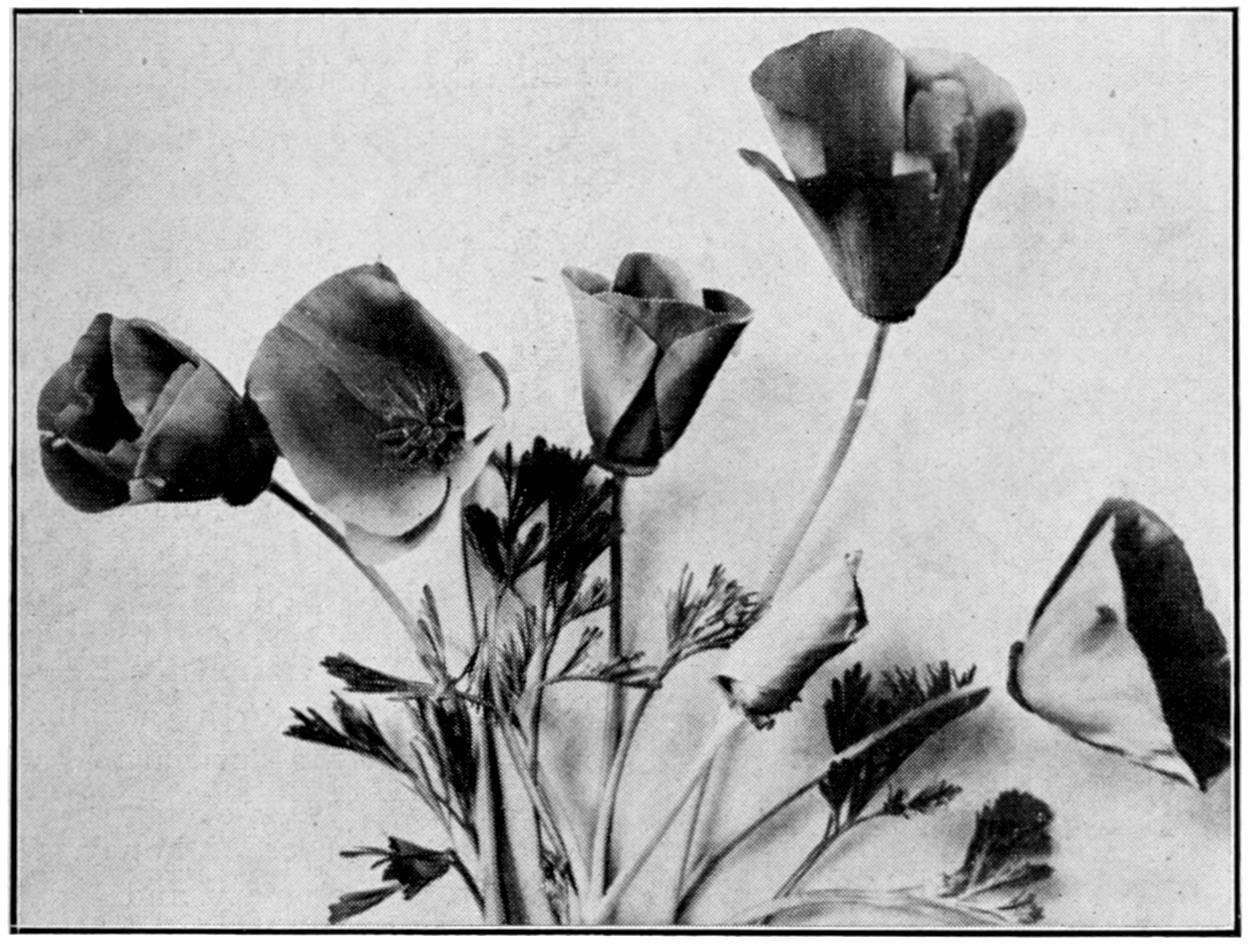
Fig. 112. The California poppy is a gorgeous flower.
POPPY (Papaver).
The garden poppy (Papaver somniferum) is a native of Asia, but is widely cultivated in many countries, including our own. It is the source of opium and morphine, drugs widely used in the practice of medicine. The bright-colored flowers are very attractive to the bees, which seek them in large numbers and fairly revel in the abundant pollen masses. The pollen secured from poppy blossoms is very dark. It is probable that the plant furnishes some nectar, also, and there are numerous reports to the effect that the bees show evidence of a narcotic when working on this plant.
The California poppy (Eschscholtzia californica) (Fig. 112) is a common and widely diffused plant in California. It is a gorgeous plant of variable habit, especially abundant in spring, but in some parts of the State may be found in flower at almost any season. Richter lists it as the source of some honey and of large amounts of orange-colored pollen.
The prickly poppy (Argemone), often called poppy thistle, is widely distributed, especially in the southwest. It is the source of large quantities of pollen.
POPPY THISTLE, see Poppy.
POSSUM HAW, see Holly.
POSSUM-WOOD, see Persimmon.
PRAIRIE CLOVER (Petalostemon).
There are several species of prairie clover native to the western prairies from Indiana west to the Rocky Mountains and south to Texas. There are frequent reports to the effect that they are valuable honey plants, though no longer sufficiently plentiful to be important except in a few localities.
PRICKLY ASH (Xanthoxylum Clava-Herculis). TOOTHACHE-TREE.
The prickly ash or toothache-tree is found from North Carolina to Florida and west to Texas. It is a small tree with the bark armed with short, warty thorns, while the branches have longer ones.
In east Texas it is frequently mentioned as a source of honey. The honey is reported as pungent in taste, sharp and peppery and light in color. The blossoms yield freely, and, where sufficiently abundant, may be expected to yield surplus. At Palestine, Texas, surplus is reported from prickly ash. (See also Colima).
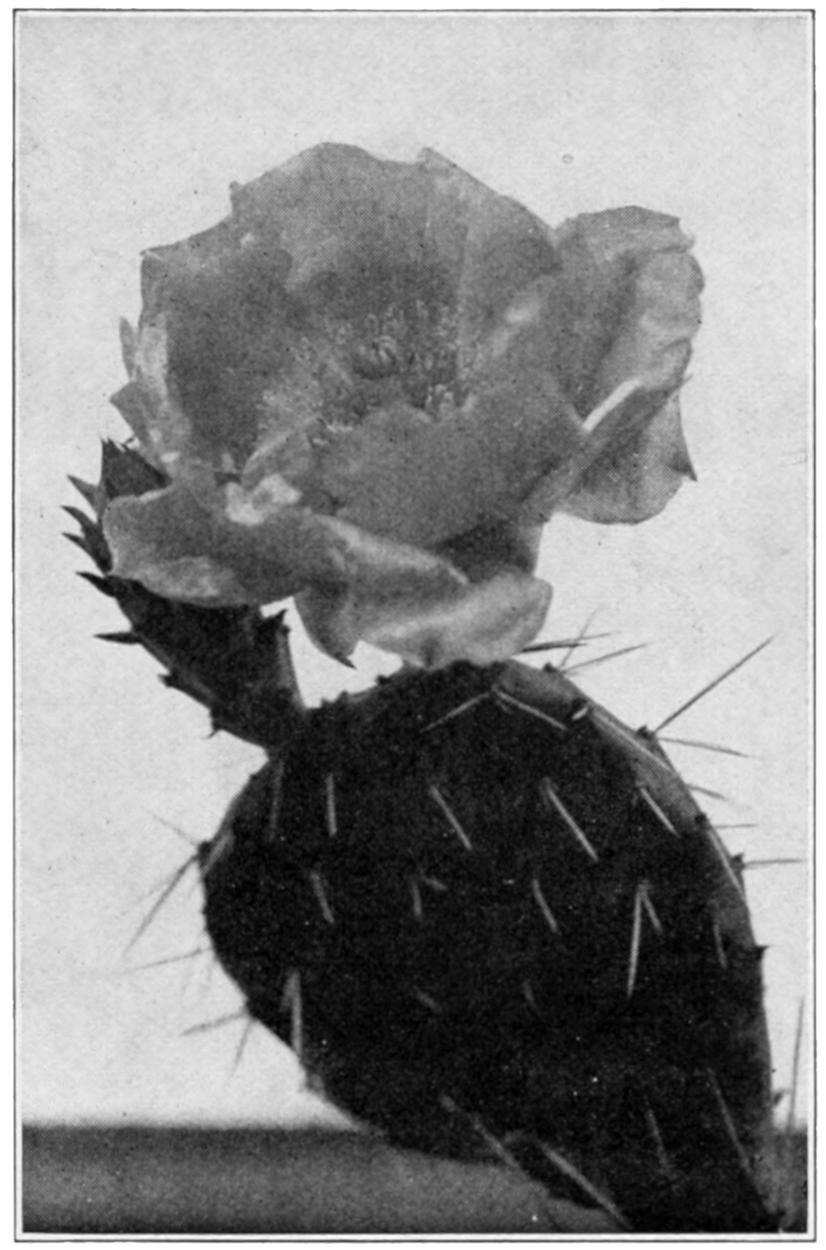
Fig. 113. Blossom of the cactus or prickly pear.
PRICKLY PEAR or INDIAN FIG (Opuntia).
Plants of the cactus family are widely scattered in the arid regions from Dakota to Washington and south to Texas and California. (Figs. 114 and 115.) Of the prickly pears (Opuntia) there are about 150 species, mostly found in the warmer sections of North America and southward. A few are to be found in sandy soils further east, ranging from Ontario and Massachusetts south to Florida. They are also sometimes grown as ornamentals. The blossom of the prickly pear is of pale yellow color and very attractive. (Fig. 113.) It is reported as a source of nectar in both Texas and California. Opuntia engelmanni is reported by Scholl in “Honey Plants of Texas,” as “of much importance to the beekeeper, especially during a season of partial drought. Both an abundance of pollen and honey was obtained, the honey being light amber in color, of heavy body but ‘stringy,’ so much so that it fairly draws out into strings when very thick. The flavor is very rank.”
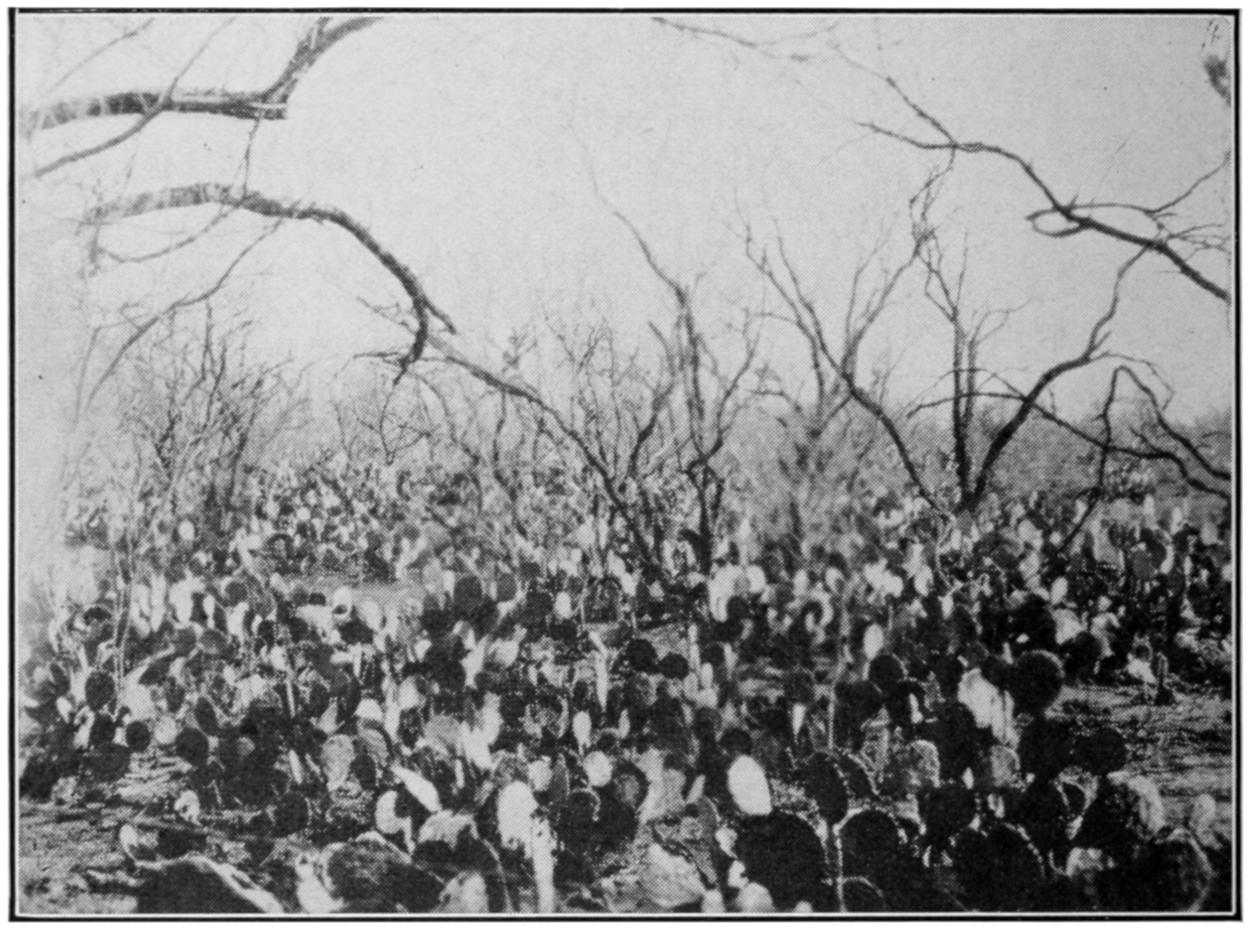
Fig. 114. In parts of Texas the land is covered with cactus as far as the eye can see.
In some parts of the Southwest it is valued more for pollen than for nectar. Beginning in July, it blooms for four to six weeks. E. G. LeStourgeon reports that in the vicinity of San Antonio, Texas, it yields surplus honey about one year in four, but that the flow is usually short, seldom more than four or five days. A peculiarity of this honey is that of granulating in large crystals in clear liquid. It is often spoken of as “buttermilk honey,” because of this peculiarity. LeStourgeon secured an average yield of 87 pounds per colony of cactus honey in Atascosta County. Such yields from this source are rare. Cactus grows in great abundance over large areas of Texas and is probably of more importance to beekeepers in that State than in any other.
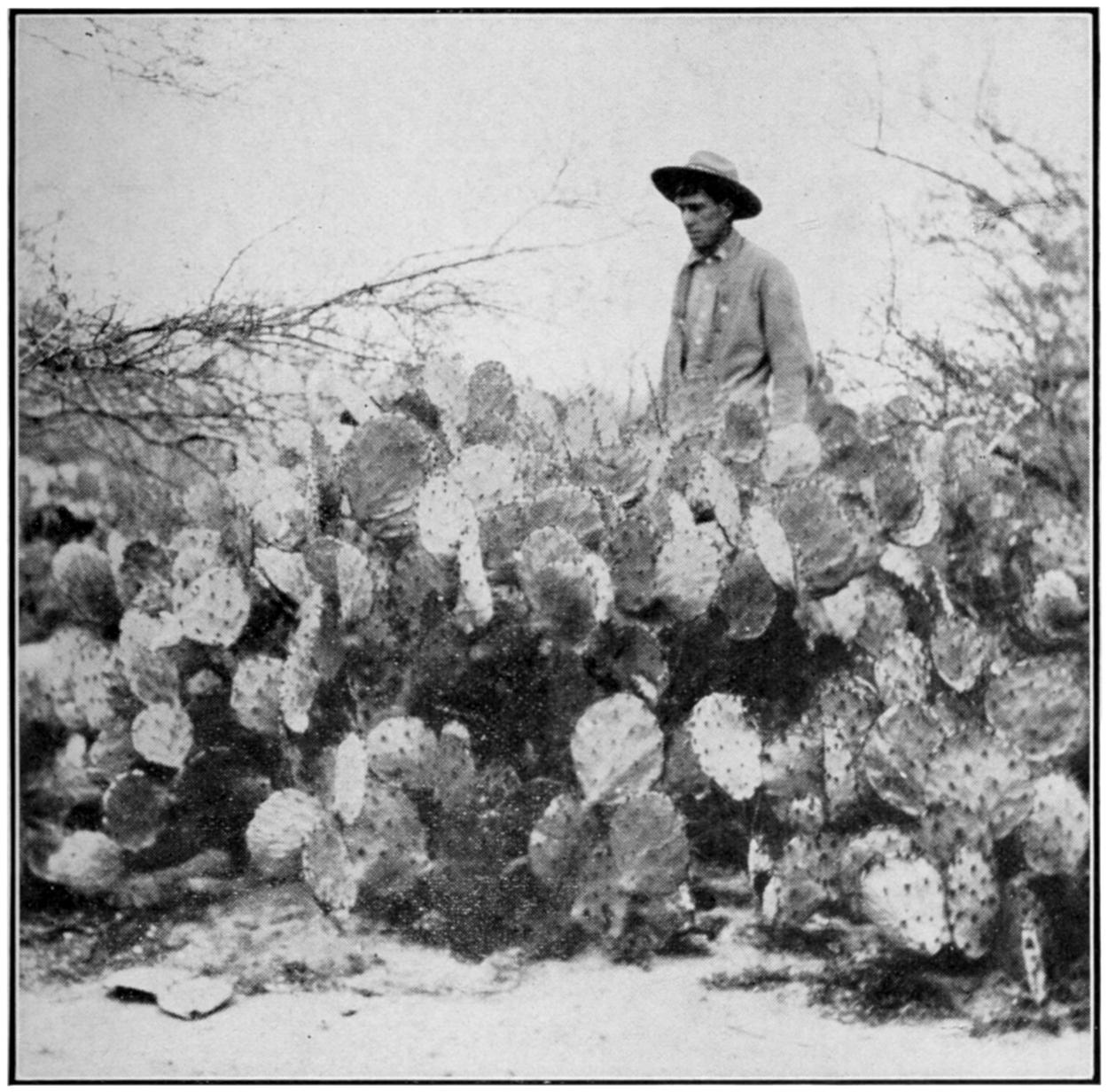
Fig. 115. A single plant of prickly pear near Brownsville, Texas.
PRICKLY POPPY, see Poppy.
PRINCE EDWARD ISLAND—Honey Sources of.
Alsike and white clover are the principal honey plants of the Island, with Tilia europea also important at Charlottetown.—F. W. L. Sladen.
PROPOLIS.
Propolis is a resinous gum gathered by the bees from buds of trees, and used to close crevices about the hive. It becomes brittle and hard in cold weather, but when warm is sticky and very tenacious. The beekeeper finds it quite a problem to keep his hands free from propolis when manipulating the hives in mid-summer. Some races of bees deposit propolis much more freely than others, the Caucasians being especially inclined to gather a great surplus of the cement and place it in lumps about the hive. If, perchance, a mouse, beetle or other object enters the hive which the bees are unable to remove, they frequently coat it freely with propolis, and there it remains.
Cracks seem obnoxious to the bees, and the small spaces between the frames are quite likely to be filled with the cement. In the production of comb honey, the tendency of the bees to fill every crevice with it leads to much labor on the part of the beekeeper in cleaning his finished sections for market. This is especially true of honey left on the hive till late in the season, as propolis is gathered in quantity in late fall in anticipation of cold weather.
Cottonwood is thought to be one of the chief sources of propolis wherever that well-known tree is found.
Bees gather much material from a great variety of sources. In addition to the fresh wax gathered from plants and trees, they are often attracted by fresh varnish or other substances from which they can get sticky material to serve as glue.
PRUNE, see Plum.
PUMPKIN (Cucurbita pepo).
The pumpkin is a well-known gourd-like fruit, usually of deep yellow color, that is widely cultivated as a food for stock and for pie. There are numerous varieties of various sizes and colors. The blossoms are large and showy and very attractive to the bees. The plants yield an abundance of pollen as well as nectar. The honey is amber and not of high quality, and granulates readily.
Where pumpkins are grown on a large scale for stock feed or for canning factories, they are a valuable source of bee pasture.
PURPLE LOOSESTRIFE (Lythrum).
There are two species of lythrum frequently reported as honey plants. The European species, Lythrum Salicaria, the spiked loosestrife, has become naturalized in wet places from Nova Scotia to Delaware. According to H. D. House, State Botanist of New York, it is common in and around the inlets and backwaters of the Hudson River all up and down that stream. It is also common up the Mohawk Valley, at Oneida Lake and along the railroads westward across the State to Lake Erie. It is a tall plant of vigorous growth, but as it confines itself largely to wet places, it is not likely to be any more of a nuisance than the usual coarse weeds growing in such situations. The bees work this plant freely and occasional reports of honey from this source are received from New York State. The honey is very dark and of strong flavor, having a slight tobacco-like taste as it gets older.
Lythrum alatum, a native species, is found from Ontario and Minnesota south to Georgia, Florida and Texas. A report from Oklahoma is to the effect that it blooms with sweet clover, lasting till frost. The bees work upon it from daylight till dark in either wet or dry weather. Similar reports come from Texas. It is found on low lands in the southwest.
It is also reported by beekeepers from New Orleans as attractive to bees in Louisiana.