Act 5 — THE ROARING GIRL.
Reading edition
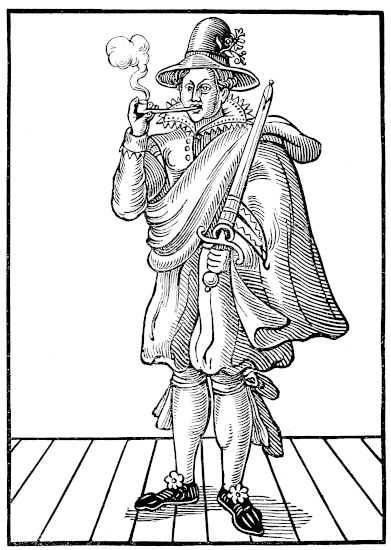
427The Roaring Girle. Or Moll Cut-Purse. As it hath lately beene Acted on the Fortune-stage by the Prince his Players. Written by T. Middleton and T. Dekkar. Printed at London for Thomas Archer, and are to be sold at his shop in Popes head-pallace, neere the Royall Exchange. 1611. 4to. On the title-page is the woodcut, a fac-simile of which is now given, representing Moll in her male dress, with these words running along the inner margin,—“My case is alter’d, I must worke for my liuing.”
This drama has been reprinted in the sixth vol. of the last two editions of Dodsley’s Old Plays.
Roaring Boys was a cant term for the riotous, quarrelsome blades of the time, who abounded in London, and took pleasure in annoying its quieter inhabitants. Of Roaring Girls, the heroine of the present play was the choicest specimen. Her real name was Mary Frith, though she was most commonly known by that of Moll Cutpurse. According to the author of her Life,[938] “she was born A.D. 1589, in Barbican, at the upper end of Aldersgate Street,” p. 3; but Malone,[939] more correctly it should seem, has fixed her birth in 1584. “From the first entrance into a competency of age,” she assumed the doublet, “and to her dying day she would not leave it off, till the infirmity and weaknesse of nature 428had brought her a-bed to her last travail, changed it for a wastcoat, and her pettycoats for a winding-sheet,” Life, p. 18. She was distinguished in the different characters of bully, prostitute, procuress, fortune-teller, thief, pickpocket, receiver of stolen goods, and forger of writings. A letter from John Chamberlain to Mr. Carleton, dated Feb. 11, 1611-12, gives the following account of her doing penance: “The last Sunday Moll Cutpurse, a notorious baggage that used to go in man’s apparel, and challenged the field of diverse gallants; was brought to the same place [Paul’s Cross], where she wept bitterly, and seemed very penitent; but it is since doubted she was maudlin drunk, being discovered to have tippel’d of three quarts of sack before she came to her penance. She had the daintiest preacher or ghostly father that ever I saw in the pulpit, one Radcliffe of Brazen-Nose College in Oxford, a likelier man to have led the revels in some inn of court, than to be where he was. But the best is, he did extreme badly, and so wearied the audience, that the best part went away, and the rest tarried rather to hear Moll Cutpurse than him.”[940] With the preceding extract let us compare what the “fair penitent” is made to say in the Life already quoted: “Some promooting Apparitor, set on by an adversary of mine, whom I could never punctually know, cited me to appear in the Court of the Arches, where was an Accusation exhibited against me for wearing undecent and manly apparel. I was advised by my Proctor to demur to the Jurisdiction of the Court, as for a Crime, if such, not cognizable there or elsewhere; but he did it to spin out my Cause, and get my Mony; for in the conclusion, I was sentenced there to stand and do Penance in a White Sheet at Paul’s Cross, during morning Sermon on a Sunday,” p. 69.
We are told that she robbed General Fairfax of 250 Jacobuses upon Hounslow Heath, shot him through the arm, and killed two horses on which a couple of his servants rode; and that being closely pursued by some Parliamentarian officers quartered at Hounslow, to whom Fairfax told the adventure, and her horse failing her at Turnham Green, she was apprehended and carried to Newgate, after which she was condemned, but procured her pardon by giving her adversary 2000 pounds![941] The story seems to be not a little exaggerated.
429Nor is the reader bound to believe the subjoined anecdote; but, as Moll had a house of her own “within 2 doors of the Globe Tavern in Fleet Street, over against the Conduit,” Life, p. 47, and appears to have acquired considerable property by her various rogueries, the circumstance of her supplying the wine is by no means improbable: “After that unnatural and detestable Rebellion of the Scots in 1638, upon his Majesties return home to London, where preparation was made for his Magnificent Entry, I was also resolved to show my Loyal and Dutiful Respects to the King in as ample manner as I could or might be permitted.... I was resolved in my own account to beare a part in the charge of this Solemnity; and therefore undertook to supply Fleetstreet Conduit adjacent to my House with Wine, to run continually for that triumphal Day, which I performed with no less Expence then Credit and delight, and the satisfaction of all Comers and Spectators. And as the King passed by me, I put out my Hand and caught Him by His, and grasped it very hard, saying, Welcome Home Charles! His Majesty smiled, and I beleeve took me for some Mad Bold Beatrice or other, while the people shouted and made a noyse, in part at my Confidence and presumption, and in part for joy of the King’s Return. The rest of that Day I spent in jollity and carousing, and concluded the night with Fireworks and Drink. This celebrated Action of mine, it being the Town talk, made people look upon me at another rate then formerly.” Life, pp. 95-98.
A dropsy, from which she had long been suffering, and which, it is said, would probably have carried her off sooner if she had not indulged greatly in the use of tobacco—(for she gloried in being the first female smoker)—at last proved fatal to the Roaring Girl. In the Memoir above cited, she is represented as bidding adieu to the world “this three score and fourteenth year of my age,” p. 169. A MS.[942] states that she died at her house in Fleet Street, July 26, 1659; that she was buried in the church of Saint Bridget’s; and that she left twenty pounds by will, that the Conduit might run with wine when King Charles the Second should return. Granger says,[943] that her death took place in her 75th year.
She is supposed to be the person alluded to in Shakespeare’s 430Twelfth Night, where Sir Toby exclaims, “Wherefore are these things hid? wherefore have these gifts a curtain before them? are they like to take dust, like mistress Mall’s picture?” Act i. sc. 3.
On the books of the Stationers’ Company, August 1610, is entered “A Booke called the Madde Prancks of Merry Mall of the Bankside, with her Walks in Man’s Apparel, and to what Purpose. Written by John Day.”[944]
In Rubbe and A great Cast. Epigrams. By Thomas Freeman, Gent., 1614, 4to, is
“Epigram 90.
Of Moll Cutpurse disguised going.
“They say Mol’s honest, and it may bee so,
But yet it is a shrewd presumption no:
To touch but pitch, ’tis knowne it will defile;
Moll weares the breech, what may she be the while?
Sure shee that doth the shadow so much grace,
What will shee when the substance comes in place?”
She figures in act ii. sc. 1 of Field’s Amends for Ladies,[945] 1618, where she is thus addressed:
——“Hence, lewd impudent!
I know not what to term thee, man or woman,
For Nature, shaming to acknowledge thee
For either, hath produc’d thee to the world
Without a sex: some say thou art a woman,
Others, a man; and many, thou art both
Woman and man; but I think rather, neither;
Or man and horse, as the old Centaurs were feign’d.”
In The Water-cormorant his Complaint against a Brood of Land-cormorants (first printed, I believe, in 1622), Taylor says,
“That if our Grand-fathers and Grand-dams should
Rise from the dead, and these mad times behold,
Amazed they halfe madly would admire
At our fantasticke gestures and attire;
And they would thinke that England in conclusion
Were a meere bable Babell of confusion;
431That Muld-sack[946] for his most vnfashion’d fashions
Is the fit patterne of their transformations;
And Mary Frith doth teach them modesty,
For she doth keepe one fashion constantly,
And therefore she deserues a Matrons praise,
In these inconstant Moon-like changing dayes.”dayes.”
p. 6.—Works, ed. 1630.
From The Witch of Edmonton (by W. Rowley, Dekker, and Ford, acted about 1623), we learn that a certain dog, used in baiting bulls and bears, was called Moll Cutpurse, after our heroine: act v. sc. 1. Ford’s Works, by Gifford, vol. ii. p. 547.
She is thus mentioned in Brome’s Court Beggar, acted 1632;
"Cit. Sprecious! How now! my fob has been fubd to-day of six pieces, and a dozen shillings at least.... My watch is gone out of my pocket too o’ th’ right side.... Ile go to honest Moll about it presently." Act ii. sc. 1. Five New Playes, 1653.
In the following couplet of Butler (the second line of which Swift has transferred, with a slight alteration, into his Baucis and Philemon), the allusion is most probably to Moll Cutpurse, and not, as Grey thinks, to Mary Carlton;
“A bold Virago, stout and tall,
As Joan of France, or English Mall.”
Hudibras, Part i. c. ii. 367.
With a quotation from a play called The Feigned Astrologer, 1668, I conclude this notice of Mary Frith;
“We cannot do that neither in quiet,
So many have found his lodging out:
And now, Moll Cut-purse, that oracle of felonie
Is dead, there’s not a pocket pickt,
But hee’s acquainted with it.” Act iv. sc. 2, p. 62.
Thomas Dekker, whose name is coupled with Middleton’s on the title-page of The Roaring Girl, was (as perhaps few readers require to be told) a very prolific and popular dramatist: many of his plays have perished.
433
TO THE COMIC PLAY-READERS, VENERY AND LAUGHTER.
The fashion of play-making I can properly compare to nothing so naturally as the alteration in apparel; for in the time of the great crop-doublet, your huge bombasted plays, quilted with mighty words to lean purpose, were[947] only then in fashion: and as the doublet fell, neater inventions began to set up. Now, in the time of spruceness, our plays follow the niceness of our garments; single plots, quaint conceits, lecherous jests, drest up in hanging sleeves: and those are fit for the times and the termers.[948] Such a kind of light-colour summer stuff, mingled with divers colours, you shall find this published comedy; good to keep you in an afternoon from dice at home in your chambers: and for venery, you shall find enough for sixpence,[949] but well couched and[950] you mark it; for Venus, being a woman, passes through the play in doublet and breeches; a brave disguise and a safe one, if the statute untie not her codpiece point. The book I make no question but is fit for many of your companies, as well as the person itself, and may be 434allowed both gallery-room at the playhouse, and chamber-room at your lodging. Worse things, I must needs confess, the world has taxed her for than has been written of her; but ’tis the excellency of a writer to leave things better than he finds ’em; though some obscene fellow, that cares not what he writes against others, yet keeps a mystical bawdyhouse himself, and entertains drunkards, to make use of their pockets and vent his private bottle-ale at midnight,—though such a one would have ript up the most nasty vice that ever hell belched forth, and presented it to a modest assembly, yet we rather wish in such discoveries, where reputation lies bleeding, a slackness of truth than fulness of slander.
THOMAS MIDDLETON.
435
PROLOGUE.
A play expected long makes the audience look
For wonders; that each scene should be a book,
Compos’d to all perfection: each one comes
And brings a play in’s head with him; up he sums
What he would of a roaring girl have writ;
If that he finds not here, he mews at it.
Only we [do] entreat you think our scene
Cannot speak high, the subject being but mean;
A roaring girl, whose notes till now ne’er were,
Shall fill with laughter our vast theatre.[951]
That’s all which I dare promise: tragic passion,
And such grave stuff, is this day out of fashion.
I see Attention sets wide ope her gates
Of hearing, and with covetous listening waits,
To know what girl this roaring girl should be,
For of that tribe are many. One is she
That roars at midnight in deep tavern-bowls,
That beats the watch, and constables controls;
Another roars i’ th’ daytime, swears, stabs, gives braves,
Yet sells her soul to the lust of fools and slaves:
Both these are suburb-roarers. Then there’s beside[952]
A civil city-roaring girl, whose pride,
Feasting, and riding, shakes her husband’s state,
And leaves him roaring through an iron grate.
None of these roaring girls is ours; she flies
With wings more lofty; thus her character lies—
Yet what need characters, when to give a guess
Is better than the person to express?
But would you know who ’tis? would you hear her name?
She’s call’d mad Moll; her life our acts proclaim.
436DRAMATIS PERSONÆ.
Sir Alexander Wengrave.
Sebastian Wengrave, his son.
Sir Guy Fitzallard.
Sir Davy Dapper.
Jack Dapper, his son.
Sir Adam Appleton.
Sir Thomas Long.
Sir Beauteous Ganymede.
Lord Noland.
Goshawk.
Laxton.
Greenwit.
Gallipot, an apothecary.
Tiltyard, a feather-seller.
Openwork, a sempster.
Neatfoot, Sir A. Wengrave’s man.
Gull, page to Jack Dapper.
Trapdoor.
Tearcat.
Coachman.
Porter.
Tailor.
Curtleax, a sergeant.
Hanger, his yeoman.
Gentlemen, Cutpurses, &c.
Moll, the Roaring Girl.
Mary Fitzallard, daughter to Sir Guy.
Mistress Gallipot.
Mistress Tiltyard.
Mistress Openwork.
Scene, London.
437THE ROARING GIRL.