The Story of the Growth of the Motor Truck[57]
Reading edition
The Story of the Growth of the Motor Truck[57]
While exact dates are not easily obtainable, it is thought to be quite within the bounds of reasonable accuracy to say that the motor truck only began to be recognized as a practical vehicle for commercial purposes in 1905.
Today motor vehicles, both pleasure and commercial, are such a common sight in every city and town, and even throughout the rural districts, that one can scarcely believe that they were a novelty such a little time ago.
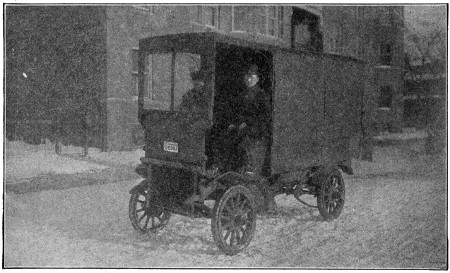
One of the Earliest Gasoline Trucks
The statistics show, however, that in 1906 the total registrations of both pleasure and commercial vehicles, as reported by the various states, was 48,000—about one month’s production today of one well-known pleasure-car maker.
In 1915 the registrations totaled nearly 2,500,000, and every day has added to the number.
It can be truthfully said that the pleasure car is the father of the truck or commercial car.
The application of the internal combustion engine to the use of propelling vehicles was the beginning of a new era in that world. The idea, born, one might say, with the new century, has already done more to revolutionize transportation than all of the inventions of all the centuries that have gone before.
The automobile, first looked upon as a freak, then “a rich man’s plaything,” has in a few years come to be recognized as a necessity, and literally millions of people are employed in its production and dependent on the industry for support.
To trace the ramifications of the industry back through the mills, mines and factories that produce the iron, steel, copper, brass, zinc, aluminum, lead, leather, lumber, glass, celluloid, etc., would make a long and interesting story, but this chapter deals with the motor vehicle as a commercial car or truck and the part it is playing in transportation of the world’s goods.
While the first commercial vehicles to come into use were electrically propelled, and while the electric truck has become a factor in the large cities, the gasoline power vehicles are, as yet, the dominant factor.
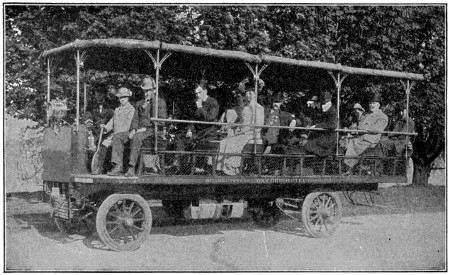
A 1907 Model Sight-seeing Car
At the first, business men were slow to take up the use of trucks for delivery and hauling purposes and one of the specialties of early factories was the making of “sight-seeing” cars which were sold to enterprising individuals in cities and summer resorts for the purpose of showing visitors the sights. These wagons became popular throughout the country and are still being used in many places.
Little by little, however, progressive business men saw the advantages to be gained by motor delivery and the motor truck began to gain favor. Several of the pleasure-car manufacturers took advantage of the awakening interest and added a commercial vehicle section to their plants.
Others began to see visions of the day when horses would no longer be used for other than strictly farm work, and motor-truck factories sprang up here and there, even faster than pleasure-car plants.
Like the seed mentioned in the parable of the sower, some fell on good ground and grew to produce a bountiful harvest, but many withered by the wayside.
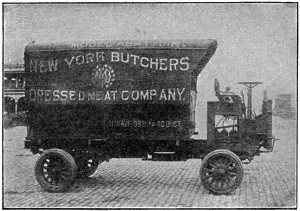
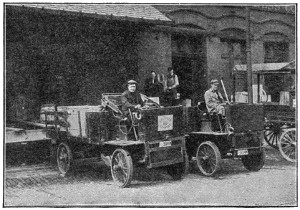
Reliance Truck—1908 1908 Truck Model
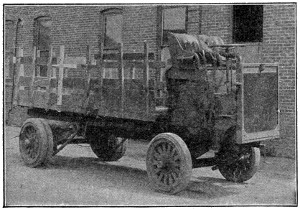
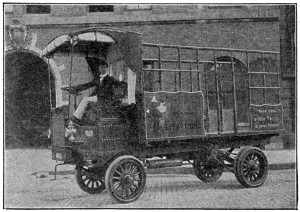
Reliance Truck—1909 1909 Truck Model
In the early days of the motor-truck industry men bought the finished vehicle, but later on the practice of selling chassis only became popular, and while today some manufacturers cater to the body trade, a large percentage of trucks are sold to the purchaser without the body, this being built by a local builder, the truck manufacturer furnishing a body builder’s blue-print.
As in everything else, it has taken time to overcome the faults of the early trucks. Most all trucks above 1,500 pounds capacity are equipped with solid rubber tires, and while the solid rubber tires and the springs on the trucks give a great deal of resiliency, it was discovered that the steady pounding over all kinds of pavements soon racked a truck to pieces and that pleasure-car practice could not be followed successively in building motor trucks.
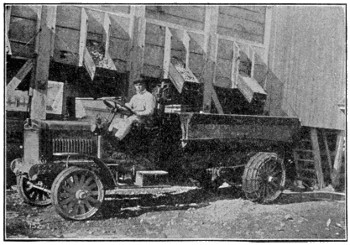
5-Ton Truck—1913-14
In the earlier days truck buyers made many mistakes in selecting the size or capacity of trucks. Some made the mistake of buying trucks too light for their work. Others selected trucks large enough to provide for exceptional or emergency loads, and would, for example, buy a truck of 31⁄2-tons capacity when 90 per cent of their hauling was loads not exceeding 11⁄2 or 2 tons. Thus they not only had a greater investment than necessary in the truck itself, but were paying an exclusive charge in the way of operating costs and depreciation.
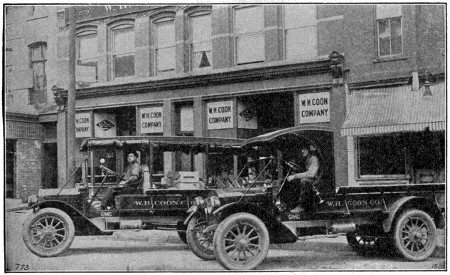
Latest 3⁄4-Ton Model
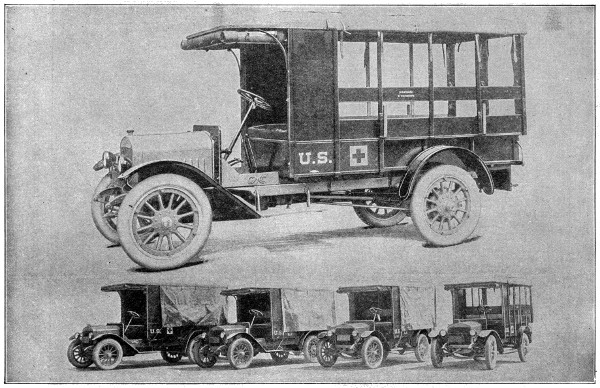
Some 3⁄4-Ton Trucks of the Latest Model
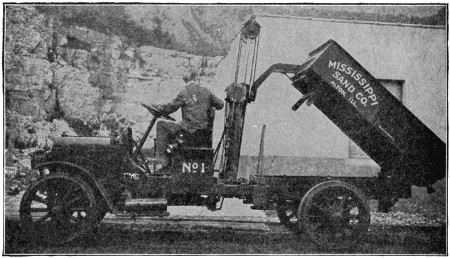
A 11⁄2-Ton Truck of the Latest Model Dumping
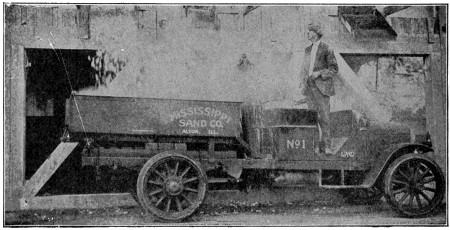
A 11⁄2-Ton Truck of the Latest Model Loading
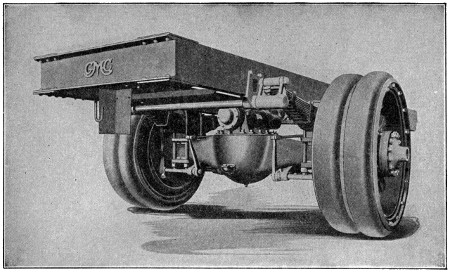
Rear End Construction of a Modern 5-Ton Truck
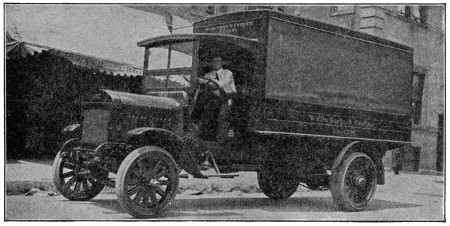
A 31⁄2-Ton Truck of the Latest Model in Active Service
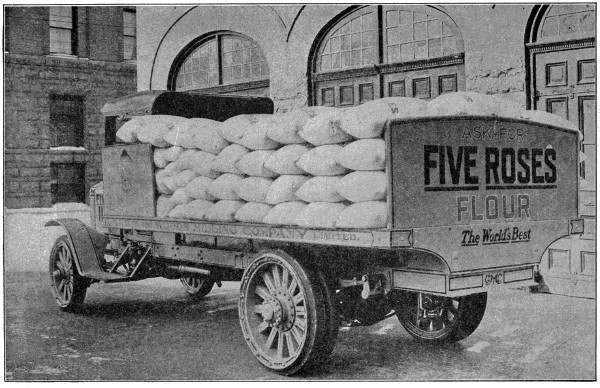
The Latest 31⁄2-Ton Truck Doing Duty
But the experimental days have passed, both in the manufacture of motor trucks and in their adaption to various lines of work. If the buyer has not determined by experience and investigation the kind and capacity of truck he should use, the older manufacturers are able to step in and analyze the work to be done and to intelligently recommend to the buyer what he should have.
That motor trucks not only furnish cheaper transportation than horse-drawn vehicles, but greatly extend the radius of operation, is quite generally conceded. This is shown by the enormous increase in the demand for motor trucks in all lines of business where goods of any kind are to be moved over any considerable distance.
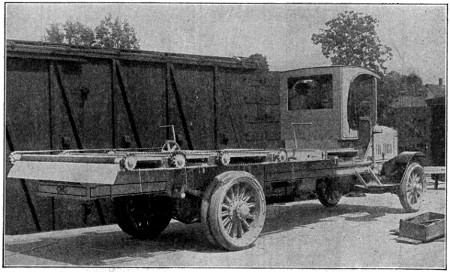
Chassis of the Latest Model 31⁄2-Ton Truck
With motor trucks, merchants have extended their deliveries to reach territory they could not touch under the horse-delivery system.
Market gardeners, who must have their product in the city markets early and have it fresh, can now sell their high-priced land adjoining the cities and go miles back in the country where as good ground can be bought for from one-tenth to one-fourth the price their suburban property will bring—and still be closer to market with their motor trucks than they were before with their horses.
Contractors can transport material long distances and save both time and money. Dairymen collect milk over a radius of thirty or forty miles and get it to market fresh. Freight and passenger lines are possible with motor trucks where a steam railroad or trolley system would not be practicable.
In short, the motor truck is revolutionizing transportation. As made today by the leading manufacturers, it is simple, durable and easy to operate and care for.
What is a Diving Bell?
Diving, aside from the pleasure afforded to good swimmers, is important in many different industries, particularly in fishing for pearls, corals, sponges, etc.
Without the aid of artificial appliances a skilful diver may remain under water for two, or even three minutes; accounts of longer periods are doubtful or absurd.
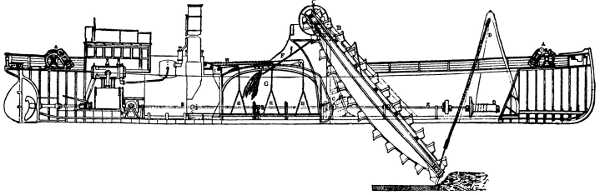
LONGITUDINAL SECTION OF HOPPER DREDGER, Employed on the River Clyde
The Vessel steams to place of working and is moored by the Steam Winches A A at bow and stern to buoys, the Bucket Ladder B is then lowered by steam power, and thereafter Buckets set in motion by gearing C C. The depth of water at which the Bucket Ladder dredges is regulated by the Hoisting Shears and Chain Barrel D D, driven by shafting E E from the Engines. The Buckets discharge the material by the shoot F into the Hopper G. The dredged material is discharged by the doors of the Hopper being opened by the Lifting Chains H H. These doors are hinged on to the side of Vessel, and suspended at centre by the Lifting Chains, which are connected to geared Crab Winches I I.
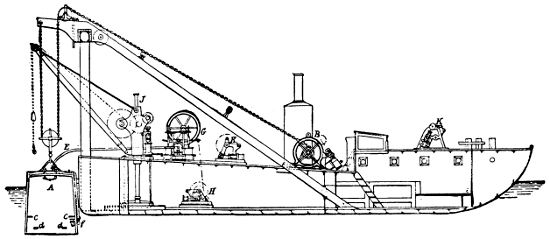
SECTIONAL VIEW OF DIVING BELL AND BARGE, Employed on the River Clyde
All the appliances are worked by steam, rendering manual labour unnecessary. A is the Bell, which is raised and lowered by means of the Chain and Steam Winch B. c c are Seats within the Bell; d d, Footboards. E, Air-pipe entering the Bell at f, the air being supplied by Air-pump G driven by the Engine H. J is a Steam Crane for raising or lowering material. K K, Steam Winches for working moorings and shifting position of the barge.
Large image (both illustrations, 1500 x 991 px, 305 kB).
Various methods have been proposed and engines contrived to render diving more safe and easy. The great object in all these is to furnish the diver with fresh air, without which he must either make but a short stay under water or perish.
Diving bells have been used very effectively. A diving bell is a contrivance for the purpose of enabling persons to descend, and to remain, below the surface of water for a length of time, to perform various operations, such as examining the foundations of bridges, blasting rocks, recovering treasure from sunken vessels, etc.
Diving bells have been made of various forms, more especially in that of a bell or hollow truncated cone, with the smaller end closed, and the larger one, which is placed lowermost, open.
The air contained within these vessels prevents them from being filled with water on submersion, so that the diver may descend in them and breathe freely for a long time provided he can be furnished with a new supply of fresh air when the contained air becomes vitiated by respiration. This is done by means of a flexible tube, through which air is forced into the bell.
A form, called the “nautilus,” has been invented which enables the occupants, and not the attendants above, to raise or sink the bell, move it about at pleasure, or raise great weights with it and deposit them in any desired spot.
How are Harbors Dredged Out?
There are several forms of mechanical, power-operated dredges. One of the most common is the “clam-shell” dredge, consisting of a pair of large, heavy iron jaws, hinged at the back, in general form resembling a pair of huge clam shells. This with its attachments is called the grapple. In operation it is lowered with open jaws, and by its own weight digs into the ground that is to be excavated. Traction is then made on the chains controlling the jaws, which close; the grapple is hoisted to the surface and its contents discharged into scows alongside the dredge.
The dipper dredge, an exclusively American type, has a bucket rigidly attached to a projecting timber arm. In operation the bucket is lowered and made to take a curving upward cut, thus dipping up the bottom material, which is discharged through the hinged bottom of the bucket. The pump or suction dredge operates by means of a flexible pipe connected with a powerful centrifugal pump. The pipe is lowered into contact with the bottom to be excavated and the material is pumped into hopper barges or into a hopper-well in the dredge itself.
The center ladder bucket dredge operates by means of an endless chain of buckets moving over an inclined plane, which in structure is a strong iron ladder, one end of which is lowered to the sea bottom. The steel buckets scoop up the material at the bottom of the ladder, which they then ascend, and are discharged by becoming inverted at the upper end of the ladder. This dredge is the only one found satisfactory in excavating rock.
How is a Razor Blade Made?
The best scissors, penknives, razors and lancets are made of cast steel. Table knives, plane irons and chisels of a very superior kind are made of shear steel, while common steel is wrought up into ordinary cutlery.
In making razors, the workman, being furnished with a bar of cast steel, forges his blade from it. After being brought into true shape by filing, the blade is exposed to a cherry-red heat and instantly quenched in cold water. The blade is then tempered by first brightening one side and then heating it over a fire free from flame and smoke, until the bright surface acquires a straw color (or it may be tempered differently). It is again quenched, and is then ready for being ground and polished.