The Story in Elevators and Escalators[15]
Reading edition
The Story in Elevators and Escalators[15]
Going up and down stairs is a duty every man, woman and child finds it necessary to perform daily and in many cases hourly, and some means for doing this is necessary in every modern household. Even in the old-time one-story house, steps from the outside to the inside were usually necessary, and when the two or more storied houses came into use the stairway became an indispensable feature. In modern times the art of building has had such an upward trend that edifices looming far into the air, hotels, stores, apartment houses, office buildings, etc., have come into use, one notable specimen, the Woolworth building in New York, towering upwards to fifty-four stories in height. This upward tendency has rendered the elevator, or lifting apparatus, an indispensable necessity, alike for passengers and freight, and it has been installed abundantly in all our large cities.
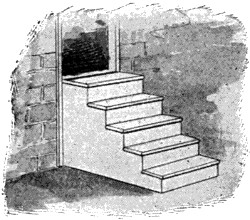
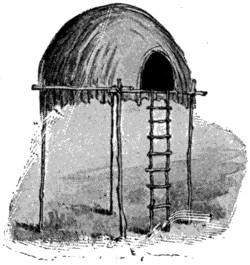
In Order to Ascend More Easily, Man Devised the Stairway, from which, in Turn, was Developed the Escalator, in Order to Further Eliminate Physical Effort Primitive Man Pulled Himself up a Ladder when He Wanted to Go from One Level to Another
The elevator is not exactly a new idea. Its pioneer form may be traced back to the Middle Ages, when heavy weights were lifted by aid of an apparatus worked by hand power. But it was not until well on into the nineteenth century that the steam-power elevator came into service. The first example is said to have been produced by Elisha Graves Otis, who applied steam power to an elevating machine in a little shop at Yonkers, on the banks of the Hudson, New York. A few years later, at the International Exhibition of 1853 in New York, he displayed the first elevator with a safety device to prevent the car from falling in case of a broken cable.
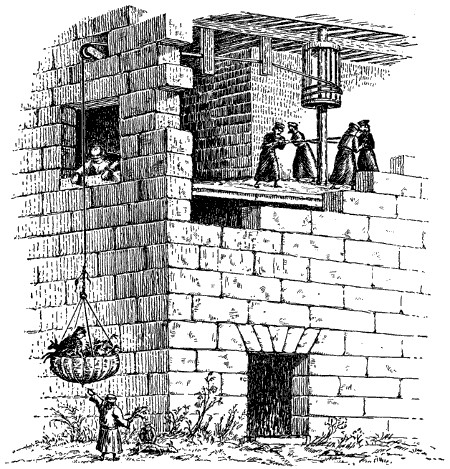
An Elevator of the Middle Ages
History tells us this form of elevator was used in monasteries for hoisting passengers and supplies.
The elevator was then a novelty. It has long since grown into a necessity. It is to be seen in all hotels and high buildings, and the art of getting up stairs has in very many cases changed into that of being lifted up by a moving car in an enclosed shaft or cage. The steam elevator, at first used, has now in great measure been replaced by the electric elevator, the first moved by an electric motor being the Otis elevator installed in the Demarest Building, New York, in 1889. This is still in active use.
The first electric elevators were confined to the drum type of machine, these having a grooved drum around which the hoisting cables were wound, the drum being revolved through worm gearing by an electric motor. But the erection of buildings, ranging from 200 to 700 feet in height has put this type of traction out of business on account of the great size of drums required and the necessary slowness of motion. It has been replaced by the electric traction elevator. In this the hoisting cables from which the car is suspended have at the other end a counterweight and pass around driving sheaves in place of a drum. This, in its latest form known as the gearless traction elevator, does away with all intricate machinery, and yields a machine moving with equal speed whatever the height.
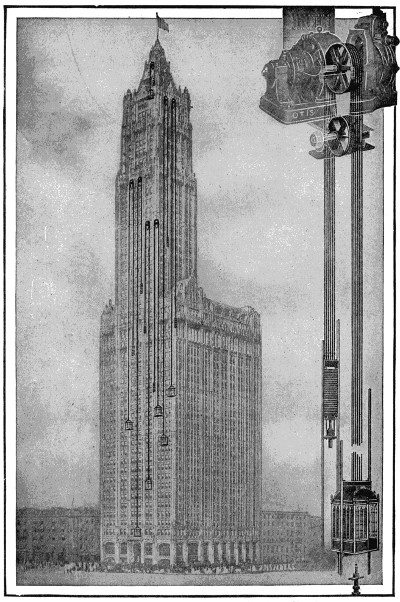
Elevator Installation in the Woolworth Building, New York
To obviate danger from accidents, safety devices are installed for gripping the rails in case of the car attaining excessive speed. Another feature of security is the oil cushion buffer. One of these is placed in the hoistway under the car and one under the counterweight, they being capable of bringing a car to rest from full speed without discomfort to those in the car. The oil in the buffer is driven by the impact of the car from one chamber of the buffer to another, but this is made to take place at a fixed rate of retardation, the oil acting as a liquid cushion which stops the car gradually and without shock.
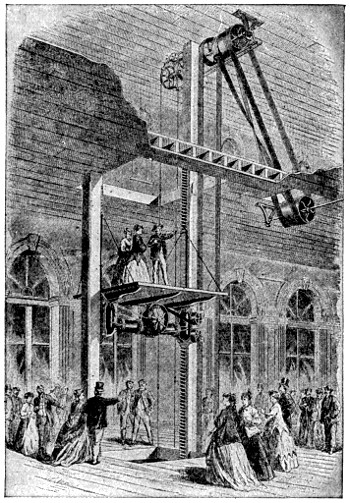
A Steam-Driven Elevator of Early Date
To do business in the modern lofty building without the aid of elevators (or lifts, as they are called in England) is today out of the question, while the great grain-transporting edifices in cities in which our annual crops are lifted and lowered, are known by the specific name of elevators. There is, however, another means of getting up and down stairs which is coming somewhat rapidly into use and in which the old stairway is restored. It is one in which the stair itself does the moving instead of the passengers upon it. This new and interesting device is known as an escalator.
The Escalator.
The earliest way to get upward from the ground was that adopted by climbing animals in clambering up tree trunks, and by man himself in “shinning” up trees by aid of his arms and legs. This was followed by the plank leading from a lower to a higher level, by the ladder, and finally by the stairway. In our days the stairway has been put on a set of revolving wheels and moves upward itself, carrying its passengers with no need on their part to use their feet. This simple but effective device is known as the escalator.
It is a very useful contrivance for tired shoppers needing to make their way from floor to floor in the great department stores, for travelers on subway or elevated railways, for large mills, theaters, or other places where easy getting up and down stairs is necessary. The escalator is a simple device. No intricate machinery is needed. It is so arranged as to be always going, traveling upwards or downwards, and returning out of sight below. It has been called “an elevator with the doors always open.” It is capable of carrying all the passengers who can crowd upon it, stepping on or off at the bottom or top, it being estimated that more than 10,000 people an hour can be thus moved.
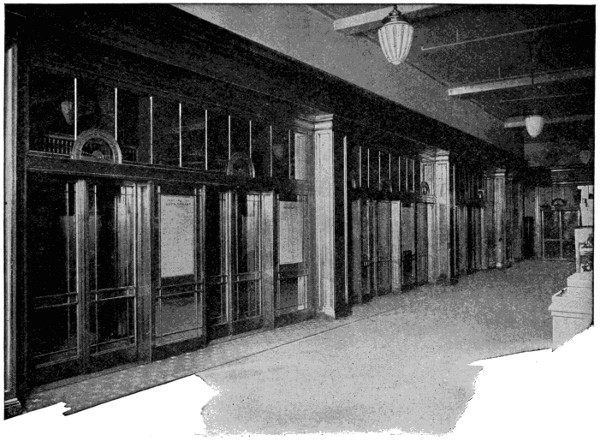
Battery of Elevators in a Department Store
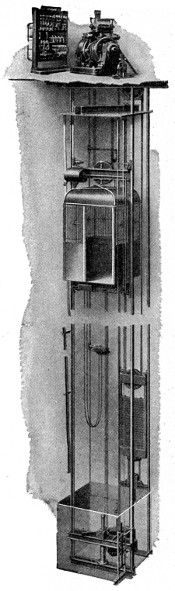
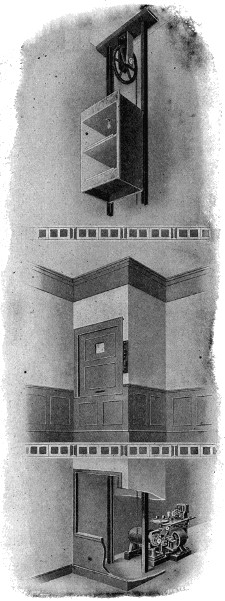
A Complete Installation of a 2 : 1 Electric Traction Passenger Elevator, Showing Machine and Controller at Top of Hatchway
This elevator is used where the slower speeds are required as in department stores. Electric Dumbwaiter Installation with Machine in Basement Showing Call Buttons
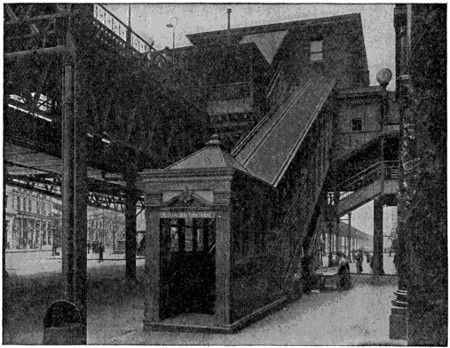
Escalator or Moving Stairway at Sixth Avenue and Thirty-third Street Station of Elevated Railway, New York City
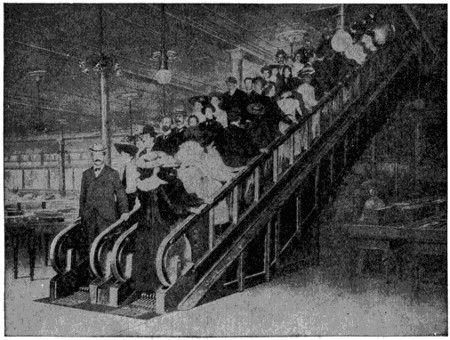
A Duplex Escalator of the Cleat Type in a Department Store
This type of escalator makes use of hard wood cleats in place of steps.
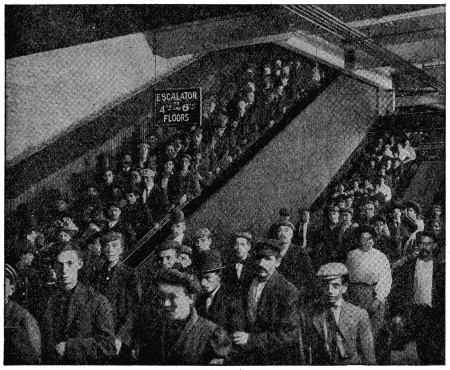
An Escalator or Moving Stairway for the Use of Employees in a Large Worsted Mill
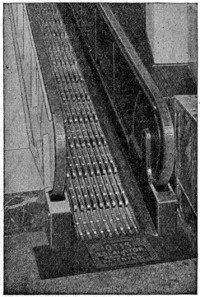
A Cleat Type Escalator, Showing the Hardwood Cleats Used in Place of Steps
The Cleat Escalator.
In the original type of escalator the steps flatten out into a level platform at top and bottom, easy to step on and off, and divide into regular steps as they climb upward, passengers in a hurry being able to hasten their speed by walking at the same time that they are carried. Another type is that known as the cleat escalator. In this there are no steps, it being composed of hardwood cleats moving in longitudinal ridges and grooves, there being a handrail on either side moving at the same speed. The platform glides through the prongs of a comb at the lower level and journeys upward at a moderate speed. At the upper level it disappears through a similar comb and returns out of sight. The passengers slide off upon the prongs of the comb at the top and land without jar or shock. Both these types of escalators can be made to move up or down by aid of a swinging switch, or two of them can be placed side by side, one moving upward and the other downward.
The Moving Platform.
A device acting on the same principle is the moving platform, with the difference that this may be of indefinite length and act as a sort of railway for carrying passengers from place to place. The passenger steps from a sideway at rest to one in moderate motion, and from this to a second one moving more rapidly, and in this way can be carried horizontally at a fair rate of speed. On reaching his station he has but to step back on the slower platform and from this to the moveless sideway. The pioneer example of this contrivance was installed on a long pier leading into Lake Michigan at the Chicago Exposition of 1893, and plans for putting it into practical use in various cities have been entertained. None of these, however, have yet been put into effect. Certain drawbacks, possibly that of cost of installation and operation, has served as a hindrance.
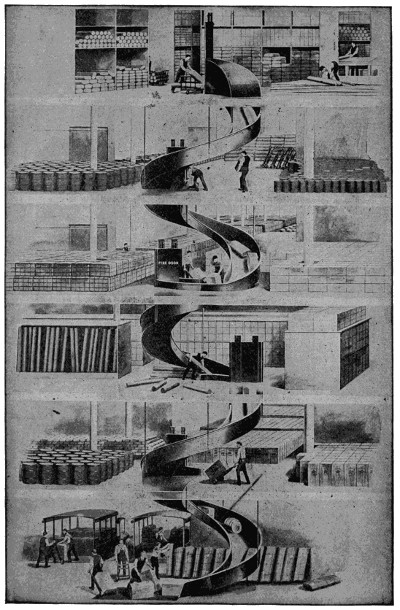
A Gravity Conveyor of the Single Spiral Open Type
For the quick and safe conveyance of heavy goods from upper to lower levels.
What Happens when Animals Hibernate?
We have all heard of certain animals sleeping through the long winter months and most of us have probably wondered what happens to them when they do this.
This hiding away for a long sleep, or hibernation, as it is called, commences when the food of the animal begins to get scarce, and the length and depth of the sleep depends on the habit and constitution of the animal.
Bats, bears, some animals of the rodent order, such as the porcupine, the dormouse, some squirrels, etc., all the animals belonging to the classes of Amphibia and Reptilia, such as tortoises, lizards, snakes, frogs, etc., and many species of mollusks and insects, hibernate more or less completely, retiring to suitable places of concealment—the bat to dark caves, the hedgehog to fern-brakes, snakes to holes in trees, etc.
During hibernation there is a great decrease of heat in the bodies of the animals, the temperature sometimes sinking to 40° or even 20° F., or in general to a point a little above that of the surrounding atmosphere. The respiration as well as the pulsation of the heart is exceedingly slow, and the irritability of the animal often so low that in some cases it can be awakened only by strong electric shocks.
With frogs and amphibious reptiles the dormant state is very common, and if the temperature is kept low by artificial means they may remain dormant for years.
The term “æstivation” has been used to describe a similar condition into which certain animals, such as serpents and crocodiles, in tropical countries pass during the hottest months of the year.
How do Peanuts Get in the Ground?
Peanuts are really the seeds or pods of a plant belonging to the family called the earthnut in Great Britain, the nuts there being used chiefly to fatten swine. The peanut-stand so commonly seen on street corners here is kept well supplied by the extensive cultivation of peanuts in the United States, mainly in the South, and in several tropical countries.
As most people have discovered, the nuts have a much more agreeable taste after being roasted. They also yield an oil which is often used for olive oil, and very good “peanut butter” is now made by grinding them up and mixing them with oil.
The peanut plant, or groundnut as it is also called, has a hairy stem and the leaves usually grow in sets of two pairs each, on the extreme end of each little branch-stem. The pod or nut is situated at the end of a separate stalk, which is longer than the leaf-stems, this stalk having the peculiarity, after flowering, of bending down and pushing the fruit into the earth. After the peanuts have reached their full growth, they are dug up very much in the same way as potatoes, a machine potato digger now being extensively used for this purpose.
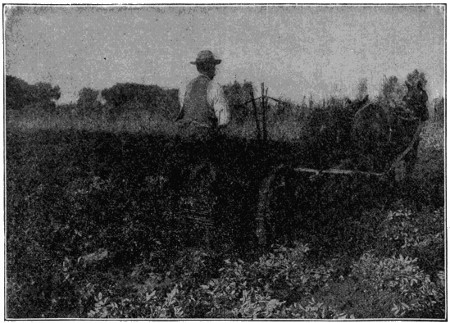
Machine Potato Digger Digging Peanuts
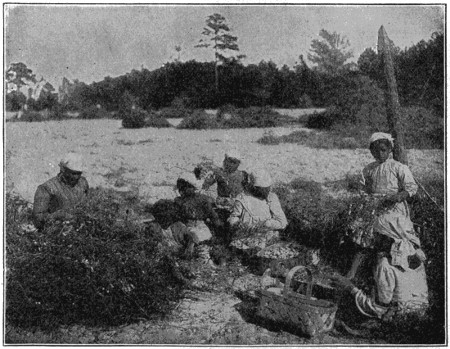
Picking Peanuts by Hand
How did Your State Get Its Name?
Alabama is named after the Indian word which means “Here we rest;” Alaska comes from the Eskimo word “Alakshak” or “Alayeska” and means “The main land;” Arizona is the result of the Indian word “Arizonac,” meaning “small springs” or “few springs;” and Arkansas is sort of a mixture of the Indian “Kansas,” which means “smoky water,” and the French prefix “arc,” meaning “bow” or “bend.”
California comes from the Spanish words “Caliente Fornalla,” or “hot furnace;” Colorado, also from the Spanish “colored,” from the red color of the Colorado River; and Connecticut, in Indian, means “long river.”
Delaware was named after Lord De la Warr; Florida originated from the Spanish “Pascua de Flores,” which means “Feast of Flowers,” because it was discovered on Easter Day; Georgia was called after King George II of England; and Hawaii is a native name peculiar to the natives there, although Captain Cook called it part of the “Sandwich Islands” after Lord Sandwich.
Idaho is Indian, meaning “Gem of the Mountains;” Illinois is another mixture of Indian and French, the Indian word “illini” and the French suffix “ois” meaning “tribe of men;” and Indiana and Iowa are both plain Indian, the former standing for “Indians’ land,” and the latter, “beautiful land.”
Kansas and Kentucky are Indian, too, Kansas meaning “smoky water” and Kentucky “at the head of the river,” or “the dark and bloody ground;” and Louisiana is named after Louis XIV of France.
Maine and Maryland each come from abroad, Maine being called after the Province of the same name in France, and Maryland after Queen Henrietta Maria of England, consort of Charles I; while Massachusetts, Michigan, Minnesota, Mississippi and Missouri are all from the native Indian language, meaning, in the order in which they are given, “place of great hills,” “fish weir,” “sky-tinted water,” “great father of waters” and “muddy;” and Montana traces back to the Latin word “montanus,” meaning “mountainous.”
Nebraska is another Indian name, and means “water valley;” while Nevada is Spanish, meaning “snow covered;” New Hampshire and New Jersey are both from across the water, the former after Hampshire County in England, and New Jersey after the Island of Jersey at the time when Sir George Carteret was its Governor; New York and both North and South Carolina were also named after monarchs abroad, New York after the Duke of York in England, and the Carolinas after Charles IX of France; while North and South Dakota bring us back to the Indian language again, meaning “allies.”
Ohio and Oklahoma are both Indian, too, Ohio meaning “beautiful river,” and the latter, “Home of the red men;” while Oregon is from the Spanish word “oregano,” which stands for the wild marjoram, a plant abundant on the coast; Pennsylvania traces back to the Latin, meaning “Penn’s woody land;” the Philippine Islands come from the Spanish words “Islas Filipinas,” after King Philip; and Porto Rico is also Spanish, from “Puerto Rico,” meaning “rich port.”
Rhode Island is called after the Island of Rhodes; Tennessee, Texas and Utah are all Indian, Tennessee meaning “river with the great bend,” Texas coming from several different forms of very old Indian language, meaning “friends,” and Utah after the tribe by that name, also called the “Utes;” Vermont is from the French, meaning “green mountains,” and Virginia is called after Elizabeth, the “Virgin Queen” of England.
Washington gets its name from a good, straight American source—George Washington; West Virginia is so called because it was formerly the western part of Virginia; and Wisconsin and Wyoming are both Indian, the former meaning “gathering of the waters,” and the latter, “great plains.”