The Story of Electricity in the Home[13]
Reading edition
The Story of Electricity in the Home[13]
How wonderful to youth always has been the magical story of Aladdin and the wonderful lamp which, through its supernatural powers, he could gently stroke and thereby make genii of the unknown world his slaves.
In the rush of modern affairs there is that which is even more fascinating, even more wonderful, than the story of Aladdin and the magical power exerted through his lamp, but which is given but a passing thought because of the rapid changes through which we are passing.
Mythical as it may sound, yet nevertheless it is true, that man has harnessed for his use every snowflake that falls in the mountain tops and settles itself in the banks of perpetual ice and snow. How man has tapped the mountain fastnesses and converted the melting snows into a servant more powerful, more magical, more easily controlled, than Aladdin’s genii, should be known to everyone. This servant is electricity.
This silent, invisible servant is ever present, always ready at the touch of a button or the snap of a switch, without hesitation, without grumbling, to do silently, swiftly, without dirt, without discomfort, without asking for a day off or for higher wages, the work which is laid out for it.
The use of electricity is so common today that the average person does not stop to think of it as a magical power wielding a tremendous influence for betterment in every-day affairs.
Electricity has rapidly found its way into the home for domestic purposes, eliminating at its entrance a host of cares of the household.
So recently, as to seem almost yesterday, the genius of man’s brain coupled electricity with mechanical devices for the comfort and efficiency of the home.
Although a number of attempts have been made to build appliances for use in the home that would utilize electricity, the real beginning of the present almost universal use of electrical appliances seems to have been in the manufacture of the electric iron. One instance, at least, coupled with the manufacture of this household necessity, offers something of romanticism.
To a certain western state, a young electrical engineer betook himself, obtaining a position as superintendent of an electric power company and establishing his abode in a tent far up a canyon, more for the benefit of his wife’s health than for the thought of being near the power plant and his work. The melting snow which gathered in little rivulets made a roaring mountain stream which generated such an excess of power for the company, that the young electrical engineer began looking about for other means of utilizing it than for lighting the homes of the villages below the mouth of the canyon. He designed a crude electric iron, placed a number of them in use, and found they gave fairly good service and at the same time enabled the power company to sell additional current. Development of the device was rapid, so rapid, in fact, that the young engineer’s time was soon taken up with it and he resigned from his position with the power company to organize a small concern for the purpose of manufacturing electric irons which at first were sold to the consumers of the power company and later to a large nearby city.
These irons met with such a ready reception and were so popular with housewives because of the time saving and the convenience, that attention was next turned to other appliances which could be used in the home and which would assist the power company in the sale of current. About one hundred electric cooking sets were manufactured, consisting of ovens and crude round stoves. These were distributed among the customers of the power company and thenceforth their operation was carefully watched and improvements made from time to time, using always the suggestions offered by the housewives to make an appliance that would meet the needs of the home.
This particular company, which was started but little more than ten years ago in a small room of a store building in a small town of Southern California, has grown rapidly from that time when its complete office and factory force consisted of a man and two boys. It now places in homes well toward a million appliances each year.
Since the home can now be operated almost exclusively with electrical appliances, including everything from the electric iron to the modern labor-saving electric range, it is well to note briefly some of the many reasons for the success of electrically-heated appliances.
Perhaps most noticeable is cleanliness and the absolute absence of dirt and grime in using pure electric heat. There is no soot, no smoke nor discoloration. There are none of the bad effects so often caused by the air becoming vitiated, due to the burning up of oxygen in the air by gas and other fuels. There is no corrosion, oxidization or other form of deterioration.
Perfect and absolute control of heat seems to be secured. The easy snap of the controlling switch on the electric burner gives a certain intensity of heat which remains at that temperature so long as the switch remains in that position. Thus, with modern appliances, the housewife operates them at high, medium or low to suit her desires.
Fire risk is reduced to a minimum, because there are no matches, no kindlings, no kerosene cans, no oil barrels and nothing of the sort to endanger life and property.
The efficiency obtained through the operation of electrical appliances soon becomes evident to the user. The heat generated for ironing, for instance, is all utilized. This is true as well with heating or cooking appliances, and this utilization of practically all of the heat units naturally results in economy in operation in communities where the lighting or power company has made a favorable rate.
Because the electric iron seems to have been the forerunner of electrical appliances for the home, it is well first to describe briefly the processes of manufacture necessary before the iron can be placed in the home and take its position as one of the modern labor-saving devices.
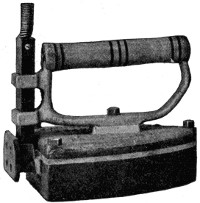
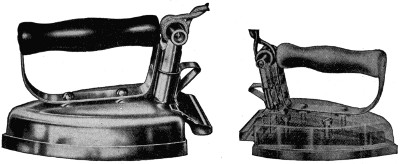
Original Electric Iron Electric Irons, 1916
One of the first irons to be manufactured, an illustration of which is shown herewith, did not offer the pleasing appearance nor give the service of its youngest sister, the illustration of which is also shown. One of the first problems was to control the heat at the iron, and to do this a separable switch plug was developed, enabling the operator to connect or disconnect the current supply at the iron.
The real problem, the one of most vital importance from the point of efficiency, was that of the heating element that would do more than heat the center of the sole plate. One of the pioneer manufacturers, after numerous experiments, concluded that, since the point or nose of an iron comes first in contact with the damp goods, naturally it should have first and most heat applied to it. The result was a double heating element in the form of a V, the resistance wire used being symmetrically wound on a flat, thin mica core. This V-shaped element, the point of the V coming up into the nose of the iron, insured a hot point, as well as hot sides, center, back and heel, where the terminals were connected with the switch plug receptacle. Another development which followed was that of an attached stand, eliminating the necessity of lifting the iron on and off a stand many times during the ironing. At first the iron was heavy and clumsy, being built of cast iron, but modern manufacture has made it possible to build the sole plate of cast iron and the top of pressed steel.
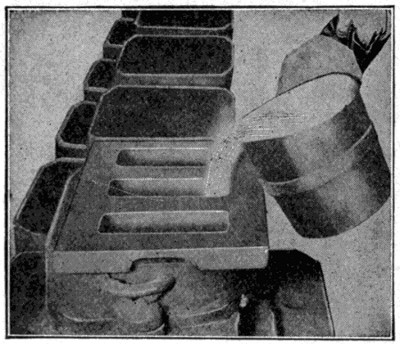
Fig. 1.—Pouring Molten Metal into Molds for Casting Iron Sole Plates
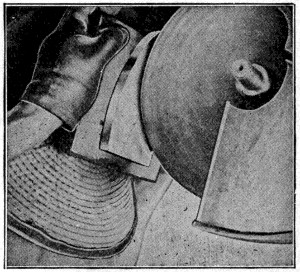
Fig. 2.—Workman Polishing Sole Plates
The illustrations show some of the steps necessary before the iron reaches the shipping room. Fig. 1 shows the workman pouring an earthen ladle of molten metal into the molds in which the sole plates are cast. Fig. 2 shows the sole plate in the hands of the workman, held against a rapidly revolving polishing wheel, after it has been run through a milling machine and ground to a perfect size. Fig. 3 shows a huge punch press which cuts the blank of steel that is afterwards drawn to the shape of the iron top. The workman is seen holding in his hand the blank cut from a sheet of steel (Fig. 4). The blanks of flat steel of such irregular shape are next passed to a mammoth draw press which draws blanks into the perfect shape to be fitted over the top of the pressure plate which holds the heating element firmly against the sole plate. At the operator’s left hand is a stack of blanks and in his left hand he holds one ready to be placed in the draw press. In his right hand is a top just pulled from the press, and at the extreme right a large truck full of finished tops ready for the polishing wheels.
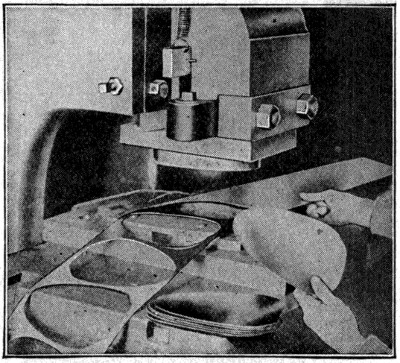
Fig. 3.—Blanking the Steel Tops
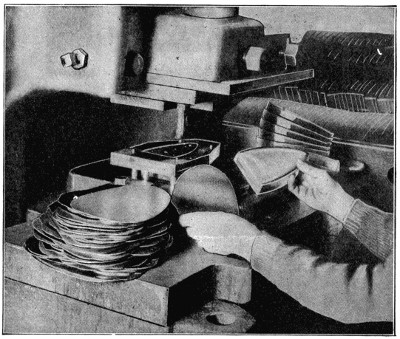
Fig. 4.—Drawing the Blanks into the Perfectly Shaped Tops
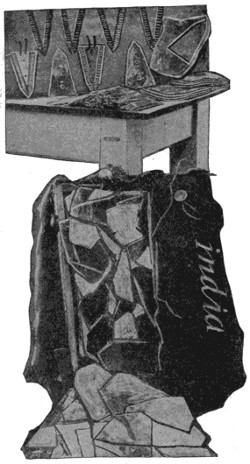
Mica, which so many people know as isinglass, is one of the most important materials in the manufacture of the standard electric iron. The highest grade mica comes from India and the open box in the picture shows thin, transparent pieces just tumbled out (Fig. 5). At the edge of the table is a stack of mica strips known as cores. Hanging over the top of the board are several cores on which the resistance wire has been wound, showing the V-shaped heating element.
One of the most important and yet seemingly simple parts of an electric iron is the switch plug which connects the electric light socket with the iron. The operator in Fig. 6 is shown assembling switch plugs and is in the act of driving home a screw which holds in place the fiber bar over which the cord bends.
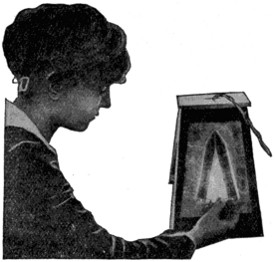
Operator Holding Element Before Strong Light to Detect Defects in the Mica
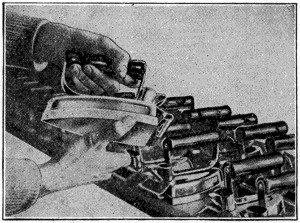
Fig. 5.—Showing a Box of Imported Mica
Above on the table, a stack of “cores” and several elements ready for insertion in the iron. Notice the V shape. Inspector with Carefully Trained, Sensitive Fingers Inspecting Finished Irons Before they are Encased in the Carton
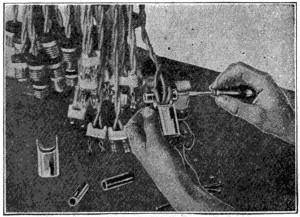
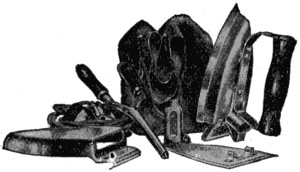
Fig. 7.—Electric Boudoir Set Three-pound Iron
Fig. 6.—Operator Assembling Switch Plugs Stand for converting the iron into small stove, curling tongs heater, felt bag.
A standard six-pound iron consists of seventy-nine parts and represents two hundred and ten distinct factory operations. Every part is carefully inspected before being routed to the assembling department, and after being fully assembled the irons are placed on a traveling table where each is examined in its turn by an inspector with carefully trained fingers, sensitive as those of a miller who tells the quality of flour by pinching it between his thumb and forefinger. This inspector can quickly detect in the handsome finish a defect that is unnoticeable to the average person.
The Traveler’s Iron.
Electric current is so nearly universally obtainable that milady who travels much has come to carry in her grip or suitcase a light-weight iron, usually of about three pounds, and to aid to further convenience, the manufacturer has supplied with this iron, curling tongs, curling tongs heater and an attached stand so that the iron can be inverted and its sole plate used as a small disc stove. The entire outfit is placed in a neat felt bag as shown by Fig. 7.
Electric Toaster Stove
Electric Cooking Appliances.
It is stated that not until the reign of Queen Elizabeth did women begin to take over generally the handling of the kitchen work. Their absence from this important part of the household is not so much to be wondered at when we consider the size of the joints served prior to the time of that well-known queen and the crude methods of preparing the meal. On the other hand, it may have been due to the fact that the Armada called for men, and the women had to go into the kitchen irrespective of conditions. Be that as it may, we naturally conclude that the evolution of the kitchen and kitchen work began at about that time, for very shortly after the open fire gave way to some of the more crude methods of contained fire pots.
It was many years after Good Queen Bess’ reign that electricity was introduced in England for cooking purposes; in fact, not until as late as 1891, when H. J. Dowsing, one of the pioneers of electric cooking, exhibited electric cookers and heaters at the Crystal Palace Electrical Exposition in London, was much interest manifested.
Divided into Three Classes.
Electric cooking appliances can very conveniently be divided into three classes: table appliances, and the light and heavy duty kitchen appliances; the latter being those requiring special wiring. Among table appliances are toasters, coffee percolators, electric teapots, chafing dishes and numerous other articles that add to the convenience of preparing food. These are termed light-duty appliances, as they operate from the light socket.
It might be well to explain that the lamp-socket appliances are those operating from the light socket and are built to carry not over 660 watts of current. Should you attach an appliance of heavier wattage to a light socket you will doubtless “blow” a fuse.
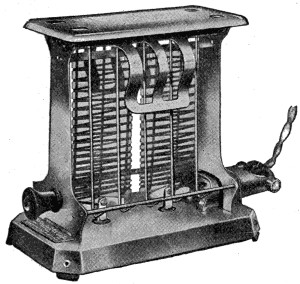
Fig. 8.—Electric Upright Toaster
Electric Toaster.
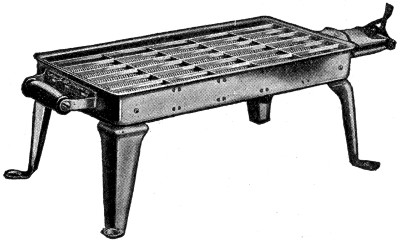
In the rush and hurry of modern life, we are inclined to go back to the days of barbarism, when real home life was unknown. Instead of all members of the family gathering about the breakfast table when the meal is ready, they come straggling in one by one. This made it very difficult for the housewife to serve the breakfast hot, and particularly the toast, which is a favorite dish of our breakfast table. The necessary steps back and forth from the breakfast room to the kitchen to prepare hot, crunchy toast made this portion of breakfast-getting a not agreeable feature. The thought, taken up by electrical engineers, brought out an electric toaster, rectangular in shape, with handsome frame, nickel supports and wire heating element. This was indeed very efficient and could be used also as a small stove. This type of toaster was followed a little later by an upright toaster (Fig. 8). The heating element is of the radiant type, made of flat resistance wire wound on mica and placed in a vertical position between the two bread racks. When the current is switched on, the heating element becomes red and the bread is inserted under the gravity-operated bread clamps on each side. The bread clamp is simply raised at the edge of the slice of bread, and holds the bread firmly in place. This appliance toasts bread evenly, rapidly, and costs very little to operate. The flat top can be used for keeping a plate warm for the toast.
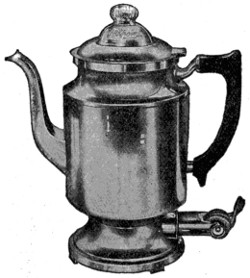
Fig. 9.—Electric Nickel Valveless Percolator
Electric Coffee Percolator.
Lovers of good coffee want it served hot, but boiling spoils coffee. The modern electric percolator, which can be operated on the dining table, has solved coffee-making problems. The particular style of percolator shown in Fig. 9 has no valves or floats or traps that continually get out of order and that make the cleaning of a percolator so disagreeable. This valveless percolator is very easily cleaned and requires no brush. The heating element of this type percolator is in the bottom of the pot in the center of the water space, and is of the immersion type, protruding up from the center of the bottom of the pot. The heating element is made of flat ribbon resistance wire wound on mica, then bent into the form of a cylinder to fit into the German silver shell. A screw-operated spreader in the center presses the heating element tightly against the entire surface of the shell and insures rapid conduction of the heat from the element to the water. A study of the illustration showing the inside of the percolator (Fig. 10) will make clear to you the method of operation. With this style of electric percolator, percolation begins within thirty seconds after the water has been placed in the pot and the current turned on, and delicious coffee, clear as amber, is ready to pour in ten minutes.
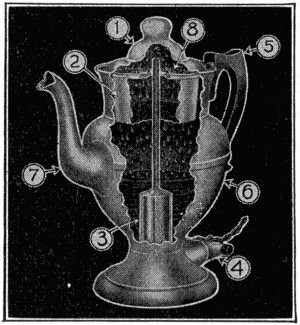
Fig 10.—X-Ray Showing the Valveless Mechanism, Electric Percolator
The above gives a comprehensive insight into the general construction, equipment and operation of valveless Percolators. 1—Glass globe. 2—Aluminum coffee basket. 3—Element, with German-silvershell—completely surrounded by water. (Highly efficient.) 4—Interchangeable switch-plug. 5—Ebonized wood—always-cool handle. 6—Copper body—nickeled and highly polished. 7—White metal spout. 8—Lid—securely fastened hinge.
Percolators of this type are made by the manufacturer from sheet copper spun in perfect shape, and also aluminum spun. The latter makes an especially desirable percolator.
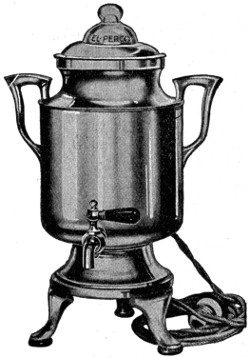
Fig. 11.—Electric Machine Type Valveless Percolator
Machine Type Percolator.
Because some prefer to draw coffee from a faucet rather than pour it from a spout, manufacturers have made a percolator of this type called the machine style. These are sold in various patterns from the Colonial design, like the illustration shown (Fig. 11), to those patterned after the Grecian urn.
We have already mentioned how an electrical engineer, shortly after placing irons in the homes of his customers, followed them with a number of small stoves and ovens. These required special wiring, as the wattage was too heavy to allow of their operation from the light socket. Principally, they were used in the kitchen on one end of the table or on a small shelf. This method necessitated carrying considerable food to the dining room after it was cooked, and brought out the thought of a means of preparing breakfast or a luncheon at the dining table. For this purpose a small stove seemed desirable, and the result was a small disc stove made of cast iron, highly nickel plated and polished.
On this little stove, herewith illustrated (Fig. 12), minor cooking operations can be performed, such as frying, boiling, etc., and it is used by many for toasting bread by placing a piece of metal screen on top. It is also very serviceable for frying hot cakes. The heating element is of the same construction as that in the iron; the mica is clapped tightly against the metal top and below this is a plate of asbestos which prevents the downward radiation of the heat.
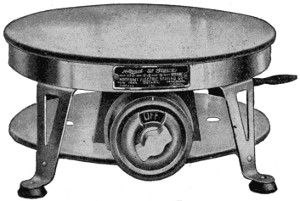
Fig. 12—Electric Disc Stove
This disc stove was first made in single heat, but the later improved stoves of this same type are made in three-heat style.
Many improvements have been made on the disc stoves and they are sold not only as single, but as double or twin, and triple discs.
One often finds it inconvenient, when traveling, to obtain hot water whenever needed. The light four-inch disc stove has proved to be a very desirable possession in cases of this kind. Its size makes it very convenient to pack in trunk or grip, and since it operates from any light socket, it is very handy, not only for the traveler and in the kitchen, but is a boon to many a bachelor man or maid.
Perhaps, before going further, it is well to explain the meaning of single and three-heat. Let us suppose that you are operating one of the small disc stoves and that the stove will carry 600 watts of current. If that stove is equipped with a single heat, you will be using the full 600 watts whenever the switch is on. If it is equipped with a three-heat switch, it can be adjusted to 600 watts at full, 300 at medium and 150 at low, which means a great saving in current for most small cooking operations.
Two Distinct Types of Heating Elements.
There are two very distinct types of electric heating elements or burners, the disc or closed type, and the open-coil type. These two types operate on entirely different principles. The disc stove conveys the heat to the food by the principle of conduction, i. e., the heated metal top of the stove in turn conducts the heat to the metal of the dish and thereby heats the food within the dish.
The open-coil type of element operates on the principle of radiant heat. The heat rays from the element are focused on the dish in which the food is being prepared. In the former style burner, sufficient time is required to heat the metal top of the stove before the heat can be utilized, while in the latter, the heat is almost instantaneously effective. Below the coils of the radiant type of grills and heaters shown in this section is placed a highly polished, nickeled disc which serves to reflect all the heat units that are directed downward, back to the dish in which the food is being prepared, thereby utilizing a maximum of the heat units produced.
One very distinct advantage in the open-coil over the disc type is that in the former practically all the utensils found in the average home can be satisfactorily used, granite and enamel-ware being especially desirable, while in the disc-type stoves, it is necessary to have dishes with smooth, clean bottoms and that they fit very closely in order to make metallic contact over the entire surface.
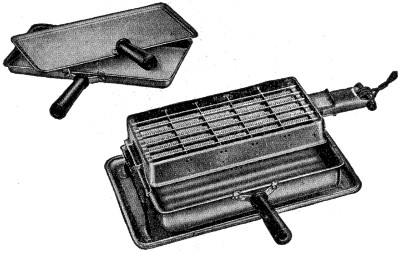
Fig. 13.—Electric Rectangular Grill
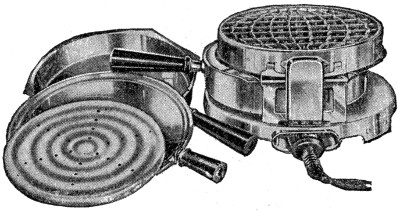
Fig. 14.—Electric Three-heat Grill
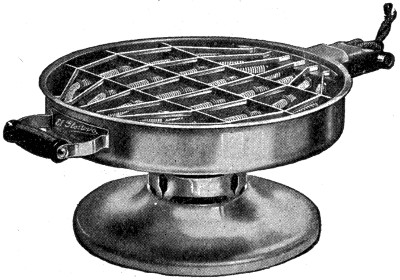
Fig. 15.—Electric Radiant Stove
The lightness, convenience, and general utility of the small open-coil stove has been responsible for a number of designs being manufactured and sold in enormous quantities, these being made up not only as stoves, but as grills. The accompanying illustration (Fig. 13) is of a rectangular grill, made of pressed steel and highly polished, designed to operate from any electric light socket. The heating element is of the open-coil reflector type and is so placed in the frame that cooking can be done both above and below the glowing coils at the same time. This is a convenience and economy, as one is able to cook two dishes of food at the cost of one. This particular grill is furnished with three dishes, any one of which can be used either above or below the coils. When cooking above the coils only is desired, the small flat pan is placed in a groove below the coils to reflect to the cooking operation any heat that would be thrown downward from the heating element. The shallow pan also serves as a cover for either of the deeper dishes or for a hot-cake griddle.
This radiant grill is light in weight, occupies a small space and is a most desirable appliance in the home, to be used in either the living room or dining room for the preparation of a light luncheon or afternoon tea service.
Of the same manufacture is the radiant grill shown in Fig. 14. This grill, you will note, is round, which particularly adapts it to the use of utensils ordinarily found in the kitchen of the average home. You will note that there are two dishes to this grill, a top dish with a broiling grid, to be used underneath the coils for broiling chops, and a shallower dish to be used above the coils for frying operations. There is furnished also a reflector which is so designed that it serves equally well as a cover for either dish and makes a very choice griddle for baking hot cakes.
While this particular grill is furnished with a wattage providing for operation from a lamp-socket, it is of the three-heat style already spoken of as so desirable in appliances of this character. A companion grill to this is of the same design, excepting that it is furnished in single heat only and lists at a somewhat lower price.
You will remember that in explaining the many advantages of the open-coil type of burner, it was stated as one of these that the housewife could use cooking utensils ordinarily found in the home, and because of this peculiar adaptability the round grills here spoken of and illustrated are having an exceedingly large sale. These open-coil grills are also very efficient as toasters, the bread being placed on top of the grating, which protects the coils from injury. Where only chops, toast, and coffee are to be had for breakfast, chops can be prepared below the coils, the toast above, while the coffee gurgle-gurgles in the percolator.
Some people who have not felt any need of a grill have desired an open-coil stove, and of this same general type of manufacture there is the open-coil radiant stove herewith illustrated (Fig. 15). It is equipped with the same kind of a burner or element with a reflector underneath, and can be used very efficiently with ordinary cooking utensils and is also very serviceable as a toaster. Using this stove in combination with the ovenette, which will be illustrated further on, the owner is provided with a table range which meets most of the requirements in a small family.
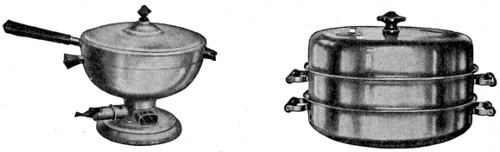
Fig. 16.—Electric Chafing Dishes
A line of cooking utensils would not be complete without suitable designs of chafing dishes, and these are made in several styles, both with and without heating elements, the latter being used on the disc and open-coil stoves already illustrated, while the former contains a heating element very much along the lines of the percolator. These are furnished, as you will note from the illustration (Fig. 16), with suitable cooking pans for the preparation of chafing-dish dainties.
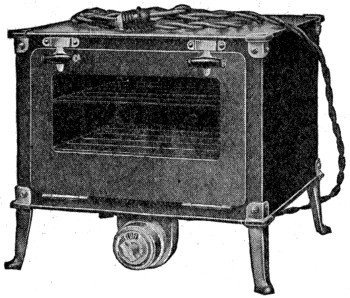
Fig. 17.—Electric Lamp-Socket Oven
Baking and Roasting.
It is only natural to suppose that manufacturers of electric stoves of both light and heavy duty should next turn their attention to ovens, since oven cooking is even primary to cooking that is done on open burners and is now coming to be even of more importance. The first oven herewith shown (Fig. 17) is of the lamp-socket type, equipped with three heats, providing a very efficient oven for small operations. The second one illustrated (Fig. 18) is of standard size and accommodates a quantity of food equal to that of any large range oven. It is provided with a heavy wattage and therefore requires special wiring.
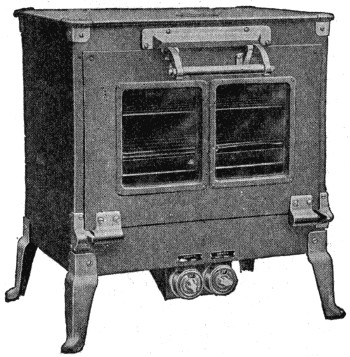
Fig. 18.—Electric Standard Oven
To meet the requirements of the many families in which such a small amount of baking is done, and to cater particularly to apartment-house dwellers, the manufacturers of the line of radiant stoves described and illustrated have brought forth a small cylindrical oven called the ovenette. This little oven fits either the radiant stove or the round radiant grill. It is made of pressed steel and finished in highly polished nickel. This ovenette, in combination with either the radiant stove or the round radiant grill, provides complete cooking equipment upon which an entire meal can be prepared, whether it be heating rolls and preparing crisp bacon or chops for breakfast, or baking a roast, a loaf cake or even bread for the dinner. It will bake pies, cake, biscuit, potatoes, roast meats, etc., up to its capacity, at a less current cost than is possible with the larger oven and in less time. This ovenette has what is called a middle ring, which makes it adjustable to two sizes when large or small quantities of food are to be prepared.
So you see, the woman of today who utilizes current furnished through the light socket, can bring to her command genii as wonderful as those at the command of Aladdin when he stroked the wonderful lamp. Her household duties are made easier. There is far less preparatory work and she is able to place her home on a much more efficient basis than with ordinary methods.
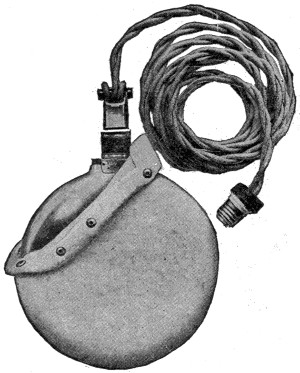
Electric Aluminum Comfo
The home electrical is not complete without containing at least some of the electrical appliances which have been designed for the purpose of alleviating pain. One of these is an electric heating pad made of steel units, so hinged as to make the appliance sufficiently flexible to be wrapped around an arm or limb and to conform to the curves of the body. The other is a pad made of aluminum which is concave on one side and convex on the other and may be used in a wet pack. Each of these heating pads is covered with a high-grade cover of eiderdown which provides a soft contact for the skin.
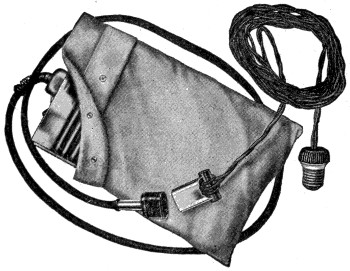
Electric Flexible Comfo (Metal)
Perhaps next in importance along this line of electrical appliances is the small immersion heater shown in Fig. 19, and which requires so little space that it can be easily carried even in a woman’s handbag. This style of heater will quickly heat a glass of water by simply immersing the heater in the water. This device is very extensively used by mothers in heating milk for the baby, by men in heating water for shaving, and by doctors and dentists who require small quantities of hot water for sterilizing and other uses.
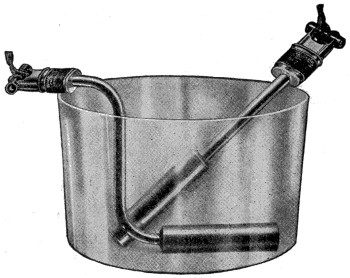
Fig. 19.—Electric Immersion Heater
One thing most desirable in connection with practically all of the lamp-socket appliances described and illustrated in this section is the very small cost of operation. Lighting companies have so reduced the cost of current within the last two or three years that a breakfast may now be prepared electrically for not more than a couple of cents, while one of the pads may be used an entire night at a cost of less than one cent in soothing rheumatic pains or in driving away the chill for outdoor sleepers.
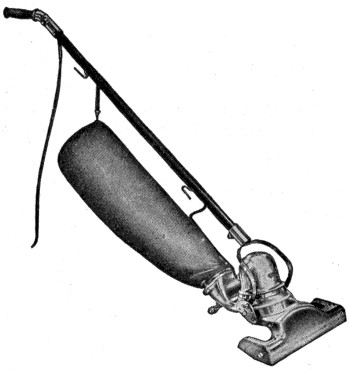
Fig. 20.—Electric Vacuum Cleaner
But one of the hardest domestic tasks is that of keeping the house clean. To obviate the difficulties encountered in this connection and to make the home sanitary, electric vacuum cleaners are provided by several manufacturers, a very recent acceptable type being illustrated in Fig. 20. This type of vacuum cleaner, which is reasonable in price, is made of steel and finished in very highly polished nickel. It operates from any light socket and consumes but a very small amount of current, much less than is consumed by a toaster. It can also be purchased with different attachments with which curtains, radiators, clothes and walls may be cleaned. The possession in the home of one of these vacuum cleaners makes it unnecessary to take up rugs, carpets, tear down curtains and go through the semi-annual worry, wear and tear of house cleaning. The vacuum cleaner will do it better and many times quicker without removing a single article of furniture or disturbing a rug or curtain; and instead of scattering the dust-laden germs in the air, to be drawn into the nostrils and lungs of the family, the cleaner sucks them up into a dust-tight bag from which they can be deposited on a paper and burned.
The evolution in cooking and heating appliances for the home in the last ten years has indeed been rapid, but it is very recently indeed that the housewife has been able to satisfy the longing and the desire that has kept getting stronger from day to day, since first she began to use electric cooking appliances. She has been dreaming of that which would make her kitchen a domestic-science laboratory, and her dream can come true because now she can purchase an electric range patterned in general style after the more acceptable gas or other fuel ranges, but infinitely more efficient.
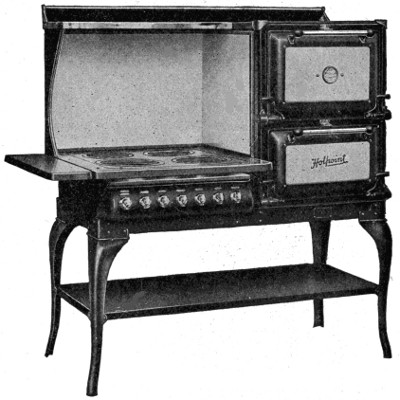
Fig. 21.—Electric Range
The particular type of range herewith illustrated (Fig. 21) uses a burner of the open-coil type, both for the surface burners and for the oven. The ovens are highly insulated with a thick packing of best grade mineral wool, which reduces air leakage to a minimum and retains the heat generated for a long period. Many cooking operations which are performed in ordinary ovens with the burners on, can be prepared in this particular style of oven by using stored heat for the last half of the operation. The range is simplicity itself in operation. Each burner is operated by an indicating snap switch which has three separate heats, full, medium and low; medium being one-half of full and low one-half of medium. There are no matches; there is no danger from fire. There is no vitiated, foul air because of noxious gases from ordinary cooking stoves. There is no soot or grime, no ashes, no wood or coal to carry; there are fewer steps; there is less watching of the range; practically none at all, because when a burner is turned to medium, for instance, you know that you have a certain degree of heat for just as long as the switch is in that position. Results are eminently satisfactory and there is a sufficient saving in the weights and the nutritive value of foods cooked, especially in the oven, to make the electric range indeed a most desirable and economical addition to any home.
Today, the housewife, whether the provider of the home be a laborer or a merchant prince, can, with a simple touch of the button or a snap of the switch, bring to her immediate command, and subservient to her wishes, that subtle something which came in the snowflake, and which, while invisible, yet provides the greatest boon to mankind—electricity.
Why is there Always a Soft Spot in a Cocoanut Shell?
A cocoanut shell always has a soft spot at one end because this is the provision nature has made to allow the embryo of the future tree to push its way out of the hard shell.
Cocoanuts, as most of us know, have a thick, hard shell, with three black scars at one end. The soft scar may easily be pierced with a pin; the others are as hard as the rest of the shell. Outside of this hard shell we are accustomed to seeing another covering of considerable thickness, of an extremely fibrous substance. When cocoanuts are picked, however, they have still another covering-an outer rind which has a smooth surface.
The tree which produces the cocoanut is a palm, from sixty to a hundred feet high. The trunk is straight and naked, and surmounted by a crown of feather-like leaves. The nuts hang from the summit of the tree in clusters of a dozen or more together.
Food, clothing and the means of shelter and protection are all afforded by the cocoanut tree. The kernels are used as food in a number of different forms, and when pressed, they yield an oil which is largely used in candle making and in the manufacture of soaps. When they are dried before the oil is pressed out they are known as “copra.”
We have given the name “milk” to the sweet and watery liquid, of a whitish color, which is inclosed in considerable quantity in the kernel.
By boring the tree itself, a white, sweetish liquid called “toddy” exudes from the wound. This yields one of the varieties of the spirit called “arack” when distilled. A kind of a sugar called “jaggery” is also obtained from the cocoanut juice.
The fibrous coat of the nut is made into a preparation called “cellulose,” which is described in another story in this book, and also into the well-known cocoanut matting. The coarse yarn obtained from it is called “coir,” and it is also used for cordage. The hard shell of the nut is polished and made into cups and other domestic utensils. The fronds are wrought into baskets, brooms, mats, sacks and many other useful articles; and the trunks are made into boats, and furnish timber for the construction of houses. Altogether the cocoanut palm will be seen to be a very useful member of the plant kingdom.
How does a Gasoline Motor Run an Electric Street Car?
A gasoline-electric railroad train was introduced in Germany in 1913. It comprises a power car and ten other cars, each of a five-ton capacity, which trail along behind. The power car carries two gasoline engines of a hundred and twenty-five horse-power each which drive a dynamo installed in the center. The current is transmitted to the electric motors, actuating each of the wheels of the power car and the trailers. The General Electric Company has perfected a similar car for use on the suburban branches of street railroads in this country. Most of them are equipped with a two hundred horse-power gasoline engine directly connected to a dynamo from which power is generated and transmitted to the motors, which are located on the car axles. Cars of this type can be made of a larger seating capacity than is customary and can easily attain a speed of a mile a minute.
Gasoline engines offer great advantages over steam because of the absence of boilers, coal and ashes, and a much higher efficiency is obtainable, a consumption of one pint of gasoline per horse-power hour being good practice for well-designed motor engines and a total efficiency of from ten to thirty-five per cent of the energy in the fuel being available, as against one to twenty per cent for steam averages. The utilization of the gasoline engine to generate electric power for surface cars, in instances where it is not practical to transmit energy from power stations, presents wonderful possibilities.
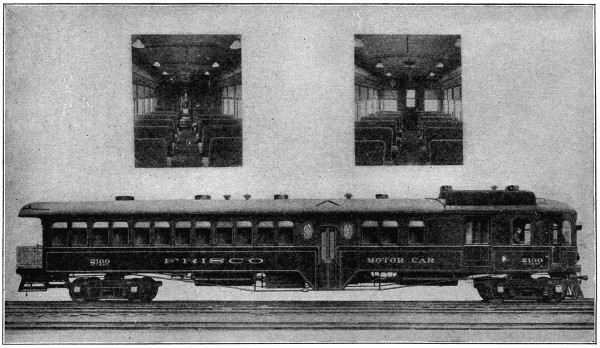
A Suburban Railway Car of the Gasoline-Electric Type
How do “Carrier Pigeons” Carry Messages?
The real carrier pigeon is a large bird with long wings, a large tuberculated mass of naked skin at the base of the beak, and a circle of naked skin round the eyes, but the variety generally employed to carry messages more resembles an ordinary pigeon.
The practice of sending letters by pigeons belongs originally to Eastern countries, though in other countries it has often been adopted, more especially before the invention of the electric telegraph. An actual post-system in which pigeons were the messengers was established at Bagdad by the Sultan Nureddin Mahmud, who died in 1174, and lasted till 1258, when Bagdad fell into the hands of the Mongols and was destroyed by them.
These birds can be utilized in this way only in virtue of what is called their “homing” faculty or instinct, which enables them to find their way back home from surprising distances. But if they are taken to the place from which the message is to be sent and kept there too long, say over a fortnight, they will forget their home and not return to it. They are tried first with short distances, which are then gradually increased. The missive may be fastened to the wing or the tail, and must be quite small and attached so as not to interfere with the bird’s flight.
By the use of microphotography a long message may be conveyed in this way, and such were received by the besieged residents in Paris during the Franco-Prussian War of 1870-71 the birds being conveyed out of the city in balloons.
Seventy-two miles in two and one-half hours, a hundred and eighty in four and one-half, have been accomplished by carrier pigeons. Large numbers of these birds are now kept in England, Belgium, France, etc., there being numerous pigeon clubs which hold pigeon races to test the speed of the birds. These pigeons are also kept in several European countries for military purposes.
What Family has Over 9,000,000 Members?
Each female cod has more than 9,000,000 eggs, but the numbers are kept down by a host of enemies.
The most interesting species is the “Common” or “Bank Cod.” Though they are found plentifully on the coasts of other northern regions, such as Britain, Scandinavia and Iceland, a stretch of sea near the coast of Newfoundland is the favorite annual resort of countless multitudes of cod, which visit the “Grand Banks” to feed upon the molluscous animals abundant there, and thus attract fleets of fishermen.
The spawning season on the banks of Newfoundland begins about the month of March and terminates in June; but the regular period of fishing does not commence before April, on account of the storms, ice and fogs. The season lasts till the end of June, when the cod commence their migrations.
The average length of the common cod is about two and one-half or three feet, and the weight between thirty and fifty pounds, though sometimes cod are caught weighing three times as much. The color is a yellowish gray on the back, spotted with yellow and brown; the belly white or red, with golden spots in young specimens.
Few members of the animal creation are more universally serviceable to man than the codfish. Both in its fresh state and when salted and dried, it is a substantial and wholesome article of food. The tongue is considered a delicacy. The swimming-bladders or “sounds,” besides being highly nutritious, supply, if rightly prepared, isinglass equal to the best of that which is brought from Russia. The oil, which is extracted from the liver, is of great medicinal value, and contributes considerably to the high economic value of the cod.
The finest and palest oil is made from fresh and carefully cleaned liver, the oil being extracted either in the cold or by a gentle heat. Only the pale oils are used in medicine; the dark oils are too rank and acrid, and they are only used in dressing leather.