The Story of the Advance of Electricity[18]
Reading edition
The Story of the Advance of Electricity[18]
It is often remarked that the history of electrical development is the history of modern industrial development. This is true, except that the terms should be reversed. Electric lighting was not invented to equip skyscrapers and the huge apartment buildings of today. In point of fact, the invention of these structures was possible only because electric light already existed. Electric motive power was not devised to supply the great manufacturing establishments of the present. On the contrary, such institutions were erected precisely because such a thing as the electric motor was available. The history of modern industry is thus seen emphatically to be the history of electricity.
The First Commercial Central Station.
The first central station for the commercial distribution of electricity was set going on the 4th of September, 1882, by Thomas Edison himself, at 257 Pearl Street, New York City. Newspapers of the following day had much to say. Wonder was expressed over the “blazing horseshoe that glowed within a pear-shaped globe.” Another told of “the dim flicker of gas supplanted by a steady glare, bright and mellow.” A third observed, “As soon as it is dark enough to need artificial light, you turn the thumb-screw and the light is there; no nauseous smell, no flicker, no glare.”
Among the five or six buildings supplied with the new lighting were the Herald offices and the Drexel Building, at the time one of New York City’s show places. The illumination of the latter was held to be a truly momentous achievement owing to its great size. The equipment, in other words, reached the grand total of 106 lamps. In comparison, it is interesting to mention the lighting equipment of the new Municipal Building, in New York City, numbering something over 15,000 lamps.
The Old Pearl Street Plant.
This primitive central station in Pearl Street was a converted warehouse of brick construction, four stories high, and it was separated in two parts by a fire wall. One of these parts was used for the storing of underground supplies, while the other was occupied by the generating machinery, for the support of which a special foundation of steel and concrete was provided. The necessary steam boilers were accommodated in the basement, while the second floor was occupied by six generators of 125 horse-power each, nicknamed “Jumbos.”
Simple as sounds this original Edison equipment, it nevertheless represented years of research and experimenting on the part of Edison and those associated with him.
Edison and the Electric Light.
In 1878 Thomas A. Edison, at his experimental laboratory at Menlo Park, New Jersey, where he had already invented the carbon telephone transmitter and many other things, undertook the task of devising a general system for the generation, distribution and utilization of electricity for lighting and power purposes.
The first marked accomplishment in operative detail was a lamp with a platinum wire burner of high resistance, protected by a high vacuum in an all-glass globe, and with the leading-in wires sealed into the glass by fusion. Such a lamp necessarily had a small illuminating power compared with that of the arc light, which was the only electric light then in commercial use.
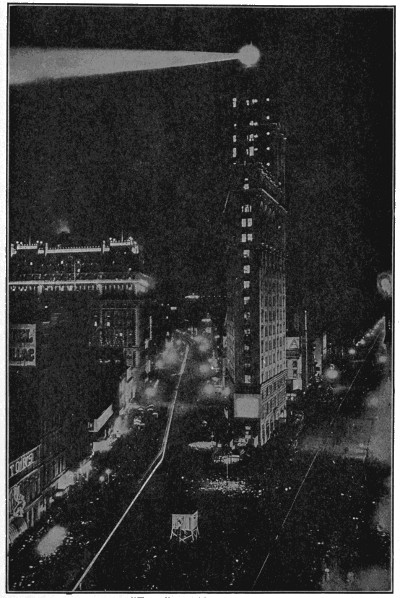
Photo by Brown Bros.
“The Great White Way”
Times Square, New York, at night, with Broadway on the left, a curving ribbon of white light. Here every night in winter thousands upon thousands of people throng to theaters and cafés.
The next step in the development of Mr. Edison’s electric-lighting system was taken on October 21, 1879, when he discovered that if a carbonized cotton thread were substituted as a burner for the platinum wire of his earlier lamp, the slender and apparently frail carbon was mechanically strong, and also durable under the action of the electric current. The announcement of the invention of the carbon filament lamp was first made to the public in December, 1879.
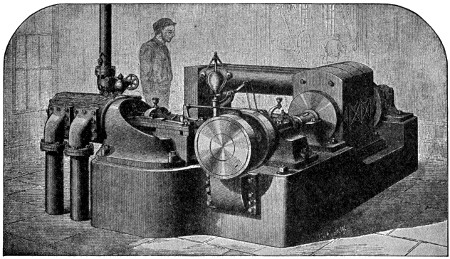
Steam Dynamo in Edison’s Old Station
With the experience gained by an experimental system at Menlo Park, Mr. Edison began, in the spring of 1881, at the Edison Machine Works, Goerck Street, New York City, the construction of the first successful direct-connected steam dynamo. The development of an adequate underground conduit proved also most serious. The district selected for lighting was the area—nearly a square mile in extent—included between Wall, Nassau, Spruce, and Ferry Streets, Peck Slip and the East River in New York City. In those days such electrical transmission as existed—this of course related largely to telegraphy—was accomplished by means of a veritable forest of poles and wires augmented by the distribution equipments of fire alarm, telephone, burglar alarm and stock ticker companies. So used had people become to this sort of thing that even the most competent electrical authorities of the time doubted extremely whether Edison’s scheme of an underground system could be made either a scientific or a commercial success, owing to the danger of great loss through leakage. However, the Edison conduits once in use, both the public and even the telephone, telegraph and ticker companies acknowledged their feasibility. Such, in fact, was the success of the new method that the city compelled at length the removal of all telegraph poles.
In the Trenches.
The systematic laying out of street mains in the first company district was begun in the summer of 1881. It must not be thought, of course, that these old-time conduits resembled strikingly those of the present day. The method then used was to dig a trench in which were laid the pipes measuring twenty feet in length. Through these the conductors were drawn, two half-round copper wires kept in place first by heavy cardboard and afterward by rope. The conductors having been drawn in, a preparation of asphaltum and linseed oil was forced into the piping to serve as insulation. The spending of three and four arduous nights a week in these trenches by Mr. Edison and his associates suggests the rigor of the later European warfare. This work, together with that incident to the operation of the new station, often proved too much even for Edison’s phenomenal endurance. At such times he slept on a cot close beside the running engines, while the rest of the crew crawled in on the lower row of field-magnet coils of the dynamos, a place warm enough, though a trifle bumpy. One of the inventor’s early assistants tells of going to sleep standing up, leaning against a door frame—this, after forty-eight hours of uninterrupted work.
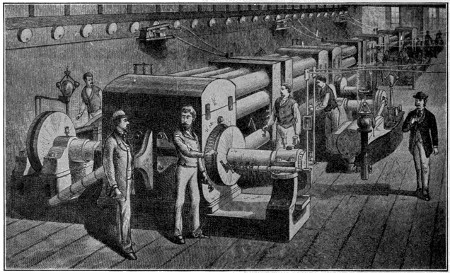
The Dynamo Room of the First Edison Electric Lighting Station in New York
September 4th saw a full 400 lamps turned on from the Pearl Street station. From that day on the station supplied current continuously until 1895, with but two brief interruptions. One of these happened in 1883 and lasted three hours. The other resulted from the serious fire of January 2, 1890, and lasted less than half a day. The record in the second case would appear astounding, as no less a handicap occurred than the burning down of the station itself. The situation was saved, however, by the presence of an auxiliary plant that had already been opened on Liberty Street.
Edison as a Central Station Pioneer.
The layman, while appreciating the tremendous advance in generating machinery since the early eighties, is surprised to learn that the great Edison system of today is conducted upon principles that Edison developed and put into practice at that time. Edison’s, in truth, was the master mind, the forming spirit of all the advances made in the seventies and eighties. Exceedingly much, on the other hand, is due the energy of his fellow workers, many of whom figure conspicuously in the country’s electrical affairs at present.
Courtesy of Indiana Steel Co.
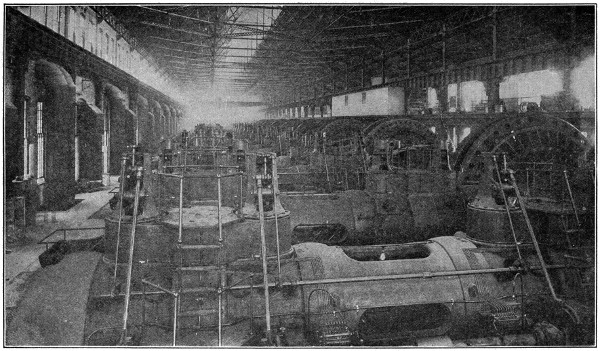
Electric Power Station
The seventeen great gas engines are operated by gas from the blast furnaces which was formerly allowed to escape. Each engine drives a 2,500-kilowatt dynamo.
In this manner Edison and his assistants became established in New York City. Current at first was supplied free to customers for approximately five months, which speaks quite as much for Edison’s Scotch “canniness” as for his inventive genius. Well before the period was over the new illuminant had justified itself, until today it shows itself an element indispensable in every phase of the country’s activity.
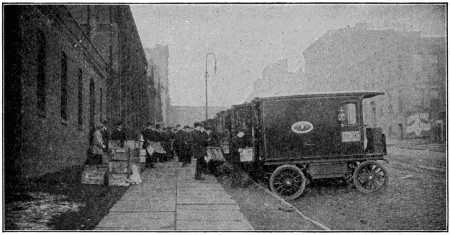
Electric Delivery Wagons Loading Edison Lamps
Early Growth.
Within two years from the opening of the station the demand for service had so increased that over one hundred applications were filed in excess of what could be accepted, because the plant was taxed already to its utmost capacity. Allusion has already been made to the auxiliary plant at Liberty Street, a station of 2,000 lights’ capacity which was instituted in 1886. By 1887, not only a second but a third district had been mapped out, the whole extending from Eighteenth to Forty-fifth Street. All the underground system in the two new districts was laid according to Edison’s new three-wire patent; and it was presently announced that customers would be supplied with power as well as with light.
Six months after the disastrous fire of 1890, in which the Pearl Street station was burned, the site was chosen for the Edison Duane Street building on which operations were so hastened that machines were installed and current turned on the first of May the following year.
The Waterside Stations.
For some time the need of a central generating plant had been apparent to all familiar with the company’s facilities and prospects. Already during the summer of 1898 an engineering commission had visited all the chief electrical stations of Europe and consulted the best-known experts of the industry, and in 1902 the first waterside station in New York was opened upon a site bordering the East River between Thirty-eighth and Thirty-ninth Streets. The new operating room contained sixteen vertical engines with a capacity each of over 5,000 horse-power. From these current was generated by 3,500 kilowatt generators and sent out to the various distributing centers.
As a very natural consequence of such development, the company by 1902 had 420 miles of underground system supplying installation amounting to 1,928,090 fifty-watt equivalents.
Electricity a Living Factor.
To talk about electrical development in terms of power consumed tells but one side of the story. More impressive even than figures are the immense number of uses to which electricity is put. Electric lighting, introduced in 1882, has become practically the standard for illumination, not only here, but for the entire civilized world.
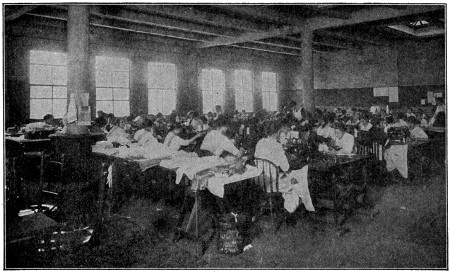
Electric Sewing Machines in the Manhattan Trade School
In the Printing Trade.
Electric power was introduced, timidly, by way of a few fans in 1884 and following this, in 1888, motor drive for printing presses was undertaken. At the present moment in New York City there is hardly a printing establishment worthy the name that is not electrically operated throughout. Among the largest customers of the central station in New York City are the great daily newspapers, among them the Times, the World, the Sun, the Evening Post, and the American.
Construction.
Not only are passengers conveyed up and down by electric elevators in skyscrapers, but the buildings themselves are erected by means of electricity. Recent examples of such construction are the Woolworth and Equitable buildings in New York City; in this last instance a thousand horse-power was used in digging the foundations alone.
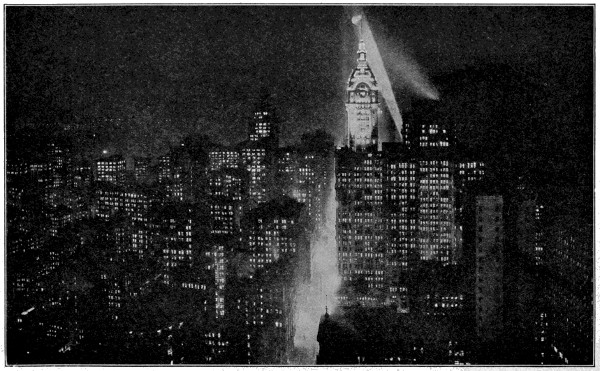
Photo by Brown Bros.
A Fairyland of Light
The canyon of lower Broadway, south from the Woolworth Building—a glorious miracle of light.
Not only are New York City’s subways operated by electricity; they were also built by electricity, a statement which applies to the new subways as well as the parts of the first system. In digging for the new Broadway subway, an electric company supplied 25,000 horse-power. The mammoth new aqueduct system by which water is carried from the Catskills to the Battery is another example of electricity as a source of power for large construction work. Still more picturesque is the use of electricity in building the under-river tubes. Indeed, it is doubtful whether this particular form of operation could have been carried on without the aid of electricity.
Loft Manufacturing.
Aside from these special instances of electricity in construction, one must think of electricity as responsible for nearly all the manufacturing, large and small, that goes on in the ever-increasing number of loft-buildings throughout all large cities. For example, New York City serves as the center of the garment-making industry for the entire country, there being fully a quarter of a million garment-trade workers in the Greater City. Along Fifth and Fourth Avenues are found the large establishments, electrically equipped throughout for cutting, stitching and pressing, while even in the smallest shops on the East Side foot-power machines have become almost a thing of the past.
Electric Heating.
The commercial use of electric heating is one of the more recent electrical developments. For the most part, this also applies to the garment trade and its closely allied clothing industries. In the modernly equipped factories one finds electric flat irons, velvet steamers and coffee urns. In the printing trade, electrically heated linotype melting pots are being introduced successfully, while glue-pots and sealing-wax melters can be seen in binderies and banking institutions. Absence of fire risk accounts for the introduction of electric heating units of different kinds into the motion-picture film manufacturing industry, a rapidly growing province. The same element of safety where inflammable substances are employed has produced the electric japan oven and similar apparatus.
Electricity and Safety.
The importance of electricity in factory work cannot be over-estimated. A shop fully equipped with electric machinery is the best possible kind of shop for employee as well as for the owner. Motor-driven machines are the safest possible kind, while absence of overhead shafting and dangerous belts mean health as well as security. In the electric shop, motor-driven blowers carry fumes and dust away from the worker and bring fresh air in. Electrically driven machinery is now regarded as the standard machinery. In the various vocational schools in New York City at present both boys and girls are taught to operate electrically driven machines, it being assumed that those will be what the pupils will be called upon to operate when they leave the school for the shop.
Electricity in Medicine.
Another domain of electric enterprise of the greatest value for the country at large is the increasing use of electricity in medicine. The most conspicuous element in this is the wide-spread acceptance of the X-ray as a necessary tool of the medical profession. Newspapers and magazines were full of the remarkable X-ray achievements of surgeons in charge of the various European war hospitals. Those, of course, were spectacular instances, but it should not be forgotten that every day, in our great hospitals, the X-ray is proving itself almost indispensable in the examination of the sick and injured. Besides utilizing X-ray in the diagnosis of disease, the rays themselves are employed in treatment of cancer and skin diseases. The oculist, the dentist, indeed medical specialists of all kinds, are coming to recognize the immense aid that electricity can give in its various forms and applications.
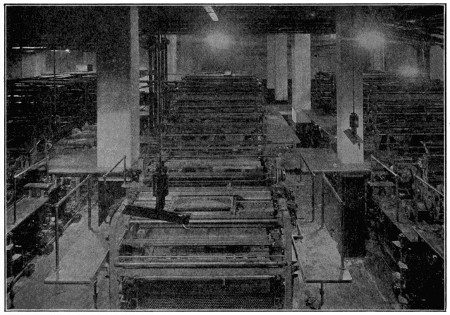
The Great Press Room of “The New York Times” is all Electrically Operated
Electric Vehicles.
The electric truck has already demonstrated itself as a safer and less expensive rival of the gasoline delivery truck in many kinds of service. In the boroughs of Manhattan and the Bronx alone, in New York City, there were more than 2,000 such trucks in operation in 1916. Counting both pleasure and business vehicles, the borough of Manhattan boasted about 2,500 storage-battery driven wagons in active use. It is rather interesting to note that Chicago operates many more electric pleasure cars than New York, while New York does far more of its business by means of the electric vehicle. Recently, there was established in New York an electric co-operative garage, the joint enterprise of the electric passenger car manufacturers and an electric company. It was believed that by providing proper and adequate facilities for garaging electric pleasure vehicles the use of passenger-electrics in New York City would be greatly increased.
Electricity and the Home.
In emphasizing the important part which electricity plays in the business of a great metropolis, the home should not be forgotten. It is now possible, by means of electric appliances, practically to eliminate all drudgery from housework. The use of many of these domestic machines is familiar to all: vacuum cleaners, washing machines, fans, and the more usual electric cooking devices. Within the next decade, one looks to see a remarkable advance in this direction. One anticipates the more extensive use of electric refrigeration and other electric labor-saving devices, to the great improvement of city homes, making them pleasanter and more healthy as toilsome operations are done away with. And it must not be forgotten that the city home, like the country home, is the backbone of the well-being of the community. Electricity can have no greater mission than improving, strengthening and upbuilding good homes.
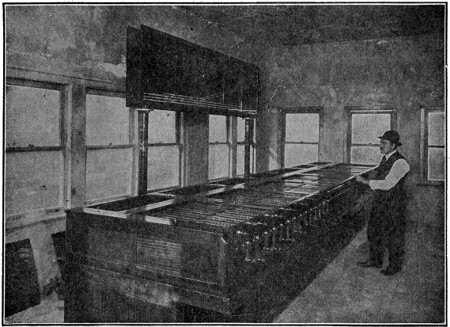
Electric Train Chart and Switch Control
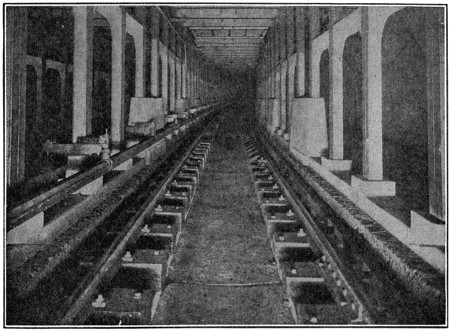
Subway Construction
In the upper view the electric chart on the wall facing the switch operator indicates the location of every train in the New York subway system at all times. The lower view shows typical subway construction for third rail train and surface cars. The material used is reinforced concrete.
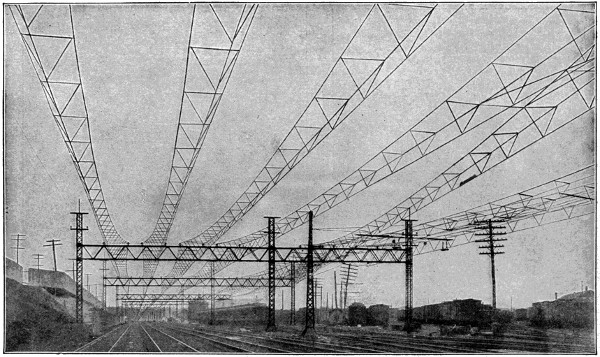
One Type of Electric Construction on Railroads
The system shown here is used upon the New York, New Haven and Hartford Railroad. It consists of pairs of wire cables supported by bridges placed about 300 feet apart. Rigid triangles of iron pipe are secured to these cables and the trolley wire attached to the triangles. The trolley wire is kept rigid and free from slack in this manner.
Decreased Cost of Electricity.
Closely akin to this is another electrical development most pleasing to consider. Years ago, electricity was considered the luxury of the rich. Now electric light is coming to be shed on rich and poor alike. Little by little the shops, factories and dwellings of more humble inhabitants are provided with electricity, so that cleanliness, safety and comfort are by no means confined even to the well-to-do or the more comfortable homes.
One great factor in this change has been the decreasing cost of electricity. Within the last decade, the cost of almost all necessities of life has ascended with leaps and bounds, so that a dollar now, expended in ordinary household goods, will purchase hardly more than what thirty cents would in 1890. But all this while, the cost of electricity has steadily decreased. With centralized generating plants, improved machinery and better lamps, one dollar today will buy eighteen times as much electric light as it would in 1884. With such facts before us, it is fairly easy to predict the still further electrical development of all important centers. There will be more and better light in homes; there will be more and better light in offices and factories, thus greatly lessening the chances for injury or eye-strain. In all industry, great and small, laborious hand processes will be replaced by safely operated electric machinery, while wider use of electric labor-saving appliances will extend into the home.
Hospitals, by aid of electricity, will be able to increase still more their splendid work for the relief of suffering, while cleaner and safer ways of living will serve as a preventive of disease. One can easily say that with increasing electrical development the country will come to be still greater, a country where electricity shall provide for the safety and well-being of all its people.
How is Die-Sinking Done?
Die-sinking is the art of preparing dies for stamping coins, buttons, medallions, jewelry, fittings, etc. The steel for the manufacture of dies is carefully selected, forged at a high heat into the rough die, softened by careful annealing, and then handed over to the engraver. After the engraver has worked out the design in intaglio the die is put through the operation of hardening, after which, being cleaned and polished, it is called a “matrix.” This is not, however, generally employed in multiplying impressions, but is used for making a “punch” or steel impression for relief. For this purpose another block of steel of the same quality is selected, and, being carefully annealed or softened, is compressed by proper machinery upon the matrix until it receives the impression. When this process is complete the impression is retouched by the engraver, and hardened and collared like the matrix. Any number of dies may now be made from this punch by impressing upon it plugs of soft steel.