The Story in the Making of a Picture[10]
Reading edition
The Story in the Making of a Picture[10]
Let us suppose, for the purposes of explanation, that as far as seeing goes, any object is made up of countless infinitesimal points of light, and that the business of the eye is to gather them in and spread them out at the back of the eye in exactly the same relation they bore to each other on the object. The points of light, so duplicated, would thus form the image of the object.
The camera works very much the same way. The lens at the front of the camera is the eye, and the plate or film at the back of the camera corresponds to the back of the eye. The lens collects all the points of light of the object we wish to photograph, and directs them to the plate or film in such fashion that they occupy exactly the same relative position that they did before. An image of the object is formed.
Now if we could look inside the camera and the image were visible, we would see that it was upside down. The reason for this is very simple, as the accompanying diagram shows. The ray of light from “A” at the bottom of the object passes through the lens at an angle, and continues in a straight line until interrupted by the film or plate. It started at the bottom of the object and ended at the top of the image. The position of all the points of light is just reversed, although their relative position remains the same.
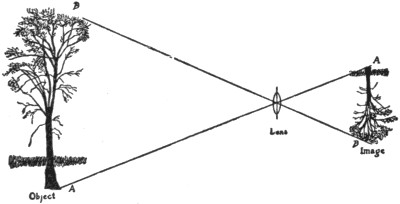
Showing Inversion of the Image
“Then here,” you say, “is where your analogy between the camera and the eye falls down.”
Not at all. It is true that we do not see things upside down, but this is because of mental readjustment during the passage of the impressions from the eye to the brain.
Now let us suppose that we have our camera loaded with film, and that mother has succeeded in keeping the baby quiet long enough for us to uncover the lens for an instant and let the points of light through to the film. The next question is, how are we going to make the resulting image permanent. We know that it is there, but in its present state it is not going to do us a great deal of good. In fact, if we should peek in the back of the camera, and to do so would ruin the exposure, we could not even see it.
But let us go back a bit. We ought to know a little something about the composition of this film on which the image has been projected.
In brief, film is a cellulose base coated with silver bromide and gelatine. If we were using a plate the only difference would be that instead of cellulose as a base we would have a sheet of glass. The gelatine is there to afford lodgment to this sensitized silver. The silver, being sensitive to the action of light, is there to record the image. As soon as one of these silver particles has been touched by light, it becomes imbued with the power of holding whatever the lens has transmitted to it. The image was formed, we remember, by points of light grouped in the same relative positions as the points of light of the object we were photographing. Consequently it is only those silver particles within the image-forming area that are affected, because that is where the light struck.
The lens, then, gathered in the points of light and dispersed them on the film so as to form an image. The silver particles held this image, but not visibly—it is a latent image, and it is the purpose of development to bring it out.
It is the particular business of a chemical called “pyro” to release this latent image. When attacked by pyro, those silver bromide particles which have been affected by light—and only those—change to black metallic silver. After all the silver bromide particles, the ones that held the image, have been transformed into metallic silver, another chemical called “hypo” effectively disposes of all the silver bromide that was not affected by light. Now only the image-forming silver bromide particles remain, and these have been transformed to metallic silver. The result is a permanent image—a negative.
But it is a negative, so called because everything in it is reversed—not only from left to right, but in the details of the image. Mother’s dark blue gown looks light, for example, and baby’s white dress, dark.
To get our picture as it should be, we must place the negative in contact with a sheet of paper coated with a gelatine containing silver. This emulsion, as the coating is called, is, as we might readily infer from the presence of the silver, sensitive to the action of light in much the same manner as was the original film. We place the negative and paper in contact, then, in what is called a printing frame, so that light may shine through the negative and impress the image on the sensitive paper. It is obvious that the light parts of the negative will let through the most light, and that consequently the silver emulsion on the paper underneath will be most blackened, while the dark parts will hold back the light and the emulsion on the paper underneath will be less affected. In other words, the very faults that we noted in the negative, from a picture point of view, automatically right themselves. Mother’s dress looks dark and baby’s dress white—just as the lens saw it.
We then have the picture in its finished form.
The story of the making of the camera is as interesting as that of the making of the pictures by the camera.
Back in 1732, J. H. Schulze discovered that chloride of silver was darkened by light and all unwittingly became the father of photography. In 1737, Hellot, of Paris, stumbled on the fact that characters written with a pen dipped in a solution of silver nitrate would be invisible, until exposure to light, when they would blacken and become perfectly legible. However, it was not until early in the nineteenth century that these two discoveries were put to any practical use, as far as photography was concerned.
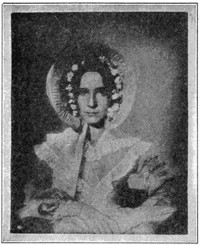
Artotype Copy of the Earliest Sunlight Picture of a Human Face
Miss Dorothy Catherine Draper, taken by her brother, Prof. John W. Draper, M.D., LL.D., in 1840.
People of an artistic turn of mind had been in the habit of making what were called “silhouettes.” The sitter was so posed that the light from a lamp threw the profile of his face in sharp shadow against a white screen. It was then easy enough to obtain a fairly accurate silhouette, by either outlining the profile or cutting it out from the screen.
It occurred to a man by the name of Wedgwood that this profile might be printed on the screen by using paper treated with silver nitrate, and he not only succeeded in accomplishing this, but also in perfecting what was then called the “camera obscura,” the forerunner of the kodak of today. The camera obscura consisted of a box with a lens at one end and a ground glass at the other, just like a modern camera. It was used by artists who found that by observing the picture on the ground glass they could draw it more easily. Wedgwood tried to make pictures by substituting his prepared paper for the ground glass, but the paper was too insensitive to obtain any result. Sir Humphrey Davy, continuing Wedgwood’s experiments, and using chloride of silver instead of nitrate, succeeded in making photographs through a microscope, by using sunlight. These were the first pictures made by means of a lens on a photographic material. But none of these pictures were permanent, and it was not until 1839 that Sir John Herschel found that “hypo,” which he had himself discovered in 1819, would enable him to “fix” the picture and make it permanent.
At about this time, Daguerre announced discoveries that gave photography at least a momentary impetus, but the Daguerre process did not long survive, as it was slow, costly and troublesome. The daguerreotype was made on a thin sheet of copper, silver plated on one side, polished to a high degree of brilliancy, and made sensitive by exposing it to the fumes of iodine. The first daguerreotype made in America, that of Miss Catherine Draper, was exposed for six minutes in strong sunlight, and the face of the sitter thickly powdered, to facilitate the exposure. An exposure today with a modern camera, under similar conditions, could be made in 1⁄1000 of a second.
It was impossible, of course, to find many sitters as patient as Miss Draper—try keeping perfectly quiet for even a minute if you would know why Miss Draper should be ranked as a photographic martyr—and many experiments were made in an attempt to materially shorten the time of exposure. The only real solution, of course, was to find some method where the light had to do only a little of the work, leaving the production of the image itself to chemical action.
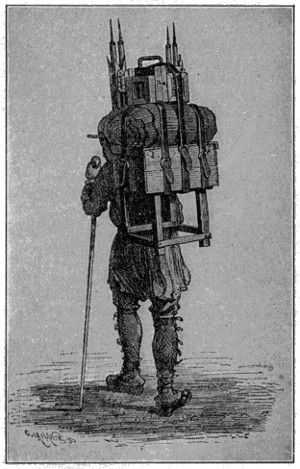
Old-Fashioned Photographic Equipment
The first great step in this direction was taken by Fox Talbot in 1841. He found, that if he prepared a sheet of paper with silver iodide and exposed it in the camera, he got only a very faint image, but if, after exposure, he washed over the paper with a solution of silver nitrate and gallic acid, the faint image was built up into a strong picture. And not only was Fox Talbot the first to develop a faint or invisible image; he was also the first to make a negative and use it for printing.
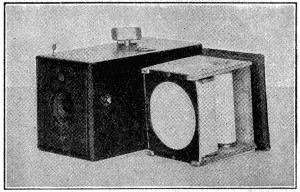
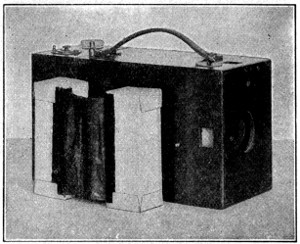
The First Kodak (1888), Showing Roll Holder and Roll Film for 100 Exposures The First Daylight Loading Method
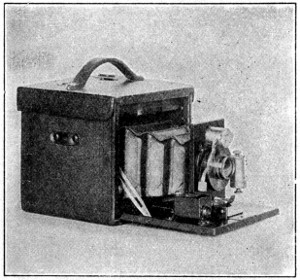
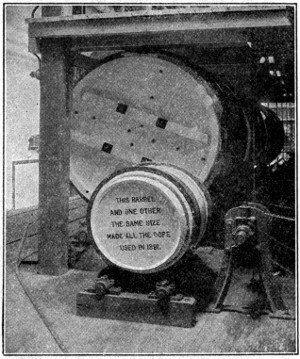
The First “Folding Kodak” Fitted for Plates or Roll Film “Dope” Barrel
In spite of all these advances, photography was almost exclusively a studio proposition, when, in 1880, experiments were begun which were to result in photography that could be universally enjoyed—photography as we know it today. Of course there were amateurs even in those early photographic days, but they were few and far between. There was something about the bulk and weight of the old-time photographic outfit that failed to beget general enthusiasm.
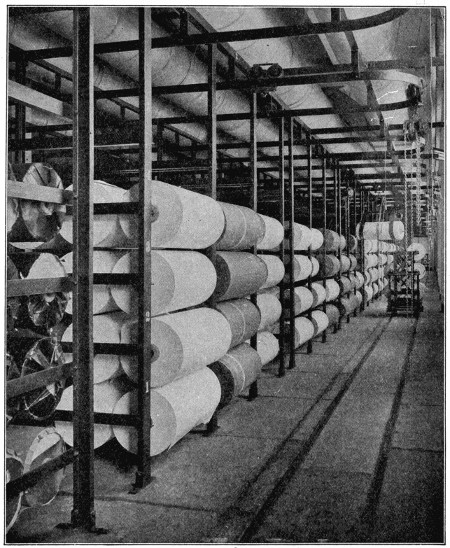
Raw Stock Rolls, Kodak Park
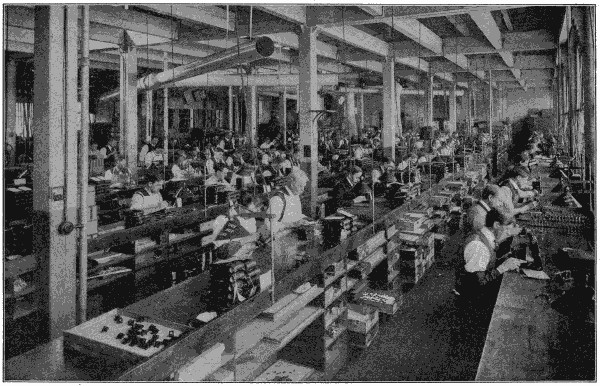
Assembling Room, Camera Works
To lighten the camera burden, and to simplify the various photographic processes, were the problems that confronted the American inventor. The first step toward film photography—and it was film photography that relegated camera bulk to the scrap heap—was a roll film made of coated paper to which a sensitive emulsion was applied, but the real goal was reached when cellulose was substituted as a film base. This made practicable the present flexible, transparent film with its attendant convenience and dependability.
The kodak was the natural outcome of the roll film system. The first one appeared in 1888, and its development, which proceeded simultaneously with the film discoveries, soon reached the point where the loading and unloading could be done in daylight. Daylight developing soon followed, and the dark room, as far as the kodaker was concerned, took its proper place as a relic of the dark ages.
With 1914 came autographic photography, so that now with a kodak in one pocket and a handful of film in the other, the amateur is equipped for a picture-making tour of the world—not simply a pictorial record, but a written record as well, for autographic photography permits the dating and titling of each negative directly after exposure.
Photography, not so many years ago an exclusive pleasure for the few, is now easy fun for millions.
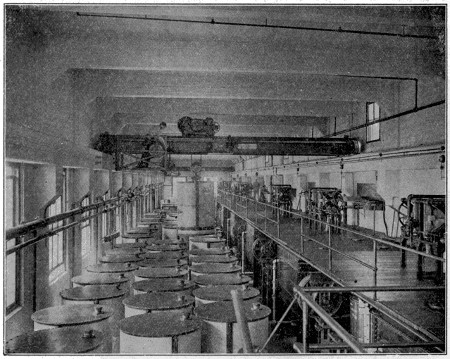
Filter Room, Kodak Park
Cellulose Acetate Manufacturing
How Deep is the Deepest Part of the Ocean?
Man has not been able to tell definitely just what the greatest depth of the ocean is, because it would be a practically unending task to go over every bit of it to take measurements. A great many exploring expeditions have been sent out to determine that interesting information so far as possible, however, and one of these, the Murray-Challenger expedition, has reported that the greatest depth that could be found in the Atlantic Ocean is 27,366 feet, in the Pacific Ocean 30,000 feet, in the Indian Ocean 18,582 feet, in the Southern Ocean 25,200 feet and in the Arctic Ocean 9,000 feet. They also stated that the Atlantic Ocean has an area in square miles, of 24,536,000; the Pacific Ocean, 50,309,000; the Indian Ocean, 17,084,000; the Southern Ocean, 30,592,000 and the Arctic Ocean, 4,781,000.
Why do We Say “Get the Sack”?
The use of the expression “get the sack,” when we mean “to be discharged,” originated through the impression made upon people in this country when stories were brought to them of the way the Sultan of Turkey disposed of members of his harem of whom he had tired. When he wanted to get rid of one of his harem he was said to have had her put into a sack and thrown into the Bosporus. People who heard of this report repeated it to others and they became so used to telling the tale that they slipped quite naturally into the habit of saying “to get the sack” when they meant that they expected to be put out of a position suddenly.
In very much the same way the phrase “Hobson’s choice” is supposed to have resulted from the story told here of a livery-stable keeper at Cambridge, England, called Hobson, who obliged each customer to take the horse nearest the stable door, when a wish to hire one was expressed, even though he might permit customers to make the rounds of all the stalls, examining and perhaps selecting other horses. Since the interest inspired by that report, “Hobson’s choice” has come to mean a choice without any alternative, or the chance to take the thing which is offered or nothing.
Why do We Call Them X-Rays?
At the time the discovery of X-rays was announced by Prof. Wilhelm Conrad Röntgen of the University of Würzburg, Germany, he was not sure of their exact nature, and so he named them “X-Rays,” because “X” has always been understood to be the symbol for an “unknown quantity.”
They are invisible rays transmitted through the air in a manner similar to light. They are produced by passing unidirectional electric current of from twenty to one hundred thousand volts pressure through a specially constructed high vacuum tube, within which rays radiating from the surface of a concave cathode (the negative electrode of a galvanic battery), are focused upon and bombard a target of refractory material such as tungsten, iridium, platinum, from which focus spot the X-rays radiate in all directions.
They are used in medicine and surgery, to photograph the skeleton and all the internal organs of the human body, as an aid in diagnosis; also to destroy diseased tissue without the aid of surgery. Cancers and tumors of certain kinds and a number of skin diseases are said to be made to disappear by their use. When the apparatus is used, the subject is placed on a long table and the X-ray tube, in its lead glass shield container, is brought over the part of the body to which the rays are to be applied.
The most up-to-date apparatus consists of a high-tension transformer and rectifier, driven by a rotary converter, which derives power from direct-current electric service and delivers alternating current to the high-tension transformer.
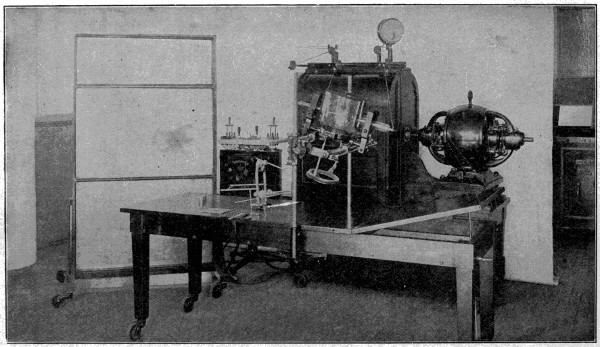
Modern X-Ray Apparatus
How did the Term “Yankee” Originate?
Although some people maintain that the word “Yankee” originated with the way white men interpreted the Indians’ name for the early settlers, most of those who have wondered about it have decided that it came to be used as a nickname for persons born in the United States, because of a farmer, named Jonathan Hastings and living in Cambridge, Massachusetts, in the eighteenth century, using it to describe some good, home-made cider of his making, as “Yankee cider.” The word was taken up by the students of Harvard University, and gradually spread throughout the whole country.
Why do We Say “Kick the Bucket”?
A great many years ago a man called Bolsover became crazed by some unhappy experiences and decided to kill himself by fastening a rope around his neck and hanging from a cross-beam overhead. In selecting a place to tie the rope high enough to accomplish his purpose he found that he would have to stand on something in order to reach it, and so he reached for the nearest thing, which happened to be a bucket; after the rope was firmly adjusted he kicked the bucket out from under his feet and his full weight hung suspended from the rope about his neck. The publicity given his act resulted in the adoption of the phrase “to kick the bucket” as meaning “to die,” and that is the explanation which most people who have tried to look up the origination of the term give as its first use.
When does a Tortoise Move Quickly?
Tortoises lay their eggs in underground nests, where they remain for almost a year, and, strange to say, they have a very curious way of drilling holes for these nests with their tails. A tortoise picks a spot where the earth is bare, and then stiffens its tail by contracting the muscles strongly, placing the tip firmly against the ground and boring a hole by moving it round and round in a circle, until a cone-shaped cavity is produced, wide at the top but tapering to a point below. When this operation is completed, it immediately sets to work to enlarge the hole with the help of its hind legs. It does this by scooping out “shovelfuls” of dirt, first with one of its hind feet and then with the other, and heaping it up like the wall of a fortress around the pit. Tortoises use their feet like hands when they do this, very carefully placing the dirt in a circle at some little distance from the edge of the cavity, and the work is continued until the hole is dug down as deep as the hind legs will reach. When it finds that no more soil can be removed, that is, at the end of an hour or more of steady digging, the tortoise accepts the job as completed and proceeds to deposit its eggs inside very carefully, just as you would put hen’s eggs into a basket. While all this is going on the body is scarcely moved and the head is kept inside the shell.
There are usually nine eggs and they just about fill the bottom of the nest, which measures approximately five inches across and is itself shaped more or less like an egg, being wider inside than at the top. After about half an hour’s rest, the hardest part of the work is begun—that of filling up the hole and leveling the ground. The dirt is placed carefully over the eggs, a “handful” at a time, the hind legs being used alternately again for that purpose. As the cavity is gradually filled up the tortoise presses the earth down with the outer edge of its foot. It takes another half hour’s rest after all the dirt has been carried back again, and then commences the part of the operation where the tortoise moves quickly enough to merit another racing title. It beats down the dirt-mound and stamps it firm and flat with the under side of its hard shell, raising the hind end of its body and then hurriedly letting it drop to the ground again, turning round and round in a circle very briskly in the meantime, at the same time doing all it can to remove any traces which might lead to the discovery of its nest.