The Story in the Making of a Pair of Shoes[46]
Reading edition
The Story in the Making of a Pair of Shoes[46]
The covering and protection of the feet has been a necessity in all but the warm climates for very many centuries, various articles being used for this purpose. Leather is now very generally employed, though wood is often used in Holland and France and paper in China and Japan. The moccasin of the American Indian was made of untanned deer skin. The first historical mention of a shoe is in the Old Testament, where Abraham refused to take as much as a “shoe-latchet” from the King of Sodom. This probably meant a sandal, leather strapped to the foot, though the Jews wore shoes as well, and both shoes and sandals were worn in Greece and Rome. Both in ancient and modern times the styles of shoes worn have varied greatly, fashion taking hold of them. In the reigns of the English kings Henry I and Stephen, the people of the court wore shoes with long points stuffed with tow and made to coil like a ram’s horn, and by the time of Richard II the points had grown so long as to reach the knee, to which they were fastened by silver or gold chains. In the eighteenth century ladies wore shoes with absurdly high heels, a ridiculous fashion which has come back within our own times. An improvement which was adopted in the early nineteenth century was that of making shoes right and left. Boots, which have at times been much worn, are a variety of shoe lengthened to protect part of the legs.
Until within a recent period the trade of shoemaker was an active one, all boots and shoes being made by hand. At the present time, however, the old-time shoemaker, with his bench, lapstone, last and awls has almost gone out of business, except as a cobbler, mending instead of making having become his usual occupation. In his place has come the factory hand, nearly all footwear being now a product of machinery, and this of greatly varied and effective character. In this form shoemaking has become a thriving industry in New England and in some other parts of the United States. This method has greatly decreased the cost of shoes, invention having so hastened and cheapened all its processes that the number of shoes that it would take an old-time shoemaker a year to make can be turned out in a few hours by modern machinery.
Shoemaking by Machine.
The variety of inventions used in shoe factories is rather bewildering, every one of the many processes having a machine of its own, and each of these doing its work with admirable precision. We can name here only the more important of these implements.
First comes the clicking machine. This has a cutting board resembling that used by the hand workmen. Over this is a beam containing a cutting die under which the leather is passed. At every descent of the die a piece of leather is cut out of the skin of the size and shape needed for the upper leather of a shoe. Thus in an instant is done what was slowly done by a sharp knife moved around a pattern in the old method.
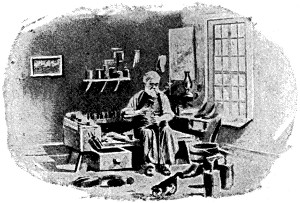
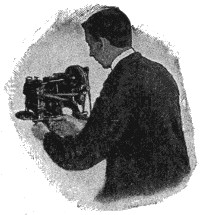
In the Days of the Awl, Lapstone and Hammer Amazeen Skiving Machine
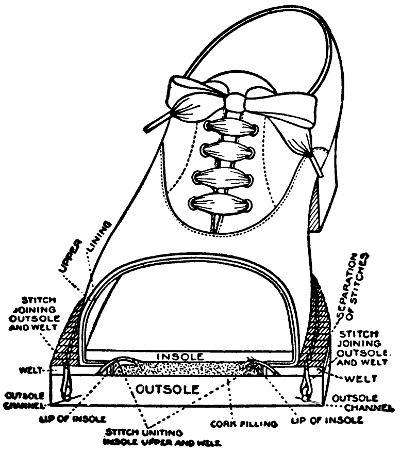
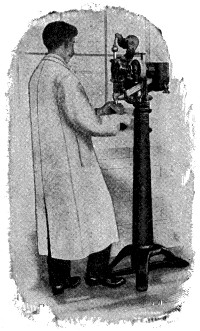
Cross-Section of Goodyear Welt Shoe, Showing the Different Parts and their Relation to Each Other Insole Tacking Machine
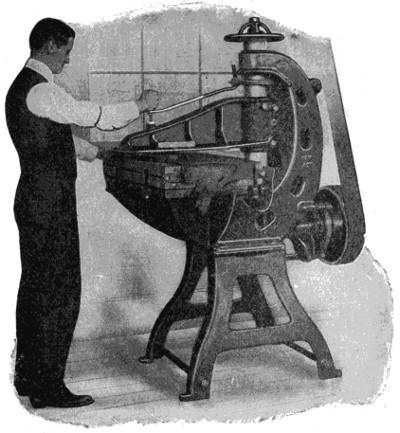
Ideal Clicking Machine
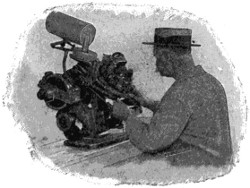
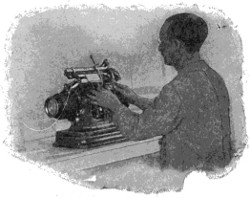
Duplex Eyeleting Machine Ensign Lacing Machine
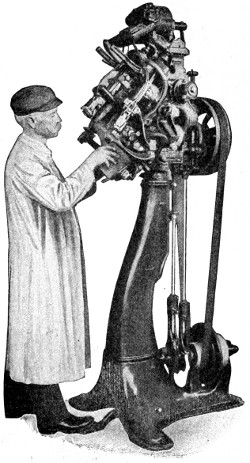
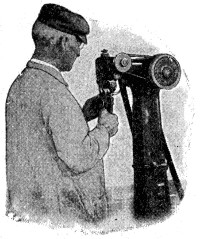
Rex Upper Trimming Machine
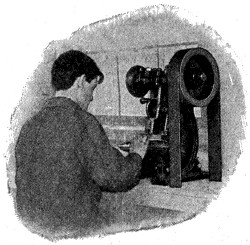
Rex Pulling-Over Machine Crown Tip Punching Machine
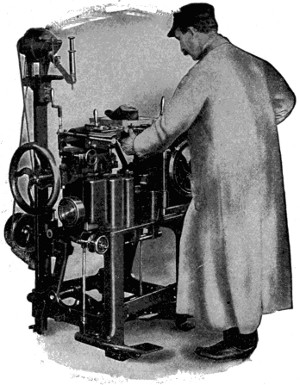
Bed Lasting Machine
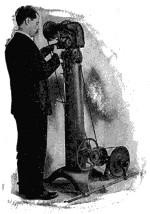
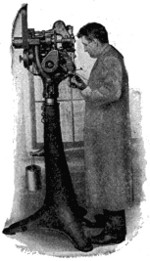
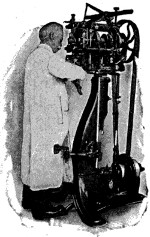
Goodyear Universal Inseam Trimming Machine Tack-Pulling and Resetting Machine Consolidated Hand Method Welt Lasting Machine
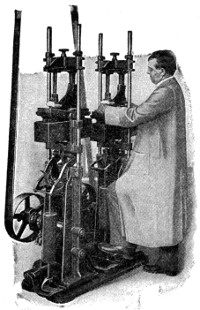
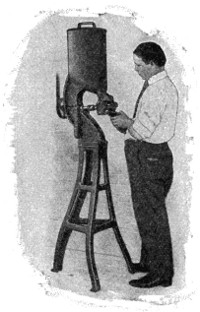
Improved Sole Laying Machine Star Channel Cementing Machine
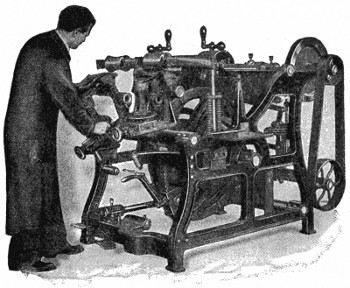
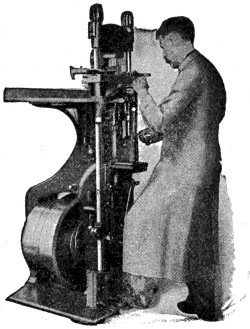
Goodyear Automatic Sole Leveling Machine American Lightning Nailing Machine
The piece of leather thus cut out is next passed under the skiving machine, which shaves down its edges to a bevel, the thinned edge being then folded, after which the toe caps are passed through a punching machine which cuts a series of ornamental perforations along the edge of the cap. The linings of the shoe are then prepared and put in place and the whole goes to the stitchers, by which all the parts of the upper are united. This is done by a range of machines, which perform the varied operations with wonderful rapidity and accuracy. The eyelets are next added by a machine which places them in both sides of the shoe at the same time and directly opposite each other, this operation finishing the upper part of the shoe.
The sole leather portions of the shoe pass through another series of machines, being cut from sides of sole leather by the dieing-out machine, cut to exact shape by the rounding machine and to exact thickness by the splitting machine, and then toughened by passing under a heavy rolling machine. These and other machines complete the soles and heels, which are finally sent to the making or bottoming room, where the completed shoe uppers await them.
The first process here is that of the ensign lacing machine, which puts a strong twine through the eyelets and ties it in an accurate manner. This is done very swiftly and exactly, its purpose being to hold the parts of the shoe in their normal position while the shoe is being completed. The last, made of wood, is now put in place and tacked fast by the insole tacking machine, when the upper is placed over it and fastened by two tacks to hold it in place. Then comes the pulling-over machine, the pincers of which draw the leather securely against the wood of the last, to which it is fastened by other tacks. These tacks in the upper are driven only part way in, so that they may be easily drawn out when no longer needed.
The welt lasting machine next takes the job in hand, it being almost human-like in the evenness and tightness with which it draws the leather around the last, other tacks being driven partly in to hold it in place. A second lasting machine of different kind, draws it around the toe and heel. Then comes the upper trimming machines, which cuts away the surplus parts of the leather, the Rex pounding machine, which hammers it around the heel, the tack pulling machine which removes the lasting tacks and puts in others to hold the new placed leather, and the upper stapling machine, which forms a little staple fastening from wire which securely holds the shoe upper to the channel lip of the insole.
The shoe is now ready to receive the welt, a narrow strip of prepared leather which is sewed along the edge of the shoe and holds all its parts firmly together. This used to be one of the most difficult tasks in hand-work, but is done rapidly and exactly by this machine. After this all protruding parts of the welt and upper are trimmed off by another machine, the insole tack pulling machine removes all the remaining temporary tacks, and the welt-beating and slashing machines beat the welt with little hammers till it stands out evenly from the side of the shoe.
It may seem as if the number of machines engaged in this work are almost beyond number, but there are nearly as many more to come. In fact, a factory shoe in many cases is not completed until 170 machines and 210 pairs of hands have taken part in putting it together and getting it into shape for the wearer, and each of these machines works with an accuracy which no hand-work can equal. We have so far witnessed the assembling of the several parts of the shoe into one connected whole. The remaining processes must be run over more rapidly.
There is a sole-laying machine, a rounding and channeling machine, a loose nailing machine (the latter driving nails into the heel at the rate of 350 per minute), a heel seat rounding machine, and various others, one sewing the welt to the shoe, a leveling machine, a second nailing machine, which does the final work of attaching the heel to the shoe, and so on somewhat indefinitely.
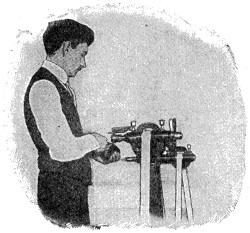
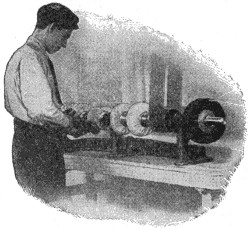
Edge Trimming Machine Climax Finishing Shaft
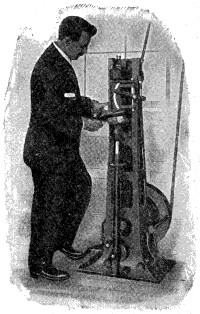
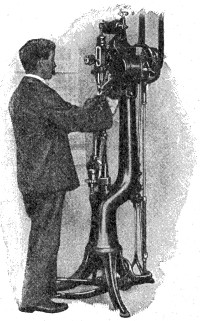
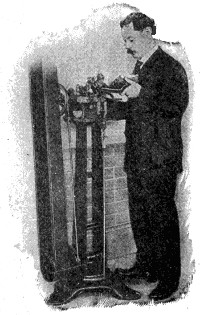
Goodyear Heel Seat Rounding Machine Loose Nailing Machine The Hadaway Stitch Separating Machine
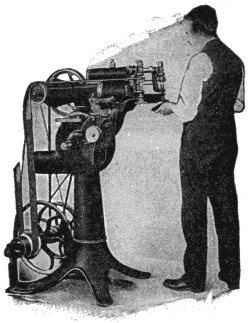
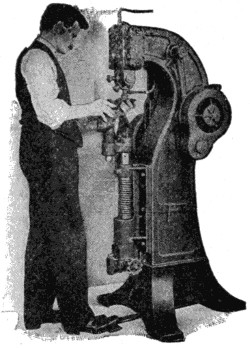
Naumkeag Buffing Machine Regent Stamping Machine
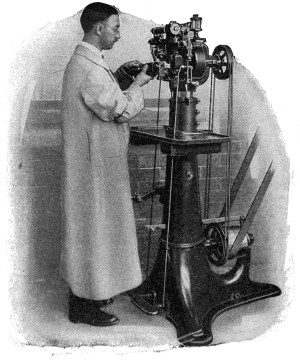
Goodyear Universal Rounding and Channeling Machine
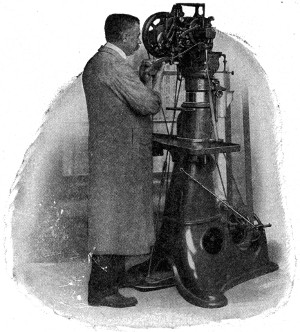
Goodyear Welt and Turn Shoe Machine
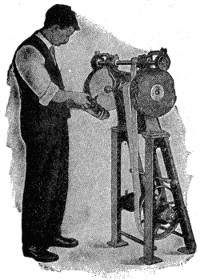
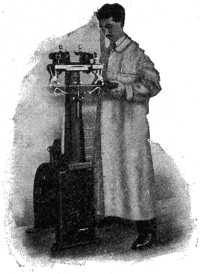
Stitch and Upper Cleaning Machine Twin Edge Setting Machine
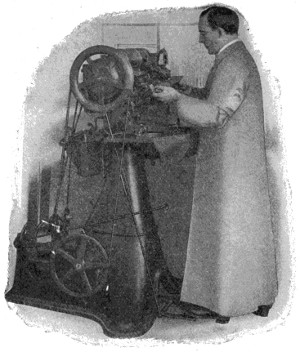
Goodyear Outsole Rapid Lockstitch Machine
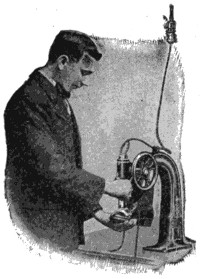
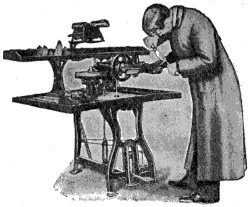
Improved Vamp Creasing Machine Miller Shoe Treeing Machine
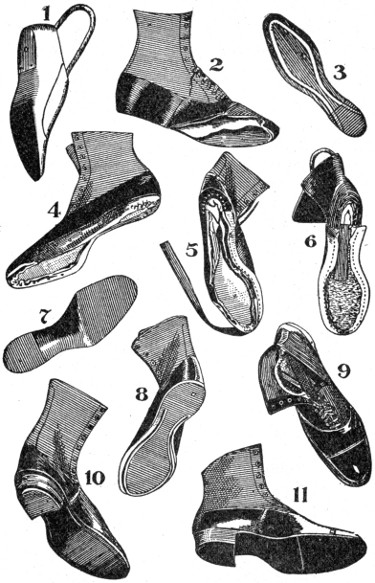
The Evolution of a Goodyear Welt Shoe
1. A last. 2. An upper. 3. An Insole. 4. Shoe lasted and ready to have welt sewed on. 5. Welt partly sewed on. 6. Welt entirely sewed on the shoe. 7. An outsole. 8. Shoe with outsole laid and rounded; channel lip turned up ready to be stitched. 9. Shoe with sole stitched on. 10. Shoe with heel in place. 11. Heel trimmed and shoe ready for finishing.
The remaining machines have to do with the final finishing. They include trimmers, stitch separators, edge setters, buffers, finishers, cleaners, stampers, shoe treers, creasers, etc., each playing a part of some importance in giving a final finish to the shoe and making it presentable to the wearer. The whole operation, as will be seen, is a highly complicated one, and is remarkably effective in preparing an article that shall appeal to the salesman and purchaser and prove satisfactory when put into use.
Such is the complicated process of making a shoe by machinery. It would be hard to find any machine process that surpasses it in complexity and the number of separate machines involved. Poor old St. Crispin would certainly expire with envy if he could see his favorite thus taken out of the hands of his artisans and the shoe whirled rapidly through a host of odd but effective contrivances on the way to become made fit for wear.
What is “Standard Gold”?
Gold is one of the heaviest of the metals, and not being liable to be injured by exposure to the air, it is well fitted to be used as coin. Its ductility and malleability are very remarkable. It may be beaten into leaves so exceedingly thin that one grain in weight will cover fifty-six square inches, such leaves having the thickness of only 1⁄282000th part of an inch. It is also extremely ductile; a single grain may be drawn into a wire 500 feet long, and an ounce of gold covering a silver wire is capable of being extended upwards of 1,300 miles. It may also be melted and remelted with scarcely any diminution of its quantity. It is soluble in nitromuriatic acid and in a solution of chlorine. Its specific gravity is 19.3, so that it is about nineteen times heavier than water. The fineness of gold is estimated by carats, pure gold being twenty-four carats fine.
Jeweler’s gold is usually a mixture of gold and copper in the proportions of three-fourths of pure gold with one-fourth of copper. Gold is seldom used for any purpose in a state of perfect purity on account of its softness, but is combined with some other metal to render it harder. Standard gold, or the alloy used for the gold coinage of Britain, consists of twenty-two parts of gold and two of copper (being thus twenty-two carats fine).
Articles of jewelry in gold are made of every degree of fineness up to eighteen carats, i. e., eighteen parts of gold to six of alloy. The alloy of gold and silver is found already formed in nature, and is that most generally known. It is distinguishable from that of copper by possessing a paler yellow than pure gold, while the copper alloy has a color bordering upon reddish yellow. Palladium, rhodium and tellurium are also met with as alloys of gold.
Gold has been found in smaller or larger quantities in nearly all parts of the world. It is commonly found in reefs or veins among quartz, and in alluvial deposits; it is separated, in the former case, by quarrying, crushing, washing and treatment with mercury. The rock is crushed by machinery and then treated with mercury, which dissolves the gold, forming a liquid amalgam; after which the mercury is volatilized, and the gold left behind; or the crushed ore is fused with metallic lead, which dissolves out the gold, the lead being afterwards separated by the process of cupellation.
By the “cyanide process,” in which cyanide of potassium is used as a solvent for the gold, low-grade ores can be profitably worked. In alluvial deposits it is extracted by washing, in dust grains, laminæ or nuggets.
In modern times large supplies of gold were obtained after the discovery of America from Peru, Bolivia, and other parts of the New World. Till the discovery of gold in California, a chief source of the supply was the Ural Mountains in Russia. An immense increase in the total production of gold throughout the world was caused by the discovery of gold in California in 1848, and that of the equally rich gold fields of Australia in 1851. The yield from both sources has considerably decreased. Other sections of the United States have of late years proved prolific sources of gold, especially Colorado, which now surpasses California in yield, and Alaska, which equals it. Canada has gold fields in several localities, the richest being those of the Klondike.
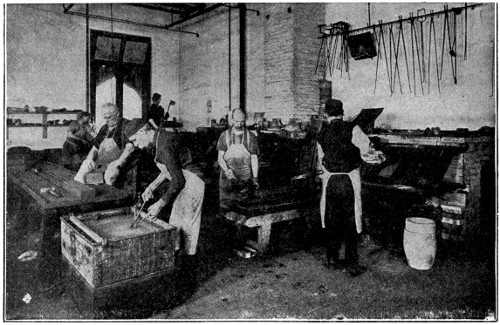
Casting Ingots
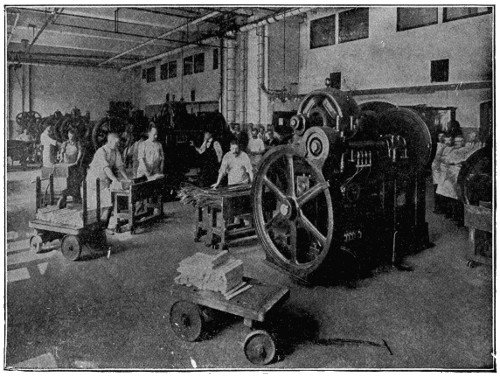
Rolling Room
The upper view shows the melting room in the United States Mint, Philadelphia. The man at the right is about to pour hot metal into the iron molds. The lower view is in the coining department, where the ingots such as are seen on the truck in foreground, are rolled into long strips of the thickness of the several coins, and then cut into blanks or planchets.
At present the richest gold field in the world is that of South Africa, which yielded in 1910 a value of $175,000,000, somewhat exceeding the combined yield of the United States and Australia. Russia and Mexico followed these in yield. The total production throughout the world amounted to over $450,000,000, of which the United States produced $96,000,000.
What are Cyclones?
A cyclone is a circular or rotatory storm, or system of winds, varying from 50 to 500 miles in diameter, revolving around a center, which advances at a rate that may be as high as forty miles an hour, and towards which the winds tend.
Cyclones of greatest violence occur within the tropics, and they revolve in opposite directions in the two hemispheres—in the southern with, and in the northern against, the hands of a watch—in consequence of which, and the progression of the center, the strength of the storm in the northern hemisphere is greater on the south of the line of progression and smaller on the north than it would if the center were stationary, the case being reversed in the southern hemisphere.
An anti-cyclone is a storm of opposite character, the general tendency of the winds in it being away from the center, while it also shifts within comparatively small limits. Cyclones are preceded by a singular calm and a great fall of the barometer.
What Metals can be Drawn into Wire Best?
The wire-drawing of metals depends on the property of solid bodies, which renders them capable of being extended without any separation of their parts, while their thickness is diminished. This property is called “ductility.”
The following is nearly the order of ductility of the metals which possess the property in the highest degree, that of the first mentioned being the greatest: gold, silver, platinum, iron, copper, zinc, tin, lead, nickel, palladium, cadmium.
Dr. Wollaston succeeded in obtaining a wire of platinum only 1⁄30000th of an inch in diameter. The ductility of glass at high temperatures seems to be unlimited, while its flexibility increases in proportion to the fineness to which its threads are drawn.
How are Cocoanuts Used to Help Our Warships?
The fibrous husks of cocoanuts are prepared in such a way as to form “cellulose,” which is used for the protection of warships, preventing the inflow of water through shot holes.
The United States adopted the preparation for this purpose in 1892.
It is very light and compressible and when tightly packed between the steel plating and the side of the vessel will expand when wet and fill up the space through which a shot may have passed.
Another and cheaper product experimented with is the pith of the cornstalk, which is much lighter than the cocoanut fiber and serves the same purpose.
How did the Dollar Sign Originate?
The sign, , used in this country to signify a dollar, is supposed to date from the time of the pillar dollar in Spain. This was known as the “Piece of Eight” (meaning eight reals), the curve being a partial representation of the figure 8. The two vertical strokes are thought to represent the Pillars of Hercules, which were stamped upon the coin itself.
