The Story of a Piece of Chewing Gum[26]
Reading edition
The Story of a Piece of Chewing Gum[26]
The original “chewing gum” was spruce gum, the exudation of the cut branches of the spruce or fir tree. Later, pure white paraffin wax, variously flavored, took its place, but only in its turn to give way to the “chicle” now almost exclusively employed.
Though its employment in the manufacture of chewing gum is of comparatively recent date, chicle was used by the Indians prior to the days of Columbus as a means of quenching their thirst. It was first commercially imported as a substitute for rubber, but its peculiar suitability for chewing gum has resulted in the entire product being consumed by that industry. In 1885 the United States imported 929,959 pounds of chicle. The growth of the chewing gum industry is shown by the importation of nearly 5,500,000 pounds for the year ending with June 30, 1910.
The trees are “tapped” during the rainy season. The sap, or juice, as it exudes has the appearance of milk, but gradually changes to a yellow color and is about the thickness of treacle. The tree drains rapidly, the full supply of “milk” being generally obtained within a few hours, but an interval of several years usually elapses before it will yield a fresh supply. The milk differs from the juice obtained from the sugar maple, for example, in that it is not the life sap of the tree, and the flow varies greatly, some trees which show full life yielding much less than apparently poorer specimens. “Crude chicle” is obtained by simple boiling and evaporation of the milk, accompanied by frequent kneading. The product, as pressed in rough molds, is of a light gray color.
The bulk of the crude chicle manufactured is shipped in blocks to Canada, where it is further evaporated and carefully refined prior to importation into the United States. When the chicle arrives at one of the chewing-gum factories it is immediately turned over to the grinding department. It comes from Mexico in cakes, varying in size from twelve-to eighteen-inch cubes; these are a putty color, but in composition chicle is porous and brittle, particularly after it is thoroughly dried. In the cubical form it is said to contain from twenty-five to thirty per cent moisture. After it is ground and dried it is practically free of moisture, but one of the most difficult problems which the manufacturer faces is to thoroughly dry chicle before he proceeds to treat it for its introduction as the base of chewing gum.
The cubes are broken by a large steam hammer into irregular-shaped pieces weighing from a few ounces to a pound. These chunks are then run through grinding machines, which reduce the chicle to a coarse meal. Sometimes this breaking and grinding is done in Mexico, but the duty on ground dried chicle is five cents per pound more than upon cube chicle.
Chicle meal is dried upon frames in a special drying room, which is kept at a temperature of 80° F. An electric blower exhausts all of the moisture from the air. The pure meal is then transformed into a thick syrup under intense heat and passed through a filtering machine, one of the latest and most expensive pieces of machinery employed in the entire manufacture of chewing gum. This machine has practically solved the perplexing problem of separating impurities and foreign substances from chicle. Before the filterer was invented it was almost impossible for the manufacturer of chewing gum to produce gum entirely free from particles of grit.
During the process of filtration the chicle is also sterilized, and comes from the machine as pure as distilled water.
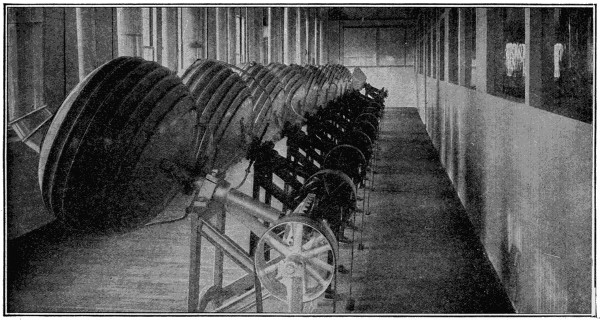
A Battery of Sugar-Coating Machines
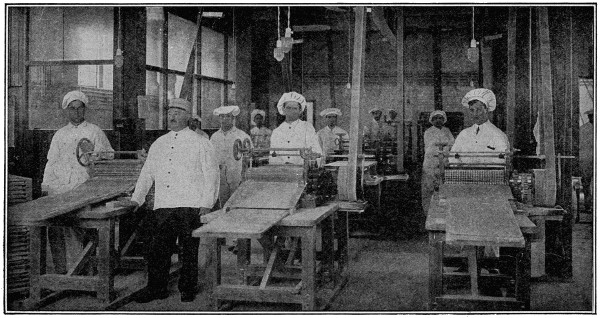
A Corner of the Scoring Room
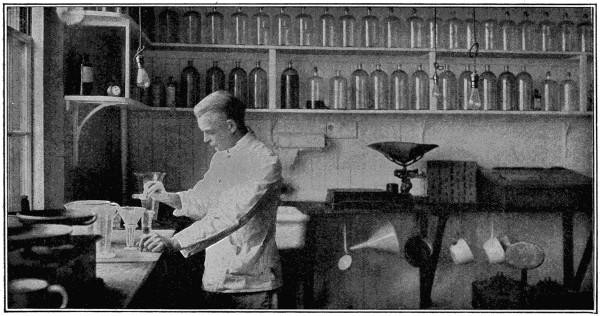
The Laboratory
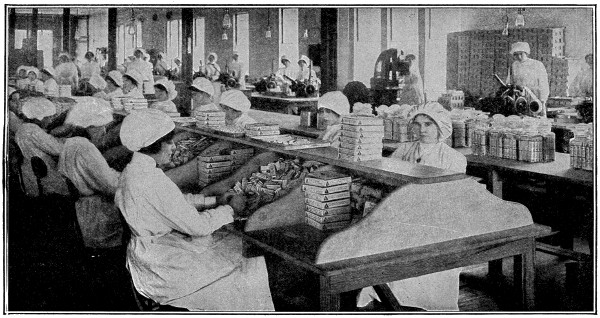
Wrapping and Packing Department
It is next passed to the cooking department and placed in huge steam-jacketed kettles, which revolve continually and thus keep the chicle from scorching. While it is being cooked in these large kettles sugar is added, and as soon as the gum is done it is placed in a kneading machine. It is now about the consistency of bread or cake dough, and after being kneaded and cooled, flavor is added.
Peppermint, spearmint and other oils used are triply distilled and absolutely free of all impurities. The orange oil comes from Messina and is always the product of the very latest orange crop.
From the kneading machine it reaches a sizing table, to which are attached heavy rollers for reducing the mass of gum to a strip about a quarter of an inch in thickness and twelve inches wide.
At this stage it will be seen the gum begins to take on a ribbon shape. As it comes from the first series of rollers, it is cut into short lengths sprinkled with powdered sugar, and these short lengths are passed in sticks about two feet high on to a second series of rollers. Under the second rollers each short length of gum is once more reduced in thickness and extended in length.
The surfaces of the second rollers contain knives running lengthwise and around. These knives partially cut the gum to its final size. The thin sheets are then sent to another drying room. They remain in this room from twelve to forty-eight hours, according to the season of the year, and are then ready for the wrapping machines.
Machines have also been invented which stamp out little nuggets of gum. To be finished these pieces are sent to a long room containing a line of twelve large white kettles, each on a separate base. It is these machines which coat the nuggets with snowy sugar. The kettles revolve until a sufficient coating of the liquid sugar has adhered.
The chewing gum wrapping machine is considered by machinery builders to be one of the most ingenious automatic manufacturing machines in use. It is about the size of an ordinary typewriter desk and is operated by one girl. She receives the thin sheet of partially cut gum from the last drying room. The machine operator drops the slabs of gum into a feeding chute. Each slab is here automatically wrapped in wax and silver-foil papers. These papers are fed from rolls, as printing paper is fed to a newspaper press.
As the slabs are wrapped they slide into a pocket. When five of them are finished, two steel fingers remove them and put on the final outside wrapper. The complete, wrapped packages of five slabs slide along a little runway into boxes.
The same girl who feeds the gum into the wrapping machine closes the lids of the boxes and places them on a packing table by her side. When the packing table is filled with boxes a boy removes it to the shipping room, where it is crated and forwarded to the wholesale dealers.
Where did the Ferris Wheel get Its Name?
The Ferris wheel was named after its builder, George W. Ferris, an able engineer, now dead.
The original Ferris wheel was exhibited at the Chicago World’s Fair. It was a remarkable engineering feature.
Its diameter was 270 feet and its circumference 825 feet. Its highest point was 280 feet. The axle was a steel bar, 45 feet long and 32 inches thick. Fastened to each of the twin wheels was a steel hub 16 feet in diameter. The two towers at the axis supporting the wheel were 140 feet high, and the motive power was secured from a 1,000 horse-power steam engine under the wheel.
The thirty-six cars on the wheel each comfortably seated forty persons. The wheel and passengers weighed 12,000 tons.
By the Ferris wheel the almost indefinite application of the tension spoke to wheels of large dimensions has been vindicated, the expense being far smaller than that of the stiff spoke.
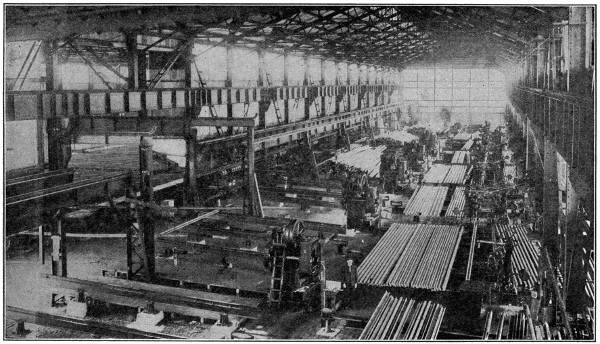
Steel Rail Mill
Interior view of the Bethlehem Steel Company’s rail mill finishing department, showing the machinery for straightening and drilling rails.
What is Done to Keep Railroad Rails from Breaking?
The breaking of rails has been the cause of much attention on the part of railroad and steel engineering experts ever since the tendency toward the construction of heavy locomotives and greater train loads became evident.
The report of the Interstate Commerce Commission for 1915 gave broken rails as the cause of 3,345 accidents, in which 205 people were killed and 7,341 were injured, with a property loss of $3,967,188. A steel man is authority for the statement that one cold winter day in 1913, a single locomotive, making excessive speed, broke about a hundred rails in the distance of a mile on one of the leading railroad systems.
Both steel and railroad men were, therefore, much interested in the announcement made by the New York Central Railroad, in August, 1916, to the effect that the road’s staff of specialists had discovered the cause and remedy for the hidden flaws in steel rails. It was said that no rails produced under the specifications provided by them had yet developed any fissures.
The process by which those rails were prevented from developing fissures consisted mainly of rolling them from reheated blooms, and although that method is said to have been used in a number of rail mills for many years, no mention had previously been recorded of the prevention of breakage in that way. The experiments are, therefore, sure to be watched with a great deal of interest, and it is probable that fewer accidents will occur from broken rails in the near future.
The technical man will be interested in an outline printed in the Iron Age, which said: “Induced interior transverse fissures in basic open-hearth rails are due in part to an occasional hot rail being cooled so rapidly by the rolls or so chilled by the gusts of air before recalescence on the hot beds as to cause a log of some of the transformations of the metal in the interior of the rail head. Induced interior transverse fissures can only develop in the track from the effects of preceding causes, either of which is no longer a mystery.”
The report of the railroad experts also laid stress on the theory that “gagging” rails—subjecting them to blows for the purpose of straightening them—was also likely to cause faults by injuring the metal.
How does a “Master Clock” Control Others by Electricity?
With the aid of electric currents, one clock can be made to control other clocks, so as to make them keep accurate time.
By means of this method one high-class clock, usually in an astronomical observatory, compels a number of other clocks at considerable distances to keep time with it.
The clocks thus controlled ought to be so regulated that if left to themselves they would always gain a little, but not more than a few minutes per day.
The pendulum of the controlling clock, in swinging to either side, makes a brief contact, which completes the circuit of a galvanic battery, and thus sends a current to the controlled clock. The currents pass through a coil in the bob of the pendulum of the controlled clock, and the action between these currents and a pair of fixed magnets urges the pendulum to one side and to the other alternately. The effect is that, though the controlled clock may permanently continue to be a fraction of a second in advance of the controlling clock, it can never be so much as half a second in advance.
An electrically controlled clock usually contains a small magnetic needle, which shows from which direction the currents are coming. The arrangements are usually such that at every sixtieth second no current is sent, and the needle stands still. Any small error is thus at once detected.