The Story in a Box of California Oranges
Reading edition
For several hundred years oranges have grown in this country. For about the last forty years men have made a business of growing them.
Oranges and lemons are called citrus fruits on account of their content of citric acid.
The two predominating varieties in California are the Washington Navel and the Valencia orange.
The California Navel orange is in the markets of the country from December 1st until about June 1st, when the California Valencia type takes its place and remains until the latter part of November.
It is a fact, therefore, that oranges are now picked fresh every day the year round in this country, and that the California oranges you buy in the summer are not fruit that has been held in storage, but are as fresh as any fresh fruit that the retailers offer.
Most California oranges and lemons are picked from the trees by gloved hands, so that the finger nails of the pickers will not injure the skin, for even a tiny scratch on the skin of an orange or lemon is sufficient to open the way for germs of decay.
Mr. G. Harold Powell, formerly connected with the United States government, was the discoverer of this source of great loss to the citrus industry. The use of gloves in the picking is thought to save the growers approximately $1,000,000 yearly.
When the oranges have been picked they are sent in boxes to a packing house where they are put through an automatic washing machine which thoroughly scrubs all dust and dirt from the skin; they then pass through a dryer and thence along a belt to men and women who roll the oranges over for examination and distribute them to other belts according to their color and the condition of the skin with regard to blemishes of all kinds. The oranges then pass over automatic sizers—that is, V-shaped rollers revolving horizontally. The oranges continue along these rollers until the space between the rollers has widened to the point where each particular size drops into a labeled bin. The sizes are designated by numbers, such as 150, 176, 250, etc., these figures signifying the number of oranges that may be packed in a regulation size box in which the jobbers and retailers buy the fruit. In other words, size 150 is a larger orange than 250.
The quality of an orange is judged in the packing house merely by the color and the condition of the skin. Size has something to do with it, but this is only one consideration. Many of the smaller oranges are just as good to eat and sometimes very much better than the larger sizes, and the condition of the skin, unless it happens to be broken in any way so that germs of decay can enter, ordinarily has no depreciable effect upon the flavor. The public, of course, finally judges an orange by its sweetness and tenderness, and a large, well-colored, smooth fruit is likely to reach the market in better condition than the rougher fruit which has a marred skin.
Oranges are usually divided in grades into four classes called, in the order of their quality, Extra Choice, Choice, Standards and Culls.
Lemons are handled throughout the processes in practically the same manner as oranges.
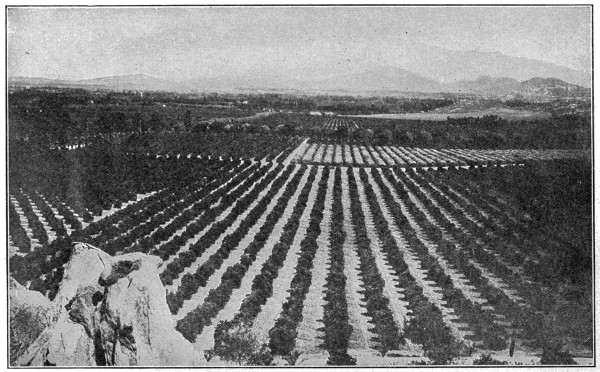
Photo by Brown Bros.
Where the Golden Orange Grows.
The far-reaching orange groves surrounding Riverside are one of the most beautiful of all beautiful sights in Southern California, and the fragrance of the blossoms is subtlest witchery.
After the fruit has passed the graders and the several sizes are separated, it goes to the packers, who pick up each orange or lemon and place a tissue wrapper around it, and press it firmly into the shipping box until the fruit “stands up high” above the top of the box. The cover is then nailed on and the box is placed in the freight car which is waiting at a convenient door. The average car carries 400 boxes of oranges or lemons.
The fruit is shipped in refrigerator cars, and is usually about eight days in making the trip from Southern California to the Eastern markets.
The California Fruit Growers’ Exchange ships on an average of sixty-five per cent of the California production of citrus fruits. This is a strictly non-profit, co-operative organization of 8,000 growers, the largest body of agriculturists operating on the non-profit co-operative plan in the world, and probably the most successful. At least, the cost to market the citrus crop under this system is lower than the marketing cost of any other agricultural crop in the world, which accounts in part for the fact that oranges and lemons are sold throughout the United States at retail prices which place this fruit within the reach of all.
What Kind of Steel Knives do not Stain nor Rust?
Shortly after the first of the year, in 1916, the U. S. Consul at Sheffield, England, reported that a new steel had been introduced there for use in making table cutlery. It was said to be untarnishable and unstainable even when used with the strongest acid foods, as well as non-rusting. The new product, which is called “Tirth’s Stainless” steel, can be thoroughly cleansed by ordinary washing with soap and water, and cutlery made from it will retain its original polish after use. The properties claimed for it are of the steel itself and not the result of any treatment; consequently knives made from the new product can easily be sharpened in the regular way without fear of resulting damage.
While the initial cost of cutlery made from “Tirth’s Steel” will probably be about double the usual cost, for not only is the price of the steel considerably more than that of other steels used for the same purpose, but it also costs more to work up, it is nevertheless expected to prove a welcome discovery to restaurant and hotel keepers as well as other large users of table cutlery because of the immense saving in labor occasioned by its use.
Why is it Necessary to Keep Unusually Quiet when Fishing?
The experienced fisherman who smiles at the amateur’s restless fidgeting and complaining has discovered by careful observation that the fish who swims around in such an exasperating manner just a foot or so away from the temptingly baited hook has had an advance tip that something out of the ordinary is going on up above him. For sound, whether it be the noise of an oarlock or a companion’s casual remark, can be heard more than four times as easily by the fish in the water beneath than it can up above in the air. Sound travels very quickly through the air, traversing ten hundred and ninety feet in a second, but it reaches forty-seven hundred feet away under water in the same time.
When the crowd on the other side of the baseball grounds yells across the field it seems as though we have heard their cheers as soon as they have been given, and so we have for all practical purposes, although in reality half a second has elapsed while the sound has been coming across the field. The time taken by sound in traveling is more apparent when the volume is sufficient to carry it a long distance. The sound of an explosion of a large quantity of dynamite and ammunition in Jersey City was not heard in Philadelphia, ninety miles away, for over seven minutes after it occurred.
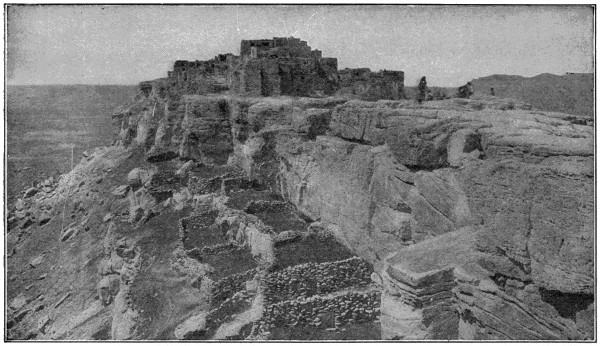
Cliff Dwellings, Walpi, Arizona
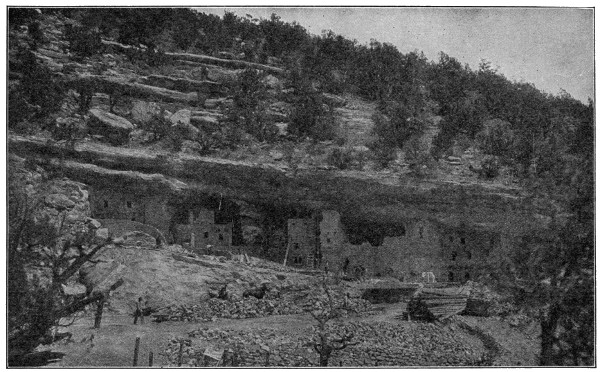
Photo by Brown Bros.
Homes of the Long-Ago
Famous reproduction of the Cliff-dwellers’ Ruins, near Colorado Springs, Col. The cliff-dwellers of early America built their habitations in the canyons of the Colorado and Rio Grande, where the action of the elements had worn away a layer of soft rock, leaving layers of hard rock above and below as roof and floor for the dwelling.
What were the First Apartment Houses in this Country?
A great many years ago, long before the white men came to America, there was a race of Indians called “cliff-dwellers,” because they built their dwelling places far up on the sides of steep cliffs. They probably made their homes so hard to reach in order that they might be safe from visits of their enemies. While many of their homes were small single-family houses, there were also a number of large two and three-story dwellings with many rooms in which different families lived.
Some of these cliff dwellings may still be seen in the valleys of the Rio Grande and the Rio Colorado and its tributaries. Close examination shows that many of them were very skilfully built, every advantage being taken of the natural rock formations, and the stones being dressed and laid in clay mortar, very much as the bricklayer does his work on an up-to-date apartment house today. The outsides of the buildings somewhat resembled the cement houses which have been put up in later days, a coat of clay being spread on the outside walls and carefully smoothed off. Oftentimes the inner walls were plastered too.
Many relics of the inhabitants have been found in these cliff dwellings, although we cannot tell how they lived, for the region is now rainless and therefore destitute of food plants. Conditions must have been different then and the ground less barren.
Why do We Call 32° Above Zero “Freezing”?
We know that freezing is the transformation of a liquid into solid under the influence of cold. Each liquid always solidifies at some fixed temperature, which is called its freezing point, and the solid melts again at the same temperature. Thus the freezing point and the melting point, or point of fusion, are the same, and the point is always the same for the same substance.
Consequently the freezing point of water, or the melting point of ice (32° F.), is taken for one of the fixed points in thermometry. The freezing point of mercury is 39° below zero, of sulphuric ether 46° below zero, of alcohol 203° below zero F.
How is Fresco Painting Done?
In producing fresco paintings, a finished drawing on paper, called a cartoon, exactly the size of the intended picture, is first made, to serve as a model.
The artist then has a limited portion of the wall covered over with a fine sort of plaster, and upon this he traces from his cartoon the part of the design suited for the space. As it is necessary to the success and permanency of his work that the colors should be applied while the plaster is yet damp, no more of the surface is plastered at one time than what the artist can finish in one day. A portion of the picture once commenced, needs to be completely finished before leaving it, as fresco does not admit of retouching after the plaster has become dry. On completing a day’s work, any unpainted part of the plaster is removed, cutting it neatly along the outline of a figure or other definite form, so that the joining of the plaster for the next day’s work may be concealed.
The art is very ancient, remains of it being found in India, Egypt, Mexico, etc. Examples of Roman frescoes are found in Pompeii and other places. After the beginning of the fifteenth century fresco painting became the favorite process of the greatest Italian masters, and many of their noblest pictorial efforts are frescoes on the walls of palaces and churches.
Some ancient wall paintings are executed in what is called “Fresco Secco,” which is distinguished from true fresco by being executed on dry plaster, which is moistened with lime water before the colors are applied.
Fresco painting has in recent years again been revived, and works of this kind have been executed in the British Houses of Parliament and other public and private buildings, more especially in Germany.