The Story of the Calculating Machine
Reading edition
How did Men Learn to Count?
Historians tell us that man was able to count long before he was able to write. Of course, he could not count very far, but it was enough for his needs at that time. He had no money and very few possessions of any kind, so that he did not have much occasion to use arithmetic.
It was fairly simple for prehistoric men to distinguish one from two, and to distinguish a few from a great number, but it was more difficult for him to learn to think of a definite number of objects between these extremes. Those who have studied the evolution of figures say that man found it hard to think of a number of objects without using a mark or a finger or something to stand for each object. That is how the first method of counting came into use.
Because man had ten fingers and thumbs, he learned to count in tens. When he had counted ten, he could make a mark to remind him of the fact, and then count them over again. Some of the early races learned to designate units from tens and tens from hundreds by working their fingers in various ways. Other peoples also made use of their toes in counting, so that they could count up to twenty without getting bothered.
Cantor, the historian, tells of a South African tribe which employed an unusual system of finger counting. Three men sat together facing a fourth who did the counting. Each of the three held up his fingers for the fourth man to count. The first man’s ten fingers and thumbs represented units; the second man represented tens, and the third hundreds. By this means, it was possible to count up to 999.
Who Invented the First Adding Machine?
Early cuneiform inscriptions, made about 2200 B. C., show that the Babylonians had developed a fairly extensive system of figuring. This was in the days of the patriarch Abraham. When men’s minds were overtaxed with the strain of counting into the hundreds and thousands, the Babylonians invented the first adding machine, a “pebble board,” a ruled surface on which pebbles were shifted about to represent different values.
The next adding and calculating machine was an evolution from the digits of the human hand and is known as the abacus in China, and the soroban in Japan.
The abacus may be defined as an arrangement of movable beads which slip along fixed rods, indicating by their arrangement some definite numerical quantity. Its most familiar form is in a boxlike arrangement, divided longitudinally by a narrow ridge of two compartments, one of which is roughly some three times larger than the other. Cylindrical rods placed at equal intervals apart pass through the framework and are fixed firmly into the sides. On these rods the counters are beaded. Each counter slides along the rod easily and on each rod there are six tamas or beads. Five of these slide on the longest segment of the rod and the remaining one on the shorter. Addition, subtraction, multiplication, division, and even square and cube root can be performed on the abacus, and in the hands of a skilled operator considerable speed can be obtained.
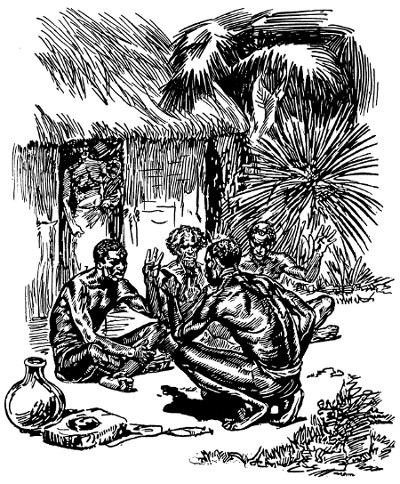
Finger Counting was Common Among Earlier Peoples, and was Brought to a Fair Degree of Efficiency by South Africans
Courtesy of the Burroughs Adding Machine Company.
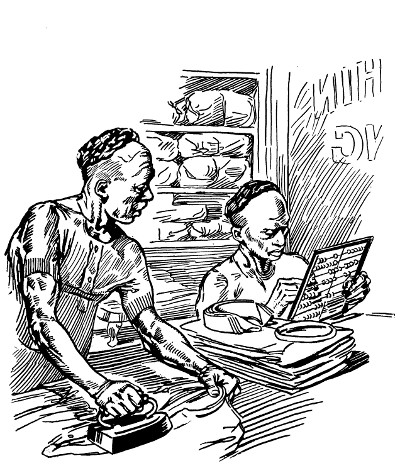
The “Abacus” was One of the Earliest Aids to Calculation
It is still used extensively in China, and occasionally will be found in Chinese laundries in the United States.
Courtesy of the Burroughs Adding Machine Company.
The Oriental tradesman does not deign to perplex himself by a process of mental arithmetic; he seizes his abacus, prepares it by a tilt, makes a few rapid, clicking movements and his calculations are completed. We always look with some slight contempt upon this method of calculation, but a little experience and investigation would tend to transform this contempt into admiration, for it may be safely asserted that even the simplest of all arithmetical operations, the abacus, possesses distinctive advantages over the mental or figuring process. In competition in simple addition between a “lightning calculator” and an ordinary Japanese small tradesman, the Japanese would easily win the contest.
Blaise Pascal, the wonderful Frenchman, who discovered the theorem in conic sections, or Pascal’s hexogram, was not only one of the foremost mathematicians of his day but also excelled in mechanics; when he was nineteen years old he produced the first machine for the carrying of tens and the first arithmetical machine, as we know it, was invented by him about 1641. This was the first calculating machine made with dials. The same principle, that of using discs with figures on their peripheries, is employed in present-day calculating machines. Among these are numbering machines of all kinds, speedometers, cyclometers and counters used on printing presses.
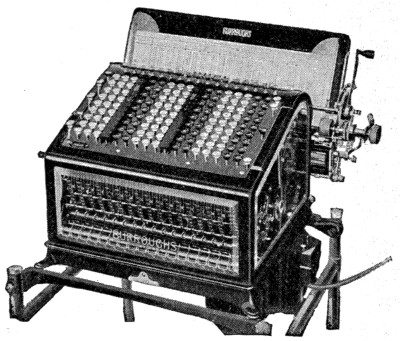
A Modern Bookkeeping Machine, Used for Ledger Posting and Statement Making
It has seventeen “banks” or rows of keys, is electrically operated, and automatically adds, subtracts, and computes balances.
Courtesy of the Burroughs Adding Machine Company.
Who Discovered the Slide Rule Principle?
It was early in the seventeenth century that Napier, a native of Naples, invented the first actual mechanical means of calculating. He arranged strips of bone, on which were figures, so that they could be brought into various fixed combinations. The instrument was called “Napier’s rod” or “Napier’s bones.” It was the beginning of the slide rule, which has been found of invaluable aid to accountants and engineers.
One trouble with all these contrivances was that, although they aided man to figure, they offered no means of making a record of the work. The man who used these machines had no way of checking his work to know if it was right unless he did it all over again.
The first machine to perform multiplication by means of successive additions was invented by Leibnitz in the year 1671 and completed in 1694. It employed the principle of the “stepped reckoner.” This model was kept first at Göttingen and afterward at Hanover, but it did not act efficiently, as the gears were not cut with sufficient accuracy. This was long before the days of accurate machine tools.
The first satisfactory calculating machine of this nature was that of C. X. Thomas, which was brought out about 1820. It is usually called the Thomas de Colmar Arithmometer. This Thomas type of machine, which is commonly known as the beveled gear type, is still in use today in modern business.
The “Difference Engine.”
In the year 1822 a very ambitious project was conceived by Charles Babbage. He commenced to construct an automatic calculating machine, which he called a “difference engine.” The work was continued during the following twenty years, the English government contributing about $85,000 to defray its cost. Babbage himself spent a further sum of about $30,000. At the end of that time the construction of the engine, though nearly finished, was unfortunately abandoned, owing to some misunderstanding with the government. A portion of this engine is exhibited in South Kensington Museum, London, along with other examples of Babbage’s work. If the engine had been finished it would have contained seven columns of wheels, twenty wheels in each column, and also a contrivance for stereotyping the tables calculated by it. It was intended to perform the most extended calculations required in astronomy and navigation, and to stamp a record of its work into plates of copper or other material.
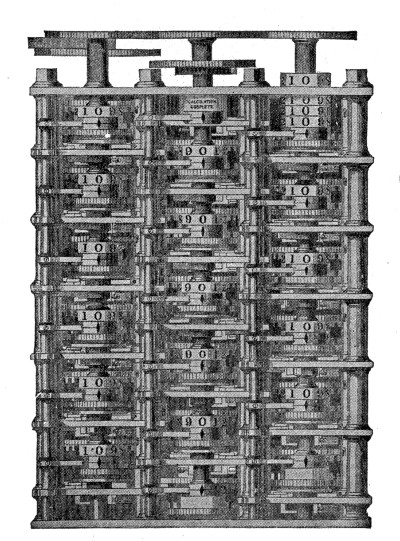
Charles Babbage’s “Engine of Differences” was the First Adding Machine Invented which was Designed to Print a Record of its Work, but it was not a Success
Courtesy of the Burroughs Adding Machine Company.
Babbage began to design his “analytical engine” in 1833 and he put together a small portion of it shortly before his death in 1871. This engine was to be capable of evaluating any algebraic formula. The formula it is desired to evaluate would be communicated to the engine by two sets of perforated cards similar to those used in the Jacquard loom. These cards would cause the engine automatically to operate on the numerical data placed in it, in such a way as to produce the correct result. Notwithstanding its simple action, its structure is complicated by a large amount of adding mechanism. A complete set of adding wheels with carrying gear being required for the tabular number, and every order of difference except the highest order.
After Babbage, there was much experimenting done by inventors to produce a real adding and listing machine. Also inspired by Babbage’s work Scheutz of Stockholm made a “difference engine,” which was exhibited in England in 1864, and subsequently acquired for Dudley Observatory, Albany, N. Y. Scheutz’s engine had mechanism for calculating with four orders of differences of sixteen figures each.
As far as we know the first patent in this country issued by the patent office for a calculating machine was to O. L. Castle of Alton, Illinois, in 1850. It was for a ten-key adding machine which did not print and only added in one column.
Work on Some of the Present-Day Models.
Frank S. Baldwin, a construction engineer, living in the United States, began to work on calculating machines in 1870. In 1874 he received a patent for a small hand adding machine. In 1875 a patent was granted him on a calculating machine. This machine was along entirely original lines. Mr. Baldwin did not even know of the existence of the Thomas machine at that time. The machine had a number of important advantages over the Thomas system. Scientists were very much interested in the invention at the time, and the John Scott medal for meritorious inventions was conferred upon Mr. Baldwin by the Franklin Institute. The only other invention being honored in that year (1875) was the George Westinghouse air brake.
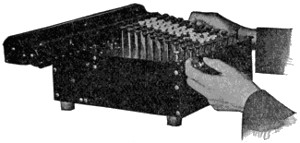
The Modern Adding Machine
Courtesy of the Monroe Calculating Machine Company.
This calculating machine, however, seemed to be too much in advance of the times, and Mr. Baldwin was unable to interest capital in it. He was very successful in his business as construction engineer and continued to spend all his spare time and money in experimental work. He brought out a number of models at later dates with important improvements.
In the early eighties one of Mr. Baldwin’s 1875 models found its way to Europe into the hands of one Ohdner, a Swede. He took out patents in all European countries on a machine that did not vary in any important particular from Mr. Baldwin’s machine, and several large manufacturing companies in Europe took it up. It is now appearing under ten to fifteen different names in Europe, the most important being “Brunsviga” and Triumphator in Germany. There is no essential difference between the machines they are turning out today and Mr. Baldwin’s original machine. More than 50,000 machines of this type have been sold throughout the world.
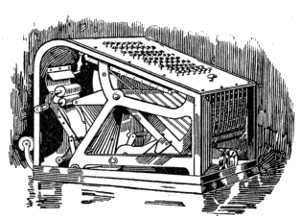
One of the First Successful Adding and Listing Machines
Courtesy of the Burroughs Adding Machine Company.
In 1883 a young man who started to work in a bank in Auburn, N. Y., discovered that nine-tenths of his work was mechanical addition. He also found that the human brain is but an imperfect tool, incapable of sustained effort without accident. His health gave way under the strain, and he quit the bank to begin work in a machine shop in St. Louis.
This was William S. Burroughs. He was of mechanical turn of mind, with an intense hobby for painful accuracy. By lamplight at home he worked out pencil outlines of a machine which would write figures and at the same time add them. It required the most painstaking work for him to make a machine to do what he had in mind. His early associates say of Burroughs that no ordinary materials were good enough for his creation. His drawings were on metal plates that would not stretch nor shrink by the fraction of a hair. He worked with hardened tools ground to a point, and when he struck a center or drew a line, he did it under a microscope.
In 1884 Burroughs took his plans to a St. Louis dry goods merchant, who thought so well of the idea that he raised $700 toward forming a company. The young man took up his work in the machine shop conducted by Joseph Boyer.
It was in January, 1885, that he applied for his patent, which was not issued until 1887.
His mechanism throughout operated on the pivotal principle. This means a minimum of friction, therefore the least wear on the machine and the least exertion on the part of the operator. The principle elements in the machine remain practically unchanged today, a fact which testifies to the excellence of the inventor’s work.
Experimenting on the machine swallowed a great deal of capital, and the stockholders of the company he had formed became impatient. Burroughs objected strenuously, for he did not wish to market the machine until he was convinced that it was perfect, but he finally agreed to manufacture fifty machines.
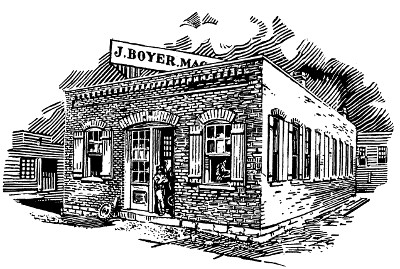
The Boyer Machine Shop, St. Louis, Where One of the First Successful Adding and Listing Machines was Born
Courtesy of the Burroughs Adding Machine Company.
In his public demonstrations, he could do wonders with the machine. The public was skeptical, however, and some averred that he was a “lightning calculator” who did sums in his head and printed them on the machine. The first machines worked all right for the inventor, but inexperienced operators obtained surprising results through punching the keys and jerking the crank.
To meet this trouble and make the machines “fool proof,” he invented the “automatic control” in 1890. This was a governor, called the “dash pot”—a small cylinder partially filled with oil, and in which was a plunger. This, in connection with an ingenious management of springs, absorbed the shocks and governed the machine so that no matter what was done to it, it would operate only at a certain speed. It is this same shock-absorbing device which is used to catch the recoil on the immense siege guns used in modern warfare.
Other improvements were made, and in 1891 the first hundred machines that were really marketable were manufactured. While still flushed with his success, Burroughs thought of the first fifty machines which had proved such a disappointment. These machines still remained in a dusty storeroom to mock him. Determined to get them out of his sight and memory, he seized them and threw them one by one from a window to the pavement below.
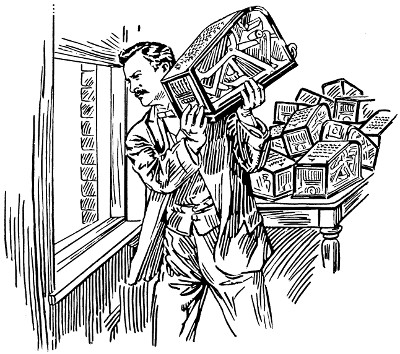
“There’s an End to My Troubles,” Said William Seward Burroughs as He Threw into the Street the First Fifty Adding Machines He Had Made
He wished nothing to remain to remind him of this early failure.
Courtesy of the Burroughs Adding Machine Company.
When he had disposed of the last one, he called Mr. Boyer to see the ruin. “There,” he exclaimed, “I have ended the last of my troubles.”
The first machines were called “Registering Accountants,” and “Arithmometers.” Burroughs lived to see the fulfilment of his dreams and the machine a commercial success. He died September 14, 1898, at his country home in Citronelle, Alabama, a victim of tuberculosis.
There were at that time 8,000 banks in the country, and it was Burroughs’ idea that as soon as these were supplied the market for adding machines would be exhausted. Today, there are more than 200,000 adding machines of that one make in use.
The need for an all-around office assistant that could multiply, divide, subtract as easily as it could add, was an idea nourished in the mind and thought of a young student of the University of Michigan.
After graduation, Jay R. Monroe turned his attention to clerical and commercial lines. He became acquainted with all the different types of adding and so-called calculating machines. He saw their limitations and restrictions. He saw the need for versatility—for more simplicity in operation—for getting away from arbitrary rules—for release from the sapping mental tax.
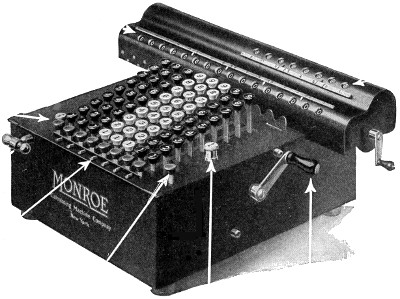
The Latest Model Calculating Machine
Courtesy of the Monroe Calculating Machine Company.
So in 1911 Monroe met Mr. Baldwin. Mr. Monroe realized the possibilities of Mr. Baldwin’s idea. Together they set about designing the machine to make it as nearly perfect as possible in adaptation to the needs of modern business.
They produced a machine in which the best of the European features are said to be combined with the operating ease and simplicity of American-made machines. Provision is made for the correction of errors, and operation is in two directions, forward for addition and multiplication, and backward for subtraction and division. The latest model is a desk machine, occupying less than one square foot of space and weighing about twenty-six pounds.
One of the latest developments of the adding machine is a type that will post ledgers and statements. This machine is said to be the final step in relieving bookkeeping of its drudgery.
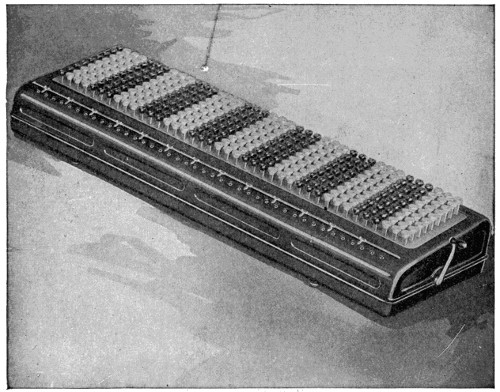
The “Duodecillion”—The Largest Capacity Adding Machine in the World—Has Forty Rows of Keys and Will Add to Within a Unit of Ten Duodecillions
To appreciate this prodigious figure, imagine that a marvelous high-speed flying machine were invented that would go to the sun and back in a day. If you made this 186,000,000-mile trip every day, it would take you just 14,729,700,000,000,000,000,000,000,000 years to travel a duodecillion miles.
Courtesy of the Burroughs Adding Machine Company.
How Big is the Largest Adding Machine in the World?
The largest adding machine ever made was produced in 1915 and has a capacity of forty columns, or within one unit of ten duodecillions. This is a number too prodigious for the mind of man to grasp. This machine was exhibited at the Panama Expositions in 1915.
To get an idea of the capacity of this machine, suppose that your income is $1,000,000 a second. At this rate for twenty-four hours a day, with no stops for eating or sleeping, it would take you 352,331,022,041,828,731,333,333,333 years to accumulate a duodecillion dollars. All the hairs on the heads of all human beings, which are supposed to be numberless, are only a small fraction of a duodecillion.
This machine has a practical use in adding several sums simultaneously, and takes the place of from ten to a dozen smaller machines.
Adding machines are made that figure in English pence, shillings and pounds; in Japanese yen, and in the monetary system of most civilized countries. They will change inches into feet, pounds into bushels, and do other “stunts” that would make the average schoolboy envious when it comes to arithmetic.
The most complicated problems of multiplication, division and fractions may be handled with ease on these machines. They have taken a great part in the day’s work of modern business, and it would be hard to imagine how the world’s finance and industry could be handled without them. Adding and calculating machines have become almost as necessary in modern business as the telephone and the typewriter.
How are Adding Machines Used?
Adding machines may be found at work in all kinds of business places from corner groceries to department stores and manufacturing plants. In the various offices and plants of the Western Electric Company, which are scattered through the country, more than 1,600 machines are in use. Other big users are railroads, banks, mail-order houses, and city, state and government offices.
The Bank of France, the Bank of England, and other of the world’s largest financial institutions do the burden of their figure work on adding machines made in the United States. The German post-office uses more than 1,200 machines. There are individual American banks, like the Corn Exchange National Bank of New York, that employ as many as 150 adding machines in their work.
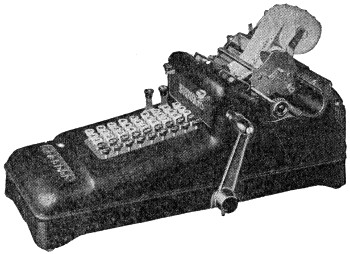
One of the Smallest Adding Machines is Adapted for Use by Retail Merchants and Others Who do not Add Figures of More than Five Digits
Courtesy of the Burroughs Adding Machine Company.
Some surprising uses are found for adding machines. One is used in a Japanese boarding house in California; another is used by a retired Dayton millionaire to count the coupons he clips; the Rockefeller Sanitary Commission uses a machine in fighting the hook-worm; the United States government uses thousands in making census tabulations and in other ways. Others are used by newsboys, egg farmers, housewives, undertakers, dentists, judges in automobile races, and by persons in a thousand different lines of business. Without adding machines the public would be obliged to wait for days for the results of most elections.
In this way, the idea of a tired bank clerk came to change the figuring methods of the world.
The words “Almighty Dollar” have been generally adopted since Irving first used them in his “Creole Village,” and the use of “lynching” to represent mob law and the action of mobs has become common since a Virginia farmer by that name instituted the first vigilance committee in America.
Where does Ermine Come From?
The ermine fur, with which we are all familiar, is furnished by the stoat, a small animal of the weasel tribe. It is found over both temperate Europe and North America, but is common only in the north.
Because of that change which occurs in the color of its fur at different seasons—by far most marked in the Arctic regions—it is not generally known that the ermine and stoat are the same. In winter, in cold countries or severe seasons, the fur changes from a reddish-brown to a yellowish-white, or almost pure white, under which shade the animal is recognized as the ermine. In both states the tip of the tail is black.
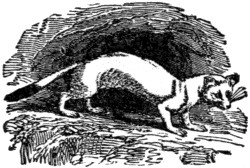
Ermine (Mustela Erminea)
Like many other species of this genus, the ermine has the faculty of ejecting a fluid of a musky odor.
Its fur is short, soft and silky; the best skins being brought from Russia, Sweden and Norway and Hudson Bay territories. Its fur was formerly one of the insignia of royalty, and is still used by judges. When used as linings of cloaks the black tuft from the tail is sewed to the skin at irregular distances.
What is the Principle of “Foreign Exchange”?
Exchange, in commerce, is a transaction by which the debts of people residing at a distance are canceled by a draft or bill of exchange, without transfer of any actual money.
A merchant in New York who owes $1,000 worth of goods in London, gives a bill or order for that amount which can be negotiated through banking agencies or otherwise against similar debts owing by other parties in London who have payments to make in New York. This obviates the expense and risk of transmitting money.
The process of liquidating obligations between different nations is carried on in the same way by an exchange of foreign bills. When all the accounts of one country correspond in value with those of another, the exchange between the countries will be at par, that is, the sum for which the bill is drawn in the one country will be the exact value of it in the other.
Exchange is said to be at par when, for instance, a bill drawn in New York for the payment of $1,000 in London can be purchased there for $1,000. If it can be purchased for less, exchange is under par and is against London. If the purchaser is obliged to give more, exchange is above par and in favor of London.
Although the thousand circumstances which incessantly affect the state of debt and credit prevent the ordinary course of exchange from being almost ever precisely at par, its fluctuations are confined within narrow limits, and if direct exchange is unfavorable between two countries this can often be obviated by the interposition of bills drawn on other countries where an opposite state of matters prevails.
What do We Mean by “The Old Moon in the New Moon’s Arms”?
“Earth-shine,” in astronomy, is the name given to the faint light visible on the part of the moon not illuminated by the sun, due to the illumination of that portion by the light which the earth reflects on her. It is most conspicuous when the illuminated part of the disc is at its smallest, as soon after new moon. This phenomenon is popularly described as “the old moon in the new moon’s arms.”