The Story of a Deep Sea Monster[54]
Reading edition
The Story of a Deep Sea Monster[54]
The early day was blue and silver; one of those colorful mornings peculiar to southern Florida. Sandwiched between the earth and the turquoise sky, the Atlantic lay gleaming like a huge silver wafer in the sunlight. Not the faintest suggestion of a ripple marred its shining surface.
Suddenly out of the stillness of the silver water a huge black fin was lifted, and a little group of men lounging on the deck of an idle fishing craft drew near the rail and used their glasses.
“Shark,” remarked the captain pleasantly after a moment’s scrutiny. “Who wants to go out with me for a little fun?”
The hastily lowered lifeboat pointed a slim nose toward the large black shape thrashing about in the shallow water. Three men were in the boat—Captain Charles H. Thompson of the yacht “Samoa,” one of the yacht’s crew, and a winter visitor to southern Florida. As they drew near, the sailor took one look at the gigantic creature and yelled to the captain:
“For heaven’s sake, man, don’t harpoon that thing; we will be crushed like an egg shell!”
Poised in the bow of the boat, harpoon in hand, stood the captain, and as they drew alongside there was a flash; the steel glittered for a moment in the sunlight, then sank into the huge black bulk. Simultaneously the little boat spun around and shot out toward the Gulf Stream like an agitated and very erratic rocket, flinging great sheets of spray high into the air as it sped.
Thus began a thirty-nine hours’ ride filled with wildest thrills, during which time Captain Thompson battled with the fish, the sailor bailed the boat unceasingly, lest they be swamped, and the tourist raised an anxious and eloquent voice to high heaven. The men were without food the entire time, sharing only a small bottle of water among them.
The news of the struggle spread rapidly, and soon hundreds of interested spectators gathered on the trestle of the East Coast sea-extension railway. Scores of times the men in the boat escaped death only by a miracle, as the wildly thrashing black tail missed them but by a hair’s breadth. Finally, after two days and one night, the monster was worn out, and the triumphant captor managed to fasten it to the trestle work on Knight’s Key, where, after a few hours’ rest, it wigwagged a festive tail, smashing the large pilings as though they were toothpicks. After another battle the fish was firmly tied up once more, this time to the yacht “Samoa;” and again it waved a wicked tail, disabling the thirty-ton yacht by smashing her propeller and breaking the cables. A tug was then summoned, and the big fellow was towed one hundred and ten miles to Miami, Florida, where it was viewed by thousands of people.
Five harpoons and one hundred and fifty-one bullets were used in subduing the monster, and it took five days to finally kill it.
It was thought at first the creature was a whale, but later it was classified as a fish, for it breathed through gills of which there were five in number. Upon careful examination it seemed probable that it was a baby of its species, as the backbone was of a cartilaginous nature, a condition found only in a young creature; in a full-grown one this develops into true bone. That it was a deep-sea fish was indicated by the small eye, which was about the size of a silver dollar. The pressure of the water is so great at the bottom of the ocean that were the eyes large they would be ruptured. That the pupil did not dilate and contract seems additional proof that the fish must have lived at a depth of probably fifteen hundred or two thousand feet, where there is little light.
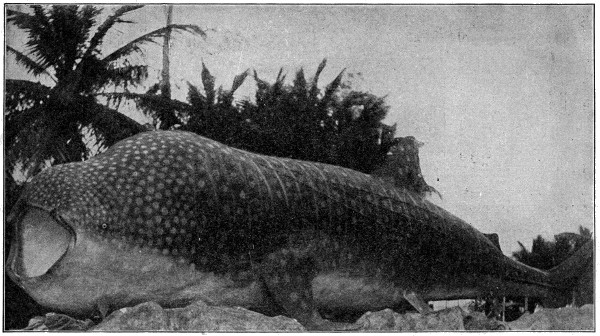
Photograph by Capt. Chas. H. Thompson
Deep Sea Monster Captured off Florida
So far as the scientific world is concerned, this is the only fish of its kind ever captured. Length, 45 feet; weight, 30,000 pounds; circumference, 23 feet 9 inches; diameter 8 feet 3 inches; mouth (open), 31 inches; mouth, 38 inches wide; mouth, 43 inches deep; tongue, 40 inches long; several thousand teeth; hide, three inches thick, no scales; had swallowed an animal weighing 1,500 pounds; tail measures 10 feet from tip to tip; pectoral fin, 5 feet long, 3 feet wide; dorsal fin, 3 feet long, 2 feet 9 inches wide; gills, 4 feet; the liver weighed 1,700 pounds.
It is generally believed that some volcanic eruption drove the fish to the surface where, owing to the difference in water pressure, the swim-bladders burst, making it impossible for him to return to his level.
What is an Armored Railway Car Like?
The armored car shown in this picture is the first of a new type of armored car to be constructed by the United States. It was designed under the direction of the Board of Engineers of the U. S. Army, and was constructed by the Standard Steel Car Company, Pittsburgh, Pa., at their Hammond, Ind., plant. The car was designed and built within twenty-seven days.
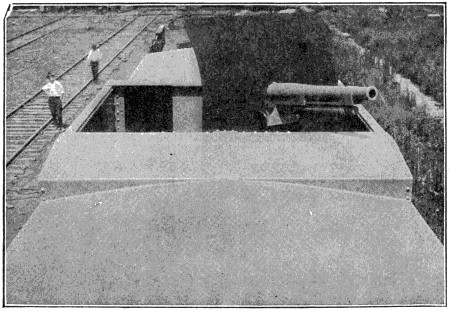
The Rapid Fire-Gun Here Shown is a Model of a Three-inch Field Gun Mounted upon a Special Carriage. The Well in which the Gun is Located may also be Used as a Fighting Top for Troops Armed with Rifles or Machine Guns.
Courtesy of the Railway Age Gazette and Standard Steel Car Co.
The car consists of heavy steel plate structure, erected upon a flat car of standard type. The interior is divided into three compartments. The end compartments are for use of troops operating machine guns and rifles through the port-holes shown on side of car. The center compartment, which is not the full height of the car, is used for ammunition storage, and is capable of holding a large quantity of ammunition, either for small arms or for the rapid-fire gun which is mounted on top of the car. The rapid-fire gun here shown is a model of a three-inch field gun mounted upon a special carriage. The well in which the gun is located may also be used as a fighting top for troops armed with rifles or machine guns.
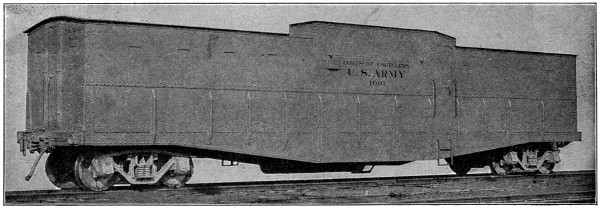
The First of a New Type of Armored Cars[55]
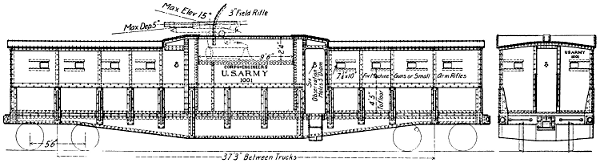
Large image (1500 x 407 px, 148 kB).
The Heavy Steel Plate Structure is Erected upon a Flat Car of Standard Type[55]
This car is known as a light-armored car. It is armed with a three-inch rapid-fire gun, two machine guns and any number of rifles which the troops occupying it may carry. The service for which this car is intended is primarily to guard railroads and depots adjacent to railroads. It is not ordinarily to be employed in aggressive movements. In effect, it is a movable block-house which may be used at any point along the line, or it may be used as a retreat for troops when necessary. It may also be used for transporting troops past danger points, and for transporting explosives or other perishable material which might be damaged by fire from the ends. The car as constructed weighs 86,200 pounds. It is 47 feet long, 9 feet 3 inches wide, and 7 feet high at the ends. When used for transportation of troops, it will accommodate a company of infantry seated on camp stools or benches. When used for patrol purposes, there would not be more than twelve men in the car, to operate the rapid-fire gun and machine guns.
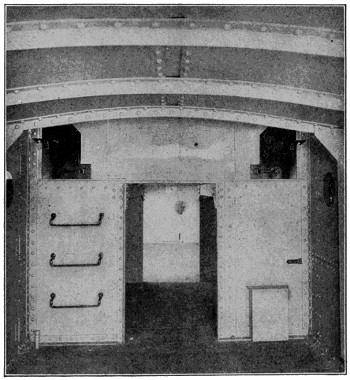
The Interior is Divided into Three Compartments
Courtesy of the Railway Age Gazette and Standard Steel Car Co.
The car was shipped to the Sandy Hook proving grounds to be equipped with rapid-fire guns and ammunition and thoroughly tested and inspected by the Engineer and Ordnance Officer of the U. S. Army.
What is an “Electric Eel”?
This is an eel abundant in the fresh waters of Brazil and the Guianas, which possesses organs capable of developing a strong electric current and thus of giving a violent shock to any one touching the eels. These organs replace the lower muscles along the sides of the tail. The eels can be taken by driving horses into the water to be shocked and seizing them when thus weakened.