The Story in Firecrackers and Sky-Rockets[9]
Reading edition
The Story in Firecrackers and Sky-Rockets[9]
The blaze and noise, indispensable to patriotic celebrations among all peoples, was produced a century ago in America by simple agencies. Washington’s Birthday was ushered in by cannon salutes in every garrisoned place in the United States, and boys the country over built bonfires as they still do in old New England towns to celebrate the day. But the Fourth of July was the great hurrah time of the year, when every youth who owned a gun or could borrow one, brought it into use as a contribution to the general noise. He might lack shoes and be short of shot and bullets for hunting, but for this occasion no young man was so poor as to have failed to lay in a hornful of powder, and at the stroke of twelve midnight, which began the day, he and his companions blazed away with guns loaded to the danger point, and kept up their fusillade as long as ammunition lasted. For demonstrations on a larger scale, a small cannon was secured if possible, but lacking this, two blacksmith’s anvils were made to do the same service, the hole in the top of one being filled with powder, a fuse laid into it and the second anvil placed as a stopper upon the first before the charge was exploded.
A favorite firearm for celebration purposes was one of the old “Queens Arm” muskets which were common in country communities, being trophies captured from the British during the Revolutionary War. One of these cumbersome flint-lock pieces might be loaded halfway to the muzzle and fired without bursting, and would roar in the discharge in a way highly pleasing to patriotic ears.
It was near the close of the eighteenth century that Chinese firecrackers first came into use in celebrating the American Independence Day. For many years they were used sparingly and only in large cities. They had been known in the New England coast cities ever since the year 1787, when Elias Haskett Derby’s ship of Salem, the first American vessel to engage in deep-water commerce, returned from her voyage to Calcutta, China and Isle of France. Among the things she brought back—more as a curiosity than as an article of cargo—was a consignment of Chinese firecrackers. Their capabilities in aiding the uproar on the Fourth of July were quickly recognized, and thereafter every ship that made the voyage from Massachusetts Bay to India or China brought back firecrackers with the tea, silks and rice. In time, rockets, squibs and torpedoes were included in the consignment, but it was not until the middle of the nineteenth century that their use became general in America.
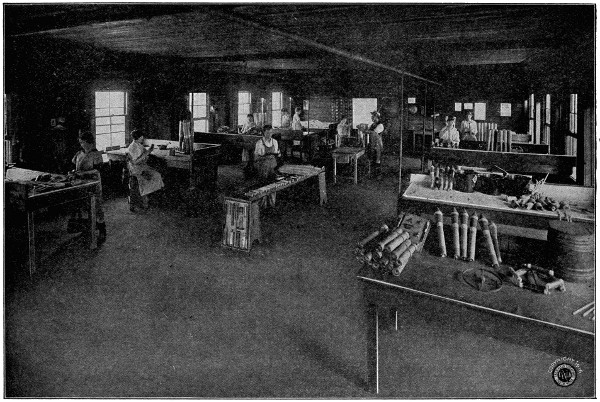
Interior of Rocket Finishing Shop
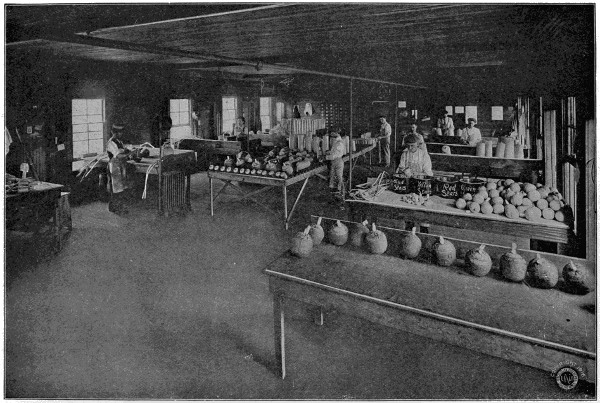
Interior of Shell Finishing Shop
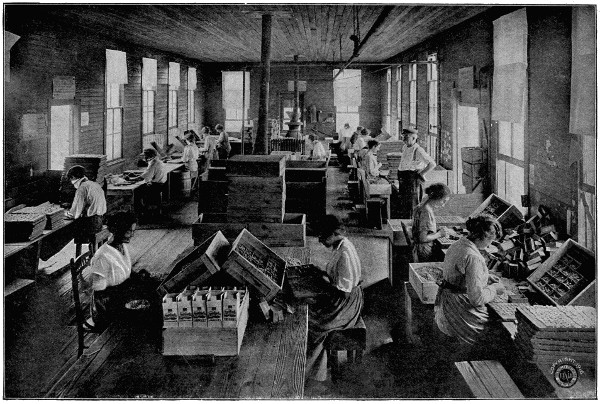
Interior of Torpedo Shop
The time when the more complicated fireworks, which we owe both to Europe and the Orient, came into vogue in this country, no one perhaps could now definitely tell. Their use was known to our seafaring men in the “forties,” for it was in that decade that Capt. Decimus Forthridge, of the American brig “Independence,” showed his Yankee pluck and resource in defeating an attack of Malay pirates with no other armament than fancy fireworks. During his voyage in the East Indies he had laid in a supply of fireworks with which to celebrate the Fourth of July in a manner worthy an American captain. For some reason no ammunition was available for swivels or muskets, when, in the mid-watch of the night, two war proas, deeply laden with armed Malays, were seen coming quickly up on the vessel’s quarter as she lay becalmed off Firabader Point in the Island of Sumatra. The cry of “All hands on deck to repel pirates” brought the crew on deck in haste, but without ammunition the chance that they would beat the enemy off was a long shot compared with the probability that the throat of every man on board would be cut as a preliminary to plundering and scuttling the vessel. Even in their extremity the crew laughed and jeered when the captain ranged them along the quarter rail with boarding pikes and empty muskets in hand to give the enemy the idea that they were ready for business, and then, opening the box of fireworks, he began to shoot rockets and roman candles at the pirates. If the crew laughed, the Malays did not, and when the captain of one of the proas was struck by a rocket, both crafts rested oars and came no nearer. But while Captain Forthridge was attending to these, a third proa came up unobserved under the port quarter, and the first that was known of its presence was the attempt of its occupants to board the vessel by the chains. To make matters worse it was discovered that the paper wrappings of the fireworks in the box were on fire. While the crew with clubbed muskets and boarding pikes kept the Malays outside the rails, Captain Forthridge picked up the blazing box, carried it to the chains, and while the mate and sailors warded the spears and krises from him, dropped it into the proa. The box was blown to pieces the minute it struck, scattering the fireworks through the proa, and with firecrackers snapping and jumping and fiery serpents running round among their bare legs, the Malays chose to take their chances with the sharks, and all hands went overboard into the water at double-quick. A little breeze came up and the brig drew away from the pirates, leaving the two proas to pick up those Malays from the water that the sharks had missed.
In the days of the China clippers, those famous ships sailed many a race from Hong Kong and Canton, with New York as the goal, to get there with “first tea” and to forestall the Fourth of July market with a cargo of firecrackers.
In China and the East Indies, fireworks, like “the fume of the incense, the clash of the cymbal, the clang and the blaze of the gong,” are a part of the worship of the gods, as well as a feature of coronations and weddings. China is the birthplace of fireworks. From China the knowledge of them spread to India, and in both these lands rockets were used as missiles of war as early as the ninth century. The Chinese war rocket was a long, heavy affair, fitted at the end with a barb-like arrow, and to a foe unacquainted with firearms, it must have seemed a formidable missile. After gunpowder was introduced in Europe, fireworks came into use on the continent, and the use of both explosives undoubtedly was learned from the Chinese.
Fireworks were manufactured in Italy as early as 1540, and in France we have accounts of their employment in great celebrations between the years 1606 and 1739. Long before this time, some form of rocket, now unknown, that would burn in water, constituted the famous Greek fire which struck terror to the hearts of invaders from Northern Europe in medieval times when the Saracens launched it against their ships. Early in the present century during the Napoleonic Wars, the rocket perfected by Sir William Congreve was used in the siege of Boulogne and in the battle of Leipsic. The conditions of modern warfare have so changed that the rocket is no longer of practical use in fighting except as a signal. In case of shipwreck it is often employed to carry a line from the shore to a stranded vessel. It is noteworthy that while almost every kind of fireworks is manufactured in Europe and the United States, the small firecrackers are still imported from China. But larger quantities are now manufactured in the United States, and it is only a matter of time when the “Young American” salute will take the place of the Chinese firecrackers.
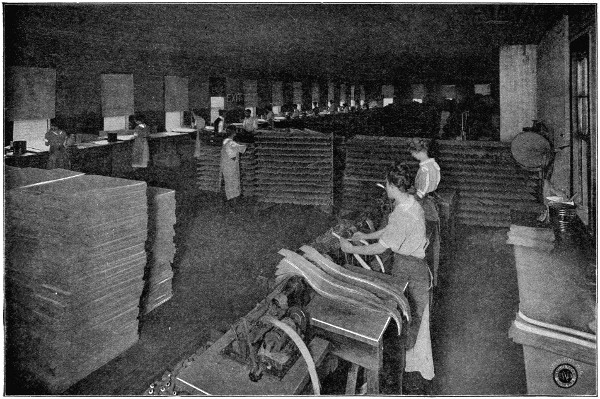
Interior of Rolling Shop
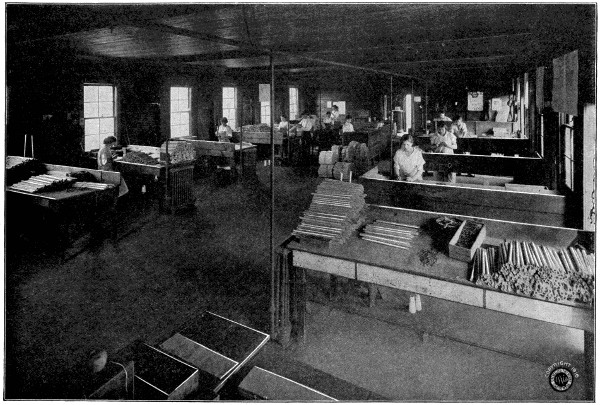
Interior of Roman Candle Shop
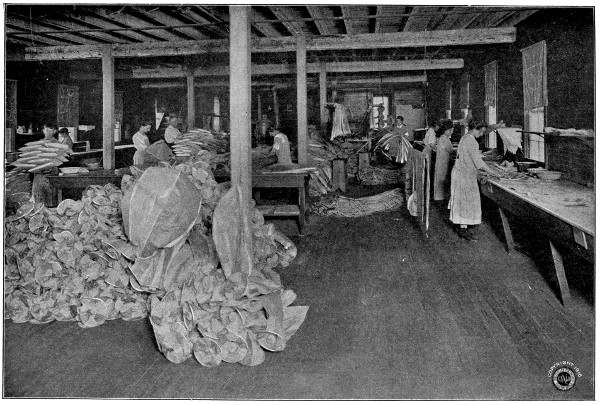
Interior of Balloon Shop
It was about ten years before the Civil War that “set pieces” began to form a part of fireworks celebrations. In those days the most famous pyrotechnic display in the whole country was given on Boston Common on the Fourth of July, and the country boy who was so lucky as to see that display, with the miracle of George Washington’s benign face illuminated amid spouting flames and a shower of fireballs and rockets, had something to talk about for the rest of the year.
The American Civil War which did so much toward the modern development of firearms and munitions of war, brought also a great advance in pyrotechny, and soon after the close of the struggle, extensive manufacture of fireworks began in this country, with New York as the headquarters of the principal firms engaged in the business.
In 1865 the first displays of fireworks in the United States, illustrating historical events, were made by a company in New York City. They were the pioneers in this line of displays. Their success was immediate, and from these displays has grown the successes of today in pyrotechnics.
Fireworks now enter into the celebration of every important event in our national, political and business life. The celebrations at Washington, D. C., at the inaugurations of our Presidents, the coronations of emperors and kings in lands beyond our borders, are all brought to a close by brilliant displays of fireworks.
The writer, in visiting the plant of a large fireworks manufacturer, found that they were turning out large quantities of time fuses and primers for shrapnel shells for the foreign powers, and are working night and day on orders for the United States government on aeroplane bombs and signals. They have also worked out a searchlight projectile which is arranged to burst in the air, throwing out a number of luminous bodies that light up the surrounding country and reveal the movements of the enemy.
All large displays of fireworks are now fired by electricity and every known color and effect is produced by the pyrotechnist of the present day.
The water displays are scarcely less varied, consisting of flying fish, diving devils, prismatic fountains, floating batteries, fiery geysers and submarine torpedoes, all of which, being ignited and thrown into the water, go through their stunts as readily as other kinds do on land and in the air.
From every part of the civilized world, from Mexico, Central and South America and Europe, orders for fireworks come in increasing numbers to American firms, who now lead the world in this art. The Philippines will soon be a customer for them, and with the general opening up of China to modern civilization, from causes now in operation, it will not be strange if some day we should supply fireworks to the land of their origin.
What Makes a Chimney Smoke?
Smoky chimneys are usually caused either by the presence of other buildings obstructing the wind and giving rise to irregular currents of air, or by improper construction of the fireplace and adjacent parts of the chimney.
The first may generally be cured by fixing a chimney-pot of a particular construction, or a revolving cowl, on the chimney top, in order to prevent the wind blowing down; in the second case the narrowing of the chimney throat will generally create a better draft.
The longer a chimney is, the more perfect is its draft, provided the fire is great enough to heat the column of air in it, because the tendency of the smoke to draw upwards is in proportion to the difference of weight between the heated air in a chimney and an equal column of external air.
The first we hear of chimneys, for the escape of the smoke from a fire or furnace, is in the middle ages.
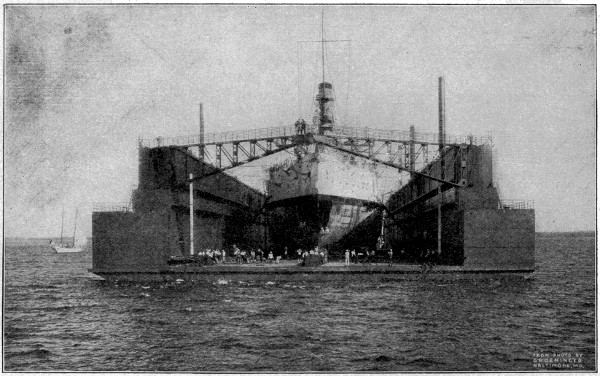
Floating Dry Dock “Dewey”
This dry dock, which is capable of floating the largest battleship, was towed from Sparrow’s Point, Maryland, to Olangapo, Philippine Islands, a voyage of 13,000 miles. In operation, the dock is sunk by admitting water into its tanks until the ship can be floated in. The water is then pumped out and the dock with the ship inside rises to the proper level as shown.
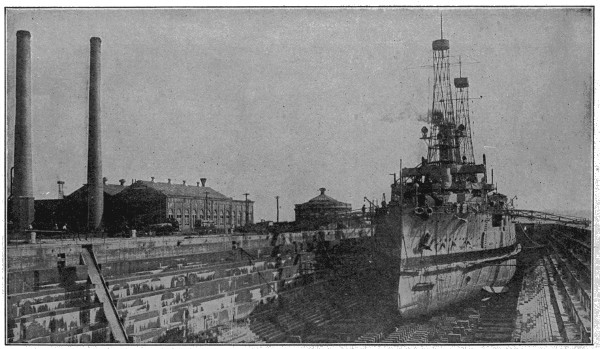
U. S. Battleship “Mississippi” in Dry Dock at League Island
What are Dry Docks Like?
Although divers are able to go down under the water to examine the bottom of a ship while it is afloat, it is usually necessary to have it up on dry land when thorough inspections or repairs have to be made. So a berth something like a huge box stall in a stable is built, with the part where a horse would stand in the stall full of water, and a door, either made like swinging gates opening in the middle, or a caisson which is operated up and down like a window, at the end. The ship is floated into the dock and then after the door is shut to prevent any more coming in, all of the water is pumped out until the vessel rests on a lot of great big wooden blocks and supporting props with which the bottom and sides of the dock are lined. Supports are also placed between the vessel and each side of the dock. Then, when the work has been finished, and the ship is ready to go to sea, water is let back either by pumping it in or else by gradually opening the door at the end, and the vessel is able to float out into the river or harbor again.
Although all of the navy yards and some private corporations in this country have docks of this kind, they are not of as much importance here as in England, where they are used, without pumping out the water, for the loading and unloading of vessels, because of the very great rise and fall of the tides there straining and otherwise damaging ships tied up to ordinary docks.
There are nine important navy yards in the United States, located at Brooklyn, N. Y.; Boston, Mass.; Portsmouth, N. H.; Philadelphia, Pa.; Portsmouth, Va.; Mare Island, Cal.; New London, Conn.; Pensacola, Fla.; Washington, D. C., and Port Orchard, Wash.
There is another kind of dry dock, called “floating docks,” which float on the surface of the water and may be sunk sufficiently to allow of a vessel being floated into them, and then raised again by pumping the water out of the tanks around the sides. They are usually built of iron, with water-tight compartments, and not closed in at either end. They are sunk to the required depth by the admission of water into so many of the compartments, till the vessel to be docked can float easily above the bottom of the dock, and then they are raised by pumping out the water until the ship can be propped up as in the land dry dock.
Why does a Lightning Bug Light Her Light?
The lightning bugs or fireflies which are seen so often on summer evenings in the country and among the trees in the parks of the city, are similar to the species of beetle called the glowworm in Great Britain, although the glowworm there does not give as much light as the firefly in America.
In reality it is only the female which is the lightning bug, for the male is not equipped with any lighting power. He has the bad habit of going out nights, and so the female has had to make use of her ability to make part of her body shine with a sort of a phosphorus green light in order to show him the way home, very much as a dweller in a poorly-lighted street keeps a light in the window or on the porch to guide visitors or the late home-comer to the proper house. She seems to possess the power of moderating or increasing the light at will.
The most brilliant fireflies are found only in the warmer regions of the world. The ordinary firefly to which we are accustomed gives off a very much brighter light if placed in warm water. Fine print may be read by the light of one kind which is found in the West Indies; in Cuba the ladies have a fashion of imprisoning them in bits of netting or lace of a fine texture and wearing them as dress ornaments, and in Hayti they are used to give light for domestic purposes, eight or ten confined in a vial emitting sufficient light to enable a person to write.