The Story of the Big Redwood Trees[23]
Reading edition
The Story of the Big Redwood Trees[23]
The “Big Trees” of California are the most magnificent specimens of tree growth that have ever been found. In addition, they are the oldest known living things; they connect the present with the past in a chain of living rings in the tree that betray their great age to the modern scientist. Estimates of the age of the “Big Trees” vary from the Christian Era through a period dating back beyond the coming of the Christian Saviour about 4,000 years.
The “Big Trees” of California are known as the “Sequoias,” and they are divided into two different although closely related species. The few enormous trees of great age which are now preserved in groves are known as the Sequoia Gigantia. These big trees grow at an altitude between 4,000 and 7,000 feet, and, whether individual or in groves, they are found in protected valleys, canyons, etc.
What is known as the Redwoods, or scientifically listed as Sequoia Sempervirens, grow in heavy stands and really are a younger growth of the “Big Trees.” The redwoods grow in the fog belt in the counties bordering the coast from Monterey Bay north to the Oregon line. These trees range in age from 500 to 2,000 years, and are generally supposed by the scientists to be a reproduction growth that began their earthly existence shortly after the glacial period. The Sequoia Gigantia reproduce from cones, while the redwoods reproduce from suckers that grow from the stump. The redwoods bear non-fertile cones. Both species of the sequoias are evergreen.
These trees, including both species, range in height from 100 to 400 feet and in circumference from 15 to 90 feet. When full grown the “Big Trees” are proportionate and symmetrical in girth and height and the beauty of the tree is enhanced by flutings that traverse the bark from the base to the apex. The root system is a remarkable feature of the “Big Trees,” for they have a very poor footing for trees of their great size and weight. The roots radiate a short distance below the surface of the ground and there is no stabilizer in the shape of a tap root such as in other woods. The bark ranges in thickness from four to thirty inches, although in rare instances it has been found fifty inches thick. The bark is light, soft and of a bright cinnamon color. The lumber from the redwood tree is light, and ranges in color from medium to light cherry, while the lumber from the “Big Trees,” or Sequoia Gigantia, has a decided pink cast.
John Muir, the eminent California naturalist, evolved the theory from the topographical position of the enormously big trees, which grow only in the vicinity of Yosemite Park, that they escaped the glacial action because they were located in protected places in the mountains.
Commercial redwood—and there are twenty-one mills cutting redwood—is one of the most valuable woods on the Pacific coast. It carries with it into lumber two traits of the tree itself—fire retardance and rot resistance. These two qualities are the real secrets of the “Big Trees.” There is no fungus growth on the redwoods neither are the redwoods attacked by boring worms or other insects so common to other species of wood.
Some of the giant redwood logs must be split in the woods with powder before they can be handled on the saw carriage, and the average yield per acre is in the neighborhood of 150,000 feet. At the present rate of cutting, about 400,000,000 feet a year, there is more than one hundred years’ supply of redwood still standing.
The redwoods thrive in moisture—it is taken into the roots, the foliage and the bark. This accounts for the remarkable rot-resisting quality. The railroads prefer redwood for ties because of its resistance to decay in contact with moist soil. The Southern Pacific Company today has in service in some of its sidings redwood ties that were put down under its rails fifty-five years ago.
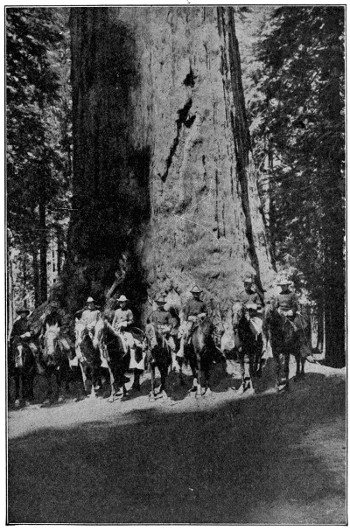
A Lordly Pillar in one of “God’s First Temples”
“Grizzly Giant,” a redwood in Mariposa Grove, California, one of the most wonderful of all wonderful sights in the West
Copyright by Underwood & Underwood, N. Y.
Fire retardance is a remarkable feature of redwood. In the early days of logging, when modern machinery was not available, the woodsmen were confronted with the problem of moving tremendously heavy trees. About sixty per cent of redwood is moisture, and what is known as the “butt cut” logs—the first cut above the ground, which is usually sixteen feet in length, will weigh from thirty to fifty tons. In order to move these heavy logs, therefore, it was necessary for the woodsmen to get rid of the bark, the undergrowth and the branches, which, in logging parlance, is known as “slash.” He soon learned that redwood so strongly resists fire that it was entirely safe to set fire to the logged-over field, burning out this slash without any damage whatever to the logs, although they were exposed to a fierce fire for a period of eight to twelve hours. Redwood does burn, but very slowly, and those who are familiar with California redwood know that it is the despair of the camper to endeavor to build a fire with it. Redwood does not contain pitch, the inflammable element in wood, and, in addition, it is extremely porous, quickly absorbing water. These two traits, in addition to the chemical composition of the wood itself, give it the fire retardance quality.
Redwood lumber, being light in weight and singularly free from many of the defects so prevalent in other wood, is extremely easy to work. When properly dried it does not shrink, warp or swell. It is capable of producing magnificent tones for interior finish, and some of the most charming homes on the Pacific coast have been made so by reason of the wonderful possibilities of redwood in this respect. Remarkable color-tone finishes are done by acid stains. Redwood is also a specialty wood. It has been used for years by the organ manufacturers in the West for organ pipes, giving eminent satisfaction. For incubators it is particularly desirable, while for concrete form lumber, and particularly in hot sections where the fierce heat of the sun is liable to warp other woods, it gives wonderful service by “staying put.” Redwood is one of the few woods that can be used over again for concrete work. For siding, sheathing, sub-flooring, shingles, window casings and frames, redwood is much used, because of its resistance to decay, both from contact with moisture or dry rot.
Redwood’s hardihood, due to the natural acids in the wood, make it so weather-resisting that it will last just as long unpainted as it does painted. However, there is no wood that takes and holds paint better. This is due to the absence of pitch and the porosity of the wood. It also possesses a remarkable resistance to corrosive acids and for this reason is the preferred material for tanks and vats in wineries, breweries, chemical works, mines, tanneries, etc.
The great bulk of redwood lumber has for years been consumed in the State of California, with about 50,000,000 feet annually going to Australia and the Orient and about 50,000,000 feet shipped by rail to the Middle West and East, the eastern shipments consisting practically of house materials and finishing stock.
How did the Expression “Forlorn Hope” Originate?
In the expression “forlorn hope” we have made the Dutch word “hoop” meaning a “company” into hope.
The “forlorn hoop” was a body of men, usually volunteers, selected from different regiments, to lead an assault, enter a breach or perform some other service attended with uncommon peril.
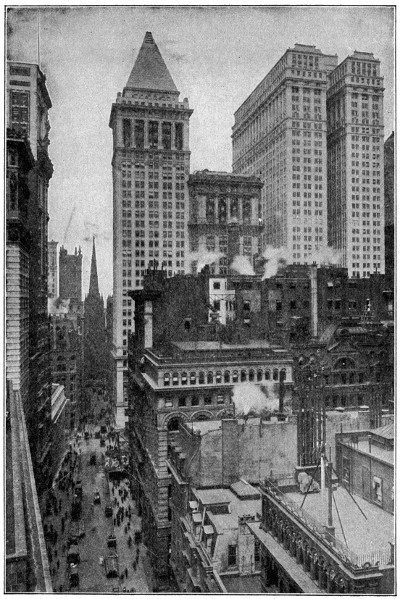
Wall Street, Known Around the World
Photo by Brown Bros.
Why is “Wall Street” Known Around the World?
This narrow canyon street in the lower part of the Borough of Manhattan is the financial center of New York City. The various exchanges and the largest banking institutions are situated here, and stocks and bonds are dealt in to a vast extent. Its control over finance has spread until now it affects the whole country and is a rival of the great financial centers of Europe.
In the picture, Trinity Church is shown, lying at the head of Wall Street, on Broadway, with its quaint old churchyard and its spire insignificant amid the giant skyscrapers that surround it. Trinity Church was founded in 1696 and rebuilt in 1839. It is probably the wealthiest and most influential of the churches in the United States, controlling many valuable real estate properties in New York City, and having some of the richest and most prominent people in the country among its members.
Starting approximately a quarter of a mile south of Wall Street, Broadway, New York City’s main business thoroughfare, extends for fifteen miles to the northern end of Manhattan Island. The activity and variety of its traffic, the elegance of its shops, and the massiveness and grandeur of many of its public and private buildings, makes it one of the most interesting streets in the world.
What Makes a Stick Seem to Bend in Water?
When we hold a stick partly in the water, it looks as though the stick bends just where it enters the water. That is due to the change of the direction of the light after it enters the water. This change in the direction of the light rays is called refraction. Glass, water and other solids and fluids each have different powers of refraction.
The law of refraction comes into operation when a ray of light passes through a smooth surface bounding two media not homogeneous, such as air and water, or when rays traverse a medium the density of which is not uniform, such as the atmosphere.
What Causes a Lump in a Person’s Throat?
When we eat anything, it passes into the throat after we have chewed it, and instead of just dropping down into our stomachs, there is a nine or ten inch series of rings in our throats, that takes the food, passing or squeezing it from one set of muscle rings to the other. These muscle rings are capable of working both up and down. If something is eaten which causes vomiting, the muscles work the other way and force the matter from the stomach.
When one is frightened a sort of a hollow feeling comes into the stomach and the muscles of the throat work upward, pressing against the windpipe and causing one to feel as if there was a lump there.
How are We Able to Hear Through Speaking-Tubes?
We know that when we speak, the sound waves that we set in motion are carried in every direction. Now when we speak into a tube, the sound waves cannot travel in all directions, but must follow the tube, and so we can hear through a tube at a greater distance than we can when speaking in the usual way.
The use of a megaphone or speaking trumpet for conveying the sound of the voice to a distance is based on the same principle.
Why do We Always Shake Hands with Our Right Hand?
The custom of shaking hands with the right hand has come down to us from the time when everyone carried a sword or knife. In those days when one met a stranger it was customary, as an indication of friendly intention, to hold out the right hand to show that it did not hold a sword or knife ready for attack.