The Story in a Giant Cannon
Reading edition
Origin of the Cannon.
The shotgun and rifle, the familiar weapons of the sportsman and the foot-soldier, are not the ancestors of the cannon, as might be surmised. On the contrary, the cannon was the predecessor of the musket and its successors. The rifle, however, antedated the rifled cannon, the type of modern artillery. We do not know when cannon first appeared, but it may have been soon after the discovery of gunpowder in Europe. This explosive seems to have been known in China long before knowledge of it reached the west, but we do not know to what extent it was developed and used in that country.
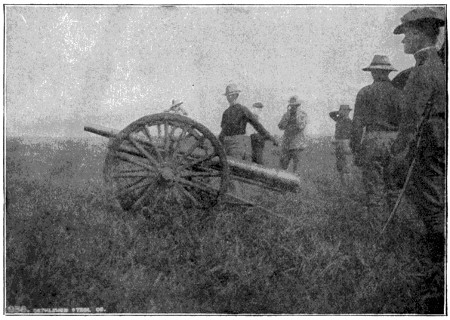
Three-inch Field Gun Under Test at Fort Riley, Kansas
In the trials conducted by the Board of Ordnance and Fortification of the United States Army. This gun and carriage, complete, weighs 2,020 pounds. Charge, 18.5 ounces of smokeless powder. Weight of projectile, 15 pounds. Muzzle velocity, 1,800-foot seconds.
Courtesy of the Bethlehem Steel Co.
The earliest cannon of which we have any knowledge were clumsy contrivances, at first wider at the mouth than at the chamber, and made of wood, and later of iron bars, hooped together with iron rings, a system of the same type as that now in use in the wire-wound cannon. They at first seem to have fired balls of stone, iron balls coming later. A doubtful statement exists to the effect that cannon were used at the siege of Belgrade in 1073, and it is said that Edward III used them against the Scotch in 1327. Other dates of their use are 1338 and 1346, in which latter year Edward III employed them against the French at Crecy. For this we have the authority of Froissart. They were known under the varied names of bombards, serpentines, etc. Twelve cannon cast by Louis VII were named after the twelve peers of France, and Charles V gave twelve others the names of the twelve apostles. Other titles came later into general use, the royal or carthorne, carrying 48 pounds; the culverin, 18 pounds; the demi-culverin, 9 pounds; the basilisk, 48; the siren, 60, etc. In still later times cannon became known by the weight and the balls they carried, 6-pounders, 12-pounders, etc. But they are now usually called after the size of their bores, as 6-inch, 8-inch, or 12-inch cannon. The oldest example still in existence is “Mons Meg,” preserved at Edinburgh Castle. This is one of the iron-bar type, hooped by iron rings. It is supposed to have been used by James II of Scotland, at the siege of Threave Castle in 1455.
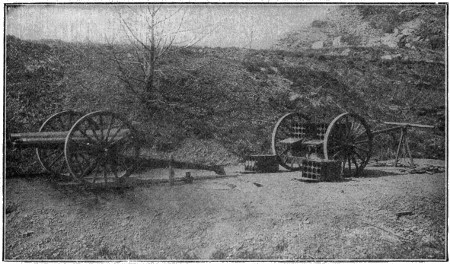
Three Inch Naval Landing Gun, Carriage and Limber
Weight of gun and mechanism, 675 pounds. Length of gun, 74.35 inches (25 calibers). Weight of projectile, 13 pounds. Travel of projectile in bore, 62.9 inches (20.97 calibers). Weight of charge, 18 ounces of smokeless powder. Muzzle velocity, 1,650-foot seconds. Muzzle energy, 246-foot tons. Weight of gun, carriage, limber, drag ropes, tools, etc., and 60 rounds of ammunition, complete, 3,420 pounds. The carriage and limber have each two removable interchangeable ammunition boxes for 12 rounds each, with a box for 12 rounds below the axle of the limber.
Courtesy of the Bethlehem Steel Co.
Louis VI used bombards of great length and power against the Flemish in 1477, while as early as 1401 bronze cannon had been cast in several cities of West Prussia. Iron cannon were not cast until near the end of that century. Coming down to the seventeenth century, we are told of the great Bijapur cast-iron gun, the “Lord of the Plain,” cast by the Mogul emperor Auremgzebe or by his foes the Mahrattas. This huge gun was 14 feet long, 28 inches bore, and fired a ball of 1,600 pounds weight. Smooth-bore cannon and mortars of cast-iron and bronze are still retained in some fortresses, though rifled cannon are the only type now made. As late as 1864 smooth-bore 100- and 150-pounder wrought-iron guns were made for the British navy and a few bronze rifled guns were made in 1870 for service in India, but all such guns are now obsolete.
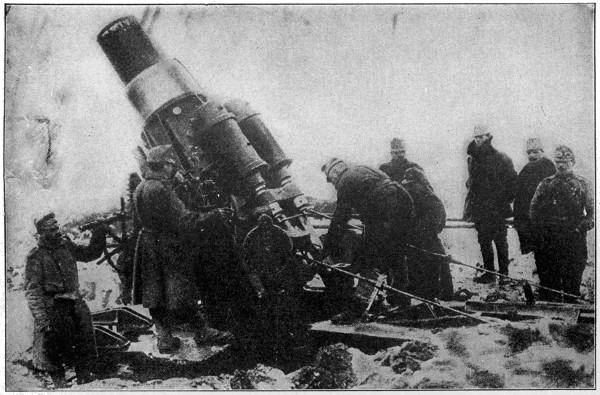
Twenty-eight Ton Austrian Siege Howitzer Which Fires a Thousand-pound Projectile
The Germans borrowed a large number of these great siege pieces from the Austrians and used them in the reduction of the Belgian defenses. Huge shells filled with high explosives from these mammoth guns rapidly destroyed the most modern and powerful fortifications known at the beginning of the great war. It is known that against such weapons of offense no fortifications can last and that the employment of such weapons has forced both armies to depend on their trenches as their main defense.
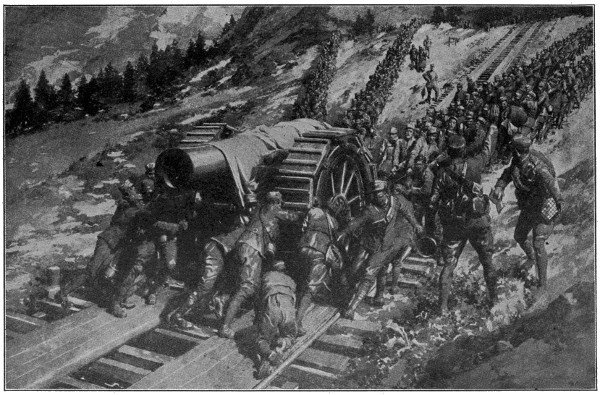
Conquering the Alps.
Immense labor and great ingenuity were required to haul the monster Italian guns up the steep mountain sides to their positions.
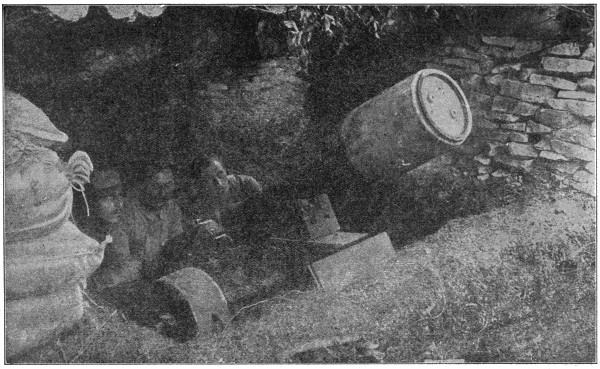
The Most Formidable of the French Army’s Trench Artillery
80-m.m. mountain gun loaded with air-mine weighing 130 pounds. These mines can be thrown for a considerable distance and create havoc in the enemy’s trenches if the aim is true.
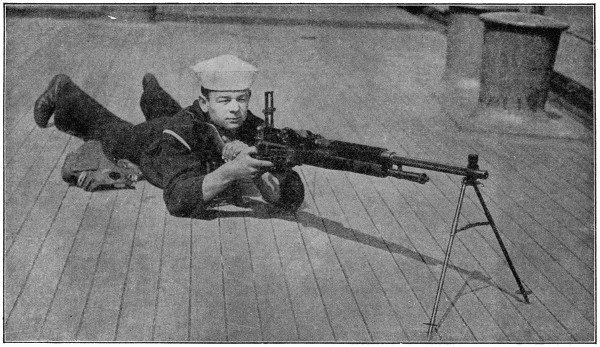
The Bennett-Mercier Machine Gun
This new automatic machine gun has been adopted by the United States Army, Navy and Marine Corps. It is handled by two men, one to aim and fire it, the other to feed the cartridges which are held in brass clips of 30 each. The complete gun weighs only about 35 pounds, fires 400 shots per minute, using regular 30-caliber Springfield rifle cartridges, with a maximum range of 3 miles and an effective range of about 2,000 yards. The weapon is air cooled and can be fired steadily for about 10 minutes without undue heating.
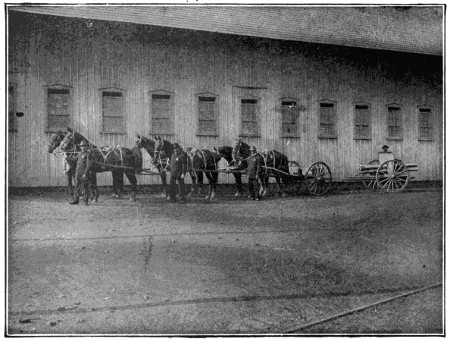
Three-inch Field Gun, Long Recoil Carriage and Limber
Weight of gun, carriage and limber complete, including 36 rounds of ammunition, 4,200 pounds; ground clearance, 22.5 inches. Seats are provided on axle of carriage for two gunners in transportation, one of whom operates the road brake.
Courtesy of the Bethlehem Steel Co.
The development of the rifle from the old smooth-bore musket, by cutting grooves or channels in the form of a screw in the interior surface, was found so advantageous in increase of precision of aim and length of range, that the rifling of cannon in time followed and is now universally used. Breech loading has also replaced muzzle loading, another vast advantage in the use of artillery. A form of breech-loading cannon was introduced in the sixteenth century, but the advantageous use of this device is of late invention. An important result of these changes is the use of elongated instead of round balls, this permitting of the employment of much heavier projectiles for the same width of bore.
Modern Cannon.
Until 1888 the largest cannon in use was the 119-ton Krupp, made in 1884 for Italy; but in 1888-90 the same house produced a 135-ton gun for Cronstadt. The heaviest British gun at that time was of 111-ton weight. This threw a projectile of 1,800 pounds with a muzzle velocity of 2,216 feet per second. But there later came a reaction in favor of lighter guns and quick firers. The heavy cannon of recent times are not cast, as of old, but are made of forged-steel by what is known as the building-up process. The different parts of these are called the tube, jacket, hoops, locking rings, trunnion rings, wire winding, etc.
Cannons are subject to great stress in firing, this being of two kinds. One is the longitudinal stress, acting in the direction of the length and tending to pull the muzzle away from the breech. The other is the circumferential or tangential stress, which tends to split the gun open in lines parallel to the axis of the bore. These stresses are results of the longitudinal and radial pressures of the gas developed by the ignition and explosion of the powder. Such destructive forces have to be guarded against in the building of a cannon and have led to a great development over the old-time casting processes. As long as projectile velocities under 1,500 feet per second were employed cannons cast in one piece sufficed, but when greater velocities were sought, the pressure grew so extreme that no cast or forged metal tube would stand the strain.
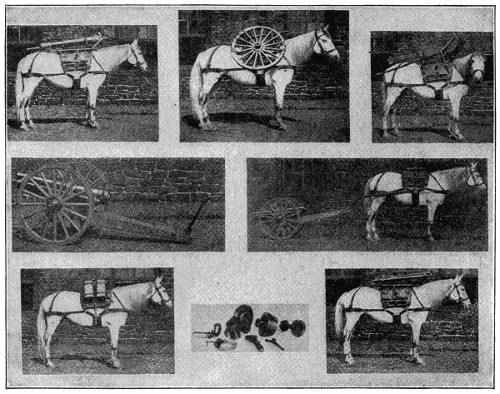
Three-inch Mountain Gun and Carriage
Weight of gun, 2061⁄2 pounds. Length of gun, 37.25 inches (12.4 calibers). Weight of projectile, 12 pounds. Travel of projectile in bore, 27.55 inches (9.2 calibers). Weight of charge, 12.5 ounces of smokeless powder. Muzzle velocity, 1,224-foot seconds. Muzzle energy, 123-foot tons. Weight of gun and carriage complete, 726 pounds. This gun and carriage break up into four loads of approximately 200 pounds each. The equipment carries 16 complete rounds of ammunition with it, which are divided equally among four boxes. The saddles are so made that the load will go on any saddle.
Courtesy of the Bethlehem Steel Co.
How Cannon are Now Made.
It was found that the inner surface of the tube stretched more than the outer surface, and that after the inner surface had been stretched to its limit of elasticity the outer part failed to add to its strength, so that further thickness was of no benefit. To do away with this condition cannon were constructed on the principle of varying elasticity, the metal with the greatest elongation within its elastic limit being placed next to the bore, yet in high-powered guns this system failed to yield the result desired and it was replaced by what is known as the initial tension system. This comprised two methods: the plain built-up gun and the wire-wound gun. In the latter certain parts of the gun were wrapped with wire in the form of a ribbon.
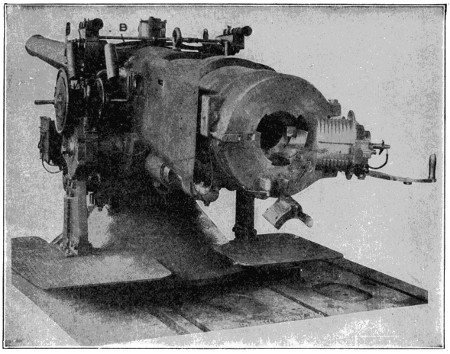
Rapid-Fire Gun
Six-inch rapid-fire gun equipped with patented two-handed elevating gear, consisting of two hand wheels on opposite ends of the same shaft, the handles being 180 degrees apart. The pointer uses both hands in elevating and depressing the gun. The electric firing trigger A is worked by the index finger of the right hand without releasing the handle. There is a second firing handle B attached to the slide, for firing either electrically or percussively.
Courtesy of the Bethlehem Steel Co.
Built-Up and Wire-Wound Guns.
A built-up gun is made of several layers of forged steel. The parts of such a gun are known as the liner, the tube, the jacket and the hoops. The liner is a single piece which extends the length of the bore and is intended to contain the rifling and the powder chamber. This is inclosed by the tube, which is also in one piece, surrounding the liner throughout its length. Outside this is the jacket, made in two pieces and shrunk on the tube. Over the jacket lie the hoops, six or seven of these being used in a big gun. Like the jacket, these also are shrunk on. All these parts are made of the finest quality of open-hearth steel.
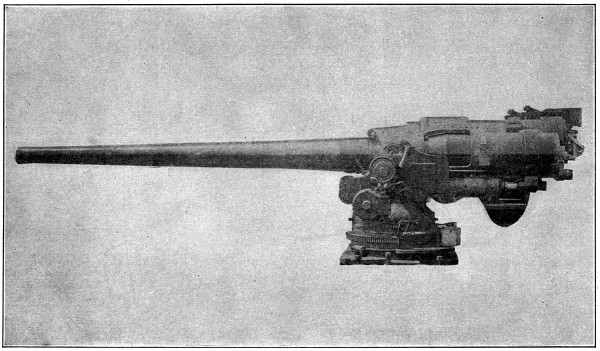
Five-Inch Naval Gun and Mount
The latest type of gun used in the U. S. Naval Service in the secondary batteries on a battleship.
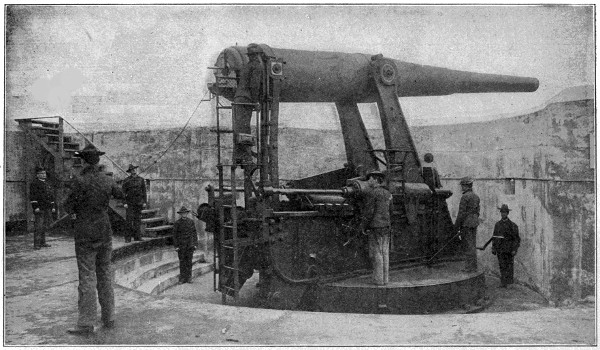
Coast Defense Gun
A modern 14-inch coast defense gun at Sandy Hook. The gun is mounted on a disappearing carriage, which lowers it out of sight behind the breastworks after firing. This is one of the most powerful guns in the world, firing a projectile which would pierce the armor of a battleship more than five miles away.
Copyright by Underwood & Underwood, N. Y.
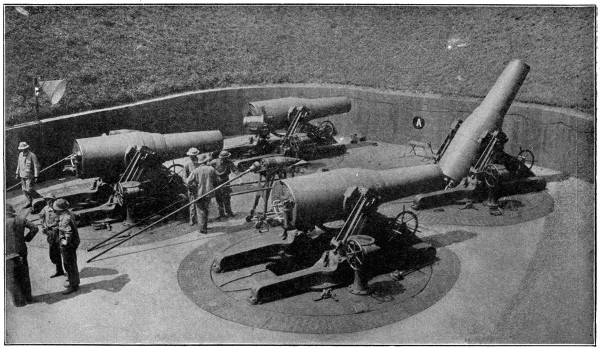
A Battery of 12-inch Coast Defense Mortars
These powerful weapons fire a projectile which weighs from 700 to 1,046 pounds, depending on the range desired, and which is capable of piercing the deck armor of any battleship. They have a range of 20,000 yards with the 700-pound projectile. The gun is 162⁄3 feet long and is fired only at elevations between 45° and 65°.
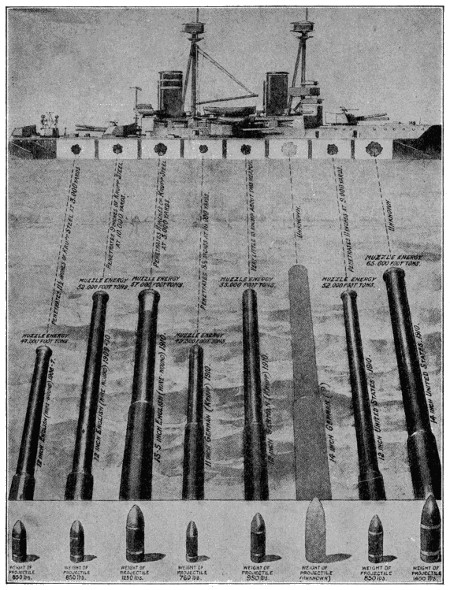
Large image (1143 x 1499 px, 703 kB).
Giant Guns—Their Muzzle-Energy, Projectiles, and Penetrating Powers
The British 13.5, which was known as the 12-inch-A until the “Lion” was launched, has a length of 45 calibers, and a muzzle-energy ten per cent greater than that of the 50-caliber 12-inch of 1909 and 1910. It may be noted that the caliber is the diameter of the bore of a gun. The statement that a gun has a length of 45 calibers, for example, implies that the gun is forty-five times the bore’s diameter. Thus a 12-inch gun of 45 calibers is 45 feet long.
These pieces are prepared with the utmost care to prevent any defective material entering into the make-up of the gun. After the parts are put together a thorough forging follows, either by use of hammer or press, the latter being now used in preference. The usual practice in forging is to continue it until the ingot is decreased to one-half its original thickness and is within two inches of the desired diameter of the finished work. It is then annealed with great care to relieve the strains set up in the metal by the forging and next goes to the machine shop to be rough bored and turned. The final boring takes place after a second annealing. The above is only a rapid sketch of the total process, in which elaborate care is taken to prevent imperfection of any kind.
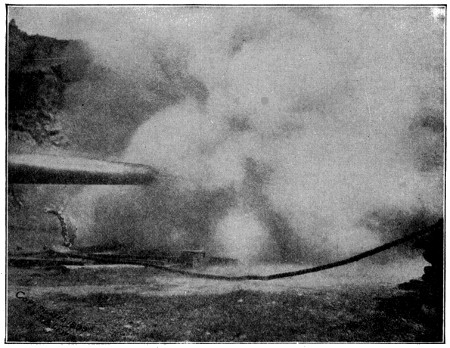
Ordnance Proving Ground
View showing smoke cone occurring during the proof firing of a twelve-inch gun with brown powder.
Courtesy of the Bethlehem Steel Co.
In a wire-wound gun an inner tube of steel is thoroughly wrapped by successive layers of ribbon wire, each layer being wound with wire at a different tension. This type of gun is preferred by foreign manufacturers, but within the United States the built-up system is in higher favor and is almost exclusively employed. The makers of the wire-wound cannon claim for it a positive soundness of material impossible to secure in a built-up gun, and that it has greater firmness of material and superior tangential strength. But with this come certain disadvantages, a notable one being a lack of rigidity in the longitudinal direction, this tending to increase the “droop” of the muzzle and give a certain “whip” to the piece when fired that reduces accuracy. This and other disadvantages have given the built-up guns general preference in this country, they being found strong enough to bear any pressure desirable in service. In addition they are much cheaper to build than the wire-wound guns.
Modern heavy guns are made of medium open-hearth carbon steel, forged as stated. The liner and tube are then placed upright in an assembling pit, the jacket and hoops shrunk on, and the finishing work done, as above said, the breech mechanism being finally fitted. Within recent years there has been a steady increase in the size and range of cannon, until an immense size and weight have been attained. For naval purposes the 14-inch gun is the largest now used in American battleships, but in the United States coast defense forts, 16-inch guns are installed. England has equipped several of her latest battleships with 15-inch guns and other nations are following in the same direction. In recent great battleships four turrets are used, each carrying three of these great guns, giving a broadside of twelve of these monster weapons of war. Of the three guns, the middle one is raised above the line of the others. A battleship thus armed is able to fire six guns ahead and six astern by raising the second and third turrets so as to fire over the others.
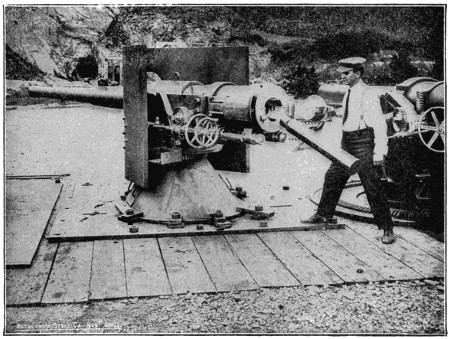
Four-inch Fifty Caliber Rapid-Fire Gun on Pedestal Mount
Extraction of cartridge case by opening of breech mechanism. Weight of gun, 6,170 pounds. Length of gun, 205 inches (51.2 calibers). Weight of projectile, 33 pounds. Travel of projectile in bore, 165.6 inches (41.4 calibers). Weight of charge, 15 pounds of smokeless powder. Muzzle velocity, 2,900-foot seconds. Muzzle energy, 1,928-foot tons. Weight of mount with shield, 9,470 pounds. Thickness of shield, 2 inches of nickel steel. Gun equipped with telescopic and night sights and with electric and percussion pull-off firing gear.
Courtesy of the Bethlehem Steel Co.
Military cannon are divided into three classes, based upon the length of caliber, and technically known as guns, mortars and howitzers. In guns the length is relatively great, in mortars relatively small, compared to their calibers. Howitzers form a class between guns and mortars in length. The field guns of the American army are the 3.6-inch breech-loading mortars, and the 3.6-inch heavy and 3.2-inch light guns. The siege guns in the service are the 5-inch siege guns, the 7-inch howitzer, and the 7-inch mortar. The coast defense artillery consists of the 8-, 10-, 12- and 16-inch guns and the 12-inch mortars. In the recent European war very heavy cannon were used for field service, pieces of the size usually placed in forts being drawn to the field by powerful tractors, set on concrete platforms and used in attacks on fortified cities. It was through the use of such ordnance that the German army so easily reduced the strongly fortified Belgian cities.
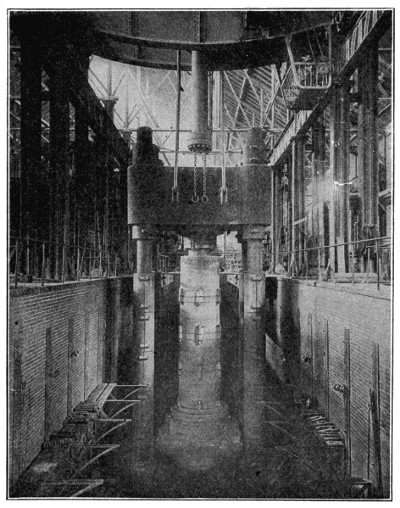
Fluid Compression Plant
While still in a molten condition in the mold, the steel used in manufacturing guns and shafting is subjected to hydraulic pressure until the ingot has cooled, thus insuring the solidity of the metal. The upper head of the compressor weighs 125 tons, and the lower one, including the cylinder through which the hydraulic pressure is applied, 135 tons.
Courtesy of the Bethlehem Steel Co.
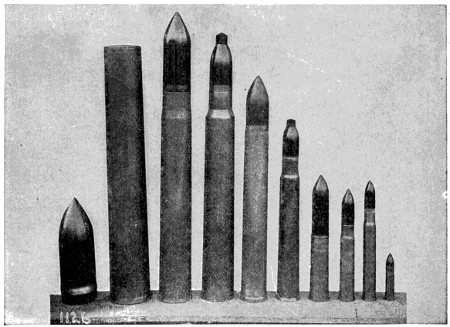
Ammunition.[32] (See page 410.)
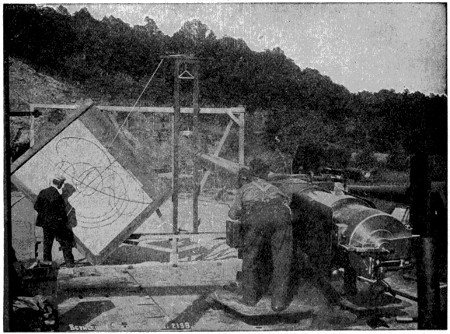
Two-Handed Elevating Gear.[32] (See page 410.)
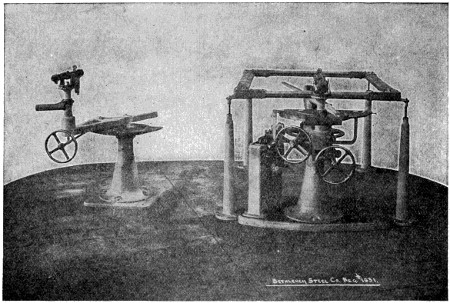
Range Finder and Predictor; Home and Distant Station Instruments.[33] (See page 410.)
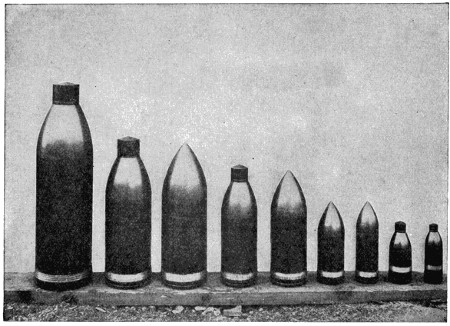
Armor Piercing Projectiles, Capped and Uncapped.[33] (See page 410.)
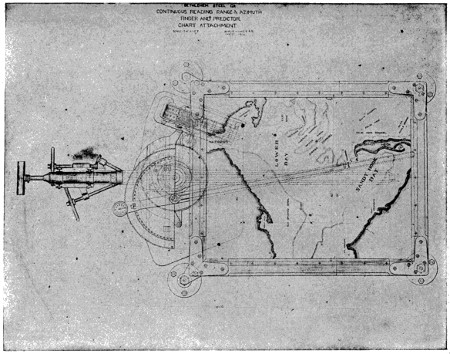
Range Finder and Chart Attachment[34]. (See page 410.)
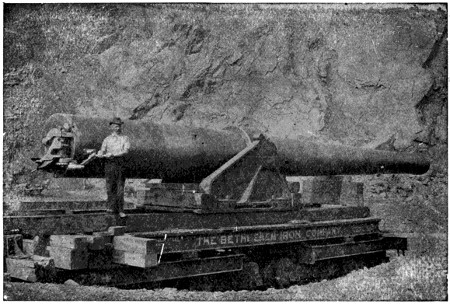
Eighteen-inch, Thirty-caliber Torpedo Gun.[34] (See page 410.)
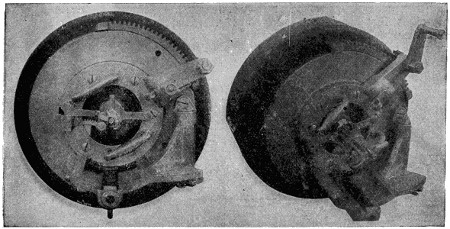
Firing Gear for Guns.[35] (See page 410.)
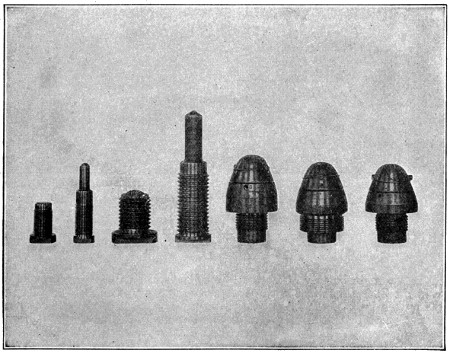
Fuses.[35] (See page 410.)
The range of these giant cannon is enormous and their destructive power great, this being added to by the fact that the explosive shell has replaced the solid round shot of old-time gunnery. A 14-inch gun of 45 caliber can discharge a 1,400-pound projectile at a muzzle velocity of 2,600 feet per second. If we compare this with a locomotive going at the speed of sixty miles an hour, we have in the latter a speed of eighty-eight feet per second to compare with the 2,600 feet per second of the cannon ball. From this we can well conjecture the vast speed with which the latter moves, its enormous range and vast powers of destruction.
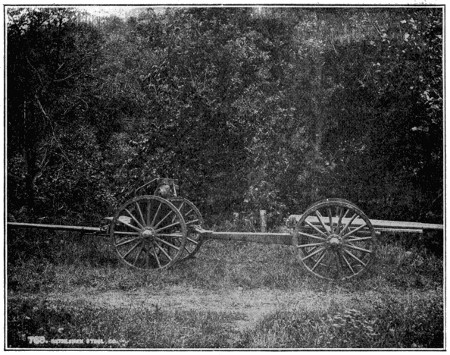
Three-inch Horse Artillery Gun, Long Recoil Carriage and Limber
Length of gun, 85 inches (28 calibers). Weight of projectile, 12 pounds. Travel of projectile in bore, 74.65 inches (24.88 calibers). Weight of charge, 17.1 ounces of smokeless powder. Muzzle velocity, 1,750-foot seconds. Muzzle energy, 255-foot tons. Weight of gun, carriage and limber, containing 36 rounds of ammunition, 3,355 pounds. Ground clearance, 18 inches.
Courtesy of the Bethlehem Steel Co.
As facts are better than theories, it will be of interest to adduce a recent example of gunnery of a most illuminating type, but as regards distance and remarkable accuracy of aim. In September, 1916, the American battleship “Pennsylvania,” armed with a main battery of twelve 14-inch guns, fired these simultaneously at a target in the Chesapeake 22,000 yards, or more than twelve miles, away. The target was the sunken hulk of the “San Marcos,” formerly the battleship “Texas,” which for several years had been used for similar purposes. As the target was invisible to the gunners it was hardly to be expected that any of the shots should fall near the target. But the extraordinary result appeared that five of these twelve shots struck the hulk. As each of these projectiles weighed 1,400 pounds any battleship receiving such a broadside would probably have gone promptly to the bottom. The result, which has never before been equaled in accuracy, sufficiently attests the remarkable proficiency in range-finding that modern engineers have developed.
As for the penetrating powers of such huge shot we may take the 15-inch gun, the type of the largest guns in our fortifications and which is claimed to be able to pierce sixteen inches of armor at a range of 18,000 yards and ten inches at a range of 20,000 yards. A notable example of this took place on September 15, 1916, at the proving grounds at Indian Head, on the Potomac River, when a 16-inch, 2,100-pound, solid steel shell, said to be the first ever fired from a naval gun of that caliber, with a small charge of explosive, went through a plate of armor, penetrated a thick sand backing, and continued its course, striking the house of an employee of the proving grounds and plunging through the kitchen rending all before it. This was a naval gun, the largest yet made for naval purposes.
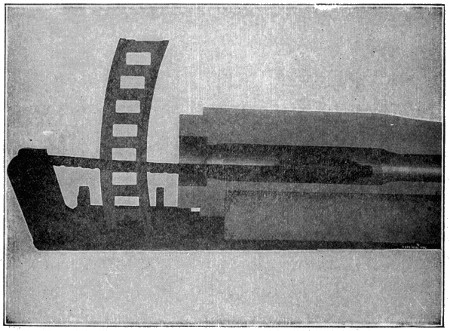
Patented Chain Rammer
As applied to loading twelve-inch turret guns. The space occupied by this rammer in the rear of the gun is less than one foot, with a possible ramming stroke of fifteen feet. The rammer being attached to the gun’s cradle or slide, moves with the gun in elevation and depression. The ammunition car also moves with the gun. Loading can be performed while the gun is kept in motion following a moving target. This rammer is stiff in all directions when extended.
Courtesy of the Bethlehem Steel Co.
In the make-up of modern guns the breech-loading mechanism is of essential importance, it being necessary that the breech should be capable of rapid opening for the insertion of the charge into the loading chamber, as rapidly closed and firmly secured to prevent it being forced open by the reaction of the discharge. It also must fit with such tightness as to prevent any escape of the gas in that direction, and force it to exert all its impelling power upon the ball. Various methods are used for this purpose, with the result that loading and firing can be very quickly and effectively performed. In the case of guns in fortifications, the disappearing carriage is a highly important invention of recent date. By its aid the gun is quickly lifted to fire over the walls of the fort and is driven backward by the force of its discharge, sinking to a place of safety behind the walls. This saves the gun and its crew from injury by return fire.
We may say in conclusion that the great European war was notable for the use of artillery to an extent far surpassing its employment in any previous war. This great conflict, indeed, was very largely a contest of gun fire, in which the opposing fields of the battling armies were so swept with shells and other explosives as to render life impossible on the open land, trench digging being one of the main employments of the embattled hosts. Never before had the supreme value of gunnery in warfare been so fully demonstrated.
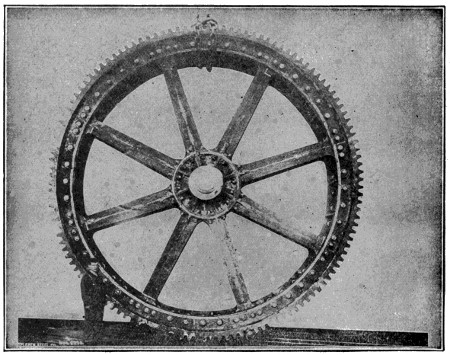
Gear Wheel and Drum for Coal Hoisting Plane
Diameter of wheel, 20 feet 91⁄2 inches; face, 431⁄2 inches; diameter of hub, 26 inches; number of teeth, 128; pitch, 61⁄8 inches; pitch diameter, 249.554 inches; shipping weight, 108,873 pounds.
Courtesy of the Bethlehem Steel Co.
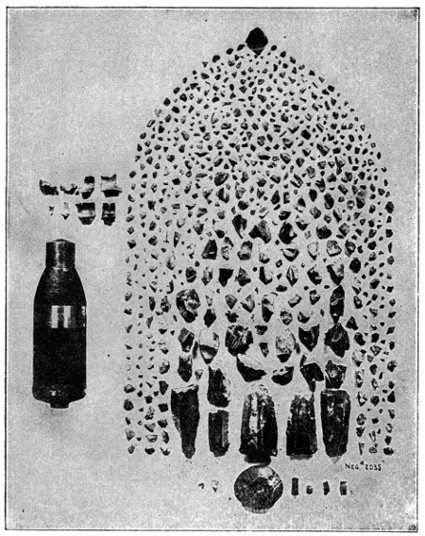
Six-Inch Ribbed Cavity Armor-Piercing Shell
Projectile was loaded with two pounds of black charcoal powder and fused with magazine fuse. Fired at six-inch Krupp hard-faced armor plate. Shell burst about eight feet to rear of plate after penetrating the same. Weight of largest fragment recovered 101⁄4 pounds. Average weight of fragments, 25⁄16 ounces. Total number of pieces recovered, 650.
Courtesy of the Bethlehem Steel Co.
Ammunition. (See page 402.)
Made-up ammunition, with brass cartridge cases, and cast-iron and forged steel shells and armor-piercing projectiles. The rounds shown are as follows: Rounds with forged steel shell for one-pounder gun, for three-pounder gun and for six-pounder gun respectively; round with cast-iron shell for three-inch field gun; round with capped armor-piercing shell for three-inch fifty-caliber rapid-fire gun; round with forged steel shell for four-inch forty caliber rapid-fire gun; round with capped armor-piercing projectiles for the four-inch and twelve-centimeter fifty-caliber rapid-fire guns respectively, and round with forged shell for six-inch gun.
Two-Handed Elevating Gear. (See page 402.)
Method of obtaining a variable movement of a miniature target, corresponding to rolls of a vessel of from 1 to 10 degrees. A series of 25,000 shots were fired thus, by eight gun pointers, at targets corresponding to the size of a battleship as seen at ranges of 1,500, 3,000, 6,000 and 9,000 yards. Using a sub-caliber rifle rigidly attached to the muzzle of the gun and fired electrically by the firing gear of the big gun. The record shows that under circumstances of average difficulty at sea (say 5 degrees roll and range of 3,500 yards), the gain in accuracy (increase in hits with a given expenditure of ammunition) is about 25 per cent, and the gain in speed of hitting (number of hits in a given time) is 50 per cent, with the two-hand gear as compared with the usual one-hand gear.
Range Finder and Predictor; Home and Distant Station Instruments. (See page 403.)
Continuous readings, by means of automatic indicators, of either the actual or the predicted ranges and azimuths of moving target at every instant and for any distance from 1,000 to 15,000 yards and through an azimuth of 160 degrees, are clearly presented at all times. The ranges are read in scales of 10-yard steps, and the azimuths for each .01 degree are traversed. The corrected ranges for the various guns served by the instruments, either actual or automatically predicted for any interval of time, are constantly communicated to the various guns whose fire is being directed by the observation instrument.
Armor-Piercing Projectiles, Capped and Uncapped. (See page 403.)
The projectiles shown are a three-inch capped, a four-inch capped, a five-inch and a six-inch uncapped, eight-inch uncapped and capped, ten-inch uncapped and capped and twelve-inch capped.
Range Finder with Chart Attachment. (See page 404.)
The chart is drawn on the lower and ground side of a ground glass plate. A pencil point is secured to moving cross-head and marks position of target on ground glass, tracing movement of same thereon. The pillar mounting allows of ready removal of chart attachment when it is not desired to use the same.
Eighteen-inch, Thirty-caliber Torpedo Gun. (See page 404.)
Weight, 134,000 pounds. Length of gun, 528 inches. Weight of projectile, 2,000 pounds. Travel of projectile in bore, 432.4 inches (24.02 calibers). Weight of charge, 310 pounds of smokeless powder. Muzzle velocity, 2,000-foot seconds. Muzzle energy, 55,500-foot tons. Greatest diameter of gun, 45 inches. Its breech mechanism was opened and closed by one man in nine seconds. It was also opened without great effort by a boy twelve years of age.
Firing Gear for Guns. (See page 405.)
External firing gear for guns using loose ammunition. The primer is inserted in the firing gear when the breech mechanism is open, but is held at an angle to the lighting vent until the final locking motion of the breech block, making it impossible to light the gun’s charge before the breech mechanism is safely closed, even if the primer should be prematurely exploded. The primer case is automatically ejected by the opening of the breech mechanism.
Fuses. (See page 405.)
The fuses shown from left to right are: minor caliber percussion fuse, minor caliber magazine percussion fuse, major caliber percussion fuse, major caliber magazine percussion fuse, triple, double and single train time fuses. The time fuses all contain a percussion element to insure their exploding on impact if not previously exploded. No special tool is required for setting these fuses. They are made up to 27 seconds burning time for guns of 2,600-foot seconds muzzle velocity, and up to 36 seconds for mortars and guns of 1400-foot seconds muzzle velocity.
What is a Deep-Sea Diver’s Dress Like?
There are now two general types of deep-sea diving equipment: an India rubber dress, covering the entire body, except the head, which is covered by a helmet, and another apparatus which is constructed entirely of metal.
The India rubber dress has a neck-piece or breast-plate, fitted with a segmental screw bayonet joint, to which the head-piece or helmet, the neck of which has a corresponding screw, can be attached or removed. The helmet has usually three eye-holes, covered with strong glass, and protected by guards. Air is supplied by means of a flexible tube which enters the helmet and communicates with an air pump above. To allow of the escape of the used air there is sometimes another flexible tube, which is led from the back part of the helmet to the surface of the water. But in the more improved forms of the dress, the breathed air escapes by a valve so constructed as to prevent water from getting in, though it lets the air out. Leaden weights are attached to the diver, and his shoes are weighted, that he may be able to descend a ladder, walk about below, etc.
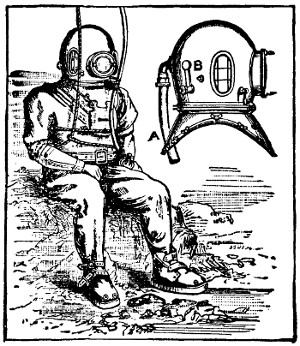
Diving-Dress and Diving-Helmet, by Siebe, Gorman & Co.
A. Pipe by which air is supplied. B. Valve by which it escapes.
Communication can be carried on with those above by means of a cord running between the diver and the attendants; or he may converse with them through a speaking tube or a telephonic apparatus. One form of diving-dress makes the diver independent of any connection with persons above the water. It is elastic and hermetically closed. A reservoir containing highly compressed air is fixed on the diver’s back, which supplies him with air by a self-regulating apparatus at a pressure corresponding to his depth. When he wishes to ascend he simply inflates his dress from the reservoir.
Another form, known as the Fleuss dress, makes the diver also independent of exterior aid. The helmet contains a supply of compressed oxygen, and the exhaled breath is passed through a filter in the breast-piece which deprives it of its carbonic acid, while the nitrogen goes back into the helmet to be mixed with the oxygen, the supply of which is under the diver’s own control, and to be successively breathed. A diver has remained an hour and a half under thirty-five feet of water in this suit.
A considerable enlargement of the field of deep-sea diving is the result of the invention recently of a form of diving apparatus which is unaffected by the limitations hitherto imposed on work of this kind. A possible depth of 204 feet is recognized by the British Admiralty regulations under the conditions that obtain with the common form of diving suit. Yet this depth has probably never been reached. One hundred feet is the rare descent of the average diver and 150 feet his maximum. With the new apparatus a submergence of 212 feet has been obtained, and this might have been indefinitely extended had there been a greater depth of water at the place where the experiment took place—Long Island Sound during the latter part of 1914.
The new diving apparatus is constructed entirely of metal, is rigid and is made of such materials that it is strong enough to resist the great pressures found in the depths to which it can penetrate. The material used is an alloy of aluminum, and the diving case weighs complete about 500 pounds. When in the air, the man inclosed in it is incapable of imparting movement to it, but in the water, which counterbalances the dead weight of the apparatus, he can easily move the articulated sections as well as give himself motion through the water. The articulated portion consists of about fifty turning joints, fitted with leather packing, which swells and has an increased effectiveness under increased water pressure. To prevent the pressure-force of the deep sea from jamming the joints, roller bearings are so arranged about them that freedom of action is constantly maintained.
The diving case is not absolutely water-tight, nor is it desired that it should be so, as the slight leakage acts as a lubricant to the joints, and aids in their movements. The danger arising from the intake of water thus into the diving case is averted by the action of an ingenious pump appliance, which serves two purposes: that of pumping the water out and pumping the air in. The diver in this invention carries his pump with him and has air supplied to him at atmospheric pressure.
At the back of the diving case is a recess and in it is installed a compact but powerful pump, which sucks from the feet of the suit all leakage and forces it at once outward. This pump is worked by compressed air, and the air, after performing its mechanical part of driving the pump, is exhausted into the suit for the diver to breathe and then passes to the surface through the free space in an armored rubber tube, within which are led down to the diver the compressed air pipe for driving the pump, and the electrical connections for telephone and lamp. Thus the diving case receives a thorough ventilation, and it has been found that should the pump fail to work for a number of minutes there would still be enough air remaining in the diving case and the tube space to supply the diver’s needs for at least the length of time he is being hauled to the surface.
During the experiment in Long Island Sound the pump was stopped for ten minutes, while the diver was at a depth of 100 feet. He suffered no inconvenience, and when the compressor again was started he was lowered to a depth of 212 feet. If such a condition as failure of the pump to work for ten minutes had arisen during a descent in the old elastic diving dress the result must necessarily have been fatal. Nor is a delay necessary in hoisting the diver clad in the new diving apparatus to the surface. According to the British Admiralty regulations, should a diver go down to a depth of 204 feet, the time of his ascent must be not less than one hour and a half. In the Long Island Sound experiments the diver was hoisted to the surface in eighty-seven seconds. He was totally unaffected by the abrupt change in pressure, although the deepest he had ever been was ninety feet, and on that occasion he had suffered from bleeding at the nose and ears.
Why do We Smile when We are Pleased?
We smile to express our pleasure. When you meet a friend on the street you smile as you greet him. This is an indication of your pleasure at seeing him. This is often caused by an unconscious nervous action produced by the impression the occurrence creates on the brain. You do not have to think about smiling, but the muscles of your face contract and give you that pleased look without any effort on your part.
Why do Some of Us have Freckles?
Some people have freckles, when others do not, because all skins are not alike, just the same as eyes are not all of one color. People with certain kinds of skin freckle more quickly when the skin is exposed to the sun. The action of the sun on their skin causes small parts of the second layer of skin to give out a yellow or yellowish brown substance. Freckles are most common in persons of fair complexion and hair. In some cases freckles are permanent, but in most cases they disappear with the coming of cold weather.