Volume 6 — XXX IN MANY PLACES
Reading edition
“The whole value and meaning of life lies in the single sense of conscience—duty.”—Frances Anne Kemble.
“Do weel and dread nought though thou be espyit; He is little gude worth that is not envyit: Take thou nae heed what tales man tells; If thou would’st live undeemed, gang where nae man dwells.” —Sir Walter Scott in Orloff Davydoff’s Album.
“True happiness is only to be obtained by devotedness to the will of God. Seeking the universal good—the highest good of all. Life can only be truly happy, not when we are in ecstasy, but when we are doing right.”—Thomas Cooper, Thoughts at Fourscore.
“Let nothing disturb thee, Let nothing affright thee— All passeth: God only remaineth. Patience wins all things; Who hath God lacketh nothing: Alone God supplieth.” —St. Theresa’s Bookmark.
GREATLY as I always enjoy my little home of Holmhurst, dear as every corner of it is to me, I never feel as if it was well to stay there too long in winter alone. In summer, Nature itself can give sufficient companionship; but when earth is dead and frost-bound, the silence in the long hours after sunset becomes almost terrible, and I increasingly feel that late autumn and winter are the best time for visits.
To Viscount Halifax.
“Holmhurst, Nov. 25.—I have much enjoyed a visit from Mr. and Mrs. Cummings, the Americans who were so kind to us on our terrible return journey from Italy in 1860, and of whom the wife, at least, is so clever, that she is suffering—as Mrs. Kemble said once of some one—from a constipation of her talents. They came here fresh from a visit to Haworth, much impressed with its severe desolation,—‘that any one should be able to have any hope, or look forward to a future life, on the top of Haworth hill is nothing short of a miracle.’ They have made a Brontë museum there now, chiefly full of Branwell’s drawings, of great interest, chiefly military. Did you know that Mr. Nichols hoped to have been rector when Mr. Brontë died? But it was given by election, and he was unpopular, and it went against him. He is still living in Ireland, whither he took all the Brontë memorials he cared for. The rest were sold by auction, and the butcher, baker, and candlestick-maker of Haworth bought them. The sexton showed Mrs. Cummings some of Charlotte’s underclothing, delicately marked by herself with her C. B., and her wedding shoes, of some grey material to match her dress. He had often seen her and her sister come out of the house, and go through the little gate at the back to the moors, which at Haworth are grass, not heather. After Charlotte married, Mr. Nichols would not let her write. His mind was of the very narrowest, and he disapproved of novels, and when she was pent up in that solitude, and all her secret thoughts were pent up too, and never allowed to come out in writing, she—died.
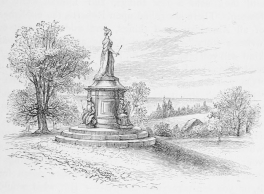
IN THE WALKS, HOLMHURST.

“Mrs. Cummings says we should not like America; ‘it is a country utterly without perspective; one must go up to the Indians and the Jesuit missionaries for that.’ She has been describing Miss Louisa Alcott,[539] the well-known authoress. ‘She lived with her old father and her beautiful mother and her three sisters. They used to write little stories. One day her sisters said, “Louisa, you must write something more than these.”—“I would, but I can’t do it here,” she answered. So the sisters clubbed their little savings together, and they sold a few things, and Louisa went to Boston. There she called upon Roberts, the publisher of all American good things, and said, “I want to write a story.”—“Very well,” he answered; “what kind will you take?”—“Oh, I can’t make up anything,” said Louisa; “I can only just write what I know.”—“Oh, you can just write what you know,” said Roberts; “then don’t stay talking here; go away at once and begin.” So she went and lived by herself and wrote, and in five weeks she brought him her “Little Women.” He took it and said, “Come again to-morrow.” And when she went next day he said, “Well, I will take your story, and I will offer you one of two things; either you can take two hundred dollars down for it, or you can take your chance.”—“But what would you do if you were me?” asked Miss Alcott. Roberts said he had never been placed in such an awkward predicament in his life, but he spoke the truth and said, “I would take my chance.” She did, and soon after he had to pay her 10,000 dollars.[540] She wrote “Little Men” afterwards, but it did not answer as well; boys do not take books to their pillows as girls do.’
“‘I love crying,’ said Mrs. Cummings, ‘but then I must have somebody to cry to. I cried as a little girl because I thought my mother might die, but I cried most because I thought that then I should have no one to cry to.’ Miss Alcott said to her, ‘My dear, I shouldn’t mind dying if it wasn’t for the funeral.’
“‘Mr. Tennyson was very rude and coarse,’ said Mrs. Cummings, ‘but he died well—reading his little book in the moonlight: he really couldn’t have done it better.’
“‘Louisa Payson, who wrote “The Pastor’s Daughter” and many other books,[541] would not say “thank you” when she was a little girl. Her father, the stern minister, punished her in various ways, but it was no good—she said she couldn’t. So at last, at five years old, he turned her out of doors late on a winter’s evening. He went to his affairs, forgot her, I suppose; but her mother was in an agony, and she prayed for her child with all the spirit that was in her. At last she could bear it no longer, and she opened the door a little way, and then she heard a little wail of “I can’t say thank you: I can’t say thank you.” What was the end I do not know, but at any rate Louisa did not die, and lived to write books.’
“These are some snatches from the Holmhurst tea-table.”
To Herbert Vaughan.
“Kingston Vicarage, Wareham, Nov. 10.—You would have liked going with us to Wool, on a ‘Tess of the D’Urbervilles’ pilgrimage, for there, rising by the reedy river-side, is the old gabled house to which Tess was taken after her marriage. It is exactly as Hardy describes it;[542] even the plank bridge remains across which Angel carried her in his sleep to the stone coffin at Bindon Abbey. The two old pictures mentioned in the book really hang at the top of the staircase, and the lady in one of them is supposed to blow out the candle of any one who ventures up the stairs after midnight. The whole country-side is full of memories of the D’Urbervilles, and there are many still living who depose to having met their phantom coach and four with outriders. The family still exists at Kingston as—Tollerfield!
“We had an awful storm last night, but such hurricanes are the fashion in Purbeck. A Mr. Bellasye, returning home, met, not his bathing-machine, but his bathing-house coming to meet him across the hedges and ditches. Mr. and Mrs. Wordsworth had a huge hole blown into their roof by one gust; but that did not much signify, as the next gust blew a haystack on to the roof and filled the hole up. All the cabbages and other vegetables in the kitchen-garden are frequently blown out of the earth and into a heap in a corner, and on one occasion those in the rectory-garden were all blown into the church porch.”
To Viscount Halifax.
“Elvedon, Thetford, Nov. 14.—All the way back from Dorsetshire did I come for the pleasure of meeting the Duchess of York here (at Lord and Lady Iveagh’s); but that was not to be, as an impending event is considered too near for her to travel with safety. The Duke is here, and very unaffected and pleasant, really a very nice prince, and quite good-looking. He never fails to be punctual to the moment—a grand quality for a prince, and due, probably, to naval discipline. He talks a great deal, and talks well, but in reality princes have no chance—no chance at all—conversationally, as no one ever contradicts them, however much they disagree; no subjects are aired but those which they choose for themselves, and the merest commonplaces from royal lips are listened to as if they were oracles.
“Anything more odious or annoying than being a prince certainly cannot be imagined. Such a wearisome round of dullest duties and painful ‘pleasures’ as it is their life’s-work to live in like a tread-mill. Then, every fault of manner, far more of conduct and character, is commented, dwelt on, and exaggerated. I should be sorry for any prince, but am really dreadfully sorry for this one, as he would have been charming, and might have been extremely happy if the misfortune of his birth had not condemned him to the severe and miserable existence of princedom, in which all minor faults are uncorrected because unsuggested, though I believe such a true friend and fine character as, for instance, Lord Carrington, would always notice any sufficiently grave to be of consequence either to the country or the royal family.
“I floated here in the luxurious saloon carriage of a special train, but felt rather shy, because whereas all the rest of the party were on terms of christian-name intimacy, I knew none of them before except Lord Rowton, who is, however, always very kind and pleasant. But I was interested to see those who are so frequently part of the royal circle, and liked them all, especially and extremely Lord and Lady Carrington; but then—everyone does!
“I wonder if you know this house of Elvedon. It was Duleep Singh’s, and he tried to make it like an Indian palace inside. Much of his decoration still remains, and the delicate white stucco-work has a pretty effect when mingled with groups of tall palms and flowering plants. Otherwise the house (with the kindest of hosts), is almost appallingly luxurious, such masses of orchids, electric light everywhere, &c. However, a set-off the other way is an electric piano, which goes on pounding away by itself with a pertinacity which is perfectly distracting. In the evenings singing men and dancing women are brought down from London, and are supposed to enliven the royal guest.
“You know, probably, how this place is the most wonderful shooting in England. The soil is so bad that it is not worth cultivating, and agriculture has been abandoned as a bad business. Game is found to be far more profitable. The sterile stony fields are intersected at intervals by belts of fir; the hedges, where they exist, are of Scotch fir kept low; and acres of thick broom are planted. Each day I have gone out with the luncheon party, and we have met the shooters at tents pitched at different parts of the wilderness, where boarded floors are laid down, and a luxurious banquet is prepared, with plate and flowers. The quantity of game killed is almost incredible, and the Royal Duke shot more than any one, really, I believe, owing to his being a very good shot, and not, as so often is the case in royal battues, from the birds being driven his way.
“A great feature of the party is Admiral Keppel, kindest, most courteous, and most engaging of old gentlemen, so captivating that there is always a rivalry amongst the ladies as to who shall walk with him, and amongst the men to get hold of his stories. He told me of how his father first started him on his naval career, and, while he talked it over at Holcombe, made him sit in the same chair in which he had talked the same subject over with Nelson when he was starting him.
“He described the prayers at Holcombe on Sunday evening in his boyhood. After dinner the men were allowed an hour or two over their wine. Then the prayer-bell rang, and they all went in. Afterwards an old servant stayed to take up those who could not get up from their knees, and carry them to bed by turns when they were too drunk to go by themselves.
“He remembered Charles James Fox reeling down the corridor at Holcombe, falling helplessly from side to side. His father followed him, and he followed his father, who kept exclaiming, ‘Good God! drunk! Good God! drunk again!’ for the expression had not gone out then.
“He said that the present Lord Leicester and his father had married at exactly a hundred years apart.”
To W. H. Milligan and Journal.
“Nov. 27, Hornby Castle, Bedale.—I came here yesterday. Several people were in the castle omnibus when I got into it at the station, of whom a grand lion-like old man turned out to be Mr. Bayard, the American Ambassador. It was dark when we arrived. We found the Duchess (of Leeds), tall, gracious, and most winning in manner, and indeed all the family, in a noble hall, coved at the top, with busts in the upper niches, like the halls of Roman palaces, and looking (by daylight) into a courtyard, which is very picturesque and curious.
“Lady Harewood is here, sweet-looking and very white, with a pleasant daughter, Mr. and Lady Alice Shaw Stewart, and several young men. Mr. Bayard came down to dinner much delighted with a book he had found in his room—the ‘Life of Agrippina’—in which ‘What news from Armenia?’ is anxiously asked, showing how the same subject occupied conversation then as now, at a distance of nineteen centuries. He said, ‘When bad men conspire, good men ought to confederate.’
“This morning, in the library, I had much and delightful talk with Mr. Bayard. He gave an interesting account of the allotment of land in America: how a reserve was left to the Indians, but they were dying out, chiefly because of their catching all the vices of Europeans, especially their love of alcohol. He said they were like the buffaloes. These used to come down and swoop through the country in vast herds, and devour all the spring produce; and later, in their vast battalions they would swoop back again; but now, fettered and shut in by barriers and fences, they pined, starved, and died; and so it was with the Indians. He described how, after an unjust woman had published a libel on her country,[543] the greatest suffering had resulted to the slaves, who would follow their former masters to suffering, wounds, imprisonment, and death. A Southern lady, when ‘the army of liberation’ approached, had entrusted all her silver and jewels to her slaves, and they had brought it all back safely after the army had passed.
“He talked of the Banco di S. Giorgio at Genoa—‘one of the most interesting buildings in the world;’ that whereas the Bank of London had lasted two centuries, that of Genoa had lasted five: that the Bank was the greatest evidence of the philosophy of nations. No aspersion was ever cast upon it, and this was because those who administered it had never derived any profit from it, only honour. An instance of its usefulness as a record-office occurred lately, when a man in America offered Mr. H. an autograph letter of Columbus. To all appearance it was genuine, but Mr. H. asked leave, which was readily granted, to have a photograph facsimile made of it before purchasing. In the Banco di Giorgio the original letter was found, and, when compared with the facsimile, proved that the copy was false. This was especially fortunate, as, after Napoleon I., ‘that great collector of other people’s property,’ took away the archives of Genoa, though most were restored, all were not.
“The library at Hornby is full of interest, but I can only remember a fifteenth-century ‘Roman de la Rose;’ a first edition of Shakspeare, which came to its present owners through Henrietta, Duchess of Marlborough, who inherited it from William Congreve; and a copy of ‘Dionysius the Areopagite,’ by Beghir, ‘the one-eyed scribe of Brabant’—most delightful name—with notes by Dean Colet.
“The Duchess has shown us the house minutely and delightfully. The family portraits were full of interest, beginning with that of Sir William Hewitt, whose daughter married William Osborne, the apprentice who saved her when she fell over London Bridge, and who founded the Leeds family. In a curious Hogarth of ‘The Beggar’s Opera,’ the Duke of Bolton is represented watching the acting of Polly Peachum, whom he afterwards married: the picture is here because Sir Conyers d’Arcy, an ancestor of the house, is also represented. Mr. Bayard was delighted to find portraits of the wife of the seventh Duke, who was Miss Caton, one of four beautiful American sisters.[544] The Duchess was amused that I had never heard of ‘Godolphin Arabian,’ the ancestor of a succession of famous racehorses.[545] In one of the rooms is the miniature spinning-wheel of Madame de Pompadour; in another, a bed of such glorious embroidery that when Lady Marian Alford was here, she could not get up for looking at it.”
“Nov. 29.—At breakfast, at one of several little round tables, Mr. Bayard talked pleasantly of a grave in the cemetery at Nuremberg. It is one of Adam Kraft’s iron tombstones, and it bears no name. Affixed to it is a human skull, exquisitely modelled, with a jaw which opens and shuts. In the forehead—the bronze forehead—is a white patch of some other metal. The story is that the owner of that skull was very unhappily married. His misery drove him from home, drove him into very bad company, and he sank lower and lower. One day he suddenly died and was buried; but soon afterwards his family began to suspect foul play, and he was exhumed. At first his body seemed to bear no witness, but then, in his forehead, under his hair, a large nail was found, buried up to the hilt, hammered in so accurately that no blood had come. Every one believed that it was his wife who had done it, but it could not be brought home to her; his associates were too bad for their evidence to be trusted. But the model of his skull was laid upon his grave, and his wife left the place; she could not continue to exist near it.
“We went to luncheon at Thorp-Perrow with Sir Frederick and Lady Milbank, who have a glorious garden. He is full of antiquarian lore and interests, and has a precious collection of old locks and keys. She knows sixteen languages well, and is learning a seventeenth. Hungarian she acquired for the sake of its literature. A despatch came to the Foreign Office in Hungarian, and no one there could read it, but Austen Lee sent it to Lady Milbank, who translated it at once. The Milbanks were very intimate with Madame Goldschmidt, whom they lived next door to in London. One day in a church—a country church—they saw her go out of her pew and shake a woman by her shoulders. ‘What on earth had that unfortunate woman done?’ they asked when they came out. ‘Why, didn’t you hear she was singing a false second.’”
“Hams, Birmingham, Nov. 30.—This is a large house of extreme comfort, and its owner, Lord Norton, who looks sixty, though he is eighty-two, is one of the most agreeable hosts in England. Walking on the terrace this morning, he said he ought to put up a slab to record how the whole constitution of New Zealand was settled on that terrace: that which was arranged while walking up and down there had never been altered. The view of the pretty windings of the Thame recalled the exclamation of a famous landscape-gardener when he saw it—‘Clever!’ ‘It was not made, it is natural,’ said Lord Norton. But no, his friend could not regard it except from the gardening point of view, and ‘clever’ was all he could say. The river was terribly polluted by Birmingham, and Lord Norton went to law about it. ‘Should the convenience of one man be considered before that of millions?’ exclaimed the Birmingham advocate at the trial. ‘Yes,’ shouted the opposition, ‘for the grandeur of English law is that millions may not interfere with the comfort and well-being of a single individual. Now the pollution is partially diverted into a sewage farm five miles in extent.
“The clergyman here has only the care of three hundred souls, so he keeps three hundred chickens, and is often able to supplement his income by getting fifty pounds for a cock.
“An oak avenue leads to the church, being a remnant probably of the Forest of Arden, of which there are many traces still, but such an avenue is very rare. The late storm had blown down several fine trees. ‘How strange it is,’ said Lord Norton, ‘that amid the thousand—the million—theories that science has put forth, there should be none about the wind: it is one of the many incidental proofs of the truths of the Bible, that our Saviour saw this when he spoke of—“The wind bloweth where it listeth,” &c.
“‘Those who say that as to religion we know nothing, do not recognise that half religion is instinct (every one has the instinct that there is a God), and the other half what Pascal calls “the submission of reason.”’
“Lord Norton used to know very well Ellis the shoemaker, who devoted himself to the reformation of boys. He said, ‘I do not take them to make shoes only; I take them to give them a conscience.’ He said, ‘Many people say that the boys are fools, but they are philosophers. They reason at night. I overhear them; I hear them reasoning as to whether there is a God.’ There was one boy especially who denied this, who laughed at all who believed. One day this boy was given a parcel to take to Sir Moses Montefiore. Now the boys may steal, but however much they do that, when they are entrusted with anything, they are most tenacious to fulfil their trust. This boy only knew of Sir Moses by his popular name of ‘the King of the Jews,’ and all day long he asked his way to him in vain. He could not find him anywhere. Evening closed in, and he was faint with hunger and fatigue. He was quite sinking, but at the last gasp cried, ‘O God, if there be a God, help me.’
“Immediately a policeman rushed at him. ‘What have you got there, you young rascal? What’s in that parcel?—something you’ve been stealing, I suppose?’—‘No, ‘taint; it’s a parcel for the King of the Jews, and I can’t find him.’—‘Why, you young fool,’ said the policeman, shaking him, ‘it’s Sir Moses Montefiore you mean: I can show you where to find him.’
“That night the boys were philosophising as usual, declaring that there was no God, there couldn’t be, when the boy who had taken the parcel shouted, ‘Stop that rubbish, you fellows; there is a God, and I know it: and as for you, you’re just as much able to judge of God as a worm is to judge of me.’”
“Dec. 2.—A walk amidst the remnants of the Forest of Arden led to much talk about trees. ‘When Gladstone meets any one new,’ said Lord Norton, ‘his first thought is, “What does he know? what can I get out of him?” When he met Lord Leigh, he had heard of Stoneleigh, that it possessed some of the finest oaks in England; so, when he sat down by him, he began at once, “Lord Leigh, have you any theory as to the age of oaks?”—“Yes, certainly I have; I possess several myself that are above a thousand years old.”—“And how do you know that is so?” said Gladstone. “Well,” said Lord Leigh, “I have several that are called ‘Gospel Oaks,’ because the old Saxon missionaries used to preach under them more than eight hundred years ago, and they would not be likely to choose a young oak to preach under: we may suppose that they chose an oak at least two hundred years old.”—“Well, that is a very good reason,” said Gladstone.’
“Lord Norton had lately been with Gladstone to Drayton, full of Peel relics, and with the wonderful collection of portraits which Sir Robert brought together. All the heads of Government, from Walpole to the Peel Administration, are represented. The pistols are preserved with which Peel intended to fight O’Connell at Calais, but O’Connell’s wife prevented it by giving notice and getting him arrested at Dover.
“While talking of hunting as conducive to the manliness of Englishmen, Lord Norton said, ‘When I was hunting with Charlie Newdigate, a boy almost naked, not quite, came out of a coal-pit, and on a donkey, without saddle or bridle, hunted with us all day, not going over the hedges, but through them. Newdigate was delighted. “That’s the stuff English heroes are made of,” he said, and he had a long talk with the boy afterwards, and explained to him all about the field, &c.... In Northumberland there was a boy who would ride one of his father’s bulls. His father cut him off at last, and would have nothing more to do with him. ‘I’m not a bad father,’ he said, ‘and I don’t mind his riding my bull, but when he takes him out with the hounds it’s too much.’”
“The Deanery, Llandaff, Dec. 7.—Lord Robert Bruce told me the facts of Lord Llanover’s ghost story. As Sir Benjamin Hall and he were riding in the Park in London, Sir Benjamin distinctly saw Lord Rivers, who was an intimate friend of his, and he saw him vanish. He went to his club immediately afterwards, and told what he had seen, and before he left the club a telegram was brought in announcing that Lord Rivers was dead. Afterwards Sir Benjamin Hall went to Mrs. Hanbury Leigh, and told her what had happened, adding, ‘You know this must mean something; it must mean that I am myself to die within the year;’ and so he did.
“I have enjoyed being again with the cousin so deeply loved in my childhood, and also seeing the really beautiful work of the gentle and, I am sure, holy Dean amongst the young men preparing for orders, who hover reveringly around him.’
“Catherine Vaughan has told me how, after Augusta Stanley’s death, she said to Mrs. Drummond (of Megginch), who was living at the Deanery, ‘Augusta’s presence so seems to fill this place, that I quite wonder she never appears here;’ and was startled by the way in which Mrs. Drummond said, ‘She does.’ Augusta used on her death-bed to say to Arthur, ‘I shall always be near you when you give the Benediction.’ One day in the Abbey, between the arches, but quite near Arthur, Mrs. Drummond most distinctly saw Augusta—a vaporous figure, wrapped in folds of vaporous white drapery, but with every feature as distinctly visible as in life. This was just before the Benediction, and as its last tones died away the appearance vanished. Mrs. Drummond had no doubt about it at all.”
To George Cockerton.
“Burwarton, Shropshire, Dec. 12.—This is a charming place in the high Clee Hills, and Lord and Lady Boyne, who live in it, are quite delightful. I have been working for a great part of several days in the library at a little book on ‘Shropshire,’ which I hope to be able to finish another year. You would have been amused by the quaint sayings of an old clergyman who came to dinner. Speaking of an unusually stupid neighbour he said, ‘His folly is incredible, but even he has his lucid intervals, for the other day he told me he knew he was an ass.’
“I would give up, if I were you, taking the extra work you speak of. There is an old Swedish proverb which says—‘You cannot get more out of an ox than beef,’ and there is no use, none, in trying to do, or to be, two things at once.”
To Viscount Halifax.
“Rome, April 23, 1896.—I wonder if you know that I have been abroad since the first of February. At first, for a month, I was on ‘the Rivieras,’ finishing up a little volume which will be so called, and which will appear before next winter. Some new places are opened up now by a railway—a most beautiful miniature railway—from Hyères to S. Raphael, and amongst them is S. Maxime, a quiet scene of tranquil beauty, where the pension is still only six francs, in a charming little hotel with a garden which comes down to a sea-cove, where you look across transparent shallows of emerald-green water into mountain distances, not grand, but supremely lovely, and where, in our long-ago days, you and I should have been in a fever of romantic interest over the old castle of Grimaud, which was the cradle of the princely Grimaldis.
“At Nice, I was not in the town, but at the old Villa Arson, which you will remember. It is now a hotel, though its wonderful garden, full of statues, staircases, fountains, and grottoes amongst the flowers and palm-trees, is quite untouched. It was all beautiful, and the sky was cloudlessly blue for a month; and I lingered at Bordighera with the Strathmores and my dear old friend Emilia de Bunsen, and then at Alassio with my cousin Lady Paul, and at beautiful Rapallo. But oh! the difference on entering real Italy, and finding oneself in the delightful old-world streets of Lucca, with their clean pavements and brown green-shuttered houses, with the air so much more bracing, the sky so much more soft, and the pleasant manner and winning tongue of the Italian people.
“At the Florence station I had an unpleasant experience, in being robbed of £100 by two roughly-jostling men at the entrance of the carriage. It was a great loss, but I could not help admiring the cleverness with which they contrived to extract my pocket-book out of the inner breast pocket of my coat with a greatcoat over it. They were taken up afterwards—Frenchmen, I am glad to say, not Italians—and immense booty of watches, purses, &c., found upon them, all taken at Florence station; but I have no chance of recovering my notes. I have had to appear against them already six times and to identify them in prison.
“My last six weeks have been spent in Rome,—spoilt, destroyed, from the old Rome of our many winters here, but settling down now into the inferior mediocrity to which the Sardinian occupation has reduced it. And, though one does not see them every hour as one used to do, there are still many lovely and attractive corners to be hunted up. The Italian archaeologists (so called) are also finding out that they have made a great mistake in tearing away all the plants and shrubs which protected the tops of the ruins, and are comically occupied in planting little roots of grass and chickweed on their barren summits. There are very few capable or interested winter visitors now. They mostly belong to the class of the first of the three audience-seekers to whom Pius IX. addressed his usual question of ‘How long have you been in Rome, and how much have you seen?’ and who answered, ‘I have been here three days, and have seen everything.’[546]
“Good old Dr. Gason has died lately (the man of whom Pius IX. said—‘un certo pagano, chi si chiama Jasone’), the leader of the Evangelical party here—one of a class who seemed to me ‘every one’ when I was a boy, and when the dreary desert of Sunday was only enlivened by Foxe’s ‘Book of Martyrs’ and ‘Josephus,’ and almost everything pleasant was a ‘carnal indulgence.’ How few there are who think like that now—no one who has a real part in my life since dear Charlotte Leycester passed away. Certainly, there is no one now to think one—well, much worse than a pagan for taking one’s sketch-book on Sundays to the Palace of the Caesars, where I have spent many quiet hours meditating on my past and its past. I am often oppressed, however, by my great loneliness, by the want of any relation who has a real interest in me, by the constant feeling—however kind people are—of signifying nothing to anybody. And those who remember our old life—the old life with the mother and Lea which was so different from this—are becoming very, very few. I can only try to say—
‘Call me, silent voices, Forward to the starry track Glimmering in the heights beyond me, On, and always on.’[547]
“The ruin of the great families here is depressing. There has been a sale at the old historic Orsini palace, at which a marble statue holding a baton behind the auctioneer seemed to repeat his action and to preside coldly over the ruin of his house and dispersion of its treasures. And on the floor of the hall, appropriately surrounded by overthrown marble pedestals, lay the great bust of the Orsini Pope, with a look of unutterable disgust upon his face at having been just sold for £6. I bought a little Madonna, which will adorn Holmhurst, if I can get it out of the country.
“There is a new line to Viterbo now, which brings many places, formerly difficult of access, within easy reach. With the Gordons from Salisbury I went to Anguillara, splendid in colour from the orange roofs of its quaint houses rising high above the broad, still lake in which Bracciano and other towns on the farther shore were reflected. We wandered afterwards in the beautiful gardens of an old ‘Ser Vincenzo,’ with woods—real trees—of camelias in fullest bloom, and larks singing, and carpets of violets. Then another day, a large party of us went to Segni in the purple recesses of the Volscian mountains, and saw that wonderful arch whose origin is lost in pre-historic mystery. We took our luncheon with us, and ate it on the down above the huge stones of the wall. But generally we have something odd at the village inns. ‘How I like topographical gastronomy!’ said old Mrs. Blackburn of Moidart on one of these tourettes.
“Few interesting visitors have been at Rome this year, but having Lady Airlie and Lady Kenmare here has been very pleasant, and dear old Miss Garden—even in her great feebleness, which, alas! is constant now—always ripples with wit and wisdom. At Mrs. Terry’s I met Miss Paterson, the martyr-bishop’s sister, who told me how her old father, when he first learnt his son’s determination to go out, began to say, ‘Oh, I cannot let him go,’ and then broke in with, ‘But oh! I cannot deny him to God.’ He parted with him knowing they could never meet again, but, after a time, in his letters found interest and consolation. To-day—a desperately wet day—has been enlivened by a summons to luncheon with the Crown Princess of Sweden, whom I think one of the most charming, natural, and attractive of human beings; and oh! how simple, how utterly without affectation is that sort of person who can have nothing to pretend to. It is that, I suppose, which makes such people so much the easiest to talk to, which makes one feel so far more at rest with them than with persons of another, even of one’s own class. The Princess’s health obliges her to winter in Italy, away from her husband and her little sons, but she will hurry back to them with the warm weather. There was no one else at luncheon but the lady and gentleman in waiting, and the conversation was chiefly about ghost stories, the Princess declaring that ‘every hair of her head had curled up’ from one I had told her at Eastbourne.
“There is a sort of homely amusement in seeing—I cannot help sometimes counting them!—the great number of people who go about here with the familiar little red and black volumes of ‘Walks in Rome.’ Sometimes also I am touched by a kind note from an unknown hand saying that one of my other books has been helpful to them. I am so glad when this happens. As to any other feeling about my books, I think I gradually get to realise how ... ‘there is one glory of the terrestrial, another glory of the celestial,’ and how one has to keep that in one’s heart.”
To Miss Garden at Rome.
“Viterbo, May 1, 1896.—Yesterday I went to Toscanella. The landlord of the hotel was to engage a little carriage for me, which I found at the door when I went down, but with a horse which was an absolute skeleton. Still they declared it could go, and it could. How it rushed, and tore, and swung us down the rose-fringed descent to the great Etruscan plain, where the faint dome of Montefiascone rose in the blue haze against the heavens, beyond the aërial distances of burnt grass, broken here and there by Etruscan caves and ruins. Then how the skeleton horse still galloped into the uplands, till great towers appeared grouped like ninepins, or rather like S. Gemignano. It is yet a long circuit to the town, a descent into a rocky gorge, then a steep ascent winding round the hill outside the walls, a sort of Calvary to this Jerusalem, where the great churches stand, S. Pietro like the most magnificent cathedral, girdled by huge walls and towers, with a ruined episcopal palace beside it, and a triumphal arch, like those of Brittany, in front of the east end. The church was locked and the key was away, but a little girl snatched a sick bambino from its cradle, and carried it, and guided me to S. Maria in the depth below—even far lovelier and more refined in the delicate sculpture of its roseate stone than the great church above. All its great western doors were open to the brilliant sunshine, yet it was terribly damp, the font and all the lower part of the pillars green as the grass outside. But the exquisite pulpit and bishop’s throne were unhurt, and the lovely frescoes—even more beautiful in effect than detail—with which the walls were covered. Having secured the key, we returned to S. Pietro, entering it by the crypt—l’incolonnata—a perfect maze of little columns like the mosque at Cordova in extreme miniature. Most grand is the upper church in its orange-grey desolation; mass there only once a year. But our bambino was worse for the damp, so we did not stay long, and indeed it was cheering to emerge on the breezy uplands, where the whole air was embalmed with sweet-basil, as one trod it down.
“The city of Toscanella scrambles, a mass of brown towers, golden roofs, and grey houses, along the opposite hill, and has a thousand corners which are enough to drive an artist frantic—such gothic windows; such dark entries; such arcaded streets, with glints of brilliant foliage and flowers breaking in upon their solemn shadows. At a little inn I had luncheon—a dish of poached eggs, excellent bread, cheese, and wine, and all for forty centimes, so living is not dear in Toscanella.
“Then oh! how the skeleton horse galloped home under the serene loveliness of the pellucid sky, over the plain where all the little grasses and flowers were quivering and shimmering in golden sunset ecstasy.
“I cannot say the food here is delicious; it would be an exaggeration. All the little somethings and nothings a butchered calf is capable of, and vegetables lost in garlic and oil. The host’s name is Zefferino; he is a very substantial zephyr. He arranged for my going this morning to S. Martino, which I was most anxious to visit, for love—or was it hate?—of Donna Olimpia Pamfili. I so longed to see where the great ‘papessa’ died; and how the plague got hold of her on that most grand height, overlooking seventy miles of pink and blue distances, one cannot imagine. Rocky honeysuckle-hung lanes lead up to it—a little brown-walled town, with gates and fountain, and just one street—the steepest street in the world, up which the great white oxen can only just struggle—leading up to the palace and church. Before the high altar of the latter is Olimpia’s tomb, providently placed in her lifetime, with, I thought, a rather touching inscription, saying that she had really tried to do all the good she could; and in the palace are her full-length portrait and furniture of her time, and two pictures of Innocent X. The great cool halls are let in the summer months, and have, oh! such a view from their terrace; while close behind the palace is another gate of the walled town, from which glorious forest—the great Ciminian oak forest—begins at once, and stretches away to infinity. I drew there, and five little swineherds in peaked hats and about a hundred pigs grouped themselves around me. How human the latter are! They all had names, to which, when their masters called them, they responded from a great distance, grunting loud, and running up as hard as they could.
“Then this afternoon—oh! wealthy Viterbo!—I have been again to the glorious Villa Lante. Surely never was there so beautiful a garden; never one so poetical out of nymph-and faun-land—the green glades, the moss-grown staircases, the fountains and vases, the foaming waterfalls, the orange-trees and flowers!”
To W. H. Milligan.
“Abbazia di S. Gregorio, Venice, May 17.—On arriving here, I was persuaded to go to one of the principal hotels, sumptuously luxurious, and consequently intensely unsympathetic and unattractive. The mass of Americans, travelling like their own trunks, and with as much understanding of the place, drove me away at last, and I was enchanted to find a refuge in this dear little abbey, with its venerable court full of flowers and beautiful decorated gateway, outside which the green waves of the Grand Canal sparkle and dance. Walter Townley and his charming bride have the other rooms, and we go together for our dinner to a restaurant, and close by are Lady Airlie and Lady Kenmare, and, just opposite, Basil and Lady Margaret Levett, all as perfect types of high-bred excellence as can be found anywhere. I have enjoyed Venice more than any other part of this time abroad—have had very happy times with these friends in the afternoons, and in the mornings by myself drawing in desolate but lovely corners, unknown places, quite overlooked in what Symonds calls ‘Ruskin’s paint-box of delirious words.’ Yet I find colouring here very difficult, and quite a new style necessary, where every shadow is transparent. Miss Clara Montalba thoroughly understands this, and the delicate drawings which come from her fairy brush have as much of the most refined poetry of the place as mine have of its most unimaginative prose. But, with the love which I suppose every one has of seeking what is unusual, she paints rather the dull and foggy than the bright days. From the windows of the old house in the Zattere, where she lives with her mother and two sisters, she has the most glorious subjects, in which shipping is the great feature. Her sister Hilda has also a studio in the top of the house—such a quaint and picturesque place, with two tame doves flying about in it. She described an old palace in which they had lived near Vicenza, where the immense dining-room table had a central leg, with a fireplace in it to keep the dinner hot.
“Two sets of people ought always to live in Venice: those who have heart complaints and those who are afraid of horses; the peaceful floating gondola life would be so suited to them. Lord Houghton’s sister, old Lady Galway, spent many winters here for the former reason. But no one ought to come here unless they at least intend to see the best of it, and to enjoy it.”
To W. H. Milligan.
“August 1, 1896.—I have enjoyed my six weeks in London with their much people-seeing. People laugh at me for liking it all so much, and still more for expressing my liking for it; but I believe I shall never turn out to be ‘one of those whom Dante found in hell-border because they had been sad under the blessed sun.’[548] How many people in ‘the world,’ so called, are perfectly charming! Surely if there are many like the Woods, Jerseys, William Lowthers, Pennants, Ilchesters, and oh! how many others, good must far predominate over evil in society.
“You know how I have always said I hated leaving London for Sundays, but I did leave it for three of them. The first was spent at Reigate Manor—Lady Henry Somerset’s charming old house, with an oak panelled hall and staircase, such as one is surprised to find near London. Lady Henry is a delightful hostess, and though so enthusiastically interested in all her good works, keeps them quite in the background. I was so glad to find George Curzon at Reigate, as pleasant as ever, and his American wife; and he has so much to say on all subjects that one does not wonder he has been spoken of as the man who ‘had seen everything, known everything, read all books, and written most of them.’ But yet the ‘feature’ of the party was Lord Carlisle’s son, Hubert Howard, who jumped upon the donkeys browsing in the park, and was kicked off by them; then upon a stray long-haired pony, and was kicked off by it; and who finally would go out to sea on the lake in a barrel in his Sunday clothes, and of course the barrel upset in the midst, and the nails with which it was studded left him with very few clothes at all.[549]
“Then I was two days at Hatfield—days of brilliant sunshine, glowing gardens, scent of lime-flowers, great kindness from host and hostess, and much pleasant companionship. The rooms have names of trees: I was in the hornbeam room, whence S. Alban’s Abbey was visible. I drew hard on Sunday amid the brilliant flowers of the garden: oh! how wicked it would have been thought when I was younger; but now no one thought it so. Most of the guests did nothing but talk and enjoy the summer beauty. Madame Ignatieff, coming to Hatfield, said, ‘Ah, I see what your life in great country-houses is—eat and doddle (dawdle), doddle and eat.’ Dear Sir Augustus Paget, of many pleasant Roman memories, sat out by me part of the time, and on the Monday morning kept me after breakfast talking of how very happy he was, how many enjoyments in his life. I could not help feeling afterwards what characteristic ‘last words’ those were. I went into the drawing-room to take leave of Lady Salisbury, and in an instant Lady Cranborne ran in saying that Sir Augustus had fallen in the hall. He scarcely spoke again, and on Saturday his bright spirit had departed. I was very sorry. I had known him so long, and—I am again quoting George Eliot, whom I have just been reading—‘how unspeakably the lengthening of memories in common endears one’s old friends.’
“Lady Salisbury is delightful, not only to listen to but to watch. She is so young in her spirit. ‘On a l’age de son cœur.’ All she does, as all she says, is so clever, and her relation to her many daughters-in-law, to the great variety of her visitors, to her vast household, is so unfailingly sagacious. Even ‘to know her is a liberal education,’ as Steele said of a lady he admired. She is a great contrast to Lord Salisbury: as I watched him solemnly and slowly walking up and down the rooms with his hand on the head of his great dog Pharaoh, I was always reminded of Henry Vaughan’s lines—
‘The darksome statesman, hung with weight and woe, Like to thick midnight fog, mov’d there so slow, He did not stay, nor go.’
“The next Sunday I was at Osterley, in intensely hot weather. Sir E. Burne Jones was there (as well as at Hatfield), the painter of morbid and unlovely women, who has given an apotheosis to ennui—the Botticelli of the nineteenth century. He is very agreeable naturally, and made infinitely more so by his seductively captivating voice. He spoke much of Mr. Pepys’ ‘Diaries,’ and what a pity it was he became blind, ‘we might have had so many more volumes.’ He described going to dine with the Blumenthals, where the footman at the door presented him with a gilt apple, and informed him that he was Paris, and would go down to dinner with whichever of the Graces he presented it to. ‘I knew I must make two deadly enemies,’ said Sir Edward, ‘so I shut my eyes and stretched out the apple into space; some one took it.’ He said peacocks made their shrill cry because they were afraid a thief might come and steal their beauty away, and then he talked of the Talmud—‘that great repository of interesting stories.’ The Grand-Vizier, he said, was terribly afraid Solomon would marry the Queen of Sheba, so he told the king her legs were hairy. Then, in his wisdom, Solomon surrounded his throne with running water, and covered it with glass. And when the queen came to him and saw the water, she lifted up her trailing robe, and he beheld her legs reflected in the glass, and they were not hairy, and he said, ‘The Grand-Vizier is a liar,’ and he put him to death. The beloved Halifaxes were at Osterley, quite delightful always—
‘Bright sparklings of all human excellence, To which the silver wands of saints in heaven Might point in rapturous joy.’[550]
“After leaving London finally I went to Oxton Hall in Nottinghamshire for my dear Hugh Bryan’s wedding with Miss Violet Sherbrooke—such a pretty wedding—and thence to Wollaton Hall, Lord Middleton’s glorious old house near Nottingham. On the way I stayed to draw Nottingham Castle, which I had drawn as a boy, but they have quite spoilt it by tearing up its fine old plateau of grey flagstones, and putting down asphalt, only, of course, in the drawing I left that out. Wollaton is a beautiful old grey stone building full of varied ornaments—niches, pinnacles, and busts, with a central tower and huge central hall. It was built by John of Padua with stone from Ancaster, all brought on donkeys, and for which nothing was paid, coal being taken and given in exchange for it from a pit already open in Elizabeth’s time. In the church, to which we went on Sunday morning, is the tomb of John of Padua’s clerk of the works, also the monument of Lady Anne Willoughby, née Grey, aunt of Lady Jane, and a beautiful tomb of a Willoughby who was Knight of the Holy Sepulchre, with little effigies of his four wives, one of whom was mother of the Arctic voyager. The afternoon was wet, and amongst other relics we saw the clothes of this Willoughby hero, left behind when he went to the North Pole, and preserved with many other old dresses in a vast deserted upper chamber called ‘Bedlam,’ probably because the ‘gentlemen’s gentlemen’ slept there in old times, as in a dormitory. There is much else to see in the house, which was strongly fortified against the Nottingham rioters, and a number of handcuffs are hanging up which were prepared for them. The first evening I was alone with my delightfully genial host and hostess, but on Saturday many guests came, including the exceedingly pleasant young Lord Deramore.
“The late Lord Middleton lived in this palace in most primitive fashion. He used to have dinner-parties, but the dinner consisted in a haunch of venison at one end and a haunch of venison at the other, and currant-jelly in the middle, and then two apple-pies to match.
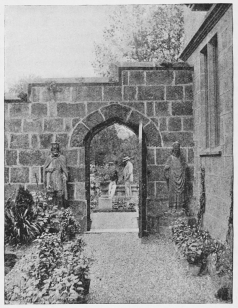
THE TERRACE DOOR, HOLMHURST.
“Here is a delightful story of the present Bishop of London for you, which is molto ben trovato, at any rate. One day, he took a cab home to Fulham from the City, and wishing to be liberal, gave the man sixpence beyond the full fare. The man looked at it. ‘What, aren’t you satisfied?’ said the Bishop. ‘Oh yes, I’m satisfied,’ said the man; ‘but if I might, I should like to ask you a question.’ ‘Oh certainly,’ said the Bishop, ‘ask whatever you like.’ ‘Well, then, if St. Paul had come back to earth and was Bishop, do you suppose he’d be living in this here palace?’ ‘Certainly not,’ replied the Bishop promptly, ‘for he’d be living at Lambeth, and it would be a shilling fare.’
“And now, after all these luxurious fine houses, I am in what, to me, is the tenfold luxury of Holmhurst.
‘My green and silent spot amid the hills, Oh, ’tis a quiet spirit-healing nook.’[551]
I should not like to live in a bare or commonplace house, but then I don’t; and oh! the luxury of absolute independence. I should rather like a carriage and horse perhaps, but I don’t in the least want them. Certainly, in words I have been reading of Bishop Fraser, ‘living in comfort is a phrase entirely depending for its meaning on the ideas of him who uses it.’”
To Francis Cookson.
“Sept. 7.—Is it a sign of old age coming on, I wonder, when one has the distaste for leaving home by which I am now possessed? I simply hate it. When one has all one wants and exactly what one likes, why should one set off on a round of visits, in which one may, and probably will, have many pleasant hours, but as certainly many bare and dull ones, often in dreary rooms, sometimes with wooden-headed people, and without the possibility of the familiar associations which habit makes such a pleasure? Then, in most country-houses, ‘l’anglais s’amuse moult tristement,’ as Froissart says. I cannot say how delightful I always find my home life—the ever-fresh morning glories of the familiar view of brilliant flowers, green lawns, and oak woods; and then the sea, which to me is so much more beautiful in its morning whiteness with faint grey cloud-shadows, or smiling under the tremulous sun-rays,[552] than in the evening light, which brings a lovely but monotonous blueness with it: the joyous companionship of my little black spitz Nero (‘Black,’ not the wicked emperor): the regularity of my proof-sheet work, and other work, till luncheon-dinner, after which there are generally visitors to be attended to; and then quiet work again, or meditation on the long-ago and the future, when
‘Silent musings urge the mind to seek Something too high for syllables to speak.’[553]
Then there is always my library, in which 6000 agreeable friends are always ready to converse with me at any moment, and ‘vingt-sept années d’ennui et de solitude lui firent lire bien des livres,’ as Catherine II. said in her epitaph on herself, might certainly be applied to me. Only I can imagine, if eyes and limbs failed, the winter evenings becoming long and monotonous. ‘Meglio solo che male accompagnato’ is a good Italian proverb, only it would be pleasant to be ‘ben accompagnato.’ I am beginning to feel with Madame de Staël—‘J’aime la solitude, mais il me faut à qui dire; j’aime la solitude.’
“The neighbours are very kindly beginning to consider me ‘the hermit of Holmhurst,’ and come to visit me in my cell, especially on Tuesdays, without expecting me to go to them. I would not have a bicycle on any account, for then I might be obliged to go, and I am too poor to have a carriage. So, in six weeks, I have only twice been outside the gates—for one day to London for George Jolliffe’s wedding, and for two nights to Battle, whence, to my great joy, the Duchess asked me to ‘mother’ her guests—charming Lady Edward Cavendish, the Vincent Corbets, and Mr. Armstrong, the Oxford history professor—to Hurstmonceaux. How beautiful, how interesting it all looked. No other place ever seems to me half so romantic; but though ‘at each step one treads on a memory,’ as Cicero says, I can go there now without a pang; my affections are too full of Holmhurst to have any room for it, and the old family are almost forgotten there already, ‘so much has happened since they left.’ ‘Lord! to see how the world makes nothing of a man, an houre after he is dead,’ writes Pepys in his Diary.
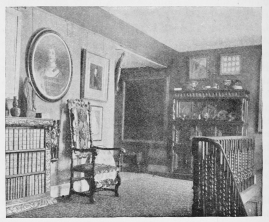
THE NAYLOR LANDING, HOLMHURST.
“I wonder if you ever saw Coventry Patmore here, who died lately. He often came to Holmhurst during the latter part of his residence at Hastings, where he wrote ‘The Angel in the House’ in memory of his first wife, and in memory of his second spent most of the large fortune she had brought him, £60,000, in building a beautiful church, S. Mary Star of the Sea; and whilst building it, though always a devout Catholic, imbibed, from being brought into close contact with them, a hatred of priests which never left him. The existence of ‘In Memoriam’ may be said to be due to Patmore. When young, he and Tennyson lodged together at some house in London, where they had a violent quarrel with their landlady, and left suddenly in a huff. Once well away, they recollected that the MS. of ‘In Memoriam’ was left in the cupboard of their room with the unfinished ham and the half-empty jam-pot. The timid Alfred would not face the wrath of the landlady, but Patmore went back to get it. He found the woman cleaning her doorstep and told her that he was come to get something he had left behind. ‘No,’ she said, ‘there was nothing, and she had seen quite enough of him, he should not go upstairs.’ But the slim Patmore took her by surprise, slipped past her, rushed up to the room, and from the jam cupboard extracted the MS., and made off with it in spite of her imprecations.
“Tennyson recognised what Patmore had done at the time, and said he should give him the MS. But he never did; he gave it to Sir J. Simeon, who left it to his second wife. When Tennyson’s MSS. rose so much in value, his family asked for it back, and Lady Simeon has promised that it shall go back at her death. In another generation, if Tennyson’s fame lasts so long, it will probably be sold for a large sum.
“Apropos of poets, pleasant old Miss Courtenay was talking to me the other day of how Browning was beyond all things a man of the world rather than a poet. When she saw Mrs. Browning at Naples long ago, and expressed some surprise at his being so much with Lockhart, who was then in his last serious illness, Mrs. Browning said, ‘Yes, and isn’t it delightful that Mr. Lockhart likes him so much; he told me the other day, “I like Robert so much because he is not a damned literary person!’”
“The clergyman in the little iron tabernacle of a church at our gate seemed to some to preach at me last night for not having been at the morning service, at which there was the Sacrament. He was quite right. I really might have gone, for I had no ‘boys’ here, and I was not merely kept away by my detestation of sermons, so seldom, what Spurgeon said they should be, ‘the man in flower;’ but I never thought of it, and was very busy at home about a thousand things. But though I revere the Sacrament as a holy commemorative ordinance, I cannot feel as if it did one the slightest good, except as concentrating one’s thoughts for a few minutes on sacred memories. James Adderley, the monk-preacher, says there are many who regard the Sacrament like a ‘mourning ring;’ and that is exactly how I look upon it. I cannot understand how people can consider such a mere commemorative service ‘a thing to live by,’ as they call it; and all the transubstantiation idea is to me too truly horrible. If I were dying—dying, I mean, in the trembling hope of a near blessed reality—the reception of this mere type would be no comfort to me. Then, also, as I am on the confession tack, I do not believe for one instant in ‘original sin;’ rather, as Solomon—who had much personal knowledge of the subject—says, that ‘God hath made man upright, but he hath sought out many inventions.’[554] ... And yet, truly, in my own way, I always feel that—
‘Malgré nous, vers le ciel il faut tourner les yeux.’”[555]
Journal and Letters.
“Chesters, Northumberland, Oct. 6.—All my dread of visits passed away when they began. Capital indeed is Milton’s advice—
‘Be not over-exquisite To cast the fashion of uncertain evils.’
And then I know one ought to go into the world ‘as a fireman on duty,’ which Cardinal Manning said was his only way of visiting it for thirty years. One thing a man who pays a good many visits should always be certain of—never to outstay his welcome. It would be dreadful to see one’s hostess begin to have the fidgets. It is safest—at latest—to go by the eleven o’clock train, but a good and pleasant plan is to take leave overnight, and be gone the next morning. I was full of enjoyment at Penrhyn Castle—the genial and charming family, the great variety of the guests, and the excursions, in spite of furious storms, into the Welsh hills. Then I was with a most kind bachelor host, Fred Swete, at Oswestry, and spent the day at Brogyntyn with Lord Harlech, a perfect example of old-fashioned courtesy and kindness. In his grounds is a long terrace with a glorious view over the plains and hills of Shropshire, including the beloved Hawkestone range of my childhood. The next day, at the Brownlow-Towers’ pleasant house at Ellesmere, a little girl of eight was most amusingly fin de siècle. ‘Now, darling, you must go up to the schoolroom and stay there,’ said her mother after luncheon. ‘No, darling, no,’ answered the child. ‘I must not, darling,’ with an exact imitation of its mother’s manner, ‘for I’ve been listening, and it’s going to be interesting.’
“We made delightful excursions from Lutwyche to draw at Bridgenorth and an old moated grange called Elswick, meeting Lady Boyne and her party, who came from Burwarton as to a half-way house.
“Then I was at Ridley Hall, full of—oh! how many memories of my long-ago. But it was the greatest pleasure to see Frank and Lady Anne Lyon there, and how much they appreciated and cared for the place. Lord and Lady Wantage were at Ridley, and I went with them to Hexham Abbey, once a most grand church, but utterly ruined by an ignorant restoration. And now, wandering still on the footprints of past days, I am at Chesters with the widow and children of my dear old friend George Clayton, he as well as all the earlier generation of his family having passed away, and Miss Annie Ogle, whom I knew so well in those far-away days, here as a delightful old lady, with snow-white hair, but the same winning character and ways as in her youth. A museum has been built now for the immense collection of Roman altars and fragments, &c., from the ‘stations’ of the Roman wall, one of the best of which (Cilurnum) is just in front of the house; while below ‘the riotous rapids of the Tyne,’ as Swinburne calls them, with their rocky shores and bosky banks, are the boundary of the park.”
“Redholm, North Berwick, Oct. 17.—I am staying here with Robert Shaw Stewart, a friend of old Roman days, and his kind wife, who was a daughter of Charles Warner, the well-known statesman-philanthropist of Trinidad,—‘fort comme le diamant, plus tendre qu’une mère’—of whom Froude has given so charming a description. The Dalzells and all my other dear friends of past days here have gone over the border-land, but, in this hospitable house, I have seen quite a diorama of people. A topic has been the three modern Scotch novelists, Crockett,[556] Barrie,[557] and Ian Maclaren (Watson): Crockett such a delightful fellow, so full of sunshine, of real happy enjoyment of people and things: Barrie, a weaver’s boy as to his origin, but simple and straightforward to a degree, though his books have made him rich: Watson just a little spoilt since the great success of his annals of Drumtochty, which, under another name (Logiealmond, near Glenalmond) was the place where he was minister. The Free Kirk minister in this place, Dr. Davidson, told me how when they all were at college together, Barrie and Crockett used to tell stories in class. They sate up in a corner, with a little coterie round them, and held their audience enthralled. No one listened to the lecturer, and some of the students outside the charmed circle used to say, ‘Had not you better send down to the professor and tell him not to make so much noise?’ The lower orders in Scotland seem to read the modern national novelists just as much as the upper, and they read other deeper books too, and think calmly in a way very unlike Englishmen. ‘The Shorter Catechism,’ which they all understand, is a proof of this. When it was published, indeed, there was a far more serious catechism for adults: this one was only intended for ‘those of tender years,’ yet there is much requiring deepest thought in it, though the peasant classes always master it.”
“Airlie Castle, Oct. 18.—Monday was fearfully cold, and it was a pleasure to see the beautiful face of Lady Airlie—more picturesque and distinguished in late middle life than any one else—looking out of a close carriage come to meet me. Her most poetical home is just suited to her—the tiniest castle in the world, with its one noble gate-tower giving access to a little green plateau beneath which the Melgum and the Isla rush through deep wooded gorges to their meeting-place. And into these gorges the castle windows look deep down. Then, to those who know Lady Airlie, I need not say how beautiful the little rooms are, how splendid the few flowers, how much of story clusters round the furniture and pictures—‘only a few; I do not like a room or a wall to be crowded, even with the best things,’ says their mistress.
“In the serene beauty of her age, she herself lends a lustre to her surroundings; quietly, contentedly severing most links with the great world in which she has so long been a star, ‘elle dépose fleur à fleur la couronne de la vie.’[558]
“Lady Maude White is here, returning to an intellectual world with which she has never broken a single link, after many years of privation, solitude, and duty nobly borne, first with her brother, and then with her husband, at a horse-ranch in America.
“The castle of Airlie has never recovered its burning by Argyll and the Covenanters, when
‘It fell on a day, a bonnie summer day, When the corn was brearin’ fairly, That there fell out a great dispute Between Argyll and Airlie.’
The family were always for the King and the Church, indeed too much so, for Maryott Ogilvy was the mistress of Cardinal Beaton, for whom he built several castles, and who was enormously endowed by him. Of their six children, the eldest girl had the richest dower in Scotland, and married the Lord Crawford of that day. It was David, Lord Ogilvy, who was out in the ‘45, who rebuilt a bit of the old castle, just enough to live in by himself after he came home, and added a few rooms for his wife when he married a second time. Behind the castle is a delightful old garden, to which Lady Airlie has added hedges and peacocks in clipped yew, with divers other ‘incidents;’ and all along the ledges of the gorges run wonderful little pathlets—beautiful exceedingly in the crimson and gold of their autumnal glory. But they will be gone directly; for, as Edward Fitzgerald says, ‘The trees in the Highlands give themselves no dying airs, but turn orange in a day, and are swept off in a whirlwind, and winter is come.’
“We drove to Cortachy through woods laid prostrate by the great storm of 1893, which has left the trees piled on one another, like the dead of a vanquished army on a battlefield. Lady Airlie made the whole of the weird desolate country live through her interpretation of it:—
“‘Those are the black hornless cattle of Angus. That is the hill of Clota, on the top of which is the old tower where the last witch was burnt. In the church books there is an entry that on a particular day there was no service, because all the congregation were gone to the burning of the witch. That village in the hollow, which is so red and striking in the sunset, is Kirriemuir: it is the “Thrums” of Barrie’s novel. Now we will leave the carriage at “the Devil’s Stone:” it is just a stone which the devil threw at the kirk, but it missed and fell into the stream: it rests the opposite way to all boulders, and it is of a different formation from all the other stones in the district. Dicky Doyle loved the story and the stone, and used to paint it. And now we will go into the “Garden of Friendship.” I made it when I first married out of an old kitchen-garden, and I cut down a belt of trees and let in the view. The lines in the summer-house are by Robert Lowe. All the trees bear the names of the different friends who planted them. That one was planted by Dr. John Brown. He was often here. He told me that my Clementine was a lassie who had said something she might be proud of. That was because one day when I said to her, “I am so tired; are not you tired, darling?” she answered, “Tired! oh no, not a bit. I have a box of laughter inside me, and the key that unlocks it is ‘fun.’” Over there is our deer-forest. Charlotte, Lady Strathmore, took me up to the tower of Glamis once, and stretched out her hand towards our hills—“You have a deer-forest, and a river, and scenery” she said, “and I have nothing.”
“‘Here is King Charles’s room. Charles II. was here for the gathering of the clans, but they did not gather as they ought, and he went away disappointed. He left a Prayer-book and a Euclid here: he was a great scientist. Under the floor at that corner is a secret room: we have never seen it. Some workmen found it after the great fire here whilst every one was away, and before we came back it was walled up, and it has never been thought worth while to disturb it again. Those are the portraits of the Ogilvy who was out in the ‘45 and his first wife. She was shut up in the Tolbooth for singing Jacobite songs in the Canongate. He was devoted to her, but after they went to St. Germains he was told that he must take a mistress because it was the fashion, and he did. After her death he married again, an extravagant woman, who wheedled him out of £3000 which he had saved to buy the property on the other side of the river at Airlie,[559] and spent it on her own devices. They quarrelled at last, for she would give a ball at Airlie Lodge at Dundee, and he told her if she did he would never forgive it; and she had the ball, and he never saw her again.’
“Lord Airlie is a splendid young man,[560] and has the most delightful of wives in one of the granddaughters of the beloved Lady Jocelyn. He is a consummate soldier. His devotion to his profession only allows him to be six weeks at Cortachy in the year, but in that time he drives about and visits every person on the estate. He has the firm faith and strong religious feeling of his Ogilvy forbears. One day, at the gate of Airlie Castle, with its unprotected precipices, he had mounted a dogcart with his sister Clementine. The horse plunged and backed violently. They were on the very edge of the abyss. ‘Make your peace with God,’ he said to his sister; ‘in an instant we shall be over.’ At the very last moment a man rushed out and caught the horse, but the wheels were half over then.
“To-day we have been to see the Monros at Lindertis—a semi-gothic house, most comfortable inside. Mrs. Munro is a capital portrait-painter in the style of Raeburn, and has done first-rate work. All evening Lady Airlie has talked delightfully:—
“‘We were a very quarrelsome family as children. At Gosport, whilst we were at church, my next sister, Cecilia,[561] who had been left at home, fell out of the window. She lived for some days, very suffering and scarcely conscious, but she used constantly, in her half-delirium, to say, “Oh, don’t quarrel, don’t quarrel;” and it made a very great impression upon me, and afterwards I always tried never to quarrel. My father never let us complain. If anything unpleasant happened and my mother murmured, he would always say, “Oh, don’t; we have so much more than we deserve.” He always thought it so ill-bred—so ill-bred towards God—to murmur. A widow, especially, should never murmur. If one has had a great place and occupied a great position which all vanishes with one’s husband, one ought to be so filled with gratitude for the has-been as to leave no room for complaints. “I have lived my life: I have enjoyed to the utmost,” that should always be the feeling. It is terrible when a widow murmurs, for it is God who gave the husband, who gave the home; and when He takes them away again, how can one doubt that He knows best when one has had enough? For children, leaving an old home is worse than for the widow: she has lived her life, but theirs is to come.
“‘Before I grew up, my mother often took me with her to Miss Berry’s in the evening. My father was away at the House, and she took her work and went there, and Miss Berry liked to see that good and beautiful young woman sitting there. At Miss Berry’s house I saw all the clever men of the day, so I knew them all before I really came out. I shall never forget going down once to Richmond to take leave of Miss Berry before we went into the country, and her saying to me, “Allez vous retremper l’âme à la campagne;” it seemed to me such a beautiful thought. Forty years afterwards my daughter Blanche told it to Schouvaloff, the Russian Minister. “Oui,” he said, and added, “et engourdir l’esprit.” It was as characteristic of him as the first part of the sentence was of Miss Berry.
“‘As soon as I came out, I went with my parents to the Grange, where the first Lady Ashburton was very kind to me, and I passionately adored her. There I first saw Carlyle and Mrs. Carlyle, but he had known my mother very well before. Mrs. Carlyle really loved Lady Ashburton, yet she was madly jealous of her. When they were at home, and Carlyle would come in quite tired out with a long day’s work, she would say, “Now just walk down to Bath House and see Lady Ashburton, and that will refresh you.” She meant him to go, but as soon as he was gone her grief was passionate, because she felt it would not have been the same thing to him if he had stayed with her. He was always pleasant, but to a few—to my mother especially—he never failed to show the most intense delicacy of feeling.
“‘I cannot describe what Charles Buller was. Girl as I was, I loved him, but so did every one else; he was so very delightful. I remember as if it were to-day going once into my mother’s room: all her long beautiful hair was down and she was sobbing violently. “Oh,” she said, “Charles Buller is dead.” How I longed to cry too, but I did not dare. I only went to my own room in most bitter grief. Wherever he went, Charles Buller brought sunshine with him. He left me his Coleridge in his will. It surprised people that he should leave anything to a young girl like me, and when I went to the Grange again, many spoke of it. Each had something to show which had belonged to him: we all mourned together.
“‘Oh, how many recollections there are which will always remain with one, which will stay by one at the resurrection. Many of my happiest are of the Grange. Lord Houghton asked me once how long I had been there, and he told me long afterwards that I had answered “Oh, I cannot tell; I only know that it is morning when I come, and night when I go away.” This bookcase is full of the gifts of friends, and recalls much of my past. Here is a volume of Thackeray with an etching by himself, and here are all John Morley’s and Lord Sherbrooke’s books, which they gave me as they came out. Here is Lord Houghton’s “Monographs,” with a touching letter from him after we had had a little coldness; and here are two bound volumes of Mrs. Carlyle’s Letters to me.”
“Balcaskie, Oct. 21.—What a wild country is this ‘low, sea-salted, wind-vexed’ Fife, with its little royal boroughs along the coast, each with its tiny municipality. About them their natives have the same pride, however, as an Aberdonian, who said the other day, ‘Just tak’ awa Aberdeen and twenty mile round her, and where are ye?’ The sea-line is broken by islets, the most important of them being May, where S. Adrian lived in a hermitage, and where the steps at the very difficult landing-place are worn away by the knees of the pilgrims to his shrine. S. Monan lived there after him, but also frequented a little cave on the mainland, where the old church stands to which we went on Sunday, so near the waves that, in rough weather, the roar of the surges mingles with the music.
“Highly picturesque is this house of Balcaskie, and its high-terraced gardens with their vases and statues. The Anstruthers have taken me to Balcarres to spend the afternoon with ever-sunny Lady Crawford. Her husband, weird-looking as an old necromancer, only came in as we were leaving, but several of the handsome sons were at home. The house looks gloomy outside from the black stone of the country, but is bright and cheerful within, and has a beautiful oak-panelled parlour.
“On Sunday afternoon we went to Kellie, a noble stern old castle, with corbie-steps and tourelles. It was neglected and deserted by the Earls of Kellie, but has been restored by Mrs. Lorimer, widow of an Edinburgh professor, who rents it. ‘Two little red shoes’ haunt it, pattering up and down its winding staircases at night. At Crail we saw wonderful old tombs of the Lindsays in the churchyard, and inside the church that of Miss Cunningham, who, said the sacristan, died on the eve of her marriage with some great poet whose name he could not remember: we afterwards found it was Drummond of Hawthornden.”
“Bishopthorpe, Oct. 23.—This house has a charm from the great variety of its styles, even the gingerbread-gothic is important as being of a date anterior to Horace Walpole, who has the reputation of having introduced that style.
“The Archbishop of York says, ‘From sudden death, good Lord deliver us,’ means, ‘From dying unprepared for death, good Lord deliver us.’
“Lord Falkland has been here. He had been lately at Skelton Castle. His hostess, Miss Wharton, took him to his room, down a long passage—a large room, panelled with dark oak and with a great four-post bed with heavy hangings. It was very gloomy and oppressive, Lord Falkland thought, but he said nothing, dressed, and went down to dinner.
“When he came upstairs again, he found the aspect of the room even more oppressive, but he made up a great fire and went to bed. In the night he was awakened by a pattering on the floor as of high-heeled shoes and the rustling of a stiff silk dress. There was still a little fire burning, but he could see nothing. As he distinctly heard the footsteps turn, he thought, ‘Oh, I hope they may not come up to the bed.’ They did. But then they turned away, and he heard them go out at the door.
“With difficulty he composed himself to sleep again, but was soon reawakened by the same sound, the rustling of silk and the footsteps. Then he was thoroughly miserable, got up, lighted candles, made up the fire, and passed a wretched night. In the morning he was glad to find an excuse for going away.
“Afterwards he heard an explanation. An old Wharton, cruel and brutal, had a young wife. One day, coming tipsy into his wife’s room, he found her nursing her baby. He was in a violent temper, and, seizing the baby from her arms, he dashed its head against the wall and killed it on the spot. When he saw it was dead, he softened at once. Even in her grief and horror Mrs. Wharton could not bear to expose him, and together they buried the child under the hearthstone; but she pined away and very soon she died.
“She used to be heard not only rustling, but weeping, wailing, sobbing, crying. At that time the Whartons were Roman Catholics, and when the family were almost driven from their home by its terrors, they got a priest to exorcise the castle and to bury the baby skeleton in consecrated ground. Since then, there have been no sobs and cries, only the rustling and pattering of feet.”
To Miss Garden at Rome.
“Oct. 26, 1896.—The first three volumes of the ‘Story of my Life’ are come out, and I send them to you. Even the favourable reviews complain vehemently about their length; and yet, if they were not in a huge type and had not quite half a volume’s space full of woodcuts, they might easily have been two very moderate volumes.[562] Then, say the reviewers, ‘the public would have welcomed the book.’ But after all, it was not written or printed for the public, only for a private inner circle, though I am sure that, in return for having been allowed to read it, ‘the public’ will kindly be willing—well, just to pay for the printing! Then it is funny how each review wants a different part left out—one the childhood, one the youth, one the experiences of later life: there would be nothing left but the little anecdotes about already well-known people, which they all wish to keep, and, in quoting these, they one and all copy each other; it saves trouble. The Saturday had what the world calls ‘a cruel review’ of the book, but what was really an article of nothing but personal vituperation against its author. I know who the review was by, and that it was not, as every one seems to think, by one of the family from whom I suffered in my childhood; certainly, however, if any one cares to know how the members of that family always spoke to and of me in my youth, they have only to read that article. I think there is a good bit about criticism in Matthew Arnold’s Letters. ‘The great thing is to speak without a particle of vice, malice, or rancour.... Even in one’s ridicule one must preserve a sweetness and good-humour.... I remember how Voltaire lamented that the “literae humanae,” humane letters, should be so dreadfully inhuman, and determined in print to be always scrupulously polite.’ Then, how truly Ruskin says, ‘The slightest manifestation of jealousy or self-complacency is sufficient to mark a second-rate character of intellect.’
“As you know, I never intended the book, written seventeen and printed two years ago, to appear till after my death, but this year it was so strongly represented to me that then all who would care to read about my earlier years would then be dead too, that I assented to the story up to 1870 being published. To tell the truth, I feel now how sorry I should have been to have missed the amusement of hearing even the most abusive things people say. And certainly, as regards reviews, I feel with Washington Irving, ‘I have one proud reflection to sustain myself with—that I never in any way sought to win the praises nor deprecate the censures of reviewers, but have left my work to rise or fall by its own deserts. If my writings are worth anything, they will outlive temporary criticism; if not, they are not worth caring about.’[563] Yet, yet, just for the sake of variety, I should like some day, as a change to the unknown, to read a really favourable review of something I have written, though I read somewhere, ‘To like to be right is the last weakness of a wise man: to like to be thought right is the inveterate prejudice of fools.’[564]
“One of the things people find fault with is that I have not shown sufficient adoration for Jowett, who was so exceedingly kind to me at Oxford. But I always felt that it was for Arthur Stanley’s sake. Jowett only really cared for three kinds of undergraduate—a pauper, a profligate, or a peer: he was boundlessly good to the first, he tried to reclaim the second, and he adored the third.”
“Blaise Castle, Henbury, Nov. 23.—I came here to charming Mary Harford[565] from Lockinge, where I paid a pleasant visit to Lord and Lady Wantage, meeting a large party. Lady Wantage, beautified by the glory of her snowy hair, was most charming—so thoughtful and kind for every one—‘elle brillait surtout par le caractère,’[566] and though ‘few can understand an argument, all can appreciate a character.’[567] One of the most agreeable guests, a ripple of interesting anecdote, which began even in the omnibus driving up from the station in the dark, was Lord James of Hereford. At dinner he told how Sir Drummond and Lady Wolff had a Spanish dog, who was the best-bred creature in the world. One day its mistress had a visitor who engrossed her so much that she forgot her dog’s dinner. It would not scratch or whine, it was too well conducted, but it went out into the garden and bit off a flower, and came and laid it at its mistress’s feet: the flower was a forget-me-not.
“George Holford of Westonburt was at Lockinge, and very pleasant. Once he walked from London to Ardington, close to Lockinge, where his grandmother, Mrs. Lindsay, was then living. When he was within a mile and a half of it, he saw a man kneeling on the body of another man on the road. He went up to them, called out, had no answer, and at last struck the kneeling man with his stick. His stick went through the man. His story was received at Lockinge with shouts of derision.
“Three years after, at a tenants’ dinner, Lord Wantage told the story of his nephew’s ‘optical delusion’ to the farmer sitting next, who said, ‘It is a very extraordinary thing, my Lord, but a man was once murdered by his servant on that very spot. The servant knocked him down, knelt upon him, and killed him; and ever since the place has had the reputation of being haunted.’”
To Viscount Halifax.
“Jan. 9, 1897.—My Christmas was spent very pleasantly at Hewell, where Lord and Lady Windsor had a large party. Most lovely and charming was the hostess, most stately and beautiful the great modern house by Bodley, greatly improved and embellished since I saw it last. How closely, during a week’s visit, one is thrown with people, whom one often does not see again for years, if ever. It is, as Florence Montgomery says—‘People in a country-house play their parts, as it were, before one, and then the curtain falls, and the actors disappear. The play is played out.’[568] How laden with gifts children are nowadays, and how far too luxurious their life is, as much in excess that way as in the privations and penances which I remember in my own childhood.
“Some people are very angry with me for telling the truth in the ‘Story of my Life’[569] about these young years, when I was suffering ‘from an indiscriminate theological education,’ as Mr. Schimmelpennick calls such, and when I was made so constantly to feel how ‘l’ennui n’a pas cessé d’être en Angleterre une institution religeuse.’[570] And it is not merely the ‘canaille of talkers in type’[571] who find fault, but many whose opinion I have a regard for. They think that the portrait of a dead person should never be like a Franz Hals, portraying every ‘projecting peculiarity,’ but all delicately wrought with the smooth enamelling touch of Carlo Dolce. They wonder I can ‘reconcile it to my conscience’ to hold ‘another estimate of the Maurices to that which has been hitherto popular.’ ‘Collect a bag of prejudices and call it conscience, and there you are!’[572] For myself, I believe, and I am sure it is the discipline of years which tells me so, that the rule of after-death praise is a false one to be regulated by. It is true that there is often an enlightenment from death upon sensations and sympathies towards one who is gone, but I cannot feel that a faithful record of words and actions ought to be altered by the mere glamour of death, which so often gives an apotheosis to those who little deserve it. One of my reviewers says he would like to read a truthful word-portrait of Augustus Hare by one of the persons he describes in print: so should I exceedingly, and most appallingly horrible it would be!
THE ARSON STEPS, HOLMHURST.
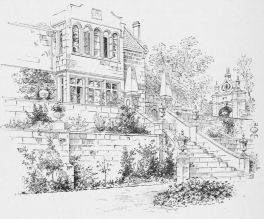
‘O wad some power the giftie gi’e us To see oorsels as ithers see us,’[573]
is what I would often say. Lately, a wonder whether I can have misjudged or exaggerated my remembrance of the long-ago has made me give many solitary evenings to old-letter reading; yet contemporary letters only confirm all I have expressed. How interesting they are! It is as Archbishop Magee says, ‘Old letters are like old ghosts, coming often uncalled for and startling us with their old familiar faces—pleasant some of them, and some of them very ugly, but all of them dead and bearing the stamp of death—and yet they will survive ourselves.’
“Most extraordinarily virulent certainly reviews can be! Really, ‘hurricanes of calumny and tornados of abuse’[574] have been hurled at me. As Cardinal Manning said, ‘To write anonymously is always a danger to charity, truth, and justice.’ Blackwood (i.e. the Maurice spirit in Blackwood), in an article which breathes of white lips, after dwelling scornfully upon ‘the sickening honey of the “Memorials,”’ writes:—
“What is Mr. Augustus Hare? He is neither anybody nor nobody—neither male nor female—neither imbecile nor wise.... As we wade through this foam of superannuated wrath ... this vicious and venomous personal onslaught ... Mr. Hare’s paragraphs plump like drops of concentrated venom over the dinted page.... Such a tenacity of ill-feeling, such a cold rage of vituperation, is seldom to be met with.’
“I wonder a little if any one can really from his heart have offered such ‘a genuine tribute of undissembled horror,’ or whether these sentiments were only written to order? And then I look at Dante and read:—
‘Vien dietro a me, e lascia dir le genti; Sta come torre ferma che non crolla Giammai la cima per soffiar de’ venti’[575]
And so—
‘I, painting from myself and to myself, Know what I do, am unmoved by men’s blame, Or their praise either.’”[576]
Journal.
“Jan. 31, 1897.—Saw Lady Delawarr, and heard all about her marvellous escape. Lady Mary (Sackville) first heard a crackling noise between two and three in the morning, and, looking out of her room door, saw that the staircase[577] was in flames. She rushed into her sister Margaret’s room, roused her, shrieked to the maids and governess, and finding a fiery gulf separated them from their mother’s room, the sisters flew in their night-dresses down the stairs, already in flames, and into the street. Lady Delawarr, stupefied by smoke, slept on heavily, though for twenty minutes her old servant Vincent, who occupied a room off the garden, threw stones at her window. He dragged his mattress beneath it, and strained it across the garden area. At last he roused her, and she rushed to the door, but closed it again as the flames poured in. Then she threw up the window. ‘Jump, my lady, jump!’ shouted Vincent; ‘there is not a moment to lose.’ There was not time even to throw out her diamonds, but she knotted her sheets firmly together, and sliding down them, dropped upon the mattress. With her it held, but the fat cook, who had not had courage to face the fiery staircase, leapt from the fourth floor, and under her great weight the mattress gave way and she fell into the area, breaking her leg in three places and fracturing her skull, and now she is dead. For a whole hour Lady Delawarr crouched behind the lilac bushes in the ice-bound garden, with the blazing house between her and all else. Then she succeeded in breaking the window of a carpenter’s shop which adjoined the garden, and was dragged through it, and reached a friend’s house in a four-wheel cab.
“This cab she sent back to fetch her daughter Mary, but the horse fell on the ice in Grosvenor Square, and Lady Mary, as she was, had to walk up Upper Brook Street to the house where her mother had taken refuge.”
“Jan. 28.—Dined at Lady Hope’s to meet Dr. Tucker, Bishop of Uganda, who had walked 10,000 miles in his bishopric; there were no other means of locomotion. He said Africa as a whole was more swamp and thicket than desert. ‘Were not the lions alarming?’ ‘Not very; they seldom attacked unless irritated.’ Once he saw five at the same time around him, but ‘they all had their own affairs to attend to.’ Snakes were worse, especially puff-adders, which would attack whenever they could.”
“Feb. 2, 1897.—Dreadful news has come of the terrible murder in the Benin expedition of my dear Kenneth Campbell (of Ardpatrick), than whom no one was better, braver, more attractive to look upon, or more pleasant to live with.