Volume 4 — XVIII LONDON WALKS AND SOCIETY
Reading edition
“It is an inexpressible pleasure to know a little of the world, and to be of no character or significancy in it.”—Steele.
“Arranging long-locked drawers and shelves Of cabinets, shut up for years, What a strange task we’ve set ourselves! How still the lonely room appears! How strange this mass of ancient treasures, Mementos of past pains and pleasures.”
“Be wisely worldly, be not worldly wise.”—Quarles.
“No, when the fight begins within himself, A man’s worth something.”—Browning.
MY three thick volumes of the “Cities of Northern and Central Italy” appeared in the autumn of 1875, a very large edition (3000 copies) being printed at once. They were immediately the object of a most violent attack from Mr. Murray, who saw in them rivals to his well-known red handbooks. A most virulent and abusive article appeared upon my work in the Athenæum, accusing me, amongst other things, of having copied from Murray’s Handbooks without acknowledgment, and quoting, as proof, passages relating to Verona in both books, which have the same singular mistake. It was certainly a curious accident which made me receive the proof-sheets of Verona when away from home on a visit at Tunbridge Wells, where the only book of reference accessible was Murray’s “Handbook of Northern Italy,” which I found in the house, so that the mistakes in my account of Verona were actually copied from Murray’s Handbook, to which I was indebted for nothing else whatever, as (though much delighted with them when they first appeared) I had for years found Murray’s Handbooks so inefficient, that I had never bought or made any use of them, preferring the accurate and intelligent Handbooks of the German Gsel-fels. Mr. Murray further took legal proceedings against me, because in one of my volumes I had mentioned that the Italian Lakes were included in his Swiss rather than his Italian Handbooks: this having been altered in recent years, but having been the case in the only volumes of his Handbooks I had ever possessed. On all occasions, any little literary success I met with excited bitter animosity from Mr. Murray.
Another curious attack was made upon me by the eccentric Mr. Freeman, the historian of the Norman Conquest. He had published in the Saturday Review a series of short articles on the Italian cities, which I always felt had never received the attention they deserved, their real interest having been overlooked owing to the unpopularity of the dogmatic and verbose style in which they were written. Therefore, really with the idea of doing Mr. Freeman a good turn, I had rather gone out of my way to introduce extracts from his articles where I could, that notice might thus be attracted to them—an attention for which I had already been thanked by other little-read authors, as, whatever may be the many faults of my books, they have always had a large circulation. But in the case of Mr. Freeman, knowing the singular character of the man, I begged a common friend to write to his daughter and amanuensis to mention my intention, and ask her, if her father had no objection to my quoting from his articles, to send me a list of them (as they were unsigned), in order that I might not confuse them with those of any other person. By return of post I received, without comment, from Miss Freeman, a list of her father’s articles, and I naturally considered this as equivalent to his full permission to quote from them. I was therefore greatly surprised, when Mr. Freeman’s articles appeared soon afterwards in a small volume, to find it introduced with a preface, the whole object of which was, in the most violent manner, to accuse me of theft. I immediately published a full statement of the circumstances under which I had quoted from Mr. Freeman in sixteen different newspapers. Mr. Freeman answered in the Times by repeating his accusation, and in the Guardian he added, “Though Mr. Hare’s conduct was barefaced and wholesale robbery, I shall take no further notice of him till he has stolen something else.”[187]
Mr. Freeman made himself many enemies, but he did not make me one; he was too odd. His neighbour, the Dean of Wells, Johnson, could not bear him. When there was an Archæological Meeting at Wells, it was thought that peace might be made if the Dean could be persuaded to propose the historian’s health at the dinner. The Dean was quite willing, but he began his speech unfortunately with—“I rise with great pleasure to propose the health of our eminent neighbour, Mr. Freeman the historian, a man who—in his own personal characteristics—has so often depicted for us the savage character of our first forefathers.”
But in spite of these little catastrophes attending its publication, I am certain that “Cities of Northern and Central Italy,” which cost me far more pains and labour, and which is more entirely original, than all my earlier books put together, was by far the best of my writings, up to that time.
Before the book was out, I was already devoted to a new work, suggested by the great delight I had long found in London, and by the desire of awakening others to an enjoyment of its little-known treasures. A set of lectures delivered at Sir John Shaw-Lefevre’s house in Seymour Street, and a series of articles in Good Words, laid the foundation for my “Walks in London.” When employed in this work, as in all my others, I felt all those portions of life to be the most interesting which were spent in following out any one single purpose.
Journal.
“Jan. 18, 1876.—I went to Cobham for three days last week. Deep snow was on the ground, but the visit was delightful. I was delighted to find Lady Pelham there, always so radiant and cordial, and so perfectly simple. Of the other guests, the most interesting were Lord and Lady Harris. There were also a great many Kentish men, hunting clergy, who dressed in top-boots, &c., during their visit, but departed in ecclesiastical attire.”
“Jan. 19.—Yesterday I went to Lady Taunton. She has a beautiful portrait of her daughter by young Richmond—a sort of play upon every possible tone of yellow—a yellow gown, a yellow background, a great cushion worked with yellow sunflowers, yellow hair looped up with pearls, only a great white living lily to throw it all back. It is a most poetical picture.
“In the evening I went to a supper at the house of young F. P. to meet a whole society of young actors, artists, &c. Eden was there, known in the stage world as Herbert, a name he took to save the feelings of his episcopal uncle, Lord Auckland. His is a fine and a charming face, but rather sad.... There were about fourteen men present, very good singing, and then supper, much kindness and cordiality, and not a word which all their mothers and sisters might not have heard. It would not have been so at college or in a mess-room: so much for maligned actors.”
“Jan. 21.—To see Frederick Walker’s pictures. It is an interesting collection, as being the written mind of one man. You see the same picture over and over again, from its first sketch of an idea—merely a floating idea—to its entire completion, and it is interesting to know how slow a growth of thought was required to lead up to something, which, after all, was not so very wonderful in the end. The pictures are not beautiful, but the man who did them must have been charming, such a simple lover of farmhouse life, apple-orchards, and old-fashioned gardens, with a glory of flowers—all the right kinds of flowers blooming together.
“It poured, so I sat some time with R. on one of the seats. He talked long and openly of all the temptations of his life, and endlessly about himself. I urged that the best way of ennobling his own nature must be through others, that self-introspection would never do, and could only lead to egotism and selfishness, but that in trying to help others he would unconsciously help himself. I find it most difficult to say anything of this kind without making illustrations out of my own life, which I have certainly no right to think exemplary.
“As we were going away, a lady who had stared long and hard at us, and whom I thought to be some waif turned up from my Roman lectures, came up to me. ‘I think, sir, that you were standing close to my sister just now, and she has lost her purse.’—‘I am very sorry your sister has lost her purse; it is very unfortunate.’—‘Yes, but my sister has lost her purse, and you, you were standing by her when she lost it.’—‘I think after what you have said I had better give you my card.’—‘Oh, no, no, no.’—’ Oh, yes, yes, yes: after what you have said I must insist upon giving you my card.’ What an odd experience, to be taken for a pickpocket! R. thought the lady had really picked my pocket, but she had not.”
“Jan. 22.—An anonymous letter of apology from the lady of the picked pocket; only she said that if I had been as flurried as she was, and had been placed in the same circumstances as she was, I should have acted exactly as she did; in which I do not quite agree with her.”
“Monk’s Orchard, Jan. 23.—This is a fine big house, be-pictured, be-statued, with a terraced garden, a lake, and a great flat park. A Mr. and Mrs. Rodd are here with their son Rennell, a pleasant-looking boy, wonderfully precocious and clever, though, as every one listens to him, he has—not unnaturally—a very good opinion of himself: still one feels at once that he is the sort of boy who will be heard of again some day.
“Our host, Mr. Lewis Loyd, is in some ways one of the most absent men in the world. One day, meeting a friend, he said, ‘Hallo! what a long time it is since I’ve seen you! How’s your father?’—‘Oh, my father’s dead.’—‘God bless me! I’m very sorry,’ &c. The next year he met the same man again, and had forgotten all about it, so began with, ‘Hallo! what a long time since I’ve seen you! How’s your father?’-‘Oh, my father’s dead still!’
“We have been to church at Shirley—one of Scott’s new country churches. In the churchyard is a cross to poor Sir John Anson, and beside it a granite altar-tomb with an inscription saying that it is to Ruskin’s father—‘a perfectly honest merchant,’ and that ‘his son, whom he loved to the uttermost, and taught to speak the truth, says this.’
“69 Onslow Square, Jan. 28.—A long visit to F. and S. It is quite a new phase of life to me. They are perfect gentlemen, at least in heart, and one cannot be with them long without seeing a kindly, chivalrous nature, which comes to the surface in a thousand little nothings. Yet they are what the world frowns upon—beginning to seek fortune on the stage, neglected or rejected by unsympathetic relations, living from hand to mouth, furnishing their rooms by pawning their rings and watches, &c. S. in terrible illness, totally penniless, ignored by every one, is taken in, nursed, doctored, and paid for by F., upon whom he has no claim whatever. F., abused, snubbed, and without any natural charm in himself, is henceforth loved, defended, regarded with the most loyal devotion, by his more popular companion.
“I dined on the 26th with Lady E. Adeane. Mr. Percy Doyle was very amusing. Talking of the anxiety of ministers in America to change their posts, he said, ‘If my father had bequeathed to me Hell and Texas, I should have lived in Hell and let Texas.’
“Yesterday I went to luncheon with the Vaughans at the Temple, and met there Miss Rye, who has a home for homeless children at Clapham, and takes them off by batches to America, to establish them there as servants, &c. She produced from her pocket about a hundred cartes-de-visite of the children, wild, unkempt, and wicked-looking, and of the same children after they had been under cultivation. Certainly the change was marvellous, but then she had employed a good photographer for the redeemed children and a very bad one for the little ruffians.”
FOUNTAIN COURT, TEMPLE. [188]

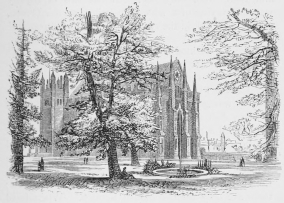
“Feb. 5.—Dined at Lady Sarah Lindsay’s. Sir Robert Phillimore was there, whom I had not seen since I was a child. He is most agreeable and has a noble nature. There was a young man there, a Bridgeman, just entering the law, and I thought the picture quite beautiful which Sir Robert drew without effort for his encouragement, of all that the profession of the law might become and be made by any one who really took to it,—of all the great aims to be fulfilled, of all the ways of making it useful to others and ennobling to one’s own nature. I felt so much all that I should have felt that sort of encouragement, drawn from practical experience, would have been to myself.”
“Feb. 8.—The opening of Parliament. I went to Lord Overstone’s. At a quarter to two the procession passed beneath—the fine old carriages and gorgeous footmen, one stream of gold and red, pouring through the black crowd and leafless trees. We all counted the carriages differently—eight, twelve, fifteen; and there were only six! All one saw of royalty was the waving of a white cap-string, as the Queen, sitting well back in the carriage, bowed to the people.”
“Feb. 13.—Dined at the Dowager Lady Barrington’s—the great topic being dinner past, present, and prospective. George, Lord Barrington, said that he had dined at the Brazilian Minister’s, and he was sure the cookery was good and also the wine, for he had eaten of every dish and drunk fourteen kinds of wine, and had passed a perfectly good night and been quite well the next morning. He also dined with Mr. Brand the Speaker, and complimented Mrs. Brand upon the dinner. She told her cook. He said, ‘We are three, Lord Granville’s, Mr. Russell Sturgis’s, and myself; there are only three cooks in London.’ When Lord Harrington afterwards saw Mrs. Brand, she told him the cook had asked who had praised him, and ‘when he heard,’ continued Mrs. Brand, ‘he also gave you his little meed of praise.’ ‘Ah, M. Barrington,’ he said, ‘c’est une bonne fourchette.’ He had been at Kinmel, but said he had ‘dismissed Mr. Hughes.’”
“Feb. 14.—Dined at Lord Halifax’s to meet Lord and Lady Cardwell. They are most pleasant, interesting, interested company, and it was altogether one of the happiest dinners I remember. The conversation was chiefly about the changes in spelling and their connection with changes in English history and customs.
“Lord Cardwell was in the habit of using the Church prayers at family prayers. One day his valet came to him and said, ‘I must leave your lordship’s service at once.’—‘Why, what have you to complain of?’—‘Nothing personally, but your lordship will repeat every morning—“We have done those things which we ought not to have done, and have left undone those things which we ought to have done:”—now I freely admit that I have often done things I ought not, but that I have left undone things that I ought to have done, I utterly deny: and I will not stay here to hear it said.’”
“Feb. 19.—A charming walk with Charlie Wood to St. Paul’s, along the Embankment and then a labyrinth of quaint City streets. He called it his half-holiday, and I am sure it was so to me to mount into his pure unworldly atmosphere even for two hours. He is really the only young man I know who at once thinks no evil, believes no evil, and does no evil.”
“Sunday, Feb. 20.—Luncheon with Mrs. Harvey of Ickwellbury, meeting Colonel Taylor, the Whip of the House of Commons—a very amusing man. He talked a great deal about Ireland. He said that when he congratulated Whyte-Melville upon the engagement of his daughter to Lord Massereene, he said, ‘Yes, I have every reason to be satisfied: first, my future son-in-law is an Irishman, and then he speaks his native tongue in all its purity.’
IN FRONT OF ST. PAUL’S. [189]
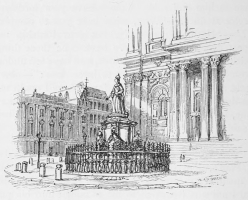
“He spoke of landing in former days at Kingstown, how the car-drivers fought for you, and, having obtained you, possessed you, and made all out of you that they could. Passing a mile-post with G. P. O. upon it, the ‘fare’ asked its meaning. ‘Why, your honour,’ said the driver, ‘it’s aizy to see that your honour has never been in ould Ireland before—why, that’s just God preserve O’Connell, your honour, and it’s on ivery mile-post all through the country.’ It was of course ‘General Post Office.’
“Coming to a river, the ‘fare’ asked, ‘What do you call this river?’—‘It’s not a river at all, your honour; it’s only a strame.’—‘Well, but what do you call it?’—‘Oh, we don’t call it at all, your honour; it just comes of itself.’”
“Feb. 24.—Dined at Lord Strathmore’s, and went on with Hedworth and Lizzie Williamson to Lady Bloomfield’s, where sixty-eight cousins assembled to take leave of Lord and Lady Lytton on their departure for India.”
If any one has ever the patience to read this memoir through, they will have been struck by the way in which, for many years before the time I am writing of, the persons with whom I lived were quite different from those amongst whom my childhood was spent. Arthur Stanley had never got over the publication of the “Memorials of a Quiet Life,” though he was always at a loss to say what he objected to in it, and Mary Stanley I never saw at all. From Lady Augusta alone I continued to receive frequent and affectionate messages.
In 1874 Lady Augusta represented the Queen at the marriage of the Duke of Edinburgh, and she never really recovered the effects of the cold which she then endured in Russia. In the summer of 1875 she was alarmingly ill in Paris, was brought home with difficulty, and from that time there was little hope of her recovery. She expired early in March 1876. I had not seen her for long, but had always a most affectionate recollection of her, and the last letter she was able to dictate was addressed to me.
Journal.
“Holmhurst, March 12.—I have been again up to London for dear Augusta Stanley’s funeral on the 9th. It was a beautiful day. All the approaches to Westminster were filled with people in mourning.
“It seemed most strange thus to go to the Deanery again—that the doors closed for six years were opened wide by death, by the death of one who had always remained my friend, and whom no efforts of others could alienate. Red cloth showed that royalty was coming, and I went at once to the library, where an immense crowd of cousins were assembled. As I went down the little staircase with Kate Vaughan, four ladies in deep mourning passed to the dining-room, carrying immense wreaths of lovely white flowers: they were the Queen and three of her daughters. The Queen seemed in a perfect anguish of grief. She remained for a short time alone with the coffin, I believe knelt by it, and was then taken to the gallery overhanging the Abbey.
“Soon the immense procession set out by the cloisters, and on entering the church, turned so as to pass beneath the Queen and then up the nave from the west end. The church was full of people: I felt as if I only saw the wind lifting the long garlands of white flowers as the coffin moved slowly on, and Arthur’s pathetic face of childlike bewilderment. The music was lovely, but in that vast choir one longed for a village service. It was not so in the second part, when we moved through one long sob from the poor of Westminster who lined the way, to the little chapel behind the tomb of Henry VII., where the service was indescribably simple and touching.
“The procession of mourners went round the Abbey from the choir by a longer way to the chapel on account of the people. As it passed the corner of the transept, the strange little figure of Mr. Carlyle slipped out. He had been very fond of Augusta, was full of feeling for Arthur, and seemed quite unconscious of who and where he was. He ran along, before the chief mourners, by the side of the coffin, and in the chapel itself he stood at the head of the grave, making the strangest ejaculations at intervals through the service.”
Arthur stood at the head of the grave with his hands on the heads of Thomas Bruce’s two children. When the last flowers fell into the grave, a single voice sang gloriously, “Write, saith the Spirit.” Then we moved back again to the nave, and, standing at the end, in a voice of most majestic pathos, quivering, yet audible through all that vast space, Arthur himself gave the blessing. “The Queen was waiting for him upon the threshold as he went into the house, and led him herself into his desolate home.”
I insert some poor lines which I wrote “In Memoriam.”
“Lately together in a common grief Our Royal mistress with her people wept, And reverently were fairest garlands laid Where our beloved one from her sufferings slept. Seeing the sunshine through a mist of tears Fall on the bier of her we loved so well, Each, in the memory sweet of happy years, Some kindly word or kindlier thought could tell. And tenderly, with sorrow-trembling voice, All sought their comfort in a meed of love, Unworthy echoes from each saddened heart Seeking their share in the great loss to prove. For she so lately gathered into rest Was one who smoothed this stony path of ours, And beating down the thorns along the way, Aye left it strewn and sweet with summer flowers. In the true candour of a noble heart, She never sought another’s fault to show, But rather thought there must be in herself Some secret failure which she did not know. While if all praised and honoured, she herself Meekly received it with a sweet surprise, Seeking henceforth to be what now she deemed Was but a phantasy in loving eyes. When the fair sunshine of her happy home Tuned her whole heart and all her life to praise, She ever tried to cheer some gloomier lot, From the abounding brightness of its ways. And many a weary sufferer blest the hand Which knew so well a healing balm to pour; While hungry voices never were denied By her, who kept, as steward, a poor man’s store. Thus when, from all the labour of her love, She passed so sadly to a bed of pain, And when from tongue to tongue the story went, That none would see the honoured face again: It was a personal grief to thousand hearts Outside the sphere in which her lot was cast, And tens of thousands sought to have a share In loving honour paid her at the last. E’en death is powerless o’er a life like hers, Its radiance lingers, though its sun has set; Rich and unstinted was the seed she sowed, The golden harvest is not gathered yet.”
Journal.
“March 25.—A ‘Spelling Bee’ at Mrs. Dundas’s. I was plucked as I entered the room over the word Camelopard.
“Dined at the Tower of London with Everard Primrose; only young Lord Mayo there. At 11 P.M. the old ceremony of relieving guard took place. I stood with Everard and a file of soldiers on a little raised terrace. A figure with a lanthorn emerged from a dark hole.
“‘Who goes there?’ shouted the soldiers.
“‘The Queen.’
“‘What Queen?’
“‘Queen Victoria.’
“‘And whose keys are those?’
“‘Queen Victoria’s keys.’
“Upon which the figure, advancing into the broad moonlight, said ‘God bless Queen Victoria!’ and all the soldiers shouted ‘Amen’ and dispersed.”
“March 28.—My lecture on ‘The Strand and the Inns of Court’ took place in 41 Seymour Street. I felt at Tyburn till I began, and then got on pretty well. There was a very large attendance. I was very much alarmed at the whole party, but had an individual dread of Lord Houghton, though I was soon relieved by seeing that he was fast asleep, and remained so all the time.”
“April 4.—My lecture on Aldersgate, &c. Dinner at the Miss Duff Gordons, meeting the Tom Taylors.[190] He talks incessantly.”
“April 6.—Dined with Lady Sarah Lindsay, where I was delighted at last to meet Mrs. Greville.[191] She recited in the evening, sitting down very quietly on the sofa with her feet on a stool. Her voice is absorbing, and in her ‘Queen of the May’ each line seems to catch up a fresh echo of pathos from the last.”
“April 7.—Dined at Sir Stafford Northcote’s.[192] Mrs. Dudley Ryder was there, who told me she had paralysis of the throat, yet sang splendidly. Sir Stafford told a capital story in French in the evening, something like that which I tell in Italian about the Duke of Torlonia.”
“April 14.—Dined at the Shaw-Lefevres’. Dear Sir John talked much, when we were alone, of the great mercies and blessings of his life—how entirely he could now say with Horne Tooke, ‘I am both content and thankful.’ He described his life—his frequent qualms at having sacrificed a certain position at the bar to an uncertain post under Government: then how the Governorship of Ceylon was offered to him, and how he longed to take it, but did not, though it was of all things what he would have liked, because an instant answer was demanded, and he could not at once find any means of providing for the children he could not take with him: how through all the year afterwards he was very miserable and could apply to nothing, it was such a very severe disappointment; and then how he was persuaded to stand for Cambridge, and how, though he did not get in, the effort served its purpose in diverting his thoughts. Eventually the place in the House of Lords was offered, in which he worked for so many years.
CHAPEL AND GATEWAY, LINCOLN’S INN. [193]
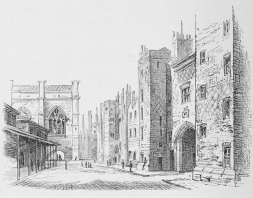
“Sir John spoke most touchingly of his boy’s death. ‘We had another little boy once, you did not know perhaps. It died. It was the dearest, most engaging child. When it died it took the shine out of life.’ Then he dwelt on the law of compensations, how the anxiety for his eldest girl Rachel, so very ill, ‘brought in on a cushion, and suffering so much, poor thing,’ diverted his thoughts from the great loss. In his old age he said, ‘And now at eighty all is blessing—all ... but it is difficult to remember how old one is. The chief sign of age I feel is the inability to apply regularly to work, the having no desire to begin anything new.’ One could not but feel as if it was Sir Thomas More who was speaking, so beautiful his spirit of blessed contentment, so perfect the trust and repose of his gentle waiting for what the future might bring.”
STAPLE INN, HOLBORN. [194]
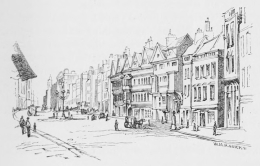
“Holmhurst, April 30.—Lea has been in saying, ‘It’s May Day to-morrow, the day to turn the cows out to grass. The poor things must have a bit of a treat then, you know; they always have done. But there’s not the good clover now-a-days there used to be. Eh! what a fuss there used to be, to be sure, putting the cows out in the clover; and we used to watch that they did not eat too much, and to see that they did not swell; if they did, they had to be pricked, or they’d have burst. And then next day there was the making of the first May cheese.... Old John Pearce at Lime used to take wonderful care of Mr. Taylor’s oxen, and proud enough he used to be of them. “Well, you give them plenty to eat, John,” I used to say. “Yes, that’s just about it, Miss Lea,” he said; “I do put it into them right down spitefully, that I do.”’
“Here are some more of her sayings:—
“‘Here’s a pretty how-d’ye-do! It’s the master finding fault!—it’s one day one thing and one another. Old bachelors and old maids are all alike. They don’t know what they want, they don’t; but I know: the old maids want husbands, and the old bachelors want wives, that’s what they want.’
“‘It’s the mischief of the farming now-a-days that the farmers always say ‘Go.’ ... My father used to say a farmer never ought to say ‘Go;’ if he did, the work was sure to be neglected: a farmer should always say ‘Come, lads,’ and then the work would be done.’
“‘It’s hailing is it? then there’ll be frost, for
“Hail, hail, Brings frost at its tail!”
as the saying is.’
“‘Why, girl, the moon’s waning. I would never kill a pig when the moon’s on the wane. Why, it would not break out; it would shrivel up. No, you must kill a pig with the new moon. I daresay folks laugh at me, but I know what’s what.’
“‘How you do make him (a sick young man) laugh!
“‘Well, and there’s nothing does him so much good. He’d mope, mope, mope, and that’s nothing. It makes him fat, like babies. Boys must laugh, or they won’t get fat. Girls may cry: it always does them good: it stretches their muscles and such like: but boys mustn’t cry; it’s bad for them: that’s how the old saying goes.’
“‘How do you like them?
“‘Eh! how do I know? We must summer ’em and winter ’em afore we can tell, must’na we, wench: aye, and a good many summers and winters it must be too, and then they may deceive ye. I have’na lived more than twenty years over half a century, but I’ve found that out.’
“I have’na heard the cuckoo this spring. I don’t know what’s come over the things. Heathfield fair is over ever so long, and “The old woman lets the cuckoo out of her basket at Heathfield fair,” that’s the old saying.’”
“May 6.—In London again, which is full of interest as ever, and now especially beautiful from its trees just bursting into leaf with indescribable wealth of lovely young green. It is certainly a most delightful time. People think I ought to feel dreadfully depressed by a most spiteful paragraph upon ‘Cities of Italy’ in the Saturday, and a more spiteful review in the Athenæum, but I do not a bit: they are most disagreeable doses to take, but I believe they are most wholesome medicine for one’s morals and capital teachers of humility.”
“May 7.—An amusing tea at the Duchess of Cleveland’s—young Lord Stanhope and Mr. Bourke there. The Duchess talked of Pimlico, the bought property of Lord Grosvenor, formerly called ‘The Five Fields.’ The Court wished to buy it because it was so close to Buckingham Palace, but thought the sum asked was too much. Lord Grosvenor gave £30,000 for it. Lord Cowper had wished to buy it, and sent his agent for the purpose, but he came back without having done so, and when Lord Cowper upbraided him, said, ‘Really, my lord, I could not find it in my heart to give £200 more for it than it was worth.’ Cubitt afterwards offered a ground-rent of £60,000.”
“May 8.—Dined with Mrs. Thellusson to meet Lady Waterford. Whistler the artist was there. He has a milk-white tuft growing out of his black hair, a peculiarity which he declares to be hereditary in his family, as in that of the Caëtani.”
“May 10.—I was ‘at home’ in the morning to a sketching-party in Bunhill Fields Cemetery. It was very sunny there and very quiet, till the Militia and a troop of attendant boys found us out. One of the latter stole my umbrella, but I pursued him and captured it again as he passed through the gate.
“A very pleasant gathering in the afternoon in the beautiful new room of Lowther Lodge, where the great characteristics are the white Queen Anne chimney-pieces, and the vast space of floors, not parquetted, but of closely fitted oak boards. Dined at the Peases’ to meet Woolner the sculptor, &c.”
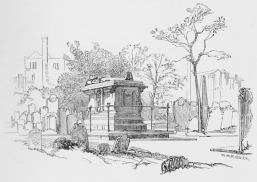
JOHN BUNYAN’S TOMB, BUNHILL FIELDS. [195]
“May 11.—A lovely day. My ‘Excursion’ to the Tower. Forty-six people met me there. All the curious chambers and vaults were open to us in turn. In the White Tower we saw the prisons of Little Ease. I had given my little explanation and returned into the sunshine with the greater number of the party, when Mrs. Maxwell Lyte, who had arrived late, went in. Being told that the cell of Sir Thomas More was to be seen, and seeing a railing by the flickering torchlight, she thought that marked the place, and went underneath it, and stepped out into—nothing! With a piercing shriek she fell into a black abyss by a precipice of fourteen feet. Every one thought she was killed, but after a minute her voice came out of the depths—‘I am not seriously hurt.’ It was a tremendous relief.
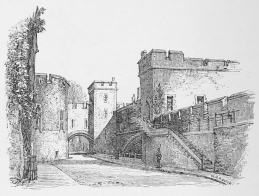
TRAITOR’S GATE, TOWER OF LONDON. [196]
“We went on to the Queen’s Head Restaurant, Emily Lefevre and I running before to order luncheon. When we arrived, we found volleys of smoke issuing from the house and the kitchen-chimney on fire. However, we waited, the party bore the smell, and eventually we had our luncheon. Tom Brassey wanted to order wine, &c., but Emily stopped him with, ‘Remember, Mr. Brassey, we are limited to fourpence a head.’
“The Prince of Wales arrived (from India) at 7 P.M. I waited two hours at the Spottiswoodes’ house in Grosvenor Place to see him, and saw nothing but the flash of light on his bald head. It was a pleasant party, but how seldom in London society does one hear anything one can carry away. Most people are like those Mme. du Deffand describes—‘des machines à ressort qui vont, viennent, parlent, vivent, sans penser, sans réfléchir, sans sentir, chacun jouant son rôle par habitude.’”
“May 12.—Trouble with Murray the publisher, who insists on believing that because some points in my ‘Cities of Italy’ resemble his Handbooks, they must be taken from them, which they most assuredly are not. I had no Handbooks with me when I was writing, but where there is only one thing to say about places, two people sometimes say it.”
“May 13.—A delightful morning, drawing in the Savoy Churchyard.”
“May 15.—Drawing-party in dirty, picturesque St. Bartholomew’s. For the first time this year no one asked me to dinner, and I was most profoundly bored.”
“May 16.—Dined at Sir Charles Trevelyan’s. Old Lord Hatherley was very interesting. He said much that was curious about the Milton houses in the City, and how as a boy he used to go to study at the Williams Library in Redcross Street: how Lady Hatherley had property in the City, in an ancient conveyance of which there was a signature of Shakspeare. I never saw people whose every word breathed more of old-fashioned goodness than Lord and Lady Hatherley.”
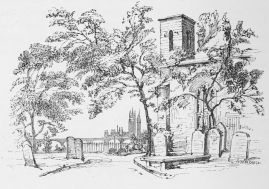
THE SAVOY CHURCHYARD. [197]
“May 17.—A sketching-party in the City. The going thither down the river, with its varieties of huge barges with their sails, quite as striking as many things abroad. In the great Church of St. Mary Overy we drew the wonderful figures of the ‘Sisters’—sleeping deeply with their rakes and prongs over their shoulders while waiting for the great final harvest.”
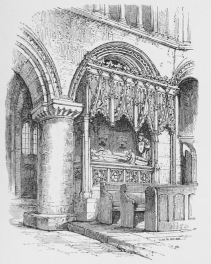
RAHERE’S TOMB, ST. BARTHOLOMEW’S, SMITHFIELD. [198]
“May 26.—Dined at Lord Ducie’s. Lord Henry Scott talked of his place on the Solent, and his different rights to flotsam, jetsam, and lagam; that it never arrived at the third: that the second had only brought him two dead sailors to bury.”
THE SLEEPING SISTERS, ST. MARY OVERY. [199]
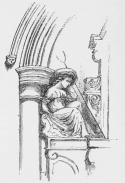
“May 27.—Dined at Lord Egerton of Tatton’s, Old General Doyle was very amusing with his stories of duels in which he had a personal share. He also told of his visit to Ireland as a young man with the present Lord Enniskillen as Lord Cole. At the first house they went to, his friend escaped after dinner, but he had not time. The host locked the door, and they began to drink at seven, and went on to eleven. At eleven his host fell under the table, and he then picked his pocket of the key and got out. The next day his host seriously consulted Lord Cole as to whether it was not his duty to call him out, because he would not stay for another drinking bout.
“He told the story of a man in France, condemned to death for the murder of his father and mother, who, when asked if he could give any reason why he should not undergo the extreme penalty of the law, clasped his hands, and said, ‘Ayez pitié d’un pauvre orphelin.’”
“May 31.—An evening party at Lord Houghton’s, an omnium-gatherum, but very amusing. It recalled Carlyle’s speech, who, when some ecclesiastic gloomily inquired in his presence ‘What would happen if Jesus Christ returned to earth now?’ retorted—‘Happen! why Dickie Milnes would ask him to dinner, to be sure, and would ask Pontius Pilate to meet him.’
“It took half-an-hour to get up the staircase. Miss Rhoda Broughton was there, beautifully dressed, pressed upon by bishops and clergy: Salvini and Irving were affectionately greeting: Lady Stanley of Alderley, under a perfect stack of diamonds, was declaiming very loud in her unknown tongue to an astonished and bewildered audience; and through all the groups upstairs the young King of the Belgians was smiling and bowing a retreat to his escape by a back-staircase.”
“June 6.—Left London for Devonshire, struck more than usual with the interest of the Great Western Railway, which has no exceptional beauty, but most characteristic changes of scenery, even the botany along the banks showing in its different plants the varied conformations of the soil.
“First, close to London, the endless brick-kilns, and the last streets stretching out into the blackened fields like fingers of a skeleton hand. Then across the green meadows, all intersected by elms, branchless and tufted like great brooms, the grey coronal of Windsor. Then the red houses and pretentious prison of Reading and the glassy reaches of the Thames, with its vigorous growth of sturdy water-plants at Pangbourne and Maple Durham.
“Next we enter Berkshire, bare and featureless except near the river and where the White Horse appears, a scraggy creature rudely scratched in the turf above a soft hollow in the downs. Chippenham is a little town in a wooded hollow, with a grey spire and stone bridge over the Avon. Then one reaches a stony country. The houses are no longer of brick, but all of stone. The Box tunnel is a result of the hills. The villas near Bath, of grey stone, cling to the sides of the heights from whose quarries they were taken. In the valley are Hampton church and ferry.
“Bath, an entirely stone city, has a consequent greyness of its own. The streets have a desolate stateliness, and are still the abode of old maids and card-playing dowagers as when described by Miss Austen; so Bath-chairs are still the popular mode of conveyance to the frequent tea-parties. Beechen Cliff is a fine feature. In the centre of the town the Abbey tower shows the poverty of perpendicular architecture.
“By Kelsey Oaks we rush on to smoky Bristol, all energy and ugliness: then a great strange rift in the hills shows where the Avon winds beneath the rocks and hanging bridge of Clifton.
“Now there is a change to softer scenery at Clevedon, Woodspring Priory, the odd hill of Weston. The houses grow warmer as well as the country—no longer of grey, but of red sandstone: the Somersetshire churches, proverbially fine, have pink-grey towers, their projections gilded with lichen. Now we pass through apple-orchards, and the thorns, snow-drifted with bloom, stand knee-deep in the long mowing grass. In the flats rises Bridgewater, then Taunton with its beautiful and picturesque towers standing out against the low grey hills; Exeter, capped by the stumpy towers of its cathedral; and then the salt estuary of the Teign laps the bank of the railway and we enter the woods of Powderham.”
“Powderham, June 9.—I found the door open last night and walked straight into the hall. Charlie Wood and Lady Agnes were there at tea, and people kept dropping in—a very pleasant party.... Lord Devon[200] is the kindest of hosts, full of small courtesies; but he is a great deal away, flying up to London after dinner and returning next day: they say he performs the circumference of the globe every year, and chiefly on his own lines of railway.
“Lord Devon’s only son, Lord Courtenay, is seldom here, but when he is, amuses every one. One evening ‘Mademoiselle Bekker’ arrived late at Powderham, coming in the hope to obtain a chairman for a meeting which was going to be held at Exeter in favour of the Rights of Women. There was a very distinguished party in the house—the Bishop of Winchester, Lord Halifax, the American Minister (Motley), &c., and they each, while refusing, made a speech in answer to hers, which was most eloquent. Eventually Mademoiselle Bekker declared herself so indignant as to be led to unsex herself: she was Lord Courtenay.”
“June 12.—On Saturday we were called at daybreak, and went to Totness by rail, and thence in waggonettes eighteen miles through deep bosky lanes, and then over breezy uplands to the Moult, Lord Devon’s enchanting little place near Salcombe. Here the blue-green transparent sea glances through the thick foliage deep below the windings of the road, and the quiet bay is encircled by rocky hills tufted with wood, which in parts feathers down into the water. We rested at North Sands Cottage, a lovely wee place of Lord Devon’s, and then walked through the grounds of his larger place of the Moult. Aloes grow and flourish here to an immense size. Beyond this a path—‘Lord Courtenay’s Walk’—runs half-way up the steep precipices above the sea.
“It was an enchanting day, white wreaths of cloud drifting above in the blue, deep below the sea gloriously transparent, with all its weed-covered rocks visible through the waters, great white gulls swooping around with their wild outcries, and the pathlet winding up and down the cliff, bordered by cistus and thrift in masses of pink luxuriance. On the steep descent to a cove, we were met by a welcome luncheon, and ate it high above some rock caverns which are very curious at that point.
“One of the principal farmers belonging to an agricultural club near this lost his wife lately, and in his kind way Lord Devon alluded to her at the annual club dinner,—speaking of her as an admirable, kind, and industrious woman, and saying how he could feel with such a loss, having had himself a bereavement which was ever present to him. But at last the farmer interrupted him—‘I doan’t know what his Lordship be a talking about; but I du know that she was an awful cranky, tiresome old woman, and God Almighty’s very welcome to she.’
“Yesterday was Sunday. I went to the service at Powderham with Lord Devon and Lady Mary Fortescue in a chapel opposite the white recumbent marble figure of Lady Devon. The afternoon was spent in the ‘plantation garden,’ where an Australian gum-tree was in full flower. In the evening there were prayers—‘Compline,’ they called it—a very living, earnest service in the chapel.... Truly I felt, as I took leave of Charlie, that above the door of every house that is his home might be inscribed the words of S. Bernard engraved over the threshold of many Cistercian houses—‘Bonum est nos hic esse, quia homo vivit purius, cadit rarius, surgit velocius, incedit cautius, quiescit securius, moritur felicius, purgatur citius, praemiatur copiosius.’”
“Abbots Kerswell, June 15.—Yesterday Sir Samuel and Lady Baker dined here. He is most agreeable, and possesses ‘l’art de narrer’ to perfection. He told a ghost-story in the evening, without either names, dates, or any definite material, and yet it was quite admirable, and kept the company breathless for three-quarters of an hour.”
“June 16.—Yesterday we paid a long visit to Sir Samuel Baker. He has bought and made his place with the money he received from the Khedive for his African discoveries.[201] The house is full of skeleton heads, horns, &c. Many others were destroyed in the African depot by an insect which forces out the bone as with a gimlet, but fortunately it will not live in England.”
“Charlton Hall, June 17.—I spent several hours in Bath on my way here. It was an exquisite day, and everything was in great beauty. Bath seems a town exclusively intended for the rich. Everything being built of stone gives it a foreign character, and the height of the surrounding hills causes you to see green down every street. I felt age in the way in which everything looked so small in proportion to my recollection.
“At Chippenham a dogcart from Lord Suffolk’s was waiting for me, and we rolled away down the dull lanes to Malmesbury. It was curious in one day to revisit, as it were, six years out of my former life. At Bath I had walked up the hill to where I could look down upon Lyncombe, and what memories it awakened of miserable longings after a fuller, more interesting life, which lasted through the whole of two years and a half of wasted, monotonous, objectless time. Now in my full life, looking down upon that richly wooded glen, it seemed quite beautiful; but in the wretched bondage of those weary years, how hideous it all was!
CHARLTON HALL.
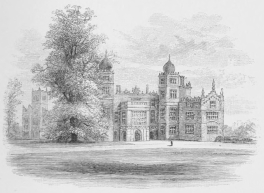
“At Chippenham, as I passed the park at Harnish, I went back farther still to three years and a half of private school imprisonment and the pettiest of petty miseries. They do not matter much now certainly, but one does grudge six years of youth denuded of all that makes life pleasant and beautiful.
“Charlton is a magnificent old house of yellow-grey stone, Jacobean, open on all sides, a perfect quadrangle. Inside, there was once a courtyard, but a former Lord Suffolk closed it in. It remained for many years a mere gravelled space: lately Lady Suffolk has had it paved, and to a certain extent furnished. The rooms are handsome in stucco ornaments, but not picturesque. The pictures are glorious. There is one of the noblest known works of Leonardo da Vinci—‘La Vierge aux Rochers,’ the figures all with the peculiar Leonardo type of face, grouped in a rocky valley—strange, wild, and fantastic.[202] The picture which to me is most charming is ‘Le Raboteur,’ attributed to Annibale Carracci. The Virgin, a sweet-looking peasant woman, yet with an expression of ‘pondering these things in her heart,’ is sitting outside her cottage door with her work-basket by her side. The boy Jesus, in a simple blue tunic, is standing at the end of the carpenter’s table—‘subject to his parents’—doing some measuring for old Joseph, who is at work there. It is a quiet village group such as one has often seen, only elevated by expression.
“There is a glorious old gallery with a noble ceiling, full of portraits and of old and interesting books. In the ‘rose parlour’ are more pictures, and a ceiling the design of which is repeated in the flower-garden. Many of the pictures belonged to James II. When he fled, he sent them to be taken care of by Colonel Graham, who had married the Earl of Berkshire’s daughter, and William III. afterwards allowed them to remain.”
“June 18.—Yesterday it rained at intervals all day. I drew the gallery, and enjoyed talking to Lady Suffolk,[203] who sat by me, with a charm of face and manner and mind which recalls Donne’s lines—
‘No spring or summer beauty hath such grace As I have seen on one autumnal face.’
She lives so far more in the heavenly than the earthly horizons, that one feels raised above earth whilst one is with her. She spoke of the impossibility of believing in eternity of punishment, yet of the mass of difficulties besetting all explanations. She talked of a woman in the village in failing health and unhappy. Being asked if she was not troubled in her mind, she confessed that she was, but said, ‘It is not for want of light; I have had plenty of light.’ She said her father had said to her, ‘Now if you go to hell, Hannah, it will not be for want of light.’
“Some one had urged Lady Suffolk to go and hear Moody and Sankey, because their sermons on heaven were such a refreshment and rest: she had gone, and the sermon had all been about hell.
“Lady Victoria drove me to Malmesbury. The town cross is beautiful. The Abbey is a gigantic remnant of a colossal whole; the existing church being about two-thirds of the nave of the original abbey-church, entered by a magnificent Norman door. By the altar is a tomb to King Athelstan, erected some centuries after his death, and there is a gallery like Prior Bolton’s in Smithfield.”
“June 18.—I sleep at Charlton in the ‘king’s room,’ so called from James II. It is hung with tapestry and old pictures. As we were going to bed, Andover said, ‘You sleep in the haunted room.’ Consequently every noise, which I had never observed before, troubled me through the night. One ought never to be told that a room is haunted.
“Conversation has been much about Mrs. Wagstaff, a homœopathic clairvoyant, wife of an allopathic doctor at Leighton Buzzard. She comes up to London if desired, and works wonderful cures. In her trances her conversation is most remarkable, but out of them she is a very ordinary person. She never remembers when awake having seen any one (with her eyes half-open) in a trance, but meets as a perfect stranger the person she has just been talking to for half-an-hour.
“It was odd on Sunday having no service in church till six in the evening, but certainly very pleasant. We walked in the park beforehand to Sans Souci, a pretty wood in which a clear stream has its source, throwing up the sand in the oddest way in a large round basin. Numbers of trees were lying about, cut down, as Andover said, ‘to meet the annual demand for the needy.’”
“June 19.—The Andovers’ little girl is most amusing. At six, if she catches a new word, she uses it without the slightest idea as to its meaning. Her maid Sabina went to her to-day and said, ‘Now, Miss Howard, I must put on your things, for you must go out.’—‘No, Sabina, you must not,’ promptly said ‘Tiny-Wee.’—‘But I really must, Miss Howard,’ said Sabina.—‘No, Sabina, you must not,’ persisted Tiny-Wee.—‘And why, Miss Howard?’ said Sabina.—‘Because, Sabina, it is co-eternal,’ said Tiny-Wee very solemnly; and Sabina was utterly quelled and gave way at once. It is needless to say that Tiny had been to church and heard the Athanasian Creed.
“Andover has been describing a clergyman who preached on the fatted calf, and sought his words as well as his ideas as he proceeded extempore, and said, ‘He came home, my brethren, he came home to his father, to his dear father, and his father killed for him the fatted calf, which he had been saving up for years, my brethren—saving up for years for some festive occasion.’
“He told of an American who never was in time for anything in his life, was unpunctual for everything systematically. One day, in a very out-of-the-way place, he fell into a cataleptic state, and was supposed to be dead. According to the rapidity of American movement, instead of bringing the undertaker to him, they took him to the undertaker, who fitted him with a coffin and left him, only laying the coffin lid loosely on the outside of it. In the middle of the night he awoke from his trance, pushed off the lid, and finding himself in a place alone surrounded by a quantity of coffins, he jumped up and pushed off the lid of the coffin nearest to him. He found nothing. He tried another: nothing. ‘Good God!’ he cried, ‘I’ve been late all my life, and now I’m late for the resurrection!’”
“June 20.—Yesterday we had a delightful drive to see Lady Cowley at Draycot, a most charming place of happy medium size, in a park full of fern and old oaks. Lord Mornington, who left it to the Cowleys, was quite a distant cousin, and they expected nothing. He came to dine with them occasionally at Paris, he mounted Lady Feodore for the Bois de Boulogne, and one day they suddenly found themselves the heirs of Draycot, perfectly fitted up with everything they could possibly wish for. It was like a fairy story, and Lady Cowley has never attempted to conceal her enchantment at it.
“To-day we went to a different place—Mr. Holford’s new house of Westonbirt. It is an immense building in a flat, ugly situation. The hall goes up the whole height of the house, with open galleries to the bedrooms, so that every one sees who goes in and out of them. The dining-room has a fine Jacobean chimney-piece and modern Corinthian pillars. There is a great chimney-piece in another room, which was an altar in a church at Rome. All is huge, and seemed very comfortless.
“It has been a most happy visit to the Suffolks, with whom one is completely at home. As Lady Suffolk says, though they have often wished to be rich, they have been much happier for being poor, for they have all been obliged to do their part in the house and place, and all that has to be carried on there, and so it is to them not only the scene of their life, but of their work.”
“June 22.—Yesterday I went to Oxford, and came in, without intending it, for Commemoration. I will never go there again if I can help it. It is like visiting a grave of happy past years.”
“June 28.—Went to Holland House. The deep shade of its lofty avenue is enchanting as one turns in from the baking street of Kensington. Lady Holland sat in the inner room, with her sweet face encircled by the prettiest of old-fashioned caps. Beau Atkinson was with her, with a lovely little Skye dog in his arms, and Lady Lilford with her two fine boys. After talking some time, we wandered into the gardens under the old cedars. When we came in, old Mr. Cheney was leaning over Lady Holland’s chair, chuckling to himself over the dogmatic self-assertion of Mr. Hayward,[204] who was talking to her of books, the value of which he considered to be quite decided by his opinion of them. Especially he talked of Ticknor’s Memoirs, so remarkable because, though he was an American of the most lowly origin, it is evident that when he came to Europe he not only saw the best society of every country he visited, but saw it intimately—which could only have been due to his own personal charm.
“Dined at Lady Barrington’s. She said I must be presented, and George Barrington said he should present me.
“L. was full of a dinner she had been at at Count Beust’s. The Prince Imperial was there, who had always hitherto been regarded as only a pleasant boy, but who electrified them on this occasion by a remarkable flash of wit. It had been impossible to avoid asking the French Ambassador, but Count Beust had taken especial pains to make it as little offensive as possible. He took in the Princess of Wales to supper and placed her at the same table with the Prince Imperial. The Comte and Comtesse d’Harcourt were at another table with the Prince of Wales. Suddenly an offensive pushing man, first secretary to the French embassy, brought Mademoiselle d’Harcourt to the Prince Imperial’s table and sat down. The Prince was very much annoyed. Looking up at a picture of the Emperor of Austria, he asked if it resembled him—‘I do not remember him, I was so very young when I saw him,’ and then in a louder tone, ‘I wonder how the French Ambassador represents the Republic of France on the walls of his rooms.’”
“June 29.—Yesterday I went down into Kent for Miss Virginia Smith’s wedding with young Francis Villiers,[205] toiling in a cab with Lady Craven over the hot chalky hills. The breakfast was at Selsden Park, a lovely place belonging to a child-heiress, Erroll Smith’s daughter.
“Dined with Lady Head, and we went on together to Baroness Burdett Coutts’, where Irving read Macbeth to an immense company, chiefly bishops and archbishops and their belongings. The reading was stilted and quite ineffective.”
“June 30.—A most pleasant party at Lord Ducie’s—Mr. and Miss Froude, Sir James Lacaita, Miss Grant the sculptress, Lord Aberdeen and Lady Katherine, Lord Northbrook and Lady Emma Baring, Lord Camperdown, Mr., Mrs., and Miss Gladstone, Lord Vernon, George and Lady Constance Shaw-Lefevre, &c.
“There was very agreeable conversation, chiefly about Macaulay’s Life—of his wonderful memory and the great power it gave him. Gladstone said the most astonishing thing about him was that he could remember not only the things worth knowing, but the most extraordinary amount of trash. He described another man he knew who, after once reading over the advertisement sheet of the Times, could repeat it straight through.
“In the evening I was asked to tell a story, and did, feeling that if Irving amused people for about three hundred nights of the year, it was rather hard if I declined to amuse him on one of the remaining sixty-five. He enjoyed it more than any one else, and lingering behind, when all were gone but Mrs. Gladstone and one or two others, said, ‘Now that we are such a very small party, do tell us another.’”
“July 6.—Went by rail with Mr. Ralph Dutton and ‘Beauty Stephens’ to Syon. It is a great house in a low-lying park, on the edge of which the Thames is marked by its great lines of tall sedges and the barges going up and down with music through the flat meadow-lands. On the parapet of the house is the poor old lion from Northumberland House. The lime-trees were in flower, scenting the whole air.
“Lady Percy received in the gallery, and about two thousand guests were collected on the lawn. I took courage and went and talked to the Japanese ambassadress, who was very smiling, but did not say much beyond ‘Me speak leetle English and no moosh French.’”
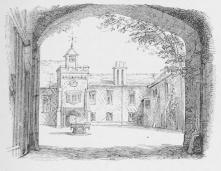
“July 7.—Went by water with Mrs. Mostyn, Miss Monk, and Miss Milnes to Fulham. The steamer was actually two hours and a half on the way. There was an interest in recognising a whole gallery of De Wint’s sketches in the tall bosky trees, the weirs, the great water-plants, and still more on the causeway leading from Fulham Church to the palace. It was a gloriously hot day, and very pleasant sitting under the old gateway looking into the sunlit court, with full light on the rich decorations of the brickwork and the massy creepers.
“Afterwards, I was at a beautiful and charming party at Holland House. A number of grown-up royalties and a whole bevy of royal children sat under the trees watching Punch and Judy. The Prince Imperial, with charming natural manners, walked about and talked to every one he knew. I was happy in finding Lady Andover and many other friends. Towards the end, Lady Wynford said the Princess Amelie of Schleswig[206] desired that I might be presented to her, as she had read my books, &c. She is elderly, but enjoys life and dances at all the balls she is asked to, especially at Pau, of which she talked with animation.”
COURTYARD, FULHAM PALACE. [207]
“July 8.—At luncheon at Lady Alwyn Compton’s I met Lady Marion Alford. There was much talk of the wills of old London citizens—how Mr. Bancroft had desired in his that for a hundred years a loaf of bread and a bottle of wine should be placed in his vault every year on the anniversary of his death, because he was convinced that before that time he should awake from his death-sleep and require it, and the hundred years had only just expired;—of how Jeremy Bentham’s body, in accordance with his will, was produced a year after his death at the feast of a club he had founded, and how all the company fled from it.
“I was afterwards at a breakfast at Lord Bute’s. There were few people I knew there, and the grass was very wet, so I sat under the verandah with the Egertons. Presently an old lady was led out there, very old, and evidently unable to walk, but with a dear beautiful face, dressed in widow’s weeds. She seemed to know no one, so gradually—I do not know how it came about—I gave her a rose, and sat down at her feet on the mat and she talked of many beautiful things. She was evidently sitting in the most peaceful waiting upon the very threshold of the heavenly kingdom. When I was going away she said, ‘I should like to know whom I have been talking to.’ I said, ‘My name is Augustus Hare.’ She said, ‘I divined that when you gave me the flower.’ I have not a notion who she was.[208]
“I dined at Sir John Lefevre’s, and was pained to see how weak and failing he looks. The Rianos were there and Sir James Lacaita, and in the evening Lady Ducie came in, radiant with goodness and beauty.”
“July 11.—A very pleasant dinner at Lord Ebury’s. He overflows with kindness. He said, ‘If this hot weather is trying for you and me, it is very good for the corn: that hardens, while we melt.’”
“July 13.—Luncheon with Sir C. Trevelyan, who showed me Macaulay’s library, and then drove me to see the remnant of the house of Villiers, Duke of Buckingham, in Villiers Street. Peter the Great lived there when in London, and David Copperfield is made to lodge there by Dickens.
“Dined at Lord Cardwell’s, where I sat by George Otto Trevelyan, the author of Lord Macaulay’s Life. At Lord Sherborne’s in the evening I found Irving, with all the three hundred nights of his Hamlet written on his face. I was introduced to Dr. Ellicott, Bishop of Gloucester and Bristol, a little dapper man in a violet coat.”
“July 14.—Luncheon at Mrs. Lowe’s. She was most amusing about her pets. ‘Mr. Lowe, you know, is always going out and bringing home a new animal: he does like pets so. He went and he bought a dog, and then he went and bought a parrot, and then he bought a cockatoo and a cat, and I said, “Mr. Lowe, if you go and buy any more pets, I will go out of the house, because I will not bear it,” and then Mr. Lowe went and bought Bow-wow, the little white dog, and it had not cut its teeth, and it was so dreadfully ill, and we had to nurse it, and it gave us more trouble than all the other pets put together; and I like Bow-wow the best of them all, and Mrs. Scutt (that’s the housekeeper) is just the same.
“‘I said to Mr. Lowe, “If you will go downstairs with that cockatoo on your shoulder, it will fly away out of the window, and you’ll lose him,” but Mr. Lowe would do it, you know, he’s so obstinate; and it was just as I said, and the cockatoo flew out of the staircase window, and Mr. Lowe was in a fine way about him. There are a lot of boys watching for him now, and he’ll come back some day, for every one knows Mr. Lowe’s cockatoo: but he won’t come back yet. And finely he’s enjoying himself, that bird is; he’s never had such a fine time in his life; he’s finished all the cherries in Eldon Grove, and he’s just beginning upon the gooseberries.
“‘When we drive down to Caterham, Bow-wow and Elfin, the two dogs, sit upon the back-seat, and the cat sits in the middle. They look out of the windows and amuse themselves wonderfully, and finely the people stare.
“‘When I first married Mr. Lowe we lived at Oxford. It was quite delightful: we had all the interesting society of the University, and Mr. Lowe was a tutor and taught all the clever young men. When we went up to London, we hired a coach, and had six first-class men inside, all Mr. Lowe’s pupils. Then Mr. Lowe’s eyes failed, and we threw it all up and went to Australia, and were away six years; but it answered to us, for I had some money left to me at that time, and Mr. Lowe had some money left to him, and we invested it there in houses, and they pay us 60 per cent., and we made our fortunes.
“‘How sad the Duchess of —— going away is! She cried so dreadfully when she went, that I am sure it’s for ever. Don’t you think, if I had had a dreadful quarrel with Mr. Lowe, and we had parted for ever, that I should cry too? It is a very different thing when it is not for ever. I go off to Wiesbaden for six weeks, and I wish Mr. Lowe good-bye, and I say, “Well, good-bye, Mr. Lowe; in six weeks you’ll have me back again,” and if we have quarrelled, it does not signify; but it would be very different if it was for ever. Why, I should cry my eyes out.’
“One day, however, when Mrs. Lowe was inveighing against the absurdity of the marriage service—of the bridegroom’s statement, ‘With all my worldly goods I thee endow,’ even when he possessed nothing and it was just the other way, and when she was saying, ‘Now when I married Mr. Lowe, he had nothing whatever but his brains’—a deep voice from the end of the room growled out, ‘Well, my love, I certainly did not endow you with those.’
“‘Why contend against your natural advantages?’ said Mr. Lowe one day to a deaf friend who was holding up an ear-trumpet to listen to a bore.
“In the afternoon I drove down with Lady Sherborne, Miss Dutton, and Miss Elliot to see Lord Russell at Pembroke Lodge. It is a beautiful place; not merely a bit of Richmond Park, but a bit of old forest enclosed, with grand old oaks and fern. The Queen gives it to Lord Russell, who, at eighty-four,[209] was seated in a Bath-chair in the garden, on a sort of bowling-green, watching his grandsons play at tennis. Though he no longer comprehends present events, he is said to be perfectly clear about a far-away past, and will converse at any length about Napoleon, the escape from Elba, &c. When I was presented to him, by way of something to say, I spoke of having seen the historical mound in his garden, and asked what it was that Henry VIII. watched for from thence as a death-signal, ‘was it a rocket or a black flag?’
“‘It was a rocket.’
“‘Then that would imply that the execution was at night, for he would hardly have seen a rocket by day.’
“‘No, it was not at night; it was very early in the morning. She was a very much maligned woman was that Anne Boleyn.’
“We all sat by a fountain under the oak-trees, and then went into the house to a sort of five-o’clock tea on a large scale.”
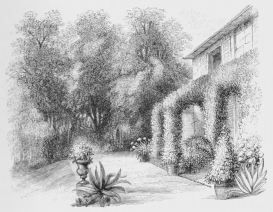
“Holmhurst, July 15.—Returned to the dear little home, where I found Charlotte Leycester sitting on the terrace surrounded by the dogs, looking on the lovely view from our greenery. The intense freshness of the air, the glory of the flowers, the deep blue sea beyond our upland hayfields, and the tame doves cooing in the copper beech-tree, are certainly a refreshing contrast to London, though I should never have been able to leave it unless Duty had pulled at me.”
“Highcliffe, July 24.—In this most unearthly Paradise all looks like last year going on still—the huge stems of chestnut, and the white lilies and bulrushes in the great vase relieved against the old boiserie of the saloon; the wide window-porch open to the fountain and orange-trees and sunlit terraces and sea; Lady Waterford coming in her hat and long sweeping dress through the narrow wind-blown arbutus avenue; old Mrs. Hamilton-Hamilton in her pleasant sitting-room, with Miss Lindsay hovering about and waiting on her like a maid-of-honour; the Ellices, so cordial and pleasant, so beaming with kindness and goodness, their largeness of heart quite preventing their being able to indulge in the sectarian part of their own religious ideas.... I have felt, as I always do very shy at first, and then entirely at home.”
HOLMHURST.
“July 25.—We have all, I think, basked as much in the mental sunshine of this beautiful life as in the external sunshine which illumines the brilliant flowers and glancing sea.
“We walked on the shore this afternoon. ‘See what festival the sea has been making, and what beautiful coloured weeds she has been scattering,’ said Lady Waterford. We found two little boots projecting from the sand, and as we dug them out and found them filled and stiff, we really expected a drowned child to follow; but it was only sand that filled them, and the little Payne child of Chewton Bunny had lost them when bathing. As we sat on the shore while Lady Waterford looked for fossils, a staith came down from the Bunny and flooded the little stream into a river, cutting off our return. We, the male part, crossed much higher up: Lady Waterford plunged in and walked: Lady Jane took off shoes and stockings and waded.
“Lady Waterford has talked much of marriages—how even indifferent marriages tone down into a degree of comfort which is better for most women than desolation.”
“July 26.—We walked in the evening to the Haven House. The old pine-wood, with its roots writhing out of the sand, and its lovely views, over still reaches of water to the great grey church, and the herons fishing, are more picturesque than ever. Afterwards Lady Herbert of Lea arrived with her beautiful daughter Gladys.[210] Lady Herbert is suffering still from the bite of a scorpion when she was drawing in the ruins of Karnac.”
Louisa, Marchioness of Waterford. From a Photograph by W. J. Reed. Bournamouth.
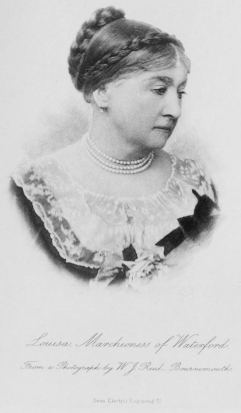
“July 29.—In the afternoon I went with Lady Waterford to General Maberly, who talked, as it seemed to me, very sensibly about the exaggerations of teetotalism. He thought that every one should do as they pleased, and that it was wrong of a great landowner to prevent the existence of a public-house on his estate: that it was following the teaching of the Baptist rather than that of our Saviour, for ‘was not our Saviour a wine-bibber?’
“Lady Waterford has been speaking of sympathy for others; that there is nothing more distressing than to see another person mortified.
“‘Mama could never bear to see any one mortified. Once at Paris, at a ball they had, there was a poor lady, and not only her chignon, but the whole edifice of hair she had, fell off in the dance. And Mama was so sorry for her, and, when all the ladies tittered, as she was Madame l’Ambassadrice and a person of some influence, I don’t think it was wrong of her to apply the verse, and she said, “Let the woman among us who has no false hair be the first to throw a stone at her.”’
“July 30.—Hamilton Aïdé says he went to visit two or three times at a lunatic asylum. The matron, a very nice person, said, ‘There is here a very extraordinary example of a person who has become quite mad, and only from vanity.’ He went to see her. It was a very old lady, with great traces of beauty and dignity of manner, but she wore the most extraordinary bonnet, very large, and from the fringe hung a pair of scissors, a thimble, and a needle-book. He made a civil speech to her about being glad to see her looking so well, or something of that kind. In reply she only just looked up and said, ‘For further information refer to the 25th chapter of the second Book of Kings,’ and took no more notice whatever.”
“July 31.—Lady Jane Ellice says that there are three shades of people one likes—those whom one must see in heaven, for it would not be heaven without them: those whom one hopes to see in heaven and to meet there: and those whom one hopes will be in heaven but that one will not see them there. Her singing this evening of ‘Zurich’s Blue Waters,’ ‘Three Blue Bottles,’ &c., has been perfectly charming.
“Lady Waterford has been telling of Ruskin ‘like a little wizened rat.’ ‘He likes to be adored, but then Somers and I did adore him, and he likes to lash his disciples with rods of iron. I do not mind that: it is his jokes I cannot bear; they make me so sorry and miserable for him.’”
“August 3.—Lady Waterford said that Lady Stuart, when a Frenchman tried to talk to her in very bad English, told him she preferred talking French. ‘Ah,’ he said, ‘vous aimez mieux, Madame, écorcher les oreilles des autres, qu’on vous écorche vos oreilles.’”
“August 5.—I have left Highcliffe, and the gates of Paradise seem closed for a year. There has been the usual perfect confidence about everything through the whole party: the pleasant going backwards and forwards to ‘Hamilton Place,’ and the waiting upon old Mrs. Hamilton of her ‘equerry’ and her ‘maid-of-honour:’ the many friendly snubs and contradictions which rail at all the smallnesses and ennoble all the higher aims of life. After luncheon we all sat in the porch surrounded by the great lilies and geraniums in flower and we had coffee there, looking upon the Isle of Wight with the Needles looming through the mist: then we parted.
“It was a long drive in pouring rain from Southampton to Sydney Lodge, where I found a warm welcome from dear old Lady Hardwicke.[211] It is a moderate house, with large gardens, into which bits of old forest are interwoven. This morning we drove to Eliot Yorke’s house at Netley Fort, an old tower of the monks, in front of which the Mayflower set sail. The situation is lovely, close to the sea, with a hilly garden in miniature and a machicolated tower rising out of ivy walls like a scene in a play. But the great charm is in Eliot himself, so handsome, with such a pleasant smile and melodious voice. His Jewess wife, Agneta Montagu, and Hinchinbroke were there. From the garden we went to the Abbey, where I drew while Hinchinbroke amused himself by pretending to make love to an old lady (‘Jemima Anne’) who was peering about in spectacles amongst the arches. When we went back, boats were arriving from Cowes at the little wharf—the Prince Imperial with the Duke and Duchess of St. Albans and a crowd of others. The Prince has the most pleasant, frank, simple manners, and makes himself agreeable to every one. He was much amused with the quantities of Yorkes who seemed to crop up from every house round, and said he ‘thought he must have landed by mistake on the coast of Yorkshire.’ His arm was in a sling, and he looked pale and fagged, for somehow, in playing at leap-frog with his ‘camarades,’ he had tumbled into a camp-fire, and, to save his face, had instinctively put out his hands, and burnt the whole skin off one of them. It must have been terrible agony, but he never complained.”
“August 6.—The Yorkes are absolutely devoted to each other. There is such family loyalty that every peccadillo is consecrated. I certainly do not wonder at their love for Eliot; he has such a sweet though frank manner, and is so genial and kind to every one.[212] L. has been talking of the advantages of even an unhappy married life over a single one, as exemplified by the poor Empress, who herself said, ‘C’est mieux d’être mal à deux que d’être seule.’
“L. was at a party at Mrs. Brand’s, sitting by Lady Cork, when Lady Francis Gordon came up to her. ‘Come, Lady Cork, can you spell in five letters the three scourges of society?’ (drink, rink, ink). ‘No,’ said Lady Cork instantly, ‘that I cannot do, but I can spell in two letters the two blessings of society—U and I.’
“Mrs. Eliot Yorke is exceedingly pleasing and much beloved in her husband’s family. Amongst the few Jews I have known, I have always found the women infinitely superior to the men, and this is especially the case with the Rothschilds. Some one once made an observation of this kind to Rogers the poet. ‘Yes,’ he said, ‘the men crucified Him, but the women—wept.’”
“August 12.—Last Monday I went to Cobham for a few days, arriving just as the setting sun was illuminating the grand old red brick house deeply set in its massy woods. A large party was assembled, its most interesting element being Fanny, Lady Winchilsea, who is always delightful. Archdeacon Cust told me a curious story of a Mr. Phipps, a clergyman at Slough. He asked him if he was related to Lord Normanby’s family, and he said they were related, but that they had never known one another, and that the reason was a strange one. His father had been residing at Caen, where they had become very intimate with a French family called Beaurepaire. After his father left Caen, the great Revolution occurred, and all the Beaurepaire family perished on the scaffold except the youngest daughter, who, for some unknown reason, was spared. Having no relation left alive, she was utterly desolate, and felt that no one in the world cared for her but young Phipps, the son of her former neighbour, who had evinced an attachment for her. So to the Phipps family she somehow made her way; but they, disapproving the attachment, were all excessively unkind to her, except one sister, who received her, and went out with her to India, where her brother was then supposed to be. But when they reached India, they found, with despair, that Phipps had left and gone to Egypt. Thither, however, they pursued him, and there Mademoiselle de Beaurepaire was married to him. Young Phipps would never forgive the unkindness which had been shown to his wife by his family, and the two branches of the Phipps family were never afterwards friends.
“A schoolmaster near Cobham, named King, for some reason best known to himself, has abolished the game of football—a most unpopular move. The boys were furious, and one day, when the master entered the schoolroom, he found ‘King is a donkey’ chalked up in large letters on a board. For an instant he was perplexed; but it would never do to take no notice. He left the inscription, but added the single word—‘driver.’ The boys quite saw the joke, and the master’s prestige was restored.”
“Ampthill Park, August 29, 1876.—I came here on Monday, stopping some hours in London on the way, and finding out ancient treasures in the purlieus of Soho and St. Giles’s, which, black and filthy as they are, are still full of reminiscences.
“At St. Pancras Station I saw a very ancient lady in a yellow wig step into a railway carriage by herself, and her footman guard the door till the train started, and I felt sure it was the Dowager Duchess of Cleveland. At Ampthill Station the Lowther carriage was waiting for both of us, and we drove off together. She talked the whole way, but the carriage rumbled so that I could hardly hear a word she said, except that when I remarked ‘What a fine tree!’ as we entered the park, she answered rather sharply ‘That was a fine tree.’ She spoke too of the Lowther boys—‘They are having their vacancies. I like that word vacancies,’ she said.
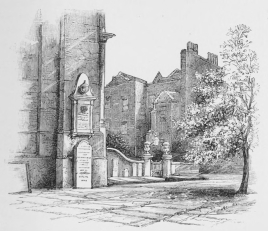
CHURCHYARD OF ST. ANNE, SOHO. [213]
“It is a fine wild park, with most unexpected ups and downs and a great deal of grand old timber, on a ridge rising high above the blue Bedfordshire plain, in the midst of which a spire rising out of a little drift of smoke indicates the town of Bedford. On one of the highest points of the ridge a cross raised on steps marks the site of the royal residence where Katherine of Arragon lived for most of her semi-widowhood, and where Anne Boleyn shot stags in a green velvet train. The later house, approached on the garden side by a narrow downhill avenue half a mile long, is in the old French style, with posts and chains, broad steps widening at the top, and a perron.... The Duchess, at eighty-four, talked most pleasantly and interestingly all evening. Lady Wensleydale, in her high cap and large chair, with her sweet face and expression, sat by like an old picture. There is a picture of her thus, by Pointer, surrounded by great white azaleas, but it does not do her justice.
“Yesterday I drove with James, Mildred, and Cecil Lowther to Wrest. It is a most stately place, one of the stateliest I have ever seen. The gardens were all laid out by Le Nôtre, and the house was of that period. Lord De Grey pulled down the house, and found it rested on no foundations whatever, but on the bare ground. It was so thin, that when the still-room maid complained that her room was rather dark, the footman took out his penknife and cut her a square hole for a window in the plaster wall. Capability Brown was employed to rearrange the gardens, which were thought hideous at one time; but though he spoilt so many other places, he had sense to admire the work of Le Notre so much here, that he made no alterations, except throwing a number of round and oblong tanks into one long canal, which, on the whole, is rather an improvement. The modern house is magnificent, and like what Chantilly must have been.
“On the vast flagged terrace in front of the windows we found Lady Cowper[214] sitting in an old-fashioned black silk dress and tight white bonnet. She has a most sweet face, and was very kind and charming in her manner. I walked with her for a long time on the terrace, looking down on the brilliant gardens, and beyond them upon equally brilliant groups of people, for it was the annual meeting of the great Bedfordshire tennis club, for which she always gives a breakfast. She told the whole story of the place, and took me to see all the finest points of view and the great collection of fine orange-trees brought from Versailles. She greatly lamented the prudishness of her great-aunt (Lady De Grey), through whom her grandmother had derived the place, who thought most of the old French statues—which, according to the custom of that day, were made of lead—to be insufficiently dressed, and so sold them for the value of the metal, at the same time that she sold an incomparable collection of old plate, for the same reason, for its weight in silver. She showed one of the statues, backed by a yew hedge some centuries old. ‘That poor lady, you see, was saved when all the others were sent away, because she had got a few clothes on.’ Lord De Grey had replaced some of the statues, and Lady Cowper herself had added a most beautiful fountain from Carrara, with a very flat basin.
“Lady Cowper talked much of my mother and the ‘Memorials’ and of ‘my sister Lady Jocelyn.’ She spoke of the extreme quietude of her own life. ‘A day like this (pointing out the crowd below) shows me that what this place wants is—people, and I never have any. I think I must hire some puppets to walk about and represent them.’ There are a number of inscriptions in the grounds to different past-members of the family and their friends. Lady Cowper said that Lady Palmerston, who was very matter-of-fact, thought that of course they were buried there, and said, ‘How I do pity Anne, living alone at Wrest, surrounded by all those graves of her family.’ Graves, however, there are, but of deceased dogs, a regular burial-ground, with headstones like those in a churchyard, surrounded by a wall of clipped yew.
“I was very glad to find Henry Cowper, who showed me the rooms, which were full of people for the ‘breakfast,’ but I saw the two great Sir Joshuas, which are magnificent, especially that of Lady Lucas and Lady Grantham, as very young girls, with a bird.
“In the evening at Ampthill I told the story of Mary-Eleanor, Lady Strathmore, to which Lady Wensleydale added her reminiscence of having been told, at four years old, of Stoney Bowes having ‘nailed his wife’s tongue to a table.’”
“August 30.—Yesterday I drew with Miss Lowther at the ruins of Houghton Hall, the old home of the Russells, where Philip Sidney wrote verses under the trees. It is a very stately though not a large house, and beautiful in colour, from the mixture of red brick and yellow-lichened stone. A great avenue, now utterly ruined, leads away from it direct to Bedford, which lies six miles away in the elm-lined plain. It was deserted because Lord Tavistock, returning from hunting, was thrown from his horse and killed on the spot in the presence of his wife, who was waiting for him on the doorstep: the family could never bear to live there again.[215]
“After luncheon, I walked with the old Duchess in the avenue. She described being couched. ‘Did you take chloroform?’—‘Oh, certainly not: no such thing: I should not have thought of it. Don’t you know that couching is a very dangerous operation? the very slightest movement might be fatal to it. I did not know what might happen under chloroform, but I knew that I should never flinch if I had my senses, and I never did: and in three weeks, though I was still bandaged up, I was out walking.’
“‘What was worse than becoming blind in my case,’ said the Duchess, ‘was breaking my knee-pan, for then, you know, one bone goes up and the other goes down, and you never really have the use of your knee again.’
“‘And yet here you are walking, Duchess.’
“‘Yes, certainly I am. Prescott Hewitt said I never should walk again, and I said “Yes, I should,”—and he answered, “Ah! well, with you perhaps it is different; you belong to a family that have got a will;” and I walk, but I walk by the sheer force of will.’
“The Duchess said she remembered old Lady Penrhyn and her pugs, and their being dressed like children, and keeping a footman, and having a key of Grosvenor Square.
“In the evening I drove with Mr. Lowther to Haynes, till lately written Hawnes, the fine old place of Lord John Thynne (Sub-Dean of Westminster), which he inherited from his uncle, Lord Carteret. We met the old man riding in his park, and so much taken up with a sick cow that he almost ignored us. But when we had walked round by the charming old-fashioned gardens, we found him waiting for us on the garden doorstep, all courtesy and kindness. Several sons and daughters-in-law dropped in to tea in a kind of passage-room, but Lord John took me to see all the curiosities of the house himself, and warmed up over them greatly. There is a most noble staircase and a very fine collection of family portraits. In the drawing-room is that of Lady Ann Carteret in a white satin dress, which she always wore, and is always remembered still as ‘The White Lady.’ Her husband was Jack Spencer, of whom there is also a fine picture. His grandmother, Sarah, Duchess of Marlborough, one day said to him suddenly, ‘Jack, you must marry, and I will give you a list of the ladies you may propose to.’—‘Very well, grannie,’ he said, and he proposed to the first on the list. When he came back with his wife from their wedding tour they went to pay their respects to the old lady. ‘Well, now,’ she said, ‘I am the root and you are only the branches, and therefore you must always pay me a great deal of deference.’—‘That is all very well,’ said Jack impertinently, ‘but I think the branches would flourish a great deal better if the root was under ground.’
“There is a great collection of small treasures at Haynes—snuff-boxes of royal persons, of Lord Chesterfield, &c., and one with a portrait of a lady ancestress,—‘not a good woman, she had nothing but her beauty,’—which takes off and puts on a mask. But the great relic of all is, in its own old shagreen case, the famous Essex ring—a gem beautifully set. With it is a most interesting letter from Weigall, the famous jeweller, explaining a great number of reasons why it must be the ring. There is also the pedigree of the ring, which came through the hands of a great number of females—heiresses.
“To-day the Duchess (Dowager of Cleveland) has been talking much of the wicked Duchess of Gordon, her ancestress. She married all her daughters to drunken Dukes. One of them had been intended to marry Lord Brome, but his father, Lord Cornwallis, objected on account of the insanity in the Gordon family. The Duchess sent for him. ‘I understand that you object to my daughter marrying your son on account of the insanity in the Gordon family: now I can solemnly assure you that there is not a single drop of Gordon blood in her veins.’
“The Duchess of Cleveland went out walking this morning in beating rain and bitter wind—blind, broken-kneed, and eighty-four as she is. ‘Well, you are a brave woman, Duchess,’ some one said as she came in. ‘You need not take the trouble to tell me that: I know that I am a brave woman,’ she answered.
“Old Miss Thornton called—Lady Leven’s sister. She talked much of the misuse of charitable funds in dinners to directors, payment of matrons, ex-matrons, &c., and said, ‘There really ought to be a society formed for the demolition of charitable institutions.’
“At dinner the Duchess vehemently inveighed against the deterioration of the times. ‘Was there ever anything so ridiculous and uncalled-for as a school-feast?’—‘But it is such a pleasure to the children.’—‘Pleasure to them! In my days people were not always thinking how children were to be amused. Children were able to amuse themselves in my day. It is not only with the lower classes: all classes are the same—the same utterly demoralising system of indulgence everywhere. Why are not the children kept at home to learn to wash and sew and do their duty?’—‘But the school-feast is only one day in the year.’—‘One day in the year! Fiddlesticks! don’t tell me. I tell you it’s utterly demoralising. Why, if the feast is only one day, it unhinges them for ten days before and ten days after.
“‘Formerly, too, people knew how to live like gentlemen and ladies. When they built houses, they built houses fit to live in, not things in which the walls were too thin to allow of the windows having any shutters.... Why, now people do not even know how to keep a great house. Look at ——, do you think she knows it, with her alternate weeks for receiving visitors. That is not what ought to be; that is not hospitality. A great house ought to be open always. The master and mistress never ought to feel it a burthen, and if it was properly managed, they never would. There should always be a foundation of guests in the house, a few relations or intimate friends, who would be quite at home there, and who would be civil and go out to walk or drive, or do whatever might be necessary to amuse the others. There ought to be no gêne of any kind, and there ought to be plenty of equipages—that should be quite indispensable.’
“The conversation fell upon Rogers the poet. ‘Mr. Rogers came here once,’ said Lady Wensleydale, ‘and I did not like him; I thought him so ill-bred. He came with the Duchess of Bedford of that time, who was the most good-natured woman in the world, and when he went out into the park and came in quite late for luncheon, she said he must have some, and went into the dining-room herself to see that he had it properly, and while he was eating cold beef, mixed him herself a kind of salad of oil and vinegar, which she brought to him. He waited a moment, then took up a piece of the beef in his fingers, rolled it in the sauce, and, walking round the table, popped it into the Duchess’s mouth. She went into the drawing-room afterwards and complained to his friend Luttrell about it, “What can I have done that Mr. Rogers should treat me so?” Luttrell said, “I have known Rogers for sixty years, and have never yet been able to account for any one of his vagaries.”
“‘Rogers and Luttrell were great friends, though they always quarrelled. When they walked out together, they never walked side by side, but always one behind the other.
“‘Rogers met Lord Dudley at one of the foreign watering-places, and began in his vain way, “What a terrible thing it is how one’s fame pursues one, and that one can never get away from one’s own identity! Now I sat by a lady the other night, and she began, ‘I feel sure you must be Mr. Rogers.’”—“And were you?” said Lord Dudley, looking up into his face quite innocently. It was the greatest snub the poet ever had.
“‘Rogers hated Monckton Milnes. He was too much of a rival. If Milnes began to talk, Rogers would look at him sourly, and say, “Oh, you want to hold forth, do you?” and then, turning to the rest of the party, “I am looking for my hat; Mr. Milnes is going to entertain the company.”’