Volume 5 — XX ROYAL DUTIES AND INTERESTS
Reading edition
“Montre ce qui est en toi! C’est le moment, c’est l’heure, on retombe dans le néant! Tu as la parole! à ton tour! fournis la mesure, dis ton mot! revèle ta nullité, ou ta capacité. Sors de l’ombre! Il ne s’agit plus de promettre, il faut tenir. Le temps d’apprentissage est terminé!”—Henri Frederic Amiel.
“Stop thine ears to whatsoever men think of thee; accept it for nothing, but regard only the judgment of God.”—Pico Della Mirandola.
“Let me never hear the word ‘trouble.’ Only tell me how the thing is to be done, to be done rightly, and I will do it if I can.”—Queen Victoria of England.[279]
“Look at the duty nearest hand, and what’s more, do it.”—Jane Welsh Carlyle.
BEING at Lowther Lodge on the 21st of May, I was sent for by the Crown Princess of Germany, who was most kind and gracious. “I have read all your books. I always buy them as soon as ever they come out, and I have so much wished to see you.” She told me that she had been to Hurstmonceaux to visit my mother’s grave, and that she had one of her strong presentiments as to the place coming back into our family, adding, “And I do so hope it will.” She talked of the dear Madame de Bunsen with the greatest affection, and then of the many branches of the Bunsen family. When my little audience of about ten minutes was over, she said with great sweetness, “I am afraid I am keeping you much too long from all your other friends.” She pressed me to come to stay with her at Potsdam. I said that I was going to Berlin to visit the Bunsens. She said, “Oh, but you must come to me; I can show quite as many things, and I can certainly show you a great many more people than the Bunsens can.” I said that I feared my visit to Berlin would be during her approaching absence in Switzerland. She said, “Well, you can go to the Bunsens in the summer when I am away, and then in the winter you can come again to see me: Berlin is not so very far off.”
As spring advanced my Life of the Baroness Bunsen was so far completed as to be ready for the inspection of her children. I therefore decided to take it to them in Germany. Feeling how impossible it would be to meet all the various wishes and tastes of such a hydra-headed family, I determined only to feel bound by the wishes of the two unmarried daughters, Frances and Emilia, and any one of their brothers whom they might choose. They selected George.
I turned first towards the Rhineland to visit the Dowager Princess of Wied, and profit by her recollections of one who had ever been one of the most valued of her friends.
On the last day of May I reached Cologne, and found there a succession of telegrams from the Princess of Wied desiring me to come to her. She did not exactly say that she expected me to stay beyond the day, so I did not like to take my luggage, and was sorry, when I found my room ready and that I was expected for a long visit, that I had sent it on.
Early on June 1, I went to Bonn. The place struck me much from its being so embowered in green and flowers. In a villa thus surrounded I found the well-known authoress Fräulein von Weling,[280] whom I surprised in bargaining for ready-plucked chickens at her door. She is a very interesting person, received me with that cordial simplicity which is so charming in Germans, and in a minute had put on her bonnet to go with me to the cemetery by a quiet walk through nursery-gardens. The churchyard itself is half hidden in pinks and roses. In the centre stands an old chapel of extreme beauty, transferred stone for stone by the King of Prussia from a solitary position in the fields. Buried in flowers is the grave where the dear friends of my childhood rest side by side. Close by is that of their brother-like friend, the noble old Brandis, his invalid wife, and his son Johannes. Farther off, but still near, are the graves of the old Arndt, Niebuhr and his Gretchen, Schumann, and the widow and son of Schiller. Then we went to Bunsen’s house, with the three-windowed room where he died, the garden with its view over the Rhine to the Sieben Gebirge, and the pavilion where he gave his last birthday feast.
It is a long ascent of an hour and a half from Neuwied through orchards and meadows radiant with wild-flowers to Segenhaus, standing on the crest of the mountain, which is literally “the House of Blessing” to all around it. The beautiful spacious rooms, full of books and pictures, look down over a steep declivity upon an immense view of the Rhineland. The Princess came in immediately with a most warm welcome—a noble, beautiful woman in a black dress, something like that one sees in pictures of Spanish Queens-Dowager, with snow-white hair drawn back under a long black veil. After a life of love, having lost all those who gave its greatest charm, she still finds much happiness in making herself the mother of her people, and the centre of good to the Rhineland from her high forest-home. After a few minutes spent in explaining the towns in the vast map-like view below us, she said, “There is a lady here who is anxious to make your acquaintance, and who was delighted to hear that you were coming: it is the Queen of Sweden.” At that moment the doors were thrown open, and the Queen entered—of middle age, with a beautiful expression, and possessing, with the utmost regal dignity, the most perfect simplicity and even cordiality of manner. She desired me to sit by the Princess upon a divan facing her. She said that I must consider her at once as a friend; that, in a life of great troubles, the “Memorials” had been her greatest comfort; that she never went anywhere without them; that my mother had been for several years the intimate friend to whom she always had recourse, and in whose written thoughts she could always find something which answered to her own feeling and the difficulty of the moment. She asked after “Mary Lea,” and how old she was now. She also talked much and naturally of my Bunsen work, and entirely entered into all the difficulties of meeting the views of so large a family of varying dispositions.
The Princess took me away to see her own room with her family portraits and photographs. She spoke of her daughter, the Princess of Roumania,[281] “in her terrible position between Russia and Turkey.” Then she said, “I want to prepare you for something. At my daughter’s court there is a blind Roumanian noble who has an only daughter. She is deaf and dumb. I could not bear that they should never communicate, so I have taken her home with me, and I am teaching her to speak by making her hold her hand on my throat as I speak very slowly; and she is already learning, and, though it takes almost all my time, I am already rewarded by her making sounds which are intelligible to me.” When we went back into the other room, the young lady was there, a most strange being, making sounds inarticulate, but intelligible to the Princess. When she saw that the Princess was going to speak, she rushed across the room and held her hand on her throat, which had an almost terrible effect, like garrotting.
Sophie. Queen of Sweden and Norway.

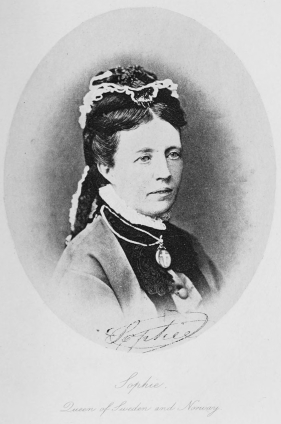
After tea the Queen ordered her donkey, which was brought round by a handsome Swedish chasseur. We went out into the forest. The Queen rode: the Princess led the donkey: I walked by the side, and only the chasseur followed. We actually went on thus for three hours, through beautiful forest glades with exquisite sylvan views, the whole reminding me of descriptions in Auerbach’s “Auf der Höhe.” The Queen never ceased talking or asking. She wished to know the whole story of my mother’s trances at Pau, of Madame de Trafford, of Prince Joseph Bonaparte—“a sort of cousin of my husband’s.” She talked much and most touchingly of her own life and its anxieties. “What I feel most,” she said, “is the impossibility of ever being alone. I have much happiness, much to be thankful for, but I feel that what one has really to look forward to must come after death, and I do not wish to live.” With her truly “la grandeur est un poids qui lasse,” as Massillon said. When alone with her sister at the Segenhaus in the quiet forest-life, she finds most happiness, and they live in a higher world, mentally as well as physically. As we went down a steep bank the donkey stumbled, and the Queen cried out. “Pardon me that I have seemed to be afraid,” she said; “I have been so very ill, that my nerves are quite shattered;” and in fact a severe illness, long supposed to be mortal, had at this time obliged her for several years to leave Sweden in the winter, to be under a great doctor at Heidelberg. She asked me to come to Norway to visit her. “You must also know my husband,” she said, “and my four sons, my four blessings of God.” She repeatedly expressed her wish that I should be at Rome in the winter with the Prince Royal. “I am sending him out to learn his world.” She asked most warmly after Lea, and sent a message to her—“I know her so well.” She also desired I would give her tender sympathy to Hilda Hare,[282] “For can I not feel for her? my second boy is at sea.” She gave a charming description of her first tour through Norway to her coronation. “I sat in my carriole by myself, and a peasant sat upon the little portmanteau behind which held my things, and told me all about the places and people.” We walked on and on through the vast woods, with lovely glimpses of country through the open glades, and masses of huge foxgloves where the wood was cut down, and one really forgot the queen, the almost tête-à-tête of three hours with a queen, in the noble great-souled woman, whose high ideal of life and all that it should be seemed for the time to ennoble all the world to one.
At the top of a high declivity the Princess unlocked a small gate. Within, in a little circular grove of lime-trees, were two marble crosses over the grave of the Prince of Wied and his martyr-like son Otto.[283] “And here,” said the Princess very simply, “is my grave also.” The plan of these green mausoleums has been adopted by the present family, and two more are planted to be ready for two generations.
Behind the palace of the Princess is the great white château of Monrepos, where her son lives with his wife, who is Princess Royal of the Netherlands. Above the lower range of windows is a line of huge stags’ heads, trophies of the chase of some former prince in the forest. The House of Wied are “ehenwürdig,” and so may always marry royalty.
I said something about never having seen the kitchen-garden of a German house, so when we came home the Princess took me to hers. The Queen then walked with us. The Princess prunes and grafts her own roses, &c., but she seems to have no perception whatever of any beauty in wild-flowers. We went in, and I was shown to a room, whence I came down to that in which the court ladies were assembled. It was rather formidable, but the Countess Ebba von Rosen, dame du palais of the Queen, talked pleasantly in English. Doors were thrown open, and the Queen and Princess entered and we went in to supper. The Queen made me sit by her: the four court ladies sat opposite: the Princess, on the other side of the Queen, made tea. Thick slices of bread and butter, like those of English school-feasts, and mutton-chops were handed round. When we went into the other room, I wrote down some names of books as desired, and then at 9.30 took leave. The Princess most cordially invited me to return, and the Queen again pressed me to visit her in her own country. The vision of the Queen’s serene noble face as she took leave has ever since remained with me, and I parted from both the royal sisters with a stronger feeling of affectionate regard than I have ever felt towards any one else upon so short an acquaintance.”
Journal and Letters to Miss Leycester and Miss Wright.
“June 2.—I slept at Neuwied, and then crossing the Rhine in the morning mist, passed a few hours at Boppart, where the colouring of the river and old houses and the peculiar grey hills was most lovely. Charles de Bunsen met me at the station of Mosbach, and took me to his villa, much like one in Italy, with the same rich intermingled vegetation of fruit and flowers growing around it.”
“June 4.—Yesterday, a very sultry day, we went to Wiesbaden. The heavy trees in the gardens looked dripping even more with heat than with rain, and there is a splendid dulness in the great rooms, formerly the gambling-house, and in the park beyond, with the many chairs under the trees on which people sit to listen to the band; but the fountain is pretty.
“Mrs. de Bunsen[284] was very amusing in her account of the crowded musical festival at Baireuth. When they complained that there were not enough carriages there, a native replied, ‘Pardon me! of carriages there are quite enough, but of people there are too many.’
“In and out, whilst I have been here, has come the next neighbour—‘the Herr Major.’ He is quite a character, and devotes his whole life to his garden. From Holland he—a poor man—ordered some fruit-trees for a very large sum, but they have been a total failure and have borne nothing. The other day Charles, driving with him, passed these trees, and knowing they were a sore subject, turned his head the other way and pretended not to see them. ‘Oh, thank you, dear friend; I appreciate what you are doing,’ said the Herr Major, enthusiastically clasping his hand. When the boys of Mosbach stole his fruit, he put up an electric wire on the wall which caused a bell to ring in his bedroom whenever any one got over it. A few nights ago the bell rang violently; the Herr Major took his stick and rushed down the garden in his night-shirt: it was only his own bulldog, which had jumped over the wall to pay a visit to a friend in Mosbach. Another time, when his fruit was stolen, the Herr Major issued a placard offering a reward of a hundred marks to any one who would deliver up the thief. The placard was read by two men sitting outside a beer-house, who were the men who had stolen the fruit. They immediately agreed upon their course of action; one man delivered the other up to justice, and he was sentenced to pay ten marks or to three days’ imprisonment; the other claimed the hundred marks, of which they had ninety to divide and to spend in drinking for whole days together to the health of the Herr Major.”
“June 15.—I have had a charming week at Herrenalb, whither Charles and Theodore de Bunsen accompanied me. It was a real pleasure to be again with the dear Frances and Emilia de Bunsen, who are so like sisters to me, and the kind pleasant Sternbergs. We were occupied almost entirely with my book, the sisters taking it in turn to talk over all the different parts, but there were also delightful intervals of forest rambles, and sittings out under the old apple-trees with Emilia. Reinhold von Ungern Sternberg came for the Sunday with Herr von Klüden, the ‘Bräutigam’ of his sister Dora. The place is just what my sweetest mother would most have enjoyed for a summer residence—no grand scenery, but very high forest-clad hills all round the rich green meadows, with the crystal Alb tossing through them. The village of quaint black and white houses clusters round the old-fashioned inn and the water-cure establishment in the buildings of the suppressed monastery, of which a beautiful ruin of red sandstone—‘The Paradise’—still stands in the churchyard. In all directions are well-kept walks and drives, and comfortable seats at every picturesque point. The people are most friendly and primitive, all the men taking off their hats, and all greeting strangers with a friendly ‘Morgen’ or ‘Tag.’
“A terrible sensation has been created by the attack on the Emperor, and still more by the first false report of his death. Men and women were alike in tears, and the national disgrace is intensely felt. I hope, if the Emperor is better, that I may see the Crown Princess again at Berlin.
“I spent four hours at Heidelberg, and revisited all our old haunts, the gardens most lovely in their luxuriance of green. Thence I had intended to go to Weimar to visit the Grand Duchess, but at Eisenach received a telegram from her lady-in-waiting, the Countess Kalkreuth, to put off my visit, as they were gone off to Berlin, the Empress Augusta being sister of the Duke of Weimar. A wet morning at the Wartburg and an afternoon at Erfurth brought me to Jena. There my cousin Alexander Paul met me at the station, a pleasant, fat, frank Prussian officer, with a face very like that of the first Napoleon.[285]
“There is much charm in this old town of Jena and its simple population, increased by the five hundred students of the university. The houses of Schiller, Alex. v. Humboldt, &c., have inscriptions in honour of those who lived there: the streets wind picturesquely around the old Schloss and its gardens, and the trumpet still sounds every quarter of an hour from the tall grey tower of the noble old church. From my own window in Alexander’s house in the Cahl’sche Allée, I see on one side a robber castle, on the other a wonderful old church of the time of the ‘Heilige Bonifacius.’
“On Thursday afternoon we went to Dornberg, where three castles crown the cliff above the village with a narrow terrace running in front of them along the edge of the precipice. One castle is occasionally inhabited by the Grand Duke; another, very old and picturesque, was given by Carl August to Goethe, and having been inhabited by him in the last years of his life, still contains much furniture of his time: the third was the palace of—the Sleeping Beauty in the Wood.
“Yesterday we went a fatiguing excursion to Schwartzberg, the palace of the Prince of Rudolstadt, by which we saw the finest parts of Thuringia. A railway took us to Schwarza, where, in a ball on the top of the church steeple, is a dart thrown by a Cossack as the Russian army passed through Germany. Thence we took an omnibus to the little Chrysopraz Hotel at Blankenberg, where, after beer and brown bread and butter under the trees, we walked up the Schwarzthal to Oppelei, where a Swiss cottage has been built by the Prince to indemnify a forester, whose daughter he had made his mistress! Hence, by a steep path, we ascended the Treppstein, whence there is a lovely view over the hollow in the forest-clad mountains, in the midst of which the great castle of the Prince of Rudolstadt rises above the little town. The Prince is not unpopular, though his life has an Eastern license. On the day when he succeeded to his tiny sovereignty he happened to be at Berlin. ‘Bonjour, souverain,’ said the Emperor when he met him, and, when he took off his hat—‘Pray put on your crown.’
“We dined at the charming little inn, where thousands of wild stags often assemble under the windows in the evenings, when the place is comparatively empty, but take flight into the woods before the summer guests. In returning, we were much amused with the old ‘Herr Apotheke’ of Rudolstadt, who had come out with a tin case to gather simples, and who insisted upon stopping to drink a tankard of beer wherever one was to be had.
“To-day we have been in a different direction, by rail to Roda, a charming little Thuringian town, and thence by carriage to the Fröhliche Wiederkunft, the old moated castle built by Friedrich Johann, father of Friedrich der Weise, on the spot where he met his family on his return from a long captivity abroad. The old Princess Therèse of Saxe-Altenbourg now lives there, she and her sisters—the Queen of Hanover, the Grand Duchess of Oldenbourg, and the Grand Duchess Constantine of Russia—having been daughters of the old Duke Josef, by whom the castle was restored. The news of the King of Hanover’s death had just arrived. ‘How many tears,’ said the old man who showed the castle, ‘did the old Duke my master shed in that chair over the King’s misfortunes.’ The story of the founder is most quaintly told in paintings on panels round one of the rooms, and there are pictures and memorials of Luther and of Friedrich Johann and his wife Sibylla over and over again.”
“June 23.—A vision of many great towns is all that I carry away from the varied journey which has brought me to Hildesheim—the old cities of Wittenberg and Eisleben, with their glorious works of Lucas Cranach and varied memorials of Luther and Melancthon: Magdeburg, great and noisy, with its dull, restored cathedral: Halberstadt, also restored, but glorious in spite of its injuries, and with intensely picturesque streets of old houses: the romantic beauty of imperial Goslar: stately Quedlinburg, where German princesses constantly reigned as abbesses: beautiful Thale, at the entrance of the Harz, with its exquisite combination of wood and rock and water: Brunswick and its many market-places, full of old houses: dull Hanover, with the great deserted gardens of Herrenhausen.
“Aunt Marcia (Frau Paul von Benningsen[286]) and my cousins Jane and Clementine met me here at the station.”
“Berlin, June 27.—My visit at Hildesheim had much of quiet interest. The town is wonderfully picturesque, and I was glad to make acquaintance with my cousins, who are perfectly grandes dames and highly educated young ladies, though they cook and do almost all the housework themselves. I drew in the early mornings, and went to dinner each day with them at 12.30.
“The Hildesheim churches are magnificent, but spoilt, ruined, by so-called restoration—the old pavements torn up, the old ornaments removed and replaced by tawdry and vulgar imitation of Munich wall-painting.
“On Monday George de Bunsen met me with his carriage at the Berlin station, and brought me through the Thier-Garten, like a bit of wild forest, to the charming airy Villa Bunsen, standing in its own garden on the extreme outskirts of the town. Here I have a most luxurious room, filled with royal portraits, and every possible luxury. We dined al fresco on the broad terrace amid the flowers. On the next evening there was a party of about fifty people—tea, and the garden and terrace lighted up, a very pretty effect; the ladies in bright dresses, the men with uniforms and orders, moving and sitting amongst the shrubs and flowers, amid which endless little supper-tables were laid at a late hour. Many were the historic names of those to whom I was introduced—Falk of the Falk laws, Mommsen the historian, Austin the poet, Mohl, and many ministers and generals. I found also Arthur Balfour, and many waifs and strays of old acquaintance. The ‘Congress’ is going on, but excites little or no general interest, and is scarcely mentioned here, German affairs being far too important.
“Berlin interests me extremely, though without preparation it can be of small interest. It is almost entirely modern. In the sixteenth century it must have been a tiny electoral town, the houses encircling the old Schloss by the Spree in the time of the Great Elector, whose statue, a grand though rococo work, stands close by on the bridge. Friedrich I., who got a kingdom by bribery, added the enormous castle, which, ludicrous as it then was in a kingdom of five millions, is now satisfactory in a kingdom of twenty millions. Close by, Frederick the Great built two domes, merely as features in the distant view of an otherwise featureless city, and to these his son added buildings which turned them into churches. Under Friedrich Wilhelm III. and IV. the great classical revival took place and endless fine buildings arose. The library is one of the few buildings which date from Frederick the Great. The architects were an endless time disputing over the designs, and at last he said, ‘Damn you all, don’t waste any more time; this commode opposite me is of a very good design, copy that,’ and accordingly the design of the commode was copied.
“The Museum was begun when the country was poor and had no money to spend. After the French war, when the country became rich, the design expanded and became magnificent. Of the sculptures, four works deserve especial attention—the ‘Adorante,’ the exquisite bronze boy who, in the early morning, stretches out his arms in adoration: the noble vivid bust of Julius Caesar in basalt, with agate eyes, so speaking though voiceless, so never to be forgotten, of which Rauch had three copies in different parts of his house that it might never be long absent from his mind: the bust of Sappho, with banded hair, recognised as the poetess from a Hermes; and the Augustus statue, more noble than that of Livia’s villa, because taken in earlier youth, when his one feeling was that he was born to command, and when no furrow of disappointment or care was yet traced on his brow.
“The collection of casts is most interesting, as showing the important statues of each subject, Venus, Minerva, Mercury, &c., side by side for instruction or contrast.
“The pictures are a grand collection, spoilt by over-cleaning. Especially worthy of remembrance are an Adoring Madonna by Filippino Lippi, with God the Father above in glory; two noble portraits by Giorgione; one by Lorenzo Lotto (possibly of Sansovino); some marvellously graphic pictures, eloquently expressed in well-considered touches, by Franz Hals; and a noble Holbein of ‘Kaufmann Georg Gigge aus Basel.’
“Last night we went late to the Zoological Garden. The most interesting thing was a solemn congregation of ibises listening in a row, each bird with one foot in the air, and its head attentively on one side, to an ibis preacher, who never ceased a continuous discourse to them, standing on a stone. The elephant is said to be five hundred years old; what a solemn silent witness! Apropos of the future of beasts, George de Bunsen talked much of the absence of all allusion to any future in the Old Testament—that it grew up, partly in the Talmud, partly in the Apocryphal writers, in what Luther beautifully calls ‘the great empty leaf between the Old and New Testaments.’
“Montbijou, the curious little one-storied palace of Sophia Charlotte, wife of Friedrich I., is now a museum for relics of the House of Brandenbourg. The chairs, sledges, and table of Friedrich I. are very curious; the wheel-chairs of his unhappy second wife: the wax figures of his grand-daughters as babies; and their portraits as grown women—queens and duchesses. Here also are three masks from the dead face of the lovely Queen Louisa, that taken immediately after death most exquisitely beautiful.”
“June 30.—The day after I last wrote, I went with the Bunsens and Mr. Waddington, the French Minister[287] (come for the Congress of Berlin) to Charlottenbourg. The palace there is charming—the large gardens, the groves of orange-trees in tubs, the great lawns sweeping away into woods, and above all the mausoleum in one of the thick groves, with the tombs of Queen Louisa and her husband. Hither the old Emperor and all the royal family come still once a year, on the anniversary of her death, to look upon the beautiful form of his young mother, snatched away in the very zenith of beauty and popularity, not living to see the re-establishment of the kingdom in whose cause she sacrificed her life. Exquisitely, perfectly beautiful is the intense repose of her lovely countenance, in what I must ever feel to be the most beautiful and impressive statue in the world. The statue of the King is very fine too, but in her angelic presence he is forgotten. And such was the feeling for her, that though he did not marry again for many years after he had lost her in his youth, his people at first would not believe it, and then never forgave it. Mr. Waddington felt nothing in the presence of this sublime statue. ‘Yes, it is very clever, it is a very clever figure indeed,’ he said. Never was any remark more completely out of tune, making it difficult for one to believe in the great power of the man.
“The next day I went to Potsdam—quite a place by itself in the world, with its endless great ultra-German palaces and stiff gardens, arid and dusty, though surrounded by many waters. Without Carlyle’s ‘Frederick the Great,’ they would be mere dead walls enclosing a number of costly objects; illuminated by the book, each room, each garden walk, thrills with human interest. In the Residenz Schloss are the rooms in which Frederick the Great passed his winters, with massive silver furniture and priceless ornaments, amid which the portrait of Wilhelmina in her childhood is a touching feature. In the Garrison Kirche is the tomb of the great king. The terrace at Sans Souci, in this dried-up land, is quite lovely with its fountains and orange-trees. Close behind is the famous windmill.
“When I returned to the station, I was surprised to find the Bunsens’ servant, sent on with my evening clothes, that I might accept an invitation (by telegram) to dine with the Crown Princess. I had only eight minutes before the royal train came up, and it was an awful scramble to wash and dress in a room the servant had taken at the station. However, when the royal train set off, I was in it. The palace-station of Wildpark was a pretty sight, red cloth laid down everywhere, and sixteen royal carriages waiting for the immense multitude of guests—quantities of ladies in evening dress (all black for the King of Hanover) and veils, splendid-looking officers, an Armenian archbishop and bishop in quaint black hoods and splendid diamond crosses. I went in a carriage with the Greek minister, and we whirled away through the green avenues to the great Neue Palais, with the sun striking warm on the old red and grey front. Count Eulenborg, Master of the Household, stood on the steps to receive us, and we passed into an immense hall, like a huge grotto, decorated with shells and fountains, where several of the court ladies were.
“At the end of the hall were some folding-doors closely watched by two aides-de-camp, till the rapping of a silver stick was heard from a distant pavement, when the doors were flung open, and Count Eulenborg came out, preceding the Prince and Princess. She immediately went up to Mrs. Grant (General Grant’s wife) and several other ladies, and then began to go the round of the guests. I had more than my fair share of her kindly presence. ‘Oh, Mr. Hare, I am so glad to see you again so soon. How little I expected it, and how sad the causes which have brought it about!’ And she went on to speak of how, at our last meeting, the Duchess of Argyll had been sitting with her at tea, and how three days after she died. ‘And for me it was only the opening act of a tragedy,’ she said. She talked of the shock which the news of the attack upon the Emperor was to her, coming to her in the picture-gallery at Panshanger, and of her hurried journey to him. The Crown Prince came up then, and led her away to dinner. Mrs. Grant was on his other side (General Grant, a very vulgar officious man, was also there). I had been directed to a place near the Archbishop and Bishop of Armenia, but as they only spoke Armenian, I was glad that a very handsome, agreeable aide-de-camp eventually took his place between me and them. The dinner was excellent, in a huge long marble hall, with windows opening to the ground on the terrace above the flower-garden. Occasionally I met a bright kindly smile as the Princess looked to see how I was getting on. There were about fifty guests, servants waiting noiselessly, not a footfall heard.
“After dinner we all went out on the terraces, and there the Crown Princess had the goodness to come again to me. She talked of all I had seen at Berlin, and of Sweden and Queen Sophie. She talked also of Queen Louisa, her husband’s grandmother, preferring her statue at Potsdam even to that at Charlottenburg, and wished to have sent an aide-de-camp with me to see it. She was so good as to desire that I should return to Potsdam, and when I showed her that I could not, said, ‘Oh, but you will now find your way again to Berlin to see me.’ The scene on the terraces was very pretty, looking upon the bright flowers beneath in the subdued light of a fine evening in this transparent atmosphere, the whole air scented with lime-flowers.
“At a quarter to nine all the carriages came again to take us away: Count Eulenborg announced them. In the ante-chamber I found the Crown Princess again. I kissed her hand, and she shook mine with many kind words, and sent affectionate messages to the Queen of Sweden.
“How we whirled away through the green avenues to Potsdam, where all the people turned out to see the cavalcade! I travelled back to Berlin with the young and very handsome Prince Friedrich of Hohenzollern (brother of the Prince of Roumania and the Comtesse de Flandres), who was saved in the annihilation of his regiment of guards in the second battle of Metz by being sent back with the standard.”
“July 5.—I spent Sunday at beautiful old Lübeck, full of colour and rich architecture, rising spire upon spire above the limpid river. In the streets and market-place are the quaintest towers, turrets, tourelles, but all end in spires. A great fat constable went about on Sunday morning, keeping everybody from following any avocation whatever during church-time: when the services were over, they might do what they liked.
“Then came the long weary journey across West Holstein—peat flats varied by marshy swamps—and a night at Schleswig, a white, colourless old town moored as if upon a raft in the marshes, where the Princess of Wales’ grandmother and other royal potentates lie in exposed coffins upon the floor of the ugly rugged old cathedral, which has a belfry like a dovecot. Everywhere roses grew in the streets on the house-walls. The children were hurrying along, carrying the shoes they were to wear in school.
THE ROSENBORG PALACE, COPENHAGEN. [288]
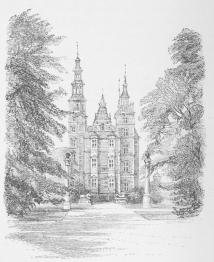
“Peat and marsh again for many hours, the interminable straight lines of landscape only broken by the mounds, probably sepulchral, which are so common here. A straight line with humps at intervals would do for a view almost anywhere in Jutland, Fuhnen, or Seeland. After hours upon hours of this engaging scenery, we crossed the Middelfardt at Fredericia into Fuhnen, which we traversed by rail, and embarked again on the Great Belt at Nyborg. Then came four hours’ more rail in Seeland, and, at 10.30 P.M., long lines of light glistening on streets of water showed that we had reached Copenhagen. Here I met the two daughters of Sir Henry Holland (Caroline and Gertrude), with whom I had arranged to go on to Norway, and their niece, Miss Chenda Buxton. As they had already been waiting for me several days, I felt obliged to give up a visit to Baron Troll (the stepson of Madame de Bülow) and the château of Gaüno, but I had three full days for Copenhagen, and greatly enjoyed them, the air being that of the high mountains in Switzerland with a mixture of sea—the most bracing place I ever was in. There is a ‘Dragon Tower,’ which is quite ideally Danish; and the old palace of the Danish kings, Rosenborg, surrounded by a moat, is fairy-like in the beauty of its old age, in the midst of a stately and brilliant old garden, and filled with historical memorials, which carry you back into marvellous depths of Danish history, in which the Christians and Friedrichs, always alternating with each other, are most bewildering. The museums also are full of interest, especially the Thorwaldsen collection, with casts of all the works of the great sculptor, and many most grand originals, especially interesting to me, as being described in Madame de Bunsen’s letters from Rome in their first conception and progress.
ROESKILDE.
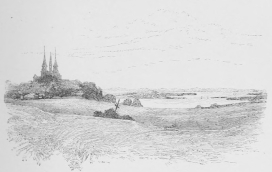
“One day we went out to Roeskilde, to the great church near a fiord where the kings are buried. Some of the older sovereigns have grand tombs, but those of later date than the grandfather of our Charles I. lie in their black and silver coffins unburied upon the floor of the church, with very odd effect.”
“Stockholm, Grand Hotel Rydberg, July 13.—On the evening of the 5th we crossed to Helsingfors in Sweden by a very rough passage of ten minutes, and had a wild evening walk in the storm, looking upon the opposite Danish coast, and Helsingborg with the great traditional castle of Hamlet, whose father was really a pirate-chief in Jutland.
CASTLE OF ELSINORE.
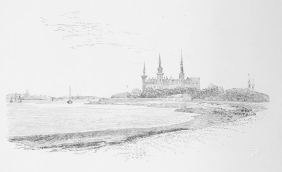
“A journey of twenty-four hours brought us to Stockholm. We only lingered on the way to see the very fine Cathedral of Lund, the Oxford of Sweden. The scenery is not beautiful, but pretty—an exaggerated Surrey, low hills and endless fir-woods, with tiny glistening lakes.
THE JUNCTION OF LAKE MALAR AND THE BALTIC, STOCKHOLM.
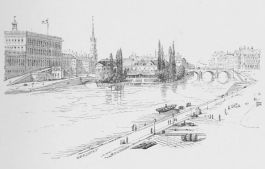
“Stockholm has deeply interested us, and there is an odd feeling in being at a place and knowing that it is for once and once only in a lifetime. It is a modern city of ugly streets, but in a situation quite exquisite, on a number of little rocky islets between Lake Malar and the Baltic, surrounding, on the central islet, the huge palace, which is very stately and imposing from its size, and the old church of Riddarholmen, where Gustavus Adolphus and many other kings and queens are buried under the banner-hung arches. Next to the palace, the stateliest building is certainly this hotel, where our windows overlook all that is most characteristic in the place, the bridge which crosses the junction of the Baltic and Lake Malar, the mighty palace dominating the central island, the great white seagulls poised upon the blue waters, and the steam-gondolas, filled with people, darting to and from one island to another. These are the chief means of communication, and we make great use of them, the passages costing twelve öere, or one penny.
RIDDARHOLMEN.
“We shall not go to see the midnight sun at Hammerfest; it would be very fatiguing, and indeed there can be little to see which we have not here; for we have only about two hours’ night in Stockholm, and by 2 A.M. it is light enough to read the smallest print. This has a very odd effect at first, but one soon gets used to it.
THE CHURCH OF OLD UPSALA.
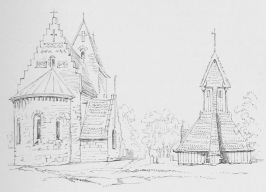
“Alas! we have been here a week, and, except one day, it has rained almost incessantly. One pities the poor Swedes in losing their short summer, for there are only about three months without snow, and every day is precious. The streets are sopping, but we have managed several excursions in the covered gondolas to quiet damp old palaces on the banks of lonely fiords. On our one fine day we went to Upsala by rail, and saw the cathedral where Gustavus Wasa lies aloft on a great tomb between his two pretty little wives, and we drove on to Old Upsala, where Odin, Thor, and Freya reigned as human beings and were buried as gods. In the tomb of Thor—a grassy mound—the Government still gives the mead of ancient times to foreign visitors. It is a very delightful place, like a dip in the Sussex downs, the quaint church, of immemorial antiquity, probably once a pagan temple, nestling behind the mounds of the heroes.
“Yesterday we heard a hundred Upsala students, the best singers in the world, sing the best national music in the Caterina Church. The King was there, a noble royal figure. He is the sovereign of the age, artist, poet, equally at home in all modern languages and several ancient ones, profoundly versed in all his duties and nobly performing them. The Crown Prince was with him, a fine young fellow, spoilt in appearance by his mother’s Nassau mouth, and the Prince Imperial, who is here with his cousins on a visit. The Queen is still away. I had many introductions here, but as the Court is at the country palace of Drottningholm, have not thought it worth while to present them; generally, however, Swedes are quite charming, especially in their manner to strangers.
“Cheating or imposition in hotels or elsewhere is utterly unknown; the only fear is lest you should not be charged enough. We asked what we should do with our luggage if we went to Dalecarlia—‘Oh, you can leave it anywhere under a bush, no one would touch a thing,’ and I am sure that it is so.
“The Hollands are delightful companions, full of interest in everything, glad to draw, reading up all the history, learning Swedish, holding historical and retrospective examinations once a week. We do a great deal of ‘lessons’ together. Certainly that one’s travels should ‘leave a good taste’ behind entirely depends upon one’s companions. And we are never even reduced to the state which I find alluded to in a French guide-book—‘Dans une voiture découverte, quand il y a une personne de mauvaise humeur, les autres admirent le paysage.’ Mr. and Mrs. Eric Magnusson are in this hotel, and we see a good deal of them. He is an Icelander, but now a Professor at Cambridge, and sent here by the University to investigate and inspect the Runic inscriptions.”
GRIPSHOLM.
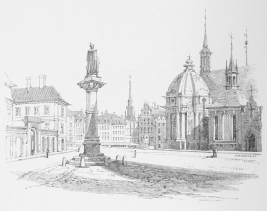
“July 15.—Yesterday we steamed down Lake Malar to Gripsholm, a very quaint castle with domed red towers, full of ancient pictures, and with the wonderful old room and bed where Queen Catherine Jagellonica (delightful name!), whose tomb we saw at Upsala, gave birth to her son Sigismund, afterwards King of Poland.”
“Throndtjem, July 28.—Surely this old cradle of Northern Christianity is one of the most beautiful places in the world. No one had ever told us about it, and we came here only because it was the Throndtjem of sagas and ballads, and expecting a wonderful and beautiful cathedral; but it is really a dream of loveliness, so exquisite in the soft silvery morning lights on the fiords and purple mountain ranges, and the nearer hills covered with bilberries and breaking into steep cliffs, that one remains in a state of transport, which is at a climax when all is engraven upon an opal sunset sky, and when ships and buildings meet their double in the still transparent water. Each old wide street of curious wooden houses displays a new vista of sea, of rocky promontories, of woods dipping into the water, and at the end of the chief street is the grey massive cathedral of St. Olaf, where Northern art and poetry have exhausted their loveliest and most poetic fancies around the grave of the national hero. Here alone in Scandinavia I have gone back perpetually to the old days of my life, and felt how happy the mother would have been here, so much—almost everything—being within her own walk; and I seem to see our trio spending a quiet month at this homelike hotel (where the landlord and landlady—highly educated people of good family—receive their guests like friends in a country-house), and sallying forth to draw in all the sheltered coves and wooded rocks by the side of fiord or river. The air too is most bracing, an arctic feeling combined with the brightest sunshine.
“My companions and I get on perfectly, and I am filled with admiration of Miss Holland’s strong, decided nature, and her perfect knowledge of all she wishes and intends, combined with great good-nature. Both sisters take boundless interest in all they see, and the journeys seem shortened by alternate lessons in history, Norsk, &c., and games of different kinds, even charades, one side of the carriage acting against the other!
“But I must go back to Kristiania, which was steaming in intensity of heat when we reached it, the wet of Stockholm having cleared in Norway into cloudless sunshine which had hatched all the mosquitoes. There is no beauty in the mean little town, which was built by Christian IV. (brother of our Anne of Denmark), and has a good central church of his time. We went by rail to Kongsberg, a primitive place with a nice little hotel kept by a Dane, where, however (and at many other places), we were annoyed by the ludicrously consequential advent of General Grant and Co. Here we hired a carriage and carriole for a five days’ excursion in Tellemarken. What a drive!—by silent lakes or through deep, beautiful, ever-varying woods of noble pine-trees, rising from thickets of juniper, bilberries, and cranberries. The loveliest mountain flowers grow in these woods—huge larkspurs of rank luxuriant foliage and flowers of faint dead blue, pinks, stagmoss—wreathing around the grey rocks, and delicate lovely soldanellas drooping in the still recesses. But what a road, or rather what a want of one!—hills of glassy rock, up which our horses scrambled like cats, abysses where they gathered up their legs and flung themselves down headlong with the carriages on the top of them, till at the bottom we were all buried in dust, and picked ourselves up, gasping and gulping, and wondering we were alive, to begin the same pantomime over again.
“Our midday halt was at Bolkesjö, where the forest opens to green lawns, hill-set, with a charming view down their smooth declivities upon a many-bayed lake with mountain distances. Here, in a group of old brown farm-buildings, covered with rude picturesque painting and sculpture, is a farmhouse inhabited by its primitive owners through many generations. The little rooms and their furniture are painted and carved with mottoes and texts, and portraits with autographs of royal visitors hang on the walls. The entrance to the cellar was under the bed. ‘Ajö, ajö,’ exclaimed Miss Buxton, in our newly acquired Norsk, as the old landlady descended into it to get us some ale.
“We arrived at the little châlet of Tinoset on the wrong day for the steamer down its lake, and had to engage a private boat. The little lake was lashed by the wind into furious purple billows, and the voyage was most wretched. A horrid male creature from Middlesborough, whom we surnamed the ‘Bumble Bee,’ accompanied us. I was brutal enough to make him over to Miss Holland, by saying, ‘This lady will be deeply interested to hear all you have to say,’ and to her he buzzed on perpetually. He told us that the people of Middlesborough were astonished—and no wonder—at his building in the midst of that hideous red manufacturing place a black and white timber house in imitation of one at Coventry, and designing to be carved on its barge-board the charming inscription—
‘Ye beastes who passe admire ye goode Which thys manne didde whereer he coulde.’
BOLKESJÖ.
“From our landing-place at Strand we had several hours’ drive along an unprotected precipice to the Rjukan-foss, the 560 feet high fall of a mountain torrent into a black rift in the hills. It is a boiling, roaring abyss of waters, with drifts of spray which are visible for miles before the fall can be seen itself, but the whole is scarcely worth the trouble of getting there, though a little mountain inn, with a well-earned dinner of trout and ale, and a quiet hour amongst the great grey larkspurs, furnish pleasant recollections.
THE CHURCH OF HITTERDAL.
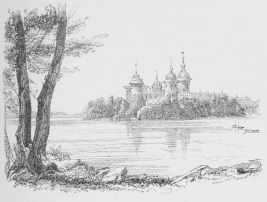
“As we returned to Kongsberg, we stopped to see Hitterdal, the date-forgotten old wooden church so familiar from picture-books. Here we were told by our landlady that she would not give us any dinner—‘Nei, nei, nothing would induce her; perhaps the woman at the house with the flag would give us some.’ So, hungry and faint, Miss Holland and I sallied out as avant-couriers to the house with the flag. All was silent and deserted except for a dog, who received us furiously. Having pacified him, and finding the front door locked, we made good our entrance at the back, examined the kitchen, pried into all the cupboards, lifted the lids of all the saucepans, and not till we had searched everything for food ineffectually, were met by the lady of the house, a pleasant young lady, speaking English perfectly, who informed us, with no small surprise at our conduct, that we had been committing a raid upon her private residence. Afterwards we found a lonely farmhouse, where also there had once been a flag, where they gave us a very good dinner. Two young girls, whom we had first met at the Rjukan-foss, dined with us, and made us acquainted with their parents. The father, an old man who smoked an enormously long pipe, turned out to be the Bishop of Christiansand.
“On the 25th we started from Kristiania for Throndtjem, the whole journey of three hundred and sixty miles very comfortable and only costing thirty francs. There is no great beauty in the scenery, but pleasant variety—rail to Eidswold, with bilberries and strawberries in birch baskets for sale at the railway-stations: a vibrating steamer on the long dull Miosen lake: railway again, with some of the carriages open at the sides: a night at Koppang, a large station, where several people, strangers to each other, are expected to share the same room. On the second day the scenery improves; the railway sometimes runs along, sometimes over the river, till the gorge of mountains opens beyond Storen into a rich open country, with turfy mounds which reminded us of the graves of the hero-gods of Upsala, till, beyond the deep cleft in which the river Nid runs between lines of old painted wooden warehouses, rises the burial-place of St. Olaf, the centre of Northern Christianity, the shrine of Northern faith, the stumpy-towered cathedral of Throndtjem.
“The most northern railway station and the most northern cathedral in Europe.”
THRONDTJEM FIORD.
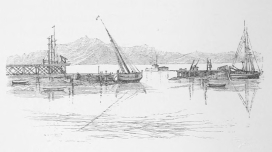
“August 8.—To the last the unspeakable beauty of Throndtjem grew upon us. It is not at first sight of its wide streets of low timber houses, or even of its fiord with purple mountain background, or of its glorious cathedral in the wide-spreading churchyard, which is the town-garden as well as the centre of all its sympathies, that you learn to admire it, but after many sunsets have turned the fiord into rippling gold, and sent an amethystine glow over the mountains, and after many rambles along the shores to rocky points and bosky hillocks.
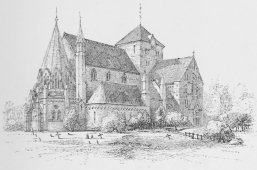
THRONDTJEM CATHEDRAL.
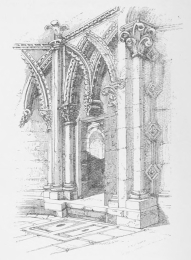
S. OLAF’S WELL.
“After much indecision, we determined to return from Throndtjem by road, and engaged two carriages at Storen, with a pleasant boy named Johann as a driver. At every ‘station’ we changed horses, which were sent back by a boy who perched on the luggage behind, and we marked our distances by calling our single carriole horses after the kings of England. Thus, setting off from Storen with William the Conqueror, we drove into the Romsdal with Edward VI., but (after a drive with Lady Jane Grey) setting off again with Bloody Mary, our kings of England failed us long before our driving was over, and we used up the kings of Rome also. It was a very wild interesting life, and there was a great charm in going on and on into the unknown, meeting no one, dining on trout and pancakes at a station at midday, sleeping in odd, primitive, but always clean rooms, and setting off again at 5.30 or 6 A.M. There are bears and wolves in the forest, but we never saw any. Their skins, shot during the winter, are hanging up in almost all our sleeping-places. The prices are extraordinarily low, and the homely, cordial people kissed our hands all round on receiving the smallest gratuity, twopence halfpenny being a source of ecstatic bliss. But the journeys were tremendous, as we were sometimes called at four, and did not get in till twelve at night.
IN THE ROMSDAL.
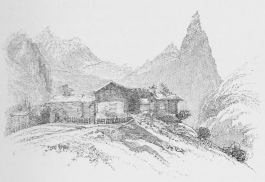
There was for a long time nothing especially fine in the scenery, except one gorge of old weird pine-trees in a rift of purple mountain, and the high moorland above Jerkinn, where the great ranges of white Sneehatten rise above the yellow grey of the Dovre Fyeld, hoary with reindeer moss. From Dombaas, we turned aside down the Romsdal, which soon became beautiful, as the road wound above a chrysopraz river, broken by many rocky islets, and swirling into many waterfalls, but always equally radiant, equally transparent, till its colour is washed out by the melting snows in a ghastly narrow valley which we called the ‘Valley of Death.’
“The little inn at Aak is very delightful, with a large garden on the hillside, and the views indescribably glorious—of the tremendous peaks of pink granite, or fields of pathless snow embossed against a sky delicately blue above, but melting into clearest opal.... There was much in the place, as at Throndtjem, which recalled my former life, and I seemed to go back into a lost past, to read a page long pasted down and put away. In both places we should have stayed for weeks; in both, I could see our trio sallying out every morning with campstools and books, making friends with the natives, or in the quiet of home life, with its home occupations in the little inn.
“And now, after many more stations, we have passed through Lilliehammer, and are again on the Miosen lake, speeding through the closing days of our tour.”
“Orkeröd near Moss, on the Kristiania Fiord, August 9.—On reaching Kristiania last night, I found a most gracious telegram from the Queen, through Countess Rosen, desiring that I would spend my last days in Norway with her. So I came this morning by the early steamer. Most beautiful were the long changing reaches of the fiord, with the rocks covered with foliage, already waving towards autumn, the rich russet and golden tints of the trees repeating themselves in the water. At Moss (to the intense astonishment of a very vulgar American family on board, who had given themselves indescribable airs to me) a royal carriage with two chasseurs in cocked hats and plumes was in waiting, and the King’s chamberlain was standing on the pier to receive me. We drove swiftly up a rocky forest road to the large villa which a merchant of Kristiania has lent to the Queen for the benefit to her health from the pine air. Another merchant close by has lent his to the King, as the immense personnel of the court could not possibly live in one house. As we drove up through the garden, a tall figure in a wide-awake hat emerged from one of the windows upon the terrace. ‘Sa Majesté le Roi!’ said the chamberlain; so I jumped out of the carriage, and he came forward at once with ‘Is it Mr. Hare? The Queen has spoken of you so much, that you are not like a stranger. The Queen will be delighted to see you, and so am I. We were so glad to hear that you would come to see us in our quiet country life. You will find nearly the whole family, only my second son, Oscar, has left us to-day. I am especially glad that you will see the Prince Royal, my eldest son, Gustaf. You will have a very little room with us, for we are so full, but you will have a good bed, and that is the essential. Come now and take a walk with me in the garden.’ So we walked and he talked, chiefly about Rome. Then he took me to the Prince Royal, who was sitting under the trees with the Countess Rosen, two maids of honour, and Baron Holtermann, the marshal of the palace. There we sat some time and talked till the Queen emerged from the house. I went towards her, and met her amongst the flower-beds. She looks wonderfully well, far better than at Segenhaus. Nothing could be more cordial or kind than her reception of me. We walked on the terrace for some time, and she talked of the great event since we parted, the attack on the Emperor, and of the Crown Princess.
“Then we went to sit under the trees and we talked of Throndtjem. The Queen described her first journey thither to her coronation. The King had been making a tour round by the North Cape, and she went to meet him. She went in a succession of carrioles by Lilliehammer and then by the Romsdal. At all the little stations people met her with flowers. ‘Art thou the mother of the land?’ they said, ‘art thou the mother of the land? Thou lookest nice, but thou must do more than look nice; that is not the essential.’ She said that even at Throndtjem the peasants touchingly and familiarly always called her ‘Du.’ ‘Art thou the mother of these tall boys?’ they said, and they would pray aloud that she might be blessed—in her husband, in her children, and in her home. One old woman asked the Countess Rosen to beg the Queen to go upon the roof of the house—‘then we shall all see her.’ The Queen also described her last journey back from Segenhaus. Her two horses, her dog, and her donkey travelled with her.
“Soon the beautiful donkey of our Segenhaus walk was brought round, with its crimson trappings, and the Queen mounted, and went off through the forest to the King’s house. I went in a kind of large open car with the Countess Rosen, the maids of honour, and the chamberlain. We reached the King’s villa before the Queen, and all drew up in two lines in the porch to receive her. There were also a great number of the people of Moss to see her arrive, as it is known she always does so at this hour. The King gave his arm to the Queen, and we all went to luncheon in a garden pavilion. Here the two youngest Princes came in,—Carl, a very handsome boy of seventeen, and Eugène, of twelve. The King called me to come up to a tiny round table at the end of the room on a daïs, where he and the Queen were alone, and made me sit with them on their divan. He said, ‘I shall now leave out your Mr. and only call you Hare, and upon that we will all drink healths;’ and he made me clink my glass with his and the Queen’s. The King talked much of the Prince Royal and his education, of all the languages he thought he ought to learn, and (perfectly without ostentation) of his own very great facility for learning—‘catching’—languages, and of the great advantage it had been to him through life. I had had no food since six o’clock in the morning and was almost fainting with hunger, so, in spite of the honour of sitting with the King and Queen, I greatly envied the court at their good luncheon below, as their Majesties (and consequently I) had only coffee cups for their soup, and a tiny slice of bread and cheese apiece.
“Then the Queen mounted her donkey again, the King lifting her up, while the young Princes, climbing the pillars of the verandah behind their mother, made a pleasant family group. The cap of the Queen’s chasseur fell off, and the King picked it up for him and playfully pushed it tight down upon his head. Then the King and Princes started to walk, and I for a long drive with the Countess Rosen and some of the court. And now I am resting and the Queen has sent me a number of English newspapers to read. A propos of the picture of Lord Beaconsfield receiving the Garter in the Illustrated, the King said, ‘Now, let us talk a little politics. I like and admire most things English, but I will not conceal from you that I do not admire Lord Beaconsfield. I did not think his conduct about Cyprus was quite straightforward.’”
“August 10.—At four o’clock yesterday the whole court met in the drawing-room, so many gentlemen turning up from hidden corners, that it made twenty-four persons in all. The Prince Imperial recognised me immediately when he came in, and was exceedingly cordial and friendly. I was really glad to see him again. He is as nice as he can be, but as to appearance, his photographs flatter him, as he has such a bad complexion and his legs are too short. He is, however, quite delightfully frank and winning. He kissed the Queen’s hand very prettily and gracefully as she came in, looking very well with large bunches of natural double geranium upon the white lace of her dress and in her hair. He took the Queen, the King took Countess Rosen, and we all followed to dinner. I was desired to sit by the Prince Royal. His peculiar features are redeemed by a good expression when animated. He talks no English and atrocious French, and was difficult to get on with at first. Prince Carl, the third son, is very handsome, and seems to have a charming disposition. After dinner the princes were to go out fishing, and the head fisherman sent to say that there would be no room for little Prince Eugène, as there were so many of the Prince Imperial’s suite to be taken. Prince Carl came to the Queen and begged that Eugène might not be told, he would be so disappointed, and that he might stay at home in his place; and the Queen said, ‘Charles is always like that; he never can be persuaded to think of himself.’ I tried to talk of Rome to the Prince Royal, but whenever a maid of honour on the other side claimed his attention, was glad to subside into conversation with an old chamberlain. The King drank healths at dinner, the Prince Imperial’s, mine, Count Murat’s. The Prince Royal asked me to clink glasses with him. ‘Do you like that custom?’ he said. A Swedish noble, appointed to wait on the Prince Imperial, stood up when the King drank his health. Then I saw the other side of the King—in very cold stern rebuke. ‘In good society gentlemen do not stand up when their healths are drunk,’ and that in the severest tones. The Queen looked surprised, and a momentary chill fell upon the whole party. I am sure that the Swede, who was a very bumptious young man, had done or said something before which had displeased the King.
“When the princes were gone to their fishing, the Queen made me come and sit by her. She returned at once to the subject of the Prince Royal and her great anxiety that I should be much with him abroad. ‘He must learn his world,’ she said, ‘he knows so little of it. He is thoroughly good, but what he wants is enthusiasm, he wants to be incited to knowledge, to learning his future out of the past, and oh! you can help him so much, and if you will, I shall always be so grateful to you: but remember, and I know it will always help you to be kind to my boy if you do remember, what my boy’s future must in all probability be. Oh, Mr. Hare, do when there is a chance, sow some little seeds of good in my son’s young heart, and remember that what you do is not only done for the Prince Royal, not even for his mother, who entirely trusts you, but for the thousands upon thousands of people whom he may one day be called upon to influence. Whatever happens, if you will only interest yourself for my boy, you will believe in his mother’s gratitude.’
“The Queen continued to talk long in this manner with the utmost animation, till the Countess Rosen, suddenly seeing some sign of illness unobserved by us, ran round and said, ‘Dear Majesty, you must not now speak any more,’ and led her away with a charming mixture of motherly affection and playful deference.
“When Countess Rosen returned, she said, ‘The King desired that as soon as the Queen had ceased speaking to you, you should go to him: he especially wishes to talk to you alone.’ I found the King under a tree in the garden, reading a book (the ‘Odes of Horace,’ I think), and, fearing to disturb him, I pretended to occupy myself with the flowers, but he perceived me at once, closed the book, and coming to me, took my arm, and walked up and down on the terrace. ‘The Queen has been speaking to you of our son,’ he said; ‘I know what the Queen has been saying, and I wish to continue her conversation. He is a good boy, but he has not been tried; he has no idea what the world is like, nor of the many temptations which lie in wait for a young man, above all for a prince. Now the Queen and I are quite agreed that it is our wish that you should be as much to our son as possible, and I wished to see you alone that you might believe that all that his mother wishes, his father wishes also.’ The King then talked in detail of the Prince’s probable life in Rome, of the places and people he must see. ‘Please understand at once that my son must go to the Quirinal,’ he said. He went on to talk more earnestly of England, of the difficulties of all the lines to be drawn, and of all the individual persons whom it might be well for the Prince to see, and also some to be avoided. He wished the Prince to have a quiet month in England, to accustom himself to language and people, before going to London: he thought of Torquay; I suggested St. Leonards. He talked of Lady Waterford, whom he remembered many years ago, and admired almost more than any woman living, and wished that she might be persuaded to give an invitation to his son.
“Speaking of the course of study which would be best for the Prince led the King to talk of the great pleasure a thorough knowledge of Latin had been to himself, both for its own sake and as making all other languages easy to him.
“The King talked much of the anxieties at Berlin, and of the cloud over the royal life there. ‘Oh, how thankful I ought to be, how thankful I continually am, for our quiet corner, for a reign which is one of love. I never felt this more than in the Queen’s lonely carriole journey to her coronation at Throndtjem, and it was renewed lately in our son’s journey to Tellemarken. And though our people care for us, they do not flatter us. When the Queen was in the little village churches, near the different small stations where she passed her Sundays, the simple village curates of those mountain districts did not hesitate to preach to their Queen of all that she ought to do, of all that her life ought to be for herself and others, and oh! we are so grateful to them.’
“While we were talking, the court ladies were playing at croquet on the lawn. The King afterwards joined them, and I took a short walk with Baron Holtermann, marshal of the palace, and then went in and sat down to read in the drawing-room. Presently the King put in his head from the Queen’s room—‘Yes, he is here,’ he said, and then he called me to come in to the Queen. They then both of them took my hands and spoke to me in a most touching manner about the Prince Royal. The Queen also spoke of the uncertainty of her life, and of renewed meetings in distant Norway, and of her hope of seeing me in another world. She gave me her portrait. I could not but feel it a very solemn moment and very affecting. They took me out on the balcony of the room for one quiet moment. ‘Remember how we trust you,’ they said. And we looked down upon the fountain playing and the burnt grass and brilliant flowers in the moonlight and then we went back to the public rooms.
“The Prince Imperial and the Swedish princes now returned from fishing, singing at the pitch of their voices through the woods, and we all went upstairs to supper. Their Majesties and the whole court had—Swedish fashion—each a great bowl of sour milk, with a great hunch of bread and two preserved peaches in a glass. The Prince Royal, by whom I again sat, fortunately asked for sweet milk, so I was able to do so also. Then the King and princes went to the other house, and I took a sad farewell of the beloved Queen. If ever there was a woman who united the truest, widest spirit of Christianity with every earthly grace, it is Queen Sophie of Nassau.
“The Queen’s dresser was turned out of a room for me—a good room, but with neither soap nor bath, no chance or understanding of hot water, and the looking-glass quite unavailable! Swedes are accustomed to none of these things as necessaries in houses where they visit.
“At 8 A.M. Baron Holtermann fetched me to walk through the woods to the King’s house to breakfast, after which I walked with the King to the pier at the end of the garden. There the younger princes kissed their father, and the Prince Imperial (who was going away at the same time and whom the King would accompany to Kristiania) took leave of the court. It was an intensely hot day, the town of Moss and the shore of the fiord seeming to steam with hot mist and the flowers all drooping. A little steam-pinnace took us all to the luxurious steamer, where there was boundless space for sitting or walking or whatever we liked. The voyage was very long—five hours. I sat reading ‘Ticknor’s Memoirs,’ and the King and Prince Imperial came occasionally to talk to me. I found in the book an account of the Prince’s grandmother, Comtesse de Téba, in her prime, which interested the King very much. He said, ‘The Prince Imperial keeps me in a perpetual state of mental tension: he does ask me such questions. I am always wondering what he will say next. He is almost too intelligent a young man. He has just asked me to tell him how long a steamer takes to get up steam. I have seen hundreds of steamers getting up steam, but I never thought before how long it took. However, I have had to think now, and it takes five quarters of an hour. Oh, the Prince Imperial is very good mental exercise.’
“Half-way down the fiord, the Prince Imperial insisted upon it that he must bathe. At first the King said it was impossible, that the moment of his arrival at Kristiania was fixed, that the people were waiting to see him, that the steamer could not be delayed—in fact, that it was out of the question. But while the King was discoursing, the Prince Imperial stripped off every article of clothing he had on, and after rushing up and down the deck perfectly naked, jumped into the sea over the poop and swam like a fish. The King then was obliged to stop the steamer, as he could not leave the Prince Imperial in the middle of the fiord, and he told an aide-de-camp to undress and go to pick out the Prince. The Prince lay on the breast of the waves laughing at the King till the aide-de-camp reached him, and then he dived, disappeared for some time, and came up on the other side of the vessel. The Prince Royal then undressed and went in too, and two aides-de-camp, and they all swam and pursued each other like mermen. When at last the Prince was persuaded to re-embark, he sang and shouted in most uproarious spirits. Then came luncheon. The King proposed the Prince’s health—‘Mon cher hôte et mon cher neveu’—and then he proposed mine, saying, ‘I drink to your meeting with the Prince Royal at Rome, and you will be kind to my boy?’
“We entered Kristiania in triumph—all the towers, houses, and masts of the vessels in the harbour decorated with flags, cannon firing, and crowds of people on the quays. At the station were crowds too, waiting for the royal carriages as they drove up. There was quite a procession of them. I went in the second carriage with Count Murat. At the station I had just time to present the Miss Hollands, then I took leave of the king.”
“August 17.—The Prince Imperial travelled with us from Kristiania. It was an ovation to him the whole way—crowds at all the stations, and shouts of ‘Hoch, Hoch!’ instead of ‘Hurrah.’
“We parted company with the Prince at Helsingor, whence we went to Fredensborg, a dull château and pretty garden, and then to Frederiksborg, really magnificent, one of Christian IV.’s grandest buildings, on three islands in a lake.
“We have since seen Bremen with the grand calm face of the gigantic Roland-Säule raised above the busy market, and Münster with its old cathedral and Congress-hall, and now we are at Tournai, where there is a noble cathedral, contrasting in its serious thoughtfulness of design with the frippery and sameness of Cologne. And to-day, being in the octave of St. Roch, Tournai is hung with flags for a really beautiful procession—crosses, banners, images, reliquaries carried aloft by troops of young girls in white and blue and little boys in mediaeval dresses. Some of the tiny children in golden oak-chaplets, and with great golden oak-bouquets or golden lilies, are quite beautiful.
“And to-day, too, we pass out of the peculiar existence of the last two months into ordinary working life again. Great is the thankfulness I feel for all, especially for my kind and pleasant companions.”
I spent the late summer of 1878 very quietly at home, busied in completing the Life of the Baroness Bunsen. Many guests came and went, amongst them Miss Wright, whose constant kindness and affection had been so much to me for many years. Whilst with me she was very ailing, but it was only supposed to be rheumatism, and doctors, who examined her carelessly, sent her from Holmhurst to Buxton, which was fatal to her, for her real disorder was heart-complaint. I never shall forget the bitter anguish of the shock, gently and tenderly broken as it was by Mary Lefevre, when I read that I should never see again the loving devoted friend of so many years, who alone was always ready to help me in any difficulty, always glad to fight a battle for me, and whose humble nature so terribly overrated me, making me, however, long to struggle up in reality to that higher shelf on which I saw she had mentally placed me. Hers was one of—
“The many lives, made beautiful and sweet By self-devotion and by self-restraint, Whose pleasure is to run without complaint On unknown errands of the Paraclete.”[289]
Wonderfully, though simply and unconsciously, did she fulfil the ideal of a holy life which is given us in the 15th Psalm. But it was not till she was gone, till her outpouring of gentle tenderness was silenced for ever, that one realised all she had been, and that her loss left a void for life which could never be filled up. Constantly have I gone back with useless self-reproach—would that I had done more to make her happy! would that I had always been more grateful in reciprocating so much kindness!—and most constantly have I been reminded—
“How each small fretting fretfulness Was but love’s over-anxiousness, Which had not been had love been less.”
Years have passed away as I write, but I can scarcely bear to speak of her, even to write of her, even now. “How holy are the holy dead! How willingly we take all the blame to ourselves which in life we were so willing to divide.”[290] “Nevermore” is one’s echo of regret, but “too late” is that of repentance.
Dear Lady Williamson passed away from us in the same autumn, deeply loved too, but in her blindness and deafness one felt that her life—her entirely noble and beautiful life—was lived out, which one could not feel dear “Aunt Sophy’s” to be. She seemed to die, her life unfulfilled.
Throughout the autumn I had heard frequently from the Queen of Sweden and Norway, through the medium of her principal lady in waiting, the Countess Ebba von Rosen. The entire confidence and noble friendship expressed in these letters made it impossible for me to hesitate, when, after the Prince Royal had spent some time in Paris, it became the strong wish of her Majesty that I should join him at Rome. It was in entire concert with the King and Queen that I drew up the scheme of a series of peripatetic lectures for the Prince, in which, by describing historic events on the places with which they were connected, I hoped to fix those events and their lessons in his recollection. Their Majesties also agreed to the plan of my inviting others to join the excursions of the Prince. It was, however, with great misgiving that I left England, feeling that I gave up my pleasant home and congenial occupations in England for the constant companionship of a young man who had not, in our short previous acquaintance, made a very favourable impression upon me, and who might—should he take that line—resent my exertions in his behalf, and look upon me rather as a spy for his parents than as a friend to himself. When I once reached Rome, however, these fears were soon set at rest, and during the whole nine months which I passed in constant intimacy with the Prince, I never once had to reproach him with want of consideration for myself personally, but, on the contrary, always received from him marks of the utmost esteem and affection.
On the evening of November 16 I left Holmhurst, having worked at the index of my Bunsen Memoirs till within ten minutes of my departure. Upon the passage of the Mont Cenis I came in for terrible snowdrifts. Suddenly, after passing the tunnel, the walls of snow increased on each side of the train so as almost to block out the light, and, with a dull thud, the train came to a standstill near the wretched village of Oulx. An avalanche had fallen upon the luggage train which was pioneering our way, and three poor men were engulfed in it. The cold was terrific, and the suffering was increased in my case, because, having usually been much tried by the overheating of foreign trains, I had brought no carriage-rug or other wraps with me. After some time a way was cut through the snow walls to a miserable tavern, where sixteen ladies decided to sleep or cower in one wretched room and twelve gentlemen in another, but I gladly made my way back to the carriage before the passage was blocked again. It was then two in the afternoon, and wearily the day wore on into night, and still more wearily passed the night hours, with snow always falling thickly. I had a little brandy in the carriage, but no food. The suffering from cold was anguish. There were several invalid ladies in the train, for whom I felt greatly, knowing what this catastrophe would have been in times past before I was alone. Before morning two more avalanches had fallen behind us and the return to France was cut off. The telegraph wires were all broken, and the guard assured us that it was possible we might be detained days, or even weeks. At midday, cold and hunger made me try the hovel once more, but the filth and smells again drove me back to the carriage. At 4 P.M., however, on the second day, a welcome shouting announced that our deliverance was at hand. No trains arriving at Turin, our position was suspected, and the town-firemen were sent out en masse to cut a way for us. At 6 P.M. we were released from our twenty-eight hours’ imprisonment, but the way was so dangerous, that we did not reach Turin till long after midnight.
To Miss Leycester.
“26 Piazza di Spagna; Rome, Nov. 25, 1878.—You will imagine how touching—I shall never grow used to it—was the slow approach by rail round the walls of Rome, crossing all the little lanes we knew so well in our drives, and seeing, one after another, S. Paolo, the Caius Cestius, the Porta S. Sebastiano, S. Giovanni in Olio, Porta Maggiore, the Minerva Medica, and then the vast space once occupied by the beautiful Villa Negroni, but now parcelled out for straight streets and stuccoed houses.
“Yet, considering it is four years since I was here last, the changes are not great yet: the same old man with peaked hat and long beard and the same pretty girls stand waiting as models: the same old stonecutter is grinding away under the Tempietto, and Francesco threw open Miss Garden’s door and announced (simply) ‘Il Signorino,’ as if I had been there the day before.
“On Sunday, Umberto and Margherita of Savoy made a triumphal entry into Rome, and I went to the Palazzo della Consulta to see them arrive at the Quirinal. It was an exquisitely beautiful evening—not a breath of air stirring the many flags: the obelisk and statues and the grand fountain of Pius VII. were in deep shadow, but the sun was glinting through the old ilexes in the Colonna Gardens and illuminated S. Peter’s and the town in the hollow. There was an immense crowd of every class, from ex-guardia nobile to peasants in the costumes of Sora and Aquino, and through them all the vast procession of sixty carriages moved to the palace, with flags flying, and flowers falling, and cannon thundering, and the one little bell of the royal chapel tinkling away as hard as it could, because the other churches would make no sign. ‘I Sovrani,’ as all the people called them, looked very proud and happy, and Queen Margherita marvellously graceful, and pleased to see the millions of marguerites, which people were wearing in honour of her. The little Principe de Napoli is quite hideous, but they say well brought up under an English governess, and King Umberto in every way seems to wish to reform his dissolute father’s court, as well as to screen his memory, having taken the whole of his enormous debts upon himself, besides paying off Victor Emmanuel’s eight ‘domestic establishments’ out of his private purse. The King and Queen came out upon the balcony of the Quirinal, and were triumphantly received. (Next after the royal carriages had come a fourgon with the bouquets presented at the station.) Last night there was a torchlight procession, tens of thousands bearing torches, with music, banners, and gigantic marguerites, who passed through the Piazza di Spagna on their way to the Quirinal. Still, taxes are rather increasing them otherwise; the misery of the formerly prosperous Romans is extreme, and many think a revolution imminent.
“Monsignor Prosperi is dead. I wonder if you remember about that most extraordinary person, who was supposed to have the evil eye. The Romans believe that all the many misfortunes of this year, and the attacks on royalty, &c., are because it fell to his turn to cantare la missa at S. Maria Maggiore on the first day of the year. No end of shipwrecks and railway accidents are attributed to him, and so the poor man’s death is a subject of general rejoicing. It is recollected that after the last visit he ever paid, the servant of the house fell down on the stairs, and cut his eye open with the Monsignore’s visiting-card which he held in his hand.”
On arriving in Rome, I had found a tolerable little apartment for myself in 29 Piazza di Spagna, and the Prince Royal established in the charming sunny first floor of the Palazzo Rocca-Giovine in the Forum of Trajan. Thither I used daily, often twice a day, to go to the Prince. From the first he welcomed me very cordially, and I could see that he was really glad of my coming, still I was uncertain whether there would ever be more than an interchange of courtesy and duty between us. I never hoped to be able to give him the real affection I afterwards so sincerely felt. Somewhat to my consternation, I was desired by the King to fix my first lecture for the Prince for one of the very first days after my arrival, in order that Baron Holtermann, marshal of the palace, who was returning to Stockholm, might take back a full account of “how it went” to their Majesties. The Queen added her special request that I would say nothing except in English, in order to force the Prince-Royal to learn that language.
As being the central feature and axis of ancient Rome, I chose the Capitoline for my first lecture. General and Mrs. Stuart and Lady Agnes Douglas met me there at the top of the steps, and waited for the Prince, who arrived on foot with Baron Holtermann and two other Swedish gentlemen. I doubt at first whether they understood a word I said in English, and the being obliged constantly to translate into French or bad German did not add to the liveliness of the lecture. Our procession passed from point to point in the most funereal manner. The Prince made no observation whatever, Romulus, the Tarpeian Rock, Marcus Aurelius passing equally unnoticed; only when we came to Palazzo Caffarelli he said, “Oh, that was where Mim Bunsen was born:” it had touched a chord of human interest.
Gustaf, Crown Prince of Sweden-Norway.
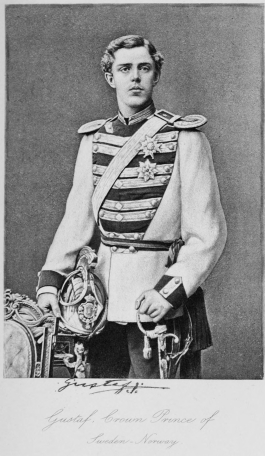
I wonder what sort of account of this lecture Baron Holtermann can have taken to the Swedish court; but we did better next time, when, on the Palatine, the Prince’s spirits quite rose over all the murders of the emperors and empresses. In the latter part of the winter, the lectures, which took place three times a week, were quite an enjoyment, he was so merry, so kind and pleasant to every one, so glad to know everything.
Very soon, after consultation with M. de Printzsköld, the Queen’s chamberlain, who had accompanied the Prince to Rome, I proposed going twice a week to read English with the Prince in the late afternoon, which was gladly accepted, and on those occasions we read “Mademoiselle Mori” alternately, and translated “Tolla” into English. It was in the little conversations which inevitably interspersed themselves with these readings that I first learnt to know my Prince really well. The readings themselves he found it very difficult to attend to, and the exercises he prepared for me were much against the grain, so we did not make much progress till I obtained an order from the Queen that the equerries should do the same exercises as the Prince, which roused his ambition, and he went ahead at once, and always did much better than his companions. I think it is Adam Smith who says that “the great secret of education is to direct vanity to proper objects.” After our lessons, I always dined with the Prince, sitting on his right hand. Afterwards the Prince and his Swedish gentlemen smoked, and as soon as it was possible to do it, I took my leave, except on evenings when I went out into the world with the Prince. But for the most part the Prince’s evenings were spent at home, the Italian court showing him no attention, and scarcely any of the Roman princes inviting him, except during the Carnival. Old Lady Morton was throughout exceedingly kind and helpful where the Prince was concerned, and gave several parties for him. At these, the Prince’s distant cousins, Princess Gabrielli, Countess Primoli, and Countess Campello, the round fat elderly daughters of Lucien Bonaparte, were always present.[291] They were pleasant sensible women, especially Countess Primoli (Princess Charlotte Bonaparte). Having all married beneath their rank, they always made a point of going in and out of a room in the order of their age, which had often a funny effect.
Of all the people who welcomed me back to Rome, the most cordial were the blind Duke and the Duchess of Sermoneta, whom I was delighted to find established for the winter in the upper floor of the old Caëtani Palace. Since her marriage, the Duchess had contrived to conciliate the whole Caëtani family, not only to herself, but to each other. She had also ransacked the unknown corners of the palace, and had found endless old hangings, old portraits, &c., things almost valueless in themselves, but which gave the bare walls a look of historic antiquity. I often took the Prince to the evening receptions of the Duchess, at which, as at all the princely Roman houses, some tea and very sour lemonade were considered quite sufficient as refreshments. Without the Prince, I often dined with the Sermonetas at their homely early excellent Italian dinner, and an oasis in commonplace life was meeting there the Abbot Marcaldi of La Cava, the Abbot Pescitelli of Farfa, and a most beautiful old Don Pietro Tailetti, canon of St. Peter’s—like a mediaeval picture. They had all wished to see me, from their pleasure in the chapter on the Benedictine rule in “Days near Rome.”
To Mary Lea Gidman.
CORNETO. [292]
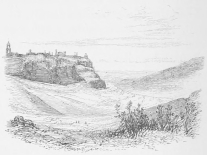
CATHEDRAL OF CORNETO. [293]
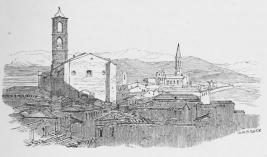
“Dec. 11, 1878.—I always see the Prince now with increased satisfaction and an increasing certainty that he likes having me with him. I also feel that I am able to be to him all that the Queen of Sweden wished, of which at first I was uncertain. In our walks he asks so many questions about what he sees, that I have to work hard in the evenings before to prepare myself to answer properly, for I find that I have forgotten much of the detail of my Roman history, &c.... Last week we went for the whole day to Corneto, eating an excellent breakfast provided by the Prince’s cook in the train. Professor Helbig, who had preceded us, met us at the station with a little omnibus. With this we went up into the high hills above old Tarquinii, and then descended with torches into the great sepulchres, where the dead of two thousand years ago are seen (in terra-cotta figures as large as life) sitting round at imaginary banquets, while the walls are covered with paintings of their deeds in life—hunting, fishing, dancing, &c., as fresh in colour as when they were painted. Then we went to visit a Countess Bruschi, who had a great collection of jewels and other beautiful things found in the tombs. This lady was the only person to whom we revealed who the Prince Royal was; but whilst we were at dinner the secret transpired, for there came from the Bruschi palace a bouquet of the most magnificent roses, like a sheaf, carried by two footmen, and another bouquet of camellias, arranged in a huge citron; and then the governor of the town arrived to make a little speech, to which the Prince gave a suitable answer, which I had to translate into Italian; and then all the people found out, and came to look at the Prince.”
On Christmas Day I received a telegram from the Queen of Sweden expressing her good wishes, and thanks for the kindness shown to her son. From a letter received about the same time from Countess Rosen I extract:—
“Stockholm, Dec. 18, 1878.—H.M. the Queen charges me to convey to you her thanks for your letters, which are very welcome. The Queen says you manage to tell just what interests her most about the doings of the Crown Prince. Both the Queen and the King thank you heartily for all your kind interest in the Crown Prince, and they perceive already that you have succeeded in gaining a good and useful influence over him, and that you have kindled up his interest for all that now surrounds him. The Queen is charmed if you write often, but she is afraid that it takes up too much of your time, which is much taxed already through all that you do for the Prince....
“The Queen begs you to write with perfect frankness, even when everything is not quite as one would wish it to be. Be sure that what you say will never be misunderstood.”
To Miss Leycester.
“Dec. 5, 1878.—I think my last letter may have expressed some of the depression I certainly felt as to the uncertainty of my position with the Prince Royal, and I know with how much pleasure you will hear that these clouds have completely cleared away. I have increasing, indeed I have now perfect satisfaction in my position with the Prince, and in the internal conviction that I can and may be to him all that the Queen has wished. The great secret is, I suppose, that I am becoming really very fond of him. He not only daily unfolds new gifts and graces for every one, but he is hourly pleasanter and more charming in all his relations to me, and I have now the certainty that I am most welcome to him; but indeed he has always treated me with entire confidence, though you will easily understand that had he possessed the slightest shadow of small-mindedness, he must have looked upon me with a sort of suspicion, from the intimacy with which his parents have honoured me, and my constant letters—which he knows must be about himself—to the Queen.