Volume 6 — XXIV BEYOND THE TOP OF THE HILL
Reading edition
“Un jour tout sera bien, voilà notre espérance! Tout est bien aujourd’hui, voilà l’illusion. . . . . . . . . . . Que tout soit mal ou bien, faisons que tout soit mieux.” —Rousseau.
“Il faut travailler en ce monde, il faut souffrir el combattre. On aura bien le temps de se reposer toute l’érnité.
“Si nous comprenions bien notre bonheur, nous pourrions presque dire que nous sommes plus heureux que les saints dans le ciel. Ils vivent des leurs rentes; ils ne peuvent rien gagner; tandis que nous, nous pouvons à chaque instant augmenter notre trésor.”—Le Curé d’Ars.
“La debolezza umana piange, sorride l’imortale speranza.”—Epitaph at Pisa.
THERE is an old print at Holmhurst which represents life in its successive stages as the ascent and descent of a hill. At fifty the top of the hill is reached and the descent begins. I have passed the top, and every year must bring less power of work and action, though I scarcely feel older now than I did at five-and-twenty. But certain marks in the forehead show that age has left his card upon one; we do not know when he called, but the visit has been paid. Well, it is the more necessary to do all we can whilst power lasts, never talking, but acting, and recollecting that a duty once divined binds one from that moment; while as for the abuse, public and private, received for anything attempted out of the ordinary groove, we ought ever to follow the simple advice of Sœur Rosalie, “Faites le bien, et laissez dire.”
Certainly the longer one lives one feels how, of all shams, the religious sham is the worst—the man who talks “goody” without any heart to sympathise with sorrow or shame, and who thus can never help those who struggle sadly against vice and meanness, whilst tremulously aiming at a nobler life. The same, in a wider sense, is true of almost all sermons one hears—
“Two lips wagging, and never a wise word.”[418]
So few clergymen feel what they say, that it only does harm. It was a saying of Pope Pius II., “Bad physicians kill the body, unskilful priests the soul.”
It ought not to be, but it certainly is true that the Church and Religion are two; and, apropos of sermons and religious discussions, another saying of Pope Pius often comes back to me, “The nature of God can be better grasped by believing than disputing.” “Let us not be the slaves of any human authority, but clear our way through all creeds and confessions to Thine own original revelation.” With Thomas Chalmers, can I not feel this?
I have endless compensations for a lonely life in my pretty little home, my sufficient means, my multitudes of friends. Besides, it is as Madame d’Houdetot wrote to Madame Necker, “Vous savez que le seul être malheureux est celui qui ne peut ni aimer, ni agir, ni mourir, et je suis bien loin de cette situation.” I often feel, however, that this book would give a very false idea of my life. I recount my many visits and what I hear there because it is amusing, and I leave unnoticed the months and months when nothing happens, and in which I am probably employed in quiet work at Holmhurst. With every one naturally it must be true that
“The life of man is made of many lives, His heart and mind of many minds and hearts.”[419]
This, however, is enough of sentimentalising. I will return to facts.
Journal.
“Jan. 9, 1886.—I am just come back from a very pleasant visit at Battle Abbey, where I met the Powerscourts, Lord and Lady George Campbell (she lovely and like a beautiful Gainsborough), Lord Hardinge and a very nice daughter, Lord Wolmer and Lady Maude, Sir Prescott Hewitt, a young Ryder, and Lady Dorothy Nevill. The latter was most amusing, and well understands the famous principle—‘Glissez, mortels, n’appuyez pas.’ She and the Duchess of Cleveland, who was in very good vein, were quite charming together.”
To Miss Leycester.
“Holmhurst, Feb. 20, 1886.—Do you know that, except for ten days, I have been at home just three months to-day, and nearly all the time quite alone. I cannot say how much I have enjoyed the quietude of study and communing with great and wise people through many books. There is certainly the greatest pleasure in thus acquiring new thoughts, and, in a small way, fresh knowledge: indeed, I always feel that to give myself up to overwork is quite as great a temptation to me as over-idleness to some people.
“Each different literary work I have had has seemed to me, at the time, more interesting and engrossing. The little accidental discoveries are so amusing. Amongst those of this week, who do you think invented a wheel-barrow?—Blaise Pascal.
THE DEANERY, BATTLE. [420]

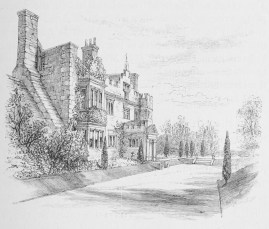
“My diversion has been reading masses of old family letters, unearthed by Lady Hartopp. They are very curious, and a complete portrait of the family at the beginning of the century. My grandfather, Mr. Hare Naylor, must have been quite odious—so imperious and arrogant: Lady Jones, the incarnation of a rod in pickle, but with very fine qualities: great-uncle Robert, the rector, more of a rowdy farmer than anything else. Penelope Shipley (Mrs. Warren), a very fine unselfish creature: Dean Shipley, selfish and dictatorial: Francis Hare, a self-indulgent dandy: Julius, a miracle of boyish learning, talking like a Solon: Augustus (it must be allowed), very priggish, but very amiable: Marcus, indulged in everything by his aunts: the second Mrs. Hare Naylor, foolish and querulous, but by no means an unjust stepmother. The religious letters of consolation which the whole party write to one another when little Anna dies are so stilted as to be truly comic. What is touching is that over the harsh letters of her fierce elder sister, the beloved memory of the first Mrs. Hare Naylor ever broods as a softening influence: however much trouble the Hare brothers give her, no pains or expense are too great for them, because ‘they were hers.’”
On the 9th of February I went up to London for Miss Jolliffe’s wedding, and came in for—a revolution! On returning from the City, I found Trafalgar Square one mass of people, and many orators addressing them, but expected nothing more. Soon, however, a Socialist leader named Burns suggested a reign of terror and offered himself as captain. Thousands of men—well fed, well dressed, but still the scum of London—rushed down Pall-Mall, breaking windows as they went—a very carnival of outlawry. Their passions grew with their progress, and in St. James Street they wrecked the University Club, which had expelled Hyndman, one of their leaders, from its society. They seized certain carriages, turning out the ladies they contained, and stripped a footman of his livery. They pulled Lady Claude Hamilton out of her carriage and boxed her ears, but when, after this, she denounced them as dogs who ought to be flogged as curs, they applauded her courage, and let her go on. Breaking windows and wrecking many shops in Piccadilly, they entered the Park at Hyde Park Corner and left it at Stanhope Gate. Then they rushed on through South Audley Street, which they left much like Paris after the excesses of the Commune. How truly Milton said—
“License they mean when they cry Liberty.”
I went the next day to see Lady Foley, whose house in Grosvenor Square had been on their line of route. It had not only no pane of glass unbroken, but not even fragments of glass left, and stones heaped in the library enough to mend a good piece of road with. Lord Percy’s house, next door, was so ruined that they went away next day.
For the two following days London had indeed a miserable aspect—windows all broken, streets littered with fragments, shops shut, streets paraded constantly by bands of entirely victorious and triumphant ruffians, and shop-keepers, in some cases, guarding their property with revolvers.
The call for a fresh edition of my “Walks in Rome” made me suddenly determine to go to Italy at the end of February. At Florence I was the constant guest of the ever-kind Duchess Dowager of Sermoneta, with whom I made delightful excursions in the hills.
To Miss Leycester.
“Hotel Paoli, Florence, March 7, 1886.—France was covered with snow from end to end, yet next day we were speeding through lemon-groves laden with fruit, and carpeted with a blaze of iris and scarlet geranium in full flower. Here, after reading about the snowstorms in England, I am glad in the gardens of Arcetri to sit to draw in the shade of the cypresses, and all the hills are pink with almond-blossom. I spent one evening with the Duchess at Palazzo Torrigiani, alone with the family there, which is the most perfect type of a grand old Italian household, consisting of between eighty and ninety persons. The kind and charming old Marchesa Elisabetta has four sons, who have all married as soon as they came of age, yet none have gone farther than to an apartment of their own under the maternal roof, and eighteen children and grandchildren dine with her daily, besides other guests. The four daughters-in-law all live in the utmost harmony; the Marchesa Giulia, wife of the eldest son Pietro, and the Marchesa Margherita, who was a Malespina (which in Italy means great things), quietly giving precedence to the Marchesa Cristina, who is a princess (Scilla) by birth. All sat with work round a table, visitors dropped in, and it was most easy and pleasant.
“Another day, the Duchess, Miss Phillimore, and I went out by the steam-tram to spend a day at the Marchese della Stufa’s[421] old castle of Castagnolo. We had an amusing luncheon of Italian dishes, guitar music and singing, a walk to pick violets, with which the hedges are full, a visit to the green-houses and aviaries of rare birds, and we were taken back to the tram-line, where the station is built of sunflower-stalks, which are like bamboo in their qualities.”
I reached Rome on the 10th of March, warmly welcomed by a large circle of friends. In the hotel were Mrs. Tilt and Letitia Hibbert, very familiar to me in early days at Birtles, and with them and their very charming sister-in-law, Mrs. Frank Hibbert (née Cholmondeley), I made delightful excursions to familiar places—Tivoli, Frascati, Albano. Sir John Lumley was now reigning at the Embassy and making it delightful to his countrymen.
To Miss Leycester.
“Hotel d’Italie, Rome, March 17, 1886.—What lovely June weather this is, so very hot, so unspeakably beautiful.... I find an immense deal to do in correcting and writing, chiefly, however, in taking away from my ‘Walks in Rome,’ so very much is destroyed; indeed, Lanciani, the archaeologist in power, says, ‘If they go on like this for twenty years, there will be nothing left of older Rome but St Peter’s and the Coliseum—if those.’”
L’ARICCIA. [422]
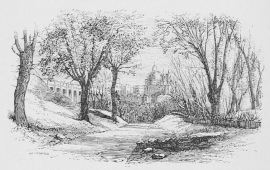
“March 21.—What expeditions we have had! On Monday we walked through the glen at Ariccia and round the glorious old woods of the Parco Chigi, full of cyclamen, cytisus, blue squills, green iris, and masses of dark violets. Then, whilst the others went on to the convent of Palazzuola, I sat to draw above the still lake, and, when they came back, we went to the grand pine-groves of the Villa Barberini, to Castel Gandolfo, and through the ilex galleries in time for the evening train.... I have dined out every day, just as in London.”
GALLERIA DI SOTTO, ALBANO. [423]
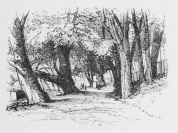
“March 31.—I wish I could transport you suddenly into the glorious radiance of this cloudless sunshine and deepest of blue skies. To me Rome has never seemed so delightful in climate as after three months of fog and sleet at Holmhurst.... Amid all the changes elsewhere, I can always turn with comfort to the Palatine, and have spent many happy mornings there amongst the gigantic ruins, and the groves of laurustinus and lentisc, and the huge fenochii, meditating on my past and its past.”
LAKE OF BOLSENA. [424]
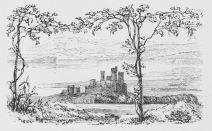
On April 22 I went to Perugia, finding in Brufani’s excellent hotel Mrs. Robert Drummond and her daughter, and two charming Americans, Miss Isabel and Miss Lorraine Wood, domesticated at Dresden. For the next fortnight we toured about together. As to some of the most restful and happiest days of my later years, I look back to the extreme comfort of Perugia, and the perfect view from the windows of my room, unspeakably glorious at all hours, but most of all when the rising sun was lighting up the tops of the distant mountains, whilst all the detail of the intermediate plain was lost in soft white haze. Equally delightful was the old-fashioned inn at Orvieto, and the drives into the hills and to Bagnorea and the Lago di Bolsena, returning in the carriage laden with branches of honeysuckle and masses of anemones, violets, cyclamen, and other spring flowers. From Siena, too, we made again the interesting excursions to Monte Oliveto and S. Gimignano.
S. DOMENICO, SIENA. [425]
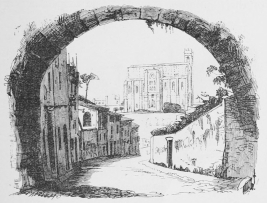
Crossing the St. Gothard to Basle, I turned aside to visit the whole of the Jura country, greatly overrated, I thought, by former travellers. Burgundy was much more interesting, with its fine churches and its noble inhabited châteaux of Ancy le Franc and Tanlay. As I was dining in the tiny primitive inn at the latter, the tradesmen who held the minute shops in the village were disputing as to the superiority of their different trades. The carpenter certainly won the day by winding up with, “Et la Vierge s’est mariée avec un charpentier: elle était bien libre de son choix, et elle a choisi—un charpentier!” Nearly the whole of June I stayed in Paris, working at the archaeological details of the town for my book, and seeing no one.
MONTE OLIVETO. [426]
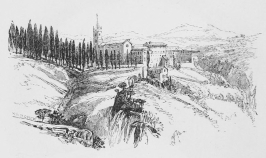
SENS. [427]
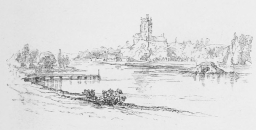
To Miss Leycester.
“Montbard, May 23, 1886.—I wonder if my date conveys anything to you? I had determined to evade this place if it were possible, yet here I am for two days at the place so connected with the agonising anxiety of our last journey, where Mother in her illness was laid flat upon the railway platform, to find, when the train was gone, that the little hotel was closed, and where she was carried through the lanes to an old farmhouse. There the people were most kind to us, and she almost enjoyed it, and dear Lea was very happy, and of its inmates both were often so anxious to hear during the after-summer of the German invasion. The old host and hostess are dead now, and the two boys, whom I saw when I went to luncheon with Mme. de Montgolfier, are married, and have twelve children between them!”
THE PARACLETE. [428]
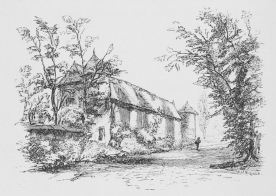
“Sens, May 28.—The weather has changed to bitter wind, but it has seemed appropriate to the wild country of Avallon and Vezelay. Auxerre is very interesting and beautiful, especially the great abbey of S. Germain and the marvellously simple and pure cathedral. Old affection for Thomas à Becket took me thence, through the sweet acacia forests, to Pontigny, since which I have been very comfortable for two nights at a charming inn close under the shadow of this old archiepiscopal cathedral.”
“Hotel Noël Peter, Paris, June 6.—I am very glad to have accomplished a long-wished-for visit to the historic sites of Clairvaux and the Paraclete, though there is nothing whatever to see in either of them! How I have worked since I have been here! My book is written, but I have to go through every part of it on the spot. I breakfast at seven and work till eleven, then luncheon and work again till four o’clock, when I come in dead-tired, only to go out again to have food at a restaurant, and to bed at eight.”
“June 16.—Two desperately hard days at Versailles and two at the Louvre, looking over and collating. Certainly no place of residence need be cheaper than Paris. Life seems to cost nothing at all, a week here being equivalent to a day in London, or even at Rome. It is an oddly lonely life, as, except for ten minutes, I have seen no one to speak to since May 11: however, there would certainly have been no time for it.”
In July I was in London, and then at Buckhurst, in glorious summer weather, to meet Lord and Lady Lathom.
Journal.
“August 13, 1886.—Two days ago Lady Ossington took me to Lady Evelyn Campbell’s wedding with James Baillie Hamilton in Henry VII.’s Chapel. They have married on his vocation, which played all the time of the ceremony, and on which their future depends for the bread and butter of life, at present supplied to them by America for looking after it. They have also a camp, in which they propose to train boys for hardships in the colonies, and the sweet little bride began her own hardships by having to walk two miles to this, through the wet grass and fern of a desolate moor, carrying in a basket the cold chicken and bread which her sisters had put up for her supper.
“I have been reminded how James Baillie Hamilton was at Harrow at Hayward’s house, which in my time used to be Harris’s, and to have then the reputation of being haunted. He told Catherine Vaughan that one night whilst he was there, Albert Grey, also a senior boy in the house, rushed into his room wild with horror, and said that when he was in bed he had seen by the moonlight a most terrible figure come in, a kind of nondescript, and that as it approached a chill as of death came over him. Eventually it had seemed to go into a corner of the room and disappear there. Something was arranged for Albert Grey for that night, and the friends never told at Harrow what had occurred. Years afterwards, at his camp, Baillie Hamilton met a boy called Anderson, who had been in Hayward’s house. He told how he and another boy slept in the same room. One night he heard his companion in an agonised tone say, ‘Oh, do light the candle: there is something most dreadful in the room.’ He lighted it, and found his friend sitting on the edge of his bed, trembling from head to foot. He said that the door had opened, and a horrible nondescript figure had come in, when the most terrible chill, as of death, had come over him. After a time, all seeming as usual, the boys put out the light. They had hardly done so, when Anderson himself saw the figure—the appalling figure, come towards him, and the same deathly icy chill seized him. They lighted the candle again, when the apparition vanished.
“One of the curates at Llandaff was going to the place where Miss Hayward, sister of the Harrow Master, lived, and Catherine asked him to inquire if she remembered the circumstance. ‘Yes,’ she said, ‘that is exactly what happened; and that room is never used now.’
“On the evening of the wedding-day I went to Chichester, where the Bishop’s palace, venerable and grey, but buried in myrtles and coronillas, and radiant with brilliant flowers, lies close under the shadow of the beautiful cathedral spire. The Bishop (Durnford), at eighty-seven, is the very type of a christian scholar, perfectly charming in conversation, equally at home in classical and in French, English, and Italian reminiscence and quotation, and touchingly filled with a generous and kindly spirit to all he meets with. Circling around him were various relations, a brother-in-law—a pleasant old clergyman Mr. Keate, nieces, two sons, Dick and Walter, the latter the pleasantest and frankest of young Eton masters, and the daughter, Miss Durnford, who is mistress of the house, and whose active energy makes all right wherever she goes, and very cheerily right too. The profuse family use of adjectives and verbs, which they unearth for themselves, was very entertaining. ‘We seem to be going to have a regular Belshazzar,’ said Walter Durnford when something more than usual appeared for luncheon.
“There is much to interest in the palace, which has a charming early English chapel and a grand old kitchen. The cathedral retains the human interest of its old pavement and a few tombs, sadly mutilated or tinkered up: one of a Lady Arundel is very fine. There are curious paintings of Cadwallador and of Henry VIII. giving charters on one of the walls, by a painter of Henry VIII.’s time, who also decorated the ceiling of the very fine old dining-room in the palace. Round the town, much of the old wall remains, making a pleasant walk; but the most curious building is St. Mary’s Hospital, like a church, with a great single nave divided at the sides by chapels, which form the little two-roomed houses of ten old women, presented by the Bishop and custos, who live there rent-free in great comfort, with firing, and twelve shillings a week for their maintenance. At the end is the chapel, only separated from the rest by an old oak screen.
“With the Bishop and his party I went to Midhurst, a most attractive old town in lovely country, and we walked through an ancient wood above the Rother to the grand ruins of Cowdray, full of recollections of the Poyntz family, who, as its possessors, came in bitterly for the curse of sacrilege. When Mr. Poyntz went out in a boat at Bognor with his two sons, and the boat upset whilst Mrs. Poyntz was watching it from the hotel-window, the boys clung to the tail of their father’s coat as he held the side of the boat in the waves, and he—who could not swim—had the agony of feeling one after the other leave go and sink, without being able to help them. He himself was eventually saved by the boatmen. In the church of Easebourne, which stands in the park, near the fine old building called the Priory, is a touching tomb by Chantrey, erected to this Mr. and Mrs. Poyntz by their three daughters—Ladies Clinton, Exeter, and Spencer. As they were co-heiresses, Cowdray was obliged to be sold, and was bought by the Egmonts.”
“Highcliffe, August 25.—I arrived here for my usual happy summer week with Tina, Lady Waterford, who has been a curious contrast to the lady of the place, but in herself very pleasant. She described how Cromwell, determined to take ‘the golden vale of Tipperary,’ said he would take it ‘by Hook or by Crook’—the two villages on either side the river—and thence the proverb.
“There has been a bee-show on the lawn here, Mr. Bellairs and young Evan Maberly going amongst the bees, taking them up, and treating them just as they pleased; but it looked horrible when their hats were covered with a crawling mass, and bees were hanging to nose and ears.
“Lady Jane Ellice says that at Harewood there is one of the most splendid collections of china—quantities of it. Formerly it all used to be kept in the gallery in which the family live, on bureaux, tables, &c. One evening it was all left in its usual place, and the next morning the whole collection—everything—quite unbroken, was found on the ground. There was never the least explanation. The china has ever since been kept in cases.”
“Lychett Heath, Poole, August 30.—My visit at Highcliffe was a very happy one. ‘We have not had a single quarrel, scarcely even a dispute,’ said Lady Waterford when I came away.
“This is the beautiful house of the Eustace Cecils. The modern house is exquisitely placed amongst sandy, heathery hills, with a lovely view, across a rich wooded foreground, of the various reaches and windings of Poole harbour. I have had much pleasant talk with Lord Eustace, and like him immensely. We had a delightful excursion to-day, taking the train to Wool, and then driving in a car to Lulworth Cove, and walking up the fine wild hills, with noble sea-views, behind it. Then we went on to Lulworth Castle, stern and stately, quadrangular with round towers at the corners, standing on a terraced base, with beautiful park and woods around. We saw the pictures, a few good family portraits of the Welds, and Charles X.’s room which he inhabited when in exile.
“Thomas Weld of Lulworth, who took orders after the death of his wife, became a bishop, and finally (1830) a cardinal. As a layman he had been perfectly devoted to hunting, and, on establishing himself at Rome, the first thing he did was to procure a very nice horse and hunt vigorously. The Pope (Pius VIII.) sent for him and said, ‘Cardinals must not hunt.’ So, for his health’s sake, Cardinal Weld took to a vehement course of walking; but the Pope sent for him again and said, ‘Cardinals must not walk’—adding, ‘If it is necessary for your health that you should walk, there is a place outside the walls where cardinals do walk up and down; you can go there.’ But Cardinal Weld died of it.
“We had tea with the Bond family and the Misses Weld of Lulworth at Binden Abbey, a Cistercian ruin, of which little remains beyond foundations near some very curious fish-ponds.”
“August 31.—I should find it difficult to say how perfectly congenial I find Lord Eustace, or how much I could look upon him as a friend. In many ways he is like Charlie (Halifax), but is no ceremony-lover. No, he says he always admires Gallio—‘such an excellent straightforward man,’—and even agrees with him on the special occasion on which we hear of him.”
“Hardwick Hall, Suffolk, Sept. 17.—I have been spending several happy days with the Lowthers at Campsea Ashe, pleasant in every way, with much agreeable conversation. One day, when it turned on the origin of words, Mr. Lowther described how the expression of ‘never set the Thames on fire’ originated in the reproach to an unenthusiastic cook, who would never set her tamise on fire.
“We went to Aldeburgh, sailing in a yacht down an estuary to a point where the sea has eaten up what was once the site of a considerable town, of which only the picturesque ‘Moot Hall’ remains, stranded on the beach. It was a still, hot, glowing day, with a sea like that of the Ancient Mariner.
“Yesterday we went to an old house, Parham Hall, which is a poem in itself. In this flat country it stands in a wide moat, in a desolate grassy hollow, surrounded by old trees, the richly sculptured oriels and gables, grey, battered, and moss-grown, rising straight from the waters.”
“Holmhurst, Sept. 26.—From Campsea Ashe I went to visit Gery Cullum, a friend I have long known, but never till lately been intimate with. One of his nieces met me at the station at Bury St. Edmunds, and brought me in a dogcart through that quaint town, past abbey gateways and the church where Mary, sister of Henry VIII., is buried, to the fine old house of Hardwick, which stands beyond a park well wooded with cedars and indigenous box, and which, with its bright flowers and sculptured terraces, well deserves the name of Allegro, as contrasted with Penseroso, the old neighbouring house of Rushbrooke.
“There is a great charm about the interior—not fine, but very large and most thoroughly comfortable—a small low hall with good portraits of James I. and Elizabeth as a child, &c.; a dining-room with family portraits; a library with curious MSS. The gardens are gorgeous in colour, and there are delightful walks beyond, with pines of all descriptions.
“The first day, knowing my love of being taken about, Gery arranged an excursion to Hengrave, a very fine old house, with an exceedingly rich front and stately garden, belonging to Lady Gage,[429] and close beside it a church filled with curious tombs.
“On Sunday we went to service at Hawsteads, where the church has fine old monuments of Drurys and Cullums, and we sat in a high James I. pew to listen to a ranting Irish preacher, who lost himself completely in the mazes of his own nonsense, and finally made us laugh by the emphasis with which he announced, ‘As it is written, my brethren, in the Duke of Bookeronomy,’ &c.
“On Monday we picnicked in the park of Penseroso, the old house of Rushbrooke, standing in a wide moat, into which a former mistress of the place, an unfaithful wife, was thrown by her husband, and upon which she is said to float nightly. Her picture hangs above the magnificent staircase, and the window whence she was thrown is pointed out at the end of a suite of desolate unfurnished rooms. The house belonged to Lord Jermyn, and, whatever his relation to Henrietta Maria may have been, two magnificent cabinets of hers are here, which Lord Bristol, to his despair, inadvertently sold, with the house, to its present possessors. Here also the church has fine tombs.
“Apropos of the dispersion of family relics, Gery told me how young Mrs. Le Strange of Hunstanton had inadvertently given away an old Persian carpet, an absolute rag, to an old woman in the village, regarding it as useless lumber. The next night she saw the most awful apparition, whom she recognised from a portrait as her husband’s grandmother, old Mrs. Styleman, looking most ferocious and diabolical. Soon an old neighbour called and said, ‘How could you venture to give away the famous carpet: you will have old Mrs. Styleman coming from the grave to remonstrate about it;’ and then it was explained that Mrs. Styleman, who had been a great heiress, and had possessed a number of beautiful things, had lived to see almost all of them dispersed and sold, owing to the extravagance of the family into which she married. At last only the carpet remained—at that time a thing of some value, and in her old age she said, ‘Now if ever you sell that, I swear before God that I will haunt you till it is replaced.’ Mrs. Le Strange bought back the carpet and laid it down in its former place, and old Mrs. Styleman has never appeared since.
“From Hardwick I went to Mrs. Robert Drummond in the lovely little black and white Upton Court of the fourteenth century, which she is renting near Eton. Over the entrance is the little figure of a monk, and in the wide porch rude old oak settees. It was a sanatorium of Merton Abbey, and the quaint old fish-tanks of the monks remain.
“We went to Ockwells, the desolate and decaying old house of the Norris’s, and finding the door off its hinges, entered, and went in and out of the deserted rooms, in one of which a coat of mail was hanging up.[430]
“And now I am at home again, furiously busy, alone, but never finding the day half long enough for all I have to do. ‘Rien ne vous serait plus laborieux qu’une grande oisiveté, si vous aviez le malheur d’y tomber. Dégouté premièrement des affaires, puis des plaisirs, vous seriez enfin dégouté de l’oisiveté elle-même.’ These are words of Louis XIV., admirable and worth thinking of.”
THE PORCH, HOLMHURST.
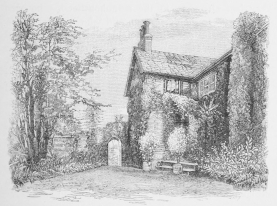
“Ickwellbury Oct. 14.—A visit to Mrs. Harvey. Parts of the house are said to date from Henry II. The Ickwell is the oak-well, a pretty bubbling spring in the garden.”
“Nov. 18.—An agreeable party at Worth (Mrs. Montefiore’s), the most luxurious of modern houses, where a bit of the Law in a little bottle is screwed upon the door of every bedroom. Mr. Algernon Tumour, who is here, stated, and considered he proved, that the average life of a five-pound note is only a single day.”
“London, Nov. 27.—Charlie Halifax says that a tenant of Carlo Milnes Gaskell (of Thornes) was found dead—murdered evidently—in one of his woods. A very bad character in the neighbourhood, who was known to hate the dead man, and who had been seen near the wood at the time of his death, was arrested and tried for the murder. All the evidence was against him, but he got off because, instead of measuring the footprints near the body and then the boots of the accused, the boots had been taken to the spot and fitted into the footprints, which allowed of its being said that they had been manufactured by pressing the boots into the soft earth. The man was always afterwards suspected of the murder, but he got work in a factory. If the subject was spoken of, he became very violent, and prayed that the devil might take him if he was guilty. One day, after he had been declaiming thus, he was caught by the mill machinery and torn to pieces. The iron claw which had caught him and pulled him in is that always known as ‘the Devil.’”
“London, Dec. 6.—Luncheon with Miss Seymour to meet Madame du Quaire,[431] who talked of the Praslin murder. She was with the old Duchesse de Grammont soon after, and Madame Alfred de Grammont was there. They began to discuss the division of money apportioned to different members of a family according to the French system, and they spoke of a member of the Praslin family whom they thought stingy. One of them added up her different expenses, ending with—‘et puis les dix-mille francs pour l’Angleterre.’ At this Madame Alfred, who is très-bête, suddenly broke in with,’ Avez vous été au Bois de Boulogne ce matin?’ ‘It was then,’ said Madame du Quaire, ‘that I first learnt that the Duc de Praslin was alive, and that they knew it.” The next day the Duc de Grammont came to call upon me, and I told him of the conversation, adding—“I know now that the Duke is alive.” He neither allowed it nor denied it. A few days after, however, the Duke came again and said, “J’ai une petite faveur à vous demander.” It was that I would never repeat to his mother what I had said to him: it might upset her. Of course I promised, but then I knew the Duke was alive.’
“‘The Duke did not wish to marry Mademoiselle de Luzy: that is an invention. He only murdered the Duchess because she was such a bore. He certainly did not wish to marry any one else.’
“Miss Seymour[432] said that the Queen of the Belgians, speaking of the Praslin murder to Mrs. Augustus Craven, said, ‘How dreadful to find one was being murdered by one’s husband: one could not even cry out.’
“Madame du Quaire was reminded of her friend Madame Solkoff, whose hair was quite snow-white whilst she was still quite young. ‘She was a Miss Childe, you know, a daughter of that Mrs. Childe who had a salon—un salon très répandu—at Paris. She eloped with a Polish Count, to whom her family objected most intensely, and she was disinherited. Very soon after her marriage it became known that it had turned out very ill, and that the young Countess was very unhappy. Eventually it became impossible for her to remain with her husband, and she went to live at Cracow with her mother-in-law, who had a very fine old palace there, and was very kind to her. She had a large apartment of her own in her mother-in-law’s house, her bedroom being approached through her sitting-room. She was still only twenty-two, when she was found one morning insensible on the floor of her sitting-room in her night-dress, and with the floor all around her saturated with blood from a terrible wound in her head. Her cabinets and jewel-cases were all broken open and rifled. The interrogatoire came, and she was examined. She said that in the night she heard a noise in her sitting-room, and going to see what it was, had found a man breaking open her drawers; that she had received a blow, and knew no more. It was in vain that she was questioned as to whom she had seen; she affirmed that she could not possibly tell who it was. But her hair was turned snow-white from that night. It was not till she knew he was dead that she allowed it was her husband she had seen.’
“Speaking of reading novels when young, Madame du Quaire said that she remembered at eleven years old reading ‘La Princesse de Babylone,’ and being found convulsed with laughter at the description of a dinner-party given by the Witch of Endor. She was described as having the guardianship of Nebuchadnezzar, who was browsing near her, and that at her party, ‘par délicatesse pour lui,’ she would allow nothing to appear which—in his unfortunate position—could wound his feelings—no beef, &c., &c.
“Madame du Quaire talked of the prevailing passion for Buddhism, and said, ‘I am not even going to attempt to believe in it, for it is not necessary to salvation: there is such a tremendous quantity that I am obliged to swallow, that I cannot possibly undertake anything—“che non e d’obligo” as the Italian priests say.’
“Madame du Quaire had met Lady Colin Campbell at dinner and sat opposite to her, but she did not know her. She could not help being attracted by the necklace she wore, it was so very extraordinary. After a time it seemed to be moving by itself. She fancied at first that this must be a delusion, but, putting up her glasses, she certainly saw the necklace writhing round Lady Colin’s throat. Seeing her astonished look, Lady Colin said, ‘Oh, I see you are looking at my snake: I always wear a live snake round my throat in hot weather: it keeps one’s neck so cool;’ and it really was a live snake.”
“Dec. 8.—Sat by Sir George Dasent at breakfast. A Mr. Frere passed through the room. ‘He comes from Roffham,’ said Sir G., ‘one of those places of which the name has such a rough East Anglian sound, and he is member of the family which possessed the Paston Letters without knowing it. There were six volumes of letters. Two of them were sent up, by request, for Queen Charlotte to look at, and they were lost. She was very accurate herself, that old woman, especially about things that were lent to her, and there is no doubt that she had given them to one of her ladies to return: anyhow they were lost. Afterwards, however, duplicate copies of many of the lost letters were found to be still in the possession of the family, and their existence quite disproved an assertion that the letters had been forgeries.
“‘They were wonderful people, those old Pastons. They used to thrash their daughters like anything if they did not behave themselves, and then, when they had flogged them well, they would say, “And now they must have silk dresses, rich, red, and beautiful!”’
“Dec. 9.—Dined with M. B., who told me of Lady Vane[433] being quite worn-out by the ghastly noises at their place in Cumberland: it was as if some one were always trying to climb up a disused chimney in the wall, and then falling violently down again. But lately, when Sir Henry Vane was away, she had the wall opened. Inside she found a wide and very lofty closet, narrowing into a funnel as it reached the roof, where it opened by a very small hole to the sky. In it were human bones, a broken water-bottle, and the cover of an old Bible, which bore a date. Lady Vane had the bones gathered up and put into a box, which was left in a corner of Sir Henry Vane’s room till his return.
“When Sir Henry Vane came home, he was exhausted by a long journey and went at once to rest. Lady Vane did not intend to tell him of her discovery till the next day. But suddenly, late in the afternoon, she heard a tremendous noise in her husband’s room. She rushed in, and found Sir Henry in a state of the greatest agitation. He said, ‘I have seen the most frightful apparition—a woman in that corner,’ pointing to where the box of bones had been deposited.
“From old family archives they found that, some years before, exactly at the date upon the Bible cover, a woman had been walled up in the house. She had made desperate efforts to escape up the funnel of the disused chimney, and had always fallen down again. Sir Henry and Lady Vane themselves buried the bones in the churchyard, and the house has been at peace ever since.”
“Thorncombe, Dec. 13.—Miss Montgomery is here, a lady of the most impassive countenance, though she is the authoress of ‘Misunderstood.’”
“Warwick Castle, Jan. 30, 1887.—A delightful visit to this beautiful place. I came off suddenly on a telegram from Lady Warwick,[434] and found several pleasant people, besides the family. More than ever have I been charmed by Lady Warwick, who has the rarest of all attractions—absolute simplicity, and ‘rien n’est difficile comme le simple,’ as Madame de Maintenon used to say. Then most glorious in position is the castle, with the river close underneath, so that the family feed the swans daily from the aërial balcony outside the breakfast-room window. Pilgrim-visitors constantly pour through the rooms with the pictures, of which the finest are a grand Morone, and a Raffaelle finished by Ghirlandajo. The visitors are conducted through the rooms by the housekeeper, who is a great character in her way. When the Prince of Wales was here, she showed him a relic which ‘belonged to King James III.’—‘Ah! the old Pretender,’ said the Prince. ‘We do not think so, your Royal Highness,’ she replied very stiffly. The pictures at Warwick are a real enjoyment, not only important and valuable, which is generally thought enough, but each individually lovely and suggestive. And the happy family life is perfection—such a sharing of interests, the hunting sons not entirely engrossed by it, and no single member of the family talking scandal or looking for motes in their neighbours’ eyes. The old town is charming, with the Leicester hospital, and the great church, chiefly renaissance, but with a fine gothic choir. One evening there was a dance, and after it Mrs. Bob Lyttelton (Miss Santley), who lives in the town, sang most gloriously.
“We have driven to see the exceedingly curious old house of Badeley Clinton, of which my distant cousin, Mr. Dering, has married the widowed owner. It is a most singular and poetical place, and there are many curious stories about it. Handsome, refined, and naturally, not affectedly, poetical and picturesque, Edward Dering is wonderfully suited to the place, and its very solitariness facilitates his leading a life there of almost mediaeval saintliness.”[435]
On the 26th of February 1887 I left England again for my French work, and spent a month in Paris at a primitive and economical inn in the Rue d’Amboise. Living here, I spent my days entirely amongst the historic quarters, seeing nothing of the Boulevards or Rue de Rivoli, but making great progress with a work—my “Paris”—which had no interruptions, and in which I became increasingly interested as I knew more of my subject. On the fine days of early March many excursions were very pleasant, involving long walks to the Abbaye du Val, Nogent les Vierges, &c. Unfortunately the weather changed before I set out on a tour through the Bourbonnais; and in Provence, where many long excursions were necessary, the mistral was quite terrific. Mounting into the wild fastnesses of the Maritime Alps above S. Maximin, to visit the cave in which the Magdalen is believed to have died, I caught a terrible chill, from which I was afterwards very ill at Manosque. But the kindly though rough proprietors of the inn—M. and Mme. Pascal—persuaded me to try the remedy of taking no nourishment whatever except hot tea, and letting nature lie absolutely at rest for forty-eight hours, and, as often since, I found this quite answer, though during that time I drove in an open carriage for eight hours to visit the Roman remains at Riez.
RIEZ. [436]
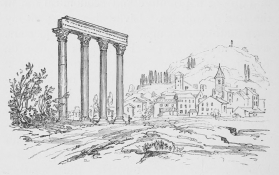
GRIGNAN. [437]
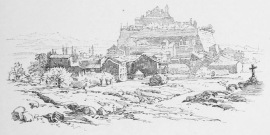
To Miss Leycester.
“Avignon, April 3, 1887.—It has been a suffering week, owing to the biting, rending, lacerating mistral, which has seemed perpetually to tear one’s vitals inside out, and to frizzle them afterwards. Thursday I went by rail to Montelimar, and then in a carriage with a horse which either galloped furiously or would not go at all, over the sixteen miles of mountain-road to Grignan, where Madame de Sévigné lived so much with her daughter, and where she died. It is a really grand and striking place—the immense château rising on a solitary rock, backed by a lovely mountain distance, and the town at its foot surrounded by cork forests. All was ruined at the Revolution, but the shell of the rich palace-castle remains—‘un château vraiment royal,’ as Madame de Sévigné calls it. In a solitary spot near is the cave, with old ilex-trees, where she used to sit, and, even with blinding dust and wind, the colouring was most beautiful.
CLOISTER OF CAVAILLON. [438]
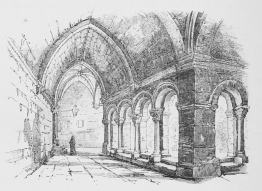
“On Saturday, I had to spend five hours at Cavaillon, and wondered how to dispose of myself. But, on reaching the cathedral, the whole population was pouring in to take part in the funeral of a famous doctor who had been a great benefactor of the place. Every one there was presented by the family with a huge wax-candle, as long as a walking-stick, and asked to ‘assist.’ I had one, and walked and stood with my burning candle for two hours! It was a striking sight, thousands taking part, and the old bishop pronouncing the elegy of the deceased, whom he described as quite a saint. But oh! how it poured, and blew, and swelched, and how deep was the white mortar-mud of Provence!”
“Arles, April 13.—The visit to this place—perhaps more than any other connected with happy days of our long-ago travels, and which I have always avoided hitherto since I have been alone—has unexpectedly proved a great pleasure. And I am glad, now I have seen so much, that I still think Arles by far the most interesting place in the south of France, and the excursion to Montmajour and Les Baux, which I made again on Saturday, quite incomparable—the former, as far as I have seen the world, one of its most beautiful ruins, the latter so glorious as to scenery. Yesterday there was what the French call a bull-fight in the amphitheatre, but there is nothing terrible: no horses, only men enticing bulls with handkerchiefs, and when they run at them, vaulting like chamois over the barriers; while the arcades of Roman masonry are filled with vast multitudes, chiefly ‘belles Arlesiennes’ in their picturesque costume—a very fine sight.”
MONTMAJOUR. [439]
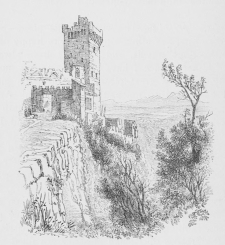
LES BAUX. [440]
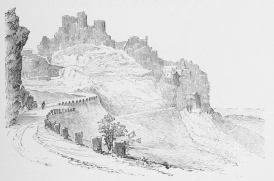
“Aix in Provence, April 15.—All Provence, as you perhaps know, is full of the same very early Church legend, that a number of the earliest Christians, escaping from Jerusalem after the Ascension, landed here on the coast and became the earliest missionaries of Gaul. Of these, Mary Salome and Mary Cleopas are supposed to have stayed at Les Saintes Maries in the Camargue, Lazarus to have gone to preach at Marseilles, Restitutus at S. Restitut, Maximin at S. Maximin; but Mary Magdalen went farther, spent years of penitence, and died in a cave at the top of the mountains, which is certainly one of the most curious places of pilgrimage in Europe. So it was to La Sainte Baume that I went yesterday, starting at 6 A.M. by rail to S. Maximin, and there engaging a carriage to Nant, where the road comes to an end. Thence it is an ascent of an hour and a half through the steep lonely rocky forest, covered with blue hepaticas, over stones, rocks, and quagmires. Near the top it began to hail and rain furiously, and the cold was most intense, snow still lying in great masses; but the cave is very curious, and the view magnificent over the lower mountains, beyond the masses of Alpine forest. How it poured! I sheltered at the worst times under some rocks, and got safely down to the sunlit valley about five, then had to wait at S. Maximin till nine o’clock for a train, and did not get back here till nearly one.”
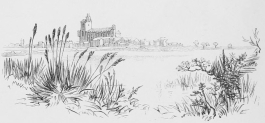
LES S. MARIES DE LA CAMARGUE. [441]
LA SALETTE. [442]
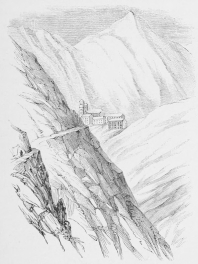
“Grenoble, April 22.—On Wednesday evening, after returning from Briançon to Gap, I engaged a carriage thence to Corps, at the foot of the mountain of La Salette. It was supposed to be three hours’ drive, but took five and a half hours, and we did not arrive till nine o’clock, having spent the last two hours in pitch darkness, with a single lanthorn, driving along the edge of the most terrific precipices, with a driver who had never been there before! Still we arrived at last at the very miserable inn. On Thursday morning I set off early on foot to La Salette, three hours of weary steep ascent of the mountains, rather fine in their snowy solitudes, but affording just a slight panic to a solitary traveller owing to the bears which still prowl about there. In the latter part of the way the snow was above my waist, but a little gulley (turned into a watercourse from the meltings) was cut through it. When at length I reached the convent, I was received with great astonishment, as no one had visited those solitudes since April 6. All around, and up to the first floor of the building, was deep massy snow, not a rock to be seen. I was comfortably fed, however, and saw the strange place to which 15,000 pilgrims come annually. You know the story, how two children declared that the Virgin had appeared to them, and told them that the bad language of the neighbouring villages was so shocking that she could no longer restrain the avenging hand of her Son unless a church was built. You will remember how Madame de Trafford never varied in her account, that she was herself botanising in those mountains in one of her eccentric expeditions, and came suddenly out of a fog upon two children, to whom she spoke of the shocking language she had heard, saying it was sure to be punished, and why was there no church? &c.: then the fog became very thick again, and when it cleared, the children were gone.”
“Cambrai, April 30.—How I thought of you to-day when I was by the tomb of Fénelon, which has a striking statue. But how ugly, how treeless, how black with coal-dust is all this north-east of France. I always imagined the Ardennes were pretty, but the beauty is only in the Belgian part. Nothing can be more frightful than Sedan, Charleville, Mezières, Valenciennes, and this place is also hideous; though perhaps all has looked worse than usual under a black sky and incessant rain.
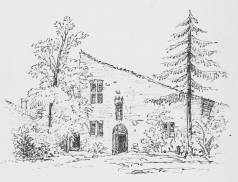
“On Thursday I saw Domremy, which is well worth a visit, and can be little altered from the time of Jeanne Darc. Seen across the flat meadows, backed by a low range of hills like Hawkestone, and with a winding stream (the infant Meuse) like the Terne, it is really a little like Stoke. The mere hamlet ends in the little church, hung all over inside, and very prettily, with wreaths and banners, sent from all quarters in honour of Jeanne; and close by is her quaint old cottage, carefully preserved, with some of its old beams, an ancient armoire, &c., and its original garden. It is now in the hands of Sisters of Charity, who manage an orphanage joining her garden and established to her memory.
DOMREMY, VILLAGE STREET. [443]
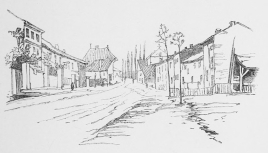
“It is really a great reward for many misères de voyage that I have now seen almost everything in Eastern France, and may soon think of publishing that part of my work.”
HOUSE OF JEANNE DARC. [444]
EMBRUN. [445]
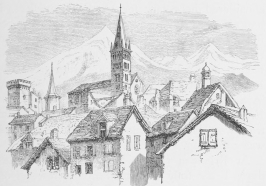
During the latter part of this French tour I had an unpleasant adventure, which excited more attention than I ever anticipated at the time. On April 19 I had gone from Gap to visit Embrun, a curious little town in the Alpes Dauphinoises. I had not long left the station before I was aware that I was watched and followed wherever I went. However, at last I contrived to dodge my pursuer, and made, from behind a wall, the sketch of the cathedral which I wanted, and then had dinner at the hotel. When I was returning to the station, separated by a desolate plain from the town, I saw, by the faint waning light, the same figure following wherever I went. It was dark when the train by which I was to leave was to start. I had taken my place, and the train was already in motion, when it was stopped, and an official accompanied by a gendarme entered the carriage and demanded what I had been doing at Embrun. “Visiting the cathedral.” “Why should I visit the cathedral?” and so on, through a long series of questions of the same kind. My passport was demanded, and, though not usually considered necessary for English travellers, I happened to have one. It was, however, refused as an identification, not being dated in the present year. Fortunately, I recollected having in my pocket-book an order from the Préfet de la Seine authorising me to draw in all the palaces in Paris and elsewhere in France, and this was considered sufficient. The train was allowed to move on just as a crowd was collecting.
CHÂTEAU DE VIZILLE. [446]
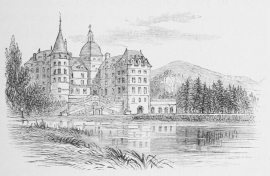
At Briançon (where I spent the following day), I carefully abstained from drawing, as it was a fortified town. But on April 23 I left the station at Vizille to visit the old château of the famous Lesdiguières, two miles distant. I had seen the château, and began to occupy the quarter of an hour which remained before the omnibus started for the station by sketching it from the village street, when I was pounced upon by a gendarme. “Who has authorised you to sketch the château of Vizille?”—“No one.”—“If you can draw this, you may also have drawn other places. You will go with me to the gendarmerie;” and I was marched through the long street of Vizille, followed by a crowd, and with the hand of the gendarme occasionally grasping me by the shoulder. At the gendarmerie a superior officer appeared, and, with the most extreme insolence of manner, demanded what I had been doing in France, &c. “What had I drawn?”—“Churches and mountains.”—“Ah! mountains! then it has been very easy for you to make a little mark in the drawing, known only to yourself, meaning here is a fortress, and there a fortress.”—“But I am an Englishman.”—“Oh, you are, are you? Then I am all the more glad that we have taken you, for we shall probably soon be at war with England, and then you will make your sketches useful to your Government; so you will consider yourself under arrest.” The letter of the Préfet de la Seine was treated as worthless because it had no seal. The passport was rejected altogether with contempt. After this, all further protestations and remonstrances were answered by an insolent shout of—“Taisez vous donc, vous êtes en état d’arrestation.”
Then the first gendarme was sent with me to the station, where my portmanteaux were opened and ransacked, the contents being tossed out upon the platform. Two suspicious articles were found. First, a slight sketch of the gorge at Sisteron (not the fort; the fort is on the other side of the rock), and, far worse, three volumes of the Guide Joanne for France. “What did I want with guidebooks?”—“To study the country.”—“Ah! that is just what I thought;” and all the officials of the station were called in to witness the discovery. The gendarme then declared that I must return with him and be locked up at Vizille, but a train coming up at that moment, I made a dash into it, and probably thinking a public scrimmage impolitic, the gendarme allowed the station-master to fasten my boxes and bring me a ticket. The gendarme then took his place opposite to me in a first-class carriage.
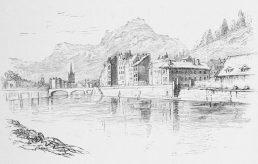
QUAYS OF GRENOBLE. [447]
At 5 P.M. the train arrived at Grenoble. At the station the gendarme of Vizille summoned a gendarme of the town, and I was conducted as a prisoner by the two to the Hotel Monnet. The gendarme of Vizille then left me in care of the other, shut up in a room of the hotel, where the gendarme of Grenoble sat silent opposite to me till 6.30. I thought that then the other gendarme would come back from the Préfecture with an order that I was to be freed from further annoyance. Not a bit of it! He came back with an order that all my possessions were to be carefully ransacked, and all the contents of my boxes were turned out upon the floor. All suspected articles—all my sketches, manuscripts, letters, and all the volumes of the Guide Joanne were then put into my smallest portmanteau, which one of the gendarmes carried, and I was marched between the two to the old palace of the Dauphins, where the courts are. Here two clerks (or secretaries of the Préfecture) subjected me to a long examination—who I was, what was my employment, where I had been, &c. The English letters found in my blotting-book (ordinary family letters) were translated into French by a clerk who understood English. All my drawings (chiefly of church architecture) were examined in detail, and their objects inquired into. The terrible Guides Joanne were passed in review and, after an hour, I was told I was free, but without a single word of apology or regret. Indeed, I should not have got away then if at last one of the clerks had not said in his insolent manner, “Est que vous êtes donc un tel, qu’il n’y a une seule personne dans toute cette partie de la France qui peut répondre de vous?” And goaded to desperation I answered, “Well, yes, there is one person, it is a lady; she is only a few miles from here now (at Aix les Bains): it is the Queen of England.” On parting, the gendarme of Vizille was told in my presence that he had only done his duty in arresting me for having ventured to draw the Château of Lesdiguières; and he left, carrying off in his pocket (by accident no doubt) a sealed packet which he had taken from my dressing-case, saying, “Nous allons ouvrir ça devant ces messieurs, ça doit être des instruments pour tirer des plans.” I called the next day upon my examiners to ask them to obtain restitution of the packet, but they declined to take any trouble. One of their comrades, looking up from his writing, said insolently, “Puisque vous avez été arrêté hier, est-ce qu’on ne vous a encore condamné?”
I wrote this story in the train, and posted it at one of the stations to the editor of the Times, who inserted it in the paper, so that when I reached home I found England ringing with it, and a question asked in the House about it. I also complained to the Foreign Office, and Lord Salisbury sent me afterwards the French answer to the inquiries made. They allowed the facts of the examination, but denied that I had ever been arrested, though the leading feature through the whole had been that whenever I attempted to speak I had been silenced by a shout of “Taisez-vous donc; rappelez-vous donc que vous êtes en arrestation.” The sealed packet was never restored.
I returned home on May 3, and at the beginning of June was at Scotney Castle.
Journal.
“Scotney, June 1, 1887.—We have been for the day at Glassenbury, the old moated house of Mr. Atkin Roberts, in a wooded hollow of the hills, surrounded by fine old trees, but of damp and dismal aspect. There is a lime avenue there, haunted by a lady—once Miss Roberts—who is always looking for her husband, for as she was riding away with him down the avenue on their wedding-day, he was thrown from his horse and killed on the spot. She never afterwards left the paternal home, where there are pictures of her, unmarried and as a widow. Some hundred years ago the last Roberts of Glassenbury had only daughters, and of these the last married the then Duke of St. Albans. The Duke was a gambler and a spendthrift, and sold all her fine things—her diamonds, her plate, her china; but she was determined that he should not make away the place, and that she would leave it to those who would take care of it; the question was—to whom?
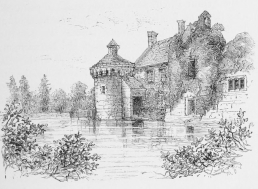
SCOTNEY CASTLE. [448]
“One day she had sent for a painter to come to Glassenbury to paint a coat of arms on her carriage, and, when she showed him the arms, he said, ‘Why, your Grace, those are the very arms I was employed to paint at a place in Ireland, to which I went quite by accident, having been shipwrecked on the coast close by.’ The Duchess inquired, and found that the people in Ireland, for whom he had painted the arms, were very distant relations, and she settled the property upon the Irish Colonel Roberts, who left it to the present owner, his nephew, formerly Atkin.
“Sir Arthur Birch, who has some high appointment at the Bank of England, has lately been at Scotney, full of a very singular circumstance. He had two clerks, an elderly Mr. Sperati and a Mr. Lutwich, and they were very intimate friends. One Whit-Monday evening, as he was sitting with his wife by the fire in his house in Burlington Gardens, Mr. Lutwich, with a very scared look, bade her mark the exact time, ‘for,’ said he, ‘I have just seen Sperati; he has just appeared in this room, as distinctly as I ever saw him in my life. He wore a very old coat of his, which I know quite well, and had a very peculiar silver-knobbed stick in his hand; I am certain he is dead, and I must go to his house and see.’
“But the wife urged him so much not to go then, and to wait till the next morning, that he assented.
“As he was on his way in the morning to Sperati’s house, he met Sperati’s brother, who said, ‘I was on my way to tell you sad news; my brother died last night at nine o’clock, very suddenly, of heart-disease.’ It was exactly the hour at which Mr. Lutwich had seen him.
“Mr. Lutwich went on to the house, and saw the butler, whom he knew well. He said, ‘I have an especial reason for asking about an old coat which I remember well, and which your master use to have—has he worn it lately?’—‘Well, it is strange you should ask about it, sir, because, though he has not worn it for some time, he had it on last night.’—‘And do you remember what stick he had in his hand?’—‘Yes, perfectly, sir, it is in the hall now,’ and it was the very stick with which he had appeared.
“Mrs. Papillon had been telling the Husseys of a very famous female mesmerist living in Park Street. Late one night this person had a visitor who urged her very much to consent to go at once to a mysterious patient, to whom she could only travel blindfolded. She hesitated for some time, but finally, being very much urged, she assented. A well-appointed carriage was at the door, in which she was driven to the railway. In the train she was blindfolded. Several hours were passed in travelling by train. Then she was taken out to a carriage and driven for some distance. On arriving at a house, she was led up a staircase and into a large room. As her bandage was removed, she saw two ladies in black just leaving the room. A gentleman was lying in bed, very dangerously ill of typhoid fever. She mesmerised him and he fell asleep. When he awoke, a great change for the better was perceptible. He said, ‘I feel better; I could drink a glass of beer.’ She said, ‘Give him the beer.’ He drank it, and fell into a restful, natural sleep.
“Then the lady was blindfolded again and conveyed back in the same way in which she came. When she reached her own house in Park Street, a cheque for a very large amount was left in her hands. The next day she read in the paper that the Prince of Wales—then most dangerously ill at Sandringham—had rallied, and fallen into a deep natural sleep from the moment of drinking a glass of beer.
“Mr. Hussey told me that an old Mr. and Mrs. Close of Nottingham were very rich and great misers, and they both made wills leaving all they possessed each to the other. However, as they died within a few hours of each other, that made very little difference to anybody.
“When the heirs-at-law arrived at Nottingham—young people full of spirits—they were greatly excited and brimming with curiosity. It was known that there were splendid diamonds, and that vast wealth of every kind existed, but at first nothing seemed to be forthcoming. Cupboards and drawers were ransacked in vain. Nothing particular was found.
“At last, in a room at the top of the house a great trunk was discovered. ‘Here,’ they said, ‘it all is; we shall find all the treasures now.’ But when the trunk was opened, the upper part was found to be full of nothing but scraps of human hair, as if for years the off-scourings of all the old hair-brushes had been collected; then below that was a layer of very dirty old curl-papers; and the bottom of the box was full of still more dirty old corsets of ladies’ dresses, and—the box was alive! When young Mrs. Close had dived into the box, she exclaimed, ‘What disgusting old creatures our relations must have been! This horrible mess might infest the whole house; we must have it burnt at once.’ So she had some men up, and the trunk carried down into the courtyard of the house, and a huge bonfire made there, and the trunk upset into it.
“As it was burning, she stood by, and heedlessly, with her stick, pulled one of the curl-papers towards her, and poked it open at her feet. It was a £50 note! In an agony, she scrimmaged at the fire, and raked out all she possibly could, but it was too late; most of the notes were burnt; she only saved about £800.
“Naturally her husband was furious, and of course he was very unjust. ‘Any one but you would have examined the box carefully; there never was such an idiot of a woman,’ &c. And every time he saw the burnt heap in the courtyard, he burst forth afresh. So she sent for the dustman round the corner, and had all the ashes carefully cleared away.
“Still nothing had been found of the diamonds. They had certainly existed; there were always the diamonds to fall back upon. But though they searched everywhere, nothing could be found of them. At last they asked the only old lady with whom Mrs. Close had visited if she knew of any one who could help them. ‘Yes, certainly,’ she said; ‘there’s old Betty Thompson at the almshouses, she was always in and out of the house as charwoman; she knew more of Mrs. Close and her ways than any one else.’ So away they went to the almshouses, and asked Betty Thompson. ‘Oh yes,’ she said, ‘she knew very well that there were diamonds, very fine diamonds indeed, but small good they ever did to old Mrs. Close, for she always kept them sewn up and hidden away in her old stays.’
“The stays had all perished in the fire; the diamonds would not have burnt, but then the very ashes had been thrown away; there was no trace left of them. The bank-notes were all very old—the few that were saved—but they were quite good; but there was very little else left of the great inheritance.”
To Louisa, Marchioness of Waterford.
“Jermyn Street, June 16, 1887.—London is in gala costume, the streets flooded with flowers, and the West End thoroughfares lined by stands, with seats covered with red and gay awnings. I am perpetually thinking of what Arthur Stanley’s ecstasy would have been on looking forward to having so many kings and queens, besides no end of other royalty, in the Abbey at once. On Saturday I was at Osterley, where the gardens were quite lovely and delicious in the heat, and yesterday there was a pleasant party at Lord Beauchamp’s, with little comedies to amuse Princess Mary, who was exceedingly gracious and kind to me.
“Alas! we are expecting the news of Theodore Walrond’s death—a man apparently as healthy in body as in mind till his last illness set in, and quite universally beloved.”
“June 17.—Yesterday I had luncheon with Miss Geary at her very pretty house in Grosvenor Street, and met Lady Elgin and a charming, fresh, sensible Miss Boscawen. I dined at Lady Manners’, where I made rather friends with Lord Apsley: afterwards there was a large brilliant party at Mrs. Portman’s.
“To-day my two young American friends, Sands and Martin, gave a most pleasant luncheon. I sat by Lady Middleton, who talked charmingly and gratefully of the happiness of married life—the pleasure to a woman of entire self-renunciation: then of her own life, which she would not exchange for any in the world, though she has had to give up all her own inclinations, and to throw herself absolutely and entirely into the interests of hunting. She said she never allowed an ill word on the field, and if she heard one, rode even for miles till she caught up the culprit to say so.”
“June 19.—Lady Dorothy Nevill has been most funny about a burglary at Lady Orford’s. While the family were away, a man came to the door, who said he was sent to measure the dining-room chimney-piece, and asked the old woman who was taking care of the place to go up to the top of the house to get him a piece of tape for the purpose. When she came down, the man was gone, and so were two of the best pictures. ‘I could swear to the pictures anywhere,’ said the old woman afterwards, ‘for they were of members of the Orford family.’ ‘They were the Virgin Mary and St. Sebastian,’ added Lady Dorothy, ‘and I leave you to imagine how far they were ever likely to have been members of the Orford family!’
“At breakfast I sat by Sir George Dasent. I spoke of his wonderful memory. He said, ‘When I was a boy, my father saw me writing—writing with a pen was never a strong point with me—but still I was busy at it, and he asked me what I was doing. I said, “Writing down what I’ve read.”—“Don’t write it down, my boy,” he said; “carry it all in your head; it is much better,” and I have always done so.’
“He spoke of the folly of interfering in any street rows. ‘It had been a wet day, and you know when the pavement is wet—why I cannot tell—you can see much farther than at other times, and down the whole length of Eaton Place I saw a man knock a woman down; she got up, and he knocked her down again. He knocked her down several times running. At last I got up to him and said, “You villain, to knock a woman down like that; how can you dare to do it?”—“Now you just go along with you,” said the woman; “he only gave me what I deserved.”—“Oh, if you like being knocked down, it’s another matter,” I said.’
“‘One day in the street,’ he related, ‘I passed a party of Germans abusing each other with most outrageous language, and I said, “Remember there are police here as well as in Germany.” When I got near St Peter’s Church, I was aware that one of the Germans was following me, and he came up and said, “I am come to demand satisfaction.”—“Very well, you shall have satisfaction,” I said, and I beckoned a policeman from the other side of the street, who came across saying, “What can I do for you, sir?” for all the police know me. So I said, “You will just take this man up, and I will go with you and appear against him.” So we went on our way, the policeman, the German, and I. When we had gone some way, the policeman said, “It’s giving you a great deal of trouble, sir, isn’t it, to go to the police-station; couldn’t we manage it here?’ So I said, “Yes, perhaps we may as well try him here. If he kneels down in the gutter in the mud and prays for forgiveness, we will let him off.” So I said in German, “He (the policeman) says that if you kneel down in the gutter and beg for forgiveness, he will let you off.”—“May not I kneel on the pavement?” he said. “No, that will not do; you must kneel in the mud, with your hands up so. “So down in the mud he went and said, “I am very sorry for vat I have done,” and we let him go.’
“Chief-Justice Morris said he was sitting on the bench in Ireland, and after a case had been tried, he said to the jurymen, ‘Now, to consider this matter, you will retire to your accustomed place,’ and two-thirds of them went into the dock.
“Another time he said to a culprit, ‘I can produce five witnesses who saw you steal that cow.”—‘Yes,’ said the prisoner, ‘but I can produce five hundred who did not.’
“Sir George Dasent said he should not go to the Abbey on the Jubilee Day. His legs were so infirm now, that a touch would upset him, and, when once down, he could not get up again. He had once been knocked down by a newspaper—‘retributive, you might say.’”[449]
“June 20.—The streets are all hung with scarlet and blue draperies, and Waterloo Place is embowered in a succession of triumphal arches. The crowds are tremendous. The foot-passengers have already expelled the carriages from the principal thoroughfares, and two million more people are expected to arrive to-day.
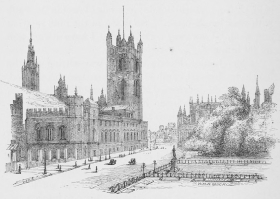
AT WESTMINSTER. [450]
“I dined last night with Charlie Halifax, meeting Lady Morton, the Arundel Mildmays, and Sir Hickman Bacon—a pale frail youth, so High-Church that he could not take part in any Jubilee gaieties whilst —— (one of their especial clergy) was imprisoned. Charlie was very funny in his tantrums against the bishops. ‘I hate them all except Lincoln, and—as cowards—I despise them.’ He said he would not go to the service in the Abbey, because he considers it desecrated by having seats erected over the altar!”
To Miss Leycester.
“June 21, 1887.—Nothing can have been more sublimely pathetic than the whole ceremony (of the Jubilee)—more inexpressibly touching and elevating. The Abbey, too, did not look spoilt: all the tiers of seats, all the galleries disappeared utterly: nothing was visible between the time-worn pillars and under the grey arches but the masses of people they contained.
“I went at 8 A.M. It was not a moment too soon. Cabs charged two pounds to the Abbey, but I walked very comfortably. The tickets had little maps of the Abbey, with the entrance for the bearer marked on each. Mine was by a door on the north-east behind St. Margaret’s, and there I waited, with a small crowd, till nine struck, and some iron gates were opened by the police, when we ran down an awned passage to where a staircase of rough timber led up by the great Norris tomb to our places.
“Mine was simply perfect, a splendid place, from whence—
‘To see the lords of human kind go by,’
as Goldsmith says. I would not have changed it with any other in the building. In the theatre it would have been the royal box—a little red gallery to hold four, over the tomb of Aylmer de Valence; in front of the gallery on the left of the sanctuary; close above the princesses of Austria, Spain, and Portugal; opposite the kings; with a view of the peers and peeresses in the right transept, and so near the Queen that one could see every play of her expression. My companions were a doctor of music in his red gown and two females of the middle class, who were very good-natured in lending me their glasses.
“The time of waiting did not seem long: all was so full of interest.
“The Abbey blazed with colour—crimson uniforms, smart ladies, ushers stiff with gold embroidery, yeomen of the guard in plumed helmets. Only, for another coronation, I would clothe the supporting pillars of the galleries with red cloth. The grey wooden supports looked cold, and their angular outlines drew attention to them amongst the rounded forms of the pillars, whereas the red seats and galleries disappeared altogether, or only served as admirable setting and background to the picture. The grand old tombs—Aylmer de Valence, Edmond Crouchback, Anne of Cleves—stood detached from the red, and in front of the altar the mosaic pavement of Henry III. was left exposed—not covered, like the rest of the floor, by red carpeting. Near the altar were two benches on each side—‘tabourets’—for queens and princesses in front, kings and princes behind. Farther back stood, on a daïs, the coronation chair, facing the altar, covered and hidden by red, and with the royal robe of state hanging over it and trailing down from the daïs on the side towards us: before it was a fald-stool and kneeling cushion.
“Every moment the vast edifice became more filled with colour, but the peers and peeresses arrived very gradually. Lady Exeter, beautiful still, sat long alone in the marchionesses’ seats, Lord and Lady Cross in the ministerial benches, and two or three duchesses in that appointed for them. Then the Argylls came in, he gorgeous in the uniform of—MacCallum More. Behind I recognised the Spencers, Powerscourts, Stanhopes, Charlie Halifax, and Lord Londonderry with the white ribbon of the Order of St. Patrick. The Lord Chancellor, preceded by mace and bag, now came in and took his place in the centre of the front row, with Lord and Lady Salisbury and the Duchess of Marlborough on his right hand. A figure which attracted more attention than any other was that of Maria, Lady Aylesbury, except her three Cambridge cousins and her two pages, the sole survivor of all those represented in the great picture of the Queen’s coronation.
“At 11.15 a burst of music announced the first procession, and Princess Frederica and the Tecks were conducted to the stalls, with two of the Edinburgh children, and three gorgeous Eastern princes[451] to the places immediately below us. Then the Queen of Hawaii, in a black dress covered with green embroidery, and with the famous yellow feathers only allowed to Sandwich Island royalty, was seated just opposite to us, with her princess-sister[452] (the heiress of the throne) in black velvet covered with orders, and with a great white ostrich fan:—not together, however, as every one was to sit according to rank, and an intermediate place after queens had to be reserved for the Duchess of Mecklenbourg-Strelitz.
“A long tension of waiting followed, but at twelve a rising of the white-robed choristers in their south-western gallery announced the second procession, and a flood of royalty poured in beneath us. Opposite sat the kings of Greece, Denmark (his father), the very handsome king of the Belgians, whose beard is beginning to turn grey, the king of Saxony, the Crown Princes of Austria, Portugal, Würtemburg, and Sweden, the Duc d’Aosta, and Prince George of Greece—a charming boy in a naval uniform. Beneath us were the Crown Princess of Portugal, Doña Eulalia of Spain, the hereditary Duchess of Mecklenbourg, and Princess Philip of Saxe-Coburg. One of these royal ladies—Doña Eulalia, I think—had a white lace mantilla instead of a bonnet, with very pretty effect. But really one of the finest features of the whole was the coming in of the Queen of the Belgians—so simple, royal, imperial—saluting everybody in comprehensive though slight inclination, infinitely graceful and regal in every attitude.
“At last a blaze of trumpets announced the Queen’s procession. It was headed by canons, the Bishop of London, the two Archbishops in most gorgeous copes, and the Dean of Westminster in a heavy old embroidered cope to his feet, which made him look like a figure risen from one of the old altar-tombs. Then—alone—serene—pale (not red)—beautifully dressed in something between a cap and bonnet of white lace and diamonds, but most becoming to her—perfectly self-possessed, full of the most gracious sweetness, lovely and lovable—the Queen! All the princesses in the choir, with the Queen of the Belgians at their head, curtseyed low as she took her place upon the throne, from which the long robe of state trailed so that it looked part of her dress.
“When she was seated in lonely splendour, the princes poured in upon her right, and the princesses on her left, and took their places on gilt chairs on either side—a little behind. The bevy of granddaughters, in white and pale blue, was very pretty—so many, all curtseying as they passed the Queen, and she smiling most sweetly and engagingly upon them with the most loving and motherly of looks.
“Then came the burst of the ‘Te Deum.’ The silver trumpets at St. Peter’s seemed as nothing to the trumpet-shout which gave effect to the exultant sentences, pealing triumphantly through the arches, and contrasting with the single voices of solitary choristers thrilling alone at intervals—voices far, far away, like the tenderest echo. The Queen did not shed a tear, and held a book all the time, but once sat down as if it was too much for her, and often looked round at the Crown Princess—who stood nearest, very sweet and sympathetic—with a look of ‘What this is to us!’ Princess Beatrice and the Grand Duchess Sergius cried the whole time.
“A striking figure throughout the entire service was the Crown Prince of Germany, especially when kneeling erect like a knight, in jackboots, but with folded hands and a simplicity of unwavering devotion.
“Very solemnly, audibly everywhere, the Archbishop of Canterbury read the prayers—the thanksgiving for all the mercies of the reign, the petition for eternal life. There was another psalm, sung most gloriously, then an anthem with a burst of trumpets in the ‘To be king for the Lord thy God.’ Lastly, the benediction, in which the Queen bent low, lower, lower, as the ‘Amen,’ sung over and over again, died away in vanishing cadences.
“When it was quite silent, in a great hush, she rose up, and a beautiful ray of sunshine shot through the stained windows and laid itself at her feet, and then passed on and gilded the head of the Prince of Wales.
“She beckoned to him afterwards, and he came and kissed her hand, but she kissed him twice most affectionately. Then came the Crown Prince and the Grand Duke of Hesse, who kissed her hands, and then the Duke of Connaught. When the Queen saw him, maternal feelings overcame those of royalty, and she embraced him fervently, and then, evidently fearing that the last two princes might be hurt, she called them back, and kissed them too, and so all the princes, who came in order. She was especially cordial to Prince Albert Victor, and heartily kissed Lord Lorne, who had bent down, as if he did not expect it.
“Meantime the Crown Princess stood by the step of the throne on the other side, and I think the most touching part of the whole was when she bent low to kiss her mother’s hand and was folded in a close embrace, and so all the daughters and the grand-daughters—such a galaxy of graceful girls—bent to kiss the hand, and were kissed in turn.
“Then the Queen went away, bowing all down the choir, and the flood of her youthful descendants ebbed after her.
“I felt I scarcely cared to see the procession afterwards, but it was very fine. How a past age is repeating itself! One sees this in comparing the newspaper accounts of the procession yesterday with the contemporary tracts about the entry of Queen Elizabeth, telling how ‘in all her passage she did show her most gracious love towards the people in general,’ and how the citizens, when they saw her, ‘took such comfort, that with tears they expressed the same.’ I am one of the 400 asked to meet the 100 royalties at the Foreign Office, but cannot manage arranging levée dress properly in time.”
“June 23, 1887.—This is a postscript to my last.
“Nothing could exceed the orderliness, good-nature, and merriment of the immense crowd at the illuminations on the evening of the Jubilee day. I took Letitia Hibbert and her friend Miss Robertson to see the best from Hyde Park, and then along the Green Park, where movement was quite easy, and the effect of the houses bathed in a halo of coloured light very beautiful through the dark massy foliage.
“Yesterday I went at 3 P.M. to Hyde Park. A dense mass of people walled in the vast enclosed space, but all in the utmost good-humour, though many came forward with—‘Oh, do give me your ticket: oh, do now, just for once.’ Inside the outer barrier was a second, within which people walked, and whence they saw. I was indignant at first at not being admitted farther, but when I saw the Archbishop of Canterbury refused, was quite contented to share the fate of the first subject in the realm. However, eventually we were both passed into the immense space where the children were playing, not apparently the least over-done by the hot sun, or tired from having been on the move since 10 A.M., and having been provided, on arriving, with nothing but a bag containing a meat-pie, a bun (they say the buns would have reached from London to Brentford in a direct line), and an orange, with instructions to put the bag in their pockets when done with! Each of the 30,000 children also had a ‘Jubilee mug’ of Doulton ware. Every now and then volleys of tiny coloured balloons were sent up, like flights of bright birds floating away into the soft blue, and, as the royalties arrived, a great yellow balloon, with several people in its car, bore a huge ‘Victoria’ skywards.
“I found my cousin Lady Normanton lost, and stayed with her and a very pleasant ex-governess of Princess May, most indignant at her adored pupil having received no Order out of the numbers distributed. Between half-past four and five life-guards heralded a long procession of carriages, with the Indian princes, the foreign queens and kings, and our own royal family in force. A number of Eastern chieftains were riding six abreast, and very like Bluebeard one or two of them looked. Finally came the Queen, smiling, good and gracious beyond words, and with a wonderful reception everywhere. ‘I have made Socialist speeches for years,’ said one man, ‘and the last two days have shown me how useless they have been, and always must be in this country.’
“As the Queen passed up the green drive by which we were standing, all the 30,000 children sang ‘God save the Queen,’ and a thanksgiving hymn, which I think must have been, not for their tea (for they never had any), but for hers, which I hope she enjoyed out of the great fourgons we saw arriving, and must much have needed. All the royal ladies’-maids and other servants also passed by in carriages on their way to the station, by the Queen’s wish, that they should share in the sight.
“Having escorted Lady Normanton to the safe solitudes of Wilton Place, I rushed off to Windsor, arriving at nine. Certainly the grandeur of the London illuminations paled before the intense picturesqueness of those in the old royal city. I had no time to go to Eton, where the Queen had entered—like Queen Elizabeth—under an arch on the battlements of which Eton boys were lustily trumpeting. But the bridge, brilliant in electric light, also ended in an arch, kept dark itself, beyond which every house in the steep, sharply-winding street was seen adorned with its own varied devices of coloured light, from basement to attics, whilst the walls were hung with scarlet draperies, and brilliant banners of scarlet and gold waved across the roadway.
“I stayed on the bridge to see the thousand Eton boys cross, marching in detachments, with white and blue uniforms alternately, carrying their (then unlighted) torches, and then went after them to the castle, where I was one of the few admitted, and pushed on at once to the inner court under the Queen’s apartments.
“Most unspeakably weird, picturesque, inspiring, beautiful, and glorious was the sight, when, with a burst of drums and trumpets, the wonderful procession emerged under the old gate of Edward III., headed by a detachment of the Blues, then the boys, six abreast, carrying lighted torches, till hundreds upon hundreds had filed in, singing splendidly ‘God save the Queen.’ All the bigger boys formed into figures of blazing light in the great court, weaving designs of light in their march—‘Welcome,’ ‘Victoria,’ &c., in radiant blaze of moving living illumination; whilst the little boys, each carrying a coloured Chinese lantern on a wand, ascended in winding chains of light the staircases on the steep hill of the Round Tower opposite the Queen’s window, till the slope was covered with brilliancy and colour. The little boys sang very sweetly in the still night their song of welcome, and then all the mass of the boys below, raising their flaming torches high into the air, shouted with their whole hearts and lungs, ‘Rule Britannia!’
“It was an unspeakably transporting scene, and I am sure that the beloved figure in the white cap seated in the wide-open central window felt it so, and was most deeply moved by the sight and sound of so much loyal and youthful chivalry.
“Then, in a great hush, she almost astonished them by leaving her place and suddenly reappearing in the open air in the courtyard amongst them, and making them a queenly and tender little speech in her clear beautiful voice—‘I do thank you so very very much,’ &c.
“You may imagine the hurrahs which followed, the frantic emotion and applause whilst she called up and spoke to Lord Ampthill and one or two other boys whose parents had been especial friends.
“And then, in figures of light from their torches, as she reappeared at the window, the vast assembly formed the word ‘Good-night.’ Nothing could possibly have been more picturesquely pretty.
“Immediately afterwards the whole of the great central tower was flooded with red light, which seemed to turn it into blood, and I went with J. Dundas to the North Terrace, whence we looked down upon the fireworks—fire-fountains, comets, cascades of golden, sapphire, and amethyst rain.
“It was 2 A.M. when I got back to London, but well worth the fatigue.”
London Journal.
“June 23, 1887.—Sat at breakfast by Sir George Dasent. ‘Did you ever know,’ he said, ‘the late old Bengal tiger at Asbburnham?[453] He asked me down there, and when I went he said, “You are here, sir, under false pretences. I have discovered that you are a member, sir, of that most disreputable society called the ‘Historic MSS. Commission:’ they are a society of ruffians, sir.”—“Surely, Lord Ashburnham, a great many eminent persons are members of that society,—Lord Salisbury, for instance, surely he is not a ruffian.”—“Yes, sir, he is a ruffian when he is acting for that society: and you, sir, you are a ruffian too—you tamper with title-deeds, sir,” and it was quite in vain to assure him that our society had no interest whatever in title-deeds of the last hundred years.
“‘I told Lady Ashburnham what he said, and she answered, “You must not mind: he is the most kind-hearted of men, but he has—his savage moments!”
“‘Afterwards he was very kind to me, and showed me all his treasures, especially his glorious Anglo-Saxon MSS.
“‘When I was at Hornby, I went up with the present Duchess of Leeds into a tower into which a former Duchess had carried a quantity of books, because, she said, “there were enough downstairs.” They had been taken up at haphazard, and some of them were of extraordinary value: there were wonderful editions of Aretino there, excessively improper, but nobody could read them. The tower had been open to the bats and owls, and when we took out the books, many of them were matted together in one solid mass: they bore the name of Hewit Osborne, the apprentice who jumped from London Bridge to save the life of his master’s daughter, and, afterwards marrying her, founded the family; he was a great Italian scholar.’”
“July 1.—Sir G. Dasent says that the late Queen of Sweden said to him that she could not imagine how it was that her eldest son had done all he could to alienate the affections of his people, and was adored, and the second all he could to conciliate them, and was detested. The eldest (the late King) was a Hercules. ‘His Majesty will rise at 3 A.M. to-morrow and will ride thirty miles (to Gripsholm), and wishes you to accompany him,’ was a frequent announcement to guests and courtiers; and when they reached Gripsholm, all was prepared for a great elk-hunt, and when that was finished, and they were gasping for rest, came the announcement, ‘His Majesty will rise at 2 A.M. to-morrow, and will ride forty miles,’ &c.
“Luncheon with Lady Stradbroke, who told me that as she was walking up Grosvenor Crescent during the illuminations, a group of country people were inspecting the devices. ‘Ah!’ she heard one of them explain, ‘V. R.—that’s for very respectable.’”
“July 3.—Yesterday was very hot—a hotter scirocco, said Roman Mr. Story, than any he had felt in Italy. There was a great volunteer review, which brought the usual picturesque procession of the Queen, with her glittering life-guards, through the Park.
“On Friday I went with Florentia Hughes to a great garden-party of the Baroness Coutts at Holly Lodge—a most lovely place, with steep hilly gardens and splendid herbaceous flowers.”