Volume 4 — XVIII LONDON WALKS AND SOCIETY (continued 3)
Reading edition
“March 8.—Luncheon at charming old Mrs. Thellusson’s, where I met Madame Taglioni, the famous danseuse. She is now an old lady, with pretty refined features, perfect grace of movement, and a most attractive manner. She has begun in her old age to give lessons again for the benefit of her family, though she is, at the same time, presenting her princess grand-daughter—the Princess Marguerite Trubetskoi, a simple natural girl. Madame Taglioni spoke of her dancing as ‘un don de Dieu,’ just as she would of music or any other art. We asked her if she would like to be young again. ‘Oh, yes, indeed,’ she said; ‘how I should dance!’ She said her father, a ballet-master, made her practise nine hours a day; ‘however great a talent you may have, you never can bring it to perfection without that amount of practice.’
“Lady Charlemont was there, and after luncheon we asked her to recite. She made no difficulties, but said nothing; only, while we had almost forgotten her, she had glided round the room to where there was a red curtain for a background, and suddenly, but slowly, she began. It was only a simple ballad of Tennyson—‘Oh, the Earl was fair to see’—but she threw a power into it which was almost agony, and the pauses were absolute depths of pathos. You felt the power of her unfaltering vengeance, you heard the raging of the storm ‘in turret and tree;’ and, when the moment of the murder came, you quivered in every nerve as she stabbed the Earl ‘through and through.’ It was absolutely awful.
“Afterwards Mrs. Greville recited ‘Jeanne d’Arc.’ It is her best part. She cannot look refined, but an inspired French paysanne she can look and be thoroughly.
“Sir Baldwin Leighton made himself so pleasant, that when he asked me to go to their box at the Lyceum in the evening, I promised to go, though I never like seeing any, even the very best plays, twice. However, the nearness of the box to the stage enabled me to see many details unobserved before. Richard III. will always, I should think, be Irving’s best part, for he looks the incarnation of the person. In Shakspeare, Richard III. is most anxious to become king, and perfectly determined to remain king when he has become so; but Irving carries out far more than this. Irving’s Richard is perfectly determined that vice shall triumph over virtue, and utterly enraptured when it does triumph, in a way which is quite diabolical. The night before Bosworth Field is most striking and beautiful. You are with the king in his tent. He draws the curtain and looks out. On the distant wind-stricken heath the camp-fires are alight, and the lights in the tents blaze out one by one, eclipsing the stars overhead. Richard says little for a time; your whole mind is allowed the repose of the beauty. The king, who has been through the last acts trying (you feel him striving against his personal disadvantages) to be kingly, is all-kingly on that night, in the immediate face of the great future on which everything hangs. He gives his orders—simply, briefly, royally. He lies down on the couch, folding himself in the royal velvet robe, which, like Creusa’s cloak, is associated with all his crimes. He falls asleep. Then, out of the almost darkness, just visible as outlines but no more, rise the phantoms; and, like a whiffling wind, the voice of Clarence floats across the stage. As each spirit delivers its message in the same faint spiritual harmonious monotone, the sleeping figure shudders and groans, moans more sadly.
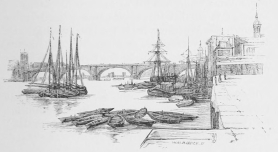
LONDON BRIDGE FROM BILLINGSGATE. [257]

“Then there is a powerfully human touch in the way in which he, so coldly royal as he lay down, turns human-like for sympathy in his great horror and anguish to the first person he sees, the soldier who wakens him.”
“March 10.—Went with Victor Parnell down the river in search of the old houses at Limehouse and Stepney. We found them, but the accounts in the Daily News, which had led us to the excursion, were so exaggerated that the houses were scarcely to be recognised. We came back by Ratcliffe Highway. It all looked very clean, and thriving, and decent, very different indeed from the descriptions in religious magazines.”
“March 11.—Luncheon with Sir Robert and Lady Cunliffe, who showed me a volume of portrait sketches by Downman, a little-known master of George III.’s time, but a wonderfully charming artist.”
END OF VOL. IV.
Printed by Ballantyne, Hanson & Co Edinburgh and London