Volume 6 — XXV IN PLEASURE AND PAIN
Reading edition
“Why, of all the countless faces which I meet as I walk down the Strand, are the enormous majority failures—deflections from the type of beauty possible to them?”—Dean Church.
“Before the beginning of years there came to the making of man, Time with a gift of tears, Grief with a glass that ran.” —Swinburne.
“From the black depths, the ashes, and the dross Of our waste lives, we reach out to the Cross, And by its fulness measure all our loss.” —Whittier.
IN the middle of October I went North for a short time.
Journal.
“Thoresby, Oct. 20, 1887.—A visit here has been charming—its inmates all so filled with kindness and goodness of every description, and Lady Manvers so very agreeable—‘une conversation si nourrie.” Nothing could exceed the dying splendour of the autumnal tints in the forest, of which we saw a great deal, as we sat out through the whole of each morning drawing amongst the tall golden bracken, over which the great antlers of a stag were now and then uplifted. My companions were Lady Mary Pierrepont, very pretty and charming, and Mrs. Trebeck, daughter and sister of a Bishop Wordsworth, who is here with her husband, Canon Trebeck of Southwell, a very singular and admirable muscular Christian. They have asked me to visit them. The first day of my visit I was delighted to meet Lord and Lady Montagu, unusually pleasant people, with a very nice daughter.”
“Southwell, Oct. 21.—Lord Manvers—kindest of hosts—sent me here, fourteen miles. It is a tiny town clustered around its—chiefly Norman—minster. The beautiful chapter-house has a wreathed door, before which Ruskin stood for an hour when he was here, motionless in rapt contemplation. On one of the old Norman pillars on the right of the nave are remains of a fresco of the Annunciation, evidently painted over an altar of the Virgin: on the other side are traces of a very early organ. In the graveyard is the tomb of Robert Lowe, Lord Sherbrooke’s father. The Sub-dean and his wife are the centre around which the whole little place revolves with its society and charities. The Bishop, who lives in the country, seems rather to despise Southwell and to wish his cathedral had been at Nottingham.
“We went from Thoresby to Rufford,[469] a curious old low-lying house containing much fine tapestry, but where the old furniture is greatly made up. The house has an obstreperous ghost, that especially haunted the room which Augustus Lumley chose as his own, and frightened his pug-dog out of its wits; for beyond that room is a little chamber in which a girl was once shut up and starved to death; but since some bones have been found under one of the passages and received christian burial, the ghost has been laid. There is a portrait of a boy who was taken as a baby from gipsies and brought up in the house, but who disappeared after he grew up and never was heard of again: it was supposed that the impulse was too strong, and that he rejoined the tribe he came from.”
“Raby Castle, Oct. 25.—The Duchess of Cleveland has been describing Lord Crawford’s interview with a famous clairvoyant. Lord Crawford saw the medium go and hold his head in the fire: the flames played round him and he was quite unhurt. Then the medium said he could make Lord Crawford impervious to fire: ‘Would he like it?’ He said ‘yes,’ and the medium took a large live coal from the fire and put it on the palm of one of his hands, which was entirely unhurt, though the coal was left upon it, and Lord Crawford was told to light his cigar at it, which he did. The clairvoyant then said, ‘Your other hand is not impervious: touch the coal with it,’ and he touched the coal which lay in the palm of his left hand, and one of the fingers of his right hand bears the marks of it still.”
“Oct. 26.—It has been a great pleasure during this visit that the Duke[470] has come in each morning for talk, generally more or less narrative—in which he rises suddenly from his chair, walks rapidly backwards and forwards to the fire, and then sits down again, always with his sharp fiery restless look; but all he says most interesting. To-day he told of his father’s early life,—sent to Oxford with a tutor, Mr. Lipscombe, then abroad for three years, spent chiefly at Orleans learning French with John, Duke of Bedford (the father of Lord Russell). The Duke of Dorset was ambassador then, and took the two young men to Versailles, where they played billiards with Marie Antoinette. The French aristocracy were quite unconscious then of the coming danger, and would not believe in the serious state of politics. The Duc de Bouillon was the great person, and they stayed with him in the country. They went on to Rome, where Cardinal York was then living. They went to his weekly receptions, where he was always treated as royalty. ‘The Duchesse d’Albanie gave my father a ring,’ said the Duke, ‘but after my father’s death it was stolen from the Duchess Elisabeth by her maid. All young men stayed abroad their three years at that time, and so did my father, then as soon as he came home he was married to my mother, who was the Duke of Bolton’s daughter.
“‘For myself, I went to Paris at eighteen in diplomacy, and was there for many years. I spoke French better than English, and lived entirely in French society. Thiers I knew intimately in all the different phases of his life. He was said to have had an intrigue with Madame Dombes. I don’t know how that may have been, but he married her daughter, and she made him a very good wife. He always began his writing at six, when he had a cup of coffee, and he wrote on—no one being allowed to disturb him—till 12 A.M., which was the hour of déjeûner, and it was this which enabled him to write his histories; when he was in office he had not time. He and Guizot were always rivals.
“‘I was in Paris in Louis Philippe’s time, but not under the Restoration. Many of the Dames de la Cour of the older time, however, were still in Paris, and had salons—Madame de Noailles, &c. I used to see much of Princess Charlotte de Rohan, who had been privately married to the Duc d’Enghien, and whose excitement was great when Louis Philippe was appointed. I was at Marienbad when the news of that revolution came, and posted back to Paris at once: we expected great difficulty on the way, but there was none. I saw the barricades, however, in the early émeute of Louis Philippe’s time, and the people with their passions roused, and the gamins who used to come under the windows of the Palais Royal and call for the king till he came out and made them a bow: it was the regular thing that was done.
“‘I was at Paris when the Duc de Bourbon hung himself. Cuvier and another great naturalist were sent down to examine into it, and they both said he must have done it himself; but the Legitimists declared it was an arrangement between the Orleanists and Madame de Feuchères, who shared his property between them.
“‘I was at Coppet with Auguste de Staël a few years after Madame de Staël died: he asked Sismondi to meet me there and several others. Old Madame Necker—Madame de Staël’s mother—had a very remarkable salon in Paris: her daughter was Duchesse de Broglie and her grand-daughter married the Comte d’Haussonville, whom I knew very well: but, oh! it is more than half a century ago now that I was at Coppet.’
“Oct. 27.—Mrs. Forester, wife of the Duke’s nephew, who is here, has told me much that is curious.
“‘An old Mrs. Sauchiehall, unfortunately dead now, told Lady Vane that when she was a girl at Doncaster, at a famous school of that time, she made a very intimate friendship with two other girls, and when they parted, they made each other a solemn vow that if either of the three were in any real trouble in after life, the others would do all they could to help her.
“They parted, and Mrs. Sauchiehall married in Cumberland—married twice, and became a second time a widow. Life had seemed constantly to drift her away from her old friends. At last, at Marienbad, she met one of them, then Mrs. A., and spent some weeks there with her, renewing all their old intimacy.
“Mrs. A. told her that she had always continued to be on terms of the most extreme intimacy with their third friend—Lady B. Her own story had been a very sad one. She had been left a widow with several children, and almost in a state of destitution. In all her troubles, she had continued to confide in Lady B., who never lost sight of her. At one time especially, Lady B. was perplexed as to how she could help her, and spoke of it to her husband, who said, ‘Well, there is at least one thing I could do for her: there is that old place of ours in Dorsetshire, where nobody lives. It is all being kept up for nothing, so if Mrs. A. likes to go and inhabit it, she is quite welcome; only, you know, she ought to be told that it is said to be haunted.’
“Lady B. made the proposal to Mrs. A., who was enchanted, and she moved at once with her children to the house in Dorsetshire, where she seemed to find a refuge from her troubles and every comfort. She asked the servants whom she found in the house about the ghosts, and they said, ‘Oh yes, the great hall and the rooms beyond it are said to be haunted, but we never go there, and the ghosts never come to our part of the house, so we are never troubled by them in the least.’ For several years Mrs. A. lived most happily in the old house, and nothing happened.
“At last, on one of her children’s birthdays, she invited some children from the neighbourhood to come and play with her own children, who begged that, after tea, they might all go and play hide-and-seek in the great disused hall. The children had finished their games, and Mrs. A. was alone in the hall setting things to rights afterwards, about 8 P.M. in the evening, with an unlighted candle in her hand, when she heard some one call out loudly, ‘Bring me a light! bring me a light!’ Then, almost immediately, the door from the inner passage leading to the farther rooms opened, and a lady rushed in, beautifully dressed in white, but with all her dress in flames. She ran across the hall screaming ‘She’s done it! she’s done it!’ and vanished through a door on the other side. Mrs. A. instantly lighted her candle, and ran with it up the passage from which the lady had emerged, but she found all the doors locked. The next night, at exactly the same hour, she came again to the hall, and exactly the same thing happened. She then wrote to Lady B. that she should be obliged to leave the place, unless Lord B. could explain the mystery.
“Lord B. then said that an ancestress of his—a widowed Lady B.—had an only son, who fell in love with the charming daughter of a neighbouring clergyman. The young lady was lovely, fascinating, and very well educated, but the mother regarded it as a mésalliance and would not hear of it. The young man, who was a very dutiful son, consented to gratify his mother by waiting, and went abroad for two years. After that time, as their attachment was unbroken, and he was of age, he married the young lady.
“It was with joyful surprise that the young married pair received a very kind letter from the mother, saying that as all was now settled, she should make a point of welcoming the bride as her daughter, and always living happily with her afterwards. They went home to the mother at the old house which Lord B. had lent to Mrs. A., and were most kindly received. All seemed perfectly smooth. At last a day came on which the mother had invited an immense party to be introduced to and do honour to the bride. The evening arrived, and the young lady was already dressed, when her mother-in-law came into the room, kissed her affectionately, and then said to her son, ‘Now that she is indeed my daughter, I am going to fetch the family diamonds, that I may have the pleasure of decorating her with them myself.’ The diamonds spoken of were really the property of the son, but he had never liked to irritate his mother by claiming them, and rejoiced that his wife should accept them from her.
“The mother then went to fetch the diamonds, the son lighting her. As they were coming back, they heard the voice of the young lady calling to her husband to bring her a light. ‘Oh, I will take it to her,’ cried the mother suddenly, and snatched the candle out of his hand. In another instant the girl rushed by with her white dress enveloped in flames, screaming ‘She’s done it! she’s done it!’ The mother confessed that her hate and jealousy had been too much for her.
“Now the house is pulled down, and a railway passes over its site.
“Another curious story, told by Mrs. Sauchiehall to Lady Vane, was that of a young lady, a great Cumberland heiress, who was engaged to be married, but who pined away from some mysterious and causeless illness. As there was no definite reason for her being ill, so nothing seemed to do her any good, but she wasted constantly, and at last she died. After her death, her old nurse, who had been her devoted attendant, rather surprised those who knew her by insisting upon leaving the place and moving to the south of England. A cousin succeeded to the property, but did not prosper. His wife died, then his children, one after another. A ghostly appearance also frequently took place, and was especially seen by a little boy, the son of the house. At last the whole family became extinct, and quite passed away out of Cumberland memory.
“Many, many years afterwards, Mrs. Sauchiehall was herself at Richmond in Surrey, when she heard that a very old woman, a native of Cumberland, was dying in the workhouse—dying, apparently, with some secret upon her mind, which she could not bring herself to confess, but which never allowed her to rest. ‘Well,’ said Mrs. Sauchiehall to her informant, ‘I am a Cumberland woman myself; I will see what I can do.’ She went to the workhouse, and soon found that the old woman had been the nurse of the young heiress who had died so long before, and heard her confess that she had accepted a large bribe from the cousin who succeeded, to poison her by slow degrees. The bribe had done her no good. She had married, all her children had died, her husband had gambled away her money, and she herself had come to die in the workhouse.
“Mrs. Forester told me of a girl who had gone to a famous school at Brighton. She was allowed to study after hours to fit her for the place of a pupil-teacher, which she wanted to get. After some time, she looked so pale and thin, that the mistress thought she was over-worked and called in a doctor. He asked her many questions, and at last ‘if she ever saw any strange visions.’ This she could conscientiously say she did not. On learning this, the doctor said that being the case, it could do her no harm to continue her studies, but that if she ever fancied she saw anything unusual, it would be a sign that her brain was overworked, and she must give up her studies at once.
“It was very soon after this that one night she distinctly heard the door of her room, which was behind a screen at the foot of her bed, open and shut again. She got up and went to the door, but it was closed, and when she opened it, there was no one there. This happened several times. At last she locked the door. Still it happened again. That night, however, she assured herself that the delusion came from being over-tired, and by sheer force of will she went to sleep.
“The next night, however, the same thing happened, and she again locked the door. Happening to look up soon after, she saw something hanging over the screen in front of her. It was a hand—an attenuated human hand. It remained there some time, then it disappeared.
“The girl then felt that she must lessen her studies, but, for fear they should be stopped altogether, she said nothing, whilst at the school, of what she had seen. Soon after this, however, she went home to the old aunt who had brought her up, and who was in very poor circumstances. She was almost surprised at the extreme and anxious tenderness with which she was received. After tea she said, ‘Auntie, I have a curious little story I want to tell you,’ and she told her what she had seen. The aunt said, ‘My love, you have unconsciously made easier for me the task of telling you some very sad news; I did not know how to break it to you, but Edward’ (the young man to whom the girl was engaged) ‘is dead; he died the night you saw the hand.’
“Mrs. Forester told this story to Lord Rayleigh, who said, ‘That is a very simple and explicable story: it is a case of telepathy.’
“The Duchess of Cleveland says that when the Sultan was at Buckingham Palace, one of his servants offended him, and he condemned him to death. The Sultan was informed that he could not execute him in this country; then he said he should do it on board his own ship. One of his wives also is said to have been executed whilst he was here, ‘because, poor thing, she had been so dreadfully sea-sick, that it was quite disgusting,’ and she is said to be buried in the palace garden.
“‘Mr. Lowell asserted to me,’ said the Duchess, ‘that there were no really old families in England. “Surely the Nevilles?” I protested. The next morning Lowell said, “I’ve been thinking that I am descended myself from the Nevilles, but I never thought it worth while before to inquire about it.”’
“‘Some one went,’ said the Duchess, ‘to inquire after the health of Madame Brunnow. “Oh,” said the servant, “she will never be any better.” The inquirer was admitted afterwards to see Baron Brunnow, to whom he said, “I am so grieved to hear from your servant that Madame Brunnow is never likely to be any better.” “Did he really say that?” said Baron Brunnow. “Oh, the faithfulness of these English servants! The fact is, Madame Brunnow really died three days ago; but the servant knows that it was not at all convenient that she should die before the reception of the Duke of Edinburgh is over, so—for inquirers—she is still only very ill.”’”
“Raby Castle, Oct. 28.—A pleasant Mr. and Mrs. Wilkinson—neighbours—came to stay yesterday. He told me a very remarkable story.
“One day last year, Mr. Gurdon, an excellent Catholic priest belonging to a mission in the East End of London, had come in from his labours dreadfully wet and tired, and rejoicing in the prospect of a quiet evening, when the bell rung, and he was told that a lady wanted to see him on most urgent business. He said to a friend who was with him, how sincerely he dreaded being called out again into the wet that night, and how he hoped that the visit meant nothing of the kind; but he admitted the lady. She was a remarkably sweet, gentle-looking person, who told him that there was a case in most urgent need of his immediate ministrations at No. 24 in a street near, and she implored him to come at once, saying that she would wait to point out the house to him. So he only stayed to change his wet things, and then prepared to follow the lady. He took with him the Host, which he wore against his breast, holding, as is the custom, his hand over it. It is not considered right for a priest carrying the Host to engage in conversation, so Mr. Gurdon did not speak to the lady on the way to the house, but she walked a little way in front of him. At last she stopped, pointed to a house, and said, ‘This, Father, is No. 24.’ Then she passed on and left him.
“Mr. Gurdon rang the bell, and when the servant came, asked who it was who was seriously ill in the house. The servant looked much surprised and said there was no illness there at all. Much astonished, Mr. Gurdon said he thought the servant must be mistaken, that he had been summoned to the house to a case in most urgent need. The servant insisted that there was no illness; but Mr. Gurdon would not go away without seeing the owner of the house, and was shown up to a sitting-room, where he found the master of the house, a pleasant-looking young man of about five-and-twenty. To him Mr. Gurdon told how he had been brought there, and the young man assured him that there must be some mistake—there was certainly no illness in the house; and to satisfy Mr. Gurdon, he sent down to his servants, and ascertained that they were all perfectly well.
“A tea-supper was upon the table, and very cordially and kindly the young man asked Mr. Gurdon to sit down to it with him. He pressed it, so they had tea together and much pleasant conversation. Eventually the young man said, ‘I also am a Catholic,’ adding, in an ingenuous way, ‘but I fear you would think a very bad one;’ and he explained that the sacraments and confession had long been practically unknown to him. ‘As long as my dear mother lived,’ he said, ‘it was different: but she died three years ago, and since her death I have paid no attention to religion.’ And he described the careless life he had been leading.
“Very earnestly and openly Mr. Gurdon talked with him, urging him to amend his ways, to go back to his old serious life. At first he urged it for his mother’s sake, then from higher motives. He seemed to make an impression, and the young man was touched by what he said, and said no one had spoken to him thus since his mother died. At last Mr. Gurdon said, ‘Why should you not begin a new life now? I might hear your confession, and then be able to give you absolution this very evening. But I should not wish you to decide this hurriedly: let me leave you for an hour—let me leave you perfectly alone for that time—you will then be able to think over your confession, and decide what you ought to tell me.’ The young man consented, but urged Mr. Gurdon not to leave the house again in the rain: there were a fire and lights in the library, would not Mr. Gurdon wait there?
“Mr. Gurdon willingly went to spend the time in the library, where two candles were lighted on the chimney-piece. Between these he placed the Host. Then he occupied himself by examining the pictures in the room. There were many fine engravings, and there was also the crayon portrait of a lady which struck him very much. He seemed to remember the original quite well, and yet he could not recall where he had seen her. On going back to the other room, he told the young man how very much he had been struck by the picture. ‘Ah!’ he said, ‘that is the portrait of my dear mother, and it is indeed the greatest comfort I have, it is so very like her.’ At that moment Mr. Gurdon suddenly recollected where he had seen the lady: she it was who had come to fetch him to the house.
“Mr. Gurdon heard the young man’s confession and gave him absolution; he seemed to be in the most serious and earnest frame of mind. He could not receive the sacrament, because it must be taken fasting, so the evening meal they had had made it impossible. But it was arranged that he should come to the chapel at eight o’clock the next morning, and that he should receive it then. Mr. Gurdon went home most deeply interested in the case, and truly thankful for having been led to it; but when morning came, and the service took place in the chapel, to his bitter disappointment the young man was not there. He feared that he had relapsed altogether, but he could not leave him thus, and as soon as the service was over he hastened to his house. When he reached it, the blinds were all down. The old female servant who opened the door was in floods of tears: her master had died in his sleep.
“On the last evening of his life his mother had brought Father Gurdon to him.”
“Muncaster Castle, Oct. 30.—What a gloriously beautiful place this is!—an ascent from the station, and then a descent through massy woods, till the castle appears—infinitely picturesque in outline and in its red and grey colouring—on the edge of a gorge, wooded on both sides, and which now has every tint, from the dark blue-green of the hollies and the russet of dead fern, through crimson, scarlet, orange, to the faintest primrose colour of the fading chestnut leaves. Then behind are the finest of Cumbrian mountains, and in front terraced gardens, and the not far distant sea. The interior has almost an equal charm, in the thick velvet-pile carpets of the long passages hung with portraits, the fine collection of books in the (too dark) octagonal library, and the low hall, which has an organ, flowers, and books, and is the common sitting-room. I sleep in ‘the ghost-room,’ and in a red silk bed used by Henry VI. when he was here, and when he gave ‘the luck of Muncaster’ to the family—an old Venetian glass bowl, from which every child of the house has been christened since. Once it was thrown from an upper window: the owners never had the courage to hunt for and examine it, and it remained buried in the earth for some years: then it was dug up quite uninjured.
“We have driven up Eskdale—a delightfully wild mountain glen, with a clear, tossing river, and dark mountains of jagged outline, covered with brown bracken wherever a turfy space is left between the rocks.
“My host—‘Josceline’—is geniality itself, and very amusing, and Lady Muncaster excessively pleasant. Only her sister, pretty Lady Kilmarnock, is here with her little Ivan, and two young ladies, Miss Rhoda Lestrange and Miss Winifred Yorke,[471] whom her friends call ‘Frivolina.’ The Muncasters have lived here for six hundred years; then they came from Pennington, where a mound still exists which was crowned by their residence in ancient British times.”
“Alnwick Castle, Nov. 4.—Yesterday I left Muncaster at eight, and had two hours in the middle of the day to wait at Carlisle. Whilst I was sauntering round the cathedral, one of the Canons came up to me, introduced himself as a college acquaintance—son of Richmond the artist—and asked me to luncheon. He also showed me the cathedral, ‘restored’ out of much interest, with a miserable modern reredos and other rubbish, but with two fine old tombs, and the modern monuments of Paley and Law. Below the great east window Sir Walter Scott was married. A noble fragment remains of a beautiful renaissance screen, and at the back of the stalls are very curious early pictures of the lives of S. Anthony, S. Augustine, &c. Close to the cathedral is the Fratry—the refectory of the abbey—now used for lectures. Carlisle is a black and truly uninviting place.
“Lady Airlie and Lady Griselda Ogilvy were at the station, and I travelled with them as far as Naworth. On arriving here, it was pleasant to be met by the cordial welcome of Duchess Eleanor, always most genial and kind. The actual Duchess[472] did not appear till dinner, when she was wheeled into the room in a chair, very sweet and attractive-looking, but very fragile. The Duke[473] looks wiry, refined, rather bored, and some people would find him very alarming. Lord and Lady Percy seem to be two of the most silent people in the world—she pretty still in spite of her ten children. There are also here pleasant little Lady Constance Campbell, Miss Ellison, who goes about with Duchess Eleanor, and Lady Emma and Miss M’Neile—the former a violent Radical, who went to bed at once when the Primrose League became the topic of conversation. We played at whist in the evening, but it was broken at ten by going to prayers, which the Duke reads in the chapel. It is the only time I have seen evening prayers in any country-house for the last fifteen years.
“This morning Duchess Eleanor showed me the rooms—the magnificent Italian rooms, which owe their glory to her husband, Duke Algernon, who, when remonstrated with for thus changing a mediaeval fortress, said, ‘Would you wish us only to sit on benches upon a floor strewn with rushes?’ He purchased the whole of the great Camuccini collection at Rome, because of his great wish to have one single picture, which they would not sell separately. It is the so-called ‘Feast of the Gods’ by Gian Bellini, with a landscape by Titian. Other noble pictures involved in the purchase are a Crucifixion by Guido, singularly dark for the master; a splendid portrait attributed to Andrea del Sarto, but more like Franciabigio; and a little Raffaelle of SS. Mary Magdalen and Catherine. Bought from the Manfrini Palace at Venice are two noble works of Pordenone—one of them the picture of the father, mother, and son mentioned by Byron (in ‘Beppo’). From the Davenport collection are portions of a grand fresco of the ‘Salutation,’ by Sebastian del Piombo, once in S. Maria della Pace at Rome. The magnificent decorations of the rooms are by Canina. But the most lasting attraction of the castle is the library, with the really splendid collection of books formed by Duke Algernon.
“The Percies are Irvingites now, as well as the Duke and Duchess. Her father, Mr. Drummond, was ‘one of the twelve apostles,’ in whose time it is a tenet of faith that the Lord must return. Now only one ‘apostle’ is alive, and when he dies what will happen? Meantime, though a very old man, he is hard at work beating up recruits and inciting proselytism. The family go to the church here, but then the vicar of Alnwick is also an Irvingite. All the gibberish which the Irvingites talk when seized by the spirit is taken down and treasured up as ‘prophecy.’”
ALNWICK CASTLE.

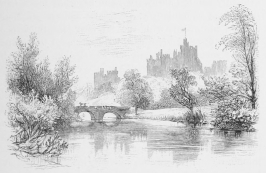
“Nov. 5.—This Irvingite family is constantly waiting and looking out for the millennium: it is terribly anxious work. But their faith is most simple and touching. When one of the Percy boys was very ill, they had him anointed with oil; after that he recovered. ‘We had no doubt it would be so,’ said Lady Percy, ‘no doubt whatever.’ After the anointing, the friends of a patient have altogether done with human agency, and leave everything in the Divine hands. It is curious to hear members of this family say casually—‘The angel was here on Monday, and will be here again on Friday.’
“I have had an interesting hour with the Duchess in her own sitting-room, where she showed me all the treasures in her cabinet—two miniatures of Elizabeth, contemporary, for they are painted without any shadow, which she forbade, upon her face, and two others, evidently painted afterwards, and naturally much more becoming; a miniature of Mary Queen of Scots painted in prison, with the fat face and thick neck which want of exercise caused in one used to so much riding; some of the hair of Charles I., cut off by Sir Henry Halford when the king’s coffin was opened at Windsor; miniatures of James I., Anne of Denmark, and three of their children; the splendid ‘George’ of the fifth Earl of Northumberland, made with the blue enamel which is now a lost art; one of the amber snuff-boxes which Queen Charlotte had constructed in Germany for her ladies, with her miniature on the outside, her dog inside the lid, and her monkey at the bottom of the box; the pencil-case of Lord Chesterfield, with a diamond at the end, being the pencil mentioned by Pope. Not less interesting is a little (Dutch) silver woman, which runs by clockwork, because it was the means of saving all the family plate. For when burglars broke into Sion, it scampered about the floor when they were going to pack it up, which made them think the plate was possessed, and they took to flight, leaving all their booty behind, with the baskets in which they had intended to carry it off.”
“Nov. 6.—All this morning I was left to ‘browse in the library,’ as Dr. Johnson expresses it. In the afternoon I had a walk with the Duke and Percy to Alnwick Abbey—utterly unknown to history, and with only the ruin of its fine gateway standing, yet which must have been one of the most important buildings in the North of England. Its substructions were sought and dug for in exact accordance with the rules laid down for building a Premonstratensian abbey, and so they were found. The church must have been grand as any cathedral.”
To Miss LEYCESTER.
“Holmhurst, Nov. 27, 1887.—I am greatly enjoying a little solitude in this time so congenial for hard work, when all nature seems wrapped in a swampy mist-cloud. There are great improvements in the garden. Along that little upper walk to the field, where the frames were, is now a rockery with rare heaths, and behind it a bed of kalmias, and then the cypress hedge of my especial little garden. Rock and fern are also put on the steep descent to the pond, opposite the line of tree-fuchsias.
“I wonder if you remember hearing of the extraordinary visitation of crickets on the night of (my mother’s death) Nov. 12-13, seventeen years ago—the uproar, like the sea in a storm, all night, scarcely allowing a voice to be heard: then heard no more till the night, twelve years after, in which dear Lea passed away. I was so struck by coming across an allusion to it when reading the last chapter of Ecclesiastes as the lesson in church last Sunday—‘And the grasshopper shall become a burden, because man goeth to his long home.’”
HOLMHURST FROM THE SHRUBBERY.
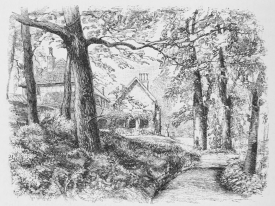
“Dec. 24.—The dreary Christmas season of damp and dyspepsia, bills and bother, is less odious than usual this year, as the day itself is swallowed up in Sunday. I have, however, also had a real pleasure in a present from the Duchess of Cleveland of her Life of Everard Primrose, only printed for his friends. It is most beautifully, touchingly, really nobly done, and the most perfect memorial of a high-minded single-hearted young man’s life. I think I never read so perfect a biography. The story is entirely told in Everard’s own admirable letters, but the Duchess has not shrunk from her own part, and the little touches from her own life, the Duke’s, &c., are indescribably simple, graceful, and sincere. The book gives one a far higher opinion of her (of Everard I had always the very highest), and makes one regret many hasty judgments. I have been quite engrossed with the book, so perfectly delightful is it.”
After a busy six weeks of work, I spent the New Year again at Cobham, always charming in its quiet home life, but was glad to return soon again to work.
Journal.
“Holmhurst, Feb. 10, 1888.—The news of Lady Marian Alford’s sudden death removes from the cycle of life one whom I had felt to be a true friend for more than thirty years. Our meetings were at long intervals, but when we met, it was as more than mere acquaintances. With a grace which was all her own, she often unfolded beautiful chapters in her own life to me, and she was one of the very few persons who have read in manuscript much of these written volumes of my past. She was a perfect grande dame, unable to harbour an ignoble thought, incapable of a small action. Regal, imperious, and extravagant,[474] she was generous, kind, and personally most unselfish, and, had the real greatness and goodness that was in her been regulated and disciplined by the circumstances of her early life, she would have been one of the noblest women of her century. Alas! only yesterday she was! How soon one has to school oneself to say ‘would have been.’ Thus, however, it will certainly be with oneself. The day after one dies people will say—and how few with even a pang—‘He would: he might have been.’”
“March 14.—Met Lady Fergusson Davy (née Fortescue). She told me that when Lady Hills Johnes, the friend of Thirlwall, was twenty-four, she was once in society with the late Lord Lytton, who was talking of second-sight, and of his own power of seeing the future of those he was with. She urged him very much to tell her future, but he was very unwilling to do so. Still she urged it so much that at last he did. He did it after the manner of the Chaldees—told it to her, and wrote it down at the same time in hieroglyphics. He said, ‘You will have a very great sorrow, which will shake your faith in man: then you will have another even greater sorrow, which will come to you through an old and trusted servant: you will marry late in life a king among men, and the close of your existence will be cloudlessly happy.’ All the first part of the prophecy has come true—the breaking off of her first engagement; the terrible murder of her father by his servant; her marriage with Sir James Hills; all that remains now is happiness.”
“Holmhurst, May 14.—I have just returned from an interesting month in London, seeing many people delightfully and making some pleasant new acquaintance. At Lady Delawarr’s I was presented to the young Duchess of Mecklenbourg, very pretty and full of life and animation. No one else came up to talk to her, and I was left to make conversation from five till a quarter to seven! by which time I think we had both exhausted all possible topics, though she was very charming. At last she said, ‘I always go at six to read to the Duchess of Cambridge.’—‘Well, ma’am,’ I answered, ‘you will certainly be terribly late to-day.’—‘What very odd things you do say to me!’ she said. The next day I sent her my ‘Walks in London,’ and as her speaking of the Duchess of Cambridge convinced me of her identity, I directed to the ‘Hereditary Grand Duchess of Mecklenbourg-Strelitz.’ The next time I saw her I had found out, and said, ‘I am sorry, ma’am, that I have made three mistakes in one line in directing to you—that you are not ‘Hereditary,’ not ‘Grand,’ and not ‘Strelitz;’ for she was the Duchess Paul of Mecklenbourg-Schwerin; but she laughed heartily.
“In going to London, I first saw, on a placard at the station, that Matthew Arnold was dead. It seemed to carry away a whole joyous part of life in a moment—for I have known Matthew Arnold ever since I remember anything, though I did not know till I lost him that his happy personality and cordial welcome had made a real difference to me for years, especially in the rooms of the Athenaeum, where I have spent so much time of late years. He had an evergreen youth, and died young at sixty-six, and he was so impregnated with social tact and courtesy, as well as with intellectual buoyancy, that he was beyond all men liveable with. Herman Merivale has written some lines which seem to express what I shall always remember—
‘Thrice happy he, whose buoyant youth In light of Beauty sought for Truth, . . . . . . . . . . And to the longing listener showed How Beauty decks the ugliest road.’
“All who knew Matthew Arnold well loved him, though ‘the Apostle of Moderation in Criticism’ would certainly have been shocked by some of the fulsome articles which have followed his death; and I doubt of any of his writings surviving his generation, especially his refined and delicate verses, which surely lack the fire of a poet whose work is to be eternal. I went on April 19, with Montagu Wood, to his funeral in the graveyard of the ancient church at Laleham, where his father was vicar before he went to Rugby, and where his children are buried. It was a day of pitiless rain, which pelted upon the widow and sisters and crowd of mourners round the grave, and on the piles of exquisite flowers beneath which his coffin was hidden. As Alfred Austin says in a beautiful article upon him, ‘Wherever he lies, there will be a Campo-Santo.’ I was glad in going down to the funeral to make friends with Edward Arnold, a charming fellow, who is the present editor of Murray’s Magazine.
“At dinner at the Miss Monks’ I was interested to find myself sitting next to Lady Sawle, who told me that she was niece of the Rose Aylmer who was the love of Landor’s youth. It was on her that he wrote the lines which Archbishop Trench declared to be better than many an epic, and which Charles Lamb said he lived upon for a fortnight. Lady Sawle was herself one of the three Roses to whom Landor afterwards addressed a poem, the third Rose being her mother. She described the death, when she was at Rome, of Miss Bathurst—beautiful, radiant, and a splendid horsewoman, riding along the narrow path between the Acqua Acetosa and the Ponte Molle. The horse suddenly slipped backwards into the Tiber. She called out to Lord Aylmer, ‘Uncle, save me!’ but he could not swim, nor could any of the gentlemen or the groom who was present. Another groom, who was a good swimmer, had been sent back to Rome with a restive horse. She sank in her long blue habit, and her body was never found. All Rome mourned ‘La bella Inglesa,’ and the little party of friends, closely united and present at her death, dispersed sadly. One of them alone, Mr. Charles Mills (of the Villa Mills), returned to Rome in the autumn. As he was about to enter the city, he sent his carriage on to the gate from the Ponte Molle, and walked slowly along the Tiber bank by what had been the scene of the accident six months before. As he walked, he saw two peasants on the other side of the river catch at something which looked like a piece of blue cloth on the mud, and pass on. A sudden impulse seized him, and he got some men to come at once with spades and dig there in the Tiber bank. There Miss Bathurst was found as if she were embalmed, in her blue riding-habit, perfectly beautiful, and with her long hair over her shoulders. There was only one little mark of a wound in her forehead. For a minute she was visible in all her loveliness—a minute only. She was buried in the English cemetery.”[475]
S. FLOUR, FROM THE SOUTH. [476]
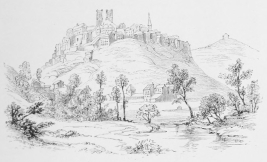
CHÂTEAU DU ROI, S. EMILION. [477]
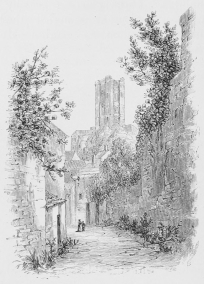
On 28th May 1888 I went abroad to my French work, feeling as usual greatly depressed at leaving home and going off into solitude, but soon able to throw myself vigorously into all the interests of my foreign life and its work. How full each week seemed!—the two first alone amongst quiet villages and churches in Picardy and afterwards in Auvergne, and many others after my friend Hugh Bryans joined me at wild S. Flour, in the hill country of Auvergne, at beautiful Obazine, and at Rocamadour again, then at beautiful S. Emilion, in wandering amongst the innumerable historic relics of La Vendée; lastly by the Loire and its surroundings. Three places especially come back to me with pleasant memories—the home-like inn at S. Emilion, its beautiful old buildings radiant with the blossom of pinks and valerian, and the sunset walks on its old walls looking into the vineyards and cornfields:—the little fishing port of Le Croisic, with its gay boats, its snow-white houses, and its windy surroundings:—and charming Clisson, with its pleasant inn and its balconies overhung with roses and wistaria. Hugh was a capital companion, and full of interest in what he saw, though—like so many at twenty-four—he pretended to hate all the historic detail. However, I am sure my endless archaeological inquiries must have sorely tried his patience, and he was always unweariedly good to me.
To Miss Leycester.
“Beauvais, June 1, 1888.—A number of friends wrote urging me to give up what was ‘entirely an imaginary duty.’ However, I felt it was a duty to finish what I had worked at so long, though perhaps it had not been a duty to begin it; and so, much as I hated coming, I am here! It is no use thinking of all one has left, and there is a great deal in what one has, most of all le grand air for hours and hours, and the marvellous light and shade, which is in itself such a beauty in this pellucid atmosphere. Then the peasants in Western France are delightful, and I have not much fear of being taken up here; and I come so well primed and informed that I know exactly what to look for everywhere, and where to find it, and almost what to say about it.
“I left dear Holmhurst at 6.30 P.M. and at 2.30 A.M. was carrying my own portmanteau down the desolate moonlit streets of Abbeville, where the old town struck me more than ever, such a complete change from England, and so romantically picturesque.”
“Clermont Ferrand, June 9.—Oh, it has been so hot! Never in my life have I been so grilled, roasted, boiled, and melted down; and it has been hard having to work on all day, whatever the intense exhaustion from the heat. But I have kept up to exactly the tale of work measured out for each day before I left home.”
“Le Puy, June 13.—We had an exquisite journey on Tuesday by rail down the valley of the Alagnon to Neussargues, the quantity of old castles on the rocky hills as striking as those on the Rhine were forty years ago, and the mountain flowers lovely. Then we drove up through the cool forests to the high plateau which is under snow nine months of the year, and which was quite chilly even now. Here, in the evening, we reached the old episcopal town of S. Flour, on a great basaltic rock, the most wonderfully placed of all French cities, and much recalling Orvieto. Everything seemed to belong to another world. From my window I could throw anything sheer down the most tremendous of quite perpendicular precipices, and the view was magnificent. The house had been in the same family for four hundred years, and the landlady showed with pride the dark passage where her ancestor intercepted the Protestants when they were trying to take the city by stealth, the stone on which they were beheaded, and the drain by which their blood flowed away. The other side of the house opened into a great square, with the cathedral standing amongst trees as in an English close, and houses with sixteenth-century colonnades. I saw the huge modern viaduct bridge of Garrabit, most extraordinary certainly, but though much more interesting to most people, less so to me than the glorious views of S. Flour itself, on its black and orange rocks, backed by the great purple towers of the cathedral.”
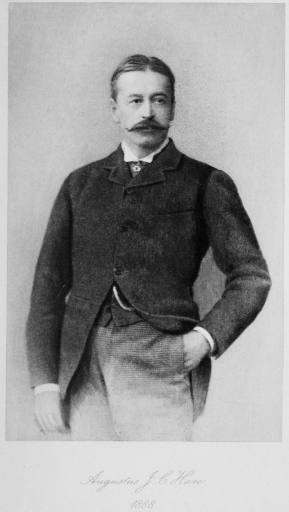
Augustus J. C. Hare 1888
S. NECTAIRE. [478]
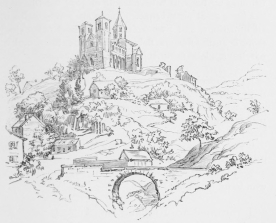
“S. Nectaire le Haut, June 28.—It was dark and raining in torrents before we arrived here, and the driver suddenly announced not only that he had lost his way, but that one of our wheels was likely to come off! We were skirting a precipice by a rocky road without any parapet, and at last, by holding the carriage lamps low, found that we had somehow got into a very ancient churchyard, where stone coffins were strewn all about. At last we knocked up a woman at a farmhouse, who guided us back to the hotel, which we had long passed in the dark. This is an enchanting place, beautifully situated in a wooded gorge below the old romanesque church, where the Sunday congregation—from many far-away villages—winding up the hill with baskets of food for the day, has been most picturesque. There are lovely walks in all directions, and Switzerland at its best never had more beautiful flowers, fields covered with lilies, orchis, narcissus, globe ranunculus, pansies, pinks, &c.”
“Le Croisic, July 17.—At this little fishing-town there is no fine scenery, but it is most artistically lovely, with wide views over the grey reaches of sea and yellow sandy flats to the soft hills, and endless fishing-boats with red sails and nets.
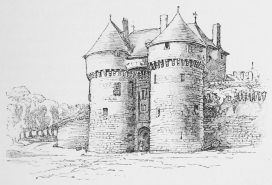
“Yesterday we spent the day at La Guerande, a little unaltered mediaeval town above the salt-flats; a very superior Winchelsea, described in Balzac’s wonderful novel of ‘Beatrix.’”
I returned to England on August 7th, just in time to attend Alwyne Greville’s wedding in London. In September I paid the Eustace Cecils a visit, and then went to the Spencer Smiths at Kingston near Wareham.
To Miss Leycester.
GATE OF LA GUERANDE. [479]
“Sept. 17.—It was a great pleasure to find Sir Howard and Lady Elphinstone at the Eustace Cecils’. I like them both so very much. They say the Queen is much occupied in learning Hindustanee and speaks it now quite well—a great delight to her Indian subjects. She has three Indian servants in constant attendance, and converses fluently with them. This afternoon has been delightful, with Mrs. Spencer Smith and her children, at St. Alban’s (St. Aldhelm’s) Head. In the little hollow with stone cottages on the way thither a boy opened a gate for us whose name was Sagittary Clump. The name came from his parents’ lodger, but it must have had its origin in Sagittarius. Mrs. Spencer Smith spoke to the boy’s father about his daughter’s misconduct. ‘I can’t help it,’ he said; ‘I’d given her her documents,’ meaning that he had spoken to her seriously: Shakspeare uses ‘documents’ in the same sense. Walking up the hill, we were terribly bitten by harvest-bugs, which little Michael Smith poetically called ‘Ces petites bêtes rouges dans les fleurs bleues’ (harebells). Close to the coastguard station, near the edge of the cliff, is a tiny chapel, perfectly square, supported by a single pillar, and with only one wee romanesque window, so that almost all the light comes from the open door: however, there is only service here in summer. A monk of Sherborne Abbey was always kept here to toll a bell to warn off ships, whilst he prayed for the shipwrecked. Seven little children aged from three to four came up to us while we were drawing. ‘We be going to throw ourselves over the cliff, we be: we be going to smash ourselves quite up, we be,’ the little monsters announced to their mothers, as they all seven marched away arm-in-arm to the edge of the cliff. Then ‘little sister’ made ‘Ernest’ sit down upon a thistle, at which ‘Ernest’ roared; and finally the mother caught up Ernest and carried it off, ‘little sister’ whacking its little naked behind with a stick all the way as they went. Then a young Palgrave appeared, who took the Spencer Smith children down to a wreck in Chapman’s (Shipman’s) Bay, to their great delight. There were seven parrots saved from that ship, but one was lost which was prepared for death by being able to say the Lord’s Prayer straight through. We went afterwards to the desolate village of Worth, where, in the wind-stricken rectory, the clergyman and his wife see no one for five months of the year, and have to shout into each other’s ears to be audible in the roaring winter blast. The church has a Saxon arch, and in its graveyard two stone sarcophagi, one that of a child-abbot, with an incised crosier lying upon it; also the gravestone, of Mr. ‘Jessy,’ ‘who, by his great courage, innoculated his wife and two sons from the (cow)’—sic. He rode up to London with saddle-bags to give his experience to the Government. The Dorsetshire here is pure Anglo-Saxon: King Alfred spoke Dorsetshire. The people are very long-lived; at Steeple in Purbeck there have only been four rectors since the time of Charles I. Three Messrs. Bond have lasted 160 years, and an old Mrs. Ross of 101 drives up this hill in a dogcart to visit her old servant of ninety-four in the village. In church the clerk said ‘Stand in a wee (awe) and sin not!’”
To Louisa, Marchioness of Waterford.
“Cadland, Sept. 21.—This comfortable house stands in a park, which is a piece of enclosed forest full of noble oaks and hollies, with glints of blue sea and shipping between. The passages are entirely clothed with fine prints and drawings, and in the rooms are many fine portraits, especially that by Zoffany of the Drummond who founded the Bank. The collection of autographs is priceless, and includes many by early kings of France, letters of Marie Antoinette, a charming one of the little Dauphin, and the execution-warrant of Madame du Barry. Amongst the drawings is the touching sketch which Severn made ‘to keep himself awake’ sitting by the death-bed of Keats.... We have driven to ‘the Cottage,’ a charming house where Lady Elizabeth Drummond lived, in woods of ilex and fir above the Solent.... The company has included Valletort; Harry Forster, a very good-looking fellow; Robert Scott, Lord Montagu’s second son; and Christopher Walsh, a very nice son of Lord Ormathwayte.”
“Malshanger, Sept. 25.—I came here on the 22nd to visit Mr. Wyndham Portal, and (in her grandmotherhood) his most beautiful as well as charming wife. After luncheon we drove to the Vyne, admirable in the rich colour of its old red brick and grey copings, and greatly beloved by Horace Walpole, who used to stay there with his friend John Chute, to whom he gave many pictures, and whose ‘Chutehood’—depression of spirits and gout—he often deplored. It was to him that Gray wrote ‘suavissime Chuti.’ The house has always been cared for and never allowed to ‘run down,’ and there is much of interest in its fine old rooms, especially in its two stories of ‘gallery,’ lined with busts and portraits. Four of these were brought hither by Lady Dacre of Hurstmonceaux, upon her second marriage with Challoner Chute of the Vyne, and include a portrait of Chrysogona Baker, afterwards Lady Dacre; of the widow of the Lord Dacre who was executed, with his picture hanging behind her, and two of the Chute Lady Dacre herself, one of them copied from a picture now at Belhus, the place of the Lennards. The present owner of the Vyne, who married Miss Eleanor Portal, showed it all admirably, and has written a capital book on the place.[480] He educates his own beautiful boys, making scholars of them before they are ten years old.
“This district—‘Portalia,’ as people call it—is quite peopled with Portals and their connections. They were a French Protestant family, greatly persecuted under Louis XIV., when they took refuge at La Cavalerie in the Larzac. Jean François de Portal escaped to Holland, and his eight children, concealed in barrels and smuggled out of the kingdom by faithful nurses, reached England. The eldest of these became tutor to George III., and the second, Henri, obtained the monopoly of the manufacture of bank-notes, which the family have enjoyed ever since. The last Portal left his vast landed estates to his eldest son, Melville, and his mills to his second son, Wyndham: now the land is only a burden, but, police-guarded, the mills at Laverstoke constantly increase in value, and turn out daily 50,000 Bank of England notes, 12,000 Indian notes, and 100,000 postal orders. By the process of one beautiful machine, the linen rags (nothing but new rags of the best linen being used) are reduced to pulp, the pulp is flattened into paper, stamped, drained, dried, and behold! before it leaves the machine, a bank-note ready for the printer. All the machinery is turned by the transparent Teste, which is full of trout almost up to its source. The workmen, who live in comfortable cottages near the mills and receive high wages, are hereditary, and always fulfil their quota of duty from father to son. Mr. Portal throws open his fine gardens here every Saturday to the people of Basingstoke, who play tennis and generally enjoy themselves, and do no harm whatever.”
Journal and Letters to Miss Leycester.
“Ford Castle, Northumberland, Nov. 23.—I set out to come here on Wednesday evening, after attending Miss Higginson’s wedding at Marlow. When we—two other guests, Mr. and Mrs. Bellairs, and I—reached the desolate station amongst the bleak moorlands, we found only one little gig in waiting, and no chance of anything else. Mrs. B. and I struggled into it, and came through the howling raging storm for seven miles here; Mr. B. walked; but our reception in these fine old rooms made us forget all else, and to-day has been like all days at Ford and Highcliffe—drawing, reading aloud with talking at intervals, and walks in the glen and gardens.”
“Nov. 26.—A delightful walk, combating with the wind, to the Devil’s rocks, ‘where,’ say the Northumbrians, ‘the devil hanged his grandmother.’ Mr. Neville (the rector) dined. He says the old rectory here was haunted. His sister came to stay with him in the spare room that looked out on the castle. The second day she said very quietly but firmly that she could not sleep in that room again; another must be given her or she must leave. Then she described that, on two successive nights, the curtain of her bed had been drawn, and a strange voice had distinctly said to her, ‘This is not a spare room.’
“Mr. Neville said—
“‘I belong to the Neville-Rolfes of Hitcham in Norfolk. After my cousin, Charles Neville-Rolfe, who was beloved by every one, died, his boxes were all found to be fastened with letter-locks, and the family were a long time before they were able to get them undone, as he had not left the clue. My cousins suggested to me afterwards that I should ask Crisp the carpenter how he had discovered it at last; so, as I was rubbing an inscription on a stone in the church, I got him to come and move part of a pew which covered it, and I asked him about it. He said, “Whilst we were puzzling over those locks, I heard in a dream the voice of Mr. Charles, and he said, ‘Crisp, come and walk and talk,’ and I said, ‘Yes, sir, gladly;’ and then he turned to me and said, ‘Crisp, guess!’—and I woke, and ‘guess’ was the word we wanted.” I told my cousins afterwards what Crisp had told me, and they said, “Yes, but the really curious part was that only three letters were wanted. Crisp thought ‘guess’ was spelt ‘ges,’ still we acted on what he said, and it was right.’”
“Lady Waterford says—‘My maid is very good, very good: her only fault is that she has three hands, she has a right hand and a left hand, and a little behind-hand.’
“Mr. Bellairs, the Highcliffe agent, who is here, said—
“‘My grandfather was both at Trafalgar and Waterloo, for he was wounded as a middy at Trafalgar, and then went into the army. It was odd when, long afterwards, some one said about Trafalgar, “It was so and so” and he said, “No, it was not, for I was there,” and that the conversation then went on to Waterloo, “It was so and so.”—“No, I beg your pardon, but I was there.”
“‘Afterwards he fell in love with Miss Mackenzie, one of two heiress sisters. He had nothing to marry upon, and the father forbade him the house, but he was allowed one interview, and in that he found out that the butler was just leaving, and the family would be wanting another. He dressed up and came and applied for the place. He got it, and it was three weeks before he was found out, and then Mr. Mackenzie allowed that he was too much for him, and allowed that he should marry his daughter. But he insisted that my grandfather should leave the army. “Very well,” he said, “if you like I will go into the Church.” So that was agreed to, and in time he became a Canon. He was as earnest in the Church as everywhere else. Soon after his appointment to a country living, as he was crossing some fields on a Sunday, he found a number of miners crowding round some prize-fighters. “Come,” he said, “I can’t have this: I shall not allow this.” “But you can’t prevent it,” they cried. “Can’t prevent it! you’ll soon see if I can’t fight for my God as well as for my king: I’ll fight you all in turn,” and he polished off the two strongest miners in fair fight, and then the others were so pleased, they chaired him, and carried him through the village to his church, which they filled from that time forward.’
“Most delightful and full of holiest teaching have been the many quiet hours I have spent with the lady of the castle. There is a sentence of Confucius which says—‘If you would escape vexation, reprove yourself liberally and others sparingly.’ It is exactly her case. And there is another sentence of Confucius which applies to her—‘The wise have no doubts, the virtuous no sorrows, the brave no fears.’ Being here so quietly, I have seen even more of her than on other visits, and more than ever has she seemed to be a fountain of original, interesting, noble, and elevating words and thoughts. She is wonderfully well now, and able to walk, and take all her old energetic interest in the place and people, and oh! how we have talked!”
“Littlecote, Wilts, Dec. 3.—A charming visit to this beautiful old house, which mostly dates from Henry VII., and has a noble hall hung with armour and the yellow jerkins of the Commonwealth, a long gallery filled with fine Popham portraits, and a charming old pleasaunce with bowling-green and long grass walks. I sleep in the ghost-room, and just outside my door is the ante-chapel where Wild Darrell roasted the baby as described in the notes to ‘Rokeby,’ but the grandfather of the present possessor was so bored by inquiring visitors that he burnt the old hangings of the bed by which the nurse identified the room of the crime, and the bed itself, with much other old furniture, was sold to provide the fortunes of the younger children in the present generation. Nothing can be more delightfully comfortable, however, than the house as it now is, and my young host—Frank Popham—is most pleasant and genial. It has been a great pleasure to find Lady Sherborne domesticated here, and to listen once more on a Sunday evening to her exquisite singing of ‘Oh rest in the Lord’—so delicate and touching in its faintly vanishing cadences as to draw tears from her audience. Very pleasant too has it been to meet charming Mrs. Howard of Greystoke and her daughter again.”
“Dec. 11.—My old cousins, Mr. and Mrs. Thurlow, who had often invited me before to their house of Baynards, wrote that this week was my last chance of going, as Baynards was just sold, so I have been for one night. The house is partly modern, but the place was an ancient royal residence, and was part of the dower of Katherine Parr. A pretty statue of Edward VI. was discovered there walled up, and Margaret Roper lived there afterwards, and long kept her father’s head in a box, which still exists at the foot of the staircase. There are also numbers of fine portraits, the dressing-box and travelling trunk of Elizabeth, and I slept in a magnificent old tapestried room and in Henry VIII.’s bed.
“Mrs. Thurlow says that Cardinal Wiseman went to dine with some friends of hers. It was a Friday, but they had quite forgotten to provide a fast-day dinner. However, he was quite equal to the occasion, for he stretched out his hands in benediction over the table and said, ‘I pronounce all this to be fish,’ and forthwith enjoyed all the good things heartily.”
“Dec. 12.—Henry Lyte says that Porson was told to write a Latin theme as to whether Brutus did well or not in killing Cæsar—‘Si bene fecit aut male fecit.’ He wrote—‘Non bene fecit, nee male fecit, sed interfecit.’
“The Stuart Exhibition is most indescribably interesting. A glorious Vandyke hangs there representing Henrietta Maria in radiant youth and happiness, with husband and children. Close by hangs the most touching portrait in the gallery—Henrietta Maria, the same person exactly, with the same curls, only grey, the same features sunken and worn by sorrow, in her old age at Chaillot, by Le Fevre.”[481]
“Cobham, Jan. 3, 1889.—Drove with Lady Kathleen Bligh, Lady Mary, and Lady Lurgan to Rochester to see the interesting old hospice for ‘six poor travellers, not rogues or proctors,’ where that number are still daily received and cared for. They are given half a loaf, boiled beef, and porter for supper, have six small clean comfortable rooms lighted by a street gas-lamp outside, and are sent away with fourpence each in the morning. On Christmas Day a lady sends the travellers of the day some tobacco, a pipe, and a sixpence each, and quaint are their letters of thanks. ‘May you live for ever and a day after,’ was the good wish of one of them this year.
“Lord Darnley went himself into the village of Cobham to engage lodgings at a poor woman’s cottage for a man who wanted to come there. Lady Kathleen went to see the poor woman afterwards, and found her greatly delighted. ‘As soon as my Lord was gone,’ she said, ‘up I went to my room, and down upon my knees I dropped to return thanks to the Almighty, because the Lord above, and the Lord below, were working together for my good.’”
“Jan. 10.—To tea with Mrs. Humphry Ward, almost a celebrity now as authoress of ‘Robert Elsmere,’ at her house in Russell Square. She said it tried her somewhat to receive from an American ‘Whiteley’ his circular with—‘for economy in literature we defy anything to beat our Elsmere at six cents.’”
On Shrove Tuesday, March 6, I left home for the south, and spent a fortnight at Mentone in the Hotel d’Italie, which I remembered—one of the few houses then existing—as the residence of Mrs. Usborne when we were living close by in 1869-70. My cousin Florentia Hughes was at Mentone with her youngest daughter, and we had many pleasant excursions together. In the hotel were Lord Northbrook and his daughter, with whom I dined several times, meeting the excessively entertaining Lord Alington and his pleasant daughters. On the 22nd I reached Rome, where I spent six weeks in the Hotel d’Italie, seeing many friends, correcting my “Walks in Rome,” and drawing a great deal.
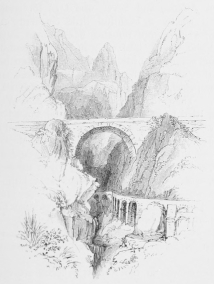
PONT S. LOUIS, MENTONE. [482]
Journal.
“April 7.—On Friday I went with some friends to Albano, and, whilst they drove to Neni, drew in the glen at Ariccia, and never was I so tormented by children as by a beautiful little cowherd—Amalia Maria—who, on my refusing her demand for soldi, vowed she would ‘lead me a life,’ which she did by fetching six other little demons worse than herself, when they all joined hands and danced round me and my campstool, kicking and screaming with all their might. Then they fetched a black pecorello, and having tried to make it eat my paints, danced again, the pecorello, held by a string, prancing behind them. Happily at last the cow which Amalia Maria was supposed to be chaperoning made its escape over a hedge, and whilst she was pursuing it over the country, I fled, and joined my companions at a little caffè, where we had a delicious luncheon of excellent bread, hard-boiled eggs—painted purple for Lent—and sparkling Aleatico, for fourpence a head. Afterwards we sat to draw, looking down upon that loveliest of lakes and woods full of cyclamens and anemones.
“The crowds in the Roman galleries are endless. Whole families arrive together, every member of them carrying a campstool, and they will sit down opposite each of the statues in turn, and move onwards gradually, whilst the father reads aloud from a guidebook, and they all drink it in. He often begins the description at the wrong end, but they do not find it out, and ... it does not signify! An American, a Mrs. Ruggles, coming to the Apollo Belvidere, said, ‘Is that the Apollo Belvidere?’—‘Yes, that’s the Apollo Belvidere.’—‘Well, then, if that’s the Apollo Belvidere, I don’t think much of him: give me Ruggles.’”
“April 18.—Caught in tremendous rain and hail near a warehouse at the back of the Palatine, and took refuge under a rude porch with a number of peasants and was kept there an hour. One of the men described his life as a soldier when his battalion was sent against the brigands near Pescara. Of these, the famous Angelo Maria was so horrible a monster, that his own mother determined to rid the world of such a fiend and to deliver him up. He discovered this, seized his mother, laid her on a table, ripped her up, and taking out her steaming heart—ate it! Words cannot describe the horrible gestures with which the peasant told this story, or the dramatic power with which he described the sister seeing the terrible scene through a chink in the door, and coming afterwards to the guard-house, saying that she wished to betray her brother. ‘Oh,’ said the officer, ‘you need not suppose that we trust you; this is a trap you have laid for us.’—‘Yesterday,’ she answered, ‘I might have laid a trap, but I had not then seen that monster eat my mother’s heart.’ And he was taken.
“But Capolo Roscia was worse. He came one night to a masseria. The doors were barred, but he forced his way in with his band. The head of the farm hid himself in the straw, but he was found and dragged out. All the men in the masseria, eighteen in number, were brought out and made to sit in a row. ‘Now you must all be shaved,’ said Capolo Roscia, and he cut all their eighteen heads off and put them in a basket.
“‘Oh, in that time when we were brigand-hunting we did not stop much to inquire how far they were guilty. “A ginocchio: avete cinque minuti,” we shouted to a peasant if we caught him. “Oh, ma signori, signori!” he would say. “A ginocchio! Un minuto, due, tre, cinque—bo-o-o-ah!” and he was done for; for he had given the brigands provisions, and so he was as bad as themselves. Even with i sindaci, well, we often did the same; but—we got rid of the brigands.’”
“Easter Sunday, April 21.—To St. Peter’s. The service was under the dome, but the group around the shrine would not call up even a reminiscence of the glorious services under the Papacy. The relics were shown afterwards from a high gallery—the spear-head of Longinus, the bit of the true cross, the napkin of Veronica, to the sight of which seven thousand years’ indulgence is attached. I gazed hard, but could only see its glittering frame, nor could any other member of the congregation see any more.”
IN S. FRANCESCO NEL DESERTO. [483]
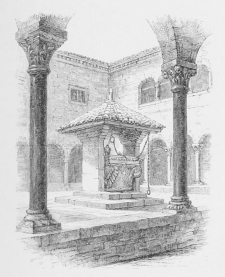
After leaving Rome, I spent ten days with a pleasant party of friends at beautiful Perugia, and then went on to Venice, where I saw much of Ainslie Bean, who took me in his gondola to many places I wanted to see, and much also of the Comte and Comtesse de Lützow, on the eve then of the great but still unforeseen sorrow of losing the dear daughter Maude who was the sunshine of their lives. I was at the Pension Anglaise, crowded with lively, kindly ultra-English people, whose mistakes were amusing. “Gesu-Maria!” suddenly exclaimed the gondolier on narrowly escaping a concussion at a sharp corner. “Why on earth does he say ‘Je suis marié’?” said a Mrs. R. Afterwards I had a week’s hard work in intense heat in Eastern France, and reached home on May 27.
To Miss Leycester.
“Holmhurst, May 27, 1889.—How quiet it is here! how shady! how thankful I am to be back! The heat yesterday at Amiens was appalling, but I reached the green retreat this morning at nine, a telegram announcing my advent having only been delivered five minutes before, so that I had the amusement of seeing Holmhurst as I had never done before, in complete un-dress.... I never saw such foliage. Charles II. might easily hide this year in any of the oak trees.”
Journal.
“July 16.—Dined at Lord Chetwynd’s, taking down a Mrs. Severn. She talked of the difficulties of faith; of the comfort she had received from Farrar’s ‘Justice and Mercy;’ of the simple impossibility of eternal punishment; of the verse ‘The Lord shall save all men, especially such as are of the household of faith,’ as especially indicating gradations of happiness in a future state.”
THE ROCKY VALLEY, HOLMHURST.
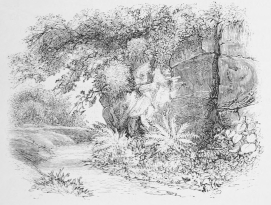
“July 18.—With troops of the London ‘world’ to a garden-party at Hatfield to meet the Shah of Persia (Nasr-ed-Din), who looks most savage and unimpressionable. He is, however, preferred to his servants, who give themselves endless airs, refusing the rooms prepared for them, &c., and their hosts are afraid to complain of them to the Shah, for fear he should cut off their heads! He is a true Eastern potentate in his consideration for himself and himself only: is most unconcernedly late whenever he chooses: utterly ignores every one he does not want to speak to: amuses himself with monkeyish and often dirty tricks: sacrifices a cock to the rising sun, and wipes his wet hands on the coat-tails of the gentleman next him without compunction. He expressed his wonder that Lord Salisbury did not take a new wife, though he gave Lady Salisbury a magnificent jewelled order. He knows no English and very few words of French, but when the Baroness Coutts, as the great benefactress of her country, was presented to him by the Prince of Wales, he looked in her face and exclaimed, ‘Quelle horreur!’”
“July 22.—A wonderful speech (at the Aberdeens’) on Christian work from the Bishop of Ripon (Boyd Carpenter)—eloquent, elevating, touching beyond description. He pictured the system of work going on through all creation—some one resting under a tree as under an object in repose, and then, if the senses could be quickened, hearing the pulse, the ever-labouring pulse which sends the sap through its every fibre: of how fallacious is the ordinary view of God as a sovereign in contemplative repose—how inconsistent with the description given us, ‘My Father worketh and I work:’ of the way in which every practical worker might be a particle of the Spirit of God: of the way in which the Christian life of every individual might radiate on others and permeate their existence, like the halos—unseen by the wearers—on the brows of saints: of the way in which the impression of a visit carried away from each country-house might influence a life, and the duty of leaving the right impression—never by ‘religious talking,’ but by loving action: that the usual saying was ‘Omnia vincit labor,’ but a truer one would be ‘Laborem vincit amor.’”
To Miss Leycester.
“Holmhurst, August 15, 1889.—I wish you were here this morning. A delicate haze softens the view of the distant sea, sprinkled over with vessels, and the castle-rock rises up pink-grey against it. Far overhead, the softest of white clouds float in the blue ether. In the meadows, where the cows are ringing their Swiss bells, the old oak-trees are throwing long deep shadows across lawns of the most emerald green, and the flower-beds and the terrace borders are brimming with the most brilliant flowers, over which whole battalions of butterflies and bees are floating and buzzing; the little pathlet at the side winds with enticing shadows under the beech-trees, whilst the white marble Venetian well, covered with delicate sculpture of vines and pomegranates, standing on the little grassy platform, makes a point of refinement which accentuates the whole. Selma steals lazily round the corner to see if she can catch a bird, but finds it quite too hot for the exertion; and Rollo raises himself now and then carelessly to snap at a fly. The doves are cooing on the ledge of the roof, and the pigeons are collecting on the smokeless chimneys. Upstairs Mrs. Whitford and Anne are dusting and laughing over their work, with the windows wide open above the ivied verandah, and Rogers is planting out a box of sweet-scented tobacco-plants which has come by the post.
FROM THE WALKS, HOLMHURST.
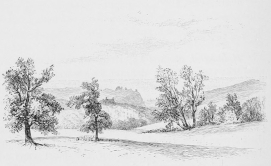
“Such is little Holmhurst on an August morning. You would be amused with my hearing the other day that one of the servants had said, ‘Our master’s a gentleman as knows his place,’ which meant that I never find fault with an under-servant except through an upper, or cast even the faintest shadow upon an upper-servant if an under-servant is present. After all, it is only another form of Landor’s observation—‘The spider is a gentleman, for he takes his fly in secret.’”
To Louisa, Marchioness of Waterford.
“St. Michael’s Mount, Sept. 7, 1889.—This is a wonderful and delightful place. It was nearly 10 P.M. when I reached the Marazion station. The day had been very hot, and the evening lights and reflections perfectly lovely; but night had quite closed in. Lord St. Levan’s carriage met me at the station, and stopped at the head of a staircase leading to the sea, where four sturdy boatmen took possession of me and my things, and rowed away on a waveless sea, following up the long stream of brilliant light which fell from one of the upper windows of the castle on the sacred mount, grim and black in the still night. An old man with a lanthorn met me at the landing-place, and guided me up a steep pathlet in the rocks. At the door a maid received me, for the family were all at dinner, but I found a pleasant meal ready for me in a small sitting-room, and then was ushered in to the large party—Lord and Lady St. Levan, six daughters, a son, a niece—Lady Agnes Townshend, Hugh Amherst, two Misses Tyssen Amherst, Mr. and Lady Harriet Cavendish, Miss Hill Trevor, Mr. Stewart, a young Manners, and Mrs. and Miss Lowther. With the latter I have spent many pleasant mornings in drawing on the rock (really improving greatly, I think, in knowledge of the ‘how’ and ‘why’ of everything), whilst the whole family has gone out fishing, and most glorious are the subjects. Mrs. Lowther’s enthusiastic energy makes her a first-rate companion. ‘Elle est au-dessus de l’ennui et de l’oisiveté, deux vilaines bêtes,’ as Madame de Sévigné would have said.
ST. MICHAEL’S MOUNT.
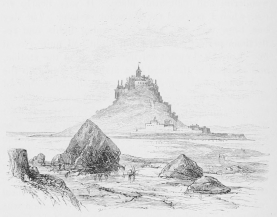
“It is a life apart. The chapel-bell rings at nine, and I always meet Mrs. Lowther on the staircase hurrying up to the service, which is reached by an open-air walk at the top of everything. Then, before breakfast in the ‘Chevy Chase Hall’ (surrounded by old stucco hunting scenes), we linger on the grand platform, looking down into the chrysoprase waves with sea-birds floating over them, and across to the mainland with its various bays, and its fleeting golden lights and purple shadows.
“On Friday we went a long drive, passing St. Buryan’s, one of the three parishes of the Deanery of St. Levan. A Mr. Stanhope was long the rector here, having also a rich living, where he resided, in Essex. At St. Buryan’s he kept a curate, to whom it was only necessary to give a very small stipend indeed, because he was—a harmless maniac! He used to be fastened to the altar-rail by a long chain, which allowed him to reach either the altar or the reading-desk. When once there, he was quite sane enough to go through the service perfectly! On week-day evenings he earned his subsistence by playing the fiddle at village taverns; but he continued to be the officiating clergyman of St. Buryan’s till his death in 1808.
“This truly aquatic family bathe together from a raft at 7 A.M. most mornings. To-day they were all rowed in their scanty bathing costumes, looking like Charon’s souls being ferried to purgatory, into the little port, and there (at twelve mid-day) one after the other took a header into the sea, and swam—many of the guests with them—to the main-shore at Marazion, to the great astonishment of the natives on the beach there. The parents followed or accompanied their mermaid-daughters in safety-boats, but instead of being anxious about those who became exhausted, encouraged them to hold on. George Manners was almost choked by a butterfly flying down his throat, mistaking his head for an unexpected islet.
“The place is beyond everything poetical: even I have been unable to refrain from some verses, which I send you.
“Grey cloud-wreaths lovingly entwine, And in their mystic maze enfold The sacred Mount, which day’s decline Shadowed upon a sheet of gold: And faint and sweet, the surges beat The burthen of the ancient lay, Which low or loud, through mirk and cloud, The Past bewails eternally. But when the radiant morn awakes To kiss fresh life into the flowers, The windows beam, the turrets gleam, The blue waves break in silver showers, Tossing their glistening foam away In merry riplets to the shore: The Present reigns; the murmuring Past, Though whispering still, is heard no more. Serene, the great Archangel keeps His vigil here on high, Whilst in the changeful world below Fleet life is fluttering by. Through shine or shower, his silent power, Unheard, unseen his sway, Spirits of ill, which daunt or chill, Shall drive rebuked away.”
To Miss Leycester.
“St. Michael’s Mount, Sept. 7, 1889.—I have enjoyed my visit here extremely, and, difficult as it was to manage coming, it is more difficult to get away, from the extreme kindness and genuine hospitality of Lord and Lady St. Levan, who would like one to stay months. I think I never saw such excellent people, or a happier, more united family; and being very well off, their kindnesses to rich and poor cannot be calculated. Then it is indeed the most delightful of homes, so healthy in its pure air of mingled sea and mountain exhilaration, so glorious in its views over land and water, with every atmospheric effect which Nature, never the same, can paint upon both. Looking down from the ramparts into the deep clear chrysoprase water is in itself a delight, and watching the fish rising and leaping with sparkling showers, and the great white seagulls swooping down upon them. No wonder the sons of the house, devoted to sport of every kind, think there is nothing to compare to the fishing excursions round their home. But there is unspeakable grandeur, too, when the sacred Mount is enveloped in sea-fog, shrouding it from all sign of the mainland and everything else, and when nothing is heard but the distant booming of the waves far down below. This is the one great house of England, I suppose, which is approached by no road whatever, for even the pathlet which winds among the cliffs and low wind-blown bushes of the island is lost where it crosses the turfy slopes which intervene here and there. The castle is in seven stories (of which I inhabit the second); many of the rooms are walled with rock, and in one of the narrow passages it is known that a number of skeletons—naughty nuns, I suppose—are walled up. I never saw a place where so much of daily life was in the open air.”
“Holmhurst, Sept. 19.—From the Mount I went to visit the Tremaynes in the Vale of Tavistock. It was an exquisite still evening when I arrived at Sydenham, and it is a beautiful drive through a richly-wooded valley, till a sharp turn brings one to the old bridge over the clear tossing Lyd, on the other side of which rises the noble old manor-house, only separated from the road by ‘the green court’ with a wrought iron gate. By this gate, as I drove up, stood, with her daughter, Mrs. Tremayne, her exquisite profile, quite white, like a Greek gem, relieved against the dark yew foliage: it is a picture that remains with one. We had tea in the old panelled hall, surrounded by four fine Chinese dogs.
“It would be difficult to over-praise the sweet seclusion of the spot, the constant merry ripple of the sparkling river, the deep shade of the tall trees, the old-fashioned gardens of splendid herbaceous flowers, the charming old rooms and staircase, in which—even in this desolate place—the two powdered footmen do not look out of keeping. But the great charm lies in the family itself—in the ever-genial, courteous, sweet-tempered father—the perfectly beautiful and dignified but simple mother—the daughters and the only son.
“A relic in the house is the ‘tongue-token,’ only given during the Civil Wars to the most faithful friends of the King and Queen,—a little gold medal which could be concealed under the tongue. In this case it was given to the Tremayne of the day, because, at imminent risk to himself, he rode to announce to the King at Oxford the birth of the Princess Henrietta at Exeter.
“We went several excursions: to the fine old gateway of Bradstone; to the Kellys of Kelly, who have a most admirable collection of Alpine plants, growing upon little but old mortar; to the Duke of Bedford’s house of Ensleigh, beautiful in hilly woods feathering down to a river; and to Launceston, a dull place, where the castle recalls that of Gisors.
“From Sydenham I went to see the Elphinstones[484] at their beautiful Government House at Plymouth, and on the same evening to Whiteway, where I paid a delightful visit to the dear Dowager Lady Morley, who is still as genially kind and as sharply truth-exacting as ever. It was comically characteristic that when the foolish Bishop of Exeter (Bickersteth) came over to Whiteway, Lady Morley, with innocent pride, showed him the improvements she had made. ‘You should not take a sinful pride in your possessions,’ said the Bishop; ‘all God’s works are beautiful, and all these are the works of God.’—‘That is all very well,’ answered Lady Morley, ‘but I made this walk.’ It was sad to see Lady Katherine, the companion of many happy mountain excursions long ago, laid up as a permanent invalid; but she is indescribably brave and cheerful.
“A child at Whiteway, being asked where the eggs were laid, answered, ‘On an average.’—‘What do you mean? who told you so?’—‘Father; he said the hens laid, on an average, twenty eggs a day.’
“With the Lowthers and Listers we one day met the Halifaxes and their two eldest children at Bovey, and we all went a delightful excursion over Dartmoor to several of the great tors, which rise above the russet wastes of moor, like castles in the south of France, and to Tecket Falls, near which Lord Devon has a cottage. Hence, after ascending through the mazes of a wood, Charlie H. insisted on our being taken blindfold till we reached ‘Exclamation Point,’ where the present Archbishop of Canterbury had fallen on his knees from the beauty of the view. We did not return till eight, when the Halifaxes stayed to dine, and went home at eleven, walking miles over the moors by night in true Charlie Halifax fashion.
“Endless was the amusing talk of Devonshire quaintnesses. ‘How did you break your arm?’ said Lady Katherine to an old woman. ‘Well, ‘twere all along of gathering apples; ‘twere first the apples and then the fall: I were like Eve, I reckon.’ ‘Blow your nose,’ she said to a child. ‘Yes, mum, but her won’t bide blowed.’”
To Louisa, Marchioness of Waterford.
“Holmhurst, Nov. 1889.—I have been far too long without writing, life ripples by so quickly: it seems every day more different from the years before I was grown up, when all was so long.... My ‘outing’ to the North was very enjoyable. I was nearly a week at Tatton, where the host and hostess were boundlessly kind. The party there had admirable elements—Lord Savile, Lord and Lady Knutsford, Lord and Lady Jersey, Lord and Lady Waldegrave, Lord and Lady Amherst, Sir Redvers and Lady Audrey Buller, Mr. and Mrs. Piers Warburton, Mrs. Percy Mitford, Mrs. Legh of Lyme, Sir Charles Grant, and Dick Bagot. We were all taken to see the Ship Canal in a royal way, with special trains, luncheon sent on, and tea at the mouth of the Canal in ‘Bridgewater House,’ where the old Duke of Bridgewater spent his later years, and where his picture still presides in the seldom-used dining-room.
“I left with Mrs. Legh, whose ponies met us at the Disley station, and took us a wild drive over moor and fen, rock and fell—a drive of glorious views, but no road whatever—before returning to Lyme. Lady Lovelace came in the evening and was most agreeable, especially in her reminiscences of India and Lady Canning. With her and Mrs. Legh I went to draw the old hall at Marple, an interesting house of the Usherwoods, who inherited it from the Bradshaws: the regicide’s chamber has its original furniture and tapestry.
“Next, I went to Ingmire, a fine old place of Mrs. Upton Cottrell-Dormer, beautifully situated amongst the Westmoreland fells, though geographically in Yorkshire. John Way, the vicar of Henbury, was there, who said that when the boys in his school were reading of Jezebel, how she ‘painted her face, tired her head,’ &c., he asked, ‘Why do you suppose she did that?’—‘She wanted to get married,’ promptly answered a boy—true, probably, too. He described how his great-grandfather, Sir Roger Hill, and his son lay dying at Denham at the same time. It was of the most vital importance to the son’s wife to keep her husband alive beyond his father, just sufficient time to enable him to sign a will, and this she did by killing one pigeon after another, keeping his feet immersed in the body of the hot steaming bird, and, as soon as it chilled, changing it for another. The pigeons conquered, and the Hedgeley property was left away to the son’s widow. The Denham property went to the daughter, Mrs. Lockey, whose daughter Abigail married Mr. Way, and was mother of Benjamin Way and Lady Sheffield.
“From Ingmire I went to Muncaster, which I thought even more beautiful and delightful than before. With Lady Muncaster and Lady Kilmarnock I had one lovely day at Wastwater—glorious in the last coruscations of Nature. The Bishop of Carlisle had just been at Muncaster, who said that a boy in a Board-school examination, being asked one of the foolish Catechism questions of ‘Why is a boy baptized when by reason of his tender age?’ &c., wrote, ‘Why indeed?’
“Another child in a higher class, being asked to define faith, said it was ‘the power of believing absolutely what was utterly incredible.’”
“Bramfield House, Hertford, Nov. 27, 1889.—Lady Bloomfield is very comfortably established here in a good house of Abel Smith’s, near a pretty little church and village, and in the midst of the amiable Smith colony. She finds no end of good works to do, and really is beyond measure kind, in addition to a thousand other unostentatious goodnesses, in filling her extra rooms with homeless and feeble gentlefolk needing help, kindness, and temporary home. We went through Panshanger yesterday, but I do not admire this cabbage-tree district, all so prosperously unpicturesque.
“You must buy, you really must, ‘John Smith on Church Reform.’ It is by no means the dull book it sounds. You will delight in it, and will present it to Mr. Neville, as I shall to our little clergyman, who is becoming quite as like naughty Rome as he dares, but is a good little man all the same.”
In quoting so constantly from journal and letters, I do not think I have mentioned how much poverty had been pressing upon me in the last few years. Not only had Messrs. Daldy and Virtue, representing my first publishers, ceased to pay even the interest of their large debt, or paid it most irregularly, but under my second set of publishers I had made nothing whatever during the seven years I had been with them. Their accounts showed that 28,000 of my books had been sold in the time, but the innumerable percentages, &c., had swallowed up the whole of the profits, leaving me nothing but the loss of money expended on woodcuts, &c.
“’Tis a very good world that we live in, To lend, or to spend, or to give in; But to beg or to borrow, or get a man’s own, ’Tis the very worst world that ever was known.”
Whilst I was at Muncaster, however, Mrs. Arthur Severn came to the castle, and told me how Mr. Ruskin also had made nothing by his books in the hands of my then publishers, but that they had brought him in a good income since they were removed to the hands of Mr. Allen of Orpington. To his hands, therefore, I soon after removed all my books. I had no complaint of unfairness to make against those I had lately employed; they only acted according to their agreements and their usual method, which I had long hoped against hope might eventually result to my advantage: and they behaved very handsomely about parting with the books, though it must have been both a loss and disappointment to them.