Volume 4 — XVI IN MY SOLITARY LIFE (continued 2)
Reading edition
“Lord and Lady Salisbury are here. The latter can only be described by the word ‘jocund,’ except when she does not wish to make acquaintance or desires to snub people, when she becomes hopelessly impenetrable. There is a party of fourteen, all new to me, but I get on very well. They look upon me as an aboriginal from another hemisphere, and indeed they are that to me; but it is too new a set to feel the least shy in. There is great satisfaction in being only a background figure, and Lady Margaret is quite charming, the house handsome, and the park pretty. We all went to church this morning in a sort of family drawing-room in the grounds, the vulgar herd screened off by red curtains, only the clergyman in his pulpit visible above the screen.”
I made a very interesting excursion with Lady Margaret and some of her guests to Haworth, the wild weird home of the Brontës on the Yorkshire fells, where the steep street with the stones placed edgeways, up which the horses scramble like cats, leads to the wind-stricken churchyard, with its vast pavement of tombstones set close together. On one side of this is the dismal grey stone house where the three unhappy sisters lived, worked, and suffered, with the window at the side through which Patrick Brontë used to climb at night. Not a tree is to be seen in the neighbourhood except the blackened lilac before the Rectory door. Nature is her dreariest self, and offers no ameliorations. The family were buried beneath their pew in the church,[31] so that Charlotte, the last survivor, sat in church over the graves of her brothers and sisters. The people seemed half savage, most of all the Rector, who violently hurled Lady Margaret and Lady Catherine Weyland from his door when they asked to see the house, being bored, I suppose, by the pertinacity of visitors.
The Brontës were really Pronty—Irish—but when old Mr. Brontë went to college, he did the wise thing of changing his name, and the family kept to it.
I went for two days from Bretton to Lord Houghton at Fryston, which has since been burnt, but which was so filled with books of every kind that the whole house was a library, each bookcase being filled with a different subject—the French Revolution, Demonology and Witchcraft, &c., &c. Lady Houghton was living then, a most gentle, kind woman, a sister of Lord Crewe. From Lord Houghton I received constant kindness and protection from my first entering upon a literary life, and, in spite of his excessive vanity, I was always sincerely attached to him. “Butterfly to the hasty eye, he was firm in his friendships, firmest of all in his fearless championship of the weak, the strugglers, the undeservedly oppressed.” As Johnson says of Garth—“he communicated himself through a very wide extent of acquaintance.” His conversation was always interesting, but I have preserved scarcely any notes of my visit to Fryston, and chiefly remember his mentioning that Sydney Smith had said to him, what I have so often thought, “It is one of the great riddles of life to me why good people should always be so dreadfully stupid.” He also spoke of the many proverbs which discouraged exertion in “doing good,” from the Persian “Do no good, and no harm will come of it,” to the French—
“Pour faire du bien Ne faites rien.”
Talking of the Baroness Burdett Coutts, Lord Houghton said, “Miss Coutts likes me because I never proposed to her. Almost all the young men of good family did: those who did their duty by their family always did. Mrs. Browne (Miss Coutts’ companion) used to see it coming, and took herself out of the way for ten minutes, but she only went into the next room and left the door open, and then the proposal took place, and immediately it was done Miss Coutts coughed, and Mrs. Browne came in again.”
Journal.
“Dec. 10, 1872.—Went to visit the Ralph Duttons at Timsbury near Romsey. The house is in a flat, and sees nothing but clipped laurel hedges. Mr. Dutton is a sporting politician: Mrs. Dutton a politician too, but on the other side. Both are full of pleasant conversation, and most kind. Regarding English country-houses, however, it is as Carlyle truly says, ‘Life may be as well spent there as elsewhere by the owners of them, who have occupations to attend to. For visitors, when large numbers are brought together, some practice is required if they are to enjoy the elaborate idleness.’
“We drove to visit Mr. Cowper Temple at Broadlands—a pleasant liveable house with beautiful flowers and pictures, the most remarkable of the latter being Guercino’s ‘Hagar and the Angel’—an angel which poises and floats, and Sir J. Reynolds’ ‘Infant Academy’ and ‘Babes in the Wood.’ In Mr. Cowper Temple’s room upstairs is Edward Clifford’s family group of the ‘Maimed and Halt’ being called in to the feast, the figures being those of the Cowper-Temples, Augustus Tollemaches, Lord Roden, Lady Palmerston, and Clifford’s favourite drummer. They are wonderful likenesses, but it is a strange picture, with our Saviour looking in at the window.”
“Dec. 13.—I arrived at Hatfield in the dark. A number of carriages from the house met the guests at the station. As I emerged from it, a little groom touched his hat and said, ‘Please, sir, are you the Lord Chancellor?’ I thought I must have grown in dignity of aspect. The Lord Chancellor was expected, and came later in the evening.
“I found Lord and Lady Salisbury in the library, lined with Burleigh books and MSS. Mr. Richmond the artist was with them. He has the most charming voice, which, quite independently of his conversation, would make him agreeable. He talked of the enormous prices obtained for statues and pictures at the present time, while Michelangelo only got £90 and a block of marble for the great David at Florence, and Titian the same for his Assumption at Venice. He spoke of the amount of chicanery which existed amongst artists even then—how the monks, and the nuns too, would supply them with good ultra-marine for their frescoes, and how they would sell the ultra-marine and use smalt. He described how Gainsborough never could sell anything but portraits: people came to him for those, but would not buy his other pictures, and his house was full of them when he died. Gainsborough gave two pictures to the carrier who brought his other pictures from Clifton to London: the carrier would take no fare, so he painted his waggon and horses and another picture and gave them to him: these two pictures have been sold lately for £18,000.
“Besides the Lord Chancellor Selborne with his two pleasant unaffected daughters, Miss Alderson was here the first day, and Sir Henry and Lady Maine. With the last I rambled in search of adventures in the evening, and we walked in the long gallery, which is splendid, with a gilt ceiling, only it is incongruous to see the old panelled wall brilliantly lighted with gas.
“Lord Salisbury is delightful, so perfectly easy and unaffected: it would be well if little great men would take pattern by him. Lady Salisbury is equally unassuming, sound sense ever dropping from her lips as unconsciously as Lady Margaret Beaumont’s bon-mots.”
“Dec. 14.—Lady Salisbury showed us the house. In the drawing-room, over the chimney-piece, is a huge statue of James I. of bronze. It is not fixed, but supported by its own weight. A ball was once given in that room. In the midst of the dancing some one observed that the bronze statue was slowly nodding its head, and gave the alarm. The stampede was frightful. All the guests fled down the long gallery.
“In the same room is a glorious portrait of Lord Salisbury’s grandmother by Reynolds. It was this Lady Salisbury who was burnt to death in her old age. She came in from riding, and used to make her maid change her habit and dress her for dinner at once, as less fatiguing. Then she rested for two or three hours with lighted candles near her, and read or nodded in her chair. One evening, from the opposite wing of the house, the late Lord Salisbury saw the windows of the rooms near hers blazing with light, and gave the alarm, but before anybody could reach his mother’s rooms they were entirely burnt—so entirely, that it would have been impossible to identify her ashes for burial but for a ruby which the present Lady Salisbury wears in a ring. A little heap of diamonds was found in one place, but that proved nothing, as all her jewels were burned with her, but the ruby her maid identified as having put on her finger when she dressed her, and the ashes of that particular spot were all gathered up and buried in a small urn. Her two favourite dogs were burnt with her, and they are probably buried with her.[32] It was this Lady Salisbury who was inadvertently thrown down by a couple waltzing violently down the long gallery, when Lord Lytton, who was present, irreverently exclaimed:
‘At Hatfield House Conservatives Become quite harum-scarum, For Radical could do no more Than overturn Old Sarum.’[33]
HATFIELD.

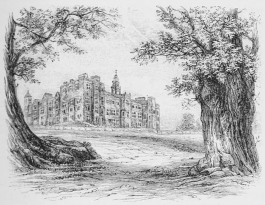
“In ‘Oliver Twist,’ Bill Sykes is described as having seen the fire at Hatfield as he was escaping from London.
“In the dining-room there is a portrait by Wilkie of the Duke of Wellington, painted when he was here after the battle of Waterloo. There is also at Hatfield a beautiful picture of Mary Queen of Scots at fifteen.[34] This, however, is not the authentic portrait. There is another, a replica of that at Hardwicke, taken in a widow’s dress shortly before her execution, which is one of the three portraits certainly painted from life. It was sent by the Queen to the Duke of Norfolk and intercepted by Lord Burleigh. One of the other two portraits belonged to Louis Philippe. As Sir Henry Bulwer was waiting for an audience of the king, another gentleman was in the room with him. The portrait of Queen Mary hung on the wall. The stranger looked at it, walked backwards and forwards to it, and examined it again and again. At last he walked up to Sir Henry Bulwer and said, ‘Can you tell me, sir, whom that portrait represents?’—‘Yes, I can,’ said Sir Henry; ‘but will you tell me why you ask?’—‘Because it is the lowest type of criminal face which is known to us.’ The stranger was Fouché the famous detective.
“In Lady Salisbury’s own room is a picture of Miss Pine, Lord Salisbury’s other grandmother, by Sir Joshua; also the Earl and Countess of Westmoreland and their child, by Vandyke; also a curious picture of a lady.
“‘She looks dull but good,’ said Miss Palmer.
“‘She looks clever but bad,’ said I.
“‘She was desperately wicked,’ said Lady Salisbury, ‘and therefore it is quite unnecessary to say that she was very religious. She endowed almshouses—‘Lady Anne’s Almshouses,’—they still exist, and she sent her son to Westminster with especial orders that he should be severely flogged, when he was seventeen, and so soured his temper for life and sent him to the bad entirely; and none but ‘a thoroughly highly-principled woman’ could do such a villainous action as that. The son lived afterwards at Quixwold, and led the most abominably wicked life there, and died a death as horrible as his life. He sold everything he could lay hands on, jewels and everything, all the old family plate except one very ugly old flat candlestick and six old sconces, which were painted over mahogany colour, and so were not known to be silver. His is the phantom coach which arrives and drives up the staircase and then disappears. Lord Salisbury heard it the other night when he was in his dressing-room, and dressed again, thinking it was visitors, and went down, but it was no one.’
“There is a picture of Elizabeth by Zucchero in the famous dress, all eyes and ears, to typify her omniscience, and with the serpent of wisdom on her arm: she loved allegorical dress. Her hat is here—an open-work straw hat—and in the recess of the gallery her cradle, with A. R. for Anne Boleyn. Elizabeth hated Hatfield. She was here in her childhood and all through Mary’s reign, and she constantly wrote from hence complaints to her father, to Mary, and to the Ministers, and they told her she must bear it; but she hated it, and after she became queen she never saw Hatfield again. The relics of her remain because James I. was in such a hurry to exchange Hatfield for Theobalds, on account of the hunting there, that he did not stop to take anything away.
“In the afternoon we had games, charades—Pilgrim, Pirate, Scullion, and stories.”
“Dec. 15.—Breakfast at a number of little round tables. I was at one with Miss Palmer, the Attorney-General, and his daughter Miss Coleridge. The Attorney-General told a story of a Mr. Kerslake, who was 6 feet 8 inches in height. A little boy in the Strand, looking up at him, said, ‘I say, Maister, if you was to fall down, you’d be halfway t’ome.’
“My cough prevented my going out, but we had Sunday-afternoon service in the chapel, with beautiful singing. In the evening Lady Salisbury asked me to tell stories to all the party, and it was sufficiently alarming when I saw the Lord Chancellor in the first row, with the Attorney-General on one side of him and Lord Cairns on the other. In repeating a story, however, I always think of a bit of advice Mr. Jowett gave me long ago—‘Try to say everything as well as you can say it.’ The Attorney-General afterwards told us—
“There is at Clifton a Mr. Harrison, who is the second medical authority there, a man of undoubted probity and reputation. He told me this.
“At Clifton lived a Mrs. Fry with her brother-in-law and his two daughters, Elizabeth and Hephzibah. These were persons who, like many Bristol people, had large property in the West Indies—the Miles’s, for instance, made their fortunes there. The elder daughter, Elizabeth, had been born in the West Indies, and when she fell into bad health, her father took the opportunity of taking her back to benefit by her native air, when he went to look after his West Indian property, leaving his younger daughter, Hephzibah, with Mrs Fry.
“They had not been gone long when Hephzibah took a chill, and in a very few days she died. Mr. Harrison attended her. Some days after he called as a friend upon Mrs. Fry, when she said, ‘I want to tell you something which has happened to me: I have seen Elizabeth.’—’ Impossible,’ said Mr. Harrison. ‘No,’ she said, ‘it was so. I was sitting reading the “Promise”’ (so I believe ‘Friends’ always call the Bible), ‘when I fell into a state which was neither sleeping nor waking, and in that state—I was not asleep—I saw Elizabeth standing by me. I spoke to her, and, forgetting what had happened in my surprise, I told her to call her sister. But she said to me that she had seen her sister already, and that she was in a box, and had a great deal of sewing about her chest. She especially used the word “sewing:” then she vanished away, and the place in the Promise where I had left off was changed: some one had turned it over.’ Mr. Harrison noted all this.
“Some time after came a letter from the father to Mrs. Fry, written before he had heard of Hephzibah’s death. After speaking of other matters he said, ‘I must now tell you of a very curious circumstance which has occurred, and which is much on my mind. The other day Elizabeth, who had been much better, and who is now nearly well, surprised us by falling into a stupor, and when she came to herself she would insist upon it that she had been to Clifton, and that she had seen you and Hephzibah, and that Hephzibah was in a long box, with a great deal of sewing upon her chest: and she says so still.’ The dates were precisely the same.
“Hephzibah’s death was so sudden that there was a post-mortem examination, though it was not considered necessary to distress Mrs. Fry by telling her of it. On this occasion Mr. Harrison was unable to be present. He went afterwards to the student of the hospital who was there, and who remembered all about it, and he said—what Mr. Harrison had not previously known—that after the examination the body was sewn up, with a great deal of sewing upon the chest.”
“Dec. 16.—The Archbishop of Canterbury and Mrs. Tait arrived before afternoon-tea, at which there was much lively conversation. Apropos of Radicalism and the conversation of Bishops, Lord Salisbury mentioned Sydney Smith’s saying that he would ‘rather fall a victim to a democratic mob than be sweetly and blandly absorbed by a bishop.’
“In speaking of Jenny Lind, Mr. Richmond said that she had ‘none of the warm ruddy glow of the sunny South in her character, it was rather the soft calm beauty of Swedish moonlight.’ He spoke of the faces he had drawn—of the interest of the ugly faces, if the lines had character; of the difficulty of translating a face like a moon or a footstool; that still such faces were quite the exception, and that he believed the reason why he succeeded better than some others of his confraternity was that he was better able to realise to himself the good in the character of his subjects.”
“Dec. 17.—Mr. Richmond was at the same little table at breakfast. He talked of great writers and talkers, how their art was not the creation of something new, but the telling of old things well in a new dress—the bringing up the thoughts long bedridden in the chambers of their own brain.
“He talked of Carlyle—of how his peculiarities began in affectation, but that now he was simply lost in the mazes of his own vocabulary. One night, he said, he met a man at Albert Gate at 12 P.M., who asked for a light for his cigar. He did not see who it was till, as he was turning away, he recognised Carlyle, who gave a laugh which could be heard all down Piccadilly as he exclaimed, ‘I thought it was just any son of Adam, and I find a friend.’ It was soon after the Pope’s return to Rome, and Mr. Richmond spoke of him. ‘The poor old Pope,’ said Carlyle, ‘the po-o-r old Pope! He has a big mouth! I do not like your button-holes of mouths, like the Greek statues you are all so fond of.’
“Our third at the breakfast-table was a Mr. Jeffreys. Mr. Richmond said afterwards that he was a conchologist, which he regarded as the very tail of science—the topmost twig of the tree looking up at the sky.”
“Dec. 19.—Yesterday I drew the gallery and chapel. There is something mediæval in the band playing all dinner-time, yet without the sound being overwhelming, from the great size of the room; in the way the host and hostess sit in the middle like royalty, and in the little lovely baskets of hot-house flowers given to each lady as she goes down the staircase to dinner.”
“Dec. 20.—The last collection of guests have included the Duke of Wellington, the Cowleys, Lord and Lady Stanhope, and M. and Madame de Lavalette—all full of interest. Certainly Hatfield is magnificent and grandly kept up. I had much talk with Mrs. Lowe,[35] who delights in tirades against Christianity. She said how absurd it was to expect belief in the Bible, when no one could agree upon so recent a subject as Lord Byron: that half the Bible was contrary to all reason: that it was monstrous to suppose that the Deity could enjoin a murder like that of Isaac, &c.”
“Dec. 27, East Sheen.—Mrs. Stuart Wortley came to luncheon. She remarked how that which was most striking in Italy was not the effect of light, but of shadow. Into the shadows of England you could not penetrate, but the shadows of Italy were transparent; the more you looked into their cavernous depths, the more you saw there, discovering marvels of beauty which existed there in repose.
“She told us that the secret of ‘the Haunted House in Berkeley Square’ is that it belonged to a Mr. Du Pré of Wilton Park. He shut up his lunatic brother there in a cage in one of the attics, and the poor captive was so violent that he could only be fed through a hole. His groans and cries could be distinctly heard in the neighbouring houses. The house is now to be let for £100 the first year, £200 the second, £300 the third, but if the tenant leaves within that time, he is to forfeit £1000. The house will be furnished in any style or taste the tenant chooses.”
To Miss Wright.
“Holmhurst, Jan. 10, 1873.—I have had a pleasant visit at Battle Abbey. The Duchess (of Cleveland) received me very kindly. The house is comfortable and the library is first-rate, and there is always a pleasure in a house which has ruins, cloisters, haunted yew walks—history, in fact—in its garden. The Duke, who is one of the few living of my father’s old friends, was very cordial; and Lord and Lady Stanhope, whom I am devoted to, arrived with me. The rest of the guests were Harry Stanhope, a clergyman, Colonel and Mrs. Heygarth, Colonel and Mrs. Byng, Mr. Newton the Lycian archæologist, Mr. Planché the Somerset Herald, and Mr. Campbell of Islay—a party which had plenty of good materials. We drew, acted, and all tried to make ourselves agreeable. The Duchess was a perfect hostess, amused us all very much, and was intensely amused herself.”
My book “Wanderings in Spain,” came out in the autumn of 1872, and met with a more enthusiastic reception from the public than anything I have ever written. Three editions were called for in six weeks, but there the sale ended.[36] The reviews were rapturously laudatory, but I felt at the time how little reliance was to be placed upon their judgment, though for the moment it was agreeable. The Times declared that no one ought to go to Spain without the book; the Athenæum, that only in one instance had pleasanter sketches fallen under its notice; while the Spectator blew the loudest trumpet of all:—
“In this least commonplace, and yet most comprehensive of works of travel, we find everything we have previously learnt of that comparatively unworked mine of history, art, poetry, and nature, Spain, as well as a great deal which is entirely novel. But the old is placed in a dazzling light of fancy, association, and suggestion, and the new is captivating. The skies of Spain shine, the wide-sweeping breezes blow, the solemn church music swells, the ancient grandeur, gravity, and dignity of the history and life of the country, the old Moorish magnificence, the splendid chivalry, the religious enthusiasm, the stern loyalty and narrow pride of the races of Arragon and Castile, all live again in the vivid pages of this book.”
The unusual success which was attending my “Walks in Rome,” and the many notes which I already possessed for a similar work in the neighbourhood, made me now devote my time to “Days near Rome,” and in January I left England to make Rome a centre from whence to revive my recollection of the towns I had already visited in the Campagna and its surrounding mountains, and to examine and sketch those I had not yet seen. Altogether, “Days near Rome” is the one of my books in the preparation of which I had the greatest enjoyment, and from which I have had least disappointment since its publication.[37] I was, however, terribly ill soon after my arrival at Rome, and nearly died there.
To Miss Leycester.
“Paris, Jan. 19, 1873.—I have felt most dolorous on the journey, and often repented having decided to come abroad: I so dread seeing Rome again. Still, as last year I added £252 to my income by small writings exclusive of the ‘Memorials,’ I must look upon it as a profession, and of course as such it is very pleasant. This morning I am cheered by George Sheffield’s pleasure at seeing me, and I am going to dine with the Comte and Comtesse de Clermont-Tonnerre.”
“Florence, Jan. 23.—All descriptions of ‘sensations’ in the Mont Cenis tunnel must be pure imagination. It is exactly like any other tunnel. I came all the way from Paris with two American ladies, one of them very handsome, but the sort of person who said, ‘I guess I am genteelly well satisfied’ when she had finished her dinner, and that she had read ‘Walks in Rome,’ which ‘was a very elegant book, a very elegant book indeed.’”
FIDENAE. [38]
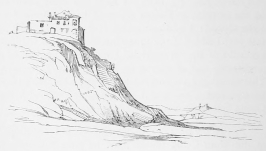
“81 Via della Croce, Rome, Jan. 27.—I left Florence on a still, mizzly morning. How familiar all the dear places seemed on the way, and yet how changed the feeling with which one saw them—Thrasymene, Perugia, Assisi, Spoleto—all so much to us, so woven into our lives, and I was thankful for the twilight obscurity before the steep of Fidenae rose beside us, and then the towers of the beloved city crested the hill, the hill down which my darling drove so often in her little carriage to the Ponte Salario and the Ponte Nomentano, drinking in the full beauty of the historic loveliness. On Saturday I removed to these rooms in the house of Voight, a German artist, much beloved by the Bunsens, and indeed married to his old still-existing Signora from their house. I think that the rooms will answer sufficiently, though, as the Voights have never let rooms before, there is a terrible amount of talking over everything I need. The whole family, of three generations, were called into council the first time I desired to have an egg for breakfast, and then it came in raw, and yesterday the scene was repeated. However, ‘pazienza.’
“On Sunday I went up first to the Pincio, and I cannot say—indeed no one could understand—all that that walk is to me, where day after day, for so many feeble winters, we helped my darling along; whence she looked down upon the windows so sacred to her in the San Sebastianello; where every shrub was familiar and commented upon, as not even those in the garden at Holmhurst have ever been. Nothing has been more our garden. It seemed almost sacrilege to see the changes, and they are not many. In the afternoon I went again with my old friend Stopford Sackville.
“It has been a great effort—a gasp—coming here, but I am thankful now that I came. There is something in the simple greetings of all our poor friends—‘Lei stá solo adesso—ahi poverino!’—far more to me than anything else could be, and the very trees and ruins talk to me, only that as she saw her Augustus’s, so I see my Mother’s name engraven on every stone. In some ways I seem every day to make fresh acquaintance with my solitary life.
“It is perfect summer here, the Villa Doria a sheet of flowers, anemones of every hue, violets almost over. ‘How full of sources of comfort has God made this lovely woe-world,’ as Mrs. Kemble says.”
“Feb. 1.—I have been very ill for the last three days with Roman fever, which has brought on a violent return of my cough. It all came from going out for one instant upon the balcony at night without extra clothing: in that instant I felt the seizure like a stab, and the most violent shivering fits came on immediately. Perhaps the chill of these rooms has something to do with it. I feel much the absence of the sympathising help I have had here in illness before, especially of Lea’s good food and attentions; and now, if I ask even for a cup of tea, the commotion is enough to bring the house down.... I am especially sorry to be shut up at this time, as there are so many pleasant people in Rome, not least the really charming Prince Arthur, to whom I was presented the other day, and whom I think most engaging, and hope—if I can only get better—to see more of next week, when I have been asked, and have promised, to go with him to several sights. Amongst his suite is Sir Howard Elphinstone, a capital artist, who is quite a friend of mine, and went out drawing with me before I was taken ill.
“The old interest of Rome has wonderfully passed away, not only to me, but I think also to many others. The absence of pope, cardinals, and monks; the shutting up of the convents; the loss of the ceremonies; the misery caused by the terrible taxes and conscription; the voluntary exile of the Borgheses and many other noble families; the total destruction of the glorious Villa Negroni and so much else of interest and beauty; the ugly new streets in imitation of Paris and New York, all grate against one’s former Roman associations. And to set against this there is so very little—a gayer Pincio, a live wolf on the Capitol, a mere scrap of excavation in the Forum, and all is said.
“Old Beppino (the beggar of the Trinità steps) escaped from a bad accident the other day and announced it thus—‘Ho mancato póco d’andare in Paradiso, che Dio me ne guarda!’”
“Il Tempietto, Feb. 4.—Since I last wrote I have been terribly ill. On Friday night I was seized with feverish convulsions, and with loss of speech for four hours. The first night I was too ill to call for any help, but next morning kind Dr. Grigor came, and I decided to forfeit the rent of my other rooms and move up here to our dear old apartment, having more than ever the immoral conviction I have always had, that one never does anything economical without doing something very foolish also. These dear rooms have all their old homelike charm. I sit in the Mother’s chair with her little table by my side, and Madame da Monaca, our old landlady, is perfectly charmed to have me back.”
“Feb. 9.—I have still some sparks of life in me, which really two days ago I did not feel, it has been such a suffering illness and the cough has quite worn me out. I am sure, in thinking of dangerous illness henceforward, I shall always remember the long nights here, nights of pain and fever, tossing restlessly and longing for the morning, and first knowing it had dawned by the tinkling bells of the goats coming to be milked under the windows, followed by the familiar cry of—
‘Acqua Acetosa Buona per la sposa.’
“Charlie Dalison, who has been in Rome, has been most kind, and the Archbishop of Dublin and Mrs. Trench, living just underneath, have been incessant in their attentions. Endless little comforts have also been supplied to me by the constant kindness of two ladies who live together, Miss Freeman Clarke, an American authoress, who has visited all the places in Italy connected with Dante, and drawn and described them; and Miss Foley, a most charming young sculptress, as clever as she is attractive.”[39]
“Feb. 16.—Last week I felt as if life was really passing away—such was my utter exhaustion and suffering.... After a most kind touching note about the ‘Memorials,’ I have had an hour’s visit from Lord Chichester, and he is coming again often. I constantly see Lady Ashburton, who rains her benefits upon me. I am doing all I can to be able to go out with the Prince soon, having put him off again and again with a greater pang each time, but I wish I could feel a little less dreadfully weak.
“I think the ‘Memorials’ will soon reach a sale like that of the Récit d’une Sœur. Hatchard is pushing the ‘Alton Sermons’ under its shadow. ‘Wanderings in Spain’ also sells beyond all expectation.”
VIEW FROM THE TEMPIETTO, ROME.
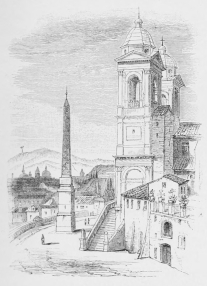
It was on the 18th of February that I was first able to have one of my lectures for Prince Arthur. It was arranged for the Palace of the Cæsars. I had asked him if Lady Ashburton and her daughter might go with us, and to this he had consented. Lady Ashburton insisted upon coming to fetch me, but, knowing her unpunctual habits, I was most unwilling she should do so. Nothing else would serve her, however, and she promised again and again to be punctual. However, the time came and she did not arrive. Having secured no other carriage I waited minute after minute in an agony, and not till after the time at which we ought to have been at the Palatine did Lady Ashburton appear on the Pincio. When we reached the Palatine, the Prince and all his suite were still in the road, unable to enter without my order. “I have been waiting ten minutes,” he said, “and they wouldn’t let me in.” It was a terrible beginning. However, his lively pleasure and active interest in all that was to be seen soon made me at home with him. If anything especial attracted his notice, he generally asked, “Do you think my brother and sister (the Prince and Princess of Wales) saw this?”
A few days after, I had another lecture for the Prince on the Cœlian. This time I refused altogether to go with Lady Ashburton, and when I arrived ten minutes before the time at the steps of S. Gregorio, found that she had already been there half-an-hour, walking up and down in the dew! This time the Prince was even pleasanter than before. Generally he begged that his name might not be mentioned, but this was necessary to get into the garden of SS. Giovanni e Paolo, which at that time was always closed. While we were in the church, a monk came up to me and said that the General of the Passionists was coming to pay his respects to the Prince. I said, “Sir, the General of the Passionists is coming to have the honour of being presented to you.” The Prince began to say “No, no, no,” but at that moment the white robes of the abbot appeared in the doorway, followed by a whole train of monks. The Prince immediately did the right thing, receiving them and speaking to them on the steps of the tribune, and I have often thought what a picture the scene would have made. In the shadow of royalty, Lady Ashburton was the first woman allowed to visit the Passionist garden, but to the Prince’s great annoyance, three Americans (probably not knowing who it was) got in too, by pretending to belong to our party. They followed us afterwards to the Villa Mattei. The Prince then asked Lady Ashburton to sit down near the entrance, and we raced up and down the walks, with the Americans cantering after us, and eventually slipped under one of the high box hedges, returned by the concealed way, snapped up Lady Ashburton, and escaped from the Villa, the gates of which were locked behind us; and how those Americans got out I have never known.
I was truly sorry when the Prince went away to Naples. He sent me from thence some friends of his—Colonel Crichton and his most sweet wife Lady Madeleine (a daughter of Lord Headfort, who has died since), and asked me to do what I could for them. I knew that this meant lectures of the same kind which I had given for the Prince himself, and thus was originated my long course of Roman lectures.
At one of my lectures at the Palace of the Cæsars a curious thing happened. We were about forty in number, and I had taken my company all over the palace, explaining and telling the story of the different rooms as we went. Finally, as was my habit, I assembled them on the slope towards the Forum for a sort of recapitulation and final discourse on all we had seen. I had observed a stranger who had attached himself to our party looking more and more angry every minute, but the “why” I could not understand. When I had concluded, the stranger stepped forward, and in a very loud voice addressed the whole party—“Gentlemen and ladies, it is not my habit to push myself forward, and it is excessively painful to me to do it on the present occasion; but there are some things which no gentleman ought to pass unnoticed. All that this person has been telling you about the Palace of the Cæsars, he has had the effrontery to relate to you as if it were his own. You will be astounded, gentlemen and ladies, to hear that it is taken, word for word—word for word, without the slightest acknowledgment, from Mr. Hare’s ‘Walks in Rome!’”
I only said, “Oh, I am so much obliged to you. I did not know there was anybody in the world who would defend my interests so kindly. I am Augustus Hare.”
To Miss Leycester.
“Il Tempietto, Rome, March 9, 1873.—I am much better, but still have fever every three days. The weather is glorious, and Miss Wright, who arrived ten days ago, is revelling in the hot sunshine.
“On Monday we had an enchanting expedition to Veii; there were twelve riders and five carriages. I went with Miss Baring[40] and her governess, and we had quite a banquet near the waterfall, with the old castle of Isola Farnese opposite, and the woods around us carpeted with cyclamen, violets, and blue and white anemones, while the cliffs were snow-drifted with laurustinus. After luncheon, the adventurous part of the company, the Sackvilles, Miss Wright, &c., went on with me to the Ponte Sodo and the painted tombs—such a hot walk through the woods, but we came back to Rome before sunset.
ISOLA FARNESE. [41]
“At the end of this week I have a lecture on the Christian history of the Trastevere.
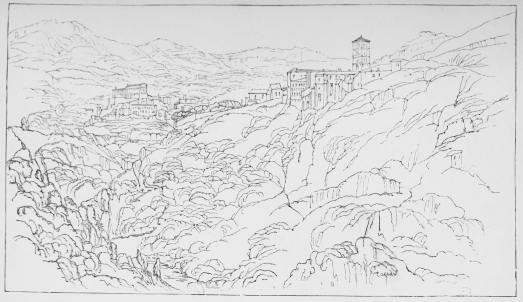
VALLEY OF SUBIACO.
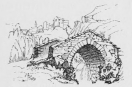
PONTE DELL’ ISOLA, VEII. [42]
“I think a Republic here will soon follow that of Spain. Victor Emmanuel is so hated, and the profligacy of the Court and the cruel taxes are hastening the end. People already shout ‘Viva la Republica’ and bawl Garibaldian hymns all night. I wonder whether you would think the freedom of religious worship a compensation for the moral changes here—the shops always open on Sundays, which were formerly so strictly closed, the churches deserted, stalls for infidel books in the streets, and an ostentatious immorality which was formerly unknown. In the Carnival, in insulting reference to the Pope, a pasteboard dome of St. Peter’s was made to travel up and down the Corso in a car, with a parrot imprisoned in a cage on the top, ‘pappagallo’ being Italian for a parrot, and ‘Papa Gallo’ a nickname given to Pio Nono during the French occupation. The parrot struggled and fluttered through the first day, but it died of sea-sickness in the evening, and afterwards it appeared stuffed. The Pope has felt bitterly the confiscation of the convents and other religious institutions which the Sardinian Government, when it first entered Rome, promised so strictly to respect; and triduos have been held at St. Peter’s and at S. Ignazio to implore that the spoliation may be averted, or that a judgment may follow the spoiler. In St. Peter’s twenty thousand persons were collected on Sunday afternoon to join with one voice in this supplication. Pius IX. took no part in the manifestation: on Sunday afternoon he is quietly occupied as a bishop in the Sala Regia, in explaining the Epistle and Gospel for the day, and praying with the people of the different Roman parishes, who come to him in turn, attended by their priests. Amongst the nuns who have suffered most are the Poor Clares of S. Lorenzo Panisperna, who, when they were driven out of the greater part of their convent in February 1872, were allowed to retain and fit up a few small rooms, from which they are now forcibly ejected altogether. The nuns of S. Antonio on the Esquiline, who plaited all the palms used in the processions at St. Peter’s, were driven out more than a year ago, though their convent has never hitherto been used for anything else. The nuns of S. Giacomo alla Lungara are reduced to absolute beggary. The Carmelites of S. Maria Vittoria have been driven out, and their Superior died of a broken heart on the day of their ejection. The nuns of S. Teresa, when driven out of their convent, were permitted to take refuge in that of Regina Cœli, where they were allowed to fit up a corridor with canvas partitions: now they are driven out again, in spite of solemn promises, and without any compensation. If the dowries of all these ladies, given to them by their parents exactly as marriage portions are given, were restored, comparatively little could be said, but their fortunes are all confiscated by the Government. A pitiful allowance is promised, just sufficient to keep body and soul together, but even this is seldom paid; for instance, in the case of the nuns of S. Teresa, the ‘assegno’ for the first half of 1871 was not paid till October 1872, and since then nothing has been paid. In the same way it is supposed that the conventual buildings and gardens are paid for at a valuation, yet the real value of those of the Cappuccini, in one of the most important situations of the town, is £40,000, and it is expropriated at 4000 francs (£160), while even this is to be paid in paper and at great intervals of time. Amongst the last institutions seized are the Orphan Asylum of the Quattro Incoronati, and the Conservatorio Pio, an especial and beloved institution of Pio Nono, intended as a school for servants and for instructing young girls in household work.[43]
“The heads of the clerical schools have inquired from Pius IX. whether their pupils were to salute Queen Margaret when she passed them. ‘Certainly,’ answered the Pope; ‘is she not a member of the royal house of Savoy?’
“There is a stall for Bibles now opposite S. Carlo. A great dog manages it, such a fine beast. He cannot be expected to do all the business, so he just receives the customers, and, when any one wants a Bible, he puts his feet up and barks.
“I am very glad to hear of Sir George Grey having given the ‘Memorials’ to the Queen, and I have a most kind letter from Lord Stanhope, delighted with ‘Wanderings in Spain.’”
“March 17.—Yesterday I drove with Lady Ashburton to Castel Fusano; Miss Wright, Miss Howard, and Walter Jekyll going in another carriage, and we picnicked under the grand old pine-trees, and had a delicious day, wandering through the labyrinths of sweet daphne and rosemary, and over carpets of cyclamen in fullest bloom.
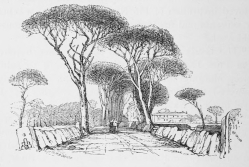
CASTEL FUSANO. [44]
“I have had several more lectures. There was a party of forty, which is the largest I can manage, at the one on the Early Christian Church in the Trastevere. We met on the Island, where I gave a sort of preliminary discourse, and led my troop to everything connected with the Christian martyrs. To-morrow I have the same kind of lecture on the Esquiline. Mrs. Locke and her pretty charming little grand-daughter[45] unexpectedly joined us at S. Cecilia, and seemed much interested, never having visited the Roman sights before. I dined with them last night—an exceptionally pleasant party, as Mrs. Locke, the Duchess, and the little Countess move about constantly all evening, and do their utmost to amuse their guests, unlike most stiff Italian hostesses. They seem to me to have three grades of beauty, the grandmother’s being the highest.”
“14 Trinità de’ Monti, March 29.—There are many quiet hours here, such as one gets nowhere else, and yet endless society of the most interesting kind; troops of visitors of every sort, and what contrasts those of a single day furnish—Madama de Bonis at breakfast, for help with her photographs; then Rosina the poor donna; then Lady Howard de Walden and a daughter; then Signor Monachesi, the Italian master; then the Marchese Carcolo, fresh from Perugia; then three ugly old ladies, whose names I failed to discover, who wanted to be told where to live, how to live, and what to live upon; then Mrs. Foljambe from Villa Savorelli; then Signor Altini the sculptor, to ask for recommendations: and this is only an ordinary Roman day, yet I cannot feel it is a useless life.”
“Albano, April 6.—Yesterday, after dining with Mrs. Lockwood, I went to meet Princess Alice at the S. Arpinos’. They have a beautiful suite of rooms in the Bonaparte Palace, the same in which ‘Madame Mère’ died. Many ambassadors and Roman princes and princesses were there, but only five English. I was presented at once to Prince Louis, who is very German and speaks very broken English, but is much better-looking than his photographs. He talked for a long time about Rome and my book. Later in the evening I was presented to the Princess. She said at once, ‘Oh, I know your face, I have seen you before,’ and with royal memory recollected all about coming to see my Mother, &c. She said, ‘I have gone about everywhere with your book, and I am so pleased to be able to say that I have found out a mistake in it: you say that the church at the Navicella was designed by Michelangelo, and it was not; it was designed by Raffaelle: I know all about it, for my dear father had the original plan and sketch for it. My dear father always took a great interest in the Navicella. I have been to see the martyrdoms at S. Stefano: they are quite shocking.’ She talked for some time, then some one else was brought up. She is grown much fatter and prettier, and was very simply dressed in high slate-coloured silk with a pearl necklace. We all stayed till she left at 11 P.M., and then made an avenue down the reception rooms, through which she passed, saying a little separate word to each lady.
“Mrs. Locke[46] said Princess Margherita was deep in ‘Walks in Rome,’[47] and had desired her to get me to tell her (Mrs. Locke) a ghost-story, and then come and retail it immediately!
“Yesterday I went with Lady Howard and her daughter and Miss Wright to Tusculum and Frascati. I never saw the Villa Mondragone before. How very grand it is, and the view was exquisitely lovely—such blue shadows cast by the clouds upon the pink campagna. All the ascent to Tusculum was fringed with cyclamen, large purple violets, laurustinus, and blue and white anemones, also the loveliest little blue squills.
“On Wednesday I met Miss Wright and Miss Howard at Albano, and we had an interesting afternoon amongst the huge Cyclopean remains of Alatri, driving on in the beautiful gloaming to Ferentino, where we slept at a primitive but clean Italian tavern. The next day we reached Segni, a Pelasgic city on the very highest peak of the Volscian mountains. On Friday I joined Lady Howard de Walden and her two daughters, and with them revisited the glorious old Papal citadel of Anagni, where Boniface VIII. was imprisoned, and where there are many relics of him, though to me Anagni has an even deeper interest, because from its walls you can see, on the barren side of the mountain, the brown building of Acuto, where my sister’s revered friend Maria di Matthias preached the sermons which had such an extraordinary influence throughout this wild country.”
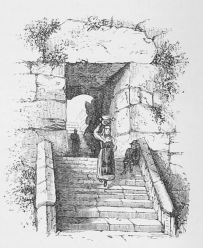
CYCLOPEAN GATE OF ALATRI. [48]
“Subiaco, April 16.—We spent Good Friday on the seashore at Porto d’Anzio, a delightful place, overgrown with gorgeous pink mesembryanthemum, and with huge remains of Nero’s palace projecting far into the sea. For Easter we were at Velletri, and on Monday drove through the blooming country to Cori, where, after seeing the beautiful temple, we rode along the edge of stupendous precipices to Norba, and the man-deserted flower-possessed fairy-like town of Ninfa, returning by the light of the stars—‘le Ninfe eterne’ of Dante. Tuesday we went to Palestrina, an extraordinary place with a perfectly savage population; and Wednesday we came hither through Olevano, which is a paradise of beauty. This place seems quite as grandly beautiful as we thought it fifteen years ago.”
THE INN AT FERENTINO. [49]
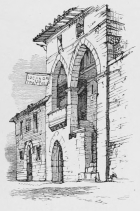
“Rome, April 28.—I parted with my kind Miss Wright at Tivoli, and next day returned to Rome in the public omnibus.”[50]
PAPAL PALACE, ANAGNI. [51]
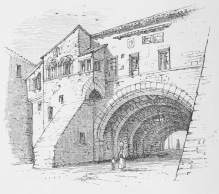
TEMPLES OF CORI. [52]
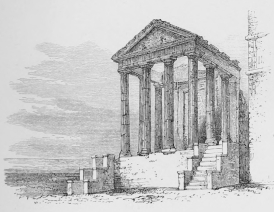
NINFA. [53]
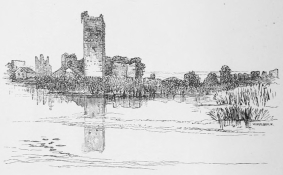
A few days later I left Rome again with Mr. and Mrs. Arbuthnot Feilden and the Misses Crawford (daughters of Mrs. Terry, and sisters of Marion Crawford) for a tour in the Ciminian Hills, which always comes back to me as a dream of transcendent loveliness.
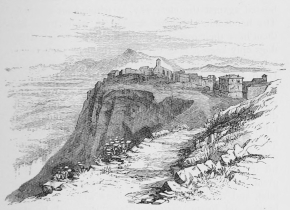
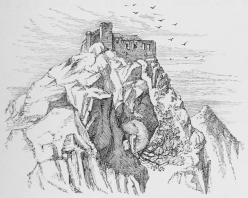
We left the railway at Civita Castellana, an unspeakably beautiful place, which I drew in the early dewy morning, sitting on the edge of its tremendous rocky gorge, above which Soracte, steeped in violet shadows, rises out of the tender green of the plain. On May-day we ascended Soracte, queen of lovely mountains, mounting gradually from the rich lower slopes into the excelsior of olives, and thence to steeps of bare grey rock, crowned—in the most sublime position—by the ruined monastery of S. Silvestro. It is the most exquisite drive from Civita Castellana, by Nepi, with a great machicolated castle overhanging a foaming waterfall, and Sutri—“the key of Etruria”—with its solemn Roman amphitheatre surrounded by some of the grandest ilexes in the world, to Ronciglione. Hence we visited Caprarola, and I will insert a little extract from “Days near Rome” about this expedition, it reminds me of so wondrously beautiful and delightful a day.
S. ORESTE, FROM SORACTE. [54]
“From the little deep-blue lake of Vico it is a long ascent, and oh! what Italian scenery, quite unspoilt by the English, who never come here now. The road is generally a dusty hollow in the tufa, which, as we pass, is fringed with broom in full flower, and all the little children we meet have made themselves wreaths and gathered long branches of it, and wave them like golden sceptres. Along the brown ridges of thymy tufa by the wayside, flocks of goats are scrambling, chiefly white, but a few black and dun-coloured creatures are mingled with them, mothers with their little dancing elf-like kids, and old bearded patriarchs who love to clamber to the very end of the most inaccessible places, and to stand there embossed against the clear sky, in triumphant quietude. The handsome shepherd dressed in white linen lets them have their own way, and the great rough white dogs only keep a lazy eye upon them as they themselves lie panting and luxuriating in the sunshine. Deep down below us, it seems as if all Italy were opening out, as the mists roll stealthily away, and range after range of delicate mountain distance is discovered. Volscian, Hernican, Sabine, and Alban hills, Soracte nobly beautiful—rising out of the soft quiet lines of the Campagna, and the Tiber winding out of the rich meadow-lands into the desolate wastes, till it is lost from sight before it reaches where a great mysterious dome rises solemnly through the mist, and reminds one of the times when, years ago, in the old happy vetturino days, we used to stop the carriage on this very spot, to have our first sight of St. Peter’s.
CONVENT OF S. SILVESTRO, SUMMIT OF SORACTE. [55]
“Near a little deserted chapel, a road branches off on the right, a rough stony road enough, which soon descends abruptly through chestnut woods, and then through deep clefts cut in the tufa and overhung by shrubs and flowers, every winding a picture, till in about half-an-hour we arrive at Caprarola. Why do not more people come here? it is so very easy. As we emerge from our rocky way, the wonderful position of the place bursts upon us at once. The grand, tremendous palace stands backed by chestnut woods, which fade into rocky hills, and it looks down from a high-terraced platform upon the little golden-roofed town beneath, and then out upon the whole glorious rainbow-tinted view, in which, as everywhere we have been, lion-like Soracte, couching over the plain, is the most conspicuous feature. The buildings are so vast in themselves, and every line so noble, every architectural idea so stupendous, that one is carried back almost with awe to the recollections of the great-souled Farnese who originated the design, and the grand architect who carried it out. S. Carlo Borromeo, the great patron of idle almsgiving, came hither to see it when it was completed, and complained that so much money had not been given to the poor instead. ‘I have let them have it all little by little,’ said Alessandro Farnese, ‘but I have made them earn it by the sweat of their brows.’
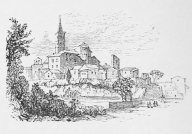
SUTRI. [56]
“Are we really in Arcadia, when the old steward opens the door from the dark halls where the Titanic forms of the frescoed figures loom upon us through the gloom, to the garden where the brilliant sunshine is lighting up long grass walks between clipped hedges, adding to the splendour of the flame-coloured marigolds upon the old walls, and even gilding the edges of the dark spires of the cypresses which were planted three hundred years ago? From the upper terraces we enter an ancient wood, carpeted with flowers—yellow orchis, iris, lilies, saxifrage, cyclamen, and Solomon’s seal. And then we pause, for at the end of the avenue we meet with a huge figure of Silence, with his finger on his lips.
CAPRAROLA. [57]
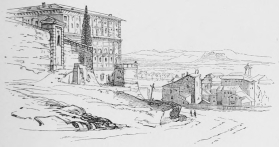
PAPAL PALACE, VITERBO.
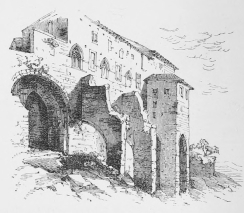
“Here an artificial cascade tumbles sparkling down the middle of the hillside path, through a succession of stone basins, and between a number of stone animals, who are sprinkled with its spray, and so we reach an upper garden before the fairy-like casino which was also built by Vignola. Here the turfy solitudes are encircled with a concourse of stone figures in every variety of attitude, a perfect population. Some are standing quietly gazing down upon us, others are playing upon different musical instruments, others are listening. Two Dryads are whispering important secrets to one another in a corner; one impertinent Faun is blowing his horn so loudly into his companion’s ears that he stops them with both his hands. A nymph is about to step down from her pedestal, and will probably take a bath as soon as we are gone, though certainly she need not be shy about it, as drapery is not much the fashion in these sylvan gardens. Above, behind the Casino, is yet another water-sparkling staircase guarded by a vast number of huge lions and griffins, and beyond this all is tangled wood and rocky mountain-side. How we pity the poor King and Queen of Naples, the actual possessors, but who can never come here now. The whole place is like a dream which you wish may never end, and as one gazes through the stony crowd across the green glades to the rosy-hued mountains, one dreads the return to a world where Fauns and Dryads are still supposed to be mythical, and which has never known Caprarola.”
FROM THE WALLS OF ORVIETO.
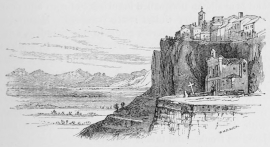
We spent several days at Viterbo—“the city of beautiful fountains”—which has never been half appreciated by travellers, and made many curious excursions into Etruria, which are all described in my book; and then proceeded to Orvieto—all-glorious Orvieto. Once more I will quote “Days near Rome.”
“Long before reaching Orvieto, one comes in sight of it. It occupies an Etruscan site. On turning the crest of the hills which shelter Bolsena, one looks down into a wide valley filled with the richest vegetation,—peach-trees and almonds and figs, with vines leaping from tree to tree and chaining them together, and beneath, an unequalled luxuriance of corn and peas and melons, every tiniest space occupied. Mountains of the most graceful forms girdle in this paradise, and, from the height whence we first gaze upon it, endless distances are seen, blue and roseate and snowy, melting into infinity of space; while, from the valley itself, rises, island-like, a mass of orange-coloured rock, crowned with old walls and houses and churches, from the centre of which is uplifted a vast cathedral, with delicate spray-like pinnacles, and a golden and jewelled front,—and this is Orvieto.
“The first impression is one which is never forgotten,—a picture which remains; and the quiet grandeurs of the place, as time and acquaintance bring it home to one, only paint in the details of that first picture more carefully.
“We descend into the plain by the winding road, where wains of great oxen are always employed for the country-work of the hillside, and we ascend the hill on which the city stands and enter it by a gate in rocky walls. The town is remarkably clean, but one has always the feeling of being in a fortress. Unlike Viterbo, gaiety and brightness seem to have deserted its narrow streets of dark houses, interspersed with huge tall square towers of the Middle Ages, and themselves, in the less frequented parts, built of rich brown stone, with sculptured cornices to their massive doors and windows, and resting on huge buttresses. From one of the narrowest and darkest of these streets we come suddenly upon the cathedral, a blaze of light and colour, the most aërial gothic structure in the world, every line a line of beauty. There is something in the feeling that no artists worked at this glorious temple but the greatest architects, the greatest sculptors of their time, that no material was used but that which was most precious, most costly, and which would produce the most glorious effect, which carries one far away from all comparisons with other earthly buildings—to the description in the Revelation of the New Jerusalem. The very platform on which the cathedral stands is of purple Apennine marble; the loveliest jaspers and pietre dure are worked into its pinnacles and buttresses; the main foundation of its pictured front is gold. A hundred and fifty-two sculptors, of whom Arnolfo and Giovanni da Pisa are the greatest names handed down to us, worked upon the ornamentation near the base: sixty-eight painters and ninety workers in mosaic gave life to the glorious pictures of its upper stories. All the surroundings are harmonious—solemn old houses, with black and white marble seats running along their basement, on which one may sit and gaze: a tower surmounted by a gigantic bronze warrior, who strikes the hours with the clash of his sword upon a great bell: an ancient oblong palace with gothic arches and flat windows, where thirty-four popes have sought a refuge or held a court at different times—all serving as a dark setting to make more resplendent the glittering radiancy of the golden front of the temple in their midst.
“No passing traveller, no stayer for one night, can realise Orvieto. Hours must be passed on those old stone benches, hours in reading the wondrous lessons of art, of truth, of beauty and of holiness which this temple of temples can unfold. For Orvieto is not merely a vast sculpture-gallery and a noble building, but its every stone has a story to tell or a mystery to explain. What depths of thought are hidden in those tremendous marble pictures between the doors! First the whole story of Genesis, then the Old Testament story which followed Genesis, leading on to the birth of Christ; then the story of our Saviour’s life upon earth; and lastly, the lesson of His redemption wrought for us, in the resurrection of the dead to the second life. Even the minor figures which surround these greater subjects, how much they have to tell us! Take the wondrous angels which surround the story of Christ; the Awe-stricken Angel of the Salutation, the Welcoming Angel of the Flight into Egypt, the Praying Angel of the Temptation, the Suffering Angel of the Betrayal, the Agonised Angel (and, oh, what a sublime figure, with its face covered with its hands!) of the Crucifixion, the Angel, rapt in entire unutterable beatitude, of the Resurrection. Or let us look at the groups of prophets, who, standing beneath the life of Christ, foresee and foretell its events,—their eager invocation, their meditation, their inspiration, their proclamation of that which was to be.”
My companions returned to Rome from Orvieto and I went on to Florence, where I found two old friends of my childhood—Ann-Emilia and Kate Malcolm, the latter of whom has always been one of the most agreeable and charming women I have ever known.[58] I remember her telling me, on this occasion, of a friend of hers who was one day sitting at the end of her terrace at a retired watering-place, and heard a bride and bridegroom talking together beneath. “My dear,” said the bridegroom, “I think it would not be unpleasant if a friend were to turn up this evening.”—“My dear,” retorted the bride, “I should be thankful to see even an enemy.” She had also a story of an old Scotch minister, who, being summoned to marry some couples, thus addressed them:—“Ma freends, to many, marriage is a great curse: ma freends, to some marriage is a great blessing: ma freends, to all marriage is a great uncertainty: wull ye risk it?” and they all said “Yes.” With the Malcolms I saw much of Sir James Lacaita. He was very full of convents and their abuses. He told me that he had personally known a nun who was forced into a convent to prevent her from marrying the man she loved; but he made a silken ladder, and, by bribing the gardener, got it fixed to her window. The nun escaped, but was in such a hurry to descend, that she slid down the cords, cut open both her hands, and bore the marks all her life. Her lover was rich, had relays of horses, and they escaped to Sicily, were married at once, and had eleven children. Lacaita also told me:—
PORCH OF CREMONA. [59]
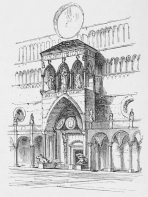
“A beautiful girl of good family was left £6000 by her father, on condition that she did not enter a convent. To prevent her doing so, he ordained that the money should revert to her brother in case of her becoming a nun.
PIAZZA MAGGIORE, BERGAMO. [60]
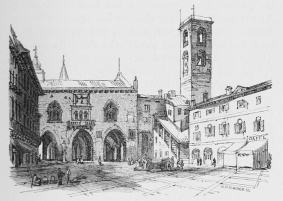
“The girl hated the very idea of a convent, but the brother made a compact with an abbess to give her a third of the girl’s fortune if they could force her to take the veil. She resisted vigorously, though the brother’s wife ill-treated her in every possible way, and she had no other home. She possessed a lover, who professed great devotion, but never would come to the point. At last the time came when the brother had arranged for her to go to the convent. Her treatment was such that she had no other course. Her lover came and pitied her. She implored him: she knelt at his feet: she stretched out her hands: she said, ‘You know you can save me;’ but he feared the priests, the Church, and her brother too much. As she knelt there, her sister-in-law opened the door. Then her horror at her position was so great, she at once declared that she would take the veil: she only wished the event hurried on.
“At last the day of the sacrifice arrived. Lacaita was present. The bride came in, in her wedding splendour, fière, darting defiance at them all; but Lacaita said he never should forget the shriek she gave when all was over and the grille closed upon her.
“The remorse of the lover began at once: he never spoke to a woman for twenty years: then he—— married!”
Lacaita also told me a most interesting story concerning persons whom he had known, of which I forget the details, but the substance was that—
A beautiful girl in Sicily, of very noble family, was engaged by her parents to make a magnificent marriage with an Italian prince of the highest rank, who had never seen her, and had only heard the report of her beauty. As she loved another, she made great friends with the gardener’s daughter, and persuaded her—for she was very lovely also—to personate her, which the peasant girl, pleased at the notion of being a princess, was very willing to do. Meantime the young Countess, supposed to have gone to her nuptials, eloped with the lover she preferred. The peasant bride was married, but her prince soon began to think she was wonderfully little educated, for he had heard of her great learning as well as her beauty, and especially of her wonderful artistic powers, and two years after he obtained a divorce on the plea that she was married under a false name.
From Florence I went to Cremona and Bergamo, lingering at them and seeing them thoroughly in glorious weather, which made one observe that, though the Southern Italian skies are the opal ones, the Northern are the blue.
I spent June (1873) in London. At luncheon at Lady Marion Alford’s I met Mr. Carlyle, who was full of the “Memorials.” He said, “I do not often cry and am not much given to weeping, but your book is most profoundly touching, and when the dear Augustus was making the hay I felt a lesson deep down in my heart.” He talked of Lady Ashburton--“Ah! yes, Lady Ashburton is just a bonnie Highland lassie, a free-spoken and open-hearted creature as ever was; and Hattie Hosmer, she is a fanciful kind of a being, who does not know yet that art is dead.” Finally he went off into one of his characteristic speeches. “That which the warld torments me in most is the awful confusion of noise. It is the devil’s own infernal din all the blessed day long, confounding God’s warks and His creatures—a truly awfu’ hell-like combination, and the warst of a’ is a railway whistle, like the screech of ten thousand cats, and ivery cat of them all as big as a cathédral.”
Journal.—To Miss Leycester.
“London, June 14, 1873.—I have seen and heard much that is interesting. Yesterday I met Lord Aberdeen at luncheon, and liked him very much. Then I went to old Lady Wensleydale’s afternoon reception, intending to stay ten minutes, and did stay two hours and a half, it was so agreeable, and I saw so many old friends. Mrs. W. Lowther is always pleasant, the rooms are delightful, and the charming garden full of flowers.”
“June 19.—Dined with Lord Ravensworth—a very pleasant party, to meet poor Lord Durham, whom I had not seen since his great sorrow. He looks as if he had cried night and day ever since, and did cry in a corner when a touching song was sung about a young wife. I was very glad to meet him again. He is quite devoted to his thirteen children, and the eldest girl, of thirteen, manages everything.”
“July 3.—The most extraordinary thing the Shah has done has been offering to buy Lady Margaret Beaumont (to carry off to Persia) for £500,000!”
“July 24, 1873.—I went to luncheon with Lady Barrington, and found her still in tears for the Bishop of Winchester’s[61] death. He had dined with her a few days before, and she had spoken of the pleasure it would be to him to go to Farnham. ‘Oh, I shall never go to Farnham,’ he said; ‘the old Bishop of Winchester will long survive me;’ and so it was. ‘Oh, what a joyful surprise for him!’ said Carlyle when he heard of the Bishop’s sudden death. ‘He is our show man for the Church of England,’ Hugh Pearson used to say.
“Dined at Lord Salisbury’s, and sat between Miss Alderson and Lady Cork. I had always heard of Lady Cork as one of the best talkers in London, but was not prepared for such a display of summer lightning as it was. Here is a trifling specimen.
“Lord Salisbury.—‘I am so glad he speaks English. I find it such an extra fatigue to have to struggle with a foreign tongue, and to think of the words as well as the ideas.’
“Lady Cork.—‘Well, I am afraid when I talk, I think neither of the one nor the other.’
“Lord S.—‘Yes, but then you come of a race’ ...
“Lady C.—‘Wha-a-at, or I had better use that most expressive French expression ‘Plait-il?’ ... We have only one English sentence which would do as well—‘I beg your parding’—with a g.’”
“July 26.—I reached Chevening about 6 P.M. It is a dull square white house with wings, but was once red, and was designed by Inigo Jones, from whom it retains the old plan, not only of the building, but of the straight avenue, the lake, and the fountain with water-lilies before the door. Between the house and the lake is the loveliest of flower-gardens, a wilderness of old-fashioned flowers, most perfectly charming. Here Lady Stanhope was sitting out with Lord and Lady Carnarvon and Lord and Lady Mahon. Lord Carnarvon is agreeable and his wife most lovely and piquant. Lady Mahon, very prettily dressed en bergère, looked like a flower herself as she moved in her bright blue dress through the living labyrinth of colour.
“Lady Carnarvon gave an amusing account of her visit to Dulwich College, of which her husband is a governor, and how she had produced a great effect by remarking that they used a new pronunciation of Latin; ‘and my little girl behaved very well too, and, though she was most awfully bored, smiled and bowed at all the right moments.... We came away before the speeches, which were all quite horrid, I believe, except Carnarvon’s, and that I am quite sure was very nice indeed.”
“Lord Stanhope talked of chess—a Persian game: in Germany they retain the old names: checkmate is Shahmate. He said when the Shah of Persia was in London it was quite impossible to make him understand how the telegraph worked, until some one had the presence of mind to say, ‘If your Majesty will imagine an immense dog, so big that his tail is in London while his head is in Teheran, your Majesty will see that if some one treads upon his tail in London, he will bark in Teheran.’
“Lord Stanhope spoke of the total absence of commissariat management in England, so that, if there was an invasion, the salvation of the country would positively have to be abandoned to Messrs. Spiers & Pond.
“Lord Carnarvon asked why Oxford was like an old Roman arsenal ‘Because the honours are classes, the men are puppes, and the women are nautes.’”
“Sunday, July 28.—We had a dull missionary sermon at church, in which the clergyman spoke of the poor Bishop of Winchester’s death as if it was a judgment for his crimes. After service Lady Airlie talked of the ‘Memorials,’ which she discussed as we walked round the lake. She spoke much of prevailing religious opinions, and said that it would be as difficult to believe in complete inspiration now as to believe in witchcraft. I startled her by telling her I did believe in witchcraft, and told something of Madame de Trafford. In the afternoon we drove with Lord Stanhope to Knockholt Beeches and back by the steep park drive. The country was quite lovely. Lord Stanhope entertained us constantly with that essence of courtesy and good-breeding which almost makes you feel as if you were the entertainer and the obliging, instead of the entertained and the obliged—indeed such perfection of courteous kindness I have never seen elsewhere in any one. I walked with Lady Airlie up to the beeches, and she talked of Lady Waterford, whom, she said, she worshipped afar off, as I did nearer.”
“July 29.—A long talk about art and drawing and Italy with old Mr. Cheney, who said, speaking of the best buildings, ‘They are much too good for this generation: it will destroy them because they are so beautiful.’ He is so pleasant that I could understand a bit of a dialogue I overheard between him and Lady Airlie.
“Lady A.—‘I am so sorry Englishwomen are not like French: they have not always le désir de plaire.’
“Mr. C.—Well I confess I always like Englishwomen best, and even their manners seem to me far more charming.’
“Lady A.—‘Oh, yes; I can quite understand that all must have le désir de plaire when they are near you.’
“I walked with Mahon in the gardens and up the hill, crushing the wild thyme and sweet marjory, and then drove with Lord Stanhope, a long charming drive up the Brasted hill, by poor Vine’s Gate and Chartwell, both of many associations. He stopped the carriage to have some foxgloves gathered, and said how the name pleased him, for the plant was the fairies’ own special flower, and the name came from folks’ love. He would only have one great stem of each foxglove gathered, the rest must be left for the fairies. Lord Stanhope told me that when he took Macaulay up that hill he looked long at the view and then said, ‘How evident it is that there has never been, can never have been, an invasion here: no other country could supply this view.”
“Lord Stanhope talked much of the poet Claudian, so superior to Statius—his descriptions so picturesque, especially that of an old man who had never been outside the walls of his native city, and how they took him out in his extreme old age, and of all that he said, &c.”
To Miss Wright.
“Holmhurst, Sept. 10, 1873.—I enjoy your detailed letters. In them a breeze from the outer world sweeps in upon my solitude. Not that it is quite solitude either, for Charlotte Leycester is still here, and Fanny Tatton is at Hastings, and often coming up to luncheon, and Miss Cole has been here for ten days, and her sister Louisa for three. Both these old friends are most pleasant and charming, and I was very glad to receive here again those whom the dear Mother was so fond of seeing in her little home. And we talked much of her, they so truly feeling all that she was, that it is as if a fragrance out of her beautiful past was hallowing their lives.
“The little Hospice has been full all summer. The present inmates are most romantic in title as well as dress—‘Sister Georgina Mary, Sister Mildred, and Sister Lilian.’ They come from St. Alban’s, Holborn, so you may imagine that Charlotte Leycester has already had some passages at arms with them. But they are truly excellent as well as pleasant guests, and I console Charlotte by telling her that if she likes to supply me with any suffering Methodists when they are gone, I shall be equally glad to see them. Certainly, the only real pleasure in having any money is the opportunities it gives.
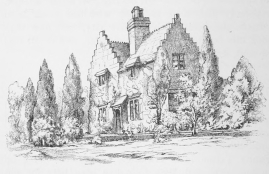
THE HOSPICE, HOLMHURST.
“Admirable, holy, saint-like, as I think dear Charlotte Leycester, her Sabbatarianism is a sore small trial to me when she lives with me for months. I love her most dearly, but I often long to say to her something like the words of Bussy-Rabutin, ‘Souvent on arrive à la même fin par différentes voies: pour moi, je ne condamne pas vos manières, chacun se sauve à sa guise; mais je n’irai point à la béatitude par le chemin que vous suivez.’”
To Miss Leycester.
“Holmhurst, Sept. 19, 1873.—Yesterday I took Hugh Pearson[62] to Hurstmonceaux. The walk through the wild ferny park and its decaying beeches was most delightful, with the softest lights and shadows glinting over the delicate distances of the Levels. What a place of memories it is! every tree, every pathlet with the reminiscences of so many generations.”
Journal.
“Sept. 30.—I came to Binstead Wyck[63] from Thornhill. It is a charming family home on the edge of a deep declivity, with wide views into the purple hollows between the beech-trees. From the windows we could see Blackmoor, whither we went the next day—the great modern mediæval house of the Lord Chancellor Selborne, set down, as it were, anywhere in an utterly inexpressive part of his large low-lying property, but with pleasant Scotchified views of heath and fir plantations. The Chancellor, pleasant and beaming, was kind, Lady Selborne very nice, and the four daughters charming. The next day we went to ‘White’s Selborne,’ through bowery lanes, where the hedges are all bound together by clematis. It is a beautiful village, just under a wooded hill called ‘the Hanger.’ The old house of Gilbert White is now inhabited by a striking old man, Mr. Bell, a retired dentist, the beneficence, the ‘Bon Dieu,’ of the neighbourhood. He showed us his lovely sunny lawn, with curious trees and shrubs, sloping up to the rich wooded hillside, and, in the house, the stick, barometer, and spectacles of Gilbert White.
“The adjoining property belonged to Sir Charles Taylor. His father was a fine old man, and some of his jokes are still quoted.
“‘How are you, sir? I hope you are quite well,’ said a young man who came on a visit.
“‘Well, sir! I am suffering from a mortal disease.’
“‘A mortal disease! and pray what may that be?’ said the young man, aghast.
“‘Why, I am suffering, sir, from—Anno Domini.’
“Close to Selborne we saw the source of the Wey—a pretty spring tumbling over a rock near the road.”
“Oct. 4-10.—A charming visit at Shavington, the great desolate brick house of Lord Kilmorey.[64] It has very little furniture, but some fine pictures, the best of them, by Gainsborough, representing an Hon. Francis Needham of the Grenadier Guards, who was poisoned at a magistrates’ dinner at Salthill in 1773. Lady Fanny Higginson[65] talked much of their old neighbours the Corbets of Adderley: how, when Lady Corbet was a child, she squinted very much, and how Dr. Johnson, when she was introduced to him, said, ‘Come here, you little Squintifinko’—which gave her the greatest horror of him. When the family doctor called at Adderley, it was generally just before dinner, and Lady Corbet used to ask him to stay for it, and he found this so pleasant that he came very often in this way, merely for the sake of the dinner; but when his bill came in, she found all these visits charged like the others. She returned it to him with his visits divided into two columns, one headed ‘Official’ and the other ‘Officious,’ and she always afterwards spoke of him as ‘the officious official.”
To Miss Leycester.
“Ford Castle, Oct. 18, 1873.—The long journey and the bitterly cold drive across the moors from Belford almost made me think before arriving that absence must have exaggerated the charms of this place; but the kind welcome of the hostess in the warm library, brilliant with flowers and colour, soon dispelled all that. There is only a small party here, what Lady Waterford calls a pension des demoiselles—the two Miss Lindsays (Lady Sarah’s daughters), Mrs. and Miss Fairholme, Lady Taunton and her daughter, and Lady Gertrude Talbot. All are fond of art and not unworthy of the place.
“I should like you to see it. No description gives any idea, not so much of the beautiful old towers, the brilliant flower-beds in the embrasures of the wall, the deep glen of old beeches, the village clustering round its tall fountain, and the soft colouring of the Cheviots and Flodden,—as of the wonderful atmosphere of goodness and love which binds all the people, the servants, the guests, so unconsciously around the beautiful central figure in this great home. Each cottage garden is a replica—the tiniest replica—of Lady Waterford’s own, equally cared for by her; each village child nestles up to her as she appears, the very tiny ones for the sugar-plums which she puts into their pockets, the elders to tell her everything as to a mother. And within the house, everything is at once so simple and so beautiful, every passage full of pictures, huge ferns, brilliant geraniums, tall vases, &c. In the evening Lady Waterford sings as delightfully as ever, and in all the intervals talks as no one else can—such exquisite stories of olden times, such poetical descriptions of scenery, and all so truth-inspiring because so wonderfully simple.”[66]
“Oct. 19.—You will never guess what I was doing yesterday—preaching to the children!
“In the morning, to my great surprise, Mr. Neville, the clergyman, came while Lady Waterford was at the school, to say he had no help that day: would I help him? There was a service for children in the church: would I undertake the sermon part? I thought it quite impossible, and utterly refused at first, only promising to read the Morning Lessons. However, in the afternoon, when I found it was not only wished but wanted, I consented. I took one of Neale’s Sermons as a foundation, and then discoursed—half story, half sermon; the story being of the departure of the swallows from Etal and Ford and Flodden at this time of year; the training from their parents—so much depending upon whether they attended or not, whether they practised their wings in preparation for the long journey or were idle; then of the temptations they had to idleness, &c.; of the journey, the crossing the sea (of death in the moral), of the difficulty of crossing alone, of the clinging of some to the mast of a ship (the Saviour), which bore them through the difficulties. I was dreadfully alarmed at the idea, but, having once begun, had no difficulty whatever, and it all came quite fluently without any seeking, though beforehand I could think of nothing to say; so that Lady Waterford said the only fault the children would find was that it was so much longer than their usual sermons. There was a great congregation of children, and all the guests in the house, and many of the servants.”
Journal.
“Oct. 16.—Mrs. Fairholme talked of her visit to Jedburgh—that she had said to the old man who showed it, ‘Do you know, I admire your abbey a great deal more than Melrose.’—‘Yes,’ he said, ‘there is no doubt it is a great deal the finer; but then you know, Ma’am, Sir Walter has cast such a halloo over Melrose that it has thrown everything else into the shade.’”
“Oct. 17.—Mrs. Fairholme brought down a beautiful miniature of an unknown lady to breakfast, which was the subject of much discussion. Lady Waterford said how she had designed a series of drawings for the whole ‘Story of a Picture.’
“1. A Louis XIV. beauty sitting to a painter, with all her adorers—a whole troop of them—behind her, quite beautiful, radiant, and vain-glorious.
“2. The portrait hanging in the room in another generation.
“3. A young girl à l’Empire, with her waist in her mouth, waving her hand towards the portrait, and telling the servant to take that ugly old picture up to the garret.
“4. Boys in the garret shooting at the old picture as a target.
“‘Do you know,’ said Lady Waterford to-day, ‘that Jane Ellice has got one convert to her teetotalism; and do you know who that is? That is me. I have not touched wine for six months. I think it is good for the household. They used to say, if they saw me as strong as a horse, “Ah! there, look at my lady; it is true she is as strong as a horse, but then she always has all the wine she wants,” but now they say, “My lady has no wine at all, and yet you see she is as strong as a horse.”’
“Mrs. Fairholme spoke of Curramore, and how she disliked somebody who pretended that the beautiful terraces there were designed by herself and not by Lady Waterford. With her generous simplicity, Lady Waterford said, ‘Oh, I don’t see why you should do that at all: I think it was rather a compliment, for it showed she admired the terraces, or she would not have wished it to be supposed that they were due to her.’
“Miss Fairholme was tired. ‘Now do rest,’ Lady Waterford said—‘there is the sofa close by you—qui vous tend les bras;’ and then she talked to us of old Lady Balcarres, ‘the mother of Grandmama Hardwicke’—the severe mother, who, when one of her little boys disobeyed her, ordered the servants to fling him into the pond in front of the house. He managed to scramble out again; she bade them throw him in a second time, and a second time he got out, and, when she ordered it a third time, he exclaimed in his broad Scotch accent, ‘Woman, wad ye droun yer ain son?’
“In the afternoon we were to have gone to the Heathpool Lynn, but did go to Langley Ford by mistake—a very long walk, after leaving the carriage, up a bleak moorland valley. I walked chiefly with Miss Lindsay. She talked of the extraordinary discovery of the well at Castle Hedingham by ‘a wise woman’ by the power of the hazel wand—the hazel twig bending on the right spot, not only upon the ground itself, but upon the representation of it on the map. She talked of the blind and dumb Sabbatarianism of the Presbyterians. She asked a respectable poor woman how she liked the new preacher. ‘Wad I presume?’ she replied.”
“Oct. 18.—This morning Lady Waterford wished that the Misses Lindsay had been dressed alike even in details. ‘It is a law of nature, I think, that sisters should dress alike. A covey of partridges are all alike; they do not want to have feathers of different colours; and why not children of the same family?’
LANGLEY FORD, IN THE CHEVIOTS. [67]
“We had a charming walk to Etal in the afternoon—lovely soft lights on the distant hills, and brilliant reflections of the autumnal foliage in the Till. We went to the castle, and then down the glen by St. Mary’s Oratory and Well. Lady W. talked of the beauty of the sedges and of their great variety—of the difficult law, or rather no law, of reflections. Then of marriages—of the number of widows being so much greater than that of widowers, and of the change which the loss of a husband made in all the smallest details of life: of the supreme desolation of Lady Charlotte Denison, ‘after a honeymoon of forty-three years.’ Old Lady Tankerville was of another nature. She was urging a widowed friend to do something. ‘Oh, but my cap, my cap!’ groaned the friend. ‘Comment,’ exclaimed Lady Tankerville, ‘c’est le vrai bonnet de la liberté.’
“Speaking of complexions—‘My grandmother used to say,’ said Mrs. Fairholme, ‘that beauty “went out” with open carriages. “Why, you are just like men, my dear,” she said, “with your brown necks, and your rough skins, and your red noses. In our days it was different; young ladies never walked, ate nothing but white meat, and never washed their faces. They covered their faces with powder, and then put cold cream on, and wiped it off with a flannel: that was the way to have a good complexion.’”
“‘I think it was Henri III.,’ said Lady Waterford, ‘who used to go to sleep with raw veal chops on his cheeks, and to cover his hands with pomade, and have them tied up to the top of the bed by silk cords, that they might be white in the morning.’”
“Oct. 21.—Lady Waterford talked of her maid Rebekah, who lived with her so long. ‘The mistake was that we were together as girls and used to romp together; and so, when I married, she thought she was to rule me. But she became the most dreadful tyrant: Tina used to say I wore her as a hair-shirt.’”
“Oct. 23.—Lady Waterford talked of ‘Grandmama Hardwicke’—how terrified she was of robbers: that one day, when she was going to cross a wide heathy common, she said, ‘If any one comes up to the carriage, I shall give up all I have at once: I shall give him no chance of being violent.’ Soon after, a man rode up. ‘Oh, take my money, but spare my life,’ exclaimed Lady Hardwicke, and threw her purse at him. ‘My good woman, I don’t want your purse,’ said the man, who was a harmless traveller.”
“Oct. 24.—Lord Houghton arrived. He is rather crusty, but most amusing. His conversation is always interesting, even when no one else can speak, and he seems to be saying, with Sydney Smith, to the art circle here—‘My dears, it’s all right; you keep with the dilettanti: I go with the talkettanti.’ He talked of Alnwick. ‘It was there I first met Père Hyacinthe. He did not strike me as anything remarkable. One evening he gave us a “Meditation.” It was just a falling into a topic and going on upon it; but nothing original or particular. I heard his sermons at Rome. He used to say a thing and then back out of it; but under the pulpit sat three Inquisitors, and they were finding him out all the time. One thing he said—speaking of religious differences—was, “N’oublions jamais que le premier crime du monde était une querelle entre deux sacerdos.”’
“Lord Houghton talked of the Bonapartes, and of the graves of Josephine and Hortense at Rueil, and of Madame Mère. ‘I had a very narrow miss of seeing Madame Mère, and I am very sorry I did not do it, for it would only have cost a scudo. She was a very long time dying, it was a kind of lying in state, and for a scudo the porter used to let people in behind a screen which there was at the foot of the bed, and they looked at her through the joinings. I was only a boy then, and I thought there was plenty of time, and put it off; but one day she died.’
“Lord Houghton also said—
“‘One of the prettiest ghost stories I ever heard is that of General Radowitz. He was made Governor of Frankfort, and not being able to go himself, and having servants who had lived with him a long time and knew all his tastes, he sent them on before him to secure a suitable house and get everything ready. They chose an excellent house, with a large garden full of lilacs and laburnums, overlooking the glacis. When General and Madame Radowitz arrived some time after, they found everything as they wished, and began to question their old servants as to how they had got on, and especially as to the neighbours. The servants said that the next villa was inhabited by a person who was quite remarkable—a lady who was always known in Frankfort as the “weisse Frau,”—a very sweet, gentle person, who was full of charity and kindness, and greatly beloved. She had, however, quite lost her memory as to the past since the death, very long ago, of her lover in battle: she had even forgotten his name, and answered to all questions about him or her own past, “Ich weiss nicht! ich weiss nicht!” but always with a sweet sad smile. And she had lived in the place so long, that, every one belonging to her having passed away, no one really knew her history. Yet, while her mind was gone as to the past, as to the practical present she was quite herself, went to market and transacted her own affairs.
“‘Gradually the confidential maid of Madame Radowitz made friends with the servants of the “weisse Frau”—for the gardens of the two houses joined—and from servants’ gossip the Radowitz family learnt a good deal about her, and from all around they heard of her as greatly respected, but always the same, sad and sweet, always dressed in white, never remembering anything.
“‘One day the “weisse Frau,” who had taken a great fancy to the maid of Madame Radowitz, invited her to come to her at twelve o’clock the next day: she said she expected some one; indeed, she pressed the maid to come without fail. The maid told her mistress, who said certainly she had better go; she should on no account wish so excellent a person as the “weisse Frau” to be disappointed.
“‘When the maid went, she found the little salon of the “weisse Frau” in gala decoration, the table laid and bright with flowers, and places set for three. The Frau was not in her usual white dress, but in a curious old costume of rich brocade, which was said to have been intended for her wedding-dress. She still said she expected some one, but when asked who it was, looked distressed and bewildered, and only said “Ich weiss nicht!”
“‘As it drew near twelve o’clock she became greatly agitated—she said he was coming. At length she threw the windows wide open, and gazing out into the street, looked back and said, “Er kommt! er kommt!” She had a radiant expression no one remembered to have seen before; her eyes sparkled, every feature became animated—and as the clock struck twelve, she went out upon the landing, appeared to enfold some one invisible in her arms, and then walking very slowly back into the room, exclaimed “Hoffmann,” and sank down dead!
“‘In the supreme moment of life she had remembered the long-forgotten name.’
“On Wednesday Lady Waterford took her books and drawing, and went to the forge to spend the afternoon with ‘Frizzle’—a poor bedridden woman there, to whom thus, not by a rapid visit, she brings enough sunshine and pleasure once every week to last for the other six days. Often she sings by the bedside, not only hymns, but a whole variety of things. I drove Mrs. Fairholme to the Routing Lynn, and we came in for one of the fiercest storms I ever knew; not rain or snow, but lumps of ice, an inch and a half long, blowing straight upon us from the Cheviots. Lady Waterford came in delighted. ‘I do enjoy a difficult walk. When it is winter, and the ground is deep in snow and the wind blowing hard, I steal out and take a walk and enjoy it. I try to steal out unobserved; I do not like the servants to get into a state about me, but I am generally betrayed afterwards by a wet petticoat or something.’”