Volume 6 — XXIX WRITING THE GURNEY MEMOIRS
Reading edition
“O thou wealthy Past, Thine are our treasures!—thine and ours alone Through thee: the Present doth in fear rejoice; The Future, but in fantasy: but thou Holdest secure for ever and for ever The bliss that has been ours; nor present woe, Nor future dread, can touch that heritage Of joy gone by—the only joy we own.” —Fanny Anne Kemble.
“The stream bears us on, and our joys and our griefs are alike left behind us: we may be shipwrecked, but we cannot be delayed: whether rough or smooth, the river hastens towards its home, till the roaring of the ocean is in our ears, and the tossing of the waves is beneath our keel, and the lands lessen from our eyes, and the floods are lifted up around us, and the earth loses sight of us, and we take our last leave of earth and its inhabitants, and of our further voyage there is no witness, but the Infinite and the Eternal.”—Reginald Heber, Farewell Sermon at Hodnet.
I HAD frequently been urged by my friend Madame E. de Bunsen to write the lives and edit the letters of her family—the Gurneys of Earlham; but I had long declined. Much as I honoured the life-work and character of the Gurneys, I felt that I was so little in sympathy with their outward forms of religion, with their peculiar expression of it—with their religious talking, in fact—that I doubted if I could do them justice. Others seemed much better fitted for the task.
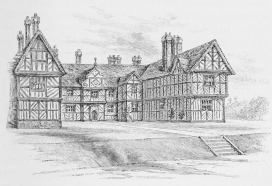
EARLHAM HALL [520]

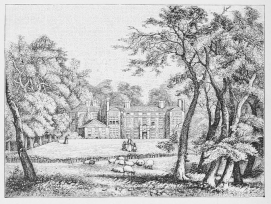
But towards the close of 1893 it was again urged upon me—urged with great persistency; and when I had taken many of the Gurney journals and letters home, a memoir seemed gradually to unravel itself in my mind, and at length I promised to do my best. I know, however, how true it is that “in a whole imbroglio of capabilities, we go stupidly groping about, to grope which is ours, and very often clutch the wrong one.”[521]
In many respects the work soon brought its own reward—inwardly, in being led to enter into the spiritual life and difficulties of so many holy departed ones: outwardly, in many visits to still living members of the family, whose life is a constant example, and has often an intellectual as well as a spiritual charm. Especially charming were some winter days at Colne House, the delightful home of Catherine, Lady Buxton, second daughter of Samuel Gurney; and a lovely spring day with Mrs. Ripley at Earlham, in the old-fashioned rooms, and on the green lawns, fragrant to the family—but also to thousands of others—with endless sacred memories.
To the Hon. G. Hylton Jolliffe.
“London, April 1894.—I have had a pleasant time here, and as usual have found that there is more to be learnt by enduring the ups and downs of social pleasures than by withdrawing from them, while in the mornings I have been very busy at the Athenaeum with a new edition of ‘Walks in London’ and the production of my little ‘Sussex.’ At Lady Wynford’s I met Miss Harynden, the authoress of ‘Ships that Pass in the Night,’ a very delicate-looking brown ‘Girton girl’—only her degree was not taken at Girton, but at the London University. She was very simple and nice, but seems to feel her books too much. She said she was generally ill and fretful because she was writing, but more ill and more fretful if she was not. She did not find her lodging at Hampstead quiet enough to write in, but shut herself up by day in a desolate cottage on the Heath. She said she had received hundreds of letters about her ‘Ships that Pass.’ That very morning she had a very kind one from an unknown gentleman, saying he liked her book very much, but was disappointed because—in spite of the title—he found no information about shipping in it!
“A little Gould child said the other day, ‘Can God Almighty do everything, mother?’—‘Yes, my dear, God is omnipotent.’—‘I know one thing He couldn’t do, mother.’—‘Quite impossible, my dear.’—‘Yes, mother; God couldn’t make a stone so big that He couldn’t carry it,’—deep unconscious theology.
” ...There is no place where Death makes a stranger impression than at the Athenaeum. You become so accustomed to many men you do not know, to their comings and goings, that they become almost a part of your daily life. You watch them growing older, the dapper young man becoming grizzled, first too careful and then too neglectful of his dress: you see his face become furrowed, his hair grow grey, then white, and at last he is lame and bent. You become worried by his coughs, and hems, and little peculiarities. And—suddenly—you are aware that he is not there, and all your little annoyances immediately seem to have been absurd. For a time you miss him. He never comes. He will cough no more, no longer creak across the floor. He has passed into the unseen; gradually he is forgotten. His place knows him no more. But the wheel goes on turning; it is others; it is oneself perhaps, who is waning away.”
To the Hon. Mrs. W. Lowther.
“Holmhurst, May 21, 1894.—You said you would like to hear about Belvoir.
“I went with Henry Maxwell-Lyte. At Grantham was a quantity of red cloth, and crowds of people to see the Princess (Louise), and a string of carriages from the castle, and George Manners to show us which we were to go in. In mine I found a young man, who turned out to be Cecil Hanbury of La Mortola, with whom I made great friends, and found, as I always do, that it makes all the difference if one has one special friend in a large party. The Princess was already at tea when we arrived, and very gracious and kind. But though she is such a really charming person, the conversation had the effect of muffled drums, which always accompanies the presence of royalty. Lord Lorne is much improved in appearance by age—a good Rubens, as his uncle, Ronald Gower—also at Belvoir—is a bad Bronzino. The Duke, as always, was most delightful, so courteous, considerate, and full of interesting information. In the mornings we walked, drew, or sat in the gardens—a many-hued carpet of spring glories. In the evenings most of the company danced. The last day we drove, all the way through the property, to Croxton Old Park, where there was once a monastery, but nothing is left of it now. There is a quaint little house, where the Duchess Mary-Isabella, whoever she may have been, died, and in its succursale we had tea, with all possible ‘ameliorations.’ ...
“Holmhurst is now a nest of spring blossoms, the azaleas glorious, and the gold of the laburnums quite hiding the leaves.
‘A tout oiseau Son nid semble beau:’
But my nest really is ‘beau.’ I am sometimes blamed for caring so much about it, so that it was a comfort to read somewhere (I cannot remember where), ‘Every man’s proper mansion-house and home, being the theater of his hospitality, the seate of self-fruition, the comfortablest part of his own life, a kind of private princedome, nay, to the possessor thereof an epitome of the whole world, may well deserve by these attributes, according to the degree of the master, to be decently and delightfully adorned.’”
It had weighed upon my mind for the last two years that my “France” remained unfinished. There was still another volume which could not be written without personally visiting all the places of interest in Normandy and Brittany, and my publishers were constantly urging its completion. The book has always been utterly unremunerative, very much the contrary, which is very depressing in its way, but “on ne vit dans le mémoire du monde que par ses travaux pour le monde.’[522] So I determined to give up London and home pleasures this summer, and to set about it, taking my young cousin Theodore Chambers as my companion and guest.
We left Holmhurst together on the first of June, and spent June in Normandy and July in Brittany. It was one of the most laborious journeys I ever made—eight or nine hours a day of walking, standing, collating, correcting, simmering in the relaxing western heat, and constantly soaked by the Scotch mist which pervades that district five days out of seven. For the latter month young Inverurie, Lady Kintore’s eldest boy, was also with me, a most kind and pleasant fellow-traveller, but, though eager about drawing, neither of my companions had any more interest in architecture or history than a stone. Thus my associations with North-Western France are not transcendent. Places, even the most beautiful, are innutritious to the mind in the long run; one needs people with mental life, and enthusiasm to see them with.
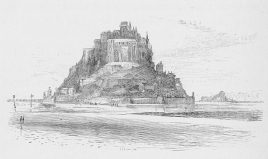
MONT S. MICHEL. [523]
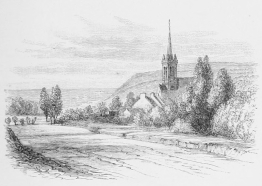
S. JEAN DU DOIGT. [524]
AT CARNAC. [525]
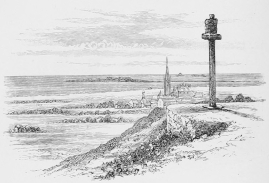
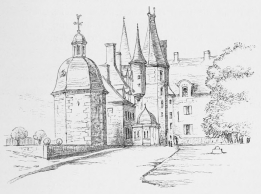
To the cloudiest days, however, come gleams of sunshine. I remember with great pleasure the Abbey of S. Waudrille near Caudebec, restored once more to the Benedictines, ejected at the Revolution. We were cordially pressed to go and stay there, and shown the charming rooms we might have, and I should really have liked it. Then five days at Mont S. Michel were enchanting, and the invigorating air, which the hundred and thirty steps to our bedrooms gave us full opportunity of benefiting by. And then from Brittany come recollections of many wonderful calvaries; of Tregastel and its golden rocks; of S. Jean du Doigt in its deep hollow, lovely in spite of soaking rain; and of Carnac and its wild moorland, redolent of sweet basil and thyme. We also saw two stately well-kept houses, Josselin of the Duc de Rohan, and Maintenon of the Duc de Noailles; but, after all, seeing houses without their owners is like seeing frames without portraits. More living to me, because I felt already so familiar with the place, was Les Rochers, pervaded by the spirit of Madame de Sévigné, and even more fragrant from the memories she has bequeathed to it than from the blossoms with which the glorious old orange-trees in its garden are covered now as in her day. It was enchanting to reach home again at the end of July. My companions said the journey had turned my hair grey, and so it really had—rather.
Journal.
LES ROCHERS. [526]
“August 16.—Most delightful has been the return to Holmhurst with its freedom and peace. The shades in my life now are seldom troubles, only uncongenialities, and the ‘small fretting fretfulnesses’ which accompany them: still, when these are past, the relief is enormous, and visits from such delightful young friends as Herbert Vaughan, Cecil Hanbury, and George Cockerton have been a great enjoyment. The last is indeed, in every respect, a dear and true friend. No rules of friendship, I feel, are better than those inculcated by Buddhism:—
“‘An honourable man should minister to his friends and companions by giving presents, by courteous speech, by promoting their interests, by treating them as his equals, by sharing with them his prosperity.
“‘They, in return, should show attachment, by watching over him when he is off his guard, by guarding his property when he is careless, by offering him a refuge in danger, by adhering to him in misfortune, by showing kindness to his family.’
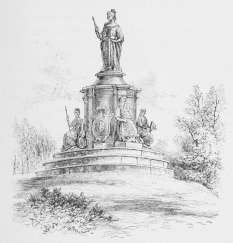
“The natural beauty of the garden here is a never-failing delight to me. Most people seem to be so full of expectations from the future that they do not allow themselves to enjoy the present; but when I am at home, I am sure that is not the case with me. On the prettiest site in the grounds I have just finished putting up the statues of Queen Anne and her four satellites by Bird, which formerly stood in front of St. Paul’s. They were taken away four years ago, and disappeared altogether till last spring, when my friend Lewis Gilbertson discovered them in a stonemason’s yard on the point of being broken up for the sake of the marble. I found they belonged to three people—the Archbishop of Canterbury, the Bishop of London, and the Lord Mayor, and all these were persuaded to resign their claims to me. The statues were brought down to Holmhurst at great expense, and put up, at much greater, on a home-made pedestal like their old one; and now I hope they are enjoying the verdure and sea-breezes after the smoke of the City.”
To W. H. Milligan, and Journal.
QUEEN ANNE AT HOLMHURST.
“Alderley Rectory, Oct. 5, 1894.—I left home on September 29, to visit the Townshend Marshams at Frognal—the place I have so often heard of and thought of, from Lord and Lady Canning having been there so frequently as the guests of Lord and Lady Sydney, who left it to the Marshams. No wonder they loved it, and that it was one of the places poor Lady Canning most looked forward to seeing again on her return from her long Indian exile. It is an enchanting old house!—its endless succession of small sitting-rooms, all lived in, all full of pictures, books, and flowers, and opening on to a sunny terrace and broad expanse of lawn, with pine-trees beyond it. In one of the rooms Lady Sydney still presides from her picture, but as few alive now can remember her, radiant in loveliness, with a coronet surmounting her abundant and beautiful hair. Upstairs there is an oak gallery, half library, half passage, but deliciously pleasant and quaint. The boy of the family is named Ferdinand, from Ferdinando Marsham, Charles I.’s esquire, upon whose tombstone it is said that ‘he was lamented by all gentlemen.’ Amongst the many curious pamphlets in the house is an account of Charles I.’s execution, printed whilst the king’s body was still lying at Whitehall, and mentioning his famous word, ‘Remember,’ as referring to his ‘George,’ which he had desired might be given to his eldest son. A sketch by Lady Sydney represents the drawing-room at Frognal, with both the Cannings and many other habitués of the house introduced, and easily recognisable as portraits.
“Through a most picturesque and lovely bit of primeval chase belonging to Frognal we walked to Chislehurst, to see the fine tomb of Lord Sydney by Boehm, surrounded by memorials of his family, and, on the common, the Prince Imperial’s Memorial Cross. Mr. Marsham Townshend, who recollected having seen the Empress in all her splendour at Paris, happened once to come upon her here, a widowed and lonely exile, in her deep mourning, attended by a single servant, sobbing alone before this memorial of her murdered son. Often, in the years she was at Chislehurst, while the family at Frognal were sitting at tea in the hall, a carriage would dash up, and the Empress Eugénie come in to stay for two hours. She loved the Sydneys.
“It was most delightful at Frognal having old Mrs. Sackville of Drayton there—‘still constant in a wondrous excellence.’
“A longish journey took me to Bromsgrove, where a carriage met me and an old Mrs. Laurence, who is apparently ‘a power’ in American society, with her nephew, Mr. Mercer, and brought us to Hewell, the great modern house which Bodley has built for the Windsors. It has an immense hall, with open galleries round it, never a comfortable arrangement, I think, but it is handsome, has two beautiful Italian chimney-pieces, and is divided by arches into compartments at the two ends. Lady Windsor is quite as beautiful and fascinating as before she married, and her mother, Lady Paget, is rather additionally embellished than otherwise by added years. Lady De Vesci was at Hewell also, supremely beautiful in her own—a poetical way.
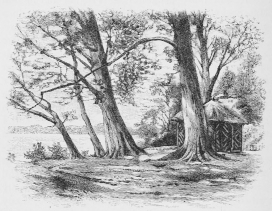
BELLA’S LOGHOUSE, ALDERLEY MERE. [527]
“I have enjoyed being in this familiar place, where the Rector of Alderley, Mr. Bell, and his daughters, are very kind. He has just been driving me to see the Ernest Leycesters at Mobberley. Passing beneath a field on the way to Chorley, he said, ‘A curious thing happened there when I was a little boy. A farmer went out very early to look over his land, and in that field he found a place where the soil had been recently upturned. ‘Oh, poachers must have been here,’ he said to himself, ‘and have buried their game;’ so he dug, and very soon came upon a sack. ‘Here it is,’ he said, when behold! from the sack emerged the long tresses of a young woman! Pale as death, he rushed across the field to Ellen Baskerville’s house, and told what had happened. It was the body of a young woman, buried in Alderley Churchyard a few days before. Resurrection-men had dug it up, and being suddenly surprised, had hastily buried it here.
“‘When I was living as chaplain in the Infirmary at Norwich,’ said Mr. Bell, ‘I was startled by hearing what seemed to be loud and furious imprecations overhead. They did not stop, and at last I ran upstairs to see. There, in bed, was the old fat swarthy cook, screaming with all her might, and a huge monkey was sitting on the bed grinning at her. I seized a newspaper which lay there, rolled it up, and hit out at the monkey. But the beast knew better than to be afraid of that, seized it, tore it up, and made at me. Then I caught up a large ruler, which was happily lying near, to defend myself with. The monkey did not like that, and bounded across the room and out at the window, and I heard a scream from the people upon whom it had descended in the street.
“‘The woman told me how the monkey had come in at the window, and jumped straight on to her bed, where it had found the pot of ointment used for her bad leg, and eaten it all up directly. Having finished that, it made for the table, where it found her wig-box, pulled it open and began to demolish her wig. That she could not stand. “Oh, ye varmint! ye varmint!” she shouted, and continued shouting till I came to the rescue.’”
“Temple Newsam, Oct. 9.—This grand old house in the Black Country has been receiving the Duke and Duchess of York. They were just gone when I arrived, but the Duchess’s pleasant brother, Prince Adolphus, is here, and his future bride, Lady Sybil Grosvenor, with Lady Grosvenor and her daughter, also the William Lowthers and the beloved Halifax’s. With the Lowthers I have been two excursions—to Swillerton, Sir C. Lowther’s rather fine house, and to the beautiful old house of Ledstone, a very picturesque place.”
“Ravenstone, Oct. 14.—This lovely little place of Mrs. Howard is above Lake Bassenthwayte, not considered a beautiful lake, but infinitely lovely at the spot to which she has taken me, through the garden of Sir H. Vane, where a richly wooded promontory embossed upon the still evening sky was reflected in every detail in the calm limpid waters.
“We have been for service to the most delightfully primitive little church—a Dalesman’s church—such as Wordsworth has described. At Greystoke we have spent a day, received by the little girl, daughter of the house, with the manners of a princess. Little of the old castle remains.”
“Bishopthorpe, Oct. 16.—‘That is a portrait of Bishop Willmer of Louisiana,’ said the Archbishop, showing his study. ‘He was at one of the conferences at Lambeth in Archbishop Tait’s time. When he went away Mrs. Tait said to him, “Well, good-bye, Bishop; I hope you’ll come again at the next conference.”—“No, Mrs. Tait, neither you nor I will be at the next conference.”—“Oh, Bishop, but I hope we shall see you again.”—“No, Mrs. Tait,” said the Bishop very solemnly, “neither you nor I shall be at the next conference, but we shall meet again very soon.” Three months after that—one in America, the other at Edinburgh—the Bishop and Mrs. Tait died on the very same day.
“‘Bishop Willmer had the utmost simplicity of character, but he was a true apostle. One day, crossing a green at Boston, he found a little boy playing pitch-and-toss. He was very fond of little boys, and he stopped and spoke to this one—spoke to him very kindly. “Now, are you a good little boy?” he said at length. “Well, I sometimes say cuss words,” answered the boy. “Oh, I’m sorry for that,” said the Bishop; “but at any rate, I see you speak the truth.”—“Oh, only dogs tell lies,” said the boy. “Well, now,” said the Bishop, “would you like to do me a kindness?”—“Yes,” said the boy. “Well, I expect a parcel at the railway station, and I want you to go for it, and bring it to a particular house. There will be seven dollars to pay for that parcel, and here are the seven dollars, and there are fifty cents for yourself.” The boy took the $7.50 and went off.
“‘When the Bishop reached the house, he told what he had done, and was heartily jeered at—that he should trust a Boston waif like that. There was a very large party, and they all went in to dinner. Before it was over, a servant came in and said that there was a boy there who wanted to speak to the Bishop. The Bishop went out, and the whole company followed him—they followed him into the hall, and there was the boy at the door. He was not the least abashed, but, when he saw the Bishop, said, “Well, I’ve brought the parcel, but it cost seven dollars fifty cents: you did not see the fifty cents marked in the corner.”—“Well, how did you get the parcel, then?”—” Oh, I paid the fifty cents you gave me.”—“And how did you know you’d get the fifty cents again?”—“ Well, I thought as a chap as would trust me with seven dollars would never make a trouble for fifty cents.”
“‘Well,’ said the Bishop, before they parted, ‘now I should like to give you my blessing;’ and the boy knelt on the door-mat, and solemnly and episcopally, before all the company, the Bishop gave the poor boy his blessing.’
“The chapel here in the palace is thirteenth-century, and has been restored by Archbishop Maclagan. The stained windows by Kempe are beautiful, representing the Crucifixion, and the saints connected with York. ‘I wished that the Saviour should be represented without any appearance of suffering,’ said the Archbishop—‘as the offering of humanity, not the sacrifice for sin. The suffering crucifixes only grew up in mediaeval times with ideas of purgatory. The early artists wished to excite faith, not pity, and represented the Saviour’s triumph over death, even while enduring it. The earliest crucifix, in the Catacomb of Pope Julius, given by Mrs. Jameson, but which totally disappeared a few years since, represents on the cross a beautiful youth, draped from head to foot, and without suffering.’
“I have had a delightful long drive with Augusta to Bramham. The old house was burnt down sixty years ago, and has never been rebuilt. But its glorious old gardens are kept up. There is nothing like them in England. They were laid out by Le Nôtre when he laid out Versailles, and are more like that than any other place. Eighty acres are intersected by grand avenues with immense walls of clipped beech, ending in summer-houses, statues, vases, or tanks walled in with stone and surrounded by statues and vases of flowers. Mr. Fox, a most grand old man, showed me everything, and talked of the change from the old times of his youth, when Yorkshire country visits were so cheery, and the chief dissipation of the county people was a ball at York. ‘Now every man with three hundred a year and a daughter thinks he must go to London.’ He talked of the degeneracy of Temple Newsam from the time when three litters of cubs were regularly brought up in the woods near the house. His sitting-room is full of hunting pictures and caricatures of his old friends—a great enjoyment to him.
“I asked Augusta much about Mrs. (Adelaide) Sartoris, whom she had known well. She said: ‘Edward Sartoris did not go with Adelaide when she went to Vichy. Leighton, who was always as a slave to her, went with her, took her lodgings, and did everything for her. Then he said, “You will be very dull, knowing no one here; I know some young men here, and I will introduce them to you. They are Burton and Swinburne, but you know one is a believer in Buddhism, the other in nothing; so you must not mind what they say.” Then Leighton left.
“‘The next evening Adelaide was having her coffee in the gardens, when the two young men came up and sat down by her. At first they made themselves very agreeable. Then at length they began to air their opinions, and to say things evidently intended to shock. Adelaide laid down her cup, looked at Burton, and said very slowly, “You believe, I think, in Juggernaut, therefore, with regard to Juggernaut, I shall be very careful not to hurt your feelings. And you, Mr. Swinburne (turning to him), believe, I think, in nothing, but if anything is mentioned in which you do believe, I shall be very careful not to hurt your feelings either, by abusing it: now I expect that you will show the same courtesy to me.”
“‘The young men laughed, and for some days all went well. Then the impression passed, and one day they began to talk as before. Adelaide again laid down her cup, and began again in the same slow tones—“You believe, Mr. Burton, I think, in Juggernaut”.... Then they burst out laughing, and they always behaved themselves in future.’
“‘When I was a girl,’ said Augusta, ‘I was with Mary at Madame de l’Aigle’s near Compiègne. There was to be a little function in the village, and some music was got up for it. We assisted at the practices, and Leighton also, who was there as a beautiful young man. But before the day of the function came he had to go. “Oh, Fay, why should you desert us? what can we do without our tenor?” said Madame de l’Aigle. But she implored him in vain; he said he must go. We all continued, however, to urge him, and at last he said, “Well, I’ll tell you what I’ll do: I must go, but I’ll come back.”—“What! all the way from London?” “Yes.” And he did. It was not long after that we found out why he thought himself obliged to go: it was because the sale of the pictures of that poor artist, Mason, who had died leaving his wife and children terribly unprovided for, was going to take place, and Leighton thought that if he were present at the sale, and seen bidding for the pictures, they would fetch higher prices. It was only one of a thousand kindnesses Leighton has done.... People have sometimes called him affected, but he was not. His manners were perfectly natural: he could not help being the spoiled darling of society.
“‘George IV., as Prince Regent, was very charming when he was not drunk, but he generally was. Do you remember how he asked Curran to dinner to amuse him—only for that? Curran was up to it, and sat silent all through dinner. This irritated the Prince, and at last, after dinner, when he had had a good deal too much, he filled a glass with wine and threw it in Curran’s face, with “Say something funny, can’t you!” Curran, without moving a muscle, threw his own glass of wine in his neighbour’s face, saying, “Pass his Royal Highness’s joke.”
“‘That story reminds me of the old Queen of Sweden. She was furious at the appointment of Bernadotte, and would have nothing to do with him; at which people congratulated him rather, because if she had seen him, they said, she would certainly have killed him. But at last she seemed to get tired of her estrangement, and she invited Bernadotte to a banquet. He was delighted—so glad to be friends; but as he was going to her palace, a paper was put into his hands inscribed—by whom he never knew—with the words, “If she offers you food or drink, as you value your life, refuse it.” He arrived, and the Queen was most affable, courtesy and kindness itself. After dinner a cup of coffee was brought on a golden salver, and, with the most exquisite grace, the Queen offered it to Bernadotte. He was just about to drink it when he remembered the warning, and he returned it to her, saying, “Après vous, Madame.” The Queen turned deadly pale, looked him full in the face, and—drank it. Next day Stockholm was agitated by terrible news. The Queen-Dowager had died in the night.’
“The dining-room here is hung with Archbishops, a very fine set of portraits. Sir Joshua painted Archbishop Harcourt, and came down with the picture to Bishopthorpe. At dinner, the chaplain, who was afterwards Archbishop Markham, said, ‘Who is the fellow who has painted that vile picture of the Archbishop?’—‘The fellow is me,’ said Sir Joshua, who was sitting by him; but he was so struck by what Markham said that he insisted on taking the picture back with him to London, and repainted it as it is now. Talking of the portraits led to Sir T. Lawrence, who was an endless time over his pictures. That was the case with his portrait of Lady Mexborough and her child. Lord Mexborough asked to have it home again and again, but it was no use. At last he said he must have the picture. ‘Well,’ said Sir Thomas, ‘I’ve been a long time, I allow; but I’ve got well forward with Lady Mexborough: it’s the baby wants finishing. Now if Lady Mexborough would kindly bring the baby and give me another sitting, I really will finish.’—‘Well, Sir Thomas,’ said Lord Mexborough, ‘my wife will be happy to give you another sitting whenever you like, but the baby’s in the Guards!’”
“Lincoln, Oct. 18.—Between York and this, I turned aside to visit Howden, a most grand church. In the vicarage garden I saw an old lady feeding chickens, and I could not help going up to her and saying, ‘Were you not once a Miss Dixon?’ She was so exactly like her sister, who was with Miss Dixon, the miniature-painter, at the little Holmhurst hospice last year. Her husband, Mr. Hutchinson, showed me all the relics, the remains of the shrine of S. John of Howden, bearing a statue of the Virgin with the dove whispering into her ear, as S. Gregory is so often represented at Rome: the Saltmarshe Chapel, with its old tombs and its stone altar with five crosses: and the lovely ruined choir, with exquisite chantry chapels opening from it. Then, in the vicarage garden, are remains of an old palace of the Bishops of Durham, with a beautiful old gateway.
“I also saw Selby, a very fine church with a Norman nave, but less interesting than Howden.
“Lincoln is altogether delightful, with its crown of yellow-grey towers rising high above the red roofs of the town. And it is most pleasant in staying with the beloved Precentor Venables to go back into the old Hurstmonceaux days, which he, and almost no one else, remembers, even though I could not join in his loyal reverence for Uncle Julius, when it was extended to Aunt Esther also. Time seems to have stood still with him and Mrs. Venables more than with any one I know, and it is difficult to believe that it is more than half a century since they came to Hurstmonceaux as bride and bridegroom—half a century of such entirely happy married life, that one cannot contemplate one surviving the other.[528]
“We visited the delightful and beautiful old Bishop King, who now has fitted up the ruins of the old palace, and lives appropriately in the heart of the cathedral society—‘very rightly placed,’ he says, ‘below the church, and far above the world.’ He has an expression of gentle benignity which I never saw equalled except by Pius IX., and a manner in which the greatest dignity of office and the most perfect personal humility are marvellously blended. He was sitting in what I thought was a purple dressing-gown, but was told it was a cassock: a jewelled cross was on his breast. I hoped to have seen him mitred in the cathedral, but he only appears thus on great festivals. He talked of the Church in France, and I urged him to visit Ars and enjoy its atmosphere of spiritual love and blessing: he said he should go there. We also visited Dean Wickham and his delightful wife, who is Gladstone’s daughter, thinking her father’s principles always right, but so full of goodness, gentleness, and beneficence herself, that it is impossible to connect her with his practice.”
“Nov. 16.—At Letton, the pleasant house of the Gurdons in Suffolk, I have met a large party, including the Hamonds of Westacre, into whose courtyard an invisible horse and rider clatter whenever any death is about to occur in their family. I have been taken to see Hingham, where the church contains the very fine tomb of Thomas, Lord Morley, of 1435. Another day we went to Dereham. S. Werburga was the great saint of the place, and was stolen by the Abbot of Ely, that her body might be venerated there with her two sainted sisters. By her empty grave a miraculous spring gushed forth to console the people of Dereham. So many children died from being bathed in it, that it is now shut off by a railing. In the church is the feeble monument of Cowper and Mrs. Unwin.
“Several curious stories were told:—
“Some young men once determined to frighten the famous naturalist Cuvier. One of them got horns, hoofs, and a tail, and appeared by Cuvier’s bedside. ‘I am the devil,’ he said, ‘and I am come to eat you.’ Cuvier looked at him. ‘Carnivorous! horns—hoofs—impossible! Good-night;’ and he turned over and went to sleep.
“Mrs. Hall Dare had told of a young girl friend of hers. She was with a number of other girls, foolish and frivolous, who went to consult an old woman who had the reputation of being a witch, and who was supposed to have the power of making them see their future husbands. She said they must say their prayers backwards, perform certain incantations with water, lock their doors when they went to bed, and then they would see whom they were to marry, but they would find their doors locked in the morning.
“The girl followed all the witch’s directions. Then she locked her door, went to bed, and waited. Gradually, by the firelight, a young man seemed to come in—to come straight through the locked door—a young man in uniform; she saw him distinctly.
“He went to the end of the room and returned. As he passed the bed his sword caught in the curtain and fell upon the floor. Then he seemed to pass out. The girl fainted.
“In the morning at first she thought it was a dream, but there, though her door was still locked, lay the actual sword upon the floor! Greatly aghast, she told no one, but put it away and kept it hidden. It was a terrible possession to her.
“The following year, at a country-house, she met the very young man she had seen. They fell violently in love and were married. For one year they were intensely—perfectly—happy.
“Then her husband’s regiment had to change its quarters. As she was packing up, with horror which was an instinct, she came upon the sword put away among her things. Just then, before she could hide it, her husband came in. He saw the sword, turned deadly pale, and in a stern voice said, ‘How did you come by that?’ She confessed the whole truth.
“He was rigid. He said, ‘I can never forgive it; I can never see you again;’ and nothing she could say or do could move him. ‘Do you know where I passed that terrible night?’ he said; ‘I passed it in hell!’ He has given up three-quarters of his income to her, but she has never seen him since.
“A Miss Broke, a niece of our host, told me even a more curious story.
“A few years ago there was a lady living in Ireland—a Mrs. Butler—clever, handsome, popular, prosperous, and perfectly happy. One morning she said to her husband, and to any one who was staying there, ‘Last night I had the most wonderful night. I seemed to be spending hours in the most delightful place, in the most enchanting house I ever saw—not large, you know, but just the sort of house one might live in one’s-self, and oh! so perfectly, so deliciously comfortable. Then there was the loveliest conservatory, and the garden was so enchanting! I wonder if anything half so perfect can really exist.’
“And the next morning she said, ‘Well, I have been to my house again. I must have been there for hours. I sat in the library: I walked on the terrace; I examined all the bedrooms: and it is simply the most perfect house in the world.’ So it grew to be quite a joke in the family. People would ask Mrs. Butler in the morning if she had been to her house in the night, and often she had, and always with more intense enjoyment. She would say, ‘I count the hours till bedtime, that I may get back to my house!’ Then gradually the current of outside life flowed in, and gave a turn to their thoughts: the house ceased to be talked about.
“Two years ago the Butlers grew very weary of their life in Ireland. The district was wild and disturbed. The people were insolent and ungrateful. At last they said, ‘We are well off, we have no children, there’s no reason why we should put up with this, and we’ll go and live altogether in England.’
“So they came to London, and sent for all the house-agents’ lists of places within forty miles of London, and many were the places they went to see. At last they heard of a house in Hampshire. They went to it by rail; and drove from the station. As they came to the lodge, Mrs. Butler said, ‘Do you know, this is the lodge of my house.’ They drove down an avenue—‘But this is my house!’ she said.
“When the housekeeper came, she said, ‘You will think it very odd, but do you mind my showing you the house: that passage leads to the library, and through that there is a conservatory, and then through a window you enter the drawing-room,’ &c., and it was all so. At last, in an upstairs passage, they came upon a baize door. Mrs. Butler, for the first time, looked puzzled. ‘But that door is not in my house,’ she said. ‘I don’t understand about your house, ma’am,’ said the housekeeper, ‘but that door has only been there six weeks.’
“Well, the house was for sale, and the price asked was very small, and they decided at once to buy it. But when it was bought and paid for, the price had been so extraordinarily small, that they could not help a misgiving that there must be something wrong with the place. So they went to the agent of the people who had sold it and said, ‘Well, now the purchase is made and the deeds are signed, will you mind telling us why the price asked was so small?’
“The agent had started violently when they came in, but recovered himself. Then he said to Mrs. Butler, ‘Yes, it is quite true the matter is quite settled, so there can be no harm in telling now. The fact is that the house has had a great reputation for being haunted; but you, madam, need be under no apprehensions, for you are yourself the ghost!’
“On the nights when Mrs. Butler had dreamt she was at her house, she—her ‘astral body’—had been seen there.”
“Ashridge, Nov. 19.—I arrived here by tea-time, passing in the beech woods Lady Lothian, who reminded me of Lady Waterford, as I saw her in her long black dress and black hat, backed by the leafless trees against the golden sunset. Then Lady Brownlow came in, still radiant in her marvellous Bronzino-like beauty. There is much charm too in the guests—Mrs. Dallas Yorke, with her subtle refinement, Mrs. Norman Grosvenor, the Jerseys, pleasant Jack Cator, and many others. Before dark, Lady Lothian took me to the drawing-room, built entirely from designs of Lord Brownlow, and thoroughly Italian in its marble pillars, green hangings, and many fine pictures, a Mona Lisa which disputes originality with that at Paris, a beautiful Lo Spagna of a saint, and the sketch for the Tintoret of the Presentation of the Virgin. The dinner was lighted from brilliant sconces on old boiserie from a Flemish sacristy. In the evening ‘Critic’ was acted as a charade, led by Lady Jersey.
“Breakfast was at small tables. Lord Brownlow, at ours, talked of a neighbouring house where a Lady Ferrers, a freebooter, used to steal out at night and rob the pilgrims coming from St. Albans. She had a passage from her room to the stables. In the morning one of the horses was often found tired out and covered with foam: no one could tell why. At last the poor lady was found dead on her doorstep in her suit of Lincoln green. She constantly haunts the place. Mr. Ady, who lives there now, meets her on the stairs and wishes her good-night. Once, seeing her with her arms stretched out in the doorway, he called out to his wife who was outside, ‘Now we’ve caught her!’ and they rushed upon her from both sides, but caught—nothing.
“Lady Brownlow came over to our table. ‘I’ve come to join in your conversation.’—‘Well, you’ve stopped it,’ said Lord B. ‘However, I bring you this story. A man in a foreign hotel took a loaded pistol to bed with him. By-and-by he saw a terrible deformed hand brandished at the foot of the bed. “If you don’t go, I’ll fire,” he shouted. It did not go and he fired. It was at his own foot.’
“It was Sunday, but I did not go to church, and walked with Lady Lothian through the sunlit green glades and russet woods of autumn. The house is of immense length of frontage, and behind it rises the chapel like a great church. ‘Can you tell me in what part of this village Lord Brownlow lives?’ asked an American when he came to Ashridge. In the evening we went to service in the chapel through the splendid conservatory, with long falling festoons of Ipomea. There was a full congregation and singing. Two panes of Holbein glass recall that Ashridge was the palace of Edward VI. and Elizabeth when young, but she hated it.
“We knew what you would say if you found Lady Waterford’s drawings all lying about,’ said Lady Brownlow, ‘so we worked hard to hang them up the day before you came.’ And they looked grand together, and such a variety—the supreme desolation of the Hagar, the self-abandonment of the Prodigal’s repentance, the proud Othello, the lovely springing, leaping children.”
“Middleton, Dec. 9.—A very agreeable visit to Lord and Lady Jersey. The country is hideous, but the house pleasant and comfortable, and a large new ball-room is hung with many fine portraits—the first Duke of Buckingham by Mytens and by Van Somer; Frances, Countess of Jersey, beloved by George IV., who was sent to meet Queen Caroline and persuaded her to eat onions—‘There is nothing the king likes so much as the smell of onions’—and Sarah, Countess of Jersey, the queen of Almack’s, a huge noble picture by Lawrence. Joining the village church is the mortuary chapel which she built, with her tomb, a copy of the Scipio tomb at Rome, and lovely medallions of her daughters, Sarah, Princess Esterhazy, and Lady Clementina Villiers. The font is said to have been that of Edward the Confessor at Islip, but is of Gothic, not Saxon date.
“Conversation fell on Christine, Lady Saye and Sele, who had three husbands. When she married the first surreptitiously, she took the bull by the horns, and said to her father at dinner, ‘Father, I’m married!’—‘Well, my dear, but at least wait till Thomas has left the room.’—‘No, father, Thomas need not leave the room, for Thomas is the man I’ve married.’”
My home life this year was very quiet and uneventful, only marked by my books. The Edgeworth family had placed Maria Edgeworth’s letters in the hands of Lionel Holland, now a publisher, and desired him to find an editor. He asked me to accept the office—certainly not a remunerative one, as I only received fifty pounds for it, the whole large profits of the book falling to the publishers. I demurred at first, but eventually undertook it, and became interested in the work, and the simple, high-toned, unselfish character of the lady whose letters I was selecting; and the book at once became popular, and had a very large circulation.
But “The Life and Letters of Maria Edgeworth” was rather a by-play. Most of my time was given to “The Gurneys of Earlham,” which gave me plenty of very hard and anxious work. I could not help feeling, as I attacked the mines and mountains of self-introspection in the form of religious journals which each one of the Gurney brothers and sisters left behind them, how unsuited I was for the task, how little I could enter into their feelings. Indeed Catherine Vaughan had written to me—“You are unworthy even to unfasten the shoe-latchets of those saints,” and I quite agreed with her. Still, into the beauty of their actions, of their devoted and unselfish lives, I could fully enter, and when the peculiar shibboleth of those times is sifted from their words, they said a great deal that was most beautiful and touching. The work has brought me into contact with many good people. And the Gurneys are still, as they were in the early days of Earlham, most liberal to all who do not agree with them, if only they are trying to follow the same Lord and Saviour—the dearest friend of the Gurneys of old time, and I think of most of those of present date.
At Christmas I was with the Halifaxes.
To W. H. Milligan.
“Hickleton, Dec. 28, 1894.—Can it be I? I say to myself, when I am called in pitch darkness in these winter mornings, and hurry in the dawn through the still dark shrubberies to the brilliantly lighted church, where, amid clouds of incense and the chanted salutation of the Blessed Sacrament, I receive ‘the mass,’ kneeling under the shadow of a great crucifix. Then, after breakfast, there is matins, what we should call early morning service, at which there are few worshippers; but when it is over, and you think you are going away, not a bit of it; there is a sound like the sea rushing in, and instantly the church is filled—thronged with people—and these come, not to receive the Sacrament, but to adore it! Charlie Halifax says, ‘How strangely things come round. My uncle, a lawyer—who had his home here with my father and mother, and died when I was five years old—used to be a great friend of Newman and Lord Devon, and others who thought as they did, and his beautiful spiritual letters and his religious sonnets remain to us. He longed for what he thought was the impossible; he longed to have it here, and now here it is. At that time there was only celebration here four times in a year; he never hoped it could be otherwise, and yet what he so longed for—what I, too, so longed for as a boy—has been all realised.
“‘Do you know that when Miss Margot Tennant (Mrs. Asquith) said to Jowett, “What do you really think of God?” he said nothing for a moment, and then answered, “I think all that signifies is what God really thinks of me.”’
“I have had many delightful talks with Charlie. When I am with him I feel imperceptibly lifted heavenwards. I do not agree with him in everything, but oh! I love him always. With him, as indeed with every one else, even where I most disagree, I am careful never to speak slightingly of anything he holds sacred. If it made any difference at all, it would only cause him to hold the cloak tighter.”
“Hatfield, Jan. 30.—After a visit to Lord and Lady Knightley at Fawsley, in bitter cold and snow, I came here to meet a huge party—Cadogans, Iveaghs, Hampdens, and very many others. Most of the company have skated in the morning, but I have thoroughly enjoyed the equably warm passages and rooms of this immense house. Arthur Balfour is here, with charming manners, quite unspoilt. He stays in his room and does not appear till luncheon-time, so getting many quiet hours for work. Lord Warkworth was here for one night, a most promising youth, who breaks the silence of the Percies. Lord Rowton also is here, and most agreeable in his natural ripple of pleasant talk. He says that he once asked Disraeli what was the most remarkable, the most self-sustained and powerful sentence he knew. Dizzy paused for a moment, and then said, ‘Sufficient unto the day is the evil thereof.’
“Disraeli used to say that, apropos of history, he should always remember going to a breakfast at Lord Houghton’s, and, as the door opened, hearing the loud voice of Bunsen exclaim, ‘Modern history! why, modern history begins with Abraham!’
“He described how the Duke of Wellington would always arrange everything for a battle—he did before Waterloo—and then would sleep soundly for an hour. ‘How could you sleep so soundly?’—‘Why, I had arranged everything.’
“Lady Salisbury said that her masseuse went constantly to the Queen. She told Lady Salisbury that what appeared to be lameness in the Queen was merely that her feet were too small to support the weight of her body. Her hands are those of a little child.
“She gave the most graphic description of an awful storm she encountered in going to S. Tropez. ‘The rivers, you know, generally flow into the sea, but then the sea flowed into the rivers: it was such a reversion of things.’
“Describing his great-grandfather, Lord Salisbury said he swore so horribly that he used to be called ‘Blastus, the king’s chamberlain.’
“I said how one of the things I most wished to see, Lady Anne Grimston’s[529] tomb, was in Hertfordshire. ‘Oh,’ said Lady Salisbury, ‘I will drive you there in my sledge;’ and so she did, across the snow-laden roads. It is the most extraordinary sight. Lady Anne Grimston was a sceptic, and when she lay upon her deathbed in 1717, her family were most anxious to make her believe in a future state, but she wouldn’t. ‘It is as likely,’ she said, ‘that I should rise again as that a tree should grow out of my body when I’m dead.’
“Lady Anne Grimston died, and was buried in Tewin churchyard, and over her grave was placed a great altar-tomb, with a huge massive stone slab on the top of it. In a year or two, this slab showed signs of internal combustion, and out of the middle of it—out of the very middle of it—grew a tree (some say six different trees, but one could not see in winter), and increased, till, in the time which has elapsed, it has become one of the largest trees in Hertfordshire. Not only that, but the branches of the tree have writhed about the tomb like the feelers of an octopus, have seized it, and lifted it into the air, so that the very base of the tomb is high up now, one with the tree or trees, so are they welded together. Then a railing was put round the tomb, and the tree has seized upon it in the same way, has twisted the strong iron rails like pack-thread, and they are to be seen tangled and twirled high in the branches of the tree. Another railing has now been put, and the tree will behave to it just as before.
“If this tree were abroad, it would become the most popular place of pilgrimage in the world. As it is, thousands visit it—even across the snow a regular path was worn to it. Tewin churchyard preaches more sermons than a thousand clergymen.
“‘I have brought back Mr. Hare a most firm believer in a future state,’ said Lady Salisbury as we re-entered the Golden Gallery at Hatfield, where all the guests were sitting.”
“London, Feb. 2.—I dined with my two friends, Lewis Gilbertson and Frank Cookson, who live so happily together in the charming little canonical house of the former in Amen Court. Gilbertson told me how Mr. Spooner of Oxford, celebrated for his absence of mind, was one evening found wandering disconsolately about the streets of Greenwich. ‘I’ve been here hours,’ he said. ‘I had an important appointment to meet some one at “The Dull Man, Greenwich,” and I can’t find it anywhere; and the odd thing is no one seems to have heard of it.’ Late at night he went back to Oxford. ‘You idiot!’ exclaimed his wife; ‘why, it was the Green Man, Dulwich, you had to go to.’”
To Herbert Vaughan of Llangoedmore.
“April 21.—My visit at Elton has been most pleasant, Lord and Lady Carysfort so kind, the house a climax of comfort, and the party one of old friends, Knightleys, Peels, Lady Tollemache, and beautiful Lady Claude Hamilton the elder. Then the gardens and groves are quite beautiful, especially at this time—
‘When daisies pied and violets blue, And lady-smocks all silver white, And cuckoo-buds of yellow hue Do paint the meadows with delight.’[530]
But what I really cared for most was that I accomplished my long-wished-for pilgrimage to Little Gidding.
“It is a most attractive spot, a bosky hollow in the uplands, with a pool and an oak-wood. The monastic house is gone, but probably stood where a farmhouse stands now, and whence the raised path which led to the still existing chapel is yet visible in the turf. An ancient box-tree with a stem like an oak, contemporary with the old house, stands on the grass. An old contemporary book in the library at Elton had made me even more familiar than ‘John Inglesant’ had done with Nicholas Ferrar, his sister—‘a tall ancient gentlewoman about eighty years of age, she being matron of the house’—and with Mrs. Collet and her sixteen children, including the seven sisters named after the Christian virtues—the Patient, the Cheerful, the Affectionate, the Submiss, the Moderate, and the Charitable—who spent their home hours in making such wonderful books of Christian Harmonies.
“To me the chapel was of most touching interest, backed by the oak-wood—‘the fine grove and sweet walks’ which the little book describes. A broad paved path leads to the door, but in the midst of the path rises a high grey altar-tomb—Nicholas Ferrar’s, I suppose—and on its paving-stones are inscriptions over graves, in which you may still make out the oft-repeated names of Ferrar and Collet. Inside, the chapel is lined by stalls of Charles I. date, with round-headed canopies and divided by oak pillars. Below is the open space where the sisterhood, who kept the six canonical hours, ‘prayed publicly three times a day after the order of the Booke of Common Prayer,’ and where the writer of my little book himself saw ‘the mother-matron with all her traine, which were her daughters and daughters’ daughters, who, with four sonnes, kneeled all the while in the body of the half-space, all being in black gownes and round Monmouth capps, save one of the daughters, who was in a friar’s grey gowne.’ There are brasses on one side of the chancel arch to John Ferrar, 1637, and John Ferrar, 1719; and on the other side to Susanna Collet, daughter of Nicholas Ferrar, who ‘had eight sons and eight daughters, and who died at the age of 76;’ below this is a brass to ‘Amy, wife of John Ferrar, 1702.’ And within is the chancel, where, with the sacrament, Inglesant received stillness and peace unspeakable, and life and light and sweetness filled his mind; where in the misty autumn sunlight and the sweeping autumn wind, heaven itself seemed to have opened to him.’
“There were many minor relics of those who did not wish it, but were called ‘the Nuns of Gidding’—an embossed book-cover of their gold-thread work, and tapestry cases to hold the sacred books; and in the farmhouse some old church plate, given to Nicholas Ferrar, and a chalice inscribed ‘What Sir Edmund Sandys bequeathed to the remembrance of friendship, his friende hath consecrated to the honour of God’s service,’ and on the handle—‘For the church of Little Gidding of Huntington Shire.’
“The owner of the property came to dinner at Elton, and told me that Charles Fitzwilliam, Lord Fitzwilliam’s brother, was lost many years ago in the wilds of America. When at the very last gasp, he saw the lights of a farmhouse, to which he made his way. The woman of the house received him most kindly, warmed and dried him, and made him some tea. ‘It will do you good; it’s Gidding tea: I had it over from Gidding.’—‘What! Gidding in Huntingdonshire.’—‘Yes.’—‘Why, that’s where I come from: I’m a Fitzwilliam!’”
To W. H. Milligan.
“July 20, 1895.—I have come away from London because all that was interesting in the season seemed to be at an end; but I enjoyed it to the last, though certainly what I find to delight in would not please many others. Most of all I have liked my quiet writing-table at the Athenæum, and the silence, not the society, of the club, where no one, except Lord Acton and myself, seems to work in the mornings. Then, after two o’clock, I never go back, but see people for the rest of the day. The garden-parties make this delightful, and I had charming afternoons at Osterley, at Roehampton, and at Sion, where the brilliant groups of people are so picturesque under the great cedar-trees. It was a great pleasure once more, to be welcomed to Holland House, and to find how much those who possess it appreciate its great interest and charm. Once a week the writing-time was broken into, and I went with drawing-parties to the garden at Lambeth, to Waltham Abbey, and to the roof of the Record Office, whence we tried to paint St. Paul’s and all the satellite City churches reared up against an opal sky. In the evenings there was less of interest, and a great party at Devonshire House left more to recollect than the daily dinners, with little real conversation. I think it is Bacon who says, ‘A crowd is not company, and faces are but a gallery of pictures, and talk but a tinkling cymbal, where there is not love.’ The last day, however, a dinner at Lady Audrey Buller’s was most pleasant. It was in honour of her cousin Captain Townshend, the hero of Chitral, who gave me a most graphic description of lying all day smoking behind a barrier of earth, with a spyhole through which he could fire at any man who showed himself, hearing the thud of the return shot against his barrier afterwards. Returning to England, he was shocked to find no one but boys at the balls—‘boys who shake hands with a movement like that of kangaroos.’ I sat by —— the widow of the historian, who talked of other historians, especially of Mr. Freeman—how he had the head of a Jupiter on the body of a gorilla: how he did not eat, but devour; it was no use to put anything less than a joint before him: how scenery never gave him the power of realising an event which he could not read of. One day at dinner Mr. Parker was within one of him. To him Freeman talked incessantly across the lady who was next him. At last there was a pause. The lady thought she would have her innings. ‘It has been very hot weather lately, Mr. Freeman,’ she said. ‘Stuff and nonsense,’ said Freeman. ‘Parker, you were saying,’ &c. His biographer misses all his characteristics, but errs most in speaking of him as a typical Teuton, when he was undoubtedly a typical Celt.
“I grumbled very much at being engaged to spend a Sunday in the country during my London time, but never enjoyed a visit more than that to Mr. and Mrs. Tower at the Weald, in Essex. It is only seventeen miles from London, but wild and most beautiful, with glorious trees, a delightful old house, and a still more delightful walled garden, with the curious brick chapel of Mary I., a long tank, and an acre of splendid roses. We ate rather too much and long, but the company was charming. I went and came back with young Lord Abinger, whom I like particularly.
‘How delightful the elections are, and the blatant, self-seeking hypocritical Radicals getting the worst of it. Do you know Luttrell’s lines?—
‘Oh, that there might in England be A duty on Hypocrisy, A tax on humbug, an excise On solemn plausibilities.”’
To Viscount Halifax.
“Penrhyn Castle, Sept. 22, 1895.—I left home in the case of one
‘Chi per lungo silenzio parea fioco,’[531]
STOKESAY.
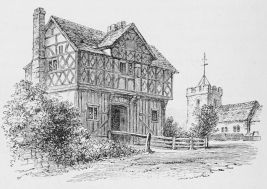
and have much enjoyed my holiday talking-time. How many delightful people there are in the world. I so seldom see any one I cannot care in the least about. One side, one aspect, seems unprepossessing, but then, if one takes the trouble to go round on the other side, one is sure to find something. Was it not Socrates who said, ‘It is impossible to lead a quiet life, for that would be to disobey the Deity.’ And I am sure no one can carry their eyes about with them through a variety of people as I do, without learning fresh lessons of compensating qualities to be traced in most, and the uniform case of all in the fight to be fought, however different the enemies with which each has to contend. I saw no end of people in Shropshire when I was at Buntingsdale—so familiar in my long-ago—for Gertrude Percy’s wedding at Hodnet. After that I was in quieter scenes, but oh! how lovely, on Wenlock Edge, that eighteen-mile long strip of craggy wooded hill which stretches from Wenlock to Craven Arms, with such fine views over the rich plain below. Wenlock Abbey I saw the evening I arrived, with its grand ruin, and the curious cloistered abbot’s house, so well restored as a residence by the Milnes-Gaskells. Lutwyche, which Lord and Lady Chetwynd have hired, is a charming old house in the very centre of all the beauty, and each day we went to some wonderful old grange, manor, or mansion—Langley, Shipton, Stokesay, Wilderhope, but I think you would have liked best of all Pitchford, the gem of old black and white houses, though you would not have enjoyed as I did the untouched pews of the church, where there is a gigantic oaken effigy of a thirteenth-century De Pitchford. At Condover we saw Miss Mary Cholmondeley the authoress,[532] who looks a genius, which most authoresses I have met do not. Even in conversation, ‘les gens d’esprit sont bêtes’ is usually as true as possible.
PITCHFORD.
“Penrhyn Castle has been delightful, and my room, with its exquisite views over sea and mountains, the most delightful thing in it. Lady Penrhyn presides over the great place with the calm of perpetual moonlight: sunlight is left to her beautiful and impulsive step-daughter Miss Alice (Pennant), who orders out no end of carriages to take guests up into the hills or wherever they want to go. And of course I longed to go to Ogwen Bank and Capel Curig, connected with my mother’s childhood, and more than ever admired these rude savage purple mountains, which have so much individual character that height is quite a secondary consideration. Then yesterday we went to that island in the Menai Straits, where there is an old chapel of great sanctity, to which Welsh funerals still wind along a narrow causeway, singing their beautiful hymns as they go.
“Do you know that ‘The Gurneys of Earlham’ is out? You will not like it, I think, and indeed I feel myself, that Carlyle would be justified in saying it was ‘a very superfluous book.’ Still, I will anticipate your asking me, and tell you that, up to its lights, it is not a bad piece of work. The whole family are a singular instance of unity without uniformity. While I have worked at the book, I have become irresistibly and most strongly attracted by such characters as Catherine Gurney and Richenda Cunningham, though for the great fetish of the family, the self-opinionated, self-parading, egotistical Joseph John, I never could have any warm feeling. Yet a descendant of one of his cousins (Lady Fry) assures me that she was so distressed on hearing of his death in her childhood, that she pulled down all the blinds of her doll’s house. So he must have had his attractive points.
“The book is certainly better reading than the earlier memoirs of those it concerns. Of those memoirs I heard an amusing story the other day. Mr. Parke of Andover, a great American philosopher and thinker, at one time quite lost the power of sleep. He said he had long tried all remedies in vain, but at last found a remedy which never failed. It was to have a book read to him, the story of a woman’s life. It always took effect at once, and soothed him into the sweetest slumbers. If he was nervous, his wife would take the book and begin—‘Elizabeth Fry was born’—‘But,’ said Mr. Parke, ‘she has begun that book constantly for two years, and I have never found out where she was born yet, for with the first words I am in dreamland.’
“Here are two little stories for you. Miss R. told me how the Bishop of Winchester and the Dean of Windsor were walking together down the street of Windsor, when they saw a little boy struggling to reach a bell. ‘Why, you’re not tall enough, my little man; let me ring the bell for you,’ said the Bishop. ‘Yes, if you please, sir,’ said the boy modestly. So the Bishop gave the bell a good pull. ‘Now then, sir, run like the devil,’ shrieked the boy, as he made off as hard as he could.
“Little E. L. was very naughty indeed the other day, and not only scratched her governess, but spit at her. ‘How can you have been so naughty?’ said her mother, ‘it can only have been the devil who made you do such a thing.’ ‘Well, perhaps it was the devil who told me to scratch her,’ replied little E——, ‘but, as for the spitting, it was entirely my own idea.’”
To W. H. Milligan.
“Garrowby, Yorkshire, Oct. 4.—The glorious weather which illuminated Wales continued at Lyme, which was still in the full splendour of summer flowers. I drew with Lady Newton each day, one day at Prestbury, where there is a wonderful old Norman mortuary chapel, like those in Brittany. Mrs. Mitford was at Lyme, and it was a pleasure to talk with her of the dear Lady Egerton, whom we both so much appreciated, and who preserved her sunny nature to the last. ‘How sad to see you suffering so!’ said Mrs. M. to her in her last terrible illness. ‘Yes,’ she said, ‘but then, you know, I have enjoyed every day of my life.’ Thinking of her, it is a difficult endeavour to be ‘doux envers la mort,’ as Bossuet said after Henrietta Maria’s death.
“I went on to flattest Lincolnshire, to Revesby Abbey, to visit my distant cousin, dear Edward Stanhope’s widow. It is delightful to see how, by making the effort at once, it is no effort to her now to talk of him, and indeed he is so often spoken of, that he seems to have a part still in the family life, and his cheerful grave, like a little garden, under the east window of the church which he built, has nothing sad. It is as if he had gone from this room into the next. Yet how delightful he was, how truly lovable! I was taken, by my urgent desire, to Mavis Enderby; but it is a little inland village with an insignificant church, which could by no possibility have given any tidal warning; so I suppose Jean Ingelow only took the name[533] because of its musical sound. On the way we passed some grassy mounds. ‘What are those?’—‘The remains of Bolingbroke—of the castle of Bolingbroke.’ How Arthur Stanley would have loved them; yet they are amongst the things which are worth seeing but not worth going to see. Another day we went by the remains of the old house of Eresby, which gave its name to Willoughby d’Eresby, to visit the grand tombs of the Willoughbys at Spilsby. They are all of alabaster, the last representing a mother who died in childbirth, with the infant which cost her life by her side in its cradle. Sir John Franklin was born at Spilsby, and he and his two brothers have monuments in the church. Their father was a small farmer close by, and when his farm failed, he settled in the village itself, and kept its shop, grocery on one side the door, drapery on the other. And, coming from thence, John Franklin became the most famous of those Arctic travellers whom Wilkie Collins aptly describes as ‘the men who go nowhere and find nothing.’ In this drive we passed by Keil, where the church tower had suddenly collapsed. ‘Well, now, how was it? was it a hurricane, or did the soil give way, or what?’ said Mrs. Egerton to the sexton, who for a minute answered nothing, and then, ‘Well, mum, ‘twere this way; her just squatted and settled.’
“The house at Revesby was full of interesting objects. Amongst them was a magnificent repeater watch which belonged to the old Lord Stanhope.[534] One night, when he was out late, a man pounced upon him with pistols and ‘Your money or your life.’ Always imperturbable, Lord Stanhope replied very slowly, ‘My friend, I have no money with me.’—‘No,’ said the robber, ‘but you have your watch; I must have your watch.’—‘My friend, this watch was given to me by one very dear to me, and I value it extremely. It is considered to be worth £100. Now, if you will trust me, I will this evening place a hundred-pound note in the hollow of that tree.’ And the highwayman trusted him and Lord Stanhope placed the note there.
“Very many years after, Lord Stanhope was at a public dinner in London, and opposite him sat a City magnate of great wealth and influence. They conversed pleasantly. Next day Lord Stanhope received a letter from him, enclosing a hundred-pound note, and saying, ‘It was your Lordship’s kind loan of that sum many years ago that started me in life, and enabled me to rise to have the honour of sitting opposite your Lordship at dinner.’
“When I was a child, ‘Marmion’ made me long passionately to see Whitby, and ‘Sylvia’s Lovers’ afterwards increased the longing. Now I have been there, and what a wonderful place it is. I think nothing on the English, or French, or Spanish, or German coasts is equal to it. The first morning was a thick fog—a most blessed fog. I felt a presentiment of what would happen. I was certain where the abbey was, and through the dim streets, up the slippery steps, and between the gravestones of the churchyard dripping with wet, I made my way to a certain field, which I was sure was the right place, and there I waited. Soon out of the thick mists rose, bathed in sudden sunlight, the grand ruin of an abbey, all glorious in the heavens, but no earth visible. It was as the summit of Mont Blanc is sometimes seen, but a New Jerusalem, in splendour beyond words—‘And the building of the wall of it was of pure gold.’ And then suddenly the fog came down again and it vanished, and in a few minutes, when the veil drew up the second time, a noble ruined abbey stood there, every arch and pillar reflected in the waters of a lonely tarn, but it was only the bones of the glorious vision which had been.
“The old courthouse of the Cholmondeleys was the abbot’s house, and in it was ‘Lady Anne’s Chamber,’ terribly haunted. A figure used to come down from a picture over the chimney, and was seen by many still living. Close by was a passage with an oubliette, down which ‘the nuns used to throw their babies.’ All, except the offices, has been cleared away by Sir C. Strickland, and a hideous modern house built. Down the steep way below the house Sir Nicholas Cholmondeley used to drive his four-in-hand furiously.
“The fog was fainter all the rest of that day, and oh! how I luxuriated in the winding ways upon the cliffs, in the dark red roofs piled one upon another, and the delicate grey distances of buildings or sea.
“Here, at Garrowby, I have been very happy with the Halifaxes. I always feel better for the life with them, and I have especially liked the spiritual part of it here, where there is no chaplain, as at Hickleton, and where the services in the beautiful little chapel are led by Charlie Halifax himself. Everybody joins, and a footman sings gloriously at the very pitch of his voice. In everything Charlie recalls to me something which I have read with a higher reference—‘Not by his doctrines has Christ laid hold upon the heart of men, but by the story of his life.’[535] He has ‘under all circumstances that just admixture in the moral character of sweetness and dignity’ which Marcus Aurelius speaks of. Unlike everything else is the simplicity and singleness of heart and purpose written so distinctly on everything he says and does. Action is easy and natural where faith is so absolute. ‘At all times a man who would do faithfully must believe firmly,’ was a saying of Carlyle. And though religion pervades everything, no house was ever so gay as that of which Charlie is master. What merriment we have had over our games in the evening: what fun over the mysterious disappearances by day into the four secret chambers which make this house so curious: what admirably good stories have been told; and while the loss of the dear boys who are gone ever leaves a blank in the parents’ hearts, how happy life is made for the children who remain! ‘La joie est très bonne pour la santé: ce qui est sot, c’est d’être triste’[536]—this seems to be one of the minor guides of action. The place is not very interesting, but the house delightfully full of books and pictures. In the park are African cows, Japanese deer, emus, and kangaroos. Lady Ernestine Edgecumbe and Lady Beauchamp are here. It is a little society of those who feel that ‘we may not only know the truth, but may live even in this life in the very household and court of God.’”[537]
To George Cockerton.
“Holmhurst, Oct. 9.—My return home was saddened by finding dear old Harriet Rogers—Lea’s niece—in a dying state at her little cottage in the grounds. She was just able to recognise me, and whispered touchingly, ‘I thank you! I thank you!’ As in the many other people I have now seen enter the shadow of death, there was no fear and no joy; the power of mental emotion seemed past. Yesterday, whilst I was with her, she died, passing the barrier quite painlessly. Yet what a change for her! There is always something very awe-striking in it.
‘And her smooth face sharpened slowly,’
is a line of the ‘Lady of Shalott’ which Tennyson afterwards removed, as giving too painful an image of death; but it is exactly what happens. To-day I feel it—yes, odd to see the same farm and garden life, in which she was interested and had a share, going on the same, and that her part in it should be so suddenly over—snapped. How she must be longing to tell one now what she felt at that momentous moment. I am exactly like the person in ‘Hitherto’—‘I can’t get over expectin’ her to come in and talk it all over. It seems as though she couldn’t do nothin’ without tellin’ folk how!—But there, I dare say,—if ‘tain’t wicked to think of it,—it’s half over heaven by this time.’
“‘Il faut mourir et rendre compte de sa vie, voilà dans toute sa simplicité le grand enseignement de la maladie. Fais au plus tôt ce que tu as à faire; rentre dans l’ordre, songe à ton devoir; prépare-toi au départ; voilà ce que crient la conscience et la raison.’[538]
“My ‘North-Western France’ is now ready to appear. It has been an immense labour, one compared with which ‘The Gurneys of Earlham’ is as a drop to a river; but I have no doubt the latter will be more read, and certainly more reviewed, for scarcely any Englishmen know enough of France to be critical about descriptions of it. I have another little book ready too—‘Biographical Essays’—which is sure to meet with plenty of abuse, but does not deserve much, all the same. In it I have tried to give such a picture of Arthur Stanley as may make people love him as a friend, whilst they shrink from following him as a guide.”