Volume 5 — XXIII IN THE FURROWS OF LIFE (continued 2)
Reading edition
“For her own sharp sayings, Mrs. Kemble is repaid by her grandchildren. She wrote to one of her grandsons that she did not care for Wagner’s music, she could not understand what he meant by it. He answered, that a fly crawling up the wall of Cologne Cathedral might as well presume to judge of its architectural glories as she of Wagner! She did not seem to know whether to be angry or pleased at this.
“Dear Lady Marian Alford used to tell of her first meeting Mrs. Kemble at a garden-party. She had scarcely sat down by her when Mrs. Kemble said slowly, with her peculiar intonation and inflection upon each syllable—‘I do per-ceive a ... stink!’
“Being asked if she would employ Pakenham or M’Crackem as agent for sending her goods from Italy to England, Mrs. Kemble said, ‘Why, rather Pack’em than Crack’em, to be sure.’”
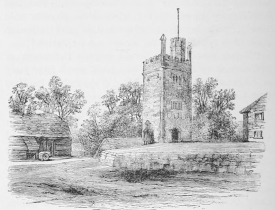
“Sept. 30.—A charming visit to the Delawarrs at Buckhurst. I had no idea there was such a beautiful place in Sussex, such moss-grown oaks and beeches; such deep ferny and heathy glens; such still pools, in which all the autumnal tints are reflected; such winding forest-paths, up and down and in and out of which Lady Delawarr has driven me with her two ponies tandem; an infantine Medway, nearly to the source of which the eldest boy, Cantilupe, rowed me through channels so narrow that one could touch the great water-plants on either side. Then the house has many delightful books and pictures, including two Sir Joshuas; and there are two other old houses, semi-deserted, but with grand castellated gateways, infinitely picturesque; and there is a monumental chapel, where a marble Duke and Duchess of Dorset kneel eternally by the tomb of the many children who died before them.
GATEWAY OF BUCKHURST. [411]

“The ‘company’ has been varied and amusing—Miss (Doll) Farquharson of Invercauld, a perfect Niagara of amusing Scottish anecdote; Mr. Broadley, of terrible review reputation; and the Roman Catholic Bishop of Portsmouth, who has propounded many quaint riddles of his own invention.
“Miss Farquharson described a minister at Invercauld, who, wishing to flatter the family, stated in his sermon that the Farquharson tartan was one of the oldest dresses in the world, as it was evident that Joseph’s coat of many colours was made of it, ‘thereby giving mortal offence to the Duffs, who sat in the opposite pew.’
“When the minister was changed, Miss Farquharson asked an old woman if she liked the new one as well as the old. ‘Eh, I like him weel eneuch, but he’s na sae frolicsome in the pulpit.’
“I made great friends with all the family at Buckhurst, down to the little Margaret of three, who peoples all the forest with imaginary bears and elephants, and talks to them, and of her adventures with them, exactly as if they were realities. We picnicked on an island in the lake, dreadfully damp, but it was very merry and pleasant.”
“Burwarton, Shropshire, Oct. 23.—This is a beautiful place of Lord Boyne’s, high in the Clee hills, with glorious views of the Welsh and Malvern ranges, beyond exquisite wooded scenery. The house is modern, but has good pictures, several representing members of the Medmenham brotherhood, and one a Lady Paisley, an ancestress, who declared that she did not wish to go to heaven if poor people went there. Many pleasant people are here, especially a Mr. Bankes, who is very amusing about the primitive ways of the Isle of Purbeck. At one time the people of Corfe had been very good for some time, so that the lock-up had not been used, and the Mayor, one Robert Taylor, had filled it with his potatoes after they were dug up. But at last there was a man who was very naughty indeed, and he had to be put in the lock-up, though there was scarcely room for him even to stand in it, it was so full of the Mayor’s potatoes. Late that night, some people going past stumbled over a great heap lying in the middle of the road—quite a huge heap. It was the Mayor’s potatoes, which the prisoner had amused himself by throwing through the bars of the window: so then the Mayor was obliged to compromise matters, and to let his victim out on condition of his picking up all the potatoes and putting them back again.
“This Mayor, Robert Taylor, used to say, ‘I shall have to adjudicate upon such and such a case to-morrow.’ He kept a shop where he sold hats. One day he saw a neighbour walking by with a very smart shiny hat, and called out, ‘Thomas, good-day, Thomas; you’ve got a new hat, may I ask where you got it, Thomas?’—‘Well, I bought it at Wareham, Mr. Taylor.’—‘Oh, you bought it at Wareham, did you? Very good, Thomas.’ Some days afterwards Thomas was set upon by a man in a lonely road and very badly beaten, really very much hurt. He went to the Mayor and said, ‘Really, Mr. Taylor, I think I must take out a summons.’—‘A summons! must you, Thomas? Well, you may just go and take it out where you bought your hat.’
“The ignorance of the people in Purbeck is intense. A clergyman preached about Zachaeus climbing into the fig-tree, &c. An old widow woman, who had stayed at home, asked her son if he could tell her what the sermon was about. ‘Yes, that he could,’ he said, ‘for it was all about Jack Key (a bad character in the village), who had been up to summut, and was to have to give half of all his goods to the poor.’
“Here, at Burwarton, witchcraft is generally believed in. A tenant said the other day that his pig was bewitched by an old woman, and that it would certainly die, unless he could have her blood; by which he meant nothing murderous—a prick of a pin would do. Many of the neighbouring clergy are bad. At a small hill-parish near this an old woman asked the clergyman what he did for his rheumatism. ‘Well, I swear like hell,’ he said.”
“Oakley Park, Oct. 17.—A lovely place, with glorious old oaks mentioned in Domesday Book. Ludlow is only 2½ miles off. Its castle, which stands grandly opposite the entrance to the drive, is associated with Prince Arthur, ‘Comus’ was acted there, and it was thence that the Princes were taken to the Tower. It was also from Ludlow that the pilgrims came who were met in the Holy Land by St. John when he gave them the ring to take back to Edward the Confessor, and this story is represented on the windows of the grand old church. Stokesay, which we have been to sketch, is inimitably picturesque. Nothing can be kinder than my present hostess, Lady Mary Clive, so considerate of all that can interest or amuse one,[412] even whilst talking incessantly of her two hobbies—Conservatism and Church matters. In the latter she is just now in her glory, as the house is full of clergy for the Church Congress at Ludlow, where all the ecclesiastics in the county are delighting, like dogs, to bark and bite. There is table-d’hôte for them here at every meal, and the house is like a clerical hotel.”
To Miss Leycester.
“Nov. 22, 1885.—Mother’s birthday! on which for so many years we have been through the Catacombs (lighted up this one day of the year) to visit the grave of S. Cecilia. My pleasant holiday and happy visits are already becoming dreamlike, and it is as if my last time alone here going on still, as I sit in my hill-set solitude. The wind whistles in the fir-trees; a cow lows in the meadow for a lost calf; Rollo snorts with fat, but is always ready to play with Selma the cat, though greatly annoyed at her having given birth to a numerous progeny in his bed; new pigstyes are built, and a Lawsoniana hedge is planted round the little garden up the steps. ‘The Holmhurst muffin-bell,’ as St. Leonards calls it, already rung for a tea-party next Tuesday; and ‘the boys’ (now Heddie Williamson and Freddie Russell) are due for their half-holiday on Wednesday; George Jolliffe is coming to stay on the 4th; and for myself, there is constant work to be done on ‘Paris,’ where, as I labour down the highways, a thousand by-ways of interest and instruction are ever opening up.
“I have, however, a little disappointment in Smith and Elder’s account, nearly £300 to the bad again this year, and no gain whatever: so much for the supposed riches of ‘a very successful author.’
“Just now also I am being most tremendously bored with the visit of young ——, and am wondering if he will profit by one of George Washington’s admirable ‘Rules of Civility,’ which I am going to read aloud to him. ‘In the presence of others, sing not to yourself with a humming voice, nor drum with your fingers or feet.’”
“Powderham Castle, Nov. 14.—I have been spending a week with Charlie Halifax in this beautiful place, which recalls the Little Gidding of ‘John Inglesant’ in its intense, its real saintliness—in the constant chapel services with wonderful singing of the servants, in the commemorative hymns for such saints as Martin and Bricius, in the spirit of harmony and universal love, which rules everything. Lord Devon[413] is absolutely seraphic. Charlie says he knows only two perfect forms of happiness, reciting the Holy Office or attending the Board of Guardians. ‘I know one thing troubles you in respect of heaven,’ says Charlie, ‘it is, that there are no boards of guardians there; but, dearest Lord Devon, if they are quite essential to your happiness, I am sure that a board will be created in some planet, with celestial paupers for you to relieve.’
“When with the Halifaxes, I always become brimful of good intentions. But then something comes back to me that I once heard a Countess Zitchi say, ‘Moi, je suis tout-à-fait comme Jésus Christ, seulement il me manque—la conduite!’
“We have had a delightful twenty-seven miles’ excursion to the very curious old desolate house of Fulford and a picnic in its deserted deer-park. Another day, Charlie, his uncle Francis Grey, and I, went to Berry Head, a wild rock-girt promontory, with ruined walls of an old fortress, looking on the bay crowded with Brixham trawlers.”
The latter months of 1885 found me quietly at home, exceedingly busy over my work on France. As at all other times, except in fine summer weather, I was chiefly alone, save when on Sundays some of my young men friends—“the boys”—were generally at Holmhurst for two nights, being usually those whose whole life is spent in bearing—
“The work-day burden of dull life, About the footsore flags of a weary world;”[414]
for I have always felt how much, in similar circumstances, I should have cared myself to have a friend and a homelike little refuge to go to. Besides, “although in a very humble and apparently confined sphere of action, who can tell the effect which our influence or that of our conduct may have upon others, and its reaction throughout future ages?”[415]
In latter years I have had better “material” in this respect; but it must be allowed that, except in very rare cases, those I tried to be useful to in former days turned out very ill. Here are just a few instances:—
No. 1 was a gentleman once in a good position, who had fallen into extreme poverty. I gave up being in London, I gave up going abroad, I always went in an omnibus instead of a cab, always travelled second class instead of first, to have £50 a year to give to No. 1. But when I found that my poor gentleman always took a hansom even to cross Eaton Square, I drew in my purse-strings.
No. 2 seemed very different. Rudely nurtured, he minded no difficulties, and was willing to live hardly. He only cared for work, and his work was science. He threw his whole life into it, and seemed on the eve of great discoveries—in fact, he made them. But he had no one to help him to buy the patents that were necessary, and I spent £800 for this, and altogether many thousand pounds in his behalf. He was to have repaid this sum if he became successful in life, but he made a very large fortune, and “forgot to pay it.” Then, having lost his fortune again, his originality and cleverness took another direction: he suddenly turned Buddhist, cared for nothing but the divine essence, and went off to India to join a brotherhood in which, after years of prayer and fasting, he might hope to obtain the distinction of “a little yellow garment.” He wrote then that his religion itself would prevent his ever again forgetting that he owed me four thousand pounds with interest. Yet, after his return, he repudiated his debt altogether, and denied that he had even the slightest obligation to me. All I had spent was thrown away! No. 2 was an utter collapse.
No. 3 wanted to be married. He had led a wild life, and his marriage would “be the saving of him;” with his marriage a new page of his life would be turned over; but to enable the marriage to be, a loan of money was necessary. I sent the money, but the marriage never took place, and the loan was never returned. No. 3 vanished into chaos.
No. 4 was very engaging and I became very fond of him. He was perpetually at my home, where I always treated him as a younger brother, giving him money when I was away for whatever he wanted. When he wished to give a party to his friends in London, the food, the wine, the flowers, came from Holmhurst. He had to work hard in a public office, so every year I gave him money for the change of a Continental tour, and on one occasion, when he had no other companion, I took him myself, and showed him the whole of a foreign country. This went on for nine years. Then a circumstance occurred which made me feel that he, in his turn, might, not even for one day, but for one hour, be useful to me. Under these circumstances I asked a favour of him. “No,” it was refused at once, “it might not be to his advantage: it might even possibly be rather inconvenient.” No. 4 collapsed.
No. 5 was a very young and ingenuous boy. I met him first when he was at Oxford, when his family—country gentlefolk—were trying to compel him to take Orders. He confided to me his misery about it, and his utter unfitness. I backed him up in resisting. From that time I saw a great deal of him. He was very affectionate to me, and I grew very fond of him. His family, irritated at his opposition to taking Orders, refused to go on spending money upon his education. I continued it, or thought I did, by letter, sending him daily questions to answer by post, and receiving précis of History from him and correcting them. He was also very frequently at Holmhurst for a long time together, and had more of a real home there than with his own parents. Once, without my knowledge or that of his family, he went to London, and got into terribly bad companionship and disgracefully bad habits. He was plundered of all he possessed, and had to pawn his watch to get away. To prevent the discovery of this, which would have hopelessly estranged him from his family, I redeemed his valuables for a considerable sum. He then seemed penitent, promised amendment, and took refuge at Holmhurst again. About a year after I found him on the eve of wilfully making an acquaintance which was sure to cause his ruin. I pointed out to him the misery he was bringing upon himself, and he promised to give it up. Then I found that all the while he was promising to do nothing of the kind, he had been constantly writing to the person in question, with whom he had no previous acquaintance, making assignations for meetings, &c. From that time he got into one miserable scrape after another. He sank and sank. Whenever he has made a promise, he has always broken his word; nothing he says can be believed; his every act must be mistrusted.... Now, he has taken Holy Orders! This is the end of No. 5.
No. 6 was very dear to me. I had known him intimately from his earliest childhood. Exceedingly unprepossessing in appearance, he gave the most brilliant promise of a distinguished career. To me he showed the most unbounded affection and confidence, but he never told the truth. This led to a series of miserable deceptions which caused his expulsion from school and brought about his failure everywhere. Dreaded, mistrusted, he became alienated from his family, almost from his fellow-men. No opportunity of extravagant folly occurred but was greedily seized upon, to be followed by fresh falsehood. His whole life has been a sorrow to those who know him, and who think mournfully of its beautiful “might have been.”
I met No. 7 when he was eighteen. Of very lowly origin but gentle instincts, he had been turned adrift at seventeen upon London to earn his own living, and he seemed at first to be earning it bravely and honestly. He was clever and was anxious to improve himself, and he spent all his evenings in reading, and succeeded in teaching himself French. By his own unaided efforts he had really given himself an education. At first I used only to lend him books and do what I could to help his reading. Then I frequently invited him to Holmhurst, and paid for his coming there. He had a bad illness in London, when I went constantly to him in his miserable garret, and supplied all his little comforts. About a year after I first knew him, he yielded to a great temptation in misappropriating a large sum of money belonging to the firm he was serving, and spending it in a very disgraceful manner. It seemed as if he really did this under a diabolic influence, and as if he really believed that he should be able to replace the money before the theft was discovered. But the time drew very near when his accounts would be examined, and there was no chance—there never had been—that they would be found correct. Then the full agony of his position came upon him, and he confessed the whole to me and implored me to save him. The day before the examination of accounts I replaced the stolen money, and the defalcation was never discovered.
From this time he seemed to go on well, and I became much attached to him. Five times a year I paid his expenses to Holmhurst, to give him country air, treating him like my own son when he was with me. Then came a time when, after several years, he fell into feeble health, and had to leave his situation. I was then not perfectly satisfied with the way in which he was going on, and did not think him as frank and candid as he had been, but I took him home with me for a month to recruit. At Holmhurst he had every kindness and indulgence, and was received not only as an equal, but almost as a child of the house. At the end of a month, he told me that he had heard of some very suitable employment in London, and hoped that I would not object to his going to town to see about it. I said, “Certainly not; but what is the employment?” To my surprise, he said that he could not tell me then, but I should know later. I was more surprised because, when he left, he was so unusually affectionate—“I am very glad you are so fond of me, but I cannot imagine why you should show it especially to-day, as you are coming back in a few hours.” He never came back. It was many days before he wrote. Then I had a formal letter saying that, when he went up to London, he had been received into the Church of Rome at Brompton Oratory, and enclosing a list of his possessions left at Holmhurst, and directions for sending them. Since then he has sunk lower and lower. I have often heard of him, and always a worse account. He is utterly lost to me. That is the end of No. 7.
No. 8 was excessively good-looking, had pleasant manners, and was especially winning to ladies. I had known his family long ago, and his home, a very quiet rectory in a desolate fen district. When he was at Oxford, I found him, like No. 5, very unhappy at being expected to take Orders, for which he honestly felt himself unfitted, and I persuaded him to tell his father that it was impossible. Then, as he was penniless and had no prospects, it was necessary that a profession should be found for him, and I obtained a nomination for him for the Foreign Office from Lord Granville. He came to London to work for this, and he worked well. Feeling that it would be most undesirable for him to go on in London, especially to enter the Foreign Office, knowing no one in society, I took him out with me every day to parties, and introduced him everywhere, claiming all kindness for him as my intimate friend. His good looks and pleasing manners made him very welcome. But he fell in love with an Earl’s daughter. Strange to say, his suit was not rejected, though a probation of two years was required, during which he must begin to make an income. With this view, he abandoned all thought of the Foreign Office and took to the Stock Exchange. A week before the end of the two years’ probation, the lady, of her own accord, threw him over, but, as far as love went, her place was soon supplied. By this time, too, the young man had acquired l’habitude de société, had begun to despise his humble relations, to cut his old friends, and a shake of the Prince of Wales’s hand finally turned his head. He scarcely speaks to me now when we meet. He openly says that, as he has gained all he can from me, he naturally prefers “those who can be more useful” to him.
No. 9, poor fellow, was long a great anxiety to me. He was of good family. He fell often—fell into the most frightful vice and shame. He repented bitterly, and then fell again worse than before. But in one of his best and truest times of repentance, God saw that he was positively unable to cope with temptation, and he died—died most mercifully, full of faith, hope, and gratitude. This was the end of No. 9. Thinking of him has often brought to my mind Rossetti’s lines—
“Look in my face: my name is Might-have-been, I am also called No-more, Too-late, Farewell.”
And yet—
“La bontà infinita ha sì gran braccia, Che prende ciò che si rivolve a lei.”[416]
As I retrace here, on paper, the story of my failures, a sentence of Balzac comes into my mind: “Il vous arrivera souvent d’être utile aux autres, de leur rendre service, et vous en serez pen récompensé”; mais n’imitez pas ceux qui se plaignent des hommes et se vantent de ne trouver que des ingrats. N’est-ce pas se mettre sur un piédestal? puis n’est-il pas un peu niais d’avouer son peu de connaissance du monde?”[417]
And then Bunyan said in his last sermon (1692):—“Dost thou see a soul that has had the image of God in him? Love him: love him: say, This man must go to heaven some day. Do good to one another, and if any wrong you, pray to God to right you, and love the brotherhood.”
And there is a line of Tasso which comes back to me in all times of disappointment—
“Brama assai—poco spera—nulla chiede.”
END OF VOL. V.
Printed by Ballantyne, Hanson & Co Edinburgh and London