Volume 5 — XXI A HALT IN LIFE
Reading edition
“When I recall my youth, what I was then, What I am now, ye beloved ones all; It seems as though these were the living men, And we the coloured shadows on the wall.” —Monckton Milnes.
“Pain and joy, deception and fulfilled hopes, are just the rain and the sunshine that must meet the traveller on his way. Button or wrap your cloak around you from the first, but do not think for a single moment that one or the other have anything to do with the end of your journey.”—Joseph Mazzini.
“Quand la vie cesse d’être une promesse, elle ne cesse pas d’être une tâche; et même son vrai nom est épreuve.”—Amiel.
“Non aver tema, disse il mio Signore, Fatti sicur, chè noi siamo a buon punto: Non stringer, ma rallarga ogni vigore.” —Dante, “Purgatorio,” Canto ix.
IN May 1878, my publishers, Messrs. Daldy and Isbister, had astounded the literary world by becoming bankrupt. They had been personally pleasant to deal with; I had never doubted their solvency; and I was on terms of friendly intercourse with Mr. Isbister. In April 1878 he wrote to me saying that he knew I applied the interest of money derived from my books to charitable purposes, and that he would much rather bestow the large interest he was prepared to give for such purpose than any other, and he asked me to lend him £1500. I had not the sum at the time he asked for it, but, about a week later, being advised to sell out that sum from some American securities, I lent it to him. Then, within a month, the firm declared itself bankrupt, owing me in all nearly £3000, and the £1500 and much more was apparently lost for ever.[326] In accepting contracts for my different books, I had always fully understood, and been given to understand, that I never parted with the copyright. I believe that most publishers would have informed an ignorant author that the very unusual forms of agreement they prepared involved the copyright, but I was allowed to suppose that I retained it in my own hands. I first discovered my mistake after their bankruptcy, when, besides owing me nearly £3000, Messrs. Daldy and Isbister demanded a bonus of £1500 (which I refused, offering £850 in vain) for giving me the permission to go on circulating my own books through another publisher.
As it was impossible to come to terms, my unfortunate books lapsed. In the autumn of 1879 Messrs. Daldy and Isbister offered to submit to an arbitrator the question of the amount to be paid to my so-great debtors for the liberty of continuing to publish my books. Three eminent publishing firms chose an arbitrator, but when he sent in his estimate they would not agree to it.
These circumstances made such a discouragement for any real work, that for two years I did nothing of a literary character beyond collecting the reminiscences contained in these volumes. The first year was chiefly occupied by my duties towards the Crown Prince of Sweden and Norway. In the second year I had a comparative holiday. It is therefore that I call it “A Halt in Life.”
In November 1879 an event occurred which would at one time have affected me very deeply—the death of the Mary Stanley who for many years ruled my adopted family by the force of her strong will, and who, after my dearest Mother was taken away from me, remorselessly used that power to expel me from the hearts and homes of those over whom she had any influence, in her fury at the publication of the “Memorials of a Quiet Life.” Yet, when her restless spirit was quieted by Death, I could only remember the kind “Cousin Mary” of my childhood, when my greatest delight was to go to her room at Norwich, and so many of my little pleasures came from her.
“Where thou hast touched, O wondrous Death! Where thou hast come between, Lo, there for ever perisheth The common and the mean. No little flaw or trivial speck Doth any more appear, And cannot, from this time, to fleck Love’s perfect image clear.”[327]
Hard to those in her own class, and with them ever occupied in asserting and insisting upon her own little imaginary dignities, Mary Stanley did more unselfish work for the poor than almost any one, and hundreds of whom nothing is known in the society in which she lived miss and mourn her. Probably only the poor knew the best, the really beautiful side of Mary Stanley’s life, which was most beautiful.
I often wish, as regards her, I could have profited more by words of Mrs. Kemble which I read too late to apply them—“Do you not know that to misunderstand and be misunderstood is one of the inevitable conclusions, and I think one of the especial purposes, of our existence? The principal use of the affection of human beings for each other is to supply the want of perfect comprehension, which is impossible. All the faith and love which we possess are barely sufficient to bridge over the abyss of individualism which separates one human being from another; and they would not, or could not, exist, if we really understood each other.”
FROM S. GREGORIO, MESSINA. [328]

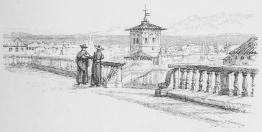
In December I went abroad to join the two Miss Hollands—my Norwegian companions—at Ancona, and go on with them to Sicily, a journey through deep snow and agonising cold. After I met the Hollands and their friend Miss Lily Howard, we went rapidly south, with Sir George Baker, his wife and daughter, semi-annexed to our party, and at Reggio we found summer—palms, bananas, blue skies and sunshine.
TAORMINA. [329]
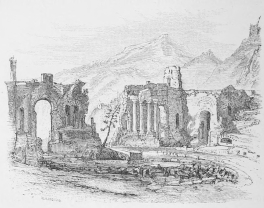
Our wretched journey made the first morning at Messina quite enchanting, as we climbed the heights, looking down upon the straits and to the purple peaks of Italy, their tips glistening with snow. Nespoli, daturas, and camellias grew as trees in full bloom; the gardens were a mass of salvias, trumpet-flower, and roses; heliotrope in full blossom hung over the high walls, and quantities of scarlet geraniums grew wild upon the beach.
More lovely still was Taormina, hanging like an eagle’s nest on the ledge of the mountain, and looking down into the blue sea, which breaks into emerald near the snowy line of breakers. On one side is Etna, quite gigantic, with pathless fields of snow even upon the lower heights; on the other are the grand ruins of the Theatre, from which, above the broken arches and pillars, the queen of fire and snow looms unspeakably sublime. Our pleasant primitive inn was in a quiet street, where all the daily incidents were lovely—the goats coming in the early morning to be milked: the peasants riding in upon their asses: the convent bells jangling: the women returning from the fountain with vases of old Greek forms upon their heads, burnished yellow, green, or red: the singing at Ave Maria and Benediction. We spent several days at Taormina, drawing quietly in the mornings amongst the rocky beds of pinks, and snapdragon, and silene: reading aloud in the evenings—Thucydides, Gregorovius, and then a novel for relaxation: the four ladies and their maid occasionally singing in parts as in Norway.
ROMAN AMPHITHEATRE, SYRACUSE. [330]
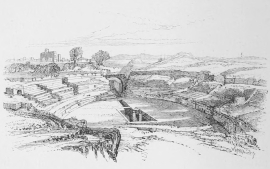
We were sorry to go on to Syracuse, for though many had told us of its intense interest and curiosity, no one had spoken of its extreme loveliness. Of its five towns, only the island-town of Ortygia remains. Acradina, Neapolis, Tycho, and Epipolae are desolate hillsides covered with pink-grey limestone, overgrown with wild figs, olives, prickly pears, and ten thousand lovely flowers; and from their sunny slopes you look to the blue mountains of Hybla and the rose-coloured rocks of Megara. Here and there, in the most exquisite situations, are Roman, and still more beautiful Greek ruins, which seem to have grown into the scenery and become part of it, gilded by lichen, fringed with flowers.
FROM THE WALLS OF EPIPOLAE. [331]
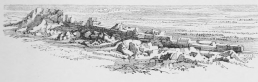
ON THE RIVER CYANE. [332]

Each morning at Syracuse we engaged little carriages (costing one shilling the hour) for the day, and took with us a well-filled luncheon basket for ourselves and our charming young drivers, and we wandered, and studied, and drew for hours. We spent a whole day on the grand heights of Epipolae, looking on one side across a luxuriant plain to snowy Etna, and on the other across the vast ruined city to the blue sea, with Ortygia gleaming upon it like a jewel. Another whole day was given to ascending the rivers Anapus and Pisma to the mystic blue fountain of Cyane: the most romantic of boating excursions, the boatmen every now and then being obliged to jump into the water and push the boat over the shallows or through the thick water-plants: the papyrus with its exquisite feathery crests almost meeting overhead, or grouped into the most glorious masses on the islets in midstream: enchanting little views opening every now and then to palms and cypresses and blue rifts in the roseate rocks of Megara; now a foreground of oleanders, then of splendid castor-oil plants. In returning, we walked up a hill to the Temple of Jupiter Olympus, through a perfect blaze of dwarf blue iris, the loveliest flowers I ever saw.
ACI CASTELLO. [333]
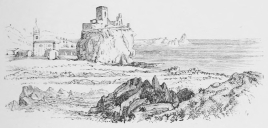
We spent the four first days of the New Year at Catania, a dull town, though backed by the glorious snow-fields of Etna, and we made thence two excursions—to Aci Castello, a beautiful old castle on lava rocks, and to Aci Reale, with the spring into which Acis, the lover of Galatea, is supposed to have been changed.
TEMPLE OF CONCORD, GIRGENTI. [334]
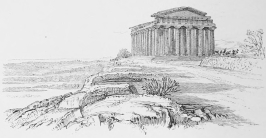
At Girgenti we found an excellent hotel, with rooms opening to delightful balconies, overhanging—at a great height—one of the noblest views in the world, billow upon billow of purple hill, crested with hoary olives, and with masses of oranges and caroubas in all the sheltered nooks, a vast expanse of glistening sea, and a range of Greek temples in desolate loveliness. The landlord, Don Gaetano de Angelis, was a stately old Sicilian, who treated us far more like honoured guests than customers, and fed us so luxuriously and magnificently that we wondered how it was possible he could repay himself. He had lately married for the second time, a pretty merry child-wife in huge gold earrings, who paid us frequent visits, and was delighted with us and our drawings, and to sit for her portrait. They quite enjoyed the preparation of the luncheon basket, with which we always set off at 9 A.M., not returning till the sunset had turned the sea rose-colour and set the mountains aflame. Each day we picnicked amongst the asphodels and lilies in the shadow of one of the Greek temples, and were glad to find a shelter from the burning sun, which blazed in a sky that only turned from turquoise to opal. Some of the temples are nearly perfect, some mere masses of ruin, or one or two pillars with a beautiful bit of yellow architrave set in the most exquisite landscape—delicate pink mountain distances, and foregrounds of grand old olive-trees or almonds flushing into richest bloom, above a ground enamelled with flowers of every hue. We all agreed in thinking Girgenti more beautiful than any other place, and its people even more charming than the scenery, so full of kindly simplicity, from the Syndic to Pasqualuccio, the little goatherd, with coins in his earrings after the old Greek fashion, who gives each of his goats a colazione of acanthus leaves, set out like plates on a dinner-table, on the fallen columns in the Temple of Juno.
IN THE TEMPLE OF JUNO LACINIA.
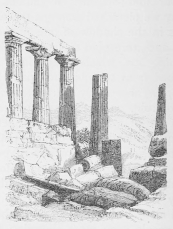
IN THE TEMPLE OF HERCULES. [335]
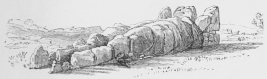
TEMPLE OF CASTOR AND POLLUX, GIRGENTI. [336]
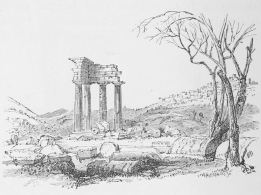
The second day after our arrival, as we were returning home up the hill in the still warm evening light, we turned aside to the old deserted convent of S. Niccola. A merry crowd of gentlemen and ladies and little boys and girls were shouting and singing on the terrace, and dancing the tarantella to the music of three peasants on a bagpipe, tambourine, and triangle. Like a Bacchanalian rout of old times they came rushing down to meet us, twenty-six in number, chained together with garlands, and the girls all wreathed with wild scarlet geranium. They escorted us all over the garden, gathering flowers and fruits for us, the crowd of little children gambolling and dancing in front. Then they begged us to go back with them to the terrace, and began dancing again, and were delighted when Miss Howard and Miss G. Holland danced with them. Afterwards, standing on the terrace, our three ladies sang one of their beautiful part songs, tumultuously applauded with prosit and evviva. The result was showers of visiting-cards from all the notables in Girgenti, especially from a family who rejoice in the singular name of the Indelicati. Then came invitations to a party and ball at Casa Gibilaro, the sons of the house, Cesare and Salvatore, coming to escort us up the steep street. Italian ladies sang, and so did our party, and all danced, and we taught the Girgentines Sir Roger de Coverley, which greatly enchanted them. The family of twenty-six—grandmother, uncles, aunts, cousins, were all there, living in the happiest union and affection, no daughter of the house ever marrying out of the place, and all meeting constantly. Carmela and Pasqualina Gibilaro were so enchanted with our two younger ladies, that they scarcely ever let go of their hands, and expressed their delight over them in the most naïve manner, and I became great friends with Salvatore and Antonio. One day, Salvatore and Pasqualina dined with us, and we afterwards went again to their house, where there was another dance, at which all the professors of the university (on delightful terms of merriment with their pupils) assisted, the Professor of Theology frisking about in the tarantella, and the Professor of Philosophy leading the cotillon. We wished this time to leave early, but our hosts insisted on our waiting till the arrival of ices, an unwonted luxury with them, but ordered in our honour. We had dined before, and since coming to the dance had been obliged to eat quantities of pasticcie, so were aghast when we found that we were each expected to eat an ice larger than an ordinary tea-cake. We managed as well as we could, but it was dreadful. I deposited more than half mine under a table. Miss Holland thought she was getting on pretty well with hers, when a Contessa Indelicato, on the opposite side of the room, seeing her flagging, filled a large spoon with her own ice, and rushing across, popped it into her mouth. With great promptitude Miss Howard instantly popped a spoonful of her ice into the mouth of a Contessina Indelicato! Great were the lamentations and embraces from this amiable family when we left Girgenti, dear little Antonio Gibilaro going with us to the station.
I spent the last morning at Girgenti in drawing the sea glistening through the pink almond-trees, and the rocky road with its troops of goats and donkeys, and in the afternoon of January 11 we went on to Palermo.
Under the later Bourbon kings Sicily was perfectly safe and brigandage utterly unknown, for the principal officials in each village and parish were made responsible for its security; but the annihilation of the rural police under the Sardinian Government taking place at the same time with the abolition of capital punishment, had introduced brigandage; and though it had become rare since the formation of railroads, it was not considered safe for us to go far from Palermo without an escort, and we were obliged to give up Segeste. When we were at Palermo, murders for vendetta were of constant occurrence, and only cost three hundred francs, as the punishment was so slight,—generally two years’ imprisonment without labour, and with a life of much greater comfort than the culprit could have enjoyed at home. Besides, the murderers are scarcely ever given up, as the vendetta would then fall upon those who betrayed them. Some of our party went to visit Calatafimi, the brigand who carried off a gentleman from Cefalu, and, when he got only half the ransom required, laboriously snipped with scissors till his head came off, in a cave on Monte Pellegrino. He was found very merry, in most comfortable quarters, with quantities of fruit, newspapers, &c. When he was tired of being there, his family would bribe the gaoler, and he would get out.
PALERMO, FROM S. MARIA DI GESU.
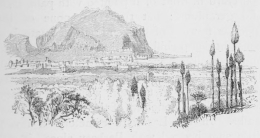
The glorious weather we enjoyed in the south of the island turned to torrents of rain at Palermo, but it is said that there are only forty-two days in the year without rain there. On the rare occasions when it clears, Palermo is most lovely, backed by such grand mountains, the nearer ones rugged purple rocks, over which the snow-peaks peep out. The cathedral also is very beautiful, with a great courtyard in front of it planted with palm-trees and geraniums; but there are none of the glorious flowers of Girgenti; the climate is a constant damp chill, like that of Pau and Pisa, and I shall always associate the place with the ceaseless melancholy roar of the sea, the drip and splash of the rain, which fell day and night, and the monotony of the mouldy deserted walks. In the Lazaretto cemetery—a lovely little spot hedged with Barbary aloes—it was touching to see the tomb of my almost unknown father. He also hated the place and was deeply depressed there.
Our one really fine day was delightful. We drove along the shore to Bagaria, where all the old nobility have their country palaces, enormous and stately in form, with huge courts and immense armorial shields over their gates, but the windows generally half choked up or glassless, the courts overgrown with weeds, and the roofs tumbling in. Sad indeed would be the shock to an English girl who married a Sicilian prince for his title and his “palace,” upon her arrival at one of these old barracks, where she would be lucky if she could find one weathertight chamber.
SOLUNTO.
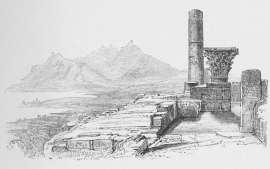
Beyond Bagaria, Capo Zafferano strides into the sea—a grand mountain, covered with cactus almost to the top; and here, high on the rocks, are the ruins of Solunto, a Carthaginian city—broad streets edged by diminutive houses and temples in the style of Pompeii. We picnicked at Solunto in the cactus shade, and drew all day the glorious view across the bay to the purple crags and fantastic forms of Monte Griffone.
Another day we went to Monreale, the grand semi-Saracenic cathedral, covered with mosaics, on the heights behind Palermo. It reminds me of a story the late Lord Clanwilliam used to tell, which I will insert here:—
“A Knight of Malta, who, by the rules of his Order, was both a soldier and a priest, was once travelling in Sicily. Being at Palermo, he strolled up to Monreale; it was a lovely evening, and in the great cathedral, where the shade was so welcome after the heat of the way, the effect was exquisitely beautiful, as the sunset streamed through the long windows upon the mosaic walls. Being an artist, the knight took out his sketch-book and began to draw, first one lovely arch and then another, till the waning light warned him that night was approaching. Then he made his way to the western door, but it was closed. He turned to the side doors, to the sacristy; they were closed also. It was evident that he was locked into the cathedral, and though he shouted and kicked at the door, he could make no one hear. Spending the night alone in a church had no terrors for him: it was only on account of the discomfort that he objected to it; so he found his way to a confessional far up the church, and made himself as comfortable there as he could with all the cushions he could collect.
CLOISTERS, MONREALE. [337]
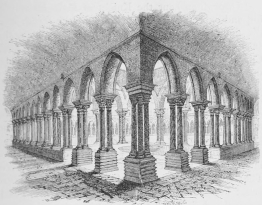
“Most wondrously beautiful is the cathedral of Monreale when the moon casts its magic halo over the ancient mosaics, and so it was on this night, when the artist-soldier-priest sat entranced with its unspeakable loveliness. The whole building was bathed in softest light, each avenue of arches at once a poem and a picture, when the clock struck twelve. Then from the west door a figure seemed to be approaching, a cowled figure in monastic robes, and the stranger felt with satisfaction that he had been missed and that one of the monks of the adjoining monastery was come to seek him. But, as he watched the figure, he observed its peculiar movement, rather floating than walking up the nave, enveloped in its sweeping draperies, and as it passed he heard a low musical voice like a wiffling wind which said, ‘Is there no good Christian who will say a mass for my poor soul?’ and the figure passed on swiftly, on behind the altar, and did not return.
“Through an hour the Knight of Malta sat watching and expecting, and then, as the clock struck one, the figure again floated up the nave, and again the same sad low voice murmured, ‘Is there no good Christian will say a mass for my poor soul?’ Then the Knight came out of the confessional and pursued the vanishing figure, pursued it to a particular spot behind the altar, where it disappeared altogether.
“When the clock struck two, the figure appeared again, and when it again uttered the words, ‘Will no good Christian say a mass for my poor soul?’ the priest-soldier answered, ‘I will; but you must serve the mass,’ for there can be no mass without a server. The holy vessels were upon the altar, and the soldier-priest began the mass. Then the monk threw back his cowl and displayed a skull, but he served the mass, which the priest courageously went through to the end: then he fell down unconscious in front of the altar.
“In the morning, when the monks came into the church, the stranger was found still unconscious upon the altar steps. He was taken into the convent, and, when he came to himself, he told what had happened. Great search was made in the archives of the monastery, though nothing was found to account for it. But long after, when some repairs were being made in the cathedral, the body of a monk in his robe and cowl was found walled up, evidently for some crime, near the altar, just at the spot where the Knight had seen him vanish.”[338]
A railway took us from Palermo to Caldane, almost on the opposite coast, and there we were transferred to a wretched tumble-down diligence, which went swinging and jolting over the deep pools in the rocky road. Though there were no regular brigands on this road, the peasants, who were too idle to work, constantly formed themselves into great bands and attacked the diligences; so the Sardinian Government, too feeble to attempt managing the people themselves, sent a guard to defend us from them. Two soldiers with guns sat on the luggage, and loaded pistols peeped ominously from under the cloaks of the Sicilians within, one of whom was an impiégato per la caccia dei briganti. However, late at night we reached Caltanisetta, a great poverty-stricken city, with white houses, white rocks, and no vegetation, high in the sulphur district.
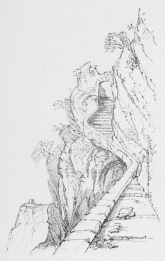
GATE OF MOLA. [339]
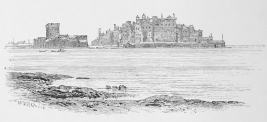
TARANTO. [340]
On going to the station the next morning, we heard that the railway near Messina was washed away, and that the last train had narrowly escaped a Tay Bridge disaster by the breaking of the high bridge at Ali. So we telegraphed to Taormina to send a carriage to meet us at Giardini, the place nearest the scene of the disaster. We did not reach Giardini till it was pitch-dark; the sea was raging close to the railway, and the rain had been falling all day in torrents. It was such a night as one scarcely ever sees, so tempestuous, so utterly black! There was no carriage for us, and no one to meet us; the telegraph had been swept away in the storm. Blankly and grimly did the officials see the large party deposited at the desolate station surrounded by waters, and great was the consternation of my four female companions when they found that it was just going to be closed and abandoned. We got a man to wade through the marsh to Giardini to try to get a carriage to come to us: the carriage tried, but an intercepting torrent was so swollen, it was impossible for it to cross without being swept out to sea. The man came back along the railway parapet, and told us that we must give up all hope of getting away. The officials refused to send any one with us; no one would face the furies of the night; nor could they lend us a lanthorn; they wanted it themselves. Happily I had made friends with a young man of Taormina—capo della musica—who happened to be at the station. He had a lanthorn, and kindly waited for us, till at last my companions consented to kilt up their dresses and venture out into the blackness. It was four miles by the road, about a mile and half by the precipices; we chose the latter. But the path through the precipices, which we had toiled up before in burning sunshine, was now a roaring torrent. However, there was nothing for it but to plunge in absolute blackness from stone to stone of the steep ascent, holding on to the broom and asphodels. At the most dangerous points the capo della musica, who made the little joke of “Io solo sono sole,” kindly waited with his lanthorn till each of the party of eight was safely round the corner. Fortunately the rain almost ceased during the ascent, and at last, by scrambling, jumping, or grovelling, we found ourselves in the street of Taormina. The people of the inn were gone to bed, but soon the great event of a large party with ladies arriving on such a terrific night caused many windows to open in the friendly primitive street, and heads and candles to appear: the hotel was roused, and we were warmly welcomed.
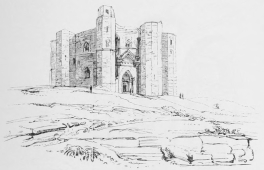
CASTEL DEL MONTE. [341]
TOMB OF BOHEMUND, CANOSA. [342]
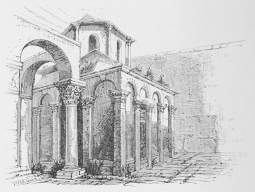
For three days we remained in a state of siege with the elements howling around in our rock-fortress of Taormina, sometimes seeing Etna reveal itself above the black storm-clouds. Then we crossed to Reggio, and went on by night to Taranto, where we spent the morning in drawing the curious island-town, and took the train again to Trani. Hence we made an excursion—three hours in a carriage and one on foot—to Castel del Monte, the favourite castle of the great Frederick II., long since a ruin, but not roofless, and presenting a more perfect picture of mediaeval splendour in its suites of marble halls than any castle I ever visited. Yet it must always have been a most desolate place and the most uninteresting of royal residences. Trani itself is full of interest, and has a beautiful cathedral. Accounts we had read of “the all-glorious cathedral of Andria” beguiled us to toil next to that old episcopal city, which we found a complete delusion, and went on to Barletta, visiting thence the battlefield of Cannae and the curious old town of Canosa, where Ariosto’s hero Bohemund is buried. Then we proceeded to Foggia, where we saw the remains of Frederick II.’s palace, and thence we made another excursion to his favourite town of Lucera, full of Saracenic remains. The next day we saw Beneventum, another glorious cathedral, mosque, and a grand Roman gateway, and arrived at Naples on the 12th of February. My last days with my companions were spent at beautiful Amalfi, and after a few lovely days at Naples and Rome, I followed them to England.
Journal.
“Elton Hall, Peterborough, April 1, 1880.—I have been two days here at Lord Carysfort’s.... The house is a jumble of architecture of every style and age, from Henry VII. to the present, and, without ever being very picturesque, is thoroughly satisfactory and comfortable, with a delightful library and a number of fine portraits. The park overlooks long lines of flat, amid which rises Fotheringhay Church. An old watermill is called ‘Pereo Mill,’ because when Mary Queen of Scots arrived and saw all the waters out, as they so often are to this day, she thought all was over with her and exclaimed, ‘Pereo,’—I perish. We have driven to Fotheringhay, and seen again the mound and the one remaining stone of the castle. The church is like a lanthorn, so full of windows, and very fine, though perpendicular. By the altar are tombs with stately inscriptions on the wall over them to Richard and Cicely Plantagenet, father and mother of Edward IV., and to his grandfather Edward Plantagenet, who was killed in the battle of Agincourt. We went on to Oundle, a charming old town with a noble church. Here, in the street, is the house of Lord and Lady Lyveden, with a large garden on the other side. The two Lady Lyvedens were there. The old one, Lord Castletown’s sister, was once the beautiful little girl of Sir T. Lawrence’s masterpiece; the younger, a plain, simple, sensible woman, well fitted for a poor peer’s wife, is perfectly adored in the town of Oundle.
“Sir Frederick Peel is here with his young wife, who is charming, so very pretty, with quantities to say on all subjects.”
“St. James’s Place, May 8.—To Mrs. Stewart’s. Lord Houghton was there, very cheery and kind. I was struck the other day by hearing some one say, ‘Lord Houghton is not only a friend in poverty, he is a friend in disgrace.’ Can there be higher praise? He was very amusing apropos of my employing Henningham and Holles to leave my cards, and said that Miss Martineau at first absolutely refused to conform to the ways of the world in paying visits, it was ‘such a waste of time;’ but it was suggested to her that she should send out ‘an inferior authoress’ with her trumpet in a hackney-coach to represent her and do her work, and that if the authoress only let the trumpet appear out of the coach-window, she would do just as well as herself.
“Dined at Lord Sherborne’s, meeting, amongst others, Lady Powerscourt, surely one of the sweetest of God’s creatures.”
“May 13.—Having heard of George Paul’s death, I went to see Auntie.[343] It was strange to find the familiar figure of my childhood, who had been inexplicably separated from me for twelve years, and with her to see again many of the silent objects connected with Esmeralda and those sealed chapters of life. We spoke only on indifferent subjects, but I cannot think poor Auntie can have felt indifferent, though she refused to show me the slightest affection, or evince the least pleasure at seeing me.”
“May 15.—I paid £50 into Auntie’s account at Coutts’s, and shall continue to do so at this date annually. More I think she would reject, but she will allow this to pass, and I am thankful even in the smallest degree to contribute to her comfort.”
“May 19.—A luncheon party at Lady Ducie’s. Mrs. Stewart was there. Some one said Sir William Harcourt’s late election failure would be as good as a dose of physic to him—‘No,’ she answered, ‘it will be no good at all; it has been a dose of castor-oil administered to a marble statue.’”
“May 25.—Luncheon at Lady Sherborne’s. Dear old Mrs. Stewart was there in great force, and recited Swinburne’s really grand lines apropos of the Prince Imperial’s proposed monument, exhorting the illustrious dead to veil their faces and leave Westminster Abbey on the arrival of his statue.
“Lady Airlie was at luncheon. She spoke of the almost necessity for a cloud over the most beautiful lives. She said how one might observe that in almost all the finest summer days the sun was clouded over for some hours.”
“May 26.—Dined at the Thorntons’. Lord Houghton was there. He said how he had discussed with George Sand the question how far it was well to know authors whose works you admired. She had urged him never to know them, that they all put their best into their books; whatever you find afterwards can only be inferior material. Carlyle, Lord Houghton allowed, was just like his books; in his case you could know the man and not be disappointed: it is the same mixture of grim humour, irony, and pathos, of which his books are composed, which enables the man personally to produce such an indescribable impression. Carlyle always hated having his picture taken, but was persuaded to sit to Millais. When he went there, to the beautiful house full of priceless art-treasures, he asked what brought them there. ‘My art,’ answered Millais proudly. ‘Then there are more fools in the world than I imagined,’ said Carlyle.”
“May 30.—Sat a long time with Lady Airlie, who talked of the power of prayer and the number of people who really believed in it. She said she prayed for everything, but always left it to God to decide for her, making a complete act of submission, but adding, ‘I should like this or that best.’ The mystic Mr. Laurence Oliphant came in and talked for a long time. Being asked as to his past and future, he said he could only act ‘under direction,’ i.e., of spirits. He said the separation from the spiritual world was entirely dependent upon the constitution of the individual. No wonder that the hallucinations of this brilliant and fascinating visionary wreck the comfort as well as the practical usefulness at once of his own life and the lives of those dearest to him.
“A few days ago Ronald Gower came and took me to Frank Miles’s studio—a new-old house in Tite Street, Chelsea. Frank Miles is a charming handsome young Bohemian, who has a delightful garden in the country filled with every lily that ever was heard of. He paints all the ‘professional beauties,’ who hover round him and his studio like moths, but his pictures have no great power.”[344]
“May 31.—I was at Stafford House in the evening, the hall brilliantly lighted, a deafening band on the staircase, and all the Campbell-Percy-Gower connection looking on.”
“June 1.—I dined with the Boynes, and went afterwards to Lady Sudeley and Mrs. Cavendish Bentinck. At these great parties I find my difficulty in recognising people an immense disadvantage. Then, with those who do not care for contemporary history or art, there are so few topics of conversation, for almost every one in London is occupied ‘de rien faire, ou de faire des riens.’”[345]
“June 4.—A party, where I heard Mrs. Caulfield sing and Genevieve Ward recite—first only some fables of La Fontaine, to which she gave a marvellous infinity of expression, and then a ballad. She is a simple and very striking-looking woman.”
“June 9.—Dined with the Haygarths. Mr. Bouverie was there, and very entertaining with stories of the old Duke of Wellington, of whom he justly said that his character had greatly risen through the publication of his letters, while other characters had been lowered. ‘They will knock down a great many statues,’ the Duke had said in speaking of them to Mr. Bouverie in his lifetime.
“Apropos of the Duke’s love of military discipline, Mr. Bouverie mentioned how, when he was at Walmer, all the officers of the neighbouring garrison called except Lord Douro, who thought it would be absurd, as he was seeing his father every day. Consequently, the Duke asked all the officers to dinner except his own son, and at dinner said to the Colonel, ‘By-the-bye, who is your Major? for he has not called on me.’
“Another example of the Duke’s character as a martinet was that Lord Douro once met him in plain clothes. The Duke took no notice of him whatever. Lord Douro, knowing how angry his father must be, rushed in, changed his clothes for uniform, and met his father again. ‘Hallo, Douro! how are you? it is a long time since I have seen you,’ said the Duke; but he had seen him quite well a quarter of an hour before.”
“June 10.—Dined with the Miss Duff Gordons, meeting Tosti the singer and tall young Carlo Orsi from one of the old castelli in the Tuscan valley of Signa. He was very naïve about his coming to London, and his asking himself when he woke, ‘And can it be thou, Carlo, who art here?’ Mrs. Caulfield (née Crampton[346]) and Tosti sang exquisitely in the evening.”
“June 14.—With Mrs. Stewart to Alma Tadema’s studio—a small house on the north of the Regent’s Park. Inside it is a labyrinth of small rooms with gilt walls and ceilings, and doors hung with quaint draperies. A vague light fell through alabaster windows upon Madame Tadema in a cloth of gold dress backed by violet draperies. The Dutch artist, her husband, thinks her red hair glorious, and introduces her in all his pictures. In his studio is a strange picture of ‘The Triumph of Death’ by Breughel the Devil. I was glad to meet again Madame Riaño—Doña Emilia de Guyangos—gliding through the half-dark rooms after the ubiquitous wife of Tom Hughes.”
“June 15.—Luncheon with Lady Dorothy Nevill in her charming house in Charles Street, which has all the attractions of an old manor. Lady Dorothy is very pretty still, like a piece of Dresden china. She and Lord Houghton were very amusing over Mr. Wolff,[347] who married her aunt, Lady Georgiana. Nothing could persuade him to cleanliness. Once they tried to insist upon his washing his hands, and took him to a jug, basin, and clean towel for the purpose, but he would only dip the ends of his fingers in the jug and dry them on his pocket-handkerchief. If he went to stay anywhere, he would never take any luggage. He was, however, persuaded for three days to take three clean shirts, but he arrived with them all on, and peeled gradually.
“Mr. Wolff went to stay with George Anthony Denison, who was frightfully bored with him. He stayed a week. As he was in the carriage going off from the door, Mr. Denison said to him, ‘Well, good-bye, my dear fellow; I’m sorry you’re going.’—‘Are you sorry I’m going?’ said a gruff voice from the carriage; ‘then I’ll stay another week.’”
“June 16.—A huge party at Devonshire House—the staircase most beautiful.”
“June 17.—To Lady Airlie to meet Miss Farrer and Emmeline Erskine—a long talk quietly about spirituality and the Quietists. Miss Farrer told me first-hand a story I have often heard before:—
“Her brother knew well a shopkeeper in Plymouth, who felt one day, he could not tell why, that he must go to Bodmin. To get there, it was necessary that he should cross a ferry. It was late at night, and he expected to have great difficulty in getting across, but, to his amazement, he found the boat ready for him. The ferryman said, ‘I am ready, because you called me an hour ago.’
“When the shopkeeper reached Bodmin, the town was full of crowds and confusion; the assizes were going on. He made his way to the court. A man was being tried for murder, and likely to be condemned. He protested his innocence in vain, and in an agony was just saying, ‘I was in Plymouth at the time, if I could only prove it.’ The shopkeeper was just in time to hear him, and exclaim, ‘I can prove it, my Lord; I remember the prisoner perfectly: he came into my shop at the very time in question.’ And it saved the man’s life.
“Emmeline told of Mr. Richmond’s little children, who, playing in a long almost dark gallery, saw their dead mother standing at the end, and went to their father and told him, ‘Mama is come back.’ An open cistern was found at the spot where they had seen her.”
“June 18.—Dined with the Owen Grants. At ninety-three old Lord Kilmorey is dying. He took his immense drives as usual till a few days ago. Then, returning from one of them, he sent for George Higginson and Owen Grant, and said, ‘Now I am going to die; I think it is time, and I wish you to stay with me to the end.’ They sent for the doctor, who persistently declared that Lord Kilmorey had nothing whatever the matter with him. They remonstrated as to the pain it would give to many. ‘Well,’ he said, ‘yes, my sister Georgiana, perhaps she will feel it; I will wait till I have seen her.’ And he waited till he had seen old Lady Georgiana, talked to her very affectionately, took leave of her, and since then has eaten nothing.”
“June 20.—Lord Kilmorey died to-day.”
“June 24.—With the Mark Woods to Charlton, the fine old house of Sir Thomas Maryon Wilson, near Greenwich. It was built by James I. for his son Prince Henry, and is in wonderful keeping with its surroundings of broad terraces, old pine-trees, &c. In the richly polished chimney-piece of one of the rooms, a lady while dressing is said to have seen a murder reflected while it was being committed in the park, and her evidence to have found the man guilty.”
“June 26.—In the evening I was at the Speaker’s party. His beautiful rooms were additionally illuminated by the glare from a great fire on the opposite bank of the river. The bridge, and the chain of omnibuses and cabs, with their roofs crowded with the black figures of spectators, and the background of flames, gave the whole scene the aspect of the Devil’s funeral with appropriate fireworks. In a great hooded car, nodding against the flame, the Devil’s widow seemed to follow. We watched from the windows for nearly two hours—inside, bright uniforms, low dresses, glistening diamonds: outside, flames and a black shimmering river. At last the fire-engines got the victory, a roof fell in, the glare began to fade, the bereaved demons returned from the ceremony, and the illuminations were extinguished. No human life was lost, only the two great bloodhounds which were the guards of the timber-yard, and which for years have gained the prize in every dog-show.”
“June 29.—Lady Lucy Grant had a pleasant party in her pretty garden. Old Madame Mohl was there, a wreck, but a curious reminiscence of the past. In the little garden-studio Miss Grant’s reredos for Edinburgh Cathedral was lighted up. In the main features it is fine, but the women are all exactly the same height as the men, and all the figures stand in a line, with an equal amount of individuality, too little occupied with each other.”
“July 7.—Dinner at Lord Ducie’s. I was delighted to sit once more by Madame de Riaño[348] and enjoy the flow of her ever-fresh originality.”
“July 8.—The Duchess of Norfolk’s ball. The house had not been opened to a great party for forty years, but the noble suite of rooms, with their old ceilings and pictures, is well adapted for it.”
“July 9.—Lord Denbigh has sent me what he calls ‘a bundle of wonders.’ It contains one curious history related by Henry Malet in August 1869.
“‘In the winter of 1854-55, at the end of December, I was in Paris, and among other people of whom I saw a good deal was Palgrave Simpson, the dramatic author. There was something about him I liked, and a certain originality in the tone of his mind interested me. One evening, after a bachelors’ dinner at Charlie Webster’s rooms, the conversation turned on clairvoyance. Palgrave Simpson expressed himself a believer in many of the clairvoyant phenomena which were then astonishing people in Paris, but nearly all the rest of us, except myself, laughed in his face, and told him that he must be insane to credit such nonsense. He and I walked home together, and I believe that I told him I should be glad of an opportunity of investigating some of the stories which had impressed him.
“‘Within a few days I received a sudden order to return at once to London and hold myself in readiness to embark for the Crimea with a large detachment of my regiment.
“‘Our departure was delayed from day to day, but about the end of March it was fixed for the first week in April. When the day was finally settled, I prevailed on my mother, who was in despair at the idea of my going on active service, to leave London with my brother and go to Frankfort, as I concluded that the actual blow of the separation would be lessened by this means.
“‘I am not quite positive as to the date of our sailing, but it was two or three days after my mother arrived at Frankfort.
“‘We were to parade in Wellington Barracks at 5 A.M., and, after midnight on the last night, I looked in at the Guards Club, and found there a note enclosing an antique ring. The note was from Palgrave Simpson and said, “Do not laugh at me, but while you are in the Crimea wear the enclosed ring. It was given to me by the last representative of an old Hungarian family on her death-bed. In her family it was an heirloom, and considered as a most precious talisman to preserve the wearer from any external harm.”
“‘I slipped the ring on my finger, I must own, without attaching any great importance to the matter, and turned in, after writing Palgrave Simpson a note to thank him for his kindness.
“‘The next morning I sailed at 10 A.M. from Portsmouth. We touched at Gibraltar, but it was not till our arrival at Malta that I heard from my family. Then I found a letter from my mother dated from Frankfort on the very day of our sailing from England. It said, “I have been quite broken-hearted about you, and could find no comfort anywhere; but now all is changed, for a most extraordinary reason. This morning, as I lay in bed in broad daylight, and after my maid had brought my hot water, just as I was about to get up, a most beautiful young lady, very fair, and dressed in grey silk, drew aside the curtain of my bed and leant over me and said, ‘Do not be unhappy about your son: no harm shall happen to him.’ I am quite certain I have had a vision, yet it seemed as if I were awake: certainly I was so the moment before this happened. The whole thing is as distinct as possible, and as unlike an effect of imagination. Of course I cannot account for it, but it has made me quite happy, and I know you will come back safe.”
“‘On receipt of this letter I bethought me of the ring, and begged my mother in reply to describe minutely the appearance of the mysterious visitor. My mother said it was a young woman about twenty-seven years of age, rather pale, with very straight features, large grey eyes, and an abundance of brown hair worn in rather an old-fashioned manner: the sleeves of the grey silk dress were what we call “bishop sleeves.”
“‘I sent copies of my mother’s letters to Palgrave Simpson, and he answered me that the description was in the minutest particular the counterpart of the lady who on her death-bed had given him the ring some sixteen or seventeen years before.
“‘It is to be observed that no communication whatever passed between me and my mother between the receipt of the ring and my arrival at Malta, and I will swear that I told no one the story.
“‘On my return from the Crimea I restored the ring to its owner, but he sent it back to me, begging me to keep it. Last year he wrote to me that he was threatened by a certain danger, and he wished to have back the talisman. I at once returned it to him, and it is now in his hands.’”
“July 10.—Dining at Louisa, Lady Ashburton’s, I sat near George N. Curzon, eldest son of Lord Scarsdale, the sort of fellow I take to at once, and we made great friends in one evening, unfolding ourselves in a way which makes me sure we shall meet again.”
“July 11.—Dined at Lord Foley’s. George Russell was there. He said he had said something about Lord Salisbury’s carriage to the Duchess Dowager of Cleveland. ‘I did not know Lord Salisbury had a carriage,’ said the old lady. ‘Surely, my dear Duchess?’—‘No; I have even heard it said that the present Marquis of Salisbury goes about in a vehicle called a brougham!’
“Sir Robert and Lady Sheffield were going down to visit some friends near West Drayton, where a carriage was to meet them. Arriving in the dark, they found a carriage waiting and jumped into it. After driving some way, they entered a park and drove up to the door of a great house. They were shown up to a long gallery, where a little old lady was arranging some books. ‘Ah! some companion,’ they thought, and for a time they took no notice of her. At last they said, ‘Is Lady —— not coming down soon?’—‘I am not cognisant of the movements of my Lady ——,’ said the old lady very sharply, rapping her ebony stick violently on the floor; ‘but you are under a misapprehension. This is Osterley Park, and I—am the Duchess of Cleveland.’ And then subsiding into her most gracious manner,—‘And now, whilst my carriage is getting ready to take you on to Lady ——, I hope you will allow me to have the pleasure of giving you some tea.’”
“July 14.—Dinner at Lady Charlemont’s. Mr. Synge, who declared at once his belief in ghostly apparitions, told a pretty story of a clergyman in Somersetshire who had ridden to the bank and drawn out all the money for his poor-club, which he was taking back with him, when he became aware of another horseman riding by his side, who did not speak, and who, at a certain point of the road beyond a hollow, disappeared. In that hollow highwaymen, who knew the clergyman was coming with the money, were waiting to attack him; but they refrained, ‘for there are two of them,’ they said. It was his guardian angel.
“Mr. Synge told us that his grandfather was the magistrate to whom the man came who said that he ought to warn Mr. Percival because he had twice dreamt of a man in a white plush coat with purple glass buttons who was going to murder him. But his grandfather restrained the man from saying anything on so slight a foundation as a dream. After the murder of Mr. Percival, the man went up to London, and in the prisoner in Newgate recognised at once the man he had seen, and found him wearing the white plush coat with the purple glass buttons.
“Lady Charlemont talked much of the Lord Chancellor Thurlow. He asked for the Bishopric of Durham for his brother. George IV. replied that he thought Lord Thurlow should have known that that Bishopric, being a principality, could only be given to persons of the very highest rank and connections. ‘It is therefore, your Majesty,’ said Lord Thurlow, ‘that I have asked for it for the brother of the Lord High Chancellor of England.’
“A clergyman desirous of a living went to the Bishop of London and asked him for an introduction to the Lord Chancellor Thurlow. The Bishop said, ‘I should be willing to give it, but an introduction from me would defeat the very end you have in view.’ However, the clergyman persisted in his request, and the introduction was given.
“The Lord Chancellor received him with fury. ‘So that damned scoundrel the Bishop of London has given you an introduction: as it is he who has introduced you, you will certainly not get the living.’—‘Well, so the Bishop said, my lord,’ replied the clergyman. ‘Did the Bishop say so?’ thundered Lord Thurlow: ‘then he’s a damned liar, and I’ll prove him so: you shall have the living,’ and the man got it.
“At Arundel the guests were astonished by the butler coming in one day abruptly and saying to the Duke, ‘May it please your Grace, Lord Thurlow has laid an egg.’ It was one of the owls which existed at Arundel till the time of the present owner. Lord Thurlow’s daughter, going round their cages in the wall, had stopped opposite one of them, and, looking at the blinking bird, said, ‘Why, he’s just like papa.’ The bird was ever after called Lord Thurlow.”
“July 16.—At Mrs. Ralph Dutton’s I took Mrs. Procter in to dinner—Barry Cornwall’s widow, always full of interest and excellence, and of many unknown kindnesses. She talked of her early days, of the charm of Monckton Milnes when young—his brightness and vigour: of the decadence of society now, when at least a thousand persons were invited to Grosvenor House whom our grandmothers would not consent to be in the same room with; but that society now required high seasoning, and royalty the strongest pepper of all: that in former days no guest would have continued in a house where he was received on entering by a wet sponge from ——: that the abbreviation of P. B.’s in use for ‘professional beauties’ was a sign of the depth to which we have fallen.
“Mrs. Stewart told me a characteristic story of Mrs. Procter’s wit. ‘The Lionel Tennysons—dear good excellent people—asked that woman Sarah Bernhardt, the actress, to luncheon, asked her to go all the way to them in Kensington, and invited some good, quiet, simple folk to meet her, just trusting in his prestige as the laureate’s son. I need hardly say that, though they waited luncheon for Sarah Bernhardt till four o’clock, she never came. She knew the company she was to meet, and she did not think it worth while. They told Mrs. Procter of it. ‘Why,’ she said, ‘if people will invite monkeys, they must provide them with nuts.’
“‘Dear Mrs. Procter is so satirical,’ says Mrs. Stewart, ‘that when I go to her and find other people in the room, I always stay till the last, that she may have no one to discuss me with.’
“When Mrs. Procter dies, her last daughter will probably go into a convent. She has had three daughters; two have become Roman Catholics, and one is already in a convent. ‘I have another daughter, but you will never see her,’ is the only way in which the mother alludes to this.”
“July 17.—Sat by Matthew Arnold at breakfast. Speaking of the odd effect misspelt words often produced, he quoted a begging letter he had just received from a lady who said she had a decided claim upon charity, being ‘the sole support of an aged Ant’ (sic).
MRS. DUNCAN STEWART
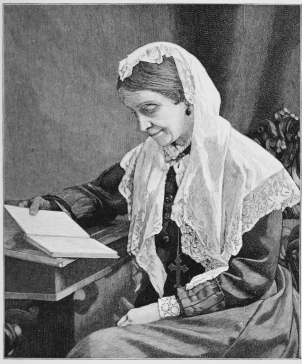
“Called on Mrs. Stewart. She said that the evening before she had asked Mr. Froude what she should reply to Mr. Tennyson if he asked her what she thought of his last wretched poems. ‘Oh, say, “Blessed sir, would I presume?”’ returned Mr. Froude.
“Two days ago I went to Lady Airlie’s, where a large party was collected to hear Mr. Browning read. I never heard any one, even a child of ten, read so atrociously. It was two of his own poems—‘Good News to Ghent’ and ‘Ivan Ivanowitch,’ the latter always most horrible and unsuitable for reading aloud, but in this case rendered utterly unintelligible by the melodramatic vocal contortions of the reader.”
“July 23.—By invitation of Mrs. Stephen Winkworth to see Lewis Campbell’s translation of the ‘Agamemnon’ acted. Mrs. Fleeming Jenkin took the parts of both Clytemnestra and Cassandra, and was very grand in both, especially the latter. She has an infinity of action, but it is all graceful and very Greek. The chorus loses much, because each of the old men is made to say his speech separately, whereas in the original Greek they evidently all talked together.”
“July 24, Milford.—I have ended a very happy season by leaving London immediately after the marriage of Evelyn Bromley Davenport with Tom Legh of Lyme. Here, at Mrs. Greville’s, I find Lady Archibald Campbell, a pale, beautiful young woman, strangely occupied with spiritualism, and Mr. Watts, one of the principal writers in the Athenæum, and the man who, living with Swinburne, has, by his personal influence, cured him of the habit of drinking.”
“July 25.—A hot Sunday afternoon, spent chiefly in sitting on the terrace, where great orange-trees are set in tubs as in a French garden, and in listening to the discursive conversation of Mr. Watts and Lady Archie about Swinburne and Rossetti.
“I am very sorry, now that it is too late, that, in my last visit here, when asked to choose which I would be taken to see, I did not say George Eliot instead of Tennyson. Mrs. Greville went to see her with an aching heart after Lewes’s death, and ‘found them all in the drawing-room playing battledore and shuttlecock, nothing changed but the man.’
“Mrs. Greville’s mother, sweet Mrs. Thellusson, was one of the claimants for the great Thellusson fortune—an unsuccessful claimant. She is lovely still in her old age. Mrs. Greville has a picture of a young man in a dress of the beginning of this century. She described his return lately from India. ‘He came to Milford, and paid me endless attentions and made me endless presents; I really thought he wished to marry me, until he proposed to—my mother!’”[349]
“Ammerdown Park, August 2.—I have been several days with Lady Waterford—always charming, always so full of holy teaching, that she recalls the closing lines of St. Patrick’s Hymn—
‘Christ in every eye that sees me, Christ in every ear that hears me.’
Yet this visit leaves nothing especially to remember except a story of Lord Waterford pursuing a robber who had broken into his house, finding him in a public-house some four miles off, and convicting him amongst a number of other men by insisting upon feeling all their hearts; the man whose heart was still beating quickly was the one who had just done running.
“On Saturday I came to Wells, the lovely old city of orchards and clear running brooks, whence Lord Hylton fetched me to Ammerdown. Sir Augustus Paget and all his family are here, the daughter a lovely, bright, natural girl,[350] and the sons, Victor and Ralph, most charming, kind-hearted, winning fellows. We have been to Mells—an overgrown park with pretty natural features, which was the favourite manor of the Abbot of Glastonbury. At the dissolution, Mr. Horner was sent to take up the parchments of the abbatial lands to Windsor, and for better security took them in a pasty. On the way he put in his thumb and pulled out for himself the title-deeds of Mells, the best plum of all, which has ever since remained in the family of ‘Little Jack Horner.’”
“Ryde, Oct. 10.—I have spent a quiet, peaceful summer: so little from the outer world seems to ruffle me now, and the storms of four terrible years have been succeeded by six years of calm. It has been a constant pleasure to visit the dear Mrs. Grove, now confined to the upper floor of her house. Charlotte Leycester has been long at Holmhurst, and other guests have come and gone, relics from my dearest Mother’s life, and waifs and strays from my own, by many of whom I am sadly overrated; the moral of which is, I suppose, that one should try really to clamber up to that high shelf on which one is placed in imagination. Of original work I have done little enough, except one article on ‘Lucca’ for Good Words.
“One of my chief occupations has been editing the life of the nun Amalie von Lassaux, translated from the German by Fräulein von Weling. As ‘Sister Augustine,’ her story possesses that interest which is always attached to a struggle in the cause of truth amid many persecutions and torments, rather mental than physical.
“I was away twice for a few days—first with young Mrs. Hamilton Seymour at Aylesford, a charming little old town on the sluggish Medway, with ‘The Friars’ close by, where pleasant Lady Aylesford lives in a beautiful old house, with oak staircase, gateway, water-gate, clipped yew-trees and terraces. Then I was two days at Hampton Court with witty old Lady Lyndhurst, and greatly delighted in the glories of the old palace and its gardens. And now I am with dear old George Liddell,[351] enjoying this otherwise dull watering-place through his genial hospitality.”
“Melchet, Hants, Oct. 23.—From Ryde I went to Amesbury to stay with Sir Edmund and Lady Antrobus, who are some of the kindest and most hospitable people in London, and have a fine house in Piccadilly. Their house in Wiltshire is very fine too, though it has never been finished. Gay’s Duchess of Queensberry lived there, and in the grounds are a cave and summer-house where the poet wrote verses to her. But the great interest of Amesbury lies in its being the scene of Guinevere’s penance, and it recalls Tennyson’s poem in the swirling mists which arise with morning and evening. Each morning we drew at Stonehenge amongst the hoary and mighty stones standing out against the ethereal lights and shadows of the plain.
“Next, I went to Rushmore, to which the Lane Fox’s have succeeded, with the name of Pitt Rivers and £36,000 a year, since the death of the 6th Lord Rivers. It is a dull country-house on Cranbourne Chase—swooping moors sprinkled with thorn-trees or thick woods of hazel. I was taken to see Shaftesbury; Cranbourne, the fine old house of the Salisburys; and Wardour, with noble cedars too closely overhanging the ruins of its castle. Lord Arundel lives in the Park at Wardour, in an immense house which he is too poor to keep in repair. He has another place somewhere near the sea, where his grandfather went to reside, to the great discomfiture of a gang of smugglers, who had previously had sole possession, and who tried to frighten him away by ghostly sights and sounds, but in vain. One night Lord Arundel was sitting in his room, having locked the door, when some one knocked. He demanded who was there, when a voice said, ‘Open and you will see:’ He opened it, and found a very rough-looking man with a keg of spirits under his arm. The man said, ‘Well, my Lord, we’ve done our best to frighten you, but you won’t be frightened, so I’ve, come to make a clean breast of it, and I’ve brought you a little offering. I only hope you won’t be hard on us.’ ‘Oh, dear no, I won’t be hard on you,’ said Lord Arundel; and Lady Marian Alford, to whom he told the story at Rome when she was four years old, vividly remembers his vigorous assertion, ‘And the smuggler gave me the very best Hollands I ever had in my life.’
“From Rushmore, after a visit to the old Shipley home at Twyford, I came here to Lady Ashburton. Melchet is a magnificent house in a beautiful country, and is filled with art-treasures of every kind. Lady Marian is here, always pleasant with her ripple of conversation and anecdote. She has been very amusing about her mother’s parrot, which used to hop about upon the lawn. One day it was carried off by an eagle. Old John Tooch, one of the dynasty of John Toochs who worked in the garden, was mowing the lawn, and as the parrot, in the eagle’s gripe, was sailing over his head, he heard a voice in the air call out, ‘We’re ridin’ noo, John Tooch, we’re ridin’ noo;’ at which strange sound the eagle was so dreadfully frightened that he let the parrot fall, so that John Tooch took it home to its cage again.”
“Melchet, Oct. 28.—Yesterday we went to Longford—Lord Radnor’s—a great castellated house in a dull park, with no view, but very fine pictures.
“In the morning the (Melchet) footman woke me with the news that the house had been broken into. The robbers had entered through the drawing-room window, perambulated the lower apartments, drunk up all the wine in the dining-room, and found all the valuables too big to carry off!”
“Oct. 29.—A charming visit to Broadlands, Lord Mount-Temple’s—the people so full of genial goodness, the house most comfortable and gardens lovely. Lady Mount-Temple—in whom, as Miss Tollemache, Ruskin saw such statuesque severity with womanly sweetness joined—a marvellous union of beauty, goodness, and intelligence. The grounds, with fountain, river, well-grouped trees, and a Palladian summer-house, are like a beautiful Claude-Lorraine picture. The same landscape—of a river, winding amongst cedar-shadowed lawns—forms the predella to Rossetti’s picture of ‘The Blessed Damozel.’”
“Holmhurst, Nov. 13.—Mr. and Mrs. Paterson have been here for the day. He told me two stories:—
“A lady was awoke in the night with the disagreeable sense of not being alone in the room, and soon felt a thud upon her bed. There was no doubt that some one was moving to and fro in the room, and that hands were constantly moving over her bed. She was so dreadfully frightened that at last she fainted. When she came to herself, it was broad daylight, and she found that the butler had walked in his sleep and had laid the table for fourteen upon her bed.
“A lunatic, who had escaped for some time from his asylum, was eventually captured. When he came in and saw the keeper who was accustomed to take care of him, he said, ‘Well, I’ve been very much occupied since I went away: I’ve been occupied in being married.’—‘Well, and whom have you married?’ said the keeper. ‘Oh, I’ve married the Devil’s daughter.’—‘Well, I hope it’s a happy union?’—‘Oh, very, thank you,’ said the lunatic; ‘only I don’t much like the old people.’”
“Holmhurst, Nov. 24.—Last week I was for two days at Cambridge as the guest of Jock Wallop, the best and kindest of hosts, under whose popular auspices I saw the present undergraduate life to perfection. There is a most charming set of fellows there now, all delighted to be young, and not aiming at juvenile senility, as was the fashion in my day at Oxford.”
“Dec. 16.—Several Midland county visits afford nothing to recollect. Certainly country-house visits are a lottery. One old lady said, ‘My dear, I am so glad to see you. It is so delightful to see any one at all pleasant. In London one can have any agreeable company one likes, but you know God Almighty fills one’s house in the country.’
“I have, however, been to George Curzon at Oxford. He is most delightful, and sure to become distinguished. At the meeting of the Conservative ‘Canning Club’ I heard a most capital paper on Ireland by young Edward Arnold. Afterwards I was three days at Sherborne, meeting, amongst other less interesting elements, the ever-charming Dowager Lady Craven. Lady Sherborne sang in a way which would move the heart of a basilisk. The country around Sherborne was the scene of innumerable battles in Saxon times, commemorated in the names of the fields and farms, which are supposed to owe their fertility to the carnage with which they had been covered. This supposition makes the peasants eager for the use of bone-dust, which they believe to be imported from the plains of Waterloo. If a field, after having been thus manured, still yields no crop, they say ‘Waterloo bean’t no use here!’”
I spent the Christmas of 1880 again with the kind Lowthers at Ampthill, meeting, as before, Louisa, Lady Ashburton, and going, as before, to spend a day at Woburn. In January 1881 I was at Bretton with the Beaumonts, meeting Julia, Lady Jersey, and a large party.
We went to see Nostell, a very grand but little known house of the Winns, full of splendid things, glorious tapestries, china, Chippendale furniture, but, most remarkable of all, a doll’s house of the last century, with miniature fairy furniture, exquisitely carved and painted, a doll trousseau with point lace, and a Liliputian service of plate.
We also went a long drive to Stainborough (Wentworth Castle), through a country which may be pretty in summer clearness, but which is hideously black in winter. The house is a great Italian palace, half Queen Anne, half older, with little temples in the grounds, the building of one of which is described by Evelyn. Inside there are fine tapestries, and many pictures of the Stuarts, ascribed to Vandyck, but probably copies. Lady Harriet Wentworth, who showed us everything herself, gave us the characteristic of her life when she said “I do so hate the thraldom of civilisation.” Her stately rooms have no charm for her, and, though they are so immense, she declares she cannot breathe in them, and she lives entirely and has all her meals in the conservatory, with a damp, warm, marshy climate, from which she does not scruple to emerge through the bitter winds of the Yorkshire wolds (for the conservatory does not join the house) with nothing extra on. From Bretton I went to Tortworth—Lord Ducie’s—in Gloucestershire.
Journal.
“Jan. 11, 1881.—There is a large party here (at Tortworth), but one forgets all its other elements in dear Mrs. Duncan Stewart. ‘L’esprit pétille sur son visage.’ Never was there a more marvellous coruscation of wit and wisdom; and she not merely evades ever saying an ill-natured thing of any one, but, where there is positively nothing of good to be said, has some apt line of old poetry or some proverb to bring forward urging mercy—‘Mercy, so much grander than justice.’
“Last night she wanted to introduce me to Mrs. Grey, an American lady who is staying here. ‘I cannot do it better,’ she said, ‘than in the words of Alfred d’Orsay when he brought up Landseer to me, saying, “Here, Mrs. Stewart, is Landseer, who can do everything better than he can paint,”—so here, Mrs. Grey, is Mr. Hare, who can do everything better than he can write.’
“To-day, at luncheon, Mrs. Stewart talked much of Paris, and of her intercourse with a French physician there. Dr. —— spoke to her of the happy despatch, and unhesitatingly allowed that when he saw a patient condemned to hopeless suffering, he practised it. ‘But of course you insist on the acquiescence both of the patients and of their families,’ said Mrs. Stewart. ‘Never,’ shouted Dr. ——. ‘I should be a mean sneak indeed if I waited for that.’
“She talked much of George Sand and of her journey to Italy, from which three books resulted, her’s, ‘Elle et Lui:’ his, ‘Lui et Elle,’ and ‘Lettres d’un Voyageur.’
“She said his was most horrible.
“Afterwards Lord —— was in a box at the opera in Paris with a number of other young men. There was a knock at the door, and George Sand came in. ‘Il y a place pour moi?’—‘Certainly,’ they said. By-and-by one of them inquired, ‘Et Musset?’—‘Oh, il voyage en Italie,’ she replied. Presently the door opened, and a man came in—haggard, dishevelled, worn to a degree. It was Musset. He shook hands with one and other of the young men. ‘Et pas un mot pour moi?’ said George Sand. ‘Non,’ he exclaimed. ‘Je vous haïs, je vous deteste! c’est que vous avez tué le bonheur de ma vie.’
“Mrs. Stewart talked of the great want of appreciation of Byron—of his wonderful satire, evinced by the lines in the ‘Age of Bronze’ on Marie Louise and Wellington: of his philosophy, for which she cited the lines on Don Quixote: of his marvellous condensation and combination, for which she repeated those on the burning of Moscow.
“She also talked of Trollope’s novels, and said how Trollope had told her of the circumstances which led to the death of Mrs. Proudie. He had gone up to write at the round table in the library at the Athenaeum, and spread his things all over it. It was early in the morning, and there is seldom any one there at that time. On this occasion, however, two country clergymen were sitting on either side of the fire reading one of his own books: after a time they began to talk about them. ‘It is a great pity Trollope does not get some fresh characters,’ said one. ‘Yes,’ said the other, ‘one gets so tired of meeting the same people again and again, especially of Mrs. Proudie.’ Then Trollope got up, and planting himself on the rug between them with his back to the fire, said, ‘Gentlemen, I do not think it would be honest to listen to you talking about my books any more, without telling you that I am the victim; but I will add that I quite agree with what you have been saying, and that I will give you my word of honour that Mrs. Proudie shall die in the very next book I write.’”
“Jan. 12.—Dr. Asa Grey, who is here, a Professor of Harvard University, is one of the most famous botanists living; but he is also a very charming person. Lowell describes how his
‘indefatigable hours Have been as gaily innocent And fragrant as his flowers.’[352]
“Mrs. Stewart talked of Madame Jerome Bonaparte, née Paterson—her beauty, her cleverness, her father to whom she always wrote of her succès de société, looking down upon him; but he could always avenge himself; he could always write to her, ‘My dear Betsy.’ ‘She would tell him how she had been received at this court and at that, and then would come his answer with “My dear Betsy.” Oh, it was a terrible revenge.’
“She talked of the society of her youth, when it was real society, for people were never in a hurry. ‘One of the marked figures then was Lady Cork,[353] who, after eighty, always dressed in white, with a little white pulled bonnet and a gold-headed stick. Another, whom you are none of you old enough to remember, was Lady Morgan, a little old lady, who used to rouge up to the eyes. M. Fonblanque—he was the editor of the Examiner—used to say, “She is just a spark of hell-fire, and is soon going back to her native element.”
“‘I wonder,’ said Mrs. Stewart, ‘what has become of an early picture which I remember of Leighton’s. A lady went to all the great artists in London to get them to paint a dream of hers, and they refused, and Leighton, who was quite a young man, undertook it. She dreamt that she had died, and that she had gone up—up to Christ, and that He had turned her back, and she said, “Why, Lord?” and He replied, “Because your work on earth is not yet done.”
“‘Leighton painted the Saviour in a glory of yellow light, and the woman being turned back by Him.’
“This reminiscence led to one of a different kind from Mr. Ashley Ponsonby.
“‘Creswick the actor was once at a dinner where Irving absorbed all the conversation and allowed no one else to speak. At last he could stand it no longer, and turning round to his next neighbour, said, “I had such an extraordinary dream last night.” Of course, the whole party were attention at once.’
“‘Yes,’ he said, ‘I dreamt that I was dead, and that I went up to the gates of heaven and knocked at them. ‘Who are you?’ said St. Peter. ‘I am Mr. Creswick.’—‘What, Creswick the Academician?’—‘No, Creswick the actor.’—‘Oh, then I can’t let you in here; we don’t admit any actors here,’ said St. Peter, and he turned me away. Dreadfully crestfallen, I went and sat down under a juniper-tree, and watched other people arriving at the gates. Many of my friends came and were let in. Then I took heart and went and knocked again, and when St. Peter said again that I must go away, for he could not admit any actors, I said, ‘But really that is not the case, for you have let in Mr. Irving.’—‘That is true,’ said St. Peter, ‘but—he was no actor.’”
“‘Take care,’ said Mrs. Stewart, ‘or you will become that most dreadful of all things, a self-observant valetudinarian. I was once in the house with a lady, who, after talking of nothing else for an hour, said, “I won’t speak of my own health, for, when I was young, a dear old wise and judicious woman said to me, ‘When anybody asks you how you are, always say you are very well, for nobody cares.’”
“‘Many people fall into sin,’ said Mrs. Stewart, ‘merely because they are tired of the monotony of innocence.’
“‘He was very fallible,’ she said, ‘and yet capable of becoming that greatest of all things—a good man.’
“‘I think it was a bishop who said, “Most people now go to seek their ancestors at the Jardin des Plantes; for my part, I am content with the Garden of Eden.”’
“‘Mr. Pigott is a finished critic, but with the innocence of a child picking daisies.’
“‘It was one of the cases in which the highest and the lowest motives combine, and oh! in life there are so many of those cases.’”
“January 12.—Mrs. Stewart has been talking of the cases in which a lie is justifiable. Of herself she said, ‘There was once a case in which I thought I ought to tell a lie, but I was not sure. I went to Dr. and Mrs. Bickersteth, and I asked them. They would only answer, “We cannot advise you to tell a lie;” they would not advise it, but they did not forbid it. So when a husband came to question me about his wife, I equivocated. I said, “She was certainly not seduced by that man.” He said to me very sternly and fiercely, “That is no answer; is my wife innocent? I will believe you if you say she is.” And I said, “She is.” I said it hesitatingly, for I knew it was false, and he knew it was false; he knew that I had lied to him, and he did not believe me in his heart; but he was glad to believe me outwardly, and he was grateful to me, and that husband and wife lived together till death. I believe that was one of the cases in which it is right to tell a lie. You will say that it might lead me to tell many others, but I don’t think it has. Stopford Brooke once said that strict merciless truth was the most selfish thing he knew.”
“Mrs. Stewart also told us—
“Dudley Smith, as a very young man, went out to China, and was employed in the opium trade. He then married and had several children. When he was thirty-three his conscience began to work, and he felt the abuses of opium. He left the trade and became a wharfinger, in which profession he made some money, though it was not nearly so lucrative as the occupation he had given up, in which he had made £12,000.
“When he was thirty-five, though he had then a wife and several children, Dudley Smith brought the £12,000 to his man of business, saying that it burnt a hole in his pocket, and desiring him to so invest it as to realise £500 a year for a mission to the Chinese, from whom it was taken. This story is delightful to me. It reminds me of a saying of old Mr. Planchet’s, which meant, though I cannot remember the exact words—
‘Of heroes and heroines I am sick grown; The only real ones are those that are unknown.’
We have been to luncheon at Berkeley Castle to-day. Lady Fitzhardinge, fat to a degree, is charming, and has the most wonderful knowledge of all the delicate finesses of form and colour, and the application of them to furniture. Her rooms are quite beautiful, everything composing the most harmonious picture, down to a string of blue beads suspended from a yellow vase. Lord Fitzhardinge came in to luncheon with Lord Worcester, Lord Guildford, and another man—four statues! Not one of them spoke a word, I believe because not one of them had a word to say, except about racehorses, about which we none of us could say anything. The castle relics are most interesting—Sir Francis Drake’s furniture, Queen Elizabeth’s plate, bequeathed to her cousin Lord Hunsdon, and the last prayer of Edward VI., written out by his sister herself, in the tiniest of little jewel-embossed volumes.”
“Jan. 15.—Mrs. Stewart has been talking much of her great delight in the works of Ampère, and of the intense devotion, the passionate love of the younger Ampère for Madame Recamier. She was guilty of a trahison to him, though. When he was at Weimar, he wrote to her a private letter, telling her particulars about all the people there, which he had better not have told, but he wrote them in strict confidence. She made that letter public. ‘My dear Mr. Hare,’ said Mrs. Stewart, ‘I have never read any letter more exquisitely, more tenderly pathetic than that which Ampère wrote her when he heard this—a letter struggling between his old respect and admiration and the feeling that his idol had fallen, that he could not but reproach her.
“When Lowell (the American poet and minister) was describing his wife’s terrible illness, he said, ‘My dear Mrs. Stewart, I would have given Job ten and won.’
“After Lady Fitzhardinge came, Mrs. Stewart talked much of her acquaintance with Brother Ignatius. She was at the place of her son-in-law, Mr. Rogerson, in Scotland. One day out walking, Mrs. Rogerson met a young man, of wonderful beauty, dressed as a monk, with bare feet and sandals. He asked her whether they were near any inn, and said, ‘The fact is, I have with me two sisters, Sister Gertrude and another, and a brother—Brother Augustine. And the brother is very ill, possibly ill to death, and we cannot go any farther.’ So Mrs. Rogerson made them come to her house, and showed them infinite kindness, ‘giving them at once water for their feet and all Scripture hospitality.’ Brother Augustine was very ill, very ill indeed, and they all remained at Mrs. Rogerson’s house three weeks, during which Mrs. Stewart became very intimate with them, especially with Brother Ignatius and Sister Gertrude. They used to go out for the day together, ‘and then, in some desolate strath, Brother Ignatius would sing, sing hymns like an archangel, and then he would kneel on the grass and pray.’
“Many years afterwards, Mrs. Stewart heard that Brother Ignatius was going to preach in London—‘some very bad part of London,’ and she went. The room was packed and crowded, but she was in the first row. He preached, a beautiful young monk, leaning against a pillar. ‘There were at least a hundred of his attitudes worth painting,’ but there was nothing in his words. At last a little girl thought he looked faint, and brought him a smelling-bottle, which she presented to him kneeling. ‘He smelled at it, and then seeing me, an old woman, near him, he sent it on to me, and I smelled at it too. Afterwards I stayed to see him, and we talked together in a small room, talked till midnight. Then he gave me his blessing, gave it me very solemnly, and afterwards I said, ‘And God bless you too, my dear young man.’
“In the evening Mrs. Stewart spoke much of the Sobieski Stuarts—their gallant appearance when young, and their change into ‘the mildew of age.’
“Apropos of the last words of St. Evremond, ‘Je vais savoir le grand peut-être,’ Mrs. Stewart mentioned Mrs. Grote having said to her at their last meeting, ‘I trust, dear, that you are living, as I am, in respectful hope.’
“This led to much talk of Mrs. Grote, who had died (Dec. 29, 1878) when I was away at Rome with the Prince Royal, and Mrs. Stewart described how, when she returned from Hanover after the fall of the royal family, and was quite full of events there, she went down at once to visit the Grotes in the country. ‘My dear,’ said Mrs. Grote, ‘I cannot enter into your feelings about all your princesses and duchesses, but as regards your king, I can enter into them fully: he has lived “as it is written.”’ Mrs. Stewart wrote this to the King, who knows Shakspeare to his finger-ends, and he said it did him more good than anything else anybody wrote or said to him. As long as he lived, he and Mrs. Grote exchanged stories and messages afterwards, through Mrs. Stewart.
“Lady William Russell said with much truth of Mr. and Mrs. Grote, ‘He is ladylike, and she is such a perfect gentleman.’
“When Lady Catherine Clive was painting her town-hall at Hereford, she was very anxious to find new, not conventional, attributes for some of her allegorical figures; she especially wished for something instead of the scales of ‘Justice.’ Mrs. Stewart wrote this to Mrs. Grote: ‘Tell your friend,’ she answered, ‘not to try to struggle against conventionalities. Tell her to be content with the scales: she will come to find the cross conventional next.’
“When Lady Eastlake undertook to write Mrs. Grote’s life after her death, she asked Mrs. Stewart for all her ‘jottings’ of Mrs. Grote’s conversations, but she made no use of them. She was so anxious that every one should find the book too short, that she really omitted almost everything characteristic. She wrote her regrets afterwards to Mrs. Stewart, who answered, ‘You are suffering, my dear, from a granted prayer,’—for, in fact, the book was so short and dry that it passed almost unnoticed.
“Mrs. Stewart spoke again of how far a lie might be made right by circumstances—giving a wrong direction to a man who was in pursuit of another to kill him, &c., and, when some one objected, dwelt upon its being far greater to be noble for others than holy for one’s self. Some one said that in this case all should follow the inner voice, which would tell them truly what their real duty was. She replied, ‘Yes, having formed your character by the Master without, you may then act in a crisis by the voice within, which will never be false to your life’s teachings.... But perhaps,’ she added, ‘I should say, like Dr. Johnson, “I have been speaking in crass ignorance, according to the failings of my fallible human nature”’ (and she repeated some lovely lines on Mary Magdalen, from Moore’s ‘Rhymes of the Road’);[354] ‘and yet, may we all, whilst acting like fallible human beings as we are, trust respectfully in God’s mercy,—though speaking of no glorious future as reserved for us, lest He should say, “What hast thou done to deserve that?”’
“The letters written to the Morning Post from Hanover during the last days of the monarchy, and signed H. S., were by Mrs. Stewart: those in the Times, bearing the same signature, were by another lady.
“After being for a time with Mrs. Stewart and hearing her talk, I feel how great the decay of conversation is since my childhood, when there were many people who knew how to converse, not merely to utter. Scarcely any one now ever says what they really think, and there is an unwholesome striving after aestheticism, Louis Quatorze, blue china, &c., which another age, if it remembers it, will think most ridiculous.”
“London, Jan. 24.—To Miss Bromley, who had been on Saturday to take leave of Carlyle, to whom she has been the most faithful of friends for many years. He has been sinking for some time, full of power, pathos, and patience. He woke out of what was supposed to be a death stupor to recognise her, and pressed her hand to his lips.”
“Feb. 26.—Went by appointment to see the Queen of Sweden, who is at Claridge’s Hotel for two nights. She was most kind and gracious, and said that she was glad to thank me in person for all that I had been to the Crown Prince. She talked of her illness and its anxieties; but there were many other people waiting for an audience, and there was no time for any real conversation.”
“March 1.—Met Lady Lyveden at dinner at General Higginson’s. She described Mrs. Grote saying one day, ‘I have to go out this morning, my dear; it’s not my usual time, and in fact it’s very inconvenient to me, but then you know, my dear, it’s an affliction job.’
“Mrs. Grote, to the last, was very proud of her appearance. Her hands and feet she was especially proud of. One day Lady Lyveden asked her to come in the evening to meet some pleasant people in her neighbouring house in Savile Row. She would not do it. ‘I shall not come, my dear,’ she said, ‘because I never go out; but besides that, I could not come, for, if I did, I should have to put my well-formed figure into one of your abominably low arm-chairs.’[355]
“There was a charm about her primitive household. There was not one of her servants who spoke of her otherwise than ‘the Missis.’
“After dinner, she would leave ‘the historian,’ as she called him, in his study, and come up to the drawing-room, where she would talk to her guests and be most entertaining. At nine o’clock, tea would be brought up—such a tea as one never sees now, with tablecloth, muffins, cakes, &c. Then she would say to the servant, ‘Bring up the historian’—and the historian was ‘brought up.’ He was vastly civil, of the old school, and wore a great deal of frill. He would take his place opposite the table, and immediately taking a large clean pocket-handkerchief from his pocket, spread it very deliberately over his knees, after which a dog jumped up and sat upon it. Then he would say, as to a perfect stranger, ‘And now, Mrs. Grote, will you kindly favour us with a sonata?’ and Mrs. Grote, who was an admirable musician, would play a very long sonata indeed; after which he would say, ‘Thank you, Mrs. Grote. I am sure Lady Lyveden joins with me in being very much obliged to you for your beautiful sonata.’[356]
“Lady Eastlake’s written portrait misses all the wit, all the acted comedy of Mrs. Grote’s real life. She made, however, a capital pencil sketch (which Lady Lyveden has) of Mrs. Grote, who was greatly pleased with it.”
“March 9.—Met Princess Mary at luncheon at Lady Harrington’s, who only presented me by ‘Here is Augustus.’ The Princess was good enough to talk to me for a long time afterwards.”
“March 22.—Dined at Lady Airlie’s, sitting by Lady Herbert of Lea, who talked much of her long residence in Sicily, with which she was connected through her mother. She went about a great deal amongst the poor at Palermo, generally accompanied by a Sister of Charity, and on one occasion nursed a sick brigand. Soon afterwards, her children, going to the Bay of Mondello to pick up shells, were seized by brigands, but as soon as they found whose children they were, they sent them back to her safe. Another day, Lady Herbert was returning from a village, whither she had been on some office of charity, to Palermo, as it was almost dark. There were high walls on either side of the way. Suddenly the Sister of Charity who was with her began to go so fast that she could not keep up with her. ‘Non posso, Sorella mia, non posso cammináre più,’ she said. ‘But look behind you,’ said the Sister. She looked, and saw three brigands following them. It would have been impossible to get away, so she waited till they came up and said, ‘Che vuole?’ They begged her to excuse them: they were sent by their chief to protect her as far as the walls of Palermo: they knew her, but others might not, and they were ordered to ascertain that she came to no harm.
“A Hungarian Count and Countess were at dinner. He talked of fashion very amusingly. He said he had learnt much from his herdsman, a very clever man (‘he was hung afterwards, poor man, but he was very clever’), who chose the animal to bear the bell, which was accustomed to go in the centre of the herd. He asked why this was, and the herdsman answered, ‘Because the one who goes first naturally runs first into all dangers, and when he has done it once or twice, the herd begin to find it out, and they cease to follow him; and the one who goes last is constantly left behind, and the herd begin to find it out, and they cease to follow him; but the one that is in the middle, and chooses the safest place, that is the one they know to be wise, and so, in any time of danger, they will assuredly follow him. The Count spoke of the mania for husband-murder which prevailed at Marseilles till it became quite a fashion. Six women were tried at the same assizes for murdering their husbands. In some of these cases there seemed something of reason or excuse, but at last there came a lady whose husband had been all that was most charming and delightful, and where the crime seemed incomprehensible. The judge pressed her as to her motive, and at first she said, ‘Ces dames me l’ont mis dans l’esprit,’ and, when urged further, ‘Mais, cela se fait à Marseilles!’
“The London world has been full of the ‘Reminiscences of Carlyle,’ published with furious haste by Froude a fortnight after his death. They have dwarfed their subject from a giant into a pigmy. His journal and letters speak well of no one except his own family, and assail with the utmost vituperation all who differed from him. For his wife there is a long wail of affection, which would be touching if the devotion had not begun after her death. ‘Never marry a genius,’ she said to Lady Ashburton; ‘I have done it, and suffered from it; but then, after my death I shall have an apotheosis’—and she has had it. Much of Carlyle’s virulence arose from the state of his health: he used to say, ‘I can wish the devil nothing worse than that he may have to digest with my stomach to all eternity; there will be no need of fire and brimstone then.’”