Volume 5 — XIX WHILST WRITING THE BUNSEN MEMOIRS
Reading edition
“Here we have no communion; company enough, but no fellowship. Meanwhile, the grand perennial Communion of Saints is ever open to us. Let us enter in and worthily comport ourselves there.”—Carlyle.
“Ce n’est ni le génie, ni la gloire, ni l’amour, qui mesurent l’élévation de l’âme; c’est la bonté.”—Père Lacordaire.
IT was soon after the death of my dear and honoured old friend, the Baroness Bunsen, that her daughters, Frances and Emilia, wrote to consult me about a Memoir of her beautiful and helpful life. I promised all the help I could give, but did not understand, till several months later, that they wished me to undertake the whole biography myself. This, however, I rejoiced to do, being assured that beyond her own children, no one had a warmer love and appreciation for the friend of my whole life, and delighting to be raised, whilst dwelling amongst her written words and thoughts, into the serene and lofty atmosphere of her inner life.
The work which I had undertaken began at this time to bring me into constant and intimate connection with all the branches of the Bunsen family, especially with Lady Llanover, the sister of my dear old friend.
“Llanover, March 18, 1877.—I left London on my birthday and went to the Harfords at Blaise Castle. It was bright but bitter March weather, and though the woods were full of flowers, there was no enjoyment of them. I had much talk with sweet Mrs. Harford about old days and the many passed-away things and people dear to us both. Sir George and Lady Grey were staying at Blaise, to my great pleasure.
“Yesterday I came here by the ferry over the Severn. Lady Llanover’s old ramshackle carriage met me at the Nantyderry Station, and brought me to Llanover. I had received endless solemn warnings about what I was to say and not to say here, what to do and not to do; but with a person of whom one is not likely to see much in after life, one never feels any alarm. Lady Llanover is very small and has been very pretty. We have a mutual bond in our love for her sister, whose memory is enshrined in her inmost heart with that of her mother, Mrs. Waddington, to whom she was quite passionately devoted. Of the Bunsen family she talked from 4 till 10.30 P.M. ‘You see I have still the full use of my lungs,’ she said.
“At eight we had tea. There is no dinner, which I like, but every one would not. After tea she gathered up all the lumps of sugar which remained and emptied them with a great clatter into a box, which she locked up. With £20,000 a year, the same economy pervades everything. Her great idea is Wales—that she lives in Wales (which many doubt), and that the people must be kept Welsh, and she has Welsh schools, Welsh services, a Welsh harper, always talks Welsh to her servants, and wears a Welsh costume at church.”
To Miss Wright.
“March 24, 1877.—I may tell you now, as it is no longer a secret, that I have acceded to the wish of all her family in undertaking to write the Life and edit the beautiful letters of my dear old friend the Baroness de Bunsen. How perfectly great and noble her character was, and the intense interest of all she wrote, few know better than myself, and, beyond her own family, no one loved her more; so, when my ‘London’ is done, I shall give myself gladly to this sacred task, and trust that it may be, as her writings cannot fail to be, a blessing to many.”
Journal.
“Holmhurst, April 6, 1877.—I look back on my visit to Llanover as quite a bit apart in my life. It was important that I should please, as much of the success of the memorials of her sister, which I have undertaken to edit, must depend upon Lady Llanover’s favourable co-operation. It was equally important that I should assert my own absolute independence of will and action, and knock under in nothing. So it was a difficult course to steer. The very warnings I had received were enough to annihilate self-confidence. I was not to believe anything Lady Llanover said about different members of her family, for she was always guided by her own prejudices and sympathies. I was not to be guided by her opinion on any subject, yet was never to contradict her. I was not to make to her any one of the promises she was sure to attempt to exact from me: above all, I was never to leave any letter or paper about in my room, as there were always ‘tame panthers stealing about the house,’ who would master the contents and make it known to their mistress.
“I began by disregarding all this advice, and taking Lady Llanover as if I had never heard a word about her, and I am sure that it was the best way. I listened to all she had to say, and received part of it to profit by. I left all my papers about, and if the mistress of the house learnt what was in them, I hope it was beneficial to her. I found her difficult to deal with certainly, but chiefly because, with endless power of talking and a vocabulary absolutely inexhaustible, it is next to impossible to keep her in the straight conversational path along which she ought to be travelling: she will linger to pick all the flowers that grow in the lanes diverging along the wayside. Thus, though on an average we talked for six hours a day, not more than one of those hours could be utilised.
“There is a great deal to admire in Lady Llanover: her pertinacity in what she thinks right, whether she is right or not: her insistence on carrying out her sovereign will in all things; but chiefly her touching devotion to the memory of the mother from whom she, the youngest and favourite daughter, was scarcely ever separated. The whitewashed ‘Upper House’ in the park is kept fresh and bright and aired, as if the long-lost mother were constantly expected. In her sitting-room a bright fire burns in winter, and fresh flowers are daily placed on the little table by her old-fashioned sofa. The plants she loved are tended and blooming in the little garden; the pictures and books are unremoved from the walls; the peacocks she used to feed, or their descendants, still spread their bright tails in the sun under her windows.
“It is in the kitchen of the ‘Upper House’ that Lady Llanover’s Welsh chaplain performs service on Sundays, for to the church she and her people will not go, as the clergyman is—undesirable. Lady Llanover on Sundays is even more Welsh than on week-days. She wears a regular man’s tall hat and short petticoats like her people, and very becoming the dress is to her, and very touching the earnestness of the whole congregation in their national costume, joining so fervently—like one person—in the services, especially in the singing, which is exquisitely beautiful. I suppose it may be only from the novelty, but this earnest service, these humble prayers on the worn benches in the brick-floored kitchen, with the incidents of manual labour in the background, and farmhouse scenes outside the windows, seemed more of a direct appeal to God than any formal prayers I ever heard in a church—the building called a church. I feel more and more that I shall probably end my days—a Dissenter!
“We had more of the Welsh music in the evening. We went and sat in the armchairs in the hall, and the household filed in above, and filled the music-gallery, and sang most gloriously, especially the burial-hymn ‘It is finished,’ which was sung in parts all the way from the house to the churchyard at the funerals of Mrs. Waddington and Lord Llanover and his son. At other times, the blind harper attached to the house came in and harped to us, and four little boys sat in a circle on the floor and sang.
“One afternoon we went to the churchyard overlooking the Usk. A great pine-tree, the seed of which was brought from Rome by Mrs. Waddington, overshadows the burial-place of the family, and, in accordance with a line in some poet she liked, her grave is covered with the simple camomile. By its side is the colossal altar-tomb of Lord Llanover. It is generally supposed to be merely commemorative, but Lady Llanover herself unlocked a door concealed beneath the carving, and we went in. There are three coffins—of Lord Llanover, his eldest son, and his grandson Stephàn, son of Mrs. Herbert of Llanarth, whom she, the Roman Catholic mother, insisted should be brought here, the priests accompanying the corpse to the churchyard gate, and there delivering it to the Welsh people, who sang their beautiful hymns over it. There was a fourth place in the tomb, which Lady Llanover, tearless in her desolation, showed me as hers, which she must soon occupy. The poor Welsh women were busy ‘dressing the graves’ in the churchyard—the graves are always dressed for Palm Sunday.
“At Llanover, in the weird house of dead associations, it was a relief when pleasant, handsome young Arthur Herbert came the last day. Almost the only other guest was Miss Geraldine Jewsbury, the intimate and faithful friend of Mrs. Carlyle. I found it difficult to trace in the ancient spinster the gifted brilliancy I had heard described, though of her strong will there was abundant evidence.[258] During an illness of Mrs. Carlyle there was a comic instance of this. Miss Jewsbury had unlimited faith in black currant jelly for a cold. Now Mrs. Carlyle’s throat was very bad, and Miss Jewsbury took some of her jelly to her. ‘But I will not take it; I will not take it, Geraldine,’ said Mrs. Carlyle, with her strong inflexion on the ‘ine.’ So Miss Jewsbury sat by the head of the bed and kept her black currant jelly well out of sight. But a moment came when Mrs. Carlyle fell fast asleep, and—if the truth must be told—opened her mouth very wide. It was Miss Jewsbury’s opportunity, and she filled a spoon full of jelly, and popped it into the open mouth. ‘Good God! Geraldine, what was that?’ exclaimed Mrs. Carlyle, waking up. ‘That was the black currant jelly.’—‘Good God, Geraldine! I thought it was a leech gone the wrong way.’
“Since I returned, I have greatly enjoyed a fortnight’s halt in life at home. When here, with charming rooms full of books and pictures, inexhaustible employment within and without, and the dear Lea, the one living relic of our past, I wonder how I can ever go away.”
“April 14.—The other day I dined at Lord Charlemont’s. Lady Charlemont[259] is astonishing. I sat near her at dinner. First she startled me by saying what a bore her neighbour on the other side was: it was Lord Campbell. Then she said, ‘I am so happy. I have found some one who breaks the first commandment.’—‘What! “Thou shalt have none other gods but me?”’—‘Yes, and the man who breaks it is Dr. Schliemann; he adds Jupiter and Venus and a lot of others, all on the same level.’
“Sir Julius Benedict was at dinner, a most amusing person. He described how he was at Mentmore, and sat up very late in the hall reading, the rest of the gentlemen having gone to the smoking-room, and Baron Rothschild having gone to bed. He was surprised after some time to see Baron Rothschild come down again and cross the entrance hall in conversation with a strange gentleman. Soon after, when Sir Julius had gone to his own room, a guest in the house knocked at the door and apologised for disturbing him, but begged to know if he knew Sir James Fergusson by sight. He said, ‘Yes, perfectly,’ and then he remembered who the stranger was whom he had seen crossing the hall with the Baron: it was Sir James Fergusson; he had not recognised him at the moment.
“The guest said, ‘You do not know what an awkward difficulty you have relieved us from; a gentleman has arrived who seems to think he is expected, and whom nobody knows, and he says he is Sir James Fergusson.’ And it was.
“Sir James had been called out from dinner by a servant from Mentmore, who said that there had been no time to write, but that he had been sent off to fetch him, for the Baroness was so alarmingly ill that there was not a moment to be lost. Sir James rushed off in a cab to Euston Square, and asked for a special train. It was Sunday, and there was none to be had without great delay; but the station-master, hearing the urgency of the case, and whom it was for, said that the express, just starting, should be allowed to stop at the station for Mentmore. On arriving there, Sir James was surprised to find no carriage, but procured a trap from the inn, and drove as hard as he could. As they reached the house, the servant got down and went round it, saying he was going in the other way.
“The servant was quite mad, and the insanity first showed itself in this odd form.
“Sir Julius also told us that—
“‘One day an American bishop called in his carriage at Hunt & Roskell’s. He asked to see some bracelets, mentioning that he was returning to America and wished to take a present to his wife. ‘Nothing very expensive,’ he said; ‘he could not afford that, but something about £70 or £80.’ Eventually he agreed to take a bracelet that cost £100. He said that he would pay for it with a £100 note which he had with him: it happened to be the only money he had at the moment, but he would wait while they sent it to the bank to ascertain that it was all right; he should really prefer doing this. They sent it to the bank and received answer that it was perfectly correct.
“‘Having paid for his bracelet, the bishop took it, and was just about to step into his carriage, when a policeman tapped him on the shoulder and said, ‘Hallo, Jim! you’re up to your old tricks again, are you? You’ll just come along with me,’ and he brought him back into the shop. Hunt & Roskell said there was some mistake, that the gentleman was an American bishop, that he had just bought a £100 bracelet and paid for it with an excellent £100 note. ‘Just let me look at the note, will you?’ said the policeman. He looked at it and said, ‘Yes, it’s just as I thought; this note is one of a particularly clever batch of forgeries, which are very difficult to detect, and the man is no more a bishop than you are. We will go off to the police-station at once. I will take the note and go on with the prisoner in the carriage, and you must send your men in a cab to meet us and bear witness.’ So the policeman took the bishop and the bracelet and the note, but when Hunt & Roskell’s men reached the police-station, they had not yet arrived; and they have never been heard of since!’”
“April 15.—Dined with Mrs. Rogerson, daughter of my dear Mrs. Duncan Stewart. Irving was there. I ventured to tell him how I thought his play was spoilt by the changes he had recently made, and why, and he was quite simple, as he always is, not the least offended, and in the end agreed with me, and said he should alter the changes as I suggested, and send me a box that I might come and see the improvement. He said how, ever since he heard me tell a story at Lord Ducie’s, he had wished I should do something in public. He ‘did not know if I wanted money, but thought I could make any sum I liked.’ He ‘believed he could guarantee’ my making £8000 a year! He advised my doing what he had intended doing himself when he had been ‘making a mere nothing of ten guineas a week, and felt that could not go on.’ He intended to have got Wilkie Collins to write him a story, and to take a room at the Egyptian Hall, fit it up in an old-fashioned way, sit down by the fire, and then take the audience, as it were, at once into his room and confidence. ‘But in your case,’ he said, ‘you need not apply to Wilkie Collins.’”
“April 16.—Miss Northcote’s wedding in Westminster Abbey. I had a capital place in a stall just behind Princess Louise and Princess Mary of Teck. The church was crowded, and though it was a bitter wind outside, it was quite glorious within, all the forest of arches tinted with golden sunlight. Arthur gave the blessing magnificently, as he always does. There were 350 people at the breakfast afterwards, which was at Lord Beaconsfield’s house in Downing Street. There were endless little tables. I sat at one with Lady Aberdare, Lady Middleton, and young Lord Colchester. I was glad to see the dear little Lady Winifred Herbert again, growing up fast, but with the same sweet innocent expression, walking about with Jim Cranbourne, who is a charming boy.”
“April 23.—Dined with Lady Charlemont. Old Mr. Planché was there, and talked much about the favourable characteristics of the present Duke of Wellington; how before his father died he said how grief for his death would be aggravated by perpetual consciousness of his own name and position. ‘Think what it will be when the Duke of Wellington is announced and only I come in!’ Poor Mr. Planché, celebrated as a wit and story-teller in former times, is becoming painfully aware of having outlived the patience of his auditors!
CHANTRY OF HENRY V. [260]

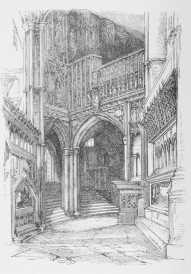
“Lady Charlemont said, ‘Whenever I make a very naughty quotation from ‘Don Juan,’ I always preface it by saying, ‘As Dr. Watts touchingly observes.’”
“April 26.—Dined at Mrs. Stratford Dugdale’s. Lord Crewe was there, with the most extraordinary and diabolic-looking red flower in his button-hole. He always has one of these weird orchids, and delights to surprise people with them.”
“April 28.—A pleasant morning with Mrs. Hollond, Sir Hampton Lorraine, and others at Grosvenor House. The rooms were quite lovely, and the flowers more so—great blue-green bowls filled with cowslips; great glasses of blue bells, with a few yellow jonquils intermixed.
“Luncheon afterwards at Mrs. Duncan Stewart’s. Mrs. Rogerson told the story of a cat she had known who would lie on the rug with its head on the side of a little dog called Flossy. People said, ‘How selfish the cat is; she only lies there because it is warm.’ But Flossy died and the cat was missing. It was found on Flossy’s grave, and lay there all night. It was brought in and milk was given to it, but it refused to eat, and as soon as it was left alone in the room where it was shut up, it dashed straight through the window and went back to the grave again. If they took hot milk out to it at the grave, it ate it, but away from the grave it would eat nothing. It lay there day and night. At last they built it a little pent-house over the grave, and it lay there, partially sheltered, till, six weeks afterwards, it died.
“Mrs. Rogerson knew another story of a terrier and a cat, who were deadly foes and always quarrelling. The cat had kittens, and the kittens were all put out of the way and were buried. The cat was inconsolable and went mewing about the house. The terrier could not make it out, and followed her everywhere; he did not snap at her any more; on the contrary, he seemed to do all he could to console her. At last he had an inspiration. He found out where the kittens were buried, and scratched and scratched till he got them up, and one by one he brought the dead kittens and laid them down before the cat. It was a very small consolation to poor pussy, but she and the terrier never quarrelled again, and were the greatest friends as long as they lived.”
“May 2.—A pleasant party at Lady Leslie’s beautiful house to meet the Tecks. She looked more amenable than ever, yet the Princess all over.”
“May 4.—Dined with Sir Dighton and Lady Probyn in the strange houses built like the Tower of Babel by Mr. Hankey. Went to a quaint collection of anybodies and nobodies at Lord Houghton’s afterwards. He spoke of the ‘unexpected places in which gold is found’ in literature.”
“May 6.—To Lady Salisbury, whom I found in her bright sunny boudoir looking on the Park. Lord Edmond Fitzmaurice and Mr. Ralli came in and talked politics furiously. Lady Maude told me of Lord Sligo’s visit to Paris immediately after the siege, and how he had driven about in the same cab for some days, and then found he had been sitting all the time on an explosive bomb which was under the seat. The cabman, when remonstrated with, as the slightest jolt might have made it explode, said he ‘had not left it at home, because he thought the children might get playing with it.’”
“May 11.—At dinner at Lady Jane Ellice’s I met Lady Waterford and Lady Folkestone.[261] The latter sang most beautifully and pathetically. She felt. ‘One cannot feel always,’ she said; ‘one cannot feel with an audience who say, “How sweet.” Lady Waterford told of Sir Philip and Lady Durham. Lady Durham died quite suddenly. She had been out in the garden the day before, seeing the gardener and ordering some bouquets she wanted. After her sudden death, Sir Philip found a paper in her dressing-box. It said—‘Something so very odd has happened to me, that I think I had better write it down. In the garden I saw a figure which beckoned to me and beckoned to me, and I followed it. I followed it a long way, and at last it reached the churchyard, and then it disappeared.’”
“May 12.—Dined at Mrs. Rogerson’s, where I took down the Countess Bremer, who has always lived at the Hanoverian Court. She is that ‘Margaret Bremer’ who is celebrated for her answer to the blind King, who loved to shock her by his improper stories. ‘What do you think of that, Margaret?’ he asked, after telling her one of his worst. ‘I think that your Majesty has a very clean way of telling a very dirty story,’ she replied.”
“May 15.—Dined at Sir John Shaw-Lefevre’s. Having two round tables made the party most pleasant. It included the beautiful and charming Lady Granville, Lady Russell, Lady Aberdeen, and Wallace of the Russian book.”
“May 17.—A party at Lord Houghton’s; every one there, from Princess Louise to Mrs. Anthony Trollope, a beautiful old lady with snow-white hair turned back. These crowded parties remind me of Madame de Staëls description—‘Une société aux coups de poing.’”
“May 26.—I have been for three days at Cobham, where the woods covered with bluebells were like expanses of Italian sky brought down and laid on the earth. There was a large party in the house—Lady Haddington and her bright Lady Ruth; Murray Finch Hatton and his wife, as delicate as a drooping lily; Meysey Clive, a charming natural fellow, and his Lady Catherine; Lord and Lady Pelham, &c. The life was most easy; we drew, read, talked, and showed the house to Lord and Lady Onslow, who arrived while touring in a four-in-hand.”
“May 30.—On Saturday I was at a pleasant party at Lord Houghton’s, meeting scarcely any one but authors, and a very odd collection—Black, Yates, and James the novelists; Sir Francis Doyle and Swinburne the poets; Mrs. Singleton the erotic poetess (Violet Fane), brilliant with diamonds; Mallock, who has suddenly become a lion from having written a clever squib called ‘The New Republic,’ and Mrs. Julia Ward Howe with her daughter. I was introduced to Mrs. Howe, having asked Lord Houghton who was the charming, simply-dressed woman with the sensible face, and then found she was sister of my Roman friend Mrs. Terry. She wrote the hymn, singing which the troops took Pittsburg. We asked her about it. She said she could not help feeling the little annoyance so many felt on similar occasions—that she should be only known as the authoress of one thing, one little waif out of all her work, and that people should treat her as if she had only written that.”
“June 3.—I have dined several times with Miss Wright to meet the Charles Wilbrahams. She sings beautifully. He had much that was curious to tell about the project of a French engineer for deepening the course of the brook Kishon, so as to let in the Mediterranean. Kishon rises near Tabor, and if the Mediterranean could once pass the watershed, it would run down on the other side into the great hollow of the Dead Sea, which is now so far below its own level. The engineer, of course, had never thought of Ezekiel xlvii., in which the fishermen of Engedi, now some 3000 feet above the level of the sea, are described as casting in their nets.
“Mr. Wilbraham was amusing with some of his American experiences. He told of two young girls who were stopped going through a turnpike gate. ‘What are your charges?’—‘Half a dollar for man and horse.’—‘Well, then, just stand on one side, will you, for we are two girls and a mare, so we’ve nothing to pay.’ He said he had asked an American at Florence what he thought of the Venus de Medicis. ‘Wal, I guess I’m not so partiklar overpowered by stone gals,’ was the reply.
“I constantly meet Froude the historian at Miss Wright’s, a somewhat shy, sardonic, and silent man. His sphinx-like character, the very doubt about him, makes him interesting: one never really knows what he would be at.”[262]
“June 4.—Dined at Lord Egerton of Tatton’s. Old Mrs. Mildmay told a rather improper story there, which was received with shouts of merriment. She was at a country-house where there was a very pleasant man named Jones, and there was also a lady who had a maid called Jones: the people in the house knew this, because there was a confusion about letters. The lady’s husband went away for the day, and, as she was going to walk to the station in the evening to meet him, the mistress of the house asked Mr. Jones to walk with her. When the train came in, the husband was not there, but just then a telegram was brought in. ‘Oh,’ said the lady, ‘Oh-o-o, I’m sure my husband is dead: I can’t open it.’—‘Nonsense!’ said Mr. Jones; ‘if he is dead, he cannot have sent you a telegram.’—‘Well, I can’t open it; I know it’s something dreadful—I can’t, I can’t, I can’t.’ So at last, Mr. Jones opened it for her and read it aloud, not seeing at once what it contained. It was—‘I am all right, unavoidably detained. If you are at all nervous, get Jones to sleep with you!’”
“June 6.—Lady Manners and her daughters drove me down to Osterley. The great wide park looked dark and dull under a leaden sky, the house gloomy and ghostly as Bleak House. The old Duchess, stumping about with her inlaid ebony stick, seemed part of the place. I dined at Sir Edward Blackett’s, a beautiful house with Raffaellesque and pink tapestry decorations, prepared for the Duke of Gloucester on his marriage with the Waldegrave, but never lived in by him.”
“June 7.—Dined with George Lefevre. Mr. Bright was there, said to be the man who reviewed me so unmercifully in the Athenæum, and I was very glad to see the kind of man he is. He talked incessantly, never allowing a word to any one else; still after a time one found out he was interesting. He talked most of Miss Martineau, then of Hawthorne with great praise—‘the kindest, most generous of men and friends.’ Of his son, Julian Hawthorne, he said that he had ‘written a book which it took very long to read.’”
“June 13.—An excursion with the Lefevres to the Rye House, which I knew so well in my boyhood. It was like spending an afternoon in Holland, so very Dutch are those long expanses of rich meadow-lands, those streams with their boats and tall water-plants. We sat in burning sunshine to draw the old terra-cotta tower, and then had tea and eggs and bacon in the garden of the little inn, which was covered with scarlet geranium in full flower up to the attic windows.”
“June 19.—The news of poor old Cousin Susan’s[263] death. It is the glueing down of another much-read page of life, which can never be seen again. I feel ashamed of not grieving more for one whom I have known so well, but have always more feared than loved. The agent wrote desiring me to come down at once, but, backed by Lady Barrington’s decision that I had better keep out of the way till the will was decided, I excused myself. Yet I am sorry not to be at the funeral, and the old house of many associations, and the little Beltingham chapel with its view over the gleaming Tyne, are very constantly in my mind. All the cousins are quite sure that I am the heir, but I do not think that it is so. Cousin Susan knew that I did not wish it, and I have always urged the claims of the Strathmore boys.”
“June 20.—I have received from Milligan the news of Cousin Susan’s will. It is exactly the will I begged her to make—all to Mr. Bowes for life, then to the Strathmores. These pleasant boys deserve their good fortunes. I would only rather she had selected one of them to have more definitely preserved her memory.”
“June 28.—After a party at Lowther Lodge, I went to Lady Marian Alford, whom I found with a very ancient aunt, Lady Elizabeth Dickens. Lady Marian showed me her drawings. There was one glorious sketch of a Roman model, yet most unlike a model. ‘She is,’ said Lady Marian, ‘the model who is so hated by the other models because of her stateliness. “She walks down the Corso as if it belonged to her,” they say. She had two beautiful children—a boy and a girl. Last time I went to Rome, I saw her alone. “Where is your boy?” I asked.—“Oh, dead,” she answered.—“And the girl?”—“Oh, dead, dead too,” she replied, pressing her hands to her forehead. And I pitied her, and I asked her about it, and she said, “I will tell you how it was.” And she told me how she was coming downstairs with her boy in her arms and the girl behind her, and that just as she reached the house-door, a church-bell began to toll. “E un giustiziáto!” said one of the neighbours. And then, she could not tell how, it was somehow borne in upon her that her boy—her son—might, if he grew up, also some day fall into sin, also some day, perhaps, even be giustiziáto; and she turned round to the Madonna on the wall, and prayed that, if it were to be so, if such agony were possible for her, that she would take her son then, that she would take him away then, from the evil to come. And her husband, who heard her, said angrily, “Che sono queste stragonfiáte;” and he beat her; but the Madonna had heard her, and that night her boy was taken ill, and in twenty-four hours he was dead.
“‘And then she said, “That night I went again to the Madonna, and I said, ‘You have taken my boy, and, oh! if I may ever have arrossire for my girl, take the girl also, take her away in her innocence;’ e la Madonna mi ha fatto anche questa caritá, and I, I am alone, but my children are safe.”’
“July 1.—To Holland House, most lovely in all the freshness of new-mown hay, and the old elm avenue dewy from a shower. It was a delight to see Mrs. Augustus Craven, altered from the lovely ‘Pauline de la Ferronays,’ but still beautiful, and I had the happiness of finding that she liked to talk to me about her loved and lost ones.
“A very interesting dinner at Miss Davenport Bromley’s. Signor Francheschi described his life in Corsica, especially the weird women, who come like the Fates, as hired mourners, to bewail the dead, yet throw themselves so completely into their profession that they become quite absorbed in grief, and torrents of tears flow down their cheeks.
“One night he had to travel. In a desolate road he saw two strange ghastly horsemen approaching, with men walking on either side of their horses and holding them. The moonlight glared upon their fixed and horrid countenances. As they came near he heard the footmen talking to them. ‘We must hasten; they are waiting for you; they are even now lamenting you.’ Then he saw that the riders were dead. They were murdered men found by the highway, and had been set on horseback to be brought home. In Corsica it is the custom never to cease speaking to the dead.”
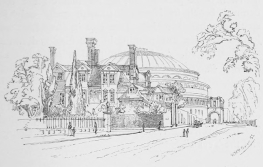
“July 7.—A capital party at Lowther Lodge to meet Princess Louise and Lord Lorne. The garden was illuminated with magnesium light, and looked both beautiful and—boundless!”
LOWTHER LODGE. [264]
“July 15.—Luncheon at Lady Combermere’s, where Lord Houghton described his experience of executions. He had been to numbers of those in Newgate. Up to the time of George III. the sign-manual was necessary for every execution, and it was an odd thing that George III., usually a humane man, used to hang every one. He would sit at the council-board and ask each of the ministers in turn whether a man was to suffer death. They would bow their heads in assent. Lord Melbourne was especially ready to do this when he was sitting at the council-board. One day, however, there was a case of a man who had murdered his wife under most brutal circumstances. The evidence was quite incontrovertible, and all were surprised that Lord Melbourne, usually so ready, shrugged his shoulders and seemed to have the greatest difficulty in making up his mind to give an assent to the death-warrant. One of the ministers, in going out, asked why it was. ‘Why, poor man, those women are so damned provoking,’ said Lord Melbourne.
“Mr. Browning said he recollected seeing as many as twenty-one persons sitting together on the condemned bench in Newgate Chapel, many only for stealing a handkerchief. One day in chapel he was jostled by some one pushing in past him, and turned round annoyed. ‘I beg your pardon, sir, but I am going to suffer,’ said the man.”
“July 12.—Monday was a most beautiful day for the party at Chiswick, for its beautiful Italian gardens with glorious cedars. All London was there, including the Prince of Wales, with his little boy George, and the Tecks.”
“July 29.—Since I wrote last the curious episode of Mrs. L. has occurred.
“On the 14th I left my lodgings in the afternoon to go to the Athenæum, when a tremendous cataract of rain came on, in which I took refuge in the covered entry of Pall Mall Place. A number of other people took refuge there also. Amongst them, I was attracted by the agonised face of a woman crouching in a corner—a lady, for so she seemed by her face, and in a certain degree by her dress; for though her gown looked as if it had been dragged through every Slough of Despond in Europe, the rest of her dress seemed to belong to the better class. As for her expression, I cannot forget it, it was of such agonised, hopeless, bewildered despair. I suppose I looked pityingly at her, for she turned to me, and in sharp wolfish accents said, ‘I am not a beggar, I am not, I am only starving to death, I am starving to death!’ I think I begged her to tell me what had brought her to such a pass; at any rate she told me—‘I am Mrs. L.’ To many this would not convey anything, but, from having always been occupied with architecture, it conveyed something to me, and I said, ‘What! the widow of L., the architect?’—‘Yes,’ she said, and she described in the same sharp, broken, gasping accents how she had been with her husband in Paris at the time of the siege, and how he had wished to get her away and had arranged for her escape to England, and how at the moment that he was parting with her and putting a purse into her hand to pay the expenses of her journey, a shell burst near them, and her jaw was blown off. ‘When I came to myself in the hospital,’ she said, ‘I found that the shell which had blown off my jaw, had blown my husband to pieces.’ She then described how she came to England, and how the Soane Museum, which takes care of the widows of architects, had given her a pension of £75 a year. ‘You wonder,’ she continued, ‘that, having this pension, I should have reached the condition I am in, but the fact is I have been a very wicked woman. When our pension is granted, we take a vow never to lend money, which is absolutely forbidden by the rules of the Museum; but a friend of mine was in great want, and I trusted her and became security for her, and she has absconded, and they have come upon me for the debt, and yesterday morning early all my things were seized, and I could not apply to the Museum, because then they would take away my pension, and I was turned adrift in the streets with nothing at all in the world.’ And then the poor woman corrected herself and said, ‘I have told a lie. I have not quite nothing in the world. I have a silk gown. I had that on when I was turned out, but I knew it would be worse for me to spend a night homeless in the streets in a silk gown, and I went to a servant I knew, and got her to take care of it for me, and to lend me the worst gown she had.’
“‘Since yesterday morning,’ she said, ‘I have tasted nothing whatever. You wonder I have not fainted. I have not done that because I am so dreadfully ill; I am in a burning fever. Yesterday I walked up to Hampstead, because there was a governess I knew there, and I thought she would help me; but when I arrived, I found her gone to Scotland with her family, and I walked all about Hampstead and Highgate, and the police insulted me, they did not protect me, they insulted me worst of all; and all through the day I have walked in the streets.’ I asked her, ‘Have you no friend in the world?’—‘Yes,’ she said, ‘I have one person who is a friend; at least there is one person who I think would help me if I could get to her, because my mother was once very kind to her, and that is Mrs. H. of the Mansfield Park School at Uxbridge, and to her, if I could have even a cup of coffee to strengthen me, I should set out and walk.’
“I got her to go and have some tea, which, as I foresaw, made her violently sick; and then, when she was a little better, I sent her by the train to Uxbridge. Immediately returning to the Athenæum, I wrote a lady who lives close to Uxbridge, briefly telling her the story, that Mrs. L. would probably arrive very ill, perhaps almost dying, and begging her to go at once to Mansfield Park and look after her.
“This was on Saturday. On Sunday there is no postal delivery. On Monday morning I received two letters. One was from Mrs. H., overwhelmingly grateful for what I had been able to do for Mrs. L., saying that she had received benefits from her mother which nothing could ever repay, and that she had been only too thankful to receive and care for the daughter. The other letter was from the lady to whom I had written, saying that there was no such place as Mansfield Park, that there was no such person as Mrs. L., and enclosing letters from the police and post-office at Uxbridge certifying this. I explained this in my own mind by remembering that, while telling me her story under the entry, Mrs. L. had said, ‘There is a little affectation about the name of Mansfield Park; it misleads people, for after all it is only a farmhouse.’
“On Monday evening the servant at my lodgings said that Mrs. L. herself had called: I was gone out to dinner. The next morning before I was up she came again, and waited till I was dressed.
“She was then quite calm and happy. She told how, when she got to Uxbridge, after being dreadfully ill in the train, her heart failed her—‘perhaps after all Mrs. H. would not receive her.’ However, she described with tears the touching kindness of Mrs. H.—that she had washed her, dressed her, put her in her own bed, tended her, and finally given her a cheque for £20, which she showed me. Her brother also, a travelling wine merchant in France, whom she had not seen for years, and to whom she had written without a hope of finding him, had also telegraphed that he was on his way to her assistance.
“She was overwhelmingly grateful to me.
“Then I asked her of her past. She said she had been the daughter of a planter in Havannah, but her fine voice induced her, against the will of her family, early to take to a public life. At the Exhibition of 1851 she (as Mademoiselle Mori) sang the anthem of which Jenny Lind sang one verse. She afterwards became a sculptress, and studied under Gibson at Rome (and she described his peculiar studio accurately). She was his only female pupil, and had the charge of his studio. He taught her his mode of colouring marble, and in her statue of ‘Waiting for the Spring,’ she used it in colouring the primroses and violets in a girl’s lap. The Queen bought this statue in the Exhibition building of 1862 before the Exhibition opened. Then she married Mr. L. and went to Paris.
“‘While I was in Paris,’ she said, ‘a very curious thing happened to me. I gave birth to three boys at once. When such an event occurs in France, the sovereigns are always god-parents, and the Emperor and Empress were pleased to have the christening of my three boys in Notre Dame, where they stood sponsors at the font.’—‘And are the boys all dead?’ I said. ‘Oh, dear no, they are all alive.’—‘Then where in the world are they?’ I said. ‘Oh, they live with the Empress: she would not part with them, and my three boys are her little pages. Now they are gone with her into Spain to see her mother.’
“She then described how the Empress often sent her money to go down to Chislehurst to see her boys, and how the Prince Imperial often called to see her, and called her ‘Grannie’ because of the boys, or left her a £10 note. ‘I should have gone at once to the Empress had she been in England,’ said Mrs. L., ‘but I would have died rather than have begged from any one: I would have died on a doorstep.’—‘Then what made you confide in me?’ I asked. ‘Oh, surely you must see that,’ she replied. ‘Of course you must see that. It was the likeness. Of course people must have told you of the great, the wonderful likeness before. I was quite prepared for death, I had made up my mind to die, and then God in His great mercy sent the likeness of my Emperor to me; and I knew then that God did not mean me to die yet.’
“She wants to paint a picture in memory of what she calls my ‘saving her.’[265]
“On the 18th, I had an interesting visit to Apsley House, for which the Duke had sent me the following order:—‘Admit Mr. Hare to see Apsley House on any day on which the street outside is dry.’ The street was quite dry, and, moreover, I went in a cab and arrived perfectly spick and span; but the servant laughed as he produced a pair of huge list slippers to go on over my boots, before I was allowed to go into any of the rooms. ‘His Grace left these himself, and desired you should wear them when you came.’ Yet the floors of Apsley House are not even polished.
“On the 19th I went to Lady Ducie’s, to see the Macdonald family act the Pilgrim’s Progress. They go through the whole of the second part, George Macdonald,[266] his wife, his twelve children, and two adopted children. Christiana (the eldest daughter) was the only one who acted well. Nevertheless, the whole effect was touching, and the audience cried most sympathetically as Christiana embraced her children to go over the great river.
“On the 21st there was a delightful party at Holland House to meet the Prince of Wales, and on Wednesday I was thankful to come home.
“Never has little Holmhurst been pleasanter than this year, and I have so enjoyed being alone, the repose of the intense quietude, the radiance of the flowers, the delicious sea-breezes through windows open to the ground, the tame doves flitting and cooing in the branches of the tall lime-tree.”
To Miss Wright.
“August 6, 1877.—I came home on Wednesday week, and have been alone ever since, and over head and ears in work. I have seen nobody except last Tuesday, when, though I thought no one knew I was at home, fourteen afternooners appeared. Miss Hamilton, who has taken a fancy to do my portrait, has done it very cleverly against a window, with ivy hanging down outside, only it is a sentimental suggestion of
‘He sat at the window all day long And watched the falling leaves.’”
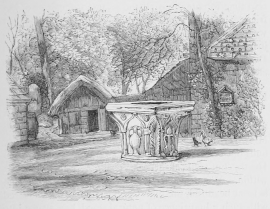
HOLMHURST, THE POULTRY-YARD.
“August 19.—I have had a pleasant visit of three days to Cobham, and felt much inclined to accede to Lord and Lady Darnley’s wish at the end, that I would consider my visit just begun, and stay another three days. It is indeed a glorious old place externally, and the gardens and immense variety of walks under grand old trees, are enchanting in hot weather. I had many happy ‘sittings out’ and talks with Lady Darnley, and could not sufficiently admire, though I always observe it, how her perfectly serene nature enables her to carry out endless people-seeing, boundless literary pursuit, and inexhaustible good works, without ever fussing herself or any one else, leaving also time to enter into all the minute difficulties of her friends in the varied gyrations of their lives.... I was taken to see Cowling Castle, a romantic old place; just on the edge of those marshes of the Thames which Dickens describes so vividly. We also saw his house, close to Dover road.”
Journal.
“Walton Heath, Oct. 6.—After a delightful visit from Harry Lee at Holmhurst, I have come here to Miss Davenport Bromley at a quaint cottage, partly built out of a church, in a corner of the vast Walton Heath, but full of artistic comfort and brightness within. We drove on Thursday to Box Hill, which is most beautiful, the high steep chalky ground covered with such a luxuriance of natural wood, box grown into trees and the billows of pink and blue distance so wonderfully luxuriant and wooded. The time of year is quite beautiful, and all the last festival of nature in the clematis wreaths and the bryony with its red berries dancing from tree to tree.
“We have been to see a quaint old house of the Heathcotes. There is a great stone hall with a high gallery, from which a young lady threw herself in her rage at her lover marrying some one else, and was killed on the spot. Her picture hangs on the staircase wall, and her ghost walks on the stairs, pretty, in white, something like a shepherdess. A housemaid cut a great cross in the picture, ‘to let the ghost out,’ as the old woman who showed the house said, and the hole has never been mended. This country is full of little traditions. There is a green lane close by, down which a headless lady walks, and a phantom coach drives along the road: a countryman who met old M. de Berg on the common declared that he had seen it—that it had driven over him.
“Yesterday we went to Gatton (Lord Monson’s), which formerly belonged to Sir Mark Wood. It is a curious place: the ugly church fitted inside with beautiful Flemish carving and glass, and the house having a hall of coloured marbles, copied from the Corsini Chapel at Rome—minus the upper story.
“I have much enjoyed learning to know Miss Bromley better. She is the kindest of women, wonderfully clever and full of insight into every minutest beauty of nature. Her devotion to animals, especially pugs, is a passion. Another pleasure has been finding Mrs. Henry de Bunsen here. She told me—
“‘There was, and there is still, living in Cadogan Place, a lady of middle age, who is clever, charming, amiable, even handsome, but who has the misfortune of having—a wooden leg. Daily, for many years, she was accustomed to amble every morning on her wooden leg down Cadogan Place, and to take the air in the Park. It was her principal enjoyment.
“‘One day she discovered that in these walks she was constantly followed by a gentleman. When she turned, he turned: where she went, he went: it was most disagreeable. She determined to put an end to it by staying at home, and for some days she did not go out at all. But she missed her walks in the Park very much, and after a time she thought her follower must have forgotten all about her, and she went out as before. The same gentleman was waiting, he followed her, and at length suddenly came up to her in the Park and presented her with a letter. He said that, as a stranger, he must apologise for speaking to her, but that he must implore her to take the letter, and read it when she got home: it was of great importance. She took the letter, and when she got home she read it, and found that it contained a violent declaration of love and a proposal of marriage. She was perfectly furious. She desired her lawyer to enclose the letter to the writer, and say that she could not find words to describe her sense of his ungentlemanly conduct, especially cruel to one afflicted as she was with a wooden leg.
“‘Several years elapsed, and the lady was paying a visit to some friends in the country, when the conversation frequently turned upon a friend of the house who was described as one of the most charming, generous, and beneficent of mankind. So delightful was the description, that the lady was quite anxious to see the original, and was enchanted when she heard that he was likely to come to the house. But when he arrived, she recognised with consternation her admirer of the Park. He did not, however, recur to their former meeting, and after a time, when she knew him well, she grew to esteem him exceedingly, and at last, when he renewed his proposal after an intimate acquaintance, she accepted him and married him.
“‘He took her to his country-house, and for six weeks they were entirely, uncloudedly happy. Then there came a day upon which he announced that he was obliged to go up to London on business. His wife could not go with him because the house in Cadogan Place was dismantled for the summer. “I should regret this more,” he said, “but that where two lives are so completely, so entirely united as ours are, there ought to be the most absolute confidence on either side. Therefore, while I am away, I shall leave you my keys. Open my desk, read all my letters and journals, make yourself mistress of my whole life. Above all,” he said, “there is one cupboard in my dressing-room which contains certain memorials of my past peculiarly sacred to me, which I should like you to make yourself acquainted with.” The wife heard with concern of her husband’s intended absence, but she was considerably buoyed up under the idea of the three days in which they were to be separated by the thought of the very interesting time she would have. She saw her husband off from the door, and as soon as she heard the wheels of his carriage die away in the distance, she clattered away as fast as she could upon her wooden leg to the dressing-room, and in a minute she was down on all fours before the cupboard he had described.
“‘She unlocked the cupboard. It contained two shelves. On each shelf was a long narrow parcel sewn up in canvas. She felt a tremor of horror as she looked at them, she did not know why. She lifted down the first parcel, and it had a label on the outside. She trembled so she could scarcely read it. It was inscribed—“In memory of my dear wife Elizabeth Anne, who died on the 24th of August 1864.” With quivering fingers she sought for a pair of scissors and ripped open the canvas, and it contained—a wooden leg!
“‘With indescribable horror she lifted down the other parcel, of the same form and size. It also bore a label—“In memory of my dearest wife Wilhelmine, who died on the 6th of March 1869,” and she opened it, and it contained—another wooden leg!
“‘Instantly she rose from her knees. “It is evident,” she said, “that I am married to a Blue Beard—a monster who collects wooden legs. This is not the time for sentiment, this is the time for action,” and she swept her jewels and some miniatures that she had into a handbag and she clattered away on her own wooden leg by the back shrubberies to the highroad—and there she saw the butcher’s cart passing, and she hailed it, and was driven by the butcher to the nearest station, where she just caught the next train to London, intending to make good her escape that night to France and to leave no trace behind her.
“‘But she had not consulted Bradshaw, and she found she had some hours to wait in London before the tidal train started. Then she could not resist employing them in going to reproach the people at whose house she had met her husband, and she told them what she had found. To her amazement they were not the least surprised. “Yes,” they said, “yes, we thought he ought to have told you: we do not wonder you were astonished. Yes, indeed, we knew dear Elizabeth Anne very well; she was indeed a most delightful person, the most perfect of women and of wives, and when she was taken away, the whole light seemed blotted out of Arthur’s life, the change was so very terrible. We thought he would never rally his spirits again; but then, after two years, he met dearest Wilhelmine, to whom he was first attracted by her having the same affliction which was characteristic of her predecessor. And Wilhelmine was perhaps even a more charming person than Elizabeth Anne, and made her husband’s life uncloudedly happy. But she too was, alas! early snatched away, and then it was as if the whole world was cut from under Arthur’s feet, until at last he met you, with the same peculiarity which was endeared to him by two lost and loved ones, and we believe that with you he has been even more entirely, more uncloudedly happy than he was either with Wilhelmine or Elizabeth Anne.
“‘And the wife was so charmed by what she heard, that it gave quite a new aspect to affairs. She went home by the next train. She was there when her husband returned; and ever since they have lived perfectly happily between his house in the country and hers in Cadogan Place.’
“Mrs. De Bunsen said that a cousin of hers was repeating this story when dining at the Balfours’. Suddenly he saw that his host and hostess were both telegraphing frantic signals to him, and by a great effort he turned it off. The lady of the wooden leg and her husband were both amongst the guests.”
“Milford Cottage, Oct. 8.—I came here with Miss Bromley on Saturday to visit Mrs. Greville and her most engaging mother, Mrs. Thellusson. It is a red house, standing almost in the village street, but with a French-looking garden behind, with clipped hedges and orange trees in tubs. It was left to Mrs. Greville by her husband, an old gentleman whom she married when the Thellussons were ruined, and he said, ‘You had better marry me; there is nothing else that I can do for you.’ He always treated her with the greatest generosity and kindness, but died very suddenly, intending to leave his wife very rich. There was, however, some mistake about the will, and she only inherited this cottage and just enough to live upon. I found at Milford, Lady Elizabeth Bryan, a Paget, who goes out visiting with four dogs, one of whom, Constance Kent, is most beautiful, and she has adopted a little cousin and presented her with six-and-thirty dolls. I went to see the adopted daughter in bed; two little dogs were cuddled in her bosom, and seven dolls lay at her feet with their heads out. Lately, the little girl has displayed signs of vanity, paraded her small person before a mirror, and exulted in fine clothes, and on these occasions she is always dressed in ‘Sukey,’ a little workhouse girl’s gown, to remind her that ‘in the sight of God she is no better.’
“This afternoon I have been with Mrs. Greville to Mr. Tennyson at Haselmere. It is a wild, high, brown heath, with ragged edges of birch, and an almost limitless view of blue Sussex distances. Jammed into a hollow is the house, a gothic house, built by Mr. Knowles, the editor of the Nineteenth Century—‘that young bricklayer fellow that Alfred is so fond of,’ as Mr. Carlyle calls him. Though the place is a bleak, wind-stricken height, where the flowers in the garden can never sit still, the house is pleasant inside and well and simply furnished, but is without any library whatever. Tennyson is older looking than I expected, so that his unkempt appearance signifies less. He has an abrupt, bearish manner, and seems thoroughly hard and unpoetical: one would think of him as a man in whom the direst prose of life was absolutely ingrained. Mrs. Greville kissed his hand as he came in, which he received without any protest. He asked if I would like to go out, and we walked round the gardens. By way of breaking the silence I said, ‘How fine your arbūtus is.’—‘Well, I would say arbūtus,’ he answered, ‘otherwise you are as bad as the gardeners, who say Clemātis.’ When we returned to the house, Hallam Tennyson brought in his mother very tenderly and put her on a sofa. She is a very sweet-looking woman, with ‘the glittering blue eyes’ which fascinated Carlyle, and a lady-abbess look from her head-dress—a kind of veil. Mrs. Greville revealed that she had broken her promise of not repeating an unpublished poem of Tennyson’s by reciting it to Mr. Carlyle, who said, ‘But did Alfred give you leave to say it?’ and Tennyson said, ‘You are the wickedest old woman I ever met with: it is most profligate conduct’—and he half meant it too. Tennyson then insisted that I should tell him some stories. I did not like it, but found it was no use to resist; I should have to do it in the end. He asked for ‘a village tragedy,’ so I told him the story of Caroline Crowhurst: he said he should write it in a play or a poem. Then I told him the stories of Mademoiselle von Raasloff and of Croglin Grange. He was atrociously bad audience, and constantly interrupted with questions. He himself repeated a little story, which Mr. Greene of the ‘English History’ had told him—of a man who felt that his fiddle, to which he was devoted, was the source of temptation to him by leading him to taverns where he got drunk. On the Mississippi river, he said, he heard a voice saying to him that he must destroy the fiddle; so he went down, kissed the fiddle, and then broke it to pieces. ‘I put in that kiss,’ said Tennyson, ‘because I thought it sounded better.’
“On the whole, the wayward poet leaves a favourable impression. He could scarcely be less egotistic with all the flattery he has, and I am glad to have seen him so quietly. The maid who opened the door was Mrs. Cameron’s beautiful model, and there were pictures of her by Mrs. Cameron all about the house.
“For the poet’s bearish manners the Tennyson family are to blame, in making him think himself a demigod. One day, on arriving at Mrs. Greville’s, he said at once, ‘Give me a pipe; I want to smoke.’ She at once went off by herself down the village to the shop, and returning with two pipes, offered them to him with all becoming subservience. He never looked at her or thanked her, but, as he took them, growled out, ‘Where are the matches? I suppose now you’ve forgotten the matches!’—‘Oh dear! I never thought of those.’
“Mrs. Greville has a note of Tennyson’s framed. It is a very pretty note; but it begins ‘Dear Madwoman.’”
“Babworth, Oct. 14.—This house overflows with loveliness in the way of amateur art, and the drawings of its mistress, Mrs. Bridgeman Simpson, are most beautiful. She is the kindest and most good-natured of hostesses.... Yesterday we went to Sandbeck, an ugly dull house in a flat, and looking bare within from paucity of furniture. Lord Scarborough, once a bold huntsman, is now patiently awaiting a second stroke of paralysis in a wheel-chair. Lumley, a pleasant boy, just going to join his regiment at Dublin, drove me after luncheon to Roche Abbey, a very pretty ruin in a glen.”
“Oct. 15.—Mrs. Simpson’s very charming Polish sister-in-law, Mrs. Drummond Baring, recounted yesterday evening a curious story out of the reminiscences of her childhood, of which her husband from knowledge confirmed every fact. Her father, Count Potocka, lived in Martinique. His wife had been married before, and her beautiful daughter, Minetta, idolised by her second husband, had made a happy marriage with the Marquis de San Luz, and resided at Port Royal about five miles from her parents. The father was a great naturalist, and had the greatest interest in introducing and naturalising all kinds of plants in the West Indies. Amongst other plants, he was most anxious to introduce strawberries. Every one said he would fail, and the neighbouring gardeners especially said so much about it that it was a positive annoyance to them when his plants all seemed to succeed, and he had a large bed of strawberries in flower. His step-daughter, Minetta, came to see them, and he always said to her that, when the strawberries were ripe, she should have the first fruit.
“A ball was given at Port Royal by the Governor, and there her parents saw Minetta, beautiful and radiant as ever; but she left the ball early, for her child was not well. As she went away, she said to her stepfather, ‘Remember my strawberries.’
“Her parents returned home in the early morning, and a day and a night succeeded. Towards dawn on the second morning, when night was just breaking into the first grey daylight, the mother felt an irresistible restlessness, and getting up and going to the window, she looked out. A figure in white was moving to and fro amongst the strawberries, carefully examining each plant and looking under the leaves. She awoke her husband, who said at once, ‘It is one of the gardeners, who are so jealous that they have come to destroy my plants;’ and jumping up, he put on his gola—a sort of dressing-gown wrapper worn in Martinique—and, taking his gun, rushed out. On first going out, he saw the figure in white moving before him, but as he came up to the strawberry beds it seemed to have disappeared. He was surprised, and turning round towards the house, saw his wife making agonised signs to him to come back. Such was her livid aspect, that he threw down his gun upon the ground and ran in to her. He found her in a dead faint upon the floor. When she recovered, she said that she had watched him from the window as he went out, and that, as he reached the strawberry beds, the figure seemed to turn round, and she saw—like a person seen through a veil and through the glass of a window, and, though perfectly distinct, transparent—her daughter Minetta. Soon after describing this, she was seized with violent convulsions. Her husband was greatly alarmed about her, and was just sending off for the doctor, who lived at some distance, when a rider on a little Porto Rico pony came clattering into the court. They thought it was the doctor, but it was not; it was a messenger from Port Royal to say that Minetta was dead. She had been seized with a chill on returning from the ball, and it had turned to fatal diphtheria. In her last hours, when her throat was so swelled and hot, she had constantly said, ‘Oh, my throat is so hot! Oh, if I had only some of those strawberries!’”
“Thoresby, Oct. 17.—Lord Manvers sent for me after luncheon three days ago, and we came with a horse fleet as the wind through the green lanes of Clumber, and across part of the (Sherwood) forest, to this immense modern palace by Salvin. All around is forest. No one was at home when I arrived, so I went out for a walk, and was joined by Lord Manvers on returning.... Lady Manvers is quite delightful, and so are her son and daughter, so I have been very glad of two days alone with the family; and the forest is enchanting from its varieties of gnarled oak, silver birch, endlessly contorted fir, and gigantic beeches, with ever-varying lights on the golden and crimson fern in its first beautiful decay. Now guests have arrived, including Mr. Frederick Tayler, the artist,[267] whose blottesque treatment of the green in the forest with only gamboge, indigo, and sepia is very interesting to see. He was very funny about the late Lord Manvers, who was a wit, and who, when Lord Ossington was rather boastful about his lake, said—‘Come, come now, Ossington, don’t speak of a lake; just wipe it up and say no more about it.’
“In the afternoon we drove through ‘the Catwhins’ to Clumber—a dull ugly low-lying house. There is much fine china, but it is a dreary place.”
“Glamis Castle, Oct. 26.—I had a delightful visit to the salt of the earth at Hutton,[268] where Mr. and Mrs. Pease were entertaining a large party, chiefly of semi-Quaker relations, including Miss Fox of Falmouth, who is most interesting and agreeable. Mrs. Pease is as delightful as she is beautiful, and the place is an oasis of good works of every kind. Thence I came here, meeting Mr. Waldegrave Leslie and Lady Rothes at the station. As we drove up to the haunted castle at night, its many turrets looked most eerie and weird against the moonlit sky, and its windows blazed with red light. The abundance of young life inside takes off the solemn effect—the number of charming children, the handsome cordial boys, the winning gracious mistress; only Lord Strathmore himself has an ever sad look. The Bishop of Brechin, who was a great friend of the house, felt this strange sadness so deeply that he went to Lord Strathmore, and, after imploring him in the most touching manner to forgive the intrusion into his private affairs, said how, having heard of the strange secret which oppressed him, he could not help entreating him to make use of his services as an ecclesiastic, if he could in any way, by any means, be of use to him. Lord Strathmore was deeply moved, though he said that he thanked him, but that in his most unfortunate position no one could ever help him. He has built a wing to the castle, in which all the children and all the servants sleep. The servants will not sleep in the house, and the children are not allowed to do so.
“I found a large party here, and was agreeably surprised to see Lady Wynford come down to dinner. Then Lady Holmesdale appeared, with her piteous little white-mouse aspect; Mr. and the charming Mrs. Streatfeild, Lady Strathmore’s sister; Miss Erica Robertson, and Lord and Lady Rosehill.
“There is much of interest in the life here—the huge clock telling the hours; the gathering in early morning for prayers by the chaplain in the chapel, through a painted panel of which some think that the secret chamber is concealed, though others maintain that it is entered through Lord Strathmore’s study, and occupies the space above ‘the crypt’—an armour-hung hall where we all meet for dinner, at which the old Lion of Lyon—gold, for holding a whole bottle of claret, which the old lords used to toss off at a draught—is produced. There are lions everywhere. Huge gilt lions stand on either side in front of the drawing-room fireplace, lions are nut-crackers, a lion sits on the letter-box, the very door-scraper is guarded by two lions.
“The boys are charming, so very nice that one cannot believe any curse can affect them. Claudie (Glamis) is very handsome, and looks strikingly so in his Scotch dress. Frank is ill now, but most engaging.
“To-day, as I was drawing, Mr. Waldegrave Leslie gave a curious account of his life at Lady Rothes’ castle—that they themselves inhabit the ghost-room, and that the ghost comes frequently, and not only groans, but howls; they often hear it. When Lady Rothes’ brother died, the episcopal service was read over him in the house by a clergyman, and the ghost then howled so horribly that the service was quite inaudible, and eventually had to be stopped. He said they did not mind the ghost, but that Lady Rothes’ Dandie Dinmont dog was distracted with terror when it came, and crept upon the bed quivering convulsively all over.
“Lady Rosehill has been meeting Mr. (Dicky) Doyle, the genial fairy lover, who told her that one day when a man was walking down Pall Mall with a most tremendous swagger, somebody walked up to him and said, ‘Sir, will you have the kindness to tell me, are you anybody in particular?’”
“Oct. 29.—Yesterday was Sunday, and we had three services in the chapel, which is painted all over with figures of saints by the same man who executed the bad paintings of the Scottish kings at Holyrood. The sermons from Mr. Beck, the chaplain, head of ‘the Holy Cross’ in Scotland, were most curious: the first—apropos of All Saints—being a mere catalogue of saints, S. Etheldreda, S. Kenneth, S. Ninian, &c., and their virtues; and describing All Saints’ festival as ‘the Mart of Holiness’: the second—apropos of All Souls—speaking of prayers for the dead as a duty inculcated by the Church in all ages, and taking the words of Judas Maccabeus as a text.”
“Gorhambury, Nov. 20.—It was dark when I reached the St. Albans Station yesterday. Lord Verulam’s carriage was in waiting for guests: I got into it with three others. ‘Lord Beaconsfield was with us in the train,’ said the young lady of the party, ‘and I am sure he is going to Gorhambury, and oh! I am so glad he has taken a fly.’ We drove up to the great porticoed house in the dark, and a small winding staircase took us to a great lofty hall, furnished as a sitting-room. Here we found Lady Verulam, two of her daughters, Lady Catherine Weyland, &c. Other guests appeared at dinner—the sallow basilisk face of Lord Beaconsfield: his most amusing secretary, Montagu Corry: Lord Exeter, with long black hair: Lady Exeter, tall, very graceful and refined-looking, but with the coldest manner in the world: a young Lord Mount-Charles: Scudamore Stanhope, remarkably pleasant: Charlie Duncombe, very pleasant too: Lady Mary Cecil: Dowager Lady Craven, always most agreeable.
“Lord Verulam is permanently lame and on two crutches, but most agreeable and kindly. This morning I sat to draw the ruin of Lord Bacon’s house (Lady Craven saved it when it was going to be pulled down). The place is full of relics of him, his observatory in the park: the ‘Kissing Oak,’ beneath which Queen Elizabeth embraced him: the ‘Queen’s Ride,’ used when she came to visit him: curious painted terra-cotta busts of his father and mother and of himself as a child, in the library: and in the dining-room a large portrait of his brother, which he (the brother) painted himself, the most prominent feature being his legs, of which he was evidently exceedingly proud.
“In the afternoon I drove with Lady Exeter, Lady Catherine Weyland, and Lady Jane Grimston to St. Albans, and went over the abbey with Mr. Chapel, the delightfully enthusiastic clerk of the works, who repeatedly exclaimed, ‘It is the pride of my life, sir; it is the pride of my life.’ He has most beautifully put together, from the fragments found, the two great shrines of the place, of St. Alban and St. Amphipolis (Arthur Stanley doubts the existence of the latter saint, and thinks the name was only that of a cloak), not adding or inventing a single bit; and the whole interior of the abbey has been hitherto done in the same way, being perhaps the one church in England really restored, not remodelled. In returning we stopped at St. Michael’s to see the tomb of Lord Bacon, represented as he sat in his chair—‘sic sedebat.’”
“Nov. 21.—At dinner last night and all day Lord Beaconsfield seemed absorbed, scarcely noticed any one, barely answered his hostess when spoken to. Montagu Corry[269] said that his chief declared that the greatest pleasure in life was writing a book, because ‘in that way alone man could become a creator:’ that his habit was to make marionettes, and then to live with them for some months before he put them into action. Lately he had made some marionettes; now he was living with them, and their society occupied him entirely.
“To-day Lord Verulam showed me many of the relics of the house—the decision of his ancestor, Judge Crook, releasing Hampden: a deed of free-warren from Henry II. confirming to one of his ancestors another deed of his grandfather Henry I.: the portrait of Edward Grimston (1460), the oldest known authentic portrait in England, representing a man who fought at Towton, but afterwards made peace with Edward IV., lived in retirement, and is mentioned in the Paston Letters.
“Lord Verulam told me of his discovery that Lord Lovat was seventy-three at the time of his execution, not eighty, as is generally affirmed. The supposed date of his birth and the date of his learning to fence tend to confirm this, and his smiling when he looked upon his coffin-plate on the scaffold and the line he quoted from Horace.”
“Nov. 25.—On Friday I drove with Lord Verulam in his victoria to Wrothampstead. The old house there is one of the long many-gabled houses, vine-covered, with windows and chimneys of moulded brick, standing, backed by fine trees, in a brilliant garden. Inside it is gloriously panelled, and has a staircase approached by balustraded gates with a tapestried room at the top of it. It belongs to a Mr. Lawes, who for a long time was supposed to be wasting all his time and most of his money in chemistry, but at length by his chemistry he discovered a cheap way of making a valuable manure, and ‘Lawes’s manure’ has made him a millionaire.
“Yesterday we went to Tittenhanger, already familiar to me from Lady Waterford’s descriptions. It is a charming old house, utterly Cromwellian, most attractive and engaging, depending for its effect upon its high overhanging roofs, and the simple, admirable brick ornaments of its windows. The rooms are full of beautiful pictures and china, but Lady Caledon was not there, and it is always a loss not to see the owner with a place.
“It was on hearing some one mention this house that Sydney Smith made the impromptu—
‘Oh, pray, where is Tittenhanger? Is it anywhere by Bangor? Or, if it is not in Wales, Can it, perhaps, be near Versailles? Tell me, in the name of grace, Is there really such a place?’
“Lady Lilian Paulet was very absurd at dinner with her story of an American who said that, going down Piccadilly, he met a mad dog, so, as he could not avoid him, he thrust his hand down its throat and pulled out its inside; after which the dog ran on still, but it could no longer say ‘bow-wow,’ it could only say ‘wow-bow.’
“It was amusing seeing Lord Beaconsfield at Gorhambury: hear him I never did, except when he feebly bleated out some brief and ghastly utterance. His is an extraordinary life. He told Lord Houghton that the whole secret of his success was his power of never dwelling upon a failure; he ‘had failed often, constantly at first, yet had never dwelt on it, but always gone on to something else.’”
TITTENHANGER. [270]
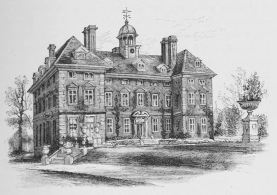
“Burghley, Nov. 29.—I have been glad to come to the place which is often called ‘the finest house in England’—a dictum in which I by no means agree. The guests are a row of elderly baronets of only hunting and Midland-county fame. An exception is Sir John Hay, a thorough old gentleman (an Admiral) and very agreeable. I took a Miss Fowke in to dinner, and complained to her of the number of old baronets. ‘Yes,’ she said, ‘they are old and they are numerous, and the central one is my father.’
“The house is immense, but has little internal beauty. There is a series of stately rooms, dull and oppressive, with fine tapestry and china, and a multitude of pictures with very fine names, almost all misnamed—a copy of the well-known Bronzino of the Medici boy being called Edward VI.; a copy of the well-known Correggio in the National Gallery being marked as an original by Angelica Kauffman, &c.[271] In a small closet is a number of jewelled trinkets, including Queen Elizabeth’s watch and thimble, and there hangs the gem of the picture collection—‘The Saviour Blessing the Elements,’ a very expressive but most unpleasing work of Carlo Dolci. It is the halo of the great Lord Burghley which gives the place all its interest. He lies on his back in a scarlet robe under a canopy in St. Martin’s Church at the entrance of the town, and close by is a cenotaph to his father and mother, who are buried at St. Margaret’s, Westminster. All the five churches of Stamford have merit, and the town is interesting and picturesque.
“Lord Exeter, with his lank black hair and his wrinkled yellow jack-boots high above the knee, looks like a soldier of Cromwell. In the evening he and the whole family dance incessantly to the music of a barrel-organ, which they take it in turn to wind.[272]
“The great idol of family adoration is ‘Telemachus’—the memory of Telemachus, or rather a whole dynasty of Telemachi, for they are now arrived at Telemachus X. The bull Telemachus I. gained more than £1000 at small county cattle-shows. His head is stuffed in the hall; his statue in silver stands in the dining-room (where there are also silver statues of Telemachus II. and III.), and his portrait hangs on the wall.”
“Dec. 6.—On Tuesday, at King’s Cross, I met Elizabeth Biddulph, Marie Adeane, Alethea Grenfell, and the Dalyells, and we came down together, a merry party, to Hertford, whither the Robert Smiths sent to fetch us to their picturesque new house of Goldings. Alethea is full of the story of Jagherds (near Corsham)—that ‘in the difficulty of finding a house there suitable for the clergyman, an old manor-house was suggested, which seemed to meet all requisites. The Bishop (Ellicott) himself went to see it, and was quite delighted with it, and the clergyman went to reside there. But his servants would not stay, his governesses would not stay; all said they were worried out of their lives by the figure of a lady in blue, which appeared all over the house and on all possible occasions; and at last the clergyman himself gave in and went away. With the next clergyman the same thing happened, and he appealed to the Bishop. The Bishop said he never could tell why he suggested it, but in his answer he said, “If the apparition comes again, I should advise you to throw as much sympathy as you can into your manner, and ask what you can do for it.” Soon after he heard from the clergyman that this had quite succeeded. The blue lady had appeared again, and the clergyman immediately, with an appearance of the utmost sympathy in his countenance, said, “Madam, is there nothing in the world I can do for you?”—upon which a seraphic smile came over the face of the spirit, and it vanished away and never appeared again.’
“Lately the Bishop had a letter from an old clergyman at Wisconsin in America, who wrote to him that an aged parishioner of his had sent for him on his deathbed, saying that he could not die happy without recounting the facts of a crime which he had witnessed in his boyhood. He had been taken by a gang of highwaymen who held their headquarters at Jagherds Court in Wiltshire, and while there was witness to many deeds of violence committed by them. Amongst others, they carried off a young lady, and in the row and quarrels which ensued, the young lady was murdered at Jagherds Court.
“The old clergyman, not knowing what to do with this confession, thought the best way was to write it to the Bishop of the diocese in which Jagherds was situated, and he wrote it to the Bishop of Gloucester, who verified the whole, finding his correspondent a veritable clergyman, &c. The Bishop of Gloucester told the story last week at Lord Ducie’s.”
“Holmhurst, Dec. 16.—I have been intensely busy. The life of Madame de Bunsen unfolds itself in her letters more than any life I have ever heard of. I long for the time to come when I may begin to unite, my links, but at present I have only been making extracts—such extracts! Her power of expression is astonishing. I discover so much that I fancy I have felt myself, and never been able to put into words. I see in the vast piles of MS. the means of building a very perfect memorial to her.”
“Ampthill, Christmas Day, 1877.—I came here yesterday from Holmhurst.... It was a great pleasure to find charming old Sir Francis Doyle here with his son and daughter. Sir Francis talks incessantly and most agreeably, and makes the mornings as interesting as the evenings. ‘C’étaient des matinées excellentes, pour lesquelles je me sentirais encore du gout,’ as Talleyrand used to say. Sir Francis has just been saying, apropos of how little one knows the true characters of those one meets:—
“‘H. told me a curious thing one day. He went to dine with a cabinet minister (I suppress the name), and there came down a lady, the governess, cherished by the family—“a perfect treasure.” He recognised her at once as a lady he had known very well, very intimately indeed. She sank after that, sank into the lowest depth of that class of life. “I used to help her with money,” he said, “as long as I could, but at last she sank too low even for that, quite out of my sphere of possibilities altogether, and here I found her reinstated. As I was questioning what I ought to do, she passed near me and said only, ‘I have sown my wild oats.’ I never told of her: I had nothing to do with placing her where she was.”’
“With the same intention Sir Francis told a curious story of ‘Two Shoes,’ a boy at Eton:—
“‘Two Shoes took a box to a boy-friend of his who was in another house and said, “A number of curious things are happening in my house, and this box contains things of value to me; I wish you would let it stay here for a little.” The boy said, “Yes, you may leave your box, provided only that it contains no money: I will not be responsible for anything with money in it.” Two Shoes said there was no money in the box, and it was left. Afterwards, when the box was moved, a great rattle as of sovereigns was heard inside, and as the tutor of the house whence it had been taken declared himself robbed at the same time, the boy in whose charge the box was left thought it necessary to declare what had happened. The sixty sovereigns lost by the tutor were found in the box. Two Shoes was expelled.... H. went down into —— shire lately, and there he found Two Shoes confidential solicitor to half the county.’
“Apropos of the secret crimes of so-called ‘religious people,’ Sir Francis said—
“‘I am quite sure that Abigail murdered her husband; that one is quite left to understand. He could not have died of the shock of having escaped David. Oh, no; she was a religious woman, so she waited till six o’clock on the Sabbath evening, and then she poisoned him.’
“His stories of old times and people are endless. He said—
“‘I always keep a reminiscence of poor Lady Davy to laugh at. It was one of those great days at Stafford House, one of their very great gala days, and Lady Davy was in the hall in the greatest anxiety about her carriage; and she, little woman, walked up to one of those very magnificent flunkeys, six feet high at least and in resplendent livery, and besought him to look after her carriage. I never saw any one so civil as that man was. “I have called your Ladyship’s carriage three times,” he said, “and it has not answered, but if your Ladyship wishes, I will try again.”
“‘I saw the second act of that little drama. I went through the door, beyond the awning, just when the footman was stalking haughtily and carelessly among the link-boys and saying disdainfully, “Just give old Davy another call.”’
“At dinner the conversation turned on Lord and Lady Lytton. She was a Miss Doyle, a distant cousin of Sir Francis, and shortened his father’s life by her vagaries and furies. After his father’s death Sir Francis left her alone for many years; then it was represented to him that she had no other relations, and that it was his duty to look after her interests, and he consented to see her, and, at her request, to ask Sir E. Bulwer to give her another hundred a year. This Sir Edward said he was most willing to do, but that she must first give a written retractation of some of the horrible accusations she had brought against him. When Lady Bulwer heard that this retractation was demanded of her, she turned upon Sir Francis with the utmost fury, and abused him with every vile epithet she could think of. She afterwards wrote to him, and directed to ‘Sir Francis Hastings Doyle, Receiver of her Majesty’s Customs (however infamous), Thames Street, London.’ ‘But,’ said Sir Francis, ‘I also had my day. I was asked as to her character. I answered, “From your point of view I believe her character to be quite immaculate, for I consider her to be so perfectly filled with envy, hatred, malice, and all uncharitableness, as to have no possible room left for the exercise of any tenderer passion.”’ Lady Bulwer appeared on the hustings against her husband. His son told Sir Edward, ‘Do you know my Lady is here?’—‘What, Henry’s wife!’—‘No, yours.’ She said, ‘He ought to have gone to the colonies long ago, and at the Queen’s expense.’”
“Ampthill, Dec. 26.—This morning Sir Francis was attracted by the portrait of old Lady Carlisle hanging by the drawing-room door, and he said, ‘That portrait always reminds me of something Lady Carlisle said once. I was speaking to her of the death of one of her sisters, and she said, “We were all very sorry, very sorry indeed; but she (pointing to another sister), she cared.”’
“For my benefit Sir Francis narrated the story of the thirty-nine Yaconines.
“In Japan, there was one Daimio who was in rivalry with another, and who was superseded by him, and of course his honour could not stand that, so he committed ‘the happy despatch.’ His followers ought to have avenged him, it was Japanese etiquette that they should, but they did not; they, lamented and howled, but they did nothing, and the chief of them in his agony lay down in the gutter and remained there fasting for several days. Then one day the head-follower of the successful Daimio, passing by, saw him in the gutter, and spurned him with his foot and said, ‘You beast, you coward, you brute! do you intend to lie there and let your master go unavenged?’ but the man still lay crouched and grovelling and took no notice.
“But a time came when the followers of the successful Daimio were dispersed, and then the thirty-eight servants of the dead man arose and went to him, and kneeling around him said with courtesy, ‘We do not wish to cut your throat, do not compel us; take the happy despatch;’ but the Daimio would not take their advice, he could not bring his mind to it; so then the Yakonines performed their duty, and they cut his throat. When they had done that, the thirty-eight Yakonines summoned all the people together to attend them, for they were about to perform their final duty, their ‘happy despatch’ to the manes of their master, and the thirty-eight performed it, amid the acclamations of the people over their fidelity even to death. But when, afterwards, men came to count the corpses, behold there were thirty-nine: the enemy who had spurned the Yakonine as he lay in the gutter repented when he saw that he had accused him falsely, and had silently joined the procession of death: there were thirty-nine Yakonines who died.”
“Dec. 27.—Last night a French play was acted, ‘Madame Choufleuri reçoit chez elle.’ Mr. Lowther, who was merely an old French gentleman spectator, created for himself a part which was a whole dumb dramatic performance in itself.
“I had a charming drive to-day with Lady Ashburton to Woburn, the rest having preceded us. There is a long winding double avenue in the park. The stables are so enormous that we mistook them for the house, and were surprised when we turned the other way. However, the door of the real house was most dilapidated and unducal. Long passages, surrounding an open court, and filled with portraits, led to a large sitting-room, where we found most of our own party and the guests of the house. The Duchess was kind and cordial. We all went to luncheon in the Canaletti room, enlivened by endless views of Venice, which, regardless of their artistic merits, are most pleasing to the eye through their delicate green-grey tints. Afterwards we went through the rooms, full of portraits, one of Lucy Harington in a ruff, very fine. In one corner is a set of interesting Tudor portraits, including a large one of Jane Seymour; hideous I thought, though Froude, when he saw it, said he did not wonder Henry VIII. cut Anne Boleyn’s head off to marry so bewitching a creature. A great portrait of the famous Lord Essex in a white dress has a mean feeble face and stubby red beard. The Duke[273] offered to take us to the church. Lady Ashburton, Lady Howard of Glossop, and I drove there with him. We passed ‘the Abbot’s Oak,’ where the last abbot was hung. Froude says he went up to London and was swallowed up by his fate. The Duke asked what this meant. It did mean that he was hung, drawn, and quartered, ‘but Froude was very angry at the question; historians never like being asked for details.’ The banks of a stone quarry are planted with cedars and evergreens, and the drive to the church is very pretty. The church was built by Clutton, who was turned loose into a field and told to produce what he could. He did produce a very poor mongrel building, neither gothic nor romanesque. The Duke said, ‘Would you like to see what is going to be done with me when I am dead?’ and he showed us the hole in the floor where he was to be let through ‘to the sound of solemn music,’ and then took us down into the vaults beneath to see the trestles on which his coffin was to repose! I long tried in vain to get Lady Ashburton to leave the endless letters, some of Sarah, Duchess of Marlborough, who stayed with her grand-daughter and complained that the house was so dreadfully out of repair that the rain came into her bedroom, but another year that was to be remedied. We were deep in a ‘Boethius de Consolatione,’ printed in Tavistock Abbey, when the Duchess came in. ‘Would you like to see my golden image?’ So we went by a long open cloister, with wooden pillars rose-entwined, to see where the statue of the Duchess stands on a hill, all gilt like the figure of the Prince Consort, so that one really could see nothing except that it was a standing figure, and I could say nothing except that it was very well placed. Then we were taken through the sculpture-gallery, in which the great feature is a glorious sarcophagus, with a relief of the body of Hector being weighed against gold, Priam and Hecuba standing by with tears upon their cheeks.”