Volume 6 — XXX IN MANY PLACES (continued 2)
Reading edition
‘I loved him, and love him for ever: the dead are not dead, but alive.’[578]
Yet a shadow is thrown over everything, and when even his friend feels as if he could never write or speak of him without tears, what must not it be to his parents! One had felt that he, if any one, had ‘i pensieri stretti ed il viso sciolto’ which would ‘go safely over the whole world,’ as Alberto Scipioni said to Sir Henry Wotton, and which the latter recommended to Milton when asked for advice as to his travels.”
To Mrs. C. Vaughan.
“May 8, 1897.—Do you remember the article on my book, or rather on me, headed ‘A Monument of Self-Sufficiency,’ which amused us both so much? Dining at Lady Margaret Watney’s, I sate opposite to Mr. E. G. who wrote it—a pleasant man and much liked—and longed to make acquaintance with him, but had not the chance. Last night I dined with Lady Ashburton, a quiet party, with all the beautiful Kent House pictures lighted up. Mr. Henschel whistled like a bullfinch at dinner, and sang gloriously ‘Der Kaiser’ afterwards. Mrs. F. Myers, who sate by me, was most agreeable, and is one of those with whom one soon penetrates ‘l’écorce extérieur de la vie,’ as our dear S. Simon calls it. Amongst a thousand interesting things, she told me that, at Cambridge, she found Lord De Rothschild’s son especially difficult to get on with, till one day he startled her by asking, ‘Have you got any fleas?’ She was surprised, but found that special point of Natural History was just the one thing he cared about, knew about, and would talk on for ever; and she was able to get him some rare fleas from a friend in India, with which he was greatly delighted.
“I also sate at dinner by ...whose father was ambassador at Vienna. He rented Prince Clary’s house. One day, as a little girl, she was at the end of the drawing-room with her mother, when they both saw a chasseur—their own chasseur, they supposed—standing in an alcove at the end of the room. ‘Oh, there is Fritz,’ said her mother. ‘What can he be doing there? Run and tell him to go downstairs.’ She ran across the room, but as she came up to the alcove the chasseur seemed to vanish. This happened three times; then the mother said, ‘If we were superstitious we might say we had seen a ghost, but it can be only a question of angles.’ Soon afterwards her father met Prince Clary at dinner and began, ‘Have you ever been troubled by any appearance?’ &c. ‘Oh, don’t speak of it,’ exclaimed Prince Clary; ‘it is a most painful subject: the fact is, that, in a fit of anger, my father killed his chasseur on that spot.’ Sir Augustus Loftus, who succeeded at the Embassy, took the same house, and reproached them much for not warning him of the apparition, on account of which he soon left and went to live in a hotel.
“At Easter I was with the Carysforts at Elton, and was taken to see Castor, with its fine Roman and Norman remains, and Stobbington, a very interesting old house, with a most curious collection of rare living fish, the pets of its owner. Lady Alwyn Compton, who was at Elton, told me a curious story. It was one of the great commentators—Calamy, she thought—who had occasion to go to a market-town in Devonshire, and take a lodging there whilst the assizes were going on. In the evening a servant came to his room and said that the master of the house hoped that he would do him the honour of coming down to supper with him. He said, ‘Oh, pray thank him very much, but say that I never take supper.’ But the servant came three times with the same message, and at last he said to himself, ‘Well, he seems so anxious to have me that it is rather churlish not to go,’ and he went. There were many people in the room, quite a number of guests, and a great supper prepared. But, being a religious man, before sitting down he said grace aloud, and, as he said it, the whole thing vanished.
“Archbishop Benson told Lady Alwyn that two Americans were talking to each other about spiritualism. Said one to the other, ‘You do not believe in ghosts, do you?’—‘No, certainly not!’ ‘You would not believe even if you saw one?’—‘No, certainly not.’ ‘Well, I am one!’ and he vanished on the spot.
“Afterwards I saw Higham Ferrers on my way to stay at Ecton, such a pleasant old house; and the next week I was with the George Drummonds at Swaylands, which has the finest rock-garden in England, and drew with Miss Henniker in the delicious old gardens of Penshurst Place.”
To Hugh Bryan and Journal.
“Castle Hale, Painswick, June 17.—‘Voici venir les longs crépuscules de juin,’[579] and I will employ one of them in writing to you. I have had a Whitsuntide of visits, beginning with the Deanery of Hereford. Mrs. Leigh[580] was full of her visit to Butler’s Island, from which she was lately returned—her last visit, she thinks, but I expect she will not long be able to keep away from the old home in the rice-swamps which she loves so dearly. Before she left, she had a little feast for all the older negroes, who had been slaves, and whose ancestors had been on the place since her great-grandfather’s time. She thanked them for coming in a little speech, expressing her attachment to them, but saying that as her years were advancing, she might not meet them often again on earth, but that she trusted to see them again hereafter. She was much moved herself, and many of the negroes wept; then, as by a universal impulse, they all sprang up and sang the Doxology! Her daughter Alice had a supper for the younger negroes in another room. One of them, a young man, made a speech, and ended it by saying, ‘I am sure that this festival will be remembered by our offspring long after their forespring are dead and gone.’
“‘Old Sie is my foreman,’ said Mrs. Leigh. ‘His grandfather lived with my great-grandfather, the first of our family who established himself on Butler’s Island. He was a very clever, efficient slave. Once, when all the other slaves were out at another island trying to cultivate it—it is called “Experiment” still—there came on one of those tremendous hurricanes which are, happily, very rare with us. The slaves, who are like sheep, all wanted at once to take to the boats and get home. Had they succeeded in embarking, they would all have been lost, as many other negroes were then, when all boats were swamped. But, at the point of the whip, Sie’s grandfather drove them all back inland to a hut where they could take refuge. Afterwards Sie was offered his freedom, but he would not take it; so my grandfather had a silver cup made for him, with an inscription recording what he had done. Last winter I said to Sie, “I think you had better let me buy that cup from you; you are all free now, and your children are not likely to care for it.” He considered awhile, then he said, “No, Missus, I tink not: I keep cup;” and then he thought a little more and said, “Missus, when I be gone done dead, you have de cup.”’
“I went with the Leighs to see the wonderful old church of ‘Abbeydore in the Golden Valley,’ as romantic as its name, and Kilpeck, a marvellous old Norman building.
“I went next to Madresfield, a first visit in a new reign, and very different it looked in its long grass and flowers, with the lovely Malvern hills behind, from the frost-bound place I remember. Its young master has spent all the time of his possession in beautifying it, planting glorious masses of peonies, iris, and a thousand other flowers in the grass, and making a herbaceous walk—winding—with a background of yew hedge, which is a very dream of loveliness. I was very happy at Madresfield, liking Beauchamp and Lady Mary so much, and all the many guests were charming, especially the Arthur Walronds, genial Dick Somerset, delightful Lady Northcote, the evergreen Duchess of Cleveland—‘Aunt Wilhelmine’—and three pleasant young men, Charlie Harris, Victor Cochran, and Lord Jedburgh. What a pleasure there is in thoroughly well-bred society! There is a capital passage in Ouida’s last book about this—‘You are always telling me that I wear my clothes too long: you’ve often seen me in an old coat—a shockingly old coat; but you never saw me in an ill-cut one. Well, I like my acquaintance to be like my clothes. They may be out at elbows, but I must have ’em well cut.’
“One afternoon we drove to Eastnor, which was in great beauty, and the castle—hideous outside—a palace of art treasures within, infinitely lovely from the flowers with which Lady Henry Somerset fills it.
“But most I liked the rambles about the inexhaustible gardens of Madresfield itself, with my charming young host and hostess, and one or other of the guests, and the practice inculcated by the oft-repeated questions which they ask so cheerily—‘Is it wise? is it kind? is it true?’ the very thought of which stops so much scandal; yet one has to consider all the three questions together, for the last would so often bring an affirmative where there would be a negative for the two others. The house itself is full of interesting and precious things, old furniture, miniatures, enamels, &c.
“Now I am with Mrs. Baddeley, whom you will remember as Helen Grant, the second of the three beautiful sisters whom all the great artists wanted to paint, but who have been such dear friends of mine from their earliest childhood, and often at Holmhurst, whether I were there or not. Helen’s husband, St. Clair Baddeley, is full of amusing stories, and his adopted father, Mr. Christie, with whom they live, is the dearest of old gentlemen. Just behind this house is the old courthouse where Charles I. lodged in most troublous times, and whence he fled. Many of his Cavaliers took refuge in the church, and numbers of them were afterwards shot in the churchyard, where old helmets are still dug up, and where a row of yews are said to mark their graves. There are ninety-nine yews altogether, and it is said that a mystic power guards this number; if any one tries to plant more, the old yews destroy them. In their shadow are a number of fine tombs, executed by Italian workmen, who left the place because they were not allowed to have their own chapel, but who were brought over when Painswick was a very flourishing town from its cloth factories, now transferred to Yorkshire.
“Just before her marriage, H. went to see Lady Burton at Mortlake, and was taken to Burton’s mausoleum as a natural part of her visit. Afterwards Lady Burton wrote to her saying that she wanted to ask a very great favour. It was that she would never wear again the hat in which she had come down to Mortlake. H. liked her hat very much—a pretty Paris hat in which she fancied herself particularly, but she said she would do as an old friend of her future husband wished, though utterly mystified. Afterwards Lady Burton wrote that when H. had come into the room on her visit, she was horrified to see three black roses in her hat; that they were the mark of a most terrible secret sect in Arabia, mixed up in every possible atrocity, and that—especially as worn by a girl about to be married—they were a presage of every kind of misfortune; that, in another case of the same kind, she had given the same warning, and the girl, who disregarded it, died on the day before her wedding. H. wore her hat again, but took out the black roses.
“Sir Richard Burton died of syncope of the heart—died twenty minutes before Lady Burton’s priest could arrive; so her report of his having been received into the Roman Catholic Church was a complete delusion.
“H. says that Count Herbert Bismarck went lately to a great function in Russia. While he wished to be incognito, he still did not see why he could not have the advantages of his cognito. ‘Stand back; you must keep the line,’ said an official as he was pushing through. ‘You do not know who I am: I am Count Herbert Bismarck.’ ‘Really? Well that quite explains, but it does not excuse your conduct,’ rejoined the officer.
“At the silver wedding of the Prince and Princess of Wales, a northern town wished to present an address, but there was a great discussion as to its wording; for some time they could not agree at all. ‘Conscious as we are of our own unworthiness,’ was universally condemned, but when some one proposed, ‘Conscious as we are of each other’s unworthiness,’ it was agreed to to a man. “Mr. P——, Q.C., who has just been here, has called to mind that the Queen’s name is neither Victoria nor Guelf. Her real name is Victorina Wetting (pronounced Vettine). She was christened Victorina, and then there was a little girl called Victorina who played a most unpleasant part in Queen Caroline’s trial, and the Duke and Duchess of Kent changed their child’s name to Victoria, that it might not be the same. And Wetting is her husband’s—the real Saxe-Coburg name.
“H. had been at Oxford when Max Müller one day received a letter which pleased him so much that he insisted on sending a very nice letter in return, though it was evidently only written to get an autograph. It asked if there was any reason, other than coincidence, for meche and mechant: wick, wicked. One day an American was shown in to Max Müller, saying, ‘I have come, sir, four thousand miles to see you,’ &c. The professor was terribly pressed for time, and bored too; but as to the latter, felt that in a quarter of an hour he would be released, as he had a lecture to deliver. So he was civil, and then excused himself, saying that he was afraid he must go to his lecture, but that if his visitor wished to go to hear it, he could. ‘No,’ said the American, ‘I will not go with you, for I am rather deaf; but I can make myself perfectly happy here, and you shall find me here on your return.”
“St. Clair has been talking of Mrs. Procter, whom he knew well, and how she used to say, ‘Never tell anybody how you are, because nobody wants to know.’ All her circle are gone now, Lowell, Matthew Arnold, Browning, Adelaide Sartoris. When she was dying, her nun-daughter came and tried to get a priest in, but she would not have it. She had preserved the letters of Thackeray, Dickens, and others in three tin boxes. Mrs. Procter left Browning and two others her executors, but the nun wanted all the papers to be given to a young Nottingham doctor, to be published just as she wished, and, when they would not have it so, she put the whole of the correspondence on the kitchen-fire: it was her vendetta on her mother for having refused the priest.
To the Countess of Darnley.
“Holmhurst, June 29, 1897.—I said I would tell you about the Jubilee. For the first few days I was with the hospitable Lowthers, and thence, on Sunday, went to the Thanksgiving service at St. Paul’s. Going very early, I had perhaps the best place in the choir, and enjoyed seeing the gradual gathering of so much of the bravery, learning, and beauty of England beneath the dusky arches and glistening mosaics. When the long file of clergy went out to meet the royal procession at the west door, the faint distant song was very lovely, gradually swelling, and lost in the blare of trumpets, the roll of drums, and the triumphant shout of welcoming voices as the clergy re-entered the choir. The most important figure was the Bishop of Finland in a white satin train with two gorgeous train-bearers; but the newspapers tell this, and how the lines of royal persons sate on crimson chairs opposite the entrance of the choir, and how the Bishop of London preached touchingly, not effusively, about the Queen and her reign, and officiated at the altar in a gorgeous mitre and cope.
“On Monday Miss Lowther and I went to tea with my friend (minor-canon) Lewis Gilbertson at his lovely little house in Amen Court, and then were taken, by one of the many secret staircases of the cathedral, to emerge over the portico for the rehearsal of the next day’s ceremony. Perhaps, in some ways, this was more impressive than the reality, as none of the vast surrounding space was kept clear; all was one sea of heads, whilst every window, every house-top, even every chimney-pot, was crowded with people. Never was anything more jubilant than the ‘Te Deum,’ more reverent than the solemn Lord’s Prayer in the open air—every hat off. When the appointed programme was over, the crowd very naturally asked for ‘God save the Queen,’ and after some hesitation, and goings to and fro of dean and canons, it was begun by the bands and choristers, and taken up vigorously by the mile of people as far as Temple Bar. How grand it was!
“That evening the dear Queen said to Miss ... ‘To-morrow will be a very happy day for me;’ and I think it must have been. Where are anarchists and socialists before such a universal burst of loyalty—not of respect only, but of heartfelt filial love?—Nowhere! Their very existence seems ridiculous. I saw all from the Beaumonts’ in Piccadilly Terrace, where a most kind hostess managed all most beautifully for us, and, entering through the garden, we had neither heat nor crowd to fear. No small part of the sight was the crowd itself—the unfailing good-humour increased by the extreme kindness of the police towards fainting women and all who needed their help. The Colonial procession was charming—its young representatives rode so well, and were in themselves such splendid specimens of humanity, and so picturesquely equipped. Then the group of old English generals on horseback drew every eye, and the sixteen carriages of princesses, amongst whom the Duchess of Teck was far more cheered than any one except the Queen herself. And lastly came the cream-coloured horses with their golden-coated footmen, and the beloved Lady herself—the ‘Mother of the Land,’—every inch a queen, royal most exceedingly, but with an expression of such love, such gratitude, such devotion, such thankfulness! Oh, no one felt for and with her only as a sovereign; it was a far closer tie than that.
“In the evening, Mrs. Tilt and her sister went with me to the Maxwell-Lytes on the top of the Record Tower, whence we saw the bonfires round London light up one by one, and St. Paul’s in silver light—a glorified spiritual church rising out of the darkness of the city against the deep blue sky. Far more than the illuminations of the noisy streets, it was a fitting end to so solemn and momentous a day.
“And on Wednesday I was in the Green Park, and heard the thousands of school-children sing their farewell to the Queen as she went away to Windsor.”
To Mrs. C Vaughan.
“March 1897.—I think the reviews of the first three volumes of my ‘Story’ must be coming to an end now. I have had them all sent to me, and very amusing they have been, mostly recalling the dictum of Disraeli, that ‘critics are those who have failed in art and literature.’ Many criticisms have been kind. One or two, but not more, have been rather clever, and some of the fault-finding ones would have been very instructive if I had not so entirely agreed with them at the outset on all their main points—that I was a mere nobody, that my life was wholly without importance, and that it was shocking to see parts of the story in print, especially the painful episode which I called ‘The Roman Catholic Conspiracy;’ for reviewers, of course, could not know the anguish it cost when I was led to publish that chapter, by its being my one chance of giving the true version of a story of which so many false versions had been given already. However, it is as Zola says, ‘Every author must, at the outset, swallow his toad,’ i.e., some malicious attack in the periodicals of the day; only I think my toads become more numerous and venomous as years go on.
“Some of the reviews are very funny indeed. The Saturday Review of ‘A Monument of Self-Sufficiency’ contrives to read (oh! where?) ‘how sweet and amenable and clever Augustus was,’ but is so shocked by a book ‘wholly without delicacy’ that it—‘cannot promise to read any more of it’!! The British Review, which thinks me an absolute beast, has a stirring article on ‘Myself in Three Volumes.’ The Pall Mall Gazette dwells upon their ‘bedside sentiment and goody-goody twaddle,’ and is ‘filled with genuine pity for a man who can attach importance to a life so trivial.’ The Athenæum describes me as a mere ‘literary valet.’ The New York Tribune finds the book ‘the continuous wail of a very garrulous person.’ The reviewer in the Bookbuyer speaks of the ‘irritation and occasional fierce anger’ which the book arouses in him(!). The New York Independent dwells upon my ‘want not only of all kindly sense of humour, but also of propriety.’ It is long since the National Observer has met with an author ‘so garrulous or so self-complacent.’ Finally, the Allahabad Pioneer (what a name!) votes that Mr. Hare’s chatter is ‘becoming a prodigious nuisance,’ and ‘if it had its deserts his book would make its way, and pretty quickly, to the pastry-cook and the trunk-maker.’
“What fun! Yet I am glad that most of the more respectable reviews say exactly the opposite, and certainly the public does not seem to agree with those I have quoted; it would be terribly expensive if it did. They are only birds of prey with their beaks cut and their claws pulled out, and if a book is found to be interesting, people read it whatever they say. They influence nobody, except just at first those who choose books for lending libraries.
“What is really almost irritating is the very ragtag and bobtail of reviews, whose writers can scarcely even glance at the books they are penny-a-lining—such as the Table, which ‘explains’ that ‘my grandmother was the wife of Archdeacon Hare;’ as another (I have lost it now) which speaks of ‘Priscilla Maurice, second wife of Julius Hare;’ as the Weekly Register, which reviews the life of ‘Esmeralda,’ or the student of the book who writes in The Dial and describes my life at ‘Balliol College,’ or Household Words (copied by the Free-thinker and several other even inferior reviews), which ‘quotes’ in full a long story about Mr. Gladstone and Father Healy which is not to be found in the ‘Story’ at all.
“Then, did you see Mr. Murray’s letter to the Times, which certainly gives a touching picture of the spirit of self-sacrifice which actuates publishers in their daily life, for he announces that my ‘Handbook of Berks, Bucks, and Oxon,’ which had three editions before his father’s death, and on which the author was only paid altogether £152, left, at that death, a deficit of £158!! I was sorry, all the same, that he was annoyed at my description of his father wrapt in his enveloppe de glace; for old Mr. Murray (who had cut me dead for all the years since the appearance of my Italian Handbooks) asked me to shake hands with him once again a few months before he died, which I did most cordially.”
To Francis Cookson.
“Holmhurst, August 29, 1897.— ...With me, life has rippled on through several months, only I have been away for some days with the Lowthers to draw under Carlandi, and quite lately I have sorrowed bitterly at the early death of my dear Inverurie, kindest and most affectionate of young friends. I feel his being taken so much myself that I cannot bear even to think of what it must be to his nearest belongings; and yet—while absolutely free from all humbug—surely never was there any young man more simply and trustfully prepared for an early death.
IN THE WALPOLE CORRIDOR, HOLMHURST.

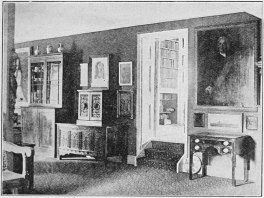
“He cared less for ‘the world’ than any young fellow I have ever known, and was more in love with his family, his homes, and their surroundings.
‘Felix ille animi, divisque simillimus ipsis. Quem non mordaci resplendens gloria fuco Sollicitat, non fastosi mala gaudia luxus Sed tacitos sinit ire dies et paupere cultu Exegit innocuae tranquilla silentia vitae.’[581]
“Last week I was for three nights at Hurstmonceaux, actually—for the first time in thirty-seven years—at my old home of Lime. What a mixture of emotions it was; but within all is so changed, I could not recall my mother and Lea there; and the present inhabitants, the young Baron and Baroness von Roemer, were boundlessly good to me. Outside, there were many spots alive with old memories, especially in the garden, where my mother and I lived so much alone—our earthly Paradise. Did you know that the word Paradeisos means a garden?
“How I should like you to know the peculiar surroundings of Lime, different to those of any other place I have seen—the brown parched sun-dried uplands, the bosky ferny hollows, the reedy pools fragrant with mint, the eternal variety of pink lights and grey shadows on the soft downs beyond the wide Levels, which recall O’Hara’s lines—
‘Where the herds are slowly winding over leagues of waving grass, And the wild cranes seek the sedges, and the wild swans homeward pass.’
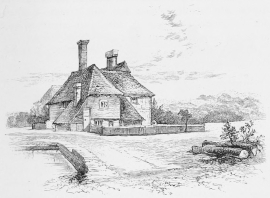
WARBLETON PRIORY, ON APPROACHING.
WARBLETON PRIORY, SEEN FROM BEHIND.
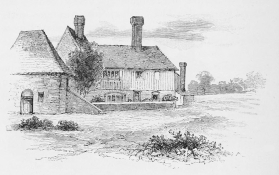
“We made a little excursion. In my very early childhood I was once at the ever-haunted Warbleton Priory, and the recollection of its utter weirdness and of the skulls kept there had always so remained with me that I had quite longed to see it again. The many stories about it are such as ought never to be told, only whispered. The very approaches have a mystery. No one will stay there now, even by broadest daylight; so we went to an old manor near Rushlake Green for the keys, but found even that so bolted and barred that we were long in obtaining them. ‘Oh no, there is never any one there,’ said the servant, ‘but you must go on till you come to a black gate, then drive in.’ To reach this, we followed a lane with well-built cottages, but they were deserted, their windows broken and their gardens overgrown; no one could live so near the accursed spot. Through the black gate we enter dark woods. A cart-track exists, winding through thickets with fine oaks interspersed, and by reedy ponds dense with waving cotton-plants. Then we cross open fields entirely covered with thistles—enough to seed all Sussex—for no one will work there. Then, through another black gate, we enter a turf-grown space, with lovely distant view between old trees, and there, with high red-tiled roofs, golden here and there with lichen, is a forlorn and mossy but handsome old stone house, built from and rising amidst other remains of an Augustinian priory. In its little garden are roses, and box bushes which have once been clipped into shapes. Inside, the mildewed rooms have some scanty remnants of their old furniture. In one of them, where a most terrible murder was committed, the blood then shed still comes up through the floor—a dark awful pool which no carpenter’s work can efface. The most frightful sounds, cries, and shrieks of anguish, rumblings and clankings, even apparently explosions, are always heard by night, and sometimes by day. In the principal room of the ground floor, in the recess of a window, are two skulls. They are believed to be those of two brothers who fought here and both fell dead. From one, the lower jaw has fallen down, increasing its ghastly effect. Successive generations of farmers have buried them, and instantly everything has gone wrong on the farm and all the cattle have died: now they have altogether abandoned a hopeless struggle with the unseen world. Besides this there is a tradition—often verified—that if any one touches the skulls, within twelve hours they pass through the valley of the shadow of Death. So naturally Warbleton Priory is left to the undisputed possession of its demon-ghosts.”
Journal and Letter to W. H. Milligan.
“Thoresby, Oct. 22, 1897.—I began my little tour of visits at Maiden Bradley.... You know how it is almost the only remnant the title possesses from the once vast Somerset estates. The 12th Duke left everything he possibly could away, and when the present Duke and Duchess succeeded, they were pictureless, bookless, almost spoonless. Still they were determined to make the best of it. ‘He could not take away our future: we will not lament over all that is lost, but enjoy to the very utmost what we have;’ this has been the rule of their existence, and so ‘Algie and Susie,’ as they, always speak of each other, have had a most delightful life, enjoying and giving enjoyment. No one ever looked more ducal than this genial, hearty, handsome Duke: no one brighter or pleasanter than his Duchess: ‘all who have to do with her find nothing but courtesy, gentleness, and goodness,’ as Brantôme wrote of Claude of France. I liked my visit extremely. My fellow-guests were Sir E. Poynter of the Royal Academy, Lady Heytesbury, and Mrs. Kelly, an authoress. With the last I saw stately Longleat, which I had not visited since I was fourteen, and—as horses are the one indulgence the Duke gives himself—he drove us luxuriously about the country on his coach-and-four.
“The following week was delightful—with the Boynes in their beautiful hill-set home. They took me glorious excursions, and we picnicked out in beautiful places five days running. One day we went to Kinlet—a really great house, as well kept by Swedish maids (its mistress is a Swede) as if there were a dozen men-servants. And the last day we went to a real still-standing Norman farmhouse (Millichope), with its original round arched doors and windows.
“From Burwarton I went on to my pleasant cousin’s, the Francis Bridgemans, close to that beautiful church at Tong, and we spent a day with Francis’s kind old father, Lord Bradford, at Weston, and he showed us all the pictures and treasures in the house, and drove us about in his sociable to the ‘Temple of Diana’ and other points of interest in the park of a very comfortable well-to-do place.
“Next, I visited Lady Margaret Herbert (daughter of my dear Lady Carnarvon) as châtelaine at Teversal manor in Notts, a smoky wind-stricken country, but with Hardwicke and other fine houses to see. The charming aunt of my hostess, Lady Guendolen, was living with her as chaperon, none the worse in body for being a strict vegetarian, and in mind the sunniest of the sunny, delightful to be with.
‘And scarcely is she altered, for the hours Have led her lightly down the vale of life, Dancing and scattering roses, and her face Seems a perpetual daybreak.’[582]
I was glad to be taken to spend the day at Bestwood, the Duke of St. Alban’s modern place, its woods an oasis in the wilderness, and its honours were charmingly done by Lady Sybil Beauclerk and her good-looking brother Burford. In the Duchess’s room were a series of albums with all the original drawings for Dickens’s works. All the best pictures were burnt in a fire.
“The Ladies Herbert sometimes, but in a far-away sense, remind me of their mother, who was quite the most perfectly brilliant person I have ever known. I have always heard that she was this even as a girl, and that it was a perpetual surprise to her parents, who were very inferior people. Lady Dufferin used to say that they were like savages who had found a watch.
“Taking stern dismal Bolsover—its delicate carvings utterly ruined by ‘trippers’—on the way, I came on to meet a large party here at Thoresby, which is in more than usual autumnal forest glory. We have just been spending the afternoon at Welbeck, shown all the improvements by Mrs. Dallas Yorke, in the absence of the tall handsome Duchess, who, however, returned before we left. One did not wonder that she is such a special joy to the old people of the place, because they had ‘been so long without a duchess, and when there was one long ago, it was only such a little one.’ She has built a delightful gallery—Florence-fashion—between the old house and the new, and hung it with a galaxy of old prints, and has made fascinating little terrace-gardens, and edged their beds with dwarf lavender, so that ‘when the ladies’ dresses brush against it, its scent may be wafted into the house.’
“And meantime my thoughts have been much at Llandaff, with the cousin[583] who was the dearest friend of my boyhood, seeming to pass with her through the closing scenes of the good Dean’s life, and to see him as she did, lying in his cathedral, dressed in his surplice, in the majesty of eternal repose.”
To Mrs. C. Vaughan.
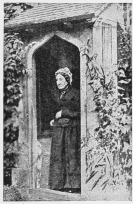
“Holmhurst, Nov. 16, 1897.—Here I am again in quietude, thinking of you very much in your last days at Llandaff; busy over the building of which I am architect, overseer, a hundred things at once, and planting a great deal, with a reminiscence of Dumbiedykes in Walter Scott—‘Be aye sticking in a tree; it will be growing, Jock, while you’re sleeping.’ My only companions now are the pleasant Hospitallers in the little Hospice, whom I constantly meet in the garden and wood walks. I wish you could see their little house, and the late roses lingering on their porch.
“I have been away for a week. Lady Stanhope took me from Chevening to see Lullingstone Castle in Kent, the old house of the Dykes, with a good brick gateway, a richly ceilinged upper gallery, and a chapel with interesting tombs. Two days afterwards, Lady Chetwynd took me to a finer place—Chawton in Hants, where the Knights, of Godmersham, live now, representing several old extinct families, especially the Lewknors, with whom I am very familiar through their tombs scattered all over Sussex, and who are commemorated at Chawton by many portraits and fine tapestried needlework. A little bookcase with a globe outside and a series of Elzevir Histories of the World within, was very attractive.
PORCH OF HOSPICE, HOLMHURST.
“Then I went to stay with ‘the richest man in the world,’ genial unassuming Mr. Astor, in his beautiful Cliveden, much improved since he bought it from its ducal owners, and enriched within by glorious portraits of Reynolds and Romney, and without by the noble terrace parapet of the Villa Borghese and its fountains, already looking here a natural part of the Buckinghamshire landscape, and replaced on its old site by a copy, which is just the same to nineteenth-century Italians! All the splendid sarcophagi and even the marble benches of the world-famous villa are now also at Cliveden, where they are more valued than at Rome. We had a charming party—Jane, Lady Churchill, retaining in advancing years ‘sa marche de déesse sur les nues,’[584] for which she was famous in her youth; the Lord Chancellor, Lady Halsbury, and a daughter; pretty gentle Princess Löwenstein; the Duchess of Roxburghe, ever wreathed in smiles of geniality and kindness, with two very tall agreeable daughters; Lord Sandwich, as bubbling with fun as when he was a young man; Lord and Lady Stanhope—always salt of the earth; with Mr. Marshall Hall and Sir Arthur Sullivan as geniuses; so, as you will see, ‘une élite très intelligente.’ Every one of these delightful people, too, was simplicity itself, rare as that virtue is to find. I see that Queen Adelaide, as Duchess of Clarence, wrote to Gabrielle von Bülow—‘How rarely you meet a really simple man or woman in our great world; they would be hard to find even with Diogenes’ lantern.’ Certainly ‘learned’ people are scarcely ever agreeable. There is a very good sentence in Hamerton about that—‘A good mental condition includes just as much culture as is necessary to the development of the faculties, but not any burden of erudition heavy enough to diminish, as erudition so often does, the promptitude or elasticity of the mind.’
“On Sunday morning we all went to the beautifully situated little church at Hedsor, arriving early and seeing the congregation wind up the steep grassy hill as to a church in Dalecarlia. In the afternoon we were driven about the grounds of Cliveden to the principal points—Waldo Story’s grand fountain in the avenue and his noble landing-place on the river. Exquisitely beautiful were the peace of the still autumn evening, the amber and golden tints of the woods, and the wide river with its reflections. Mr. Astor has attended to all the historic associations of the spot; placing a fine statue of Marlborough in the temple built by Lord Orkney, who was one of his generals, and portraits of Lady Shrewsbury and her Duke of Buckingham, and of Frederick and Augusta of Wales, in the successor of the house where they lived. Another portrait of Frederick, with his three sisters, Anne, Emily, and Caroline, all playing on musical instruments, has the old house in the background. Our host seemed to me quite absolutely frank and delightful; indeed, Surrey’s lines on Sir T. Wyatt might be applied to him—
‘An eye whose judgment no effect could blind, Friends to allure and foes to reconcile, Whose piercing look did represent a mind With virtue fraught, reposèd, void of guile.’
“Now, I am enjoying the time alone at home, with its much-reading opportunity, and I often think that my natural bent would have been to enjoy it quite as much as a boy, when all the family except you treated me not only as a consummate dunce, but a hopeless dunce; and when almost every book was thought wicked, or at best quite unsuited for a boy’s digestion. Now, eyes ache often, but I may say with Lady M. Wortley Montagu, ‘If relays of eyes were to be ordered like post-horses, I would admit none but silent companions.’
“Les années d’ennui et de solitude lui firent lire bien des livres’—part of Catherine II.’s epitaph on herself—is certainly true in my case. Just now I have been labouring through the two long thick volumes which are called ‘Memoirs of Tennyson,’ though, when you close them, you have less idea of what the man was like than when you began—of the rude, rugged old egotist, who was yet almost sublimely picturesque; of the aged sage, who in dress, language, manners was always posing for the adoration of strangers, and furious if he did not get it, or—if he did. The book is most provoking, for it would by no means have destroyed the hero to have truthfully described the man.
“There have been no end of hard-worked boy-friends here for Sundays, and it is no trouble, but very much the contrary. We always get on together capitally—
‘That which we like, likes us: No need of any fuss,’
is a capital Feejee proverb.[585]
THE AVE-VALE STEPS, HOLMHURST.
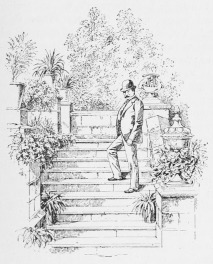
“I think it is Frederick Locker who says that one gradually finds out how much of the affection one inspires is ‘reflected.’ ‘Though thou lose all that thou deemest happiness, if thou canst but make the happiness of others, thou shall find it again in thine own heart,’ is a sentence of George Ebers, of which I mentally leave out as irrelevant the conclusion—‘Is not this playing at being God Almighty?’”
To Miss Garden at Lucca, and Journal.
“Holmhurst, August 1, 1898.—I have been much in London since I wrote last, enjoying the garden-parties at Sion, Osterley, Holland House, Hatfield, Lady Penrhyn’s, Lady Portman’s, &c., and seeing many pleasant people, mostly ‘grandes dames de par le monde.’ Yet, in the season, it is all too great a hurry; one seldom has time to become really acquainted with any one; there are few who have even sufficient personality to leave an individual impression on the mind; if any one does, he or she is ‘like a tree in the steppe’ in the monotony of London life. I dined out daily for two months, but how difficult it is to remember any dinner-party! ‘Who cares for the whipped cream of London society?’ was a saying of Walter Scott. I do recollect one dinner, however, at Mr. Knowles’s, from the fine effect of light on Leighton’s ‘Clytie,’ the principal ornament of his dining-room, all the illumination being given to one fold of the dress, and the rest effectively left in shadow. One charming person whom I remember was Lady Blake, lately returned to England with her husband, who had been governor of Jamaica. She was fond of tame animals. ‘In Jamaica,’ she said, ‘I often had a large snake coiled round my waist; my tiger-cat I generally led by a string, for I never knew what he might do, but my tame crocodile always quietly followed me.’ She was Irish—a Bernal Osborne. ‘Oh, I assure you the Irish are very good to us, quite charming, in fact.’ ‘But if you do anything they don’t like, they kill you.’—‘Naturally.’
“On July 11 I was at Miss Fleetwood Wilson’s wedding to Prince Dolgorouki, and also at Lady Mary Savile’s in the Church of the Assumption, which was a most picturesque ceremony, performed by Cardinal Vaughan—such a fine cardinal!—in a jewelled mitre, with all accompaniments of cross-bearers, incense-swingers, &c.
“The nobly Christian death of Mr. Gladstone and the almost ludicrous apotheosis of one who, in his political life, did nothing and undid so much, were events of the spring. I have personally more individual recollection of his kindness to those who needed it than of his witty sayings; but they were constant. ‘What do you think of Purcell’s Life of Manning?’ some one said to him shortly before the end. ‘I think that Manning need have nothing to fear at the day of judgment.’ He was formidable to strangers, chiefly on account of ‘those demoniac eyes of his,’ as Cardinal Alcander said of Luther; and though in his private capacity he was all goodness, it seemed inconsistent with his public one. Yet what admirers he had! I remember his saying once to Lord Houghton, ‘I lead the life of a dog,’ and the answer, ‘Yes, of a St. Bernard—the saviour of men.’ Joseph Parker used to describe him as ‘the greatest Englishman of the century, he was so massive, sincere, and majestic. If he had had humour he would have been too good to live, but eagles don’t laugh.’
“How much and long people have talked of him, and now what a silence will fall upon it all. An amusing breakfast at Mr. Leveson’s has just been recalled to me, where Lady Marian Alford said, ‘Gladstone really puts his foot in it so often, he is a perfect centipede.’ Directly after, a wasp lighted on the breakfast-table and there was some question of killing it. ‘Oh, don’t; I can’t bear killing anything,’ cried Lady Marian. ‘What! not even a centipede?’ quietly said Lord Lyons, who was present.
“I was with Mrs. John Dundas at Holt in Wiltshire, where the little village once prospered exceedingly owing to its mineral spring. Ten smart carriages used to wait round its fountain at once whilst their owners drank the waters, and a house is pointed out where some Duchess or other died. Then the fashion changed, and drainage was allowed to filter into the spring, and Holt sank into obscurity.
“We went to see Mr. Moseley, the admirable old Rector, who is half-paralysed. A farmer had been to him to ask whether he did not think he might get his hay in on a Sunday afternoon, as the weather was likely to change, and he answered, ‘Certainly; it is God’s hay; save it by all means.’ How unlike most English priests, but how Christ-like—‘personne moins prêtre que Jesus Christ.’ ‘From the fetters of spiritual narrowness, Good Lord deliver us,’ is a petition which I feel more and more ought to be added to the Litany.[586] Yet in many houses I visit I still find much of the old Sabbath-bondage remaining, though certainly it is true that ‘we almost sigh with relief when we discover that even saints can find monotony monotonous.’
“There is a perfect cordon of drawable old manor-houses round Holt, and it is only two miles from Bradford-on-Avon, from which the great town in Yorkshire was colonised, and which owes much of its foreign look to French refugees. Its houses rise high, tier above tier, on the hillside, blue-grey against the sky. Over the Avon is a beautiful bridge with a fine old bracketed mass-chapel, long used as a lock-up. A tiny Saxon church—the only real one probably in England—has been discovered walled up into cottages; and there is a noble old ‘palace’ of the Dukes of Kingston standing in high-terraced gardens. Great Chalfield is a most lovely Tudor house, with an old chapel and moat. At South Wraxhall how I recalled many visits from my miserable so-called tutors at Lyncombe, in days of penury and starvation. How indefinite the misty future seemed in the thinking-time which those long solitary rambles afforded, and how I longed to penetrate it. At fifteen ‘j’ai trop voulu, des choses infinies,’ but I was at a parting of the ways of life then, and I think I decided in those early days to try to do the best I could here, and leave the eternities and infinities—of which I heard so much more than of realities—to take care of themselves, for:—
‘Though reason may at her own quarry fly, Yet how can finite grasp infinity?’
“But I am moralising too much and must return to my old houses, which were full of smugglers formerly—‘moonrakers’ they called them in Wiltshire, because many of the smuggled goods were concealed in the ponds, and when the excisemen caught the smugglers extracting them at night, and demanded what they were doing, they answered, ‘Oh, we are raking out the moon.’ I was working in Shropshire for some time after my Wiltshire visit, inspecting almost every church and old house for my book, and hospitably entertained by genial Fred Swete at Oswestry and the Misses Windsor Clive at beautiful Oakly Park near Ludlow.
“While in London I went for two days to Bulstrode, which the late Duke of Somerset left to his youngest daughter, Lady Guendolen Ramsden, who is the most charming of hostesses, but the place is disappointing—a very large modern villa, only one room remaining of the old house where Mrs. Delany lived so much with Margaret, Duchess of Portland, and nothing of that of Judge Jeffreys, which preceded it. It contains an early portrait of Shakspeare, and a most grand Sir Joshua of a Mrs. Weddell. We dawdled most of the day in the verandah. Oh, the waste of time in country-house visits; but Lady Guendolen had much that was pleasant to tell of her mother, the witty (Sheridan) Duchess of Somerset. ‘She was once at a bazaar selling things, and a fat, burly, plethoric farmer asked her the price of something and she mentioned it. The price seemed to him absurd. ‘Do you take me for the Prodigal,’ he said. ‘Oh, no,’ she replied; ‘I take you for the fatted calf.’ This made Graham Vivian, who was one of the party, recollect. ‘I was walking by the Duchess’s donkey-chair, and suddenly the donkey brayed horribly. “Will he do it again?” said the Duchess. “Not unless he hears another,” answered the donkey-boy. “Then mind you don’t sneeze,” said the Duchess, turning to me.’
“About Mr. L., who always speaks his mind, Lady Guendolen was very amusing:—‘Mr. L. took me in to dinner, and I thought I was making myself very agreeable to him, when he suddenly said—“Talk to your neighbour on the other side.” I felt humiliated, but I thought he fancied I couldn’t, so I did, and went on, and never spoke another word to Mr. L. I told him of it afterwards, that he had hurt me so much that I dreamt of it, and I told him my dream—that I said to him that I was considered to become very amusing after I had had two glasses of wine, and he answered, ‘Then, my dear lady, you must have been most uncommonly sober this evening.’”
To Viscount Halifax.
“Holmhurst, August 21, 1898.—I have been for three days at Hurstmonceaux, doubly picturesque in the burnt turf of this hot summer, upon which the massy foliage of the trees is embossed as in Titian’s landscapes. I always feel there, as nowhere else except in the views of the Roman Campagna from the Alban Hills, the supreme beauty of looking down upon vast stretches of flat pasture-land, reaching for ten miles or more, and iridescent in its pink and blue cloud-shadows, with here and there a ripple of delicate green in softest glamour of quivering light. Every hour one sees it change—luminous with long lines of natural shadow, purple from drifting storm-clouds—
‘Then at some angel evening after rain Glowing like early Paradise again.’
It is a pleasure now to be there, though life there is living amongst the sepulchres. ‘La morte, l’estrema visitatrice,’[587] has come to all I knew, and the gravestones of most of them are moss-grown—not only of all the family of my childhood, but of all the neighbours, and all that generation of poor people. How often there comes into one’s mind something like the lines often repeated in the cemetery of Port-Royal—
‘Tous ces morts ont véçu, toi qui vis, tu mourras: Ce jour terrible approche, et tu n’y penses pas.’
IN THE CHURCHYARD, HURSTMONCEAUX.
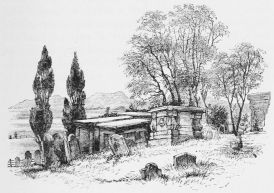
‘Ce n’est pas le temps qui passe, ce sont les hommes,’ was a saying of Louis Philippe. How different everything is to the time which Hurstmonceaux recalls; all hurry now and energy and updoing, and then such an extreme quietude of intellectual pursuits, in which every uninitiated visitor was considered an unendurable bore, if, however interesting he might be in himself, he did not fall in with the mutual admiration society of which the Rectory was the axis. I remember how Thomas Carlyle and Monckton Milnes, with his ‘gay and airy mind,’[588] were amongst those so considered, for they had naturally their outside views and intelligence, and the Rectory group never tried for a moment to penetrate ‘l’écorce exterieur de leur vie;’ and, while bristling with prejudices themselves, they always found much to be shocked at in every outside person they came across. It seemed oddly apropos in all the remembrance of the closed Hurstmonceaux life to read in Madame de Montagu—‘It is not a good thing for everybody to see each other every day and too closely; they risk becoming unconscious egoists, critics, rulers, or subjects, and exhaust themselves by revolving perpetually on a tiny axis.’ Yet in many ways how much more really interesting the life was then; how picturesque Uncle Julius’s enthusiasm, how pathetic his pathos over the books which were his realities; how interesting the conversation, and how genial the courtesy of such constant visitors as Bunsen and Landor, though the latter was such a perfect original, ‘dressed in classical adorning,’ as Arthur Young said of some one; then how unruffled my dearest mother’s temper, over which even Aunt Esther’s strenuous exactions were powerless; and how ceaseless the flow of her love—not charity, as people use the word now—to the poor of the cottages in the hazel-fringed lanes around her, whose cares she made her own, more moved and stirred by the querulous mutterings of Mrs. Burchett or Mrs. Cornford than by the most important events of English politics or the world’s history. Certainly she had a wonderful power with the poor, and an influence which has never passed away, for she had the rare art of entering into and understanding all their feelings; and then, when with them, she always gave them her whole attention. I feel that my two books give very different ideas of what Hurstmonceaux was fifty years ago, but both are quite true; only the ‘Memorials of a Quiet Life’ is the inside, and the ‘Story of my Life’ the outside view. How much of life, after sixty, consists in retrospect! It is, as Fanny Kemble says—
‘Youth with swift feet walks onward in the way, The land of joy lies all before his eyes; Age, stumbling, lingers slower day by day, Still looking back, for it behind him lies.’
One great difference of feeling older is that one is afraid to put off doing anything. ‘By the street of By-and-by, you come to the house of Nowhere,’ is an admirable Spanish proverb.
“I have greatly enjoyed the vivid, charming, simple letters of Mary Sibylla Holland—‘anche oggi si sente una dolcezza d’affetto a leggere quel libro.’”
To W. H. Milligan.
THE AVE-VALE GATE, HOLMHURST.
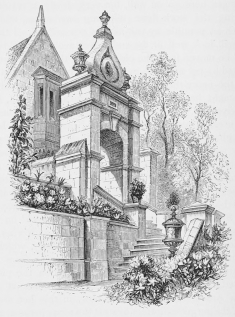
“Holmhurst, Sept. 29, 1898.—The building and changes here go on well, but very slowly, a result of having the work done with my own stone, and as much as possible by the men of our village. I think all will look well in the end. Not a chair or a book will be moved from the older part of the house, consecrated by my mother’s memory, but room will be given for the many things connected with Esmeralda, which I bought back at Sir Edward Paul’s sale, and, if I survive her, for many precious pieces of furniture, pictures, prints, and books from Norwich which Mrs. Vaughan says that she has left me. Where you will remember a steep grass bank, there is now a double stone terrace, with vases and obelisks, and luxuriant beds of brilliant flowers edged with stone, copied as a whole from the Italian Villa Lante near Viterbo. At the end are a staircase and gateway to the Solitude, the ‘Ave-Vale Gate,’ with ‘Ave’ on the outside and ‘Vale’ within. Cypresses are growing up beside it to enhance the impression of Italy, which is further carried out in a widening staircase from the centre of the terrace, with lead vases on the piers, copied in design and proportions from one at the Villa Arson near Nice. Just now, in this hot noon-day, the gorgeous flowers against the stone parapet, and background of brown-green ilex and blue-green pine are really very Italian, while below in the meadows all is as English as it can be, the cows feeding in the rich grass, the heavy rounded masses of oak foliage, and the misty sea asleep in the motionless heat. Nothing seems to move, except my little black Pomeranian spitz, Nero, frisking and barking at the butterflies. I am sure that much the happiest part of my present life is that spent at home, though there is nothing to tell about it—‘l’histoire ne se soucie pas des heureux.’
“Emmie Penrhyn is here, whose visits are always an unusual pleasure to me, and who is one of the dearest relations I have left, partly because, more than any one else, she has a distant likeness to my mother. She lives happily and most usefully at Richmond in a very little world, with a weak body but an all-sufficing soul.
“I have grieved so truly over the news of Ranulph Mostyn’s death in India, that I could not help writing to his mother. Yet I always hesitate about whether letters of condolence can be of any comfort, and can only act upon the knowledge that I like myself to have them in any great sorrow. No Christian disquisitions, however: they always seem forced and unmeaning. ‘Honest plain words best pierce the ear of grief;’ that is somewhere in Shakspeare. Thirlwall’s Letters have an excellent passage about them—‘Expressions of general condolence may be welcome as tokens of goodwill, but can scarcely exert any general alleviating power. The afflicted ones stand within a circle of images and feelings of their own, which, painful as they may be, they would not part with for worlds. Any attempt to draw them out of that circle can only inflict a useless annoyance.”
To Mrs. C. Vaughan.
“Holmhurst, Oct. 16, 1898.—I am alone this evening; the wind is wailing a dirge, and ‘the dark sea drinks in the greyness of the sky.’[589] But I have been away for three weeks. First to the sisters of my old friend Willie Milligan, who now live in the Barrington dower-house at Shrivenham, close to Beckett, the ideal ‘great house’ of my boyhood, so stately and luxurious. Now, so are the mighty fallen, it is let to some Australians, and the family—unless helped by an heiress—can never afford to live there again. Then I was with the delightful Boynes in the high Shropshire uplands, seeing in the most charming way many beautiful old houses. I saw two more from my next visit at Oxton in Notts—Wiverton, and Annesley where the Miss Chaworth Musters, beloved by Byron, once walked on the beautiful old terraces. Another echo from my long-ago came from my visit to Streatlam, where I so often was in my young days, and which is now inhabited by Lord Strathmore’s sister, Lady Frances Trevanion, and her pleasant cheery husband, both most kind cousins to me. The long galleries are filled with family portraits, including a great one of Mary Eleanor Bowes, whose strange story I have so often told. Lady Frances’s time is greatly taken up by the manners and morals of her dogs, the very smallest and noisiest I ever saw. They must be the sort of dogs Chaucer speaks of—
‘Of small houndes hadde she, that she fedde With rosted flesh and milk, and wastel brede; But sore wept she if one of hem were dead.’
“It was a short journey from Streatlam to Kiplin, the beautiful old house of Admiral Carpenter.... He told me how his grandfather had six sons, Talbots, and was fond of making them all lie down full length on the dining-room floor, joining one another, that he might see how many yards of sons he had! I saw Richmond from Kiplin: what a beautiful place, few abroad equal to it.
“But my most interesting visit was that to Baddesley Clinton in Warwickshire, rising, with a fortified central gate-tower, from a deep still moat, and with an inner courtyard full of flowers. It has dark tapestried rooms, several priest’s hiding-holes, ghosts of a lady and a child, and a murder-room, stained with the blood of a priest whom a squire of Edward IV.’s time slew when he caught him chucking his wife under the chin.[590] Then there are all the refined luxuries of fast-day dinners, evening prayers in the chapel with a congregation of maids veiled like nuns, and a live Bishop (of Portsmouth), in violet robes and gold cross and chain, to officiate.
“Such a bishop he is! such a ripple of wit and wisdom! and so full of playfulness! I read and copied somewhere—“A man after God’s own heart is never a one-sided man. He is not wholly spiritual, he is not wholly natural; he is not all earnestness, he is not all play; he cannot be all things at once, and therefore he is all things by turns.”[591] Our Bishop at Baddesley was just like this in his fun, in his love of cats, and never more charming than when he gathered up all the scraps of toast left at breakfast, and throwing open one of the windows, called ‘Quack, quack!’ and crowds of ducks came rushing under the bridge over the moat to scramble for them, one brown duck, which the Bishop called ‘the orphan,’ being especially cared for. Speaking of the frequent ignorance of religious intolerance led him to tell of the people of Imola and Brigatella, who were always quarrelling. When the priest at Brigatella began the paschal mass with ‘Christus immolatus est,’ his congregation thought it was some compliment to the people of Imola, and declared they would kill him unless he began ‘Christus brigatellatus est.’
“He had been with the Calthorpes of Woodland Vale to see an old house of theirs in the Isle of Wight, which was quite deserted, and in the very room where it occurred was told the reason why. A friend who had come there to stay with Mr. Calthorpe saw there, in the dawn of the morning, an old woman sitting knitting at the foot of the bed; he even heard the click of the knitting-needles. At first he thought she had mistaken the room, but it happened again the next day. The third time it happened, he kicked out. The old woman then turned round her face towards him, and displayed—a death’s-head. Another guest met the old woman on the stairs and equally saw the death’s-head. No servant would stay in the house, and now it is pulled down.
“After the evening service in the chapel, the Bishop went to have a cigar before going to bed. When I excused myself from joining him, he told of Benedict XIV., who offered a pinch of snuff to one of his Cardinals. ‘Santo padre, non ho quel vizio,’ he answered. ‘Se fosse vizio, tu l’avrei,’ said the Pope.
“Most charming of all was the châtelaine, the widow of my cousin Heneage Dering, whose first wife was her aunt, Lady Chatterton, the well-known novelist. The niece (‘Pysie’ Orpen) was then married to Marmion Ferrers, the last of a famous Catholic family lineally descended from the Earl of Derby attainted in the Wars of the Roses, and himself legally Baron Compton and De Ferrers, though he never claimed the title on account of his poverty and having no son. He was the pleasantest and most genial of men—‘the old squire’ he used to be called in Warwickshire. One day he found an old woman stealing his wood, and, when she expected a great scolding, he only said, ‘That load of wood is a great deal too heavy for you; you must let me carry it home for you,’ and he did. Another day he caught three poachers, and said, ‘Come, now, let us have it out!’ and they pulled off their coats and had a regular set-to: he floored two of them, he was so strong, and then he let them all go.
“His life seems to have been made up of deeds of faith and charity, but his property fell into decadence and must have been sold, if Heneage Dering, who had married his wife’s aunt, had not come to the rescue. They all lived together in the old house, mediaevally, almost mediaeval even in their dress; and after Lady Chatterton died, and then Marmion Ferrers, a final break-up of the remaining links with the past was prevented by the marriage of Heneage Dering with the widowed ‘Pysie.’ They were perfectly happy for several years, but he always said ‘a sudden death is the happiest death,’ and so in 1892 it was.
“Over the chapel door is inscribed—
‘Transit gloria mundi, Fides catholica manet,’
and the Catholic religion nourishes as much at Baddesley still as it did in the time of Sir Edward Ferrers, who founded this branch of the family in 1517, and left ‘five masses in worship of the five wounds principal that Our Lord suffered in His bitter Passion,’ and who is depicted kneeling before a crucifix, with the legend ‘Amor meus crucifixus est’ issuing from his mouth. On Sunday afternoon we went to hear the Benediction service beautifully sung by the invisible nuns of a convent close by—a convent of ‘Colettines’ from Bruges, a severe form of Poor Clares, founded here in 1850, the first of the Order since the Dissolution. A niece of Lord Clifford was their abbess. There are 250 Catholics at Baddesley.
“As we drove to Warwick, we passed through a village where the learned Dr. Parr was rector. ‘He took pupils,’ said the Bishop. ‘They were not very bright. One of them said, “I make a point of never believing anything I do not understand.” “Then your creed must be most uncommonly brief,” said Dr. Parr.’
“In returning home, I lingered one day with my kind friend E. Mathews at Sonning. I had often longed to go there on a pilgrimage to dear Hugh Pearson’s grave, and never before been able. What a lovely village it is, with its old red roofs nestling under tufted trees, and how fragrant is the beloved memory of the true pastor who gave himself so royally for his people. ‘Go and break it to my family,’ were his first words when told he could not live, meaning by his family his parishioners, the people in the village, who loved him so, and amongst whom he was almost ideally happy, for he was not only always striving to do good for the poor and helpless, but was successful in doing it.
‘His virtues walked their humble round, Nor knew a pause, nor felt a void, And sure the Eternal Master found His single talent well employ’d.’[592]
“My volume on ‘Shropshire’ has come out—another book-child launched into public life.”
To W. H. Milligan, and Journal.
“Belvoir Castle, Nov. 18, 1898.—I have been with my dear Lowthers at Campsea Ashe, enjoying their large party of pleasant musicianers, Countess Valda Gleichen, radiant Mrs. Arkwright of the lovely voice, &c., but enjoying much more two quiet days with the family when the others were gone. Mrs. L. took me to Crowe Hall, a moated house with a delightful old lady-farmeress, of the hard-working high-thinking type, so familiar in my boyhood, but almost extinct in these days of over-dressed, gig-driving, pianoforte-strumming minxes.
“One of those kind and characteristic telegrams of the Duchess of Rutland, extending over a whole page, has brought me here, where there is a large party too, almost entirely composed of the Duke’s innumerable nephews and nieces. As I do not either shoot or care for the regular evening ball in the gallery, what I like best is the daily walk with the Duke and Duchess, meeting them in the hall as the clock strikes 12.15, and wandering in the wood walks or on the nearer terraces, already fragrant with violets, listening to the Duke’s reminiscences of his own past and Belvoir’s past, always of endless interest. How I pity my host and hostess in their over-anxious cares about their immense estates; but they must be comforted themselves by the pleasure they are able to give. Sightseers are admitted always, and the great Midland towns daily pour their legions into these beautiful woods: they do no harm and behave wonderfully well, but one almost feels as if the public, who most enjoy it, ought to help to keep up the place. In the case of Belvoir, the scourge of the death-duties affects what is the pleasaunce of thousands.
“I went with Mrs. G. Drummond to Bottesford, where there is such a grand series of monuments of the Earls of Rutland and their families, including one of some children who died by witchcraft. Their nurse was condemned to be burnt for it, but said, ‘If I am guilty, may this bit of bread choke me,’ and it did! The Duchess Elizabeth, who made all the charming walks here, moved all the Dukes to her new mausoleum in the Belvoir woods, but she left the Earls at Bottesford.
“Hearing of her again here has recalled much that Lady Waterford used to tell me of the Duchess Isabella, who was called ‘Was a bella’ in her later years. She used to describe the painting of her fine portrait by Sir Joshua, how he would rush forward and look closely into her eyes, take her well in, and then go as far back as possible and look at the general effect in a distant glass, chiefly making his picture from that. Lady Adeliza Manners once met a very beautiful peasant girl near Belvoir, very beautiful except that she had lost one of her best front teeth. ‘What a misfortune,’ said Lady A.; ‘how could it have happened?’—‘Oh, the Duchess (Isabella) had lost one of her front teeth, so she forced me to have mine taken out to replace it.’
“I wonder if you went to Harlaxton when you were here—the immense modern house by Blomfield, of which a most pleasant Mr. Pearson Gregory suddenly found himself the heir from a godfather. He was staying at the castle and took me there. When the Empress Frederick was here, she admired it beyond words, but I did not: it is magnificent, but too heavy, and the staircase very dark. Outside there are garden-staircases and fountains, which are really beautiful, almost worthy of the Villa Aldobrandini. There is a picture of a De Ligne baby, the heir of the place, whose cradle was put too close to the fire: a coal flew out, and it was burnt to death. The village is rendered infinitely picturesque by stone wells and portals made from fragments of a recently destroyed moated manor-house, of which only the gateway is left.
“There is a great charm in being made a sharer in what Disraeli called ‘the sustained splendour of a stately life,’ but much of the pleasure of a great country-house depends upon whom it falls to your lot to take down to dinner, and the Duchess attends to this with careful cleverness. I was especially amused by one sentence in that delightful ‘Isabel Carnaby’—‘There is one good thing in getting married. You know then that, whatever happens, there is one woman you will never have to take in to dinner again as long as you live.’
“And what funny things people say at dinner. Lately—not here—a very ‘great lady’ said to me, ‘I can assure you that the consciousness of being well dressed gives me an inward peace which religion could never bestow.’”
Journal.
IN THE UPPER CORRIDOR, HOLMHURST.
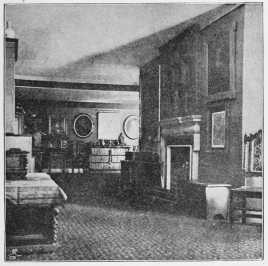
“Holmhurst, Jan. 21, 1899.—I sit alone on my hilltop, amid the swirling mists, and howling winds, and swelching rain, and am often very desolate and full of melancholy thoughts, which require active work to drive them away. But I ought not to complain, for before Christmas I was a week with the kind Llangattocks at the Hendre in beautiful Monmouthshire, seeing much that was interesting, and driving with four horses and postillions, to Raglan, and through the beautiful brown billowy country of the Forest of Dean. Then I had a quietly happy fortnight at Torquay with my kind Thornycroft cousins; and went from them to Mount Ebford to Pamela Turner, a very pleasant first cousin I had not seen for years; paying, lastly, a sad visit—because probably the last ever possible—to beautiful Cobham.... Yet I am alone now, and perhaps it is as well that my thoughts should be always turning to the ‘undiscovered country’ which will be so much to us, and of which we know nothing, even though we may be very near its shores. I work on, I enjoy on, but I feel more that life is becoming a waiting time.
‘I have a journey, sir, shortly to go; My master calls me, I must not say no.’[593]
And there is a sentence of Epictetus which seems to demand thinking about. ‘If the Master call, run to the ship, forsaking all these things, and looking not behind. And if thou be in old age, go not far from the ship at any time, lest the Master should ask, and thou not be ready.’ ... It was Adrienne de Lafayette who said, ‘Must we not all die? The great thing is to be always ready; as for the kind of death, that is only a detail.’ I think and think, as so many millions have thought, how it can be after death, and such inquiries and searchings have no answer. Still, as Jowett wrote towards the close of life, ‘Though we cannot see into another life, we believe, with inextinguishable hope, that there is still something reserved for us.’
“I feel the view usually held now on these subjects is wholesomer than that of my childhood, when ‘good people’ talked with such dogmatic assurance, in all ‘le bel air de leur devotion,’ of how glorious their life in another world would be, whilst definitely condemning so many of their neighbours to the hell which, in their imagination, was their God’s vindictive retaliation for His injuries. I often remember her words, and I think I realise the feeling with which my dear old friend Mrs. Duncan Stewart once said to me, ‘I should say, like Dr. Johnson, I am speaking in crass ignorance, according to the failings of my fallible human nature; and yet, may we not all, whilst acting like fallible human beings as we are, trust respectfully to God’s mercy, though speaking of no glorious future as reserved for us, lest He should say, “What hast thou done to deserve this?”’
“Lord Llangattock writes urging me to join the Anti-vivisection Society; but I answer I am not competent to judge of it. Then he sends me its pamphlets, which seem to me rather blasphemous, asserting that ‘Christ died just as much for all animals as for all human beings.’ What! for bugs, lice, ringworms, mosquitoes? ‘Don’t kill that flea; Christ died for it.’ Then how about cobras and puff-adders? Surely it must have been the Devil that died for those. What nonsense people, especially ‘religious people,’ write in these little pamphlets, almost as great nonsense as most country clergy preach in the dreary Sahara of their endless sermons. ‘Long texts, short sermons,’ was John Wesley’s maxim, and what a good one!”
Journal and Letters.
“Rome, March 10, 1899.—I was very ailing, and Catherine Vaughan insisted on my seeing Dr. Sansom, who found me so ‘run down’ that he insisted on my coming out here to my ‘native air;’ therefore here I am, and already it has done me good. I found my dear old friend Miss Garden rather better than I left her three years ago, and full of her sister Mrs. Ramsay’s escape, having been upset in a carriage close to the edge of the Tarpeian rock. ‘If the horse had not been assolutamente pecora,’ said the coachman, ‘she must have gone over.’
“The other day I was with a circle of old friends who were discussing the ‘Story of my Life.’ ‘Surely the early part must have been exaggerated,’ said one of them, ‘that story of Aunt Esther hanging the cat, for instance,[594] because the child loved it.’ ‘I can testify that that story was absolutely true, for I was there,’ said an old clergyman present, ‘and I have shuddered over the cruel recollection ever since.’ It was Canon Douglas Gordon. I had quite forgotten that he was a pupil of Mr. Simpkinson, curate of Hurstmonceaux, at the time. Mr. Gordon also said, ‘I can vouch, too, for the truth of the story of the bullying at Harrow, for I was myself the victim;’ and he told how a brutal bully got a dead dog, and cut off its feet, ears, &c., and forced him to drink them in coffee. That day he ran away. ‘Alexander Russell’ went with him. They had only four miles to go to his father Lord Aberdeen’s house at Stanmore. He and Lord Abercorn were governors of the school. They happened to be together, and they sent him back in a carriage that evening with a letter to the head-master saying that, in the interests of the school, what had happened had better be hushed up; but that it was so dreadful, that he—the master—must be compelled to take the awful bullying in the school seriously in hand. And he did. Mr. Gordon says that the wickedness of Harrow at that time was quite appalling: things which could never be mentioned were then of nightly occurrence all over the school. The masters were as bad, and would come into the very pupil-rooms humming obscene songs.
“What an age of independent criticism it is! An acquaintance here said to me the other day, ‘I have a horror of the patriarchs, and how any one can set up such wicked, low, mean men as an example, I cannot understand—Jacob and the rams, for instance. No wonder the Jews were bad with such examples to follow.... I believe in Christ thoroughly and cling to the thought of Him: of course the story of His birth and all that is very difficult, but “autre pays, autres mœurs,” that is what I say.’”
“March 24.—We have been to Tivoli on the most glorious day—a pellucid sky, and exquisite blue shadows flitting over the young green of the Campagna. From the station I went to S. Antonio, the old hermitage and shrine bought by the Searles. Mrs. Searle met me most kindly. I said, ‘What a beautiful home you have!’ ‘Yes,’ she answered, ‘and the really delightful thing is that the Lord has given it to us.’ I could hardly help saying, ‘I suppose that means you bought it.’ Afterwards I found she was one of the very few ladies who belong to the Salvation Army. She is kind and Christian beyond words—‘vraie marchande de bonheur’—and her lovely home is a centre of thoughtful charity; but being in this Catholic country gives her many qualms and shocks. One day lately she was alone in a lane near her home, and came upon a shrine of the Virgin with her little statue, and was filled with righteous indignation at ‘that doll.’ As she stood there, a number of peasant women came up and knelt before the shrine and prayed most devoutly. When they got up she said, ‘How could you pray to that graven image? I wonder what you were praying for.’ ‘Why, we were asking the Madonna to send us rain; our land needs it so much,’ said the women, much surprised at her wrath. ‘How can you pray to her for that?’ said Mrs. Searle; ‘let me show you how to pray,’ and then and there she knelt down in the dusty road and prayed aloud, prayed with her whole heart to her Lord, that He would send them the rain they needed; and immediately, though the sky had been quite clear till then, it poured!
“The women went away to their priest and told him that they had seen a lady who reviled the Madonna, but who was a powerful witch and had been able to bring the rain by her enchantments.”
“March 29.—To Sutri with Mrs. Ramsay. In the early morning the dew was like crystal, every leaf glistening. The mountains rose pale blue against an opal sky, but were hidden at their base by the delicate mists of the plain. It was a long, long drive before we reached the great solid rock, which is hewn away within into all the circular steps of a vast amphitheatre overhung by mighty ilexes. Behind it, is an Early Christian church, also hewn out of the rock,—pillars, font, and altar all one with it.
“Se voi pensate sedere sopra una cittadina Americana, voi vi sbagliate,’ was heard by Gery Cullum from an American lady here in altercation with her cabman.”
“April 1.—I have had one of my Palatine lectures quite in the old way, and a luncheon with the charming Crown Princess of Sweden has been a great pleasure.
“Dining at Palazzo Bonaparte, M. de Westenberg told me that one day when Madame Mère was living there, a stranger came to the palace and insisted upon seeing her on a matter of vital importance. He was evidently a gentleman, but would not tell his name or errand. At last his urgency prevailed, and Madame Mère admitted him. He gave her a crucifix and said it belonged to her son in St. Helena, and then he said, ‘You need no longer be unhappy about him, for he has just entered into rest: his sorrows are over.’ It was on that day that Napoleon died in St. Helena.
“Miss Garden says, ‘Lanciani came to me one day. He was not married then, and he said, “I am too miserably dull; it cannot go on; I must either take a wife or a cat.” “Well, and which should you prefer, Signer Lanciani?”—“Oh, a me sono tutte due eguale,” he said. “But la signora madre, which would she prefer?”—“Oh, la madre,” he said meditatively, “il gatto.”
“‘All life has its sorrows,’ says Miss Garden, ‘only they are unequally distributed. Do you know what Eddie Baddeley’s sorrow is? He is only three, you know. It is that the turkey-cock at the Villa Borghese will not make friends with him. “But don’t you think he will ever like me?” he said to his mother. “No, my dear,” she said, “I don’t think he ever will.” But it was just one of those cases in which I think a lie would have been permissible; she had better have held out hopes.’”
“Palazzo Guadagni, Florence, April 17.—I have been here ten days as the guest of the ever-kind Duchess Dowager of Sermoneta, and found Mrs. and Miss Lowther here. It is an unusual life. We scarcely see our hostess till dinner-time, unless she asks us to drive with her, and we have each a most comfortable apartment, with excellent food and service, and the whole day to employ as we like. Many are the old friends we have seen, but most frequently the Marchesa Peruzzi, Story’s daughter, who has all his agreeable power of narration. ‘The reason why we loved Mrs. Browning so much as children,’ she says, ‘is because she always treated us as her equals, and talked to us as such. Pen and I used to sit at her feet, and she was just as courteous to us as to any of the grown-up people.’”
“Arco in Sud Tyrol, April 27.—I came here with the Lowthers, and we have been some days with two delightful Misses Warre, sisters of the head-master of Eton. It is an exquisitely beautiful place, with glorious excursions. One day we have spent most deliciously at Castel Toblino, a grand old castle which looks at itself in a glassy lake surrounded by mountains. General Baratieri, a hero, though a most unfortunate one, is one of those of whom we have seen something here.”
“Holmhurst, May 10.—Reached the dear home with great thankfulness, after a most severely hard-worked fortnight for a new edition of my ‘Paris.’”
THE PORCH, HOLMHURST.
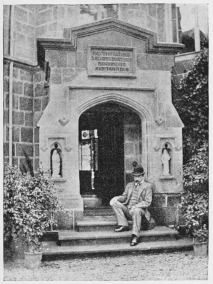
“June 14, 1899.—At luncheon at Lady Constance Leslie’s I met Mr. Holman Hunt, a charming, simple, natural man. He spoke of the great difficulty of getting any one to do such work as is wanted for St. Paul’s Cathedral; that few would give up the high prices paid now for other work for the small prices the Government would pay. He talked of Leighton, whom he had known intimately in early life. Three tailors in Bond Street, thinking it might be a good speculation, clubbed together to buy one of his first pictures. They offered £100 for it: he stuck out for £200. Eventually it was arranged that they should pay £150, but a suit of clothes was to be thrown in. Then came the violent abuse of all Leighton’s work, and the tailors got alarmed, and sold the picture for £100 without any suit of clothes. That picture was afterwards bought for thousands by the Gallery at Liverpool, and there it is now, unlikely ever to come to the hammer again.
“After this, when Leighton’s pictures were accepted for the Academy and he was hard at work for the next year, he was told by his studio-man that some one wanted to speak to him. He sent out word that he was very busy and could not see any one; but the man was pertinacious and would not go away. At last Leighton said, ‘Well, he had better come in for a minute and say what his business is.’ So he was let in. But it was a man who stood by the door and did not come further. ‘Well,’ said Leighton, ‘what do you want?’ ‘To come straight to the point at once,’ said the man, ‘I want that picture’ (pointing to the work upon the easel). ‘You get £300 now for your pictures, don’t you? Well, I will give you £700.’ ‘But you have not even seen the picture,’ said Leighton; ‘you don’t even know what the subject is.’ ‘No, I don’t,’ said the man, ‘and, if I did, I should know no more about it than I do now.’ That man was Agnew. He acquired the picture: it was his first venture.
“Mr. Holman Hunt said, speaking of the bad results of Board Schools, that he had been away lately. When he came back, a boy came to him as a model, a very good boy, whom he had not seen for some time. ‘Well,’ he said to the boy, ‘it’s a long time since I’ve seen you; I’ve been away; I’ve been at Stratford-on-Avon.’ ‘Ah,’ said the boy slowly, ‘so you’ve been at Stratford-on-Avon, have you? That’s where Shakspeare lived, him as married Anne Hathaway, and him as they called the Swan of Avon and the smooth-tongued liar (lyre). It’s well I didn’t live in them times, or they might have been calling me some such beastly names as that.’”
“Holmhurst, Sept. 8.—Early on the morning of July 29 I was summoned from home by telegraph to the dying bed of my dear cousin Catherine Vaughan, perhaps more than any one else still left bound up with all my life in the long-ago. She had forbidden any one to come to her when ill, but desired that, if it was known she was dying, I should be sent for. I found her terribly ill and suffering, though delighted to see me. That Saturday was a day of great anguish, both for herself and those with her. But she grew calmer in the night, and was with us still for four days and nights, during which I seemed to go back into my old life with my mother, constantly by her side, fanning her, wiping the poor brow, trying to help her to bear through. Almost her very last words were ‘Dear, dear Augustus.’ Then, the day before she quite left us, she was unconscious, and we sate in a great calm, only waiting for the coming of the angel. A majestic beauty had come back to her in the shadow of death, a likeness to her mother, to her brother Arthur Stanley at his best, to the ‘Curly Kate’ of sixty years ago, only now they were snow-white curls which rippled over the pillow. I think it was the so frequent sight of this life-long friend, more intimate and dearer than ever in the last few years, yet so much older than myself, which has always made me feel young, and that, with her passing away, a bridge is broken down. It has been since quite a small added pain to take leave of the old furniture and pictures, the inanimate witnesses of our lives—‘auld nick-nackets’ somebody called them—but still silent and sacred memorials of the dear Alderley and Norwich family homes, which have now passed almost to a stranger. They could still recall to those familiar with them so much that only Kate and I knew, and so much more that only Kate and I cared about.
‘Yea, truly, as the sallowing years Fall from us faster, like frost-loosened leaves Pushed by the misty touch of shortening days, And that unwakened winter nears, ’Tis the void chair our surest guest receives, ’Tis lips long cold that give the warmest kiss, ’Tis the lost voice comes oftenest to our ears; We count our rosary by the beads we miss.’[595]
“How long and how full the hours of watching by a death-bed seem! how full of what varied emotions and anxieties, an almost agonising eagerness to do the right thing every minute even in a physical sense, but much more to say the right thing, only the right thing, to one who is on the awful threshold of so great a transition, to whom, because she is on the very brink of unravelling the great mystery, all the commonplaces, even of religion, must fall so flat. One can only try to help, to support the beloved one, who is passing away from our possibilities, spiritually as well as physically, try to recollect what would be a comfort to oneself in such a crisis, and let oneself go with the departing one to the very portal itself.
“With dear Kate I had often spoken of this, yet, when the reality came, it was unlike all we had imagined, and I suppose it is always so. But I felt how well it must always be to talk over the end of life with those you are likely to be near when the close really comes. It makes a sort of death-bed comradeship, if I can so call it, which could never exist without it, and certainly in this case it made Kate cling to my being constantly with her, when she would allow no one else to see her. Then how seldom any words are possible from a dying person. In the six death-beds I have attended it has been so; and even in this case, when it lasted four days and nights, there was little speech, only an urgency that I should never leave her, that I should keep near her, that I should be close by her side as long as she was on earth at all, till she passed into the unseen.
“Whilst feeling the change which her loss makes in my life, I have read words of Bishop Magee which have come home to me. ‘The most beautiful and natural of sunsets is still a sunset, and the shadows that follow it are chill and depressing. I begin to feel the peculiar sadness that the death of much older relatives brings to those who are entering themselves on old age. When I see all those whom I remember once, middle-aged men and women, younger by many years than I am now, all passed and gone, I feel somehow as if light was going out of life very fast. There are so few living with whom one can recall the past, and grow young again in recalling it.’”
Journal.
“Holmhurst, Sept. 31.—I have been a week at Swaylands to meet the Duchess of York, and as there were scarcely any other guests, saw a great deal of her, and was increasingly filled with admiration for the dignified simplicity and single-mindedness, and the high sense of duty by which her naturally merry, genial nature is pervaded, and which will be the very salvation of England some day. Before her scandal sits dumb: she has a quiet but inflexible power of silencing everything which seems likely to approach ill-natured gossip, yet immediately after gives such a genial kindly look and word to the silenced one as prevents any feeling of mortification. All morning the Duchess was occupied with her lady in real hard work, chiefly letters, I believe; in the afternoons we went for long drives and sight-seeings—of Penshurst, Knole, Groombridge, Hever, Ightham, and she was full of interest in the history and associations of these old-world places. At Hever the owners were away, but we got a table from a cottage, and an excellent tea-meal was spread upon it at the top of the high field above the castle. If the Duchess is ever Queen of England, that table will be considered to have a history.”
“Holmhurst, Sept. 8.—I have been in Suffolk on an ancestor-hunt, which involved a delightful visit to Herbert and Lady Mary Ewart at Great Thurlow. It was in the time of George I., I think, that our great-great-uncle Francis Naylor, the owner of Hurstmonceaux Castle, a ‘Medmenham Brother’ and the wildest of the wild, was led to a changed and better life by his love for the beautiful Carlotta Alston of Edwardstone. Unfortunately, whilst they were engaged, his father, Bishop Hare, found out that her elder sister, Mary Margaret, was one of the greatest heiresses in England, married her without telling his son till the day before the wedding, and then positively forbade him to become his brother-in-law. Francis Naylor was very much inclined to go to the devil again, but Carlotta maintained her influence, and eventually they were married without the Bishop’s consent. They were too poor to live at Hurstmonceaux, but the third Miss Alston had married the rich Stephen Soame, and she gave them a home, and there, in the house of the generous Anne Soame, they lived and died. The old Jacobean mansion of Little Thurlow was magnificent and had eighty-one bedrooms; its beautiful wrought-iron gates with pilasters were given by Charles II., who often stayed there, and the family lived at Little Thurlow in most unusual state, even for that time, driving out daily in three carriages-and-four. Sir Stephen Soame, the builder of the house, has a grand tomb in the church where Francis and Carlotta Naylor and Anne Soame are buried behind his stately carved pew, and there are a most picturesque grammar-school and almshouses erected by him. I remember some of the Soames coming to Hurstmonceaux—as cousins—in my childhood, but their direct line died out at last, and the place went to some very distant relations from Beverley, who pulled down the old hall, because ‘they could not live in a house where you could drive a coach-and-four up the great staircase.’ Old Mrs. Soame, however, of the second set, did not die till she was 104, and the last of her two daughters only in 1885. Yet the Misses Soame had never been to London: their travels were limited to being driven twice a year to Lowestoft in their large yellow chariot with post-horses. They always intended to try the railway by going from Haverhill to the next station and having their carriage to meet them there; but when the day came they shrank from the feat. They were ‘worth an income to the doctor, the chemist, and the fishmonger,’ and they left a fortune to the family of a man who had once proposed to one of them.”
“Holmhurst, Oct. 23.—Again I have been on an ancestor-hunt. I met Mrs. Lowther at the old haunted house of Lawford Hall near Manningtree, and our hostess, Mrs. Mouncey, sent us to Hadleigh, where Mary Margaret Alston’s grandfather, Charles Trumbull, was the very saintly Rector in the time of James II., and resigned his living for his ordination oath’s sake on the advent of William III. The Rectory, now known as the Deanery, is a glorious old house, with a grand brick gateway, priests’ hiding-holes, and curious pictures by Canaletto—an intimate friend and visitor of one of the rectors—let into its walls. It was the home of Rowland Taylor, the Marian martyr, who was dragged down the street of Hadleigh to his stake outside the town ‘cracking jokes all the way,’ and another vicar was Hugh Rose, when Archbishop Trench was the curate.