Volume 5 — XXIII IN THE FURROWS OF LIFE
Reading edition
“Days—when gone— Gone! they ne’er go; when past they haunt us still.” —Edward Young.
“What used to be joy is joy no longer: but what is pain is easier because they have not to bear it.”—George Eliot.
“To live for the shorter or longer remainder of my days with the simple bravery, veracity, and piety of her that is gone, that would be a right learning from her death, and a right honouring of her memory.”—Carlyle.
“Dieu donne la robe selon le froid.”—Pascal.
Journal.
“DEC. 1882.—With what a numbed feeling of desolate sadness do I look back upon the last chapter. My home existence is so intensely changed by the blank which the dear old friend of my whole life has left. It was long before I could bear to go into her changed rooms, and I still wake nightly with the sad inward outcry, ‘Can it be—can it be? Is every one gone who shared our home life? Is there no one left who is associated with all our wealthy past?’ ‘Entbehren sollst du—sollst entbehren.’ And when my friends urge me to marry, I feel the utter desolateness of attempting to make new ties with any one who knows nothing and cares nothing of those with whom all my earlier life was bound up. I have happily still a great power of enjoyment when anything pleasant comes to me, but oh! how seldom it happens. Griefs and worries—griefs and worries come round with wheel-like recurrence. I often think of Aubrey de Vere’s lines:—
‘When I was young, I said to Sorrow, “Come, and I will play with thee.” He is near me now all day; And at night returns to say, “I will come again to-morrow, I will come and stay with thee.”
“Archbishop Tait, long a kind friend, is dead. I hear that at his funeral, in the beautiful churchyard at Addington, a little robin perched on an adjoining tombstone and poured forth a flood of song, apparently unconscious of all present. ‘How our father would have liked to have seen it,’ said one of the daughters.”
“Jan. 12, 1883.—Tea with Dowager Lady Donoughmore,[386] who was very pleasant. She described walking in Ireland with a stingy old gentleman. A beggar came up to them, and he said, ‘I have not got a penny to give you.’ The beggar retorted, ‘You’ve got an awful ugly face: I hope you may die soon, but I pity the worms that will have to eat you.’
“Lady Donoughmore, however, said that she had boundless experience of the natural poetry in the Irish peasantry. On receiving a shilling, an old woman said to her, ‘May ivery hair of yer honour’s head become a torch to guide yer sowle to heaven.’”
“June 19.—Dined with Lady Airlie, only meeting Mrs. Duncan Stewart and Lady De Clifford. Mrs. Stewart talked much of Mr. Carlyle.
“‘Mr. Hannay knew Carlyle very well, and often went to see him, but it was in his poorer days. One day when Mr. Hannay went to the house, he saw two gold sovereigns lying exposed in a little vase on the chimney-piece. He asked Carlyle what they were for. Carlyle looked—for him—embarrassed, but gave no definite answer. “Well, now, my dear fellow,” said Mr. Hannay, “neither you nor I are quite in a position to play ducks and drakes with sovereigns: what are these for?”—“Well,” said Carlyle, “the fact is, Leigh Hunt likes better to find them there than that I should give them to him.”
“‘I was sitting once by Mr. Bourton,’ said Mrs. Stewart, ‘and he was talking of Leigh Hunt. He said, “He is the only person, I believe, who, if he saw something yellow in the distance, and was told it was a buttercup, would be disappointed if he found it was only a guinea.”’
“Lady Airlie said she had known Leigh Hunt very well when she was a child. He had taken her into the garden, and talked to her, and asked her what she thought heaven would be like, and then he said, ‘I will tell you what I think it will be like: I think it will be like a most beautiful arbour all hung with creepers and flowers, and that one will be able to sit in it all day, and read a most interesting novel.’
“Of her early acquaintance with Washington Irving, Mrs. Stewart said, ‘It was at Havre. My guardian was consul there. People used to say, “Where is Harriet gone?” and he answered, “Oh, she is down at the end of the terrace, busy making Washington Irving believe he is God Almighty, and he is busy believing it.”’
“Mrs. Stewart told of Miss Ruth Paget, one of many sisters, who went down at night to the kitchen to let out her little dog for a minute, and found her brother Marco, who was a midshipman in the Mediterranean, sitting on the kitchen-table, swinging his legs, but pouring with wet. She said, ‘Good heavens, Marco, how did you come here?’ He looked at her, and only said, ‘Do not tell any one you have seen me.” She looked round for an instant to see if any one was coming, and when she turned, he was gone.
“Ghastly pale, she went upstairs. Her sisters said, ‘You look as if you had seen a ghost,’ and they tried to insist on her telling them what had happened to her. She put them off by complaining of headache and faintness; but she was terribly anxious.
“Three months afterwards she heard her brother was coming home, then that he had arrived at Portsmouth, then he came. The first time she was alone with him she said, ‘I must tell you something,’ and she told him how he had appeared to her, and then she said, ‘I wrote it down at the time, and here is the paper, with the date and the hour.’
“He looked shocked at first, and then said, that at that very moment, being absent from his ship without leave, his boat had been upset, and he had been as nearly drowned as possible—in fact, when he was taken out of the water, life was supposed to be extinct. His first fear on recovering was that his absence without leave would be detected by his accident and become his ruin, and his first words were, ‘Do not tell any one you have seen me.’”
“June 21.—At Madame du Quaire’s I met Oscar Wilde and Mrs. Stewart. He talked in a way intended to be very startling, but she startled him by saying quietly, ‘You poor dear foolish boy! how can you talk such nonsense?’ Mrs. M. L. had recently met this ‘type of an aesthetic age’ at a country house, and described his going out shooting in a black velvet dress with salmon-coloured stockings, and falling down when the gun went off, yet captivating all the ladies by his pleasant talk. One day he came down looking very pale. ‘I am afraid you are ill, Mr. Wilde,’ said one of the party. ‘No, not ill, only tired,’ he answered. ‘The fact is, I picked a primrose in the wood yesterday, and it was so ill, I have been sitting up with it all night.’ Oscar Wilde’s oddities would attract notice anywhere, but of course they do so ten times more in the plein midi of London society, where the smallest faults of manner, most of all of assumption, are detected and exposed at once.”
“July 2, 1883.—I have just heard again the ghost story so often told by Mrs. Thompson Hankey:
“Two beautiful but penniless sisters were taken out in London by an aunt. A young gentleman from the north, of very good family and fortune, fell in love with one of them, and proposed to her, but she was with difficulty persuaded to accept him, and afterwards could never be induced to fix a date for their marriage. The young man, who was very much in love, urged and urged, but, on one excuse or another, he was always put off. Whilst things were in this unsettled state, the young lady was invited to a ball. Her lover implored her not to go to it, and when she insisted, he made her promise not to dance any round dances, saying that if she did, he should believe she had ceased to care for him.
“The young lady went to the ball, and, as usual, all the young men gathered round her, trying to persuade her to dance. She refused any but square dances. At last, however, as a delightful valse was being played, and she was standing looking longingly on, she suddenly felt herself seized round the waist, and hurried into the dance. Not till she reached the end of the room, very angry, did she succeed in seeing with whom she had been forced to dance: it was with her own betrothed. Furious, she said she should never forgive him. But, as she spoke, he disappeared. She begged several young men to look for him, but he could not be found anywhere, and, to her astonishment, every one denied altogether having seen him. On reaching home, she found a telegram telling her of his death, and when the hours were compared, he was found to have died at the very moment when he had seized her for the dance.
“Mrs Thompson Hankey knew all the persons concerned.
ON THE TERRACE, HOLMHURST.

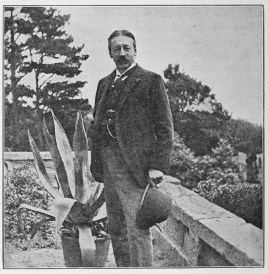
“Catherine Vaughan has just been taken to see an old woman in Scotland, whose daughter was married last year. She asked if she was getting on well. ‘Aye, she’s gettin’ on varra weel, varra weel indeed. She’s got a pig, and she’s got a cock, and she’s got a son: it’s true that she hates her mon, but one must aye have ae thing.’”
IN THE KITCHEN, HOLMHURST.
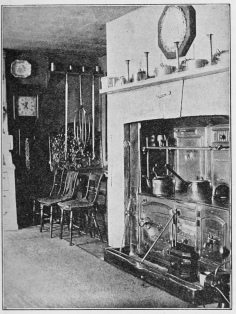
“Charlotte Leycester is to be left in possession of my little Holmhurst whilst I am away, and has such complete enjoyment of it, that I shall have no sense of wasting my home by a long absence, as would otherwise be the case.”
During the summer of 1883, I left England to join my oft-times travelling companions, the Miss Hollands, for a tour in Russia. I did not greatly enjoy this tour, partly because I felt so terribly knowing almost nothing of the language of the country, not being able to read even the names of the streets. I also suffered from not having had time to teach myself anything of the country before I went there: for, after I came home, and tried to instruct my mind by every book I could get hold of about Russia, I found my travels had been much more interesting than, from the very intensity of my ignorance, I believed them to be at the time.
At Kieff I left my companions, and found my way home alone by Warsaw and by Cracow, with its curious monuments and odious Jew population. After the great discomforts of Russia, a very few days in Germany seemed very charming, and I was especially glad to see beautiful old Breslau, and afterwards Wilhelmshohe near Cassel, in a perfect conflagration of splendid autumnal tints, truly realising Hood’s lines—
“How bravely Autumn paints upon the sky The gorgeous fame of Summer which is fled.”
To Miss Leycester.
“St. Petersburg, August 22, 1883.—A rest in the interesting group of North-German cities, Dantzic, Marienburg, Königsberg, prepared us for the thirty-six hours’ journey through monotonous fir-woods and cornfields, unvaried through 1000 miles, till two great purple domes rose on the horizon—St. Alexander Newski and the Cathedral of St. Isaac.
CATHEDRAL OF ST. ISAAC, ST. PETERSBURG. [387]
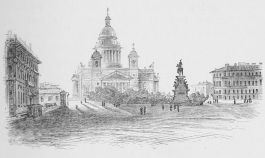
“It was difficult to believe we were in Europe on emerging from the station and seeing the endless droskies—sledges on wheels—drawn up, with their extraordinary-looking drivers, in long blue dressing-gowns (wadded like feather-beds, so as to make the wearer look like a huge pillow), with a girdle, and low cap. Then the gigantic streets, each about as broad as St. James’s Square, and the huge squares, in which the palaces, however vast, are so disproportioned to the immensity of space, that their architectural features are lost. Then the utter desolation, one carriage and two or three foot-passengers in the apparently boundless vistas. Altogether, St. Petersburg is quite the ugliest place I ever saw, even the Neva, huge as it is, so black and grim, and the smoke of the steamers giving the worst aspects of London. But yesterday evening we had a delightful drive of four hours on the islands in the Neva, which answer here to the Park, and are exquisitely varied—lovely winding alleys, bosquets of flowering trees, green meadows, little lakes, rushing brooks, every variety of cottage and villa and garden and bridge, at least twenty miles of them. Coming back, we stopped at the fortress-church to see the royal tombs—stately marble sarcophagi in groups; first Peter the Great and his family, then two groups of intermediate sovereigns, then the present family, surrounded (inside the church) by a grove of palms and laden with flowers. Close by is Peter the Great’s cottage, and the tiny early church in which he worshipped, and, at the former, the famous ‘icon’ which he carried in his wars, before which crowds of people were incessantly prostrating and kissing the pavement.”
“Sept. 4.—We returned last night from Finland, of which I am glad to have visited a specimen, though there is not much to see, except gloomy little lakes, flat country, hundreds of miles of monotonous forests of young firs and birch, and little wooden villages. All is very much like an inferior Sweden, and the people understand Swedish, and have the Swedish characteristics of honesty and civility, which, at so short a distance off, make them an extraordinary contrast to the Russians. Our journey was amusingly varied by endless changes of rail, steamer, walk, char-a-banc, as the country allowed. At Imatra, our destination, a lake tumbles into a river by curious rapids.”
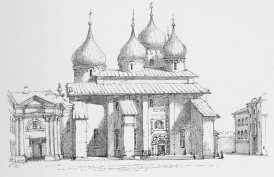
ST. SOPHIA OF NOVGOROD. [388]
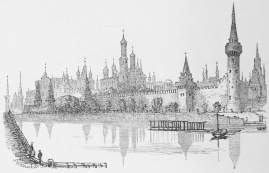
KREMLIN, MOSCOW. [389]
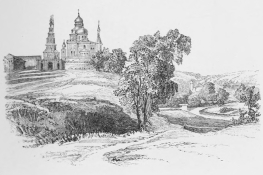
THE NEW JERUSALEM. [390]
“Moscow, Sept. 9.—We left St. Petersburg on Monday, and went to Novgorod the Great, one of the oldest cities in Russia, once enormous, but now dwindled to a large village, with a decaying kremlin and a wonderful cathedral like a mosque, a blaze of beautiful ancient colour within, quite splendid in its gold and silver decorations, and the shrines of sixteen famous saints (the Greek saints are most puzzling) who are buried there, and whose mummified hands, left outside their cerecloths, are exposed to the kisses of the faithful. A journey of nineteen hours’ rail brought us here on Thursday morning. The first impression of Moscow is disappointing—commonplace omnibuses at the station, ugly vulgar streets like the back-streets of Brighton, and, as the town is above twenty miles round and nine miles across, they seem endless. But you enter the Chinese town, in which we are now living, by gates in the strangest walls imaginable, and the street has all the crowd and clamour of Naples. Another series of very tall battlemented red walls and lofty gates announces the Kremlin. This is more striking than I expected—the three mosque-like cathedrals (there are five cathedrals and three hundred churches in Moscow), and the splendid view from the high terrace in front of them, which recalls that from the Pincio at Rome, only the Moskva is a very broad river, and every church has the strangest of towers—like bulbs, pine-apples, melons, fir-cones, gilt or blue or brightest green, covered with network, with stars, discs, moons, hung with chains like veils, every device that the wildest dream or maddest imagination can invent, and yet in this clear atmosphere of intense burning heat and with the arid low hills or burnt plains which surround the town, it all looks right. Inside, the cathedrals put all the churches in Italy and Spain to shame by their splendour, but one is sorry not to know more of their history. I can speak enough Russian now to get on humbly; but the alphabet beats me still: it is not only that there are so many letters, but that the old familiar forms of written letters mean something new.”
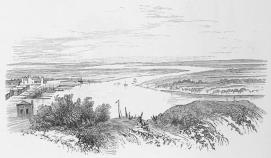
THE DNIEPER, KIEFF. [391]
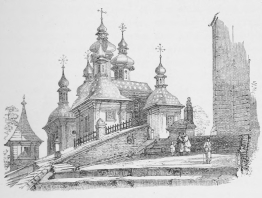
THE HOLY CHAPEL OF KIEFF. [392]
“Kieff, ‘The Holy City,’ Sept. 21.—We made excursions from Moscow to all the great monasteries. There are few other sights of importance, but these, in Russia, are quite unique—immense spaces surrounded by walls, towers, and gates, which have stood many a siege, and which are like the towns in old woodcuts, and contain gardens, cemeteries, cathedrals, usually six churches with gilt domes and minarets, besides accommodation for 600 or 800 monks and nuns, who have their wells, gardens, farms, &c. One of those which I thought most attractive was Novo Devichi, rising from an arid sandy plain close to the town, but full of lovely flowers, which a kind old prioress came and gave us handfuls of. Then we went to the New Jerusalem, where the famous Nikon lived and is buried—many hours jolting along a no-road through the forests in a rough tarantass, but a beautiful place when you get there. Nikon chose it because he thought it so like the real Jerusalem, and changed the name of its river to Jordan, and made a Kedron. It was a quiet countrified spot, and the only one I have seen which the Mother and Lea would have enjoyed in the old days, and there was a primitive inn with kindly, gentle people. We also went to the famous Troitsa, the home and grave of Philaret. In all these excursions, as everywhere else, we found the ‘difficulties’ of Russian travel entire imagination: nothing can be easier.
CITADEL OF CRACOW. [393]
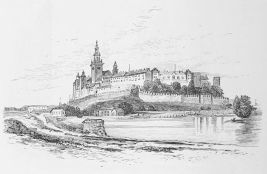
“Nevertheless, the journey to Kieff by a slow train was terrible, lasting two days and a night, and awfully hot—across a hideous brown steppe the whole way, with scarcely a tree to vary it. (There are forests till Moscow, only steppes afterwards.) I was ill and wretched enough before this interesting place rose on its low hills above the Dnieper.
“To-day, however, has quite satisfied me that it was worth while to come. It is a most unique and beautiful place, the vast town, or rather three great towns, so embosomed in trees and gardens, that the houses are almost lost. But the greatest charm lies in the constant view over the glorious Dnieper, and the immense aërial plain beyond, with its delicate pink lights and blue shadows. Then Kieff is the Mecca of Russia, full of tombs of saints and holy images, and, though this is no special season, the thousands and thousands of pilgrims are most extraordinary—in sheep-skins and goat-skins, in fur caps, high-peaked head-dresses and turbans; in azure blue, bright pink, or pale primrose colour. I never could have believed without seeing it the reverence of the Russian religion, and it has seemed the same everywhere and in all classes. The bowing and curvetting and crossing before the icons is most extraordinary, and still more so the three prostrations which all make on approaching any holy place, bending down and kissing the dust in a way worthy of an acrobat, though treated as a matter of course by the devotees themselves. But the intense expression of devotion borne by these pilgrims (who have often walked from Archangel!) is such as I have never seen on other faces, and some of the old men and women especially would make the grandest studies for pictures of saintly apostles and matrons. To see a smart young officer unhesitatingly prostrate himself and kiss the ground on sight of an icon (in the mud of this morning even), in the presence of equally smart companions, has something deeply touching in it, and one wonders if any young guardsman in England would do the same if and because he thought it right.”
“In the Warsaw train, Sept. 25.—In this smoothly gliding train, which takes one in fifty-four weary hours across the steppes, it is as easy to write as in the study at home. I should be most comfortable if it were not that my companion (in the compartment for two) is the most odious type of American I ever came across. ‘I guess you will not want to have the windows of this carriage opened till you get to Warsaw, because I will not submit to it: I am in my right, and I will not submit to it.’
“We were arrested again yesterday at Kieff, though then only by priests—veiled priests—for daring to sketch the outside of one of their sacred chapels; but after being hurried about from place to place for an hour, and shut up in a courtyard, with a wooden bench to sit upon, for another, we were regaled with a pile of beautiful grapes and apples, and sent about our business. This constant worrying when drawing has really made Russia very tiresome; but for those who do not want to draw, I do not see what difficulties travelling in the country can present, and Russians are always civil, even when arresting you.”
“Warsaw, Sept. 27.—We arrived at the junction station of Brest more than two hours late, for on some of the Russian lines no hours are obligatory, and you are quite at the mercy of conductors and their whims for spending ten, thirty, or even forty minutes in gossiping at side stations. So the Warsaw train had left Brest, and we had five hours to wait for another. Ill and wretched, I left the horrible room where a crowd of people were smoking, spitting, and smelling, and made my way to a sort of deserted public garden, where cows were browsing on the lilacs. Here, from mere want of something to do, I began to sketch some cottages and bushes, when I was suddenly seized by two soldiers and carried off to the guard-house. Here a very furious bombastical old major cross-examined me, and went into a passion over each sketch in my book, with volleys of questions about each, and then he sent me with a military escort to the station to fetch my passport. It was right, of course, and at last, after several hours, I was dismissed with ‘Maintenant c’est fini;’ but after a quadruple walk of two miles each way, and over such a pavement as only Russia can supply.
“I never was at Warsaw before, and should not care to stay. The Vistula divides the town, which is full of palaces and gardens, but has older quarters full of Jews, which are like the old streets of Paris. This afternoon I drove to the old Sobieski palace of Villanov. Two horses were necessary, for just outside this capital city the roads are like the roughest of ploughed fields.”
I spent the autumn of 1883 very quietly at Holmhurst, but paid some visits in the winter.
To Miss Leycester.
“Palace, Lichfield, Jan. 1, 1884.—After a pleasant Christmas at Kinmel, I came here yesterday to dear Augusta Maclagan. The immense quantity of work she does suits her, though it seems too much to those who do not know her. Town, Diocese, Chapter, and the society of the neighbourhood all work the willing horse alike. I cannot sufficiently admire the marvellous versatility of the Bishop, or his wonderful power of conversation, recalling that of Dean Alford in its simplicity and vivacity. He has led the most varied of lives, and has much of interest to tell of each part of it. He was for three years a soldier. When he was born, the whole house was disturbed by the most fearful row, and when they inquired what it was, the servant said, ‘Eh, it’s just Sandie and Nellie fighting over the bit bairnie.’ Sandie, who had been military servant to the father, an army doctor, said it must be brought up as a soldier. Nellie said, ‘Nay, it’s the seventh bairn, and if it’s a soldier, it must be the Lord’s soldier: the bairn must aye be a minister;’ and he was both. The Bishop is still passionately fond of riding and driving, and as soon as he gets out of Lichfield, mounts the box of his carriage and drives his own horses, ‘Pride’ and ‘Prejudice.’ He says people may consider it a terrible thing for a Bishop to be drawn hither and thither by these passions, but then it is assuredly a fine thing to have them well under control.
“The Lonsdales dined last night, and afterwards we sat up for a touching little midnight service in the palace chapel, in which the Bishop preached, but very briefly, saying just what I have so often felt, that it is not the expected, but the unexpected events which come with the New Year—that God’s hand is full of ‘surprises.’
“Augusta has written so admirable, so intensely interesting a Memoir of her dear mother, that I cannot say how delightful I find it, or how beautifully it portrays that lovely and lovable life from life to death. It is only in MS., though one of the best biographies I ever read—‘the history of a life, not a stuffed animal.’
“The cathedral is most uniform in its beauty, even the modern monuments so fine. Of the older ones, the most interesting is that of Bishop Hackett, who was appointed by Charles II. after the destruction caused by the Puritans. He found the church a ruin, and it is touching to hear how he called his choir and the one remaining canon into the only bit which had still a roof, and prayed that he might have life and energy to restore it. Going back to his palace, he harnessed his coach-horses to the first cart that drew materials for the cathedral, and, though his income was so small, he spent £8000 upon it.
“The statue of our Lord over the west front was put up by the present Bishop in the place of a statue of Charles II., which was due to a Mrs. Wilson. She was of an old Lichfield family, and married far beneath her, a mere mason; but she said to him, ‘Now you are a clever man: you know how to carve; make a good statue of his Majesty for the cathedral, and it will be heard of at court, and you will be knighted, and I shall die “my lady.”’ And all this actually happened. When the statue of Charles was being taken down, the present Dean gave a groan of ‘Poor King Charles!’—‘Why do you call him poor King Charles?’ said the Bishop. ‘Because he is being dethroned by a restoration.’
“Bishop Selwyn always desired that he might not be buried in the cathedral, so a little mortuary chapel on the outside was restored for him, and you look from the church through arches upon his beautiful sleeping figure by Adams. When the Maori chiefs were in England, they came down especially to see it, and gazed upon it with their eyes streaming with tears. ‘They have laid him on a New Zealand mat, as a chieftain should lie,’ they said.”
“Fawsley, Jan. 8, 1884.—I came here from Lichfield to find a very large party in this large and most comfortable house, with a hall of Henry VII.’s time. Sir Rainald Knightley, its owner, is a splendid type of an English gentleman, very conservative, very courteous, very clever, and devoted to country sports and interests, which alternate with the politics in which his more serious moments are spent. The only blemish on his perfectly happy married life with Miss Bowater, who enters into all his pursuits, whether duties or pleasures, politics, country business, hunting, &c., is that they have no children. He is surrounded by cousins—Charleses and Valentines—repeating in actual life the many Charleses and Valentines to whom there are monuments in the fine old church near the house. In the autumn, rheumatism takes him to Homburg, but he refuses to learn German, ‘the grinding gibberish of the garrulous Goth.’
“The parish has a population of fifty-eight, and there is only service once on Sundays, performed by the cousin who is in orders. It is alternately in the morning and afternoon, the difference being that the morning service begins at noon, and the afternoon service at a quarter past.
“Mrs. Charles Knightley drove me to Canons Ashby, the beautiful and romantic old place of the eccentric and impoverished Sir H. Dryden. I thought it looked like the background of a novel, and afterwards found that it was the background of—‘Sir Charles Grandison’!
“Lady Knightley took me to Shackborough—a pretty place. When Charles I. was going to the battle of Edgehill he met its proprietor of that day merrily hunting. He had never heard that there was a civil war going on, such was the paucity of political news! But he turned about and went with the king into the fight and was wounded there.
“At the beginning of this century, the daughter of the house became engaged to be married to an officer quartered at Weedon—a mésalliance which was greatly disapproved by her family. At last she was induced to break it off. But the officer persuaded her to grant him one last interview at the summer-house on the hill that he might give her back her letters. He gave her the letters with one hand, and with the other he shot her dead, and then shot himself.
“At Marston St. Lawrence, near this, is an old house, beautiful and moated. Here a Mrs. Blencowe was one day being dressed by her maid before the toilet-table. Suddenly she said, ‘Did you see anything’—‘Yes,’ said the maid. A hand had come out from behind the curtain. They had both seen it, and both screamed violently. Help came, and the room was searched, but no one was there.”
“Ickwellbury, Jan. 27.—A man here, being asked by Mrs. Harvey how he liked going to church, said, ‘Well, I like it very much: I goes to church, and I sits down, and I thinks o’ nowt.’”
“London, Feb. 23.—My dear Mrs. Duncan Stewart is dead. She never rallied from the sudden death of her son-in-law Mr. Rogerson. But she was able to see several people, to whom she spoke with that all-majestic charity which was the mainspring and keynote of her life. Her last words were ‘Higher, higher!’ and we may believe that she has passed into those higher regions where her thirst after life, not repose, meets its full fruition. I went to see her in the solemn peace of the newly dead, and last Thursday I saw her laid in a grave of flowers at Kensal Green, many faithful hearts mourning, many sad eyes weeping beside her coffin.[394]
“There were few equal to her. Mrs. Procter is most so. I met her the other day, and some one made her a pretty speech. She said, ‘When I was very young, Sydney Smith said to me, “My dear, do you like flattery?”—“Very much indeed,” I answered, “but I do not like it put on with a trowel.” What I really do like is—in the words of Sterne—a few delicate attentions, not so vague as to be bewildering, and not so pointed as to be embarrassing.’”
“Firle, Lewes, April 18, 1884.—I came here to find a party of twenty in the house, including Sir Rainald and Lady Knightley. It is a large house, like a French château, close under the downs, but as my kind but singular little host, Lord Gage, likes every window open in these bitter winds, the cold is ferocious. On Wednesday I got Lady Knightley to walk with me (the inhabitants of this place had never heard of it!) 2½ miles across the marshes to Laughton Place, the ancient and original residence of the Pelhams—a moated grange, having an old red brick tower with terra-cotta ornaments, and many other curious remains, looking—stranded in the desolate fen, and with an abundance of animal life—like an old Dutch picture.
“Yesterday I walked with Sir Rainald to Glynde. It is a curious old house, approached through a gateway and stableyard and by clipped yew hedges, having a pleasant view over upland country and high gardens. A fine black oak staircase leads to a noble gallery-room, with deep alcoves, so pleasantly furnished with fine pictures, &c., that, though suitable to an enormous party, a single individual would never feel solitary in it. Miss Brand did the honours of the many good portraits very pleasantly, and, before we left, Lady Hampden came in from walking, and I was very glad to see her in her country home, having so often been in her house in the palace at Westminster.”
Ill-health in June made a happy excuse for my spending a delightful month abroad. I saw first the group of towns around Laon, charming old-fashioned Noyon, beautiful Soissons, and Coucy with its grand castle. Then Alick Pitt met me at Thun, and we spent a delightful time, joining the Husseys of Scotney Castle at Mürren and Rosenlaui, sketching and flower-picking, and reawakening every slumbering sense of the delights of Switzerland.
To Miss Leycester.
“Pension Baumgarten, Thun, June 25, 1884.—You will be wishing to hear from this well-remembered place, where the mountains are quite as rugged and purple, the lake as limpid and still, the river as green and rushing, and the old town and castle as picturesque, as any youthful recollection could paint them. This pension, too, is perfectly delightful, with its coloured awnings over the wide terrace, its tubs of pomegranates and oleanders, its garden of roses, and its meadows behind, with the wooden châlets and the women making hay, and the delightful pathlets through the dark woods on the mountain-side.
“I had a calm crossing on Friday, and reached Laon by seven. On Saturday morning I saw the stately cathedral at St. Quentin, and spent the afternoon at Noyon, which has an exquisite cathedral, Calvin’s curious old house, and a most attractive little inn. Sunday I was at Coucy, where there is the finest ruined château in existence after Heidelberg, beautifully situated amongst wooded hills, in scenery so pretty, you would take it for the Vosges, not Picardy. Monday morning I spent at Soissons, with two fine cathedrals, one in ruins, and an interesting town, and then came on by night to Berne.
NOYON. [395]
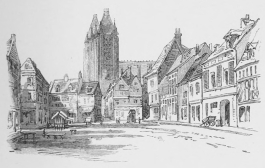
“The last night I was in London I dined with the Reptons to meet the Kildares—Lady Kildare quite the most beautiful creature I ever saw.”
SOISSONS. [396]
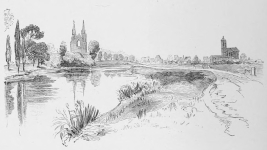
Journal.
“Oct. 10.—Since I returned from Switzerland, my home life has been quite happy and uneventful. Only ten days ago I had a telegram from ‘my Prince’ (of Sweden and Norway), asking me to come and spend Sunday afternoon and evening with him at Eastbourne, as he was only there for two days. He met me most cordially and affectionately, making me feel as if the seeming neglect of several years was only ‘royalty’s way,’ and pleasantly taking up all the dropped threads of life. We were several hours together, and while we were talking a sweet-faced young lady looked in. ‘I must come in: you are such a friend of the Prince: I have heard of you, too, all my life. I am so very glad to see you at last,’—and I felt at once that the Crown-Princess was a friend.
“She wanted to know what I thought of the Prince—the Prince wanted to know what I thought of her: I was glad to be able to answer both most satisfactorily.
CHÂTEAU DE COUCY. [397]
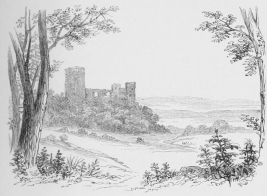
“I saw her again at dinner, and she talked most delightfully, and was full of animation and interest. I came away with a happy feeling that my affectionate occupation of many months for the Prince had, after all, not been thrown away.”
“Highcliffe, Oct. 26, 1884.—Lady Waterford says that the father of that Thérèse Longworth who called herself Lady Avonmore was a young clerk at Bordeaux at the time of the Noyades. Two beautiful young girls were tied together, and were going to be drowned. Suddenly a poissarde, seized with compassion from their looks, jumped upon a barrel and shouted, ‘Are there no young men here who will save the lives of these two beautiful girls by marrying them?’ Longworth and another young fellow were looking out of a window at the time and heard it, and said to one another, ‘Shall we do it?’ It was rather a gulp, for they were both very young at the time; but they went down and said they would, and they were both married there and then, by joining hands after the fashion of the Commune. The daughter of one of those marriages was Thérèse Longworth.”
Early in October I paid a visit to my distant cousins, Mrs. Quin and her brother, Edmund Boyle, who were staying at Ramsgate. The health of Sir Moses Montefiore, at the great age of one hundred, was then a great topic of the place. Mrs. Quin said something to him about another year at his age being only a waiting time, when he answered sharply, “What do you mean by feeling old? I only feel forty.” He said no one had ever mentioned the name of Christ to him except one person, and that was Cardinal Antonelli!
Journal.
“Ruxley Lodge, Oct. 30.—I am enjoying a pleasant visit to Lady Foley and her sons; only Lady Jane Repton here besides. It is a charming house, full of books and pictures, in a beautiful country, with fine views of Windsor and Claremont. Once there was an old priory here, but only the fishponds are left. We went to-day to see the tomb of Pamela, mother of my Uncle Fitzgerald, at Thames Ditton. It was brought there from Montmartre, where it was broken by a bomb in 1870. It is inscribed, ‘Pamela, Ladye Edward Fitzgerald, par son ami dévoué, L. L.;’ and no one now knows who L. L. was. Close by are the graves of her daughter, Lady Campbell, and several of her grand-daughters.
“The Foleys are said to descend from ‘Foley the Fiddler,’ a mechanic who determined to make his fortune by finding out the secret of making nails by machinery in Sweden. Up to that time the secret had been successfully kept: the ironfounders had shut every one out, and let no one see their process. But Foley the Fiddler, pretending to be half-witted, went and played in the neighbourhood of the manufactory. The Swedish workmen danced to his music, and eventually were so delighted with him that they could not resist taking him to play inside the factory. When he had been there some time, he fancied he had seen all he wanted, and went home. He set up ironworks on the plan of what he had seen, but when he came to completing them, found that, after all, he did not understand the process perfectly. He went back, and the Swedish workmen were quite delighted to find him again fiddling outside the factory—‘a daft fiddler’—and they brought him in, and he learnt all he wanted, and went home and made a great fortune.”
“Goldings, Herts, Nov. 20.—Isabel Smith says that a lady in Wales, a friend of Miss Frances Wynne, looked up suddenly one day after reading the obituary in the Times, and exclaimed, ‘Now, at last, my lips are unsealed.’ Then she told this:—
“One day she had been alone at her country-house in Wales, with her son and a friend of his. She had received all the money for her rents that day—a very large sum—and put it away in a strong box. Being asked, she said she did not mind the least having it in her room, and should sleep with the key under her pillow.
“When she had been in bed some time, she was aware that her door opened, and that a man in a cloak came into her room with a candle. He passed the candle before her face, but she lay with closed eyes, perfectly motionless. Then he felt for the key; he felt for a long time, but somehow he failed to find it. At last he went away.
“As soon as the door closed, she sprang out of bed, intending to go to her son’s room to warn him that a robber was in the house. But his room was a long way off, and she thought it would be better to go instead to the friend, whose room was nearer.
“As she opened the door suddenly, she saw a figure muffled up in a long cloak put down the candle. It was the same figure who had come into her room. She looked at him fixedly. ‘To-morrow at 9 A.M.,’ she said, ‘the dogcart will come to the door which was to have taken my strong box to the bank: you will go in that dogcart, and you will never enter my door again. If you never attempt to do this, I will never say a word on what has happened as long as you live.’ And she never did, even to her son.”
“Nov. 21.—We have spent the day at Knebworth, an interesting place, though full of shams—a sham old house, with a sham lake, sham heraldic monsters, sham ancient portraits, &c. Lord Lytton, with his velvet collar and gold chains, recalled his father, who is represented on the walls, with his boots pointed like a needle, in a picture by Maclise. The ‘old’ rooms are chiefly modern in reality, but there is one really ancient bedroom—a room in which Queen Elizabeth once slept. Lady Lytton, beautiful, charming, and courteous, looked like a queen in the large saloons and galleries. We found Lady Marian Alford, Lady Colley—the pretty widow of Sir George—and Lady Paget, with her nice son Victor, amongst the guests.
“I wish one did not know that the real name of the Lyttons is Wiggett. William Wiggett took the name of Bulwer on his marriage with Sarah Bulwer in 1756, and his youngest son (the novelist) took the name of Lytton on succeeding to his mother’s property of Knebworth, she being one Elizabeth Warburton, whose very slight connection with the real Lytton family consisted in the fact that her grandfather, John Robinson was cousin (maternally) to Lytton Strode, who was great-nephew of a Sir William Lytton, who died childless in 1704.
“I have had the small trial of another ‘call’ of £300 on those unfortunate Electric Lights in which St. George Lane Fox involved me. I had saved up the money, so it was there, but it was provoking to have to pay what is almost certain to be lost, yet to be obliged to do so, as the only chance of seeing again any part of the £7000 which had gone before it. However, I am never more than very temporarily troubled by such things—there is no use. All I have ever made by my writings in fourteen very hard-worked years is gone now through St. G. Lane Fox—there is nothing else left to lose.”
“Thoresby Park, Dec. 12.—This has been a most delightful visit at one of the great houses I like the best. Its inmates are always so perfectly brimming with kindness, goodness, and simplicity, and every surrounding is so really handsome, even magnificent, without the slightest ostentation. I arrived with Lord and Lady Leitrim—he quite charming, so merry, pleasant, and natural, and she one of the delightful sisters of charming Lady Powerscourt. It has been a great pleasure to find the Boynes here, and Lady Newark, who is an absolute sunbeam in her husband’s home—perfect in her relation to every member of his family. I have been again to Welbeck and Clumber, only remarking fresh at the former a fine Sir Joshua of a Mr. Cleaver, an old man in the neighbourhood, dressed in grey, and the melancholy interesting portrait of Napoleon by Delaroche, given by the Duc de Coigny.
“A Mrs. Francklin (sister of Lord St. Vincent), staying here, says that a young man, going to stay with Millais, saw distinctly a hand and arm come out of the fireplace in his room, and do it repeatedly. At last he told Millais, who said it had often happened before, and they had the hearthstone taken up, and found the bodies of a woman and child.”
“Babworth, Dec. 14.—Mrs. Drummond Baring has been most agreeable in her talk of the society at Paris under the Empire, the soirées intimes, at which all etiquette was laid aside, and Prosper Merimée, Théophile Gautier, &c., were seen at their best. No one knew so much about the Empress as Merimée. He had known her well as a girl, and all the letters about the marriage had passed through his hands. Nothing could be more naïve than the Empress in her early married days. She would go shopping. She clapped her hands with delight at the opera-bouffe, and the Emperor took them and held them, to the great delight of the people, who applauded vehemently.
“In the last days at the Tuileries, all the court ladies were only occupied in packing up their own things; all deserted their mistress except Madame le Breton. She and the Empress stayed to the last. The Empress asked General Tronchin how long the palace could hold out. He said, ‘Certainly three days.’ It did not hold out three hours. They fled as the people entered, fled precipitately by the long galleries of the Louvre, once in agony finding a door locked and having to look for the key. The Empress had no bonnet. Madame le Breton, with a bit of lace, made something for her head. They reached the street and hailed a cab. ‘Eh! ma petite mère,’ said the driver, ‘il parait que nous nous sauvons: où est le papa donc?’ But he took them and did not recognise them. They went in the cab to the Boulevard Haussmann. Then they found that they had no money to pay it, and Madame le Breton took off one of her rings. ‘We have forgotten our money,’ she said, ‘but you see how suffering my friend is. I must take her on to the dentist, but I will leave this with you; give me your address and I will redeem it.’ And he let them go.
“They took a second cab to the house of Evans, the American dentist, and there found he was gone to his villa at Passy. They followed him there, but when they reached the villa, the servant said he was out, and positively refused to let them in. But Madame le Breton insisted—her friend was so terribly ill: Mr. Evans knew her very well: she was quite certain that he would see her: and at length she almost forced her way in, and, moreover, made the servant pay the cab. At last Mr. Evans came in. He had been to Paris, in terrible anxiety as to the fate of the Empress, knowing that the mob had broken into the Tuileries.
“Mrs. Baring said that when Plonplon, commonly called ‘Fatalité,’ was ill, the people said he was ‘Fat alité.’”
“Hickledon, Dec. 17.—No words can say how glad I am to be here with the dearest friend of my young life—dearer still, if possible, with all his six children around him, who are learning also to be fond of me. We walk and talk, and are perfectly happy together in everything.
“We have been to visit Barnborough Church. A man met a wild-cat in Bella Wood, some distance off. He and the cat fought all the way along the hillside, and they both fell down dead in this church porch.
“Yesterday we went to Sprotborough to visit old Miss Copley. It is a very pretty place, a handsome house on a terrace upon a wooded bank above the river. Sir Joseph Copley and his wife Lady Charlotte (Pelham) quarrelled early in their married life. He overheard her at Naples, through a thin wall of a room, telling a friend that he was mad, and he never forgave it. They were separated for some years, then they lived together again, but there was no cordiality. They were really Moyles. A Moyle married a Copley heiress, and the Copleys long ago had married the heiress of the Fitzwilliams, for Sprotborough was the old Fitzwilliam place, and many of the family are buried there in the church. The Copleys divided into two branches, of Sprotborough and Wadsworth, and it is a pretty story that when the Copley of Sprotborough had nothing but daughters, he left the estate to the Copley of Wadsworth, and then, when the Copley of Wadsworth had nothing but daughters, he left it back to the representative of the other branch. Not far from Sprotborough, Conisborough stands beautifully on the top of a wooded hill: in ‘Ivanhoe’ its castle is the place where Athelstan lies in state when supposed to be dead.
“The Bishop of Winchester told Charlie Wood that his predecessor, Bishop Wilberforce, had always very much wished to see a portrait at Wotton (the Evelyns’ place) of Mrs. Godolphin, whose life he had written whilst he was at Alverstoke. This wish he had often expressed; but Mr. Evelyn had not liked the Bishop, and he had never been invited.
“On the day on which the Bishop set off with Lord Granville to ride to ‘Freddie Leveson’s,’ Mr. Evelyn, his brother, and a doctor were sitting late in the dining-room at Wotton, when the brother exclaimed, ‘Why, there is the Bishop of Winchester looking in at the window.’ They all three then saw him distinctly. Then he seemed to go away towards some shrubs, and they thought he must have gone round to the door, and expected him to be announced. But he never came, and an hour after a servant brought in the news that he had been killed only two miles off.
“Mrs. George Portal of Burgclere told Charlie Wood that when Allan Herbert was so ill at Highclere—ill to death, it was supposed—the nurse, who was sitting up, saw an old lady come into the room when he was at the worst, gaze at him from the foot of the bed, and nod her head repeatedly. When he was better, and after he could be left, the housekeeper, wishing to give the nurse a little distraction, showed her through the rooms, and, in Lord Carnarvon’s sitting-room, the nurse suddenly pointed at the portrait over the chimney-piece and said, ‘That is the lady who came into the sick-room.’ The portrait was that of old Lady Carnarvon, Allan Herbert’s mother, and the servants well recollected her peculiar way of nodding her head repeatedly.
“Mrs. George Portal was niece of Lady Anne Townshend, who was also aunt of that young Lord George Osborne who was killed at Oxford when wrestling with Lord Downshire in 1831. On the day of his death, she saw him pass through the room; she called to him, and he did not answer; she rang the bell for the servant, who declared he had never entered the house, and then she wrote the fact of having seen him to her husband, who was absent. Next morning came a messenger to tell Lady Anne of the death of her nephew, with whom she had been very intimate, and to beg her to break it to her sister—his mother, the Duchess of Leeds. Years after, when Mrs. George Portal was sorting her aunt’s letters after her death, she found amongst them the very letter to her husband in which she told what she had seen.”
“Mount St. John, Dec. 20.—To-day was Lord Halifax’s birthday. The hounds met at Hickledon, wishing to do him honour, but it was almost too much for him. With me, I think it has been a pleasure to him to go back into old days, old memories, old sketch-books, &c. I cannot say how much I enjoyed my visit to the kind old man, as well as to my own dear Charlie—better, dearer, more charming than ever, and more in favour, one feels sure, with God as well as with man.
“Yet Charlie does not wish to die: his life here is so perfectly happy and useful, but he says that it must be ‘very unpleasant to God to feel that His children never wish to come home: he is sure he should feel it so with his children.’ He says he is quite certain what the pains of Purgatory will be—‘they will be the realising for the first time the love of God, and not being able to do anything for Him: this life is our only chance.’ He says he is ‘sure that the next life will be in a more beautiful world, like this, only glorified, and so much, oh! so much better in everything. “Such cats!” my Uncle Courtenay says, “such cats!”’
“Young Charlie came home yesterday, a most delightful boy, only less engaging perhaps than little Francis.[398] To me, these children of my dear brother-like friend are what no other children can ever be.
“This Mount St. John (where I am now visiting Mrs. J. Dundas, Charlie Wood’s sister) is a beautiful place, very high up in hills which are now snowy. There is a long chain of them, ending in Rolleston Scaur, where it is said that, in the earliest times of Christianity, the followers of the Druids met the first missionaries in a public discussion. The devil was disguised in the ranks of the former, who, for a long time, had the best of it; but, when Christian truth began to prevail, he was so disgusted that he flew away to the neighbouring isolated height of Hode’s Point, and a stone which stuck to his red-hot foot was deposited on its summit—a tangible proof of the story, as it is of a wholly different geological formation from its surroundings. The view from these hills is intensely beautiful, comprising York Minster in the hazy plain, and the many places which take their name from the god Thor—Thirkleby, Thirsk, &c.”
“Dec. 24.—Yesterday we spent at Newburgh, cordially received, and shown all over the house by Lady Julia Wombwell—a most simple, pleasant, winning person. There is the look of an old Dutch house externally, in the clock-tower, clipped yews, and formal water. Inside, the house is very uncomfortable and cold, and has no good staircase. Mary, Lady Falconberg, Cromwell’s daughter, is said to have rescued her father’s body from Westminster at the Restoration, and to have buried it here at the top of the stairs leading to the maids’ rooms. The family, however, prudently refuse to open ‘the tomb’ and see if there is anything inside. Two portraits are shown as those of Mary, Lady Falconberg, and there really is an old silver pen which belonged to her father. There is a beautiful Vandyke of a Bellasye in a red coat, and a good Romney of a lady. The church has an octagonal tower and some tombs of Falconbergs. At the end of the village is the house of Sterne, who was curate there, with an inscription.”
“Whitburn, Dec. 28.—Lizzie Williamson[399] says she wonders very much that, when our Saviour was on earth, no one thought of asking Him if people ill of hopeless and agonising complaints, idiots, cretins, &c., might not be put out of the way—‘the Bible would have been so much more useful if it had only given us a little information on these points.’
“I stayed a few hours in Durham as I passed through, and found what is so picturesque in summer unbearably black and dismal in winter. The present Dean (Lake), who has so spoilt the cathedral, is most unpopular. One day he had taken upon himself to lecture Mr. Greenwell, one of the minor canons, for doing his part in the service in thick laced boots. Greenwell was furious. Rushing out of the cathedral, he met Archdeacon Bland, the most polite and deliberate of men, and exclaimed, ‘I’ve been having the most odious time with the Dean, and I really think he must have got the devil in him.’—‘No, Mr. Greenwell, no, no, not that,’ said Archdeacon Bland in his quiet way; ‘he is only possessed by three imps: he is imperious, he is impetuous, and he is impertinent.’
“People are full of ‘The Unclassed,’ a powerful novel, though, as a very pretty young lady said to me the other day, ‘not at all the sort of book one would give to one’s mother to read!’
“Coming through Roker, I heard a woman say, ‘Wal, geese is geese, and ye canna mak um nought else.’ But some one else had this to report as a specimen Northumbrian sentence: ‘I left the door on the sneck, and, as I was ganging doun the sandy chare (lane), I met twa bairnies huggin a can o’ bumblekites, and a good few tykes were havin a reglar hubbledeshoo o’ a midden.’”
“Brancepeth Castle, Jan. 3, 1885.—Mr. Wharton dined. He said, ‘When I was at the little inn at Ayscliffe, I met a Mr. Bond, who told me a story about my friend Johnnie Greenwood of Swancliffe. Johnnie had to ride one night through a wood a mile long to the place he was going to. At the entrance of the wood a large black dog joined him, and pattered along by his side. He could not make out where it came from, but it never left him, and when the wood grew so dark that he could not see it, he still heard it pattering beside him. When he emerged from the wood, the dog had disappeared, and he could not tell where it had gone to. Well, Johnnie paid his visit, and set out to return the same way. At the entrance of the wood, the dog joined him, and pattered along beside him as before; but it never touched him, and he never spoke to it, and again, as he emerged from the wood, it ceased to be there.
“‘Years after, two condemned prisoners in York gaol told the chaplain that they had intended to rob and murder Johnnie that night in the wood, but that he had a large dog with him, and when they saw that, they felt that Johnnie and the dog together would be too much for them.’
“‘Now that is what I call a useful ghostly apparition,’ said Mr. Wharton.”
“London, Feb. 22, 1885.—At dinner at Miss Bromley’s I met the Misses Bryant, who live in 17 Somerset Street. On the ground-floor of the house is a large room said to be haunted, and in which such terrible noises are heard as prevent any one sleeping there. A man with a grey beard once committed suicide in that room. The other day some children, nephews and nieces of the Misses Bryant, came to spend the afternoon with them, and, to amuse them, one of the ladies got them to help her in arranging her garden upon the leads. While they were at work, the little boy looked over the parapet into the court below, and said, ‘Who is that old man with the grey beard who keeps looking at me out of that window? Oh! he is gone now, but he has put out his head and looked up at me several times.’ The window was that of ‘Greybeard’s room.’ Miss Bryant immediately ran down and asked the servants if any one with a grey beard had come into the house, but no one had entered the house at all, and ‘Greybeard’s room’ was locked up.”
“March 7.—Two days ago I dined with Lady Sarah Lindsay to meet Colonel Hugh Lindsay and Lady Jane. Colonel Lindsay was full of spiritualism and the wonderful discoveries this generation seems on the verge of. He had himself seen a large table, which had been first set in motion, after the hands which touched it were taken away, float up to the ceiling, remain there for some time over their heads, and then float down again. ‘The conjurors Maskelyne and Cook could not have done this; they might have raised the table (by wires), but it would not have floated.’
“Colonel Lindsay spoke much of the wonderful Providence which keeps down voracious animals. He said that the aphis (of the rose, &c.) reproduced itself in such intense multitudes, that, if not kept down by weather and other insects, it would, in ten days, have assumed proportions equal in volume to many thousand times the inhabitants of the earth, the whole air would be darkened, and every living thing upon earth would be utterly consumed by them!
“Lady Sarah told of her grandmother, old Lady Hardwicke,[400] with whom a young lady came to stay. They dined at three o’clock, but when the girl came down, she was dreadfully agitated, and looked as if she had seen a ghost. When Lady Hardwicke pressed her as to the reason, she, after a time, confessed that it was because there was a spirit in her room. It came to her lamenting its hard fate whilst she was dressing, and she was sure there had been a murder in that room. Lady Hardwicke said, ‘Well, my dear, to-morrow you must let me come and stay with you when you are dressing,’ and she did. Soon the girl said, ‘There—there it is!’ and Lady Hardwicke really did hear something. ‘Oh, listen!’ cried the girl. ‘Once I was hap-hap-hap-y, but now I am me-e-e-serable!’ a voice seemed to wail: it was the old kitchen jack!”
“March 19.—Edward Malet was married to Lady Ermyntrude Russell in Westminster Abbey at 4 P.M. Seldom was there a greater crowd in the streets near Westminster. I met Lady Jane Repton in the crush, and we made our way in together through the Deanery. The glorious building was crowded from end to end, and the music most beautiful. Perhaps the greatest of smaller features was Lady Ermyntrude’s dress, which the papers describe as ‘more pearly than pearl, and more snowy than snow.’”
“March 28.—Dining at Mrs. Quin’s, I met Mrs. Ward, who was very amusing.
“She described the airs of Frances-Anne, Lady Londonderry.[401] One day she was extremely irritated with her page, and sent him to Lord Londonderry with a note, in which she had written in pencil, ‘Flog this fellow well for me: he has been quite unendurable.’ But the page read the note on the way, and meeting one of the great magnificent flunkeys, six feet high, said, ‘Just oblige me by taking this note in to my lord: I am forced to do something else.’ The flunkey brought out the answer, and met the page, who took it in to his lady. She was rather surprised, for it was—‘I’m afraid.’ Mrs. Ward was in the house when this happened.
“Mrs. Ward recollected, in her own childhood, when she was not three years old, sitting on the floor in her mother’s sitting-room cutting up a newspaper with a pair of blunt scissors. A lady came in to see her mother, and brought with her two very fat children, with great round staring eyes. The children were told to sit down by her on the floor, and she was bidden to amuse them. It was impossible: they only stared in hopeless irresponsiveness. Soon her mother began to talk as loudly as she could. It was to drown the voice of her own little girl, whom she heard repeating aloud a verse of the psalm she had been learning that morning, ‘Eyes have they, but they see not: ears have they, but they hear not: neither speak they with their lips.’
SHRINE OF ST. ERASMUS, WESTMINSTER ABBEY. [402]
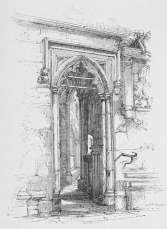
“In the afternoon I went with a crowd to see Herkomer’s portrait of my friend Katharine Grant—a magnificent tour de force, white upon white.”
On the 1st of May 1885 I set off on the first of a series of excursions in France for literary purposes, oftentimes of dismal solitude, and always of weary hard work, though full of interest of their own. I found then, as I have always done, how different seeing a thing with intention is to ordinary sight-seeing. A dentist at Rome once said to me, “Mr. Hare, you do not brush your teeth.”—“Yes, indeed I do,” I answered, “every night and morning.”—“Ah! yes; you brush them from habit, but not from motive;” and I discovered the result from my many past tours in France had been just the same. As usual, I found that the ordinary English travellers, who are always occupied in playing at “follow my leader” all the time they are abroad, had missed the best part of France, and that the churches and abbeys of the Correze and Creuse—almost unknown hitherto—are absolutely glorious; and some places in that part of France—Rocamadour, for instance—worthy of being compared with the very finest scenes in Italy. I described much of this tour in a series of papers in the Art Journal, as well as in my books on France. In the central provinces the accommodation was very good in its way, and the food always excellent, but in some of the places in the Eastern Pyrenees the dirt was scarcely endurable. The excellent hotel at Montpelier came as a real respite. Whilst there, I made some acquaintance with a banker of the place, who had a poetic Ruskin-like way of describing the wildness of the Cevennes, the grey rocks, desolate scenery, long lines of russet landscape. This so took hold of me, that I went to Lodêve and engaged a carriage for several days to explore the Cevennes thoroughly. It was wild enough certainly and rather curious, but an unbroken monotone; every view, every rocky foreground, even each dreary ruinous village, repeated the last, and after eight or nine hours I was utterly wearied of it; thus it was an intense relief when my driver came in the evening, with no end of apologies, and said he had received a telegram, bidding him return at once to Lodêve; and I was free to jump into the first diligence and reach the nearest station. Railway then took me to Mende, an exceedingly beautiful place, and afterwards to Rodez. Hence I went south again by S. Antonin and Bruniquel, whence beautiful recollections of the spring verdure and clear river come back to me. I made a little tour afterwards to Luchon and other places in the Pyrenees which I had not seen before, and returned straight home from Bordeaux. During this two months’ tour I do not think I ever once saw an English person, even in the railway, and I made no acquaintances.
I found Lourdes entirely changed since I was there last by its enormous religious pilgrimages, and no doubt, whether from the healing waters or the power of faith, many wonderful cures had taken place. It was strange, on nearing the miraculous fountain, to read the inscription, “Ici les malades vont au pas,” &c. A story was told of an officer who had a wooden leg and came to the fountain. When he put in his legs (he put them both in, the wooden leg and the other), as he did so he uttered a little prayer—“Faites, Seigneur, O faites que mes jambes soient pareilles.” When he drew them out, they were both wooden legs!
To Miss Leycester.
“Châteauroux, May 6, 1885.—What weather! bitter north-east winds and torrents of rain ever since I landed in France.... I spent Sunday at Etampes, a little narrow town, one street wide and three miles long, with four churches of the utmost architectural importance.... Leaving Orleans, my ‘Untrodden France’ began, and very pleasantly, at pretty Vierzon on the rushing river Cher. There are rather oppressive moments of solitude, but in this awful weather I am especially glad not to have any grumblers against disagreeables which cannot be helped.”
“Argenton, May 8.—Yesterday I was called at five for an excursion of forty miles up the valley of the Creuse, but it rained in such torrents it was impossible. At eight it cleared a little, and I set off, and did it all, returning at eight, but it rained in a deluge more than half the time. There were, however, beautiful moments of sun-gleam, and the scenery very lovely. At Le Crozant, the great rendezvous of French artists, where a most charming old woman keeps a very primitive inn, it is even magnificent, finer than anything on Rhine or Moselle—stupendous rocks and a grand castle. Gargilesse, the place where Mme. George Sand lived so oddly, and wrote ‘Promenades autour de mon Village,’ is also a very curious and charming place, the village clustering around a romanesque church in the enceinte of a great ruined castle above the river.”
“Brive, May 15.—I feel like a child eating through a cake, feeling it a duty not to leave anything remarkable unseen in this part of France, so little known to the English. How unfairly those judge this country who measure France by what they see from the well-known railways to Strasbourg or Marseilles. Nothing can be more beautiful than these hills and valleys of the Creuse and Correze, nothing more rich than the forest-clad country, besides the interest of endless castles and later châteaux, of old towns where the greater proportion of the houses date from the thirteenth century, and of perfectly honest, primitive, and unspoilt people.
“I came to Limoges last Friday, and remained there five days, that is to say, was scarcely there at all, but returned to a good hotel there at night. I saw the great castle of Chalusset; the romanesque Abbey of Solignac; S. Junien, a most grand church; Le Dorat, almost as fine; Montmorillon, full of curiosities; and Chalus, where Richard Cœur de Lion was killed, and where, under the old castle he was besieging, the stone called Rocher de Malmont still rises in the water-meadows, upon which he was standing when the fatal arrow struck him.
LE CROZANT. [403]
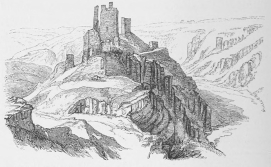
“Then I came here, and am staying here in the same way, breakfasting daily at seven, off at half-past seven, and only returning to go to bed. All yesterday I was at the wonderful sanctuary of Rocamadour—the La Salette of these parts—a most curious place, beautiful exceedingly; indeed, though it sounds a very grand comparison, rather like—Tivoli! But it poured all day, with a bitter wind, and this has been the case every day, only this afternoon there have been lovely lights at the falls of Gimel in the exquisite mountain forests. I am so glad I have no companions: they would never have endured the discomfort. No words can say how tired I am every day, nor how wet, nor how dirty; but I shall be glad afterwards to have done it all.”
SOLIGNAC. [404]
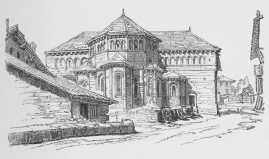
ROCAMADOUR. [405]
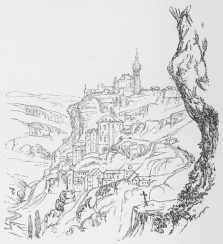
“Sarlat in the Dordogne, May 21.—We are still in swelching torrents ... but this is a pleasant little hotel in an old cathedral town, with marvellous streets of houses of fourteenth, fifteenth, and sixteenth centuries. The weather makes no end of hindrances and discomforts, yet in this tour, as in all others, I have found that expected misfortunes never happen: there are plenty of others, but what one looks for never comes, and I have gone on steadily, missing nothing of the plan marked out, only sometimes delayed. The people are beyond measure pleasant and kind, and the cheapness of everything is a perpetual amazement.”
“Carcassonne, May 28.—On Friday 23rd it poured in torrents, but I could not give in, so went by the earliest train as far into the hills as it penetrated, and then by omnibus to Souillac, one of the grand and glorious abbey churches, now parochial, which are so common in that part of France and nowhere else—full of colour and solemnity, though rugged to a degree, and into which you descend by long flights of steps.
“It poured in returning too, but I stopped at a wayside station, and a long walk through chalky mud and a ferry over the Dordogne took me to Fénelon, which is a noble old château splendidly placed on a peninsula looking down upon the meeting of many valleys and streams. It has always been kept up; its terraces were in luxuriant beauty of flowers, and the owner, Comte de Morville, was excessively civil in showing everything. I drew under an umbrella in torrents.
CLOISTER OF CADOUIN. [406]
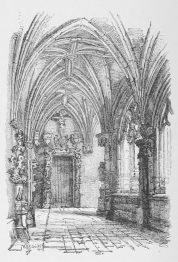
“Saturday I was up at five, and off by rail and road to Cadouin, another of those grand abbey churches, of the same character as the rest, but with the addition of a splendid gothic cloister. I arrived at nine, perished with wet and cold, but was resuscitated by the kind woman at the little inn, who made a hot fire on the great dogs of her hearth, and soon had hot coffee ready. It was, however, a long day, and I did not arrive till near midnight at Montpazier. This curious Bastide was built by Edward III. of England, and has never been touched since his time, and, whilst all is so changed in England, it was interesting to find in this remote French hill-country a town the same as when the Black Prince lived there, with old walls and gates, gothic house-windows, rectangular streets, and in the centre of all the market, surrounded by arcades like those at Padua, only here the arcades are so wide that you can drive in them. It was a quaint, charming place, and I stayed till Monday, spending Sunday in the magnificent old Château de Biron.
ARCADES OF MONTPAZIER. [407]
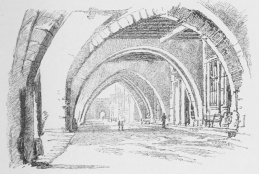
“Then, by Cahors, with its wonderful old bridge over the Lot, I came to Montpezat, a very simple place and primitive inn—wild open down, old church, arcaded streets, flowers, goats, and old women in white-winged caps. Late that night I reached Moissac, a place where there is a wonderful church and cloister, which has been extolled as one of the archaeological marvels of the world, but its describers have evidently never seen St. Junien, Le Dorat, Souillac, Cadouin.”
“Narbonne, June 4.—The wet weather has changed to intense heat. Saturday was an interesting day at Alet, a ruined cathedral, and pretty desolate place on the edge of the Eastern Pyrenees, with a very admirable old curé, with whom I made great friends. That afternoon brought me to Perpignan, an almost Spanish town on the frontier—filthily dirty, but I was obliged to stay there to see Prades, the fine lonely monastery of S. Michel de Cuxa, Amélie les Bains, and Arles-sur-Tech. The great excursion to the latter place was indeed a penance—ten hours in a jolting diligence, five each way, with burning sun and stifling dust, and four passengers forced into each place meant for three, so that any movement was impossible, and as the diligence started at five, one was breakfastless. However, all miseries have an end, and Aries had to be visited, for St. Abdon and St. Sennen are buried there; but oh! how glad I was I had no companion to suffer too! On the way here I saw Elne, most Spanish and picturesque, with perhaps the most beautiful cloister in the world. Yesterday too was an interesting day, spent entirely at the great convent of Fontefroide, in the mountains nine miles from hence, spared at the late suppression of monasteries on account of the beneficent and useful lives of its monks—of whom there are still more than fifty—the benefactors of the whole of this part of the country, not only in teaching and preaching, but by taking the lead in all industrial and agricultural work. They receive all strangers, and gave me an excellent luncheon, though, being Wednesday, they had only boiled beans for themselves. The mountains all round the monastery were ablaze with cistus—white, pink, and rose-coloured, with yellow salvia and honeysuckle in masses.”
AT FONTEFROIDE. [408]
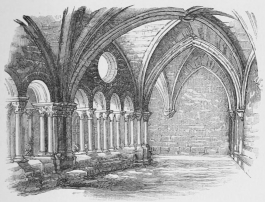
“Lodéve, June 8.—From Montpelier I went to Aigues-Mortes, the old sea-town where St. Louis embarked for the Crusades, little altered since his time, unless, indeed, the mosquitoes are worse, for they are terrible.”
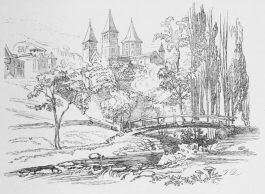
“Lexos, Aveyron, June 15.—From Rodez and its great cathedral, and Mareillac in the heart of the vine country, I had an excursion of transcendent beauty through the most exquisite mountain valleys and chestnut forests, by rocks and waterfalls, to Conques. I was taken there by a single line in Fergusson’s ‘Architecture’ comparing it with Souillac, which I had already seen, but found perhaps the most beautiful spot in France, and, in that desolation, a glorious romanesque abbey church, grand as a cathedral of the first rank, in which, owing to its lonely position, all the curious mediaeval treasures remain unspoilt. Here, and indeed everywhere, I found the greatest kindness from the charming well-to-do peasantry. Every one seems well off: every one full of courtesy and goodness; and though all the men in blouses expect to be treated as equals, they are indescribably pleasant.
“Anything so cheap as ‘Untravelled France’ it is impossible to imagine. Even at Mende, where it is quite a good hotel, prices were: room—very good, 1 fr., dinner 2 fr., breakfast 50 c., service 50 c., bougie never anything, and these are the usual prices.
“Nothing can describe what the delicious, sweetness of the acacias has been, so abundant in all these town-villages, and now it is giving way to that of the limes.
“This is a wooden inn of the humblest kind, close in the shadow of a great junction station, at which I am for convenience, but the pleasantness of the people gives it a charm. This solitary existence is a placid, peculiar halt in life.”
I was the greater part of July in London.
Journal.
CONQUES. [409]
“July 25, 1885.—Mrs. Rogerson, working in the east end of London, met with a family of poor children—very hopelessly poor children—whom she knew, with a dog. She stopped and told them that, as they could not keep themselves, she wondered they could keep a dog. The eldest boy answered rather savagely, ‘Father bought it: father gave sixpence for the dog, and right well he did too, for the rats wos so many, they wos, they used to eat our toes at night, and the dog keeps them all off.’
“The Maharajah of Johore asked me to his ball. When he goes out to luncheon or dinner he sends on his own cook to prepare for him, taking with him, to kill on the spot, the chicken which his master is to eat. When the cook kills it he says a sort of little prayer—‘Dear little brother, forgive me for the pain I am going to inflict upon you: it will only be momentary, and it really cannot be helped.’”
“Campsea Ashe, Suffolk, August 22.—On the way here I saw Ipswich, its great feature being ‘the Ancient House,’ adorned outside with representations of the Seasons. Close to St. Peter’s Church is Wolsey’s Gate, covered with ivy, which led to his college. This place, which the William Lowthers have bought, in the flat corn-lands of Suffolk, has a fine old garden, with clipped yew hedges and long tanks like Wrest. It has been a most pleasant visit. I heard some one say once, ‘Mrs. Lowther is a most extraordinary woman: she never will let the grass grow under any one of her children’s feet even for a single instant;’ but it has made them all very agreeable, from the immense variety of occupations in which they are interested, and in which, consequently, they interest others. James Lowther, who is at home now, is certainly one of the pleasantest and best-informed young men of the day. He has just been very amusing about answers in Board Schools, telling, amongst others, of a child who was asked ‘If King Alfred had been alive now, what part would he have taken in politics?’ and replied, ‘If King Alfred had been alive now, he would have been far too old to have taken part in politics at all!’
“We had a pleasant picnic at Framlingham, a noble ruined castle, which, for Suffolk, stands almost on a height, and went to Sanbourn, the luxurious home of the rich family of Heywood, and to Glemham, where Lady North, mother of Lord Guildford, lives in a fine old house, which contains much good old furniture and china.
“We spent a long interesting day at the noble old moated house of Helmingham, where Lady Tollemache apologised amusingly for only having nine of her sons at home to assist her in doing the honours! It is a delightful place, with beautiful old gardens, and its inhabitants are delightful too. Lord Tollemache especially brims with goodness to all around him. He was very amusing in urging Miss Lowther, when she had as many sons as he has (!), to make their home pleasanter to them than any other place in the world, so that they should always prefer it to everything else. He showed us all his relics, especially his Anglo-Saxon MS. of the time of Alfred the Great, and several beautiful Bibles of the time of Edward I. There is a pretty picture of Mary Tudor as a child. Queen Elizabeth was at Helmingham, and stood godmother to a baby there, who lived to become Sir Lionel Tollemache: that baby is represented, with its three little sisters, in a curious picture in the hall.
“In the church is the tomb of Colonel Thomas Tollemache, who was distinguished in the wars of Queen Anne’s time. The Duke of Marlborough ordered him to attack Brest. There were reasons which made him very doubtful of success, and he represented to the Duke that the only chance of it lay in a surprise: still the Duke ordered him to attempt it. Brest was found thoroughly prepared, the hoped-for surprise was an utter failure, and Tollemache fell in the attack. The French Government had been forewarned, and it was afterwards found that it had been forewarned by Marlborough! When the Duc d’Aumale came to Helmingham, he said that the thing he was most anxious to see was the monument of this unfortunate officer, and that he had himself read, in the archives at Brest, the letter of the Duke of Marlborough warning the garrison of the coming attack.
“The last owner of Campsea Ashe, Mr. Shepherd, was the grandson of a gardener. The Mr. Shepherd who then owned Campsea adopted a nephew, a young Frere, grandfather of the well-known Sir Bartle. The nephew invited his friends to Campsea, and, after the fashion of the time, they sat up drinking. Very late, young Frere rang the bell and ordered another bottle of port. The butler, very cross, went up to his master’s room and woke him, saying that Mr. Frere wanted some more port and that he must have the key of the cellar. Old Mr. Shepherd, furious, gave the key, but next morning sent for a lawyer and disinherited his nephew, and, no one else being handy, and having a gardener he liked who bore his own name of Shepherd, he left him his fortune.”
“Holmhurst, August 23.—In returning from Campsea Ashe I spent some hours at Colchester, and saw its two abbeys and its castle—rather curious than beautiful.”
“Drayton House, Northamptonshire, Sept. 20.—I have been spending several days in this most pleasant old house, which is full of charm and interest—many-towered, with an entrance court, a deserted Georgian chapel, a grand hall full of fine pictures, a vaulted room dating from Edward III., cellars probably from Henry III., admirable buildings of Elizabeth and James I.
“The place belonged to the Greenes, who, with the Earl of Wiltshire, who married a daughter of the house, have grand tombs in the church. Then it passed to the Mordaunts, and was left by Lady Mary Mordaunt, the divorced wife of the Duke of Norfolk, to her second husband, Sir John Germaine, whose second wife, Lady Betty, left it to Lord George Sackville, from whom it descended to its present owner, sweet engaging Mrs. Sackville, who inherited it from her uncle, the last Duke of Dorset, and who has all the perfect simplicity of the truest high-breeding.
“The gardens are full of terraces, staircases, fountains, pleached walks, avenues, and leaden statues—beautiful exceedingly. There is a gallery of Mordaunt portraits in the house; in the old library at the top are no end of treasures, and out of it opens the Duchess of Norfolk’s boudoir, with old Japanese ornaments. Through a plank missing in the floor of an upper gallery you can look into quite a large room which no one has ever entered. Its windows are darkened by the overgrowth of the creepers outside, and the only object in it is a large box like a portmanteau. The Sackvilles have always lived here, yet not one of them has had the curiosity to descend into that room or to look into that portmanteau!
“I have been taken to see the curious old house of Lyveden—never finished—one of the three strange semi-religious erections of the Tresham of the Gunpowder Plot. This is supposed to be in honour of the Virgin, and is covered with the oddest devices, such as ‘the Seven Eyes of God,’ the money-bag of Judas, with the thirty pieces of silver round it, &c. The second of Tresham’s buildings is Rothwell townhall; the third a lodge at Rushton in honour of the Trinity, in which everything, down to the minutest ornament, is three-cornered.
“Then we have been to Boughton, the Duke of Buccleuch’s great desolate house, which contains two cartoons attributed, without any cause, to Raffaelle. The house was built by the Duke of Montagu, who was ambassador to Louis XIV., and the king lent him a French architect and gardener. He made it as like a French château as possible. Then he told his friends that he must plant an avenue to drive to London by, and when they remonstrated that an immense part of the way to London did not belong to him, he said, ‘Well, at any rate I will have an avenue of the same length,’ and he planted seventy-two miles of it in his park. These trees, hemming in the view in all directions, make the place indescribably dull. Just outside the park is the pretty village of Geddington, with a fine old church and bridge, and a beautiful Eleanor cross with slender detached columns. We went on thence to tea at Warkton with Mrs. Bridges, wife of the clergyman, a real patrician Venetian beauty, who has set all Northamptonshire quarrelling as to whether the glorious colour of her hair can be real; but it is. Half of the church her husband serves is a mausoleum of the Dukes of Buccleuch, who have four large and magnificent monuments in it.
“The old Duchess of Buccleuch, a homely-looking person, was very fond of joining people who came to see the place and talking to them. One day she walked by a visitor and said, ‘You know, all this belongs to the Duke of Buccleuch.’—‘And pray, whom did he marry?’—‘ME!’”
“Cromer, Sept. 22.—I came yesterday to stay with the Lockers, who have lately taken the additional name of Lampson, with a fortune from her father, Sir Curtis Lampson. They are exceedingly happy together. ‘My winsome marrow,’ Mr. Locker has just said to his wife, ‘you know I never can go anywhere without you.’ In the evening, Mr. Locker was very pleasant in describing Rogers and his stories. Apropos of the dictum that the postscript of a well-told story is often its best feature, he told of Rogers describing a duel between a Frenchman and an Englishman, which was to be fought in the dark. The Englishman was a very humane man, and when it came to his turn to fire, fired up the chimney, that he might do his adversary no harm, but brought down the Frenchman, who had taken refuge there. ‘But when I tell that story in Paris,’ added Rogers, ‘it is the Englishman who is up the chimney.’
CROMER.
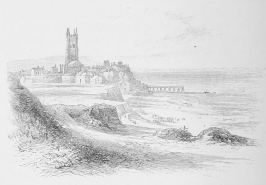
“He told of a Mr. Egerton who was with his regiment in Canada. Coming into the messroom one morning, he seemed much depressed, and being asked the reason, said he was troubled by an oddly vivid dream, in which he had seen his own coffin on the deck of a vessel, and in the dream had been even able to read the plate upon the coffin, which bore his name and the date June 16. He was so full of it, that the Colonel, to humour him, wrote down the circumstances and the date. This was in April. Afterwards he went to Upper Canada, where he was killed by Indians on the 16th of June, and his coffin was brought down the river as he had seen it. Mr. Locker told this story to Lord Algernon St. Maur, who said, ‘I can corroborate that story, for I was in the messroom when what you describe occurred.’
“Mr. Locker described Dickens’s way of telling stories. He heard him tell that of Lincoln’s dream, and of his describing the oppressive feeling he had, how he was ‘drifting, drifting, drifting,’ and how at that moment the members of council came in and he said, ‘Now we must go to business.’ It was on leaving that council that he was shot, so no one heard the end of that dream, or whether there would seem to be any forewarning in it.
“We have been to-day to Felbrigge, the fine old house of the Windhams, sold to a Norwich tradesman named Catton, whose daughters have adopted the older family as if it were their own, and are quite worthy of the old pictures, MSS., &c., all left in the house, nothing having been taken away when the place was given up. ‘Mr. Windham comes every night to look after his favourite books in the library,’ said Miss Catton; ‘he often comes, and he goes straight to the shelves where they are: we hear him moving the tables and chairs about: we never disturb him though, for we intend to be ghosts ourselves some day, and to come about the old place just as he does.’ In the hall there is a grand bust of the statesman by Nollekens. Formerly it was on his monument in the church, but after some years the family put a copy there, and moved the original into the house. The church, however, still retains the most glorious brasses. One is that of a lady in waiting who came over with Anne of Bohemia, and whose daughter was herself invited to share the throne. But the man she really married was one of the early owners of Felbrigge.”
“Sept. 24.—We have been with the Dick Gurneys in their fleet waggonette to Blickling, quite glorious, so perfect in colour, with an exquisite entrance, and a splendid herbaceous garden. In the church is the tomb which Lady Lothian has erected to her husband,[410] a most grand one, with the head of the reclining statue turned to one side, and the long beard drifted over the pillow.
“The innumerable Gurneys, Buxtons, and Hoares who populate Cromer come in and out of this house, as of each other’s, whenever they like, without ringing the bell.
“Last night Mrs. R. Hoare dined here. She says the people here always address their superiors in the third person, as in French. They always say ‘I’m very much fatagued,’ for bothered. ‘Well, Mrs. Smith, are you going to take the blue dress or the brown?’ she said when keeping a charity shop. ‘Why, ma’am, I’ve not fairly averdupoised,’ replied the woman; and it is a common expression for balancing.
“There are many remnants here in Cromer from Danish occupation. The ghosts, as in Denmark, are always without heads. There is great faith in the story of ‘Old Strop,’ a Danish dog who was washed ashore with the bodies of two Danish sailors, one of whom was buried at Overstrand and the other at Cromer. Every night the dog, headless, is believed to run from one grave to the other, and fishermen will always go round by the shore at night rather than by the shorter lane, which the dog is supposed to take.”
“Sept. 25.—Mrs. Ritchie (Miss Thackeray) is here, most charming and interesting, as I have always thought her. She describes Tennyson and Mrs. Kemble as the noblest man and woman she knows.
“Mrs. Kemble found, when in England, that her husband was going to take advantage of an American law which allowed him to obtain a divorce if she was away from him two years. For her children’s sake it was imperative that she should prevent this. She hurried back, and just arrived in time by two or three days. Afterwards she herself quietly obtained a divorce in some way which gave her the charge of her children.... One of her daughters is Mrs. Leigh, whose husband, the Vicar of St. Mary, Bryanston Square, she is always trying to persuade to go out to the family plantations in Georgia. The other, Sarah, is the wife of a merchant in New York, and a replica—a much feebler replica—of her mother.
“Now, Mrs. Kemble is generally to be found knitting by her fireside. One day Mrs. Ritchie took her little girl to see her. ‘Here I am,’ Mrs. Kemble said to the child, ‘an old woman who never allows another person to put in a word when she is talking; and now, what do you think of me?’ The little girl, who was shy, did not know what to say, and looked as if she was going to cry. Mrs. Ritchie, to fill up the gap, said, ‘Oh, she thinks, Mrs. Kemble, that no one could possibly wish to put in a word when they could listen to you.’ ‘Ma fille, ne dites pas des choses comme ça,’ cried Mrs. Kemble furiously; and then, more quietly, ‘You should not say such things before the child: it is not right to teach her to be artificial.’
“‘Right is right,’ she said one day, ‘and wrong is wrong, but God forbid that I should judge of another whether he is right or wrong.’
“‘One day,’ said Mrs. Ritchie, ‘I found Mrs. Kemble sitting by her fireside looking rather disconsolate, and asked her what she was doing. “Oh, I’m knocking my head against the wall, my dear; that man who was here was so dreadfully stupid, I’m obliged to knock it out of me.”’
“Mrs. Kemble was at an inn in Switzerland with a lady with whom she never made acquaintance. They were both reading ‘Middlemarch,’ and came down with their books into the public room, and were engrossed in them. But one day the lady was so enchanted with a passage in her volume that she burst out with, ‘Well, this woman is one of the noblest of authors: whatever the peculiarities of her views on life may be, I will never believe that the woman who can write thus can be other than one with the very noblest aims.’ Then Mrs. Kemble turned upon her furiously with, ‘Who are you that you should presume to dare to judge such a woman as George Eliot? how can you dare to judge her?’ and the lady jumped up, and, instead of being angry, embraced Mrs. Kemble upon the spot.