Volume 4 — XVII LITERARY WORK AT HOME AND ABROAD
Reading edition
“Ohne Hast, aber ohne Rast.”—Goethe.
“Leisure and I have taken leave of one another. I propose to be busy as long as I live, if my health is so long indulged to me.”—John Wesley.
“To seek fame is even a solemn duty for men endowed with more than ordinary powers of mind. First, as multiplying the ways and chances by which a useful work comes into the hands of such as are prepared to avail themselves of it; secondly, as securing for such a work that submissiveness of heart, that docility, without which nothing really good can be really acquired; and lastly, because the individuality of the author, with all the associations connected with his name and history, adds greatly to the effect of a work.”—Coleridge to Sir G. Beaumont.
“For ever I wrastle, for ever I am behind.”—Gower, Confessio Amantis.
“’Tis not in mortals to command success; But we’ll do more, Sempronius—we’ll deserve it” —Addison, Cato.
THE success of “Walks in Rome,” and the great pleasure which I had derived from the preparation of my “Days near Rome,” made me undertake, in the spring of 1874, the more ambitious work of “Cities of Northern and Central Italy,” in preparation for which I left England at the end of January, accepting on the way an oft-repeated invitation from Mr. and Mrs. de Wesselow to their beautiful home at Cannes.
Journal.
“Villa La Cava, Cannes, Jan. 30, 1874.—What a view I look upon here from my beautiful room!—a pure blue sky all around, fading into the softest most delicate golden hues where it meets the waveless expanse of sea, upon which the islands seem asleep in the sunshine; on one side the old town of Cannes, with its pier and shipping and the white sails of its boats; on the other, the endless villas, and Mougins, and the mountains—all rising from a wealth of orange and cypress groves; and, close at hand, masses of geraniums and roses and the ‘sunshine tree’ (golden mimosa) in full blossom,—and thus, they say, it has been all winter.
“Paris was at its ugliest. I had a pleasant dinner at the Embassy, and I went to see old Madame Dubois at the top of a house, in her room which is at once sitting-room, bedroom, and kitchen. She was full of the wretchedness of living in a country where your servant had no scruple in telling you she was your equal, and that she was jealous of your being richer than herself. She showed her household treasures, especially a little silver owl, ‘qui est restée longtemps sans se marier, et puis a fait un petit hibou.’
“I left in the evening for my four-and-twenty hours’ journey. The train was crowded, every place full, but, in spite of my seven companions and their twenty-eight handbags, which obliged me to sit bolt upright the whole way, I rather enjoyed it. There is something so interesting in the rapid transitions: the plains of Central France: the rolling hills of Burgundy in the white moonlight: the great towns, Dijon and Lyons, deep down below, and mapped out by their lamps: the dawn over the Rhone valley: the change to blue sky melting into delicate amber: the first stunted olives: the white roads leading, dust-surrounded, to the white cities, Avignon and Tarascon and Arles: the desolate stone-laden Crau: the still blue Mediterranean, and Marseilles with its shipping, and then the granite phase of southern Provence and its growth of heath and lavender and pines.
“On this, the eastern side, Cannes is a new world to me, but on Sunday, with Marcus Hare and G., I went up to the other side, to the Villa S. François and our beloved pine-wood, alive still with sacred memories, where the dear form still might seem to wander with her sunshade and camp-stool, and where we sat on the very stone she used to rest on in ‘the Shepherdesses’ Walk.’ G. is too matter of fact to enjoy this country. When I exclaimed over the glorious beauty and variety of the view of the Rocher de Bilheres, standing out as it does from the supreme point of the forest promontory, with the purple shadows behind it in the deep rift, she could only say, ‘I should be better satisfied if I could ascertain exactly what it is mineralogically.’
“I went with Frank de Wesselow to Vallauris, the walk a perfect series of pictures—the winding road with its glorious sea-views; then, at the chapel, the opening upon all the Alpine range; then the deep hollow ways overhung by old gnarled olives, and peopled by peasants with their mules and baskets.
“Yesterday I had a visit from George Sutherland, whom I looked after in his fever at Rome, full of his spiritualism, of his drawings made under the influence of spirits, who ‘squeeze out just the amount of colour to be used and no more,’ and of his conversations with his dead mother, whom he described as ‘touching him constantly.’
“In the evening we talked of the De Wesselows’ faithful servant Mrs. Manning, of her wonderful power of making people understand her, and how her appreciation of foreigners was entirely in proportion to their doing so. Frank was standing by her one day in the garden when their maid Thérèse passed by. Mrs. Manning said quickly, ‘Teresa, acqua fresca pully, and these things want lavering,’ and, without giving another moment’s attention, went on with what she had been doing. Thérèse, in her slow way, said ‘Yees,’ thinking that she talked English very well, and understood perfectly that she was to give some water to the chickens and that the things wanted washing.”
To Miss Leycester.
“Villa Heraud, Cimies, Feb. 6, 1874.—I am writing from a beautiful country villa, where, in sweet Mary Harford,[71] I find the friend of my childhood quite unchanged, though it is fifteen years since I have seen her. In spite of being the mother of six daughters and two sons, she looks still as young as the Mary Bunsen who was carried quite helpless into Hurstmonceaux Place twenty-three years ago. It is a most united family, and you would admire the ‘way in which the six daughters take arms and sing a hymn behind their mother (who plays) after family prayers.”
“Parma, Feb. 12, 1874.—I had so many kind invitations at Nice, I rather longed to remain there. On Sunday I went home after church with Lady Jocelyn and her little grand-daughter. I had not seen her since the loss of her children. Her sweet sad face quite haunts me. I said to her, ‘Do you often drive out.’—‘No,’ she said; ‘I must always walk, or else the days would be too long.’
“I had an interesting railway journey on Monday with Madame Franzoni, who lives in the house at Taggia described in ‘Dr. Antonio.’ She was Swiss. Her husband, of an old Swiss-Italian family, was disinherited on becoming Protestant, and was obliged to become an engineer. His father, still living, has been prevented by his priests from speaking to him for five-and-twenty years, though devotedly fond of him. She took her two little children and made them sing a hymn beneath the tree in which their grandfather was sitting. Tears streamed down the old man’s cheeks, but he would not look at them; he said it must be a lesson to his other children. The mother offered her whole fortune if her son would consent to hear one mass; she believed that one mass would reconvert him. Since then the Protestant part of the family have been dreadfully poor, whilst the rest are immensely rich. Madame Franzoni said that the priests of Taggia were very kind to them privately, but would not recognise them in public.
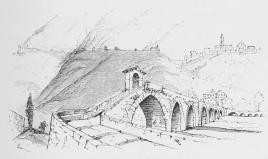
LAMPEDUSA FROM TAGGIA. [72]

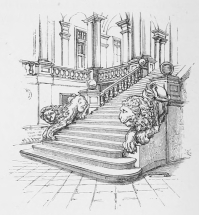
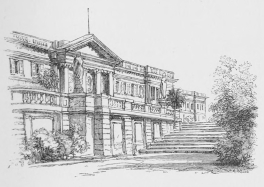
STAIRCASE, PALAZZO DELL’ UNIVERSITA, GENOA [73]
“When we parted, I gave her my card. Some Americans in the carriage saw it and almost flew into my arms. ‘Oh, the “Quiet Life”—too great happiness,’ &c. Afterwards I had a warning to be careful what subjects one touched upon with strangers, for I said something about the loss of the Ville de Havre. The lady (Mrs. Colt) burst into tears, and her daughter said, ‘Mother’s brother was the judge who was lost; he would not leave his wife, and went down with her in his arms, saying, “Let us die bravely!”’ Afterwards at Genoa I met a young lady (Miss Bulkeley) who went down with her mother. The mother was lost. As the daughter rose, something hurt her head; she put her hand to it and caught a chain, and finding her head above water, called, ‘A woman! help!’ She heard men say, ‘American sailors are saving you,’ but became unconscious and knew nothing for long afterwards. She said it was quite a mistake to say drowning was painless—the oppression on the lungs was agony.
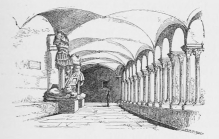
CLOISTER OF S. MATTEO, GENOA. [74]
“I enjoyed Genoa and my work there, and made several pleasant Italian acquaintances, the Genoese are so hospitable. The Marchese Spinola showed me all the treasures and pictures of his old palace himself. I suppose I must take this as a great compliment, for I was amused the other day by an anecdote of the Marchesa Spinola, who made herself most agreeable to an Englishman she met at the Baths of Monte Catini. On taking leave, he politely expressed a hope that, as they were both going to Rome in the winter, they might meet there. ‘Mais non, Monsieur,’ she replied; ‘à Monte Catini je suis charmée de vous voir, mais à Rome c’est toute autre chose.’ Yesterday I spent in correcting my account of Piacenza—bitterly cold, children sliding all over the streets, which were one mass of ice.... I had forgotten the intense interest of Parma and its glorious pictures, especially what a grand master Pordenone was.”
“59 B. Mario de’ Fiori, Rome, Feb. 22.—Rome is fearfully modernised, such quantities of new houses built, such quantities of old buildings swept away—the old shell fountain in the Felice, the lion of the Apostoli, the Vintner’s fountain at Palazzo Simonetti, the ruins of the Ponte Salara, and ... all the shrines in the Coliseum, even the famous cross on the wall. The last nearly caused a Revolution. On the Pincio a Swiss cottage is put up, strangely out of place amongst the old statues, and a clock which goes by water. Even the most ardent Protestants too are a little shocked that the famous Quirinal Chapel, so redolent of Church history, should be turned into a cloak-room for balls, and the cloak-tickets kept in the holy water basins. The poverty and suffering amongst the Romans is dreadful, the great influx of Torinese taking the bread out of their mouths.
“You would be amused with the economy of my servants Ambrogio and Maria. They think it most extravagant if I have both vegetables and a pudding, and quite sinful to have soup the same day; and the first day, after I had seen the kitchen fire blazing away all afternoon, and ‘Il Signorino è servito’ was announced very magnificently, behold the dinner was—three larks! But what a pleasure it is to hear again from servants—‘Felicissima notte,’—that sweetest bidding of repose, as Palgrave calls it.”
“March 1.—I know, as usual, far too many people here for comfort, nearly three hundred. But I have enjoyed constant drives with Lady Castletown and her most sweet and charming daughter, Mrs. Lewis Wingfield. The Miss Seymours also are here, and very agreeable, with their very handsome sister, married to the Austrian Count von Lutzow. The Duchesse S. Arpino and her mother and engaging little daughter make their house as pleasant as ever. Mr. Adolphus Trollope has a pretty little daughter who sings most enchantingly.[75] I also like Lady Paget, the Minister’s wife, who is a clever artist in her own way.
“The spoliation of Rome continues every day. Its picturesque beauty is gone. Nothing can exceed the tastelessness of all that is being done—the Coliseum, Baths of Caracalla, and the temples are scraped quite clean, and look like sham ruins built yesterday: all the pretty trees are cut down: the outsides of the mediæval churches (Prassede, Pudentiana, &c.) are washed yellow or painted over: the old fountains are stripped of their ferns and polished: the Via Crucis and other processions are forbidden: and the Government has even sent out the ‘pompieri’ to cut down all the ivy from the aqueducts. I have, however, got back one thing—the Lion of the Apostoli! I went round to a number of people living in that neighbourhood, and engaged them to go in the morning to the Senators in the Capitol and demand its restoration: and a message was sent that the lion should be restored at once. So the little hideous beast goes back this week to his little vacant sofa, where he has sat for more than six hundred years.
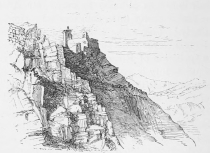
COLONNA CASTLE, PALESTRINA. [76]
“The cardinals have been dying off a good deal lately, and a curious relic of old times was the lying in state of Cardinal Bernabo in the Propaganda Fide—the chapel hung with black, the catafalque with cloth of gold, a chain of old abbots and cardinals standing and kneeling round with tapers, and all the students singing. Pius IX. is well, and Antonelli has never been the least ill, except in the Times, in which he has received the last sacraments.”
GENAZZANO. [77]
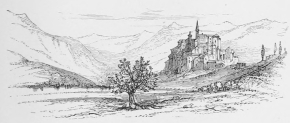
SUBIACO. [78]
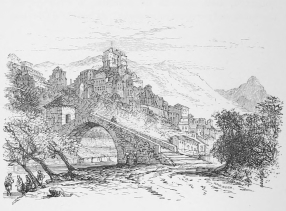
“Tivoli, March 22.—I have been greatly enjoying a little mountain tour with Lady Castletown and Mrs. Lewis Wingfield. On Wednesday we spent the day in the villas Aldobrandini and Mondragone at Frascati, and the next morning had the most charming drive by Monte Porzio and Monte Compatri, chiefly through the desolate chestnut forests, to Palestrina. It was the fair of Genazzano, and the whole road was most animated, such crowds of peasants in their gayest costumes and prettiest ornaments. At beautiful Olevano we had just time to go to the little inn and visit my friend of last year, Peppina Baldi. It was a tiring journey thence to Subiaco after such a long day, and we only passed the worst precipices by daylight, so it was quite dark when we reached Subiaco, where we found rooms with difficulty, as, quite unwittingly, we had arrived on the eve of the great festa of S. Benedetto. Most delighted we were, however, of course, and most picturesque and beautiful was the early pilgrimage, with bands of music and singing, up the stony mountain paths. Lady Castletown travels with a second carriage for her maids, so prices naturally rise at first sight of so grand a princess.... On the way here we diverged to the farm of Horace in the Licenza valley, all marvellously unaltered—the brook, the meadows, the vines, the surrounding hills and villages, still just as he described them eighteen hundred years ago. It is a wonderful country, one lives so entirely in the past.”
I have seldom enjoyed Tivoli more than in this spring of 1874. It was then that, sitting in the scene I describe, I wrote the paragraph of “Days near Rome” which I insert here.
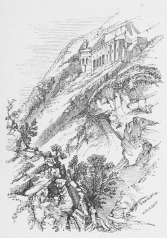
SACRO SPECO, SUBIACO. [79]
“Nothing can exceed the loveliness of the views from the road which leads from Tivoli by the chapel of S. Antonio to the Madonna di Quintiliolo. On the opposite height rises the town with its temples, its old houses and churches clinging to the edge of the cliffs, which are overhung with such a wealth of luxuriant vegetation as is almost indescribable; and beyond, beneath the huge pile of building known as the Villa of Maecenas, the thousand noisy cataracts of the Cascatelle leap forth beneath the old masonry, and sparkle and dance and foam through the green—and all this is only the foreground to vast distances of dreamy campagna, seen through the gnarled hoary stems of grand old olive-trees—rainbow-hued with every delicate tint of emerald and amethyst, and melting into sapphire, where the solitary dome of St. Peter’s rises, invincible by distance, over the level line of the horizon.
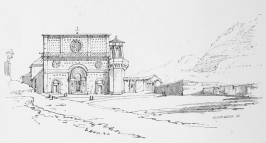
S. MARIA DI COLLEMAGGIO, AQUILA. [80]
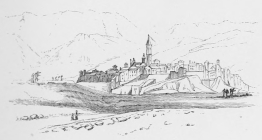
SOLMONA. [81]
“And the beauty is not confined to the views alone. Each turn of the winding road is a picture; deep ravines of solemn dark-green olives which waken into silver light as the wind shakes their leaves—old convents and chapels buried in shady nooks on the mountain-side—thickets of laurustinus, roses, genista, and jessamine—banks of lilies and hyacinths, anemones and violets—grand masses of grey rock, up which white-bearded goats are scrambling to nibble the myrtle and rosemary, and knocking down showers of the red tufa on their way;—and a road, with stone seats and parapets, twisting along the edge of the hill through a constant diorama of loveliness, and peopled by groups of peasants in their gay dresses returning from their work, singing in parts wild canzonetti which echo amid the silent hills, or by women washing at the wayside fountains, or returning with brazen conche poised upon their heads, like stately statues of water-goddesses wakened into life.”
Great was the difficulty of securing any companion for the desolate excursion to the Abruzzi, but at length I found a clever artist, Mr. Donne, who agreed to go with me.
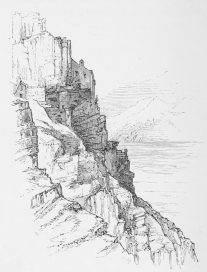
HERMITAGE OF PIETRO MURRONE. [82]
To Miss LEYCESTER.
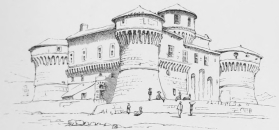
CASTLE OF AVEZZANO. [83]
GATE OF ARPINUM. [84]
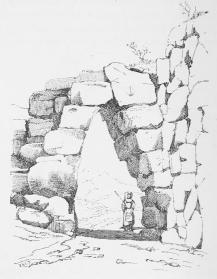
“Sora in the Marsica, April 2.—Mr. Donne and I left the train at Terni, taking diligence to Rieti, the capital of the Sabina. Next day we had a long dreary drive to Aquila, a dismal place, but full of curious remains, surrounded by tremendous snow mountains. Thence we crossed a fearful pass in ghastly barren mountains to Solmona, a wonderful mediæval city seldom visited. On Sunday we clambered up the mountains above the town to the hermitage of Pietro Murrone, afterwards Cœlestine V., and then, as the snow was too deep to make it possible to cross the mountain, returned by night to Aquila. On Tuesday our journey of a whole day was through perfectly Lapland scenery, the road a mere track in the deep snow, which covered hedges and fields alike. Fortunately the weather was lovely, but it was a relief to come down again to even partial civilisation at Avezzano, on the borders of what was once the Lago Fucino, now dried up and spoilt by Prince Torlonia. Here I had an introduction to Count and Countess Restà, to whom I paid a most curious visit. On Wednesday we drew at S. Maria di Luco, a picturesque church on the site of a temple above the lake, and in the evening came on here, arriving at 2 A.M.—glorious moonlight and grand scenery, but the diligence unspeakably wretched. We have just been spending a charming day, partly at Arpino, the birthplace of Cicero, where there are wonderful Pelasgic remains, and a gateway which is the oldest architectural monument in Europe, and partly at Cicero’s island home on the Liris, a lovely place, all primroses and violets as in England, but with a background of snow mountains.”
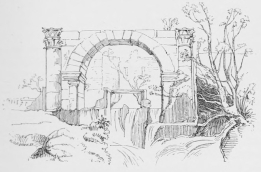
TRIUMPHAL ARCH, AQUINO.
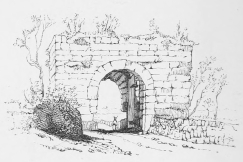
PORTO S. LORENZO, AQUINO. [86]
“Easter Sunday, 1874.—The Count and Countess de Lützow, the two Miss Seymours, and Miss Ellis[87] met me at S. Germano, and we have been spending to-day in the monastery of Monte Cassino, gloriously beautiful always, with its palatial buildings on a mountain-top, and all around billows of purple hill tipped with snow. An introduction from the Duke of Sermoneta caused the gentle-looking Abbot to receive us, and then the great bent figure of the great Tosti came forward, his deep-set eyes excessively striking. After the service in the church they entertained us to an excellent dinner, finishing with delicious Aleatico wine. They were ‘spogliati,’ they said, but ‘La Providenza’ still watched over them.”
“April 7.—In the second-class carriage of the train on our way to Velletri sat a venerable and beautiful old man, to whom we talked of Aquino, the birthplace of St. Thomas Aquinas, where we spent yesterday. Gradually we found out that he was the Abbot of Monte Vergine, and he told us much that was interesting about that wonderful place—of the intense love and veneration of the Neapolitan people for the sanctuary, which is connected with the different events of their domestic life; that no betrothal or marriage or birth was considered entirely consecrated without receiving a benediction at the sanctuary; that peasant women had it entered in their marriage contracts that they should be allowed to make the pilgrimage from time to time, and after the birth of each child; that because, on account of the suppression, two miles of the road to the sanctuary still remained unfinished, the peasants voluntarily undertook to finish it themselves, 30,000 persons subscribing one soldo apiece; that when, at the same time, he, the Abbot, was obliged to give up keeping a carriage, five Neapolitan families insisted upon undertaking to keep one for him, one paying the horses, another the coachman, &c. The Abbot gave us his benediction on taking leave, and invited us to Monte Vergine.”[88]
“April 14.—I met Mademoiselle von Raasloff at Mrs. Terry’s. She narrated to me some facts which had been told to her by the well-known Dr. Pereira.
“An acquaintance of his, a lady, was travelling with some friends in an out-of-the-way part of Poland. Suddenly, late at night, their carriage broke down and they were obliged to get out, and as they knew of no shelter near, they were in great difficulties. At this juncture a gentleman appeared, who said to the lady that if she would take the trouble to walk a few steps farther, she would come to the gate of his house; that he was unable to accompany her, but that if she would mention his name she would be received, and would find all she required. She thanked him and followed his directions. The servant to whom she spoke at the house seemed very much surprised, but seeing her plight, brought her in, left her in a library, and went to get some refreshment. When she was alone, a door in the panelling opened and the unknown master of the house came in and sat down by her. As he said nothing, she felt rather awkward, and more so when the servant, coming in with a tray, seemed to brush up close to him in a very odd way as he set it down. When the servant left the room, the unknown said, ‘Ne vous étonnez pas, Mademoiselle, c’est que je suis mort;’ and he proceeded to say that he was most thankful she had come, and that he wished her to make him a solemn promise; that the people who were now in possession of the property were not the rightful heirs, but that he had left a will, deposited with a certain lawyer in a certain place, the name of which he made her write down. She listened as in a trance, but did as she was bid. The servant, coming in again about this time, walked straight through the unknown. Presently the carriage, being mended, was announced to be at the door, upon which the unknown walked with her to the porch, bowed, and disappeared.
“When the lady got to Warsaw, she had an attaque des nerfs, was very ill, and sent for Dr. Pereira. She told him all she had seen, and also gave him the paper with the directions she had written down. Dr. Pereira, finding that the person and place mentioned really existed, inquired into the matter, and the result was that the will was found, the wrongful possessors ejected, and the rightful owners set up in their place.”
“One evening at the Palazzo Odescalchi, when everybody had been telling stories, and nothing very interesting, Mademoiselle von Raasloff suddenly astonished us by saying, ‘Now I will tell you something.’ Then she said—
“There was a young lady in Denmark, whose family, from circumstances, had lived very much before the Danish world, and with whom, in so small a society as that of Copenhagen, almost every one was acquainted. Consequently it was a subject of interest, almost of universal interest, at Copenhagen, when it became known that this young lady, with the full approval of her parents and joyful consent of every one concerned, had become engaged to a young Danish officer of good family and position.
“‘Now in Danish society a betrothal is considered to be almost the same thing as a marriage: new relationships date from that time, and if either the affianced bride or bridegroom die, the family of the other side mourn as for a son or brother, as if the marriage had actually taken place.
“‘While this young lady of whom I have spoken was only engaged, her betrothed husband was summoned to join his regiment in a war which was going on; and very soon to the house of his betrothed came the terrible news that he was dead, that he was killed in battle. And the way in which the news came was this. A soldier of his regiment was wounded and was taken prisoner; and as he was lying in his cot in the hospital, he said to his companion who was in the next bed, “I saw the young Colonel—I saw the young Colonel on his white horse, and he rode into the ranks of the enemy and he never came back again.” And the man who said that died, but the man to whom he said it recovered, and, in process of time, he was ransomed, and came back to Copenhagen and told his story with additions. “My comrade, who is dead, said that he saw the young Colonel on his white horse, and that he saw him ride into the ranks of the enemy and the soldiers of the enemy drag him from his horse and kill him, so that he never came back again.” This was the form in which the story reached the family of the affianced wife of the young Colonel, and they mourned him most truly; for they loved him much, and they put on all the outward signs of deepest grief. There was only one person who would not put on the outward signs of mourning, and that was his affianced bride herself. She said, and persisted in saying, that she could not believe that, where two persons had been as entirely united as she and her betrothed had been, one could pass entirely out of life without the other knowing it. That her lover was sick, in prison, in trouble, she could believe, but that he was dead—never, without her having an inner conviction of it; and she would not put on the outward signs of mourning, which to her sense implied an impression of ill omen. Her parents urged her greatly, not only because their own reality of grief was very great, but because, according to the feeling of things in Copenhagen, it cast a very great slur upon their daughter that she should appear without the usual signs of grief. They urged her ceaselessly, and the tension of mind in which she lived, and the perpetual struggle with her own family, added to her own deep grief, had a very serious effect upon her.
“‘It was while things were in this state that one day she dreamt—she dreamt that she received a letter from her betrothed, and in her dream she felt that it was of the most vital importance that she should see the date of that letter; and she struggled and laboured to see it, but she could not make it out; and she laboured on with the utmost intensity of effort, but she could not decipher it; and it seemed to her the most wearisome night she had ever spent, so incessant was her effort, but she could not read it: still she would not give it up, and at last, just as the dawn was breaking, she saw the date of the letter, and it was May the 10th. The effort was so great that she woke; but the date remained with her still—it was May the 10th.
“‘Now she knew that if such a letter had been really written on the 10th of May, by the 1st of June she must receive that letter.
“‘The next morning, when her father came in to see her before she was up, as he had always done since their great sorrow, he was surprised to find her not only calm and serene, but almost radiant. She said, “You have often blamed me for not wearing the outward signs of mourning for my betrothed: grant me now only till the 1st of June, and then, if I receive no letter from him, I will promise to resign myself to believe the worst, and I will do as you desire.” Three weeks of terrible tension ensued, and the 1st of June arrived. She said then that she felt as if her whole future life hung upon the postman’s knock. It came—and there was the letter! Her lover had been taken prisoner, communication with him had been cut off—in fact, till then it was impossible she should hear. Soon afterwards he was exchanged, came home, and they were married.
“‘Now,’ said Mademoiselle von Raasloff, as she finished her narrative, ‘that is no story which I have heard. The young lady was my dear mother; she is here to testify to it: the young officer was my dear father, General von Raasloff; he is here to confirm it.’ And they were both present.”
“April 15.—There is a pretty young American lady at the table-d’hôte—most amusing. Here are some snatches from her lips:—
“‘I wonder if the old masters who painted such absurd figures of saints and angels meant to be funny, or if they were only funny by mistake.’
“‘Pity is like eating mustard without beef, and you wouldn’t like that, would you?’
“‘I was at a pension at Castellamare—Miss Baker’s. Avoid it. There were places for fifty at dinner, and forty-nine of them were old maids. No gentleman stayed—of course he couldn’t: they would have gobbled him up alive.’
“‘I went to the Trinità to hear the nuns sing. The nun who opened the door said, “You’re too late!”—“Well,” I said, “you declared I was too early yesterday. When am I to come?”—“Well, I don’t know,” she said; “we’re always changing.”—“Well, you are a civil old party, you are,” I said—and the old tigress actually slammed the door in my face.’
“‘Somebody said to me about a nigger I was abusing that I shouldn’t, because he was a man and a brother. “Well, sir, he may be your brother,” I said, “but most certainly he is not mine.” I should think not indeed, with a leg that comes down in the middle of his foot.’
“‘I shall be burnt, I hope, when I die. I feel like the old lady I heard of the other day who knew she was getting immensely old and could not live long, so paid down three thousand dollars to have a good big stove made right off at once.’
“‘I hope when I’m dying my people won’t be able to go on pegging away at their dinner just as if nothing was happening: I should not like that at all.’”
To Miss Leycester.
FARFA. [89]
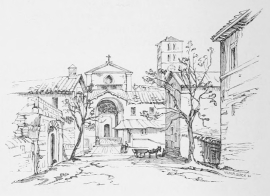
GATE OF CASAMARI. [90]
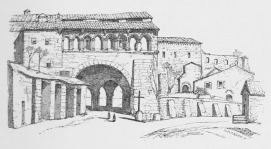
“Assisi, April 26.—I had a proposal from the Miss Seymours and Miss Ellis that if I would wait at Rome till Saturday the 18th, they would set off with me in search of the lost monastery of Farfa, which was, of all places, the one I wanted most to see, and from which fear of brigands had previously caused all my companions to fail at the last moment. If you have read any old histories of Italy, you will remember how all-important Farfa was in the Middle Ages, and will wonder that no one, not even the best Roman antiquarians, knew anything about its present state, or even where it is. We could only judge by old maps and chronicles. However, the excursion completely answered, and, after divers little adventures, which ‘Days near Rome’ will narrate, we not only arrived at Farfa, but found the Father-General of the Benedictines accidentally there to receive us. Greatly astonished he was at our arrival, but said that one enterprising stranger had reached the place three years before—I need hardly add, an English lady. Really Farfa is one of the most radiant spots in Italy, and the sheets of wild-flowers, and the songs of nightingales and cuckoos enhanced its charms. My companions were so delighted that they consented, if I would stay till Wednesday, to set off again on a long, wild, and very rough tourette to the monasteries of the Hernican mountains. So on the 22nd we went by rail to Frosinone, and thence drove to Casamari, going on by a grand mountain road to sleep at Alatri. The next day we rode up a jagged rock path for many hours to the Carthusian Trisulti, a huge monastery in a mountain forest, amid Alpine flowers and close under the snows. Then we saw the famous Grottoes of Collepardo—a sort of underground Staffa, very grand indeed, and returned at night to Frosinone, and next day to Rome.”
Journal.
“May 4, Florence.—General von Raasloff is here, and says that a friend of his going to China received endless commissions for things he was to bring home, but that only one of the people who gave them sent money for the things they wanted. On his return, this commission was the only one he had fulfilled. His disappointed friends upbraided him, and he said, ‘You see it was very unfortunate, but when we were nearing China, I spread out all my different commissions on the deck that I might examine them, and I put the money for each on the paper to which it belonged: and—it was very unfortunate, but my attention was called away for an instant, and behold a great gust of wind had come, and all those commissions which were not weighted by money had been blown far out to sea, and I never saw them again.’
“Mademoiselle von Raasloff told me that—
“Count Piper, an ancestor of the present Count Piper, was a very determined gambler. Being once at one of his desolate country estates, he was in perfect despair for some one to play with him, but he was alone. At last, in a fit of desperation, he said, ‘If the devil himself were to come to play with me, I should be grateful.’ Soon a tremendous storm began to rage, during which a servant came in and said that a gentleman overtaken by night was travelling past, and implored shelter. Count Piper was quite enchanted, and a very gentlemanlike man was shown in. Supper was served, and then Count Piper proposed a game of cards, in which the stranger at once acquiesced. Count Piper won so enormously, that he felt quite ashamed, and at last he proposed their retiring. As they were leaving the room, the stranger said, ‘I am very much concerned that I have not sufficient money with me to pay all my debt now; however, I shall beg you to take my ring as a guarantee, which is really of greater value than the money, and which has very peculiar properties, one of which is that as long as you wear it, all you possess is safe from fire.’ The Count took the ring, and escorting the stranger to his room, wished him good-night. The next morning he sent to inquire after him: he was not there, his bed had not been slept in, and he never was heard of again. Count Piper wore the ring, but after some time, as it was very heavy and old-fashioned, he took it off and put it away. The next morning came the news that one of his finest farm-houses had been burnt down. And so it always is in that family. The descendants of Count Piper always have to wear the ring, and if ever they leave it off for a single day, one of their houses on one of their great estates is burnt.”
“Florence, May 10.—Ten days here in the radiant spring-tide have been very delightful. I have seen a great deal of Mrs. Ross, Lady Duff Gordon’s beautiful daughter, who is now writing the story of her mother’s life. She has a noble head, which is almost more full of expression than that of any one I know, and I am sure that her character is noble too, with all the smallnesses of life, which make a thoroughly anglicised character ignoble, washed out, and its higher qualities remaining to be mingled with the Italian frankness and kindly simplicity which English-English do not possess, and consequently cannot understand. Her singing to a guitar is capital—chiefly of Italian stornelli, rendered with all the verve which a contadina herself could give them. It is no wonder that Italians adore her. Each summer she and her husband spend at Castagnuolo with the Marchese Lotteria della Stufa, the great friend of her father, who died in his arms. This is ‘Il Marchese’ par excellence with the Florentines, to whom he is public property. When a child accidentally shot him with a pistol through the crown of his hat, thousands of people thronged the street before his house to inquire, and in all the villages round his native valley of Signa the price of wax went up for a fortnight, so many candles were burnt to the Madonna as thank-offerings for his escape. The next day, as he was crossing one of the bridges, he met Giacomo, a flyman he knew, driving a carriage full of very respectable old Scotch ladies. Giacomo flung his reins on the box, and rushing up to the Marchese, threw himself sobbing on his breast.
LA BADIA DI SETTIMO. [91]
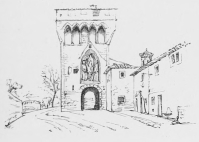
“I have been out with Mrs. Ross to the Stufa villa of Castagnuolo, seven miles off, near the Badia di’ Settimo, in a tiny baroccino, drawn by Tocco, the smallest of spirited ponies, and with Picco, the weest terrier ever seen, upon our knees. As we turned up from the highroad to the villa on the hills through the rich luxuriant vineyards, the warmest welcome met us from all the peasants, and Mrs. Ross received them with ‘Ah, caro Maso, e come va la moglie,’—‘Addio, caro Guido mio.’ In a house in the grounds—a ‘podere’—the whole family of inmates thronged round her with ‘Vi pigliero un consiglio, Signora,’ about a sick child. We wandered up the woods, gathering lovely wild orchids, and then went to the farm, where the creatures, like the people, seemed to regard Mrs. Ross as one of themselves: the cows came and licked her, the sheep came and rubbed against her, the pigeons perched, and even the wild boars were gentleness itself. She was first able to make her way at Castagnuolo by nursing day and night an old contadino who died in her arms. She described comically, though pathetically, the frantic grief which ensued: how the son, Antonio, tried to drown himself, and was pulled out of the water by his breeches: how the whole family insisted upon being bled: how a married daughter, a niece, and a cousin came and had strong convulsions; and how, when she ventured to leave them for a little to go to her dinner, the fattore rushed after her with—‘Ma Signora, tutte le donne son svenute;’[92] how eventually she locked up each separately for the night with a basin of soup, having made them a little speech, &c. Whenever any of the contadini have burns, they are cured by poultices of arum-leaves.
“All is simple, graceful goodness at Castagnuolo.”
“Venice, May.—I feel that I am now learning much about masters I never knew before. One is introduced to them at one place and continues the acquaintance at another, till one becomes really intimate. Marco Basaiti is the best of these new friends, with his sad shadowy figures always painted against an afterglow. One learns how, as Savonarola says, ‘every painter paints himself. However varied his subjects, his works bear the sign-manual of his thought.’[93]
“At Milan, on the Eve of S. Ambrogio, an American next me at the table-d’hôte said to his neighbour opposite, ‘I have been, Marm, to see St. Ambrose; and I say, Marm, do you know that to-morrow they are going to tootle the old gentleman all round the town?’”
AT MILAN. [94]
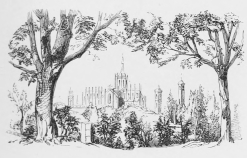
PARAY LE MONIAL. [95]
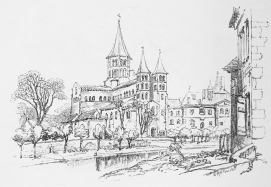
In returning from Italy this year I made the excursion to the curious shrine of Paray le Monial which I have described in an article in Evening Hours. All the time I had been abroad, as during my tour in Spain, I had sent monthly articles to Good Words, for which I was paid at the rate of five guineas a page—a sum, I believe, given besides only to Dean Alford and Arthur Stanley. But those were the palmy days of the magazine. I was paid much less afterwards, till it came down to a fifth of that sum. I spent the rest of the summer in London. It was during this year that I became a member of the Athenæum Club—an incalculable advantage. Twelve years before, old Dr. Hawtrey, the Provost of Eton, had said to me, “You ought to be a member of the Athenæum,” and I had answered “Then I wish you would propose me.” But I had quite forgotten about this, and had never known that the kind old man, long since dead, had really done it; so the news that my name was just coming up for ballot was a joyful surprise. I have since spent every London morning in steady work at the Athenæum, less disturbed there than even at Holmhurst. The difficulties which the club rules throw in the way of receiving visitors are a great advantage to students, and my life at the Athenæum has been as regular as clockwork. At breakfast I have always occupied the same table,—behind the door leading to the kitchen, the one which, I believe, was always formerly used by Wilberforce. In the afternoons, when all the old gentlemen arrive, to poke up huge fires in winter and close all the windows in summer, I have never returned to the club.
Journal.
“London, June (in the Park).—Fine Lady.—‘How strange it is to see all these smart carriages driving about and nobody in them.’
“My simple self.—‘Nobody in them! why, they are quite full of people.’
“Fine Lady.—‘Ah, ye-es—people, but nobody all the same. We never drive in the Park now. It was only to show you this mob that I came. We are obliged to retreat, though, before their advancing battalions. They pursue us everywhere. There is no humiliation and suffering they won’t undergo in the chase. They drove us out of the Row long ago, and this year we took a row of chairs on Sunday afternoons on a little rising ground between Albert Gate and Stanhope Gate;[96] but the enemy pursued us, and as they always get the better of us, we shall be obliged to yield that position too. There is never any safety from them but in flight, for they are certainly our superiors in—numbers.’”
“June 22.—Went to see Madame du Quaire,[97] whom I found in her low French-looking room in Wilton Street, perfectly covered with pictures and oggetti. She talked of spiritualism—how she had been to a meeting at Mrs. Gregory’s—‘a truthful woman, who would not stand imposture if she knew it.’ She ‘cottoned’ up the medium, ‘parcequ’il faut mieux s’adresser à Dieu qu’à ses saints.’ They sat in the dark, which was depressing. Soon after she felt a shock ‘like a torpedo,’ and something like the leg of a chair came and scratched her head. A voice called her and said, ‘I am John King, and I want you, Madame du Quaire; I have got something for you.’ ‘Then,’ said Madame du Q., ‘he gave me a sort of chain of sharks’ teeth; the kind of thing of which, when it was given to some one at Honolulu, the recipient inquired, “C’est un collier?”—“Mais pardon,” said the donor, “c’est une robe.”’
“June 24.—I dined with Lord Ravensworth at Percy’s Cross, and he told me—
“When I was a young man, I was staying at Balnagowan with Lady Mary Ross. She had a son and daughter. The daughter was a very handsome, charming girl. One day I was walking with her, and she told me that when her brother was ill of the measles, at their other place, Bonnington, where the Falls of the Clyde are, an old nurse who lived at the lodge some way off used to come up and sit by him in the day, returning home at night. One morning when she arrived, she was most dreadfully depressed, and being questioned as to the cause, said, ‘I am na lang for this warld; and not only me, but a greater than I is na lang for this warld—and that is the head o’ this hoose.’ And she said that as she was walking home, two lights came out of the larches and flitted before her: one was a feeble light, close to the ground; the other a large bright light higher up. They passed before her to the park gates and then disappeared. ‘And,’ she said, ‘I know that the feeble light is myself, and the greater light is the head o’ this hoose.’
“A few days afterwards the old woman took a cold and died, and within a fortnight Sir C. Ross died too,[98] while the little boy recovered and is alive still.”
Captain Fisher, who is engaged to be married to Victoria Liddell, told me that—
‘When Mr. Macpherson of Glen Truim was dying, his wife had gone to rest in a room looking out over the park, and sat near the window. Suddenly she saw lights as of a carriage coming in at the distant lodge-gate, and calling to one of the servants, said, ‘Do go down; some one is coming who does not know of all this grief.’ But the servant remained near her at the window, and as the carriage came near the house, they saw it was a hearse drawn by four horses and covered with figures. As it stopped at the porch door, the figures looked up at her, and their eyes glared with light; then they scrambled down and seemed to disappear into the house. Soon they reappeared and seemed to lift some heavy weight into the hearse, which then drove off at full speed, causing all the stones and gravel to fly up at the windows. Mrs. Macpherson and the butler had not rallied from their horror and astonishment, when the nurse watching in the next room came in to tell her that the Colonel was dead.
“I was surprised to hear that Mrs. Hungerford was in London, and asked why she had left Ireland so unexpectedly. I was told she had had a great fright—then I heard what it was.
“She was in her room in the evening in her beautiful house, which looks out upon a lake, beyond which rise hills wooded with fir-trees. Suddenly, on the opposite side of the lake, she saw a form which seemed—with sweeping garments—to move forward upon the water. It was gigantic. Mrs. Hungerford screamed, and her sister, Miss Cropper (who afterwards married Mr. Jerome), and the nurse came to her from the inner nursery. The three remained at the window for some time, but retreated as the figure advanced, and at length—being then so tall that it reached to the second floor—looked in at the window, and disclosed the most awful face of a hideous old woman.
“It was a Banshee, and one of the family died immediately afterwards.”
Captain Fisher also told us this really extraordinary story connected with his own family:—
“Fisher may sound a very plebeian name, but this family is of very ancient lineage, and for many hundreds of years they have possessed a very curious old place in Cumberland, which bears the weird name of Croglin Grange. The great characteristic of the house is that never at any period of its very long existence has it been more than one story high, but it has a terrace from which large grounds sweep away towards the church in the hollow, and a fine distant view.
“When, in lapse of years, the Fishers outgrew Croglin Grange in family and fortune, they were wise enough not to destroy the long-standing characteristic of the place by adding another story to the house, but they went away to the south, to reside at Thorncombe near Guildford, and they let Croglin Grange.
“They were extremely fortunate in their tenants, two brothers and a sister. They heard their praises from all quarters. To their poorer neighbours they were all that is most kind and beneficent, and their neighbours of a higher class spoke of them as a most welcome addition to the little society of the neighbourhood. On their part the tenants were greatly delighted with their new residence. The arrangement of the house, which would have been a trial to many, was not so to them. In every respect Croglin Grange was exactly suited to them.
“The winter was spent most happily by the new inmates of Croglin Grange, who shared in all the little social pleasures of the district, and made themselves very popular. In the following summer, there was one day which was dreadfully, annihilatingly hot. The brothers lay under the trees with their books, for it was too hot for any active occupation. The sister sat in the verandah and worked, or tried to work, for, in the intense sultriness of that summer day, work was next to impossible. They dined early, and after dinner they still sat out in the verandah, enjoying the cool air which came with evening, and they watched the sun set, and the moon rise over the belt of trees which separated the grounds from the churchyard, seeing it mount the heavens till the whole lawn was bathed in silver light, across which the long shadows from the shrubbery fell as if embossed, so vivid and distinct were they.
“When they separated for the night, all retiring to their rooms on the ground-floor (for, as I said, there was no upstairs in that house), the sister felt that the heat was still so great that she could not sleep, and having fastened her window, she did not close the shutters—in that very quiet place it was not necessary—and, propped against the pillows, she still watched the wonderful, the marvellous beauty of that summer night. Gradually she became aware of two lights, two lights which flickered in and out in the belt of trees which separated the lawn from the churchyard, and as her gaze became fixed upon them, she saw them emerge, fixed in a dark substance, a definite ghastly something, which seemed every moment to become nearer, increasing in size and substance as it approached. Every now and then it was lost for a moment in the long shadows which stretched across the lawn from the trees, and then it emerged larger than ever, and still coming on—on. As she watched it, the most uncontrollable horror seized her. She longed to get away, but the door was close to the window and the door was locked on the inside, and while she was unlocking it, she must be for an instant nearer to it. She longed to scream, but her voice seemed paralysed, her tongue glued to the roof of her mouth.
“Suddenly, she never could explain why afterwards, the terrible object seemed to turn to one side, seemed to be going round the house, not to be coming to her at all, and immediately she jumped out of bed and rushed to the door, but as she was unlocking it, she heard scratch, scratch, scratch upon the window, and saw a hideous brown face with flaming eyes glaring in at her. She rushed back to the bed, but the creature continued to scratch, scratch, scratch upon the window. She felt a sort of mental comfort in the knowledge that the window was securely fastened on the inside. Suddenly the scratching sound ceased, and a kind of pecking sound took its place. Then, in her agony, she became aware that the creature was unpicking the lead! The noise continued, and a diamond pane of glass fell into the room. Then a long bony finger of the creature came in and turned the handle of the window, and the window opened, and the creature came in; and it came across the room, and her terror was so great that she could not scream, and it came up to the bed, and it twisted its long, bony fingers into her hair, and it dragged her head over the side of the bed, and—it bit her violently in the throat.
“As it bit her, her voice was released, and she screamed with all her might and main. Her brothers rushed out of their rooms, but the door was locked on the inside. A moment was lost while they got a poker and broke it open. Then the creature had already escaped through the window, and the sister, bleeding violently from a wound in the throat, was lying unconscious over the side of the bed. One brother pursued the creature, which fled before him through the moonlight with gigantic strides, and eventually seemed to disappear over the wall into the churchyard. Then he rejoined his brother by the sister’s bedside. She was dreadfully hurt and her wound was a very definite one, but she was of strong disposition, not given either to romance or superstition, and when she came to herself she said, ‘What has happened is most extraordinary and I am very much hurt. It seems inexplicable, but of course there is an explanation, and we must wait for it. It will turn out that a lunatic has escaped from some asylum and found his way here.’ The wound healed and she appeared to get well, but the doctor who was sent for to her would not believe that she could bear so terrible a shock so easily, and insisted that she must have change, mental and physical; so her brothers took her to Switzerland.
“Being a sensible girl, when she went abroad, she threw herself at once into the interests of the country she was in. She dried plants, she made sketches, she went up mountains, and, as autumn came on, she was the person who urged that they should return to Croglin Grange. ‘We have taken it,’ she said, ‘for seven years, and we have only been there one; and we shall always find it difficult to let a house which is only one story high, so we had better return there; lunatics do not escape every day.’ As she urged it, her brothers wished nothing better, and the family returned to Cumberland. From there being no upstairs in the house, it was impossible to make any great change in their arrangements. The sister occupied the same room, but it is unnecessary to say she always closed her shutters, which, however, as in many old houses, always left one top pane of the window uncovered. The brothers moved, and occupied a room together exactly opposite that of their sister, and they always kept loaded pistols in their room.
“The winter passed most peacefully and happily. In the following March the sister was suddenly awakened by a sound she remembered only too well—scratch, scratch, scratch upon the window, and looking up, she saw, climbed up to the topmost pane of the window, the same hideous brown shrivelled face, with glaring eyes, looking in at her. This time she screamed as loud as she could. Her brothers rushed out of their room with pistols, and out of the front door. The creature was already scudding away across the lawn. One of the brothers fired and hit it in the leg, but still with the other leg it continued to make way, scrambled over the wall into the churchyard, and seemed to disappear into a vault which belonged to a family long extinct.
“The next day the brothers summoned all the tenants of Croglin Grange, and in their presence the vault was opened. A horrible scene revealed itself. The vault was full of coffins; they had been broken open, and their contents, horribly mangled and distorted, were scattered over the floor. One coffin alone remained intact. Of that the lid had been lifted, but still lay loose upon the coffin. They raised it, and there, brown, withered, shrivelled, mummified, but quite entire, was the same hideous figure which had looked in at the windows of Croglin Grange, with the marks of a recent pistol-shot in the leg; and they did—the only thing that can lay a vampire—they burnt it.”
Journal.
“Highcliffe, June 30, 1874.—It is delightful to be here again. I came on Friday with Everard Primrose,[99] a friend who always especially interests me, in spite of the intense melancholy which always makes him say that he longs for an early death.
“This place, so spiritually near the gates of heaven, is a great rest—quite a halt in life—after London, which, though I thought it filled with all great and beautiful things, packs in too much, so that one loses breath mentally. Here all is still, and the touching past and earnestly hopeful future lend a wonderful charm to the quiet life of the present. ‘Les beaux jours sont là; on ne les voit pas, on les sent.’[100]
“The dear lady of the castle is not looking well. I believe it is owing to her conversion to Lady Jane Ellice’s teetotalism; but she says it is not that. Lady Jane herself is a perpetual sunshine, which radiates on all around her and is quite enchanting. Miss Lindsay is the only other guest. In the evening Lady Jane sings and Miss Lindsay recites—most wonderfully—out of Shakspeare, with great power and pathos.
“It has not been fine weather, but we have had delightful walks on the sand, by the still sad-looking sea, with the Isle of Wight and its Needles rising in the faint distance, or in the thick woods of wind-blown ilex and arbutus. One day we went to ‘the Haven House,’ which is a place that often comes back to my recollection—picturesquely, gauntly standing on a tongue of land at the meeting of river and bay, at the end of a weird pine-wood, where the gnarled roots of the trees all writhe seawards out of the sand. Here groups of children were at play on the little jetties of sea-weedy stones and timber, while a row of herons were catching fish—solitarily—at great intervals, in the bay.
“Lady Mary Lambart came last night—a simple, self-composed girl, with a pale face and golden hair. She lives exclusively with her aunt, Lady Alicia Blackwood.
“Yesterday, in the ‘Lady Chapel’ of the great church at Christ-Church, I suddenly came upon the tomb of Mary Morgan, who died in 1796. She was companion to my great-aunt, the unhappy Countess of Strathmore, and this monument was dedicated ‘to the most rare of all connections, a perfect and disinterested friend, by the Countess of Strathmore, who, conscious of the treasure, valued its possession and mourned its loss.... To her heroic qualities, her cool deliberate courage, and her matchless persevering friendship, the tears of blood shed by one who despises weakness, the records of law and justice, and perhaps even the historic page, will bear witness to an astonished and admiring posterity.’
THE GARDEN TERRACE, HIGHCLIFFE. [101]
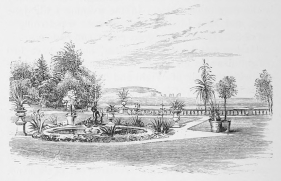
THE HAVEN HOUSE. [102]
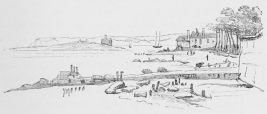
“On the whole, Christ-Church is dull inside: it is so vast, and chiefly perpendicular. The old tombs are used as pedestals for modern monuments, and the old gravestones, stripped of their brasses, have modern epitaphs inserted between the ancient gothic inscriptions. Outside, the position is beautiful, on a little height above the river, near which are some old ruins, and which winds away to the sea through flat reedy meadow-lands, still marked by sails of boats where its outline is lost in distance.”
“June 30.—Mrs. Hamilton Hamilton came last night. She was a daughter of Sir G. Robinson. Her father’s aide-de-camp, Captain Campbell, a poor man, wanted to marry her, and she was attached to him; but it was not allowed, and they were separated. She was married to Mr. Hamilton Hamilton, but Captain Campbell never ceased to think of her, and he was ambitious for her sake, and became Sir Colin Campbell and Lord Clyde. Afterwards, when she was free, it was thought he would marry her. He sent her an Indian shawl, and he wrote to her, and he came to see her, but he never proposed; and she waited and expected, and at last she heard he had said, ‘No, it could not be; people would say it was absurd.’ But it would not have been absurd at all, and she would have liked it very much.
“One always feels here as if one did not half appreciate the perfection of each day as it goes by. It needs time to recognise and realise the warmth and colour which a noble mind, a true heart, and an ever heaven-aspiring soul can throw into even the commonest things of life. I often wonder how these walks, how these rooms with their old boisserie would appear with another inhabitant; quite unimpressive perhaps—but now they are simply illuminated. Beautiful pictures remain with one from everything at Highcliffe, but most of all that of the noble figure, seated in her high tapestried chair, painting at her little table by the light of the green lamp, and behind her a great vase filled with colossal branches of green chestnut, mingled with tall white lilies, such as Gabriel bore before the Virgin. As Lady Jane sings, she is roused to call for more songs, for ‘something pathetic, full of passion—love cannot be passionate enough.’—‘What! another?’ says Lady Jane. ‘Another, two nothers, three nothers: I cannot have enough.’
“‘In the perfect Christian, the principal virtues which produce an upright life and beauty of form are fervent faith and the love of our crucified Redeemer. As faith and love deepen, so external grace and beauty increase, until they become able to convert the hearts of men.... The soul that is beloved of God becomes beautiful in proportion as it receives more of the Divine grace.’ These words are from Savonarola’s Sermons, and do they not apply to our Lady?
“Lady Caroline Charteris[103] came to luncheon—plain in features, but in mind indescribably beautiful and interesting. She brought with her a most touching letter she had received from Dr. Brown[104] after his wife’s death. He spoke of the wells of salvation which men came to when they were truly thirsty, otherwise most people either passed them altogether, or stayed an instant, gazed into them admiringly, and still passed on. With Lady Caroline came Mrs. David Ricardo in a beautiful pink hat, like a Gainsborough in flesh and blood.”
“July 1.—A delightful morning in the library, fitful sunlight gleaming through the stained windows and upon the orange datura flowers in the conservatory, Lady Waterford painting at her table, Lady Jane and Miss Lindsay and Lady Mary Lambart[105] (a noble-looking girl like a picture by Bronzino) working around. Lady Waterford talked of the odd mistakes of words—how an old lady always said ‘facetious’ for ‘officious’—that when she came by the railway the porters had been so very ‘facetious,’ &c. Miss Mary Boyle condoled with an old woman at the Ashridge almshouses on the loss of her old husband. ‘Oh, yes, ma’am, it’s a great loss; but still, ma’am, I’m quite happy, for I know that he’s gone to Beelzebub’s bosom.’—‘I think you must mean Abraham.’—‘Well, yes, ma’am, since you mention it, I think that was the gentleman’s name.’
THE LIBRARY, HIGHCLIFFE. [106]
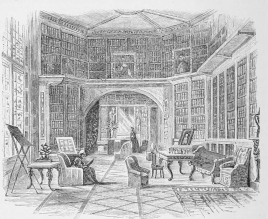
“In the afternoon we had a delightful walk to Hoborne, across a common on which a very rare kind of ophrys grows. Lady Waterford talked of a visit she had had at Ford from Mr. Wayte, the new Rector of Norham, who told her that a few nights before, his curate, Mr. Simon, had been obliged to go to fetch some papers out of the vestry at night. When he opened the church door, the moonlight was streaming in at the west window, and the middle of the nave was in bright light, but the side aisles were dark. He walked briskly down the middle of the church to the vestry, and, as he went, was aware that a figure dressed in white was sitting motionless in the corner of one of the pews in the aisle. He did not stay, but went into the vestry to get his papers, and, as he returned, he saw that the figure was still in the same place. Much agitated, he did not go up to it, but hurried home, and waited for daylight, when he returned at once to the church. The figure was still there, and did not move as he approached. When he uncovered its face, he saw that it was a dead body. The body had been found in the Tweed the day before, and the finders had not known what to do with it, so they had wrapped it in a sheet, and set it up in the church.”
“July 3.—We drove to Ashley Clinton—a charming place. Lady Waterford talked of the origin of words—of weeds as applied to dress. Mrs. Hamilton said how the Queen of the Sandwich Islands always spoke of flowers as weeds. ‘What pretty weeds there are in the cottage gardens.’
THE FOUNTAIN, HIGHCLIFFE. [107]
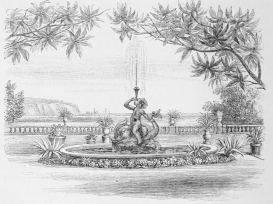
“Lady Waterford spoke of the picture of Miss Jane Warburton near her bedroom door; how she was appointed maid of honour to Queen Caroline at a time when maids of honour were rather fast, and how, at dinner, when the maids proposed toasts, and one gave the Archbishop of Canterbury, another the Dean of St. Paul’s, or some other old man, she alone had the courage to give the smartest and handsomest man of the day, the Duke of Argyll.[108] She was so laughed at by her companions that it made her cry, and at the drawing-room somebody said to the Duke of Argyll, ‘That is a young lady who has been crying for you,’ and told him the story. He was much touched, but unfortunately he was married. Afterwards, however, when his Duchess died, he married Miss Warburton, and, though she was very ugly, he thought her absolute perfection. In the midst of the most interesting conversation he would break off to ‘listen to his Jane;’ and he had the most absolute faith in her, till once he discovered that she had deceived him in something about a marriage for one of her daughters with an Earl of Dalkeith, which was not quite straightforward; and it broke his heart, and he died.”
“July 5.—I came up to London with Lady Waterford on Friday, and as usual I find what Carlyle calls ‘the immeasurable, soul-confusing uproar of a London life’ rather delightful than otherwise. To-day I have been with Mary Lefevre to Marylebone, to hear Mr. Haweis[109] preach. He is like a Dominican preacher in Italy, begins without a text, acts, crouches, springs, walks about in the pulpit—which is fortunately large enough, and every now and then spreads out vast black wings like a bat, and looks as if he was about to descend upon his appalled congregation. Part of his sermon was very solemn, but in part preacher and audience alike giggled. ‘He was converted last Sunday week: he was converted exactly at half-past four P.M., but since then they say that he has been seen at a theatre, at a ball, and at a racecourse, and that therefore his conversion is doubtful. Now you know my opinion is that none of these things are wrong in themselves. The question is not what the places are, but with what purpose and in what spirit people go to them. Our Saviour would not have thought it wrong to go to any of these places. John the Baptist certainly acted altogether on a lower level and went out as an ascetic into the wilderness. But our Saviour was both charitable and large-hearted. When He was asked to a feast, he went. He never sacrificed Himself unnecessarily, and so the ‘religious people’ of that day abused him for eating with publicans and sinners. It is just what ‘religious people,’ the Pharisees of our own day, say now.... Oh, let us leave these perpetual judgments of others.’
“I went afterwards to luncheon at Lady Castletown’s; she was not come in from church, but I went up into the drawing-room. A good-looking very smart young lady was sitting there, with her back to the window, evidently waiting also. After a pause, I made some stupid remark to her about heat or cold, &c. She looked at me, and said, ‘That is a very commonplace remark. I’ll make a remark. If a woman does not marry, she is nobody at all, nothing at all in the world; but if a man ever marries at all, he is an absolute fool.’ I said, ‘I know who you are; no one but Miss Rhoda Broughton would have said that.’ And it was she.
“Mr. Browning came and sat on the other side of her at luncheon. She said something of novels without love: I said something of black dose as a cure for love. Mr. Browning said that Aristophanes spoke of ‘the black-dose-loving Egyptians.’ Miss Broughton said, ‘How do you know the word means black dose?’—‘Because there is a similar passage in Herodotus which throws light upon the subject, with details on which it would not be delicate to dwell.’”
“July 6.—Dined with Madame du Quaire, meeting Mr. and Mrs. Wigan and Mr. and Mrs. Preston. Mrs. Wigan talked of children’s odd sayings: of one who, being told that God could see everywhere, asked if He could see the top of His own head; of another, at a school-feast, who being asked to have another bun, said, ‘Oh no, want to go home.’—‘Nonsense! have another bun.’—‘No, want to go home;’ upon which the giver of the feast took him up, and the child exclaimed, ‘Oh don’t, don’t bend me.’”
“July 8.—A drawing-party at Lambeth. Madeleine Lefevre and I went afterwards to show our drawings to Mrs. Tait, and had luncheon in the large cool pleasant rooms. In the afternoon I went with the Lefevres to the camp at Wimbledon. It is an immense enclosure, with streets of tents, lines of flags. In front of the officers’ tents are masses of flowers in pots sunk in a substratum of tan, as by law the turf may not be broken. Lady Ducie’s tent, whither we went, was most luxurious. We went on afterwards to Lady Leven’s garden, which was a beautiful sight, with brilliant groups of people. At the end, children were watching the manœuvres of some cats, who sat quiet with garlands of mice and birds upon their heads.”
“July 10.—Drew in the Tower of London, and dined at Lord Castletown’s to meet Mr. and Mrs. Godfrey Pearse (she Mario’s daughter), Madame du Quaire, and the truly extraordinary M. Vivier.
GATEWAY, LAMBETH PALACE. [110]
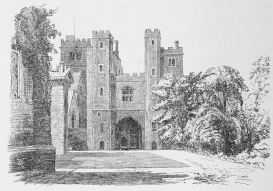
“He talked incessantly, but expected what Lady Castletown called ‘a gallery,’ and perfect silence and attention. ‘Je suis intéressant, moi! La petite de C. elle n’a rien: elle chante, elle fait les oiseaux, voilà tout. Pour entendre les oiseaux, vous ferez mieux d’aller dans vos squares: vous les entendrez, et vous payerez rien. Mais la petite de C. elle est moralement malsaine: moi je ne le suis pas, et je suis—intéressant.’
“He was so surprised at the number of servants: ‘And does all that sleep in the house?’ he said.
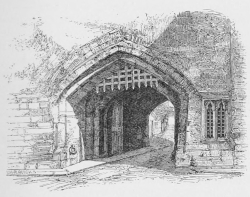
THE BLOODY GATE, TOWER OF LONDON. [111]
“In the evening he sang ‘Nellie,’ and his ‘Drame’—of a blind Spanish musician with a violin, watching windows for money, a perfect passion of avarice and expectation.”
“July 11.—Luncheon with Lady Morley, meeting Miss Flora Macdonald, who has still a reminiscence of the great beauty which brought such a surprise to the old Duchess of Gloucester when she asked Victor Emmanuel what he admired most in England, and he answered so promptly, ‘Miss Flora Macdonald.’ Lady Katherine Parker described—‘because, alas! it was discovered that we date just a little farther back than the Leicesters,’ having to sit near ——, the most airified man in London. She was congratulated afterwards upon his having condescended to speak to her, but said he wouldn’t, only his neighbour on the other side was even more insignificant than herself, and to her he did not speak at all. He said, apropos of a dinner at Dorchester House, ‘Pray who are these Holfords?’—‘Oh,’ said Lady Katherine, ‘I believe they are people who have got a little shake-down somewhere in Park Lane.’
“I was at the ‘shake-down’ in the evening—something quite beautiful. The staircase is that of an old Genoese palace, and was one blaze of colour, and the broad landings behind the alabaster balustrades were filled with people, sitting or leaning over, as in old Venetian pictures. The dress of the time entirely lends itself to these effects. I sat in one of the arcades with Lady Sarah Lindsay and her daughters, then with Lady Carnarvon. We watched the amusing contrasts of the people coming upstairs—the shrinking of some, the dégagée manner of others, the dignity of a very few—in this, no one to be compared with Princess Mary. The Prince and Princess of Wales were close by (he very merry, talking with much action, like a foreigner), also the Prince and Princess of Prussia. Lady Somers looked glorious in a black dress thickly sprinkled with green beetles’ wings and a head-dress of the same.
“With Lady Carnarvon I had a long talk, and could not help feeling how truly one might apply to her Edgar Poe’s lines:—
“Thou would’st be loved, oh! then thy heart From its present pathway part not: Being everything that now thou art, Be nothing that thou art not. So, with the world, thy winning ways, Thy grace, thy more than beauty, Shall be the theme of endless praise, And love, and simple duty.”
“July 12.—Yesterday there was a great party at Hatfield. I drove with the Woods to King’s Cross for the special train at 4 P.M., but was separated from them at the station, and joined Lady Darnley and Raglan Somerset. A tremendous storm was brewing over London, but we left it behind at first. Quantities of carriages from the house were in waiting at the Hatfield station. The street was lined with wreaths and flowers, and a succession of triumphal arches made the steep hill look like a long flowery bower. In the park, the grand old limes were in full blossom in front of the stately brick house. On the terrace on the other side the mass of guests was assembling. I went off with Lady Braybrooke to the labyrinth, then with Lady Darnley and the E. de Bunsens over the house. The storm now broke with tremendous lightning and loud peals of thunder, and in the Golden Gallery it was almost dark. Just as it began, the royal party drove up, the Prince and Princess of Wales, Prince and Princess of Prussia, Prince Arthur, the Tecks, the Duchess of Manchester, and a great quantity of suite—a very pretty procession, vehemently cheered by the people. When the storm cleared, we went out upon the terraces; the royal party went to the labyrinth. As it returned, I was standing with the Leghs of Lyme at the head of the steps, when Prince Arthur came up to me, was very cordial, and talked for some time about Rome, &c. I asked him if the Queen drew still. ‘Oh, yes,’ he said, ‘she is quite devoted to it: and I am very fond of it too, but then I have so little time.’
“Owing to the rain, the dinner for eight hundred had to be moved into the Armoury. The royal guests and a few others dined in the Marble Hall; the Princess of Prussia was forgotten as they were going in, and had to be hunted for. We all dined at little tables; I was at one with Mrs. Stuart Wortley, Mrs. W. Lowther, and Lord Sydney. Afterwards the terraces and house were beautifully illuminated with coloured lights, in which, through what looked like a sea of fire and blood, the cascades of white roses frothed up. Every one walked out. The royalties seemed to spring up everywhere; one was always running against them by mistake. There was a pretty procession as they went away, and immediately afterwards I returned with Miss Thackeray, her sister, and the Master of Napier.
“An excursion of this kind from London is delightful. C’est l’entr’acte!”
COMPIÈGNE. [112]
“July 13.—Yesterday (Sunday) I had luncheon with Lady Castletown; young Mr. Astley was there, and Miss Trollope. Lady Castletown talked of Vivier, of the marvellous versatility of his genius, of his absolute refusal to go any way but his own; that except for love he never sang a single song under three thousand francs; that when he gave a concert at Nice he asked ‘cent francs chaque,’ and the rooms were crowded; that at Compiègne he did some things, but he only allowed three persons to be present—the Emperor and two others. He excluded the Empress, because, in his Spanish scene, she had dared, Spanish-wise, to throw a bracelet into his hat, which so offended him that he told the Emperor he should never let her see him again. The Emperor quite delighted in him, and could not bear him to go away. He persuaded Vivier to go with him to Vichy, and there some of the great men of the court called to him from a window, as he was walking in the garden, and begged him to come to them. He was furious, and complained to the Emperor. ‘Sire, ce n’est pas comme cela qu’il faut appeler Vivier.’ On one occasion he stopped and threw up his whole comedy in the middle before a large audience because Lord Houghton sneezed. It was therefore necessary carefully to select his audience, otherwise he might take offence and never return. He has discovered powers in a French horn which no one had any idea of before, and he can sit close by you and play it with a degree of delicacy which perfectly transports you—the most sublime philosophy of music.
HOLLAND HOUSE. [114]
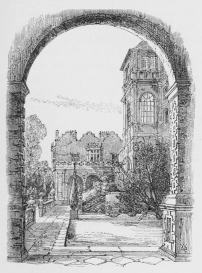
“We went afterwards to Holland House. I sat in the carriage at first under the shadow of the grand old red pile, but Lady Holland sent Mr. Hayward out to fetch me in, which he did with a bad grace.[113] Lady Holland is a very little woman, simply dressed, with a white cap. She has sparkling eyes, which give her face a wonderful animation; which is almost beauty in itself, and which, in the setting of that house and its historic memories, makes her quite a person to remember. Mrs. Locke was there, and Lord Tankerville, whom I was very glad to see again. Outside, on a comfortable bench, we sat some time with the old Duc de Richelieu. Mrs. Wingfield and I wandered about in the gardens, which were glorious!—such blazes of flowers between the trees, such splashing fountains, such armies of scarlet lilies looking over the clipped yew hedges; and the house itself so rich in colour and in shadow. Then there is a glade—a grass walk of immense length, completely shut in by trees and forest-like tangle, so that you might think yourself in the deep recesses of Sherwood instead of close to London.
“Everard Primrose called to us out of a window, and we went up to him in the old library. He was in a melancholy mood, and would not come down with us; but Mrs. Wingfield went back to him alone, and, with that wonderful sympathy which is natural to her, she soon tamed him, and he came to us and was as pleasant as possible.
“The picture of Marie, Princess Lichtenstein, hung, pale and sad, looking down on us from a corner, and seemed to say, ‘Hence I am now banished; even my portrait is put away.’”
“July 14.—Dined at Lady Carnarvon’s to meet Lord Stanhope. Only the two mothers of the house, Lady Chesterfield and Lady Carnarvon—a charming good-humoured old lady, and a Mr. Townshend were there. Lord Carnarvon talked much of the interests of regular work and the unutterable weariness of interruptions. Lord Stanhope was very agreeable at dinner, but fell asleep afterwards. The younger Lady Carnarvon, with her hair sprinkled with diamonds, looked unspeakably lovely.”
To Miss Wright.
HOLMHURST, THE ROCK WALK.
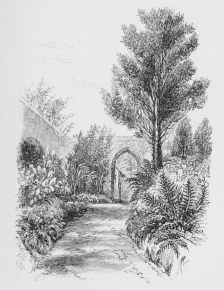
“Holmhurst, July 19, 1874.—I know half my friends wonder how I can like the change from the intellectual interests and luxurious life of London to the society of the bumble-bees and butterflies in this little hermitage; but I am sure the absolute quietude is very good for one, and I rush into my work at once, and get through no end of it. I came away from London, however, rather pining to stay for the party at Holland House, because I thought it was a duty to Lea and Miss Leycester, and I experienced the bathos, which so often comes when one is rather conceited about a little piece of self-sacrifice, of finding they would both much rather I had gone to the party, that they might have heard all about it!
“Miss Leycester is very cheerful, and greatly enjoys her summer retreat here—sitting out amid the scent of the lime-flowers: being wheeled about in her chair amongst the baskets of geraniums: having tea upon the terrace, &c. Another sweet old lady cousin, Miss Tatton, who cannot walk at all, is just arriving for a fortnight, and the Hospice is quite full of dear feeble beings.
“As to the little troubles about which you ask me, I can only reply in the words of Delatouche to George Sand, ‘Patientez avec le temps et l’expérience, et soyez tranquille: ces deux tristes conseilleurs viendront assez vite.’
“I shall be very anxious to hear about your German travels.... To me, if one is not in a fever about going on, the lingering in the wonderful old towns by the way, so full of a past deeply written still on their remains, is far more interesting than that part of the tour which all the world takes, and the little glimpses of people and life which one gets in them give one far more to think about afterwards. Würtzburg and Ratisbon I forbid you to pass unseen: they used to be reached, toiled after with such labour and fatigue; and now, in these railway days, they are generally—passed.”
Journal.
“July 29.—I have been in London again for two days. On Tuesday Sir Howard Elphinstone, the Lefevres, and I went to Holland House, where Lady Castletown and Mrs. Wingfield joined us. We drew in the Arcade, and then Miss Coventry came out in her Spanish hat and called us in to Lady Holland. She was in the west room, sitting in the wide window, and, like a queen, she sat on, moving for nobody. She was, however, very kind, and pleased with our drawings. She talked of the royal ball, and said that the two little Princes were so delighted with Puss in Boots that they pulled his tail incessantly, till at last Puss said, ‘Remember I have got teeth and claws as well as a tail,’ and then they were frightened and left off.
HOLLAND HOUSE (GENERAL VIEW). [115]
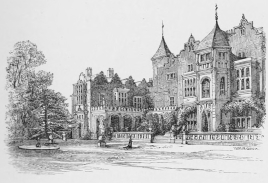
“Wednesday was Victoria Liddell’s wedding-day.[116] All Fulham turned out, and Walham Green was a succession of triumphal arches, garlands, and mottoes. I went with Victor Williamson, and they mistook us for the bridegroom and best man. They told us to go up and wait near the altar, and the Wedding March struck up, but stopped abruptly as we went into a pew.”
“July 30.—Yesterday I dined at Lord Castletown’s, and met, as usual, an interesting party. Lord Castletown[117] talked of his youth at Holland House, when he was brought up there as the ward of Lord Holland. ‘Lord H. was most indulgent, and was always finding amusements for me. One day, two days before the end of the Eton holidays, he asked me to go somewhere. “No, sir,” I said, “I cannot do that, because I have got my holiday task to finish.”—“And what is your task?” said Lord Holland. “Latin verses on St. Paul preaching at Athens, seventy lines.”—” Oh, what a grand subject,” said Lord Holland; “leave it for me. I will do your task for you, and do you go out and amuse yourself.” And he did it all but four lines, and then some important business called him away, and he gave them back to me, saying I must finish them as well as I could. It was a most grand set of verses, and when I gave them up to Keats, he would read them aloud before the whole school. In the middle he said, “Who wrote these, sir?”—“I, sir.”—“You lie, sir,” said Keats. At last he came to the last four lines. “You wrote these, sir,” he said. I heard no more of it, but I never got back my copy of verses.
“‘Once I escaped from Eton, and Lord Holland caught me—found me in the streets of London. He made me get into his carriage at once, and told the man to drive to the White Horse Cellar, whence the coach started for Eton. Unfortunately for me, there was one starting at once, and he made me get in. I remonstrated, saying that I had not got my things. “They shall be sent after you,” he said. “But I shall be flogged, sir.”—“Serve you right, too; I hope you will be flogged,” he said. I looked very piteous, and as I got into the coach he said, “Well, good-bye, John; I hope you’ll be flogged,” and he shook hands with me, and in my hand I found a five-pound note. He was always doing those kind things.
“‘At Holland House I saw everybody most worth seeing in Europe. All that was best flowed in to Lord Holland, and he was equally hospitable to all. The Whigs, not only of England, but of all the world, came to him.’
“Lady Castletown told a story of a Russian Princess who had a very hideous maid. One morning her maid came to her looking very much agitated—perfectly défaite. The Princess asked her what was the matter, when she said, ‘Oh, I have had the most extraordinary night. As I was going to bed, I saw a man’s foot under the bed. I was going to ring the bell when he stopped me by saying, “Oh, don’t ring; I have been brought into this predicament by my hopeless passion for you. I felt that there was no other chance of seeing you, so I ran this risk.” Seeing that he was serious, and never having had a proposal before, I could not but talk to him; and we talked all night, and now it is all settled, and we are to be married.’—‘Well,’ said the Princess, ‘that is very strange; and now I am going to court, so where are my diamonds?’—‘Oh, of course where they always are,’ said the maid; but, when she looked, they were gone: the lover had taken them. ‘Of course that is what he came for,’ said the Princess; ‘do you think he would have come for you?’ And the diamonds were never recovered.”
HOLLAND HOUSE (THE LILY GARDEN). [118]
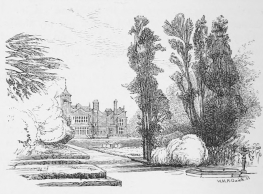
“August 8.—Came to Chevening. The house strikes one by its overwhelming impression of sadness. The sunshine is all blotted out since last year by the death of its beloved mistress last winter;[119] but I am glad I came, as it gives pleasure, and I am glad I was asked so soon, as it shows their liking to have me. Walking with Lady Mahon[120] between the same beds of tall flowers amongst which I walked with Lady Stanhope last year, she spoke of her very touchingly, how, though there might be many pleasures and interests left in life, there was always the feeling that there never could be what had been—the warm interest in others, the cheerful sunny nature which radiated on all it came in contact with. The illness was very sudden, and little alarm felt till just the end. Her last words to her poor broken-hearted husband were, ‘Do not fret, love; I shall soon be quite well now.’ Lady Mahon said that Lord Stanhope’s heroic determination to bear up for all their sakes enabled them to follow his example.”
“August 10, Sunday.—This afternoon I drove with Lord Stanhope in the long grassy glades of the park, the highest and prettiest of which gave a name to the place—Chevening, ‘the Nook in the Hill.’ We drove afterwards from one fine young Wellingtonia which he had planted to another, examining them all, and came back by the Spottiswoodes’. It is a fine old place, intended as an imitation of the Villa Doria at Rome, and though in nowise like Villa Doria, it has a look of Italy in its groves of ilexes and its cypresses. Lady Frederick Campbell[121] lived here. Her first husband was the Lord Ferrers who was hanged, and some evidence which she gave was instrumental in bringing about his condemnation. Lord Ferrers cursed her, saying that her death would be even more painful than his; and so in fact it was, for in 1807 she was burnt in one of the towers of the house, from spontaneous combustion it is said. Nothing was found of her but her thumb, she was so completely consumed, and ever since it is said that the ghost of Lady Frederick Campbell wanders in the grounds at night, brandishing her thumbless hand, and looking for her lost thumb. The place lends itself to this from its wonderful green glades lined with cedars and guarded by huge grey stone vases.
“Coomb Bank was afterwards bought by the Claytons, who spent all they had in the purchase and had nothing left for keeping it up, so eventually they sold it to Mr. Spottiswoode, the King’s Printer, to whom the monopoly of printing Bibles and Prayer-books has been the source of a large fortune. Mr. Spottiswoode himself is a most remarkable man, who, for hours before his daily walk to the City, is occupied with the highest mathematical speculations, and returns to spend his evenings in studies of the most abstract nature. It is said that the present generation is more indebted to him than to any other person for its improved powers of analysis. He has made no important discoveries yet, but he probably will make them, if he lives long enough. His character seems to be a wonderful combination of profound knowledge and power and profound humility.”
“August 11.—A semi-wet day, spent chiefly in the library, which is attached to the house by a corridor full of portraits. In the afternoon, though it poured, we had a long drive on the Chart. The Spottiswoodes dined, and Mrs. Spottiswoode sang very old music.”
“August 12.—Came to Cobham. It has a beautiful approach across the broken ground of a very wild park with grand old trees. In the hollow is the old house, which is immense, of red brick with projecting oriels and towers. Lady Darnley[122] received me in the library; she has an unintentionally haughty manner, but when you are accustomed to her, you find that she is charming—
‘Si sta placido e cheto, Ma serba dell’ altiero nel mansueto;’[123]
and soon it seemed as if one had known her all one’s life. The children came dropping in—two grown-up daughters, two little girls, Lord Clifton, and two fine frank younger boys—Ivo and Arthur. There are many guests.”
“August 13.—A most pleasant morning sitting with Lady Darnley under the fine old trees drawing the house, and seeing the rooms and the pictures, which are mostly dull—chiefly nymphs and satyrs with very few clothes on—two very fine Titians being the redeeming part of the gallery. The pictures are wisely devoted to the public; they are too uncomfortable to live with, and the Chatham people adore them.
COBHAM HALL.
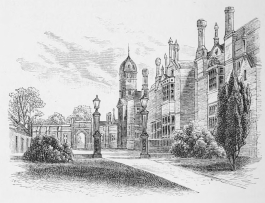
“I find this house, where no one is too clever, but every one is pleasant nevertheless, a great rest after Chevening, where I always felt struggling up to an intellectual level which I have no right to and which I cannot attain. Apropos, the last morning Lord Stanhope talked much of the origin of words, and said ‘Beldam’ came from ‘Belle dame’ used satirically.”
“August 15.—Returned to Holmhurst. Mr. Thomas, the landscape gardener, travelled with me. He spoke of an obnoxious American coming into a great hotel at Liverpool and boasting of how much finer American hotels were—‘a hundred times the size,’ &c. The man he addressed listened quietly and then said, ‘But you have not yet seen our great hotel at Southampton, sir; it is a mile long, will accommodate 5000 people, and all the waiters wait on horseback.’—‘I guess that’s a lie, sir,’ said the American. ‘Yes, it is,’ replied the Englishman, ‘but then I thought you were telling lies.’”
“Sept. 28.—A very pleasant visit of two days to the Shaw-Lefevres. They are certainly one of the happiest and most united of families. We made a delightful excursion of sixteen miles to Sutton Court, where they lived formerly. It must be very seldom that, after a lapse of ten years, a father and mother can return to such a place in old age with their family of the original seven unbroken, only many others added. Sutton, the beautiful old house of the Westons, inlaid with terra-cotta, is just the place for a story, with the closed wing where the ivy forces its way through the walls and wreaths round the frames of the old family portraits, which, rent and forlorn, flap in the gusts of wind whenever a distant door opens. Then there is the still-used Roman Catholic chapel, with its priest and its country congregation.”
“Powderham Castle, Oct. 4.—A week here has been most delightful. I had not felt certain how much I might like it, how much my dear friend of old days might be changed by lapse of time and new relations. I can only say that, if he is changed, it is in being more entirely and perfectly delightful than ever, more indescribably thoughtful for others, more filled with plans for the good of every one, and withal so simple, so free from cant, that all else seems unchristian and mundane by comparison. Lady Agnes is the one person I have seen who is quite entirely worthy of him, and it does seem as if a reward of such perfectly beautiful lives was given even in this life, that they should have been thrown together.