BOOK VIII THE AGE OF THE GREAT POWERS (continued 5)
Reading edition
§ 4
We have traced throughout this history the gradual restriction of the idea of property from the first unlimited claim of the strong man to possess everything and the gradual realization of brotherhood as something transcending personal self-seeking (see especially chap. xxxvii, § 13). Men were first subjugated into more than tribal societies by the fear of monarch and deity. It is only within the last three or at most four thousand years that we have any clear evidence that voluntary self-abandonment to some greater end, without fee or reward, was an acceptable idea to men, or that anyone had propounded it. Then we find spreading over the surface of human affairs, as patches of sunshine spread and pass over the hillsides upon a windy day in spring, the idea that there is a happiness in self-devotion greater than any personal gratification or triumph, and a life of mankind different and greater and more important than the sum of all the individual lives within it. We have seen that idea become vivid as a beacon, vivid as sunshine caught and reflected dazzlingly by some window in the landscape, in the teaching of Buddha, Lao Tse, and, most clearly of all, of Jesus of Nazareth. Through all its variations and corruptions Christianity has never completely lost the suggestion of a devotion to God’s commonweal that makes the personal pomps of monarchs and rulers seem like the insolence of an over-dressed servant and the splendours and gratifications of wealth like the waste of robbers. No man living in a community which such a religion as Christianity or Islam has touched can be altogether a slave; there is an ineradicable quality in these religions that compels men to judge their masters and to realize their own responsibility for the world.
As men have felt their way towards this new state of mind from the fierce self-centred greed and instinctive combativeness of the early Palæolithic family group, they have sought to express the drift of their thoughts and necessities very variously. They have found themselves in disagreement and conflict with old-established ideas, and there has been a natural tendency to contradict these ideas flatly, to fly over to the absolute contrary. Faced by a world in which rule and classes and order seem to do little but give opportunity for personal selfishness and unrighteous oppression, the first impatient movement was to declare for a universal equality and a practical anarchy. Faced by a world in which property seemed little more than a protection for selfishness and a method of enslavement, it was as natural to repudiate all property. Our history shows an increasing impulse to revolt against rulers and against ownership. We have traced it in the middle ages burning the rich man’s châteaux and experimenting in theocracy and communism. In the French revolutions this double revolt is clear and plain. In France we find side by side, inspired by the same spirit and as natural parts of the same revolutionary movement, men who, with their eyes on the ruler’s taxes, declared that property should be inviolable, and others who, with their eyes on the employer’s hard bargains, declared that property should be abolished. But what they are really revolting against in each case is that the ruler and the employer, instead of becoming servants of the community, still remain, like most of mankind, self-seeking, oppressive individuals.
Throughout the ages we find this belief growing in men’s minds that there can be such a rearrangement of laws and powers as to give rule and order while still restraining the egotism of any ruler and of any ruling class that may be necessary, and such a definition of property as will give freedom without oppressive power. We begin to realize nowadays that these ends are only to be attained by a complex constructive effort; they arise through the conflict of new human needs against ignorance and old human nature; but throughout the nineteenth century there was a persistent disposition to solve the problem by some simple formula. (And be happy ever afterwards, regardless of the fact that all human life, all life, is throughout the ages nothing but the continuing solution of a continuous synthetic problem.)
The earlier half of the nineteenth century saw a number of experiments in the formation of trial human societies of a new kind. One of these, the Oneida Community (1845-79), under the leadership of a man of very considerable genius and learning, John Humphry Noyes, did for a number of decades succeed in realizing many of the most striking proposals of Plato’s Republic; it became wealthy and respected; but it broke up in 1879 largely because of the disposition of the younger generation to leave its peculiar limitations in order to play a part in the larger community of the world outside. A powerful business corporation still preserves its industrial tradition.[463] But the Oneida experiment was too bold and strange a departure to influence the general development of modern civilization. Far more important historically were the experiments and ideas of Robert Owen (1771-1858), a Manchester cotton-spinner. He is very generally regarded as the founder of modern Socialism; it was in connection with his work that the word “socialism” first arose (about 1835).
He seems to have been a thoroughly competent business man; he made a number of innovations in the cotton-spinning industry, and acquired a fair fortune at an early age. He was distressed by the waste of human possibilities among his workers, and he set himself to improve their condition and the relations of employer and employed. This he sought to do first at his Manchester factory and afterwards at New Lanark, where he found himself in practical control of works employing about two thousand people. Between 1800 and 1828 he achieved very considerable things: he reduced the hours of labour, made his factory sanitary and agreeable, abolished the employment of very young children, improved the training of his workers, provided unemployment pay during a period of trade depression, established a system of schools, and made New Lanark a model of a better industrialism, while at the same time sustaining its commercial prosperity. He wrote vigorously to defend the mass of mankind against the charges of intemperance and improvidence which were held to justify the economic iniquities of the time.[464] He held that men and women are largely the product of their educational environment, a thesis that needs no advocacy to-day. And he set himself to a propaganda of the views that New Lanark had justified. He attacked the selfish indolence of his fellow manufacturers, and in 1819, largely under his urgency, the first Factory Act was passed, the first attempt to restrain employers from taking the most stupid and intolerable advantages of their workers’ poverty. Some of the restrictions of that Act amaze us to-day. It seems incredible now that it should ever have been necessary to protect little children of nine (!) from work in factories, or to limit the nominal working day of such employees to twelve hours!
People are perhaps too apt to write of the industrial revolution as though it led to the enslavement and overworking of poor children who had hitherto been happy and free. But this misinterprets history. From the very beginnings of civilization the little children of the poor had always been obliged to do whatever work they could do. But the factory system gathered up all this infantile toil and made it systematic, conspicuous, and scandalous. The factory system challenged the quickening human conscience on that issue. The British Factory Act of 1819, weak and feeble though it seems to us, was the Magna Carta of childhood; thereafter the protection of the children of the poor, first from toil and then from bodily starvation and ignorance, began.
We cannot tell here in any detail the full story of Owen’s life and thought.[465] His work at New Lanark had been, he felt, only a trial upon a small working model. What could be done for one industrial community could be done, he held, for every industrial community in the country; he advocated a resettlement of the industrial population in townships on the New Lanark plan. For a time he seemed to have captured the imagination of the world. The Times and Morning Post supported his proposals; among the visitors to New Lanark was the Grand Duke Nicholas who succeeded Alexander I as Tsar; a fast friend was the Duke of Kent, son of George III and father of Queen Victoria. But all the haters of change and all—and there are always many such—who were jealous of the poor, and all the employers who were likely to be troubled by his projects, were waiting for an excuse to counter-attack him, and they found it in the expression of his religious opinions, which were hostile to official Christianity, and through those he was successfully discredited. But he continued to develop his projects and experiments, of which the chief was a community at New Harmony in Indiana (U. S. A.), in which he sank most of his capital. His partners bought him out of the New Lanark business in 1828.
Owen’s experiments and suggestions ranged very widely, and do not fall under any single formula. There was nothing doctrinaire about him. His New Lanark experiment was the first of a number of “benevolent businesses” in the world; Lord Leverhulme’s Port Sunlight, the Cadburys’ Bournville, and the Ford businesses in America are contemporary instances; it was not really a socialist experiment at all; it was a “paternal” experiment. But his proposals for state settlements were what we should call state socialism to-day. His American experiment and his later writings point to a completer form of socialism, a much wider departure from the existing state of affairs. It is clear that the riddle of currency exercised Owen. He understood that we can no more hope for real economic justice while we pay for work with money of fluctuating value than we could hope for a punctual world if there was a continual inconstant variability in the length of an hour. One of his experiments was an attempt at a circulation of labour notes representing one hour, five hours, or twenty hours of work. The co-operative societies of to-day, societies of poor men which combine for the collective buying and distribution of commodities or for collective manufacture or dairying or other forms of agriculture, arose directly out of his initiatives, though the pioneer co-operative societies of his own time ended in failure. Their successors have spread throughout the whole world, and number to-day some thirty or forty million of adherents.
A point to note about this early socialism of Owen’s is that it was not at first at all “democratic.” Its initiative was benevolent, its early form patriarchal; it was something up to which the workers were to be educated by liberally disposed employers and leaders. The first socialism was not a worker’s movement; it was a master’s movement.
Concurrently with this work of Owen’s, another and quite independent series of developments was going on in America and Britain which was destined to come at last into reaction with his socialistic ideas. The English law had long prohibited combinations in restraint of trade, combinations to raise prices or wages by concerted action. There had been no great hardship in these prohibitions before the agrarian and industrial changes of the eighteenth century let loose a great swarm of workers living from hand to mouth and competing for insufficient employment. Under these new conditions, the workers in many industries found themselves intolerably squeezed. They were played off one against another; day by day and hour by hour none knew what concession his fellow might not have made, and what further reduction of pay or increase of toil might not ensue. It became vitally necessary for the workers to make agreements—illegal though they were—against such underselling. At first these agreements had to be made and sustained by secret societies. Or clubs, established ostensibly for quite other purposes, social clubs, funeral societies, and the like, served to mask the wage-protecting combination. The fact that these associations were illegal disposed them to violence; they were savage against “blacklegs” and “rats” who would not join them, and still more savage with traitors. In 1824 the House of Commons recognized the desirability of relieving tension in these matters by conceding the right of workmen to form combinations for “collective bargaining” with the masters. This enabled Trade Unions to develop with a large measure of freedom. At first very clumsy and primitive organizations and with very restricted freedoms, the Trade Unions have risen gradually to be a real Fourth Estate in the country, a great system of bodies representing the mass of industrial workers.
Arising at first in Britain and America, they have, with various national modifications, and under varying legal conditions, spread to France, Germany, and all the westernized communities.
Organized originally to sustain wages and restrict intolerable hours, the Trade Union movement was at first something altogether distinct from socialism. The Trade Unionist tried to make the best for himself of the existing capitalism and the existing conditions of employment; the socialist proposed to change the system. It was the imagination and generalizing power of Karl Marx which brought these two movements into relationship. He was a man with the sense of history very strong in him; he was the first to perceive that the old social classes that had endured since the beginning of civilization were in process of dissolution and regrouping. His racial Jewish commercialism made the antagonism of property and labour very plain to him. And his upbringing in Germany—where, as we have pointed out, the tendency of class to harden into caste was more evident than in any other European country—made him conceive of labour as presently becoming “class conscious” and collectively antagonistic to the property-concentrating classes. In the Trade Union movement which was spreading over the world, he believed he saw this development of class-conscious labour.
What, he asked, would be the outcome of the “class war” of the capitalist and proletariat? The capitalist adventurers, he alleged, because of their inherent greed and combativeness, would gather power over capital into fewer and fewer hands,[466] until at last they would concentrate all the means of production, transit, and the like into a form seizable by the workers, whose class consciousness and solidarity would be developed pari passu by the process of organizing and concentrating industry. They would seize this capital and work it for themselves. This would be the social revolution. Then individual property and freedom would be restored, based upon the common ownership of the earth and the management by the community as a whole of the great productive services which the private capitalist had organized and concentrated. This would be the end of the “capitalist” system, but not the end of the system of capitalism. State capitalism would replace private owner capitalism.
This marks a great stride away from the socialism of Owen. Owen (like Plato) looked to the common sense of men of any or every class to reorganize the casual and faulty political, economic, and social structure. Marx found something more in the nature of a driving force in his class hostility based on expropriation and injustice. And he was not simply a prophetic theorist; he was also a propagandist of the revolt of labour, the revolt of the so-called “proletariat.” Labour, he perceived, had a common interest against the capitalist everywhere, though under the test of the Great Power wars of the time, and particularly of the liberation of Italy, he showed that he failed to grasp the fact that labour everywhere has a common interest in the peace of the world. But with the social revolution in view he did succeed in inspiring the formation of an international league of workers, the First International.
The subsequent history of socialism is chequered between the British tradition of Owen and the German class feeling of Marx. What is called Fabian Socialism, the exposition of socialism by the London Fabian Society, makes its appeal to reasonable men of all classes. What are called “Revisionists” in German Socialism incline in the same direction. But on the whole, it is Marx who has carried the day against Owen, and the general disposition of socialists throughout the world is to look to the organization of labour and labour only to supply the fighting forces that will disentangle the political and economic organization of human affairs from the hands of the more or less irresponsible private owners and adventurers who now control it.
These are the broad features of the project which is called Socialism. We will discuss its incompletenesses and inadequacies in our next section. It was perhaps inevitable that socialism should be greatly distraught and subdivided by doubts and disputes and sects and schools; they are growth symptoms like the spots on a youth’s face. Here we can but glance at the difference between state socialism, which would run the economic business of the country through its political government, and the newer schools of syndicalism and guild socialism which would entrust a large measure in the government of each industry to the workers of every grade—including the directors and managers—engaged in that industry. This “guild socialism” is really a new sort of capitalism with a committee of workers and officials in each industry taking the place of the free private capitalists of that industry. The personnel becomes the collective capitalist. Nor can we discuss the undemocratic idea of the Russian leader Lenin, that a population cannot judge of socialism before it has experienced it, and that a group of socialists are therefore justified in seizing and socializing, if they can, the life of a country without at first setting up any democratic form of general government at all, for which sort of seizure he uses the Marxian phrase, a very incompetent phrase, the “dictatorship of the proletariat.” All Russia now is a huge experiment in that dictatorship (August, 1920).[467] The “proletariat” is supposed to be dictating through committees of workmen and soldiers, the Soviets, but at present we have no means of ascertaining how far Russian affairs are under the direction of a genuine mass intelligence and will, and how far the activities of the Soviets are restrained and directed by the group of vigorous personalities which leads the revolution. Nor do we know if the methods of election used for the Soviets are any improvement upon the unsatisfactory methods in use in the Atlantic democracies. Non-workers have no representation in this new Russian state.
§ 5
We are all socialists nowadays, said Sir William Harcourt years ago, and that is loosely true to-day. There can be few people who fail to realize the provisional nature and the dangerous instability of our present political and economic system, and still fewer who believe with the doctrinaire individualists that profit-hunting “go as you please” will guide mankind to any haven of prosperity and happiness. Great rearrangements are necessary, and a systematic legal subordination of personal self-seeking to the public good. So far most reasonable men are socialists. But these are only preliminary propositions. How far has socialism and modern thought generally gone towards working out the conception of this new political and social order, of which our world admittedly stands in need? We are obliged to answer that there is no clear conception of the new state towards which we vaguely struggle, that our science of human relationships is still so crude and speculative as to leave us without definite guidance upon a score of primarily important issues. In 1920 we are no more in a position to set up a scientifically conceived political system in the world than were men to set up an electric power station in 1820. They could not have done that then to save their lives.
The Marxist system points us to an accumulation of revolutionary forces in the modern world. These forces will continually tend towards revolution. But Marx assumed too hastily that a revolutionary impulse would necessarily produce an ordered state of a new and better kind. A revolution may stop half way in mere destruction. No socialist sect has yet defined its projected government clearly; the Bolsheviks in their Russian experiment seem to have been guided by a phrase, the dictatorship of the proletariat, and in practice, we are told, Trotsky and Lenin have proved as autocratic as the less intelligent but equally well-meaning Tsar, Alexander I. We have been at some pains to show from our brief study of the French revolution that a revolution can establish nothing permanent that has not already been thought out beforehand and apprehended by the general mind. The French republic, confronted with unexpected difficulties in economics, currency, and international relationships, collapsed to the egotisms of the newly rich people of the Directory, and finally to the egotism of Napoleon. Law and a plan, steadily upheld, are more necessary in revolutionary times than in ordinary hum-drum times, because in revolutionary times society degenerates much more readily into a mere scramble under the ascendancy of the forcible and cunning.
If in general terms we take stock of the political and social science of our age, we shall measure something of the preliminary intellectual task still to be done by mankind before we can hope to see any permanent constructive achievements emerging from the mere traditionalism and adventuring that rule our collective affairs to-day. This Socialism, which professes to be a complete theory of a new social order, we discover, when we look into it, to be no more than a partial theory—very illuminating, so far as it goes—about property. We have already discussed the relationship of social development to the restriction of the idea of property (chap. xxxvii, § 13). There are various schools of thought which would restrict property more or less completely. Communism is the proposal to abolish property altogether, or, in other words, to hold all things in common. Modern Socialism, on the other hand—or, to give it a more precise name, “Collectivism”—does clearly distinguish between personal property and collective property. The gist of the socialist proposal is that land and all the natural means of production, transit, and distribution should be collectively owned. Within these limits there is to be much free private ownership and unrestricted personal freedom. Given efficient administration, it may be doubted whether many people nowadays would dispute that proposal. But socialism has never gone on to a thorough examination of that proviso for efficient administration.
Again, what community is it that is to own the collective property; is it to be the sovereign or the township or the county or the nation or mankind? Socialism makes no clear answer. Socialists are very free with the word “nationalize,” but we have been subjecting the ideas of “nations” and “nationalism” to some destructive criticism in this Outline. If socialists object to a single individual claiming a mine or a great stretch of agricultural land as his own individual property, with a right to refuse or barter its use and profit to others, why should they permit a single nation to monopolize the mines or trade routes or natural wealth of the territories in which it lives, against the rest of mankind? There seems to be great confusion in socialist theory in this matter. And unless human life is to become a mass meeting of the race in permanent session, how is the community to appoint its officers to carry on its collective concerns? After all, the private owner of land or of a business or the like is a sort of public official in so far as his ownership is sanctioned and protected by the community. Instead of being paid a salary or fees, he is allowed to make a profit. The only valid reason for dismissing him from his ownership is that the new control to be substituted will be more efficient and profitable and satisfactory to the community. And, being dismissed, he has at least the same claim to consideration from the community that he himself has shown in the past to the worker thrown out of employment by a mechanical invention.
This question of administration, the sound and adequate bar to much immediate socialization, brings us to the still largely unsolved problem of human association; how are we to secure the best direction of human affairs and the maximum of willing co-operation with that direction? This is ultimately a complex problem in psychology, but it is absurd to pretend that it is an insoluble one. There must be a definite best, which is the right thing, in these matters. But if it is not insoluble, it is equally unreasonable to pretend that it has been solved. The problem in its completeness involves the working out of the best methods in the following departments, and their complete correlation:—
(i) Education.—The preparation of the individual for an understanding and willing co-operation in the world’s affairs.
(ii) Information.—The continual truthful presentation of public affairs to the individual for his judgment and approval. Closely connected with this need for current information is the codification of the law, the problem of keeping the law plain, clear, and accessible to all.
(iii) Representation.—The selection of representatives and agents to act in the collective interest in harmony with the general will based on this education and plain information.
(iv) The Executive.—The appointment of executive agents and the maintenance of means for keeping them responsible to the community, without at the same time hampering intelligent initiatives.
(v) Thought and Research.—The systematic criticism of affairs and laws to provide data for popular judgments, and through those judgments to ensure the secular improvement of the human organization.
These are the five heads under which the broad problem of human society presents itself to us. In the world around us we see makeshift devices at work in all those branches, ill co-ordinated one with another and unsatisfactory in themselves. We see an educational system meanly financed and equipped, badly organized and crippled by the interventions and hostilities of religious bodies; we see popular information supplied chiefly by a venal press dependent upon advertisements and subsidies; we see farcical methods of election returning politicians to power as unrepresentative as any hereditary ruler or casual conqueror; everywhere the executive is more or less influenced or controlled by groups of rich adventurers, and the pursuit of political and social science and of public criticism is still the work of devoted and eccentric individuals rather than a recognized and honoured function in the state. There is a gigantic task before right-thinking men in the cleansing and sweetening of the politician’s stable; and until it is done, any complete realization of socialism is impossible. While private adventurers control the political life of the State it is ridiculous to think of the state taking over collective economic interests from private adventurers.
Not only has the socialist movement failed thus far to produce a scientifically reasoned scheme for the correlation of education, law, and the exercise of public power, but even in the economic field, as we have already pointed out, creative forces wait for the conception of a right organization of credit and a right method of payment and interchange. It is a truism that the willingness of the worker depends, among other things, upon his complete confidence in the purchasing power of the currency in which he is paid. As this confidence goes, work ceases, except in so far as it can be rewarded by payment in goods. But there is no sufficient science of currency and business psychology to restrain governments from the most disturbing interferences with the public credit and with the circulation. And such interferences lead straight to the cessation of work, that is, of the production of necessary things. Upon such vital practical questions it is scarcely too much to say that the mass of those socialists who would recast the world have no definite ideas at all. Yet in a socialist world quite as much as in any other sort of world, people must be paid money for their work rather than be paid in kind if any such thing as personal freedom is to continue. Here too there must be an ascertainable right thing to do. Until that is determined, history in these matters will continue to be not so much a record of experiments as of flounderings.[468]
And in another direction the social and political thinking of the nineteenth century was, in the face of the vastness of the mechanical revolution, timid, limited, and insufficient, and that was in regard to international relations. The reader of socialistic literature will find the socialists constantly writing and talking of the “State,” and never betraying any realization that the “State” might be all sorts of organizations in all sorts of areas, from the republic of San Marino to the British Empire. It is true that Karl Marx had a conception of a solidarity of interests between the workers in all the industrialized countries, but there is little or no suggestion in Marxist socialism of the logical corollary of this, the establishment of a democratic world federal government (with national or provincial “state” governments) as a natural consequence of his projected social revolution. At most there is a vague aspiration. But if there is any logic about the Marxist, it should be his declared political end for which he should work without ceasing. Put to the test of the war of 1914, the socialists of almost all the European countries showed that their class-conscious internationalism was veneered very thinly indeed over their patriotic feelings, and had to no degree replaced them. Everywhere during the German war socialists denounced that war as made by capitalist governments, but it produces little or no permanent effect to denounce a government or a world system unless you have a working idea of a better government and a better system to replace it.
We state these things here because they are facts, and a living and necessary part of a contemporary survey of human history. It is not our task either to advocate or controvert socialism. But it is in our picture to note that political and social life are, and must remain, chaotic and disastrous without the development of some such constructive scheme as socialism sketches, and to point out clearly how far away the world is at present from any such scheme. An enormous amount of intellectual toil and discussion and education and many years—whether decades or centuries, no man can tell—must intervene before a new order, planned as ships and railways are planned, runs, as the cables and the postal deliveries run, over the whole surface of our earth. And until such a new order draws mankind together with its net, human life, as we shall presently show by the story of the European wars since 1854, must become more and more casual, dangerous, miserable, anxious, and disastrous because of the continually more powerful and destructive war methods the continuing mechanical revolution produces.
§ 6[469]
While the mechanical revolution which the growth of physical science had brought about was destroying the ancient social classification of the civilized state which had been evolved through thousands of years, and producing new possibilities and new ideals of a righteous human community and a righteous world order, a change at least as great and novel was going on in the field of religious thought. That same growth of scientific knowledge from which sprang the mechanical revolution was the moving cause of these religious disturbances.
In the opening chapters of this Outline we have given the main story of the Record of the Rocks; we have shown life for the little beginning of consciousness that it is in the still waiting vastness of the void of space and time. But before the end of the eighteenth century, this enormous prospect of the past which fills a modern mind with humility and illimitable hope, was hidden from the general consciousness of our race. It was veiled by the curtain of a Sumerian legend. The heavens were no more than a stage background to a little drama of kings. Men had been too occupied with their own private passions and personal affairs to heed the intimations of their own great destiny that lay about them everywhere.
They learnt their true position in space long before they placed themselves in time. We have already named the earlier astronomers, and told how Galileo was made to recant his assertion that the earth moved round the sun. He was made to do so by the church, and the church was stirred to make him do so because any doubt that the world was the centre of the universe seemed to strike fatally at the authority of Christianity.
Now, upon that matter the teller of modern history is obliged to be at once cautious and bold. He has to pick his way between cowardly evasion on the one hand, and partisanship on the other. As far as possible he must confine himself to facts and restrain his opinions. Yet it is well to remember that no opinions can be altogether restrained. The writer has his own very strong and definite persuasions, and the reader must bear that in mind. It is a fact in history that the teaching of Jesus of Nazareth had in it something profoundly new and creative; he preached a new Kingdom of Heaven in the hearts and in the world of men. There was nothing in his teaching, so far as we can judge it at this distance of time, to clash or interfere with any discovery or expansion of the history of the world and mankind. But it is equally a fact in history that St. Paul and his successors added to or completed or imposed upon or substituted another doctrine for—as you may prefer to think—the plain and profoundly revolutionary teachings of Jesus by expounding a subtle and complex theory of salvation, a salvation which could be attained very largely by belief and formalities, without any serious disturbance of the believer’s ordinary habits and occupations, and that this Pauline teaching did involve very definite beliefs about the history of the world and man. It is not the business of the historian to controvert or explain these matters; the question of their ultimate significance depends upon the theologian; the historian’s concern is merely with the fact that official Christianity throughout the world adopted St. Paul’s view so plainly expressed in his epistles and so untraceable in the gospels, that the meaning of religion lay not in the future, but in the past, and that Jesus was not so much a teacher of wonderful new things, as a predestinate divine blood sacrifice of deep mystery and sacredness made in atonement of a particular historical act of disobedience to the Creator committed by our first parents, Adam and Eve, in response to the temptation of a serpent in the Garden of Eden. Upon the belief in that Fall as a fact, and not upon the personality of Jesus of Nazareth, upon the theories of Paul, and not upon the injunctions of Jesus, doctrinal Christianity built itself.
We have already noted that this story of the special creation of the world and of Adam and Eve and the serpent was also an ancient Babylonian story, and probably a still more ancient Sumerian story, and that the Jewish sacred books were the medium by which this very ancient and primitive “heliolithic” serpent legend entered Christianity. Wherever official Christianity has gone, it has taken this story with it. It has tied itself up to that story. Until a century and less ago the whole Christianized world felt bound to believe and did believe, that the universe had been specially created in the course of six days by the word of God a few thousand years before—according to Bishop Ussher, 4004 B.C. (The Universal History, in forty-two volumes, published in 1779 by a group of London booksellers, discusses whether the precise date of the first day of Creation was March 21st or September 21st, 4004 B.C., and inclines to the view that the latter was the more probable season.)
Upon this historical assumption rested the religious fabric of the Western and Westernized civilization, and yet the whole world was littered, the hills, mountains, deltas, and seas were bursting with evidence of its utter absurdity. The religious life of the leading nations, still a very intense and sincere religious life, was going on in a house of history built upon sand.
There is frequent recognition in classical literature of a sounder cosmogony. Aristotle was aware of the broad principles of modern geology, they shine through the speculations of Lucretius, and we have noted also Leonardo da Vinci’s (1452-1519) lucid interpretation of fossils. A Frenchman, Descartes (1596-1650), speculated boldly upon the incandescent beginnings of our globe, and an Italian, Steno (1631-87), began the collection of fossils and the description of strata. But it was only as the eighteenth century drew to its close that the systematic study of geology assumed such proportions as to affect the general authority of the Bible version of that ancient Sumerian narrative. Contemporaneously with the Universal History quoted above, a great French naturalist, Buffon, was writing upon the Epochs of Nature (1778), and boldly extending the age of the world to 70,000 or 75,000 years. He divided his story into six epochs to square with the six days of the Creation story. These days, it was argued, were figurative days; they were really ages. There was a general disposition to do this on the part of the new science of geology. By that accommodating device, geology contrived to make a peace with orthodox religious teaching that lasted until the middle of the nineteenth century.
We cannot trace here the contributions of such men as Hutton and Playfair and Sir Charles Lyell, and the Frenchmen Lamarck and Cuvier, in unfolding and developing the record of the rocks. It was only slowly that the general intelligence of the Western world was awakened to two disconcerting facts: firstly, that the succession of life in the geological record did not correspond to the acts of the six days of creation; and, secondly, that the record, in harmony with a mass of biological facts, pointed away from the Bible assertion of a separate creation of each species straight towards a genetic relation between all forms of life, in which even man was included! The importance of this last issue to the existing doctrinal system was manifest. If all the animals and man had been evolved in this ascendant manner, then there had been no first parents, no Eden, and no Fall. And if there had been no fall, then the entire historical fabric of Christianity, the story of the first sin and the reason for an atonement, upon which the current teaching based Christian emotion and morality, collapsed like a house of cards.
It was with something like horror, therefore, that great numbers of honest and religious-spirited men followed the work of the great English naturalist, Charles Darwin (1809-82); in 1859 he published his Origin of Species by Means of Natural Selection, a powerful and permanently valuable exposition of that conception of the change and development of species which we have sketched briefly in Chapter III; and in 1871 he completed the outline of his work with the Descent of Man, which brought man definitely into the same scheme of development with the rest of life.
Many men and women are still living who can remember the dismay and distress among ordinary intelligent people in the Western communities as the invincible case of the biologists and geologists against the orthodox Christian cosmogony unfolded itself. The minds of many quite honest men resisted the new knowledge instinctively and irrationally. Their whole moral edifice was built upon false history; they were too old and set to rebuild it; they felt the practical truth of their moral convictions, and this new truth seemed to them to be incompatible with that. They believed that to assent to it would be to prepare a moral collapse for the world. And so they produced a moral collapse by not assenting to it. The universities in England particularly, being primarily clerical in their constitution, resisted the new learning very bitterly. During the seventies and eighties a stormy controversy raged throughout the civilized world. The quality of the discussions and the fatal ignorance of the church may be gauged by a description in Hackett’s Commonplace Book of a meeting of the British Association in 1860, at which Bishop Wilberforce assailed Huxley, the great champion of the Darwinian views, in this fashion.
Facing “Huxley with a smiling insolence, he begged to know, was it through his grandfather or grandmother that he claimed his descent from a monkey? Huxley turned to his neighbour, and said, ‘The Lord hath delivered him into my hands.’ Then he stood before us and spoke these tremendous words, ‘He was not ashamed to have a monkey for his ancestor; but he would be ashamed to be connected with a man who used great gifts to obscure the truth.’” (Another version has it: “I have certainly said that a man has no reason to be ashamed of having an ape for his grandfather. If there were an ancestor whom I should feel ashamed in recalling, it would rather be a man of restless and versatile intellect who plunges into scientific questions with which he has no real acquaintance, only to obscure them by an aimless rhetoric and distract the attention of his audience from the real point at issue by eloquent digressions and skilled appeals to prejudice.”) These words were certainly spoken with passion. The scene was one of great excitement. A lady fainted, says Hackett.... Such was the temper of this controversy.
The Darwinian movement took formal Christianity unawares, suddenly. Formal Christianity was confronted with a clearly demonstrable error in her theological statements. The Christian theologians were neither wise enough nor mentally nimble enough to accept the new truth, modify their formulæ, and insist upon the living and undiminished vitality of the religious reality those formulæ had hitherto sufficed to express. For the discovery of man’s descent from sub-human forms does not even remotely touch the teaching of the Kingdom of Heaven. Yet priests and bishops raged at Darwin; foolish attempts were made to suppress Darwinian literature and to insult and discredit the exponents of the new views. There was much wild talk of the “antagonism” of religion and science. Now in all ages there have been sceptics in Christendom. The Emperor Frederick II was certainly a sceptic; in the eighteenth century Gibbon and Voltaire were openly anti-Christian, and their writings influenced a number of scattered readers. But these were exceptional people.... Now the whole of Christendom became as a whole sceptical. This new controversy touched everybody who read a book or heard intelligent conversation. A new generation of young people grew up, and they found the defenders of Christianity in an evil temper, fighting their cause without dignity or fairness. It was the orthodox theology that the new scientific advances had compromised, but the angry theologians declared that it was religion.
In the end men may discover that religion shines all the brighter for the loss of its doctrinal wrappings, but to the young it seemed as if indeed there had been a conflict of science and religion, and that in that conflict science had won.
The immediate effect of this great dispute upon the ideas and methods of people in the prosperous and influential classes throughout the westernized world was very detrimental indeed. The new biological science was bringing nothing constructive as yet to replace the old moral stand-bys. A real de-moralization ensued. The general level of social life in those classes was far higher in the early twentieth than in the early seventeenth century, but in one respect, in respect to disinterestedness and conscientiousness in these classes, it is probable that the tone of the earlier age was better than the latter. In the owning and active classes of the seventeenth century, in spite of a few definite “infidels,” there was probably a much higher percentage of men and women who prayed sincerely, who searched their souls to find if they had done evil, and who were prepared to suffer and make great sacrifices for what they conceived to be right, than in the opening years of the twentieth century. There was a real loss of faith after 1859. The true gold of religion was in many cases thrown away with the worn-out purse that had contained it for so long, and it was not recovered. Towards the close of the nineteenth century a crude misunderstanding of Darwinism had become the fundamental mindstuff of great masses of the “educated” everywhere. The seventeenth-century kings and owners and rulers and leaders had had the idea at the back of their minds that they prevailed by the will of God; they really feared Him, they got priests to put things right for them with Him; when they were wicked, they tried not to think of Him. But the old faith of the kings, owners, and rulers of the opening twentieth century had faded under the actinic light of scientific criticism. Prevalent peoples at the close of the nineteenth century believed that they prevailed by virtue of the Struggle for Existence, in which the strong and cunning get the better of the weak and confiding. And they believed further that they had to be strong, energetic, ruthless, “practical,” egotistical, because God was dead, and had always, it seemed, been dead—which was going altogether further than the new knowledge justified.
They soon got beyond the first crude popular misconception of Darwinism, the idea that every man is for himself alone. But they stuck at the next level. Man, they decided, is a social animal like the Indian hunting dog. He is much more than a dog—but this they did not see. And just as in a pack it is necessary to bully and subdue the younger and weaker for the general good, so it seemed right to them that the big dogs of the human pack should bully and subdue. Hence a new scorn for the ideas of democracy that had ruled the earlier nineteenth century, and a revived admiration for the overbearing and the cruel. It was quite characteristic of the times that Mr. Kipling should lead the children of the middle and upper-class British public back to the Jungle, to learn “the law,” and that in his book Stalky and Co. he should give an appreciative description of the torture of two boys by three others, who have by a subterfuge tied up their victims helplessly before revealing their hostile intentions.
It is worth while to give a little attention to this incident in Stalky and Co., because it lights up the political psychology of the British Empire at the close of the nineteenth century very vividly. The history of the last half century is not to be understood without an understanding of the mental twist which this story exemplifies. The two boys who are tortured are “bullies,” that is the excuse of their tormentors, and these latter have further been incited to the orgy by a clergyman. Nothing can restrain the gusto with which they (and Mr. Kipling) set about the job. Before resorting to torture, the teaching seems to be, see that you pump up a little justifiable moral indignation, and all will be well. If you have the authorities on your side, then you cannot be to blame. Such, apparently, is the simple doctrine of this typical imperialist. But every bully has to the best of his ability followed that doctrine since the human animal developed sufficient intelligence to be consciously cruel.
Another point in the story is very significant indeed. The head master and his clerical assistant are both represented as being privy to the affair. They want this bullying to occur. Instead of exercising their own authority, they use these boys, who are Mr. Kipling’s heroes, to punish the two victims. Head master and clergyman turn a deaf ear to the complaints of an indignant mother. All this Mr. Kipling represents as a most desirable state of affairs. In this we have the key to the ugliest, most retrogressive, and finally fatal idea of modern imperialism; the idea of a tacit conspiracy between the law and illegal violence. Just as the Tsardom wrecked itself at last by a furtive encouragement of the ruffians of the Black Hundreds, who massacred Jews and other people supposed to be inimical to the Tsar, so the good name of the British Imperial Government has been tainted—and is still tainted—by an illegal raid made by Doctor Jameson into the Transvaal before the Boer War, and by the adventures, which we shall presently describe, of Sir Edward Carson and Mr. F. E. Smith (now Lord Birkenhead) in Ireland. By such treasons against their subjects, empires destroy themselves. The true strength of rulers and empires lies not in armies and emotions, but in the belief of men that they are inflexibly open and truthful and legal. So soon as a government departs from that standard, it ceases to be anything more than “the gang in possession,” and its days are numbered.
It was just this dignity of government which the crude Darwinism and the Kiplingism of the later Victorian years were destroying. Competition and survival were accepted as the basal facts of life. “War is the natural state of nations,” said a popular London men’s weekly[470] the other day, with an air of repeating something universally known. “Peace is only the interval of rest and preparation between wars.” In accordance with such ideas the growing boy was exhorted to be “loyal” to his school and contemptuous of other schools, “loyal” to his class against other classes, “loyal” to his nation and contemptuous and fierce towards other nations, “loyal” to the English-speaking peoples and contemptuous and hostile to the German or French-speaking. His instinct for brotherhood was narrowed and debased. The universal brotherhood of mankind was laughed to scorn. All life was bickering, he was taught; and yet the whole course of history has shown that the bickering nations perish, and that the alliances and coalescences of peoples and nations ensure the life they comprehend.
So the Darwinian crisis continued that destruction of Christian prestige which the narrowness of priestcraft and the consequent division of Christendom among the monarchist and national Protestant churches of the Reformation had begun, and at a time when man’s need for pacifying and unifying ideas was greater than it had ever been. Just when men of different races and languages and political ideas were being brought by the mechanical revolution to a closeness of contact and a power of mutual injury undreamt of before, the authority of the doctrines by which men had hitherto transcended tribal and local limitations was undermined. Just when different classes were being aroused to a fierce realization of mutual economic antagonism, the fundamental teaching of brotherhood was discredited and a pseudo-scientific sanction given to self-seeking and oppression.[471] From this stage onward the historian can tell no longer of ordinary clerical Christianity as a power in men’s affairs. In politics and social questions the appeal to its standards ceased. Yet never was there so imperative a demand in the world of men for a common basis upon which they could work together, a common conception of aim in which they could lose themselves. We shall find great masses of people inspired to passionate devotion, by ideas of nationalism, of imperialism, of class-conscious socialism. But official and orthodox Christianity no longer inspired. Men would no longer live by it or die for it.
This paradoxical final decline of a universal faith in the Westernized world, just when men were being drawn together by the mechanical revolution into one inseparable political and economic system, may have been due entirely to the coincidence of that revolution with destructive scientific discovery, or it may also have been accelerated by the irritations produced by the sudden close clashing with unfamiliar peoples and races. It may have been a merely temporary decline due to the need for a sloughing-off of the out-worn theology and antique sacerdotalism which confined its appeal to the western world, preparatory to a reconstruction of religious statement upon simpler world-wide lines. It may have been merely a cleansing of the teachings of Jesus of Nazareth from theological and ceremonial accretions. Upon such “may have beens” we can speculate here, but we cannot decide. History can deal with the small beginnings in the past of the great things of the present, but in the present only with what is plain and obvious. We cannot tell what seeds of the future may not be germinating already amidst our present confusions.
§ 7
The vast changes we have been recording in the range of human power and intercourse constitute the fundamental realities of nineteenth-century history. But the atlas and political history of a time do not show what is being made, but what has been made, and what is still going on. The formal history of the latter half of the nineteenth century is not so much concerned with these permanent changes in human affairs, as with the schemes of Foreign Offices and the continuing exploits of the Great Powers. The men who were discovering, inventing, developing inventions and working out ideas were far too busy and far too few for effective interference in public affairs. The diplomatists, politicians, and statesmen, on the other hand, were far too occupied with their established interplay of nations and parties to heed what the contemporary mind was doing. The Earl of Beaconsfield (1804-81), a leading British statesman, remarked (of the Darwinian controversy) that it seemed to be a dispute whether men were descended from apes or angels, and that for his part, he was “on the side of the angels”—a sprightly saying which added greatly to his reputation. His rival, Gladstone (1809-98), was of a more serious quality, and in the habit of plunging during his vacations heavily and conspicuously into intellectual affairs; among other such exploits he joined in public controversy with Huxley upon Huxley’s own subject. He revealed ideas derived from Buffon (died 1788) uncontaminated by any later influence. The whole field of modern discovery, says Lecky in his Democracy and Liberty was outside his range.
When this Mr. Gladstone was taken by Sir John Lubbock to see Charles Darwin,[472] he talked all the time of Bulgarian politics, and was evidently quite unaware of the real importance of the man he was visiting. Darwin, Lord Morley records, expressed himself as deeply sensible of the honour done him by the visit of “such a great man,” but he offered no comments on the Bulgarian discourse. Faraday, the English electrician, whose work lives wherever a dynamo spins, who is in the aeroplane, the deep-sea cable, the lights that light the ways of the world, and wherever electricity serves our kind, was also visited by Gladstone when the latter was Chancellor of the Exchequer. The man of science tried in vain to explain some simple piece of apparatus to this fine flower of the parliamentary world. “But,” said Mr. Gladstone, “after all, what good is it?” “Why, sir,” said Faraday, doing his best to bring things home to him, “presently you will be able to tax it.”[473]

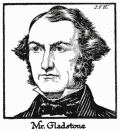
Mr. Gladstone was one of the most central and representative politician statesmen of the later nineteenth century, and it will be worth while to devote a paragraph or so to his ideas and intellectual limitations. They will help us to understand better the astonishing irrelevance of the political life of this period to the realities that rose about it. He was a person of exceptional intellectual vigour; he had flashes of real insight; but his circumstances and temperament conspired against his ever attaining any real vision of the world in which he lived.
He was the son of Sir John Gladstone, a West Indian slave-holder, the mortality among whose slaves was a matter of debate in the House of Commons; he was educated at Eton College, and at Christ Church, Oxford, and his mind never recovered from the process. We have already told how after the Reformation the English universities ceased to be the organs of the general intellectual life, and shrank to be merely the educational preserves of the aristocracy and the church. Jews, Roman Catholics, dissenters, sceptics, and all forms of intellectual activity were carefully barred out from those almost extinguished lamps of learning. Their mathematical work was poor, a series of exercises in the mere patience-games and formulæ-writing of lower mathematics; science they despised and excluded, and their staple training was the study, without any archæology or historical perspective, of the more rhetorical and “poetic” of the Latin and Greek classics.[474] Such a training prepared men not so much to tackle and solve the problems of life, as to plaster them over with more or less apt quotations. It turned the mind away from living contemporary things; it showed the world reflected in a distorting mirror of bad historical analogies; all the fated convergences of history were refracted into false parallels. The British Parliament was thought of as a Senate, statesmen postured as patricians and equestrians; the new industrial population, now learning to read and think for itself, was transfigured into the likeness of the illiterate savage and privileged citizen mob of later republican Rome.[475] It was natural, therefore, that at the Oxford Union Society young Gladstone should distinguish himself by an eloquent speech against the threatened reform of the worst electoral abuses (see chap. xxxiv, § 2), should contest the immediate emancipation of the parental slaves—slavery, he said, was “sanctioned by Holy Scripture”—and should oppose on religious grounds the removal of the disabilities of the Jews. He was returned to Parliament as Tory member for Newark in 1832, promising to resist “that growing desire for change” which threatened to produce, “along with partial good, a melancholy preponderance of mischief.” In his first Parliament he distinguished himself by his opposition to the admission of religious dissenters to the universities.
Here we have a mind manifestly of a tradition and make-up akin to that of the framers of the Holy Alliance, a mind set steadfastly against all the vast creative tendencies of the nineteenth-century world, as though they were no more than a mere mischievous restlessness of slaves and lower-class persons that would presently be allayed. But because of the streak of insight in his composition, Gladstone did not remain set in a course of pure conservatism, he presently began to realize the strength of the stream upon which things were being carried forward; his intelligence, in spite of its perversion, set itself to grasp the real forms of the torrent of change about him. He was a man of great ambitions and immense energy; his animosity against his brilliant and flippant Jewish rival Disraeli (afterwards Lord Beaconsfield), who was becoming a leader amid the shifting of groups and parties, swung this man who had been the “rising hope of the stern unbending Tories” more and more into a liberal attitude. He began to express belief in the people, to support extensions of the franchise, to cultivate the esteem of the dissenters, and, as Chancellor of the Exchequer, to shift the burthen of taxation from the food and comforts of the new classes of needy voters, that the franchise extensions were bringing into the political world. It is clear that for some years he was profoundly perplexed by the deep forces that evidently lay beneath the stir and thrust of international politics; then he became a great exponent of a half-true theory, the theory of Nationalism, that has played and still plays an intensely mischievous part in the world.
We have already pointed out that there must be a natural political map of the world which gives the best possible geographical divisions for human administrations. Any other political division of the world than this natural political map will necessarily be a misfit, and must produce stresses of hostility and insurrection tending to shift boundaries in the direction indicated by the natural political map. These would seem to be self-evident propositions were it not that the diplomatists at Vienna evidently neither believed nor understood anything of the sort, and thought themselves as free to carve up the world as one is free to carve up such a boneless structure as a cheese. Nor were these propositions evident to Mr. Gladstone. Most of the upheavals and conflicts that began in Europe as the world recovered from the exhaustion of the Napoleonic wars were quite obviously attempts of the ordinary common men to get rid of governments that were such misfits as to be in many cases intolerable. Generally the existing governments were misfits throughout Europe because they were not socially representative, and so they were hampering production and wasting human possibilities; but when there were added to these universal annoyances differences of religion and racial culture between rulers and ruled (as in most of Ireland), differences in race and language (as in Austrian North Italy and throughout most of the Austrian Empire), or differences in all these respects (as in Poland and the Turkish Empire in Europe), the exasperation drove towards bloodshed. Europe was a system of governing machines abominably adjusted. But Mr. Gladstone was no patient mechanic set upon easing and righting the clumsy injuries of those stupid adjustments. He was a white-faced, black-haired man of incredible energy, with eyes like an eagle’s, wrath almost divine, and the “finest baritone voice in Europe.” He apprehended these things romantically, therefore, in a manner suitable for passionate treatment in large halls.
He was blind to the pitiful and wonderful reality of mankind, to these millions and millions of ill-informed, ill-equipped, inexpressive, and divided human beings, mostly very willing, could they but do it, to live righteously and well. He fixed his eagle eye on a fantastic vision of “nations rightly struggling to be free.”[476]
What is a nation? What is nationality? He never paused to ask. No one under the spell of that fine baritone paused to ask. But historians must stand to the questions a politician can evade. If our story of the world has demonstrated anything, it has demonstrated the mingling of races and peoples, the instability of human divisions, the swirling variety of human groups and human ideas of association. A nation, it has been said, is an accumulation of human beings who think they are one people; but we are told that Ireland is a nation, and Protestant Ulster certainly does not share that idea; and Italy did not think it was one people until long after its unity was accomplished. When the writer was in Italy in 1916, people were saying: “This war will make us one nation.” Again, are the English a nation or have they merged into a “British nationality”? Scotchmen do not seem to believe very much in this British nationality. It cannot be a community of race or language that constitutes a nation, because the Gaels and the Lowlanders make up the Scotch “nation”; it cannot be a common religion, for England has scores; nor a common literature, or why is Britain separated from the United States, and the Argentine Republic from Spain? We may suggest that a nation is in effect any assembly, mixture, or confusion of people which is either afflicted by or wishes to be afflicted by a foreign office of its own, in order that it should behave collectively as if it alone constituted humanity. We have already in Chapter XXXVI, § 6, traced the development of the Machiavellian monarchies into the rule of their foreign offices, playing the part of “Powers.” The “nationality” which Mr. Gladstone made his guiding political principle, is really no more than the romantic and emotional exaggeration of the stresses produced by the discord of the natural political map with unsuitable political arrangements. These stresses could be used for the benefit of this power or the detriment of that.
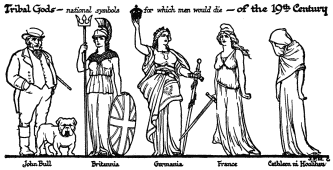
Throughout the nineteenth century, and particularly throughout its latter half, there has been a great working up of this nationalism in the world. All men are by nature partisans and patriots, but the natural tribalism of men in the nineteenth century was unnaturally exaggerated, it was fretted and over-stimulated and inflamed and forced into the nationalist mould. Nationalism was taught in schools, emphasized by newspapers, preached and mocked and sung into men. Men were brought to feel that they were as improper without a nationality as without their clothes in a crowded assembly. Oriental peoples who had never heard of nationality before, took to it as they took to the cigarettes and bowler hats of the west. India, a galaxy of contrasted races, religions, and cultures, Dravidian, Mongolian, and Aryan, became a “nation.” There were perplexing cases, of course, as when a young Whitechapel Jew had to decide whether he belonged to the British or the Jewish nation.[477] Caricature and political cartoons played a large part in this elevation of the cult of these newer and bigger tribal gods—for such indeed the modern “nations” are—to their ascendancy over the imagination of the nineteenth century. If one turns over the pages of Punch, that queer contemporary record of the British soul, which has lasted now since 1841, one finds the figures of Britannia, Hibernia, France, and Germania embracing, disputing, reproving, rejoicing, grieving. It greatly helped the diplomatists to carry on their game of Great Powers to convey politics in this form to the doubting general intelligence. To the common man, resentful that his son should be sent abroad to be shot, it was made clear that instead of this being merely the result of the obstinacy and greed of two foreign offices, it was really a necessary part of a righteous inevitable gigantic struggle between two of these dim vast divinities. France had been wronged by Germania, or Italia was showing a proper spirit to Austria. The boy’s death ceased to appear an outrage on common sense; it assumed a sort of mythological dignity. And insurrection could clothe itself in the same romantic habiliments as diplomacy. Ireland became a Cinderella goddess, Cathleen ni Houlihan, full of heart-rending and unforgivable wrongs, and young India transcended its realities in the worship of Bande Mataram.
The essential idea of nineteenth-century nationalism was the “legitimate claim” of every nation to complete sovereignty, the claim of every nation to manage all its affairs within its own territory, regardless of any other nation. The flaw in this idea is that the affairs and interests of every modern community extend to the uttermost parts of the earth. The assassination of Sarajevo in 1914, for example, which caused the great war, produced the utmost distress among the Indian tribes of Labrador because that war interrupted the marketing of the furs upon which they relied for such necessities as ammunition, without which they could not get sufficient food. A world of independent sovereign nations means, therefore, a world of perpetual injuries, a world of states constantly preparing for or waging war. But concurrently and discordantly with the preaching of this nationalism of which Gladstone was the outstanding exponent,[478] there was, among the stronger nationalities, a vigorous propagation of another set of ideas, the ideas of imperialism, in which a powerful and advanced nation was conceded the right to dominate a group of other less advanced nations or less politically developed nations or peoples whose nationality was still undeveloped, who were expected by the dominating nation to be grateful for its protection and dominance. This use of the word empire was evidently a different one from its former universal significance. The new empires did not even pretend to be a continuation of the world empire of Rome. The leading spirit in British imperialism was Lord Beaconsfield, Gladstone’s antagonist. These two ideas of nationality and, as the crown of national success, “empire,” ruled European political thought, ruled indeed the political thought of the world, throughout the latter half of the nineteenth century, and ruled it to the practical exclusion of any wider conception of a common human welfare. They were plausible and dangerously unsound working ideas. They represented nothing fundamental and inalterable in human nature, and they failed to meet the new needs of world controls and world security that the mechanical revolution was every day making more imperative. They were accepted because people in general had neither the sweeping views that a scientific study of history can give, nor had they any longer the comprehensive charity of a world religion. Their danger to all the routines of ordinary life was not realized until it was too late.
§ 8
After the middle of the nineteenth century, this world of new powers and old ideas, this fermenting new wine in the old bottles of diplomacy, broke out through the flimsy restraints of the Treaty of Vienna into a series of wars. By an ironical accident the new system of disturbances was preceded by a peace festival in London, the Great Exhibition of 1851.
The moving spirit in this exhibition was Prince Albert of Saxe-Coburg-Gotha, the nephew of Leopold I, the German king who had been placed upon the Belgian throne in 1831, and who was also the maternal uncle of the young Queen Victoria of England. She had become queen in 1837 at the age of eighteen. The two young cousins—they were of the same age—had married in 1840 under their uncle’s auspices, and Prince Albert was known to the British as the “Prince Consort.” He was a young man of sound intelligence and exceptional education, and he seems to have been greatly shocked by the mental stagnation into which England had sunken. Oxford and Cambridge, those once starry centres, were still recovering but slowly from the intellectual ebb of the later eighteenth century. At neither university did the annual matriculations number more than four hundred. The examinations were for the most part mere viva voce ceremonies. Except for two colleges in London (the University of London) and one in Durham, this was all the education on a university footing that England had to offer. It was very largely the initiative of this scandalized young German who had married the British queen which produced the university commission of 1850, and it was with a view to waking up England further that he promoted the first International Exhibition which was to afford some opportunity for a comparison of the artistic and industrial products of the various European nations.
The project was bitterly opposed. In the House of Commons it was prophesied that England would be overrun by foreign rogues and revolutionaries who would corrupt the morals of the people and destroy all faith and loyalty in the country.
The exhibition was held in Hyde Park in a great building of glass and iron—which afterwards was re-erected as the Crystal Palace. Financially it was a great success. It made many English people realize for the first time that theirs was not the only industrial country in the world, and that commercial prosperity was not a divinely appointed British monopoly. There was the clearest evidence of a Europe recovering steadily from the devastation of the Napoleonic wars, and rapidly overtaking the British lead in trade and manufacture. It was followed directly by the organization of a Science and Art Department (1853), to recover, if possible, the educational leeway that Britain had lost.
The exhibition released a considerable amount of international talk and sentiment. It had already found expression in the work of such young poets as Tennyson, who had glanced down the vista of the future.
“Till the war-drums throb’d no longer, and the battle-flags were furl’d In the Parliament of man, the Federation of the world.”
There was much shallow optimism on the part of comfortable people just then. Peace seemed to be more secure than it had been for a long time. The social gales of 1848 had blown, and, it seemed, blown themselves out. Nowhere had the revolution succeeded. In France it had been betrayed a second time by a Bonaparte, a nephew of the first Napoleon, but a much more supple and intelligent man.[479] He had posed as a revolutionary while availing himself of the glamour of his name; he had twice attempted raids on France during the Orleans monarchy. He had written a manual of artillery to link himself to his uncle’s prestige, and he had also published an account of what he alleged to be Napoleonic views, Des Idées Napoléoniennes, in which he jumbled up socialism, socialistic reform, and pacificism with the Napoleonic legend. The republic of 1848 was soon in difficulties with crude labour experiments, and in October he was able to re-enter the country and stand for election as President. He took an oath as President to be faithful to the democratic republic, and to regard as enemies all who attempted to change the form of government. In two years’ time (December, 1852) he was Emperor of the French.
At first he was regarded with considerable suspicion by Queen Victoria, or rather by Baron Stockmar, the friend and servant of King Leopold of Belgium, and the keeper of the international conscience of the British queen and her consort. All this group of Saxe-Coburg-Gotha people had a reasonable and generous enthusiasm for the unity and well-being of Germany—upon liberal lines—and they were disposed to be alarmed at this Bonapartist revival. Lord Palmerston, the British foreign minister, was, on the other hand, friendly with the usurper from the outset; he offended the queen by sending amiable despatches to the French President without submitting them for her examination and so giving her sufficient time to consult Stockmar upon them, and he was obliged to resign. But subsequently the British Court veered round to a more cordial attitude to the new adventurer. The opening years of his reign promised a liberal monarchy rather than a Napoleonic career; a government of “cheap bread, great public works, and holidays,”[480] and he expressed himself warmly in favour of the idea of nationalism, which was naturally a very acceptable idea to any liberal German intelligence. There had been a brief all-German parliament at Frankfort in 1848, which was overthrown in 1849 by the Prussian monarchy.
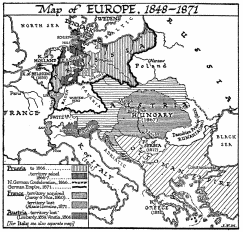
(This conflict between Palmerston and the Crown is interesting because it shows the way in which the aristocratic ruling class of the crowned republic of the Britain of the early Georges was now, with an uneasy democracy below it, an educated royal consort above, and an education which had not kept pace with the times, losing power to the renascent energy of the Crown. A Stockmar would have been impossible in the reigns of George I or George II, or in a nineteenth-century Great Britain with a reasonably well-educated peerage.)
Before 1848 all the great European courts of the Vienna settlement had been kept in a kind of alliance by the fear of a second and more universal democratic revolution. After the revolutionary failures of 1848 this fear was lifted, and they were free to resume the scheming and counter-scheming of the days before 1789—with the vastly more powerful armies and fleets the first Napoleonic phase had given them. The game of Great Powers was resumed with zest, after an interval of sixty years, and it continued until it produced the catastrophe of 1914.
The Tsar of Russia, Nicholas I, was the first to move towards war. He resumed the traditional thrust of Peter the Great towards Constantinople. Nicholas invented the phrase of the “sick man of Europe” for the Sultan, and, finding an excuse in the misgovernment of the Christian population of the Turkish empire, he occupied the Danubian principalities in 1853. European diplomatists found themselves with a question of quite the eighteenth-century pattern. The designs of Russia were understood to clash with the designs of France in Syria, and to threaten the Mediterranean route to India of Great Britain, and the outcome was an alliance of France and England to bolster up Turkey and a war, the Crimean War, which ended in the repulse of Russia. One might have thought that the restraint of Russia was rather the business of Austria and Germany, but the passion of the foreign offices of France and England for burning their fingers in Russian affairs has always been very difficult to control.
The next phase of interest in this revival of the Great Power drama was the exploitation by the Emperor Napoleon III and the king of the small kingdom of Sardinia in North Italy, of the inconveniences and miseries of the divided state of Italy, and particularly of the Austrian rule in the north. The King of Sardinia, Victor Emmanuel, made an old-time bargain for Napoleon’s help in return for the provinces of Nice and Savoy. The war between France and Sardinia on the one hand, and Austria on the other, broke out in 1859, and was over in a few weeks. The Austrians were badly beaten at Magenta and Solferino. Then, being threatened by Prussia on the Rhine, Napoleon made peace, leaving Sardinia the richer for Lombardy.
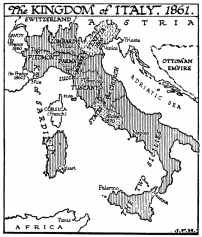
The next move in the game of Victor Emmanuel, and of his chief minister Cavour, was an insurrectionary movement in Sicily led by the great Italian patriot Garibaldi. Sicily and Naples were liberated, and all Italy, except only Rome (which remained loyal to the Pope) and Venetia, which was held by the Austrians, fell to the king of Sardinia. A general Italian parliament met at Turin in 1861, and Victor Emmanuel became the first king of Italy.
But now the interest in this game of European diplomacy shifted to Germany. Already the common sense of the natural political map had asserted itself. In 1848 all Germany, including, of course, German Austria, was for a time united under the Frankfort parliament. But that sort of union was particularly offensive to all the German courts and foreign offices; they did not want a Germany united by the will of its people, they wanted Germany united by regal and diplomatic action—as Italy was being united. In 1848 the German parliament had insisted that the largely German provinces of Schleswig-Holstein, which had been in the German Bund, must belong to Germany. It had ordered the Prussian army to occupy them, and the king of Prussia had refused to take his orders from the German parliament, and so had precipitated the downfall of that body. Now the King of Denmark, Christian IX, for no conceivable motive except the natural folly of kings, embarked upon a campaign of annoyance against the Germans in these two duchies. Prussian affairs were then very much in the hands of a minister of the seventeenth-century type, Von Bismarck (count in 1865, prince in 1871), and he saw brilliant opportunities in this trouble. He became the champion of the German nationality in these duchies—it must be remembered that the King of Prussia had refused to undertake this rôle for democratic Germany in 1848—and he persuaded Austria to side with Prussia in a military intervention. Denmark had no chance against these Great Powers; she was easily beaten and obliged to relinquish the duchies. Then Bismarck picked a quarrel with Austria for the possession of these two small states. So he brought about a needless and fratricidal war of Germans for the greater glory of Prussia and the ascendancy of the Hohenzollern dynasty in Germany. German writers of a romantic turn of mind represent Bismarck as a great statesman planning the unity of Germany; but indeed he was doing nothing of the kind. The unity of Germany was a reality in 1848. It was and is in the nature of things. The Prussian monarchy was simply delaying the inevitable in order to seem to achieve it in Prussian fashion. That is why, when at last Germany was unified, instead of bearing the likeness of a modern civilized people, it presented itself to the world with the face of this archaic Bismarck, with a fierce moustache, huge jack boots, a spiked helmet, and a sword.
In this war between Prussia and Austria, Prussia had for an ally Italy; most of the smaller German states, who dreaded the schemes of Prussia, fought on the side of Austria. The reader will naturally want to know why Napoleon III did not grasp this admirable occasion for statecraft and come into the war to his own advantage. All the rules of the Great Power game required that he should. But Napoleon, unhappily for himself, had got his fingers in a trap on the other side of the Atlantic, and was in no position to intervene.
Bismarck
In order to understand the entanglement of this shifty gentleman, it is necessary to explain that the discord in interests between the northern and southern states of the American union, due to the economic differences based on slavery, had at last led to open civil war. The federal system established in 1789 had to fight the secessionist efforts of the confederated slave-holding states. We have traced the causes of that great struggle in Chapter XXXVII, §6; its course we cannot relate here, nor tell how President Lincoln (born 1809, died 1865, president from 1861) rose to greatness, how the republic was cleansed from the stain of slavery, and how the federal government of the union was preserved.
For four long years (1861-65) this war swung to and fro, through the rich woods and over the hills of Virginia between Washington and Richmond, until at last the secessionist left was thrust back and broken, and Sherman, the unionist general, swept across Georgia to the sea in the rear of the main confederate (secessionist) armies. All the elements of reaction in Europe rejoiced during the four years of republican dissension; the British aristocracy openly sided with the confederate states, and the British Government permitted several privateers, and particularly the Alabama, to be launched in England to attack the federal shipping. Napoleon III was even more rash in his assumption that after all the new world had fallen before the old. The sure shield of the Monroe Doctrine, it seemed to him, was thrust aside for good, the Great Powers might meddle again in America, and the blessings of an adventurous monarchy be restored there. A pretext for interference was found in certain liberties taken with the property of foreigners by the Mexican president. A joint expedition of French, British, and Spanish occupied Vera Cruz, but Napoleon’s projects were too bold for his allies, and they withdrew when it became clear that he contemplated nothing less than the establishment of a Mexican empire. This he did, after much stiff fighting, making the Archduke Maximilian of Austria, Emperor of Mexico in 1864. The French forces, however, remained in effectual possession of the country, and a crowd of French speculators poured into Mexico to exploit its mines and resources.
But in April, 1865, the civil war in the United States was brought to an end by the surrender of the great southern commander, General Lee, at Appomattox Court House, and the little group of eager Europeans in possession of Mexico found themselves faced by the victorious federal government, in a thoroughly grim mood, with a large, dangerous-looking army in hand. The French imperialists were bluntly given the alternative of war with the United States or clearing out of America. In effect this was an instruction to go. This was the entanglement which prevented Napoleon III from interference between Prussia and Austria in 1866, and this was the reason why Bismarck precipitated his struggle with Austria.
While Prussia was fighting Austria, Napoleon III was trying to escape with dignity from the briars of Mexico. He invented a shabby quarrel upon financial grounds with Maximilian and withdrew the French troops. Then, by all the rules of kingship, Maximilian should have abdicated. But instead he made a fight for his empire; he was defeated by his recalcitrant subjects, caught, and shot as a public nuisance in 1867. So the peace of President Monroe was restored to the new world. There remained only one monarchy in America, the empire of Brazil, where a branch of the Portuguese royal family continued to reign until 1889. In that year the emperor was quietly packed off to Paris, and Brazil came into line with the rest of the continent.
But while Napoleon was busy with his American adventure, Prussia and Italy were snatching victory over the Austrians (1866). Italy was badly beaten at Custozza and in the naval battle of Lissa, but the Austrian army was so crushed by the Prussian at the battle of Sadow, that Austria made an abject surrender. Italy gained the province of Venetia, so making one more step towards unity—only Rome and Trieste and a few small towns on the north and north-western frontiers remained—and Prussia became the head of a North German Confederation, from which Bavaria, Württemberg, Baden, Hesse, and Austria were excluded.
Four years later came the next step towards the natural political map of Europe, when Napoleon III plunged into war against Prussia. A kind of self-destroying foolishness urged him to do this. He came near to this war in 1867 so soon as he was free from Mexico, by demanding Luxembourg for France; he embarked upon it in 1870, when a cousin of the king of Prussia became a candidate for the vacant throne of Spain. Napoleon had some theory in his mind that Austria, Bavaria, Württemberg, and the other states outside the North German Confederation would side with him against Prussia.[481] He probably thought this would happen because he wanted it to happen. But since 1848 the Germans, so far as foreign meddling was concerned, had been in spirit a united people; Bismarck was merely imposing the Hohenzollern monarchy, with pomp, ceremony, and bloodshed, upon accomplished facts. All Germany sided with Prussia.
Early in August, 1870, the united German forces invaded France. After the battles of Wörth and Gravelotte, one French army under Bazaine was forced into Metz and surrounded there, and, on September 1st, a second, with which was Napoleon, was defeated and obliged to capitulate at Sedan. Paris found herself bare to the invader. For a second time the promises of Napoleonism had failed France disastrously. On September 4th, France declared herself a republic again, and thus regenerated, prepared to fight for existence against triumphant Prussianism. For though it was a united Germany that had overcome French imperialism, it had Prussia in the saddle. The army in Metz capitulated in October; Paris, after a siege and bombardment, surrendered in January, 1871.
With pomp and ceremony, in the Hall of Mirrors at Versailles, amidst a great array of military uniforms, the King of Prussia was declared German Emperor, and Bismarck and the sword of the Hohenzollerns claimed the credit for that German unity which a common language and literature had long since assured.
The peace of Frankfort was a Hohenzollern peace. Bismarck had availed himself of the national feeling of Germany to secure the aid of the South German states, but he had no grasp of the essential forces that had given victory to him and to his royal master. The power that had driven Prussia to victory was the power of the natural political map of Europe insisting upon the unity of the German-speaking peoples. In the east, Germany was already sinning against that natural map by her administration of Posen and other Polish districts. Now greedy for territory, and particularly for iron mines, she annexed a considerable area of French-speaking Lorraine, including Metz, and Alsace, which, in spite of its German speech, was largely French in sympathy. Inevitably there was a clash between German rulers and French subjects in these annexed provinces; inevitably the wrongs and bitterness of the subjugated France of Lorraine echoed in Paris and kept alive the passionate resentment of the French....
The natural map had already secured political recognition in the Austrian Empire after Sadowa (1866). Hungary, which had been subordinated to Austria, was erected into a kingdom on an equal footing with Austria, and the Empire of Austria had become the dual “monarchy” of Austria-Hungary. But in the southeast of this empire, and over the Turkish empire, the boundaries and subjugations of the conquest period still remained.
A fresh upthrust of the natural map began in 1875, when the Christian races in the Balkans, and particularly the Bulgarians, became restless and insurgent. The Turks adopted violent repressive measures, and embarked upon massacres of Bulgarians on an enormous scale. Thereupon Russia intervened (1877), and after a year of costly warfare obliged the Turks to sign the treaty of San Stefano, which was, on the whole, a sensible treaty, breaking up the artificial Turkish Empire, and to a large extent establishing the natural map. But it had become the tradition of British policy to thwart “the designs of Russia”—heaven knows why!—whenever Russia appeared to have a design, and the British foreign office, under the premiership of Lord Beaconsfield, intervened with a threat of war if a considerable restoration of the Turks’ facilities for exaction, persecution, and massacre was not made. For a time war seemed very probable. The British music-halls, those lamps to British foreign policy, were lit with patriotic fire, and the London errand-boy on his rounds was inspired to chant, with the simple dignity of a great people conscious of its high destinies, a song declaring that:
“We don’t want to fight, but, by Jingo,[482] if we do, We got the ships, we got the men, we got the munn-aye too”....
and so on to a climax:
“The Russ’ns shall not ’ave Con-stan-te-no - - - ple.”
In consequence of this British opposition, a conference was assembled in 1878 at Berlin to revise the treaty of San Stefano, chiefly in the interests of the Turkish and Austrian monarchies, the British acquired the island of Cyprus, to which they had no sort of right whatever, and which has never been of the slightest use to them, and Lord Beaconsfield returned triumphantly from the Berlin Conference, to the extreme exasperation of Mr. Gladstone, with what the British were given to understand at the time was “Peace with Honour.”
This treaty of Berlin was the second main factor, the peace of Frankfort being the first, in bringing about the great war of 1914-18.
These thirty years after 1848 are years of very great interest to the student of international political methods. Released from their terror of a world-wide insurrection of the common people, the governments of Europe were doing their best to resume the game of Great Powers that had been so rudely interrupted by the American and French revolutions. But it looked much more like the old game than it was in reality. The mechanical revolution was making war a far more complete disturbance of the general life than it had ever been before, and the proceedings of the diplomatists were ruled, in spite of their efforts to disregard the fact, by imperatives that Charles V and Louis XIV had never known. Irritation with misgovernment was capable of far better organization and far more effective expression than it had ever been before. Statesmen dressed this up as the work of the spirit of Nationalism, but there were times and occasions when that costume wore very thin. The grand monarchs of the seventeenth and eighteenth centuries had seemed to be free to do this or that, to make war or to keep the peace, to conquer this province or cede that as they willed; but such a ruler as Napoleon III went from one proceeding to another with something of the effect of a man who feels his way among things unseen.
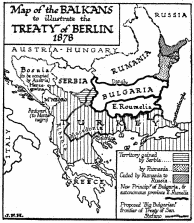
None of these European governments in the nineteenth century was in fact a free agent. We look to-day at the maps of Europe since 1814, we compare them with the natural map, and we see that the game the Great Powers played was indeed a game of foregone conclusions. Whatever arrangements they made that were in accordance with the natural political map of the world, and the trend towards educational democracy, held, and whatever arrangements they made contrary to these things, collapsed. We are forced, therefore, to the conclusion, that all the diplomatic fussing, posturing, and scheming, all the intrigue and bloodshed of these years, all the monstrous turmoil and waste of kings and armies, all the wonderful attitudes, deeds, and schemes of the Cavours, Bismarcks, Disraelis, Bonapartes, and the like “great men,” might very well have been avoided altogether had Europe but had the sense to instruct a small body of ordinarily honest ethnologists, geographers, and sociologists to draw out its proper boundaries and prescribe suitable forms of government in a reasonable manner. The romantic phase in history had come to an end. A new age was beginning with new and greater imperatives, and these nineteenth-century statesmen were but pretending to control events.
§ 9
We have suggested that in the political history of Europe between 1848 and 1878, the mechanical revolution was not yet producing any very revolutionary changes. The post-revolutionary Great Powers were still going on within boundaries of practically the same size and with much the same formalities as they had done in pre-revolutionary times. But where the increased speed and certainty of transport and telegraphic communications were already producing very considerable changes of condition and method, was in the overseas enterprises of Britain and the other European powers, and in the reaction of Asia and Africa to Europe.
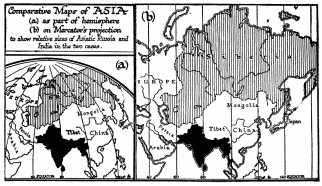
The end of the eighteenth century was a period of disrupting empires and disillusioned expansionists. The long and tedious journey between Britain and Spain and their colonies in America prevented any really free coming and going between the home land and the daughter lands, and so the colonies separated into new and distinct communities, with distinctive ideas and interests and even modes of speech. As they grew they strained more and more at the feeble and uncertain link of shipping that joined them. Weak trading-posts in the wilderness, like those of France in Canada, or trading establishments in great alien communities, like those of Britain in India, might well cling for bare existence to the nation which gave them support and a reason for their existence. That much and no more seemed to many thinkers in the early part of the nineteenth century to be the limit set to overseas rule. In 1820 the sketchy great European “empires” outside of Europe that had figured so bravely in the maps of the middle eighteenth century, had shrunken to very small dimensions. Only the Russian sprawled as large as ever across Asia. It sprawled much larger in the imaginations of many Europeans than in reality, because of their habit of studying the geography of the world upon Mercator’s projection, which enormously exaggerated the size of Siberia.
The British Empire in 1815 consisted of the thinly populated coastal river and lake regions of Canada, and a great hinterland of wilderness in which the only settlements as yet were the fur-trading stations of the Hudson Bay Company, about a third of the Indian peninsula, under the rule of the East India Company, the coast districts of the Cape of Good Hope inhabited by blacks and rebellious-spirited Dutch settlers; a few trading stations on the coast of West Africa, the rock of Gibraltar, the island of Malta, Jamaica, a few minor slave-labour possessions in the West Indies, British Guiana in South America, and, on the other side of the world, two dumps for convicts at Botany Bay in Australia and in Tasmania. Spain retained Cuba and a few settlements in the Philippine Islands. Portugal had in Africa some vestiges of her ancient claims. Holland had various islands and possessions in the East Indies and Dutch Guiana, and Denmark an island or so in the West Indies. France had one or two West Indian Islands and French Guiana. This seemed to be as much as the European powers needed, or were likely to acquire of the rest of the world. Only the East Indian Company showed any spirit of expansion.