BOOK VIII THE AGE OF THE GREAT POWERS (continued 2)
Reading edition
Looking back upon this period, which came to its climax in the eighteenth century, looking back, as we can begin to do nowadays, and seeing its events in relation to the centuries that came before it and to the great movements of the present time, we are able to realize how transitory and provisional were its political forms and how unstable its securities. Provisional it was as no other age has been provisional, an age of assimilation and recuperation, a political pause, a gathering up of the ideas of men and the resources of science for a wider human effort. But the contemporary mind did not see it in that light. The failure of the great creative ideas as they had been formulated in the Middle Ages, had left human thought for a time destitute of the guidance of creative ideas; even educated and imaginative men saw the world undramatically; no longer as an interplay of effort and destiny, but as the scene in which a trite happiness was sought and the milder virtues were rewarded. It was not simply the contented and conservative-minded who, in a world of rapid changes, were under the sway of this assurance of an achieved fixity of human conditions. Even highly critical and insurgent intelligences, in default of any sustaining movements in the soul of the community, betrayed the same disposition. Political life, they felt, had ceased to be the urgent and tragic thing it had once been; it had become a polite comedy. The eighteenth was a century of comedy—which at the end grew grim. It is inconceivable that that world of the middle eighteenth century could have produced a Jesus of Nazareth, a Gautama, a Francis of Assisi, an Ignatius of Loyola. If one may imagine an eighteenth-century John Huss, it is impossible to imagine anyone with sufficient passion to burn him. Until the stirrings of conscience in Britain that developed into the Methodist revival began, we can detect scarcely a suspicion that there still remained great tasks in hand for our race to do, that enormous disturbances were close at hand, or that the path of man through space and time was dark with countless dangers, and must to the end remain a high and terrible enterprise.
We have quoted again and again in this history from Gibbon’s Decline and Fall of the Roman Empire. Now we shall quote from it for the last time and bid it farewell, for we have come to the age in which it was written. Gibbon was born in 1737,[410]
and the last volume of his history was published in 1787, but the passage we shall quote was probably written in the year 1780. Gibbon was a young man of delicate health and fairly good fortune; he had a partial and interrupted education at Oxford, and then he completed his studies in Geneva; on the whole his outlook was French and cosmopolitan rather than British, and he was much under the intellectual influence of that great Frenchman who is best known under the name of Voltaire (François Marie Arouet de Voltaire, 1694-1778). Voltaire was an author of enormous industry; seventy volumes of him adorn the present writer’s shelves, and another edition of Voltaire’s works runs to ninety-four; he dealt largely with history and public affairs, and he corresponded with Catherine the Great of Russia, Frederick the Great of Prussia, Louis XV, and most of the prominent people of the time. Both Voltaire and Gibbon had the sense of history strong in them; both have set out very plainly and fully their visions of human life; and it is clear that to both of them the system in which they lived, the system of monarchy, of leisurely and privileged gentlefolks, of rather despised industrial and trading people and of down-trodden and negligible labourers and poor and common people, seemed the most stably established way of living that the world has ever seen. They postured a little as republicans, and sneered at the divine pretensions of monarchy; but the republicanism that appealed to Voltaire was the crowned republicanism of the Britain of those days, in which the king was simply the official head, the first and greatest of the gentlemen.
The ideal they sustained was the ideal of a polite and polished world in which men—men of quality that is, for no others counted—would be ashamed to be cruel or gross or enthusiastic, in which the appointments of life would be spacious and elegant, and the fear of ridicule the potent auxiliary of the law in maintaining the decorum and harmonies of life. Voltaire had in him the possibility of a passionate hatred of injustice, and his interventions on behalf of persecuted or ill-used men are the high lights of his long and complicated life-story. And this being the mental disposition of Gibbon and Voltaire, and of the age in which they lived, it is natural that they should find the existence of religion in the world, and in particular the existence of Christianity, a perplexing and rather unaccountable phenomenon. The whole of that side of life seemed to them a kind of craziness in the human make-up. Gibbon’s great history is essentially an attack upon Christianity as the operating cause of the decline and fall. He idealized the crude and gross plutocracy of Rome into a world of fine gentlemen upon the eighteenth-century model, and told how it fell before the Barbarian from without because of the decay through Christianity within. In our history here we have tried to set that story in a better light. To Voltaire official Christianity was “l’infâme”; something that limited people’s lives, interfered with their thoughts, persecuted harmless dissentients. And indeed in that period of the interregnum there was very little life or light in either the orthodox Christianity of Rome or in the orthodox tame churches of Russia and of the Protestant princes. In an interregnum incommoded with an abundance of sleek parsons and sly priests it was hard to realize what fires had once blazed in the heart of Christianity, and what fires of political and religious passion might still blaze in the hearts of men.
At the end of his third volume Gibbon completed his account of the breaking up of the Western Empire. He then raised the question whether civilization might ever undergo again a similar collapse. This led him to review the existing state of affairs (1780) and to compare it with the state of affairs during the decline of imperial Rome. It will be very convenient to our general design to quote some passages from that comparison here, for nothing could better illustrate the state of mind of the liberal thinkers of Europe at the crest of the political interregnum of the age of the Great Powers, before the first intimations of those profound political and social forces of disintegration that have produced at length the dramatic interrogations of our own times.
“This awful revolution,” wrote Gibbon of the Western collapse, “may be usefully applied to the useful instruction of the present age. It is the duty of a patriot to prefer and promote the exclusive interest and glory of his native country; but a philosopher may be permitted to enlarge his views, and to consider Europe as one great republic, whose various inhabitants have attained almost the same level of politeness and cultivation. The balance of power will continue to fluctuate, and the prosperity of our own or the neighbouring kingdoms may be alternately exalted or depressed; but these partial events cannot essentially injure our general state of happiness, the system of arts, and laws, and manners, which so advantageously distinguish, above the rest of mankind, the Europeans and their colonies. The savage nations of the globe are the common enemies of civilized society; and we may enquire with anxious curiosity whether Europe is still threatened with a repetition of those calamities which formerly oppressed the arms and institutions of Rome. Perhaps the same reflections will illustrate the fall of that mighty empire and explain the probable causes of our actual security.
“The Romans were ignorant of the extent of their danger, and the number of their enemies. Beyond the Rhine and Danube, the northern countries of Europe and Asia were filled with innumerable tribes of hunters and shepherds, poor, voracious, and turbulent; bold in arms, and impatient to ravish the fruits of industry. The Barbarian world was agitated by the rapid impulse of war; and the peace of Gaul or Italy was shaken by the distant revolutions of China. The Huns, who fled before a victorious enemy, directed their march towards the west; and the torrent was swelled by the gradual accession of captives and allies. The flying tribes who yielded to the Huns assumed in their turn the spirit of conquest; the endless column of barbarians pressed on the Roman Empire with accumulated weight and, if the foremost were destroyed, the vacant space was instantly replenished by new assailants. Such formidable emigrations can no longer issue from the North; and the long repose, which has been imputed to the decrease of population, is the happy consequence of the progress of arts and agriculture. Instead of some rude villages, thinly scattered among its woods and morasses, Germany now produces a list of two thousand three hundred walled towns; the Christian kingdoms of Denmark, Sweden, and Poland have been successively established; and the Hanse merchants, with the Teutonic knights, have extended their colonies along the coast of the Baltic, as far as the Gulf of Finland. From the Gulf of Finland to the Eastern Ocean, Russia now assumes the form of a powerful and civilized empire. The plough, the loom, and the forge are introduced on the banks of the Volga, the Oby, and the Lena; and the fiercest of the Tartar hordes have been taught to tremble and obey....
“The Empire of Rome was firmly established by the singular and perfect coalition of its members.... But this union was purchased by the loss of national freedom and military spirit; and the servile provinces, destitute of life and motion, expected their safety from the mercenary troops and governors, who were directed by the orders of a distant court. The happiness of a hundred millions depended on the personal merit of one or two men, perhaps children, whose minds were corrupted by education, luxury, and despotic power. Europe is now divided into twelve powerful, though unequal kingdoms, three respectable commonwealths, and a variety of smaller, though independent, states; the chances of royal and ministerial talents are multiplied, at least with the number of its rulers; and a Julian[411] or Semiramis[412] may reign in the north, while Arcadius and Honorius[413] again slumber on the thrones of the House of Bourbon. The abuses of tyranny are restrained by the mutual influence of fear and shame; republics have acquired order and stability; monarchies have imbibed the principles of freedom, or, at least, of moderation; and some sense of honour and justice is introduced into the most defective constitutions by the general manners of the times. In peace, the progress of knowledge and industry is accelerated by the emulation of so many active rivals: in war, the European forces are exercised by temperate and undecisive contests. If a savage conqueror should issue from the deserts of Tartary, he must repeatedly vanquish the robust peasants of Russia, the numerous armies of Germany, the gallant nobles of France, and the intrepid freemen of Britain; who, perhaps, might confederate for their common defence. Should the victorious Barbarians carry slavery and desolation as far as the Atlantic Ocean, ten thousand vessels would transport beyond their pursuit the remains of civilized society; and Europe would revive and flourish in the American world which is already filled with her colonies and institutions.
“Cold, poverty, and a life of danger and fatigue fortify the strength and courage of Barbarians. In every age they have oppressed the polite and peaceful nations of China, India, and Persia, who neglected, and still neglect, to counterbalance these natural powers by the resources of military art. The warlike states of antiquity, Greece, Macedonia, and Rome, educated a race of soldiers; exercised their bodies, disciplined their courage, multiplied their forces by regular evolutions, and converted the iron which they possessed into strong and serviceable weapons. But this superiority insensibly declined with their laws and manners; and the feeble policy of Constantine and his successors armed and instructed, for the ruin of the empire, the rude valour of the Barbarian mercenaries. The military art has been changed by the invention of gunpowder; which enables man to command the two most powerful agents of nature, air and fire. Mathematics, chemistry, mechanics, architecture, have been applied to the service of war; and the adverse parties oppose to each other the most elaborate modes of attack and of defence. Historians may indignantly observe that the preparations of a siege would found and maintain a flourishing colony; yet we cannot be displeased that the subversion of a city should be a work of cost and difficulty, or that an industrious people should be protected by those arts, which survive and supply the decay of military virtue. Cannon and fortifications now form an impregnable barrier against the Tartar horse;[414] and Europe is secure from any future irruption of Barbarians; since, before they can conquer, they must cease to be barbarous....
“Should these speculations be found doubtful or fallacious, there still remains a more humble source of comfort and hope. The discoveries of ancient and modern navigators, and the domestic history, or tradition, of the most enlightened nations, represent the human savage, naked both in mind and body, and destitute of laws, of arts, of ideas, and almost of language. From this abject condition, perhaps the primitive and universal state of man, he has gradually arisen to command the animals, to fertilize the earth, to traverse the ocean, and to measure the heavens. His progress in the improvement and exercise of his mental and corporeal faculties has been irregular and various, infinitely slow in the beginning, and increasing by degrees with redoubled velocity; ages of laborious ascent have been followed by a moment of rapid downfall; and the several climates of the globe have felt the vicissitudes of light and darkness. Yet the experience of four thousand years should enlarge our hopes, and diminish our apprehensions; we cannot determine to what height the human species may aspire in their advances towards perfection; but it may safely be presumed that no people, unless the face of nature is changed, will relapse into their original barbarism.
“Since the first discovery of the arts, war, commerce, and religious zeal have diffused, among the savages of the Old and New World, those inestimable gifts, they have been successively propagated; they can never be lost. We may therefore acquiesce in the pleasing conclusion that every age of the world has increased, and still increases, the real wealth, the happiness, the knowledge, and perhaps the virtue, of the human race.”
§ 12[415]
One of the most interesting aspects of this story of Europe in the seventeenth and earlier eighteenth century during the phase of the Grand and Parliamentary Monarchies, is the comparative quiescence of the peasants and workers. The insurrectionary fires of the fourteenth and fifteenth and sixteenth centuries seem to have died down. The acute economic clashes of the earlier period had been mitigated by rough adjustments. The discovery of America had revolutionized and changed the scale of business and industry, had brought a vast volume of precious metal for money into Europe, had increased and varied employment. For a time life and work ceased to be intolerable to the masses of the poor. This did not, of course, prevent much individual misery and discontent; the poor we have always had with us, but this misery and discontent was divided and scattered. It became inaudible.
In the earlier period the common people had had an idea to crystallize upon, the idea of Christian communism. They had found an educated leadership in the dissentient priests and doctors of the Wycliffe type. As the movement for a revival in Christianity spent its force, as Lutheranism fell back for leadership from Jesus upon the Protestant Princes, this contact and reaction of the fresher minds of the educated class upon the illiterate mass was interrupted. However numerous a downtrodden class may be, and however extreme its miseries, it will never be able to make an effective protest until it achieves solidarity by the development of some common general idea. Educated men and men of ideas are more necessary to a popular political movement than to any other political process. A monarchy learns by ruling, and an oligarchy of any type has the education of affairs; but the common man, the peasant or toiler, has no experience in large matters, and can exist politically only through the services, devotion, and guidance of educated men. The Reformation, the Reformation that succeeded, the Reformation that is of the Princes, by breaking up educational facilities, largely destroyed the poor scholar and priest class whose persuasion of the crowd had rendered the Reformation possible.
The Princes of the Protestant countries when they seized upon the national churches early apprehended the necessity of gripping the universities also. Their idea of education was the idea of capturing young clever people for the service of their betters. Beyond that they were disposed to regard education as a mischievous thing. The only way to an education, therefore, for a poor man was through patronage. Of course there was a parade of encouragement towards learning in all the Grand Monarchies, a setting up of Academies and Royal Societies, but these benefited only a small class of subservient scholars. The church also had learnt to distrust the educated poor man. In the great aristocratic “crowned republic” of Britain there was the same shrinkage of educational opportunity. “Both the ancient universities,” says Hammond, in his account of the eighteenth century, “were the universities of the rich. There is a passage in Macaulay describing the state and pomp of Oxford at the end of the seventeenth century, ‘when her Chancellor, the Venerable Duke of Ormonde, sat in his embroidered mantle on his throne under the painted ceiling of the Sheldonian theatre, surrounded by hundreds of graduates robed according to their rank, while the noblest youths of England were solemnly presented to him as candidates for academical honours.’ The university was a power, not in the sense in which that could be said of a university like the old university of Paris, whose learning could make Popes tremble, but in the sense that the university was part of the recognized machinery of aristocracy. What was true of the universities was true of the public schools. Education in England was the nursery not of a society, but of an order; not of a state, but of a race of owner-rulers.” The missionary spirit had departed from education throughout Europe. To that quite as much as to the amelioration of things by a diffused prosperity, this phase of quiescence among the lower classes is to be ascribed. They had lost brains and speech, and they were fed. The community was like a pithed animal in the hands of the governing class.[416]
Moreover, there had been considerable changes in the proportions of class to class. One of the most difficult things for the historian to trace is the relative amount of the total property of the community held at any time by any particular class in that community. These things fluctuate very rapidly. The peasant wars of Europe indicate a phase of comparatively concentrated property when large masses of people could feel themselves expropriated and at a common disadvantage, and so take mass action. This was the time of the rise and prosperity of the Fuggers and their like, a time of international finance. Then with the vast importation of silver and gold and commodities into Europe from America, there seems to have been a restoration of a more diffused state of wealth. The poor were just as miserable as ever, but there were perhaps not so many poor relatively, and they were broken up into a variety of types without any ideas in common. In Great Britain the agricultural life which had been dislocated by the confiscations of the Reformation had settled down again into a system of tenant fanning under great landowners. Side by side with the large estates there was still, however, much common land for pasturing the beasts of the poorer villagers, and much land cultivated in strips upon communal lines. The middling sort of man, and even the poorer sort of man upon the land, were leading an endurable existence in 1700. The standard of life, the idea, that is, of what is an endurable existence, was, however, rising during the opening phase of Grand Monarchy; after a time the process of the upward concentration of wealth seems to have been resumed, the larger landowners began to acquire and crowd out the poorer free cultivators, and the proportion of poor people and of people who felt they were leading impoverished lives increased again. The bigger men were unchallenged rulers of Great Britain, and they set themselves to enact laws, the Enclosure Acts, that practically confiscated the unenclosed and common lands, mainly for the benefit of the larger landowners. The smaller men sank to the level of wage workers upon the land over which they had once possessed rights of cultivation and pasture.
The peasant in France and upon the Continent generally was not so expropriated; his enemy was not the landlord, but the tax-gatherer; he was squeezed on his land instead of being squeezed off it.
As the eighteenth century progressed, it is apparent in the literature of the time that what to do with “the poor” was again exercising men’s thoughts. We find such active-minded English writers as Defoe (1659-1731) and Fielding (1707-54) deeply exercised by this problem. But as yet there is no such revival of the communistic and equalitarian ideas of primitive Christianity as distinguished the time of Wycliffe and John Huss. Protestantism in breaking up the universal church had for a time broken up the idea of a universal human solidarity. Even if the universal church of the Middle Ages had failed altogether to realize that idea, it had at any rate been the symbol of that idea.
Defoe and Fielding were men of a livelier practical imagination than Gibbon, and they realized something of the economic processes that were afoot in their time. So did Oliver Goldsmith (1728-74); his Deserted Village (1770) is a pamphlet on enclosures disguised as a poem.[417] But Gibbon’s circumstances had never brought economic facts very vividly before his eyes; he saw the world as a struggle between barbarism and civilization, but he perceived nothing of that other struggle over which he floated, the mute, unconscious struggle of the commonalty against able, powerful, rich, and selfish men. He did not perceive the accumulation of stresses that were presently to strain and break up all the balance of his “twelve powerful, though unequal, kingdoms,” his “three respectable commonwealths,” and their rag, tag, and bobtail of independent minor princes, reigning dukes, and so forth. Even the civil war that had begun in the British colonies in America did not rouse him to the nearness of what we now call “Democracy.”
From what we have been saying hitherto, the reader may suppose that the squeezing of the small farmer and the peasant off the land by the great landowners, the mere grabbing of commons and the concentration of property in the hands of a powerful privileged and greedy class, was all that was happening to the English land in the eighteenth century. So we do but state the worse side of the change. Concurrently with this change of ownership there was going on a great improvement in agriculture. There can be little doubt that the methods of cultivation pursued by the peasants, squatters, and small farmers were antiquated, wasteful, and comparatively unproductive, and that the larger private holdings and estates created by the Enclosure Acts were much more productive (one authority says twenty times more productive) than the old ways. The change was perhaps a necessary one and the evil of it was not that it was brought about, but that it was brought about so as to increase both wealth and the numbers of the poor. Its benefits were intercepted by the bigger private owners. The community was injured to the great profit of this class.
And here we come upon one of the chief problems of our lives at the present time, the problem of the deflection of the profits of progress. For two hundred years there has been, mainly under the influence of the spirit of science and enquiry, a steady improvement in the methods of production of almost everything that humanity requires. If our sense of community and our social science were equal to the tasks required of them, there can be little question that this great increment in production would have benefited the whole community, would have given everyone an amount of education, leisure and freedom such as mankind had never dreamt of before. But though the common standard of living has risen, the rise has been on a scale disproportionately small. The rich have developed a freedom and luxury unknown in the world hitherto, and there has been an increase in the proportion of rich people and stagnantly prosperous and unproductive people in the community; but that also fails to account for the full benefit. There has been much sheer waste. Vast accumulations of material and energy have gone into warlike preparations and warfare. Much has been devoted to the futile efforts of unsuccessful business competition. Huge possibilities have remained undeveloped because of the opposition of owners, forestallers, and speculators to their economical exploitation. The good things that science and organization have been bringing within the reach of mankind have not been taken methodically and used to their utmost, but they have been scrambled for, snatched at, seized upon by gambling adventurers and employed upon selfish and vain ends. The eighteenth century in Europe, and more particularly in Great Britain and Poland, was the age of private ownership. “Private enterprise,” which meant in practice that everyone was entitled to get everything he could out of the business of the community, reigned supreme. No sense of obligation to the state in business matters is to be found in the ordinary novels, plays, and such like representative literature of the time. Everyone is out “to make his fortune,” there is no recognition that it is wrong to be an unproductive parasite on the community, and still less that a financier or merchant or manufacturer can ever be overpaid for his services to mankind. This was the moral atmosphere of the time, and those lords and gentlemen who grabbed the people’s commons, assumed possession of the mines under their lands, and crushed down the yeoman farmers and peasants to the status of pauper labourers, had no idea that they were living anything but highly meritorious lives.
Concurrently with this change in Great Britain from traditional patch agriculture and common pasture to large and more scientific agriculture, very great changes were going on in the manufacture of commodities. In these changes Great Britain was, in the eighteenth century, leading the world. Hitherto, throughout the whole course of history from the beginnings of civilization, manufactures, building, and industries generally had been in the hands of craftsmen and small masters who worked in their own houses. They had been organized in guilds, and were mostly their own employers. They formed an essential and permanent middle class. There were capitalists among them, who let out looms and the like, supplied material, and took the finished product, but they were not big capitalists. There had been no rich manufacturers. The rich men of the world before this time had been great landowners or money-lenders and money manipulators or merchants. But in the eighteenth century, workers in certain industries began to be collected together into factories in order to produce things in larger quantities through a systematic division of labour, and the employer, as distinguished from the master worker, began to be a person of importance. Moreover, mechanical invention was producing machines that simplified the manual work of production, and were capable of being driven by water power and presently by steam. In 1765 Watt’s steam engine was constructed, a very important date in the history of industrialism.
The cotton industry was one of the first to pass into factory production (originally with water-driven machinery). The woollen industry followed. At the same time iron smelting, which had been restrained hitherto to small methods by the use of charcoal, resorted to coke made from coal, and the coal and iron industries also began to expand. The iron industry shifted from the wooded country of Sussex and Surrey to the coal districts. By 1800 this change-over of industry from a small scale business with small employers to a large scale production under big employers was well in progress. Everywhere there sprang up factories using first water then steam power. It was a change of fundamental importance in human economy. From the dawn of history the manufacturer and craftsman had been, as we have said, a sort of middle-class townsman. The machine and the employer now superseded his skill, and he either became an employer of his fellows, and grew towards wealth and equality with the other rich classes, or he remained a worker and sank very rapidly to the level of a mere labourer. This great change in human affairs is known as the Industrial Revolution. Beginning in Great Britain, it spread during the nineteenth century throughout the world.
As the Industrial Revolution went on, a great gulf opened between employer and employed. In the past every manufacturing worker had the hope of becoming an independent master. Even the slave craftsmen of Babylon and Rome were protected by laws that enabled them to save and buy their freedom and to set up for themselves. But now a factory and its engines and machines became a vast and costly thing, measured by the scale of the worker’s pocket. Wealthy men had to come together to create an enterprise; credit and plant, that is to say, “Capital,” were required. “Setting up for oneself” ceased to be a normal hope for an artisan. The worker was henceforth a worker from the cradle to the grave. Besides the landlords and merchants and the money-dealers who financed trading companies and lent their money to the merchants and the state, there arose now this new wealth of industrial capital—a new sort of power in the state.
Of the working out of these beginnings we shall tell later. The immediate effect of the industrial revolution upon the countries to which it came was to cause a vast, distressful shifting and stirring of the mute, uneducated, leaderless, and now more and more propertyless common population. The small cultivators and peasants, ruined and dislodged by the Enclosure Acts, drifted towards the new manufacturing regions, and there they joined the families of the impoverished and degraded craftsmen in the factories. Great towns of squalid houses came into existence. Nobody seems to have noted clearly what was going on at the time. It is the keynote of “private enterprise” to mind one’s own business, secure the utmost profit, and disregard any other consequences. Ugly great factories grew up, built as cheaply as possible, to hold as many machines and workers as possible. Around them gathered the streets of workers’ homes, built at the cheapest rate, without space, without privacy, barely decent, and let at the utmost rent that could be exacted. These new industrial centres were at first without schools, without churches.... The English gentleman of the closing decades of the eighteenth century read Gibbon’s third volume and congratulated himself that there was henceforth no serious fear of the Barbarians, with this new barbarism growing up, with this metamorphosis of his countrymen into something dark and desperate, in full progress, within an easy walk perhaps of his door.
XXXVII THE NEW DEMOCRATIC REPUBLICS OF AMERICA AND FRANCE
§ 1. Inconveniences of the Great Power System. § 2. The Thirteen Colonies before Their Revolt. § 3. Civil War is Forced upon the Colonies. § 4. The War of Independence. § 5. The Constitution of the United States. § 6. Primitive Features of the United States Constitution. § 7. Revolutionary Ideas in France. § 8. The Revolution of the Year 1789. § 9. The French “Crowned Republic” of ‘89-91. § 10. The Revolutions of the Jacobins. § 11. The Jacobin Republic, 1792-94. § 12. The Directory. § 13. The Pause in Reconstruction and the Dawn of Modern Socialism.
§ 1[418]
WHEN Gibbon, nearly a century and a half ago, was congratulating the world of refined and educated people that the age of great political and social catastrophes was past, he was neglecting many signs which we—in the wisdom of accomplished facts—could have told him portended far heavier jolts and dislocations than any he foresaw. We have told how the struggle of the sixteenth and seventeenth-century princes for ascendancies and advantages developed into a more cunning and complicated struggle of foreign offices, masquerading as idealized “Great Powers,” as the eighteenth century wore on. The intricate and pretentious art of diplomacy developed. The “Prince” ceased to be a single and secretive Machiavellian schemer, and became merely the crowned symbol of a Machiavellian scheme. Prussia, Russia, and Austria fell upon and divided Poland. France was baffled in profound schemes against Spain. Britain circumvented the “designs of France” in America and acquired Canada, and got the better of France in India. And then a remarkable thing occurred, a thing very shocking to European diplomacy. The British colonies in America flatly refused to have further part or lot in this game of “Great Powers.” They objected that they had no voice and no great interest in these European schemes and conflicts, and they refused to bear any portion of the burthen of taxation these foreign policies entailed.
Of course this decision did not flash out complete and finished from the American mind at the beginning of these troubles. In America in the eighteenth century, just as in England in the seventeenth, there was an entire willingness, indeed a desire on the part of ordinary men, to leave foreign affairs in the hands of the king and his ministers. But there was an equally strong desire on the part of ordinary men to be neither taxed nor interfered with in their ordinary pursuits. These are incompatible wishes. Common men cannot shirk world politics and at the same time enjoy private freedom; but it has taken them countless generations to learn this. The first impulse in the American revolt against the government in Great Britain was therefore simply a resentment against the taxation and interference that followed necessarily from “foreign policy” without any clear recognition of what was involved in that objection. It was only when the revolt was consummated that the people of the American colonies recognized at all clearly that they had repudiated the Great Power view of life. The sentence in which that repudiation was expressed was Washington’s injunction to “avoid entangling alliances.” From his time until the year 1917 the united colonies of Great Britain in North America, liberated and independent as the United States of America, stood apart altogether from the blood-stained intrigues and conflicts of the European foreign offices. Soon after (1810-1823) they were able to extend their principle of detachment to the rest of the continent, and to make all the New World “out of bounds” for the scheming expansionists of the old. When at length, in 1917, they were obliged to re-enter the arena of world politics, it was to bring the new spirit and new aims their aloofness had enabled them to develop into the tangle of international relationships. They were not, however, the first to stand aloof. Since the treaty of Westphalia (1648), the confederated states of Switzerland, in their mountain fastnesses, had sustained their right to exclusion from the schemes of kings and empires.
But since the North American peoples are now to play an increasingly important part in our history, it will be well to devote a little more attention than we have hitherto given to their development. We have already glanced at this story in § 8 of the preceding chapter. We will now tell a little more fully—though still in the barest outline—what these colonies were, whose recalcitrance was so disconcerting to the king and ministers of Great Britain in their diplomatic game against the rest of mankind.[419]
§ 2
The extent of the British colonies in America in the early half of the eighteenth century is shown in the accompanying map.[420] The darker shading represents the districts settled in 1700, the lighter the growth of the settlements up to 1760. It will be seen that the colonies were a mere fringe of population along the coast, spreading gradually inland and finding in the Alleghany and Blue Mountains a very serious barrier. Among the oldest of these settlements was the colony of Virginia, the name of which commemorates Queen Elizabeth, the Virgin Queen of England. The first expedition to found a colony in Virginia was made by Sir Walter Raleigh in 1584, but there was no permanent settlement at that time; and the real beginnings of Virginia date from the foundation of the Virginia Company in 1606 in the reign of James I (1603-25). The story of John Smith and the early founders of Virginia, and of how the Indian “princess” Pocahontas married one of his gentlemen, is an English classic.[421] In growing tobacco the Virginians found the beginning of prosperity. At the same time that the Virginian Company was founded, the Plymouth Company obtained a charter for the settlement of the country to the north of Long Island Sound, to which the English laid claim. But it was only in 1620 that the northern region began to be settled, and that under fresh charters. The settlers of the northern region (New England), which became Connecticut, New Hampshire, Rhode Island, and Massachusetts, were men of a different stamp to the Virginia people. They were Protestants discontented with the Anglican Church compromise, and republican-spirited men hopeless of resistance to the Grand Monarchy of James I and Charles I. Their pioneer ship was the Mayflower, which founded New Plymouth in 1620. The dominant northern colony was Massachusetts. Differences in religious method and in ideas of toleration led to the separation of the three other Puritan colonies from Massachusetts. It illustrates the scale upon which things were done in those days that the whole state of New Hampshire was claimed as belonging to a certain Captain John Mason, and that he offered to sell it to the king (King Charles II in 1671) in exchange for the right to import 300 tons of French wine free of duty—an offer which was refused. The present state of Maine was bought by Massachusetts from its alleged owner for twelve hundred and fifty pounds.
In the Civil War that ended with the decapitation of Charles I the sympathies of New England were for the Parliament, and Virginia was Cavalier; but two hundred and fifty miles separated these settlements, and there were no serious hostilities. With the return of the monarchy in 1660, there was a vigorous development of British colonization in America. Charles II and his associates were greedy for gain, and the British crown had no wish to make any further experiments in illegal taxation at home. But the undefined relations of the colonies to the crown and the British government seemed to afford promise of financial adventure across the Atlantic. There was a rapid development of plantations and proprietary colonies. Lord Baltimore had already in 1632 set up a colony that was to be a home of religious freedom for Catholics under the attractive name of Maryland, to the north and east of Virginia; and now the Quaker Penn (who was nevertheless a very good friend of Charles II) established himself to the north at Philadelphia and founded the colony of Pennsylvania. Its main boundary with Maryland and Virginia was delimited by two men, Mason and Dixon, whose “Mason and Dixon line” was destined to become a very important line indeed in the later affairs of the United States. Carolina, which was originally an unsuccessful French Protestant establishment, and which owed its name not to Charles (Carolus) II of England, but to Charles IX of France, had fallen into English hands and was settled at several points.[422] Between Maryland and New England stretched a number of small Dutch and Swedish settlements, of which the chief town was New Amsterdam. These settlements were captured from the Dutch by the British in 1664, lost again in 1673, and restored by treaty when Holland and England made peace in 1674. Thereby the whole coast from Maine to Carolina became in some form or other a British possession. To the south the Spanish were established; their headquarters were at Fort St. Augustine in Florida, and in 1732 the town of Savannah[423] was settled by a philanthropist Oglethorpe from England, who had taken pity on the miserable people imprisoned for debt in England, and rescued a number of them from prison to become the founders of a new colony, Georgia, which was to be a bulwark against the Spanish. So by the middle of the eighteenth century we have these settlements along the American coastline: the New England group of Puritans and free Protestants, Maine (belonging to Massachusetts), New Hampshire, Connecticut, Rhode Island, and Massachusetts; the captured Dutch group, which was now divided up into New York (New Amsterdam rechristened), New Jersey, and Delaware (Swedish before it was Dutch, and in its earliest British phase attached to Pennsylvania); then came catholic Maryland; Cavalier Virginia; Carolina (which was presently divided into North and South), and Oglethorpe’s Georgia. Later on a number of Tyrolese Protestants took refuge in Georgia, and there was a considerable immigration of a good class of German cultivators into Pennsylvania.

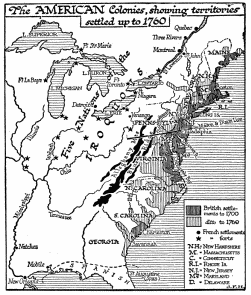
Such were the miscellaneous origins of the citizens of the Thirteen Colonies.[424] The possibility of their ever becoming closely united would have struck an impartial observer in 1760 as being very slight. Superadded to the initial differences of origin, fresh differences were created by climate. North of the Mason and Dixon line farming was practised mainly upon British or Central European lines by free white cultivators. The settled country of New England took on a likeness to the English countryside; considerable areas of Pennsylvania developed fields and farmhouses like those of South Germany. The distinctive conditions in the north had, socially, important effects. Masters and men had to labour together as backwoodsmen, and were equalized in the process. They did not start equally; many “servants” are mentioned in the roster of the Mayflower. But they rapidly became equal under colonial conditions; there was, for instance, a vast tract of land to be had for the taking, and the “servant” went off and took land like his master. The English class system disappeared. Under colonial conditions there arose equality “in the faculties both of body and mind,” and an individual independence of judgment impatient of interference from England. But south of the Mason and Dixon line tobacco growing began, and the warmer climate encouraged the establishment of plantations with gang labour. Red Indian captives were employed; Cromwell sent Irish prisoners of war to Virginia, which did much to reconcile the Royalist planters to republicanism; convicts were sent out, and there was a considerable trade in kidnapped children, who were “spirited away” to America to become apprentices or bond slaves. But the most convenient form of gang labour proved to be that of negro slaves. The first negro slaves were brought to Jamestown in Virginia by a Dutch ship as early as 1620. By 1700 negro slaves were scattered all over the states, but Virginia, Maryland, and the Carolinas were their chief regions of employment, and while the communities to the north were communities of not very rich and not very poor farming men, the south developed a type of large proprietor and a white community of overseers and professional men subsisting on slave labour. Slave labour was a necessity to the social and economic system that had grown up in the south; in the north the presence of slaves was unnecessary and in some respects inconvenient. Conscientious scruples about slavery were more free, therefore, to develop and flourish in the northern atmosphere. To this question of the revival of slavery in the world we must return when we come to consider the perplexities of American Democracy. Here we note it simply as an added factor in the heterogeneous mixture of the British Colonies.[425]
But if the inhabitants of the Thirteen Colonies were miscellaneous in their origins and various in their habits and sympathies, they had three very strong antagonisms in common. They had a common interest against the Red Indians. For a time they shared a common dread of French conquest and dominion. And thirdly, they were all in conflict with the claims of the British crown and the commercial selfishness of the narrow oligarchy who dominated the British Parliament and British affairs.
So far as the first danger went, the Indians were a constant evil, but never more than a threat of disaster. They remained divided against themselves. Yet they had shown possibilities of combination upon a larger scale. The Five Nations of the Iroquois (see map, p. 283) was a very important league of tribes. But it never succeeded in playing off the French against the English to secure itself, and no Red Indian Jengis Khan ever arose among these nomads of the new world. The French aggression was a more serious threat. The French never made settlements in America on a scale to compete with the English, but their government set about the encirclement of the colonies and their subjugation in a terrifyingly systematic manner. The English in America were colonists; the French were explorers, adventurers, agents, missionaries, merchants, and soldiers. Only in Canada did they strike root. French statesmen sat over maps and dreamt dreams, and their dreams are to be seen in our map in the chain of forts creeping southward from the Great Lakes and northward up the Mississippi and Ohio rivers. The struggle of France and Britain was a worldwide struggle. It was decided in India, in Germany, and on the high seas. In the Peace of Paris (1763) the French gave England Canada, and relinquished Louisiana to the inert hands of declining Spain. It was the complete abandonment of America by France. The lifting of the French danger left the colonists unencumbered to face their third common antagonist—the crown and government of their mother land.
§ 3
We have noted in the previous chapter how the governing class of Great Britain steadily acquired the land and destroyed the liberty of the common people throughout the eighteenth century, and how greedily and blindly the new industrial revolution was brought about. We have noted also how the British Parliament, through the decay of the representative methods of the House of Commons, had become both in its upper and lower houses merely the instrument of government through the big landowners. Both these big property-holders and the crown were deeply interested in America; the former as private adventurers, the latter partly as representing the speculative exploitations of the Stuart kings, and partly as representing the state in search of funds for the expenses of foreign policy, and neither lords nor crown were disposed to regard the traders, planters, and common people of the colonies with any more consideration than they did the yeomen and small cultivators at home. At bottom the interests of the common man in Great Britain, Ireland, and America were the same. Each was being squeezed by the same system. But while in Britain oppressor and oppressed were closely tangled up in one intimate social system, in America the crown and the exploiter were far away, and men could get together and develop a sense of community against their common enemy.
Moreover, the American colonist had the important advantage of possessing a separate and legal organ of resistance to the British government in the assembly or legislature of his colony that was necessary for the management of local affairs. The common man in Britain, cheated out of his proper representation in the Commons, had no organ, no centre of expression and action for his discontents.
It will be evident to the reader, bearing in mind the variety of the colonies, that here was the possibility of an endless series of disputes, aggressions, and counter-aggressions. The story of the development of irritations between the colonies and Britain is a story far too intricate, subtle, and lengthy for the scheme of this Outline. Suffice it that the grievances fell under three main heads: attempts to secure for British adventurers or the British government the profits of the exploitation of new lands; systematic restrictions upon trade designed to keep the foreign trade of the colonies entirely in British hands, so that the colonial exports all went through Britain and only British-made goods were used in America;[426] and finally attempts at taxation through the British Parliament as the supreme taxing authority of the empire. Under the pressure of this triple system of annoyances, the American colonists were forced to do a very considerable amount of hard political thinking. Such men as Patrick Henry and James Otis began to discuss the fundamental ideas of government and political association very much as they had been discussed in England in the great days of Cromwell’s Commonweal. They began to deny both the divine origin of kingship and the supremacy of the British Parliament, and (James Otis, 1762[427]) to say such things as:—
“God made all men naturally equal.
“Ideas of earthly superiority are educational, not innate.
“Kings were made for the good of the people, and not the people for them.
“No government has a right to make slaves of its subjects.
“Though most governments are de facto arbitrary, and consequently the curse and scandal of human nature, yet none are de jure arbitrary.”
Some of which propositions reach far.
This ferment in the political ideas of the Americans was started by English leaven. One very influential English writer was John Locke (1632-1704), whose Two Treatises on Civil Government may be taken, as much as any one single book can be taken in such cases, as the point of departure for modern democratic ideas. He was the son of a Cromwellian soldier, he was educated at Christ Church, Oxford, during the republican ascendancy, he spent some years in Holland in exile, and his writings form a bridge between the bold political thinking of those earlier republican days and the revolutionary movement both in America and France.
But men do not begin to act upon theories. It is always some real danger, some practical necessity, that produces action; and it is only after action has destroyed old relationships and produced a new and perplexing state of affairs that theory comes to its own. Then it is that theory is put to the test. The discord in interests and ideas between the colonists was brought to a fighting issue by the obstinate resolve of the British Parliament after the peace of 1763 to impose taxation upon the American colonies. Britain was at peace and flushed with successes; it seemed an admirable opportunity for settling accounts with these recalcitrant settlers. But the great British property-owners found a power beside their own, of much the same mind with them, but a little divergent in its ends—the reviving crown. King George III, who had begun his reign in 1760, was resolved to be much more of a king than his two German predecessors. He could speak English; he claimed to “glory in the name of Briton”—and indeed it is not a bad name for a man without a perceptible drop of English, Welsh, or Scotch blood in his veins. In the American colonies and the overseas possessions generally, with their indefinite charters or no charters at all, it seemed to him that the crown might claim authority and obtain resources and powers absolutely denied to it by the strong and jealous aristocracy in Britain. This inclined many of the Whig noblemen to a sympathy with the colonists that they might not otherwise have shown. They had no objection to the exploitation of the colonies in the interests of British “private enterprise,” but they had very strong objections to the strengthening of the crown by that exploitation so as to make it presently independent of themselves.[428]
The war that broke out was therefore in reality not a war between Britain and the colonists, it was a war between the British government and the colonists, with a body of Whig noblemen and a considerable amount of public feeling in England on the side of the latter. An early move after 1763 was an attempt to raise revenue for Britain in the colonies by requiring that newspapers and documents of various sorts should be stamped. This was stiffly resisted, the British crown was intimidated, and the Stamp Acts were repealed (1766). Their repeal was greeted by riotous rejoicings in London, more hearty even than those in the colonies.
But the Stamp Act affair was only one eddy in a turbulent stream flowing towards civil war. Upon a score of pretexts, and up and down the coast, the representatives of the British government were busy asserting their authority and making British government intolerable. The quartering of soldiers upon the colonists was a great nuisance. Rhode Island was particularly active in defying the trade restrictions; the Rhode Islanders were “free traders,”—that is to say, smugglers; a government schooner, the Gaspee, ran aground off Providence; she was surprised, boarded, and captured by armed men in boats, and burnt. In 1773, with a total disregard of the existing colonial tea trade, special advantages for the importation of tea into America[429] were given by the British Parliament to the East India Company. It was resolved by the colonists to refuse and boycott this tea. When the tea importers at Boston showed themselves resolute to land their cargoes, a band of men disguised as Indians, in the presence of a great crowd of people, boarded the three tea ships and threw the tea overboard (December 16th, 1773).
All 1774 was occupied in the gathering up of resources on either side for the coming conflict. It was decided by the British Parliament in the spring of 1774 to punish Boston by closing her port. Her trade was to be destroyed unless she accepted that tea. It was a quite typical instance of that silly “firmness” which shatters empires. In order to enforce this measure, British troops were concentrated at Boston under General Gage. The colonists took counter-measures. The first colonial Congress met at Philadelphia in September, at which twelve colonies were represented: Massachusetts, Connecticut, New Hampshire, Rhode Island, New York, New Jersey, Pennsylvania, Maryland, Delaware, Virginia, and North and South Carolina. Georgia was not present. True to the best English traditions, the Congress documented its attitude by a “Declaration of Rights.” Practically this Congress was an insurrectionary government, but no blow was struck until the spring of 1775. Then came the first shedding of blood.
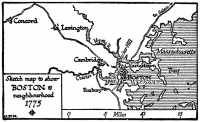
Two of the American leaders, Hancock and Samuel Adams, had been marked down by the British Government for arrest and trial for treason; they were known to be at Lexington, about eleven miles from Boston; and in the night of April 18th, 1775, Gage set his forces in motion for their arrest.
That night was a momentous one in history. The movement of Gage’s troops had been observed, signal lanterns were shown from a church tower in Boston, and two men, Dawes and Paul Revere, stole away in boats across the Back Bay to take horse and warn the countryside. The British were also ferried over the water, and as they marched through the night towards Lexington, the firing of signal cannon and the ringing of church bells went before them. As they entered Lexington at dawn, they saw a little company of men drawn up in military fashion. It seems that the British fired first. There was a single shot and then a volley, and the little handful decamped, apparently without any answering shots, leaving eight dead and nine wounded upon the village green.
The British then marched on to Concord, ten miles further, occupied the village, and stationed a party on the bridge at that place. The expedition had failed in its purpose of arresting Hancock and Adams, and the British commander seems to have been at a loss what to do next. Meanwhile the colonial levies were coming up from all directions, and presently the picket upon the bridge found itself subjected to an increasing fire from a gathering number of assailants firing from behind trees and fences. A retreat to Boston was decided upon. It was a disastrous retreat. The country had risen behind the British; all the morning the colonials had been gathering. Both sides of the road were now swarming with sharpshooters firing from behind rock and fence and building; the soldiers were in conspicuous scarlet uniforms, with yellow facings and white gaiters and cravats; this must have stood out very vividly against the cold sharp colours of the late New England spring; the day was bright, hot, and dusty, and they were already exhausted by a night march. Every few yards a man fell, wounded or killed. The rest tramped on, or halted to fire an ineffectual volley. No counter-attack was possible. Their assailants lurked everywhere. At Lexington there were British reinforcements and two guns, and after a brief rest the retreat was resumed in better order. But the sharpshooting and pursuit was pressed to the river, and after the British had crossed back into Boston, the colonial levies took up their quarters in Cambridge and prepared to blockade the city.
§ 4
So the war began. It was not a war that promised a conclusive end. The colonists had no one vulnerable capital; they were dispersed over a great country, with a limitless wilderness behind it, and so they had great powers of resistance. They had learnt their tactics largely from the Indians; they could fight well in open order, and harry and destroy troops in movement. But they had no disciplined army that could meet the British in a pitched battle, and little military equipment; and their levies grew impatient at a long campaign, and tended to go home to their farms. The British, on the other hand, had a well-drilled army, and their command of the sea gave them the power of shifting their attack up and down the long Atlantic seaboard. They were at peace with all the world. But the king was stupid and greedy to interfere in the conduct of affairs; the generals he favoured were stupid “strong men” or flighty men of birth and fashion; and the heart of England was not in the business. He trusted rather to being able to blockade, raid, and annoy the colonists into submission than to a conclusive conquest and occupation of the land. But the methods employed, and particularly the use of hired German troops, who still retained the cruel traditions of the Thirty Years’ War, and of Indian auxiliaries, who raped and scalped the outlying settlers, did not so much weary the Americans of the war as of the British. The Congress, meeting for the second time in 1775, endorsed the actions of the New England colonists, and appointed George Washington the American commander-in-chief. In 1777, General Burgoyne, in an attempt to get down to New York from Canada, was defeated at Freeman’s Farm on the Upper Hudson, and surrounded and obliged to capitulate at Saratoga with his whole army. This disaster encouraged the French and Spanish to come into the struggle on the side of the colonists. The French sent an army to the States under General Lafayette, and their fleet did much to minimize the advantage of the British at sea. General Cornwallis was caught in the Yorktown peninsula in Virginia in 1781, and capitulated with his army. The British Government, now heavily engaged with France and Spain in Europe, was at the end of its resources.
At the outset of the war the colonists in general seem to have been as little disposed to repudiate monarchy and claim complete independence as were the Hollanders in the opening phase of Philip II’s persecutions and follies. The separatists were called radicals; they were mostly extremely democratic, as we should say in England to-day, and their advanced views frightened many of the steadier and wealthier colonists, for whom class privileges and distinctions had considerable charm. But early in 1776 an able and persuasive Englishman, Tom Paine, published a pamphlet at Philadelphia with the title of Common Sense, which had an enormous effect on public opinion. Its style was rhetorical by modern standards. “The blood of the slain, the weeping voice of Nature cries, ‘’Tis time to part,’” and so forth. But its effects were very great. It converted thousands to the necessity of separation. The turn-over of opinion, once it had begun, was rapid.
Only in the summer of 1776 did Congress take the irrevocable step of declaring for separation. “The Declaration of Independence,” another of those exemplary documents which it has been the peculiar service of the English to produce for mankind, was drawn up by Thomas Jefferson; and after various amendments and modifications it was made the fundamental document of the United States of America. There were two noteworthy amendments to Jefferson’s draft. He had denounced the slave trade fiercely, and blamed the home government for interfering with colonial attempts to end it. This was thrown out, and so too was a sentence about the British: “we must endeavour to forget our former love for them ... we might have been a free and a great people together.”
(But for the British crown and great proprietors and the mutual ignorance of the common men in the two countries.)[430]
Towards the end of 1782, the preliminary articles of the treaty in which Britain recognized the complete independence of the United States were signed at Paris. The end of the war was proclaimed on April 19th, 1783, exactly eight years after Paul Revere’s ride, and the retreat of Gage’s men from Concord to Boston. The Treaty of Peace was finally signed at Paris in September.
§ 5
From the point of view of human history, the way in which the Thirteen States became independent is of far less importance than the fact that they did become independent. And with the establishment of their independence came a new sort of community into the world. It was like something coming out of an egg. It was a western European civilization that had broken free from the last traces of Empire and Christendom; it had not a vestige of monarchy left and no state religion. It had no dukes, princes, counts, nor any sort of title-bearers claiming to ascendancy or respect as a right. Even its unity was as yet a mere unity for defence and freedom. It was in these respects such a clean start in political organization as the world had not seen before. The absence of any binding religious tie is especially noteworthy. It had a number of forms of Christianity, its spirit was indubitably Christian; but as a state document of 1796 explicitly declared, “The government of the United States is not in any sense founded on the Christian religion.”[431] The new community had in fact gone right down to the bare and stripped fundamentals of human association, and it was building up a new sort of society and a new sort of state upon those foundations.
Here were about four million people scattered over vast areas with very slow and difficult means of inter-communication, poor as yet, but with the potentiality of limitless wealth, setting out to do in reality on a huge scale such a feat of construction as the Athenian philosophers twenty-two centuries before had done in imagination and theory.
This situation marks a definite stage in the release of man from precedent and usage, and a definite step forward towards the conscious and deliberate reconstruction of his circumstances to suit his needs and aims. It was a new method becoming practical in human affairs. The modern states of Europe have been evolved institution by institution slowly and planlessly out of preceding things. The United States were planned and made.
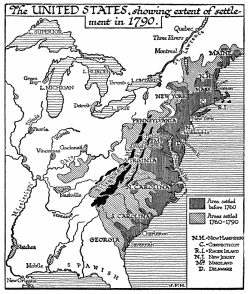
In one respect, however, the creative freedom of the new nation was very seriously restricted. This new sort of community and state was not built upon a cleared site. It was not even so frankly an artificiality as some of the later Athenian colonies, which went out from the mother city to plan and build brand new city states with brand new constitutions. The thirteen colonies by the end of the war had all of them constitutions either like that of Connecticut and Rhode Island dating from their original charters (1662) or, as in the case of the rest of the states, where a British governor had played a large part in the administration, re-made during the conflict. But we may well consider these reconstructions as contributory essays and experiments in the general constructive effort.
Upon the effort certain ideas stood out very prominently. One is the idea of political and social equality. This idea, which we saw coming into the world as an extreme and almost incredible idea in the age between Buddha and Jesus of Nazareth, is now asserted in the later eighteenth century as a practical standard of human relationship. Says the fundamental statement of Virginia: “All men are by nature equally free and independent,” and it proceeds to rehearse their “rights,” and to assert that all magistrates and governors are but “trustees and servants”; of the commonweal. All men are equally entitled to the free exercise of religion. The king by right, the aristocrat, the “natural slave,” the god king, and the god have all vanished from this political scheme—so far as these declarations go. Most of the states produced similar preludes to government. The Declaration of Independence said that “all men are born equal.” It is everywhere asserted in eighteenth-century terms that the new community is to be—to use the phraseology we have introduced in an earlier chapter—a community of will and not a community of obedience. But the thinkers of that time had a rather clumsier way of putting the thing, they imagined a sort of individual choice of and assent to citizenship that never in fact occurred—the so-called Social Contract. The Massachusetts preamble, for instance, asserts that the state is a voluntary association, “by which the whole people covenants with each citizen and each citizen with the whole people that all shall be governed by certain laws for the common good.”
Now it will be evident that most of these fundamental statements are very questionable statements. Men are not born equal, they are not born free; they are born a most various multitude enmeshed in an ancient and complex social net. Nor is any man invited to sign the social contract or, failing that, to depart into solitude. These statements, literally interpreted, are so manifestly false that it is impossible to believe that the men who made them intended them to be literally interpreted. They made them in order to express certain elusive but profoundly important ideas—ideas that after another century and a half of thinking the world is in a better position to express. Civilization, as this outline has shown, arose as a community of obedience, and was essentially a community of obedience. But generation after generation the spirit was abused by priests and rulers. There was a continual influx of masterful will from the forests, parklands, and steppes. The human spirit had at last rebelled altogether against the blind obediences of the common life; it was seeking—and at first it was seeking very clumsily—to achieve a new and better sort of civilization that should also be a community of will. To that end it was necessary that every man should be treated as the sovereign of himself; his standing was to be one of fellowship and not of servility. His real use, his real importance depended upon his individual quality.
The method by which these creators of political America sought to secure this community of will was an extremely simple and crude one. They gave what was for the time, and in view of American conditions, a very wide franchise. Conditions varied in the different states; the widest franchise was in Pennsylvania, where every adult male taxpayer voted, but, compared with Britain, all the United States were well within sight of manhood suffrage by the end of the eighteenth century. These makers of America also made efforts, considerable for their times, but puny by more modern standards, to secure a widely diffused common education. The information of the citizens as to what was going on at home and abroad, they left, apparently without any qualms of misgiving, to public meetings and the privately owned printing press.
The story of the various state constitutions, and of the constitution of the United States as a whole, is a very intricate one, and we can only deal with it here in the broadest way. The most noteworthy point in a modern view is the disregard of women as citizens. The American community was a simple, largely agricultural community, and most women were married; it seemed natural that they should be represented by their men folk. But New Jersey admitted a few women to vote on a property qualification. Another point of great interest is the almost universal decision to have two governing assemblies, confirming or checking each other, on the model of the Lords and Commons of Britain. Only Pennsylvania had a single representative chamber, and that was felt to be a very dangerous and ultra-democratic state of affairs. Apart from the argument that legislation should be slow as well as sure, it is difficult to establish any necessity for this “bi-cameral” arrangement. It seems to have been a fashion with constitution planners in the eighteenth century rather than a reasonable imperative. The British division was an old one; the Lords, the original parliament, was an assembly of “notables,” the leading men of the kingdom; the House of Commons came in as a new factor, as the elected spokesmen of the burghers and the small landed men. It was a little too hastily assumed in the eighteenth century that the commonalty would be given to wild impulses and would need checking; opinion was for democracy, but for democracy with powerful brakes always on, whether it was going up hill or down. About all the upper houses there was therefore a flavour of selectness; they were elected on a more limited franchise. This idea of making an upper chamber which shall be a stronghold for the substantial man does not appeal to modern thinkers so strongly as it did to the men of the eighteenth century, but the bi-cameral idea in another form still has its advocates. They suggest that a community may with advantage consider its affairs from two points of view—through the eyes of a body elected to represent trades, industries, professions, public services, and the like, a body representing function, and through the eyes of a second body elected by localities to represent communities. For the members of the former a man would vote by his calling, for the latter by his district of residence. They point out that the British House of Lords is in effect a body representing function, in which the land, the law, and the church are no doubt disproportionately represented, but in which industrialism, finance, the great public services, art, science, and medicine, also find places; and that the British House of Commons is purely geographical in its reference. It has even been suggested in Britain that there should be “labour peers,” selected from among the leaders of the great industrial trade unions. But these are speculations beyond our present scope.
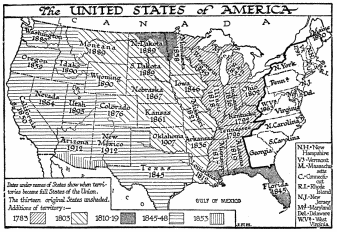
The Central Government of the United States was at first a very feeble body, a congress of representatives of the thirteen governments, held together by certain Articles of Confederation. This Congress was little more than a conference of sovereign representatives; it had no control, for instance, over the foreign trade of each state, it could not coin money nor levy taxes by its own authority. When John Adams, the first minister from the United States to England, went to discuss a commercial treaty with the British foreign secretary, he was met by a request for thirteen representatives, one from each of the states concerned. He had to confess his inadequacy to make binding arrangements. The British presently began dealing with each state separately over the head of Congress, and they retained possession of a number of posts in the American territory about the great lakes because of the inability of Congress to hold these regions effectually. In another urgent matter Congress proved equally feeble. To the west of the thirteen states stretched limitless lands into which settlers were now pushing in ever-increasing numbers. Each of the states had indefinable claims to expansion westward. It was evident to every clear-sighted man that the jostling of these claims must lead in the long run to war, unless the Central Government could take on their apportionment. The feebleness of the Central Government, its lack of concentration, became so much of an inconvenience and so manifest a danger that there was some secret discussion of a monarchy, and Nathaniel Gorham of Massachusetts, the president of Congress, caused Prince Henry of Prussia, the brother of Frederick the Great, to be approached on the subject. Finally a constitutional convention was called in 1787 at Philadelphia, and there it was that the present constitution of the United States was in its broad lines hammered out. A great change of spirit had gone on during the intervening years, a widespread realization of the need of unity.
When the Articles of Confederation were drawn up, men had thought of the people of Virginia, the people of Massachusetts, the people of Rhode Island, and the like; but now there appears a new conception, “the people of the United States.” The new government, with the executive President, the senators, congressmen, and the Supreme Court, that was now created, was declared to be the government of “the people of the United States”; it was a synthesis and not a mere assembly. It said “we the people,” and not “we the states,” as Lee of Virginia bitterly complained. It was to be a “federal” and not a confederate government.
State by state the new constitution was ratified, and in the spring of 1788 the first congress upon the new lines assembled at New York, under the presidency of George Washington, who had been the national commander-in-chief throughout the War of Independence. The constitution then underwent considerable revision, and Washington upon the Potomac was selected as the Federal capital.
§ 6
In an earlier chapter we have described the Roman republic, and its mixture of modern features with dark superstition and primordial savagery, as the Neanderthal anticipation of the modern democratic state. A time may come when people will regard the contrivances and machinery of the American constitution as the political equivalents of the implements and contrivances of Neolithic man. They have served their purpose well, and under their protection the people of the States have grown into one of the greatest, most powerful, and most civilized communities that the world has yet seen; but there is no reason in that for regarding the American constitution as a thing more final and inalterable than the pattern of street railway that overshadows many New York thoroughfares, or the excellent and homely type of house architecture that still prevails in Philadelphia. These things also have served a purpose well, they have their faults, and they can be improved. Our political contrivances, just as much as our domestic and mechanical contrivances, need to undergo constant revision as knowledge and understanding grow.
Since the American constitution was planned, our conception of history and our knowledge of collective psychology has undergone very considerable development. We are beginning to see many things in the problem of government to which the men of the eighteenth century were blind; and, courageous as their constructive disposition was in relation to whatever political creation had gone before, it fell far short of the boldness which we in these days realize to be needful if this great human problem of establishing a civilized community of will in the earth is to be solved. They took many things for granted that now we know need to be made the subject of the most exacting scientific study and the most careful adjustment. They thought it was only necessary to set up schools and colleges, with a grant of land for maintenance, and that they might then be left to themselves. But education is not a weed that will grow lustily in any soil, it is a necessary and delicate crop that may easily wilt and degenerate. We learn nowadays that the under-development of universities and educational machinery is like some under-development of the brain and nerves, which hampers the whole growth of the social body. By European standards, by the standard of any state that has existed hitherto, the level of the common education of America is high; but by the standard of what it might be, America is an uneducated country. And those fathers of America thought also that they had but to leave the press free, and everyone would live in the light. They did not realize that a free press could develop a sort of constitutional venality due to its relations with advertisers, and that large newspaper proprietors could become buccaneers of opinion and insensate wreckers of good beginnings. And, finally, the makers of America had no knowledge of the complexities of vote manipulation. The whole science of elections was beyond their ken, they knew nothing of the need of the transferable vote to prevent the “working” of elections by specialized organizations, and the crude and rigid methods they adopted left their political system the certain prey of the great party machines that have robbed American democracy of half its freedom and most of its political soul. Politics became a trade, and a very base trade; decent and able men, after the first great period, drifted out of politics and attended to “business,” and what I have called elsewhere the “sense of the state”[432] declined. Private enterprise ruled in many matters of common concern, because political corruption made collective enterprise impossible.
Yet the defects of the great political system created by the Americans of the revolutionary period did not appear at once. For several generations the history of the United States was one of rapid expansion and of an amount of freedom, homely happiness, and energetic work unparalleled in the world’s history. And the record of America for the whole last century and a half, in spite of many reversions towards inequality, in spite of much rawness and much blundering, is nevertheless as bright and honourable a story as that of any other contemporary people.
Benjamin Franklin

In this brief account of the creation of the United States of America we have been able to do little more than mention the names of some of the group of great men who made this new departure in human history. We have named casually or we have not even named such men as Tom Paine, Benjamin Franklin, Patrick Henry, Thomas Jefferson, the Adams brothers, Madison, Alexander Hamilton, and George Washington. It is hard to measure the men of one period of history with those in another. Some writers, even American writers, impressed by the artificial splendours of the European courts and by the tawdry and destructive exploits of a Frederick the Great or a Great Catherine, display a snobbish shame of something homespun about these makers of America. They feel that Benjamin Franklin at the court of Louis XVI, with his long hair, his plain clothes, and his pawky manner, was sadly lacking in aristocratic distinction. But stripped to their personalities, Louis XVI was hardly gifted enough or noble-minded enough to be Franklin’s valet. If human greatness is a matter of scale and glitter, then no doubt Alexander the Great is at the apex of human greatness. But is greatness that? Is not a great man rather one who, in a great position or amidst great opportunities—and great gifts are no more than great opportunities—serves God and his fellows with a humble heart? And quite a number of these Americans of the revolutionary time do seem to have displayed much disinterestedness and devotion. They were limited men, fallible men; Washington was, for example, a conspicuously indolent man; but on the whole they seem to have cared more for the commonweal they were creating than for any personal end or personal vanity.
Washington
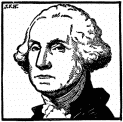
They were all limited men. They were limited in knowledge and outlook; they were limited by the limitations of the time. And there was no perfect man among them. They were, like all of us, men of mixed motives; good impulses arose in their minds, great ideas swept through them, and also they could be jealous, lazy, obstinate, greedy, vicious. If one were to write a true, full, and particular history of the making of the United States, it would have to be written with charity and high spirits as a splendid comedy. And in no other regard do we find the rich tortuous humanity of the American story so finely displayed as in regard to slavery. Slavery, having regard to the general question of labour, is the test of this new soul in the world’s history, the American soul.
Slavery began very early in the European history of America, and no European people who went to America can be held altogether innocent in the matter. At a time when the German is still the moral whipping-boy of Europe, it is well to note that the German record is in this respect the best of all. Almost the first outspoken utterances against negro slavery came from German settlers in Pennsylvania. But the German settler was working with free labour upon a temperate countryside, well north of the plantation zone; he was not under serious temptation in this matter. American slavery began with the enslavement of Indians for gang work in mines and upon plantations, and it is curious to note that it was a very good and humane man indeed, Las Casas, who urged that negroes should be brought to America to relieve his tormented Indian protégés. The need for labour upon the plantations of the West Indies and the south was imperative. When the supply of Indian captives proved inadequate, the planters turned not only to the negro, but to the jails and poor-houses of Europe for a supply of toilers. The reader of Defoe’s Moll Flanders will learn how the business of Virginian white slavery looked to an intelligent Englishman in the early eighteenth century. But the negro came very early. The year (1620) that saw the Pilgrim Fathers landing at Plymouth in New England saw a Dutch sloop disembarking the first cargo of negroes at Jamestown in Virginia. Negro slavery was as old as New England; it had been an American institution for over a century and a half before the War of Independence. It was to struggle on for the better part of a century more.
But the conscience of thoughtful men in the colonies was never quite easy upon this score, and it was one of the accusations of Thomas Jefferson against the crown and lords of Great Britain that every attempt to ameliorate or restrain the slave trade on the part of the colonists had been checked by the great proprietary interests in the mother country.[433] With the moral and intellectual ferment of the revolution, the question of negro slavery came right into the foreground of the public conscience. The contrast and the challenge glared upon the mind. “All men are by nature free and equal,” said the Virginia Bill of Rights, and outside in the sunshine, under the whip of the overseer, toiled the negro slave.
It witnesses to the great change in human ideas since the Roman Imperial system dissolved under the barbarian inrush, that there could be this heart-searching. Conditions of industry, production, and land tenure had long prevented any recrudescence of gang slavery; but now the cycle had come round again, and there were enormous immediate advantages to be reaped by the owning and ruling classes in the revival of that ancient institution in mines, upon plantations, and upon great public works. It was revived—but against great opposition. From the beginning of the revival there were protests, and they grew. The revival was counter to the new conscience of mankind. In some respects the new gang slavery was worse than anything in the ancient world. Peculiarly horrible was the provocation by the trade of slave wars and man hunts in Western Africa, and the cruelties of the long transatlantic voyage. The poor creatures were packed on the ships often with insufficient provision of food and water, without proper sanitation, without medicines. Many who could tolerate slavery upon the plantations found the slave trade too much for their moral digestions. Three European nations were chiefly concerned in this dark business, Britain, Spain, and Portugal, because they were the chief owners of the new lands in America. The comparative innocence of the other European powers is to be ascribed largely to their lesser temptations. They were similar communities; in parallel circumstances they would have behaved similarly.
Throughout the middle part of the eighteenth century there was an active agitation against negro slavery in Great Britain as well as in the States. It was estimated that in 1770 there were fifteen thousand slaves in Britain, mostly brought over by their owners from the West Indies and Virginia. In 1771 the issue came to a conclusive test in Britain before Lord Mansfield. A negro named James Somersett had been brought to England from Virginia by his owner. He ran away, was captured, and violently taken on a ship to be returned to Virginia. From the ship he was extracted by a writ of habeas corpus. Lord Mansfield declared that slavery was a condition unknown to English law, an “odious” condition, and Somersett walked out of the court a free man.
The Massachusetts constitution of 1780 had declared that “all men are born free and equal.” A certain negro, Quaco, put this to the test in 1783, and in that year the soil of Massachusetts became like the soil of Britain, intolerant of slavery; to tread upon it was to become free. At that time no other state in the Union followed this example. At the census of 1790, Massachusetts, alone of all the states, returned “no slaves.”
The state of opinion in Virginia is remarkable, because it brings to light the peculiar difficulties of the southern states. The great Virginian statesmen, such as Washington and Jefferson, condemned the institution, yet because there was no other form of domestic service, Washington owned slaves. There was in Virginia a strong party in favour of emancipating slaves. But they demanded that the emancipated slaves should leave the state within a year or be outlawed! They were naturally alarmed at the possibility that a free barbaric black community, many of its members African-born and reeking with traditions of cannibalism and secret and dreadful religious rites, should arise beside them upon Virginian soil. When we consider that point of view, we can understand why it was that a large number of Virginians should be disposed to retain the mass of blacks in the country under control as slaves, while at the same time they were bitterly opposed to the slave trade and the importation of any fresh blood from Africa. The free blacks, one sees, might easily become a nuisance; indeed the free state of Massachusetts presently closed its borders to their entry.... The question of slavery, which in the ancient world was usually no more than a question of status between individuals racially akin, merged in America with the different and profounder question of relationship between two races at opposite extremes of the human species and of the most contrasted types of tradition and culture. If the black man had been white, there can be little doubt that negro slavery, like white servitude, would have vanished from the United States within a generation of the Declaration of Independence as a natural consequence of the statements in that declaration.
§ 7[434]
We have told of the War of Independence in America as the first great break away from the system of European monarchies and foreign offices, as the repudiation by a new community of Machiavellian statescraft as the directive form of human affairs. Within a decade there came a second and much more portentous revolt against this strange game of Great Powers, this tangled interaction of courts and policies which obsessed Europe. But this time it was no breaking away at the outskirts. In France, the nest and home of Grand Monarchy, the heart and centre of Europe, came this second upheaval. And, unlike the American colonists, who simply repudiated a king, the French, following in the footsteps of the English revolution, beheaded one.
Like the British revolution and like the revolution in the United States, the French revolution can be traced back to the ambitious absurdities of the French monarchy. The schemes of aggrandizement, the aims and designs of the Grand Monarch, necessitated an expenditure upon war equipment throughout Europe out of all proportion to the taxable capacity of the age. And even the splendours of monarchy were enormously costly, measured by the productivity of the time. In France, just as in Britain and in America, the first resistance was made not to the monarch as such and to his foreign policy as such, nor with any clear recognition of these things as the roots of the trouble, but merely to the inconveniences and charges upon the individual life caused by them. The practical taxable capacity of France must have been relatively much less than that of England because of the various exemptions of the nobility and clergy. The burthen resting directly upon the common people was heavier. That made the upper classes the confederates of the court instead of the antagonists of the court as they were in England, and so prolonged the period of waste further; but when at last the bursting-point did come, the explosion was more violent and shattering.
During the years of the American War of Independence there were few signs of any impending explosion in France.[435] There was much misery among the lower classes, much criticism and satire, much outspoken liberal thinking, but there was little to indicate that the thing as a whole, with all its customs, usages, and familiar discords, might not go on for an indefinite time. It was consuming beyond its powers of production, but as yet only the inarticulate classes were feeling the pinch. Gibbon, the historian, knew France well; Paris was as familiar to him as London; but there is no suspicion to be detected in the passage we have quoted that days of political and social dissolution were at hand. No doubt the world abounded in absurdities and injustices, yet nevertheless, from the point of view of a scholar and a gentleman, it was fairly comfortable, and it seemed fairly secure.
There was much liberal thought, speech, and sentiment in France at this time. Parallel with and a little later than John Locke in England, Montesquieu (1689-1755) in France, in the earlier half of the eighteenth century, had subjected social, political, and religious institutions to the same searching and fundamental analysis, especially in his Esprit des Lois. He had stripped the magical prestige from the absolutist monarchy in France. He shares with Locke the credit for clearing away many of the false ideas that had hitherto prevented deliberate and conscious attempts to reconstruct human society. It was not his fault if at first some extremely unsound and impermanent shanties were run up on the vacant site. The generation that followed him in the middle and later decades of the eighteenth century was boldly speculative upon the moral and intellectual clearings he had made. A group of brilliant writers, the “Encyclopædists,” mostly rebel spirits from the excellent schools of the Jesuits, set themselves under the leadership of Diderot to scheme out, in a group of works, a new world (1766). The glory of the Encyclopædists, says Mallet, lay “in their hatred of things unjust, in their denunciation of the trade in slaves, of the inequalities of taxation, of the corruption of justice, of the wastefulness of wars, in their dreams of social progress, in their sympathy with the rising empire of industry which was beginning to transform the world.” Their chief error seems to have been an indiscriminate hostility to religion. They believed that man was naturally just and politically competent, whereas his impulse to social service and self-forgetfulness is usually developed only through an education essentially religious, and sustained only in an atmosphere of honest co-operation. Unco-ordinated human initiatives lead to nothing but social chaos.
Side by side with the Encyclopædists were the Economists or Physiocrats, who were making bold and crude inquiries into the production and distribution of food and goods. Morally, the author of the Code de la Nature, denounced the institution of private property and proposed a communistic organization of society. He was the precursor of that large and various school of collectivist thinkers in the nineteenth century who are lumped together as Socialists.
Both the Encyclopædists and the various Economists and Physiocrats demanded a considerable amount of hard thinking in their disciples. An easier and more popular leader to follow was that eloquent sentimentalist, Rousseau (1712-78). He preached the alluring doctrine that the primitive state of man was one of virtue and happiness, from which he had declined through the rather inexplicable activities of priests, kings, lawyers, and the like. (We have tried to convey to our readers in chap, ix, § 2, primitive man’s state of virtue and happiness, as the vivid vision of Mr. Worthington Smith has realized it; and we have done our best to show both the necessity of priests and kings to early civilization, and the possible inconveniences of their later rô1es in human affairs.) Rousseau’s work was essentially demoralizing. It struck not only at the existing social fabric, but at any social organization. When he wrote of the Social Contract, he did so rather to excuse breaches of the covenant than to emphasize its necessity. Man is so far from perfect, that a writer who could show that the almost universal disposition, against which we all have to fortify ourselves, to repudiate debts, misbehave sexually, and evade the toil and expenses of education for ourselves and others, is not after all a delinquency, but a fine display of Natural Virtue, was bound to have a large following in every class that could read him. Rousseau’s tremendous vogue did much to swamp the harder, clearer thinkers of this time, and to prepare a sentimental, declamatory, and insincere popular psychology for the great trials that were now coming upon France.[436]