BOOK VII THE MONGOL EMPIRES OF THE LAND WAYS AND THE NEW EMPIRES OF THE SEA WAYS (continued 3)
Reading edition
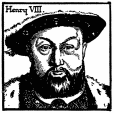
The Emperor never seems to have grasped the true forces at work in these gathering troubles. He was for his time and station an exceptionally worthy man, and he seems to have taken the religious dissensions that were tearing Europe into warring fragments as genuine theological differences. He gathered diets and councils in futile attempts at reconciliation. Formulæ and confessions were tried over. The student of German history must struggle with the details of the Religious Peace of Nuremberg, the settlement at the diet of Ratisbon, the Interim of Augsburg, and the like. Here we do but mention them as details in the worried life of this culminating emperor. As a matter of fact, hardly one of the multifarious princes and rulers in Europe seems to have been acting in good faith. The widespread religious trouble of the world, the desire of the common people for truth and social righteousness, the spreading knowledge of the time, all those things were merely counters in the imaginations of princely diplomacy. Henry VIII of England, who had begun his career with a book written against heresy, and who had been rewarded by the Pope with the title of “Defender of the Faith,” being anxious to divorce his first wife in favour of an animated young lady named Anne Boleyn,[401] and wishing also to turn against the Emperor in favour of Francis I and to loot the vast wealth of the church in England, joined the company of Protestant princes in 1530. Sweden, Denmark, and Norway had already gone over to the Protestant side.
Henry VIII.

The German religious war began in 1546, a few months after the death of Martin Luther. We need not trouble about the incidents of the campaign. The Protestant Saxon army was badly beaten at Lochau. By something very like a breach of faith Philip of Hesse, the Emperor’s chief remaining antagonist, was caught and imprisoned, and the Turks were bought off by the payment of an annual tribute. In 1547, to the great relief of the Emperor, Francis I died. So by 1547 Charles got to a kind of settlement, and made his last efforts to effect peace where there was no peace. In 1552 all Germany was at war again, only a precipitate flight from Innsbruck saved Charles from capture, and in 1552, with the treaty of Passau, came another unstable equilibrium. Charles was now utterly weary of the cares and splendours of empire; he had never had a very sound constitution, he was naturally indolent, and he was suffering greatly from gout. He abdicated. He made over all his sovereign rights in Germany to his brother Ferdinand, and Spain and the Netherlands he resigned to his son Philip. He then retired to a monastery at Yuste, among the oak and chestnut forests in the hills to the north of the Tagus valley, and there he died in 1558.
Charles V.
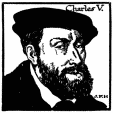
Much has been written in a sentimental vein of this retirement, this renunciation of the world by this tired majestic Titan, world-weary, seeking in an austere solitude his peace with God. But his retreat was neither solitary nor austere; he had with him nearly a hundred and fifty attendants; his establishment had all the indulgences without the fatigues of a court, and Philip II was a dutiful son to whom his father’s advice was a command. As for his austerities, let Prescott witness: “In the almost daily correspondence between Quixada, or Gaztelu, and the Secretary of State at Valladolid, there is scarcely a letter that does not turn more or less on the Emperor’s eating or his illness. The one seems naturally to follow, like a running commentary, on the other. It is rare that such topics have formed the burden of communications with the department of state. It must have been no easy matter for the secretary to preserve his gravity in the perusal of despatches in which politics and gastronomy were so strangely mixed together. The courier from Valladolid to Lisbon was ordered to make a detour, so as to take Jarandilla in his route, and bring supplies for the royal table. On Thursdays he was to bring fish to serve for the jour maigre that was to follow. The trout in the neighbourhood Charles thought too small; so others, of a larger size, were to be sent from Valladolid. Fish of every kind was to his taste, as, indeed, was anything that in its nature or habits at all approached to fish. Eels, frogs, oysters, occupied an important place in the royal bill of fare. Potted fish, especially anchovies, found great favour with him; and he regretted that he had not brought a better supply of these from the Low Countries. On an eel-pasty he particularly doted.”...[402]
In 1554 Charles had obtained a bull from Pope Julius III granting him a dispensation from fasting, and allowing him to break his fast early in the morning even when he was to take the sacrament.
“That Charles was not altogether unmindful of his wearing apparel in Yuste, may be inferred from the fact that his wardrobe contained no less than sixteen robes of silk and velvet, lined with ermine, or eider down, or the soft hair of the Barbary goat. As to the furniture and upholstery of his apartments, how little reliance is to be placed on the reports so carelessly circulated about these may be gathered from a single glance at the inventory of his effects, prepared by Quixada and Gaztelu soon after their master’s death. Among the items we find carpets from Turkey and Alcarez, canopies of velvet and other stuffs, hangings of fine black cloth, which since his mother’s death he had always chosen for his own bedroom; while the remaining apartments were provided with no less than twenty-five suits of tapestry, from the looms of Flanders, richly embroidered with figures of animals and with landscapes.... Among the different pieces of plate we find some of pure gold, and others especially noted for their curious workmanship; and as this was an age in which the art of working the precious metals was carried to the highest perfection, we cannot doubt that some of the finest specimens had come into the Emperor’s possession. The whole amount of plate was estimated at between twelve and thirteen thousand ounces in weight.”...[403]
Charles had never acquired the habit of reading, but he would be read aloud to at meals after the fashion of Charlemagne, and would make what one narrator describes as a “sweet and heavenly commentary.” He also amused himself with technical toys, by listening to music or sermons, and by attending to the imperial business that still came drifting in to him. The death of the Empress, to whom he was greatly attached, had turned his mind towards religion, which in his case took a punctilious and ceremonial form; every Friday in Lent he scourged himself with the rest of the monks with such good will as to draw blood. These exercises and the gout released a bigotry in Charles that had been hitherto restrained by considerations of policy. The appearance of Protestant teaching close at hand in Valladolid roused him to fury. “Tell the grand inquisitor and his council from me to be at their posts, and to lay the axe at the root of the evil before it spreads further.”... He expressed a doubt whether it would not be well, in so black an affair, to dispense with the ordinary course of justice, and to show no mercy; “lest the criminal, if pardoned, should have the opportunity of repeating his crime.” He recommended, as an example, his own mode of proceeding in the Netherlands, “where all who remained obstinate in their errors were burned alive, and those who were admitted to penitence were beheaded.”
Among the chief pleasures of the Catholic monarch between meals during this time of retirement were funeral services. He not only attended every actual funeral that was celebrated at Yuste, but he had services conducted for the absent dead, he held a funeral service in memory of his wife on the anniversary of her death, and finally he celebrated his own obsequies. “The chapel was hung with black, and the blaze of hundreds of wax-lights was scarcely sufficient to dispel the darkness. The brethren in their conventual dress, and all the Emperor’s household clad in deep mourning, gathered round a huge catafalque, shrouded also in black, which had been raised in the centre of the chapel. The service for the burial of the dead was then performed; and, amidst the dismal wail of the monks, the prayers ascended for the departed spirit, that it might be received into the mansions of the blessed. The sorrowful attendants were melted to tears, as the image of their master’s death was presented to their minds—or they were touched, it may be, with compassion by this pitiable display of weakness. Charles, muffled in a dark mantle, and bearing a lighted candle in his hand, mingled with his household, the spectator of his own obsequies; and the doleful ceremony was concluded by his placing the taper in the hands of the priest, in sign of his surrendering up his soul to the Almighty.”
Other accounts make Charles wear a shroud and lie in the coffin, remaining there alone until the last mourner had left the chapel.
Within two months of this masquerade he was dead. And the greatness of the Holy Roman Empire died with him. The Holy Roman Empire struggled on indeed to the days of Napoleon, but as an invalid and dying thing.
§ 11B
Ferdinand, the brother of Charles V, took over his abandoned work and met the German princes at the diet of Augsburg in 1555. Again there was an attempt to establish a religious peace. Nothing could better show the quality of that attempted settlement and the blindness of the princes and statesmen concerned in it, to the deeper and broader processes of the time, than the form that settlement took. The recognition of religious freedom was to apply to the states and not to individual citizens; cujus regio ejus religio, “the confession of the subject was to be dependent on that of the territorial lord.”
§ 11C
We have given as much attention as we have done to the writings of Machiavelli and to the personality of Charles V because they throw a flood of light upon the antagonisms of the next period in our history. This present chapter has told the story of a vast expansion of human horizons and of a great increase and distribution of knowledge; we have seen the conscience of common men awakening and intimations of a new and profounder social justice spreading throughout the general body of the Western civilization. But this process of light and thought was leaving courts and the political life of the world untouched. There is little in Machiavelli that might not have been written by some clever secretary in the court of Chosroes I or Shi-Hwang-ti—or even of Sargon I or Pepi. While the world in everything else was moving forward, in political ideas, in ideas about the relationship of state to state and of sovereign to citizen, it was standing still. Nay, it was falling back. For the great idea of the Catholic Church as the world city of God had been destroyed in men’s minds by the church itself, and the dream of a world imperialism had, in the person of Charles V, been carried in effigy through Europe to limbo. Politically the world seemed falling back towards personal monarchy of the Assyrian or Macedonian pattern.
It is not that the newly awakened intellectual energies of western European men were too absorbed in theological restatement, in scientific investigations, in exploration and mercantile development, to give a thought to the claims and responsibilities of rulers. Not only were common men drawing ideas of a theocratic or republican or communistic character from the now accessible Bible, but the renewed study of the Greek classics was bringing the creative and fertilizing spirit of Plato to bear upon the Western mind. In England Sir Thomas More produced a quaint imitation of Plato’s Republic in his Utopia, setting out a sort of autocratic communism. In Naples, a century later, a certain friar Campanella was equally bold in his City of the Sun. But such discussions were having no immediate effect upon political arrangements. Compared with the massiveness of the task, these books do indeed seem poetical and scholarly and flimsy. (Yet later on the Utopia was to bear fruit in the English Poor Laws.) The intellectual and moral development of the Western mind and this drift towards Machiavellian monarchy in Europe were for a time going on concurrently in the same world, but they were going on almost independently. The statesmen still schemed and manœuvred as if nothing grew but the power of wary and fortunate kings. It was only in the seventeenth and eighteenth centuries that these two streams of tendency, the stream of general ideas and the drift of traditional and egoistic monarchical diplomacy, interfered and came into conflict.