BOOK IV JUDEA, GREECE, AND INDIA (continued 3)
Reading edition
The evidence of a bitter hostility between mother and father peeps out in many little things in the histories. She was evidently jealous of Philip’s conquests; she hated his fame. There are many signs that Olympias did her best to set her son against his father and attach him wholly to herself. A story survives (in Plutarch’s Life) that “whenever news was brought of Philip’s victories, the capture of a city or the winning of some great battle, he never seemed greatly rejoiced to hear it; on the contrary he used to say to his play-fellows: ‘Father will get everything in advance, boys; he won’t leave any great task for me to share with you.’” ...
It is not a natural thing for a boy to envy his father in this fashion without some inspiration. That sentence sounds like an echo.
We have already pointed out how manifest it is that Philip planned the succession of Alexander, and how eager he was to thrust fame and power into the boy’s hands. He was thinking of the political structure he was building—but the mother was thinking of the glory and pride of that wonderful lady Olympias. She masked her hatred of her husband under the cloak of a mother’s solicitude for her son’s future. When in 337 B.C. Philip, after the fashion of kings in those days, married a second wife who was a native Macedonian, Cleopatra, “of whom he was passionately enamoured,” Olympias made much trouble.
Plutarch tells of a pitiful scene that occurred at Philip’s marriage to Cleopatra. There was much drinking of wine at the banquet, and Attalus, the father of the bride, being “intoxicated with liquor,” betrayed the general hostility to Olympias and Epirus by saying he hoped there would be a child by the marriage to give them a truly Macedonian heir. Whereupon Alexander, taut for such an insult, cried out, “What then am I?” and hurled his cup at Attalus. Philip, enraged, stood up and, says Plutarch, drew his sword, only to stumble and fall. Alexander, blind with rage and jealousy, taunted and insulted his father.
“Macedonians,” he said. “See there the general who would go from Europe to Asia! Why! he cannot get from one table to another!”
How that scene lives still, the sprawl, the flushed faces, the angry voice of the boy! Next day Alexander departed with his mother—and Philip did nothing to restrain them. Olympias went home to Epirus; Alexander departed to Illyria. Thence Philip persuaded him to return.
Fresh trouble arose. Alexander had a brother of weak intellect, Aridæus, whom the Persian governor of Caria sought as a son-in-law. “Alexander’s friends and his mother now infused notions into him again, though perfectly groundless, that by so noble a match, and the support consequent upon it, Philip designed the crown for Aridæus. Alexander, in the uneasiness these suspicions gave him, sent one Thessalus, a player, into Caria, to desire the grandee to pass by Aridæus, who was of spurious birth, and deficient in point of understanding, and to take the lawful heir to the crown into his alliance. Pixodarus was infinitely more pleased with this proposal. But Philip no sooner had intelligence of it, than he went to Alexander’s apartment, taking along with him Philotas, the son of Parmenio, one of his most intimate friends and companions, and, in his presence, reproached him with his degeneracy and meanness of spirit, in thinking of being son-in-law to a man of Caria, one of the slaves of a barbarian king. At the same time he wrote to the Corinthians, insisting that they should send Thessalus to him in chains. Harpalus and Niarchus, Phrygius and Ptolemy, some of the other companions of the prince, he banished. But Alexander afterwards recalled them, and treated them with great distinction.”
There is something very touching in this story of the father pleading with the son he manifestly loved, and baffled by the web of mean suggestion which had been spun about the boy’s imagination.
It was at the marriage of his daughter to her uncle, the king of Epirus and the brother of Olympias, that Philip was stabbed. He was walking in a procession into the theatre unarmed, in a white robe, and he was cut down by one of his bodyguard. The murderer had a horse waiting, and would have got away, but the foot of his horse caught in a wild vine and he was thrown from the saddle by the stumble and slain by his pursuers....
So at the age of twenty Alexander was at the end of his anxiety about the succession, and established king in Macedonia.
Olympias then reappeared in Macedonia, a woman proudly vindicated. It is said that she insisted upon paying the same funeral honours to the memory of the murderer as to Philip, and that she consecrated the fatal weapon to Apollo, inscribed with the name Myrtalis, by which Philip had been wont to address her when their loves first began.[197] In Greece there were great rejoicings over this auspicious event, and Demosthenes, when he had the news, although it was but seven days after the death of his own daughter, went into the public assembly at Athens in gay attire wearing a chaplet.
Whatever Olympias may have done about her husband’s assassin, history does not doubt about her treatment of her supplanter, Cleopatra. So soon as Alexander was out of the way—and a revolt of the hillmen in the north called at once for his attention—Cleopatra’s newly born child was killed in its mother’s arms, and Cleopatra—no doubt after a little taunting—was then strangled. These excesses of womanly feeling are said to have shocked Alexander, but they did not prevent him from leaving his mother in a position of considerable authority in Macedonia. She wrote letters to him upon religious and political questions, and he showed a dutiful disposition in sending her always a large share of the plunder he made.
§ 3
These stories have to be told because history cannot be understood without them. Here was the great world of men between India and the Adriatic ready for union, ready as it had never been before for a unifying control. Here was the wide order of the Persian empire with its roads, its posts, its general peace and prosperity, ripe for the fertilizing influence of the Greek mind. And these stories display the quality of the human beings to whom those great opportunities came. Here was this Philip who was a very great and noble man, and yet he was drunken, he could keep no order in his household. Here was Alexander in many ways gifted above any man of his time, and he was vain, suspicious, and passionate, with a mind set awry by his mother.
We are beginning to understand something of what the world might be, something of what our race might become, were it not for our still raw humanity. It is barely a matter of seventy generations between ourselves and Alexander; and between ourselves and the savage hunters our ancestors, who charred their food in the embers or ate it raw, intervene some four or five hundred generations. There is not much scope for the modification of a species in four or five hundred generations. Make men and women only sufficiently jealous or fearful or drunken or angry, and the hot red eyes of the cavemen will glare out at us to-day. We have writing and teaching, science and power; we have tamed the beasts and schooled the lightning; but we are still only shambling towards the light. We have tamed and bred the beasts, but we have still to tame and breed ourselves.
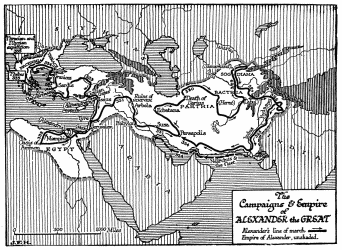
From the very beginning of his reign the deeds of Alexander showed how well he had assimilated his father’s plans, and how great were his own abilities. A map of the known world is needed to show the course of his life. At first, after receiving assurances from Greece that he was to be captain-general of the Grecian forces, he marched through Thrace to the Danube; he crossed the river and burnt a village, the second great monarch to raid the Scythian country beyond the Danube; then recrossed it and marched westward and so came down by Illyria. By that time the city of Thebes was in rebellion, and his next blow was at Greece. Thebes—unsupported of course by Athens—was taken and looted; it was treated with extravagant violence; all its buildings, except the temple and the house of the poet Pindar, were razed, and thirty thousand people sold into slavery. Greece was stunned, and Alexander was free to go on with the Persian campaign.
This destruction of Thebes betrayed a streak of crazy violence in the new master of human destinies. It was too heavy a blow to have dealt. It was a barbaric thing to do. No Greeks would have gone so far with conquered Greeks. If the spirit of rebellion was killed, so also was the spirit of help. The Greek states remained inert thereafter, neither troublesome nor helpful. They would not support Alexander with their shipping, a thing which was to prove a very grave embarrassment to him.[198]
There is a story told by Plutarch about this Theban massacre, as if it redounded to the credit of Alexander, but indeed it shows only how his saner and his crazy sides were in conflict. It tells of a Macedonian officer and a Theban lady. This officer was among the looters, and he entered this woman’s house, inflicted unspeakable insults and injuries upon her, and at last demanded whether she had gold or silver hidden. She told him all her treasures had been put into the well, conducted him thither, and, as he stooped to peer down, pushed him suddenly in and killed him by throwing great stones upon him. Some allied soldiers came upon this scene and took her forthwith to Alexander for judgment.
She defied him. Already the extravagant impulse that had ordered the massacre was upon the wane, and he not only spared her, but had her family and property and freedom restored to her. This Plutarch makes out to be a generosity, but the issue is more complicated than that. It was Alexander who was outraging and plundering and enslaving all Thebes. That poor crumpled Macedonian brute in the well had been doing only what he had been told he had full liberty to do. Is a commander first to give cruel orders, and then to forgive and reward those who slay his instruments? This gleam of remorse at the instance of one woman who was not perhaps wanting in tragic dignity and beauty, is a poor set-off to the murder of a great city.
Mixed with the craziness of Olympias in Alexander was the sanity of Philip and the teachings of Aristotle. This Theban business certainly troubled the mind of Alexander. Whenever afterwards he encountered Thebans, he tried to show them special favour. Thebes, to his credit, haunted him.
Yet the memory of Thebes did not save three other great cities from similar brain storms; Tyre he destroyed, and Gaza, and a city in India, in the storming of which he was knocked down in fair fight and wounded; and of the latter place not a soul, not a child, was spared. He must have been badly frightened to have taken so evil a revenge.
At the outset of the war the Persians had this supreme advantage, they were practically masters of the sea. The ships of the Athenians and their allies sulked unhelpfully. Alexander, to get at Asia, had to go round by the Hellespont; and if he pushed far into the Persian empire, he ran the risk of being cut off completely from his base. His first task, therefore, was to cripple the enemy at sea, and this he could only do by marching along the coast of Asia Minor and capturing port after port until the Persian sea bases were destroyed. If the Persians had avoided battle and hung upon his lengthening line of communications they could probably have destroyed him, but this they did not do. A Persian army not very much greater than his own gave battle on the banks of the Granicus (334 B.C.) and was destroyed. This left him free to take Sardis, Ephesus, Miletus, and, after a fierce struggle, Halicarnassus. Meanwhile the Persian fleet was on his right flank and between him and Greece, threatening much but accomplishing nothing.
In 333 B.C., pursuing this attack upon the sea bases, he marched along the coast as far as the head of the gulf now called the Gulf of Alexandretta. A huge Persian army, under the great king Darius III, was inland of his line of march, separated from the coast by mountains, and Alexander went right beyond this enemy force before he or the Persians realized their proximity. Scouting was evidently very badly done by Greek and Persian alike. The Persian army was a vast, ill-organized assembly of soldiers, transport, camp followers, and so forth. Darius, for instance, was accompanied by his harem, and there was a great multitude of harem slaves, musicians, dancers, and cooks. Many of the leading officers had brought their families to witness the hunting down of the Macedonian invaders. The troops had been levied from every province in the empire; they had no tradition or principle of combined action. Seized by the idea of cutting off Alexander from Greece, Darius moved this multitude over the mountains to the sea; he had the luck to get through the passes without opposition, and he encamped on the plain of Issus between the mountains and the shore. And there Alexander, who had turned back to fight, struck him. The cavalry charge and the phalanx smashed this great brittle host as a stone smashes a bottle. It was routed. Darius escaped from his war chariot—that out-of-date instrument—and fled on horseback, leaving even his harem in the hands of Alexander.
All the accounts of Alexander after this battle show him at his best. He was restrained and magnanimous. He treated the Persian princesses with the utmost civility. And he kept his head; he held steadfastly to his plan. He let Darius escape, unpursued, into Syria, and he continued his march upon the naval bases of the Persians—that is to say, upon the Phœnician ports of Tyre and Sidon.
Sidon surrendered to him; Tyre resisted.
Here, if anywhere, we have the evidence of great military ability on the part of Alexander. His army was his father’s creation, but Philip had never shone in the siege of cities. When Alexander was a boy of sixteen, he had seen his father repulsed by the fortified city of Byzantium upon the Bosphorus. Now he was face to face with an inviolate city which had stood siege after siege, which had resisted Nebuchadnezzar the Great for fourteen years. For the standing of sieges Semitic peoples hold the palm. Tyre was then an island half a mile from the shore, and her fleet was unbeaten. On the other hand, Alexander had already learnt much by the siege of the citadel of Halicarnassus; he had gathered to himself a corps of engineers from Cyprus and Phœnicia, the Sidonian fleet was with him, and presently the king of Cyprus came over to him with a hundred and twenty ships, which gave him the command of the sea. Moreover, great Carthage, either relying on the strength of the mother city or being disloyal to her, and being furthermore entangled in a war in Sicily, sent no help.

The first measure of Alexander was to build a pier from the mainland to the island, a dam which remains to this day; and on this, as it came close to the walls of Tyre, he set up his towers and battering-rams. Against the walls he also moored ships in which towers and rams were erected. The Tyrians used fire-ships against this flotilla, and made sorties from their two harbours. In a big surprise raid that they made on the Cyprian ships they were caught and badly mauled; many of their ships were rammed, and one big galley of five banks of oars and one of four were captured outright. Finally a breach in the walls was made, and the Macedonians, clambering up the débris from their ships, stormed the city.
The siege had lasted seven months. Gaza held out for two. In each case there was a massacre, the plundering of the city, and the selling of the survivors into slavery. Then towards the end of 332 B.C. Alexander entered Egypt, and the command of the sea was assured. Greece, which all this while had been wavering in its policy, decided now at last that it was on the side of Alexander, and the council of the Greek states at Corinth voted its “captain-general” a golden crown of victory. From this time onward the Greeks were with the Macedonians.
The Egyptians also were with the Macedonians. But they had been for Alexander from the beginning. They had lived under Persian rule for nearly two hundred years, and the coming of Alexander meant for them only a change of masters; on the whole, a change for the better. The country surrendered without a blow. Alexander treated its religious feelings with extreme respect. He unwrapped no mummies as Cambyses had done; he took no liberties with Apis, the sacred bull of Memphis. Here in great temples, and upon a vast scale, Alexander found the evidences of a religiosity, mysterious and irrational, to remind him of the secrets and mysteries that had entertained his mother and impressed his childhood. During his four months in Egypt he flirted with religious emotions.
He was still a very young man, we must remember, divided against himself. The strong sanity he inherited from his father had made him a great soldier; the teaching of Aristotle had given him something of the scientific outlook upon the world. He had destroyed Tyre; in Egypt, at one of the mouths of the Nile, he now founded a new city, Alexandria, to replace that ancient centre of trade. To the north of Tyre, near Issus, he founded a second port, Alexandretta. Both of these cities flourish to this day, and for a time Alexandria was perhaps the greatest city in the world. The sites, therefore, must have been wisely chosen. But also Alexander had the unstable emotional imaginativeness of his mother, and side by side with such creative work he indulged in religious adventures. The gods of Egypt took possession of his mind. He travelled four hundred miles to the remote oasis of the oracle of Ammon. He wanted to settle certain doubts about his true parentage. His mother had inflamed his mind by hints and vague speeches of some deep mystery about his parentage. Was so ordinary a human being as Philip of Macedon really his father?
For nearly four hundred years Egypt had been a country politically contemptible, overrun now by Ethiopians, now by Assyrians, now by Babylonians, now by Persians. As the indignities of the present became more and more disagreeable to contemplate, the past and the other world became more splendid to Egyptian eyes. It is from the festering humiliations of peoples that arrogant religious propagandas spring. To the triumphant the downtrodden can say, “It is naught in the sight of the true gods.” So the son of Philip of Macedon, the master-general of Greece, was made to feel a small person amidst the gigantic temples. And he had an abnormal share of youth’s normal ambition to impress everybody. How gratifying then for him to discover presently that he was no mere successful mortal, not one of these modern vulgar Greekish folk, but ancient and divine, the son of a god, the Pharaoh god, son of Ammon Ra!
Already in a previous chapter we have given a description of that encounter in the desert temple.
Not altogether was the young man convinced. He had his moments of conviction; he had his saner phases when the thing was almost a jest. In the presence of Macedonians and Greeks he doubted if he was divine. When it thundered loudly, the ribald Aristarchus could ask him: “Won’t you do something of the sort, oh Son of Zeus?” But the crazy notion was, nevertheless, present henceforth in his brain, ready to be inflamed by wine or flattery.
Next spring (331 B.C.) he returned to Tyre, and marched thence round towards Assyria, leaving the Syrian desert on his right. Near the ruins of forgotten Nineveh he found a great Persian army, that had been gathering since the battle of Issus, awaiting him. It was another huge medley of contingents, and it relied for its chief force upon that now antiquated weapon, the war chariot. Of these Darius had a force of two hundred, and each chariot had scythes attached to its wheels and to the pole and body of the chariot. There seem to have been four horses to each chariot, and it will be obvious that if one of those horses was wounded by javelin or arrow, that chariot was incapacitated. Against broken footmen or a crowd of individualist fighters such vehicles might be formidable; but Darius began the battle by flinging these instruments against the cavalry and light infantry. Few reached their objective, and those that did were readily disposed of. There was some manœuvring for position. The well-drilled Macedonians moved obliquely across the Persian front, keeping good order; the Persians, following this movement to the flank, opened gaps in their array. Then suddenly the disciplined Macedonian cavalry charged at one of these torn places and smote the centre of the Persian host. The infantry followed close upon their charge. The centre and left of the Persians crumpled up. For a while the light cavalry on the Persian right gained ground against Alexander’s left, only to be cut to pieces by the cavalry from Thessaly, which by this time had become almost as good as its Macedonian model. The Persian forces ceased to resemble an army. They dissolved into a vast multitude of fugitives streaming under great dust clouds and without a single rally across the hot plain towards Arbela. Through the dust and the flying crowd rode the victors, slaying and slaying until darkness stayed the slaughter. Darius led the retreat.
Such was the battle of Arbela. It was fought on October the 1st, 331 B.C. We know its date so exactly, because it is recorded that, eleven days before it began, the soothsayers on both sides had been greatly exercised by an eclipse of the moon.
Darius fled to the north into the country of the Medes. Alexander marched on to Babylon. The ancient city of Hammurabi (who had reigned seventeen hundred years before) and of Nebuchadnezzar the Great and of Nabonidus, unlike Nineveh, was still a prosperous and important centre. Like the Egyptians, the Babylonians were not greatly concerned at a change of rule to Macedonian from Persian. The temple of Bel-Marduk was in ruins, a quarry for building material, but the tradition of the Chaldean priests still lingered, and Alexander promised to restore the building. Thence he marched on to Susa, once the chief city of the vanished and forgotten Elamites, and now the Persian capital. He went on to Persepolis, where, as the climax of a drunken carouse, he burnt down the great palace of the king of kings. This he afterwards declared was the revenge of Greece for the burning of Athens by Xerxes.
§ 4
And now begins a new phase in the story of Alexander. For the next seven years he wandered with an army chiefly of Macedonians in the north and east of what was then the known world. At first it was a pursuit of Darius. Afterwards it became ——? Was it a systematic survey of a world he meant to consolidate into one great order, or was it a wild-goose chase? His own soldiers, his own intimates, thought the latter, and at last stayed his career beyond the Indus. On the map it looks very like a wild-goose chase; it seems to aim at nothing in particular and to get nowhere.
The pursuit of Darius III soon came to a pitiful end. After the battle of Arbela his own generals seem to have revolted against his weakness and incompetence; they made him a prisoner, and took him with them in spite of his desire to throw himself upon the generosity of his conqueror. Bessus, the satrap of Bactria, they made their leader. There was at last a hot and exciting chase of the flying caravan which conveyed the captive king of kings. At dawn, after an all-night pursuit, it was sighted far ahead. The flight became a headlong bolt. Baggage, women, everything was abandoned by Bessus and his captains; and one other impediment also they left behind. By the side of a pool of water far away from the road a Macedonian trooper presently found a deserted mule-cart with its mules still in the traces. In this cart lay Darius, stabbed in a score of places and bleeding to death. He had refused to go on with Bessus, refused to mount the horse that was brought to him. So his captains had run him through with their spears and left him.... He asked his captors for water. What else he may have said we do not know. The historians have seen fit to fabricate a quite impossible last dying speech for him. Probably he said very little....
When, a little after sunrise, Alexander came up, Darius was already dead....
To the historian of the world the wanderings of Alexander have an interest of their own quite apart from the light they throw upon his character. Just as the campaign of Darius I lifted the curtain behind Greece and Macedonia, and showed us something of the silent background to the north of the audible and recorded history of the early civilizations, so now Alexander’s campaigns take us into regions about which there had hitherto been no trustworthy record made.
We discover they were not desert regions, but full of a gathering life of their own.
He marched to the shores of the Caspian, thence he travelled eastward across what is now called Western Turkestan. He founded a city that is now known as Herat; whence he went northward by Cabul and by what is now Samarkand, right up into the mountains of Central Turkestan. He returned southward, and came down into India by the Khyber Pass. He fought a great battle on the Upper Indus against a very tall and chivalrous king, Porus, in which the Macedonian infantry encountered an array of elephants and defeated them. Possibly he would have pushed eastward across the deserts to the Ganges valley, but his troops refused to go further. Possibly, had they not done so, then or later he would have gone on until he vanished eastward out of history. But he was forced to turn about. He built a fleet and descended to the mouth of the Indus. There he divided his forces. The main army he took along the desolate coast back to the Persian Gulf, and on the way it suffered dreadfully and lost many men through thirst. The fleet followed him by sea, and rejoined him at the entrance to the Persian Gulf. In the course of this six-year tour he fought battles, received the submission of many strange peoples, and founded cities. He saw the dead body of Darius in June, 330 B.C.; he returned to Susa in 324 B.C. He found the empire in disorder: the provincial satraps raising armies of their own, Bactria and Media in insurrection, and Olympias making government impossible in Macedonia. Harpalus, the royal treasurer, had bolted with all that was portable of the royal treasure, and was making his way, bribing as he went, towards Greece. Some of the Harpalus money is said to have reached Demosthenes.
But before we deal with the closing chapter of the story of Alexander, let us say a word or so about these northern regions into which he wandered. It is evident that from the Danube region right across South Russia, right across the country to the north of the Caspian, right across the country to the east of the Caspian, as far as the mountain masses of the Pamir Plateau and eastward into the Tarim basin of Eastern Turkestan, there spread then a series of similar barbaric tribes and peoples all at about the same stage of culture, and for the most part Aryan in their language and possibly Nordic in their race. They had few cities, mostly they were nomadic; at times they settled temporarily to cultivate the land. They were certainly already mingling in Central Asia with Mongolian tribes, but the Mongolian tribes were not then prevalent there.
An immense process of drying up and elevation has been going on in these parts of the world during the last ten thousand years. Ten thousand years ago there was probably a continuous water barrier between the basin of the Obi and the Aral-Caspian sea. As this had dried up and the marshy land had become steppe-like country, Nordic nomads from the west and Mongolian nomads from the east had met and mixed, and the riding horse had come back into the western world. It is evident this great stretch of country was becoming a region of accumulation for these barbaric peoples. They were very loosely attached to the lands they occupied. They lived in tents and wagons rather than houses. A brief cycle of plentiful and healthy years, or a cessation of tribal warfare under some strong ruler, would lead to considerable increases of population; then two or three hard years would suffice to send the tribes wandering again in search of food.
From before the dawn of recorded history this region of human accumulation between the Danube and China had been, as it were, intermittently raining out tribes southward and westward. It was like a cloud bank behind the settled landscape that accumulated and then precipitated invaders. We have noted how the Keltic peoples drizzled westward, how the Italians, the Greeks, and their Epirote, Macedonian, and Phrygian kindred came south. We have noted too the Cimmerian drive from the east, like a sudden driving shower of barbarians across Asia Minor, the southward coming of the Scythians and Medes and Persians, and the Aryan descent into India. About a century before Alexander there had been a fresh Aryan invasion of Italy by a Keltic people, the Gauls, who had settled in the valley of the Po. Those various races came down out of their northern obscurity into the light of history; and meanwhile beyond that light the reservoir accumulated for fresh discharges. Alexander’s march in Central Asia brings now into our history names that are fresh to us; the Parthians, a race of mounted bowmen who were destined to play an important rôle in history a century or so later, and the Bactrians who lived in the sandy native land of the camel. Everywhere he seems to have met Aryan-speaking peoples. The Mongolian barbarians to the north-eastward were still unsuspected, no one imagined there was yet another great cloud bank of population beyond the Scythians and their kind, in the north of China, that was presently also to begin a drift westward and southward, mixing as it came with the Nordic Scythians and every other people of kindred habits that it encountered. As yet only China knew of the Huns; there were no Turks in Western Turkestan or anywhere else then, no Tartars in the world.
This glimpse of the state of affairs in Turkestan in the fourth century B.C. is one of the most interesting aspects of the wanderings of Alexander; another is his raid through the Punjab. From the point of view of the teller of the human story it is provocative that he did not go on into the Ganges country, and that consequently we have no independent accounts by Greek writers of the life in ancient Bengal. But there is a considerable literature in various Indian languages dealing with Indian history and social life that still needs to be made accessible to European readers.
§ 5
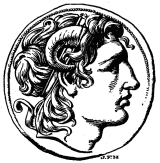
Alexander the Great (silver coin of Lysimachus, 321-281 B.C.)
Alexander had been in undisputed possession of the Persian empire for six years. He was now thirty-one. In those six years he had created very little. He had retained most of the organization of the Persian provinces, appointing fresh satraps or retaining the former ones; the roads, the ports, the organization of the empire was still as Cyrus, his greater predecessor, had left them; in Egypt he had merely replaced old provincial governors by new ones; in India he had defeated Porus, and then left him in power much as he found him, except that Porus was now called a satrap by the Greeks. Alexander had, it is true, planned out a number of towns, and some of them were to grow into great towns; seventeen Alexandrias he founded altogether;[199] but he had destroyed Tyre, and with Tyre the security of the sea routes which had hitherto been the chief westward outlet for Mesopotamia. Historians say that he Hellenized the east. But Babylonia and Egypt swarmed with Greeks before his time; he was not the cause, he was a part of the Hellenization. For a time the whole world, from the Adriatic to the Indus, was under one ruler; so far he had realized the dreams of Isocrates and Philip his father. But how far was he making this a permanent and enduring union? How far as yet was it anything more than a dazzling but transitory flourish of his own magnificent self?
He was making no great roads, setting up no sure sea communications. It is idle to accuse him of leaving education alone, because the idea that empires must be cemented by education was still foreign to human thought. But he was forming no group of statesmen about him; he was thinking of no successor; he was creating no tradition—nothing more than a personal legend. The idea that the world would have to go on after Alexander, engaged in any other employment than the discussion of his magnificence, seems to have been outside his mental range. He was still young, it is true, but well before Philip was one and thirty he had been thinking of the education of Alexander.
Was Alexander a statesman at all?
Some students of his career assure us that he was; that now at Susa he planned a mighty world empire, seeing it not simply as a Macedonian conquest of the world, but as a melting together of racial traditions. He did one thing, at any rate, that gives colour to this idea; he held a great marriage feast, in which he and ninety of his generals and friends were married to Persian brides. He himself married a daughter of Darius, though already he possessed an Asiatic wife in Roxana, the daughter of the king of Samarkand. This wholesale wedding was made a very splendid festival, and at the same time all of his Macedonian soldiers, to the number of several thousands, who had married Asiatic brides, were given wedding gifts. This has been called the Marriage of Europe and Asia; the two continents were to be joined, wrote Plutarch, “in lawful wedlock and by community of offspring.” And next he began to train recruits from Persia and the north, Parthians, Bactrians, and the like, in the distinctive disciplines of the phalanx and the cavalry. Was that also to assimilate Europe and Asia, or was it to make himself independent of his Macedonians? They thought the latter, at any rate, and mutinied, and it was with some difficulty that he brought them to a penitent mood and induced them to take part in a common feast with the Persians. The historians have made a long and eloquent speech for him on this occasion, but the gist of it was that he bade his Macedonians begone, and gave no sign of how he proposed they should get home out of Persia. After three days of dismay they submitted to him and begged his forgiveness.
Here is the matter for a very pretty discussion. Was Alexander really planning a racial fusion or had he just fallen in love with the pomp and divinity of an Oriental monarch, and wished to get rid of these Europeans to whom he was only a king-leader? The writers of his own time, and those who lived near to his time, lean very much to the latter alternative. They insist upon his immense vanity. They relate how he began to wear the robes and tiara of a Persian monarch. “At first only before the barbarians and privately, but afterwards he came to wear it in public when he sat for the dispatch of business.” And presently he demanded Oriental prostrations from his friends.
One thing seems to support the suggestion of great personal vanity in Alexander. His portrait was painted and sculptured frequently, and always he is represented as a beautiful youth, with wonderful locks flowing backward from a broad forehead. Previously most men had worn beards. But Alexander, enamoured of his own youthful loveliness, would not part with it; he remained a sham boy at thirty-two; he shaved his face, and so set a fashion in Greece and Italy that lasted many centuries.
The stories of violence and vanity in his closing years cluster thick upon his memory. He listened to tittle-tattle about Philotas, the son of Parmenio, one of his most trusted and faithful generals. Philotas, it was said, had boasted to some woman he was making love to that Alexander was a mere boy; that, but for such men as his father and himself, there would have been no conquest of Persia, and the like. Such assertions had a certain element of truth in them. The woman was brought to Alexander, who listened to her treacheries. Presently Philotas was accused of conspiracy, and, upon very insufficient evidence, tortured and executed. Then Alexander thought of Parmenio, whose other two sons had died for him in battle. He sent swift messengers to assassinate the old man before he could hear of his son’s death! Now Parmenio had been one of the most trusted of Philip’s generals; it was Parmenio who had led the Macedonian armies into Asia before the murder of Philip. There can be little doubt of the substantial truth of this story, nor about the execution of Callisthenes, the nephew of Aristotle, who refused Alexander divine honours, and “went about with as much pride as if he had demolished a tyranny, while the young men followed him as the only freeman among thousands.” Mixed with such incidents we have the very illuminating story of the drunken quarrel in which he killed Clitus. The monarch and his company had been drinking hard, and the drink had made the talk loud and free. There was much flattery of the “young god,” much detraction of Philip, at which Alexander had smiled with satisfaction.[200] Was he not the son of a god? This drunken self-complacency was more than the honest Macedonians could stand; it roused Clitus, his foster-brother, to a frenzy. Clitus reproached Alexander with his Median costume and praised Philip, there was a loud quarrel, and, to end it, Clitus was hustled out of the room by his friends. He was, however, in the obstinate phase of drunkenness, and he returned by another entrance. He was heard outside quoting Euripides “in a bold and disrespectful tone”:
“Are these your customs? Is it thus that Greece Rewards her combatants? Shall one man claim The trophies won by thousands?”
Whereupon Alexander snatched a spear from one of his guards and ran Clitus through the body as he lifted the curtain to come in....
One is forced to believe that this was the real atmosphere of the young conqueror’s life. Then the story of his frantic and cruel display of grief for Hephæstion can scarcely be all invention. If it is true, or in any part true, it displays a mind ill-balanced and altogether wrapped up in personal things, to whom empire was no more than opportunity for egoistic display, and all the resources of the world stuff for freaks of that sort of “generosity” which robs a thousand people to extort the admiration of one astounded recipient.
Hephæstion, being ill, was put upon a strict diet, but in the absence of his physician at the theatre he ate a roasted fowl and drank a flagon of iced wine, in consequence of which he died. Thereupon Alexander decided upon a display of grief. It was the grief of a lunatic. He had the physician crucified! He ordered every horse and mule in Persia to be shorn, and pulled down the battlements of the neighbouring cities. He prohibited all music in his camp for a long time, and, having taken certain villages of the Cusæans, he caused all the adults to be massacred, as a sacrifice to the manes of Hephæstion. Finally he set aside ten thousand talents (a talent = £240) for a tomb. For those days this was an enormous sum. None of which things did any real honour to Hephæstion, but they served to demonstrate to an awe-stricken world what a tremendous thing the sorrow of Alexander could be.
This last story and many such stories may be lies or distortions or exaggerations. But they have a vein in common. After a bout of hard drinking in Babylon a sudden fever came upon Alexander (323 B.C.), and he sickened and died. He was still only thirty-three years of age. Forthwith the world empire he had snatched at and held in his hands, as a child might snatch at and hold a precious vase, fell to the ground and was shattered to pieces.
Whatever appearance of a world-wide order may have gleamed upon men’s imaginations vanished at his death. The story becomes the story of a barbaric autocracy in confusion. Everywhere the provincial rulers set up for themselves. In the course of a few years the entire family of Alexander had been destroyed. Roxana, his barbarian wife, was prompt to murder, as a rival, the daughter of Darius. She herself presently bore Alexander a posthumous son, who was also called Alexander. He was murdered, with her, a few years later (311 B.C.). Hercules, the only other son of Alexander, was murdered also. So too was Aridæus, the weak-minded half-brother (see § 2). Plutarch gives a last glimpse of Olympias during a brief interval of power in Macedonia, accusing first this person and then that of poisoning her wonderful son. Many she killed in her fury. The bodies of some of his circle who had died after his death she caused to be dug up, but we do not know if any fresh light was shed upon his death by these disinterments. Finally Olympias was killed in Macedonia by the friends of those she had slain.
§ 6
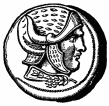
Tetradrachm with head of Seleucus I.
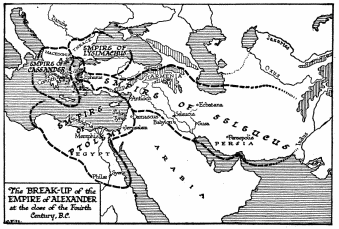
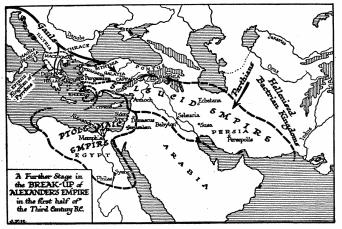
From this welter of crime there presently emerged three leading figures. Much of the old Persian empire, as far as the Indus eastward and almost to Lydia in the west, was held by one general Seleucus, who founded a dynasty, the Seleucid Dynasty; Macedonia fell to another Macedonian general, Antigonus; a third Macedonian, Ptolemy, secured Egypt, and making Alexandria his chief city, established a sufficient naval ascendancy to keep also Cyprus and most of the coast of Phœnicia and Asia Minor. The Ptolemaic and Seleucid empires lasted for a considerable time: the forms of government in Asia Minor and the Balkans were more unstable. Two maps will help the reader to a sense of the kaleidoscopic nature of the political boundaries of the third century B.C. Antigonus was defeated and killed at the battle of Ipsus (301), leaving Lysimachus, the governor of Thrace, and Cassander, of Macedonia and Greece, as equally transitory successors. Minor governors carved out smaller states. Meanwhile the barbarians swung down into the broken-up and enfeebled world of civilization from the west and from the east. From the west came the Gauls, a people closely related to the Kelts. They raided down through Macedonia and Greece to Delphi, and (227 B.C.) two sections of them crossed the Bosphorus into Asia Minor, being first employed as mercenaries and then setting up for themselves as independent plunderers; and after raiding almost to the Taurus, they settled in the old Phrygian land, holding the people about them to tribute. (These Gauls of Phrygia became the Galatians of St. Paul’s Epistle.) Armenia and the southern shores of the Black Sea became a confusion of changing rulers. Kings with Hellenistic ideas appeared in Cappadocia, in Pontus (the south shore of the Black Sea), in Bithynia, and in Pergamum. From the east the Scythians and the Parthians and Bactrians also drove southward.... For a time there were Greek-ruled Bactrian states becoming more and more Orientalized; in the second century B.C. Greek adventurers from Bactria raided down into North India and founded short-lived kingdoms there, the last eastward fling of the Greek; then gradually barbarism fell again like a curtain between the Western civilizations and India.[201]
§ 7
Amidst all these shattered fragments of the burst bubble of Hellenic empire one small state stands out and demands at least a brief section to itself, the kingdom of Pergamum. We hear first of this town as an independent centre during the struggle that ended in the battle of Ipsus. While the tide of the Gaulish invasion swirled and foamed to and fro about Asia Minor between the years 277 and 241, Pergamum for a time paid them tribute, but she retained her general independence, and at last, under Attalus I, refused her tribute and defeated them in two decisive battles. For more than a century thereafter (until 133 B.C.) Pergamum remained free, and was perhaps during that period the most highly civilized state in the world. On the hill of the Acropolis was reared a rich group of buildings, palaces, temples, a museum, and a library, rivals of those of Alexandria of which we shall presently tell, and almost the first in the world. Under the princes of Pergamum, Greek art blossomed afresh, and the reliefs of the altar of the temple of Zeus and the statues of the fighting and dying Gauls which were made there, are among the great artistic treasures of mankind.
In a little while, as we shall tell later, the influence of a new power began to be felt in the Eastern Mediterranean, the power of the Roman republic, friendly to Greece and to Greek civilization; and in this power the Hellenic communities of Pergamum and Rhodes found a natural and useful ally and supporter against the Galatians and against the Orientalized Seleucid empire. We shall relate how at last the Roman power came into Asia, how it defeated the Seleucid empire at the battle of Magnesia (190 B.C.), and drove it out of Asia Minor and beyond the Taurus mountains, and how finally in 133 B.C. Attalus III, the last king of Pergamum, bowing to his sense of an inevitable destiny, made the Roman republic the heir to his kingdom, which became then the Roman province of “Asia.”
§ 8
Nearly all historians are disposed to regard the career of Alexander the Great as marking an epoch in human affairs. It drew together all the known world, excepting only the western Mediterranean, into one drama. But the opinions men have formed of Alexander himself vary enormously. They fall, most of them, into two main schools. One type of scholar is fascinated by the youth and splendour of this young man. These Alexander-worshippers seem disposed to take him at his own valuation, to condone every crime and folly either as the mere ebullience of a rich nature or as the bitter necessity to some gigantic scheme, and to regard his life as framed upon a design, a scheme of statesmanship, such as all the wider knowledge and wider ideas of these later times barely suffice to bring into the scope of our understanding. On the other hand, there are those who see him only as a wrecker of the slowly maturing possibilities of a free and tranquil Hellenized world.
Before we ascribe to Alexander or to his father Philip schemes of world policy such as a twentieth-century historian-philosopher might approve, we shall do well to consider very carefully the utmost range of knowledge and thought that was possible in those days. The world of Plato, Isocrates, and Aristotle had practically no historical perspective at all; there had not been such a thing as history in the world, history, that is, as distinguished from mere priestly chronicles, until the last couple of centuries. Even highly educated men had the most circumscribed ideas of geography and foreign countries. For most men the world was still flat and limitless. The only systematic political philosophy was based on the experiences of minute city states, and took no thought of empires. Nobody knew anything of the origins of civilization.
No one had speculated upon economics.[202] No one had worked out the reaction of one social class upon another. We are too apt to consider the career of Alexander as the crown of some process that had long been afoot; as the climax of a crescendo. In a sense, no doubt, it was that; but much more true is it that it was not so much an end as a beginning; it was the first revelation to the human imagination of the oneness of human affairs. The utmost reach of the thought of Greece before his time was of a Persian empire Hellenized, a predominance in the world of Macedonians and Greeks. But before Alexander was dead, and much more after he was dead and there had been time to think him over, the conception of a world law and organization was a practicable and assimilable idea for the minds of men.
For some generations Alexander the Great was for mankind the symbol and embodiment of world order and world dominion. He became a fabulous being. His head, adorned with the divine symbols of the demi-god Hercules or the god Ammon Ra, appears on the coins of such among his successors as could claim to be his heirs. Then the idea of world dominion was taken up by another great people, a people who for some centuries exhibited considerable political genius, the Romans; and the figure of another conspicuous adventurer, Cæsar, eclipsed for the western half of the old world the figure of Alexander.
So by the beginning of the third century B.C. we find already arisen in the Western civilization of the old world three of the great structural ideas that rule the mind of contemporary mankind. We have already traced the escape of writing and knowledge from the secrets and mysteries and initiations of the old-world priesthoods, and the development of the idea of a universal knowledge, of a universally understandable and communicable history and philosophy. We have taken the figures of Herodotus and Aristotle as typical exponents of this first great idea, the idea of science—using the word science in its widest and properest sense, to include history and signify a clear vision of man in relation to the things about him. We have traced also the generalization of religion among the Babylonians, Jews, and other Semitic peoples, from the dark worship in temples and consecrated places of some local or tribal god to the open service of one universal God of Righteousness, whose temple is the whole world. And now we have traced also the first germination of the idea of a world polity. The rest of the history of mankind is very largely the history of those three ideas of science, of a universal righteousness, and of a human commonweal, spreading out from the minds of the rare and exceptional persons and peoples in which they first originated, into the general consciousness of the race, and giving first a new colour, then a new spirit, and then a new direction to human affairs.
XXV SCIENCE AND RELIGION AT ALEXANDRIA[203]
§ 1. The Science of Alexandria. § 2. Philosophy of Alexandria. § 3. Alexandria as a Factory of Religions.
§ 1
ONE of the most prosperous fragments of the brief world empire of Alexander the Great was Egypt, which fell to the share of the Ptolemy whose name we have already noted as one of the associates of Alexander whom King Philip had banished. The country was at a secure distance from plundering Gaul or Parthian, and the destruction of Tyre and the Phœnician navy and the creation of Alexandria gave Egypt a temporary naval ascendancy in the Eastern Mediterranean. Alexandria grew to proportions that rivalled Carthage; eastward she had an overseas trade through the Red Sea with Arabia and India; and westward her traffic competed with the Carthaginian. In the Macedonian and Greek governors of the Ptolemies, the Egyptians found a government more sympathetic and tolerable than any they had ever known since they ceased to be a self-governing empire. Indeed it is rather that Egypt conquered and annexed the Ptolemies politically, than that the Macedonians ruled Egypt.
There was a return to Egyptian political ideas, rather than any attempt to Hellenize the government of the country. Ptolemy became Pharaoh, the god king, and his administration continued the ancient tradition of Pepi, Thotmes, Rameses, and Necho. Alexandria, however, for her town affairs, and subject to the divine overlordship of Pharaoh, had a constitution of the Greek city type. And the language of the court and administration was Attic Greek. Greek became so much the general language of educated people in Egypt that the Jewish community there found it necessary to translate their Bible into the Greek language; many men of their own people being no longer able to understand Hebrew, Attic Greek for some centuries before and after Christ was the language of all educated men from the Adriatic to the Persian Gulf.
Of all Alexander’s group of young men, Ptolemy seems to have done most to carry out those ideas of a systematic organization of knowledge with which Aristotle had no doubt familiarized the court of Philip of Macedon. Ptolemy was a man of very extraordinary intellectual gifts, at once creative and modest, with a certain understandable cynicism towards the strain of Olympias in the mind of Alexander. His contemporary history of Alexander’s campaigns has perished; but it was a source to which all the surviving accounts are deeply indebted.
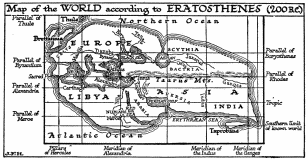
The Museum he set up in Alexandria was in effect the first university in the world. As its name implies, it was dedicated to the service of the Muses, which was also the case with the Peripatetic school at Athens. It was, however, a religious body only in form, in order to meet the legal difficulties of endowment in a world that had never foreseen such a thing as a secular intellectual process. It was essentially a college of learned men engaged chiefly in research and record, but also to a certain extent in teaching. At the outset, and for two or three generations, the Museum at Alexandria presented such a scientific constellation as even Athens at its best could not rival. Particularly sound and good was the mathematical and geographical work. The names of Euclid, familiar to every schoolboy, Eratosthenes, who measured the size of the earth and came within fifty miles of the true diameter, Apollonius, who wrote on conic sections, stand out. Hipparchus made the first attempt to catalogue and map the stars with a view to checking any changes that might be occurring in the heavens. Hero devised the first steam engine. Archimedes came to Alexandria to study, and remained a frequent correspondent of the Museum. The medical school of Alexandria was equally famous. For the first time in the world’s history a standard of professional knowledge was set up. Herophilus, the greatest of the Alexandrian anatomists, is said to have conducted vivisections upon condemned criminals.[204] Other teachers, in opposition to Herophilus, condemned the study of anatomy and developed the science of drugs. But this scientific blaze at Alexandria did not endure altogether for more than a century. The organization of the Museum was not planned to ensure its mental continuity. It was a “royal” college; its professors and fellows (as we may call them) were appointed and paid by Pharaoh. “The republican character of the private corporations called the schools or academies at Athens was far more stable and independent.”[205] Royal patronage was all very well so long as Pharaoh was Ptolemy I, or Ptolemy II, but the strain degenerated, and the long tradition of Egyptian priestcraft presently swallowed up the Ptolemies—and destroyed the Aristotelian mentality of the Museum altogether. The Museum had not existed for a hundred years before its scientific energy was extinct.
Side by side with the Museum, Ptolemy I created a more enduring monument to himself in the great library. This was a combination of state library and state publishing upon a scale hitherto unheard of. It was to be altogether encyclopædic. If any stranger brought an unknown book to Egypt, he had to have it copied for the collection, and a considerable staff of copyists was engaged continually in making duplicates of all the more popular and necessary works. The library, like a university press, had an outward trade. It was a book-selling affair. Under Callimachus, the head of the library during the tune of Ptolemy II and III, the arrangement and cataloguing of the accumulations was systematically undertaken. In those days, it must be remembered, books were not in pages, but rolled like the music-rolls of the modern piano-player, and in order to refer to any particular passage, a reader had to roll back or roll forward very tediously, a process which wore out books and readers together. One thinks at once of a simple and obvious little machine by which such a roll could have been quickly wound to and fro for reference, but nothing of the sort seems to have been used. Every time a roll was read it was handled by two perspiring hands. It was to minimize the waste of time and trouble that Callimachus broke up long works, such as the History of Herodotus, into “books” or volumes, as we should call them, each upon a separate roll. The library of Alexandria drew a far vaster crowd of students than the teachers of the Museum. The lodging and catering for these visitors from all parts of the world became a considerable business interest for the Alexandrian population.

It is curious to note how slowly the mechanism of the intellectual life improves. Contrast the ordinary library facilities of a middle-class English home, such as the present writer is now working in, with the inconveniences and deficiencies of the equipment of an Alexandrian writer, and one realizes the enormous waste of time, physical exertion, and attention that went on through all the centuries during which that library flourished. Before the present writer lie half a dozen books, and there are good indices to three of them. He can pick up any one of these six books, refer quickly to a statement, verify a quotation, and go on writing. Contrast with that the tedious unfolding of a rolled manuscript. Close at hand are two encyclopædias, a dictionary, an atlas of the world, a biographical dictionary, and other books of reference. They have no marginal indices, it is true; but that perhaps is asking for too much at present. There were no such resources in the world in 300 B.C. Alexandria had still to produce the first grammar and the first dictionary. This present book is being written in manuscript; it is then taken by a typist and typewritten very accurately. It can then, with the utmost convenience, be read over, corrected amply, rearranged freely, retyped, and recorrected. The Alexandrian author had to dictate or recopy every word he wrote. Before he could turn back to what he had written previously, he had to dry his last words by waving them in the air or pouring sand over them; he had not even blotting-paper. Whatever an author wrote had to be recopied again and again before it could reach any considerable circle of readers, and every copyist introduced some new error.[206] Whenever a need for maps or diagrams arose, there were fresh difficulties. Such a science as anatomy, for example, depending as it does upon accurate drawing, must have been enormously hampered by the natural limitations of the copyist. The transmission of geographical fact again must have been almost incredibly tedious. No doubt a day will come when a private library and writing-desk of the year A.D. 1919 will seem quaintly clumsy and difficult; but, measured by the standards of Alexandria, they are astonishingly quick, efficient, and economical of nervous and mental energy.
No attempt seems to have been made at Alexandria to print anything at all. That strikes one at first as a very remarkable fact. The world was crying out for books, and not simply for books. There was an urgent public need for notices, proclamations, and the like. Yet there is nothing in the history of the Western civilizations that one can call printing until the fifteenth century A.D. It is not as though printing was a recondite art or dependent upon any precedent and preliminary discoveries. Printing is the most obvious of dodges. In principle it has always been known. As we have already stated, there is ground for supposing that the Palæolithic men of the Magdalenian period may have printed designs on their leather garments. The “seals” of ancient Sumeria again were printing devices. Coins are print. Illiterate persons in all ages have used wooden or metal stamps for their signatures; William I, the Norman Conqueror of England, for example, used such a stamp with ink to sign documents. In China the classics were being printed by the second century A.D. Yet either because of a complex of small difficulties about ink or papyrus or the form of books, or because of some protective resistance on the part of the owners of the slave copyists, or because the script was too swift and easy to set men thinking how to write it still more easily, as the Chinese character or the Gothic letters did, or because of a gap in the social system between men of thought and knowledge and men of technical skill, printing was not used—not even used for the exact reproduction of illustrations.
The chief reason for this failure to develop printing systematically lies, no doubt, in the fact that there was no abundant supply of printable material of a uniform texture and convenient form. The supply of papyrus was strictly limited, strip had to be fastened to strip, and there was no standard size of sheet. Paper had yet to come from China to release the mind of Europe. Had there been presses, they would have had to stand idle while the papyrus rolls were slowly made. But this explanation does not account for the failure to use block printing in the case of illustrations and diagrams.
These limitations enable us to understand why it was that Alexandria could at once achieve the most extraordinary intellectual triumphs—for such a feat as that of Eratosthenes, for instance, having regard to his poverty of apparatus, is sufficient to put him on a level with Newton or Pasteur—and yet have little or no effect upon the course of politics or the lives and thoughts of people round about her. Her Museum and library were a centre of light, but it was light in a dark lantern hidden from the general world. There were no means of carrying its results even to sympathetic men abroad except by tedious letter-writing. There was no possibility of communicating what was known there to the general body of men. Students had to come at great cost to themselves to this crowded centre because there was no other way of gathering even scraps of knowledge. At Athens and Alexandria there were bookstalls where manuscript note-books of variable quality could be bought at reasonable prices, but any extension of education to larger classes and other centres would have produced at once a restrictive shortage of papyrus. Education did not reach into the masses at all; to become more than superficially educated one had to abandon the ordinary life of the times and come for long years to live a hovering existence in the neighbourhood of ill-equipped and overworked sages. Learning was not indeed so complete a withdrawal from ordinary life as initiation into a priesthood, but it was still something in that nature.
And very speedily that feeling of freedom, that openness and directness of statement which is the vital air of the true intellectual life, faded out of Alexandria. From the first the patronage even of Ptolemy I set a limit to political discussion. Presently the dissensions of the schools let in the superstitions and prejudices of the city mob to scholastic affairs.
Wisdom passed away from Alexandria and left pedantry behind. For the use of books was substituted the worship of books. Very speedily the learned became a specialized queer class with unpleasant characteristics of its own. The Museum had not existed for half a dozen generations before Alexandria was familiar with a new type of human being; shy, eccentric, unpractical, incapable of essentials, strangely fierce upon trivialities of literary detail, as bitterly jealous of the colleague within as of the unlearned without, the bent Scholarly Man. He was as intolerant as a priest, though he had no altar; as obscurantist as a magician, though he had no cave. For him no method of copying was sufficiently tedious and no rare book sufficiently inaccessible. He was a sort of by-product of the intellectual process of mankind. For many precious generations the new-lit fires of the human intelligence were to be seriously banked down by this by-product.
Right thinking is necessarily an open process, and the only science and history of full value to men consist of what is generally and clearly known; this is surely a platitude, but we have still to discover how to preserve our centres of philosophy and research from the caking and darkening accumulations of narrow and dingy-spirited specialists. We have still to ensure that a man of learning shall be none the less a man of affairs, and that all that can be thought and known is kept plainly, honestly, and easily available to the ordinary men and women who are the substance of mankind.
§ 2
At first the mental activities of Alexandria centred upon the Museum, and were mainly scientific. Philosophy, which in a more vigorous age had been a doctrine of power over self and the material world, without abandoning these pretensions, became in reality a doctrine of secret consolation. The stimulant changed into an opiate. The philosopher let the world, as the vulgar say, rip, the world of which he was a part, and consoled himself by saying in very beautiful and elaborate forms that the world was illusion and that there was in him something quintessential and sublime, outside and above the world. Athens,[207] politically insignificant, but still a great and crowded mart throughout the fourth century, decaying almost imperceptibly so far as outer seeming went, and treated with a strange respect that was half contempt by all the warring powers and adventurers of the world, was the fitting centre of such philosophical teaching. It was quite a couple of centuries before the schools of Alexandria became as important in philosophical discussion.
But of Philo the Jew in the first century A.D., and of Plotinus in the third, interesting as the thought and influence of these men were, the scale of this outline will not permit us to treat.
§ 3
If Alexandria was late to develop a distinctive philosophy, she was early prominent as a great factory and exchange of religious ideas.
The Museum and Library represented only one of the three sides of the triple city of Alexandria. They represented the Aristotelian, the Hellenic, and Macedonian element. But Ptolemy I had brought together two other factors to this strange centre. First there was a great number of Jews, brought partly from Palestine, but largely also from those settlements in Egypt which had never returned to Jerusalem; these latter were the Jews of the Diaspora or Dispersion, a race of Jews who, as we have already noted in Chapter XXI, had not shared the Babylonian Captivity, but who were nevertheless in possession of the Bible and in close correspondence with their co-religionists throughout the world. These Jews populated so great a quarter of Alexandria that the town became the largest Jewish city in the world, with far more Jews in it than there were in Jerusalem. We have already noted that they had found it necessary to translate their scriptures into Greek. And, finally, there was a great population of native Egyptians, also for the most part speaking Greek, but with the superstitious temperament of the dark whites and with the vast tradition of forty centuries of temple religion and temple sacrifices at the back of their minds. In Alexandria three types of mind and spirit met, the three main types of the white race, the clear-headed criticism of the Aryan Greek, the moral fervour and monotheism of the Semitic Jew, and the deep Mediterranean tradition of mysteries and sacrifices that we have already seen at work in the secret cults and occult practices of Greece, ideas which in Hamitic Egypt ruled proudly in great temples in the open light of day.
These three were the permanent elements of the Alexandrian blend. But in the seaport and markets mingled men of every known race, comparing their religious ideas and customs. It is even related that in the third century B.C. Buddhist missionaries came from the court of King Asoka in India. Aristotle remarks in his Politics that the religious beliefs of men are apt to borrow their form from political institutions, “men assimilate the lives no less than the bodily forms of the gods to their own,” and this age of Greek-speaking great empires under autocratic monarchs was bearing hardly upon those merely local celebrities, the old tribal and city deities. Men were requiring deities with an outlook at least as wide as the empires, and except where the interests of powerful priesthoods stood in the way, a curious process of assimilation of gods was going on. Men found that though there were many gods, they were all very much alike. Where there had been many gods, men came to think there must be really only one god under a diversity of names. He had been everywhere—under an alias. The Roman Jupiter, the Greek Zeus, the Egyptian Ammon, the putative father of Alexander and the old antagonist of Amenophis IV., the Babylonian Bel-Marduk, were all sufficiently similar to be identified.
“Father of all in every age, in every clime adored By saint, by savage and by sage, Jehovah, Jove or Lord.”
Where there were distinct differences, the difficulty was met by saying that these were different aspects of the same god. Bel-Marduk, however, was now a very decadent god indeed, who hardly survived as a pseudonym; Assur, Dagon, and the like, poor old gods of fallen nations, had long since passed out of memory, and did not come into the amalgamation. Osiris, a god popular with the Egyptian commonalty, was already identified with Apis, the sacred bull in the temple of Memphis, and somewhat confused with Ammon. Under the name of Serapis he became the great god of Hellenic Alexandria.[208] He was Jupiter-Serapis. The Egyptian cow goddess, Hathor or Isis, was also represented now in human guise as the wife of Osiris, to whom she bore the infant Horus, who grew up to be Osiris again. These bald statements sound strange, no doubt, to a modern mind, but these identifications and mixing up of one god with another are very illustrative of the struggle the quickening human intelligence was making to cling still to religion and its emotional bonds and fellowship, while making its gods more reasonable and universal.
This fusing of one god with another is called theocrasia, and nowhere was it more vigorously going on than in Alexandria. Only two peoples resisted it in this period: the Jews, who already had their faith in the One God of Heaven and Earth, Jehovah, and the Persians, who had a monotheistic sun worship.
It was Ptolemy I who set up not only the Museum in Alexandria, but the Serapeum, devoted to the worship of a trinity of gods which represented the result of a process of theocrasia applied more particularly to the gods of Greece and Egypt.
Isis and Horus

This trinity consisted of the god Serapis (= Osiris + Apis), the goddess Isis (= Hathor, the cow-moon goddess), and the child-god Horus. In one way or another almost every other god was identified with one or other of these three aspects of the one God, even the sun god Mithras of the Persians. And they were each other; they were three, but they were also one. They were worshipped with great fervour, and the jangling of a peculiar instrument, the sistrum, a frame set with bells and used rather after the fashion of the tambourine in the proceedings of the modern Salvation Army, was a distinctive accessory to the ceremonies. And now for the first time we find the idea of immortality becoming the central idea of a religion that extended beyond Egypt. Neither the early Aryans nor the early Semites seem to have troubled very much about immortality, it has affected the Mongolian mind very little, but the continuation of the individual life after death had been from the earliest times an intense pre-occupation of the Egyptians. It played now a large part in the worship of Serapis. In the devotional literature of his cult he is spoken of as “the saviour and leader of souls, leading souls to the light and receiving them again.” It is stated that “he raises the dead, he shows forth the longed-for light of the sun to those who see, whose holy tombs contain multitudes of sacred books”; and again, “we never can escape him, he will save us, after death we shall still be the care of his providence.”[209]
The ceremonial burning of candles and the offering of ex-votos, that is to say of small models of parts of the human body in need of succour, was a part of the worship of the Serapeum. Isis attracted many devotees, who vowed their lives to her. Her images stood in the temple, crowned as the Queen of Heaven and bearing the infant Horus in her arms. The candles flared and guttered before her, and the wax ex-votos hung about the shrine. The novice was put through a long and careful preparation, he took vows of celibacy, and when he was initiated his head was shaved and he was clad in a linen garment....
Serapis
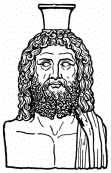
In this worship of Serapis, which spread very widely throughout the civilized world in the third and second centuries B.C., we see the most remarkable anticipations of usages and forms of expression that were destined to dominate the European world throughout the Christian era. The essential idea, the living spirit, of Christianity was, as we shall presently show, a new thing in the history of the mind and will of man; but the garments of ritual and symbol and formula that Christianity has worn, and still in many countries wears to this day, were certainly woven in the cult and temples of Jupiter, Serapis, and Isis that spread now from Alexandria throughout the civilized world in the age of theocrasia in the second and first centuries before Christ.[210]
XXVI THE RISE AND SPREAD OF BUDDHISM[211]
§ 1. The Story of Gautama. § 2. Teaching and Legend in Conflict. § 3. The Gospel of Gautama Buddha. § 4. Buddhism and Asoka.[212] § 5. Two Great Chinese Teachers. § 6. The Corruptions of Buddhism. § 7. The Present Range of Buddhism.
§ 1
IT is interesting to turn from the mental and moral activities of Athens and Alexandria, and the growth of human ideas in the Mediterranean world, to the almost entirely separate intellectual life of India. Here was a civilization which from the first seems to have grown up upon its own roots and with a character of its own. It was cut off from the civilizations to the west and to the east by vast mountain barriers and desert regions. The Aryan tribes who had come down into the peninsula soon lost touch with their kindred to the west and north, and developed upon lines of their own. This was more particularly the case with those who had passed on into the Ganges country and beyond. They found a civilization already scattered over India, the Dravidian civilization. This had arisen independently, just as the Sumerian, Cretan, and Egyptian civilizations seem to have arisen, out of that widespread development of the Neolithic culture, the heliolithic culture, whose characteristics we have already described. They revived and changed this Dravidian civilization much as the Greeks did the Ægean or the Semites the Sumerian.
These Indian Aryans were living under different conditions from those that prevailed to the north-west. They were living in a warmer climate, in which a diet of beef and fermented liquor was destructive; they were forced, therefore, to a generally vegetarian dietary, and the prolific soil, almost unasked, gave them all the food they needed. There was no further reason for them to wander; the crops and seasons were trustworthy. They wanted little clothing or housing. They wanted so little that trade was undeveloped. There was still land for every one who desired to cultivate a patch—and a little patch sufficed. Their political life was simple and comparatively secure; no great conquering powers had arisen as yet in India, and her natural barriers sufficed to stop the early imperialisms to the west of her and to the east. Thousands of comparatively pacific little village republics and chieftainships were spread over the land. There was no sea life, there were no pirate raiders, no strange traders. One might write a history of India coming down to four hundred years ago and hardly mention the sea.
The history of India for many centuries had been happier, less fierce, and more dreamlike than any other history. The noblemen, the rajahs, hunted; life was largely made up of love stories. Here and there a maharajah arose amidst the rajahs and built a city, caught and tamed many elephants, slew many tigers, and left a tradition of his splendour and his wonderful processions.
It was somewhen between 500 and 600 B.C., when Crœsus was flourishing in Lydia and Cyrus was preparing to snatch Babylon from Nabonidus, that the founder of Buddhism was born in India. He was born in a small republican tribal community in the north of Bengal under the Himalayas, in what is now overgrown jungle country on the borders of Nepal. The little state was ruled by a family, the Sakya clan, of which this man, Siddhattha Gautama, was a member. Siddhattha was his personal name, like Caius or John; Gautama, or Gôtama, his family name, like Cæsar or Smith; Sakya his clan name, like Julius. The institution of caste was not yet fully established in India, and the Brahmins, though they were privileged and influential, had not yet struggled to the head of the system; but there were already strongly marked class distinctions and a practically impermeable partition between the noble Aryans and the darker common people. Gautama belonged to the former race. His teaching, we may note, was called the Aryan Path, the Aryan Truth.
It is only within the last half-century that the increasing study of the Pali language, in which most of the original sources were written, has given the world a real knowledge of the life and actual thought of Gautama. Previously his story was overlaid by monstrous accumulations of legend, and his teaching violently misconceived. But now we have a very human and understandable account of him.
He was a good-looking, capable young man of fortune, and until he was twenty-nine he lived the ordinary aristocratic life of his time. It was not a very satisfying life intellectually. There was no literature except the oral tradition of the Vedas, and that was chiefly monopolized by the Brahmins; there was even less knowledge. The world was bound by the snowy Himalayas to the north and spread indefinitely to the south. The city of Benares, which had a king, was about a hundred miles away. The chief amusements were hunting and love-making. All the good that life seemed to offer, Gautama enjoyed. He was married at nineteen to a beautiful cousin. For some years they remained childless. He hunted and played and went about in his sunny world of gardens and groves and irrigated rice-fields. And it was amidst this life that a great discontent fell upon him. It was the unhappiness of a fine brain that seeks employment. He lived amidst plenty and beauty, he passed from gratification to gratification, and his soul was not satisfied. It was as if he heard the destinies of the race calling to him. He felt that the existence he was leading was not the reality of life, but a holiday—a holiday that had gone on too long.
While he was in this mood he saw four things that served to point his thoughts. He was driving on some excursion of pleasure, when he came upon a man dreadfully broken down by age. The poor bent, enfeebled creature struck his imagination. “Such is the way of life,” said Channa, his charioteer, and “to that we must all come.” While this was yet in his mind he chanced upon a man suffering horribly from some loathsome disease. “Such is the way of life,” said Channa. The third vision was of an unburied body, swollen, eyeless, mauled by passing birds and beasts and altogether terrible. “That is the way of life,” said Channa.
The sense of disease and mortality, the insecurity and the unsatisfactoriness of all happiness, descended upon the mind of Gautama. And then he and Channa saw one of those wandering ascetics who already existed in great numbers in India. These men lived under severe rules, spending much time in meditation and in religious discussion. For many men before Gautama in that land of uneventful sunshine had found life distressing and mysterious. These ascetics were all supposed to be seeking some deeper reality in life, and a passionate desire to do likewise took possession of Gautama.
He was meditating upon this project, says the story, when the news was brought to him that his wife had been delivered of his first-born son. “This is another tie to break,” said Gautama.
He returned to the village amidst the rejoicings of his fellow clansmen. There was a great feast and a Nautch dance to celebrate the birth of this new tie, and in the night Gautama awoke in a great agony of spirit, “like a man who is told that his house is on fire.” In the ante-room the dancing girls were lying in strips of darkness and moonlight. He called Channa, and told him to prepare his horse. Then he went softly to the threshold of his wife’s chamber, and saw her by the light of a little oil lamp, sleeping sweetly, surrounded by flowers, with his infant son in her arm. He felt a great craving to take up the child in one first and last embrace before he departed, but the fear of waking his wife prevented him, and at last he turned away and went out into the bright Indian moonshine to Channa waiting with the horses, and mounted and stole away.
As he rode through the night with Channa, it seemed to him that Mara, the Tempter of Mankind, filled the sky and disputed with him. “Return,” said Mara, “and be a king, and I will make you the greatest of kings. Go on, and you will fail. Never will I cease to dog your footsteps. Lust or malice or anger will betray you at last in some unwary moment; sooner or later you will be mine.”
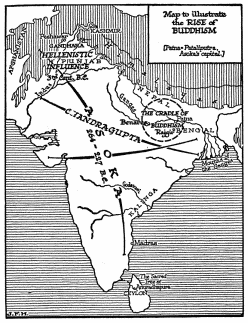
Very far they rode that night, and in the morning he stopped outside the lands of his clan, and dismounted beside a sandy river. There he cut off his flowing locks with his sword, removed all his ornaments, and sent them and his horse and sword back to his house by Channa. Then going on he presently met a ragged man and exchanged clothes with him, and so having divested himself of all worldly entanglements, he was free to pursue his search after wisdom. He made his way southward to a resort of hermits and teachers in a hilly spur running into Bengal northward from the Vindhya Mountains, close to the town of Rajgir. There a number of wise men lived in a warren of caves, going into the town for their simple supplies and imparting their knowledge by word of mouth to such as cared to come to them.
This instruction must have been very much in the style of the Socratic discussions that were going on in Athens a couple of centuries later. Gautama became versed in all the metaphysics of his age. But his acute intelligence was dissatisfied with the solutions offered him.
The Indian mind has always been disposed to believe that power and knowledge may be obtained by extreme asceticism, by fasting, sleeplessness, and self-torment, and these ideas Gautama now put to the test. He betook himself with five disciple companions to the jungle in a gorge in the Vindhya Mountains, and there he gave himself up to fasting and terrible penances. His fame spread, “like the sound of a great bell hung in the canopy of the skies.”[213] But it brought him no sense of truth achieved. One day he was walking up and down, trying to think in spite of his enfeebled state. Suddenly he staggered and fell unconscious. When he recovered, the preposterousness of these semi-magic ways of attempting wisdom was plain to him.
He amazed and horrified his five companions by demanding ordinary food and refusing to continue his self-mortifications. He had realized that whatever truth a man may reach is reached best by a nourished brain in a healthy body. Such a conception was absolutely foreign to the ideas of the land and age. His disciples deserted him, and went off in a melancholy state to Benares. The boom of the great bell ceased. Gautama the wonderful had fallen.
For a time Gautama wandered alone, the loneliest figure in history, battling for light.
When the mind grapples with a great and intricate problem, it makes its advances, it secures its positions step by step, with but little realization of the gains it has made, until suddenly, with an effect of abrupt illumination, it realizes its victory. So it would seem it happened to Gautama. He had seated himself under a great tree by the side of a river to eat, when this sense of clear vision came to him. It seemed to him that he saw life plain. He is said to have sat all day and all night in profound thought, and then he rose up to impart his vision to the world.
§ 2
Such is the plain story of Gautama as we gather it from a comparison of early writings. But common men must have their cheap marvels and wonders.
It is nothing to them that this little planet should at last produce upon its surface a man thinking of the past and the future and the essential nature of existence. And so we must have this sort of thing by some worthy Pali scribe, making the most of it:
“When the conflict began between the Saviour of the World and the Prince of Evil a thousand appalling meteors fell.... Rivers flowed back towards their sources; peaks and lofty mountains where countless trees had grown for ages rolled crumbling to the earth.... the sun enveloped itself in awful darkness, and a host of headless spirits filled the air.”[214]
Of which phenomena history has preserved no authentication. Instead we have only the figure of a lonely man walking towards Benares.
Extraordinary attention has been given to the tree under which Gautama had this sense of mental clarity. It was a tree of the fig genus, and from the first it was treated with peculiar veneration. It was called the Bo Tree. It has long since perished, but close at hand lives another great tree which may be its descendant, and in Ceylon there grows to this day a tree, the oldest historical tree in the world, which we know certainly to have been planted as a cutting from the Bo Tree in the year 245 B.C. From that time to this it has been carefully tended and watered; its great branches are supported by pillars, and the earth has been terraced up about it so that it has been able to put out fresh roots continually. It helps us to realize the shortness of all human history to see so many generations spanned by the endurance of one single tree. Gautama’s disciples unhappily have cared more for the preservation of his tree than of his thought, which from the first they misconceived and distorted.
At Benares Gautama sought out his five pupils, who were still leading the ascetic life. There is an account of their hesitation to receive him when they saw him approaching. He was a backslider. But there was some power of personality in him that prevailed over their coldness, and he made them listen to his new convictions. For five days the discussion was carried on. When he had at last convinced them that he was now enlightened, they hailed him as the Buddha. There was already in those days a belief in India that at long intervals Wisdom returned to the earth and was revealed to mankind through a chosen person known as the Buddha. According to Indian belief there have been many such Buddhas; Gautama Buddha is only the latest one of a series. But it is doubtful if he himself accepted that title or recognized that theory. In his discourses he never called himself the Buddha.
He and his recovered disciples then formed a sort of Academy in the Deer Park at Benares. They made themselves huts, and accumulated other followers to the number of threescore or more. In the rainy season they remained in discourse at this settlement, and during the dry weather they dispersed about the country, each giving his version of the new teachings. All their teaching was done, it would seem, by word of mouth. There was probably no writing yet in India at all. We must remember that in the time of Buddha it is doubtful if even the Iliad had been committed to writing. Probably the Mediterranean alphabet, which is the basis of most Indian scripts, had not yet reached India. The master, therefore, worked out and composed pithy and brief verses, aphorisms, and lists of “points,” and these were expanded in the discourse of his disciples. It greatly helped them to have these points and aphorisms numbered. The modern mind is apt to be impatient of the tendency of Indian thought to a numerical statement of things, the Eightfold Path, the Four Truths, and so on, but this enumeration was a mnemonic necessity in an undocumented world.
§ 3
The fundamental teaching of Gautama, as it is now being made plain to us by the study of original sources, is clear and simple and in the closest harmony with modern ideas. It is beyond all dispute the achievement of one of the most penetrating intelligences the world has ever known.
We have what are almost certainly the authentic heads of his discourse to the five disciples which embodies his essential doctrine. All the miseries and discontents of life he traces to insatiable selfishness. Suffering, he teaches, is due to the craving individuality, to the torment of greedy desire. Until a man has overcome every sort of personal craving his life is trouble and his end sorrow. There are three principal forms the craving of life takes, and all are evil. The first is the desire to gratify the senses, sensuousness. The second is the desire for personal immortality. The third is the desire for prosperity, worldliness. All these must be overcome—that is to say, a man must no longer be living for himself—before life can become serene. But when they are indeed overcome and no longer rule a man’s life, when the first personal pronoun has vanished from his private thoughts, then he has reached the higher wisdom, Nirvana, serenity of soul. For Nirvana does not mean, as many people wrongly believe, extinction, but the extinction of the futile personal aims that necessarily make life base or pitiful or dreadful.
Now here, surely, we have the completest analysis of the problem of the soul’s peace. Every religion that is worth the name, every philosophy, warns us to lose ourselves in something greater than ourselves. “Whosoever would save his life, shall lose it;” there is exactly the same lesson.
The teaching of history, as we are unfolding it in this book, is strictly in accordance with this teaching of Buddha. There is, as we are seeing, no social order, no security, no peace or happiness, no righteous leadership or kingship, unless men lose themselves in something greater than themselves. The study of biological progress again reveals exactly the same process—the merger of the narrow globe of the individual experience in a wider being (compare what has been said in Chaps. XII and XVIII). To forget oneself in greater interests is to escape from a prison.
The self-abnegation must be complete. From the point of view of Gautama, that dread of death, that greed for an endless continuation of his mean little individual life which drove the Egyptian and those who learnt from him with propitiations and charms into the temples, was as mortal and ugly and evil a thing as lust or avarice or hate. The religion of Gautama is flatly opposite to the “immortality” religions. And his teaching is set like flint against asceticism, as a mere attempt to win personal power by personal pains.
But when we come to the rule of life, the Aryan Path, by which we are to escape from the threefold base cravings that dishonour human life, then the teaching is not so clear. It is not so clear for one very manifest reason, Gautama had no knowledge nor vision of history; he had no clear sense of the vast and many-sided adventure of life opening out in space and time. His mind was confined within the ideas of his age and people, and their minds were shaped into notions of perpetual recurrence, of world following world and of Buddha following Buddha, a stagnant circling of the universe. The idea of mankind as a great Brotherhood pursuing an endless destiny under the God of Righteousness, the idea that was already dawning upon the Semitic consciousness in Babylon at this time, did not exist in his world. Yet his account of the Eightfold Path is, nevertheless, within these limitations, profoundly wise.