BOOK IV JUDEA, GREECE, AND INDIA (continued 4)
Reading edition
Let us briefly recapitulate the eight elements of the Aryan Path. First, Right Views; Gautama placed the stern examination of views and ideas, the insistence upon truth as the first research of his followers. There was to be no clinging to tawdry superstitions. He condemned, for instance, the prevalent belief in the transmigration of souls. In a well-known early Buddhist dialogue there is a destructive analysis of the idea of an enduring individual soul. Next to Right Views came Right Aspirations; because nature abhors a vacuum, and since base cravings are to be expelled, other desires must be encouraged—love for the service of others, desire to do and secure justice and the like. Primitive and uncorrupted Buddhism aimed not at the destruction of desire, but at the change of desire. Devotion to science and art, or to the betterment of things manifestly falls into harmony with the Buddhistic Right Aspirations, provided such aims are free from jealousy or the craving for fame. Right Speech, Right Conduct, and Right Livelihood, need no expansion here. Sixthly in this list came Right Effort, for Gautama had no toleration for good intentions and slovenly application; the disciple had to keep a keenly critical eye upon his activities. The seventh element of the path, Right Mindfulness, is the constant guard against a lapse into personal feeling or glory for whatever is done or not done. And, finally, comes Right Rapture, which seems to be aimed against the pointless ecstasies of the devout, such witless gloryings, for instance, as those that went to the jingle of the Alexandrian sistrum.
We will not discuss here the Buddhistic doctrine of Karma, because it belongs to a world of thought that is passing away. The good or evil of every life was supposed to determine the happiness or misery of some subsequent life, that was in some inexplicable way identified with its predecessor. Nowadays we realize that a life goes on in its consequences for ever, but we find no necessity to suppose that any particular life resumes again. The Indian mind was full of the idea of cyclic recurrence; everything was supposed to come round again. This is a very natural supposition for men to make; so things seem to be until we analyze them. Modern science has made clear to us that there is no such exact recurrence as we are apt to suppose; every day is by an infinitesimal quantity a little longer than the day before; no generation repeats the previous generation precisely; history never repeats itself; change, we realize now, is inexhaustible; all things are eternally new. But these differences between our general ideas and those Buddha must have possessed need not in any way prevent us from appreciating the unprecedented wisdom, the goodness, and the greatness of this plan of an emancipated life as Gautama laid it down somewhen in the sixth century before Christ.
And if he failed in theory to gather together all the wills of the converted into the one multifarious activity of our race battling against death and deadness in time and space, he did in practice direct his own life and that of all his immediate disciples into one progressive adventure, which was to preach and spread the doctrine and methods of Nirvana or soul-serenity throughout our fevered world. For them at least his teaching was complete and full. But all men cannot preach or teach; doctrine is but one of many of the functions of life that are fundamentally righteous. To the modern mind it seems at least equally acceptable that a man may, though perhaps against greater difficulties, cultivate the soil, rule a city, make roads, build houses, construct engines, or seek and spread knowledge, in perfect self-forgetfulness and serenity. As much was inherent in Gautama’s teaching, but the stress was certainly laid upon the teaching itself, and upon withdrawal from rather than upon the ennoblement of the ordinary affairs of men.
In certain other respects this primitive Buddhism differed from any of the religions we have hitherto considered. It was primarily a religion of conduct, not a religion of observances and sacrifices. It had no temples, and since it had no sacrifices it had no sacred order of priests. Nor had it any theology. It neither asserted nor denied the reality of the innumerable and often grotesque gods who were worshipped in India at that time. It passed them by.
§ 4
From the very first this new teaching was misconceived. One corruption was perhaps inherent in its teaching. Because the world of men had as yet no sense of the continuous progressive effort of life, it was very easy to slip from the idea of renouncing self to the idea of renouncing active life. As Gautama’s own experiences had shown, it is easier to flee from this world than from self. His early disciples were strenuous thinkers and teachers, but the lapse into mere monastic seclusion was a very easy one, particularly easy in the climate of India, where an extreme simplicity of living is convenient and attractive, and exertion more laborious than anywhere else in the world.
And it was early the fate of Gautama, as it has been the fate of most religious founders since his days, to be made into a wonder by his less intelligent disciples in their efforts to impress the outer world. We have already noted how one devout follower could not but believe that the moment of the master’s mental irradiation must necessarily have been marked by an epileptic fit of the elements. This is one small sample of the vast accumulation of vulgar marvels that presently sprang up about the memory of Gautama.
There can be no doubt that for the great multitude of human beings then as now the mere idea of an emancipation from self is a very difficult one to grasp. It is probable that even among the teachers Buddha was sending out from Benares there were many who did not grasp it and still less were able to convey it to their hearers. Their teaching quite naturally took on the aspect of salvation not from oneself—that idea was beyond them—but from misfortunes and sufferings here and hereafter. In the existing superstitions of the people, and especially in the idea of the transmigration of the soul after death, though this idea was contrary to the Master’s own teaching, they found stuff of fear they could work upon. They urged virtue upon the people lest they should live again in degraded or miserable forms, or fall into some one of the innumerable hells of torment with which the Brahminical teachers had already familiarized their minds. They represented Buddha as the saviour from almost unlimited torment.
There seems to be no limit to the lies that honest but stupid disciples will tell for the glory of their master and for what they regard as the success of their propaganda. Men who would scorn to tell a lie in everyday life will become unscrupulous cheats and liars when they have given themselves up to propagandist work; it is one of the perplexing absurdities of our human nature. Such honest souls, for most of them were indubitably honest, were presently telling their hearers of the miracles that attended the Buddha’s birth—they no longer called him Gautama, because that was too familiar a name—of his youthful feats of strength, of the marvels of his everyday life, winding up with a sort of illumination of his body at the moment of death. Of course it was impossible to believe that Buddha was the son of a mortal father. He was miraculously conceived through his mother dreaming of a beautiful white elephant! Previously he had himself been a marvellous elephant with six tusks; he had generously given them all to a needy hunter—and even helped him to saw them off. And so on.
Moreover, a theology grew up about Buddha. He was discovered to be a god. He was one of a series of divine beings, the Buddhas. There was an undying “Spirit of all the Buddhas”; there was a great series of Buddhas past and Buddhas (or Buddisatvas) yet to come. But we cannot go further into these complications of Asiatic theology. “Under the overpowering influence of these sickly imaginations the moral teachings of Gautama have been almost hid from view. The theories grew and flourished; each new step, each new hypothesis, demanded another; until the whole sky was filled with forgeries of the brain, and the nobler and simpler lessons of the founder of the religion were smothered beneath the glittering mass of metaphysical subtleties.”[215]
Hariti (painting from Chinese Turkestan, 6th Centy. A.D.) after Foucher

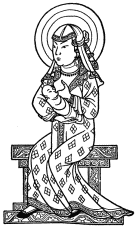
In the third century B.C. Buddhism was gaining wealth and power, and the little groups of simple huts in which the teachers of the Order gathered in the rainy season were giving place to substantial monastic buildings. To this period belong the beginnings of Buddhistic art. Now if we remember how recent was the adventure of Alexander, that all the Punjab was still under Seleucid rule, that all India abounded with Greek adventurers, and that there was still quite open communication by sea and land with Alexandria, it is no great wonder to find that this early Buddhist art was strongly Greek in character, and that the new Alexandrian cult of Serapis and Isis was extraordinarily influential in its development.
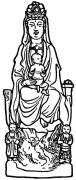
The kingdom of Gandhara on the northwest frontier near Peshawar, which flourished in the third century B.C., was a typical meeting-place of the Hellenic and Indian worlds. Here are to be found the earliest Buddhist sculptures, and interwoven with them are figures which are recognizably the figures of Serapis and Isis and Horus already worked into the legendary net that gathered about Buddha. No doubt the Greek artists who came to Gandhara were loath to relinquish a familiar theme. But Isis, we are told, is no longer Isis but Hariti, a pestilence goddess whom Buddha converted and made benevolent. Foucher traces Isis from this centre into China, but here other influences were also at work and the story becomes too complex for us to disentangle in this Outline.[216] China had a Taoist deity, the Holy Mother, the Queen of Heaven, who took on the name (originally a male name) of Kuan-yin and who came to resemble the Isis figure very closely. The Isis figures, we feel, must have influenced the treatment of Kuan-yin. Like Isis she was also Queen of the Seas, Stella Maris. In Japan she was called Kwannon. There seems to have been a constant exchange of the outer forms of religion between east and west. We read in Hue’s Travels how perplexing he and his fellow missionary found this possession of a common tradition of worship. “The cross,” he says, “the mitre, the dalmatica, the cope, which the Grand Lamas wear on their journeys, or when they are performing some ceremony out of the temple; the service with double choirs, the psalmody, the exorcisms, the censer, suspended from five chains, which you can open or close at pleasure; the benedictions given by the Lamas by extending the right hand over the heads of the faithful; the chaplet, ecclesiastical celibacy, spiritual retirement, the worship of the saints, the fasts, the processions, the litanies, the holy water, all these are analogies between the Buddhists and ourselves.”[217]
Chinese Image of Kuan-yin.
The cult and doctrine of Gautama, gathering corruptions and variations from Brahminism and Hellenism alike, was spread throughout India by an increasing multitude of teachers in the fourth and third centuries B.C. For some generations at least it retained much of the moral beauty and something of the simplicity of the opening phase. Many people who have no intellectual grasp upon the meaning of self-abnegation and disinterestedness have nevertheless the ability to appreciate a splendour in the reality of these qualities. Early Buddhism was certainly producing noble lives, and it is not only through reason that the latent response to nobility is aroused in our minds. It spread rather in spite of than because of the concessions that it made to vulgar imaginations. It spread because many of the early Buddhists were sweet and gentle, helpful and noble and admirable people, who compelled belief in their sustaining faith.
Quite early in its career Buddhism came into conflict with the growing pretensions of the Brahmins. As we have already noted, this priestly caste was still only struggling to dominate Indian life in the days of Gautama. They had already great advantages. They had the monopoly of tradition and religious sacrifices. But their power was being challenged by the development of kingship, for the men who became clanleaders and kings were usually not of the Brahminical caste.
Kingship received an impetus from the Persian and Greek invasions of the Punjab. We have already noted the name of King Porus whom, in spite of his elephants, Alexander defeated and turned into a satrap. There came also to the Greek camp upon the Indus a certain low-caste[218] adventurer named Chandragupta Maurya, whom the Greeks called Sandracottus, with a scheme for conquering the Ganges country. The scheme was not welcome to the Macedonians, who were in revolt against marching any further into India, and he had to fly the camp. He wandered among the tribes upon the north-west frontier, secured their support, and after Alexander had departed, overran the Punjab, ousting the Macedonian representatives. He then conquered the Ganges country (321 B.C.), waged a successful war (303 B.C.) against Seleucus (Seleucus I) when the latter attempted to recover the Punjab, and consolidated a great empire reaching across all the plain of northern India from the western to the eastern sea. And this King Chandragupta came into much the same conflict with the growing power of the Brahmins, into the conflict between crown and priesthood, that we have already noted as happening in Babylonia and Egypt and China. He saw in the spreading doctrine of Buddhism an ally against the growth of priestcraft and caste. He supported and endowed the Buddhistic Order, and encouraged its teachings.
He was succeeded by his son, who conquered Madras and was in turn succeeded by Asoka (264 to 227 B.C.), one of the great monarchs of history, whose dominions extended from Afghanistan to Madras. He is the only military monarch on record who abandoned warfare after victory. He had invaded Kalinga (255 B.C.), a country along the east coast of Madras, perhaps with some intention of completing the conquest of the tip of the Indian peninsula. The expedition was successful, but he was disgusted by what he saw of the cruelties and horrors of war. He declared, in certain inscriptions that still exist, that he would no longer seek conquest by war, but by religion, and the rest of his life was devoted to the spreading of Buddhism throughout the world.
He seems to have ruled his vast empire in peace and with great ability. He was no mere religious fanatic. But in the year of his one and only war he joined the Buddhist community as a layman, and some years later he became a full member of the Order, and devoted himself to the attainment of Nirvana by the Eightfold Path. How entirely compatible that way of living then was with the most useful and beneficent activities his life shows. Right Aspiration, Right Effort, and Right Livelihood distinguished his career. He organized a great digging of wells in India, and the planting of trees for shade. He appointed officers for the supervision of charitable works. He founded hospitals and public gardens. He had gardens made for the growing of medicinal herbs. Had he had an Aristotle to inspire him, he would no doubt have endowed scientific research upon a great scale. He created a ministry for the care of the aborigines and subject races. He made provision for the education of women. He made, he was the first monarch to make, an attempt to educate his people into a common view of the ends and way of life. He made vast benefactions to the Buddhist teaching orders, and tried to stimulate them to a better study of their own literature. All over the land he set up long inscriptions rehearsing the teaching of Gautama, and it is the simple and human teaching and not the preposterous accretions. Thirty-five of his inscriptions survive to this day. Moreover, he sent missionaries to spread the noble and reasonable teaching of his master throughout the world, to Kashmir, to Ceylon, to the Seleucids, and the Ptolemies. It was one of these missions which carried that cutting of the Bo Tree, of which we have already told, to Ceylon.
For eight and twenty years Asoka worked sanely for the real needs of men. Amidst the tens of thousands of names of monarchs that crowd the columns of history, their majesties and graciousnesses and serenities and royal highnesses and the like, the name of Asoka shines, and shines almost alone, a star. From the Volga to Japan his name is still honoured. China, Tibet, and even India, though it has left his doctrine, preserve the tradition of his greatness. More living men cherish his memory to-day than have ever heard the names of Constantine or Charlemagne.
§ 5
It is thought that the vast benefactions of Asoka finally corrupted Buddhism by attracting to its Order great numbers of mercenary and insincere adherents, but there can be no doubt that its rapid extension throughout Asia was very largely due to his stimulus.
It made its way into Central Asia through Afghanistan and Turkestan, and so reached China. Buddhist teaching had spread widely in China before 200 B.C.[219] Buddhism found there a popular and prevalent religion, Taoism, a development of very ancient and primitive magic and occult practices. It was reorganized as a distinctive cult by Chang Daoling in the days of the Han dynasty. Tao means the Way, which corresponds closely with the idea of the Aryan Path. The two religions spread side by side and underwent similar changes, so that nowadays their outward practice is very similar. Buddhism also encountered Confucianism, which was even less theological and even more a code of personal conduct. And finally it encountered the teachings of Lao Tse, “anarchist, evolutionist, pacifist, and moral philosopher,”[220] which were not so much a religion as a philosophical rule of life. The teachings of this Lao Tse were later to become incorporated with the Taoist religion by Chen Tuan, the founder of modern Taoism.
Confucius, the founder of Confucianism, like Lao Tse, the great southern teacher (whom he met and admired), and Gautama, lived also in the sixth century B.C. His life has some interesting parallelisms with that of some of the more political of the Greek philosophers of the fifth and fourth. The sixth century B.C. falls into the period assigned by Chinese historians to the Chow Dynasty, but in those days the rule of that dynasty had become little more than nominal; the emperor conducted the traditional sacrifices of the Son of Heaven, and received a certain formal respect. Even his nominal empire was not a sixth part of the China of to-day. In Chapter XVI we have already glanced at the state of affairs in China at this time; practically China was a multitude of warring states open to the northern barbarians. Confucius was a subject in one of those states, Lu; he was of aristocratic birth, but poor; and, after occupying various official positions, he set up a sort of Academy in Lu for the discovery and imparting of Wisdom. And we also find Confucius travelling from state to state in China, seeking a prince who would make him his counsellor and become the centre of a reformed world. Plato, two centuries later, in exactly the same spirit, went as advisor to the tyrant Dionysius of Syracuse, and we have already noted the attitudes of Aristotle and Isocrates towards Philip of Macedonia.
The teaching of Confucius centred upon the idea of a noble life which he embodied in a standard or ideal, the Aristocratic Man. This phrase is often translated into English as the Superior Person, but as “superior” and “person,” like “respectable” and “genteel,” have long become semi-humorous terms of abuse, this rendering is not fair to Confucianism. He did present to his time the ideal of a devoted public man. The public side was very important to him. He was far more of a constructive political thinker than Gautama or Lao Tse. His mind was full of the condition of China, and he sought to call the Aristocratic Man into existence very largely in order to produce the noble state. One of his sayings may be quoted here: “It is impossible to withdraw from the world, and associate with birds and beasts that have no affinity with us. With whom should I associate but with suffering men? The disorder that prevails is what requires my efforts. If right principles ruled through the kingdom, there would be no necessity for me to change its state.”
The political basis of his teaching seems to be characteristic of Chinese moral ideas; there is a much directer reference to the State than is the case with most Indian and European moral and religious doctrine. For a time he was appointed magistrate in Chung-tu, a city of the dukedom of Lu, and here he sought to regulate life to an extraordinary extent, to subdue every relationship and action indeed to the rule of an elaborate etiquette. “Ceremonial in every detail, such as we are wont to see only in the courts of rulers and the households of high dignitaries, became obligatory on the people at large and all matters of daily life were subject to rigid rule. Even the food which the different classes of people might eat was regulated; males and females were kept apart in the streets; even the thickness of coffins and the shape and situation of graves were made the subject of regulations.”[221]
This is all, as people say, very Chinese. No other people have ever approached moral order and social stability through the channel of manners. Yet in China, at any rate, the methods of Confucius have had an enormous effect, and no nation in the world to-day has such a universal tradition of decorum and self-restraint.
Later on the influence of Confucius over his duke was undermined, and he withdrew again into private life. His last days were saddened by the deaths of some of his most promising disciples. “No intelligent ruler,” he said, “arises to take me as his master, and my time has come to die.” ...
But he died to live. Says Hirth, “There can be no doubt that Confucius has had a greater influence on the development of the Chinese national character than many emperors taken together. He is, therefore, one of the essential figures to be considered in connection with any history of China. That he could influence his nation to such a degree was, it appears to me, due more to the peculiarity of the nation than to that of his own personality. Had he lived in any other part of the world, his name would perhaps be forgotten. As we have seen, he had formed his character and his personal views on man’s life from a careful study of documents closely connected with the moral philosophy cultivated by former generations. What he preached to his contemporaries was, therefore, not all new to them; but, having himself, in the study of old records, heard the dim voice of the sages of the past, he became, as it were, the megaphone phonograph through which were expressed to the nation those views which he had derived from the early development of the nation itself.... The great influence of Confucius’s personality on national life in China was due not only to his writings and his teachings as recorded by others, but also to his doings. His personal character, as described by his disciples and in the accounts of later writers, some of which may be entirely legendary, has become the pattern for millions of those who are bent on imitating the outward manners of a great man.... Whatever he did in public was regulated to the minutest detail by ceremony. This was no invention of his own, since ceremonial life had been cultivated many centuries before Confucius; but his authority and example did much to perpetuate what he considered desirable social practices.”
The Chinese speak of Buddhism and the doctrines of Lao Tse and Confucius as the Three Teachings. Together they constitute the basis and point of departure of all later Chinese thought. Their thorough study is a necessary preliminary to the establishment of any real intellectual and moral community between the great people of the East and the Western world.[222]
There are certain things to be remarked in common of all these three teachers, of whom Gautama was indisputably the greatest and profoundest, whose doctrines to this day dominate the thought of the great majority of human beings; there are certain features in which their teaching contrasts with the thoughts and feelings that were soon to take possession of the western world. Primarily they are personal and tolerant doctrines; they are doctrines of a Way, of a Path, of a Nobility, and not doctrines of a church or a general rule. And they offer nothing either for or against the existence and worship of the current gods. The Athenian philosophers, it is to be noted, had just the same theological detachment; Socrates was quite willing to bow politely or sacrifice formally to almost any divinity,—reserving his private thoughts. This attitude is flatly antagonistic to the state of mind that was growing up in the Jewish communities of Judea, Egypt, and Babylonia, in which the thought of the one God was first and foremost. Neither Gautama nor Lao Tse nor Confucius had any inkling of this idea of a jealous God, a God who would have “none other gods,” a God of terrible Truth, who would not tolerate any lurking belief in magic, witchcraft, or old customs, or any sacrificing to the god-king or any trifling with the stern unity of things.
§ 6
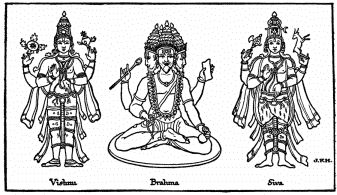
The intolerance of the Jewish mind did keep its essential faith clear and clean. The theological disregard of the great Eastern teachers, neither assenting nor denying, did on the other hand permit elaborations of explanation and accumulations of ritual from the very beginning. Except for Gautama’s insistence upon Right Views, which was easily disregarded, there was no self-cleansing element in either Buddhism, Taoism, or Confucianism. There was no effective prohibition of superstitious practices, spirit raising, incantations, prostrations, and supplementary worships. At an early stage a process of encrustation began, and continued. The new faiths caught almost every disease of the corrupt religions they sought to replace; they took over the idols and the temples, the altars and the censers.
Tibet to-day is a Buddhistic country, yet Gautama, could he return to earth, might go from end to end of Tibet seeking his own teaching in vain. He would find that most ancient type of human ruler, a god-king, enthroned, the Dalai Lama, the “living Buddha.” At Lhassa he would find a huge temple filled with priests, abbots, and lamas—he whose only buildings were huts and who made no priests—and above a high altar he would behold a huge golden idol, which he would learn was called “Gautama Buddha”! He would hear services intoned before this divinity, and certain precepts, which would be dimly familiar to him, murmured as responses. Bells, incense, prostrations, would play their part in these amazing proceedings. At one point in the service a bell would be rung and a mirror lifted up, while the whole congregation, in an access of reverence, bowed lower....
About this Buddhist countryside he would discover a number of curious little mechanisms, little wind-wheels and water-wheels spinning, on which brief prayers were inscribed. Every time these things spin, he would learn, it counts as a prayer. “To whom?” he would ask. Moreover, there would be a number of flagstaffs in the land carrying beautiful silk flags, silk flags which bore the perplexing inscription, “Om Mani padme hum,” “the jewel is in the lotus.” Whenever the flag flaps, he would learn, it was a prayer also, very beneficial to the gentleman who paid for the flag and to the land generally. Gangs of workmen, employed by pious persons, would be going about the country cutting this precious formula on cliff and stone. And this, he would realize at last, was what the world had made of his religion! Beneath this gaudy glitter was buried the Aryan Way to serenity of soul.[223]
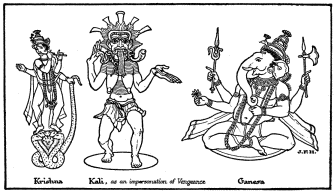
We have already noted the want of any progressive idea in primitive Buddhism. In that again it contrasted with Judaism. The idea of a Promise gave to Judaism a quality no previous or contemporary religion displayed; it made Judaism historical and dramatic. It justified its fierce intolerance because it pointed to an aim. In spite of the truth and profundity of the psychological side of Gautama’s teaching, Buddhism stagnated and corrupted for the lack of that directive idea. Judaism, it must be confessed, in its earlier phases, entered but little into the souls of men; it let them remain lustful, avaricious, worldly, or superstitious; but because of its persuasion of a promise and of a divine leadership to serve divine ends, it remained in comparison with Buddhism bright and expectant, like a cared-for sword.
§ 7
For some time Buddhism flourished in India. But Brahminism, with its many gods and its endless variety of cults, always flourished by its side, and the organization of the Brahmins grew more powerful, until at last they were able to turn upon this caste-denying cult and oust it from India altogether. The story of that struggle is not to be told here; there were persecutions and reactions, but by the eleventh century, except for Orissa, Buddhist teaching was extinct in India. Much of its gentleness and charity had, however, become incorporated with Brahminism.
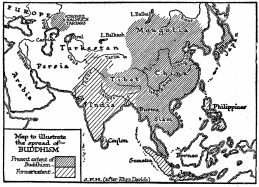
Over great areas of the world, as our map has shown, it still survives; and it is quite possible that in contact with western science, and inspired by the spirit of history, the original teaching of Gautama, revived and purified, may yet play a large part in the direction of human destiny.
But with the loss of India the Aryan Way ceased to rule the lives of any Aryan peoples. It is curious to note that while the one great Aryan religion is now almost exclusively confined to Mongolian peoples, the Aryans themselves are under the sway of two religions, Christianity and Islam, which are, as we shall see, essentially Semitic. And both Buddhism and Christianity wear garments of ritual and formula that seem to be derived through Hellenistic channels from that land of temples and priestcraft, Egypt, and from the mentality of the brown Hamitic peoples.