BOOK V THE RISE AND COLLAPSE OF THE ROMAN EMPIRE (continued 2)
Reading edition
There can be no doubt that all Italy, all the empire, was festering with discomfort, anxiety, and discontent in the century after the destruction of Carthage; a few men were growing very rich, and the majority of people found themselves entangled in an inexplicable net of uncertain prices, jumpy markets, and debts; but yet there was no way at all of stating and clearing up the general dissatisfaction. There is no record of a single attempt to make the popular assembly a straightforward and workable public organ. Beneath the superficial appearances of public affairs struggled a mute giant of public opinion and public will, who sometimes made some great political effort, a rush to vote or such like, and sometimes broke into actual violence. So long as there was no actual violence, the Senate and the financiers kept on in their own disastrous way. Only when they were badly frightened would governing cliques or parties desist from some nefarious policy and heed the common good. The real method of popular expression in Italy in those days was not the comitia tributa, but the strike and insurrection, the righteous and necessary methods of all cheated or suppressed peoples. We have seen in our own days in Great Britain a decline in the prestige of parliamentary government and a drift towards unconstitutional methods on the part of the masses through exactly the same cause, through the incurable disposition of politicians to gerrymander the electoral machine until the community is driven to explosion.
For insurrectionary purposes a discontented population needs a leader, and the political history of the concluding century of Roman republicanism is a history of insurrectionary leaders and counter-revolutionary leaders. Most of the former are manifestly unscrupulous adventurers who try to utilize the public necessity and unhappiness for their own advancement. Many of the historians of this period betray a disposition to take sides, and are either aristocratic in tone or fiercely democratic; but, indeed, neither side in these complex and intricate disputes has a record of high aims or clean hands. The Senate and the rich equestrians were vulgar and greedy spirits, hostile and contemptuous towards the poor mob; and the populace was ignorant, unstable, and at least equally greedy. The Scipios in all this record shine, by comparison, a group of gentlemen. To the motives of one or the other figures of the time, to Tiberius Gracchus, for example, we may perhaps extend the benefit of the doubt. But for the rest, they do but demonstrate how clever and cunning men may be, how subtle in contention, how brilliant in pretence, and how utterly wanting in wisdom or grace of spirit. “A shambling, hairy, brutish, but probably very cunning creature with a big brain behind;” so someone, I think it was Sir Harry Johnston, has described Homo Neanderthalensis.
To this day we must still use similar terms to describe the soul of the politician. The statesman has still to oust the politician from his lairs and weapon heaps. History has still to become a record of human dignity.
§ 2
Another respect in which the Roman system was a crude anticipation of our own, and different from any preceding political system we have considered, was that it was a cash and credit-using system. Money had been in the world as yet for only a few centuries. But its use had been growing; it was providing a fluid medium for trade and enterprise, and changing economic conditions profoundly. In republican Rome, the financier and the “money” interest began to play a part recognizably similar to their rôles to-day.
We have already noted—in our account of Herodotus—that a first effect of money was to give freedom of movement and leisure to a number of people who could not otherwise have enjoyed these privileges. And that is the peculiar value of money to mankind. Instead of a worker or helper being paid in kind and in such a way that he is tied as much in his enjoyment as in his labour, money leaves him free to do as he pleases amidst a wide choice of purchasable aids, eases, and indulgences. He may eat his money or drink it or give it to a temple or spend it in learning something or save it against some foreseen occasion. That is the good of money, the freedom of its universal convertibility. But the freedom money gives the poor man is nothing to the freedom money has given the rich man. With money rich men ceased to be tied to lands, houses, stores, flocks, and herds. They could change the nature and locality of their possessions with an unheard-of freedom. In the third and second century b.c., this release, this untethering of wealth, began to tell upon the general economic life of the Roman and Hellenized world. People began to buy land and the like not for use, but to sell again at a profit; people borrowed to buy, speculation developed. No doubt there were bankers in the Babylon of 1000 b.c., but they lent in a far more limited and solid way, bars of metal and stocks of goods. That earlier world was a world of barter and payment in kind, and it went slowly—and much more staidly and stably—for that reason. In that state the vast realm of China has remained almost down to the present time.
The big cities before Rome were trading and manufacturing cities. Such were Corinth and Carthage and Syracuse. But Rome never produced a very considerable industrial population, and her warehouses never rivalled those of Alexandria. The little port of Ostia was always big enough for her needs. Rome was a political and financial capital, and in the latter respect, at least, she was a new sort of city. She imported profits and tribute, and very little went out from her in return. The wharves of Ostia were chiefly busy unloading corn from Sicily and Africa and loot from all the world.
After the fall of Carthage the Roman imagination went wild with the hitherto unknown possibilities of finance. Money, like most other inventions, had “happened” to mankind, and men had still to develop—to-day they have still to perfect—the science and morality of money. One sees the thing “catching on” in the recorded life and the writings of Cato the Censor. In his early days he was bitterly virtuous against usury; in his later he was devising ingenious schemes for safe usury.
In this curiously interesting century of Roman history we find man after man asking, “What has happened to Rome?” Various answers are made—a decline in religion, a decline from the virtues of the Roman forefathers, Greek “intellectual poison,” and the like. We who can look at the problem with a large perspective, can see that what had happened to Rome was “money”—the new freedoms and chances and opportunities that money opened out. Money floated the Romans off the firm ground, everyone was getting hold of money, the majority by the simple expedient of running into debt; the eastward expansion of the empire was very largely a hunt for treasure in strong rooms and temples to keep pace with the hunger of the new need. The Equestrian order, in particular, became the money power. Everyone was developing property. Farmers were giving up corn and cattle, borrowing money, buying slaves, and starting the more intensive cultivation of oil and wine. Money was young in human experience and wild, nobody had it under control. It fluctuated greatly. It was now abundant and now scarce. Men made sly and crude schemes to corner it, to hoard it, to send up prices by releasing hoarded metals. A small body of very shrewd men was growing immensely rich. Many patricians were growing poor and irritated and unscrupulous. Among the middle sort of peoples there was much hope, much adventure, and much more disappointment. The growing mass of the expropriated was permeated by that vague, baffled, and hopeless sense of being inexplicably bested, which is the preparatory condition for all great revolutionary movements.
§ 3
The first conspicuous leader to appeal to the gathering revolutionary feeling in Italy was Tiberius Gracchus. He looks more like an honest man than any other figure in this period of history, unless it be Scipio Africanus the Elder. At first Tiberius Gracchus was a moderate reformer of a rather reactionary type. He wished to restore the yeoman class to property, very largely because he believed that class to be the backbone of the army, and his military experience in Spain before and after the destruction of Carthage had impressed upon him the declining efficiency of the legions. He was what we should call nowadays a “Back-to-the-land” man. He did not understand, and few people understand to-day, how much easier it is to shift population from the land into the towns, than to return it to the laborious and simple routines of agricultural life. He wanted to revive the Licinian laws, which had been established when Camillus built his temple of Concord nearly two centuries and a half before (see Chap. xxvii, § 2), so far as they broke up great estates and restrained slave labour.
These Licinian laws had repeatedly been revived and repeatedly lapsed to a dead letter again. It was only when the big proprietors in the Senate opposed this proposal that Tiberius Gracchus turned to the people and began a furious agitation for popular government. He created a commission to inquire into the title of all landowners. In the midst of his activities occurred one of the most extraordinary incidents in history. Attalus, the king of the rich country of Pergamum in Asia Minor, died (133 b.c.), and left his kingdom to the Roman people.
It is difficult for us to understand the motives of this bequest. Pergamum was a country allied to Rome, and so moderately secure from aggression; and the natural consequence of such a will was to provoke a violent scramble among the senatorial gangs and a dispute between them and the people for the spoils of the new acquisition. Practically Attalus handed over his country to be looted. The act is so amazing that one is driven towards the hypothesis of forgery.[247] There were of course many Italian business people established in the country and a strong party of native rich men in close relations with Rome. To them, no doubt, a coalescence with the Roman system would have been acceptable. Josephus bears witness to such a desire for annexation among the rich men of Syria, a desire running counter to the wishes of both king and people. This Pergamum bequest, astonishing in itself, had the still more astonishing result of producing imitations in other quarters. In 96 B.C. Ptolemy Apion bequeathed Cyrenaica, in North Africa, to the Roman people; in 81 B.C. Alexander II, King of Egypt, followed suit with Egypt, a legacy too big for the courage if not for the appetite of the Senators, and they declined it; in 74 B.C. Nicomedes, King of Bithynia, demised Bithynia. Of these latter testamentary freaks we will say no more here. But it will be manifest how great an opportunity was given Tiberius Gracchus, by the bequest of Attalus, of accusing the rich of greed and of proposing to decree the treasures of Attalus to the commonalty. He proposed to use this new wealth to provide seed, stock, and agricultural implements for the resettlement of the land.
His movement was speedily entangled in the complexities of the Roman electoral system—without a simple and straightforward electoral method, all popular movements in all ages necessarily become entangled and maddened in constitutional intricacies, and almost as necessarily lead to bloodshed. It was needed, if his work was to go on, that Tiberius Gracchus should continue to be tribune, and it was illegal for him to be tribune twice in succession. He overstepped the bounds of legality, and stood for the tribuneship a second time; the peasants who came in from the countryside to vote for him came in armed; the cry that he was aiming at a tyranny, the cry that had long ago destroyed Mælius and Manlius, was raised in the Senate, the friends of “law and order” went to the Capitol in state, accompanied by a rabble of dependents armed with staves and bludgeons; there was a conflict, or rather a massacre of the revolutionaries, in which nearly three hundred people were killed, and Tiberius Gracchus was beaten to death with the fragments of a broken bench by two Senators.
Thereupon the Senators attempted a sort of counter-revolution, and proscribed many of the followers of Tiberius Gracchus; but the state of public opinion was so sullen and threatening that this movement was dropped and Scipio Nasica, who was implicated in the death of Tiberius, though he occupied the position of pontifex maximus and should have remained in Rome for the public sacrifices which were the duties of that official, went abroad to avoid trouble.
The uneasiness of Italy next roused Scipio Africanus the Younger to propose the enfranchisement of all Italy. But he died suddenly before he could carry the proposal into effect.
Then followed the ambiguous career of Caius Gracchus, the brother of Tiberius, who followed some tortuous “policy” that still exercises the mind of historians. He increased the burthens of taxation laid upon the provinces, it is supposed with the idea of setting the modern financiers (the Equites) against the senatorial landowners. He gave the former the newly bequeathed taxes of Asia to farm, and, what is worse, he gave them control of the special courts set up to prevent extortion. He started enormous public works and particularly the construction of new roads, and he is accused of making a political use of the contracts. He revived the proposal to enfranchise Italy. He increased the distribution of subsidized cheap corn to the Roman citizens.... Here we cannot attempt to disentangle his schemes, much less to judge him. But that his policy was offensive to the groups that controlled the Senate there can be no doubt whatever. He was massacred by the champions of “law and order,” with about three thousand of his followers, in the streets of Rome in 121 b.c. His decapitated head was carried to the Senate on the point of a pike.
(A reward of its weight in gold, says Plutarch, had been offered for this trophy; and its captor, acting in the true spirit of a champion of “big business,” filled the braincase with lead on its way to the scales.)
In spite of these prompt firm measures the Senate was not to enjoy the benefits of peace and the advantages of a control of the imperial resources for long. Within ten years the people were in revolt again.
In 118 B.C. the throne of Numidia, the semi-barbaric kingdom that had arisen in North Africa upon the ruins of the civilized Carthaginian power, was seized by a certain able Jugurtha, who had served with the Roman armies in Spain, and had a knowledge of the Roman character. He provoked the military intervention of Rome. But the Romans found that their military power, under a Senate of financiers and landlords, was very different from what it had been even in the days of the younger Scipio Africanus. “Jugurtha bought over the Commissioners sent out to watch him, the Senators charged with their prosecution, and the generals in command against him.”[248] There is a mistaken Roman proverb: “pecunia non olet” (money does not stink), for the money of Jugurtha stank even in Rome. There was an angry agitation; and a capable soldier of lowly origin, Marius, was carried to the consulship (107 B.C.) on the wave of popular indignation. Marius made no attempt on the model of the Gracchi to restore the backbone of the army by rehabilitating the yeoman class. He was a professional soldier with a high standard of efficiency and a disposition to take short cuts. He simply raised troops from among the poor, whether countrymen or townsmen, paid them well, disciplined them thoroughly, and (106 B.C.) ended the seven years’ war with Jugurtha by bringing that chieftain in chains to Rome. It did not occur to anybody that incidentally Marius had also created a professional army with no interest to hold it together but its pay. He then held on to the consulship more or less illegally for several years, and in 102 and 101 B.C. repelled a threatening move of the Germans (who thus appear in our history for the first time), who were raiding through Gaul towards Italy. He gained two victories; one on Italian soil. He was hailed as the saviour of his country, a second Camillus (100 B.C.).
The social tensions of the time mocked that comparison with Camillus. The Senate benefited by the greater energy in foreign affairs and the increased military efficiency that Marius had introduced, but the sullen, shapeless discontent of the mass of the people was still seeking some effective outlet. The rich grew richer and the poor poorer. It was impossible to stifle the consequences of that process for ever by political trickery. The Italian people were still unenfranchised. Two extreme democratic leaders, Saturninus and Glaucia, were assassinated, but that familiar senatorial remedy failed to assuage the populace on this occasion. In 92 B.C. an aristocratic official, Rutilius Rufus, who had tried to restrain the exactions of the financiers in Asia Minor, was condemned on a charge of corruption so manifestly trumped up that it deceived no one; and in 91 b.c., Livius Drusus, a newly elected tribune of the people, who was making capital out of the trial of Rutilius Rufus, was assassinated. He had proposed a general enfranchisement of the Italians, and he had foreshadowed not only another land law, but a general abolition of debts. Yet for all this vigour on the part of the senatorial usurers, landgrabbers, and forestallers, the hungry and the anxious were still insurgent. The murder of Drusus was the last drop in the popular cup; Italy blazed into a desperate insurrection.
There followed two years of bitter civil war, the Social War. It was a war between the idea of a united Italy and the idea of the rule of the Roman Senate. It was not a “social” war in the modern sense, but a war between Rome and her Italian allies (allies = Socii). “Roman generals, trained in the traditions of colonial warfare, marched ruthlessly up and down Italy, burning farms, sacking towns, and carrying off men, women, and children, to sell them in the open market or work them in gangs upon their estates.”[249] Marius and an aristocratic general, Sulla, who had been with him in Africa and who was his bitter rival, both commanded on the side of Rome. But though the insurgents experienced defeats and looting, neither of these generals brought the war to an end. It was ended in a manner (89 b.c.) by the practical surrender of the Roman Senate to the idea of reform. The spirit was taken out of the insurrection by the concession of their demands “in principle”; and then as soon as the rebels had dispersed, the usual cheating of the new voters, by such methods as we have explained in § 1 of this chapter, was resumed.
By the next year (88 B.C.) the old round had begun again. It was mixed up with the personal intrigues of Marius and Sulla against each other; but the struggle had taken on another complexion through the army reforms of Marius, which had created a new type of legionary, a landless professional soldier with no interest in life but pay and plunder, and with no feeling of loyalty except to a successful general. A popular tribune, Sulpicius, was bringing forward some new laws affecting debt, and the consuls were dodging the storm by declaring a suspension of public business. Then came the usual resort to violence, and the followers of Sulpicius drove the consuls from the forum. But here it is that the new forces which the new army had made possible came into play. King Mithridates of Pontius, the Hellenized king of the southern shores of the Black Sea east of Bithynia, was pressing Rome into war. One of the proposed laws of Sulpicius was that Marius should command the armies sent against this Mithridates. Whereupon Sulla marched the army he had commanded throughout the Social War to Rome, Marius and Sulpicius fled, and a new age, an age of military pronunciamentos, began.
Of how Sulla had himself made commander against Mithridates and departed, and of how legions friendly to Marius then seized power, how Marius returned to Italy and enjoyed a thorough massacre of his political opponents and died, sated, of fever, we cannot tell in any detail. But one measure during the Marian reign of terror did much to relieve the social tension, and that was the abolition of three-quarters of all outstanding debts. Nor can we tell here how Sulla made a discreditable peace with Mithridates (who had massacred a hundred thousand Italians in Asia Minor) in order to bring his legions back to Rome, defeat the Marians at the battle of the Colline Gate of Rome, and reverse the arrangements of Marius. Sulla restored law and order by the proscription and execution of over five thousand people. He desolated large parts of Italy, restored the Senate to power, repealed many of the recent laws, though he was unable to restore the cancelled burden of debt, and then, feeling bored by politics and having amassed great riches, he retired with an air of dignity into private life, gave himself up to abominable vices, and so presently died, eaten up with some disgusting disease produced by debauchery.[250]
§ 4
Political life in Italy was not so much tranquillized as stunned by the massacres and confiscations of Marius and Sulla. The scale upon which this history is planned will not permit us to tell here of the great adventurers who, relying more and more on the support of the legions, presently began to scheme and intrigue again for dictatorial power in Rome. In 73 B.C. all Italy was terrified by a rising of the slaves, and particularly of the gladiators, led by a gladiator from Thessaly, Spartacus. He and seventy others had fled out from a gladiatorial “farm” at Capua. Similar risings had already occurred in Sicily. The forces under Spartacus necessarily became a miscellaneous band drawn from east and west, without any common idea except the idea of dispersing and getting home; nevertheless, he held out in southern Italy for two years, using the then apparently extinct crater of Vesuvius for a time as a natural fortress. The Italians, for all their love of gladiatorial display, failed to appreciate this conversion of the whole country into an arena, this bringing of the gladiatorial sword to the door, and when at last Spartacus was overthrown, their terror changed to frantic cruelty, six thousand of his captured followers were crucified—long miles of nailed and drooping victims—along the Appian Way.
Here we cannot deal at any length with Lucullus, who invaded Pontus and fought Mithridates, and brought the cultivated cherry-tree to Europe; nor can we tell how ingeniously Pompey the Great stole the triumph and most of the prestige Lucullus had won in Armenia beyond Pontus. Lucullus, like Sulla, retired into an opulent private life, but with more elegance and with a more gracious end. We cannot relate in any detail how Julius Cæsar accumulated reputation in the west, by conquering Gaul, defeating the German tribes upon the Rhine, and pushing a punitive raid across the Straits of Dover into Britain. More and more important grow the legions; less and less significant are the Senate and the assemblies of Rome. But there is a certain grim humour about the story of Crassus that we cannot altogether neglect.

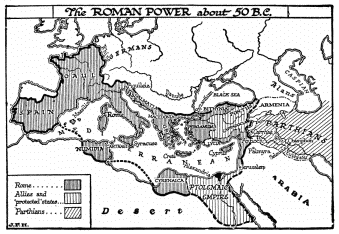
This Crassus was a great money-lender and forestaller. He was a typical man of the new Equestrian type, the social equivalent of a modern munition profiteer. He first grew rich by buying up the property of those proscribed by Sulla. His earliest exploits in the field were against Spartacus, whom finally he crushed by great payments and exertions after a prolonged and expensive campaign. He then, as the outcome of complicated bargains, secured the command in the east and prepared to emulate the glories of Lucullus, who had pushed east from Pergamum and Bithynia into Pontus, and of Pompey, who had completed the looting of Armenia.
His experiences serve to demonstrate the gross ignorance with which the Romans were conducting their affairs at that time. He crossed the Euphrates, expecting to find in Persia another Hellenized kingdom like Pontus. But, as we have already intimated, the great reservoirs of nomadic peoples that stretched round from the Danube across Russia into Central Asia, had been raining back into the lands between the Caspian Sea and the Indus that Alexander had conquered for Hellenism. Crassus found himself against the “Scythian” again; against mobile tribes of horsemen led by a monarch in Median costume.[251] The particular variety of “Scythian” he encountered was called the Parthian. It is possible that in the Parthians a Mongolian (Turanian) element was now mingled with the Aryan strain; but the campaign of Crassus beyond the Euphrates is curiously like the campaign of Darius beyond the Danube; there is the same heavy thrusting of an infantry force against elusive light horsemen. But Crassus was less quick than Darius to realize the need of withdrawal, and the Parthians were better bowmen than the Scythians Darius met. They seemed to have had some sort of noisy projectile of unusual strength and force, something different from an ordinary arrow.[252] The campaign culminated in that two days’ massacre of the hot, thirsty, hungry, and weary Roman legions, which is known as the battle of Carrhæ (53 B.C.). They toiled through the sand, charging an enemy who always evaded their charge and rode round them and shot them to pieces. Twenty thousand of them were killed, and ten thousand marched on eastward as prisoners into slavery in Iran.
What became of Crassus is not clearly known. There is a story, probably invented for our moral benefit and suggested by his usuries, that he fell alive into the hands of the Parthians and was killed by having molten gold poured down his throat.
But this disaster has a very great significance indeed to our general history of mankind. It serves to remind us that from the Rhine to the Euphrates, all along to the north of the Alps and Danube and Black Sea, stretched one continuous cloud of nomadic and semi-nomadic peoples, whom the statescraft of imperial Rome was never able to pacify and civilize, nor her military science subdue. We have already called attention to a map showing how the Second Babylonian Empire, the Chaldean Empire, lay like a lamb in the embrace of the Median power. In exactly the same way the Roman Empire lay like a lamb in the embrace of this great crescent of outer barbarians. Not only was Rome never able to thrust back or assimilate that superincumbent crescent, but she was never able to organize the Mediterranean Sea into a secure and orderly system of communication between one part of her empire and another. Quite unknown as yet to Rome, the Mongolian tribes from northeastern Asia, the Huns and their kin, walled back and driven out from China by the Tsi and Han dynasties, were drifting and pressing westward, mixing with the Parthians, the Scythians, the Teutons and the like, or driving them before them.
Never at any time did the Romans succeed in pushing their empire beyond Mesopotamia, and upon Mesopotamia their hold was never very secure. Before the close of the republic that power of assimilation which had been the secret of their success was giving way to “patriotic” exclusiveness and “patriotic” greed. Rome plundered and destroyed Asia Minor and Babylonia, which were the necessary basis for an eastward extension to India, just as she had destroyed and looted Carthage and so had no foothold for extension into Africa, and just as she had destroyed Corinth and so cut herself off from an easy way into the heart of Greece. Western European writers, impressed by the fact that later on Rome Romanized and civilized Gaul and South Britain and restored the scene of her earlier devastations in Spain to prosperity, are apt to ignore that over far greater areas to the south and east her influence was to weaken and so restore to barbarism the far wider conquests of Hellenic civilization.
§ 5
But among the politicians of Italy in the first century b.c. there were no maps of Germany and Russia, Africa and central Asia, and no sufficient intelligence to study them had they existed. Rome never developed the fine curiosities that sent Hanno and the sailors of Pharaoh Necho down the coasts of Africa. When, in the first century B.C., the emissaries of the Han dynasty reached the eastern shores of the Caspian Sea, they found only stories of a civilization that had receded. The memory of Alexander still lived in these lands, but of Rome men only knew that Pompey had come to the western shores of the Caspian and gone away again, and that Crassus had been destroyed. Rome was preoccupied at home. What mental energy remained over in the Roman citizen from the attempt to grow personally rich and keep personally safe was intent upon the stratagems and strokes and counter-strokes of the various adventurers who were now manifestly grappling for the supreme power.
It is the custom of historians to treat these struggles with extreme respect. In particular the figure of Julius Cæsar is set up as if it were a star of supreme brightness and importance in the history of mankind.[253] Yet a dispassionate consideration of the known facts fails altogether to justify this demi-god theory of Cæsar. Not even that precipitate wrecker of splendid possibilities, Alexander the Great, has been so magnified and dressed up for the admiration of careless and uncritical readers. There is a type of scholar who, to be plain, sits and invents marvellous world policies for the more conspicuous figures in history with the merest scraps of justification or with no justification at all. We are told that Alexander planned the conquest of Carthage and Rome and the complete subjugation of India, and that only his death shattered these schemes. What we know for certain is that he conquered the Persian Empire, and never went far beyond its boundaries; and that when he was supposed to be making these vast and noble plans, he was in fact indulging in such monstrous antics as his mourning for his favourite Hephæstion, and as his main occupation he was drinking himself to death. So too Julius Cæsar is credited with the intention of doing just that one not impossible thing which would have secured the Roman Empire from its ultimate collapse—namely, the systematic conquest and civilization of Europe as far as the Baltic and the Dnieper. He was to have marched upon Germany, says Plutarch, through Parthia and Scythia, round the north of the Caspian and Black Seas. Yet the fact we have to reconcile with this wise and magnificent project is that at the crest of his power, Cæsar, already a bald, middle-aged man, past the graces and hot impulses of youthful love, spent the better part of a year in Egypt, feasting and entertaining himself in amorous pleasantries with the Egyptian queen Cleopatra. And afterwards he brought her with him to Rome, where her influence over him was bitterly resented. Such complications with a woman mark the elderly sensualist or sentimentalist—he was fifty-four at the commencement of the affaire—rather than the master-ruler of men.
On the side of the superman idea of Cæsar, we have to count a bust in the Naples Museum. It represents a fine and intellectual face, very noble in its expression, and we can couple with that the story that his head, even at birth, was unusually large and finely formed. But there is really no satisfying evidence that this well-known bust does represent Cæsar, and it is hard to reconcile its austere serenity with the reputation for violent impulse and disorderliness that clung to him. Other busts of a quite different man are also, with more probability, ascribed to him.
There can be little doubt that he was a dissolute and extravagant young man—the scandals cluster thick about his sojourn in Bithynia, whither he fled from Sulla; he was the associate of the reprobate Clodius and the conspirator Catiline, and there is nothing in his political career to suggest any aim higher or remoter than his own advancement to power, and all the personal glory and indulgence that power makes possible. We will not attempt to tell here of the turns and devices of his career. Although he was of an old patrician family, he came into politics as the brilliant darling of the people. He spent great sums and incurred heavy debts to provide public festivals on the most lavish scale. He opposed the tradition of Sulla, and cherished the memory of Marius, who was his uncle by marriage. For a time he worked in conjunction with Crassus and Pompey, but after the death of Crassus he and Pompey came into conflict. By 49 B.C. he and Pompey, with their legions, he from the west and Pompey from the east, were fighting openly for predominance in the Roman state. He had broken the law by bringing his legions across the Rubicon, which was the boundary between his command and Italy proper. At the battle of Pharsalos in Thessaly (48 B.C.) Pompey was routed, and, fleeing to Egypt, was murdered, leaving Cæsar more master of the Roman world than ever Sulla had been.
He was then created dictator for ten years in 46 B.C., and early in 45 B.C. he was made dictator for life. This was monarchy; if not hereditary monarchy, it was at least electoral life monarchy. It was unlimited opportunity to do his best for the world. And by the spirit and quality of his use of this dictatorial power during these four years we are bound to judge him. A certain reorganization of local administration he effected, and he seems to have taken up what was a fairly obvious necessity of the times, a project for the restoration of the two murdered seaports of Corinth and Carthage, whose destruction had wrecked the sea-life of the Mediterranean. But much more evident was the influence of Cleopatra and Egypt upon his mind. Like Alexander before him, his head seems to have been turned by the king-god tradition, assisted no doubt in his case by the adulation of that charming hereditary goddess, Cleopatra. We find evidence of exactly that same conflict upon the score of divine pretensions, between him and his personal friends, that we have already recorded in the case of Alexander. So far as the Hellenized east was concerned, the paying of divine honours to rulers was a familiar idea; but it was still repulsive to the lingering Aryanism of Rome.
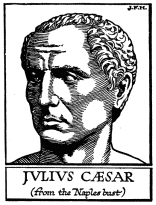
Antony, who had been his second in command at Pharsalos, was one of the chief of his flatterers. Plutarch describes a scene at the public games in which Antony tried to force a crown upon Cæsar, which Cæsar, after a little coyness and in face of the manifested displeasure of the crowd, refused. But he had adopted the ivory sceptre and throne, which were the traditional insignia of the ancient kings of Rome. His image was carried amidst that of the gods in the opening pompa of the arena, and his statue was set up in a temple with an inscription, “To the Unconquerable God!” Priests even were appointed for his godhead. These things are not the symptoms of great-mindedness, but of a common man’s megalomania. Cæsar’s record of vulgar scheming for the tawdriest mockeries of personal worship is a silly and shameful record; it is incompatible with the idea that he was a wise and wonderful superman setting the world to rights.
Finally (44 B.C.) he was assassinated by a group of his own friends and supporters, to whom these divine aspirations had become intolerable. He was beset in the Senate, and stabbed in three and twenty places, dying at the foot of the statue of his fallen rival Pompey the Great. The scene marks the complete demoralization of the old Roman governing body. Brutus, the ringleader of the murderers, would have addressed the senators, but, confronted by this crisis, they were scuttling off in every direction. For the best part of a day Rome did not know what to make of this event; the murderers marched about with their bloody weapons through an undecided city, with no one gainsaying them and only a few joining them; then public opinion turned against them, some of their houses were attacked, and they had to hide and fly for their lives.
§ 6
But the trend of things was overwhelmingly towards monarchy. For thirteen years more the struggle of personalities went on. One single man is to be noted as inspired by broad ideas and an ambition not entirely egoistic, Cicero. He was a man of modest origin, whose eloquence and literary power had won him a prominent place in the Senate. He was a little tainted by the abusive tradition of Demosthenes, nevertheless he stands out, a noble and pathetically ineffective figure, pleading with the now utterly degenerate, base, and cowardly Senate for the high ideals of the Republic. He was a writer of great care and distinction, and the orations and private letters he has left us make him one of the most real and living figures of this period to the modern reader.[254] He was proscribed and killed in 43 B.C., the year after the murder of Julius Cæsar, and his head and hands were nailed up in the Roman forum. Octavian, who became at last the monarch of Rome, seems to have made an effort to save Cicero; that murder was certainly not his crime.
Here we cannot trace out the tangle of alliances and betrayals that ended in the ascendancy of this Octavian, the adopted heir of Julius Cæsar. The fate of the chief figures is interwoven with that of Cleopatra.
After the death of Cæsar, she set herself to capture the emotions and vanity of Antony, a much younger man than Cæsar, with whom she was probably already acquainted. For a time Octavian and Antony and a third figure, Lepidus, divided the Roman world just as Cæsar and Pompey had divided it before their final conflict. Octavian took the hardier west, and consolidated his power; Antony had the more gorgeous east—and Cleopatra. To Lepidus fell that picked bone, Carthaginian Africa. He seems to have been a good man of good traditions, set upon the restoration of Carthage rather than upon wealth or personal vanities. The mind of Antony succumbed to those same ancient ideas of divine kingship that had already proved too much for the mental equilibrium of Julius Cæsar. In the company of Cleopatra he gave himself up to love, amusements, and a dream of sensuous glory, until Octavian felt that the time was ripe to end these two Egyptian divinities.
In 32 B.C. Octavian induced the Senate to depose Antony from the command of the east, and proceeded to attack him. A great naval battle at Actium (31 B.C.) was decided by the unexpected desertion of Cleopatra with sixty ships in the midst of the fight. It is quite impossible for us to decide now whether this was due to premeditated treachery or to the sudden whim of a charming woman. The departure of these ships threw the fleet of Antony into hopeless confusion, which was increased by the headlong flight of this model lover in pursuit. He went off in a swift galley after her without informing his commanders. He left his followers to fight and die as they thought fit, and for a time they were incredulous that he had gone. The subsequent encounter of the two lovers and their reconciliation is a matter for ironical speculation on the part of Plutarch.
Octavian’s net closed slowly round his rival. It is not improbable that there was some sort of understanding between Octavian and Cleopatra, as perhaps in the time of Julius Cæsar there may have been between the queen and Antony. Antony gave way to much mournful posturing, varied by love scenes, during this last stage of his little drama. For a time he posed as an imitator of the cynic Timon, as one who had lost all faith in mankind, though one may think that his deserted sailors at Actium had better reason for such an attitude. Finally he found himself and Cleopatra besieged by Octavian in Alexandria. There were some sallies and minor successes, and Antony was loud with challenges to Octavian to decide the matter by personal combat. Being led to believe that Cleopatra had committed suicide, this star of romance stabbed himself, but so ineffectually as to die lingeringly, and he was carried off to expire in her presence (30 B.C.).
Plutarch’s account of Antony, which was derived very largely from witnesses who had seen and known him, describes him as of heroic mould. He is compared to the demi-god Hercules, from whom indeed he claimed descent, and also to the Indian Bacchus. There is a disgusting but illuminating description of a scene in the Senate when he attempted to speak while drunk, and was overtaken by one of the least dignified concomitants of intoxication.
For a little while Cleopatra still clung to life, and perhaps to the hope that she might reduce Octavian to the same divine rôle that had already been played by Julius Cæsar and Antony. She had an interview with Octavian, in which she presented herself as beauty in distress and very lightly clad. But when it became manifest that Octavian lacked the godlike spark, and that his care for her comfort and welfare was dictated chiefly by his desire to exhibit her in a triumphal procession through the streets of Rome, she also committed suicide. An asp was smuggled to her past the Roman sentries, concealed in a basket of figs, and by its fangs she died.
Octavian seems to have been almost entirely free from the divine aspirations of Julius Cæsar and Antony. He was neither God nor romantic hero; he was a man. He was a man of far greater breadth and capacity than any other player in this last act of the Republican drama in Rome. All things considered, he was perhaps the best thing that could have happened to Rome at that time. He “voluntarily resigned the extraordinary powers which he had held since 43, and, to quote his own words, ‘handed over the republic to the control of the Senate and the people of Rome.’ The old constitutional machinery was once more set in motion; the Senate, assembly, and magistrates resumed their functions, and Octavian himself was hailed as the ‘restorer of the commonwealth and the champion of freedom.’ It was not so easy to determine what relation he himself, the actual master of the Roman world, should occupy towards this revived republic. His abdication, in any real sense of the word, would have simply thrown everything back into confusion. The interests of peace and order required that he should retain at least the substantial part of his authority; and this object was in fact accomplished, and the rule of the emperors founded, in a manner which has no parallel in history. Any revival of the kingly title was out of the question, and Octavian himself expressly refused the dictatorship. Nor was any new office created or any new official title invented for his benefit. But by Senate and people he was invested according to the old constitutional forms with certain powers, as many citizens had been before him, and so took his place by the side of the lawfully appointed magistrates of the republic; only, to mark his pre-eminent dignity, as the first of them all, the Senate decreed that he should take as an additional cognomen that of ‘Augustus,’ while in common parlance he was henceforth styled Princeps, a simple title of courtesy, familiar to republican usage and conveying no other idea than that of a recognized primacy and precedence over his fellow-citizens. The ideal sketched by Cicero in his De Republica, of a constitutional president of a free republic, was apparently realized; but it was only in appearance. For in fact the special prerogatives conferred upon Octavian gave him back in substance the autocratic authority he had resigned, and as between the restored republic and its new princeps the balance of power was overwhelmingly on the side of the latter.”[255]
§ 7
In this manner it was that Roman republicanism ended in a princeps or ruling prince, and the first great experiment in a self-governing community on a scale larger than that of tribe or city, collapsed and failed.
The essence of its failure was that it could not sustain unity. In its early stages its citizens, both patrician and plebeian, had a certain tradition of justice and good faith, and of the loyalty of all citizens to the law, and of the goodness of the law for all citizens; it clung to this idea of the importance of the law and of law-abidingness nearly into the first century B.C. But the unforeseen invention and development of money, the temptations and disruptions of imperial expansion, the entanglement of electoral methods, weakened and swamped this tradition by presenting old issues in new disguises under which the judgment did not recognize them, and by enabling men to be loyal to the professions of citizenship and disloyal to its spirit. The bond of the Roman people had always been a moral rather than a religious bond; their religion was sacrificial and superstitious; it embodied no such great ideas of a divine leader and of a sacred mission as Judaism was developing. As the idea of citizenship failed and faded before the new occasions, there remained no inner, that is to say no real, unity in the system at all. Every man tended more and more to do what was right in his own eyes.
Under such conditions there was no choice between chaos and a return to monarchy, to the acceptance of some chosen individual as the one unifying will in the state. Of course in that return there is always hidden the expectation that the monarch will become as it were magic, will cease to be merely a petty human being, and will think and feel as something greater and more noble, as indeed a state personage; and of course monarchy invariably fails to satisfy that expectation. We shall glance at the extent of this failure in the brief review we shall presently make of the emperors of Rome. We shall find at last one of the more constructive of these emperors, Constantine the Great, conscious of his own inadequacy as a unifying power, turning to the faith, the organization, and teaching network of one of the new religious movements in the empire, to supply just that permeating and correlating factor in men’s minds that was so manifestly wanting.
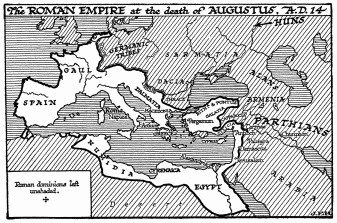
With Cæsar, the civilization of Europe and Western Asia went back to monarchy, and, through monarchy, assisted presently by organized Christianity, it sought to achieve peace, righteousness, happiness, and world order for close upon eighteen centuries. Then almost suddenly it began reverting to republicanism, first in one country and then in another, and, assisted by the new powers of printing and the press and of organized general education, and by the universalist religious ideas in which the world had been soaked for generations, it has now resumed again the effort to create a republican world-state and a world-wide scheme of economic righteousness which the Romans had made so prematurely and in which they had so utterly and disastrously failed.
Certain conditions, we are now beginning to perceive, are absolutely necessary to such a creation; conditions which it is inconceivable that any pre-Christian Roman could have regarded as possible. We may still think the attainment of these conditions a vastly laborious and difficult and uncertain undertaking, but we understand that the attempt must be made because no other prospect before us gives even a promise of happiness or self-respect or preservation of our kind. The first of these conditions is that there should be a common political idea in the minds of all men, an idea of the state thought of as the personal possession of each individual and as the backbone fact of his scheme of duties. In the early days of Rome, when it was a little visible state, twenty miles square, such notions could be and were developed in children in their homes, and by what they saw and heard of the political lives of their fathers; but in a larger country such as Rome had already become before the war with Pyrrhus, there was a need of an organized teaching of the history, of the main laws, and of the general intentions of the state towards everyone if this moral unity was to be maintained. But the need was never realized, and no attempt at any such teaching was ever made. At the time it could not have been made. It is inconceivable that it could have been made. The knowledge was not there, and there existed no class from which the needed teachers could be drawn and no conception of an organization for any such systematic moral and intellectual training as the teaching organization of Christianity, with its creeds and catechisms and sermons and confirmations, presently supplied.
Moreover, we know nowadays that even a universal education of this sort supplies only the basis for a healthy republican state. Next to education there must come abundant, prompt, and truthful information of what is going on in the state, and frank and free discussion of the issues of the time. Even nowadays these functions are performed only very imperfectly and badly by the press we have and by our publicists and politicians; but badly though it is done, the thing is done, and the fact that it is done at all argues that it may ultimately be done well. In the Roman state it was not even attempted. The Roman citizen got his political facts from rumour and the occasional orator. He stood wedged in the forum, imperfectly hearing a distant speaker. He probably misconceived every issue upon which he voted.
And of the monstrous ineffectiveness of the Roman voting system we have already written.
Unable to surmount or remove these obstacles to a sane and effective popular government, the political instincts of the Roman mind turned towards monarchy. But it was not monarchy of the later European type, not hereditary monarchy, which was now installed in Rome. The princeps was really like an American war-time president elected not for four years, but for life, able to appoint senators instead of being restrained by an elected senate, and with a rabble popular meeting in the place of the house of representatives. He was also pontifex maximus, chief of the sacrificial priests, a function unknown at Washington; and in practice it became usual for him to designate and train his successor and to select for that honour a son or an adopted son or a near relation whom he could trust. The power of the princeps was in itself enormous to entrust to the hands of a single man without any adequate checks, but it was further enhanced by the tradition of monarch-worship which had now spread out from Egypt over the entire Hellenized east, and which was coming to Rome in the head of every Oriental slave and immigrant. By natural and imperceptible degrees the idea of the god emperor came to dominate the whole Romanized world.
Only one thing presently remained to remind the god emperor that he was mortal, and that was the army. The god emperor was never safe upon the Olympus of the Palatine Hill at Rome. He was only secure while he was the beloved captain of his legions. And as a consequence only the hardworking emperors who kept their legions active and in close touch with themselves had long reigns. The sword overhung the emperor and spurred him to incessant activity. If he left things to his generals, one of those generals presently replaced him. This spur was perhaps the redeeming feature of the Roman Imperial system. In the greater, compacter, and securer empire of China there was not the same need of legions, and so there was not the same swift end for lazy or dissipated or juvenile monarchs that overtook such types in Rome.
XXIX THE CÆSARS BETWEEN THE SEA AND THE GREAT PLAINS OF THE OLD WORLD[256]
§ 1. A Short Catalogue of Emperors. § 2. Roman Civilization at its Zenith. § 3. Limitations of the Roman Mind. § 4. The Stir of the Great Plains. § 5. The Western (true Roman) Empire crumples up. § 6. The Eastern (revived Hellenic) Empire.
§ 1
WESTERN writers are apt, through their patriotic predispositions, to overestimate the organization, civilizing work, and security of the absolute monarchy that established itself in Rome after the accession of Augustus Cæsar. From it we derive the political traditions of Britain, France, Spain, Germany, and Italy, and these countries loom big in the perspectives of European writers. By the scale of a world history the Roman Empire ceases to seem so overwhelmingly important. It lasted about four centuries in all before it was completely shattered. The Byzantine Empire was no genuine continuation of it; it was a resumption of the Hellenic Empire of Alexander; it spoke Greek; its monarch had a Roman title no doubt, but so for that matter had the late Tsar of Bulgaria. During its four centuries of life the empire of Rome had phases of division and complete chaos; its prosperous years, if they are gathered together and added up, do not amount in all to a couple of centuries. Compared with the quiet steady expansion, the security, and the civilizing task of the contemporary Chinese Empire, or with Egypt between 4000 and 1000 B.C., orwith Sumeria before the Semitic conquest, this amounts to a mere incident in history. The Persian Empire of Cyrus, again, which reached from the Hellespont to the Indus, had as high a standard of civilization; and its homelands remained unconquered and fairly prosperous for over two hundred years. Its predecessor, the Median Empire, had endured for half a century. After a brief submergence by Alexander the Great, it rose again as the Seleucid Empire, which endured for some centuries. The Seleucid dominion shrank at last to the west of the Euphrates, and became a part of the Roman Empire; but Persia, revived by the Parthians as a new Persian Empire, first under the Arsacids and then under the Sassanids, outlived the empire of Rome. The Sassanids repeatedly carried war into the Byzantine Empire, and held the line of the Euphrates steadfastly. In 616 A.D. under Chosroes II, they were holding Damascus, Jerusalem, and Egypt, and threatening the Hellespont. But there has been no tradition to keep alive the glories of the Sassanids. The reputation of Rome has flourished through the prosperity of her heirs. The tradition of Rome is greater than its reality.
History distinguishes two chief groups of Roman emperors who were great administrators. The first of these groups began with:—
Augustus Cæsar (27 B.C. to 14 A.D.), the Octavian of the previous section, who worked hard at the reorganization of the provincial governments and at financial reform. He established a certain tradition of lawfulness and honesty in the bureaucracy, and he restrained the more monstrous corruptions and tyrannies by giving the provincial citizen the right to appeal to Cæsar. But he fixed the European boundaries of the empire along the Rhine and Danube, so leaving Germany, which is the necessary backbone of a safe and prosperous Europe, to barbarism; and he made a similar limitation in the east at the Euphrates, leaving Armenia independent, to be a constant bone of contention with the Arsacids and Sassanids. It is doubtful whether he considered that he was fixing the final boundaries of the empire along these lines, or whether he thought it desirable to consolidate for some years before any further attempts at expansion.
Tiberius (14 to 37 A.D.) is also described as a capable ruler, but he became intensely unpopular in Rome, and it would seem that he was addicted to gross and abominable vices. But his indulgence in these and his personal tyrannies and cruelties did not interfere with the general prosperity of the empire. It is difficult to judge him; nearly all our sources of information are manifestly hostile to him.
Caligula (37 to 41 A.D.) was insane, but the empire carried on during four years of eccentricity at its head. Finally he was murdered in his palace by his servants, and there seems to have been an attempt to restore the senatorial government, an attempt which was promptly suppressed by the household legions.
Claudius (41 to 54 A.D.), the uncle of Caligula, upon whom the choice of the soldiers fell, was personally uncouth, but he seems to have been a hardworking and fairly capable administrator. He advanced the westward boundary of the empire by annexing the southern half of Britain. He was poisoned by Agrippina, the mother of his adopted son, Nero, and a woman of great charm and force of character.
Nero (54 to 68 A.D.), like Tiberius, is credited with monstrous vices and cruelties, but the empire had acquired sufficient momentum to carry on through his fourteen years of power. He certainly murdered his devoted but troublesome mother and his wife, the latter as a mark of devotion to a lady, Poppæa, who then married him; but the domestic infelicities of the Cæsars are no part of our present story. The reader greedy for criminal particulars must go to the classical source, Suetonius. These various Cæsars and their successors and their womenkind were probably no worse essentially than most weak and passionate human beings, but they had no real religion, being themselves gods; they had no wide knowledge on which to build high ambitions, their women were fierce and often illiterate, and they were under no restraints of law or custom. They were surrounded by creatures ready to stimulate their slightest wishes and to translate their vaguest impulses into action. What are mere passing black thoughts and angry impulses with most of us became therefore deeds with them. Before a man condemns Nero as a different species of being from himself, he should examine his own secret thoughts very carefully. Nero became intensely unpopular in Rome, and it is interesting to note that he became unpopular not because he murdered and poisoned his intimate relations, but because there was an insurrection in Britain under a certain Queen Boadicea, and the Roman forces suffered a great disaster (61 A.D.), and because there was a destructive earthquake in Southern Italy. The Roman population, true to its Etruscan streak, never religious and always superstitious, did not mind a wicked Cæsar, but it did object strongly to an unpropitious one. The Spanish legions rose in insurrection under an elderly general of seventy-three, Galba, whom they acclaimed emperor. He advanced upon Rome carried in a litter. Nero, hopeless of support, committed suicide (68 A.D.).
Galba, however, was only one of a group of would-be emperors. The generals in command of the Rhine legions, the Palatine troops, and the eastern armies, each attempted to seize power. Rome saw four emperors in a year, Galba, Otho, Vitellus, and Vespasian; the fourth, Vespasian (69-79 A.D.), from the eastern command, had the firmest grip, and held and kept the prize. But with Nero the line of Cæsars born or adopted ended. Cæsar ceased to be the family name of the Roman emperors, and became a title, Divus Cæsar, the Cæsar god. The monarchy took a step forward towards orientalism by an increased insistence upon the worship of the ruler.
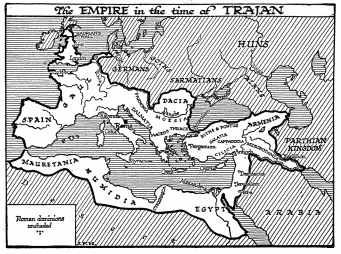
Vespasian (69 to 79 A.D.) and his sons Titus (79 A.D.) and Domitian (81 A.D.) constitute, as it were, a second dynasty, the Flavian; then after the assassination of Domitian came a group of emperors related to one another not by blood, but by adoption, the adoptive emperors. Nerva (96 A.D.) was the first of this line, and Trajan (98 A.D.) the second. They were followed by the indefatigable Hadrian (117 A.D.), Antoninus Pius (138 A.D.), and Marcus Aurelius (161 to 180 A.D.). Under both the Flavians and the Antonines the boundaries of the empire crept forward again. North Britain was annexed in 84 A.D., the angle of the Rhine and Danube was filled in, and what is now Transylvania was made into a new province, Dacia. Trajan also invaded Parthia and annexed Armenia, Assyria, and Mesopotamia. Under his rule the empire reached its maximum extent. Hadrian, his successor, was of a cautious and retractile disposition. He abandoned these new eastern conquests of Trajan’s, and he also abandoned North Britain. He adopted the Chinese idea of the limiting wall against barbarism, an excellent idea so long as the pressure of population on the imperial side of the wall is greater than the pressure from without, but worthless otherwise. He built Hadrian’s wall across Britain, and a palisade between the Rhine and the Danube. The full tide of Roman expansion was past, and in the reign of his successor the North European frontier was already actively on the defensive against the aggression of Teutonic and Slavic tribes.
Marcus Aurelius Antoninus is one of those figures in history about which men differ widely and intensely. To some critics he seems to have been a priggish person; he dabbled in religions, and took a pleasure in conducting priestly ceremonies in priestly garments—a disposition offensive to common men—and they resent his alleged failure to restrain the wickedness of his wife Faustina. The stories of his domestic infelicity, however, rest on no very good foundations, though certainly his son Commodus was a startling person for a good home to produce. On the other hand, he was unquestionably a devoted and industrious emperor, holding social order together through a series of disastrous years of vile weather, great floods, failing harvests and famine, barbaric raids and revolts, and at last a terrible universal pestilence. Says F. W. Farrar, quoted in the Encyclopædia Britannica, “He regarded himself as being, in fact, the servant of all. The registry of the citizens, the suppression of litigation, the elevation of public morals, the care of minors, the retrenchment of public expenses, the limitation of gladiatorial games and shows, the care of roads, the restoration of senatorial privileges, the appointment of none but worthy magistrates, even the regulation of street traffic, these and numberless other duties so completely absorbed his attention that, in spite of indifferent health, they often kept him at severe labour from early morning till long after midnight. His position, indeed, often necessitated his presence at games and shows; but on these occasions he occupied himself either in reading, or being read to, or in writing notes. He was one of those who held that nothing should be done hastily, and that few crimes were worse than waste of time.”
But it is not by these industries that he is now remembered. He was one of the greatest exponents of the Stoical philosophy, and in his Meditations, jotted down in camp and court, he has put so much of a human soul on record as to raise up for himself in each generation a fresh series of friends and admirers.
With the death of Marcus Aurelius this phase of unity and comparatively good government came to an end, and his son Commodus inaugurated an age of disorder. Practically the empire had been at peace within itself for two hundred years. Now for a hundred years the student of Roman history must master the various criminology of a number of inadequate emperors, while the frontier crumbled and receded under barbarian pressure. One or two names only seem to be the names of able men: such were Septimius Severus, Aurelian, and Probus. Septimius Severus was a Carthaginian, and his sister was never able to master Latin. She conducted her Roman household in the Punic language, which must have made Cato the elder turn in his grave. The rest of the emperors of this period were chiefly adventurers too unimportant to the general scheme of things for us to note. At times there were separate emperors ruling in different parts of the distracted empire. From our present point of view the Emperor Decius, who was defeated and killed during a great raid of the Goths into Thrace in 251 A.D., and the Emperor Valerian, who, together with the great city of Antioch, was captured by the Sassanid Shah of Persia in 260 A.D., are worthy of notice because they mark the insecurity of the whole Roman system, and the character of the outer pressure upon it. So too is Claudius, “the Conqueror of the Goths,” because he gained a great victory over these people at Nish in Serbia (270 A.D.), and because he died, like Pericles, of the plague.
Through all these centuries intermittent pestilences were playing a part in weakening races and altering social conditions, a part that has still to be properly worked out by historians. There was, for instance, a great plague throughout the empire between the years 164 and 180 A.D. in the reign of the Emperor Marcus Aurelius. It probably did much to disorganize social life and prepare the way for the troubles that followed the accession of Commodus. This same pestilence devastated China, as we shall note in § 4 of this chapter. Considerable fluctuations of climate had also been going on in the first and second centuries, producing stresses and shiftings of population, whose force historians have still to appraise. But before we go on to tell of the irruptions of the barbarians and the attempts of such later emperors as Diocletian (284 A.D.) and Constantine the Great (312 A.D.) to hold together the heaving and splitting vessel of the state we must describe something of the conditions of human life in the Roman Empire during its two centuries of prosperity.
§ 2
The impatient reader of history may be disposed to count the two centuries of order between 27 B.C. and 180 A.D. as among the wasted opportunities of mankind. It was an age of spending rather than of creation, an age of architecture and trade in which the rich grew richer and the poor poorer and the soul and spirit of man decayed. Looked at superficially, as a man might have looked at it from an aeroplane a couple of thousand feet in the air, there was a considerable flourish of prosperity. Everywhere, from York to Cyrene and from Lisbon to Antioch, he would have noted large and well-built cities, with temples, theatres, amphitheatres, markets, and the like; thousands of such cities, supplied by great aqueducts and served by splendid high roads, whose stately remains astonish us to this day. He would have noted an abundant cultivation, and have soared too high to discover that this cultivation was the grudging work of slaves. Upon the Mediterranean and the Red Sea a considerable traffic would be visible; and the sight of two ships alongside each other would not at that altitude reveal the fact that one was a pirate and plundering the other.
And even if the observer came down to a closer scrutiny, there would still be much accumulated improvement to note. There had been a softening of manners and a general refinement since the days of Julius Cæsar. With this there had been a real increase of humane feeling. During the period of the Antonines, laws for the protection of slaves from extreme cruelty came into existence, and it was no longer permissible to sell them to the gladiatorial schools. Not only were the cities outwardly more splendidly built, but within the homes of the wealthy there had been great advances in the art of decoration. The gross feasting, animal indulgence, and vulgar display of the earlier days of Roman prosperity were now tempered by a certain refinement. Dress had become richer, finer, and more beautiful. There was a great trade in silk with remote China, for the mulberry tree and the silkworm had not yet begun to move west. By the time silk had ended its long and varied journey to Rome it was worth its weight in gold. Yet it was used abundantly, and there was a steady flow of the precious metals eastward in exchange. There had been very considerable advances in gastronomy and the arts of entertainment. Petronius describes a feast given by a wealthy man under the early Cæsars, a remarkable succession of courses, some delicious, some amazing, exceeding anything that even the splendours and imagination of modern New York could produce; and the festival was varied by music and by displays of tight-rope dancing, juggling, Homeric recitations, and the like. There was a considerable amount of what we may describe as “rich men’s culture” throughout the empire. Books were far more plentiful than they had been before the time of the Cæsars. Men prided themselves upon their libraries, even when the cares and responsibilities of property made them too busy to give their literary treasures much more than a passing examination. The knowledge of Greek spread eastward and of Latin westward, and if the prominent men of this or that British or Gallic city lacked any profound Greek culture themselves, they could always turn to some slave or other, whose learning had been guaranteed of the highest quality by the slave-dealer, to supply the deficiency.
The generation of Cato had despised Greeks and the Greek language, but now all that was changed. The prestige of Greek learning of an approved and settled type was as high in the Rome of Antoninus Pius as it was in the Oxford and Cambridge of Victorian England. The Greek scholar received the same mixture of unintelligent deference and practical contempt. There was a very considerable amount of Greek scholarship, and of written criticism and commentary. Indeed there was so great an admiration for Greek letters as almost completely to destroy the Greek spirit; and the recorded observations of Aristotle were valued so highly as to preclude any attempt to imitate his organization of further inquiry. It is noteworthy that while Aristotle in the original Greek fell like seed upon stony soil in the Roman world, he was, in Syrian and Arabic translations, immensely stimulating to the Arabic civilization of a thousand years later. Nor were the æsthetic claims of Latin neglected in this heyday of Greek erudition. As Greece had her epics and so forth, the Romans felt that they too must have their epics. The age of Augustus was an age of imitative literature. Virgil in the Æneid set himself modestly but resolutely, and with an elegant sort of successfulness, to parallel Homer, just as Lord Tennyson, the poet laureate of Queen Victoria, using the mediæval literature about King Arthur as his material, did a similar service for Great Britain in his Idylls of the King.
All this wide-spread culture of the wealthy householder is to the credit of the early Roman Empire, and Gibbon makes the most of it in the sunny review of the age of the Antonines with which he opens his Decline and Fall of the Roman Empire. His design for that great work demanded a prelude of splendour and tranquillity. But he was far too shrewd and subtle not to qualify his apparent approval of the conditions he describes. “Under the Roman Empire,” he writes, “the labour of an industrious and ingenious people was variously but incessantly employed in the service of the rich. In their dress, their table, their houses, and their furniture, the favourites of fortune united every refinement of convenience, of elegance, and of splendour, whatever could soothe their pride, or gratify their sensuality. Such refinements, under the odious name of luxury, have been severely arraigned by the moralists of every age; and it might perhaps be more conducive to the virtue, as well as happiness, of mankind, if all possessed the necessaries, and none the superfluities of life. But in the present imperfect condition of society, luxury, though it may proceed from vice or folly, seems to be the only means that can correct the unequal distribution of property. The diligent mechanic and the skilful artist, who have obtained no share in the division of the earth, receive a voluntary tax from the possessors of land; and the latter are prompted, by a sense of interest, to improve those estates, with whose produce they may purchase additional pleasure. This operation, the particular effects of which are felt in every society, acted with much more diffuse energy in the Roman world. The provinces would soon have been exhausted of their wealth, if the manufactures and commerce of luxury had not insensibly restored to the industrious subjects the sums which were exacted from them by the arms and authority of Rome.” And so on, with a sting of satire in every fold of the florid description.
If we look a little more widely than a hovering aeroplane can do at the movement of races upon the earth, or a little more closely than an inspection of streets, amphitheatres, and banquets goes, into the souls and thoughts of men, we shall find that this impressive display of material prosperity is merely the shining garment of a polity blind to things without and things within, and blind to the future. If, for instance, we compare the two centuries of Roman ascendancy and opportunity, the first and second centuries A.D., with the two centuries of Greek and Hellenic life beginning about 466 B.C. with the supremacy of Pericles in Athens, we are amazed by—we cannot call it an inferiority, it is a complete absence of science. The incuriousness of the Roman rich and the Roman rulers was more massive and monumental even than their architecture.
In one field of knowledge particularly we might have expected the Romans to have been alert and enterprising, and that was geography. Their political interests demanded a steadfast inquiry into the state of affairs beyond their frontiers, and yet that inquiry was never made. There is practically no literature of Roman travel beyond the imperial limits, no such keen and curious accounts as Herodotus gives of the Scythians, the Africans, and the like. There is nothing in Latin to compare with the early descriptions of India and Siberia that are to be found in Chinese. The Roman legions went at one time into Scotland, yet there remains no really intelligent account of Picts or Scots, much less any glance at the seas beyond. Such explorations as those of Hanno or Pharaoh Necho seem to have been altogether beyond the scope of the Roman imagination. It is probable that after the destruction of Carthage the amount of shipping that went out into the Atlantic through the Straits of Gibraltar fell to inconsiderable proportions. Still more impossible in this world of vulgar wealth, enslaved intelligence, and bureaucratic rule was any further development of the astronomy and physiography of Alexandria. The Romans do not seem even to have inquired what manner of men wove the silk and prepared the spices or collected the amber and the pearls that came into their markets. Yet the channels of inquiry were open and easy; pathways led in every direction to the most convenient “jumping-off places” for explorers it is possible to imagine.
“The most remote countries of the ancient world were ransacked to supply the pomp and delicacy of Rome. The forests of Scythia afforded some valuable furs. Amber was brought overland from the shores of the Baltic to the Danube, and the barbarians were astonished at the price which they received in exchange for so useless a commodity. There was a considerable demand for Babylonian carpets and other manufactures of the East; but the most important branch of foreign trade was carried on with Arabia and India. Every year, about the time of the summer solstice, a fleet of a hundred and twenty vessels sailed from Myos-hormos, a port of Egypt on the Red Sea. By the periodical assistance of the monsoons, they traversed the ocean in about forty days. The coast of Malabar, or the island of Ceylon, was the usual term of their navigation, and it was in those markets that the merchants from the more remote countries of Asia expected their arrival. The return of the fleet to Egypt was fixed to the months of December or January, and as soon as their rich cargo had been transported, on the backs of camels, from the Red Sea to the Nile, and had descended that river as far as Alexandria, it was poured, without delay, into the capital of the empire.”[257]
Yet Rome was content to feast, exact, grow rich, and watch its gladiatorial shows without the slightest attempt to learn anything of India, China, Persia or Scythia, Buddha or Zoroaster, or about the Huns, the Negroes, the people of Scandinavia, or the secrets of the western sea.
When we realize the uninspiring quality of the social atmosphere which made this indifference possible, we are able to account for the failure of Rome during its age of opportunity to develop any physical or chemical science, and as a consequence to gain any increased control over matter. Most of the physicians in Rome were Greeks and many of them slaves—for the Roman wealthy did not even understand that a bought mind is a spoilt mind. Yet this was not due to any want of natural genius among the Roman people; it was due entirely to their social and economic conditions. From the Middle Ages to the present day Italy has produced a great number of brilliant scientific men. And one of the most shrewd and inspired of scientific writers was an Italian, Lucretius, who lived between the time of Marius and Julius Cæsar (about 100 B.C. to about 55 B.C.). This amazing man was of the quality of Leonardo da Vinci (also an Italian) or Newton. He wrote a long Latin poem about the processes of Nature, De Rerum Natura, in which he guessed with astonishing insight about the constitution of matter and about the early history of mankind. Osborn in his Old Stone Age quotes with admiration long passages from Lucretius about primitive man, so good and true are they to-day. But this was an individual display, a seed that bore no fruit. Roman science was stillborn, into a suffocating atmosphere of vile wealth and military oppression. The true figure to represent the classical Roman attitude to science is not Lucretius, but that Roman soldier who hacked Archimedes to death at the storming of Syracuse.
And if physical and biological science wilted and died on the stony soil of Roman prosperity, political and social science never had a chance to germinate. Political discussion would have been treason to the emperor, social or economic inquiry would have threatened the rich. So Rome, until disaster fell upon her, never examined into her own social health, never questioned the ultimate value of her hard officialism. Consequently, there was no one who realized the gravity of her failure to develop any intellectual imagination to hold her empire together, any general education in common ideas that would make men fight and work for the empire as men will fight and work for a dear possession. But the rulers of the Roman Empire did not want their citizens to fight for anything in any spirit at all. The rich had eaten the heart out of their general population, and they were content with the meal they had made. The legions were filled with Germans, Britons, Numidians, and the like; and until the very end the wealthy Romans thought they could go on buying barbarians to defend them against the enemy without and the rebel poor within. How little was done in education by the Romans is shown by an account of what was done. Says Mr. H. Stuart Jones,[258] “Julius Cæsar bestowed Roman citizenship on ‘teachers of the liberal arts’; Vespasian endowed professorships of Greek and Latin oratory at Rome; and later emperors, especially Antoninus Pius, extended the same benefits to the provinces. Local enterprise and munificence were also devoted to the cause of education; we learn from the correspondence of the younger Pliny that public schools were founded in the towns of Northern Italy. But though there was a wide diffusion of knowledge under the empire, there was no true intellectual progress. Augustus, it is true, gathered about him;the most brilliant writers of his time, and the début of the new monarchy coincided with the Golden Age of Roman literature; but this was of brief duration, and the beginnings of the Christian era saw the triumph of classicism and the first steps in the decline which awaits all literary movements which look to the past rather than the future.”
There is a diagnosis of the intellectual decadence of the age in a treatise upon the sublime by a Greek writer who wrote somewhen in the second, third, or fourth century A.D., and who may possibly have been Longinus Philologus,[259] which states very distinctly one manifest factor in the mental sickness of the Roman world. He is cited by Gibbon: “The sublime Longinus, who, in somewhat a later period and in the court of a Syrian queen, preserved the spirit of ancient Athens, observes and laments the degeneracy of his contemporaries, which debased their sentiments, enervated their courage, and depressed their talents. ‘In the same manner,’ says he, ‘as some children always remain pigmies, whose infant limbs have been too closely confined, thus our tender minds, fettered by the prejudices and habits of a just servitude, are unable to expand themselves or to attain that well-proportioned greatness which we admire in the ancients; who, living under a popular government, wrote with all the same freedom as they acted.’”
But this critic grasped only one aspect of the restraints upon mental activity. The leading-strings that kept the Roman mind in a permanent state of infantilism constituted a double servitude; they were economic as well as political. The account Gibbon gives of the life and activities of a certain Herodes Atticus, who lived in the time of Hadrian, shows just how little was the share of the ordinary citizen in the outward magnificence of the time. This Atticus had an immense fortune, and he amused himself by huge architectural benefactions to various cities. Athens was given a racecourse and a theatre of cedar, curiously carved, was set up there to the memory of his wife; a theatre was built at Corinth, a racecourse was given to Delphi, baths to Thermopylæ, an aqueduct to Canusium, and so on and so on. One is struck by the spectacle of a world of slaves and common people who were not consulted and over whose heads, without any participation on their part, this rich man indulged in his displays of “taste.”[260] Numerous inscriptions in Greece and Asia still preserve the name of Herodes Atticus, “patron and benefactor,” who ranged about the empire as though it was his private garden, commemorating himself by these embellishments. He did not confine himself to splendid buildings. He was also a philosopher, though none of his wisdom has survived. He had a large villa near Athens, and there philosophers were welcome guests so long as they convinced their patron of the soundness of their pretensions, received his discourses with respect, and did not offend him by insolent controversy.
The world, it is evident, was not progressing during these two centuries of Roman prosperity. But was it happy in its stagnation? There are signs of a very unmistakable sort that the great mass of human beings in the empire, a mass numbering something between a hundred and a hundred and fifty millions, was not happy, was probably very acutely miserable, beneath its outward magnificence. True there were no great wars and conquests within the empire, little of famine or fire or sword to afflict mankind; but, on the other hand, there was a terrible restraint by government, and still more by the property of the rich, upon the free activities of nearly everyone. Life for the great majority who were neither rich nor official, nor the womankind and the parasites of the rich and official, must have been laborious, tedious, and lacking in interest and freedom to a degree that a modern mind can scarcely imagine.
Three things in particular may be cited to sustain the opinion that this period was a period of widespread unhappiness. The first of these is the extraordinary apathy of the population to political events. They saw one upstart pretender to empire succeed another with complete indifference. Such things did not seem to matter to them; hope had gone. When presently the barbarians poured into the empire, there was nothing but the legions to face them. There was no popular uprising against them at all. Everywhere the barbarians must have been outnumbered if only the people had resisted. But the people did not resist. It is manifest that to the bulk of its inhabitants the Roman Empire did not seem to be a thing worth fighting for. To the slaves and common people the barbarian probably seemed to promise more freedom and less indignity than the pompous rule of the imperial official and grinding employment by the rich. The looting and burning of palaces and an occasional massacre did not shock the folk of the Roman underworld as it shocked the wealthy and cultured people to whom we owe such accounts as we have of the breaking down of the imperial system. Great numbers of slaves and common people probably joined the barbarians, who knew little of racial or patriotic prejudices, and were openhanded to any promising recruit. No doubt in many cases the population found that the barbarian was a worse infliction even than the tax-gatherer and the slave-driver. But that discovery came too late for resistance or the restoration of the old order.
And as a second symptom that points to the same conclusion that life was hardly worth living for the poor and the slaves and the majority of people during the age of the Antonines, we must reckon the steady depopulation of the empire. People refused to have children. They did so, we suggest, because their homes were not safe from oppression, because in the case of slaves there was no security that the husband and wife would not be separated, because there was no pride nor reasonable hope in children any more. In modern states the great breeding-ground has always been the agricultural countryside where there is a more or less secure peasantry; but under the Roman Empire the peasant and the small cultivator was either a worried debtor, or he was held in a network of restraints that made him a spiritless serf, or he had been ousted altogether by the gang production of slaves.
A third indication that this outwardly flourishing period was one of deep unhappiness and mental distress for vast multitudes, is to be found in the spread of new religious movements throughout the population. We have seen how in the case of the little country of Judea a whole nation may be infected by the persuasion that life is unsatisfactory and wrong, and that something is needed to set it right. The mind of the Jews, as we know, had crystallized about the idea of the Promise of the One True God and the coming of a Saviour or Messiah. Rather different ideas from these were spreading through the Roman Empire. They were but varying answers to one universal question: “What must we do for salvation?” A frequent and natural consequence of disgust with life as it is, is to throw the imagination forward to an after-life, which is to redeem all the miseries and injustices of this one. The belief in such compensation is a great opiate for present miseries. Egyptian religion had long been saturated with anticipations of immortality, and we have seen how central was that idea to the cult of Serapis and Isis at Alexandria. The ancient mysteries of Demeter and Orpheus, the mysteries of the Mediterranean race, revived and made a sort of theocrasia with these new cults.
A second great religious movement was Mithraism, a development of Zoroastrianism, a religion of very ancient Aryan origin, traceable back to the Indo-Iranian people before they split into Persians and Hindus. We cannot here examine its mysteries in any detail.[261] Mithras was a god of light, a Sun of Righteousness, and in the shrines of the cult he was always represented as slaying a sacred bull whose blood was the seed of life. Suffice it that, complicated with many added ingredients, this worship of Mithras came into the Roman Empire about the time of Pompey the Great, and began to spread very widely under the Cæsars and Antonines. Like the Isis religion, it promised immortality. Its followers were mainly slaves, soldiers, and distressed people. In its methods of worship, in the burning of candles before the altar and so forth, it had a certain superficial resemblance to the later developments of the ritual of the third great religious movement in the Roman world, Christianity.
Christianity also was a doctrine of immortality and salvation, and it too spread at first chiefly among the lowly and unhappy. Christianity has been denounced by modern writers as a “slave religion.” It was. It took the slaves and the downtrodden, and it gave them hope and restored their self-respect, so that they stood up for righteousness like men and faced persecution and torment. But of the origins and quality of Christianity we will tell more fully in a later chapter.
§ 3
We have already shown reason for our statement that the Roman imperial system was a very unsound political growth indeed. It is absurd to write of its statecraft; it had none. At its best it had a bureaucratic administration which kept the peace of the world for a time and failed altogether to secure it.
Let us note here the main factors in its failure.
The clue to all its failure lies in the absence of any free mental activity and any organization for the increase, development, and application of knowledge. It respected wealth and it despised science. It gave government to the rich, and imagined that wise men could be bought and bargained for in the slave markets when they were needed. It was, therefore, a colossally ignorant and unimaginative empire. It foresaw nothing.
It had no strategic foresight, because it was blankly ignorant of geography and ethnology. It knew nothing of the conditions of Russia, Central Asia, and the East. It was content to keep the Rhine and Danube as its boundaries, and to make no effort to Romanize Germany. But we need only look at the map of Europe and Asia showing the Roman Empire to see that a willing and incorporated Germany was absolutely essential to the life and security of Western Europe. Excluded, Germany became a wedge that needed only the impact of the Hunnish hammer to split up the whole system.
Moreover, this neglect to push the boundaries northward to the Baltic left that sea and the North Sea as a region of experiment and training and instruction in seamanship for the Northmen of Scandinavia, Denmark, and the Frisian coast. But Rome went on its way quite stupidly, oblivious to the growth of a newer and more powerful piracy in the north.
The same unimaginative quality made the Romans leave the seaways of the Mediterranean undeveloped. When presently the barbarians pressed down to the warm water, we read of no swift transport of armies from Spain or Africa or Asia to the rescue of Italy and the Adriatic coasts. Instead, we see the Vandals becoming masters of the western Mediterranean without so much as a naval battle.
The Romans had been held at the Euphrates by an array of mounted archers. It was clear that as the legion was organized it was useless in wide open country, and it should have been equally clear that sooner or later the mounted nomads of east Germany, south Russia, or Parthia were bound to try conclusions with the empire. But the Romans, two hundred years after Cæsar’s time, were still marching about, the same drilled and clanking cohorts they had always been, easily ridden round and shot to pieces. The empire had learnt nothing even from Carrhæ.
The incapacity of the Roman imperialism for novelty in methods of transport again is amazing. It was patent that their power and unity depended upon the swift movement of troops and supplies from one part of the empire to another. The republic made magnificent roads; the empire never improved upon them. Four hundred years before the Antonines, Hero of Alexandria had made the first steam-engine. Beautiful records of such beginnings of science were among the neglected treasures of the rich men’s libraries throughout the imperial domains. They were seed lying on stony ground. The armies and couriers of Marcus Aurelius drudged along the roads exactly as the armies of Scipio Africanus had done three centuries before them.
The Roman writers were always lamenting the effeminacy of the age. It was their favourite cant. They recognized that the free men of the forest and steppes and desert were harder and more desperate fighters than their citizens, but the natural corollary of developing the industrial power of their accumulations of population to make a countervailing equipment never entered their heads. Instead they took the barbarians into their legions, taught them the arts of war, marched them about the empire, and returned them, with their lesson well learnt, to their own people.
In view of these obvious negligences, it is no wonder that the Romans disregarded that more subtle thing, the soul of the empire altogether, and made no effort to teach or train or win its common people into any conscious participation with its life. Such teaching or training would indeed have run counter to all the ideas of the rich men and the imperial officials. They had made a tool of religion; science, literature, and education they had entrusted to the care of slaves, who were bred and trained and sold like dogs or horses; ignorant, pompous, and base, the Roman adventurers of finance and property who created the empire lorded it with a sense of the utmost security while their destruction gathered without the empire and within.
By the second and third centuries A.D. the overtaxed and overstrained imperial machine was already staggering towards its downfall.
§ 4[262]
And now it is necessary, if we are to understand clearly the true situation of the Roman Empire, to turn our eyes to the world beyond its northern and eastern borders, the world of the plains, that stretches, with scarcely a break, from Holland across Germany and Russia to the mountains of Central Asia and Mongolia, and to give a little attention to the parallel empire in China that was now consolidating and developing a far tougher and more enduring moral and intellectual unity than the Romans ever achieved.