BOOK VII THE MONGOL EMPIRES OF THE LAND WAYS AND THE NEW EMPIRES OF THE SEA WAYS
Reading edition
XXXIV THE GREAT EMPIRE OF JENGIS KHAN AND HIS SUCCESSORS (The Age of the Land Ways)
§ 1. Asia at the end of the Twelfth Century. § 2. The Rise and Victories of the Mongols. § 3. The Travels of Marco Polo. § 4. The Ottoman Turks and Constantinople. § 5. Why the Mongols were not Christianized. § 5A. Kublai Khan founds the Yuan Dynasty. § 5B. The Mongols Revert to Tribalism. § 5C. The Kipchak Empire and the Tsar of Muscovy. § 5D. Timurlane. § 5E. The Mongol Empire of India. § 5F. The Mongols and the Gipsies.
§ 1
WE have to tell now of the last and greatest of all the raids of nomadism upon the civilizations of the East and West. We have traced in this history the development side by side of these two ways of living, and we have pointed out that as the civilizations grew more extensive and better organized, the arms, the mobility, and the intelligence of the nomads also improved. The nomad was not simply an uncivilized man, he was a man specialized and specializing along his own line. From the very beginning of history the nomad and the settled people have been in reaction. We have told of the Semitic and Elamite raids upon Sumeria; we have seen the Western empire smashed by the nomads of the great plains and Persia conquered and Byzantium shaken by the nomads of Arabia. Whenever civilization seems to be choking amidst its weeds of wealth and debt and servitude, when its faiths seem rotting into cynicism and its powers of further growth are hopelessly entangled in effete formulæ, the nomad drives in like a plough to break up the festering stagnation and release the world to new beginnings. The Mongol aggression, which began with the thirteenth century, was the greatest, and so far it has been the last, of all these destructive reploughings of human association.
From entire obscurity the Mongols came very suddenly into history towards the close of the twelfth century. They appeared in the country to the north of China, in the land of origin of the Huns and Turks, and they were manifestly of the same strain as these peoples. They were gathered together under a chief, with whose name we will not tax the memory of the reader; under his son Jengis Khan their power grew with extraordinary swiftness.
The reader will already have an idea of the gradual breaking up of the original unity of Islam. In the beginning of the thirteenth century there were a number of separate and discordant Moslem states in Western Asia. There was Egypt (with Palestine and much of Syria) under the successors of Saladin, there was the Seljuk power in Asia Minor, there was still an Abbasid caliphate in Bagdad, and to the east of this again there had grown up a very considerable empire, the Kharismian empire, that of the Turkish princes from Khiva who had conquered a number of fragmentary Seljuk principalities and reigned from the Ganges Valley to the Tigris. They had but an insecure hold on the Persian and Indian populations.

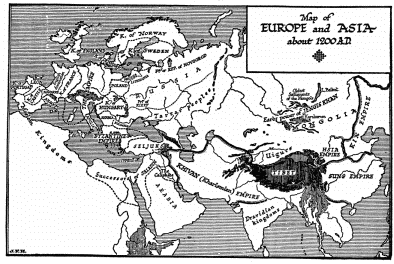
The state of the Chinese civilization was equally inviting to an enterprising invader. One last glimpse of China in this history was in the seventh century during the opening years of the Tang dynasty, when that shrewd and able emperor Tai-tsung was weighing the respective merits of Nestorian Christianity, Islam, Buddhism, and the teachings of Lao Tse, and on the whole inclining to the opinion that Lao Tse was as good a teacher as any. We have described his reception of the traveller Yuan Chwang. Tai-tsung tolerated all religions, but several of his successors conducted a pitiless persecution of the Buddhist faith; it flourished in spite of these persecutions, and its monasteries played a somewhat analogous part in at first sustaining learning and afterwards retarding it, that the Christian monastic organization did in the West. By the tenth century the great Tang dynasty was in an extreme state of decay; the usual degenerative process through a series of voluptuaries and incapables had gone on, and China broke up again politically into a variable number of contending states, “The age of the Ten States,” an age of confusion that lasted through the first half of the tenth century. Then arose a dynasty, the Northern Sung (960-1127), which established a sort of unity, but which was in constant struggle with a number of Hunnish peoples from the north who were pressing down the eastern coast. For a time one of these peoples, the Khitan, prevailed. In the twelfth century these people had been subjugated and had given place to another Hunnish empire, the empire of the Kin, with its capital at Pekin and its southern boundary south of Hwangho. The Sung empire shrank before this Kin empire. In 1138 the capital was shifted from Nankin, which was now too close to the northern frontier, to the city of Han Chau on the coast. From 1127 onward to 1295, the Sung dynasty is known as the Southern Sung. To the northwest of its territories there was now the Tartar empire of the Hsia; to the north, the Kin empire, both states in which the Chinese population was under rulers in whom nomadic traditions were still strong. So that here on the east also the main masses of Asiatic mankind were under uncongenial rulers and ready to accept, if not to welcome, the arrival of a conqueror.
Northern India we have already noted was also a conquered country at the opening of the thirteenth century. It was at first a part of the Khivan empire, but in 1206 an adventurous ruler, Kutub, who had been a slave and who had risen as a slave to be governor of the Indian province, set up a separate Moslem state of Hindustan in Delhi. Brahminism had long since ousted Buddhism from India, but the converts to Islam were still but a small ruling minority in the land.
Such was the political state of Asia when Jengis Khan began to consolidate his power among the nomads in the country between Lakes Balkash and Baikal in the beginning of the thirteenth century.
§ 2
The career of conquest of Jengis Khan and his immediate successors astounded the world, and probably astounded no one more than these Mongol Khans themselves.
The Mongols were in the twelfth century a tribe subject to those Kin who had conquered Northeast China. They were a horde of nomadic horsemen living in tents, and subsisting mainly upon mare’s milk products and meat. Their occupations were pasturage and hunting, varied by war. They drifted northward as the snows melted for summer pasture, and southward to winter pasture after the custom of the steppes. Their military education began with a successful insurrection against the Kin. The empire of Kin had the resources of half China behind it, and in the struggle the Mongols learnt very much of the military science of the Chinese. By the end of the twelfth century they were already a fighting tribe of exceptional quality.
The opening years of the career of Jengis were spent in developing his military machine, in assimilating the Mongols and the associated tribes about them into one organized army. His first considerable extension of power was westward, when the Tartar Kirghis and the Uigurs (who were the Tartar people of the Tarim basin) were not so much conquered as induced to join his organization. He then attacked the Kin empire and took Pekin (1214). The Khitan people, who had been so recently subdued by the Kin, threw in their fortunes with his, and were of very great help to him. The settled Chinese population went on sowing and reaping and trading during this change of masters without lending its weight to either side.
We have already mentioned the very recent Kharismian empire of Turkestan, Persia, and North India. This empire extended eastward to Kashgar, and it must have seemed one of the most progressive and hopeful empires of the time. Jengis Khan, while still engaged in this war with the Kin empire, sent envoys to Kharismia. They were put to death, an almost incredible stupidity. The Kharismian government, to use the political jargon of to-day, had decided not to “recognize” Jengis Khan, and took this spirited course with him. Thereupon (1218) the great host of horsemen that Jengis Khan had consolidated and disciplined swept over the Pamirs and down into Turkestan. It was well armed, and probably it had some guns and gunpowder for siege work—for the Chinese were certainly using gunpowder at this time, and the Mongols learnt its use from them. Kashgar, Khokand, Bokhara fell and then Samarkand, the capital of the Kharismian empire. Thereafter nothing held the Mongols in the Kharismian territories. They swept westward to the Caspian, and southward as far as Lahore. To the north of the Caspian a Mongol army encountered a Russian force from Kieff. There was a series of battles, in which the Russian armies were finally defeated and the Grand Duke of Kieff taken prisoner. So it was the Mongols appeared on the northern shores of the Black Sea. A panic swept Constantinople, which set itself to reconstruct its fortifications. Meanwhile other armies were engaged in the conquest of the empire of the Hsia in China. This was annexed, and only the southern part of the Kin empire remained unsubdued. In 1227 Jengis Khan died in the midst of a career of triumph. His empire reached already from the Pacific to the Dnieper. And it was an empire still vigorously expanding.
Like all the empires founded by nomads, it was, to begin with, purely a military and administrative empire, a framework rather than a rule. It centred on the personality of the monarch, and its relations with the mass of the populations over which it ruled was simply one of taxation for the maintenance of the horde. But Jengis Khan had called to his aid a very able and experienced administrator of the Kin empire, who was learned in all the traditions and science of the Chinese. This statesman, Yeliu Chutsai, was able to carry on the affairs of the Mongols long after the death of Jengis Khan, and there can be little doubt that he is one of the great political heroes of history. He tempered the barbaric ferocity of his masters, and saved innumerable cities and works of art from destruction. He collected archives and inscriptions, and when he was accused of corruption, his sole wealth was found to consist of documents and a few musical instruments. To him perhaps quite as much as to Jengis is the efficiency of the Mongol military machine to be ascribed. Under Jengis, we may note further, we find the completest religious toleration established across the entire breadth of Asia.
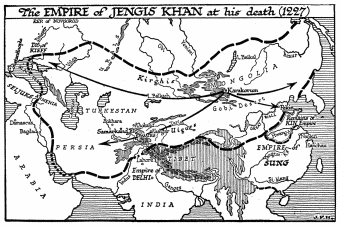
At the death of Jengis the capital of the new empire was still in the great barbaric town of Karakorum in Mongolia. There an assembly of Mongol leaders elected Ogdai Khan, the son of Jengis, as his successor. The war against the vestiges of the Kin empire was prosecuted until Kin was altogether subdued (1234). The Chinese empire to the south under the Sung dynasty helped the Mongols in this task, so destroying their own bulwark against the universal conquerors. The Mongol hosts then swept right across Asia to Russia (1235), an amazing march. Kieff was destroyed in 1240, and nearly all Russia became tributary to the Mongols. Poland was ravaged, and a mixed army of Poles and Germans was annihilated at the battle of Liegnitz in Lower Silesia in 1241. The Emperor Frederick II does not seem to have made any great efforts to stay the advancing tide.
“It is only recently,” says Bury, in his notes to Gibbon’s Decline and Fall of the Roman Empire, “that European history has begun to understand that the successes of the Mongol army which overran Poland and occupied Hungary in the spring of A.D. 1241 were won by consummate strategy and were not due to a mere overwhelming superiority of numbers. But this fact has not yet become a matter of common knowledge; the vulgar opinion which represents the Tartars as a wild horde carrying all before them solely by their multitude, and galloping through Eastern Europe without a strategic plan, rushing at all obstacles and overcoming them by mere weight, still prevails....
“It was wonderful how punctually and effectually the arrangements of the commander were carried out in operations extending from the Lower Vistula to Transylvania. Such a campaign was quite beyond the power of any European army of the time, and it was beyond the vision of any European commander. There was no general in Europe, from Frederick II downward, who was not a tyro in strategy compared to Subutai. It should also be noticed that the Mongols embarked upon the enterprise with full knowledge of the political situation of Hungary and the condition of Poland—they had taken care to inform themselves by a well-organized system of spies; on the other hand, the Hungarians and Christian powers, like childish barbarians, knew hardly anything about their enemies.”
But though the Mongols were victorious at Liegnitz, they did not continue their drive westward. They were getting into woodlands and hilly country, which did not suit their tactics; and so they turned southward and prepared to settle in Hungary, massacring or assimilating the kindred Magyar, even as these had previously massacred and assimilated the mixed Scythians and Avars and Huns before them. From the Hungarian plain they would probably have made raids west and south as the Hungarians had done in the ninth century, the Avars in the seventh and eighth, and the Huns in the fifth. But in Asia the Mongols were fighting a stiff war of conquest against the Sung, and they were also raiding Persia and Asia Minor; Ogdai died suddenly, and in 1242 there was trouble about the succession, and recalled by this, the undefeated hosts of Mongols began to pour back across Hungary and Rumania towards the east.
To the great relief of Europe the dynastic troubles at Karakorum lasted for some years, and this vast new empire showed signs of splitting up. Mangu Khan became the Great Khan in 1251, and he nominated his brother Kublai Khan as Governor-General of China. Slowly but surely the entire Sung empire was subjugated, and as it was subjugated the eastern Mongols became more and more Chinese in their culture and methods. Tibet was invaded and devastated by Mangu, and Persia and Syria invaded in good earnest. Another brother of Mangu, Hulagu, was in command of this latter war. He turned his arms against the caliphate and captured Bagdad, in which city he perpetrated a massacre of the entire population. Bagdad was still the religious capital of Islam, and the Mongols had become bitterly hostile to the Moslems. This hostility exacerbated the natural discord of nomad and townsman. In 1259 Mangu died, and in 1260—for it took the best part of a year for the Mongol leaders to gather from the extremities of this vast empire, from Hungary and Syria and Scind and China—Kublai was elected Great Khan. He was already deeply interested in Chinese affairs; he made his capital Pekin instead of Karakorum, and Persia, Syria, and Asia Minor became virtually independent under his brother Hulagu, while the hordes of Mongols in Russia and Asia next to Russia, and various smaller Mongol groups in Turkestan became also practically separate. Kublai died in 1294, and with his death even the titular supremacy of the Great Khan disappeared.
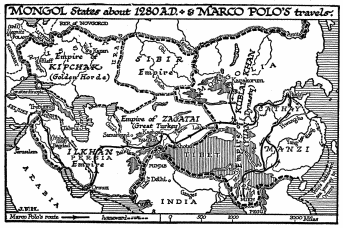
At the death of Kublai there was a main Mongol empire, with Pekin as its capital, including all China and Mongolia; there was a second great Mongol empire, that of Kipchak in Russia; there was a third in Persia, that founded by Hulagu, the Ilkhan empire, to which the Seljuk Turks in Asia Minor were tributary; there was a Siberian state between Kipchak and Mongolia; and another separate state “Great Turkey” in Turkestan. It is particularly remarkable that India beyond the Punjab was never invaded by the Mongols during this period, and that an army under the Sultan of Egypt completely defeated Ketboga, Hulagu’s general, in Palestine (1260), and stopped them from entering Africa. By 1260 the impulse of Mongol conquest had already passed its zenith. Thereafter the Mongol story is one of division and decay.
The Mongol dynasty that Kublai Khan had founded in China, the Yuan dynasty, lasted from 1280 until 1368. Later on a recrudescence of Mongolian energy in Western Asia was destined to create a still more enduring monarchy in India.
§ 3
Now this story of Mongolian conquests is surely the most remarkable in all history. The conquests of Alexander the Great cannot compare with them in extent. And their effect in diffusing and broadening men’s ideas, though such things are more difficult to estimate, is at least comparable to the spread of the Hellenic civilization which is associated with Alexander’s adventure. For a time all Asia and Western Europe enjoyed an open intercourse; all the roads were temporarily open, and representatives of every nation appeared at the court of Karakorum. The barriers between Europe and Asia set up by the religious feud of Christianity and Islam were lowered. Great hopes were entertained by the papacy for the conversion of the Mongols to Christianity. Their only religion so far had been Shamanism, a primitive paganism. Envoys of the Pope, Buddhist priests from India, Parisian and Italian and Chinese artificers, Byzantine and Armenian merchants, mingled with Arab officials and Persian and Indian astronomers and mathematicians at the Mongol court. We hear too much in history of the campaigns and massacres of the Mongols, and not enough of their indubitable curiosity and zest for learning. Not perhaps as an originative people, but as transmitters of knowledge and method their influence upon the world’s history has been enormous. And everything one can learn of the vague and romantic personalities of Jengis or Kublai tends to confirm the impression that these men were built upon a larger scale, and were at least as understanding and creative monarchs as either that flamboyant but egotistical figure Alexander the Great, or that raiser of political ghosts, that energetic but illiterate theologian, Charlemagne.
The missionary enterprises of the papacy in Mongolia ended in failure. Christianity was losing its persuasive power. The Mongols had no prejudice against Christianity; they evidently preferred it at first to Islam; but the missions that came to them were manifestly using the power in the great teachings of Jesus to advance the vast claims of the Pope to world dominion. Christianity so vitiated was not good enough for the Mongol mind. To make the empire of the Mongols part of the kingdom of God might have appealed to them; but not to make it a fief of a group of French and Italian priests, whose claims were as gigantic as their powers and outlook were feeble, who were now the creatures of the Emperor of Germany, now the nominees of the King of France, and now the victims of their own petty spites and vanities. In 1269 Kublai Khan sent a mission to the Pope with the evident intention of finding some common mode of action with Western Christendom. He asked that a hundred men of learning and ability should be sent to his court to establish an understanding. His mission found the Western world popeless, and engaged in one of those disputes about the succession that are so frequent in the history of the papacy. For two years there was no pope at all. When at last a pope was appointed, he despatched two Dominican friars to convert the greatest power in Asia to his rule! Those worthy men were appalled by the length and hardship of the journey before them, and found an early excuse for abandoning the expedition.
But this abortive mission was only one of a number of attempts to communicate, and always they were feeble and feeble-spirited attempts, with nothing of the conquering fire of the earlier Christian missions. Innocent IV had already sent some Dominicans to Karakorum, and Saint Louis of France had also despatched missionaries and relics by way of Persia; Mangu Khan had numerous Nestorian Christians at his court, and subsequent papal envoys actually reached Pekin. We hear of the appointment of various legates and bishops to the East, but many of these seem to have lost themselves and perhaps their lives before they reached China. There was a papal legate in Pekin in 1346, but he seems to have been a mere papal diplomatist. With the downfall of the Mongolian (Yuan) dynasty (1368), the dwindling opportunity of the Christian missions passed altogether. The house of Yuan was followed by that of Ming, a strongly nationalist Chinese dynasty, at first very hostile to all foreigners. There may have been a massacre of the Christian missions. Until the later days of the Mings (1644) little more is heard of Christianity, whether Nestorian or Catholic, in China. Then a fresh and rather more successful attempt to propagate Catholic Christianity in China was made by the Jesuits, but this second missionary wave reached China by the sea.
In the year 1298 a naval battle occurred between the Genoese and the Venetians, in which the latter were defeated. Among the 7000 prisoners taken by the Genoese was a Venetian gentleman named Marco Polo, who had been a great traveller, and who was very generally believed by his neighbours to be given to exaggeration. He had taken part in that first mission to Kublai Khan, and had gone on when the two Dominicans turned back. While this Marco Polo was a prisoner in Genoa, he beguiled his tedium by talking of his travels to a certain writer named Rusticiano, who wrote them down. We will not enter here into the vexed question of the exact authenticity of Rusticiano’s story—we do not certainly know in what language it was written—but there can be no doubt of the general truth of this remarkable narrative, which became enormously popular in the fourteenth and fifteenth centuries with all men of active intelligence. The Travels of Marco Polo is one of the great books of history. It opens this world of the thirteenth century, this century which saw the reign of Frederick II and the beginnings of the Inquisition, to our imaginations as no mere historian’s chronicle can do. It led directly to the discovery of America.
It begins by telling of the journey of Marco’s father, Nicolo Polo, and uncle, Maffeo Polo, to China. These two were Venetian merchants of standing, living in Constantinople, and somewhen about 1260 they went to the Crimea and thence to Kazan; from that place they journeyed to Bokhara, and at Bokhara they fell in with a party of envoys from Kublai Khan in China to his brother Hulagu in Persia. These envoys pressed them to come on to the Great Khan, who at that time had never seen men of the “Latin” peoples. They went on; and it is clear they made a very favourable impression upon Kublai, and interested him greatly in the civilization of Christendom. They were made the bearers of that request for a hundred teachers and learned men, “intelligent men acquainted with the Seven Arts, able to enter into controversy and able clearly to prove to idolaters and other kinds of folk that the Law of Christ was best,” to which we have just alluded. But when they returned Christendom was in a phase of confusion, and it was only after a delay of two years that they got their authorization to start for China again in the company of those two faint-hearted Dominicans. They took with them young Marco, and it is due to his presence and the boredom of his subsequent captivity at Genoa that this most interesting experience has been preserved to us.
The three Polos started by way of Palestine and not by the Crimea, as in the previous expedition. They had with them a gold tablet and other indications from the Great Khan that must have greatly facilitated their journey. The Great Khan had asked for some oil from the lamp that burns in the Holy Sepulchre at Jerusalem; and so thither they first went, and then by way of Cilicia into Armenia. They went thus far north because the Sultan of Egypt was raiding the Ilkhan domains at this time. Thence they came by way of Mesopotamia to Ormuz on the Persian Gulf, as if they contemplated a sea voyage. At Ormuz they met merchants from India. For some reason they did not take ship, but instead turned northward through the Persian deserts, and so by way of Balkh over the Pamir to Kashgar, and by way of Kotan and the Lob Nor (so following in the footsteps of Yuan Chwang) into the Hwangho Valley and on to Pekin. Pekin Polo calls “Cambulac”; Northern China, “Cathay” (= Khitan); and Southern China of the former Sung dynasty, “Manzi.” At Pekin was the Great Khan, and they were hospitably entertained. Marco particularly pleased Kublai; he was young and clever, and it is clear he had mastered the Tartar language very thoroughly. He was given an official position and sent on several missions, chiefly in South-west China. The tale he had to tell of vast stretches of smiling and prosperous country, “all the way excellent hostelries for travellers,” and “fine vineyards, fields, and gardens,” of “many abbeys” of Buddhist monks, of manufactures of “cloth of silk and gold and many fine taffetas,” a “constant succession of cities and boroughs,” and so on, first roused the incredulity and then fired the imagination of all Europe. He told of Burmah, and of its great armies with hundreds of elephants, and how these animals were defeated by the Mongol bowmen, and also of the Mongol conquest of Pegu. He told of Japan, and greatly exaggerated the amount of gold in that country. And, still more wonderful, he told of Christians and Christian rulers in China, and of a certain “Prester John,” John the Priest, who was the “king” of a Christian people. Those people he had not seen. Apparently they were a tribe of Nestorian Tartars in Mongolia. An understandable excitement probably made Rusticiano over-emphasize what must have seemed to him the greatest marvel of the whole story, and Prester John became one of the most stimulating legends of the fourteenth and fifteenth centuries. It encouraged European enterprise enormously to think that far away in China was a community of their co-religionists, presumably ready to welcome and assist them. For three years Marco ruled the city of Yang-chow as governor, and he probably impressed the Chinese inhabitants as being very little more of a foreigner than any Tartar would have been. He may also have been sent on a mission to India. Chinese records mention a certain Polo attached to the imperial council in 1277, a very valuable confirmation of the general truth of the Polo story.
The Polos had taken about three and a half years to get to China. They stayed there upwards of sixteen. Then they began to feel homesick. They were the protégés of Kublai, and possibly they felt that his favours roused a certain envy that might have disagreeable results after his death. They sought his permission to return. For a time he refused it, and then an opportunity occurred. Argon, the Ilkhan monarch of Persia, the grandson of Hulagu, Kublai’s brother, had lost his Mongol wife, and on her deathbed had promised not to wed any other woman but a Mongol of her own tribe. He sent ambassadors to Pekin, and a suitable princess was selected, a girl of seventeen. To spare her the fatigues of the caravan route, it was decided to send her by sea with a suitable escort. The “Barons” in charge of her asked for the company of the Polos because these latter were experienced travellers and sage men, and the Polos snatched at this opportunity of getting homeward. The expedition sailed from some port on the east of South China; they stayed long in Sumatra and South India, and they reached Persia after a voyage of two years. They delivered the young lady safely to Argon’s successor—for Argon was dead—and she married Argon’s son. The Polos then went by Tabriz to Trebizond, sailed to Constantinople, and got back to Venice about 1295. It is related that the returned travellers, dressed in Tartar garb, were refused admission to their own house. It was some time before they could establish their identity. Many people who admitted that, were still inclined to look askance at them as shabby wanderers; and, in order to dispel such doubts, they gave a great feast, and when it was at its height they had their old padded suits brought to them, dismissed the servants, and then ripped open these garments, whereupon an incredible display of “rubies, sapphires, carbuncles, emeralds, and diamonds” poured out before the dazzled company. Even after this, Marco’s accounts of the size and population of China were received with much furtive mockery. The wits nicknamed him Il Milione, because he was always talking of millions of people and millions of ducats.
Such was the story that raised eyebrows first in Venice and then throughout the Western world. The European literature, and especially the European romance of the fifteenth century, echoes with the names in Marco Polo’s story, with Cathay and Cambulac and the like.
§ 4
These travels of Marco Polo were only the beginning of a very considerable intercourse. That intercourse was to bring many revolutionary ideas and many revolutionary things to Europe, including a greatly extended use of paper and printing from blocks, the almost equally revolutionary use of gunpowder in warfare, and the mariner’s compass which was to release the European shipping from navigation by coasting. The popular imagination has always been disposed to ascribe every such striking result to Marco Polo. He has become the type and symbol for all such interchanges. As a matter of fact, there is no evidence that he had any share in these three importations. There were many mute Marco Polos who never met their Rusticianos, and history has not preserved their names. Before we go on, however, to describe the great widening of the mental horizons of Europe that was now beginning, and to which this book of travels was to contribute very materially, it will be convenient first to note a curious side consequence of the great Mongol conquests, the appearance of the Ottoman Turks upon the Dardanelles, and next to state in general terms the breaking up and development of the several parts of the empire of Jengis Khan.
The Ottoman Turks were a little band of fugitives who fled southwesterly before the first invasion of Western Turkestan by Jengis. They made their long way from Central Asia, over deserts and mountains and through alien populations, seeking some new lands in which they might settle. “A small band of alien herdsmen,” says Sir Mark Sykes, “wandering unchecked through crusades and counter-crusades, principalities, empires, and states. Where they camped, how they moved and preserved their flocks and herds, where they found pasture, how they made their peace with the various chiefs through whose territories they passed, are questions which one may well ask in wonder.”
They found a resting-place at last and kindred and congenial neighbours on the tablelands of Asia Minor among the Seljuk Turks. Most of this country, the modern Anatolia, was now largely Turkish in speech and Moslem in religion, except that there was a considerable proportion of Greeks, Jews, and Armenians in the town populations. No doubt the various strains of Hittite, Phrygian, Trojan, Lydian, Ionian Greek, Cimmerian, Galatian, and Italian (from the Pergamus times) still flowed in the blood of the people, but they had long since forgotten these ancestral elements. They were indeed much the same blend of ancient Mediterranean dark-whites, Nordic Aryans, Semites and Mongolians as were the inhabitants of the Balkan peninsula, but they believed themselves to be a pure Turanian race, and altogether superior to the Christians on the other side of the Bosphorus.
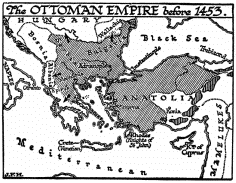
Gradually the Ottoman Turks became important, and at last dominant among the small principalities into which the Seljuk empire, the empire of “Roum,” had fallen. Their relations with the dwindling empire of Constantinople remained for some centuries tolerantly hostile. They made no attack upon the Bosphorus, but they got a footing in Europe at the Dardanelles, and, using this route, the route of Xerxes and not the route of Darius, they pushed their way steadily into Macedonia, Epirus, Illyria, Yugo-Slavia, and Bulgaria. In the Serbs (Yugo-Slavs) and Bulgarians the Turks found people very like themselves in culture and, though neither side recognized it, probably very similar in racial admixture, with a little less of the dark Mediterranean and Mongolian strains than the Turks and a trifle more of the Nordic element. But these Balkan peoples were Christians, and bitterly divided among themselves. The Turks on the other hand spoke one language; they had a greater sense of unity, they had the Moslem habits of temperance and frugality, and they were on the whole better soldiers. They converted what they could of the conquered people to Islam; the Christians they disarmed, and conferred upon them the monopoly of tax-paying. Gradually the Ottoman princes consolidated an empire that reached from the Taurus mountains in the east to Hungary and Roumania in the west. Adrianople became their chief city. They surrounded the shrunken empire of Constantinople on every side.
The Ottomans organized a standing military force, the Janissaries, rather on the lines of the Mamelukes who dominated Egypt. “These troops were formed of levies of Christian youths to the extent of one thousand per annum, who were affiliated to the Bektashi order of dervishes, and though at first not obliged to embrace Islam, were one and all strongly imbued with the mystic and fraternal ideas of the confraternity to which they were attached. Highly paid, well disciplined, a close and jealous secret society, the Janissaries provided the newly formed Ottoman state with a patriotic force of trained infantry soldiers, which, in an age of light cavalry and hired companies of mercenaries, was an invaluable asset....[363]
“The relations between the Ottoman Sultans and the Emperors has been singular in the annals of Moslem and Christian states. The Turks had been involved in the family and dynastic quarrels of the Imperial City, were bound by ties of blood to the ruling families, frequently supplied troops for the defence of Constantinople, and on occasion hired parts of its garrison to assist them in their various campaigns; the sons of the Emperors and Byzantine statesmen even accompanied the Turkish forces in the field, yet the Ottomans never ceased to annex Imperial territories and cities both in Asia and Thrace. This curious intercourse between the House of Osman and the Imperial government had a profound effect on both institutions; the Greeks grew more and more debased and demoralized by the shifts and tricks that their military weakness obliged them to adopt towards their neighbours, the Turks were corrupted by the alien atmosphere of intrigue and treachery which crept into their domestic life. Fratricide and parricide, the two crimes which most frequently stained the annals of the Imperial Palace, eventually formed a part of the policy of the Ottoman dynasty. One of the sons of Murad I embarked on an intrigue with Andronicus, the son of the Greek Emperor, to murder their respective fathers....
“The Byzantine found it more easy to negotiate with the Ottoman Pasha than with the Pope. For years the Turks and Byzantines had intermarried, and hunted in couples in strange by-paths of diplomacy. The Ottoman had played the Bulgar and the Serb of Europe against the Emperor, just as the Emperor had played the Asiatic Amir against the Sultan; the Greek and Turkish Royal Princes had mutually agreed to hold each other’s rivals as prisoners and hostages; in fact, Turk and Byzantine policy had so intertwined that it is difficult to say whether the Turks regarded the Greeks as their allies, enemies, or subjects, or whether the Greeks looked upon the Turks as their tyrants, destroyers, or protectors....”[364]
It was in 1453, under the Ottoman Sultan, Muhammad II, that Constantinople at last fell to the Moslems. He attacked it from the European side, and with a great power of artillery. The Greek Emperor was killed, and there was much looting and massacre. The great church of Saint Sophia which Justinian the Great had built (532) was plundered of its treasures and turned at once into a mosque. This event sent a wave of excitement throughout Europe, and an attempt was made to organize a crusade, but the days of the crusades were past.
Says Sir Mark Sykes: “To the Turks the capture of Constantinople was a crowning mercy and yet a fatal blow. Constantinople had been the tutor and polisher of the Turks. So long as the Ottomans could draw science, learning, philosophy, art, and tolerance from a living fountain of civilization in the heart of their dominions, so long had the Ottomans not only brute force, but intellectual power. So long as the Ottoman Empire had in Constantinople a free port, a market, a centre of world finance, a pool of gold, an exchange, so long did the Ottomans never lack for money and financial support. Muhammad was a great statesman, the moment he entered Constantinople he endeavoured to stay the damage his ambition had done; he supported the patriarch, he conciliated the Greeks, he did all he could to continue Constantinople the city of the Emperors ... but the fatal step had been taken; Constantinople as the city of the Sultans was Constantinople no more; the markets died away, the culture and civilization fled, the complex finance faded from sight; and the Turks had lost their governors and their support. On the other hand, the corruptions of Byzantium remained, the bureaucracy, the eunuchs, the palace guards, the spies, the bribers, go-betweens—all these the Ottomans took over, and all these survived in luxuriant life. The Turks, in taking Stambul, let slip a treasure and gained a pestilence....”
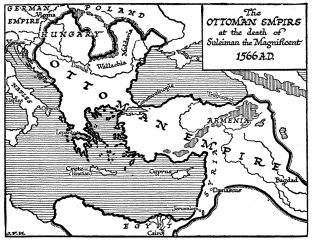
Muhammad’s ambition was not sated by the capture of Constantinople. He set his eyes also upon Rome. He captured and looted the Italian town of Otranto, and it is probable that a very vigorous and perhaps successful attempt to conquer Italy—for the peninsula was divided against itself—was averted only by his death (1481). His sons engaged in fratricidal strife. Under Bayezid II (1481-1512), his successor, war was carried into Poland, and most of Greece was conquered. Selim (1512-1520), the son of Bayezid, extended the Ottoman power over Armenia and conquered Egypt. In Egypt, the last Abbasid Caliph was living under the protection of the Mameluke Sultan—for the Fatimite caliphate was a thing of the past. Selim bought the title of Caliph from this last degenerate Abbasid, and acquired the sacred banner and other relics of the Prophet. So the Ottoman Sultan became also Caliph of all Islam. Selim was followed by Suleiman the Magnificent (1520-1566), who conquered Bagdad in the east and the greater part of Hungary in the west, and very nearly captured Vienna. His fleets also took Algiers, and inflicted a number of reverses upon the Venetians. In most of his warfare with the empire he was in alliance with the French. Under him the Ottoman power reached its zenith.
§ 5
Let us now very briefly run over the subsequent development of the main masses of the empire of the Great Khan. In no case did Christianity succeed in capturing the imagination of these Mongol states. Christianity was in a phase of moral and intellectual insolvency, without any collective faith, energy, or honour; we have told of the wretched brace of timid Dominicans which was the Pope’s reply to the appeal of Kublai Khan, and we have noted the general failure of the overland mission of the thirteenth and fourteenth centuries. That apostolic passion that could win whole nations to the Kingdom of Heaven was dead in the church.
In 1305, as we have told, the Pope became the kept pontiff of the French king. All the craft and policy of the Popes of the thirteenth century to oust the Emperor from Italy had only served to let in the French to replace him. From 1305 to 1377 the Popes remained at Avignon; and such slight missionary effort as they made was merely a part of the strategy of Western European politics.[365] In 1377 the Pope Gregory XI did indeed re-enter Rome and die there, but the French cardinals split off from the others at the election of his successor, and two Popes were elected, one at Avignon and one at Rome. This split, the Great Schism, lasted from 1378 to 1418. Each Pope cursed the other, and put all his supporters under an interdict. Such was the state of Christianity, and such were now the custodians of the teachings of Jesus of Nazareth. All Asia was white unto harvest, but there was no effort to reap it.
When at last the church was reunited and missionary energy returned with the foundation of the order of the Jesuits, the days of opportunity were over. The possibility of a world-wide moral unification of East and West through Christianity had passed away. The Mongols in China and Central Asia turned to Buddhism; in South Russia, Western Turkestan, and the Ilkhan Empire they embraced Islam.
§ 5A
In China the Mongols were already saturated with Chinese civilization by the time of Kublai. After 1280 the Chinese annals treat Kublai as a Chinese monarch, the founder of the Yuan dynasty (1280-1368). This Mongol dynasty was finally over-thrown by a Chinese nationalist movement which set up the Ming dynasty (1368-1644), a cultivated and artistic line of emperors, ruling until a northern people, the Manchus, who were the same as the Kin whom Jengis had overthrown, conquered China and established a dynasty which gave way only to a native republican form of government in 1912.
It was the Manchus who obliged the Chinese to wear pig-tails as a mark of submission. The pigtailed Chinaman is quite a recent, and now a vanished figure in history.
§ 5B
In the Pamirs, in much of Eastern and Western Turkestan, and to the north, the Mongols dropped back towards the tribal conditions from which they had been lifted by Jengis. It is possible to trace the dwindling succession of many of the small Kans who became independent during this period, almost down to the present time. The Kalmuks in the seventeenth and eighteenth centuries founded a considerable empire, but dynastic troubles broke it up before it had extended its power beyond Central Asia. The Chinese recovered Eastern Turkestan from them about 1757.
Tibet was more and more closely linked with China, and became the great home of Buddhism and Buddhist monasticism.
Over most of the area of Western Central Asia and Persia and Mesopotamia, the ancient distinction of nomad and settled population remains to this day. The townsmen despise and cheat the nomads, the nomads ill-treat and despise the townsfolk.
§ 5C
The Mongols of the great realm of Kipchak remained nomadic, and grazed their stock across the wide plains of South Russia and Western Asia adjacent to Russia. They became not very devout Moslems, retaining many traces of their earlier barbaric Shamanism. Their chief Khan was the Khan of the Golden Horde. To the west, over large tracts of open country, and more particularly in what is now known as Ukrainia, the old Scythian population, Slavs with a Mongol admixture, reverted to a similar nomadic life. These Christian nomads, the Cossacks, formed a sort of frontier screen against the Tartars, and their free and adventurous life was so attractive to the peasants of Poland and Lithuania that severe laws had to be passed to prevent a vast migration from the ploughlands to the steppes. The serf-owning landlords of Poland regarded the Cossacks with considerable hostility on this account, and war was as frequent between the Polish chivalry and the Cossacks as it was between the latter and the Tartars.[366]
In the empire of Kipchak, as in Turkestan almost up to the present time, while the nomads roamed over wide areas, a number of towns and cultivated regions sustained a settled population which usually paid tribute to the nomad Khan. In such towns as Kieff, Moscow, and the like, the pre-Mongol, Christian town life went on under Russian dukes or Tartar governors, who collected the tribute for the Khan of the Golden Horde. The Grand Duke of Moscow gained the confidence of the Khan, and gradually, under his authority, obtained an ascendancy over many of his fellow tributaries. In the fifteenth century, under its grand duke, Ivan III, Ivan the Great (1462-1505), Moscow threw off its Mongol allegiance and refused to pay tribute any longer (1480). The successors of Constantine no longer reigned in Constantinople, and Ivan took possession of the Byzantine double-headed eagle for his arms. He claimed to be the heir to Byzantium because of his marriage (1472) with Zoe Palæologus of the imperial line. This ambitious grand dukedom of Moscow assailed and subjugated the ancient Northman trading republic of Novgorod to the north, and so the foundations of the modern Russian Empire were laid and a link with the mercantile life of the Baltic established. Ivan III did not, however, carry his claim to be the heir of the Christian rulers of Constantinople to the extent of assuming the imperial title. This step was taken by his grandson, Ivan IV (Ivan the Terrible, because of his insane cruelties; 1533-1584). Although the ruler of Moscow thus came to be called Tsar (Cæsar), his tradition was in many respects Tartar rather than European; he was autocratic after the unlimited Asiatic pattern, and the form of Christianity he affected was the Eastern, court-ruled, “orthodox” form, which had reached Russia long before the Mongol conquest, by means of Bulgarian missionaries from Constantinople.
To the west of the domains of Kipchak, outside the range of Mongol rule, a second centre of Slav consolidation had been set up during the tenth and eleventh centuries in Poland. The Mongol wave had washed over Poland, but had never subjugated it. Poland was not “orthodox,” but Roman Catholic in religion; it used the Latin alphabet instead of the strange Russian letters, and its monarch never assumed an absolute independence of the Emperor. Poland was in fact in its origins an outlying part of Christendom and of the Holy Empire; Russia never was anything of the sort.
§ 5D
The nature and development of the empire of the Ilkhans in Persia, Mesopotamia, and Syria is perhaps the most interesting of all the stories of these Mongol powers, because in this region nomadism really did attempt, and really did to a very considerable degree succeed in its attempt to stamp a settled civilized system out of existence. When Jengis Khan first invaded China, we are told that there was a serious discussion among the Mongol chiefs whether all the towns and settled populations should not be destroyed. To these simple practitioners of the open-air life the settled populations seemed corrupt, crowded, vicious, effeminate, dangerous, and incomprehensible; a detestable human efflorescence upon what would otherwise have been good pasture. They had no use whatever for the towns. The early Franks and the Anglo-Saxon conquerors of South Britain had much the same feeling towards townsmen. But it was only under Hulagu in Mesopotamia that these ideas seem to have been embodied in a deliberate policy. The Mongols here did not only burn and massacre; they destroyed the irrigation system that had endured for at least eight thousand years, and with that the mother civilization of all the Western world came to an end. Since the days of the priest-kings of Sumeria there had been a continuous cultivation in these fertile regions, an accumulation of tradition, a great population, a succession of busy cities, Eridu, Nippur, Babylon, Nineveh, Ctesiphon, Bagdad. Now the fertility ceased. Mesopotamia became a land of ruins and desolation, through which great waters ran to waste, or overflowed their banks to make malarious swamps. Later on Mosul and Bagdad revived feebly as second-rate towns....
But for the defeat and death of Hulagu’s general Kitboga in Palestine (1260), the same fate might have overtaken Egypt. But Egypt was now a Turkish sultanate; it was dominated by a body of soldiers, the Mamelukes, whose ranks, like those of their imitators, the Janissaries of the Ottoman Empire, were recruited and kept vigorous by the purchase and training of boy slaves. A capable Sultan such men would obey; a weak or evil one they would replace. Under this ascendancy Egypt remained an independent power until 1517, when it fell to the Ottoman Turks.
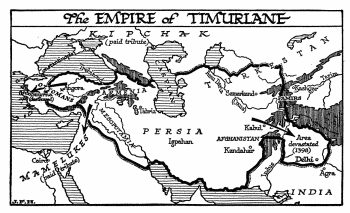
The first destructive vigour of Hulagu’s Mongols soon subsided, but in the fifteenth century a last tornado of nomadism arose in Western Turkestan under the leadership of a certain Timur the Lame, or Timurlane. He was descended in the female line from Jengis Khan. He established himself in Samarkand, and spread his authority over Kipchak (Turkestan to South Russia), Siberia, and southward as far as the Indus. He assumed the title of Great Khan in 1369. He was a nomad of the savage school, and he created an empire of desolation from North India to Syria. Pyramids of skulls were his particular architectural fancy; after the storming of Ispahan he made one of 70,000. His ambition was to restore the empire of Jengis Khan as he conceived it, a project in which he completely failed. He spread destruction far and wide; the Ottoman Turks—it was before the taking of Constantinople and their days of greatness—and Egypt paid him tribute; the Punjab he devastated; and Delhi surrendered to him. After Delhi had surrendered, however, he made a frightful massacre of its inhabitants. At the time of his death (1405) very little remained to witness to his power but a name of horror, ruins, and desolated countries, and a shrunken and impoverished domain in Persia.
The dynasty founded by Timur in Persia was extinguished by another Turkoman horde fifty years later.
§ 5E[367]
In 1505 a small Turkoman chieftain, Baber, a descendant of Timur and therefore of Jengis, was forced after some years of warfare and some temporary successes—for a time he held Samarkand—to fly with a few followers over the Hindu Kush to Afghanistan. There his band increased, and he made himself master of Cabul. He assembled an army, accumulated guns, and then laid claim to the Punjab, because Timur had conquered it a hundred and seven years before. He pushed his successes beyond the Punjab. India was in a state of division, and quite ready to welcome any capable invader who promised peace and order. After various fluctuations of fortune Baber met the Sultan of Delhi at Panipat (1525), ten miles north of that town, and though he had but 25,000 men, provided, however, with guns, against a thousand elephants and four times as many men—the numbers, by the by, are his own estimate—he gained a complete victory. He ceased to call himself King of Cabul, and assumed the title of Emperor of Hindustan. “This,” he wrote, “is quite a different world from our countries.” It was finer, more fertile, altogether richer. He conquered as far as Bengal, but his untimely death in 1530 checked the tide of Mongol conquest for a quarter of a century, and it was only after the accession of his grandson Akbar that it flowed again. Akbar subjugated all India as far as Berar, and his great-grandson Aurungzeb (1658-1707) was practically master of the entire peninsula. This great dynasty of Baber (1526-1530), Humayun (1530-1556), Akbar (1556-1605), Jehangir (1605-1628), Shah Jehan (1628-1658), and Aurungzeb (1658-1707), in which son succeeded father for six generations, this “Mogul (= Mongol) dynasty,”[368] marks the most splendid age that had hitherto dawned upon India. Akbar next perhaps to Asoka, was one of the greatest of Indian monarchs, and one of the few royal figures that approach the stature of great men.
To Akbar it is necessary to give the same distinctive attention that we have shown to Charlemagne or Constantine the Great. He is one of the hinges of history. Much of his work of consolidation and organization in India survives to this day. It was taken over and continued by the British when they became the successors of the Mogul emperors. The British monarch, indeed, now uses as his Indian title the title of the Mogul emperors, Kaisar-i-Hind. All the other great administrations of the descendants of Jengis Khan, in Russia, throughout Western and Central Asia and in China, have long since dissolved away and given place to other forms of government. Their governments were indeed little more than taxing governments; a system of revenue-collecting to feed the central establishment of the ruler, like the Golden Horde in South Russia or the imperial city at Karakorum or Pekin. The life and ideas of the people they left alone, careless how they lived—so long as they paid. So it was that after centuries of subjugation, a Christian Moscow and Kieff, a Shiite Persia, and a thoroughly Chinese China rose again from their Mongol submergence. But Akbar made a new India. He gave the princes and ruling classes of India some inklings at least of a common interest. If India is now anything more than a sort of rag-bag of incoherent states and races, a prey to every casual raider from the north, it is very largely due to him.
His distinctive quality was his openness of mind. He set himself to make every sort of able man in India, whatever his race or religion, available for the public work of Indian life. His instinct was the true statesman’s instinct for synthesis. His empire was to be neither a Moslem nor a Mongol one, nor was it to be Rajput or Aryan, or Dravidian, or Hindu, or high or low caste; it was to be Indian. “During the years of his training he enjoyed many opportunities of noting the good qualities, the fidelity, the devotion, often the nobility of soul, of those Hindu princes, whom, because they were followers of Brahma, his Moslem courtiers devoted mentally to eternal torments. He noted that these men, and men who thought like them, constituted the vast majority of his subjects. He noted, further, of many of them, and those the most trustworthy, that though they had apparently much to gain from a worldly point of view by embracing the religion of the court, they held fast to their own. His reflective mind, therefore, was unwilling from the outset to accept the theory that because he, the conqueror, the ruler, happened to be born a Muhammadan, therefore Muhammadanism was true for all mankind. Gradually his thoughts found words in the utterance: ‘Why should I claim to guide men before I myself am guided?’ and, as he listened to other doctrines and other creeds, his honest doubts became confirmed, and, noting daily the bitter narrowness of sectarianism, no matter of what form of religion, he became more and more wedded to the principle of toleration for all.”
“The son of a fugitive emperor,” says Dr. Emil Schmit, “born in the desert, brought up in nominal confinement, he had known the bitter side of life from his youth up. Fortune had given him a powerful frame, which he trained to support the extremities of exertion. Physical exercise was with him a passion; he was devoted to the chase and especially to the fierce excitement of catching the wild horse or elephant or slaying the dangerous tiger. On one occasion, when it was necessary to dissuade the Raja of Jodhpore to abandon his intention of forcing the widow of his deceased son to mount the funeral pyre, Akbar rode two hundred and twenty miles in two days. In battle he displayed the utmost bravery. He led his troops in person during the dangerous part of a campaign, leaving to his generals the lighter task of finishing the war. In every victory he displayed humanity to the conquered, and decisively opposed any exhibition of cruelty. Free from all these prejudices which separate society and create dissension, tolerant to men of other beliefs, impartial to men of other races, whether Hindu or Dravidian, he was a man obviously marked out to weld the conflicting elements of his kingdom into a strong and prosperous whole.
“In all seriousness he devoted himself to the work of peace. Moderate in all pleasures, needing but little sleep and accustomed to divide his tune with the utmost accuracy, he found leisure to devote himself to science and art after the completion of his State duties. The famous personages and scholars who adorned the capital he had built for himself at Fatehpur-Sikri were at the same time his friends; every Thursday evening a circle of these was collected for intellectual conversation and philosophical discussion. His closest friends were two highly talented brothers, Faizi and Abul Fazl, the sons of a learned free-thinker. The elder of these was a famous scholar in Hindu literature; with his help, and under his direction, Akbar had the most important of the Sanskrit works translated into Persian. Fazl, on the other hand, who was an especially close friend of Akbar, was a general, a statesman, and an organizer, and to his activity Akbar’s kingdom chiefly owed the solidarity of its internal organization.”[369]
(Such was the quality of the circle that used to meet in the palaces of Fatehpur-Sikri, buildings which still stand in the Indian sunlight—but empty now and desolate. Fatehpur-Sikri, like the city of Ambar, is now a dead city. A few years ago the child of a British official was killed by a panther in one of its silent streets.)
All this that we have quoted reveals a pre-eminent monarch. But Akbar, like all men, great or petty, lived within the limitations of his period and its circles of ideas. And a Turkoman, ruling in India, was necessarily ignorant of much that Europe had been painfully learning for a thousand years. He knew nothing of the growth of a popular consciousness in Europe, and little or nothing of the wide educational possibilities that the church had been working out in the West. His upbringing in Islam and his native genius made it plain to him that a great nation in India could only be cemented by common ideas upon a religious basis, but the knowledge of how such a solidarity could be created and sustained by universal schools, cheap books, and a university system at once organized and free to think, to which the modern state is still feeling its way, was as impossible to him as a knowledge of steamboats or aeroplanes. The form of Islam he knew best was the narrow and fiercely intolerant form of the Turkish Sunnites. The Moslems were only a minority of the population. The problem he faced was indeed very parallel to the problem of Constantine the Great. But it had peculiar difficulties of its own. He never got beyond an attempt to adapt Islam to a wider appeal by substituting for “There is one God, and Muhammad is his prophet,” the declaration, “There is one God, and the Emperor is his vice-regent.” This he thought might form a common platform for every variety of faith in India, that kaleidoscope of religions. With this faith he associated a simple ritual borrowed from the Persian Zoroastrians (the Parsees) who still survived, and survive to-day, in India. This new state religion, however, died with him, because it had no roots in the minds of the people about him.
The essential factor in the organization of a living state, the world is coming to realize, is the organization of an education. This Akbar never understood. And he had no class of men available who would suggest such an idea to him or help him to carry it out. The Moslem teachers in India were not so much teachers as conservators of an intense bigotry; they did not want a common mind in India, but only a common intolerance in Islam. The Brahmins, who had the monopoly of teaching among the Hindus, had all the conceit and slackness of hereditary privilege. Yet though Akbar made no general educational scheme for India, he set up a number of Moslem and Hindu schools. He knew less and he did more for India in these matters than the British who succeeded him. Some of the British viceroys have aped his magnificence, his costly tents and awnings, his palatial buildings and his elephants of state, but none have gone far enough beyond the political outlook of this mediæval Turkoman to attempt that popular education which is an absolute necessity to India before she can play her fitting part in the commonweal of mankind.[370]
§ 5F
A curious side result of these later Mongol perturbations, those of the fourteenth century of which Timurlane was the head and centre, was the appearance of drifting batches of a strange refugee Eastern people in Europe, the Gipsies. They appeared somewhen about the end of the fourteenth and early fifteenth centuries in Greece, where they were believed to be Egyptians (hence Gipsy), a very general persuasion which they themselves accepted and disseminated. Their leaders, however, styled themselves “Counts of Asia Minor.” They had probably been drifting about Western Asia for some centuries before the massacres of Timurlane drove them over the Hellespont. They may have been dislodged from their original homeland—as the Ottoman Turks were—by the great cataclysm of Jengis or even earlier. They had drifted about as the Ottoman Turks had drifted about, but with less good fortune. They spread slowly westward across Europe, strange fragments of nomadism in a world of plough and city, driven off their ancient habitat of the Bactrian steppes to harbour upon European commons and by hedgerows and in wild woodlands and neglected patches. The Germans called them “Hungarians” and “Tartars,” the French, “Bohemians.” They do not seem to have kept the true tradition of their origin, but they have a distinctive language which indicates their lost history; it contains many North Indian words, and is probably in its origin North India. There are also considerable Armenian and Persian elements in their speech. They are found in all European countries to-day; they are tinkers, pedlars, horse-dealers, showmen, fortune-tellers, and beggars. To many imaginative minds their wayside encampments, with their smoking fires, their rounded tents, their hobbled horses, and their brawl of sunburnt children, have a very strong appeal. Civilization is so new a thing in history, and has been for most of the time so very local a thing, that it has still to conquer and assimilate most of our instincts to its needs. In most of us, irked by its conventions and complexities, there stirs the nomad strain. We are but half-hearted home-keepers. The blood in our veins was brewed on the steppes as well as on the ploughlands.
XXXV THE RENASCENCE OF WESTERN CIVILIZATION[371] (Land Ways Give Place to Sea Ways)
§ 1. Christianity and Popular Education. § 2. Europe begins to Think for Itself. § 3. The Great Plague and the Dawn of Communism. § 4. How Paper Liberated the Human Mind. § 5. Protestantism of the Princes and Protestantism of the Peoples. § 6. The Reawakening of Science. § 7. The New Growth of European Towns. § 8. America Comes into History. § 9. What Machiavelli Thought of the World. § 10. The Republic of Switzerland. § 11A. The Life of the Emperor Charles V. § 11B. Protestants if the Prince Wills it. § 11C. The Intellectual Under-tow.
§ 1
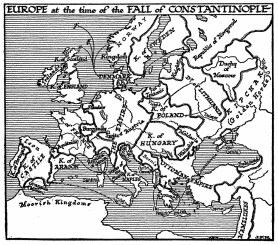
JUDGED by the map, the three centuries from the beginning of the thirteenth to the end of the fifteenth century were an age of recession for Christendom. These centuries were the Age of the Mongolian peoples. Nomadism from Central Asia dominated the known world. At the crest of this period there were rulers of Mongol or the kindred Turkish race and nomadic tradition in China, India, Persia, Egypt, North Africa, the Balkan Peninsula, Hungary, and Russia. The Ottoman Turk had even taken to the sea, and fought the Venetian upon his own Mediterranean waters. In 1529 the Turks besieged Vienna, and were defeated rather by the weather than by the defenders. The Habsburg empire of Charles V paid the Sultan tribute. It was not until the battle of Lepanto in 1571, the battle in which Cervantes, the author of Don Quixote, lost his left arm, that Christendom, to use his words, “broke the pride of the Osmans and undeceived the world which had regarded the Turkish fleet as invincible.” The sole region of Christian advance was Spain. A man of foresight surveying the world in the early sixteenth century might well have concluded that it was only a matter of a few generations before the whole world became Mongolian—and probably Moslem. Just as to-day most people seem to take it for granted that European rule and a sort of liberal Christianity are destined to spread over the whole world. Few people seem to realize how recent a thing is this European ascendancy. It was only as the fifteenth century drew to its close that any indications of the real vitality of Western Europe became clearly apparent.
Our history is now approaching our own times, and our study becomes more and more a study of the existing state of affairs. The European or Europeanized system in which the reader is living is the same system that we see developing in the crumpled-up, Mongol-threatened Europe of the early fifteenth century. Its problems then were the embryonic form of the problems of to-day. It is impossible to discuss that time without discussing our own time. We become political in spite of ourselves. “Politics without history has no root,” said Sir J. R. Seeley; “history without politics has no fruit.”
Let us try, with as much detachment as we can achieve, to discover what the forces were that were dividing and holding back the energies of Europe during this tremendous outbreak of the Mongol peoples, and how we are to explain the accumulation of mental and physical energy that undoubtedly went on during this phase of apparent retrocession, and which broke out so impressively at its close.
Now, just as in the Mesozoic Age, while the great reptiles lorded it over the earth, there were developing in odd out-of-the-way corners those hairy mammals and feathered birds who were finally to supersede that tremendous fauna altogether by another far more versatile and capable, so in the limited territories of Western Europe of the Middle Ages, while the Mongolian monarchies dominated the world from the Danube to the Pacific and from the Arctic seas to Madras and Morocco and the Nile, the fundamental lines of a new and harder and more efficient type of human community were being laid down. This type of community, which is still only in the phase of formation, which is still growing and experimental, we may perhaps speak of as the “modern state.” This is, we must recognize, a vague expression, but we shall endeavour to get meaning into it as we proceed. We have noted the appearance of its main root ideas in the Greek republics and especially in Athens, in the great Roman republic, in Judaism, in Islam, and in the story of Western Catholicism. Essentially this modern state, as we see it growing under our eyes to-day, is a tentative combination of two apparently contradictory ideas, the idea of a community of faith and obedience, such as the earliest civilizations undoubtedly were, and the idea of a community of will, such as were the primitive political groupings of the Nordic and Hunnish peoples. For thousands of years the settled civilized peoples, who were originally in most cases dark-white Caucasians, or Dravidian or Southern Mongolian peoples, seem to have developed their ideas and habits along the line of worship and personal subjection, and the nomadic peoples theirs along the line of personal self-reliance and self-assertion. Naturally enough under the circumstances the nomadic peoples were always supplying the civilizations with fresh rulers and new aristocracies. That is the rhythm of all early history. It was only after thousands of years of cyclic changes between refreshment by nomadic conquest, civilization, decadence, and fresh conquest that the present process of a mutual blending of “civilized” and “free” tendencies into a new type of community, that now demands our attention and which is the substance of contemporary history, began.
We have traced in this history the slow development of larger and larger “civilized” human communities from the days of such a Palæolithic family tribe as that described in Chapter IX. We have seen how the advantages and necessities of cultivation, the fear of tribal gods, the ideas of the priest-king and the god-king, played their part in consolidating continually larger and more powerful societies in regions of maximum fertility. We have watched the interplay of priest, who was usually native, and monarch, who was usually a conqueror, in these early civilizations, the development of a written tradition and its escape from priestly control, and the appearance of novel forces, at first apparently incidental and secondary, which we have called the free intelligence and the free conscience of mankind. We have seen the rulers of the primitive civilizations of the river valleys widening their area and extending their sway, and simultaneously over the less fertile areas of the earth we have seen mere tribal savagery develop into a more and more united and politically competent nomadism. Steadily and divergently mankind pursued one or other of these two lines. For long ages all the civilizations grew and developed along monarchist lines, upon lines of absolute monarchy, and in every monarchy and dynasty we have watched, as if it were a necessary process, efficiency and energy give way to pomp, indolence, and decay, and finally succumb to some fresher lineage from the desert or the steppe. The story of the early cultivating civilizations and their temples and courts and cities bulks large in human history, but it is well to remember that the scene of that story was never more than a very small part of the land surface of the globe. Over the greater part of the earth until quite recently, until the last two thousand years, the hardier, less numerous tribal peoples of forest and parkland and the nomadic peoples of the seasonal grasslands maintained and developed their own ways of life.
The primitive civilizations were, we may say, “communities of obedience”; obedience to god-kings or kings under gods was their cement; the nomadic tendency on the other hand has always been towards a different type of association which we shall here call a “community of will.” In a wandering, fighting community the individual must be at once self-reliant and disciplined. The chiefs of such communities must be chiefs who are followed, not masters who compel. This community of will is traceable throughout the entire history of mankind; everywhere we find the original disposition of all the nomads alike, Nordic, Semitic, or Mongolian, was individually more willing and more erect than that of the settled folk. The Nordic peoples came into Italy and Greece under leader kings; they did not bring any systematic temple cults with them, they found such things in the conquered lands and adapted as they adopted them. The Greeks and Latins lapsed very easily again into republics, and so did the Aryans in India. There was a tradition of election also in the early Frankish and German kingdoms.[372] The early Caliphs were elected, the Judges of Israel and the “kings” of Carthage and Tyre were elected, and so was the Great Khan of the Mongols until Kublai became a Chinese monarch.... Equally constant in the settled lands do we find the opposite idea, the idea of a non-elective divinity in kings and of their natural and inherent right to rule.... As our history has developed we have noted the appearance of new and complicating elements in the story of human societies; we have seen that nomad turned go-between, the trader, appear, and we have noted the growing importance of shipping in the world. It seems as inevitable that voyaging should make men free in their minds as that settlement within a narrow horizon should make men timid and servile.... But in spite of all such complications, the broad antagonism between the method of obedience and the method of will runs through history down into our own times. To this day their reconciliation is incomplete.
Civilization even in its most servile forms has always offered much that is enormously attractive, convenient, and congenial to mankind; but something restless and untamed in our race has striven continually to convert civilization from its original reliance upon unparticipating obedience into a community of participating wills. And to the lurking nomadism in our blood, and particularly in the blood of monarchs and aristocracies, we must ascribe also that incessant urgency towards a wider range that forces every state to extend its boundaries if it can, and to spread its interests to the ends of the earth. The power of nomadic restlessness that tends to bring all the earth under one rule, seems to be identical with the spirit that makes most of us chafe under direction and restraint, and seek to participate in whatever government we tolerate. And this natural, this temperamental struggle of mankind to reconcile civilization with freedom has been kept alive age after age by the military and political impotence of every “community of obedience” that has ever existed. Obedience, once men are broken to it, can be easily captured and transferred; witness the passive rôle of Egypt, Mesopotamia, and India, the original and typical lands of submission, the “cradles of civilization,” as they have passed from one lordship to another. A servile civilization is a standing invitation to predatory free men. But on the other hand a “community of will” necessitates a fusion of intractable materials; it is a far harder community to bring about, and still more difficult to maintain. The story of Alexander the Great displays the community of will of the Macedonian captains gradually dissolving before his demand that they should worship him. The incident of the murder of Clitus is quite typical of the struggle between the free and the servile tradition that went on whenever a new conqueror from the open lands and the open air found himself installed in the palace of an ancient monarchy.
In the case of the Roman Republic, history tells of the first big community of will in the world’s history, the first free community much larger than a city, and how it weakened with growth and spent itself upon success until at last it gave way to a monarchy of the ancient type, and decayed swiftly into one of the feeblest communities of servitude that ever collapsed before a handful of invaders. We have given some attention in this book to the factors in that decay, because they are of primary importance in human history. One of the most evident was the want of any wide organization of education to base the ordinary citizens’ minds upon the idea of service and obligation to the republic, to keep them willing, that is; another was the absence of any medium of general information to keep their activities in harmony, to enable them to will as one body. The community of will is limited in size by the limitations set upon the possibilities of a community of knowledge. The concentration of property in a few hands and the replacement of free workers by slaves were rendered possible by the decay of public spirit and the confusion of the public intelligence that resulted from these limitations. There was, moreover, no efficient religious idea behind the Roman state; the dark Etruscan liver-peering cult of Rome was as little adapted to the political needs of a great community as the very similar Shamanism of the Mongols. It is in the fact that both Christianity and Islam, in their distinctive ways, did at least promise to supply, for the first time in human experience, this patent gap in the Roman republican system as well as in the nomadic system, to give a common moral education for a mass of people, and to supply them with a common history of the past and a common idea of a human purpose and destiny, that their enormous historical importance lies. Aristotle, as we have noted, had set a limit to the ideal community of a few thousand citizens, because he could not conceive how a larger multitude could be held together by a common idea. He had had no experience of any sort of education beyond the tutorial methods of his time. Greek education was almost purely viva-voce education; it could reach therefore only to a limited aristocracy. Both the Christian church and Islam demonstrated the unsoundness of Aristotle’s limitation. We may think they did their task of education in their vast fields of opportunity crudely or badly, but the point of interest to us is that they did it at all. Both sustained almost world-wide propagandas of idea and inspiration. Both relied successfully upon the power of the written word to link great multitudes of diverse men together in common enterprises. By the eleventh century, as we have seen, the idea of Christendom had been imposed upon all the vast warring miscellany of the smashed and pulverized Western empire, and upon Europe far beyond its limits, as a uniting and inspiring idea. It had made a shallow but effective community of will over an unprecedented area and out of an unprecedented multitude of human beings. Only one other thing at all like this had ever happened to any great section of mankind before, and that was the idea of a community of good behaviour that the literati had spread throughout China.[373]
The Catholic Church provided what the Roman Republic had lacked, a system of popular teaching, a number of universities and methods of intellectual inter-communication. By this achievement it opened the way to the new possibilities of human government that now become apparent in this Outline, possibilities that are still being apprehended and worked out in the world in which we are living. Hitherto the government of states had been either authoritative, under some uncriticized and unchallenged combination of priest and monarch, or it had been a democracy, uneducated and uninformed, degenerating with any considerable increase of size, as Rome and Athens did, into a mere rule by mob and politician. But by the thirteenth century the first intimations had already dawned of an ideal of government which is still making its way to realization, the modern ideal, the ideal of a world-wide educational government, in which the ordinary man is neither the slave of an absolute monarch nor of a demagogue-ruled state, but an informed, inspired, and consulted part of his community. It is upon the word educational that stress must be laid, and upon the idea that information must precede consultation. It is in the practical realization of this idea[374] that education is a collective function and not a private affair that one essential distinction of the “modern state” from any of its precursors lies. The modern citizen, men are coming to realize, must be informed first and then consulted. Before he can vote he must hear the evidence; before he can decide he must know. It is not by setting up polling booths, but by setting up schools and making literature and knowledge and news universally accessible that the way is opened from servitude and confusion to that willingly co-operative state which is the modern ideal. Votes in themselves are worthless things. Men had votes in Italy in the time of the Gracchi. Their votes did not help them. Until a man has education, a vote is a useless and dangerous thing for him to possess. The ideal community towards which we move is not a community of will simply; it is a community of knowledge and will, replacing a community of faith and obedience. Education is the adapter which will make the nomadic spirit of freedom and self-reliance compatible with the co-operations and wealth and security of civilization.
§ 2
But though it is certain that the Catholic Church, through its propagandas, its popular appeals, its schools and universities, opened up the prospect of the modern educational state in Europe, it is equally certain that the Catholic Church never intended to do anything of the sort. It did not send out knowledge with its blessing; it let it loose inadvertently. It was not the Roman Republic whose heir the Church esteemed itself, but the Roman Emperor. Its conception of education was not release, not an invitation to participate, but the subjugation of minds. Two of the greatest educators of the Middle Ages were indeed not churchmen at all, but monarchs and statesmen, Charlemagne and Alfred the Great of England, who made use of the church organization. But it was the church that had provided the organization. Church and monarchs in their mutual grapple for power were both calling to their aid the thoughts of the common man. In response to these conflicting appeals appeared the common man, the unofficial outside independent man, thinking for himself.
Already in the thirteenth century we have seen Pope Gregory IX and the Emperor Frederick II engaging in a violent public controversy. Already then there was a sense that a new arbitrator greater than pope or monarchy had come into the world, that there were readers and a public opinion. The exodus of the Popes to Avignon, and the divisions and disorders of the Papacy during the fourteenth century, stimulated this free judgment upon authority throughout Europe enormously.
At first the current criticism upon the church concerned only moral and material things. The wealth and luxury of the higher clergy and the heavy papal taxation were the chief grounds of complaint. And the earlier attempts to restore Christian simplicity, the foundation of the Franciscans for example, were not movements of separation, but movements of revival. Only later did a deeper and more distinctive criticism develop which attacked the central fact of the church’s teaching and the justification of priestly importance, namely, the sacrifice of the mass.
We have sketched in broad outlines the early beginnings of Christianity, and we have shown how rapidly that difficult and austere conception of the Kingdom of God, which was the central idea of the teachings of Jesus of Nazareth, was overlaid by a revival of the ancient sacrificial idea, a doctrine more difficult indeed to grasp, but easier to reconcile with the habits and dispositions and acquiescences of everyday life in the Near East. We have noted how a sort of theocrasia went on between Christianity and Judaism and the cult of the Serapeum and Mithraism and other competing cults, by which the Mithraist Sun-day, the Jewish idea of blood as a religious essential, the Alexandrian importance of the Mother of God, the shaven and fasting priest, self-tormenting asceticism, and many other matters of belief and ritual and practice, became grafted upon the developing religion. These adaptations, no doubt, made the new teaching much more understandable and acceptable in Egypt and Syria and the like. There were things in the way of thought of the dark-white Mediterranean race; they were congenial to that type. But as we have shown in our story of Muhammad, these acquisitions did not make Christianity more acceptable to the Arab nomads; to them these features made it disgusting. And so, too, the robed and shaven monk and nun and priest seem to have roused something like an instinctive hostility in the Nordic barbarians of the North and West. We have noted the peculiar bias of the early Anglo-Saxons and Northmen against the monks and nuns. They seem to have felt that the lives and habits of these devotees were queer and unnatural.
The clash between what we may call the “dark-white” factors and the newer elements in Christianity was no doubt intensified by Pope Gregory VII’s imposition of celibacy upon the Catholic priests in the eleventh century. The East had known religious celibates for thousands of years; in the West they were regarded with the profoundest scepticism and suspicion.[375]
And now in the thirteenth and fourteenth centuries, as the lay mind of the Nordic peoples began to acquire learning, to read and write and express itself, and as it came into touch with the stimulating activities of the Arab mind, we find a much more formidable criticism of Catholicism beginning, an intellectual attack upon the priest as priest, and upon the ceremony of the mass as the central fact of the religious life, coupled with a demand for a return to the personal teachings of Jesus as recorded in the Gospels.
We have already mentioned the career of the Englishman Wycliffe (c. 1320-1384), and how he translated the Bible into English in order to set up a counter authority to that of the Pope. He denounced the doctrines of the church about the mass as disastrous error, and particularly the teaching that the consecrated bread eaten in that ceremony becomes in some magical way the actual body of Christ. We will not pursue the question of transubstantiation, as this process of the mystical change of the elements in the sacrament is called, into its intricacies. These are matters for the theological specialist. But it will be obvious that any doctrine, such as the Catholic doctrine, which makes the consecration of the elements in the sacrament a miraculous process performed by the priest, and only to be performed by the priest, and which makes the sacrament the central necessity of the religious system, enhances the importance of the priestly order enormously. On the other hand, the view, which was the typical “Protestant” view, that this sacrament is a mere eating of bread and drinking of wine as a personal remembrance of Jesus of Nazareth, does away at last with any particular need for a consecrated priest at all. Wycliffe himself did not go to this extremity; he was a priest, and he remained a priest to the end of his life, but his doctrine raised a question that carried men far beyond his positions. From the point of view of the historian the struggle against Rome that Wycliffe opened became very speedily a struggle of what one may call rational or layman’s religion making its appeal to the free intelligence and the free conscience in mankind, against authoritative, traditional, ceremonial, and priestly religion. The ultimate tendency of this complicated struggle was to strip Christianity as bare as Islam of every vestige of ancient priestcraft, to revert to the Bible documents as authority, and to recover, if possible, the primordial teachings of Jesus. Most of its issues are still undecided among Christians to this day.[376]
Wycliffe’s writings had nowhere more influence than in Bohemia. About 1396 a learned Czech, John Huss, delivered a series of lectures in the university of Prague based upon the doctrines of the great Oxford teacher. Huss became rector of the university, and his teachings roused the church to excommunicate him (1412). This was at the time of the Great Schism, just before the Council of Constance (1414-1418) gathered to discuss the scandalous disorder of the church. We have already told (chap. xxxiii, § 13) how the schism was ended by the election of Martin V. The council aspired to reunite Christendom completely. But the methods by which it sought this reunion jar with our modern consciences. Wycliffe’s bones were condemned to be burnt. Huss was decoyed to Constance under promise of a safe conduct, and he was then put upon his trial for heresy. He was ordered to recant certain of his opinions. He replied that he could not recant until he was convinced of his error. He was told that it was his duty to recant if his superiors required it of him, whether he was convinced or not. He refused to accept this view. In spite of the Emperor’s safe conduct, he was burnt alive (1415), a martyr not for any specific doctrine, but for the free intelligence and free conscience of mankind.
It would be impossible to put the issue between priest and anti-priest more clearly than it was put at this trial of John Huss, or to demonstrate more completely the evil spirit in priestcraft. A colleague of Huss, Jerome of Prague, was burnt in the following year.
These outrages were followed by an insurrection of the Hussites in Bohemia (1419), the first of a series of religious wars that marked the breaking-up of Christendom. In 1420, the Pope, Martin V, issued a bull proclaiming a crusade “for the destruction of the Wycliffites, Hussites, and all other heretics in Bohemia,” and attracted by this invitation the unemployed soldiers of fortune, and all the drifting blackguardism of Europe converged upon that valiant country. They found in Bohemia, under its great leader Ziska, more hardship and less loot than crusaders were disposed to face. The Hussites were conducting their affairs upon extreme democratic lines, and the whole country was aflame with enthusiasm. The crusaders beleaguered Prague, but failed to take it, and they experienced a series of reverses that ended in their retreat from Bohemia. A second crusade (1421) was no more successful. Two other crusades failed. Then unhappily the Hussites fell into internal dissensions. Encouraged by this, a fifth crusade (1431) crossed the frontier under Frederick, Margrave of Brandenburg.
The army of these crusaders, according to the lowest estimates, consisted of 90,000 infantry and 40,000 horsemen. Attacking Bohemia from the west, they first laid siege to the town of Tachov, but failing to capture the strongly fortified city, they stormed the little town of Most, and here, as well as in the surrounding country, committed the most horrible atrocities on a population a large part of which was entirely innocent of any form of theology whatever. The crusaders, advancing by slow marches, penetrated further into Bohemia, till they reached the neighbourhood of the town of Domazlice (Tauss). “It was at three o’clock on August 14th, 1431, that the crusaders, who were encamped in the plain between Domazlice and Horsuv Tyn, received the news that the Hussites, under the leadership of Prokop the Great, were approaching. Though the Bohemians were still four miles off, the rattle of their war-wagons and the song, ‘All ye warriors of God,’ which their whole host was chanting, could already be heard.” The enthusiasm of the crusaders evaporated with astounding rapidity. Lützow[377] describes how the papal representative and the Duke of Saxony ascended a convenient hill to inspect the battlefield. It was, they discovered, not going to be a battlefield. The German camp was in utter confusion. Horsemen were streaming off in every direction, and the clatter of empty wagons being driven off almost drowned the sound of that terrible singing. The crusaders were abandoning even their loot. Came a message from the Margrave of Brandenburg advising flight; there was no holding any of their troops. They were dangerous now only to their own side, and the papal representative spent an unpleasant night hiding from them in the forest.... So ended the Bohemian crusade.
In 1434 civil war again broke out among the Hussites, in which the extreme and most valiant section was defeated, and in 1436 an agreement was patched up between the Council of Basle and the moderate Hussites, in which the Bohemian church was allowed to retain certain distinctions from the general Catholic practice, which held good until the German Reformation in the sixteenth century.
§ 3
The split among the Hussites was largely due to the drift of the extremer section towards a primitive communism, which alarmed the wealthier and more influential Czech noblemen. Similar tendencies had already appeared among the English Wycliffites. They seem to follow naturally enough upon the doctrines of equal human brotherhood that emerge whenever there is an attempt to reach back to the fundamentals of Christianity.
The development of such ideas had been greatly stimulated by a stupendous misfortune that had swept the world and laid bare the foundations of society, a pestilence of unheard-of virulence. It was called the Black Death, and it came nearer to the extirpation of mankind than any other evil has ever done. It was far more deadly than the plague of Pericles, or the plague of Marcus Aurelius, or the plague waves of the time of Justinian and Gregory the Great that paved the way for the Lombards in Italy. It arose in South Russia or Central Asia, and came by way of the Crimea and a Genoese ship to Genoa and Western Europe. It passed by Armenia to Asia Minor, Egypt, and North Africa. It reached England in 1348. Two thirds of the students at Oxford died, we are told; it is estimated that between a quarter and a half of the whole population of England perished at this time. Throughout all Europe there was as great a mortality. Hecker estimates the total as twenty-five million dead. It spread eastward to China, where, the Chinese records say, thirteen million people perished. In China the social disorganization led to a neglect of the river embankments, and as a consequence great floods devastated the crowded agricultural lands.[378]
Never was there so clear a warning to mankind to seek knowledge and cease from bickering, to unite against the dark powers of nature. All the massacres of Hulagu and Timurlane were as nothing to this. “Its ravages,” says J. R. Green, “were fiercest in the greater towns, where filthy and undrained streets afforded a constant haunt to leprosy and fever. In the burial-ground which the piety of Sir Walter Manny purchased for the citizens of London, a spot whose site was afterwards marked by the Charter House, more than fifty thousand corpses are said to have been interred. Thousands of people perished at Norwich, while in Bristol the living were hardly able to bury the dead. But the Black Death fell on the villages almost as fiercely as on the towns. More than one half of the priests of Yorkshire are known to have perished; in the diocese of Norwich two thirds of the parishes changed their incumbents. The whole organization of labour was thrown out of gear. The scarcity of hands made it difficult for the minor tenants to perform the services due for their lands, and only a temporary abandonment of half the rent by the landowners induced the farmers to refrain from the abandonment of their farms. For a time cultivation became impossible. ‘The sheep and cattle strayed through the fields and corn,’ says a contemporary, ‘and there were none left who could drive them.’”
“We have the payne and traveyle, rayne and wynd in the feldes” ... John Ball’s speech

It was from these distresses that the peasant wars of the fourteenth century sprang. There was a great shortage of labour and a great shortage of goods, and the rich abbots and monastic cultivators who owned so much of the land, and the nobles and rich merchants, were too ignorant of economic laws to understand that they must not press upon the toilers in this time of general distress. They saw their property deteriorating, their lands going out of cultivation, and they made violent statutes to compel men to work without any rise in wages, and to prevent their straying in search of better employment. Naturally enough this provoked “a new revolt against the whole system of social inequality which had till then passed unquestioned as the divine order of the world. The cry of the poor found a terrible utterance in the words of ‘a mad priest of Kent,’ as the courtly Froissart calls him, who for twenty years (1360-1381) found audience for his sermons, in defiance of interdict and imprisonment, in the stout yeomen who gathered in the Kentish churchyards. ‘Mad,’ as the landowners called him, it was in the preaching of John Ball that England first listened to a declaration of natural equality and the rights of man. ‘Good people,’ cried the preacher, ‘things will never go well in England so long as goods be not in common, and so long as there be villeins and gentlemen. By what right are they whom we call lords greater folk than we? On what grounds have they deserved it? Why do they hold us in serfage? If we all came of the same father and mother, of Adam and Eve, how can they say or prove that they are better than we, if it be not that they make us gain for them by our toil what they spend in their pride? They are clothed in velvet and warm in their furs and their ermines, while we are covered with rags. They have wine and spices and fair bread; and we oat-cake and straw, and water to drink. They have leisure and fine houses; we have pain and labour, the rain and the wind in the fields. And yet it is of us and of our toil that these men hold their state.’ A spirit fatal to the whole system of the Middle Ages breathed in the popular rhyme which condensed the levelling doctrine of John Ball: ‘When Adam delved and Eve span, who was then the gentleman?’”[379]