BOOK III THE DAWN OF HISTORY (continued 2)
Reading edition
§ 4
The great trading cities of the Phœnicians are the most striking of the early manifestations of the peculiar and characteristic gift of the Semitic peoples to mankind, trade and exchange.[127] While the Semitic Phœnician peoples were spreading themselves upon the seas, another kindred Semitic people, the Arameans, whose occupation of Damascus we have already noted, were developing the caravan routes of the Arabian and Persian deserts, and becoming the chief trading people of Western Asia. The Semitic peoples, earlier civilized than the Aryan, have always shown, and still show to-day, a far greater sense of quality and quantity in marketable goods than the latter; it is to their need of account-keeping that the development of alphabetical writing is to be ascribed, and it is to them that most of the great advances in computation are due. Our modern numerals are Arabic; our arithmetic and algebra are essentially Semitic sciences.
The Semitic peoples, we may point out here, are to this day counting peoples strong in their sense of equivalents and reparation. The moral teaching of the Hebrews was saturated by such ideas. “With what measure ye mete, the same shall be meted unto you.” Other races and peoples have imagined diverse and fitful and marvellous gods, but it was the trading Semites who first began to think of God as a Righteous Dealer, whose promises were kept, who failed not the humblest creditor, and called to account every spurious act.
The trade that was going on in the ancient world before the sixth or seventh century B.C. was almost entirely a barter trade. There was little or no credit or coined money. The ordinary standard of value with the early Aryans was cattle, as it still is with the Zulus and Kaffirs to-day. In the Iliad, the respective values of two shields are stated in head of cattle, and the Roman word for moneys, pecunia, is derived from pecus, cattle. Cattle as money had this advantage; it did not need to be carried from one owner to another, and if it needed attention and food, at any rate it bred. But it was inconvenient for ship or caravan transit. Many other substances have at various times been found convenient as a standard; tobacco was once legal tender in the colonial days in North America, and in West Africa fines are paid and bargains made in bottles of trade gin. The early Asiatic trade included metals; and weighed lumps of metal, since they were in general demand and were convenient for hoarding and storage, costing nothing for fodder and needing small house-room, soon asserted their superiority over cattle and sheep. Iron, which seems to have been first reduced from its ores by the Hittites, was, to begin with, a rare and much-desired substance.[128] It is stated by Aristotle to have supplied the first currency. In the collection of letters found at Tel-el-Amarna, addressed to and from Amenophis III (already mentioned) and his successor Amenophis IV, one from a Hittite king promises iron as an extremely valuable gift. Gold, then as now, was the most precious and therefore most portable, security. In early Egypt silver was almost as rare as gold until after the XVIIIth Dynasty. Later the general standard of value in the Eastern world became silver, measured by weight.
To begin with, metals were handed about in ingots and weighed at each transaction. Then they were stamped to indicate their fineness and guarantee their purity. The first recorded coins were minted about 600 B.C. in Lydia, a gold-producing country in the west of Asia Minor. The first-known gold coins were minted in Lydia by Crœsus, whose name has become a proverb for wealth; he was conquered, as we shall tell later, by that same Cyrus the Persian who took Babylon in 539 B.C. But very probably coined money had been used in Babylonia before that time. The “sealed shekel,” a stamped piece of silver, came very near to being a coin. The promise to pay so much silver or gold on “leather” (= parchment) with the seal of some established firm is probably as old or older than coinage. The Carthaginians used such “leather money.” We know very little of the way in which small traffic was conducted. Common people, who in those ancient times were in dependent positions, seem to have had no money at all; they did their business by barter. Early Egyptian paintings show this going on.[129]
§ 5
When one realizes the absence of small money or of any conveniently portable means of exchange in the pre-Alexandrian world, one perceives how impossible was private travel in those days.[130] The first “inns”—no doubt a sort of caravanserai—are commonly said to have come into existence in Lydia in the third or fourth century B.C. That, however, is too late a date. They are certainly older than that. There is good evidence of them at least as early as the sixth century. Æschylus twice mentions inns. His word is “all-receiver,” or “all-receiving house.”[131] Private travellers must have been fairly common in the Greek world, including its colonies, by this time. But such private travel was a comparatively new thing then. The early historians Hecatæus and Herodotus travelled widely. “I suspect,” says Professor Gilbert Murray, “that this sort of travel ‘for Historie’ or ‘for discovery’ was rather a Greek invention. Solon is supposed to have practiced it; and even Lycurgus.”... The earlier travellers were traders travelling in a caravan or in a shipload, and carrying their goods and their minas and shekels of metal or gems or bales of fine stuff with them, or government officials travelling with letters of introduction and a proper retinue. Possibly there were a few mendicants, and, in some restricted regions, religious pilgrims.
That earlier world before 600 B.C. was one in which a lonely “stranger” was a rare and suspected and endangered being. He might suffer horrible cruelties, for there was little law to protect such as he. Few individuals strayed therefore. One lived and died attached and tied to some patriarchal tribe if one was a nomad, or to some great household if one was civilized, or to one of the big temple establishments which we will presently discuss. Or one was a herded slave. One knew nothing, except for a few monstrous legends, of the rest of the world in which one lived. We know more to-day, indeed, of the world of 600 B.C. than any single living being knew at that time. We map it out, see it as a whole in relation to past and future. We begin to learn precisely what was going on at the same time in Egypt and Spain and Media and India and China. We can share in imagination, not only the wonder of Hanno’s sailors, but of the men who lit the warning beacons on the shore. We know that those “mountains flaming to the sky” were only the customary burning of the dry grass at that season of the year. Year by year, more and more rapidly, our common knowledge increases. In the years to come men will understand still more of those lives in the past until perhaps they will understand them altogether.
XVIII WRITING
§ 1. Picture Writing. § 2. Syllable Writing. § 3. Alphabet Writing. § 4. The Place of Writing in Human Life.
§ 1
IN the five preceding chapters (XIII to XVII) we have sketched in broad outline the development of the chief human communities from the primitive beginnings of the heliolithic culture to the great historical kingdoms and empires in the sixth century B.C. We must now study a little more closely the general process of social change, the growth of human ideas, and the elaboration of human relationships that were going on during these ages between 10,000 B.C. and 500 B.C. What we have done so far is to draw the map and name the chief kings and empires, to define the relations in time and space of Babylonia, Assyria, Egypt, Phœnicia, Cnossos, and the like; we come now to the real business of history, which is to get down below these outer forms to the thoughts and lives of individual men.
By far the most important thing that was going on during those fifty or sixty centuries of social development was the invention of writing and its gradual progress to importance in human affairs. It was a new instrument for the human mind, an enormous enlargement of its range of action, a new means of continuity. We have seen how in later Palæolithic and early Neolithic times the elaboration of articulate speech gave men a mental handhold for consecutive thought and a vast enlargement of their powers of co-operation. For a time this new acquirement seems to have overshadowed their earlier achievement of drawing, and possibly it checked the use of gesture. But drawing presently reappeared again, for record, for signs, for the joy of drawing. Before real writing came picture-writing, such as is still practised by the Amerindians, the Bushmen, and savage and barbaric people in all parts of the world. It is essentially a drawing of things and acts, helped out by heraldic indications of proper names, and by strokes and dots to represent days and distances and such-like quantitative ideas.
Quite kindred to such picture-writing is the pictograph that one finds still in use to-day in international railway time-tables upon the continent of Europe, where a little black sign of a cup indicates a stand-up buffet for light refreshments; a crossed knife and fork, a restaurant; a little steamboat, a transfer to a steamboat; and a postilion’s horn, a diligence. Similar signs are used in the well-known Michelin guides for automobilists in Europe, to show a post-office (envelope) or a telephone (telephone receiver). The quality of hotels is shown by an inn with one, two, three, or four gables, and so forth. Similarly, the roads of Europe are marked with wayside signs representing a gate, to indicate a level crossing ahead, a sinuous bend for a dangerous curve, and the like. From such pictographic signs to the first elements of Chinese writing is not a very long stretch.
In Chinese writing there are still traceable a number of pictographs. Most are now difficult to recognize. A mouth was originally written as a mouth-shaped hole and is now, for convenience of brushwork, squared; a child, originally a recognizable little mannikin, is now a hasty wriggle and a cross; the sun, originally a large circle with a dot in the centre, has been converted, for the sake of convenience of combination, into a crossed oblong, which is easier to make with a brush. By combining these pictographs, a second order of ideas is expressed. For example, the pictograph for mouth combined with pictograph for vapour expressed “words.”[132]

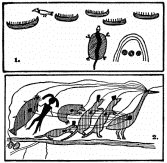
Specimens of American Indian picture-writing (after Schoolcraft ...)
No. 1, painted on a rock on the shore of Lake Superior, records an expedition across the lake, in which five canoes took part. The upright strokes in each indicate the number of the crew, and the bird represents a chief, “The Kingfisher.” The three circles (suns) under the arch (of heaven) indicate that the voyage lasted three days, and the tortoise, a symbol of land, denotes a safe arrival. No. 2 is a petition sent to the United States Congress by a group of Indian tribes, asking for fishing rights in certain small lakes. The tribes are represented by their totems, martens, bear, manfish, and catfish, led by the crane. Lines running from the heart and eye of each animal to the heart and eye of the crane denote that they are all of one mind; and a line runs from the eye of the crane to the lakes, shown in the crude little “map” in the lower left-hand corner.
From such combinations one passes to what are called ideograms: the sign for “words” and the sign for “tongue” combine to make “speech”; the sign for “roof” and the sign for “pig” make “home”—for in the early domestic economy of China the pig was as important as it used to be in Ireland. But, as we have already noted earlier, the Chinese language consists of a comparatively few elementary monosyllabic sounds, which are all used in a great variety of meanings, and the Chinese soon discovered that a number of these pictographs and ideographs could be used also to express other ideas, not so conveniently pictured, but having the same sound. Characters so used are called phonograms. For example, the sound fang meant not only “boat,” but “a place,” “spinning,” “fragrant,” “inquire,” and several other meanings according to the context. But while a boat is easy to draw most of the other meanings are undrawable. How can one draw “fragrant” or “inquire”? The Chinese, therefore, took the same sign for all these meanings of fang, but added to each of them another distinctive sign, the determinative, to show what sort of fang was intended. A “place” was indicated by the same sign as for “boat” (fang) and the determinative sign for “earth”; “spinning” by the sign for fang and the sign for “silk”; “inquire” by the sign for fang and the sign for “words,” and so on.
One may perhaps make this development of pictographs, ideographs, and phonograms a little clearer by taking an analogous case in English. Suppose we were making up a sort of picture-writing in English, then it would be very natural to use a square with a slanting line to suggest a lid, for the word and thing box. That would be a pictograph. But now suppose we had a round sign for money, and suppose we put this sign inside the box sign, that would do for “cash-box” or “treasury.” That would be an ideogram. But the word “box” is used for other things than boxes. There is the box shrub which gives us boxwood. It would be hard to draw a recognizable box-tree distinct from other trees, but it is quite easy to put our sign “box,” and add our sign for shrub as a determinative to determine that it is that sort of box and not a common box that we want to express. And then there is “box,” the verb, meaning to fight with fists. Here, again, we need a determinative; we might add the two crossed swords, a sign which is used very often upon maps to denote a battle. A box at a theatre needs yet another determinative, and so we go on, through a long series of phonograms.
Now it is manifest that here in the Chinese writing is a very peculiar and complex system of sign-writing. A very great number of characters have to be learnt and the mind habituated to their use. The power it possesses to carry ideas and discussion is still ungauged by western standards, but we may doubt whether with this instrument it will ever be possible to establish such a wide, common mentality as the simpler and swifter alphabets of the western civilizations permit. In China it created a special reading-class, the mandarins, who were also the ruling and official class. Their necessary concentration upon words and classical forms, rather than upon ideas and realities, seems, in spite of her comparative peacefulness and the very high individual intellectual quality of her people, to have greatly hampered the social and economic development of China. Probably it is the complexity of her speech and writing, more than any other imaginable cause, that has made China to-day politically, socially, and individually a vast pool of backward people rather than the foremost power in the whole world.[133]
§ 2
But while the Chinese mind thus made for itself an instrument which is probably too elaborate in structure, too laborious in use, and too inflexible in its form to meet the modern need for simple, swift, exact, and lucid communications, the growing civilizations of the west were working out the problem of a written record upon rather different and, on the whole, more advantageous lines. They did not seek to improve their script to make it swift and easy, but circumstances conspired to make it so. The Sumerian picture-writing, which had to be done upon clay and with little styles, which made curved marks with difficulty and inaccurately, rapidly degenerated by a conventionalized dabbing down of wedged-shaped marks (cuneiform = wedge-shaped) into almost unrecognizable hints of the shapes intended. It helped the Sumerians greatly to learn to write, that they had to draw so badly. They got very soon to the Chinese pictographs, ideographs, and phonograms, and beyond them.
Most people know a sort of puzzle called a rebus. It is a way of representing words by pictures, not of the things the words represent, but by the pictures of other things having a similar sound. For example, two gates and a head is a rebus for Gates-head; a little streamlet (beck), a crowned monarch, and a ham, Beckingham. The Sumerian language was a language well adapted to this sort of representation. It was apparently a language of often quite vast polysyllables, made up of very distinct inalterable syllables; and many of the syllables taken separately were the names of concrete things. So that this cuneiform writing developed very readily into a syllabic way of writing, in which each sign conveys a syllable just as each act in a charade conveys a syllable. When presently the Semites conquered Sumeria, they adapted the syllabic system to their own speech, and so this writing became entirely a sign-for-a-sound writing. It was so used by the Assyrians and by the Chaldeans. But it was not a letter-writing, it was a syllable-writing. This cuneiform script prevailed for long ages over Assyria, Babylonia, and the Near East generally; there are vestiges of it in some of the letters of our alphabet to-day.
§ 3
But, meanwhile, in Egypt and upon the Mediterranean coast another system of writing grew up. Its beginnings are probably to be found in the priestly picture-writing (hieroglyphics) of the Egyptians, which also in the usual way became partly a sound-sign system. As we see it on the Egyptian monuments, the hieroglyphic writing consists of decorative but stiff and elaborate forms, but for such purpose as letter-writing and the keeping of recipes and the like, the Egyptian priests used a much simplified and flowing form of these characters, the hieratic script. Side by side with this hieratic script rose another, probably also derivative from the hieroglyphs, a script now lost to us, which was taken over by various non-Egyptian peoples in the Mediterranean, the Phœnicians, Libyans, Lydians, Cretans, and Celt-Iberians, and used for business purposes. Possibly a few letters were borrowed from the later cuneiform. In the hands of these foreigners this writing was, so to speak, cut off from its roots; it lost all but a few traces of its early pictorial character. It ceased to be pictographic or ideographic; it became simply a pure sound-sign system, an alphabet.
There were a number of such alphabets in the Mediterranean differing widely from each other.[134] It may be noted that the Phœnician alphabet (and perhaps others) omitted vowels. Possibly they pronounced their consonants very hard and had rather indeterminate vowels, as is said to be still the case with tribes of South Arabia. Quite probably, too, the Phœnicians used their alphabet at first not so much for writing as for single initial letters in their business accounts and tallies. One of these Mediterranean alphabets reached the Greeks, long after the time of the Iliad, who presently set to work to make it express the clear and beautiful sounds of their own highly developed Aryan speech. It consisted at first of consonants, and the Greeks added the vowels. They began to write for record, to help and fix their bardic tradition....
§ 4
So it was by a series of very natural steps that writing grew out of the life of man. At first and for long ages it was the interest and the secret of only a few people in a special class, a mere accessory to the record of pictures. But there were certain very manifest advantages, quite apart from the increased expressiveness of mood and qualification, to be gained by making writing a little less plain than straightforward pictures, and in conventionalizing and codifying it. One of these was that so messages might be sent understandable by the sender and receiver, but not plain to the uninitiated. Another was that so one might put down various matters and help one’s memory and the memory of one’s friends, without giving away too much to the common herd. Among some of the earliest Egyptian writings, for example, are medical recipes and magic formulæ. Accounts, letters, recipes, name lists, itineraries; these were the earliest of written documents. Then, as the art of writing and reading spread, came that odd desire, that pathetic desire so common among human beings, to astonish some strange and remote person by writing down something striking, some secret one knew, some strange thought, or even one’s name, so that long after one had gone one’s way, it might strike upon the sight and mind of another reader. Even in Sumeria men scratched on walls, and all that remains to us of the ancient world, its rocks, its buildings, is plastered thickly with the names and the boasting of those foremost among human advertisers, its kings. Perhaps half the early inscriptions in that ancient world are of this nature, if, that is, we group with the name-writing and boasting the epitaphs, which were probably in many cases prearranged by the deceased.
For long the desire for crude self-assertion of the name-scrawling sort and the love of secret understandings kept writing within a narrow scope; but that other, more truly social desire in men, the desire to tell, was also at work. The profounder possibilities of writing, the possibilities of a vast extension and definition and settlement of knowledge and tradition, only grew apparent after long ages. But it will be interesting at this point and in this connection to recapitulate certain elemental facts about life, upon which we laid stress in our earlier chapters, because they illuminate not only the huge value of writing in the whole field of man’s history, but also the rôle it is likely to play in his future.
1. Life had at first, it must be remembered, only a discontinuous repetition of consciousness, as the old died and the young were born.
Such a creature as a reptile has in its brain a capacity for experience, but when the individual dies, its experience dies with it. Most of its motives are purely instinctive, and all the mental life that it has is the result of heredity (birth inheritance).
2. But ordinary mammals have added to pure instinct tradition, a tradition of experience imparted by the imitated example of the mother, and in the case of such mentally developed animals as dogs, cats, or apes, by a sort of mute precept also. For example, the mother cat chastises her young for misbehaviour. So do mother apes and baboons.
3. Primitive man added to his powers of transmitting experience, representative art and speech. Pictorial and sculptured record and verbal tradition began.
Verbal tradition was developed to its highest possibility by the bards. They did much to make language what it is to the world to-day.
4. With the invention of writing, which developed out of pictorial record, human tradition was able to become fuller and much more exact. Verbal tradition, which had hitherto changed from age to age, began to be fixed. Men separated by hundreds of miles could now communicate their thoughts. An increasing number of human beings began to share a common written knowledge and a common sense of a past and a future. Human thinking became a larger operation in which hundreds of minds in different places and in different ages could react upon one another; it became a process constantly more continuous and sustained....
5. For hundreds of generations the full power of writing was not revealed to the world, because for a long time the idea of multiplying writings by taking prints of a first copy did not become effective. The only way of multiplying writings was by copying one copy at a time, and this made books costly and rare. Moreover, the tendency to keep things secret, to make a cult and mystery of them, and so to gain an advantage over the generality of men, has always been very strong in men’s minds. It is only nowadays that the great masses of mankind are learning to read, and reaching out towards the treasures of knowledge and thought already stored in books.
Nevertheless, from the first writings onward a new sort of tradition, an enduring and immortal tradition, began in the minds of men. Life, through mankind, grew thereafter more and more distinctly conscious of itself and its world. It is a thin streak of intellectual growth we trace in history, at first in a world of tumultuous ignorance and forgetfulness; it is like a mere line of light coming through the chink of an opening door into a darkened room; but slowly it widens, it grows. At last came a time in the history of Europe when the door, at the push of the printer, began to open more rapidly. Knowledge flared up, and as it flared it ceased to be the privilege of a favoured minority. For us now that door swings wider, and the light behind grows brighter. Misty it is still, glowing through clouds of dust and reek.
The door is not half open; the light is but a light new lit. Our world to-day is only in the beginning of knowledge.
XIX GODS AND STARS, PRIESTS AND KINGS
§ 1. Nomadic and Settled Religion. § 2. The Priest Comes into History. § 3. Priests and the Stars. § 4. Priests and the Dawn of Learning. § 5. King against Priest. § 6. How Bel-Marduk Struggled against the Kings. § 7. The God-Kings of Egypt. § 8. Shi Hwang-ti Destroys the Books.
§ 1
WE have already told what there is to tell of the social life of the Aryan tribes when they were settling down to the beginnings of civilized life; we have seen how they were associated in great households, grouped together under tribal leaders, who made a sort of informal aristocracy rather like that of the sixth form and prefects in an English boys’ school; we have considered the rôle of the bards in the creation of an oral tradition, and we have glanced at their not very complex religious ideas. We may note one or two points of difference from the equivalent life of the nomadic Semites.
Like the early Aryan life, it was a life in a sort of family-tribe household. But it had differences due originally perhaps to the warmer, drier climate. Though both groups of races had cattle and sheep, the Aryans were rather herdsmen, the Semites, shepherds. The Semites had no long winter evenings and no bardic singing. They never sat in hall. They have consequently no epics. They had stories, camp-fire stories, but not verbally beautified story-recitations. The Semite also was more polygamous than the Aryan, his women less self-assertive,[135] and the tendency of his government more patriarchal. The head of the household or the tribe was less of a leader and more of a master, more like the Palæolithic Old Man. And the Semitic nomads were closer to the earlier civilizations, a thing that fitted in with their greater aptitude for trade and counting. But the religion of the nomadic Semite was as little organized as the religion of the Aryan. In either case the leading man performed most of the functions of the priest. The Aryan gods were little more than a kind of magical super-prince; they were supposed to sit in hall together, and to talk and make scenes with one another under Jupiter or Thor. The early Semitic gods, on the other hand, were thought of as tribal patriarchs. As peoples develop towards nomadism, they seem to lose even such primitive religion and magic as their Neolithic ancestors professed. Nomadism cuts men off from fixed temples and intense local associations; they take a broader and simpler view of the world. They tend towards religious simplification.
We write here of the nomadic peoples, the Aryan herdsmen and Semitic shepherds, and we write in the most general terms. They had their undercurrent of fables and superstitions, their phases of fear and abjection and sacrificial fury. These people were people like ourselves, with brains as busy and moody and inconsistent, and with even less training and discipline. It is absurd to suppose—as so many writers about early religion do seem to suppose—that their religious notions can be reduced to the consistent logical development of some one simple idea. We have already glanced, in Chapter XII, at the elements of religion that must have arisen necessarily in the minds of those early peoples. But for most of the twenty-four hours these nomads were busy upon other things, and there is no sign that their houses, their daily routines, their ordinary acts, were dominated or their social order shaped, by any ideas that we should now call religious. As yet life and its ideas were too elementary for that.
But directly we turn our attention to these new accumulations of human beings that are beginning in Egypt and Mesopotamia, we find that one of the most conspicuous objects in every city is a temple or a group of temples. In some cases there arises beside it in these regions a royal palace, but as often the temple towers over the palace. This presence of the temple is equally true of the Phœnician cities and of the Greek and Roman as they arise. The palace of Cnossos, with its signs of comfort and pleasure-seeking, and the kindred cities of the Ægean peoples, include religious shrines, but in Crete there are also temples standing apart from the palatial city-households. All over the ancient civilized world we find them; wherever primitive civilization set its foot in Africa, Europe, or western Asia, a temple arose, and where the civilization is most ancient, in Egypt and in Sumer, there the temple is most in evidence. When Hanno reached what he thought was the most westerly point of Africa, he set up a temple to Hercules. We have, in fact, come now to a new stage in the history of mankind, the temple stage.
§ 2
In all these temples there was a shrine; dominating the shrine there was commonly a great figure, usually of some monstrous half-animal form, before which stood an altar for sacrifices. This figure was either regarded as the god or as the image or symbol of the god, for whose worship the temple existed. And connected with the temple there were a number, and often a considerable number, of priests or priestesses, and temple servants, generally wearing a distinctive costume and forming an important part of the city population. They belonged to no household, as did the simple priest of the primitive Aryan; they made up a new kind of household of their own. They were a caste and a class apart, attracting intelligent recruits from the general population.
The primary duty of this priesthood was concerned with the worship of and the sacrifices to the god of the temple. And these things were done, not at any time, but at particular times and seasons. There had come into the life of man with his herding and agriculture a sense of a difference between the parts of the year and of a difference between day and day. Men were beginning to work—and to need days of rest. The temple, by its festivals, kept count. The temple in the ancient city was like the clock and calendar upon a writing-desk.
But it was a centre of other functions. It was in the early temples that the records and tallies of events were kept and that writing began. And there was knowledge there. The people went to the temple not only en masse for festivals, but individually for help. The early priests were also doctors and magicians. In the earliest temples we already find those little offerings for some private and particular end, which are still made in the chapels of Catholic churches to-day, ex votos, little models of hearts relieved and limbs restored, acknowledgment of prayers answered and accepted vows.
It is clear that here we have that comparatively unimportant element in the life of the early nomad, the medicine-man, the shrine-keeper, and the memorist, developed, with the development of the community and as a part of the development of the community from barbarism to civilized settlement, into something of very much greater importance. And it is equally evident that those primitive fears of (and hopes of help from) strange beings, the desire to propitiate unknown forces, the primitive desire for cleansing and the primitive craving for power and knowledge have all contributed to crystallize out this new social fact of the temple.
The temple was accumulated by complex necessities, it grew from many roots and needs, and the god that dominated the temple was the creation of many imaginations and made up of all sorts of impulses, ideas, and half ideas. Here there was a god in which one sort of ideas predominated, and there another. It is necessary to lay some stress upon this confusion and variety of origin in gods, because there is a very abundant literature now in existence upon religious origins, in which a number of writers insist, some on this leading idea and some on that—we have noted several in our Chapter XII on “Early Thought”—as though it were the only idea. Professor Max Müller in his time, for example, harped perpetually on the idea of sun stories and sun worship. He would have had us think that early man never had lusts or fears, cravings for power, nightmares or fantasies, but that he meditated perpetually on the beneficent source of light and life in the sky. Now dawn and sunset are very moving facts in the daily life, but they are only two among many.
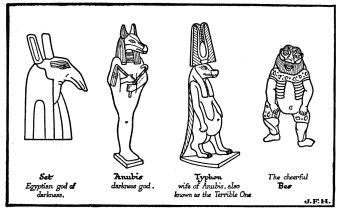
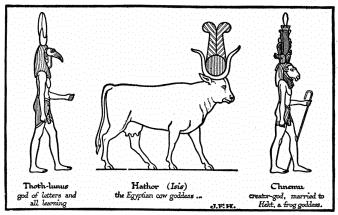
Early men, three or four hundred generations ago, had brains very like our own. The fancies of our childhood and youth are perhaps the best clue we have to the ground-stuff of early religion, and anyone who can recall those early mental experiences will understand very easily the vagueness, the monstrosity, and the incoherent variety of the first gods. There were sun gods, no doubt, early in the history of temples, but there were also hippopotamus gods and hawk gods; there were cow deities, there were monstrous male and female gods, there were gods of terror and gods of an adorable quaintness, there were gods who were nothing but lumps of meteoric stone that had fallen amazingly out of the sky, and gods who were mere natural stones that had chanced to have a queer and impressive shape. Some gods, like Marduk of Babylon and the Baal (= the Lord) of the Phœnicians, Canaanites, and the like, were quite probably at bottom just legendary wonder beings, such as little boys will invent for themselves to-day. The early Semites, it is said, as soon as they thought of a god, invented a wife for him; most of the Egyptian and Babylonian gods were married. But the gods of the nomadic Semites had not this marrying disposition. Children were less eagerly sought by the inhabitants of the food-grudging steppes.
Even more natural than to provide a wife for a god is to give him a house to live in to which offerings can be brought. Of this house the knowing man, the magician, would naturally become the custodian. A certain seclusion, a certain aloofness, would add greatly to the prestige of the god. The steps by which the early temple and the early priesthood developed so soon as an agricultural population settled and increased are all quite natural and understandable, up to the stage of the long temple with the image, shrine and altar at one end and the long nave in which the worshippers stood. And this temple, because it had records and secrets, because it was a centre of power, advice, and instruction, because it sought and attracted imaginative and clever people for its service, naturally became a kind of brain in the growing community. The attitude of the common people who tilled the fields and herded the beasts towards the temple would remain simple and credulous. There, rarely seen and so imaginatively enhanced, lived the god whose approval gave prosperity, whose anger meant misfortune; he could be propitiated by little presents and the help of his servants could be obtained. He was wonderful, and of such power and knowledge that it did not do to be disrespectful to him even in one’s thoughts. Within the priesthood, however, a certain amount of thinking went on at a rather higher level than that.
§ 3[136]
And now we have to note a very interesting fact about the chief temples of Egypt and, so far as we know—because the ruins are not so distinct—of Babylonia, and that is that they were “oriented”—that is to say, that the same sort of temple was built so that the shrine and entrance always faced in the same direction.[137] In Babylonian temples this was most often due east, facing the sunrise on March 21st and September 21st, the equinoxes; and it is to be noted that it was at the spring equinox that the Euphrates and Tigris came down in flood. The Pyramids of Gizeh are also oriented east and west, and the Sphinx faces due east, but very many of the Egyptian temples to the south of the delta of the Nile do not point due east, but to the point where the sun rises at the longest day—and in Egypt the inundation comes close to that date. Others, however, pointed nearly northward, and others again pointed to the rising of the star Sirius or to the rising-point of other conspicuous stars. The fact of orientation links up with the fact that there early arose a close association between various gods and the sun and various fixed stars. Whatever the mass of people outside were thinking, the priests of the temples were beginning to link the movements of those heavenly bodies with the power in the shrine. They were thinking about the gods they served and thinking new meanings into them. They were brooding upon the mystery of the stars. It was very natural for them to suppose that these shining bodies, so irregularly distributed and circling so solemnly and silently, must be charged with portents to mankind.
Among other things, this orientation of the temples served to fix and help the great annual festival of the New Year. On one morning in the year, and one morning alone, in a temple oriented to the rising-place of the sun at Midsummer Day, the sun’s first rays would smite down through the gloom of the temple and the long alley of the temple pillars, and light up the god above the altar and irradiate him with glory. The narrow, darkened structure of the ancient temples seems to be deliberately planned for such an effect. No doubt the people were gathered in the darkness before the dawn; in the darkness there was chanting and perhaps the offering of sacrifices; the god alone stood mute and invisible. Prayers and invocations would be made. Then upon the eyes of the worshippers, sensitized by the darkness, as the sun rose behind them, the god would suddenly shine.
So, at least, one explanation of orientation is found by such students of orientation as Sir Norman Lockyer.[138] Not only is orientation apparent in most of the temples of Egypt, Assyria, Babylonia, and the east, it is found in the Greek temples; Stonehenge is oriented to the midsummer sunrise, and so are most of the megalithic circles of Europe; the Temple of Heaven in Peking is oriented to midwinter. In the days of the Chinese Empire, up to a few years ago, one of the most important of all the duties of the Emperor of China was to sacrifice and pray in this temple upon midwinter’s day for a propitious year.
The Egyptian priests had mapped out the stars into the constellations, and divided up the zodiac into twelve signs, by 3000 B.C. ...
§ 4
This clear evidence of astronomical inquiry and of a development of astronomical ideas is the most obvious, but only the most obvious, evidence of the very considerable intellectual activities that went on within the temple precincts in ancient times. There is a curious disposition among many modern writers to deprecate priesthoods and to speak of priests as though they had always been impostors and tricksters, preying upon the simplicity of mankind. But, indeed, they were for long the only writing class, the only reading public, the only learned and the only thinkers; they were all the professional classes of the time. You could have no intellectual life at all, you could not get access to literature or any knowledge except through the priesthood. The temples were not only observatories and libraries and clinics, they were museums and treasure-houses. The original Periplus of Hanno hung in one temple in Carthage, skins of his “gorillas” were hung and treasured in another. Whatever there was of abiding worth in the life of the community sheltered there. Herodotus, the early Greek historian (485-425 B.C.), collected most of his material from the priests of the countries in which he travelled, and it is evident they met him generously and put their very considerable resources completely at his disposal. Outside the temples the world was still a world of blankly illiterate and unspeculative human beings, living from day to day entirely for themselves. Moreover, there is little evidence that the commonalty felt cheated by the priests, or had anything but trust and affection for the early priesthoods. Even the great conquerors of later times were anxious to keep themselves upon the right side of the priests of the nations and cities whose obedience they desired, because of the immense popular influence of these priests.
No doubt there were great differences between temple and temple and cult and cult in the spirit and quality of the priesthood. Some probably were cruel, some vicious and greedy, many dull and doctrinaire, stupid with tradition, but it has to be kept in mind that there were distinct limits to the degeneracy or inefficiency of a priesthood. It had to keep its grip upon the general mind. It could not go beyond what people would stand—either towards the darkness or towards the light. Its authority rested, in the end, on the persuasion that its activities were propitious.
§ 5[139]
It is clear that the earliest civilized governments were essentially priestly governments. It was not kings and captains who first set men to the plough and a settled life. It was the ideas of the gods and plenty, working with the acquiescence of common men. The early rulers of Sumer we know were all priests, kings only because they were chief priests. And priestly government had its own weaknesses as well as its peculiar deep-rooted strength. The power of a priesthood is a power over their own people alone. It is a subjugation through mysterious fears and hopes. The priesthood can gather its people together for war, but its traditionalism and all its methods unfit it for military control. Against the enemy without, a priest-led people is feeble.
Moreover, a priest is a man vowed, trained, and consecrated, a man belonging to a special corps, and necessarily with an intense esprit de corps. He has given up his life to his temple and his god. This is a very excellent thing for the internal vigour of his own priesthood, his own temple. He lives or dies for the honour of his particular god. But in the next town or village is another temple with another god. It is his constant preoccupation to keep his people from that god. Religious cults and priesthoods are sectarian by nature; they will convert, they will overcome, but they will never coalesce. Our first perceptions of events in Sumer, in the dim uncertain light before history began, is of priests and gods in conflict; until the Sumerians were conquered by the Semites they were never united; and the same incurable conflict of priesthoods scars all the temple ruins of Egypt. It was impossible that it could have been otherwise, having regard to the elements out of which religion arose.
An Assyrian King & his Chief Minister
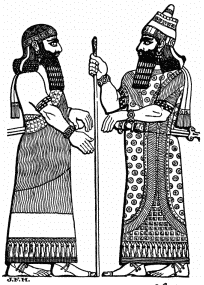
It was out of those two main weaknesses of all priesthoods, namely, the incapacity for efficient military leadership and their inevitable jealousy of all other religious cults, that the power of secular kingship arose. The foreign enemy either prevailed and set up a king over the people, or the priesthoods who would not give way to each other set up a common fighting captain, who retained more or less power in peace time. This secular king developed a group of officials about him and began, in relation to military organization, to take a share in the priestly administration of the people’s affairs. So, growing out of priestcraft and beside the priest, the king, the protagonist of the priest, appears upon the stage of human history, and a very large amount of the subsequent experiences of mankind is only to be understood as an elaboration, complication, and distortion of the struggle, unconscious or deliberate, between these two systems of human control, the temple and the palace. And it was in the original centres of civilization that this antagonism was most completely developed. The Aryan peoples never passed through a phase of temple rule on their way to civilization; they came to civilization late; they found that drama already half-played. They took over the ideas of both temple and kingship, when those ideas were already elaborately developed, from the more civilized Hamitic or Semitic people they conquered.
The greater importance of the gods and the priests in the earlier history of the Mesopotamian civilization is very apparent, but gradually the palace won its way until it was at last in a position to struggle definitely for the supreme power. At first, in the story, the palace is ignorant and friendless in the face of the temple; the priests alone read, the priests alone know, the people are afraid of him. But in the dissensions of the various cults comes the opportunity of the palace. From other cities, from among captives, from defeated or suppressed religious cults, the palace gets men who also can read and who can do magic things.[140] The court also becomes a centre of writing and record; the king thinks for himself and becomes politic. Traders and foreigners drift to the court, and if the king has not the full records and the finished scholarship of the priests, he has a wider and fresher first-hand knowledge of many things. The priest comes into the temple when he is very young; he passes many years as a neophyte; the path of learning the clumsy letters of primitive times is slow and toilsome; he becomes erudite and prejudiced rather than a man of the world. Some of the more active-minded young priests may even cast envious eyes at the king’s service. There are many complications and variations in this ages-long drama of the struggle going on beneath the outward conflicts of priest and king, between the made man and the born man, between learning and originality, between established knowledge and settled usage on the one hand, and creative will and imagination on the other. It is not always, as we shall find later, the priest who is the conservative and unimaginative antagonist. Sometimes a king struggles against narrow and obstructive priesthoods; sometimes priesthoods uphold the standards of civilization against savage, egotistical, or reactionary kings.
One or two outstanding facts and incidents of the early stages of this fundamental struggle in political affairs are all that we can note here between 4000 B.C. and the days of Alexander.
§ 6
In the early days of Sumeria and Akkadia the city-kings were priests and medicine-men rather than kings, and it was only when foreign conquerors sought to establish their hold in relation to existing institutions that the distinction of priest and king became definite. But the god of the priests remained as the real overlord of the land and of priest and king alike. He was the universal landlord; the wealth and authority of his temples and establishments outshone those of the king. Especially was this the case within the city walls. Hammurabi, the founder of the first Babylonian Empire, is one of the earlier monarchs whom we find taking a firm grip upon the affairs of the community. He does it with the utmost politeness to the gods. In an inscription recording his irrigation work in Sumeria and Akkadia, he begins: “When Anu and Bel entrusted me with the rule of Sumer and Akkad——.” We possess a code of laws made by this same Hammurabi—it is the earliest known code of law—and at the head of this code we see the figure of Hammurabi receiving the law from its nominal promulgator, the god Shamash.
An act of great political importance in the conquest of any city was the carrying off of its god to become a subordinate in the temple of its conqueror. This was far more important than the subjugation of king by king. Merodach, the Babylonian Jupiter, was carried off by the Elamites, and Babylon did not feel independent until its return. But sometimes a conqueror was afraid of the god he had conquered. In the collection of letters addressed to Amenophis III and IV at Tel-Amarna in Egypt, to which allusion has already been made, is one from a certain king, Tushratta, King of Mitani, who has conquered Assyria and taken the statue of the goddess Ishtar. Apparently he has sent this statue into Egypt, partly to acknowledge the overlordship of Amenophis, but partly because he fears her anger. (Winckler.) In the Bible is related (Sam. i. v. 1) how the Ark of the Covenant of the God of the Hebrews was carried off by the Philistines, as a token of conquest, into the temple of the fish god, Dagon, at Ashdod, and how Dagon fell down and was broken, and how the people of Ashdod were smitten with disease. In the latter story particularly the gods and priests fill the scene; there is no king in evidence at all.
Right through the history of the Babylonian and Assyrian empires no monarch seems to have felt his tenure of power secure in Babylon until he had “taken the hand of Bel”—that is to say, that he had been adopted by the priesthood of “Bel” as the god’s son and representative. As our knowledge of Assyrian and Babylonian history grows clearer, it becomes plainer that the politics of that world, the revolutions, usurpations, changes of dynasty, intrigues with foreign powers, turned largely upon issues between the great wealthy priesthoods and the growing but still inadequate power of the monarchy. The king relied on his army, and this was usually a mercenary army of foreigners, speedily mutinous if there was no pay or plunder, and easily bribed. We have already noted the name of Sennacherib, the son of Sargon II, among the monarchs of the Assyrian Empire. Sennacherib was involved in a violent quarrel with the priesthood of Babylon; he never “took the hand of Bel”; and finally struck at that power by destroying altogether the holy part of the city of Babylon (691 B.C.) and removing the statue of Bel-Marduk to Assyria. He was assassinated by one of his sons, and his successor, Esarhaddon (his son, but not the son who was his assassin), found it expedient to restore Bel-Marduk and rebuild his temple, and make his peace with the god.[141]
Assurbanipal (Greek, Sardanapalus), the son of this Esarhaddon, is a particularly interesting figure from this point of view of the relationship of priesthood and king. His father’s reconciliation with the priests of Bel-Marduk went so far that Sardanapalus was given a Babylonian instead of a military Assyrian education. He became a great collector of the clay documents of the past, and his library, which has been unearthed, is now the most precious source of historical material in the world. But for all his learning he kept his grip on the Assyrian army; he made a temporary conquest of Egypt, suppressed a rebellion in Babylon, and carried out a number of successful expeditions. As we have already told in Chapter XVI, he was almost the last of the Assyrian monarchs. The Aryan tribes, who knew more of war than of priestcraft, and particularly the Scythians, the Medes and Persians, had long been pressing upon Assyria from the north and north-east. The Medes and Persians formed an alliance with the nomadic Semitic Chaldeans of the south for the joint undoing of Assyria. Nineveh, the Assyrian capital, fell to these Aryans in 606 B.C.
Sixty-seven years after the taking of Nineveh by the Aryans, which left Babylonia to the Semitic Chaldeans, the last monarch of the Chaldean Empire (the Second Babylonian Empire), Nabonidus, the father of Belshazzar, was overthrown by Cyrus, the Persian. This Nabonidus, again, was a highly educated monarch, who brought far too much intelligence and imagination and not enough of the short range wisdom of this world to affairs of state. He conducted antiquarian researches, and to his researches it is that we owe the date of 3750 B.C., assigned to Sargon I and still accepted by many authorities. He was proud of this determination, and left inscriptions to record it. It is clear he was a religious innovator; he built and rearranged temples and attempted to centralize religion in Babylon by bringing a number of local gods to the temple of Bel-Marduk. No doubt he realized the weakness and disunion of his empire due to these conflicting cults, and had some conception of unification in his mind.
Events were marching too rapidly for any such development. His innovation had manifestly raised the suspicion and hostility of the priesthood of Bel. They sided with the Persians. “The soldiers of Cyrus entered Babylon without fighting.” Nabonidus was taken prisoner, and Persian sentinels were set at the gates of the temple of Bel, “where the services continued without intermission.”
Cyrus did, in fact, set up the Persian Empire in Babylon with the blessing of Bel-Marduk. He gratified the conservative instincts of the priests by packing off the local gods back to their ancestral temples. He also restored the Jews to Jerusalem.[142] These were merely matters of immediate policy to him. But in bringing in the irreligious Aryans, the ancient priesthood was paying too highly for the continuation of its temple services. It would have been wiser to have dealt with the innovations of Nabonidus, that earnest heretic, to have listened to his ideas, and to have met the needs of a changing world. Cyrus entered Babylon 539 B.C.; by 521 B.C. Babylon was in insurrection again, and in 520 B.C. another Persian monarch, Darius, was pulling down her walls. Within two hundred years the life had altogether gone out of those venerable rituals of Bel-Marduk, and the temple of Bel-Marduk was being used by builders as a quarry.
§ 7[143]
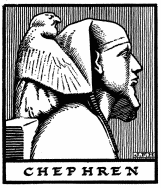
The story of priest and king in Egypt is similar to, but by no means parallel with, that of Babylonia. The kings of Sumeria and Assyria were priests who had become kings; they were secularized priests. The Pharaoh of Egypt does not appear to have followed precisely that line. Already in the very oldest records the Pharaoh has a power and importance exceeding that of any priest. He is, in fact, a god, and more than either priest or king. We do not know how he got to that position. No monarch of Sumeria or Babylonia or Assyria could have induced his people to do for him what the great pyramid-building Pharaohs of the IVth Dynasty made their people do in those vast erections. The earlier Pharaohs were not improbably regarded as incarnations of the dominant god. The falcon god Horus sits behind the head of the great statue of Chephren. So late a monarch as Rameses III (XIXth Dynasty) is represented upon his sarcophagus (now at Cambridge) bearing the distinctive symbols of the three great gods of the Egyptian system.[144] He carries the two sceptres of Osiris, the god of Day and Resurrection; upon his head are the horns of the cow goddess Hathor, and also the sun ball and feathers of Ammon Ra. He is not merely wearing the symbols of these gods as a devout Babylonian might wear the symbols of Bel-Marduk; he is these three gods in one.
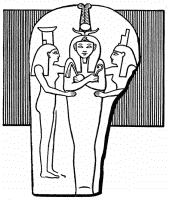
Ramses III as Osiris—between the goddesses Nephthys and Isis....
Relief on the cover of the sarcophagus (at Cambridge). After Sharpe.
Inscription (round the edges of cover), as far as decipherable.
“Osiris, King of Upper and Lower Egypt, lord of the two countries ... son of the Sun, beloved of the gods, lord of diadems, Rameses, prince of Heliopolis, triumphant! Thou art in the condition of a god, thou shalt arise as Usr, there is no enemy to thee, I give to thee triumph among them....” Budge, Catalogue, Egyptian Collection, Fitzwilliam Museum, Cambridge.
The student will find much more in Sir J. G. Frazer’s Golden Bough about the ancient use of human beings as well as statues to represent gods. Here we have merely to point to an apparent difference of idea between the Asiatic and African monarchies in this respect.
We find also a number of sculptures and paintings to enforce the idea that the Pharaohs were the actual sons of gods. The divine fathering and birth of Amenophis III, for instance (of the XVIIIth Dynasty), is displayed in extraordinary detail in a series of sculptures at Luxor. Moreover, it was held that the Pharaohs, being of so divine a strain, could not marry common clay, and consequently they were accustomed to marry blood relations within the degrees of consanguinity now prohibited, even marrying their sisters.
The struggle between palace and temple came into Egyptian history, therefore, at a different angle from that at which it came into Babylonia. Nevertheless, it came in. Professor Maspero (in his New Light on Ancient Egypt) gives a very interesting account of the struggle of Amenophis IV with the priesthoods, and particularly with priests of the great god, Ammon Ra, Lord of Karnak. The mother of Amenophis IV was not of the race of Pharaoh; it would seem that his father, Amenophis III, made a love match with a subject, a beautiful Syrian named Tii, and Professor Maspero finds in the possible opposition to and annoyance of this queen by the priests of Ammon Ra the beginnings of the quarrel. She may, he thinks, have inspired her son with a fanatical hatred of Ammon Ra. But Amenophis IV may have had a wider view. Like the Babylonian Nabonidus, who lived a thousand years later, he may have had in mind the problem of moral unity in his empire. We have already noted that Amenophis III ruled from Ethiopia to the Euphrates, and that the store of letters to himself and his son found at Tel Amarna show a very wide range of interest and influence. At any rate, Amenophis IV set himself to close all the Egyptian and Syrian temples, to put an end to all sectarian worship throughout his dominions, and to establish everywhere the worship of one god, Aton, the solar disk. He left his capital, Thebes, which was even more the city of Ammon Ra than later Babylon was the city of Bel-Marduk, and set up his capital at Tel Amarna; he altered his name from “Amenophis,” which consecrated him to Ammon (Amen) to “Akhnaton,” the Sun’s Glory; and he held his own against all the priesthoods of his empire for eighteen years and died a Pharaoh.
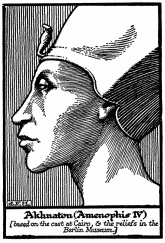
Opinions upon Amenophis IV, or Akhnaton, differ very widely. There are those who regard him as the creature of his mother’s hatred of Ammon and the uxorious spouse of a beautiful wife. Certainly he loved his wife very passionately; he showed her great honour—Egypt honoured women, and was ruled at different times by several queens—and he was sculptured in one instance with his wife seated upon his knees, and in another in the act of kissing her in a chariot; but men who live under the sway of their womenkind do not sustain great empires in the face of the bitter hostility of the most influential organized bodies in their realm.[145] Others write of him as a “gloomy fanatic.” Matrimonial bliss is rare in the cases of gloomy fanatics. It is much more reasonable to regard him as the Pharaoh who refused to be a god. It is not simply his religious policy and his frank display of natural affection that seem to mark a strong and very original personality. His æsthetic ideas were his own. He refused to have his portrait conventionalized into the customary smooth beauty of the Pharaoh god, and his face looks out at us across an interval of thirty-four centuries, a man amidst ranks of divine insipidities.
A reign of eighteen years was not long enough for the revolution he contemplated, and his son-in-law who succeeded him went back to Thebes and made his peace with Ammon Ra.
To the very end of the story the divinity of kings haunted the Egyptian mind, and infected the thoughts of intellectually healthier races. When Alexander the Great reached Babylon, the prestige of Bel-Marduk was already far gone in decay, but in Egypt, Ammon Ra was still god enough to make a snob of the conquering Grecian. The priests of Ammon Ra, about the time of the XVIIIth or XIXth Dynasty (circa 1400 B.C.), had set up in an oasis of the desert a temple and oracle. Here was an image of the god which could speak, move its head, and accept or reject scrolls of inquiry. This oracle was still flourishing in 332 B.C. The young master of the world, it is related, made a special journey to visit it; he came into the sanctuary, and the image advanced out of the darkness at the back to meet him. There was an impressive exchange of salutations. Some such formula as this must have been used (says Professor Maspero): “Come, son of my loins, who loves me so that I give thee the royalty of Ra and the royalty of Horus! I give thee valiance, I give thee to hold all countries and all religions under thy feet; I give thee to strike all the peoples united together with thy arm!”
So it was that the priests of Egypt conquered their conqueror, and an Aryan monarch first became a god....[146]
§ 8
The struggle of priest and king in China cannot be discussed here at any length. It was different again, as in Egypt it was different from Babylonia, but we find the same effort on the part of the ruler to break up tradition because it divides up the people. The Chinese Emperor, the “Son of Heaven,” was himself a high-priest, and his chief duty was sacrificial; in the more disorderly phases of Chinese history he ceases to rule and continues only to sacrifice. The literary class was detached from the priestly class at an early date. It became a bureaucratic body serving the local kings and rulers. That is a fundamental difference between the history of China and any Western history. While Alexander was overrunning Western Asia, China, under the last priest-emperors of the Chow Dynasty, was sinking into a state of great disorder. Each province clung to its separate nationality and traditions, and the Huns spread from province to province. The King of Ts’in (who lived about eighty years after Alexander the Great), impressed by the mischief tradition was doing in the land, resolved to destroy the entire Chinese literature, and his son, Shi Hwang-ti, the “first universal Emperor,” made a strenuous attempt to seek out and destroy all the existing classics.[147] They vanished while he ruled, and he ruled without tradition, and welded China into a unity that endured for some centuries; but when he had passed, the hidden books crept out again. China remained united, though not under his descendants, but after a civil war under a fresh dynasty, the Han Dynasty (206 B.C.). The first Han monarch did not sustain this campaign of Shi Hwang-ti against the literati, and his successor made his peace with them and restored the texts of the classics.
XX SERFS, SLAVES, SOCIAL CLASSES, AND FREE INDIVIDUALS
§ 1. The Common Man in Ancient Times. § 2. The Earliest Slaves. § 3. The first “Independent” Persons. § 4. Social Classes Three Thousand Years Ago. § 5. Classes Hardening into Castes. § 6. Caste in India. § 7. The System of the Mandarins. § 8. A Summary of Five Thousand Years.
§ 1
WE have been sketching in the last four chapters the growth of civilized states out of the primitive Neolithic agriculture that began in Mesopotamia perhaps 15,000, perhaps 20,000, years ago. It was at first horticulture rather than agriculture; it was done with the hoe before the plough, and at first it was quite supplementary to the sheep, goat, and cattle tending that made the “living” of the family tribe. We have traced the broad outlines of the development in regions of exceptional fruitfulness of the first settled village communities into more populous towns and cities, and the growth of the village shrine and the village medicine-man into the city temple and the city priesthood. We have noted the beginnings of organized war, first as a bickering between villages, and then as a more disciplined struggle between the priest-king and god of one city and those of another. Our story has passed on rapidly from the first indications of conquest and empire in Sumer, perhaps 6000 or 7000 B.C., to the spectacle of great empires growing up, with roads and armies, with inscriptions and written documents, with educated priesthoods and kings and rulers sustained by a tradition already ancient. We have traced in broad outline the appearance and conflicts and replacements of these empires of the great rivers. We have directed attention, in particular, to the evidence of a development of still wider political ideas as we find it betrayed by the actions and utterances of such men as Nabonidus and Amenophis IV. It has been an outline of the accumulations of human experience for ten or fifteen thousand years, a vast space of time in comparison with all subsequent history, but a brief period when we measure it against the succession of endless generations that intervenes between us and the first rude flint-using human creatures of the Pleistocene dawn. But for these last four chapters we have been writing almost entirely not about mankind generally, but only about the men who thought, the men who could draw and read and write, the men who were altering their world. Beneath their activities what was the life of the mute multitude?
The life of the common man was, of course, affected and changed by these things, just as the lives of the domestic animals and the face of the cultivated country were changed; but for the most part it was a change suffered and not a change in which the common man upon the land had any voice or will. Reading and writing were not yet for the likes of him. He went on cultivating his patch, loving his wife and children, beating his dog and tending his beasts, grumbling at hard times, fearing the magic of the priests and the power of the gods, desiring little more except to be left alone by the powers above him. So he was in 10,000 B.C.; so he was, unchanged in nature and outlook, in the time of Alexander the Great; so over the greater part of the world he remains to-day. He got rather better tools, better seeds, better methods, a slightly sounder house, he sold his produce in a more organized market as civilization progressed. A certain freedom and a certain equality passed out of human life when men ceased to wander. Men paid in liberty for safety, shelter, and regular meals. By imperceptible degrees the common man found the patch he cultivated was not his own; it belonged to the god; and he had to pay a fraction of his produce to the god. Or the god had given it to the king, who exacted his rent and tax. Or the king had given it to an official, who was the lord of the common man. And sometimes the god or the king or the noble had work to be done, and then the common man had to leave his patch and work for his master.
How far the patch he cultivated was his own was never very clear to him. In ancient Assyria the land seems to have been held as a sort of freehold and the occupier paid taxes; in Babylonia the land was the god’s, and he permitted the cultivator to work thereon. In Egypt the temples or Pharaoh-the-god or the nobles under Pharaoh were the owners and rent receivers. But the cultivator was not a slave; he was a peasant, and only bound to the land in so far that there was nothing else for him to do but cultivate, and nowhere else for him to go. He lived in a village or town, and went out to his work. The village, to begin with, was often merely a big household of related people under a patriarch headman, the early town a group of householders under its elders. There was no process of enslavement as civilization grew, but the headmen and leaderly men grew in power and authority, and the common men did not keep pace with them, and fell into a tradition of dependence and subordination.
On the whole, the common men were probably well content to live under lord or king or god and obey their bidding. It was safer. It was easier. All animals—and man is no exception—begin life as dependents. Most men never shake themselves loose from the desire for leading and protection.[148]
§ 2
Egyptian peasants seized for non-payment of taxes ... (Pyramid Age)
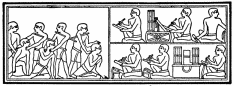
The earlier wars did not involve remote or prolonged campaigns, and they were waged by levies of the common people. But war brought in a new source of possessions, plunder, and a new social factor, the captive. In the earlier, simpler days of war, the captive man was kept only to be tortured or sacrificed to the victorious god; the captive women and children were assimilated into the tribe. But later many captives were spared to be slaves because they had exceptional gifts or peculiar arts. It would be the kings and captains who would take these slaves at first, and it would speedily become apparent to them that these men were much more their own than were the peasant cultivators and common men of their own race.[149] The slave could be commanded to do all sorts of things for his master that the quasi-free common man would not do so willingly because of his attachment to his own patch of cultivation. From a very early period the artificer was often a household slave, and the manufacture of trade goods, pottery, textiles, metal ware, and so forth, such as went on vigorously in the household city of the Minos of Cnossos, was probably a slave industry from the beginning. Sayce, in his Babylonians and Assyrians,[150] quotes Babylonian agreements for the teaching of trades to slaves, and dealing with the exploitation of slave products. Slaves produced slave children, enslavement in discharge of debts added to the slave population; it is probable that as the cities grew larger, a larger part of the new population consisted of these slave artificers and slave servants in the large households. They were by no means abject slaves; in later Babylon their lives and property were protected by elaborate laws. Nor were they all outlanders. Parents might sell their children into slavery, and brothers their orphan sisters. Free men who had no means of livelihood would even sell themselves into slavery. And slavery was the fate of the insolvent debtor. Craft apprenticeship, again, was a sort of fixed-term slavery. Out of the slave population, by a converse process, arose the freed-man and freed-woman, who worked for wages and had still more definite individual rights. Since in Babylon slaves could themselves own property, many slaves saved up and bought themselves. Probably the town slave was often better off and practically as free as the cultivator of the soil, and as the rural population increased, its sons and daughters came to mix with and swell the growing ranks of artificers, some bound, some free.
As the extent and complexity of government increased, the number of households multiplied. Under the king’s household grew up the households of his great ministers and officials, under the temple grew up the personal households of temple functionaries; it is not difficult to realize how houses and patches of land would become more and more distinctly the property of the occupiers, and more and more definitely alienated from the original owner-god. The earlier empires in Egypt and China both passed into a feudal stage, in which families, originally official, became for a time independent noble families. In the later stages of Babylonian civilization we find an increasing propertied class of people appearing in the social structure, neither slaves nor peasants nor priests nor officials, but widows and descendants of such people, or successful traders and the like, and all masterless folk. Traders came in from the outside. Babylon was full of Aramean traders, who had great establishments, with slaves, freed-men, employees of all sorts. (Their book-keeping was a serious undertaking. It involved storing a great multitude of earthenware tablets in huge earthenware jars.) Upon this gathering mixture of more or less free and detached people would live other people, traders, merchants, small dealers, catering for their needs. Sayce (op. cit.) gives the particulars of an agreement for the setting up and stocking of a tavern and beerhouse, for example. The passer-by, the man who happened to be about, had come into existence.
But another and far less kindly sort of slavery also arose in the old civilization, and that was gang slavery. If it did not figure very largely in the cities, it was very much in evidence elsewhere. The king was, to begin with, the chief entrepreneur. He made the canals and organized the irrigation (e.g. Hammurabi’s enterprises noted in the previous chapter). He exploited mines. He seems (at Cnossos, e.g.) to have organized manufactures for export. The Pharaohs of the 1st Dynasty were already working the copper and turquoise mines in the peninsula of Sinai. For many such purposes gangs of captives were cheaper and far more controllable than levies of the king’s own people. From an early period, too, captives may have tugged the oars of the galleys, though Torr (Ancient Ships) notes that up to the age of Pericles (450 B.C.) the free Athenians were not above this task. And the monarch also found slaves convenient for his military expeditions. They were uprooted men; they did not fret to go home, because they had no homes to go to. The Pharaohs hunted slaves in Nubia, in order to have black troops for their Syrian expeditions. Closely allied to such slave troops were the mercenary barbaric troops the monarchs caught into their service, not by positive compulsion, but by the bribes of food and plunder and under the pressure of need. As the old civilization developed, these mercenary armies replaced the national levies of the old order more and more, and servile gang labour became a more and more important and significant factor in the economic system. From mines and canal and wall building, the servile gang spread into cultivation. Nobles and temples adopted the gang slave system for their works. Plantation gangs began to oust the patch cultivation of the labourer-serf in the case of some staple products....
§ 3
So, in a few paragraphs, we trace the development of the simple social structure of the early Sumerian cities to the complex city crowds, the multitude of individuals varying in race, tradition, education, and function, varying in wealth, freedom, authority, and usefulness, in the great cities of the last thousand years B.C. The most notable thing of all is the gradual increase amidst this heterogeneous multitude of what we may call free individuals, detached persons who are neither priests, nor kings, nor officials, nor serfs, nor slaves, who are under no great pressure to work, who have time to read and inquire. They appear side by side with the development of social security and private property. Coined money and monetary reckoning developed. The operations of the Arameans and such-like Semitic trading people led to the organization of credit and monetary security. In the earlier days almost the only property, except a few movables, consisted of rights in land and in houses; later, one could deposit and lend securities, could go away and return to find one’s property faithfully held and secure. Towards the middle of the period of the Persian Empire there lived one free individual, Herodotus, who has a great interest for us because he was among the first writers of critical and intelligent history, as distinguished from a mere priestly or court chronicle. It is worth while to glance here very briefly at the circumstances of his life. Later on we shall quote from his history.
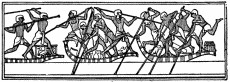
Brawl among boatmen ... (From tomb of Ptah-hetep——Pyramid Age)
We have already noted the conquest of Babylonia by the Aryan Persians under Cyrus in 539 B.C. We have noted, further, that the Persian Empire spread into Egypt, where its hold was precarious; and it extended also over Asia Minor. Herodotus was born about 484 B.C. in a Greek city of Asia Minor, Halicarnassus, which was under the overlordship of the Persians, and directly under the rule of a political boss or tyrant. There is no sign that he was obliged either to work for a living or spend very much time in the administration of his property. We do not know the particulars of his affairs, but it is clear that in this minor Greek city, under foreign rule, he was able to obtain and read and study manuscripts of nearly everything that had been written in the Greek language before his time. He travelled, so far as one can gather, with freedom and comfort about the Greek archipelagoes; he stayed wherever he wanted to stay, and he seems to have found comfortable accommodation; he went to Babylon and to Susa, the new capital the Persians had set up in Babylonia to the east of the Tigris; he toured along the coast of the Black Sea, and accumulated a considerable amount of knowledge about the Scythians, the Aryan people who were then distributed over South Russia; he went to the south of Italy, explored the antiquities of Tyre, coasted Palestine, landed at Gaza, and made a long stay in Egypt. He went about Egypt looking at temples and monuments and gathering information. We know, not only from him, but from other evidence, that in those days the older temples and the pyramids (which were already nearly three thousand years old) were visited by strings of tourists, a special sort of priests acting as guides. The inscriptions the sightseers scribbled upon the walls remain to this day, and many of them have been deciphered and published.
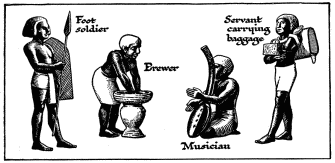
Statuettes from Middle-Class Egyptian Tombs showing Low Class Social Types in the Ancient Communities.
As his knowledge accumulated, he conceived the idea of writing a great history of the attempts of Persia to subdue Greece. But in order to introduce that history he composed an account of the past of Greece, Persia, Assyria, Babylonia, Egypt, Scythia, and of the geography and peoples of those countries. He then set himself, it is said, to make his history known among his friends in Halicarnassus by reciting it to them, but they failed to appreciate it; and he then betook himself to Athens, the most flourishing of all Greek cities at that time. There his work was received with applause. We find him in the centre of a brilliant circle of intelligent and active-minded people, and the city authorities voted him a reward of ten talents (a sum of money equivalent to £2,400) in recognition of his literary achievement....
But we will not complete the biography of this most interesting man, nor will we enter into any criticism of his garrulous, marvel-telling, and most entertaining history. It is a book to which all intelligent readers come sooner or later, abounding as it does in illuminating errors and Boswellian charm. We give these particulars here simply to show that in the fifth century B.C. a new factor was becoming evident in human affairs. Reading and writing had already long escaped from the temple precincts and the ranks of the court scribes. Record was no longer confined to court and temple. A new sort of people, these people of leisure and independent means, were asking questions, exchanging knowledge and views, and developing ideas. So beneath the march of armies and the policies of monarchs, and above the common lives of illiterate and incurious men, we note the beginnings of what is becoming at last nowadays a dominant power in human affairs, the free intelligence of mankind.
Of that free intelligence we shall have more to say when in a subsequent chapter we tell of the Greeks.
§ 4
We may summarize the discussion of the last two chapters here by making a list of the chief elements in this complicated accumulation of human beings which made up the later Babylonian and Egyptian civilizations of from two thousand five hundred to three thousand years ago. These elements grew up and became distinct one from another in the great river valleys of the world in the course of five or six thousand years. They developed mental dispositions and traditions and attitudes of thought one to another. The civilization in which we live to-day is simply carrying on and still further developing and working out and rearranging these relationships. This is the world from which we inherit. It is only by the attentive study of their origins that we can detach ourselves from the prejudices and immediate ideas of the particular class to which we may belong, and begin to understand the social and political questions of our own time.
(1) First, then, came the priesthood, the temple system, which was the nucleus and the guiding intelligence about which the primitive civilizations grew. It was still in these later days a great power in the world, the chief repository of knowledge and tradition, an influence over the lives of every one, and a binding force to hold the community together. But it was no longer all-powerful, because its nature made it conservative and inadaptable. It no longer monopolized knowledge nor initiated fresh ideas. Learning had already leaked out to other less pledged and controlled people, who thought for themselves. About the temple system were grouped its priests and priestesses, its scribes, its physicians, its magicians, its lay brethren, treasurers, managers, directors, and the like. It owned great properties and often hoarded huge treasures.
(2) Over against the priesthood, and originally arising out of it, was the court system, headed by a king or a “king of kings,” who was in later Assyria and Babylonia a sort of captain and lay controller of affairs, and in Egypt a god-man, who had released himself from the control of his priests. About the monarch were accumulated his scribes, counsellors, record keepers, agents, captains, and guards. Many of his officials, particularly his provincial officials, had great subordinate establishments, and were constantly tending to become independent. The nobility of the old river valley civilizations arose out of the court system. It was, therefore, a different thing in its origins from the nobility of the early Aryans, which was a republican nobility of elders and leading men.
(3) At the base of the social pyramid was the large and most necessary class in the community, the tillers of the soil. Their status varied from age to age and in different lands; they were free peasants paying taxes, or serfs of the god, or serfs or tenants of king or noble, or of a private owner, paying him a rent; in most cases tax or rent was paid in produce. In the states of the river valleys they were high cultivators, cultivating comparatively small holdings; they lived together for safety in villages, and had a common interest in maintaining their irrigation channels and a sense of community in their village life. The cultivation of the soil is an exacting occupation; the seasons and the harvest sunsets will not wait for men; children can be utilized at an early age, and so the cultivator class is generally a poorly educated, close-toiling class, superstitious by reason of ignorance and the uncertainty of the seasons, ill-informed and easily put upon. It is capable at times of great passive resistance, but it has no purpose in its round but crops and crops, to keep out of debt and hoard against bad times. So it has remained to our own days over the greater part of Europe and Asia.
(4) Differing widely in origin and quality from the tillers of the soil was the artisan class. At first, this was probably in part a town-slave class, in part it consisted of peasants who had specialized upon a craft. But in developing an art and mystery of its own, a technique that had to be learnt before it could be practised, each sort of craft probably developed a certain independence and a certain sense of community of its own. The artisans were able to get together and discuss their affairs more readily than the toilers on the land, and they were able to form guilds to restrict output, maintain rates of pay, and protect their common interest.
(5) As the power of the Babylonian rulers spread out beyond the original areas of good husbandry into grazing regions and less fertile districts, a class of herdsmen came into existence. In the case of Babylonia these were nomadic Semites, the Bedouin, like the Bedouin of to-day. They probably grazed their flocks over great areas much as the sheep ranchers of California do.[151] They were paid and esteemed much more highly than the husbandmen.
(6) The first merchants in the world were shipowners, like the people of Tyre and Cnossos, or nomads who carried and traded goods as they wandered between one area of primitive civilization and another. In the Babylonian and Assyrian world the traders were predominantly the Semitic Arameans, the ancestors of the modern Syrians. They became a distinct factor in the life of the community; they formed great households of their own. Usury developed largely in the last thousand years B.C. Traders needed accommodation; cultivators wished to anticipate their crops. Sayce (op. cit.) gives an account of the Babylonian banking-house of Egibi, which lasted through several generations and outlived the Chaldean Empire.
(7) A class of small retailers, one must suppose, came into existence with the complication of society during the later days of the first empires, but it was not probably of any great importance. It is difficult to understand how there could be much active retailing without small change, and there is little evidence of small change to be found either in Egypt or Mesopotamia.[152] Shekels and half-shekels of silver, weighing something between a quarter and half an ounce, are the lightest weights of stamped metal of which we find mention.
(8) A growing class of independent property owners.
(9) As the amenities of life increased, there grew up in the court, temples, and prosperous private houses a class of domestic servants, slaves or freed slaves, or young peasants taken into the household.
(10) Gang workers.—These were prisoners of war or debt slaves, or impressed or deported men.
(11) Mercenary soldiers.—These also were often captives or impressed men. Sometimes they were enlisted from friendly foreign populations in which the military spirit still prevailed.
(12) Seamen.
In modern political and economic discussions we are apt to talk rather glibly of “labour.” Much has been made of the solidarity of labour and its sense of community. It is well to note that in these first civilizations, what we speak of as “labour” is represented by five distinct classes dissimilar in origin, traditions, and outlook—namely, classes 3, 4, 5, 9, 10, and the oar-tugging part of 12. The “solidarity of labour” is, we shall find when we come to study the mechanical revolution of the nineteenth century A.D., a new idea and a new possibility in human affairs.
§ 5
Let us, before we leave this discussion of the social classes that were developing in these first civilizations, devote a little attention to their fixity. How far did they stand aloof from each other, and how far did they intermingle? So far as the classes we have counted as 9, 10, 11, and 12 go, the servants, the gang labourers and slaves, the gang soldiers, and, to a lesser extent, the sailors, or at any rate the galley rowers among the sailors, they were largely recruited classes, they did not readily and easily form homes, they were not distinctively breeding classes; they were probably replenished generation after generation by captives, by the failures of other classes, and especially from the failures of the class of small retailers, and by persuasion and impressment from among the cultivators. But so far as the sailors go, we have to distinguish between the mere rower and the navigating and shipowning seamen of such ports as Tyre and Sidon. The shipowners pass, no doubt, by insensible gradations into the mercantile class, but the navigators must have made a peculiar community in the great seaports, having homes there and handing on the secrets of seacraft to their sons. The eighth class we have distinguished was certainly a precarious class, continually increased by the accession of the heirs and dependents, the widows and retired members of the wealthy and powerful, and continually diminished by the deaths or speculative losses of these people and the dispersal of their properties. The priests and priestesses too, so far as all this world west of India went, were not a very reproductive class; many priesthoods were celibate, and that class, too, may also be counted as a recruited class. Nor are servants, as a rule, reproductive. They live in the households of other people; they do not have households and rear large families of their own. This leaves us as the really vital classes of the ancient civilized community:
(a) The royal and aristocratic class, officials, military officers, and the like;
(b) The mercantile class;
(c) The town artisans;
(d) The cultivators of the soil; and
(e) The herdsmen.
Each of these classes reared its own children in its own fashion, and so naturally kept itself more or less continuously distinct from the others. General education was not organized in those ancient states, education was mainly a household matter (as it is still in many parts of India to-day), and so it was natural and necessary for the sons to follow in the footsteps of their father and to marry women accustomed to their own sort of household. Except during times of great political disturbance therefore, there would be a natural and continuous separation of classes; which would not, however, prevent exceptional individuals from intermarrying or passing from one class to another. Poor aristocrats would marry rich members of the mercantile class; ambitious herdsmen, artisans, or sailors would become rich merchants. So far as one can gather, that was the general state of affairs in both Egypt and Babylonia. The idea was formerly entertained that in Egypt there was a fixity of classes, but this appears to be a misconception due to a misreading of Herodotus. The only exclusive class in Egypt which did not intermarry was, as in England to-day, the semi-divine royal family.
At various points in the social system there were probably developments of exclusiveness, an actual barring out of interlopers. Artisans of particular crafts possessing secrets, for example, have among all races and in all ages tended to develop guild organizations restricting the practice of their craft and the marriage of members outside their guild. Conquering people have also, and especially when there were marked physical differences of race, been disposed to keep themselves aloof from the conquered peoples, and have developed an aristocratic exclusiveness. Such organizations of restriction upon free intercourse have come and gone in great variety in the history of all long-standing civilizations. The natural boundaries of function were always there, but sometimes they have been drawn sharply and laid stress upon, and sometimes they have been made little of. There has been a general tendency among the Aryan peoples to distinguish noble (patrician) from common (plebeian) families; the traces of it are evident throughout the literature and life of Europe to-day, and it has received a picturesque enforcement in the “science” of heraldry. This tradition is still active even in democratic America. Germany, the most methodical of European countries, had in the Middle Ages a very clear conception of the fixity of such distinctions. Below the princes (who themselves constituted an exclusive class which did not marry beneath itself) there were the: