BOOK II THE MAKING OF MEN
Reading edition
VIII THE ANCESTRY OF MAN[20]
§ 1. Man Descended from a Walking Ape. § 2. First Traces of Man-like Creatures. § 3. The Heidelberg Sub-man. § 4. The Piltdown Sub-man. § 5. The Riddle of the Piltdown Remains.
§ 1
THE origin of man is still very obscure. It is commonly asserted that he is “descended” from some man-like ape such as the chimpanzee, the orang-utang, or the gorilla, but that of course is as reasonable as saying that I am “descended” from some Hottentot or Esquimaux as young or younger than myself. Others, alive to this objection, say that man is descended from the common ancestor of the chimpanzee, the orang-utang, and the gorilla. Some “anthropologists” have even indulged in a speculation whether mankind may not have a double or treble origin; the negro being descended from a gorilla-like ancestor, the Chinese from a chimpanzee-like ancestor, and so on. These are very fanciful ideas, to be mentioned only to be dismissed. It was formerly assumed that the human ancestor was “probably arboreal,” but the current idea among those who are qualified to form an opinion seems to be that he was a “ground ape,” and that the existing apes have developed in the arboreal direction.

Of course, if one puts the skeleton of a man and the skeleton of a gorilla side by side, their general resemblance is so great that it is easy to jump to the conclusion that the former is derived from such a type as the latter by a process of brain growth and general refinement. But if one examines closely into one or two differences, the gap widens. Particular stress has recently been laid upon the tread of the foot. Man walks on his toe and his heel; his great toe is his chief lever in walking, as the reader may see for himself if he examines his own footprints on the bathroom floor and notes where the pressure falls as the footprints become fainter. His great toe is the king of his toes.
Among all the apes and monkeys, the only group that have their great toes developed on anything like the same fashion as man are some of the lemurs. The baboon walks on a flat foot and all his toes, using his middle toe as his chief throw off, much as the bear does. And the three great apes all walk on the outer side of the foot in a very different manner from the walking of man.
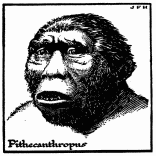
Possible Appearance of the Sub-man Pithecanthropus. The face, jaws, and teeth are mere guess work (see text). The creature may have been much less human looking than this.
The great apes are forest dwellers; their walking even now is incidental; they are at their happiest among trees. They have very distinctive methods of climbing; they swing by the arms much more than the monkeys do, and do not, like the latter, take off with a spring from the feet. They have a specially developed climbing style of their own. But man walks so well and runs so swiftly as to suggest a very long ancestry upon the ground. Also, he does not climb well now; he climbs with caution and hesitation. His ancestors may have been running creatures for long ages. Moreover, it is to be noted that he does not swim naturally; he has to learn to swim, and that seems to point to a long-standing separation from rivers and lakes and the sea. Almost certainly that ancestor was a smaller and slighter creature than its human descendants. Conceivably the human ancestor at the opening of the Cainozoic period was a running ape, living chiefly on the ground, hiding among rocks rather than trees. It could still climb trees well and hold things between its great toe and its second toe (as the Japanese can to this day), but it was already coming down to the ground again from a still remoter, a Mesozoic arboreal ancestry. It is quite understandable that such a creature would very rarely die in water in such circumstances as to leave bones to become fossilized.
It must always be borne in mind that among its many other imperfections the Geological Record necessarily contains abundant traces only of water or marsh creatures or of creatures easily and frequently drowned. The same reasons that make any traces of the ancestors of the mammals rare and relatively unprocurable in the Mesozoic rocks, probably make the traces of possible human ancestors rare and relatively unprocurable in the Cainozoic rocks. Such knowledge as we have of the earliest men, for example, is almost entirely got from a few caves, into which they went and in which they left their traces. Until the hard Pleistocene times they lived and died in the open, and their bodies were consumed or decayed altogether.
But it is well to bear in mind also that the Record of the Rocks has still to be thoroughly examined. It has been studied only for a few generations, and by only a few men in each generation. Most men have been too busy making war, making profits out of their neighbours, toiling at work that machinery could do for them in a tenth of the time, or simply playing about, to give any attention to these more interesting things. There may be, there probably are, thousands of deposits still untouched containing countless fragments and vestiges of man and his progenitors. In Asia particularly, in India or the East Indies, there may be hidden the most illuminating clues. What we know to-day of early men is the merest scrap of what will presently be known.
The apes and monkeys already appear to have been differentiated at the beginning of the Cainozoic Age, and there are a number of Oligocene and Miocene apes whose relations to one another and to the human line have still to be made out. Among these we may mention Dryopithecus of the Miocene Age, with a very human-looking jaw. In the Siwalik Hills of northern India remains of some very interesting apes have been found, of which Sivapithecus and Palæopithecus were possibly related closely to the human ancestor. Possibly these animals already used implements. Charles Darwin represents baboons as opening nuts by breaking them with stones, using stakes to prize up rocks in the hunt for insects, and striking blows with sticks and stones.[21] The chimpanzee makes itself a sort of tree hut by intertwining branches. Stones apparently chipped for use have been found in strata of Oligocene Age at Boncelles in Belgium. Possibly the implement-using disposition was already present in the Mesozoic ancestry from which we are descended.[22]
§ 2
Among the earliest evidences of some creature, either human or at least more man-like than any living ape upon earth, are a number of flints and stones very roughly chipped and shaped so as to be held in the hand. These were probably used as hand-axes. These early implements (“Eoliths”) are often so crude and simple that there was for a long time a controversy whether they were to be regarded as natural or artificial productions.[23] The date of the earliest of them is put by geologists as Pliocene—that is to say, before the First Glacial Age. They occur also throughout the First Interglacial period. We know of no bones or other remains in Europe or America of the quasi-human beings of half a million years ago, who made and used these implements. They used them to hammer with, perhaps they used them to fight with, and perhaps they used bits of wood for similar purposes.[24]
But at Trinil, in Java, in strata which are said to correspond either to the later Pliocene or to the American and European First Ice Age, there have been found some scattered bones of a creature, such as the makers of these early implements may have been. The top of a skull, some teeth, and a thigh-bone have been found. The skull shows a brain-case about half-way in size between that of the chimpanzee and man, but the thigh-bone is that of a creature as well adapted to standing and running as a man, and as free, therefore, to use its hands. The creature was not a man, nor was it an arboreal ape like the chimpanzee. It was a walking ape. It has been named by naturalists Pithecanthropus erectus (the walking ape-man). We cannot say that it is a direct human ancestor, but we may guess that the creatures who scattered these first stone tools over the world must have been closely similar and kindred, and that our ancestor was a beast of like kind. This little trayful of bony fragments from Trinil is, at present, apart from stone implements, the oldest relic of early humanity, or of the close blood relations of early humanity, that is known.
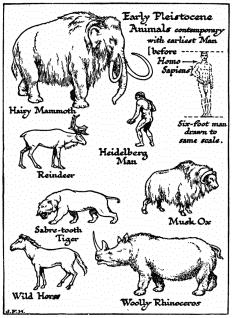
While these early men or “sub-men” were running about Europe four or five hundred thousand years ago, there were mammoths, rhinoceroses, a huge hippopotamus, a giant beaver, and a bison and wild cattle in their world. There were also wild horses, and the sabre-toothed tiger still abounded. There are no traces of lions or true tigers at that time in Europe, but there were bears, otters, wolves, and a wild boar. It may be that the early sub-man sometimes played jackal to the sabre-toothed tiger, and finished up the bodies on which the latter had gorged itself.[25]
§ 3
After this first glimpse of something at least sub-human in the record of geology, there is not another fragment of human or man-like bone yet known from that record for an interval of hundreds of thousands of years. It is not until we reach deposits which are stated to be of the Second Interglacial period, 200,000 years later, 200,000 or 250,000 years ago, that another little scrap of bone comes to hand. Then we find a jaw-bone.
This jaw-bone was found in a sandpit near Heidelberg, at a depth of eighty feet from the surface,[26] and it is not the jaw-bone of a man as we understand man, but it is man-like in every respect, except that it has absolutely no trace of a chin; it is more massive than a man’s, and its narrowness behind could not, it is thought, have given the tongue sufficient play for articulate speech. It is not an ape’s jaw-bone; the teeth are human. The owner of this jaw-bone has been variously named Homo Heidelbergensis and Palæoanthropus Heidelbergensis, according to the estimate formed of its humanity or sub-humanity by various authorities. He lived in a world not remotely unlike the world of the still earlier sub-man of the first implements; the deposits in which it is found show that there were elephants, horses, rhinoceroses, bison, a moose, and so forth with it in the world, but the sabre-toothed tiger was declining and the lion was spreading over Europe. The implements of this period (known as the Chellean period) are a very considerable advance upon those of the Pliocene Age. They are well made but very much bigger than any truly human implements. The Heidelberg man may have had a very big body and large forelimbs. He may have been a woolly strange-looking creature.
§ 4
We must turn over the Record for, it may be, another 100,000 years for the next remains of anything human or sub-human. Then in a deposit ascribed to the Third Interglacial period, which may have begun 100,000 years ago and lasted 50,000 years,[27] the smashed pieces of a whole skull turn up. The deposit is a gravel which may have been derived from the washing out of still earlier gravel strata and this skull fragment may be in reality as old as the First Glacial period. The bony remains discovered at Piltdown in Sussex display a creature still ascending only very gradually from the sub-human.
The first scraps of this skull were found in an excavation for road gravel in Sussex. Bit by bit other fragments of this skull were hunted out from the quarry heaps until most of it could be pieced together. It is a thick skull, thicker than that of any living race of men, and it has a brain capacity intermediate between that of Pithecanthropus and man. This creature has been named Eoanthropus, the dawn man. In the same gravel-pits were found teeth of rhinoceros, hippopotamus, and the leg-bone of a deer with marks upon it that may be cuts. A curious bat-shaped instrument of elephant bone has also been found.[28]
There was, moreover, a jaw-bone among these scattered remains, which was at first assumed naturally enough to belong to Eoanthropus, but which it was afterwards suggested was probably that of a chimpanzee. It is extraordinarily like that of a chimpanzee, but Dr. Keith, one of the greatest authorities in these questions, assigns it, after an exhaustive analysis in his Antiquity of Man (1915), to the skull with which it is found. It is, as a jaw-bone, far less human in character than the jaw of the much more ancient Homo Heidelbergensis, but the teeth are in some respects more like those of living men.
Diagram to Illustrate the Riddle of The Piltdown Sub-man.
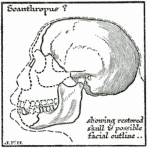
Dr. Keith, swayed by the jaw-bone, does not think that Eoanthropus, in spite of its name, is a creature in the direct ancestry of man. Much less is it an intermediate form between the Heidelberg man and the Neanderthal man we shall presently describe. It was only related to the true ancestor of man as the orang is related to the chimpanzee. It was one of a number of sub-human running apes of more than ape-like intelligence, and if it was not on the line royal, it was at any rate a very close collateral.
After this glimpse of a skull, the Record for very many centuries gives nothing but flint implements, which improve steadily in quality. A very characteristic form is shaped like a sole, with one flat side stricken off at one blow and the other side worked. The archæologists, as the Record continues, are presently able to distinguish scrapers, borers, knives, darts, throwing stones, and the like. Progress is now more rapid; in a few centuries the shape of the hand-axe shows distinct and recognizable improvements. And then comes quite a number of remains. The Fourth Glacial Age is rising towards its maximum. Man is taking to caves and leaving vestiges there; at Krapina in Croatia, at Neanderthal near Düsseldorf, at Spy, human remains have been found, skulls and bones of a creature that is certainly a man. Somewhere about 50,000 years ago, if not earlier, appeared Homo Neanderthalensis (also called Homo antiquus and Homo primigenius), a quite passable human being. His thumb was not quite equal in flexibility and usefulness to a human thumb, he stooped forward, and could not hold his head erect, as all living men do, he was chinless and perhaps incapable of speech, there were curious differences about the enamel and the roots of his teeth from those of all living men, he was very thick-set, he was, indeed, not quite of the human species; but there is no dispute about his attribution to the genus Homo. He was certainly not descended from Eoanthropus, but his jaw-bone is so like the Heidelberg jaw-bone as to make it possible that the clumsier and heavier Homo Heidelbergensis, a thousand centuries before him, was of his blood and race.
§ 5
Upon this question of the Piltdown jaw-bone, it may be of interest to quote here a letter to the writer from Sir Ray Lankester, discussing the question in a familiar and luminous manner. It will enable the reader to gauge the extent and quality of the evidence that we possess at present upon the nature of these early human and sub-human animals. Upon these fragile Piltdown fragments alone more than a hundred books, pamphlets, and papers have been written. These scraps of bone are guarded more carefully from theft and wilful damage than the most precious jewels, and in the museum cases one sees only carefully executed fac-similes.
“As to the Piltdown jaw-bone, the best study of it is that by Smith Woodward, who first described it and the canine found later. The jaw is imperfect in front, but has the broad, flat symphysis of the Apes. G. S. Miller, an American anthropologist, has made a very good comparison of it with a chimpanzee’s jaw, and concludes that it is a chimpanzee’s. (His monograph is in the Am. Jour. of Phys. Anthrop., vol. i, no. 1.) The one point in the Piltdown jaw itself against chimpanzee identification is the smooth, flat, worn surface of the molars. This is a human character, and is due to lateral movement of the jaw, and hence rubbing down of the tubercles of the molars. This is not worth much. But the serious question is, are we to associate this jaw with the cranium found close by it? If so, it is certainly not chimpanzee nor close to the Apes, but decidedly hominid. Two other small fragments of crania and a few more teeth have been found in the gravel two miles from Piltdown, which agree with the Piltdown cranium in having superciliary ridges fairly strong for a human skull, but not anything like the great superciliary ridges of Apes. The fact one has to face is this; here you have an imperfect cranium, very thick-walled and of small cubical contents (1100 or so), but much larger in that respect than any ape’s. A few yards distant from it in the same layer of gravel is found a jaw-bone having rather large pointed canines, a flat, broad symphysis, and other points about the inner face of the ramus and ridges which resemble those of the chimpanzee. Which is the more likely: (a) that these two novel fragments tending apewards from man were parts of the same individual; or (b), that the sweeping of the Wealden valley has brought there together a half-jaw and a broken cranium both more ape-like in character than any known human corresponding bits, and yet derived from two separate anthropoid beasts, one (the jaw) more simian, and the other (the cranium) much less so? As to the probabilities, we must remember that this patch of gravel at Piltdown, clearly and definitely, is a wash-up of remains of various later tertiary and post-tertiary deposits. It contains fragments of Miocene mastodon and rhinoceros teeth. These latter differ entirely in mineral character from the Eoanthropus jaw and the cranium. But (and this needs re-examination and chemical analysis) the Piltdown jaw and the Piltdown cranium do not seem to me to be quite alike in their mineral condition. The jaw is more deeply iron-stained, and I should say (but not confidently), harder than the cranium. Now, it is easy to attribute too much importance to that difference, since in a patch of iron-stained gravel, such as that at Piltdown, the soaking of water and iron salts into bones embedded may be much greater in one spot than in another only a yard off, or a few inches deeper!
“So I think we are stumped and baffled! The most prudent way is to keep the jaw and the cranium apart in all argument about them. On the other hand, on the principle that hypotheses are not to be multiplied beyond necessity, there is a case for regarding the two—jaw and cranium—as having been parts of one beast—or man.”
To which Sir H. H. Johnston adds: “Against the chimpanzee hypothesis it must be borne in mind that so far no living chimpanzee or fossil chimpanzee-like remains have been found nearer England than north equatorial Africa or North-west India, and no remains of great apes at all nearer than Southern France and the upper Rhine—and those widely different from the Eoanthropus jaw.”
IX THE NEANDERTHAL MEN, AN EXTINCT RACE (The Early Palæolithic Age[29])
§ 1. The World 50,000 Years Ago. § 2. The Daily Life of the First Men. § 3. The Last Palæolithic Men.
§ 1
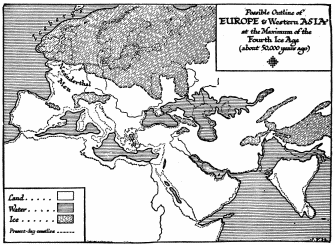
IN the time of the Third Interglacial period the outline of Europe and western Asia was very different from what it is to-day. Vast areas to the west and northwest which are now under the Atlantic waters were then dry land; the Irish Sea and the North Sea were river valleys. Over these northern areas there spread and receded and spread again a great ice cap such as covers central Greenland to-day (see Map, on page 77). This vast ice cap, which covered both polar regions of the earth, withdrew huge masses of water from the ocean, and the sea-level consequently fell, exposing great areas of land that are now submerged again. The Mediterranean area was probably a great valley below the general sea-level, containing two inland seas cut off from the general ocean. The climate of this Mediterranean basin was perhaps cold temperate, and the region of the Sahara to the south was not then a desert of baked rock and blown sand, but a well-watered and fertile country. Between the ice sheets to the north and the Alps and Mediterranean valley to the south stretched a bleak wilderness whose climate changed from harshness to a mild kindliness and then hardened again for the Fourth Glacial Age.
Across this wilderness, which is now the great plain of Europe, wandered a various fauna. At first there were hippopotami, rhinoceroses, mammoths, and elephants. The sabre-toothed tiger was diminishing towards extinction. Then, as the air chilled, the hippopotamus, and then other warmth-loving creatures, ceased to come so far north, and the sabre-toothed tiger disappeared altogether. The woolly mammoth, the woolly rhinoceros, the musk ox, the bison, the aurochs, and the reindeer became prevalent, and the temperate vegetation gave place to plants of a more arctic type. The glaciers spread southward to the maximum of the Fourth Glacial Age (about 50,000 years ago), and then receded again. In the earlier phase, the Third Interglacial period, a certain number of small family groups of men (Homo Neanderthalensis) and probably of sub-men (Eoanthropus) wandered over the land, leaving nothing but their flint implements to witness to their presence. They probably used a multitude and variety of wooden implements also; they had probably learnt much about the shapes of objects and the use of different shapes from wood, knowledge which they afterwards applied to stone; but none of this wooden material has survived; we can only speculate about its forms and uses. As the weather hardened to its maximum of severity, the Neanderthal men, already it would seem acquainted with the use of fire, began to seek shelter under rock ledges and in caves—and so leave remains behind them. Hitherto they had been accustomed to squat in the open about the fire, and near their water supply. But they were sufficiently intelligent to adapt themselves to the new and harder conditions. (As for the sub-men, they seem to have succumbed to the stresses of this Fourth Glacial Age altogether. At any rate, the rudest type of Palæolithic implements presently disappears.)
This Map Represents the Present State of Our Knowledge of the Geography of Europe And Western Asia at a Period which We Guess to be about 50,000 Years Ago, the Neanderthaler Age. Much of this map is of course speculative, but its broad outlines must be fairly like those of the world in which men first became men.
Not merely man was taking to the caves. This period also had a cave lion, a cave bear, and a cave hyæna. These creatures had to be driven out of the caves and kept out of the caves in which these early men wanted to squat and hide; and no doubt fire was an effective method of eviction and protection. Probably early men did not go deeply into the caves, because they had no means of lighting their recesses. They got in far enough to be out of the weather, and stored wood and food in odd corners. Perhaps they barricaded the cave mouths. Their only available light for going deeply into the caverns would be torches.
What did these Neanderthal men hunt? Their only possible weapons for killing such giant creatures as the mammoth or the cave bear, or even the reindeer, were spears of wood, wooden clubs, and those big pieces of flint they left behind them, the “Chellean” and “Mousterian” implements;[30] and probably their usual quarry was smaller game. But they did certainly eat the flesh of the big beasts when they had a chance, and perhaps they followed them when sick or when wounded by combats, or took advantage of them when they were bogged or in trouble with ice or water. (The Labrador Indians still kill the caribou with spears at awkward river crossings.) At Dewlish in Dorset, an artificial trench has been found which is supposed to have been a Palæolithic trap for elephants.[31] We know that the Neanderthalers partly ate their kill where it fell; but they brought back the big marrow bones to the cave to crack and eat at leisure, because few ribs and vertebræ are found in the caves, but great quantities of cracked and split long bones. They used skins to wrap about them, and the women probably dressed the skins.
We know also that they were right-handed like modern men, because the left side of the brain (which serves the right side of the body) is bigger than the right. But while the back parts of the brain which deal with sight and touch and the energy of the body are well developed, the front parts, which are connected with thought and speech, are comparatively small. It was as big a brain as ours, but different. This species of Homo had certainly a very different mentality from ours; its individuals were not merely simpler and lower than we are, they were on another line. It may be they did not speak at all, or very sparingly. They had nothing that we should call a language.
§ 2
In Worthington Smith’s Man the Primeval Savage there is a very vividly written description of early Palæolithic life, from which much of the following account is borrowed. In the original, Mr. Worthington Smith assumes a more extensive social life, a larger community, and a more definite division of labour among its members than is altogether justifiable in the face of such subsequent writings as J. J. Atkinson’s memorable essay on Primal Law.[32] For the little tribe Mr. Worthington Smith described there has been substituted, therefore, a family group under the leadership of one Old Man, and the suggestions of Mr. Atkinson as to the behaviour of the Old Man have been worked into the sketch.
Mr. Worthington Smith describes a squatting-place near a stream, because primitive man, having no pots or other vessels, must needs have kept close to a water supply, and with some chalk cliffs adjacent from which flints could be got to work. The air was bleak, and the fire was of great importance, because fires once out were not easily relit in those days. When not required to blaze it was probably banked down with ashes. The most probable way in which fires were started was by hacking a bit of iron pyrites with a flint amidst dry dead leaves; concretions of iron pyrites and flints are found together in England where the gault and chalk approach each other.[33] The little group of people would be squatting about amidst a litter of fern, moss, and such-like dry material. Some of the women and children would need to be continually gathering fuel to keep up the fires. It would be a tradition that had grown up. The young would imitate their elders in this task. Perhaps there would be rude wind shelters of boughs on one side of the encampment.
The Old Man, the father and master of the group, would perhaps be engaged in hammering flints beside the fire. The children would imitate him and learn to use the sharpened fragments. Probably some of the women would hunt good flints; they would fish them out of the chalk with sticks and bring them to the squatting-place.
There would be skins about. It seems probable that at a very early time primitive men took to using skins. Probably they were wrapped about the children, and used to lie upon when the ground was damp and cold. A woman would perhaps be preparing a skin. The inside of the skin would be well scraped free of superfluous flesh with trimmed flints, and then strained and pulled and pegged out flat on the grass, and dried in the rays of the sun.
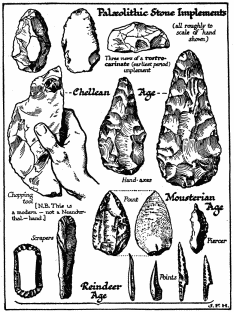
Early Stone Implements. The Mousterian Age implements, and all above it, are those of Neanderthal men or, possibly in the case of the rostro-carinates, of sub-men. The lower row (Reindeer Age) are the work of true men. The student should compare this diagram with the time diagram attached to Chapter VII, § 6, and he should note the relatively large size of the pre-human implements.
Away from the fire other members of the family group prowl in search of food, but at night they all gather closely round the fire and build it up, for it is their protection against the wandering bear and such-like beasts of prey. The Old Man is the only fully adult male in the little group. There are women, boys and girls, but so soon as the boys are big enough to rouse the Old Man’s jealousy, he will fall foul of them and either drive them off or kill them. Some girls may perhaps go off with these exiles, or two or three of these youths may keep together for a time, wandering until they come upon some other group, from which they may try to steal a mate. Then they would probably fall out among themselves. Some day, when he is forty years old perhaps or even older, and his teeth are worn down and his energy abating, some younger male will stand up to the Old Man and kill him and reign in his stead. There is probably short shrift for the old at the squatting-place. So soon as they grow weak and bad-tempered, trouble and death come upon them.
What did they eat at the squatting-place?
“Primeval man is commonly described as a hunter of the great hairy mammoth, of the bear, and the lion, but it is in the highest degree improbable that the human savage ever hunted animals much larger than the hare, the rabbit, and the rat. Man was probably the hunted rather than the hunter.
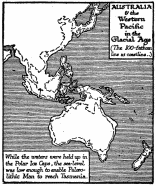
AUSTRALIA & the Western Pacific in the Glacial Age
“The primeval savage was both herbivorous and carnivorous. He had for food hazel-nuts, beech-nuts, sweet chestnuts, earth-nuts, and acorns. He had crab-apples, wild pears, wild cherries, wild gooseberries, bullaces, sorbs, sloes, blackberries, yewberries, hips and haws, water-cress, fungi, the larger and softer leaf-buds, Nostoc (the vegetable substance called ‘fallen stars’ by country-folk), the fleshy, juicy, asparagus-like rhizomes or subterranean stems of the Labiatæ and like plants, as well as other delicacies of the vegetable kingdom. He had birds’ eggs, young birds, and the honey and honeycomb of wild bees. He had newts, snails, and frogs—the two latter delicacies are still highly esteemed in Normandy and Brittany. He had fish, dead and alive, and fresh-water mussels; he could easily catch fish with his hands and paddle and dive for and trap them. By the seaside he would have fish, mollusca, and seaweed. He would have many of the larger birds and smaller mammals, which he could easily secure by throwing stones and sticks, or by setting simple snares. He would have the snake, the slow-worm, and the crayfish. He would have various grubs and insects, the large larvæ of beetles and various caterpillars. The taste for caterpillars still survives in China, where they are sold in dried bundles in the markets. A chief and highly nourishing object of food would doubtlessly be bones smashed up into a stiff and gritty paste.
“A fact of great importance is this—primeval man would not be particular about having his flesh food over-fresh. He would constantly find it in a dead state, and, if semi-putrid, he would relish it none the less—the taste for high or half-putrid game still survives. If driven by hunger and hard pressed, he would perhaps sometimes eat his weaker companions or unhealthy children who happened to be feeble or unsightly or burthensome. The larger animals in a weak and dying state would no doubt be much sought for; when these were not forthcoming, dead and half-rotten examples would be made to suffice. An unpleasant odour would not be objected to; it is not objected to now in many continental hotels.
“The savages sat huddled close together round their fire, with fruits, bones, and half-putrid flesh. We can imagine the old man and his women twitching the skin of their shoulders, brows, and muzzles as they were annoyed or bitten by flies or other insects. We can imagine the large human nostrils, indicative of keen scent, giving rapidly repeated sniffs at the foul meat before it was consumed; the bad odour of the meat, and the various other disgusting odours belonging to a haunt of savages, being not in the least disapproved.
“Man at that time was not a degraded animal, for he had never been higher; he was therefore an exalted animal, and, low as we esteem him now, he yet represented the highest stage of development of the animal kingdom of his time.”
That is at least an acceptable sketch of a Neanderthal squatting-place. But before extinction overtook them, even the Neanderthalers learnt much and went far.
Whatever the older Palæolithic men did with their dead, there is reason to suppose that the later Homo Neanderthalensis buried some individuals at least with respect and ceremony. One of the best-known Neanderthal skeletons is that of a youth who apparently had been deliberately interred. He had been placed in a sleeping posture, head on the right fore-arm. The head lay on a number of flint fragments carefully piled together “pillow fashion.” A big hand-axe lay near his head, and around him were numerous charred and split ox bones, as though there had been a feast or an offering.
To this appearance of burial during the later Neanderthal age we shall return when we are considering the ideas that were inside the heads of primitive men.
This sort of men may have wandered, squatted about their fires, and died in Europe for a period extending over 100,000 years, if we assume, that is, that the Heidelberg jaw-bone belongs to a member of the species, a period so vast that all the subsequent history of our race becomes a thing of yesterday. Along its own line this species of men was accumulating a dim tradition, and working out its limited possibilities. Its thick skull imprisoned its brain, and to the end it was low-browed and brutish.
§ 3
When the Dutch discovered Tasmania, they found a detached human race not very greatly advanced beyond this Lower Palæolithic stage. But over most of the world the Lower Palæolithic culture had developed into a more complicated and higher life twenty or thirty thousand years ago. The Tasmanians were not racially Neanderthalers;[34] their brain-cases, their neck-bones, their jaws and teeth, show that; they had no Neanderthal affinities; they were of the same species as ourselves. There can be little doubt that throughout the hundreds of centuries during which the scattered little groups of Neanderthal men were all that represented men in Europe, real men, of our own species, in some other part of the world, were working their way along parallel lines from much the same stage as the Neanderthalers ended at, and which the Tasmanians preserved, to a higher level of power and achievement. The Tasmanians, living under unstimulating conditions, remote from any other human competition or example, lagged behind the rest of the human brotherhood.[35]
About 200 centuries ago or earlier, real men of our own species, if not of our own race, came drifting into the European area.
X THE LATER POSTGLACIAL PALÆOLITHIC MEN, THE FIRST TRUE MEN (Later Palæolithic Age)
§ 1. The Coming of Men Like Ourselves. § 2. Subdivision of the Later Palæolithic. § 3. The Earliest True Men Were Splendid Savages. § 4. Hunters Give Place to Herdsmen. § 5. No Sub-men in America.
§ 1
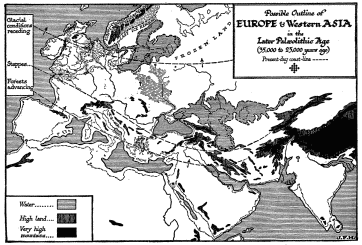
THE Neanderthal type of man prevailed in Europe at least for tens of thousands of years. For ages that make all history seem a thing of yesterday, these nearly human creatures prevailed. If the Heidelberg jaw was that of a Neanderthaler, and if there is no error in the estimate of the age of that jaw, then the Neanderthal Race lasted out for more than 200,000 years! Finally, between 40,000 and 25,000 years ago, as the Fourth Glacial Age softened towards more temperate conditions (see Map on p. 89), a different human type came upon the scene, and, it would seem, exterminated Homo Neanderthalensis.[36] This new type was probably developed in South Asia or North Africa, or in lands now submerged in the Mediterranean basin, and, as more remains are collected and evidence accumulates, men will learn more of their early stages. At present we can only guess where and how, through the slow ages, parallel with the Neanderthal cousin, these first true men arose out of some more ape-like progenitor. For hundreds of centuries they were acquiring skill of hand and limb, and power and bulk of brain, in that still unknown environment. They were already far above the Neanderthal level of achievement and intelligence, when first they come into our ken, and they had already split into two or more very distinctive races.
These new-comers did not migrate into Europe in the strict sense of the word, but rather, as century by century the climate ameliorated, they followed the food and plants to which they were accustomed, as those spread into the new realms that opened to them. The ice was receding, vegetation was increasing, big game of all sorts was becoming more abundant. Steppe-like conditions, conditions of pasture and shrub, were bringing with them vast herds of wild horse. Ethnologists (students of race) class these new human races in one same species as ourselves, and with all human races subsequent to them, under one common specific name of Homo sapiens. They had quite human brain-cases and hands. Their teeth and their necks were anatomically as ours are.
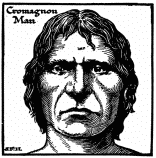
Now here again, with every desire to be plain and explicit with the reader, we have still to trouble him with qualified statements and notes of interrogation. There is now an enormous literature about these earliest true men, the men of the Later Palæolithic Age, and it is still for the general reader a very confusing literature indeed. It is confusing because it is still confused at the source. We know of two distinct sorts of skeletal remains in this period, the first of these known as the Cro-Magnon race, and the second the Grimaldi race; but the great bulk of the human traces and appliances we find are either without human bones or with insufficient bones for us to define their associated physical type. There may have been many more distinct races than these two. There may have been intermediate types. In the grotto of Cro-Magnon it was that complete skeletons of one main type of these Newer Palæolithic men, these true men, were first found, and so it is that they are spoken of as Cro-Magnards.
Map showing Europe and Western Asia about the Time the True Men were Replacing the Neanderthalers in Western Europe
These Cro-Magnards were a tall people with very broad faces, prominent noses, and, all things considered, astonishingly big brains. The brain capacity of the woman in the Cro-Magnon cave exceeded that of the average male to-day. Her head had been smashed by a heavy blow. There were also in the same cave with her the complete skeleton of an older man, nearly six feet high, the fragments of a child’s skeleton, and the skeletons of two young men. There were also flint implements and perforated sea-shells, used no doubt as ornaments. Such is one sample of the earliest true men. But at the Grimaldi cave, near Mentone, were discovered two skeletons also of the Later Palæolithic period, but of a widely contrasted type, with negroid characteristics that point rather to the negroid type. There can be no doubt that we have to deal in this period with at least two, and probably more, highly divergent races of true men. They may have overlapped in time, or Cro-Magnards may have followed the Grimaldi race, and either or both may have been contemporary with the late Neanderthal men. Various authorities have very strong opinions upon these points, but they are, at most, opinions. The whole story is further fogged at present by our inability to distinguish, in the absence of skeletons, which race has been at work in any particular case. In what follows the reader will ask of this or that particular statement, “Yes, but is this the Cro-Magnard or the Grimaldi man or some other that you are writing about?” To which in most cases the honest answer is, “As yet we do not know.” Confessedly our account of the newer Palæolithic is a jumbled account. There are probably two or three concurrent and only roughly similar histories of these newer Palæolithic men as yet, inextricably mixed up together. Some authorities appear to favour the Cro-Magnards unduly and to dismiss the Grimaldi people with as little as possible of the record.
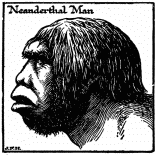
The appearance of these truly human postglacial Palæolithic peoples was certainly an enormous leap forward in the history of mankind. Both of these main races had a human fore-brain, a human hand, an intelligence very like our own. They dispossessed Homo Neanderthalensis from his caverns and his stone quarries. And they agreed with modern ethnologists, it would seem, in regarding him as a different species. Unlike most savage conquerors, who take the women of the defeated side for their own and interbreed with them, it would seem that the true men would have nothing to do with the Neanderthal race, women or men. There is no trace of any intermixture between the races, in spite of the fact that the newcomers, being also flint users, were establishing themselves in the very same spots that their predecessors had occupied. We know nothing of the appearance of the Neanderthal man, but this absence of intermixture seems to suggest an extreme hairiness, an ugliness, or a repulsive strangeness in his appearance over and above his low forehead, his beetle brows, his ape neck, and his inferior stature. Or he—and she—may have been too fierce to tame. Says Sir Harry Johnston, in a survey of the rise of modern man in his Views and Reviews: “The dim racial remembrance of such gorilla-like monsters, with cunning brains, shambling gait, hairy bodies, strong teeth, and possibly cannibalistic tendencies, may be the germ of the ogre in folklore....”
These true men of the Palæolithic Age, who replaced the Neanderthalers, were coming into a milder climate, and although they used the caves and shelters of their predecessors, they lived largely in the open. They were hunting peoples, and some or all of them appear to have hunted the mammoth and the wild horse as well as the reindeer, bison, and aurochs. They ate much horse. At a great open-air camp at Solutré, where they seem to have had animal gatherings for many centuries, it is estimated that there are the bones of 100,000 horses, besides reindeer, mammoth, and bison bones. They probably followed herds of horses, the little bearded ponies of that age, as these moved after pasture. They hung about on the flanks of the herd, and became very wise about its habits and dispositions. A large part of these men’s lives must have been spent in watching animals.
Whether they tamed and domesticated the horse is still an open question. Perhaps they learnt to do so by degrees as the centuries passed. At any rate, we find late Palæolithic drawings of horses with marks about the heads that are strongly suggestive of bridles, and there exists a carving of a horse’s head showing what is perhaps a rope of twisted skin or tendon. But even if they tamed the horse, it is still more doubtful whether they rode it or had much use for it when it was tamed. The horse they knew was a wild pony with a beard under its chin, not up to carrying a man for any distance. It is improbable that these men had yet learnt the rather unnatural use of animal’s milk as food. If they tamed the horse at last, it was the only animal they seem to have tamed. They had no dogs, and they had little to do with any sort of domesticated sheep or cattle.
It greatly aids us to realize their common humanity that these earliest true men could draw. Both races, it would seem, drew astonishingly well. They were by all standards savages, but they were artistic savages. They drew better than any of their successors down to the beginnings of history. They drew and painted on the cliffs and cave walls that they had wrested from the Neanderthal men. And the surviving drawings come to the ethnologist, puzzling over bones and scraps, with the effect of a plain message shining through guesswork and darkness. They drew on bones and antlers; they carved little figures.
These late Palæolithic people not only drew remarkably well for our information, and with an increasing skill as the centuries passed, but they have also left us other information about their lives in their graves. They buried. They buried their dead, often with ornaments, weapons, and food; they used a lot of colour in the burial, and evidently painted the body. From that one may infer that they painted their bodies during life. Paint was a big fact in their lives. They were inveterate painters; they used black, brown, red, yellow, and white pigments, and the pigments they used endure to this day in the caves of France and Spain. Of all modern races, none have shown so pictorial a disposition; the nearest approach to it has been among the American Indians.
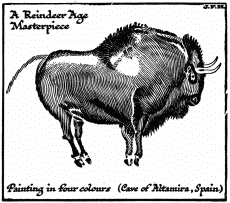
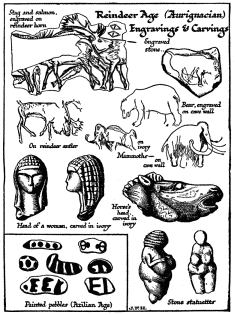
These drawings and paintings of the later Palæolithic people went on through a long period of time, and present wide fluctuations in artistic merit. We give here some early sketches, from which we learn of the interest taken by these early men in the bison, horse, ibex, cave bear, and reindeer. In its early stages the drawing is often primitive like the drawing of clever children; quadrupeds are usually drawn with one hindleg and one foreleg, as children draw them to this day. The legs on the other side were too much for the artist’s technique. Possibly the first drawings began as children’s drawings begin, out of idle scratchings. The savage scratched with a flint on a smooth rock surface, and was reminded of some line or gesture. But their solid carvings are at least as old as their first pictures. The earlier drawings betray a complete incapacity to group animals. As the centuries progressed, more skilful artists appeared. The representation of beasts became at last astonishingly vivid and like. But even at the crest of their artistic time they still drew in profile as children do; perspective and the fore-shortening needed for back and front views were too much for them.[37] They rarely drew themselves. The vast majority of their drawings represent animals. The mammoth and the horse are among the commonest themes. Some of the people, whether Grimaldi people or Cro-Magnon people, also made little ivory and soapstone statuettes, and among these are some very fat female figures. These latter suggest the physique of Grimaldi rather than of Cro-Magnon artists. They are like Bushmen women. The human sculpture of the earlier times inclined to caricature, and generally such human figures as they represent are far below the animal studies in vigour and veracity.
Later on there was more grace and less coarseness in the human representations. One little ivory head discovered is that of a girl with an elaborate coiffure. These people at a later stage also scratched and engraved designs on ivory and bone. Some of the most interesting groups of figures are carved very curiously round bone, and especially round rods of deer bone, so that it is impossible to see the entire design all together. Figures have also been found modelled in clay, although no Palæolithic people made any use of pottery.
Many of the paintings are found in the depths of unlit caves. They are often difficult of access. The artists must have employed lamps to do their work, and shallow soapstone lamps in which fat could have been burnt have been found. Whether the seeing of these cavern paintings was in some way ceremonial or under what circumstances they were seen, we are now altogether at a loss to imagine.
§ 2
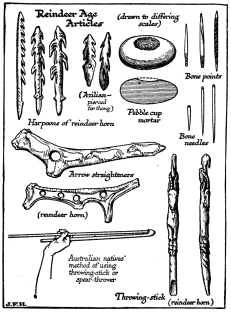
Archæologists distinguish at present three chief stages in the history of these newer Palæolithic men in Europe, and we must name these stages here. But it may be as well to note at the same time that it is a matter of the utmost difficulty to distinguish which of two deposits in different places is the older or newer. We may very well be dealing with the work of more or less contemporary and different races when we think we are dealing with successive ones. We are dealing, the reader must bear in mind, with little disconnected patches of material, a few score all together. The earliest stage usually distinguished by the experts is the Aurignacian (from the grotto of Aurignac); it is characterized by very well-made flint implements, and by a rapid development of art and more particularly of statuettes and wall paintings. The most esteemed of the painted caves is ascribed to the latter part of this the first of the three subdivisions of the newer Palæolithic. The second subdivision of this period is called the Solutrian (from Solutré), and is distinguished particularly by the quality and beauty of its stone implements; some of its razor-like blades are only equalled and not surpassed by the very best of the Neolithic work. They are of course unpolished, but the best specimens are as thin as steel blades and almost as sharp. Finally, it would seem, came the Magdalenian (from La Madeleine) stage, in which the horse and reindeer were dwindling in numbers and the red deer coming into Europe.[38] The stone implements are smaller, and there is a great quantity of bone harpoons, spearheads, needles, and the like. The hunters of the third and last stage of the later Palæolithic Age appear to have supplemented a diminishing food supply by fishing. The characteristic art of the period consists of deep reliefs done upon bone and line engraving upon bone. It is to this period that the designs drawn round bones belong, and it has been suggested that these designs upon round bones were used to print coloured designs upon leather. Some of the workmanship on bone was extraordinarily fine. Parkyn quotes from de Mortillet, about the Reindeer Age (Magdalenian) bone needles, that they “are much superior to those of later, even historical, times, down to the Renaissance. The Romans, for example, never had needles comparable to those of the Magdalenian epoch.”
Time Diagram Showing the Estimated Duration of the True Human Periods. This time diagram again is on a larger scale than its predecessors. The time diagram on page 60, if it were on this scale, would be nearly 4 feet long, and the diagram of the whole geological time on page 14, between 500 and 5000 feet long (or perhaps even as much as 10,000 feet long).
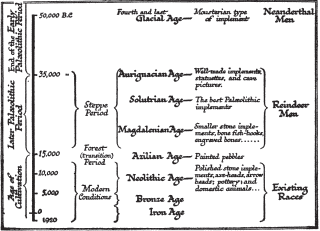
It is quite impossible at present to guess at the relative lengths of these ages. We are not even positive about their relative relationship. Each lasted perhaps for four or five more thousand years, more than double the time from the Christian Era to our own day.
At last it would seem that circumstances began to turn altogether against these hunting Newer Palæolithic people who had flourished for so long in Europe. They disappeared. New kinds of men appeared in Europe, replacing them. These latter seem to have brought in bow and arrows; they had domesticated animals and cultivated the soil. A new way of living, the Neolithic way of living, spread over the European area; and the life of the Reindeer Age and of the races of Reindeer Men, the Later Palæolithic men, after a reign vastly greater than the time between ourselves and the very earliest beginnings of recorded history, passed off the European stage.
§ 3
There is a disposition on the part of many writers to exaggerate the intellectual and physical qualities of these later Palæolithic men and make a wonder of them.[39] Collectively considered, these people had remarkable gifts, but a little reflection will show they had almost as remarkable deficiencies. The tremendous advance they display upon their Neanderthalian predecessors and their special artistic gift must not blind us to their very obvious limitations. For all the quantity of their brains, the quality was narrow and special. They had vivid perceptions, an acute sense of animal form, they had the real artist’s impulse to render; so far they were fully grown human beings. But that disposition to paint and draw is shown to-day by the Bushmen, by Californian Indians, and by Australian black fellows; it is not a mark of all-round high intellectual quality. The cumulative effect of their drawings and paintings is very great, but we must not make the mistake of crowding all these achievements together in our minds as though they had suddenly flashed out upon the world in a brief interval of time, or as though they were all the achievements of one people. These races of Reindeer Men were in undisturbed possession of western Europe for a period at least ten times as long as the interval between ourselves and the beginning of the Christian Era, and through all that immense time they were free to develop and vary their life to its utmost possibilities. Their art constitutes their one claim to be accounted more than common savages.
They were in close contact with animals, but they never seemed to have got to terms with any animal unless it was the horse. They had no dogs. They had no properly domesticated animals at all. They watched and drew and killed and ate. They do not seem to have cooked their food. Perhaps they scorched and grilled it, but they could not have done much more, because they had no cooking implements. Although they had clay available, and although there are several Palæolithic clay figures on record, they had no pottery. Although they had a great variety of flint and bone implements, they never rose to the possibilities of using timber for permanent shelters or such-like structures. They never made hafted axes or the like that would enable them to deal with timber. There is a suggestion in some of the drawings of a fence of stakes in which a mammoth seems to be entangled. But here we may be dealing with superimposed scratchings. They had no buildings. It is not even certain that they had tents or huts. They may have had simple skin tents. Some of the drawings seem to suggest as much. It is doubtful if they knew of the bow. They left no good arrowheads behind them. Certain of their implements are said to be “arrow-straighteners” by distinguished authorities, but that is about as much evidence as we have of arrows. They may have used sharpened sticks as arrows. They had no cultivation of grain or vegetables of any sort. Their women were probably squaws, smaller than the men; the earlier statuettes represent them as grossly fat, almost as the Bushmen women are often fat to-day. (But this may not be true of the Cro-Magnards.)
They clothed themselves, it would seem, in skins, if they clothed themselves at all. These skins they prepared with skill and elaboration, and towards the end of the age they used bone needles, no doubt to sew these pelts. One may guess pretty safely that they painted these skins, and it has even been supposed, printed off designs upon them from bone cylinders. But their garments were mere wraps; there are no clasps or catches to be found. They do not seem to have used grass or such-like fibre for textiles. Their statuettes are naked. They were, in fact, except for a fur wrap in cold weather, naked painted savages.
These hunters lived on open steppes for two hundred centuries or so, ten times the length of the Christian era. They were, perhaps, overtaken by the growth of the European forests, as the climate became milder and damper. When the wild horse and the reindeer diminished in Europe, and a newer type of human culture, with a greater power over food supply, a greater tenacity of settlement, and probably a larger social organization, arose, the Reindeer Men had to learn fresh ways of living or disappear. How far they learnt and mingled their strain with the new European populations, and how far they went under we cannot yet guess. Opinions differ widely. Wright lays much stress on the “great hiatus” between the Palæolithic and Neolithic remains, while Osborn traces the likeness of the former in several living populations. In the region of the Doubs and of the Dordogne in France, many individuals are to be met with to this day with skulls of the “Cro-Magnon” type. Apparently the Grimaldi type of men has disappeared altogether from Europe. Whether the Cro-Magnon type of men mingled completely with the Neolithic peoples, or whether they remained distinct and held their own in favourable localities to the north and west, following the reindeer over Siberia and towards America, which at that time was continuous with Siberia, or whether they disappeared altogether from the world, is a matter that can be only speculated about at present. There is not enough evidence for a judgment. Possibly they mingled to a certain extent. There is little to prevent our believing that they survived without much intermixture for a long time in north Asia, that “pockets” of them remained here and there in Europe, that there is a streak of their blood in most European peoples to-day, and that there is a much stronger streak, if not a predominant strain, in the Mongolian and American races.[40]
§ 4
It was about 12,000 or fewer years ago that, with the spread of forests and a great change of the fauna, the long prevalence of the hunting life in Europe drew to its end. Reindeer vanished. Changing conditions frequently bring with them new diseases. There may have been prehistoric pestilences. For many centuries there may have been no men in Britain or Central Europe (Wright). For a time there were in Southern Europe drifting communities of some little known people who are called the Azilians.[41] They may have been transition generations; they may have been a different race. We do not know. Some authorities incline to the view that the Azilians were the first wave of a race which, as we shall see later, has played a great part in populating Europe, the dark-white or Mediterranean or Iberian race. These Azilian people have left behind them a multitude of pebbles, roughly daubed with markings of an unknown purport (see illus., p. 94). The use or significance of these Azilian pebbles is still a profound mystery. Was this some sort of token writing? Were they counters in some game? Did the Azilians play with these pebbles or tell a story with them, as imaginative children will do with bits of wood and stone nowadays? At present we are unable to cope with any of these questions.
We will not deal here with the other various peoples who left their scanty traces in the world during the close of the New Palæolithic period, the spread of the forests where formerly there had been steppes, and the wane of the hunters, some 10,000 or 12,000 years ago. We will go on to describe the new sort of human community that was now spreading over the northern hemisphere, whose appearance marks what is called the Neolithic Age. The map of the world was assuming something like its present outlines, the landscape and the flora and fauna were taking on their existing characteristics. The prevailing animals in the spreading woods of Europe were the royal stag, the great ox, and the bison; the mammoth and the musk ox had gone. The great ox, or aurochs, is now extinct, but it survived in the German forests up to the time of the Roman Empire. It was never domesticated.[42] It stood eleven feet high at the shoulder, as high as an elephant. There were still lions in the Balkan peninsula, and they remained there until about 1000 or 1200 B.C. The lions of Württemberg and South Germany in those days were twice the size of the modern lion. South Russia and Central Asia were thickly wooded then, and there were elephants in Mesopotamia and Syria, and a fauna in Algeria that was tropical African in character.
Hitherto men in Europe had never gone farther north than the Baltic Sea or the English midlands, but now Ireland, the Scandinavian peninsula, and perhaps Great Russia were becoming possible regions for human occupation. There are no Palæolithic remains in Sweden or Norway, nor in Ireland or Scotland. Man, when he entered these countries, was apparently already at the Neolithic stage of social development.
§ 5
Nor is there any convincing evidence of man in America before the end of the Pleistocene.[43] The same relaxation of the climate that permitted the retreat of the reindeer hunters into Russia and Siberia, as the Neolithic tribes advanced, may have allowed them to wander across the land that is now cut by Bering Strait, and so reach the American continent. They spread thence southward, age by age. When they reached South America, they found the giant sloth (the Megatherium), the glyptodon, and many other extinct creatures, still flourishing. The glyptodon was a monstrous South American armadillo, and a human skeleton has been found by Roth buried beneath its huge tortoise-like shell.[44]
All the human remains in America, even the earliest, it is to be noted, are of an Amer-Indian character. In America there does not seem to have been any preceding races of sub-men. Man was fully man when he entered America. The old world was the nursery of the sub-races of mankind.
XI NEOLITHIC MAN IN EUROPE[45]
§ 1. The Age of Cultivation Begins. § 2. Where Did the Neolithic Culture Arise? § 3. Everyday Neolithic Life. § 4. How Did Sowing Begin? § 5. Primitive Trade. § 6. The Flooding of the Mediterranean Valley.
§ 1
THE Neolithic phase of human affairs began in Europe about 10,000 or 12,000 years ago. But probably men had reached the Neolithic stage elsewhere some thousands of years earlier.[46] Neolithic men came slowly into Europe from the south or south-east as the reindeer and the open steppes gave way to forest and modern European conditions.
The Neolithic stage in culture is characterized by: (1) the presence of polished stone implements, and in particular the stone axe, which was perforated so as to be the more effectually fastened to a wooden handle, and which was probably used rather for working wood than in conflict. There are also abundant arrow heads. The fact that some implements are polished does not preclude the presence of great quantities of implements of unpolished stone. But there are differences in the make between even the unpolished tools of the Neolithic and of the Palæolithic Period. (2) The beginning of a sort of agriculture, and the use of plants and seeds. But at first there are abundant evidences that hunting was still of great importance in the Neolithic Age. Neolithic man did not at first sit down to his agriculture. He took snatch crops. He settled later. (3) Pottery and proper cooking. The horse is no longer eaten. (4) Domesticated animals. The dog appears very early. The Neolithic man had domesticated cattle, sheep, goats, and pigs. He was a huntsman turned herdsman of the herds he once hunted.[47] (5) Plaiting and weaving.
These Neolithic people probably “migrated” into Europe, in the same way that the Reindeer Men had migrated before them; that is to say, generation by generation and century by century, as the climate changed, they spread after their accustomed food. They were not “nomads.” Nomadism, like civilization, had still to be developed. At present we are quite unable to estimate how far the Neolithic peoples were new-comers and how far their arts were developed or acquired by the descendants of some of the hunters and fishers of the Later Palæolithic Age.
Whatever our conclusions in that matter, this much we may say with certainty; there is no great break, no further sweeping away of one kind of man and replacement by another kind between the appearance of the Neolithic way of living and our own time. There are invasions, conquests, extensive emigrations and intermixtures, but the races as a whole carry on and continue to adapt themselves to the areas into which they began to settle in the opening of the Neolithic Age. The Neolithic men of Europe were white men ancestral to the modern Europeans. They may have been of a darker complexion than many of their descendants; of that we cannot speak with certainty. But there is no real break in culture from their time onward until we reach the age of coal, steam, and power-driven machinery that began in the eighteenth century.
After a long time gold, the first known of the metals, appears among the bone ornaments with jet and amber. Irish Neolithic remains are particularly rich in gold. Then, perhaps 6000 or 7000 years ago in Europe, Neolithic people began to use copper in certain centres, making out of it implements of much the same pattern as their stone ones. They cast the copper in moulds made to the shape of the stone implements. Possibly they first found native copper and hammered it into shape.[48] Later—we will not venture upon figures—men had found out how to get copper from its ore. Perhaps, as Lord Avebury suggested, they discovered the secret of smelting by the chance putting of lumps of copper ore among the ordinary stones with which they built the fire pits they used for cooking. In China, Hungary, Cornwall, and elsewhere copper ore and tinstone occur in the same veins; it is a very common association, and so, rather through dirtiness than skill, the ancient smelters, it may be, hit upon the harder and better bronze, which is an alloy of copper and tin.[49] Bronze is not only harder than copper, but the mixture of tin and copper is more fusible and easier to reduce. The so-called “pure-copper” implements usually contain a small proportion of tin, and there are no tin implements known, nor very much evidence to show that early men knew of tin as a separate metal.[50][51] The plant of a prehistoric copper smelter has been found in Spain, and the material of bronze foundries in various localities. The method of smelting revealed by these finds carries out Lord Avebury’s suggestion. In India, where zinc and copper ore occur together, brass (which is an alloy of the two metals) was similarly hit upon.
So slight was the change in fashions and methods produced by the appearance of bronze, that for a long time such bronze axes and so forth as were made were cast in moulds to the shape of the stone implements they were superseding.
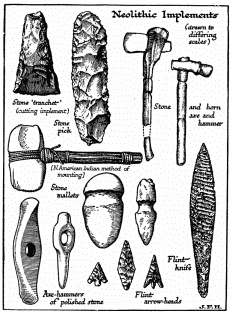
Finally, perhaps as early as 3000 years ago in Europe, and even earlier in Asia Minor, men began to smelt iron. Once smelting was known to men, there is no great marvel in the finding of iron. They smelted iron by blowing up a charcoal fire, and wrought it by heating and hammering. They produced it at first in comparatively small pieces;[52] its appearance worked a gradual revolution in weapons and implements; but it did not suffice to change the general character of men’s surroundings. Much the same daily life that was being led by the more settled Neolithic men 10,000 years ago was being led by peasants in out-of-the-way places all over Europe at the beginning of the eighteenth century.[53]
People talk of the Stone Age, the Bronze Age, and the Iron Age in Europe, but it is misleading to put these ages as if they were of equal importance in history. Much truer is it to say that there was:
(1) An Early Palæolithic Age, of vast duration; (2) a Later Palæolithic Age, that lasted not a tithe of the time; and (3) the Age of Cultivation, the age of the white men in Europe, which began 10,000 or at most 12,000 years ago, of which the Neolithic Period was the beginning, and which is still going on.
§ 2
We do not know yet the region in which the ancestors of the white and whitish Neolithic peoples worked their way up from the Palæolithic stage of human development. Probably it was somewhere about south-western Asia, or in some region now submerged beneath the Mediterranean Sea or the Indian Ocean, that, while the Neanderthal men still lived their hard lives in the bleak climate of a glaciated Europe, the ancestors of the white men developed the rude arts of their Later Palæolithic period. But they do not seem to have developed the artistic skill of their more northerly kindred, the European Later Palæolithic races. And through the hundred centuries or so while Reindeer Men were living under comparatively unprogressive conditions upon the steppes of France, Germany, and Spain, these more-favoured and progressive people to the south were mastering agriculture, learning to develop their appliances, taming the dog, domesticating cattle, and, as the climate to the north mitigated and the equatorial climate grew more tropical, spreading northward. All these early chapters of our story have yet to be disinterred. They will probably be found in Asia Minor, Persia, Arabia, India, or north Africa, or they lie beneath the Mediterranean waters. Twelve thousand years ago, or thereabouts—we are still too early for anything but the roughest chronology—Neolithic peoples were scattered all over Europe, north Africa, and Asia. They were peoples at about the level of many of the Polynesian islanders of the last century, and they were the most advanced peoples in the world.
§ 3
It will be of interest here to give a brief account of the life of the European Neolithic people before the appearance of metals. We get our light upon that life from various sources. They scattered their refuse about, and in some places (e.g. on the Danish coast) it accumulated in great heaps, known as the kitchen middens. They buried some of their people, but not the common herd, with great care and distinction, and made huge heaps of earth over their sepulchres; these heaps are the barrows or dolmens which contribute a feature to the European, Indian, and American scenery in many districts to this day. In connection with these mounds, or independently of them, they set up great stones (megaliths), either singly or in groups, of which Stonehenge in Wiltshire and Carnac in Brittany are among the best-known examples. In various places their villages are still traceable.
One fruitful source of knowledge about Neolithic life comes from Switzerland, and was first revealed by the very dry winter of 1854, when the water level of one of the lakes, sinking to an unheard-of lowness, revealed the foundations of prehistoric pile dwellings of the Neolithic and early Bronze Ages, built out over the water after the fashion of similar homes that exist to-day in Celebes and elsewhere. Not only were the timbers of those ancient platforms preserved, but a great multitude of wooden, bone, stone, and earthenware utensils and ornaments, remains of food and the like, were found in the peaty accumulations below them. Even pieces of net and garments have been recovered. Similar lake dwellings existed in Scotland, Ireland, and elsewhere—there are well-known remains at Glastonbury in Somersetshire; in Ireland lake dwellings were inhabited from prehistoric times up to the days when O’Neil of Tyrone was fighting against the English before the plantation of Scotch colonists to replace the Irish in Ulster in the reign of James I of England. These lake villages had considerable defensive value, and there was a sanitary advantage in living over flowing water.
Probably these Neolithic Swiss pile dwellings did not shelter the largest communities that existed in those days. They were the homes of small patriarchal groups. Elsewhere upon fertile plains and in more open country there were probably already much larger assemblies of homes than in those mountain valleys. There are traces of such a large community of families in Wiltshire in England, for example; the remains of the stone circle of Avebury near Silbury mound were once the “finest megalithic ruin in Europe.”[54] It consisted of two circles of stones surrounded by a larger circle and a ditch, and covering all together twenty-eight and a half acres. From it two avenues of stones, each a mile and a half long, ran west and south on either side of Silbury Hill. Silbury Hill is the largest prehistoric artificial mound in England. The dimensions of this centre of a faith and a social life now forgotten altogether by men indicate the concerted efforts and interests of a very large number of people, widely scattered though they may have been over the west and south and centre of England. Possibly they assembled at some particular season of the year in a primitive sort of fair. The whole community “lent a hand” in building the mounds and hauling the stones. The Swiss pile-dwellers, on the contrary, seem to have lived in practically self-contained villages.
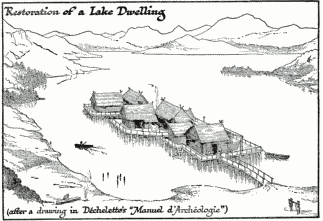
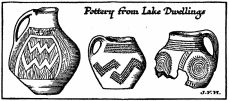
These lake-village people were considerably more advanced in methods and knowledge, and probably much later in time than the early Neolithic people who accumulated the shell mounds, known as kitchen middens, on the Danish and Scotch coasts. These kitchen midden folk may have been as early as 10,000 B.C. or earlier; the lake dwellings were probably occupied continuously from 5000 or 4000 B.C. down almost to historic times. Those early kitchen-midden people were among the most barbaric of Neolithic peoples, their stone axes were rough, and they had no domesticated animal except the dog. The lake-dwellers, on the other hand, had, in addition to the dog, which was of a medium-sized breed, oxen, goats, and sheep. Later on, as they were approaching the Bronze Age, they got swine. The remains of cattle and goats prevail in their débris, and, having regard to the climate and country about them, it seems probable that these beasts were sheltered in the buildings upon the piles in winter, and that fodder was stored for them. Probably the beasts lived in the same houses with the people, as the men and beasts do now in Swiss chalets. The people in the houses possibly milked the cows and goats, and milk perhaps played as important a part in their economy as it does in that of the mountain Swiss of to-day. But of that we are not sure at present. Milk is not a natural food for adults; it must have seemed queer stuff to take at first; and it may have been only after much breeding that a continuous supply of milk was secured from cows and goats. Some people think that the use of milk, cheese, butter, and other milk products came later into human life when men became nomadic. The writer is, however, disposed to give the Neolithic men credit for having discovered milking. The milk, if they did use it (and, no doubt, in that case sour curdled milk also, but not well-made cheese and butter), they must have kept in earthenware pots, for they had pottery, though it was roughly hand-made pottery and not the shapely product of the potter’s wheel. They eked out this food supply by hunting. They killed and ate red deer and roe deer, bison and wild boar. And they ate the fox, a rather high-flavoured meat, and not what any one would eat in a world of plenty. Oddly enough, they do not seem to have eaten the hare, although it was available as food. They are supposed to have avoided eating it, as some savages are said to avoid eating it to this day, because they feared that the flesh of so timid a creature might make them, by a sort of infection, cowardly.[55]
Of their agricultural methods we know very little. No ploughs and no hoes have been found. They were of wood and have perished. Neolithic men cultivated and ate wheat, barley, and millet, but they knew nothing of oats or rye. Their grain they roasted, ground between stones and stored in pots, to be eaten when needed. And they made exceedingly solid and heavy bread, because round flat slabs of it have been got out of these deposits. Apparently they had no yeast. If they had no yeast, then they had no fermented drink. One sort of barley that they had is the sort that was cultivated by the ancient Greeks, Romans, and Egyptians, and they also had an Egyptian variety of wheat, showing that their ancestors had brought or derived this cultivation from the south-east. The centre of diffusion of wheat was somewhere in the eastern Mediterranean region. A wild form is still found in the neighbourhood of Mt. Hermon (see footnote to Ch. XVI, § 1). When the lake dwellers sowed their little patches of wheat in Switzerland, they were already following the immemorial practice of mankind. The seed must have been brought age by age from that distant centre of diffusion. In the ancestral lands of the south-east men had already been sowing wheat perhaps for thousands of years.[56] Those lake dwellers also ate peas, and crab-apples—the only apples that then existed in the world. Cultivation and selection had not yet produced the apple of to-day.
They dressed chiefly in skins, but they also made a rough cloth of flax. Fragments of that flaxen cloth have been discovered. Their nets were made of flax; they had as yet no knowledge of hemp and hempen rope. With the coming of bronze, their pins and ornaments increased in number. There is reason to believe they set great store upon their hair, wearing it in large shocks with pins of bone and afterwards of metal. To judge from the absence of realistic carvings or engravings or paintings, they either did not decorate their garments or decorated them with plaids, spots, interlacing designs, or similar conventional ornament. Before the coming of bronze there is no evidence of stools or tables; the Neolithic people probably squatted on their clay floors. There were no cats in these lake dwellings; no mice or rats had yet adapted themselves to human dwellings; the cluck of the hen was not as yet added to the sounds of human life, nor the domestic egg to its diet.[57]
The chief tool and weapon of Neolithic man was his axe; his next the bow and arrow. His arrow heads were of flint, beautifully made, and he lashed them tightly to their shafts. Probably he prepared the ground for his sowing with a pole, or a pole upon which he had stuck a stag’s horn. Fish he hooked or harpooned. These implements no doubt stood about in the interior of the house, from the walls of which hung his fowling-nets. On the floor, which was of clay or trodden cow-dung (after the fashion of hut floors in India to-day), stood pots and jars and woven baskets containing grain, milk, and such-like food. Some of the pots and pans hung by rope loops to the walls. At one end of the room, and helping to keep it warm in winter by their animal heat, stabled the beasts. The children took the cows and goats out to graze, and brought them in at night before the wolves and bears came prowling.
Hut urns, the first probably representing a lake-dwelling.... After Lubbock.
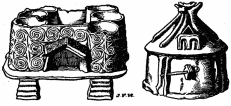
Since Neolithic man had the bow, he probably also had stringed instruments, for the rhythmic twanging of a bow-string seems almost inevitably to lead to that. He also had earthenware drums across which skins were stretched; perhaps also he made drums by stretching skins over hollow tree stems.[58] We do not know when man began to sing, but evidently he was making music, and since he had words, songs were no doubt being made. To begin with, perhaps, he just let his voice loose as one may hear Italian peasants now behind their ploughs singing songs without words. After dark in the winter he sat in his house and talked and sang and made implements by touch rather than sight. His lighting must have been poor, and chiefly firelight, but there was probably always some fire in the village, summer or winter. Fire was too troublesome to make for men to be willing to let it out readily. Sometimes a great disaster happened to those pile villages, the fire got free, and they were burnt out. The Swiss deposits contain clear evidence of such catastrophes.
All this we gather from the remains of the Swiss pile dwellings, and such was the character of the human life that spread over Europe, coming from the south and from the east with the forests as, 10,000 or 12,000 years ago, the reindeer and the Reindeer Men passed away. It is evident that we have here a way of life already separated by a great gap of thousands of years of invention from its original Palæolithic stage. The steps by which it rose from that condition we can only guess at. From being a hunter hovering upon the outskirts of flocks and herds of wild cattle and sheep, and from being a co-hunter with the dog, man by insensible degrees may have developed a sense of proprietorship in the beasts and struck up a friendship with his canine competitor. He learnt to turn the cattle when they wandered too far; he brought his better brain to bear to guide them to fresh pasture. He hemmed the beasts into valleys and enclosures where he could be sure to find them again. He fed them when they starved, and so slowly he tamed them. Perhaps his agriculture began with the storage of fodder. He reaped, no doubt, before he sowed. The Palæolithic ancestor away in that unknown land of origin to the south-east first supplemented the precarious meat supply of the hunter by eating roots and fruits and wild grains. Man storing graminiferous grasses for his cattle might easily come to beat out the grain for himself.
§ 4
How did man learn to sow in order that he might reap?
We may hesitate here to guess at the answer to that question. But a very great deal has been made of the fact that wherever sowing occurs among primitive people in any part of the world, it is accompanied by a human sacrifice or by some ceremony which may be interpreted as the mitigation and vestige of an ancient sacrificial custom. This is the theme of Sir J. G. Frazer’s Golden Bough. From this it has been supposed that the first sowings were in connection with the burial of a human being, either through wild grain being put with the dead body as food or through the scattering of grain over the body. It may be argued that there is only one reason why man should have disturbed the surface of the earth before he took to agriculture, and that was to bury his dead; and in order to bury a dead body and make a mound over it, it was probably necessary for him to disturb the surface over a considerable area. Neolithic man’s chief apparatus for mound-making consisted of picks of deer’s horn and shovels of their shoulder-blades, and with this he would have found great difficulty in making a deep excavation. Nor do we find such excavations beside the barrows. Instead of going down into tough sub-soil, the mound-makers probably scraped up some of the surface soil and carried it to the mound. All this seems probable, and it gives just that wide area of bared and turned-over earth upon which an eared grass, such as barley, millet, or primitive wheat, might have seeded and grown. Moreover, the mound-makers, being busy with the mound, would not have time to hunt meat, and if they were accustomed to store and eat wild grain, they would be likely to scatter grain, and the grain would be blown by the wind out of their rude vessels over the area they were disturbing. And if they were bringing up seed in any quantity in baskets and pots to bury with the corpse, some of it might easily blow and be scattered over the fresh earth. Returning later to the region of the mound, they would discover an exceptionally vigorous growth of food grain, and it would be a natural thing to associate it with the buried person, and regard it as a consequence of his death and burial. He had given them back the grain they gave him increased a hundredfold.
At any rate, there is apparently all over the world a traceable association in ancient ceremonial and in the minds of barbaric people between the death and burial of a person and the ploughing and sowing of grain. From this it is assumed that there was once a world-wide persuasion that it was necessary that some one should be buried before a crop could be sown, and that out of this persuasion arose a practice and tradition of human sacrifice at seedtime, which has produced profound effects in the religious development of the race. There may have been some idea of refreshing the earth by a blood draught or revivifying it with the life of the sacrificed person. We state these considerations here merely as suggestions that have been made of the way in which the association of seedtime and sacrifice arose. They are, at the best, speculations; they have a considerable vogue at the present time, and we have to note them, but we have neither the space nor the time here to examine them at length. The valuable accumulations of suggestions due to the industry and ingenuity of Sir J. G. Frazer still await a thorough critical examination, and to his works the reader must go for the indefatigable expansion of this idea.
§ 5
All these early beginnings must have taken place far back in time, and in regions of the world that have still to be effectively explored by the archæologists. They were probably going on in Asia or Africa, in what is now the bed of the Mediterranean, or in the region of the Indian Ocean, while the Reindeer man was developing his art in Europe. The Neolithic men who drifted over Europe and western Asia 12,000 or 10,000 years ago were long past these beginnings; they were already close, a few thousand years, to the dawn of written tradition and the remembered history of mankind. Without any very great shock or break, bronze came at last into human life, giving a great advantage in warfare to those tribes who first obtained it. Written history had already begun before weapons of iron came into Europe to supersede bronze.
Already in those days a sort of primitive trade had sprung up. Bronze and bronze weapons, and such rare and hard stones as jade, gold because of its plastic and ornamental possibilities, and skins and flax-net and cloth, were being swapped and stolen and passed from hand to hand over great stretches of country. Salt also was probably being traded. On a meat dietary men can live without salt, but grain-consuming people need it just as herbivorous animals need it. Hopf says that bitter tribal wars have been carried on by the desert tribes of the Soudan in recent years for the possession of the salt deposits between Fezzan and Murzuk. To begin with, barter, blackmail, tribute, and robbery by violence passed into each other by insensible degrees. Men got what they wanted by such means as they could.[59]
§ 6
So far we have been telling of a history without events, a history of ages and periods and stages in development. But before we conclude this portion of the human story, we must record what was probably an event of primary importance and at first perhaps of tragic importance to developing mankind, and that was the breaking in of the Atlantic waters to the great Mediterranean valley.
The reader must keep in mind that we are endeavouring to give him plain statements that he can take hold of comfortably. But both in the matter of our time charts and the three maps we have given of prehistoric geography there is necessarily much speculative matter. We have dated the last Glacial Age and the appearance of the true men as about 40,000 or 35,000 years ago. Please bear that “about” in mind. The truth may be 60,000 or 20,000. But it is no good saying “a very long time” or “ages” ago, because then the reader will not know whether we mean centuries or millions of years. And similarly in these maps we give, they represent not the truth, but something like the truth. The outline of the land was “some such outline.” There were such seas and such land masses. But both Mr. Horrabin, who has drawn these maps, and I, who have incited him to do so, have preferred to err on the timid side.[60] We are not geologists enough to launch out into original research in these matters, and so we have stuck to the 40-fathom line and the recent deposits as our guides for our post-glacial map and for the map of 12,000 to 10,000 B.C. But in one matter we have gone beyond these guides. It is practically certain that at the end of the last Glacial Age the Mediterranean was a couple of land-locked sea basins, not connected—or only connected by a torrential overflow river. The eastern basin was the fresher; it was fed by the Nile, the “Adriatic” river, the “Red-Sea” river, and perhaps by a river that poured down amidst the mountains that are now the Greek Archipelago from the very much bigger Sea of Central Asia that then existed. Almost certainly human beings, and possibly even Neolithic men, wandered over that now lost Mediterranean valley.
The reasons for believing this are very good and plain. To this day the Mediterranean is a sea of evaporation. The rivers that flow into it do not make up for the evaporation from its surface. There is a constant current of water pouring into the Mediterranean from the Atlantic, and another current streaming in from the Bosphorus and Black Sea. For the Black Sea gets more water than it needs from the big rivers that flow into it; it is an overflowing sea, while the Mediterranean is a thirsty sea. From which it must be plain that when the Mediterranean was cut off both from the Atlantic Ocean and the Black Sea it must have been a shrinking sea with its waters sinking to a much lower level than those of the ocean outside. This is the case of the Caspian Sea to-day. Still more so is it the case with the Dead Sea.
But if this reasoning is sound, then where to-day roll the blue waters of the Mediterranean there must once have been great areas of land, and land with a very agreeable climate. This was probably the case during the last Glacial Age, and we do not know how near it was to our time when the change occurred that brought back the ocean waters into the Mediterranean basin. Certainly there must have been Grimaldi people, and perhaps even Azilian and Neolithic people going about in the valleys and forests of these regions that are now submerged. The Neolithic Dark Whites, the people of the Mediterranean race, may have gone far towards the beginnings of settlement and civilization in that great lost Mediterranean Valley.
Mr. W. B. Wright[61] gives us some very stimulating suggestions here. He suggests that in the Mediterranean basin there were two lakes, “one a fresh-water lake, in the eastern depression, which drained into the other in the western depression. It is interesting to think what must have happened when the ocean level rose once more as a result of the dissipation of the ice-sheets, and its waters began to pour over into the Mediterranean area. The inflow, small at first, must have ultimately increased to enormous dimensions, as the channel was slowly lowered by erosion and the ocean level slowly rose. If there were any unconsolidated materials on the sill of the Strait, the result must have been a genuine debacle, and if we consider the length of time which even an enormous torrent would take to fill such a basin as that of the Mediterranean, we must conclude that this result was likely to have been attained in any case. Now, this may seem all the wildest speculation, but it is not entirely so, for if we examine a submarine contour map of the Straits of Gibraltar, we find there is an enormous valley running up from the Mediterranean deep, right through the Straits, and trenching some distance out on to the Atlantic shelf. This valley or gorge is probably the work of the inflowing waters of the ocean at the termination of the period of interior drainage.”