BOOK VIII THE AGE OF THE GREAT POWERS (continued 4)
Reading edition
His career as First Consul was perhaps the least dishonourable phase in his career. He took the crumbling military affairs of the Directory in hand, and after a complicated campaign in North Italy brought matters to a head in the victory of Marengo, near Alessandria (1800). It was a victory that at some moments came very near disaster. In the December of the same year General Moreau, in the midst of snow, mud, and altogether abominable weather, inflicted an overwhelming defeat upon the Austrian army at Hohenlinden. If Napoleon had gained this battle, it would have counted among his most characteristic and brilliant exploits. These things made the hoped-for peace possible. In 1801 the preliminaries of peace with England and Austria were signed. Peace with England, the Treaty of Amiens, was concluded in 1802, and Napoleon was free to give himself to the creative statecraft of which France, and Europe through France, stood in need. The war had given the country extended boundaries, the treaty with England restored the colonial empire of France and left her in a position of security beyond the utmost dreams of Louis XIV. It was open to Napoleon to work out and consolidate the new order of things, to make a modern state that should become a beacon and inspiration to Europe and all the world.
He attempted nothing of the sort. He did not realize that there were such things as modern states in the scheme of possibility. His little imitative imagination was full of a deep cunning dream of being Cæsar over again—as if this universe would ever tolerate anything of that sort over again! He was scheming to make himself a real emperor, with a crown upon his head and all his rivals and school-fellows and friends at his feet. This could give him no fresh power that he did not already exercise, but it would be more splendid—it would astonish his mother. What response was there in a head of that sort for the splendid creative challenge of the time? But first France must be prosperous. France hungry would certainly not endure an emperor. He set himself to carry out an old scheme of roads that Louis XV had approved; he developed canals in imitation of the English canals; he reorganized the police and made the country safe; and, preparing the scene for his personal drama, he set himself to make Paris look like Rome, with classical arches, with classical columns. Admirable schemes for banking development were available, and he made use of them. In all these things he moved with the times, they would have happened—with less autocracy, with less centralization, if he had never been born. And he set himself to weaken the republicans whose fundamental convictions he was planning to outrage. He recalled the émigrés, provided they gave satisfactory assurances to respect the new régime. Many were very willing to come back on such terms, and let Bourbons be bygones. And he worked out a great reconciliation, a Concordat, with Rome. Rome was to support him, and he was to restore the authority of Rome in the parishes. France would never be obedient and manageable, he thought; she would never stand a new monarchy, without religion. “How can you have order in a state,” he said, “without religion? Society cannot exist without inequality of fortunes, which cannot endure apart from religion. When one man is dying of hunger near another who is ill of surfeit, he cannot resign himself to this difference, unless there is an authority which declares—‘God wills it thus: there must be poor and rich in the world: but hereafter and during all eternity the division of things will take place differently.’” Religion—especially of the later Roman brand—was, in fact, excellent stuff for keeping the common people quiet. In his early honest Jacobin days he had denounced it for that very reason.
Another great achievement which marks his imaginative scope and his estimate of human nature was the institution of the Legion of Honour, a scheme for decorating Frenchmen with bits of ribbon which was admirably calculated to divert ambitious men from subversive proceedings. (Washington, when he became President of the United States, abolished the only order that has ever adorned any citizen of the American republic, the Order of Cincinnatus, because he had no use for the snob in his fellow man.)
And also Napoleon interested himself in Christian propaganda. Here is the Napoleonic view of the political uses of Christ, a view that has tainted all French missions from that time forth. “It is my wish to re-establish the institution for foreign missions; for the religious missionaries may be very useful to me in Asia, Africa, and America, as I shall make them reconnoitre all the lands they visit. The sanctity of their dress will not only protect them, but serve to conceal their political and commercial investigations. The head of the missionary establishment shall reside no longer at Rome, but in Paris.”
These are the ideas of a roguish merchant rather than a statesman. His treatment of education shows the same narrow vision, the same blindness to the realities of the dawn about him. Elementary education he neglected almost completely; he left it to the conscience of the local authorities, and he provided that the teachers should be paid out of the fees of the scholars; it is clear he did not want the common people to be educated; he had no glimmering of any understanding why they should be; but he interested himself in the provision of technical and higher schools because his state needed the services of clever, self-seeking, well-informed men. This was an astounding retrogression from the great scheme, drafted by Condorcet, for the Republic in 1792, for a complete system of free education for the entire nation. Slowly but steadfastly the project of Condorcet comes true; the great nations of the world are being compelled to bring it nearer and nearer to realization, and the cheap devices of Napoleon pass out of our interest. As for the education of the mothers and wives of our race, this was the quality of Napoleon’s wisdom: “I do not think that we need trouble ourselves with any plan of instruction for young females, they cannot be better brought up than by their mothers. Public education is not suitable for them, because they are never called upon to act in public. Manners are all in all to them, and marriage is all they look to.”
The First Consul was no kinder to women in the Code Napoleon. A wife, for example, had no control over her own property; she was in her husband’s hands. This code was the work very largely of the Council of State. Napoleon seems rather to have hindered than helped its deliberations. He would invade the session without notice, and favour its members with lengthy and egotistical monologues, frequently quite irrelevant to the matter in hand. The Council listened with profound respect; it was all the Council could do. He would keep his councillors up to unearthly hours, and betray a simple pride in his superior wakefulness. He recalled these discussions with peculiar satisfaction in his later years, and remarked on one occasion that his glory consisted not in having won forty battles, but in having created the Code Napoleon.... So far as it substituted plain statements for inaccessible legal mysteries his Code was a good thing; it gathered together, revised and made clear a vast disorderly accumulation of laws, old and new. Like all his constructive work, it made for immediate efficiency, it defined things and relations so that men could get to work upon them without further discussion. It was of less immediate practical importance that it frequently defined them wrongly. There was no intellectual power, as distinguished from intellectual energy, behind this codification. It took everything that existed for granted. (“Sa Majesté ne croit que ce qui est.”[450]) The fundamental ideas of the civilized community and of the terms of human co-operation were in a process of reconstruction all about Napoleon—and he never perceived it. He accepted a phase of change, and tried to fix it for ever. To this day France is cramped by this early nineteenth-century strait-waistcoat into which he clapped her. He fixed the status of women, the status of labourers, the status of the peasant; they all struggle to this day in the net of his hard definitions.
So briskly and forcibly Napoleon set his mind, hard, clear, narrow, and base, to brace up France. That bracing up was only a part of the large egotistical schemes that dominated him. His imagination was set upon a new Cæsarism. In 1802 he got himself made First Consul for life with the power of appointing a successor, and his clear intention of annexing Holland and Italy, in spite of his treaty obligations to keep them separate, made the Peace of Amiens totter crazily from the very beginning. Since his schemes were bound to provoke a war with England, he should, at any cost, have kept quiet until he had brought his navy to a superiority over the British navy. He had the control of great resources for ship-building, the British government was a weak one, and three or four years would have sufficed to shift that balance. But in spite of his rough experiences in Egypt, he had never mastered the importance of sea power, and he had not the mental steadfastness for a waiting game and long preparation. In 1803 his occupation of Switzerland precipitated a crisis,[451] and war broke out again with England. The weak Addington in England gave place to the greater Pitt. The rest of Napoleon’s story turns upon that war.
During the period of the Consulate, the First Consul was very active in advancing the fortunes of his brothers and sisters. This was quite human, very clannish and Corsican, and it helps us to understand just how he valued his position and the opportunities before him. Few of us can live without an audience, and the first audience of our childhood is our family; most of us to the end of our days are swayed by the desire to impress our parents and brothers and sisters. Few “letters home” of successful men or women display the graces of modesty and self-forgetfulness. Only souls uplifted, as the soul of Jesus of Nazareth was uplifted, can say of all the world, “Behold my mother and my brethren!” A large factor in the making of Napoleon was the desire to amaze, astonish, and subdue the minds of the Bonaparte family, and their neighbours. He promoted his brothers ridiculously—for they were the most ordinary of men. The hungry Bonapartes were in luck. Surely all Corsica was open-mouthed! But one person who knew him well was neither amazed nor subdued. This was his mother. He sent her money to spend and astonish the neighbours; he exhorted her to make a display, to live as became the mother of so marvellous, so world-shaking, a son. But the good lady, who had birched the Man of Destiny at the age of sixteen for grimacing at his grandmother, was neither dazzled nor deceived by him at the age of thirty-two. All France might worship him, but she had no illusions. She put by the money he sent her; she continued her customary economies. “When it is all over,” she said, “you will be glad of my savings.”
Napoleon as Emperor

§ 4
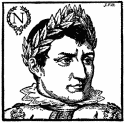
We will not detail the steps by which Napoleon became Emperor. His coronation was the most extraordinary revival of stale history that it is possible to imagine. Cæsar was no longer the model; Napoleon was playing now at being Charlemagne. He was crowned emperor, not indeed at Rome, but in the cathedral of Notre-Dame in Paris; the Pope (Pius VII) had been brought from Rome to perform the ceremony; and at the climax Napoleon I seized the crown, waved the Pope aside, and crowned himself. The attentive reader of this Outline will know that a thousand years before this would have had considerable significance; in 1804 it was just a ridiculous scene. In 1806 Napoleon revived another venerable antiquity, and, following still the footsteps of Charlemagne, crowned himself with the iron crown of Lombardy in the cathedral of Milan. All this mummery was to have a wonderful effect upon the imagination of western Germany, which was to remember that it too had been a part of the empire of Charlemagne.
The four daughter republics of France were now to become kingdoms; in 1806 he set up brother Louis in Holland and brother Joseph in Naples. But the story of the subordinate kingdoms he created in Europe, helpful though this free handling of frontiers was towards the subsequent unification of Italy and Germany, is too complex and evanescent for this Outline.
The pact between the new Charlemagne and the new Leo did not hold good for very long. In 1807 he began to bully the Pope, and in 1811 he made him a close prisoner at Fontainebleau. There does not seem to have been much reason in these proceedings. They estranged all Catholic opinion, as his coronation had estranged all liberal opinion. He ceased to stand either for the old or the new. The new he had betrayed; the old he had failed to win. He stood at last for nothing but himself.
There seems to have been as little reason in the foreign policy that now plunged Europe into a fresh cycle of wars. Having quarreled with Great Britain too soon, he (1804) assembled a vast army at Boulogne for the conquest of England, regardless of the naval situation. He even struck a medal and erected a column at Boulogne to commemorate the triumph of this projected invasion. In some “Napoleonic” fashion the British fleet was to be decoyed away, this army of Boulogne was to be smuggled across the Channel on a flotilla of rafts and boats, and London was to be captured before the fleet returned. At the same time his aggressions in south Germany forced Austria and Russia steadily into a coalition with Britain against him. In 1805 two fatal blows were struck at any hope he may have entertained of ultimate victory, by the British Admirals Calder and Nelson. In July the former inflicted a serious reverse upon the French fleet in the Bay of Biscay; in October the latter destroyed the joint fleets of France and Spain at the battle of Trafalgar. Nelson died splendidly upon the Victory, victorious. Thereafter Napoleon was left with Britain in pitiless opposition, unattainable and unconquerable, able to strike here or there against him along all the coasts of Europe.
But for a while the mortal wound of Trafalgar was hidden from the French mind altogether. They heard merely that “storms have caused us to lose some ships of the line after an imprudent fight.” After Calder’s victory he had snatched his army from Boulogne, rushed it across half Europe, and defeated the Austrian and Russian armies at Ulm and Austerlitz. Under these inauspicious circumstances Prussia came into the war against him, and was utterly defeated and broken at the battle of Jena (1806). Although Austria and Prussia were broken, Russia was still a fighting power, and the next year was devoted to this unnecessary antagonist of the French, against whom an abler and saner ruler would never have fought at all. We cannot trace in any detail the difficulties of the Polish campaign against Russia; Napoleon was roughly handled at Pultusk—which he announced in Paris as a brilliant victory—and again at Eylau. Then the Russians were defeated at Friedland (1807). As yet he had never touched Russian soil, the Russians were still as unbeaten as the British; but now came an extraordinary piece of good fortune for Napoleon. By a mixture of boasting, subtlety, and flattery he won over the young and ambitious Tsar, Alexander I—he was just thirty years old—to an alliance. The two emperors met on a raft in the middle of the Niemen at Tilsit, and there came to an understanding.
Tsar Alexander I.
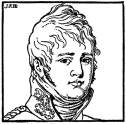
This meeting was an occasion for sublime foolishness on the part of both the principal actors. Alexander had imbibed much liberalism during his education at the court of Catherine II, and was all for freedom, education, and the new order of the world—subject to his own pre-eminence. “He would gladly have everyone free,” said one of his early associates, “provided that everyone was prepared to do freely exactly what he wished.” And he declared that he would have abolished serfdom if it had cost him his head—if only civilization had been more advanced. He made war against France, he said, because Napoleon was a tyrant, to free the French people. After Friedland he saw Napoleon in a different light. These two men met eleven days after that rout; Alexander no doubt in the state of explanatory exaltation natural to his type during a mood of change.
To Napoleon the meeting must have been extremely gratifying. This was his first meeting with an emperor upon terms of equality. Like all men of limited vision, this man was a snob to the bone, his continual solicitude for his titles shows as much, and here was a real emperor, a born emperor, taking his three-year-old dignities as equivalent to the authentic imperialism of Moscow. Two imaginations soared together upon the raft at Tilsit. “What is Europe?” said Alexander. “We are Europe.” They discussed the affairs of Prussia and Austria in that spirit, they divided Turkey in anticipation, they arranged for the conquest of India, and indeed of most of Asia, and that Russia should take Finland from the Swedes; and they disregarded the disagreeable fact that the greater part of the world’s surface is sea, and that on the seas the British fleets sailed now unchallenged. Close at hand was Poland, ready to rise up and become the passionate ally of France had Napoleon but willed it so. But he was blind to Poland. It was a day of visions without vision. Napoleon even then, it seems, concealed the daring thought that he might one day marry a Russian princess, a real princess. But that, he was to learn in 1810, was going a little too far.
After Tilsit there was a perceptible deterioration in Napoleon’s quality; he became rasher, less patient of obstacles, more and more the fated master of the world, more and more intolerable to everyone he encountered.
In 1808 he committed a very serious blunder. Spain was his abject ally, completely under his control, but he saw fit to depose its Bourbon king in order to promote his brother Joseph from the crown of the two Sicilies. Portugal he had already conquered, and the two kingdoms of Spain and Portugal were to be united. Thereupon the Spanish arose in a state of patriotic fury, surrounded a French army at Baylen, and compelled it to surrender. It was an astonishing break in the French career of victory.
The British were not slow to seize the foothold this insurrection gave them. A British army under Sir Arthur Wellesley (afterwards the Duke of Wellington) landed in Portugal, defeated the French at Vimiero, and compelled them to retire into Spain. The news of these reverses caused a very great excitement in Germany and Austria, and the Tsar assumed a more arrogant attitude towards his ally.
There was another meeting of these two potentates at Erfurt, in which the Tsar was manifestly less amenable to the dazzling tactics of Napoleon than he had been. Followed four years of unstable “ascendancy” for France, while the outlines on the map of Europe waved about like garments on a clothesline on a windy day. Napoleon’s personal empire grew by frank annexations to include Holland, much of western Germany, much of Italy, and much of the eastern Adriatic coast. But one by one the French colonies were falling to the British, and the British armies in the Spanish peninsula, with the Spanish auxiliaries, slowly pressed the French northward. All Europe was getting very weary of Napoleon and very indignant with him; his antagonists now were no longer merely monarchs and ministers, but whole peoples also. The Prussians, after the disaster of Jena in 1807, had set to work to put their house in order. Under the leadership of Freiherr von Stein they had swept aside their feudalism, abolished privilege and serfdom, organized popular education and popular patriotism, accomplished, in fact, without any internal struggle nearly everything that France had achieved in 1789. By 1810 a new Prussia existed, the nucleus of a new Germany. And now Alexander, inspired it would seem by dreams of world ascendancy even crazier than his rival’s, was posing again as the friend of liberty. In 1810 fresh friction was created by Alexander’s objection to Napoleon’s matrimonial ambitions. For he was now divorcing his old helper Josephine, because she was childless, in order to secure the “continuity” of his “dynasty.” Napoleon, thwarted of a Russian princess, snubbed indeed by Alexander, turned to Austria, and married the arch-duchess Marie Louise. The Austrian statesmen read him aright. They were very ready to throw him their princess. By that marriage Napoleon was captured for the dynastic system; he might have been the maker of a new world, he preferred to be the son-in-law of the old.
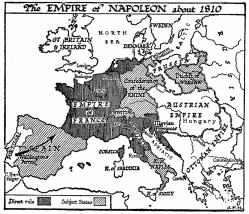
In the next two years this adventurer’s affairs crumbled apace. Nobody believed in his pretensions any more. He was no longer the leader and complement of the revolution; no longer the embodied spirit of a world reborn; he was just a new and nastier sort of autocrat. He had estranged all free-spirited men, and he had antagonized the church. Kings and Jacobins were at one, when it came to the question of his overthrow. Only base and self-seeking people supported him, because he seemed to have the secret of success. Britain was now his inveterate enemy, Spain was blazing with a spirit that surely a Corsican should have understood; it needed only a breach with Alexander I to set this empire of bluff and stage scenery swaying towards its downfall. The quarrel came. Alexander’s feelings for Napoleon had always been of a very mixed sort; he envied Napoleon as a rival, and despised him as an underbred upstart. Moreover, there was a kind of vague and sentimental greatness about Alexander; he was given to mystical religiosity, he had the conception of a mission for Russia and himself to bring peace to Europe and the world—by destroying Napoleon. In that respect he had an imaginative greatness Napoleon lacked. But bringing peace to Europe seemed to him quite compatible with the annexation of Finland, of most of Poland, and of great portions of the Turkish empire. This man’s mind moved in a luminous fog. And particularly he wanted to resume trading with Britain, against which Napoleon had set his face. For all the trade of Germany had been dislocated and the mercantile classes embittered by the Napoleonic “Continental System,” which was to ruin Britain by excluding British goods from every country in Europe. Russia had suffered more even than Germany.
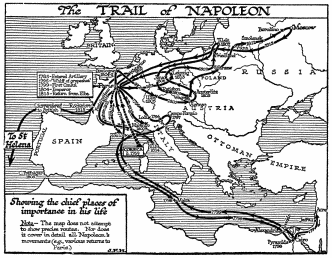
The breach came in 1811, when Alexander withdrew from the “Continental System.” In 1812 a great mass of armies, amounting altogether to 600,000 men, began to move towards Russia under the supreme command of the new emperor. About half this force was French; the rest was drawn from the French allies and subject peoples. It was a conglomerate army like the army of Darius or the army of Kavadh. The Spanish war was still going on; Napoleon made no attempt to end it. Altogether, it drained away a quarter of a million men from France. He fought his way across Poland and Russia to Moscow before the winter—for the most part the Russian armies declined battle—and even before the winter closed in upon him his position became manifestly dangerous. He took Moscow, expecting that this would oblige Alexander to make peace. Alexander would not make peace, and Napoleon found himself in much the same position as Darius had been in 2,300 years before in South Russia. The Russians, still unconquered in a decisive battle, raided his communications, wasted his army—disease helped them; even before Napoleon reached Moscow 150,000 men had been lost. But he lacked the wisdom of Darius, and would not retreat. The winter remained mild for an unusually long time—he could have escaped; but instead he remained in Moscow, making impossible plans, at a loss. He had been marvellously lucky in all his previous flounderings; he had escaped undeservedly from Egypt, he had been saved from destruction in Britain by the British naval victories; but now he was in the net again, and this time he was not to escape. Perhaps he would have wintered in Moscow, but the Russians smoked him out; they set fire to and burnt most of the city.[452]
It was late in October, too late altogether, before he decided to return. He made an ineffectual attempt to break through to a fresh line of retreat to the southwest, and then turned the faces of the survivors of his Grand Army towards the country they had devastated in their advance. Immense distances separated them from any friendly territory. The winter was in no hurry. For a week the Grand Army struggled through mud; then came sharp frosts, and then the first flakes of snow, and then snow and snow....
Slowly discipline dissolved. The hungry army spread itself out in search of supplies until it broke up into mere bands of marauders. The peasants, if only in self-defence, rose against them, waylaid them, and murdered them; a cloud of light cavalry—Scythians still—hunted them down. That retreat is one of the great tragedies of history.
At last Napoleon and his staff and a handful of guards and attendants reappeared in Germany, bringing no army with him, followed only by straggling and demoralized bands. The Grand Army, retreating under Murat, reached Königsberg in a disciplined state, but only about a thousand strong out of six hundred thousand. From Königsberg Murat fell back to Posen. The Prussian contingent had surrendered to the Russians; the Austrians had gone homeward to the south. Everywhere scattered fugitives, ragged, lean, and frost-bitten, spread the news of the disaster.
Napoleon’s magic was nearly exhausted. He did not dare to stay with his troops in Germany; he fled post haste to Paris. He began to order new levies and gather fresh armies amidst the wreckage of his world empire. Austria turned against him (1813); all Europe was eager to rise against this defaulting trustee of freedom, this mere usurper. He had betrayed the new order; the old order he had saved and revived now destroyed him. Prussia rose, and the German “War of Liberation” began. Sweden joined his enemies. Later Holland revolted. Murat had rallied about 14,000 Frenchmen round his disciplined nucleus in Posen, and this force retreated through Germany, as a man might retreat who had ventured into a cageful of drugged lions and found that the effects of the drug were evaporating. Napoleon, with fresh forces, took up the chief command in the spring, won a great battle at Dresden, and then for a time he seems to have gone to pieces intellectually and morally. He became insanely irritable, with moods of inaction. He did little or nothing to follow up the Battle of Dresden. In September the “Battle of the Nations” was fought round and about Leipzig, after which the Saxons, who had hitherto followed his star, went over to the allies. The end of the year saw the French beaten back into France.
1814 was the closing campaign. France was invaded from the east and the south; Swedes, Germans, Austrians, Russians, crossed the Rhine; British and Spanish came through the Pyrenees. Once more Napoleon fought brilliantly, but now he fought ineffectually. The eastern armies did not so much defeat him as push past him, and Paris capitulated in March. A little later at Fontainebleau the emperor abdicated.
In Provence, on his way out of the country, his life was endangered by a royalist mob.
§ 5
This was the natural and proper end of Napoleon’s career. So this raid of an intolerable egotist across the disordered beginnings of a new time should have closed. At last he was suppressed. And had there been any real wisdom in the conduct of human affairs, we should now have to tell of the concentration of human science and will upon the task his treachery and vanity had interrupted, the task of building up a world system of justice and free effort in the place of the bankrupt ancient order. But we have to tell of nothing of the sort. Science and wisdom were conspicuously absent from the great council of the allies. Came the vague humanitarianism and dreamy vanity of the Tsar Alexander, came the shaken Habsburgs of Austria, the resentful Hohenzollerns of Prussia, the aristocratic traditions of Britain, still badly frightened by the revolution and its conscience all awry with stolen commons and sweated factory children. No peoples came to the Congress, but only monarchs and foreign ministers; and though you bray a foreign office in the bloodiest of war mortars, yet will its diplomatic habits not depart from it. The Congress had hardly assembled before the diplomatists set to work making secret bargains and treaties behind each other’s backs. Nothing could exceed the pompous triviality of the Congress which gathered at Vienna after a magnificent ceremonial visit of the allied sovereigns to London. The social side of the congress was very strong, pretty ladies abounded, there was a galaxy of stars and uniforms, endless dinners and balls, a mighty flow of bright anecdotes and sparkling wit. Whether the two million dead men upon the battle-fields laughed at the jokes, admired the assemblies, and marvelled at the diplomatists is beyond our knowledge. It is to be hoped their poor wraiths got something out of the display. The brightest spirit of the gathering was a certain Talleyrand, one of Napoleon’s princes, a very brilliant man indeed, who had been a pre-revolutionary cleric, who had proposed the revolutionary confiscation of the church estates, and who was now for bringing back the Bourbons.
The allies, after the fashion of Peace Congresses, frittered away precious time in more and more rapacious disputes; the Bourbons returned to France. Back came all the remainder of the émigrés with them, eager for restitution and revenge. One great egotism had been swept aside—only to reveal a crowd of meaner egotists. The new king was the brother of Louis XVI; he had taken the title of Louis XVIII very eagerly so soon as he learnt that his little nephew (Louis XVII) was dead in the Temple. He was gouty and clumsy, not perhaps ill-disposed, but the symbol of the ancient system; all that was new in France felt the heavy threat of reaction that came with him. This was no liberation, only a new tyranny, a heavy and inglorious tyranny instead of an active and splendid one. Was there no hope for France but this? The Bourbons showed particular malice against the veterans of the Grand Army, and France was now full of returned prisoners of war, who found themselves under a cloud. Napoleon had been packed off to a little consolation empire of his own, upon the island of Elba. He was still to be called Emperor and keep a certain state. The chivalry or whim of Alexander had insisted upon this treatment of his fallen rival. The Habsburgs, who had toadied to his success, had taken away his Habsburg empress—she went willingly enough—to Vienna, and he never saw her again.
After eleven months at Elba Napoleon judged that France had had enough of the Bourbons; he contrived to evade the British ships that watched his island, and reappeared at Cannes in France for his last gamble against fate. His progress to Paris was a triumphal procession; he walked on white Bourbon cockades. For a hundred days, “the Hundred Days,” he was master of France again.
His return created a perplexing position for any honest Frenchman. On the one hand there was this adventurer who had betrayed the republic; on the other the dull weight of old kingship restored. The allies would not hear of any further experiments in republicanism; it was the Bourbons or Napoleon. Is it any wonder that on the whole France was with Napoleon? And he came back professing to be a changed man; there was to be no more despotism; he would respect the constitution régime....
He gathered an army, he made some attempts at peace with the allies; when he found these efforts ineffectual, he struck swiftly at the British, Dutch, and Prussians in Belgium, hoping to defeat them before the Austrians and Russians could come up. He did very nearly manage this. He beat the Prussians at Ligny, but not sufficiently; and then he was hopelessly defeated by the tenacity of the British under Wellington at Waterloo (1815), the Prussians, under Blücher, coming in on his right flank as the day wore on. Waterloo ended in a rout; it left Napoleon without support and without hope. France fell away from him again. Everyone who had joined him was eager now to attack him, and so efface that error. A provisional government in Paris ordered him to leave the country; was for giving him twenty-four hours to do it in.
He tried to get to America, but Rochefort, which he reached, was watched by British cruisers. France, now disillusioned and uncomfortably royalist again, was hot in pursuit of him. He went aboard a British frigate, the Bellerophon, asking to be received as a refugee, but being treated as a prisoner. He was taken to Plymouth, and from Plymouth straight to the lonely tropical island of St. Helena.
There he remained until his death from cancer in 1821, devoting himself chiefly to the preparation of his memoirs, which were designed to exhibit the chief events of his life in a misleading and attractive light and to minimize his worst blunders. One or two of the men with him recorded his conversations and set down their impressions of him.
These works had a great vogue in France and Europe. The Holy Alliance of the monarchs of Russia, Austria, and Prussia (to which other monarchs were invited to adhere) laboured under the delusion that in defeating Napoleon they had defeated the Revolution, turned back the clock of fate, and restored Grand Monarchy—on a sanctified basis for evermore. The cardinal document of the scheme of the Holy Alliance is said to have been drawn up under the inspiration of the Baroness von Krüdener, who seems to have been a sort of spiritual director to the Russian emperor. It opened, “In the name of the Most Holy and Indivisible Trinity,” and it bound the participating monarchs “regarding themselves towards their subjects and armies as fathers of families,” and “considering each other as fellow-countrymen,” to sustain each other, protect true religion, and urge their subjects to strengthen and exercise themselves in Christian duties. Christ, it was declared, was the real king of all Christian peoples, a very Merovingian king, one may remark, with these reigning sovereigns as his mayors of the palace. The British king had no power to sign this document, the Pope and the sultan were not asked; the rest of the European monarchs, including the king of France, adhered. But the king of Poland did not sign because there was no king in Poland; Alexander, in a mood of pious abstraction, was sitting on the greater part of Poland. The Holy Alliance never became an actual legal alliance of states; it gave place to a real league of nations, the Concert of Europe, which France joined in 1818, and from which Britain withdrew in 1822.
There followed a period of peace and dull oppression in Europe over which Alexander brooded in attitudes of orthodoxy, piety, and unquenchable self-satisfaction. Many people in those hopeless days were disposed to regard even Napoleon with charity, and to accept his claim that in some inexplicable way he had, in asserting himself, been asserting the revolution and France. A cult of him as of something mystically heroic grew up after his death.[453]
§ 6
In the long perspectives of history the cult of Napoleon, and his peculiar effect upon certain types of mind, is of far more interest and far more importance than his actual adventures. The world has largely recovered from the mischief he did; perhaps that amount of mischief had to be done by some agency; perhaps his career, or some such career, was a necessary consequence of the world’s mental unpreparedness for the crisis of the revolution. But that his peculiar personality should dominate the imaginations of great numbers of people, throws a light upon factors of enduring significance in our human problem.
It would be difficult to find a human being less likely to arouse affection. One reads in vain through the monstrous accumulations of Napoleonic literature for a single record of self-forgetfulness. Laughter is one great difference between man and the lower animals, one method of our brotherhood, and there is no evidence that Napoleon ever laughed. Nor can we imagine another of the most beautiful of human expressions upon the face of this saturnine egotist, that expression of disinterested interest that one sees in the face of an artist or artisan “lost,” as we say, in his work. Out of his portraits he looks at us with a thin scorn upon his lips, the scorn of the criminal who believes that he can certainly cheat such fools as we are, and withal with a certain uneasiness in his eyes. That uneasiness haunts all his portraits. Are we really convinced he is quite right? Are his laurels straight? He had a vast contempt for man in general and men in particular, a contempt that took him at last to St. Helena, that same contempt that fills our jails with forgers, poisoners, and the like victims of self-conceit. There is no proof that this unbrotherly, unhumorous egotist was ever sincerely loved by any human being. The Empress Josephine was unfaithful to him as he to her. His young Austrian wife would not accompany him to Elba. A certain Polish countess followed him thither, but not, it would seem, for love, but on account of the son she had borne him. She wanted settlements. She stayed only two days with him. He had never even a dog to love him. He estranged most of his colleagues and fellow generals. He had no familiar friend. No one who knew him felt safe with him. In his intimacy, his unflinching self-concentration must have been a terrible bore. His personal habits were unpleasant; the moodiness of bad health came to him early. True it is that his soldiers, who, save for a few rare melodramatic encounters, saw nothing of him, idolized their “Little Corporal.” But it was not him they idolized, but a carefully fostered legend of an incredibly clever, recklessly brave little man, a little pet of a man, who was devoted to France and them.
Why, then, is there an enormous cult of Napoleon, an endless writing of books about him, an insatiable collecting of relics and documents, a kind of worship of his memory? Marat was a far more noble, persistent, subtle, and pathetic figure; Talleyrand a greater statesman and a much more amusing personality; Moreau and Hoche abler leaders of armies; his rival, the Tsar Alexander, as egotistical, more successful, more emotional, and with a finer imagination. Are men dazzled simply by the scale of his flounderings, by the mere vastness of his notoriety?
No doubt scale has something to do with the matter; he was a “record,” the record plunger; but there is something more in it than that. There is an appeal in Napoleon to something deeper and more fundamental in human nature than mere astonishment at bigness. His very deficiencies bring out starkly certain qualities that lurk suppressed and hidden in us all. He was unhampered. He had never a gleam of religion or affection or the sense of duty. He was, as few men are or dare to be, a scoundrel, bright and complete. Most of us are constrained more or less and now and then to serve God or our fellow men, to do things disinterestedly, to behave decently when no one is watching us. He was not so constrained. Most men do a little regret and resent their good deeds, and find a secret satisfaction in their unpunished bad ones. The early palæolithic strain is still strong in us; we are being made over, slowly and reluctantly, into social and fraternal creatures. Few of us thoroughly enjoy being good citizens. Our moral conflicts, therefore, are intricate and comic; the constant effort to explain to ourselves and others that there is a fine moral purpose in this shirking of our duty or in that self-seeking act. We are all regretfully of the race of Tsar Alexander, who destroyed the freedom of Poland, annexed Finland, and secured his imperial predominance piously, “in the name of the most Holy and Indivisible Trinity”—when it would have been far more agreeable to have done it in the name of the most Holy and Magnificent Alexander. There was none of this robing of greed and crime about Napoleon. His self-conceit and his instinctive and fundamental atheism made him at least magnificently direct. What we all want to do secretly, more or less, he did in the daylight.
Directness was his distinctive and immortalizing quality. He had no brains to waste in secondary considerations. He flung his armies across Europe straight at their mark, there never were such marches before; he fought to win; when he struck he struck with all his might. And what he wanted, he wanted simply and completely, and got—if he could.
There lies his fascination. Since his time his name has been one of the utmost reassurance to great multitudes of doubting men; to the business man hesitating over a more than shady transaction, to the clerk fingering a carelessly written cheque that could so easily be altered, to the trustee in want of ready money, to the manufacturer meditating the pros and cons of an adulteration, to thousands of such people the word “Napoleonic” has come with an effect of decisive relief. We live in a world full of would-be Napoleons of finance, of the press, of the turf; half the cells in our jails and many in our mad-houses are St. Helenas. He was the very embodiment of that sound, clear, self-centred common sense, without sentiment or scruples or reflection, that struggles with our feebler better nature, that may ultimately destroy mankind. In all history there is no figure so completely antithetical to the figure of Jesus of Nazareth, whose pitiless and difficult doctrine of self-abandonment and self-forgetfulness we can neither disregard nor yet bring ourselves to obey. That summons to a new way of life haunts our world to-day, haunts wealth and comfort and every sort of success. It is a trouble to us all. Our uneasiness grows. Napoleon was free from it. The cultivation of the Napoleonic legend seems to offer a kind of refuge. From salvation.
In that antithesis lies the essential historical importance of Napoleon. His career marks the beginning of a new phase in the elations of strong and able and energetic and advantageously placed men to the main mass of mankind. They are robbed of Self-deception; they must either serve or openly defy the idea of service. They must be humble or Napoleonic; there is no more service with privilege and pride. Napoleon adorned himself with ancient titles and antiquated robes, but the more he brought himself into contact with tradition, the more manifestly he displayed himself as something new. In the Tsar Alexander I, who was never direct, this direct new imperialism met the old. Hitherto the kings and potentates of the world had taken themselves in good faith, had had the support of religion in their consciences, had believed they were serving God in their kingship, and that they were necessary to mankind and beneficial to mankind. In many cases they were no doubt swayed by very mixed motives, his majesty had “weaknesses,” his majesty almost always had a sensitive personal vanity. Sometimes, indeed, a born rascal like Charles II of England would have the grace or the gracelessness to laugh at himself, but the generality of kings and tyrants had the profoundest faith in themselves, and were sustained by the sincere faith of their loyal supporters. The emperor Charles V and his son Philip II, Charles I of England, Louis XIV, and the Tsar Alexander were all inspired by a complete assurance of their own righteousness, were convinced that opposition to them was sheer wickedness, wickedness to be overcome in any way and punished with the utmost severity. But Napoleon knew himself for what he was, an individual man getting the better of his fellow men. He had small doubt in his struggle with the republicans, where the moral superiority lay. With Napoleon, we note the beginning of a clearer-headed age. The self-deceptions of wealth, power, and prominence wear thin. His new imperialism reflected upon the old.
For a time the Concert of Europe struggled valiantly to carry on upon the old lines, but the French Revolution had shrivelled the heart of monarchy. In 1830, and again in 1848, the evaporation of the simple old royalist faith became very evident. Alexander I and his narrow-minded successor, Nicholas I, could still sustain the delusion of divine right in Russia—that did not perish until 1917—the idea hung on in Prussia in spite of much muttered criticism,[454] but for the rest of Europe the days of the unchallenged claim of kingship had gone. “What good are you?” said the world to monarchs; “and what do you do for us?”
So challenged, many of the monarchs became apologetic and fussily useful. One or two, as we shall have to tell, became “Napoleonic.” But so far no European monarch has betrayed any disposition to waive the remnant of his ancient trappings, to cease his passive and traditional opposition to political readjustment, and to move of his own accord towards that more broadly conceived government of human affairs as one world-wide community of will, which the future welfare of mankind demands.
§ 7[455]
For nearly forty years the idea of the Holy Alliance, the Concert of Europe which arose out of it, and the series of congresses and conferences that succeeded the concert, kept an insecure peace in war-exhausted Europe. Two main things prevented that period from being a complete social and international peace, and prepared the way for the cycle of wars between 1854 and 1871. The first of these was the tendency of the royal courts concerned, towards the restoration of unfair privilege and interference with freedom of thought and writing and teaching. The second was the impossible system of boundaries drawn by the diplomatists of Vienna.
The obstinate disposition of monarchy to march back towards past conditions was first and most particularly manifest in Spain. Here even the Inquisition was restored. Across the Atlantic the Spanish colonies had followed the example of the United States and revolted against the European Great Power system, when Napoleon set up his brother Joseph upon the Spanish throne in 1810. The Washington of South America was General Bolivar. Spain was unable to suppress this revolt, it dragged on much as the United States War of Independence had dragged on, and at last the suggestion was made by Austria in accordance with the spirit of the Holy Alliance, that the European monarchs should assist Spain in this struggle. This was opposed by Britain in Europe, but it was the prompt action of President Monroe of the United States in 1823 which conclusively warned off this projected monarchist restoration. He announced that the United States would regard any extension of the European system in the Western Hemisphere as a hostile act. Thus arose the Monroe Doctrine, which has kept the Great Power System out of America for nearly a hundred years, and permitted the new states of Spanish America to work out their destinies along their own lines. But if Spanish monarchism lost its colonies, it could at least, under the protection of the Concert of Europe, do what it chose in Europe. A popular insurrection in Spain was crushed by a French army in 1823, with a mandate from a European congress, and simultaneously Austria suppressed a revolution in Naples. The moving spirit in this conspiracy of governments against peoples was the Austrian statesman, Metternich.
In 1824 Louis XVIII died, and was succeeded by that Count d’Artois whom we have seen hovering as an émigré on the French frontiers in 1789; he took the title of Charles X. Charles set himself to destroy the liberty of the press and universities, and to restore absolute government; the sum of a billion francs was voted to compensate the nobles for the château burnings and sequestrations of 1789. In 1830 Paris rose against this embodiment of the ancient régime, and replaced him by the son of that sinister Philip, Duke of Orleans, whose execution was one of the brightest achievements of the Terror. The other continental monarchies, in face of the open approval of the revolution by Great Britain and a strong liberal ferment in Germany and Austria, did not interfere in this affair. After all, France was still a monarchy. This young man, Louis Philippe (1830-48), remained the constitutional king of France for eighteen years. He went down in 1848, a very eventful year for Europe, of which we shall tell in the next chapter.
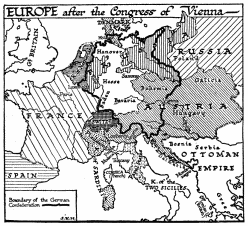
Such were the uneasy swayings of the peace of the Congress of Vienna, which were provoked by the reactionary proceedings to which, sooner or later, all monarchist courts seem by their very nature to gravitate. The stresses that arose from the unscientific map-making of the diplomatists gathered force more deliberately, but they were even more dangerous to the peace of mankind. It is extraordinarily inconvenient to administer together the affairs of peoples speaking different languages and so reading different literatures and having different general ideas, especially if those differences are exacerbated by religious disputes. Only some strong mutual interest, such as the common defensive needs of the Swiss mountaineers, can justify a close linking of peoples of dissimilar languages and faiths; and even in Switzerland there is the utmost local autonomy. Ultimately, when the Great Power tradition is certainly dead and buried, those Swiss populations may gravitate towards their natural affinities in Germany, France, and Italy. When, as in Macedonia, populations are mixed in a patchwork of villages and districts, the cantonal system is imperatively needed. But if the reader will look at the map of Europe as the Congress of Vienna drew it, he will see that this gathering seems almost as if it had planned the maximum of local exasperation. It destroyed the Dutch Republic, quite needlessly, it lumped together the Protestant Dutch with the French-speaking Catholics of the old Spanish (Austrian) Netherlands, and set up a kingdom of the Netherlands. It handed over not merely the old republic of Venice, but all of North Italy as far as Milan to the German-speaking Austrians. French-speaking Savoy it combined with pieces of Italy to restore the kingdom of Sardinia.[456] Austria and Hungary, already a sufficiently explosive mixture of discordant nationalities, Germans, Hungarians, Czecho-Slovaks, Jugo-Slavs, Roumanians, and now Italians, was made still more impossible by confirming Austria’s Polish acquisitions of 1772 and 1795. The Polish people, being catholic and republican-spirited, were chiefly given over to the less civilized rule of the Greek-orthodox Tsar, but important districts went to Protestant Russia. The Tsar was also confirmed in his acquisition of the entirely alien Finns. The very dissimilar Norwegian and Swedish peoples were bound together under one king. Germany, the reader will see, was left in a particularly dangerous state of muddle. Prussia and Austria were both partly in and partly out of a German confederation, which included a multitude of minor states. The King of Denmark came into the German confederation by virtue of certain German-speaking possessions in Holstein. Luxembourg was included in the German Confederation, though its ruler was also King of the Netherlands, and though many of its peoples talked French. Here was a crazy tangle, an outrage on the common sense of mankind, a preposterous disregard of the fact that the people who talk German and base their ideas on German literature, the people who talk Italian and base their ideas on Italian literature, and the people who talk Polish and base their ideas on Polish literature, will all be far better off and most helpful and least obnoxious to the rest of mankind if they conduct their own affairs in their own idiom within the ring-fence of their own speech. Is it any wonder that one of the most popular songs in Germany during this period declared that wherever the German tongue was spoken, there was the German Fatherland?
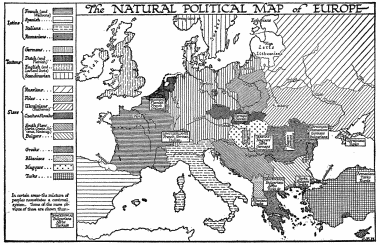
Even to-day men are still reluctant to recognize that areas of government are not matters for the bargaining and interplay of tsars and kings and foreign offices. There is a natural and necessary political map of the world which transcends these things. There is a best way possible of dividing any part of the world into administrative areas, and a best possible kind of government for every area, having regard to the speech and race of its inhabitants, and it is the common concern of all men of intelligence to secure those divisions and establish those forms of government quite irrespective of diplomacies and flags, “claims” and melodramatic “loyalties” and the existing political map of the world. The natural political map of the world insists upon itself. It heaves and frets beneath the artificial political map like some misfitted giant. In 1830 French-speaking Belgium, stirred up by the current revolution in France, revolted against its Dutch association in the kingdom of the Netherlands. The Powers, terrified at the possibility of a republic and of annexation to France, hurried in to pacify this situation, and gave the Belgians a monarch from that rich breeding-ground of monarchs, Germany, Leopold I of Saxe-Coburg Gotha. There were also ineffectual revolts in Italy and Germany in 1830, and a much more serious one in Russian Poland. A republican government held out in Warsaw for a year against Nicholas I (who succeeded Alexander in 1825), and was then stamped out of existence with great violence and cruelty. The Polish language was banned, and the Greek Orthodox church was substituted for the Roman Catholic as the State religion....
An outbreak of the natural political map of the world, which occurred in 1821, ultimately secured the support of England, France, and Russia. This was the insurrection of the Greeks against the Turks. For six years they fought a desperate war, while the governments of Europe looked on. Liberal opinion protested against this inactivity; volunteers from every European country joined the insurgents, and at last Britain, France, and Russia took joint action. The Turkish fleet was destroyed by the French and English at the Battle of Navarino (1827), and the Tsar invaded Turkey. By the treaty of Adrianople (1829) Greece was declared free, but she was not permitted to resume her ancient republican traditions. There is a sort of historical indecency in a Greek monarchy. But a Greek republic would have been dangerous to all monarchy in a Europe that fretted under the ideas of the Holy Alliance. One monarch makes many. A German king was found for Greece, one Prince Otto of Bavaria, slightly demented, but quite royal—he gave way to delusions about his divine right, and was ejected in 1862—and Christian governors were set up in the Danubian provinces (which are now Roumania) and Serbia (a part of the Jugo-Slav region). This was a partial concession to the natural political map, but much blood had still to run before the Turk was altogether expelled from these lands. A little later the natural political map was to assert itself in Italy and Germany.
XXXIX THE REALITIES AND IMAGINATIONS OF THE NINETEENTH CENTURY[457]
§ 1. The Mechanical Revolution. § 2. Relation of the Mechanical to the Industrial Revolution. § 3. The Fermentation of Ideas, 1848. § 4. The Development of the Idea of Socialism. § 5. Shortcomings of Socialism as a Scheme of Human Society. § 6. How Darwinism Affected Religious and Political Ideas. § 7. Mr. Gladstone and the Idea of Nationalism. § 8. Europe between 1848 and 1878. § 9. The (Second) Scramble for Overseas Empires. § 10. The Indian Precedent in Asia. § 11. The History of Japan. § 12. Close of the Period of Overseas Expansion. § 13. The British Empire in 1914.
§ 1
THE career and personality of Napoleon I bulks disproportionately in the nineteenth century histories. He was of little significance to the broad onward movement of human affairs; he was an interruption, a reminder of latent evils, a thing like the bacterium of some pestilence. Even regarded as a pestilence, he was not of supreme rank; he killed far fewer people than the influenza epidemic of 1918, and produced less political and social disruption than the plague of Justinian. Some such interlude had to happen, and some such patched-up settlement of Europe as the Concert of Europe, because there was no worked-out system of ideas upon which a new world could be constructed. And even the Concert of Europe had in it an element of progress. It did at least set aside the individualism of Machiavellian monarchy and declare that there was a human or at any rate a European commonweal. If it divided the world among the kings, it made respectful gestures towards human unity and the service of God and man.
The permanently effective task before mankind which had to be done before any new and enduring social and political edifice was possible, the task upon which the human intelligence is, with many interruptions and amidst much anger and turmoil, still engaged, was, and is, the task of working out and applying a Science of Property as a basis for freedom and social justice, a Science of Currency to ensure and preserve an efficient economic medium, a Science of Government and Collective Operations whereby in every community men may learn to pursue their common interests in harmony, a Science of World Politics, through which the stark waste and cruelty of warfare between races, peoples, and nations may be brought to an end and the common interests of mankind brought under a common control, and, above all, a world-wide System of Education to sustain the will and interest of men in their common human adventure. The real makers of history in the nineteenth century, the people whose consequences will be determining human life a century ahead, were those who advanced and contributed to this fivefold constructive effort. Compared to them, the foreign ministers and “statesmen” and politicians of this period were no more than a number of troublesome and occasionally incendiary schoolboys—and a few metal thieves—playing about and doing transitory mischief amidst the accumulating materials upon the site of a great building whose nature they did not understand.
And while throughout the nineteenth century the mind of Western civilization, which the Renascence had released, gathered itself to the task of creative social and political reconstruction that still lies before it, there swept across the world a wave of universal change in human power and the material conditions of life that the first scientific efforts of that liberated mind had made possible. The prophecies of Roger Bacon began to live in reality. The accumulating knowledge and confidence of the little succession of men who had been carrying on the development of science, now began to bear fruit that common men could understand. The most obvious firstfruit was the steam-engine. The first steam-engines in the eighteenth century were pumping engines used to keep water out of the newly opened coal mines. These coal mines were being worked to supply coke for iron smelting, for which wood-charcoal had previously been employed. It was James Watt, a mathematical instrument maker of Glasgow, who improved this steam-pumping engine and made it available for the driving of machinery. The first engine so employed was installed in a cotton mill in Nottingham in 1785. In 1804 Trevithick adapted the Watt engine to transport, and made the first locomotive. In 1830 the first railway, between Liverpool and Manchester, was opened, and Stephenson’s “Rocket,” with a thirteen-ton train, got up to a speed of forty-four miles per hour. From 1830 onward railways multiplied. By the middle of the century a network of railways had spread all over Europe.
Here was a sudden change in what had long been a fixed condition of human life, the maximum rate of land transport. After the Russian disaster, Napoleon travelled from near Vilna to Paris in 312 hours. This was a journey of about 1,400 miles. He was travelling with every conceivable advantage, and he averaged under five miles an hour. An ordinary traveller could not have done this distance in twice the time. These were about the same maximum rates of travel as held good between Rome and Gaul in the first century A.D., or between Sardis and Susa in the fourth century B.C. Then suddenly came a tremendous change. The railways reduced this journey for any ordinary traveller to less than forty-eight hours. That is to say, they reduced the chief European distances to about a tenth of what they had been. They made it possible to carry out administrative work in areas ten times as great as any that had hitherto been workable under one administration. The full significance of that possibility in Europe still remains to be realized. Europe is still netted in boundaries drawn in the horse and road era. In America the effects were immediate. To the United States of America, sprawling westward, it meant the possibility of a continuous access to Washington, however far the frontier travelled across the continent. It meant unity, sustained on a scale that would otherwise have been impossible.
The steamboat was, if anything, a little ahead of the steam-engine in its earlier phases. There was a steamboat, the Charlotte Dundas, on the Firth of Clyde Canal in 1802, and in 1807 an American named Fulton had a paying steamer, The Clermont, with British-built engines, upon the Hudson River above New York. The first steamship to put to sea was also an American, the Phœnix, which went from New York (Hoboken) to Philadelphia. So, too, was the first ship using steam (she also had sails) to cross the Atlantic, the Savannah (1819). All these were paddle-wheel boats, and paddle-wheel boats are not adapted to work in heavy seas. The paddles smash too easily, and the boat is then disabled. The screw steamship followed rather slowly. Many difficulties had to be surmounted before the screw was a practicable thing. Not until the middle of the century did the tonnage of steamships upon the sea begin to overhaul that of sailing-ships. After that the evolution in sea transport was rapid. For the first time men began to cross the seas and oceans with some certainty as to the date of their arrival. The transatlantic crossing, which had been an uncertain adventure of several weeks—which might stretch to months—was accelerated, until in 1910 it was brought down, in the case of the fastest boats, to under five days, with a practically notifiable hour of arrival. All over the oceans there was the same reduction in the time and the same increase in the certainty of human communications.
Concurrently with the development of steam transport upon land and sea a new and striking addition to the facilities of human intercourse arose out of the investigations of Volta, Galvani, and Faraday into various electrical phenomena. The electric telegraph came into existence in 1835. The first underseas cable was laid in 1851 between France and England. In a few years the telegraph system had spread over the civilized world, and news which had hitherto travelled slowly from point to point became practically simultaneous throughout the earth.
These things, the steam railway and the electric telegraph, were to the popular imagination of the middle nineteenth century the most striking and revolutionary of inventions, but they were only the most conspicuous and clumsy firstfruits of a far more extensive process. Technical knowledge and skill were developing with an extraordinary rapidity, and to an extraordinary extent measured by the progress of any previous age. Far less conspicuous at first in everyday life, but finally far more important, was the extension of man’s power over various structural materials. Before the middle of the eighteenth century iron was reduced from its ores by means of wood-charcoal, was handled in small pieces, and hammered and wrought into shape. It was material for a craftsman. Quality and treatment were enormously dependent upon the experience and sagacity of the individual iron worker. The largest masses of iron that could be dealt with under those conditions amounted at most (in the sixteenth century) to two or three tons. (There was a very definite upward limit, therefore, to the size of cannon.) The blast furnace arose in the eighteenth century, and developed with the use of coke. Not before the eighteenth century do we find rolled sheet iron (1728) and rolled rods and bars (1783). Nasmyth’s steam hammer came as late as 1838. The ancient world, because of its metallurgical inferiority, could not use steam. The steam engine, even the primitive pumping engine, could not develop before sheet iron was available. The early engines seem to the modern eye very pitiful and clumsy bits of ironmongery, but they were the utmost that the metallurgical science of the time could do. As late as 1856 came the Bessemer process, and presently (1864) the open-hearth process, in which steel and every sort of iron could be melted, purified, and cast in a manner and upon a scale hitherto unheard of. To-day in the electric furnace one may see tons of incandescent steel swirling about like boiling milk in a saucepan. Nothing in the previous practical advances of mankind is comparable in its consequences to the complete mastery over enormous masses of steel and iron and over their texture and quality which man has now achieved. The railways and early engines of all sorts were the mere first triumphs of the new metallurgical methods. Presently came ships of iron and steel, vast bridges, and a new way of building with steel upon a gigantic scale. Men realized too late that they had planned their railways with far too timid a gauge, that they could have organized their travelling with far more steadiness and comfort upon a much bigger scale.
Before the nineteenth century there were no ships in the world much over 2,000 tons burthen; now there is nothing wonderful about a 50,000-ton liner. There are people who sneer at this kind of progress as being a progress in “mere size,” but that sort of sneering merely marks the intellectual limitations of those who indulge in it. The great ship or the steel-frame building is not, as they imagine, a magnified version of the small ship or building of the past; it is a thing different in kind, more lightly and strongly built, of finer and stronger materials; instead of being a thing of precedent and rule-of-thumb, it is a thing of subtle and intricate calculation. In the old house or ship, matter was dominant—the material and its needs had to be slavishly obeyed; in the new, matter has been captured, changed, coerced. Think of the coal and iron and sand dragged out of the banks and pits, wrenched, wrought, molten and cast, to be flung at last, a slender, glittering pinnacle of steel and glass, six hundred feet above the crowded city!
We have given these particulars of the advance in man’s knowledge of the metallurgy of steel and its results by way of illustration. A parallel story could be told of the metallurgy of copper and tin, and of a multitude of metals, nickel and aluminium to name but two, unknown before the nineteenth century dawned. It is in this great and growing mastery over substances, over different sorts of glass, over rocks and plasters and the like, over colours and textures, that the main triumphs of the mechanical revolution have thus far been achieved. Yet we are still in the stage of the firstfruits in the matter. We have the power, but we have still to learn how to use our power. Many of the first employments of these gifts of science have been vulgar, tawdry, stupid, or horrible. The artist and the adaptor have still hardly begun to work with the endless variety of substances now at their disposal.
Concurrently with this extension of mechanical possibilities the new science of electricity grew up. It was only in the eighties of the nineteenth century that this body of inquiry began to yield results to impress the vulgar mind. Then suddenly came electric light and electric traction; and the transmutation of forces, the possibility of sending power, that could be changed into mechanical motion or light or heat as one chose, along a copper wire, as water is sent along a pipe, began to come through to the ideas of ordinary people....
The British and the French were at first the leading peoples in this great proliferation of knowledge; but presently the German, who had learnt humility under Napoleon, showed such zeal and pertinacity in scientific inquiry as to overhaul these leaders. British science was largely the creation of Englishmen and Scotchmen[458] working outside the ordinary centres of erudition.[459] We have told how in England the universities after the reformation ceased to have a wide popular appeal, how they became the educational preserve of the nobility and gentry, and the strongholds of the established church. A pompous and unintelligent classical pretentiousness dominated them, and they dominated the schools of the middle and upper classes. The only knowledge recognized was an uncritical textual knowledge of a selection of Latin and Greek classics, and the test of a good style was its abundance of quotations, allusions, and stereotyped expressions. The early development of British science went on, therefore, in spite of the formal educational organization, and in the teeth of the bitter hostility of the teaching and clerical professions. French education, too, was dominated by the classical tradition of the Jesuits, and consequently it was not difficult for the Germans to organize a body of investigators, small indeed in relation to the possibilities of the case, but large in proportion to the little band of British and French inventors and experimentalists. And though this work of research and experiment was making Britain and France the most rich and powerful countries in the world, it was not making scientific and inventive men rich and powerful. There is a necessary unworldliness about a sincere scientific man; he is too preoccupied with his research to plan and scheme how to make money out of it. The economic exploitation of his discoveries falls very easily and naturally, therefore, into the hands of a more acquisitive type; and so we find that the crops of rich men which every fresh phase of scientific and technical progress has produced in Great Britain, though they have not displayed quite the same passionate desire to insult and kill the goose that laid the national golden eggs as the scholastic and clerical professions, have been quite content to let that profitable creature starve. Inventors and discoverers came by nature, they thought, for cleverer people to profit by.
In this matter the Germans were a little wiser. The German “learned” did not display the same vehement hatred of the new learning. They permitted its development. The German business man and manufacturer again had not quite the same contempt for the man of science as had his British competitor. Knowledge, these Germans believed, might be a cultivated crop, responsive to fertilizers. They did concede, therefore, a certain amount of opportunity to the scientific mind; their public expenditure on scientific work was relatively greater, and this expenditure was abundantly rewarded. By the latter half of the nineteenth century the German scientific worker had made German a necessary language for every science student who wished to keep abreast with the latest work in his department, and in certain branches, and particularly in chemistry, Germany acquired a very great superiority over her western neighbours. The scientific effort of the sixties and seventies in Germany began to tell after the eighties, and the Germans gained steadily upon Britain and France in technical and industrial prosperity.
In an Outline of History such as this it is impossible to trace the network of complex mental processes that led to the incessant extension of knowledge and power that is now going on; all we can do here is to call the reader’s attention to the most salient turning-points that finally led the toboggan of human affairs into its present swift ice-run of progress. We have told of the first release of human curiosity and of the beginnings of systematic inquiry and experiment. We have told, too, how, when the plutocratic Roman system and its resultant imperialism had come and gone again, this process of inquiry was renewed. We have told of the escape of investigation from ideas of secrecy and personal advantage to the idea of publication and a brotherhood of knowledge, and we have noted the foundation of the British Royal Society, the Florentine Society, and their like as a consequence of this socializing of thought. These things were the roots of the mechanical revolution, and so long as the root of pure scientific inquiry lives, that revolution will progress. The mechanical revolution itself began, we may say, with the exhaustion of the wood supply for the ironworks of England. This led to the use of coal, the coal mine led to the simple pumping engine, the development of the pumping engine by Watt into a machine-driving engine led on to the locomotive and the steamship. This was the first phase of a great expansion in the use of steam. A second phase in the mechanical revolution began with the application of electrical science to practical problems and the development of electric lighting, power-transmission, and traction.
A third phase is to be distinguished when in the eighties a new type of engine came into use, an engine in which the expansive force of an explosive mixture replaced the expansive force of steam. The light, highly efficient engines that were thus made possible were applied to the automobile, and developed at last to reach such a pitch of lightness and efficiency as to render flight—long known to be possible—a practical achievement. A successful flying-machine—but not a machine large enough to take up a human body—was made by Professor Langley of the Smithsonian Institution of Washington as early as 1897. By 1909 the aeroplane was available for human locomotion. There had seemed to be a pause in the increase of human speed with the perfection of railways and automobile road traction, but with the flying-machine came fresh reductions in the effective distance between one point of the earth’s surface and another. In the eighteenth century the distance from London to Edinburgh was an eight days’ journey; in 1918 the British Civil Air Transport Commission reported that the journey from London to Melbourne, half-way round the earth, would probably, in a few years’ time, be accomplished in that same period of eight days.
Too much stress must not be laid upon these striking reductions in the time distances of one place from another. They are merely one aspect of a much profounder and more momentous enlargement of human possibility. The science of agriculture and agricultural chemistry, for instance, made quite parallel advances during the nineteenth century. Men learnt so to fertilize the soil as to produce quadruple and quintuple the crops got from the same area in the seventeenth century. There was a still more extraordinary advance in medical science; the average duration of life rose, the daily efficiency increased, the waste of life through ill-health diminished.
Now here altogether we have such a change in human life as to constitute a fresh phase of history. In a little more than a century this mechanical revolution has been brought about. In that time man made a stride in the material conditions of his life vaster than he had done during the whole long interval between the palæolithic stage and the age of cultivation, or between the days of Pepi in Egypt and those of George III. A new gigantic material framework for human affairs has come unto existence. Clearly it demands great readjustments of our social, economical, and political methods. But these readjustments have necessarily waited upon the development of the mechanical revolution, and they are still only in their opening stage to-day.
§ 2
There is a tendency in many histories to confuse together what we have here called the mechanical revolution, which was an entirely new thing in human experience arising out of the development of organized science, a new step like the invention of agriculture or the discovery of metals, with something else, quite different in its origins, something for which there was already an historical precedent, the social and financial development which is called the industrial revolution. The two processes were going on together, they were constantly reacting upon each other, but they were in root and essence different. There would have been an industrial revolution of sorts if there had been no coal, no steam, no machinery; but in that case it would probably have followed far more closely upon the lines of the social and financial developments of the later years of the Roman republic. It would have repeated the story of dispossessed free cultivators, gang labour, great estates, great financial fortunes, and a socially destructive financial process. Even the factory method came before power and machinery. Factories were the product not of machinery, but of the “division of labour.” Drilled and sweated workers were making such things as millinery, cardboard boxes, and furniture, and colouring maps and book illustrations, and so forth, before even water-wheels had been used for industrial processes. There were factories in Rome in the days of Augustus. New books, for instance, were dictated to rows of copyists in the factories of the booksellers. The attentive student of Defoe and of the political pamphlets of Fielding will realize that the idea of herding poor people into establishments to work collectively for their living was already current in Britain before the close of the seventeenth century. There are intimations of it even as early as More’s Utopia (1516). It was a social and not a mechanical development.
Up to past the middle of the eighteenth century the social and economic history of western Europe was in fact retreading the path along which the Roman State had gone in the three last centuries B.C. America was in many ways a new Spain, and India and China a new Egypt. But the political disunions of Europe, the political convulsions against monarchy, the recalcitrance of the common folk and perhaps also the greater accessibility of the western European intelligence to mechanical ideas and inventions, turned the process into quite novel directions. Ideas of human solidarity, thanks to Christianity, were far more widely diffused in this newer European world, political power was not so concentrated, and the man of energy anxious to get rich turned his mind, therefore, very willingly from the ideas of the slave and of gang labour to the idea of mechanical power and the machine.
The mechanical revolution, the process of mechanical invention and discovery, was a new thing in human experience, and it went on regardless of the social, political, economic, and industrial consequences it might produce. The industrial revolution, on the other hand, like most other human affairs, was and is more and more profoundly changed and deflected by the constant variation in human conditions caused by the mechanical revolution. And the essential difference between the amassing of riches, the extinction of small farmers and small business men, and the phase of big finance in the latter centuries of the Roman republic on the one hand, and the very similar concentration of capital in the eighteenth and nineteenth centuries on the other, lies in the profound difference in the character of labour that the mechanical revolution was bringing about. The power of the old world was human power; everything depended ultimately upon the driving power of human muscle, the muscle of ignorant and subjugated men. A little animal muscle, supplied by draft oxen, horse traction, and the like, contributed. Where a weight had to be lifted, men lifted it; where a rock had to be quarried, men chipped it out; where a field had to be ploughed, men and oxen ploughed it; the Roman equivalent of the steamship was the galley with its banks of sweating rowers. A vast proportion of mankind in the early civilizations was employed in purely mechanical drudgery. At its onset, power-driven machinery did not seem to promise any release from such unintelligent toil. Great gangs of men were employed in excavating canals, in making railway cuttings and embankments, and the like. The number of miners increased enormously. But the extension of facilities and the output of commodities increased much more. And as the nineteenth century went on, the plain logic of the new situation asserted itself more clearly. Human beings were no longer wanted as a source of mere indiscriminated power. What could be done mechanically by a human being could be done faster and better by a machine. The human being was needed now only where choice and intelligence had to be exercised. Human beings were wanted only as human beings. The drudge, on whom all the previous civilizations had rested, the creature of mere obedience, the man whose brains were superfluous, had become unnecessary to the welfare of mankind.
This was as true of such ancient industries as agriculture and mining as it was of the newest metallurgical processes. For ploughing, sowing, and harvesting, swift machines came forward to do the work of scores of men.[460] The Roman civilization was built upon cheap and degraded human beings; modern civilization is being rebuilt upon cheap mechanical power. For a hundred years power has been getting cheaper and labour dearer. If for a generation or so machinery has had to wait its turn in the mine, it is simply because for a time men were cheaper than machinery.[461]
Now here was a change-over of quite primary importance in human affairs. The chief solicitude of the rich and of the ruler in the old civilization had been to keep up a supply of drudges. As the nineteenth century went on, it became more and more plain to the intelligent directive people that the common man had now to be something better than a drudge. He had to be educated—if only to secure “industrial efficiency.” He had to understand what he was about. From the days of the first Christian propaganda, popular education had been smouldering in Europe, just as it has smouldered in Asia wherever Islam has set its foot, because of the necessity of making the believer understand a little of the belief by which he is saved, and of enabling him to read a little in the sacred books by which his belief is conveyed. Christian controversies, with their competition for adherents, ploughed the ground for the harvest of popular education. In England, for instance, by the thirties and forties of the nineteenth century, the disputes of the sects and the necessity of catching adherents young had produced an abundance of night schools, Sunday schools, and a series of competing educational organizations for children, the dissenting British schools, the church National Schools, and even Roman Catholic elementary schools. The earlier, less enlightened manufacturers, unable to take a broad view of their own interests, hated and opposed these schools. But here again needy Germany led her richer neighbours. The religious teacher found the profit-seeker at his side, unexpectedly eager to get the commonalty, if not educated, at least “trained.” The student of the English magazines of the middle and later Victorian period may trace the steadily spreading recognition of the new necessity for popular education. The upper and middle classes of England, themselves by no means well educated, for a generation or so regarded popular education with a sort of tittering hostility. In the middle Victorian period it was thought to be extraordinarily funny that a shop assistant should lean across the counter and ask two lady customers not to speak French, as he “understood the langwidge.” This was a “joke” in that monumental record of British humour, Punch. It was almost as amusing to the Victorian English as the story of Balaam’s ass. The German competitor later on robbed that joke of its fun. Before the death of Queen Victoria, English shop assistants were being badgered to attend evening classes to learn French.
The second half of the nineteenth century was a period of rapid advance in popular education throughout all the Westernized world. There was no parallel advance in the education of the upper classes, some advance no doubt, but nothing to correspond, and so the great gulf that had divided that world hitherto into the readers and the non-reading mass became little more than a slightly perceptible difference in educational level. At the back of this process was the mechanical revolution, apparently regardless of social conditions, but really insisting inexorably upon the complete abolition of a totally illiterate class throughout the world.
The economic revolution of the Roman republic had never been clearly apprehended by the common people of Rome. The ordinary Roman citizen never saw the changes through which he lived, clearly and comprehensively as we see them. But the industrial revolution, as it went on towards the end of the nineteenth century, was more and more distinctly seen as one whole process by the common people it was affecting, because presently they could read and discuss and communicate, and because they went about and saw things as no commonalty had ever done before.
In this Outline of History we have been careful to indicate the gradual appearance of the ordinary people as a class with a will and ideas in common. It is the writer’s belief that massive movements of the “ordinary people” over considerable areas only became possible as a result of the propagandist religions, Christianity and Islam, and their insistence upon individual self-respect. We have cited the enthusiasm of the commonalty for the First Crusade as marking a new phase in social history. But before the nineteenth century even these massive movements were comparatively restricted. The equalitarian insurrections of the peasantry, from the Wycliffe period onward, were confined to the peasant communities of definite localities, they spread only slowly into districts affected by similar forces. The town artisan rioted indeed, but only locally. The château-burning of the French revolution was not the act of a peasantry who had overthrown a government, it was the act of a peasantry released by the overthrow of a government. The Commune of Paris was the first effective appearance of the town artisan as a political power, and the Parisian crowd of the First Revolution was a very mixed, primitive-thinking, and savage crowd compared with any Western European crowd after 1830.
But the mechanical revolution was not only pressing education upon the whole population, it was leading to a big-capitalism and to a large-scale reorganization of industry that was to produce a new and distinctive system of ideas in the common people in the place of the mere uncomfortable recalcitrance and elemental rebellions of an illiterate commonalty. We have already noted how the industrial revolution had split the manufacturing class, which had hitherto been a middling and various sort of class, into two sections, the employers, who became rich enough to mingle with the financial, merchandizing, and landowning classes, and the employees, who drifted to a status closer and closer to that of mere gang and agricultural labour. As the manufacturing employee sank, the agricultural labourer, by the introduction of agricultural machinery and the increase in his individual productivity, rose. By the middle of the nineteenth century, Karl Marx (1818-83), a German Jew of great scholarly attainments, who did much of his work in the British Museum library in London, was pointing out that the organization of the working classes by the steadily concentrating group of capitalist owners, was developing a new social classification to replace the more complex class systems of the past (see chapter xx, §§ 4, 5, and 6). Property, so far as it was power, was being gathered together into relatively few hands, the hands of the big rich men, the capitalist class; while there was a great mingling of workers with little or no property, whom he called the “expropriated,” or “proletariat”—a misuse of this word (see chap. xxvii, § 2)—who were bound to develop a common “class consciousness” of the conflict of their interests with those of the rich men. Differences of education and tradition between the various older social elements which were in process of being fused up into the new class of the expropriated, seemed for a time to contradict this sweeping generalization; the traditions of the professions, the small employers, the farmer peasant and the like were all different from one another and from the various craftsman traditions of the workers; but with the spread of education and the cheapening of literature, this “Marxian” generalization becomes now more and more acceptable. These classes, who were linked at first by nothing but a common impoverishment, were and are being reduced or raised to the same standard of life, forced to read the same books and share the same inconveniences. A sense of solidarity between all sorts of poor and propertyless men, as against the profit-amassing and wealth-concentrating class, is growing more and more evident in our world. Old differences fade away, the difference between craftsman and open-air worker, between black coat and overall, between poor clergyman and elementary school-master, between policeman and bus-driver. They must all buy the same cheap furnishings and live in similar cheap houses; their sons and daughters will all mingle and marry; success at the upper levels becomes more and more hopeless for the rank and file. Marx, who did not so much advocate the class-war, the war of the expropriated mass against the appropriating few, as foretell it, is being more and more justified by events.[462]
§ 3
To trace any broad outlines in the fermentation of ideas that went on during the mechanical and industrial revolution of the nineteenth century is a very difficult task. But we must attempt it if we are to link what has gone before in this history with the condition of our world to-day.
It will be convenient to distinguish two main periods in the hundred years between 1814 and 1914. First came the period 1814-48, in which there was a very considerable amount of liberal thinking and writing in limited circles, but during which there were no great changes or development of thought in the general mass of the people. Throughout this period the world’s affairs were living, so to speak, on their old intellectual capital, they were going on in accordance with the leading ideas of the Revolution and the counter-revolution. The dominant liberal ideas were freedom and a certain vague equalitarianism; the conservative ideas were monarchy, organized religion, social privilege, and obedience.
Until 1848 the spirit of the Holy Alliance, the spirit of Metternich, struggled to prevent a revival of the European revolution that Napoleon had betrayed and set back. In America, both North and South, on the other hand, the revolution had triumphed and nineteenth-century liberalism ruled unchallenged. Britain was an uneasy country, never quite loyally reactionary nor quite loyally progressive, neither truly monarchist nor truly republican, the land of Cromwell and also of the Merry Monarch, Charles; anti-Austrian, anti-Bourbon, anti-papal, yet weakly repressive. We have told of the first series of liberal storms in Europe in and about the year 1830; in Britain in 1832 a Reform Bill, greatly extending the franchise and restoring something of its representative character to the House of Commons, relieved the situation. Round and about 1848 came a second and much more serious system of outbreaks, that overthrew the Orleans monarchy and established a second Republic in France (1848-52), raised North Italy and Hungary against Austria, and the Poles in Posen against the Germans, and sent the Pope in flight from the republicans of Rome. A very interesting Pan-Slavic conference held at Prague foreshadowed many of the territorial readjustments of 1919. It dispersed after an insurrection at Prague had been suppressed by Austrian troops.
Ultimately all these insurrections failed; the current system staggered, but kept its feet. There were no doubt serious social discontents beneath these revolts, but as yet, except in the case of Paris, these had no very clear form; and this 1848 storm, so far as the rest of Europe was concerned, may be best described, in a phrase, as a revolt of the natural political map against the artificial arrangements of the Vienna diplomatists, and the system of suppressions those arrangements entailed.
The history of Europe, then, from 1815 to 1848 was, generally speaking, a sequel to the history of Europe from 1789 to 1814. There were no really new motifs in the composition. The main trouble was still the struggle, though often a blind and misdirected struggle, of the interests of ordinary men against the Great Powers system which cramped and oppressed the life of mankind.
But after 1848, from 1848 to 1914, though the readjustment of the map still went on towards a free and unified Italy and a unified Germany, there began a fresh phase in the process of mental and political adaptation to the new knowledge and the new material powers of mankind. Came a great irruption of new social, religious, and political ideas into the general European mind. In the next three sections we will consider the origin and quality of these irruptions. They laid the foundations upon which we base our political thought to-day, but for a long time they had no very great effect on contemporary politics. Contemporary politics continued to run on in the old lines, but with a steadily diminishing support in the intellectual convictions and consciences of men. We have already described the way in which a strong intellectual process undermined the system of Grand Monarchy in France before 1789. A similar undermining process was going on throughout Europe during the Great Power period of 1848-1914. Profound doubts of the system of government and of the liberties of many forms of property in the economic system spread throughout the social body. Then came the greatest and most disorganizing war in history, so that it is still impossible to estimate the power and range of the accumulated new ideas of those sixty-six years. We have been through a greater catastrophe even than the Napoleonic catastrophe, and we are in a slack-water period, corresponding to the period 1815-30. Our 1830 and our 1848 are still to come and show us where we stand.