BOOK IV JUDEA, GREECE, AND INDIA
Reading edition
XXI THE HEBREW SCRIPTURES AND THE PROPHETS[157]
§ 1. The Place of the Israelites in History. § 2. Saul, David, and Solomon. § 3. The Jews a People of Mixed Origin. § 4. The Importance of the Hebrew Prophets.
§ 1
WE are now in a position to place in their proper relationship to this general outline of human history the Israelites, and the most remarkable collection of ancient documents in the world, that collection which is known to all Christian peoples as the Old Testament. We find in these documents the most interesting and valuable lights upon the development of civilization, and the clearest indications of a new spirit that was coming into human affairs during the struggles of Egypt and Assyria for predominance in the world of men.
All the books that constitute the Old Testament were certainly in existence, and in very much their present form, at latest by the year 100 B.C. They were probably already recognized as sacred writings in the time of Alexander the Great (330 B.C.), and known and read with the utmost respect a hundred years before his time.[158] At that time some of them were of comparatively recent composition; others were already of very considerable antiquity. They were the sacred literature of a people, the Jews, who, except for a small remnant of common people, had recently been deported to Babylonia from their own country in 587 B.C. by Nebuchadnezzar II, the Chaldean. They had returned to their city, Jerusalem, and had rebuilt their temple there under the auspices of Cyrus, that Persian conqueror who, we have already noted, in 539 B.C. overthrew Nabonidus, the last of the Chaldean rulers in Babylon. The Babylonian Captivity had lasted about fifty years, and many authorities are of opinion that there was a considerable admixture during that period both of race and ideas with the Babylonians.
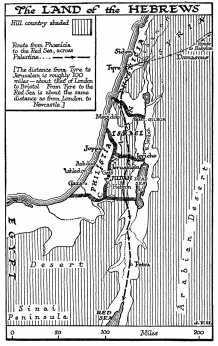
The position of the land of Judea and of Jerusalem, its capital, is a peculiar one. The country is a band-shaped strip between the Mediterranean to the west and the desert beyond the Jordan to the east; through it lies the natural high road between the Hittites, Syria, Assyria, and Babylonia to the north and Egypt to the south. It was a country predestined, therefore, to a stormy history. Across it Egypt, and whatever power was ascendant in the north, fought for empire; against its people they fought for a trade route. It had itself neither the area, the agricultural possibilities, nor the mineral wealth to be important. The story of its people that these scriptures have preserved runs like a commentary to the greater history of the two systems of civilization to the north and south and of the sea peoples to the west.
These scriptures consist of a number of different elements. The first five books, the Pentateuch, were early regarded with peculiar respect. They begin in the form of a universal history with a double account of the Creation of the world and mankind, of the early life of the race, and of a great Flood by which, except for certain favoured individuals, mankind was destroyed. Excavations have revealed Babylonian versions of both the Creation story and the Flood story of prior date to the restoration of the Jews, and it is therefore argued by Biblical critics that these opening chapters were acquired by the Jews during their captivity. They constitute the first ten chapters of Genesis. There follows a history of the fathers and founders of the Hebrew nation, Abraham, Isaac, and Jacob. They are presented as patriarchal Bedouin chiefs, living the life of nomadic shepherds in the country between Babylonia and Egypt. The existing Biblical account is said by the critics to be made up out of several pre-existing versions; but whatever its origins, the story, as we have it to-day, is full of colour and vitality. What is called Palestine to-day was at that time the land of Canaan, inhabited by a Semitic people called the Canaanites, closely related to the Phœnicians who founded Tyre and Sidon, and to the Amorites who took Babylon and, under Hammurabi, founded the first Babylonian Empire. The Canaanites were a settled folk in the days—which were perhaps contemporary with the days of Hammurabi—when Abraham’s flocks and herds passed through the land. The God of Abraham, says the Bible narrative, promised this smiling land of prosperous cities to him and to his children. To the book of Genesis the reader must go to read how Abraham, being childless, doubted this promise, and of the births of Ishmael and Isaac. And in Genesis too, he will find the lives of Isaac and Jacob, whose name was changed to Israel, and of the twelve sons of Israel; and how in the days of a great famine they went down into Egypt. With that, Genesis, the first book of the Pentateuch, ends. The next book, Exodus, is concerned with the story of Moses.
The story of the settlement and slavery of the children of Israel in Egypt is a difficult one. There is an Egyptian record of a settlement of certain Semitic peoples in the land of Goshen by the Pharaoh Rameses II, and it is stated that they were drawn into Egypt by want of food. But of the life and career of Moses there is no Egyptian record at all; there is no account of any plagues of Egypt or of any Pharaoh who was drowned in the Red Sea. There is much about the story of Moses that has a mythical flavour, and one of the most remarkable incidents in it, his concealment by his mother in an ark of bulrushes, has also been found in an ancient Sumerian inscription made at least a thousand years before his time by that Sargon I who founded the ancient Akkadian Sumerian Empire. It runs:
“Sargon, the powerful king, the king of Akkadia am I, my mother was poor, my father I knew not; the brother of my father lived in the mountains.... My mother, who was poor, secretly gave birth to me; she placed me in a basket of reeds, she shut up the mouth of it with bitumen, she abandoned me to the river, which did not overwhelm me. The river bore me away and brought me to Akki the irrigator. Akki the irrigator received me in the goodness of his heart. Akki the irrigator reared me to boyhood. Akki the irrigator made me a gardener. My service as a gardener was pleasing unto Istar and I became king.”

This is perplexing. Still more perplexing is the discovery of a clay tablet written by the Egyptian governors of a city in Canaan to the Pharaoh Amenophis IV, who came in the XVIIIth Dynasty before Rameses II, apparently mentioning the Hebrews by name and declaring that they are overrunning Canaan. Manifestly, if the Hebrews were conquering Canaan in the time of the XVIIIth Dynasty, they could not have been made captive and oppressed, before they conquered Canaan, by Rameses II of the XIXth Dynasty. But it is quite understandable that the Exodus story, written long after the events it narrates, may have concentrated and simplified, and perhaps personified and symbolized, what was really a long and complicated history of tribal invasions. One Hebrew tribe may have drifted down into Egypt and become enslaved, while the others were already attacking the outlying Canaanite cities. It is even possible that the land of the captivity was not Egypt (Hebrew, Misraim), but Misrim in the north of Arabia, on the other side of the Red Sea. These questions are discussed fully and acutely in the Encyclopædia Biblica (articles Moses and Exodus), to which the curious reader must be referred.[159]
Two other books of the Pentateuch, Deuteronomy and Leviticus, are concerned with the Law and the priestly rules. The book of Numbers takes up the wanderings of the Israelites in the desert and their invasion of Canaan.
Whatever the true particulars of the Hebrew invasion of Canaan may be, there can be no doubt that the country they invaded had changed very greatly since the days of the legendary promise, made centuries before, to Abraham. Then it seems to have been largely a Semitic land, with many prosperous trading cities. But great waves of strange peoples had washed along this coast. We have already told how the dark Iberian or Mediterranean peoples of Italy and Greece, the peoples of that Ægean civilization which culminated at Cnossos, were being assailed by the southward movement of Aryan-speaking races, such as the Italians and Greeks, and how Cnossos was sacked about 1400 B.C., and destroyed altogether about 1000 B.C. It is now evident that the people of these Ægean seaports were crossing the sea in search of securer land nests. They invaded the Egyptian delta and the African coast to the west, they formed alliances with the Hittites and other Aryan or Aryanized races. This happened after the time of Rameses II, in the time of Rameses III. Egyptian monuments record great sea fights, and also a march of these people along the coast of Palestine towards Egypt. Their transport was in the ox-carts characteristic of the Aryan tribes, and it is clear that these Cretans were acting in alliance with some early Aryan invaders. No connected narrative of these conflicts that went on between 1300 B.C. and 1000 B.C. has yet been made out, but it is evident from the Bible narrative, that when the Hebrews under Joshua pursued their slow subjugation of the promised land, they came against a new people, the Philistines, unknown to Abraham,[160] who were settling along the coast in a series of cities of which Gaza, Gath, Ashdod, Ascalon, and Joppa became the chief, who were really, like the Hebrews, newcomers, and probably chiefly these Cretans from the sea and from the north. The invasion, therefore, that began as an attack upon the Canaanites, speedily became a long and not very successful struggle for the coveted and promised land with these much more formidable newcomers, the Philistines.
It cannot be said that the promised land was ever completely in the grasp of the Hebrews. Following after the Pentateuch in the Bible come the books of Joshua, Judges, Ruth (a digression), Samuel I and II, and Kings I and II, with Chronicles repeating with variation much of the matter of Samuel II and Kings; there is a growing flavour of reality in most of this latter history, and in these books we find the Philistines steadfastly in possession of the fertile lowlands of the south, and the Canaanites and Phœnicians holding out against the Israelites in the north. The first triumphs of Joshua are not repeated. The book of Judges is a melancholy catalogue of failures. The people lose heart. They desert the worship of their own god Jehovah,[161] and worship Baal and Ashtaroth (= Bel and Ishtar). They mixed their race with the Philistines, with the Hittites, and so forth, and became, as they have always subsequently been, a racially mixed people. Under a series of wise men and heroes they wage a generally unsuccessful and never very united warfare against their enemies. In succession they are conquered by the Moabites, the Canaanites, the Midianites, and the Philistines. The story of these conflicts, of Gideon and of Samson and the other heroes who now and then cast a gleam of hope upon the distresses of Israel, is told in the book of Judges. In the first book of Samuel is told the story of their great disaster at Ebenezer in the days when Eli was judge.
This was a real pitched battle in which the Israelites lost 30,000 (!) men. They had previously suffered a reverse and lost 4000 men, and then they brought out their most sacred symbol, the Ark of the Covenant of God.
“And when the ark of the covenant of the Lord came into the camp, all Israel shouted with a great shout, so that the earth rang again. And when the Philistines heard the noise of the shout, they said, ‘What meaneth the noise of this great shout in the camp of the Hebrews?’ And they understood, that the ark of the Lord was come into the camp. And the Philistines were afraid, for they said, ‘God is come into the camp,’ And they said, ‘Woe unto us! for there hath not been such a thing heretofore. Woe unto us! who shall deliver us out of the hand of these mighty Gods? these are the Gods that smote the Egyptians with all the plagues in the wilderness. Be strong, and quit yourselves like men, O ye Philistines, that ye be not servants unto the Hebrews, as they have been to you: quit yourselves like men, and fight.’
“And the Philistines fought, and Israel was smitten, and they fled every man into his tent: and there was a very great slaughter for there fell of Israel thirty thousand[162] footmen. And the ark of God was taken; and the two sons of Eli, Hophni and Phinehas, were slain.
“And there ran a man of Benjamin out of the army, and came to Shiloh the same day with his clothes rent, and with earth upon his head. And when he came, lo, Eli sat upon a seat by the wayside watching: for his heart trembled for the ark of God. And when the man came into the city and told it, all the city cried out. And when Eli heard the noise of the crying, he said, ‘What meaneth the noise of this tumult?’ And the man came in hastily, and told Eli. Now Eli was ninety and eight years old; and his eyes were dim, that he could not see. And the man said unto Eli, ‘I am he that came out of the army, and I fled to-day out of the army.’ And he said, ‘What is there done, my son?’ And the messenger answered and said, ‘Israel is fled before the Philistines, and there hath been also a great slaughter among the people, and thy two sons also, Hophni and Phinehas, are dead, and the ark of God is taken.’ And it came to pass when he made mention of the ark of God, that Eli fell from off his seat backward by the side of the gate, and his neck brake, and he died: for he was an old man, and heavy. And he had judged Israel forty years.
“And his daughter in law, Phinehas’ wife, was with child, near to be delivered: and when she heard the tidings that the ark of God was taken, and that her father in law and her husband were dead, she bowed herself and travailed; for her pains came upon her. And about the time of her death the women that stood by her said unto her, ‘Fear not; for thou hast born a son! But she answered not, neither did she regard it. And she named the child I-chabod,[163] saying, ‘The glory is departed from Israel:’ because the ark of God was taken, and because of her father in law and her husband.” (1 Sam., chap. iv.)
The successor of Eli and the last of the Judges was Samuel, and at the end of his rule came an event in the history of Israel which paralleled and was suggested by the experience of the greater nations around. A king arose. We are told in vivid language the plain issue between the more ancient rule of priestcraft and the newer fashion in human affairs. It is impossible to avoid a second quotation.
“Then all the elders of Israel gathered themselves together, and came to Samuel unto Ramah, and said unto him: ‘Behold, thou art old, and thy sons walk not in thy ways: now make us a king to judge us like all the nations.’
“But the thing displeased Samuel, when they said, ‘Give us a king to judge us.’ And Samuel prayed unto the Lord. And the Lord said unto Samuel, ‘Hearken unto the voice of the people in all that they say unto thee: for they have not rejected thee, but they have rejected me, that I should not reign over them. According to all the works which they have done since the day that I brought them up out of Egypt even unto this day, wherewith they have forsaken me, and served other gods, so do they also unto thee. Now therefore hearken unto their voice: howbeit yet protest solemnly unto them, and shew them the manner of the king that shall reign over them.’
“And Samuel told all the words of the Lord unto the people that asked of him a king. And he said, ‘This will be the manner of the king that shall reign over you: He will take your sons, and appoint them for himself, for his chariots, and to be his horsemen; and some shall run before his chariots. And he will appoint him captains over thousands, and captains over fifties; and will set them to ear his ground, and to reap his harvest, and to make his instruments of war, and instruments of his chariots. And he will take your daughters to be confectioners, and to be cooks, and to be bakers. And he will take your fields, and your vineyards, and your oliveyards, even the best of them, and give them to his servants. And he will take the tenth of your seed, and of your vineyards, and give to his officers, and to his servants. And he will take your menservants, and your maidservants, and your goodliest young men, and your asses, and put them to his work. He will take the tenth of your sheep: and ye shall be his servants. And ye shall cry out in that day because of your king which ye shall have chosen you; and the Lord will not hear you in that day.’
“Nevertheless the people refused to obey the voice of Samuel; and they said, ‘Nay; but we will have a king over us; that we also may be like all the nations; and that our king may judge us, and go out before us, and fight our battles.’” (I Sam., chap. viii.)
§ 2
But the nature and position of their land was against the Hebrews, and their first king Saul was no more successful than their judges. The long intrigues of the adventurer David against Saul are told in the rest of the first book of Samuel, and the end of Saul was utter defeat upon Mount Gilboa. His army was overwhelmed by the Philistine archers.
“And it came to pass on the morrow, when the Philistines came to strip the slain, that they found Saul and his three sons fallen in Mount Gilboa. And they cut off his head, and stripped off his armour, and sent into the land of the Philistines round about, to publish it in the house of their idols, and among the people. And they put his armour in the house of Ashtaroth; and they fastened his body to the wall of Beth-shan.” (I Sam., chap, xxxi.)
David (990 B.C. roughly) was more politic and successful than his predecessor, and he seems to have placed himself under the protection of Hiram, King of Tyre. This Phœnician alliance sustained him, and was the essential element in the greatness of his son Solomon. His story, with its constant assassinations and executions, reads rather like the history of some savage chief than of a civilized monarch. It is told with great vividness in the second book of Samuel.
The first book of Kings begins with the reign of King Solomon (960 B.C. roughly). The most interesting thing in that story, from the point of view of the general historian, is the relationship of Solomon to the national religion and the priesthood, and his dealings with the tabernacle, the priest Zadok, and the prophet Nathan.
The opening of Solomon’s reign is as bloody as his father’s. The last recorded speech of David arranges for the murder of Shimei; his last recorded word is “blood.” “But his hoar head bring thou down to the grave with blood,” he says, pointing out that though old Shimei is protected by a vow David had made to the Lord so long as David lives, there is nothing to bind Solomon in that matter. Solomon proceeds to murder his brother, who has sought the throne but quailed and made submission. He then deals freely with his brother’s party. The weak hold of religion upon the racially and mentally confused Hebrews at that time is shown by the ease with which he replaces the hostile chief priest by his own adherent Zadok, and still more strikingly by the murder of Joab by Benaiah, Solomon’s chief ruffian, in the Tabernacle, while the victim is claiming sanctuary and holding to the very horns of Jehovah’s altar. Then Solomon sets to work, in what was for that time a thoroughly modern spirit, to recast the religion of his people. He continues the alliance with Hiram, King of Sidon, who uses Solomon’s kingdom as a high road by which to reach and build shipping upon the Red Sea, and a hitherto unheard-of wealth accumulates in Jerusalem as a result of this partnership. Gang labour appears in Israel; Solomon sends relays of men to cut cedarwood in Lebanon under Hiram, and organizes a service of porters through the land. (There is much in all this to remind the reader of the relations of some Central African chief to a European trading concern.) Solomon then builds a palace for himself, and a temple not nearly as big for Jehovah. Hitherto, the Ark of the Covenant, the divine symbol of these ancient Hebrews, had abode in a large tent, which had been shifted from one high place to another, and sacrifices had been offered to the God of Israel upon a number of different high places. Now the ark is brought into the golden splendours of the inner chamber of a temple of cedar-sheathed stone, and put between two great winged figures of gilded olivewood, and sacrifices are henceforth to be made only upon the altar before it.
This centralizing innovation will remind the reader of both Akhnaton and Nabonidus. Such things as this are done successfully only when the prestige and tradition and learning of the priestly order has sunken to a very low level.[164]
“And he appointed, according to the order of David his father, the courses of the priests to their service, and the Levites to their charges, to praise and minister before the priests, as the duty of every day required; the porters also by their courses at every gate; for so had David the man of God commanded. And they departed not from the commandment of the king unto the priests and Levites concerning any matter, or concerning the treasures.”
Neither Solomon’s establishment of the worship of Jehovah in Jerusalem upon this new footing, nor his vision of and conversation with his God at the opening of his reign, stood in the way of his developing a sort of theological flirtatiousness in his declining years. He married widely, if only for reasons of state and splendour, and he entertained his numerous wives by sacrificing to their national deities, to the Sidonian goddess Ashtaroth (Ishtar), to Chemosh (a Moabitish god), to Moloch, and so forth. The Bible account of Solomon does, in fact, show us a king and a confused people, both superstitious and mentally unstable, in no way more religious than any other people of the surrounding world.
A point of considerable interest in the story of Solomon, because it marks a phase in Egyptian affairs, is his marriage to a daughter of Pharaoh: This must have been one of the Pharaohs of the XXIst Dynasty: In the great days of Amenophis III, as the Tel Amarna letters witness, Pharaoh could condescend to receive a Babylonian princess into his harem, but he refused absolutely to grant so divine a creature as an Egyptian princess in marriage to the Babylonian monarch. It points to the steady decline of Egyptian prestige that now, three centuries later, such a petty monarch as Solomon could wed on equal terms with an Egyptian princess. There was, however, a revival with the next Egyptian dynasty (XXII); and the Pharaoh Shishak, the founder, taking advantage of the cleavage between Israel and Judah, which had been developing through the reigns of both David and Solomon, took Jerusalem and looted the all-too-brief splendours both of the new temple and of the king’s house.
Shishak seems also to have subjugated Philistia. From this time onward it is to be noted that the Philistines fade in importance. They had already lost their Cretan language and adopted that of the Semites they had conquered, and although their cities remain more or less independent, they merge gradually into the general Semitic life of Palestine.
There is evidence that the original rude but convincing narrative of Solomon’s rule, of his various murders, of his association with Hiram, of his palace and temple building, and the extravagances that weakened and finally tore his kingdom in twain, has been subjected to extensive interpolations and expansions by a later writer, anxious to exaggerate his prosperity and glorify his wisdom. It is not the place here to deal with the criticism of Bible origins, but it is a matter of ordinary common sense rather than of scholarship to note the manifest reality and veracity of the main substance of the account of David and Solomon, an account explaining sometimes and justifying sometimes, but nevertheless relating facts, even the harshest facts, as only a contemporary or almost contemporary writer, convinced that they cannot be concealed, would relate them, and then to remark the sudden lapse into adulation when the inserted passages occur. It is a striking tribute to the power of the written assertion over realities in men’s minds that this Bible narrative has imposed, not only upon the Christian, but upon the Moslim world, the belief that King Solomon was not only one of the most magnificent, but one of the wisest of men. Yet the first book of Kings tells in detail his utmost splendours, and beside the beauty and wonder of the buildings and organizations of such great monarchs as Thotmes III or Rameses II or half a dozen other Pharaohs, or of Sargon II or Sardanapalus or Nebuchadnezzar the Great, they are trivial. His temple, measured internally, was twenty cubits broad, about 35 feet[165]—that is, the breadth of a small villa residence—and sixty cubits, say, 100 feet, long. And as for his wisdom and statescraft, one need go no further than the Bible to see that Solomon was a mere helper in the wide-reaching schemes of the trader-king Hiram, and his kingdom a pawn between Phœnicia and Egypt. His importance was due largely to the temporary enfeeblement of Egypt, which encouraged the ambition of the Phœnician and made it necessary to propitiate the holder of the key to an alternate trade route to the East. To his own people Solomon was a wasteful and oppressive monarch, and already before his death his kingdom was splitting, visibly to all men.
With the reign of King Solomon the brief glory of the Hebrews ends; the northern and richer section of his kingdom, long oppressed by taxation to sustain his splendours, breaks off from Jerusalem to become the separate kingdom of Israel, and this split ruptures that linking connection between Sidon and the Red Sea by which Solomon’s gleam of wealth was possible. There is no more wealth in Hebrew history. Jerusalem remains the capital of one tribe, the tribe of Judah, the capital of a land of barren hills, cut off by Philistia from the sea and surrounded by enemies.
The tales of wars, of religious conflicts, of usurpations, assassinations, and of fratricidal murders to secure the throne goes on for three centuries. It is a tale frankly barbaric. Israel wars with Judah and the neighbouring states; forms alliances first with one and then with the other. The power of Aramean Syria burns like a baleful star over the affairs of the Hebrews, and then there rises behind it the great and growing power of the last Assyrian Empire. For three centuries the life of the Hebrews was like the life of a man who insists upon living in the middle of a busy thoroughfare, and is consequently being run over constantly by omnibuses and motor-lorries.
“Pul” (apparently the same person as Tiglath Pileser III) is, according to the Bible narrative, the first Assyrian monarch to appear upon the Hebrew horizon, and Menahem buys him off with a thousand talents of silver (738 B.C.). But the power of Assyria is heading straight for the now aged and decadent land of Egypt, and the line of attack lies through Judea; Tiglath Pileser III returns and Shalmaneser follows in his steps, the King of Israel intrigues for help with Egypt, that “broken reed,” and in 721 B.C., as we have already noted, his kingdom is swept off into captivity and utterly lost to history. The same fate hung over Judah, but for a little while it was averted. The fate of Sennacherib’s army in the reign of King Hezekiah (701 B.C.), and how he was murdered by his sons (II Kings xix. 37), we have already mentioned. The subsequent subjugation of Egypt by Assyria finds no mention in Holy Writ, but it is clear that before the reign of Sennacherib, King Hezekiah had carried on a diplomatic correspondence with Babylon (700 B.C.), which was in revolt against Sargon II of Assyria. There followed the conquest of Egypt by Esarhaddon, and then for a time Assyria was occupied with her own troubles; the Scythians and Medes and Persians were pressing her on the north, and Babylon was in insurrection. As we have already noted, Egypt, relieved for a time from Assyrian pressure, entered upon a phase of revival, first under Psammetichus and then under Necho II.
Again the little country in between made mistakes in its alliances. But on neither side was there safety. Josiah opposed Necho, and was slain at the battle of Megiddo (608 B.C.). The king of Judah became an Egyptian tributary. Then when Necho, after pushing as far as the Euphrates, fell before Nebuchadnezzar II, Judah fell with him (604 B.C.). Nebuchadnezzar, after a trial of three puppet kings, carried off the greater part of the people into captivity in Babylon (586 b.c.), and the rest, after a rising and a massacre of Babylonian officials, took refuge from the vengeance of Chaldea in Egypt.
“And all the vessels of the house of God, great and small, and the treasures of the house of the Lord, and the treasures of the king, and of his princes; all these he brought to Babylon. And they burnt the house of God and brake down the wall of Jerusalem, and burnt all the palaces thereof with fire, and destroyed all the goodly vessels thereof. And them that had escaped from the sword carried he away to Babylon; where they were servants to him and his sons until the reign of the kingdom of Persia.” (II Chron. xxxvi. 18, 19, 20.)
So the four centuries of Hebrew kingship comes to an end. From first to last it was a mere incident in the larger and greater history of Egypt, Syria, Assyria, and Phœnicia. But out of it there were now to arise moral and intellectual consequences of primary importance to all mankind.
§ 3
The Jews who returned, after an interval of more than two generations, to Jerusalem from Babylonia in the time of Cyrus were a very different people from the warring Baal worshippers and Jehovah worshippers, the sacrificers in the high places and sacrificers at Jerusalem of the kingdoms of Israel and Judah. The plain fact of the Bible narrative is that the Jews went to Babylon barbarians and came back civilized. They went a confused and divided multitude, with no national self-consciousness; they came back with an intense and exclusive national spirit. They went with no common literature generally known to them, for it was only about forty years before the captivity that king Josiah is said to have discovered “a book of the law” in the temple (II Kings xxii.), and, besides that, there is not a hint in the record of any reading of books; and they returned with most of their material for the Old Testament. It is manifest that, relieved of their bickering and murderous kings, restrained from politics and in the intellectually stimulating atmosphere of that Babylonian world, the Jewish mind made a great step forward during the captivity.
It was an age of historical inquiry and learning in Babylonia. The Babylonian influences that had made Sardanapalus collect a great library of ancient writings in Nineveh were still at work. We have already told how Nabonidus was so preoccupied with antiquarian research as to neglect the defence of his kingdom against Cyrus. Everything, therefore, contributed to set the exiled Jews inquiring into their own history, and they found an inspiring leader in the prophet Ezekiel. From such hidden and forgotten records as they had with them, genealogies, contemporary histories of David, Solomon, and their other kings, legends and traditions, they made out and amplified their own story, and told it to Babylon and themselves. The story of the Creation and the Flood, much of the story of Moses, much of Samson, were probably incorporated from Babylonian sources.[166] When the Jews returned to Jerusalem, only the Pentateuch had been put together into one book, but the grouping of the rest of the historical books was bound to follow.
The rest of their literature remained for some centuries as separate books, to which a very variable amount of respect was paid. Some of the later books are frankly post-captivity compositions. Over all this literature were thrown certain leading ideas. There was an idea, which even these books themselves gainsay in detail, that all the people were pure-blooded children of Abraham; there was next an idea of a promise made by Jehovah to Abraham that he would exalt the Jewish race above all other races; and, thirdly, there was the belief first of all that Jehovah was the greatest and most powerful of tribal gods, and then that he was a god above all other gods, and at last that he was the only true god. The Jews became convinced at last, as a people, that they were the chosen people of the one God of all the earth.
And arising very naturally out of these three ideas, was a fourth, the idea of a coming leader, a saviour, a Messiah who would realize the long-postponed promises of Jehovah.
This welding together of the Jews into one tradition-cemented people in the course of the “seventy years” is the first instance in history of the new power of the written word in human affairs. It was a mental consolidation that did much more than unite the people who returned to Jerusalem. This idea of belonging to a chosen race predestined to pre-eminence was a very attractive one. It possessed also those Jews who remained in Babylonia. Its literature reached the Jews now established in Egypt. It affected the mixed people who had been placed in Samaria, the old capital of the kings of Israel when the ten tribes were deported to Media. It inspired a great number of Babylonians and the like to claim Abraham as their father, and thrust their company upon the returning Jews. Ammonites and Moabites became adherents. The book of Nehemiah is full of the distress occasioned by this invasion of the privileges of the chosen. The Jews were already a people dispersed in many lands and cities, when their minds and hopes were unified and they became an exclusive people. But at first their exclusiveness is merely to preserve soundness of doctrine and worship, warned by such lamentable lapses as those of King Solomon. To genuine proselytes of whatever race, Judaism long held out welcoming arms.
To Phœnicians after the falls of Tyre and Carthage, conversion to Judaism must have been particularly easy and attractive. Their language was closely akin to Hebrew. It is possible that the great majority of African and Spanish Jews are really of Phœnician origin. There were also great Arabian accessions. In South Russia, as we shall note later, there were even Mongolian Jews.
§ 4
The historical books from Genesis to Nehemiah, upon which the idea of the promise to the chosen people had been imposed later, were no doubt the backbone of Jewish mental unity, but they by no means complete the Hebrew literature from which finally the Bible was made up. Of such books as Job, said to be an imitation of Greek tragedy, the Song of Solomon, the Psalms, Proverbs, and others, there is no time to write in this Outline, but it is necessary to deal with the books known as “the Prophets” with some fullness. For those books are almost the earliest and certainly the best evidence of the appearance of a new kind of leading in human affairs.[167]
These prophets are not a new class in the community; they are of the most various origins—Ezekiel was of the priestly caste and of priestly sympathies, and Amos was a shepherd; but they have this in common, that they bring into life a religious force outside the sacrifices and formalities of priesthood and temple. The earlier prophets seem most like the earlier priests, they are oracular, they give advice and foretell events; it is quite possible that at first, in the days when there were many high places in the land and religious ideas were comparatively unsettled, there was no great distinction between priest and prophet. The prophets danced, it would seem, somewhat after the Dervish fashion, and uttered oracles. Generally they wore a distinctive mantle of rough goat-skin. They kept up the nomadic tradition as against the “new ways” of the settlement. But after the building of the temple and the organization of the priesthood, the prophetic type remains over and outside the formal religious scheme. They were probably always more or less of an annoyance to the priests. They became informal advisers upon public affairs, denouncers of sin and strange practices, “self-constituted,” as we should say, having no sanction but an inner light. “Now the word of the Lord came unto”—so and so; that is the formula.
In the latter and most troubled days of the kingdom of Judah, as Egypt, North Arabia, Assyria, and then Babylonia closed like a vice upon the land, these prophets became very significant and powerful. Their appeal was to anxious and fearful minds, and at first their exhortation was chiefly towards repentance, the pulling down of this or that high place, the restoration of worship in Jerusalem, or the like. But through some of the prophecies there runs already a note like the note of what we call nowadays a “social reformer.” The rich are “grinding the faces of the poor”; the luxurious are consuming the children’s bread; influential and wealthy people make friends with and imitate the splendours and vices of foreigners, and sacrifice the common people to these new fashions; and this is hateful to Jehovah, who will certainly punish the land.
But with the broadening of ideas that came with the Captivity, the tenour of prophecy broadens and changes. The jealous pettiness that disfigures the earlier tribal ideas of God give place to a new idea of a god of universal righteousness. It is clear that the increasing influence of prophets was not confined to the Jewish people; it was something that was going on in those days all over the Semitic world. The breaking down of nations and kingdoms to form the great and changing empires of that age, the smashing up of cults and priesthoods, the mutual discrediting of temple by temple in their rivalries and disputes—all these influences were releasing men’s minds to a freer and wider religious outlook. The temples had accumulated great stores of golden vessels and lost their hold upon the imaginations of men. It is difficult to estimate whether, amidst these constant wars, life had become more uncertain and unhappy than it had ever been before, but there can be no doubt that men had become more conscious of its miseries and insecurities. Except for the weak and the women, there remained little comfort or assurance in the sacrifices, ritual and formal devotions of the temples. Such was the world to which the later prophets of Israel began to talk of the One God, and of a Promise that some day the world should come to peace and unity and happiness. This great God that men were now discovering lived in a temple “not made with hands, eternal in the heavens.” There can be little doubt of a great body of such thought and utterance in Babylonia, Egypt, and throughout the Semitic east. The prophetic books of the Bible can be but specimens of the prophesyings of that time....
We have already drawn attention to the gradual escape of writing and knowledge from their original limitation to the priesthood and the temple precincts, from the shell in which they were first developed and cherished. We have taken Herodotus as an interesting specimen of what we have called the free intelligence of mankind. Now here we are dealing with a similar overflow of moral ideas into the general community. The Hebrew prophets, and the steady expansion of their ideas towards one God in all the world, is a parallel development of the free conscience of mankind. From this time onward there runs through human thought, now weakly and obscurely, now gathering power, the idea of one rule in the world, and of a promise and possibility of an active and splendid peace and happiness in human affairs. From being a temple religion of the old type, the Jewish religion becomes, to a large extent, a prophetic and creative religion of a new type. Prophet succeeds prophet. Later on, as we shall tell, there was born a prophet of unprecedented power, Jesus, whose followers founded the great universal religion of Christianity. Still later Muhammad, another prophet, appears in Arabia and founds Islam. In spite of very distinctive features of their own, these two teachers do in a manner arise out of, and in succession to these Jewish prophets. It is not the place of the historian to discuss the truth and falsity of religion, but it is his business to record the appearance of great constructive ideas. Two thousand four hundred years ago, and six or seven or eight thousand years after the walls of the first Sumerian cities arose, the ideas of the moral unity of mankind and of a world peace had come into the world.[168]
XXII THE GREEKS AND THE PERSIANS[169]
§ 1. The Hellenic Peoples. § 2. Distinctive Features of Hellenic Civilization. § 3. Monarchy, Aristocracy, and Democracy in Greece. § 4. The Kingdom of Lydia. § 5. The Rise of the Persians in the East. § 6. The Story of Crœsus. § 7. Darius Invades Russia. § 8. The Battle of Marathon. § 9. Thermopylæ and Salamis. § 10. Platæa and Mycale.
§ 1
AND now our history must go back again to those Aryan-speaking peoples of whose early beginnings we have given an account in Chapters XIV and XV. We must, for the sake of precision, repeat here two warnings we have already given the reader: first, that we use the word Aryan in its widest sense, to express all the early peoples who spoke languages of the “Indo-Germanic” or “Indo-European” group; and, secondly, that when we use the word Aryan we do not imply any racial purity.
The original speakers of the fundamental Aryan language, 2000 or 3000 years B.C., were probably a specialized and distinctive Nordic race of fair white men, accustomed to forests and cattle, who wandered east of the Rhine and through the forests of the Danube valley, the Balkan peninsula, Asia Minor, and eastward to the north and west of the great Central Asian Sea; but very early they had encountered and mixed themselves extensively, and as they spread they continued to mix themselves with other races, with races of uncertain affinities in Asia Minor and with Iberian and Mediterranean peoples of the dark-haired white race. For instance, the Aryans, spreading and pressing westward in successive waves of Keltic-speaking peoples through Gaul and Britain and Ireland, mixed more and more with Iberian races, and were affected more and more by that Iberian blood and their speech by the characteristics of the language their Keltic tongue superseded. Other waves of Keltic peoples washed with diminishing force into Spain and Portugal, where to this day the pre-Keltic strain is altogether dominant although the languages spoken are Aryan. Northward, in Europe, the Aryan peoples were spreading into hitherto uninhabited country, and so remaining racially more purely Nordic blonds. They had already reached Scandinavia many centuries B.C.
From their original range of wandering, other Aryan tribes spread to the north as well as to the south of the Black Sea, and ultimately, as these seas shrank and made way for them, to the north and east of the Caspian, and so began to come into conflict with and mix also with Mongolian peoples of the Ural-Altaic linguistic group, the horse-keeping people of the grassy steppes of Central Asia. From these Mongolian races the Aryans seem to have acquired the use of the horse for riding and warfare. There were three or four prehistoric varieties or sub-species of horse in Europe and Asia, but it was the steppe or semi-desert lands that first gave horses of a build adapted to other than food uses.[170] All these peoples, it must be understood, shifted their ground rapidly, a succession of bad seasons might drive them many hundreds of miles, and it is only in a very rough and provisional manner that their “beats” can now be indicated. Every summer they went north, every winter they swung south again. This annual swing covered sometimes hundreds of miles. On our maps, for the sake of simplicity, we represent the shifting of nomadic peoples by a straight line; but really they moved in annual swings, as the broom of a servant who is sweeping out a passage swishes from side to side as she advances. Spreading round the north of the Black Sea, and probably to the north of the Caspian, from the range of the original Teutonic tribes of Central and North-central Europe to the Iranian peoples who became the Medes and Persians and (Aryan) Hindus, were the grazing lands of a confusion of tribes, about whom it is truer to be vague than precise, such as the Cimmerians, the Sarmatians, and those Scythians who, together with the Medes and Persians, came into effective contact with the Assyrian Empire by 1000 B.C. or earlier.
East and south of the Black Sea, between the Danube and the Medes and Persians, and to the north of the Semitic and Mediterranean peoples of the sea coasts and peninsulas, ranged another series of equally ill-defined Aryan tribes, moving easily from place to place and intermixing freely—to the great confusion of historians. They seem, for instance, to have broken up and assimilated the Hittite civilization, which was probably pre-Aryan in its origin. They were, perhaps, not so far advanced along the nomadic line as the Scythians of the great plains.
The general characteristics of the original Aryan peoples we have already discussed in Chapter XV. They were a forest people, not a steppe people, and, consequently, wasteful of wood; they were a cattle people and not a horse people. The Greeks appear in the dim light before the dawn of history (say 1500 B.C.), as one of the wandering imperfectly nomadic Aryan peoples who were gradually extending the range of their pasturage southward into the Balkan peninsula and coming into conflict and mixing with that preceding Ægean civilization of which Cnossos was the crown.
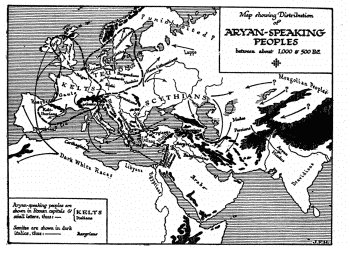
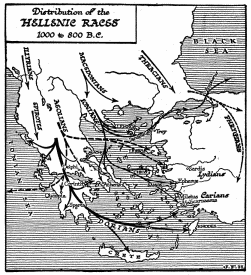
In the Homeric poems these Greek tribes speak one common language, and a common tradition upheld by the epic poems keeps them together in a loose unity; they call their various tribes by a common name, Hellenes. They probably came in successive waves. Three main variations of the ancient Greek speech are distinguished; the Ionic, the Æolic, and the Doric. There was a great variety of dialects in Greece, almost every city having its own output of literature.[171] The Doric apparently constituted the last and most powerful wave of the migration. These Hellenic tribes conquered and largely destroyed the Ægean civilization that had preceded their arrival; upon its ashes they built up a civilization of their own. They took to the sea and crossed by way of the islands to Asia Minor; and, sailing through the Dardanelles and Bosphorus, spread their settlements along the south, and presently along the north borders of the Black Sea. They spread also over the south of Italy, which was called at last Magna Græcia, and round the northern coast of the Mediterranean. They founded the town of Marseilles on the site of an earlier Phœnician colony. They began settlements in Sicily in rivalry with the Carthaginians as early as 735 B.C.
In the rear of the Greeks proper came the kindred Macedonians and Thracians; on their left wing, the Phrygians crossed by the Bosphorus into Asia Minor.
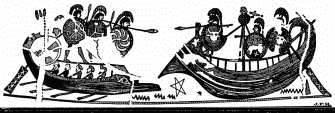
An early Greek sea-fight. From a painted vase, about 550 B.C.
We find all this distribution of the Greeks effected before the beginnings of written history. By the seventh century B.C.—that is to say, by the time of the Babylonian captivity of the Jews—the landmarks of the ancient world of the pre-Hellenic civilization in Europe have been obliterated. Tiryns and Cnossos are unimportant sites; Mycenæ and Troy survive in legend; the great cities of this new Greek world are Athens, Sparta (the capital of Lacedemon), Corinth, Thebes, Samos, Miletus. The world our grandfathers called “Ancient Greece” had arisen on the forgotten ruins of a still more Ancient Greece, in many ways as civilized and artistic, of which to-day we are only beginning to learn through the labours of the excavator. But the newer Ancient Greece, of which we are now telling, still lives vividly in the imaginations and institutions of men because it spoke a beautiful and most expressive Aryan tongue akin to our own, and because it had taken over the Mediterranean alphabet and perfected it by the addition of vowels, so that reading and writing were now easy arts to learn and practise, and great numbers of people could master them and make a record for later ages.[172]
§ 2
Now this Greek civilization that we find growing up in South Italy and Greece and Asia Minor in the seventh century B.C., is a civilization differing in many important respects from the two great civilized systems whose growths we have already traced, that of the Nile and that of the Two Rivers of Mesopotamia. These civilizations grew through long ages where they are found; they grew slowly about a temple life out of a primitive agriculture; priest kings and god kings consolidated such early city states into empires. But the barbaric Greek herdsmen raiders came southward into a world whose civilization was already an old story. Shipping and agriculture, walled cities and writing, were already there. The Greeks did not grow a civilization of their own; they wrecked one and put another together upon and out of the ruins.
To this we must ascribe the fact that there is no temple-state stage, no stage of priest kings, in the Greek record. The Greeks got at once to the city organization that in the east had grown round the temple. They took over the association of temple and city; the idea was ready-made for them. What impressed them most about the city was probably its wall. It is doubtful if they took to city life and citizenship straight away. At first they lived in open villages outside the ruins of the cities they had destroyed, but there stood the model for them, a continual suggestion. They thought first of a city as a safe place in a time of strife, and of the temple uncritically as a proper feature of the city. They came into this inheritance of a previous civilization with the ideas and traditions of the woodlands still strong in their minds. The heroic social system of the Iliad took possession of the land, and adapted itself to the new conditions. As history goes on the Greeks became more religious and superstitious as the faiths of the conquered welled up from below.[173]
We have already said that the social structure of the primitive Aryans was a two-class system of nobles and commoners, the classes not very sharply marked off from each other, and led in warfare by a king who was simply the head of one of the noble families, primus inter pares, a leader among his equals. With the conquest of the aboriginal population and with the building of towns there was added to this simple social arrangement of two classes a lower stratum of farm-workers and skilled and unskilled workers, who were for the most part slaves. But all the Greek communities were not of this “conquest” type. Some were “refugee” cities representing smashed communities, and in these the aboriginal substratum would be missing.
In many of the former cases the survivors of the earlier population formed a subject class, slaves of the state as a whole, as, for instance, the Helots in Sparta. The nobles and commoners became landlords and gentlemen farmers; it was they who directed the shipbuilding and engaged in trade. But some of the poorer free citizens followed mechanic arts, and, as we have already noted, would even pull an oar in a galley for pay. Such priests as there were in this Greek world were either the guardians of shrines and temples or sacrificial functionaries; Aristotle, in his Politics, makes them a mere subdivision of his official class. The citizen served as warrior in youth, ruler in his maturity, priest in his old age. The priestly class, in comparison with the equivalent class in Egypt and Babylonia, was small and insignificant. The gods of the Greeks proper, the gods of the heroic Greeks, were, as we have already noted, glorified human beings, and they were treated without very much fear or awe; but beneath these gods of the conquering freemen lurked other gods of the subjugated peoples, who found their furtive followers among slaves and women. The original Aryan gods were not expected to work miracles or control men’s lives. But Greece, like most of the Eastern world in the thousand years B.C., was much addicted to consulting oracles or soothsayers. Delphi was particularly famous for its oracle. “When the Oldest Men in the tribe could not tell you the right thing to do,” says Gilbert Murray, “you went to the blessed dead. All oracles were at the tombs of Heroes. They told you what was ‘Themis,’ what was the right thing to do, or, as religious people would put it now, what was the Will of the God.”
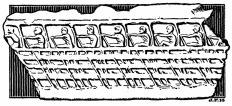
Rowers in an Athenian warship, about 400 B.C. (Fragment of relief found on the Acropolis)
The priests and priestesses of these temples were not united into one class, nor did they exercise any power as a class. It was the nobles and free commoners, two classes which, in some cases, merged into one common body of citizens, who constituted the Greek state. In many cases, especially in great city states, the population of slaves and unenfranchised strangers greatly outnumbered the citizens. But for them the state did not exist; it existed for the select body of citizens alone. It might or might not tolerate the outsider and the slave, but they had no legal voice in their treatment—any more than if it had been a despotism.[174]
This is a social structure differing widely from that of the Eastern monarchies. The exclusive importance of the Greek citizen reminds one a little of the exclusive importance of the children of Israel in the later Jewish state, but there is no equivalent on the Greek side to the prophets and priests, nor to the idea of an over-ruling Jehovah.
Another contrast between the Greek states and any of the human communities to which we have hitherto given attention is their continuous and incurable division. The civilizations of Egypt, Sumeria, China, and no doubt North India, all began in a number of independent city states, each one a city with a few miles of dependent agricultural villages and cultivation around it, but out of this phase they passed by a process of coalescence into kingdoms and empires. But to the very end of their independent history the Greeks did not coalesce. Commonly, this is ascribed to the geographical conditions under which they lived. Greece is a country cut up into a multitude of valleys by mountain masses and arms of the sea that render intercommunication difficult; so difficult that few cities were able to hold many of the others in subjection for any length of time. Moreover, many Greek cities were on islands and scattered along remote coasts. To the end the largest city states of Greece remained smaller than many English counties; and some had an area of only a few square miles. Athens, the largest of the Greek cities, at the climax of its power had a population of perhaps a third of a million. Hardly any other Greek cities ever exceeded 50,000. Of this, half or more were slaves and strangers, and two-thirds of the free body women and children.
§ 3
The government of these city states varied very widely in its nature. As they settled down after their conquests the Greeks retained for a time the rule of their kings, but these kingdoms drifted back more and more to the rule of the aristocratic class. In Sparta (Lacedemon) kings were still distinguished in the sixth century B.C. The Lacedemonians had a curious system of a double kingship; two kings, drawn from different royal families, ruled together. But most of the Greek city states had become aristocratic republics long before the sixth century. There is, however, a tendency towards slackness and inefficiency in most families that rule by hereditary right; sooner or later they decline; and as the Greeks got out upon the seas and set up colonies and commerce extended, new rich families arose to jostle the old and bring new personalities into power. These nouveaux riches became members of an expanded ruling class, a mode of government known as oligarchy—in opposition to aristocracy—though, strictly, the term oligarchy (= government by the few) should of course include hereditary aristocracy as a special case.
In many cities persons of exceptional energy, taking advantage of some social conflict or class grievance, secured a more or less irregular power in the state. This combination of personality and opportunity has occurred in the United States of America, for example, where men exercising various kinds of informal power are called bosses. In Greece they were called tyrants. But the tyrant was rather more than a boss; he was recognized as a monarch, and claimed the authority of a monarch. The modern boss, on the other hand, shelters behind legal forms which he has “got hold of” and uses for his own ends. Tyrants were distinguished from kings, who claimed some sort of right, some family priority, for example, to rule. They were supported, perhaps, by the poorer class with a grievance; Peisistratus, for example, who was tyrant of Athens, with two intervals of exile, between 560 and 527 b.c., was supported by the poverty-struck Athenian hillmen. Sometimes, as in Greek Sicily, the tyrant stood for the rich against the poor. When, later on, the Persians began to subjugate the Greek cities of Asia Minor, they set up pro-Persian tyrants.
Aristotle, the great philosophical teacher, who was born under the hereditary Macedonian monarchy, and who was for some years tutor to the king’s son, distinguishes in his Politics between kings who ruled by an admitted and inherent right, such as the King of Macedonia, whom he served, and tyrants who ruled without the consent of the governed. As a matter of fact, it is hard to conceive of a tyrant ruling without the consent of many, and the active participation of a substantial number of his subjects; and the devotion and unselfishness of your “true kings” has been known to rouse resentment and questioning. Aristotle was also able to say that while the king ruled for the good of the state, the tyrant ruled for his own good. Upon this point, as in his ability to regard slavery as a natural thing and to consider women unfit for freedom and political rights, Aristotle was in harmony with the trend of events about him.
A third form of government that prevailed increasingly in Greece in the sixth, fifth, and fourth centuries B.C., was known as democracy. As the modern world nowadays is constantly talking of democracy, and as the modern idea of democracy is something widely different from the democracy of the Greek city states, it will be well to be very explicit upon the meaning of democracy in Greece. Democracy then was government by the commonalty, the Demos; it was government by the whole body of the citizens, by the many as distinguished from the few. But let the modern reader mark that word “citizen.” The slave was excluded, the freedman was excluded, the stranger; even the Greek born in the city, whose father had come eight or ten miles from the city beyond the headland, was excluded. The earlier democracies (but not all) demanded a property qualification from the citizen, and property in those days was land; this was subsequently relaxed, but the modern reader will grasp that here was something very different from modern democracy. At the end of the fifth century b.c. this property qualification had been abolished in Athens, for example; but Pericles, a great Athenian statesman of whom we shall have more to tell later, had established a law (451 B.C.) restricting citizenship to those who could establish Athenian descent on both sides. Thus, in the Greek democracies quite as much as in the oligarchies, the citizens formed a close corporation, ruling sometimes, as in the case of Athens in its great days, a big population of serfs, slaves, and “outlanders.” A modern politician used to the idea, the entirely new and different idea, that democracy in its perfected form means that every adult man and woman shall have a voice in the government, would, if suddenly spirited back to the extremist Greek democracy, regard it as a kind of oligarchy. The only real difference between a Greek “oligarchy” and a Greek democracy was that in the former, the poorer and less important citizens had no voice in the government, and in the latter every citizen had. Aristotle, in his Politics, betrays very clearly the practical outcome of this difference. Taxation sat lightly on the rich in the oligarchies; the democracies, on the other hand, taxed the rich, and generally paid the impecunious citizen a maintenance allowance and special fees. In Athens fees were paid to citizens even for attending the general assembly. But the generality of people outside the happy order of citizens worked and did what they were told, and if one desired the protection of the law, one sought a citizen to plead for one. For only the citizen had any standing in the law courts. Greek democracy was, in fact, a sort of government by a swarm of hereditary barristers. Our modern idea, that any one in the state is a citizen, would have shocked the privileged democrats of Athens profoundly.[175]
One obvious result of this monopolization of the state by the class of citizens was that the patriotism of these privileged people took an intense and narrow form. They would form alliances, but never coalesce with other city states. That would have obliterated every advantage by which they lived. There would have been no more fees, no more privileges. The narrow geographical limits of these Greek states added to the intensity of their feeling. A man’s love for his country was reinforced by his love for his native town, his religion, and his home; for these were all one. Of course the slaves did not share in these feelings, and in the oligarchic states very often the excluded class got over its dislike of foreigners in its greater dislike of the class at home which oppressed it. But in the main, patriotism in the Greek was a personal passion of an inspiring and dangerous intensity. Like rejected love, it was apt to turn into something very like hatred. The Greek exile resembled the French or Russian émigré in being ready to treat his beloved country pretty roughly in order to save her from the devils in human form who had taken possession of her and turned him out.
In the fifth century B.C. Athens formed a system of relationships with a number of other Greek city states which is often spoken of by historians as the Athenian Empire. But all the other city states retained their own governments. One “new fact” added by the Athenian Empire was the complete and effective suppression of piracy; another was the institution of a sort of international law. The law, indeed, was Athenian law; but actions could now be brought and justice administered between citizens of the different states of the League, which of course had not been possible before. The Athenian Empire had really developed out of a league of mutual defence against Persia; its seat had originally been in the island of Delos, and the allies had contributed to a common treasure at Delos; the treasure of Delos was carried off to Athens because it was exposed to a possible Persian raid. Then one city after another offered a monetary contribution instead of military service, with the result that in the end Athens was doing almost all the work and receiving almost all the money. She was supported by one or two of the larger islands. The “League” in this way became gradually an “Empire,” but the citizens of the allied states remained, except where there were special treaties of intermarriage and the like, practically foreigners to one another. And it was chiefly the poorer citizens of Athens who sustained this empire by their most vigorous and incessant personal service. Every citizen was liable to military service at home or abroad between the ages of eighteen and sixty, sometimes on purely Athenian affairs and sometimes in defence of the cities of the Empire whose citizens had bought themselves off. There was probably no single man over twenty-five in the Athenian Assembly who had not served in several campaigns in different parts of the Mediterranean or Black Sea, and who did not expect to serve again. Modern imperialism is denounced by its opponents as the exploitation of the world by the rich; Athenian imperialism was the exploitation of the world by the poorer citizens of Athens.
Another difference from modern conditions, due to the small size of the Greek city states, was that in a democracy every citizen had the right to attend and speak and vote in the popular assembly. For most cities this meant a gathering of only a few hundred people; the greatest had no more than some thousands of citizens. Nothing of this sort is possible in a modern “democracy” with, perhaps, several million voters. The modern “citizen’s” voice in public affairs is limited to the right to vote for one or other of the party candidates put before him. He, or she, is then supposed to have “assented” to the resultant government. Aristotle, who would have enjoyed the electoral methods of our modern democracies keenly, points out very subtly how the outlying farmer class of citizens in a democracy can be virtually disenfranchised by calling the popular assembly too frequently for their regular attendance. In the later Greek democracies (fifth century) the appointment of public officials, except in the case of officers requiring very special knowledge, was by casting lots. This was supposed to protect the general corporation of privileged citizens from the continued predominance of rich, influential, and conspicuously able men.
Some democracies (Athens and Miletus, e.g.) had an institution called the ostracism,[176] by which in times of crisis and conflict the decision was made whether some citizen should go into exile for ten years. This may strike a modern reader as an envious institution, but that was not its essential quality. It was, says Gilbert Murray, a way of arriving at a decision in a case when political feeling was so divided as to threaten a deadlock. There were in the Greek democracies parties and party leaders, but no regular government in office and no regular opposition. There was no way, therefore, of carrying out a policy, although it might be the popular policy, if a strong leader or a strong group stood out against it. But by the ostracism, the least popular or the least trusted of the chief leaders in the divided community was made to retire for a period without loss of honour or property. Professor Murray suggests that a Greek democracy, if it had found itself in such a position of deadlock as the British Empire did upon the question of Home Rule for Ireland in 1914, would have probably first ostracized Sir Edward Carson, and then proceeded to carry out the provisions of the Home Rule Bill.
This institution of the ostracism has immortalized one obscure and rather illiterate member of the democracy of Athens. A certain Aristides had gained a great reputation in the law court for his righteous dealing. He fell into a dispute with Themistocles upon a question of naval policy; Aristides was for the army, Themistocles was a “strong navy” man, and a deadlock was threatened. There was resort to an ostracism to decide between them. Plutarch relates that as Aristides walked through the streets while the voting was in progress, he was accosted by a strange citizen from the agricultural environs unaccustomed to the art of writing, and requested to write his own name on the proffered potsherd.
“But why?” he asked. “Has Aristides ever injured you?”
“No,” said the citizen. “No. Never have I set eyes on him. But, oh! I am so bored by hearing him called Aristides the Just.”
Whereupon, says Plutarch, without further parley Aristides wrote as the man desired....
When one understands the true meaning of these Greek constitutions, and in particular the limitation of all power, whether in the democracies or the oligarchies, to a locally privileged class, one realizes how impossible was any effective union of the hundreds of Greek cities scattered about the Mediterranean region, or even of any effective co-operation between them for a common end. Each city was in the hands of a few or a few hundred men, to whom its separateness meant everything that was worth having in life. Only conquest from the outside could unite the Greeks, and until Greece was conquered they had no political unity. When at last they were conquered, they were conquered so completely that their unity ceased to be of any importance even to themselves; it was a unity of subjugation.
Yet there was always a certain tradition of unity between all the Greeks, based on a common language and script, on the common possession of the heroic epics, and on the continuous intercourse that the maritime position of the states made possible. And, in addition, there were certain religious bonds of a unifying kind. Certain shrines, the shrines of the god Apollo in the island of Delos and at Delphi, for example, were sustained not by single states, but by leagues of states or Amphictyonies (= League of neighbours), which in such instances as the Delphic amphictyony became very wide-reaching unions. The league protected the shrine and the safety of pilgrims, kept up the roads leading thereunto, secured peace at the time of special festivals, upheld certain rules to mitigate the usages of war among its members, and—the Delian league especially—suppressed piracy. A still more important link of Hellenic union was the Olympian games that were held every four years at Olympia. Foot races, boxing, wrestling, javelin throwing, quoit throwing, jumping, and chariot and horse racing were the chief sports, and a record of victors and distinguished visitors was kept. From the year 776 B.C. onward[177] these games were held regularly for over a thousand years, and they did much to maintain that sense of a common Greek life (pan-Hellenic) transcending the narrow politics of the city states.
Such links of sentiment and association were of little avail against the intense “separatism” of the Greek political institutions. From the History of Herodotus the student will be able to gather a sense of the intensity and persistence of the feuds that kept the Greek world in a state of chronic warfare. In the old days (say, to the sixth century B.C.) fairly large families prevailed in Greece, and something of the old Aryan great household system (see Chap. XV), with its strong clan feeling and its capacity for maintaining an enduring feud, still remained. The history of Athens circles for many years about the feud of two great families, the Alcmæonidæ and the Peisistratidæ; the latter equally an aristocratic family, but founding its power on the support of the poorer class of the populace and the exploitation of their grievances. Later on, in the sixth and fifth centuries, a limitation of births and a shrinkage of families to two or three members—a process Aristotle notes without perceiving its cause—led to the disappearance of the old aristocratic clans, and the later wars were due rather to trade disputes and grievances caused and stirred up by individual adventurers than to family vendettas.
It is easy to understand, in view of this intense separatism of the Greeks, how readily the Ionians of Asia and of the islands fell first under the domination of the kingdom of Lydia, and then under that of the Persians when Cyrus overthrew Crœsus, the king of Lydia. They rebelled only to be reconquered. Then came the turn of European Greece. It is a matter of astonishment, the Greeks themselves were astonished, to find that Greece itself did not fall under the dominion of the Persians, these barbaric Aryan masters of the ancient civilizations of Western Asia. But before we tell of this struggle we must give some attention to these Asiatics against whom they were pitted; and particularly to these Medes and Persians who, by 538 B.C., were already in possession of the ancient civilizations of Assyria, Babylonia, and about to subjugate Egypt.
§ 4
We have had occasion to mention the kingdom of Lydia, and it may be well to give a short note here upon the Lydians before proceeding with our story. The original population of the larger part of Asia Minor may perhaps have been akin to the original population of Greece and Crete. If so, it was of “Mediterranean” race. Or it may have been another branch of those still more generalized and fundamental darkish peoples from whom arose the Mediterranean race to the west and the Dravidians to the east. Remains of the same sort of art that distinguishes Cnossos and Mycenæ are to be found scattered over Asia Minor. But just as the Nordic Greeks poured southward into Greece to conquer and mix with the aborigines, so did other and kindred Nordic tribes pour over the Bosphorus into Asia Minor. Over some areas these Aryan peoples prevailed altogether, and became the bulk of the inhabitants and retained their Aryan speech. Such were the Phrygians, a people whose language was almost as close to that of the Greeks as the Macedonian. But over other areas the Aryans did not so prevail. In Lydia the original race and their language held their own. The Lydians were a non-Aryan people speaking a non-Aryan speech, of which at the present time only a few words are known. Their capital city was Sardis.
Their religion was also non-Aryan. They worshipped a Great Mother goddess. The Phrygians also, though retaining their Greek-like language, became infected with mysterious religion, and much of the mystical religion and secret ceremonial that pervaded Athens at a later date was Phrygian (when not Thracian) in origin.
At first the Lydians held the western seacoast of Asia Minor, but they were driven back from it by the establishment of Ionian Greeks coming by the sea and founding cities. Later on, however, these Ionian Greek cities were brought into subjection by the Lydian kings.
The history of this country is not clearly known, and were it known it would scarcely be of sufficient importance to be related in this historical outline, but in the eighth century B.C. one monarch, named Gyges, becomes noteworthy. The country under his rule was subjected to another Aryan invasion; certain nomadic tribes called the Cimmerians came pouring across Asia Minor, and they were driven back with difficulty by Gyges and his son and grandson. Sardis was twice taken and burnt by these barbarians. And it is on record that Gyges paid tribute to Sardanapalus, which serves to link him up with our general ideas of the history of Assyria, Israel, and Egypt. Later, Gyges rebelled against Assyria, and sent troops to help Psammetichus I to liberate Egypt from its brief servitude to the Assyrians.
It was Alyattes, the grandson of Gyges, who made Lydia into a considerable power. He reigned for seven years, and he reduced most of the Ionian cities of Asia Minor to subjection. The country became the centre of a great trade between Asia and Europe; it had always been productive and rich in gold, and now the Lydian monarch was reputed the richest in Asia. There was a great coming and going between the Black and Mediterranean Seas, and between the East and West. We have already noted that Lydia was reputed to be the first country in the world to produce coined money, and to provide the convenience of inns for travellers and traders. The Lydian dynasty seems to have been a trading dynasty of the type of Minos in Crete, with a banking and financial development.... So much we may note of Lydia by way of preface to the next section.
§ 5
Now while one series of Aryan-speaking invaders had developed along the lines we have described in Greece, Magna Græcia, and around the shores of the Black Sea, another series of Aryan-speaking peoples, whose originally Nordic blood was perhaps already mixed with a Mongolian element, were settling and spreading to the north and east of the Assyrian and Babylonian empires. We have already spoken of the arc-like dispersion of the Nordic Aryan peoples to the north of the Black and Caspian Seas; it was probably by this route that the Aryan-speaking races gradually came down into what is now the Persian country, and spread, on the one hand, eastward to India (? 2000 to 1000 B.C.), and on the other, increased and multiplied in the Persian uplands until they were strong enough to assail first Assyria (650 B.C.) and then Babylon (538 B.C.).
There is much that is not yet clear about the changes of climate that have been going on in Europe and Asia during the last 10,000 years. The ice of the last glacial age receded gradually, and gave way to a long period of steppe or prairie-like conditions over the great plain of Europe. About 12,000 or 10,000 years ago, as it is reckoned now, this state of affairs was giving place to forest conditions. We have already noted how, as a consequence of these changes, the Solutrian horse hunters gave place to Magdalenian fishers and forest deer hunters; and these, again, to the Neolithic herdsmen and agriculturists. For some thousands of years the European climate seems to have been warmer than it is to-day. A great sea spread from the coast of the Balkan peninsula far into Central Asia and extended northward into Central Russia, and the shrinkage of that sea and the consequent hardening of the climate of south Russia and Central Asia was going on contemporaneously with the development of the first civilizations in the river valleys. Many facts seem to point to a more genial climate in Europe and western Asia, and still more strongly to a greater luxuriance of plant and vegetable life, 4000 to 3000 years ago, than we find to-day. There were forests then in south Russia and in the country which is now Western Turkestan, where now steppes and deserts prevail. On the other hand, between 1500 and 2000 years ago, the Aral-Caspian region was probably drier and those seas smaller than they are at the present time.
We may note in this connection that Thotmes III (say, the fifteenth century B.C.), in his expedition beyond the Euphrates, hunted a herd of 120 elephants in that region. Again, an Ægean dagger from Mycenæ, dating about 2000 B.C., shows a lion-hunt in progress. The hunters carry big shields and spears, and stand in rows one behind the other. The first man spears the lion, and when the wounded beast leaps at him, drops flat under the protection of his big shield, leaving the next man to repeat his stroke, and so on, until the lion is speared to death. This method of hunting is practised by the Masai to-day, and could only have been worked out by a people in a land where lions were abundant. But abundant lions imply abundant game, and that again means abundant vegetation. About 2000 B.C. the hardening of the climate in the central parts of the Old World, to which we have already referred, which put an end to elephants and lions in Asia Minor and Greece,[178] was turning the faces of the nomadic Aryan peoples southward towards the fields and forests of the more settled and civilized nations.
These Aryan peoples come down from the East Caspian regions into history about the time that Mycenæ and Troy and Cnossos are falling to the Greeks. It is difficult to disentangle the different tribes and races that appear under a multitude of names in the records and inscriptions that record their first appearance, but, fortunately, these distinctions are not needed in an elementary outline such as this present history. A people called the Cimmerians appear in the districts of Lake Urumiya and Van, and shortly after Aryans have spread from Armenia to Elam. In the ninth century B.C. a people called the Medes, very closely related to the Persians to the east of them, appear in the Assyrian inscriptions. Tiglath Pileser III and Sargon II, names already familiar in this story, profess to have made them pay tribute. They are spoken of in the inscriptions as the “dangerous Medes.” They are as yet a tribal people, not united under one king.
About the ninth century b.c. Elam and the Elamites, whose capital was Susa, a people which possessed a tradition and civilization at least as old as the Sumerian, suddenly vanish from history. We do not know what happened. They seem to have been overrun and the population absorbed by the conquerors. Susa is in the hands of the Persians.
Scythians ... as portrayed by a Greek artist.... One of the Few Existing Representations of the Ancient Scythians. From a Greek Electrum Vase.
A fourth people, related to these Aryan tribes, who appear at this time in the narrative of Herodotus, are the “Scythians.” For a while the monarchs of Assyria play off these various kindred peoples, the Cimmerians, the Medes, the Persians, and the Scythians, against each other. Assyrian princesses (a daughter of Esarhaddon, e.g.) are married to Scythian chiefs. Nebuchadnezzar the Great, on the other hand, marries a daughter of Cyaxares, who has become king of all the Medes. The Aryan Scythians are for the Semitic Assyrians; the Aryan Medes for the Semitic Babylonians. It was this Cyaxares who took Nineveh, the Assyrian capital, in 606 B.C., and so released Babylon from the Assyrian yoke to establish, under Chaldean rule, the Second Babylonian Empire. The Scythian allies of Assyria drop out of the story after this. They go on living their own life away to the north without much interference with the peoples to the south. A glance at the map of this period shows how, for two-thirds of a century, the Second Babylonian Empire lay like a lamb within the embrace of the Median lion.
Into the internal struggles of the Medes and Persians, that ended at last in the accession of Cyrus “the Persian” to the throne of Cyaxares in 550 B.C., we will not enter. In that year Cyrus was ruling over an empire that reached from the boundaries of Lydia to Persia and perhaps to India. Nabonidus, the last of the Babylonian rulers, was, as we have already told, digging up old records and building temples in Babylonia.
§ 6
But one monarch in the world was alive to the threat of the new power that lay in the hands of Cyrus. This was Crœsus, the Lydian king. His son had been killed in a very tragic manner, which Herodotus relates, but which we will not describe here. Says Herodotus:
“For two years then, Crœsus remained quiet in great mourning, because he was deprived of his son; but after this period of time, the overt hrowing of the rule of the son of Cyaxares by Cyrus, and the growing greatness of the Persians, caused Crœsus to cease from his mourning, and led him to a care of cutting short the power of the Persians if by any means he might, while yet it was in growth and before they should have become great.”
He then made trial of the various oracles. His method of trial we will not relate here, but it led him to the belief that the Delphi Oracle was alone trustworthy. What follows is rather a lengthy passage, but it is so characteristic of the garrulousness and wonder-loving mind of the Father of History, and with such a pleasant touch of spite against the Lacedemonians, that it is impossible to resist the quotation.
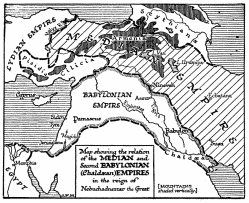
“After this, with great sacrifices, he endeavoured to win the favour of the god at Delphi: for of all the animals that are fit for sacrifice he offered three thousand of each kind, and he heaped up couches overlaid with gold and overlaid with silver, and cups of gold, and robes of purple, and tunics, making of them a great pyre, and this he burnt up, hoping by these means the more to win over the god to the side of the Lydians; and he proclaimed to all the Lydians that every one of them should make sacrifice with that which each man had. And when he had finished the sacrifice, he melted down a vast quantity of gold, and of it he wrought half-plinths, making them six palms in length and three in breadth, and in height one palm; and their number was one hundred and seventeen. Of these four were of pure gold weighing two talents and a half each, and the others of gold alloyed with silver weighing two talents. And he caused to be made also an image of a lion of pure gold weighing ten talents; which lion, when the temple at Delphi was being burnt down, fell from off the half-plinths, for upon these it was set, and is placed now in the treasury of the Corinthians, weighing six talents and a half, for three talents and a half were melted away from it. So Crœsus, having finished all these things, sent them to Delphi, and with them these besides: two mixing-bowls of great size, one of gold and the other of silver, of which the golden bowl was placed on the right hand as one enters the temple, and the silver on the left, but the places of these also were changed after the temple was burnt down.... Moreover, Crœsus sent four silver wine-jars, which stand in the treasury of the Corinthians, and two vessels for lustral water, one of gold and the other of silver, of which the gold one is inscribed ‘from the Lacedemonians,’ who say that it is their offering; therein, however, they do not speak rightly, for this also is from Crœsus, but one of the Delphians wrote the inscription upon it, desiring to gratify the Lacedemonians; and his name I know, but I will not make mention of it.... And many other votive offerings Crœsus sent with these, not specially distinguished, among which are certain castings of silver of a round shape, and also a golden figure of a woman three cubits high, which the Delphians say is a statue of the baker of Crœsus. Moreover, Crœsus dedicated the ornaments from his wife’s neck and her girdles....
“To the Lydians who were to carry these gifts to the temples Crœsus gave charge that they should ask the Oracles this question also: whether Crœsus should march against the Persians, and, if so, whether he should join with himself any army of men as his friends. And when the Lydians had arrived at the places to which they had been sent and had dedicated the votive offerings, they inquired of the Oracles, and said: ‘Crœsus, king of the Lydians and of other nations, considering that these are the only true Oracles among men, presents to you gifts such as your revelations deserve, and asks you again now whether he shall march against the Persians, and, if so, whether he shall join with himself any army of men as allies.’ They inquired thus, and the answers of both the Oracles agreed in one, declaring to Crœsus that if he should march against the Persians he should destroy a great empire.... So when the answers were brought back and Crœsus heard them, he was delighted with the Oracles, and expecting that he would certainly destroy the kingdom of Cyrus, he sent again to Pytho, and presented to the men of Delphi, having ascertained the number of them, two staters of gold for each man: and in return for this the Delphians gave to Crœsus and to the Lydians precedence in consulting the Oracle and freedom from all payments, and the right to front seats at the games, with this privilege also for all time, that any one of them who wished should be allowed to become a citizen of Delphi.”
But here we may not run on as Herodotus loved to do. Suffice it to say that Crœsus made a defensive alliance both with the Lacedemonians and the Egyptians. We will not quote the story of how a great bronze mixing-bowl that the Lacedemonians sent to Crœsus went astray, but we will note a light on the life of the Medes and Persians of that time.
“Thus, then, it happened about the mixing-bowl; but meanwhile Crœsus, mistaking the meaning of the Oracle, was making a march into Cappadocia, expecting to overthrow Cyrus and the power of the Persians; and while Crœsus was preparing to march against the Persians, one of the Lydians, who even before this time was thought to be a wise man, but in consequence of this opinion got a very great name for wisdom among the Lydians, had advised Crœsus as follows: ‘O king, thou art preparing to march against men who wear breeches of leather, and the rest of their clothing is of leather also; and they eat food not such as they desire, but such as they can obtain, dwelling in a land which is rugged; and, moreover, they make no use of wine but drink water; and no figs have they for dessert, nor any other good thing. On the one hand, if thou shalt overcome them, what wilt thou take away from them, seeing they have nothing? and, on the other hand, if thou shalt be overcome, consider how many good things thou wilt lose; for once having tasted our good things, they will cling to them fast, and it will not be possible to drive them away. I, for my own part, feel gratitude to the gods that they do not put it into the minds of the Persians to march against the Lydians.’ Thus he spoke not persuading Crœsus; for it is true indeed that the Persians before they subdued the Lydians had no luxury nor any good thing.”
Crœand Cyrus fought an indecisive battle at Pteria, from which Crœretreated. Cyrus followed him up, and he gave battle outside his capital town of Sardis. The chief strength of the Lydians lay in their cavalry; they were excellent, if undisciplined, horsemen, and fought with long spears.
“Cyrus, when he saw the Lydians being arrayed for battle, fearing their horsemen, did on the suggestion of Harpagos, a Mede, as follows: All the camels which were in the train of his army carrying provisions and baggage he gathered together, and he took off their burdens and set men upon them provided with the equipment of cavalry; and, having thus furnished them, forth he appointed them to go in front of the rest of the army towards the horsemen of Crœsus; and after the camel-troop he ordered the infantry to follow; and behind the infantry he placed his whole force of cavalry. Then, when all his men had been placed in their several positions, he charged them to spare none of the other Lydians, slaying all who might come in their way, but Crœsus himself they were not to slay, not even if he should make resistance when he was being captured. Such was his charge: and he set the camels opposite the horsemen for this reason—because the horse has a fear of the camel and cannot endure either to see his form or to scent his smell; for this reason then the trick had been devised, in order that the cavalry of Crœsus might be useless, that very force wherewith the Lydian king was expecting most to shine. And as they were coming together to the battle, so soon as the horses scented the camels and saw them, they turned away back, and the hopes of Crœsus were at once brought to nought. The Lydians, however, for their part did not upon that act as cowards, but when they perceived what was coming to pass, they leapt from their horses and fought with the Persians on foot. At length, however, when many had fallen on either side, the Lydians turned to flight; and having been driven within the wall of their fortress, they were besieged by the Persians.”
In fourteen days Sardis was stormed and Crœsus taken prisoner....
“So the Persians having taken him brought him into the presence of Cyrus; and he piled up a great pyre and caused Crœsus to go up upon it bound in fetters, and along with him twice seven sons of Lydians, whether it was that he meant to dedicate this offering as first-fruits of his victory to some god, or whether he desired to fulfil a vow, or else had heard that Crœsus was a god-fearing man, and so caused him to go up on the pyre because he wished to know if any one of the divine powers would save him, so that he should not be burnt alive. He, they say, did this; but to Crœsus as he stood upon the pyre there came, although he was in such evil case, a memory of the saying of Solon, how he had said with divine inspiration that no one of the living might be called happy. And when this thought came into his mind, they say that he sighed deeply and groaned aloud, having been for long silent, and three times he uttered the name of Solon. Hearing this, Cyrus bade the interpreters ask Crœsus who was this person on whom he called; and they came near and asked. And Crœsus for a time, it is said, kept silence when he was asked this, but afterwards, being pressed, he said: ‘One whom more than much wealth I should have desired to have speech with all monarchs.’ Then, since his words were of doubtful import, they asked again of that which he said; and as they were urgent with him and gave him no peace, he told how once Solon, an Athenian, had come and having inspected all his wealth had made light of it, with such and such words; and how all had turned out for him according as Solon had said, not speaking at all especially with a view to Crœsus himself, but with a view to the whole human race, and especially those who seem to themselves to be happy men. And while Crœsus related these things, already the pyre was lighted and the edges of it round about were burning. Then they say that Cyrus, hearing from the interpreters what Crœsus had said, changed his purpose and considered that he himself also was but a man, and that he was delivering another man, who had been not inferior to himself in felicity, alive to the fire; and, moreover, he feared the requital, and reflected that there was nothing of that which men possessed which was secure; therefore, they say, he ordered them to extinguish as quickly as possible the fire that was burning, and to bring down Crœsus and those who were with him from the pyre; and they, using endeavours, were not able now to get the mastery of the flames. Then it is related by the Lydians that Crœsus, having learned how Cyrus had changed his mind, and seeing that every one was trying to put out the fire, but that they were no longer able to check it, cried aloud, entreating Apollo that if any gift had ever been given by him which was acceptable to the god, he would come to his aid and rescue him from the evil which was now upon him. So he with tears entreated the god, and suddenly, they say, after clear sky and calm weather clouds gathered and a storm burst, and it rained with a very violent shower, and the pyre was extinguished. Then Cyrus, having perceived that Crœsus was a lover of the gods and a good man, caused him to be brought down from the pyre and asked him as follows: ‘Crœsus, tell me who of all men was it who persuaded thee to march upon my land and so to become an enemy to me instead of a friend?’ And he said: ‘O king, I did this to thy felicity and to my own misfortune, and the causer of this was the god of the Hellenes, who incited me to march with my army. For no one is so senseless as to choose of his own will war rather than peace, since in peace the sons bury their fathers, but in war the fathers bury their sons. But it was pleasing, I suppose, to the divine powers that these things should come to pass thus.’”