BOOK VIII THE AGE OF THE GREAT POWERS (continued 3)
Reading edition
We have already remarked that hitherto no human community has begun to act upon theory. There must first be some breakdown and necessity for direction that lets theory into her own. Up to 1788 the republican and anarchist talk and writing of French thinkers must have seemed as ineffective and politically unimportant as the æsthetic socialism of William Morris at the end of the nineteenth century. There was the social and political system going on with an effect of an invincible persistence, the king hunting and mending his clocks, the court and the world of fashion pursuing their pleasures, the financiers conceiving continually more enterprising extensions of credit, business blundering clumsily along its ancient routes, much incommoded by taxes and imposts, the peasants worrying, toiling, and suffering, full of a hopeless hatred of the nobleman’s château. Men talked—and felt they were merely talking. Anything might be said, because nothing would ever happen.
§ 8
The first jar to this sense of the secure continuity of life in France came in 1787. Louis XVI (1774-92) was a dull, ill-educated monarch, and he had the misfortune to be married to a silly and extravagant woman, Marie Antoinette, the sister of the Austrian emperor. The question of her virtue is one of profound interest to a certain type of historical writer, but we need not discuss it here. She lived, as Paul Wiriath[437] puts it, “side by side, but not at the side” of her husband. She was rather heavy-featured, but not so plain as to prevent her posing as a beautiful, romantic, and haughty queen. When the exchequer was exhausted by the war in America (an enterprise to weaken England of the highest Machiavellian quality), when the whole country was uneasy with discontents, she set her influence to thwart the attempts at economy of the king’s ministers, to encourage every sort of aristocratic extravagance, and to restore the church and the nobility to the position they had held in the great days of Louis XIV. Non-aristocratic officers were to be weeded from the army; the power of the church over private life was to be extended. She found in an upper-class official, Calonne, her ideal minister of finance. From 1783-87 this wonderful man produced money as if by magic—and as if by magic it disappeared again. Then in 1787 he collapsed. He had piled loan on loan, and now he declared that the monarchy, the Grand Monarchy that had ruled France since the days of Louis XIV, was bankrupt. No more money could be raised. There must be a gathering of the Notables of the kingdom to consider the situation.
To the gathering of notables, a summoned assembly of leading men, Calonne propounded a scheme for a subsidy to be levied upon all landed property. This roused the aristocrats to a pitch of great indignation. They demanded the summoning of a body roughly equivalent to the British parliament, the States General, which had not met since 1610. Regardless of the organ of opinion they were creating for the discontents below them, excited only by the proposal that they should bear part of the weight of the financial burthens of the country, the French notables insisted. And in May, 1789, the States General met.
It was an assembly of the representatives of three orders, the nobles, the clergy, and the Third Estate, the commons. For the Third Estate the franchise was very wide, nearly every tax-payer of twenty-five having a vote. (The parish priests voted as clergy, the small noblesse as nobles.) The States General was a body without any tradition of procedure. Enquiries were sent to the antiquarians of the Academy of Inscriptions in that matter. Its opening deliberations turned on the question whether it was to meet as one body or as three, each estate having an equal vote. Since the Clergy numbered 308, the Nobles 285, and the Deputies 621, the former arrangement would put the Commons in an absolute majority, the latter gave them one vote in three. Nor had the States General any meeting-place. Should it meet in Paris or in some provincial city? Versailles was chosen, “because of the hunting.”
It is clear that the king and queen meant to treat this fuss about the national finance as a terrible bore, and to allow it to interfere with their social routine as little as possible. We find the meetings going on in salons that were not wanted, in orangeries and tennis-courts, and so forth.
The question whether the voting was to be by the estates or by head was clearly a vital one. It was wrangled over for six weeks. The Third Estate, taking a leaf from the book of the English House of Commons, then declared that it alone represented the nation, and that no taxation must be levied henceforth without its consent. Whereupon the king closed the hall in which it was sitting, and intimated that the deputies had better go home. Instead, the deputies met in a convenient tennis-court, and there took oath, the Oath of the Tennis Court, not to separate until they had established a constitution in France.
The king took a high line, and attempted to disperse the Third Estate by force. The soldiers refused to act. On that the king gave in with a dangerous suddenness, and accepted the principle that the Three Estates should all deliberate and vote together as one National Assembly. Meanwhile, apparently at the queen’s instigation, foreign regiments in the French service, who could be trusted to act against the people, were brought up from the provinces under the Marshal de Broglie, and the king prepared to go back upon his concessions. Whereupon Paris and France revolted. Broglie hesitated to fire on the crowds. A provisional city government was set up in Paris and in most of the other large cities, and a new armed force, the National Guard, a force designed primarily and plainly to resist the forces of the crown, was brought into existence by these municipal bodies.
The revolt of July, 1789 was really the effective French revolution. The grim-looking prison of the Bastille was stormed by the people of Paris, and the insurrection spread rapidly throughout France. Everywhere châteaux belonging to the nobility were burnt by the peasants, their title-deeds carefully destroyed, and the nobles murdered or driven away. In a month the ancient and decayed system of the aristocratic order had collapsed. Many of the leading princes and courtiers of the queen’s party fled abroad. The National Assembly found itself called upon to create a new political and social system for a new age.[438]
§ 9
The French National Assembly was far less fortunate in the circumstances of its task than the American Congress. The latter had half a continent to itself, with no possible antagonist but the British Government. Its religious and educational organizations were various, collectively not very powerful, and on the whole friendly. King George was far away in England, and sinking slowly towards an imbecile condition. Nevertheless, it took the United States several years to hammer out a working constitution. The French, on the other hand, were surrounded by aggressive neighbors with Machiavellian ideas, they were encumbered by a king and court resolved to make mischief, and the church was one single great organization inextricably bound up with the ancient order. The queen was in close correspondence with the Count of Artois, the Duke of Bourbon, and the other exiled princes who were trying to induce Austria and Prussia to attack the new French nation. Moreover, France was already a bankrupt country, while the United States had limitless undeveloped resources; and the revolution, by altering the conditions of land tenure and marketing, had produced an economic disorganization that has no parallel in the case of America.
These were the unavoidable difficulties of the situation. But in addition the Assembly made difficulties for itself. There was no orderly procedure. The English House of Commons had had more than five centuries of experience in its work, and Mirabeau, one of the great leaders of the early Revolution, tried in vain to have the English rules adopted. But the feeling of the times was all in favour of outcries, dramatic interruptions, and such-like manifestations of Natural Virtue. And the disorder did not come merely from the assembly. There was a great gallery, much too great a gallery, for strangers; but who would restrain the free citizens from having a voice in the national control? This gallery swarmed with people eager for a “scene,” ready to applaud or shout down the speakers below. The abler speakers were obliged to play to the gallery, and take a sentimental and sensational line. It was easy at a crisis to bring in a mob to kill debate.
So encumbered, the Assembly set about its constructive task. On the Fourth of August it achieved a great dramatic success. Led by several of the nobles, it made a clean sweep, in a series of resolutions, of serfdom, privileges, tax exemptions, tithes, feudal courts. Titles followed. Long before France was a republic it was an offence for a nobleman to sign his name with his title. For six weeks the Assembly devoted itself, with endless opportunities for rhetoric, to the formulation of a Declaration of the Rights of Man—on the lines of the Bills of Rights that were the English preliminaries to organized change. Meanwhile the court plotted for reaction, and the people felt that the court was plotting. The story is complicated here by the scoundrelly schemes of the king’s cousin, Philip of Orleans, who hoped to use the discords of the time to replace Louis on the French throne. His gardens at the Palais Royal were thrown open to the public, and became a great centre of advanced discussion. His agents did much to intensify the popular suspicion of the king. And things were exacerbated by a shortage of provisions—for which the king’s government was held guilty.
Presently the loyal Flanders regiment appeared at Versailles. The royal family was scheming to get farther away from Paris—in order to undo all that had been done, to restore tyranny and extravagance. Such constitutional monarchists as General Lafayette were seriously alarmed. And just at this time occurred an outbreak of popular indignation at the scarcity of food, that passed by an easy transition into indignation against the threat of royalist reaction. It was believed that there was an abundance of provisions at Versailles; that food was being kept there away from the people. The public mind had been much disturbed by reports, possibly by exaggerated reports, of a recent banquet at Versailles, hostile to the nation. Here are some extracts from Carlyle descriptive of that unfortunate feast.
“The Hall of the Opera is granted; the Salon d’Hercule shall be drawing-room. Not only the Officers of Flandre, but of the Swiss, of the Hundred Swiss; nay of the Versailles National Guard, such of them as have any loyalty, shall feast; it will be a Repast like few.
“And now suppose this Repast, the solid part of it, transacted; and the first bottle over. Suppose the customary loyal toasts drunk; the King’s health, the Queen’s with deafening vivats; that of the nation ‘omitted,’ or even ‘rejected.’ Suppose champagne flowing; with pot-valorous speech, with instrumental music; empty featherheads growing ever the noisier, in their own emptiness, in each other’s noise. Her Majesty, who looks unusually sad to-night (His Majesty sitting dulled with the day’s hunting), is told that the sight of it would cheer her. Behold! She enters there, issuing from her State-rooms, like the Moon from clouds, this fairest unhappy Queen of Hearts; royal Husband by her side, young Dauphin in her arms! She descends from the Boxes, amid splendour and acclaim; walks queen-like round the Tables; gracefully nodding; her looks full of sorrow, yet of gratitude and daring, with the hope of France on her mother-bosom! And now, the band striking up, O Richard, O mon Roi, l’univers t’abandonne (Oh Richard, O my king, the world is all forsaking thee), could man do other than rise to height of pity, of loyal valour? Could feather-headed young ensigns do other than, by white Bourbon Cockades, handed them from fair fingers; by waving of swords, drawn to pledge the Queen’s health; by trampling of National Cockades; by scaling the Boxes, whence intrusive murmurs may come; by vociferation, sound, fury and distraction, within doors and without—testify what tempest-tost state of vacuity they are in?...
“A natural Repast; in ordinary times, a harmless one: now fatal.... Poor ill-advised Marie Antoinette; with a woman’s vehemence, not with a sovereign’s foresight! It was so natural, yet so unwise. Next day, in public speech of ceremony, her Majesty declares herself ‘delighted with Thursday.’”
And here to set against this is Carlyle’s picture of the mood of the people.
“In squalid garret, on Monday morning Maternity awakes, to hear children weeping for bread. Maternity must forth to the streets, to the herb-makers and bakers’-queues; meets there with hunger-stricken Maternity, sympathetic, exasperative. O we unhappy women! But, instead of bakers’-queues, why not to Aristocrats’ palaces, the root of the matter? Allons! Let us assemble. To the Hôtel-de-Ville; to Versailles....”
There was much shouting and coming and going in Paris before this latter idea realized itself. One Maillard appeared with organizing power, and assumed a certain leadership. There can be little doubt that the revolutionary leaders, and particularly General Lafayette, used and organized this outbreak to secure the king, before he could slip away—as Charles I did to Oxford—to begin a civil war. As the afternoon wore on, the procession started on its eleven mile tramp....
Again we quote Carlyle:
“Maillard has halted his draggled Menads on the last hill-top; and now Versailles, and the Château of Versailles, and far and wide the inheritance of Royalty opens to the wondering eye. From far on the right, over Marly and Saint-Germain-en-Laye; round towards Rambouillet, on the left, beautiful all; softly embosomed; as if in sadness, in the dim moist weather! And near before us is Versailles, New and Old; with that broad frondent Avenue de Versailles between—stately frondent, broad, three hundred feet as men reckon, with its four rows of elms; and then the Château de Versailles, ending in royal parks and pleasances, gleaming lakelets, arbours, labyrinths, the Ménagerie, and Great and Little Trianon. High-towered dwellings, leafy pleasant places; where the gods of this lower world abide: whence, nevertheless, black care cannot be excluded; whither Menadic hunger is even now advancing, armed with pike-thyrsi!”
Rain fell as the evening closed.
“Behold the Esplanade, over all its spacious expanse, is covered with groups of squalid dripping women; of lank-haired male rascality, armed with axes, rusty pikes, old muskets, iron-shod clubs (batons ferrés, which end in knives or swordblades, a kind of extempore billhook); looking nothing but hungry revolt. The rain pours; Gardes-du-Corps go caracoling through the groups ‘amid hisses’; irritating and agitating what is but dispersed here to reunite there....
“Innumerable squalid women beleaguer the President and Deputation; insist on going with him: has not his Majesty himself, looking from the window, sent out to ask, What we wanted? ‘Bread, and speech with the King,’ that was the answer. Twelve women are clamorously added to the deputation; and march with it, across the Esplanade; through dissipated groups, caracoling bodyguards and the pouring rain.”
“Bread and not too much talking!” Natural demands.
“One learns also that the royal Carriages are getting yoked, as if for Metz. Carriages, royal or not, have verily showed themselves at the back gates. They even produced, or quoted, a written order from our Versailles Municipality—which is a monarchic not a democratic one. However, Versailles patrols drove them in again; as the vigilant Lecointre had strictly charged them to do....
“So sink the shadows of night, blustering, rainy; and all paths grow dark. Strangest night ever seen in these regions; perhaps since the Bartholomew Night, when Versailles, as Bassompierre writes of it, was a chetif château.
“O for the lyre of some Orpheus, to constrain, with touch of melodious strings, these mad masses into Order! For here all seems fallen asunder, in wide-yawning dislocation. The highest, as in down-rushing of a world, is come in contact with the lowest: the rascality of France beleaguering the royalty of France; ‘iron-shod batons’ lifted round the diadem, not to guard it! With denunciations of bloodthirsty anti-national bodyguards, are heard dark growlings against a queenly name.
“The Court sits tremulous, powerless: varies with the varying temper of the Esplanade, with the varying colour of the rumours from Paris. Thick-coming rumours; now of peace, now of war. Necker and all the Ministers consult; with a blank issue. The Œil-de-Bœuf is one tempest of whispers: We will fly to Metz; we will not fly. The royal carriages again attempt egress—though for trial merely; they are again driven in by Lecointres patrols.”
But we must send the reader to Carlyle to learn of the coming of the National Guard in the night under General Lafayette himself, the bargaining between the Assembly and the King, the outbreak of fighting in the morning between the bodyguard and the hungry besiegers, and how the latter stormed into the palace and came near to a massacre of the royal family. Lafayette and his troops turned out in time to prevent that, and timely cart-loads of loaves arrived from Paris for the crowd.
At last it was decided that the king should come to Paris.
“Processional marches not a few our world has seen; Roman triumphs and ovations, Cabiric cymbal-beatings, Royal progresses, Irish funerals; but this of the French Monarchy marching to its bed remained to be seen. Miles long, and of breadth losing itself in vagueness, for all the neighbouring country crowds to see. Slow: stagnating along, like shoreless Lake, yet with a noise like Niagara, like Babel and Bedlam. A splashing and a tramping; a hurrahing, uproaring, musket-volleying; the truest segment of Chaos seen in these latter Ages! Till slowly it disembogue itself in the thickening dusk, into expectant Paris, through a double row of faces all the way from Passy to the Hôtel-de-Ville.
“Consider this: Vanguard of National troops; with trains of artillery; of pikemen and pikewomen, mounted on cannons, on carts, hackney-coaches, or on foot.... Loaves stuck on the points of bayonets, green boughs stuck in gun-barrels. Next, as main-march, ‘fifty cart-loads of corn,’ which have been lent, for peace, from the stores of Versailles. Behind which follow stragglers of the Garde-du-Corps; all humiliated, in Grenadier bonnets. Close on these comes the royal carriage; come royal carriages; for there are a hundred national deputies too, among whom sits Mirabeau—his remarks not given. Then finally, pell-mell, as rear-guard, Flandre, Swiss, Hundred Swiss, other bodyguards, brigands, whosoever cannot get before. Between and among all which masses flows without limit Saint-Antoine and the Menadic cohort. Menadic especially about the royal carriage.... Covered with tricolor; singing ‘allusive songs’; pointing with one hand to the royal carriage, which the allusions hit, and pointing to the provision-wagons with the other hand, and these words: ‘Courage, Friends! We shall not want bread now; we are bringing you the Baker, the Bakeress, and Baker’s boy.’ ...
“The wet day draggles the tricolor, but the joy is unextinguishable. Is not all well now? ‘Ah Madame, notre bonne Reine,’ said some of these Strong-women some days hence, ‘Ah, Madame, our good Queen, don’t be a traitor any more and we will all love you!’ ...”
This was October the sixth, 1789. For nearly two years the royal family dwelt unmolested in the Tuileries. Had the court kept common faith with the people, the king might have died there, a king.
From 1789 to 1791 the early Revolution held its own; France was a limited monarchy, the king kept a diminished state in the Tuileries, and the National Assembly ruled a country at peace. The reader who will glance back to the maps of Poland we have given in the previous chapter will realize what occupied Russia, Prussia, and Austria at this time. While France experimented with a crowned republic in the west, the last division of the crowned republic of the east was in progress. France could wait.
When we consider its inexperience, the conditions under which it worked, and the complexities of its problems, one must concede that the Assembly did a very remarkable amount of constructive work. Much of that work was sound and still endures, much was experimental and has been undone. Some was disastrous. There was a clearing up of the penal code; torture, arbitrary imprisonment, and persecutions for heresy were abolished; and the ancient provinces of France, Normandy, Burgundy, and the like gave place to eighty departments. Promotion to the highest ranks in the army was laid open to men of every class. An excellent and simple system of law courts was set up, but its value was much vitiated by having the judges appointed by popular election for short periods of time. This made the crowd a sort of final court of appeal, and the judges, like the members of the Assembly, were forced to play to the gallery. And the whole vast property of the church was seized and administered by the state; religious establishments not engaged in education or works of charity were broken up, and the salaries of the clergy made a charge upon the nation. This in itself was not a bad thing for the lower clergy in France, who were often scandalously underpaid in comparison with the richer dignitaries. But in addition the choice of priests and bishops was made elective, which struck at the very root idea of the Roman church, which centred everything upon the Pope, and in which all authority is from above downward. Practically the National Assembly wanted at one blow to make the church in France Protestant, in organization if not in doctrine. Everywhere there were disputes and conflicts between the state priests of the republic and the recalcitrant (non-juring) priests who were loyal to Rome....
One curious thing the National Assembly did which greatly weakened its grip on affairs. It decreed that no member of the Assembly should be an executive minister. This was in imitation of the American constitution, where also ministers are separated from the legislature. The British method has been to have all ministers in the legislative body, ready to answer questions and account for their interpretation of the laws and their conduct of the nation’s business. If the legislature represents the sovereign people, then it is surely necessary for the ministers to be in the closest touch with their sovereign. This severance of the legislature and executive in France caused misunderstandings and mistrust; the legislature lacked control and the executive lacked moral force. This led to such an ineffectiveness in the central government that in many districts at this time, communes and towns were to be found that were practically self-governing communities; they accepted or rejected the commands of Paris as they thought fit, declined the payment of taxes, and divided up the church lands according to their local appetites.
§ 10
It is quite possible that with the loyal support of the crown and a reasonable patriotism on the part of the nobility, the National Assembly, in spite of its noisy galleries, its Rousseauism, and its inexperience, might have blundered through to a stable form of parliamentary government for France. In Mirabeau it had a statesman with clear ideas of the needs of the time; he knew the strength and the defects of the British system, and apparently he had set himself to establish in France a parallel political organization upon a wider, more honest franchise. He had, it is true, indulged in a sort of Ruritanian flirtation with the queen, seen her secretly, pronounced her very solemnly the “only man” about the king, and made rather a fool of himself in that matter, but his schemes were drawn upon a much larger scale than the scale of the back stairs of the Tuileries. By his death in 1791 France certainly lost one of her most constructive statesmen, and the National Assembly its last chance of any co-operation with the king. When there is a court there is usually a conspiracy, and royalist schemes and royalist mischief-making were the last straw in the balance against the National Assembly. The royalists did not care for Mirabeau, they did not care for France; they wanted to be back in their lost paradise of privilege, haughtiness, and limitless expenditure, and it seemed to them that if only they could make the government of the National Assembly impossible, then by a sort of miracle the dry bones of the ancient régime would live again. They had no sense of the other possibility, the gulf of the republican extremists, that yawned at their feet.

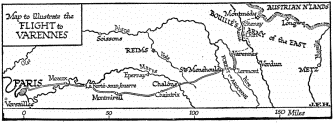
One June night in 1791, between eleven o’clock and midnight, the king and queen and their two children slipped out of the Tuileries disguised, threaded their palpitating way through Paris, circled round from the north of the city to the east, and got at last into a travelling-carriage that was waiting upon the road to Chalons. They were flying to the army of the east.[439] The army of the east was “loyal,” that is to say, its general and officers at least were prepared to betray France to the king and court. Here was adventure at last after the queen’s heart, and one can understand the pleasurable excitement of the little party as the miles lengthened between themselves and Paris. Away over the hills were reverence, deep bows, and the kissing of hands. Then back to Versailles. A little shooting of the mob in Paris—artillery, if need be. A few executions—but not of the sort of people who matter. A White Terror for a few months. Then all would be well again. Perhaps Calonne might return too, with fresh financial expedients. He was busy just then gathering support among the German princes. There were a lot of chateaux to rebuild, but the people who burnt them down could hardly complain if the task of rebuilding them pressed rather heavily upon their grimy necks....
All such bright anticipations were cruelly dashed that night at Varennes. The king had been recognized at Sainte Menehould by the landlord of the post house, and as the night fell, the eastward roads clattered with galloping messengers rousing the country, and trying to intercept the fugitives. There were fresh horses waiting in the upper village of Varennes—the young officer in charge had given the king up for the night and gone to bed—while for half an hour in the lower village the poor king, disguised as a valet, disputed with his postillions, who had expected reliefs in the lower village and refused to go further. Finally they consented to go on. They consented too late. The little party found the postmaster from Sainte Menehould, who had ridden past while the postillions wrangled, and a number of worthy republicans of Varennes whom he had gathered together, awaiting them at the bridge between the two parts of the town. The bridge was barricaded. Muskets were thrust into the carriage: “Your passports?”
The king surrendered without a struggle. The little party was taken into the house of some village functionary. “Well,” said the king, “here you have me!” Also he remarked that he was hungry. At dinner he commended the wine, “quite excellent wine.” What the queen said is not recorded. There were royalist troops at hand, but they attempted no rescue. The tocsin began to ring, and the village “illuminated itself,” to guard against surprise....
A very crestfallen coachload of royalty returned to Paris and was received by vast crowds—in silence. The word had gone forth that whoever insulted the king should be thrashed, and whoever applauded him should be killed....
It was only after this foolish exploit that the idea of a republic took hold of the French mind. Before this flight to Varennes there was no doubt much abstract republican sentiment, but there was scarcely any expressed disposition to abolish monarchy in France. Even in July, a month after the flight, a great meeting in the Champ de Mars, supporting a petition for the dethronement of the king, was dispersed by the authorities, and many people were killed. But such displays of firmness could not prevent the lesson of that flight soaking into men’s minds. Just as in England in the days of Charles I, so now in France men realized that the king could not be trusted—he was dangerous. The Jacobins, the extreme republican party, grew rapidly in strength. Their leaders, Robespierre, Danton, Marat, who had hitherto been a group of impossibles on the extreme left, began to dominate the National Assembly.
These Jacobins were the equivalents of the American radicals, men with untrammelled advanced ideas. Their strength lay in the fact that they were unencumbered and downright. They were poor men with nothing to lose. The party of moderation, of compromise with the relics of the old order, was led by such men of established position as General Lafayette, the general who had commanded the French troops in America, and Mirabeau, an aristocrat who was ready to model himself on the rich and influential aristocrats of England. But Robespierre was a needy but clever young lawyer from Arras, whose most precious possession was his faith in Rousseau; Danton was a scarcely more wealthy barrister in Paris, one of those big roaring gesticulating Frenchmen who are in normal times the heroic loud-talkers of provincial cafés; Marat was an older man, a Swiss of very great scientific distinction, but equally unembarrassed by possessions. On Marat’s scientific standing it is necessary to lay stress because there is a sort of fashion among English writers to misrepresent the leaders of great revolutionary movements as ignorant men. This gives a false view of the mental processes of revolution; and it is the task of the historian to correct it. Marat, we find, was conversant with English, Spanish, German, and Italian; he had spent several years in England, he was made an honorary M.D. of St. Andrew’s, and had published some valuable contributions to medical science in English. Both Benjamin Franklin and Goethe were greatly interested in his work in physics. This is the man who is called by Carlyle “rabid dog,” “atrocious,” “squalid,” and “Dog-leech”—this last by way of tribute to his science.
The revolution called Marat to politics, and his earliest contributions to the great discussion were fine and sane. There was a prevalent delusion in France that England was a land of liberty. His Tableau des vices de la constitution d’Angleterre showed the realities of the English position. His last years were maddened by an almost intolerable skin disease which he caught while hiding in the sewers of Paris to escape the consequences of his denunciation of the king as a traitor after the flight to Varennes. Only by sitting in a hot bath could he collect his mind to write. He had been treated hardly and suffered, and he became hard; nevertheless he stands out in history as a man of rare, unblemished honesty. His poverty seems particularly to have provoked the scorn of Carlyle.
“What a road he has travelled; and sits now, about half-past seven of the clock, stewing in slipper-bath; sore afflicted; ill of Revolution Fever.... Excessively sick and worn, poor man: with precisely elevenpence half penny of ready-money, in paper; with slipper-bath; strong three-footed stool for writing on, the while: and a squalid Washerwoman for his sole household ... that is his civic establishment in Medical-School Street; thither and not elsewhere has his road led him.... Hark, a rap again! A musical woman’s voice, refusing to be rejected: it is the Citoyenne who would do France a service. Marat, recognizing from within, cries, Admit her. Charlotte Corday is admitted.”
The young heroine—for republican leaders are fair game, and their assassins are necessarily heroines and their voices “musical”—offered to give him some necessary information about the counter-revolution at Caen, and as he was occupied in making a note of her facts, she stabbed him with a large sheath knife (1792)....
Such was the quality of most of the leaders of the Jacobin party. They were men of no property—untethered men. They were more dissociated and more elemental, therefore, than any other party; and they were ready to push the ideas of freedom and equality to a logical extremity. Their standards of patriotic virtue were high and harsh. There was something inhuman even in their humanitarian zeal. They saw without humour the disposition of the moderates to ease things down, to keep the common folk just a little needy and respectful, and royalty (and men of substance) just a little respected. They were blinded by the formulæ of Rousseauism to the historical truth that man is by nature oppressor and oppressed, and that it is only slowly by law, education, and the spirit of love in the world that men can be made happy and free.
And while in America the formulæ of eighteenth-century democracy were on the whole stimulating and helpful because it was already a land of open-air practical equality so far as white men were concerned, in France these formulæ made a very heady and dangerous mixture for the town populations, because considerable parts of the towns of France were slums full of dispossessed, demoralized, degraded, and bitter-spirited people. The Parisian crowd was in a particularly desperate and dangerous state, because the industries of Paris had been largely luxury industries, and much of her employment parasitic on the weaknesses and vices of fashionable life. Now the fashionable world had gone over the frontier, travellers were restricted, business disordered, and the city full of unemployed and angry people.
But the royalists, instead of realizing the significance of these Jacobins with their dangerous integrity and their dangerous grip upon the imagination of the mob, had the conceit to think they could make tools of them. The time for the replacement of the National Assembly under the new-made constitution by the “Legislative Assembly” was drawing near; and when the Jacobins, with the idea of breaking up the moderates, proposed to make the members of the National Assembly ineligible for the Legislative Assembly, the royalists supported them with great glee, and carried the proposal. They perceived that the Legislative Assembly, so clipped of all experience, must certainly be a politically incompetent body. They would “extract good from the excess of evil,”[440] and presently France would fall back helpless into the hands of her legitimate masters. So they thought. And the royalists did more than this. They backed the election of a Jacobin as Mayor of Paris. It was about as clever as if a man brought home a hungry tiger to convince his wife of her need of him. There stood another body ready at hand with which these royalists did not reckon, far better equipped than the court to step in and take the place of an ineffective Legislative Assembly, and that was the strongly Jacobin Commune of Paris installed at the Hôtel de Ville.
So far France had been at peace. None of her neighbours had attacked her, because she appeared to be weakening herself by her internal dissensions. It was Poland that suffered by the distraction of France. But there seemed no reason why they should not insult and threaten her, and prepare the way for a later partition at their convenience. At Pillnitz, in 1791, the King of Prussia and the Emperor of Austria met, and issued a declaration[441] that the restoration of order and monarchy in France was a matter of interest to all sovereigns. And an army of emigrés, French nobles and gentlemen, an army largely of officers, was allowed to accumulate close to the frontier.
It was France that declared war against Austria. The motives of those who supported this step were conflicting. Many republicans wanted it because they wished to see the kindred people of Belgium liberated from the Austrian yoke. Many royalists wanted it because they saw in war a possibility of restoring the prestige of the crown. Marat opposed it bitterly in his paper L’Ami du Peuple, because he did not want to see republican enthusiasm turned into war fever. His instinct warned him of Napoleon. On April 20th, 1792, the king came down to the Assembly and proposed war amidst great applause.
The war began disastrously. Three French armies entered Belgium, two were badly beaten, and the third, under Lafayette, retreated. Then Prussia declared war in support of Austria, and the allied forces, under the Duke of Brunswick, prepared to invade France. The duke issued one of the most foolish proclamations in history; he was, he said, invading France to restore the royal authority. Any further indignity shown the king he threatened to visit upon the Assembly and Paris with “military execution.” This was surely enough to make the most royalist Frenchman a republican—at least for the duration of the war.
The new phase of revolution, the Jacobin revolution, was the direct outcome of this proclamation. It made the Legislative Assembly, in which orderly republicans (Girondins) and royalists prevailed, it made the government which had put down that republican meeting in the Champ de Mars and hunted Marat into the sewers, impossible. The insurgents gathered at the Hôtel de Ville, and on the tenth of August the Commune launched an attack on the palace of the Tuileries.
The king behaved with a clumsy stupidity, and with that disregard for others which is the prerogative of kings. He had with him a Swiss guard of nearly a thousand men as well as National Guards of uncertain loyalty. He held out vaguely until firing began, and then he went off to the adjacent Assembly to place himself and his family under its protection, leaving his Swiss fighting. No doubt he hoped to antagonize Assembly and Commune, but the Assembly had none of the fighting spirit of the Hôtel de Ville. The royal refugees were placed in a box reserved for journalists (out of which a small room opened), and there they remained for sixteen hours while the Assembly debated their fate. Outside there were the sounds of a considerable battle; every now and then a window would break. The unfortunate Swiss were fighting with their backs to the wall because there was now nothing else for them to do....
The Assembly had no stomach to back the government’s action of July in the Champ de Mars. The fierce vigour of the Commune dominated it. The king found no comfort whatever in the Assembly. It scolded him and discussed his “suspension.” The Swiss fought until they received a message from the king to desist, and then—the crowd being savagely angry at the needless bloodshed and out of control—they were for the most part massacred.
The long and tedious attempt to “Merovingianize” Louis, to make an honest crowned republican out of a dull and inadaptable absolute monarch, was now drawing to its tragic close. The Commune of Paris was practically in control of France. The Legislative Assembly—which had apparently undergone a change of heart—decreed that the king was suspended from his office, confined him in the Temple, replaced him by an executive commission, and summoned a National Convention to frame a new constitution.
The tension of patriotic and republican France was now becoming intolerable. Such armies as she had were rolling back helplessly toward Paris. Longwy had fallen, the great fortress of Verdun followed, and nothing seemed likely to stop the march of the allies upon the capital. The sense of royalist treachery rose to panic cruelty. At any rate the royalists had to be silenced and stilled and scared out of sight. The Commune set itself to hunt out every royalist that could be found, until the prisons of Paris were full. Danton incited the crowd against the prisoners, Marat saw the danger of a massacre. Before it was too late Marat tried to secure the establishment of emergency tribunals to filter the innocent from the guilty in this miscellaneous collection of schemers, suspects, and harmless gentlefolk. He was disregarded, and early in September the inevitable massacre occurred.
Suddenly, first at one prison and then at others, bands of insurgents took possession. A sort of rough court was constituted, and outside gathered a wild mob armed with sabres, pikes, and axes. One by one the prisoners, men and women alike, were led out from their cells, questioned briefly, pardoned with the cry of “Vive la Nation,” or thrust out to the mob at the gates. There the crowd jostled and fought to get a slash or thrust at a victim. The condemned were stabbed, hacked, and beaten to death, their heads hewn off, stuck on pikes, and carried about the town, their torn bodies thrust aside. Among others, the Princesse de Lamballe, whom the king and queen had left behind in the Tuileries, perished. Her head was carried on a pike to the Temple for the queen to see.
In the queen’s cell were two National Guards. One would have had her look out and see this grisly sight. The other, in pity, would not let her do so.
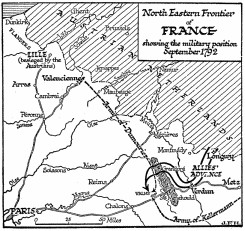
Even as this red tragedy was going on in Paris, the French general Dumouriez, who had rushed an army from Flanders into the forests of the Argonne, was holding up the advance of the allies beyond Verdun. On September 20th occurred a battle, mainly an artillery encounter, at Valmy. A not very resolute Prussian advance was checked,[442] the French infantry stood firm, their artillery was better than the allied artillery. For ten days after this repulse the Duke of Brunswick hesitated, and then he began to fall back towards the Rhine. This battle at Valmy—it was little more than a cannonade—was one of the decisive battles in the world’s history. The Revolution was saved. The National Convention met on September 21st, 1792, and immediately proclaimed a republic. The trial and execution of the king followed with a sort of logical necessity upon these things. He died rather as a symbol than as a man. There was nothing else to be done with him; poor man, he cumbered the earth. France could not let him go to hearten the emigrants, could not keep him harmless at home; his existence threatened her. Marat had urged this trial relentlessly, yet with that acid clearness of his he would not have the king charged with any offence committed before he signed the constitution, because before then he was a real monarch, super-legal, and so incapable of being illegal. Nor would Marat permit attacks upon the king’s counsel.... Throughout Marat played a bitter and yet often a just part; he was a great man, a fine intelligence, in a skin of fire; wrung with that organic hate in the blood that is not a product of the mind but of the body.
Louis was beheaded in January, 1793. He was guillotined—for since the previous August the guillotine had been in use as the official instrument in French executions.
Danton, in his leonine rôle, was very fine upon this occasion. “The kings of Europe would challenge us,” he roared. “We throw them the head of a king!”
§ 11
And now followed a strange phase in the history of the French people. There arose a great flame of enthusiasm for France and the Republic. There was to be an end to compromise at home and abroad; at home royalists and every form of disloyalty were to be stamped out; abroad France was to be the protector and helper of all revolutionaries. All Europe, all the world, was to become republican. The youth of France poured into the Republican armies; a new and wonderful song spread through the land, a song that still warms the blood like wine, the Marseillaise. Before that chant and the leaping columns of French bayonets and their enthusiastically served guns the foreign armies rolled back; before the end of 1792 the French armies had gone far beyond the utmost achievements of Louis XIV; everywhere they stood on foreign soil. They were in Brussels, they had overrun Savoy, they had raided to Mayence; they had seized the Scheldt from Holland. Then the French Government did an unwise thing. It had been exasperated by the expulsion of its representative from England upon the execution of Louis, and it declared war against England. It was an unwise thing to do, because the revolution which had given France a new enthusiastic infantry and a brilliant artillery, released from its aristocratic officers and many cramping traditions,[443] had destroyed the discipline of its navy, and the English were supreme upon the sea. And this provocation united all England against France, whereas there had been at first a very considerable liberal movement in Great Britain in sympathy with the revolution. It robbed France of her one prospective ally.[444]
Of the fight that France made in the next few years against a European coalition we cannot tell in any detail. She drove the Austrians for ever out of Belgium, and made Holland a republic. The Dutch fleet, frozen in the Texel, surrendered to a handful of cavalry without firing its guns. For some time the French thrust towards Italy was hung up, and it was only in 1796 that a new general, Napoleon Bonaparte, led the ragged and hungry republican armies in triumph across Piedmont to Mantua and Verona. An Outline of History cannot map out campaigns; but of the new quality that had come into war, it is bound to take note. The old professional armies had fought for the fighting, as slack as workers paid by the hour; these wonderful new armies fought hungry and thirsty, for victory. Their enemies called them the “New French.” Says C. F. Atkinson,[445] “What astonished the Allies most of all was the number and the velocity of the Republicans. These improvised armies had in fact nothing to delay them. Tents were unprocurable for want of money, untransportable for want of the enormous number of wagons that would have been required, and also unnecessary, for the discomfort that would have caused wholesale desertion in professional armies was cheerfully borne by the men of 1793-4. Supplies for armies of then unheard-of size could not be carried in convoys, and the French soon became familiar with ‘living on the country.’ Thus 1793 saw the birth of the modern system of war—rapidity of movement, full development of national strength, bivouacs, requisitions and force as against cautious manœuvring, small professional armies, tents and full rations, and chicane. The first represented the decision-compelling spirit, the second the spirit of risking little to gain a little....”
And while these ragged hosts of enthusiasts were chanting the Marseillaise and fighting for la France, manifestly never quite clear in their minds whether they were looting or liberating the countries into which they poured, the republican enthusiasm in Paris was spending itself in a far less glorious fashion. Marat, the one man of commanding intelligence among the Jacobins, was now frantic with an incurable disease, and presently he was murdered; Danton was a series of patriotic thunderstorms; the steadfast fanaticism of Robespierre dominated the situation. This man is difficult to judge; he was a man of poor physique, naturally timid, and a prig. But he had that most necessary gift for power, faith. He believed not in a god familiar to men, but in a certain Supreme Being, and that Rousseau was his prophet. He set himself to save the Republic as he conceived it, and he imagined it could be saved by no other man than he. So that to keep in power was to save the republic. The living spirit of the republic, it seemed, had sprung from a slaughter of royalists and the execution of the king. There were insurrections: one in the west, in the district of La Vendée, where the people rose against the conscription and against the dispossession of the orthodox clergy, and were led by noblemen and priests; one in the south, where Lyons and Marseilles had risen and the royalists of Toulon had admitted an English and Spanish garrison. To which there seemed no more effectual reply than to go on killing royalists.
Nothing could have better pleased the fierce heart of the Paris slums. The Revolutionary Tribunal went to work, and a steady slaughtering began.[446] The invention of the guillotine was opportune to this mood. The queen was guillotined, most of Robespierre’s antagonists were guillotined, atheists who argued that there was no Supreme Being were guillotined, Danton was guillotined because he thought there was too much guillotine; day by day, week by week, this infernal new machine chopped off heads and more heads and more. The reign of Robespierre lived, it seemed, on blood, and needed more and more, as an opium-taker needs more and more opium.
Danton was still Danton, leonine and exemplary upon the guillotine. “Danton,” he said, “no weakness!”
And the grotesque thing about the story is that Robespierre was indubitably honest. He was far more honest than any of the group of men who succeeded him. He was inspired by a consuming passion for a new order of human life. So far as he could contrive it, the Committee of Public Safety, the emergency government of twelve which had now thrust aside the Convention, constructed. The scale on which it sought to construct was stupendous. All the intricate problems with which we still struggle to-day were met by swift and shallow solutions. Attempts were made to equalize property. “Opulence,” said St. Just, “is infamous.” The property of the rich was taxed or confiscated in order that it should be divided among the poor. Every man was to have a secure house, a living, a wife and children. The labourer was worthy of his hire, but not entitled to an advantage. There was an attempt to abolish profit altogether, the rude incentive of most human commerce since the beginning of society. Profit is the economic riddle that still puzzles us to-day. There were harsh laws against “profiteering” in France in 1793—England in 1919 found it necessary to make quite similar laws. And the Jacobin government not only replanned—in eloquent outline—the economic, but also the social system. Divorce was made as easy as marriage; the distinction of legitimate and illegitimate children was abolished.... A new calendar was devised, with new names for the months, a week of ten days, and the like—that has long since been swept away; but also the clumsy coinage and the tangled weights and measures of old France gave place to the simple and lucid decimal system that still endures.... There was a proposal from one extremist group to abolish God among other institutions altogether, and to substitute the worship of Reason. There was, indeed, a Feast of Reason in the cathedral of Notre-Dame, with a pretty actress as the goddess of Reason. But against this Robespierre set his face; he was no atheist. “Atheism,” he said, “is aristocratic. The idea of a Supreme Being who watches over oppressed innocence and punishes triumphant crime is essentially the idea of the people.”
So he guillotined Hébert, who had celebrated the Feast of Reason, and all his party.
A certain mental disorder became perceptible in Robespierre as the summer of 1794 drew on. He was deeply concerned with his religion. (The arrests and executions of suspects were going on now as briskly as ever. Through the streets of Paris every day rumbled the Terror with its carts full of condemned people.) He induced the Convention to decree that France believed in a Supreme Being, and in that comforting doctrine, the immortality of the soul. In June he celebrated a great festival, the festival of his Supreme Being. There was a procession to the Champ de Mars, which he headed, brilliantly arrayed, bearing a great bunch of flowers and wheat ears. Figures of inflammatory material, representing Atheism and Vice, were solemnly burnt; then, by an ingenious mechanism, and with some slight creakings, an incombustible statue of Wisdom rose in their place. There were discourses—Robespierre delivered the chief one—but apparently no worship....
Thereafter Robespierre displayed a disposition to brood aloof from affairs. For a month he kept away from the Convention.
One day in July he reappeared and delivered a strange speech that clearly foreshadowed fresh prosecutions. “Gazing on the multitude of vices which the torrent of Revolution has rolled down,” he cried, in his last great speech in the Convention, “I have sometimes trembled lest I should be soiled by the impure neighbourhood of wicked men.... I know that it is easy for the leagued tyrants of the world to overwhelm a single individual; but I know also what is the duty of a man who can die in the defence of humanity.”...
And so on to vague utterances that seemed to threaten everyone.
The Convention heard this speech in silence; then when a proposal was made to print and circulate it, broke into a resentful uproar and refused permission. Robespierre went off in bitter resentment to the club of his supporters, and reread his speech to them!
That night was full of talk and meetings and preparations for the morrow, and the next morning the Convention turned upon Robespierre. One Tallien threatened him with a dagger. When he tried to speak, he was shouted down, and the President jingled the bell at him. “President of Assassins,” cried Robespierre, “I demand speech!” It was refused him. His voice deserted him; he coughed and spluttered. “The blood of Danton chokes him,” cried someone.
He was accused and arrested there and then with his chief supporters.
Whereupon the Hôtel de Ville, still stoutly Jacobin, rose against the Convention, and Robespierre and his companions were snatched out of the hands of their captors. There was a night of gathering, marching, counter-marching; and at last, about three in the morning, the forces of the Convention faced the forces of the Commune outside the Hôtel de Ville. Henriot, the Jacobin commander, after a busy day was drunk upstairs; a parley ensued, and then, after some indecision, the soldiers of the Commune went over to the Government. There was a shouting of patriotic sentiments, and someone looked out from the Hôtel de Ville. Robespierre and his last companions found themselves betrayed and trapped.
Two or three of these men threw themselves out of a window, and injured themselves frightfully on the railings below without killing themselves. Others attempted suicide. Robespierre, it seems, was shot in the lower jaw by a gendarme. He was found, his eyes staring from a pale face whose lower part was blood.
Followed seventeen hours of agony before his end. He spoke never a word during that time; his jaw being bound up roughly in dirty linen. He and his companions, and the broken, dying bodies of those who had jumped from the windows, twenty-two men altogether, were taken to the guillotine instead of the condemned appointed for that day. Mostly, his eyes were closed, but, says Carlyle, he opened them to see the great knife rising above him, and struggled. Also it would seem he screamed when the executioner removed his bandages. Then the knife came down, swift and merciful.
The Terror was at an end. From first to last there had been condemned and executed about four thousand people.
§ 12
It witnesses to the immense vitality and the profound rightness of the flood of new ideals and intentions that the French Revolution had released into the world of practical endeavour, that it could still flow in a creative torrent after it had been caricatured and mocked in the grotesque personality and career of Robespierre. He had shown its deepest thoughts, he had displayed anticipations of its methods and conclusions, through the green and distorting lenses of his preposterous vanity and egotism, he had smeared and blackened all its hope and promise with blood and horror, and the power of these ideas was not destroyed. They stood the extreme tests of ridiculous and horrible presentation. After his downfall, the Republic still ruled unassailable. Leaderless, for his successors were a group of crafty or commonplace men, the European republic struggled on, and presently fell and rose again, and fell and rose and still struggles, entangled but invincible.
And it is well to remind the reader here of the real dimensions of this phase of the Terror, which strikes so vividly upon the imagination and which has therefore been enormously exaggerated relatively to the rest of the revolution. From 1789 to late in 1791 the French Revolution was an orderly process, and from the summer of 1794 the Republic was an orderly and victorious state. The Terror was not the work of the whole country, but of the town mob which owed its existence and its savagery to the misrule and social injustice of the ancient régime; and the explosion of the Terror could have happened only through the persistent treacherous disloyalty of the royalists which, while it raised the extremists to frenzy, disinclined the mass of moderate republicans from any intervention. The best men were busy fighting the Austrians and royalists on the frontier. Altogether, we must remember, the total of the killed in the Terror amounted to a few thousands, and among those thousands there were certainly a great number of active antagonists whom the Republic, by all the standards of that time, was entitled to kill. It included such traitors and mischief-makers as Philip, Duke of Orleans, of the Palais Royal, who had voted for the death of Louis XVI. More lives were wasted by the British generals alone on the opening day of what is known as the Somme offensive of July, 1916, than in the whole French revolution from start to finish. We hear so much about the martyrs of the French Terror because they were notable, well-connected people, and because there has been a sort of propaganda of their sufferings. But let us balance against them in our minds what was going on in the prisons of the world generally at that time. In Britain and America, while the Terror ruled in France, far more people were slaughtered for offences—very often quite trivial offences—against property than were condemned by the Revolutionary Tribunal for treason against the State. Of course, they were very common people indeed, but in their rough way they suffered. A girl was hung in Massachusetts in 1789 for forcibly taking the hat, shoes, and buckles of another girl she had met in the street.[447] Again, Howard the philanthropist (about 1773) found a number of perfectly innocent people detained in the English prisons who had been tried and acquitted, but were unable to pay the gaoler’s fees. And these prisons were filthy places under no effective control. Torture was still in use in the Hanoverian dominions of his Britannic majesty King George III. It had been in use in France up to the time of the National Assembly. These things mark the level of the age. It is not on record that anyone was deliberately tortured by the French revolutionaries during the Terror. Those few hundreds of French gentlefolk fell into a pit that most of them had been well content should exist for others. It was tragic, but not, by the scale of universal history, a great tragedy. The common man in France was more free, better off, and happier during the “Terror” than he had been in 1787.
The story of the Republic after the summer of 1794 becomes a tangled story of political groups aiming at everything from a radical republic to a royalist reaction, but pervaded by a general desire for some definite working arrangement even at the price of considerable concessions. There was a series of insurrections of the Jacobins and of the royalists, there seems to have been what we should call nowadays a hooligan class in Paris which was quite ready to turn out to fight and loot on either side; nevertheless the Convention produced a government, the Directory of five members, which held France together for five years. The last, most threatening revolt of all, in October, 1795, was suppressed with great skill and decision by a rising young general, Napoleon Bonaparte.
The Directory was victorious abroad, but uncreative at home; its members were far too anxious to stick to the sweets and glories of office to prepare a constitution that would supersede them, and far too dishonest to handle the task of financial and economic reconstruction demanded by the condition of France. We need only note two of their names, Carnot, who was an honest republican, and Barras, who was conspicuously a rogue. Their reign of five years formed a curious interlude in this history of great changes. They took things as they found them. The propagandist zeal of the revolution carried the French armies into Holland, Belgium, Switzerland, south Germany, and north Italy. Everywhere kings were expelled and republics set up. But such propagandist zeal as animated the Directorate did not prevent the looting of the treasures of the liberated peoples to relieve the financial embarrassment of the French Government. Their wars became less and less the holy war of freedom, and more and more like the aggressive wars of the ancient régime. The last feature of Grand Monarchy that France was disposed to discard was her tradition of foreign policy, grasping, aggressive, restless, French-centred. One discovers it still as vigorous under the Directorate as if there had been no revolution.
§ 13
The ebb of this tide of Revolution in the world, this tide which had created the great Republic of America and threatened to submerge all European monarchies, was now at hand. It is as if something had thrust up from beneath the surface of human affairs, made a gigantic effort, and spent itself. It swept many obsolescent and evil things away, but many evil and unjust things remained. It solved many problems, and it left the desire for fellowship and order face to face with much vaster problems that it seemed only to have revealed. Privilege of certain types had gone, many tyrannies, much religious persecution. When these things of the ancient régime had vanished, it seemed as if they had never mattered. What did matter was that for all their votes and enfranchisement, and in spite of all their passion and effort, common men were still not free and not enjoying an equal happiness; that the immense promise and air of a new world with which the Revolution had come, remained unfulfilled.
Yet, after all, this wave of revolution had realized nearly everything that had been clearly thought out before it came. It was not failing now for want of impetus, but for want of finished ideas. Many things that had oppressed mankind were swept away for ever. Now that they were swept away it became apparent how unprepared men were for the creative opportunities this clearance gave them. And periods of revolution are periods of action; in them men reap the harvests of ideas that have grown during phases of interlude, and they leave the fields cleared for a new season of growth, but they cannot suddenly produce ripened new ideas to meet an unanticipated riddle.
The sweeping away of king and lord, of priest and inquisitor, of landlord and tax-gatherer and task-master, left the mass of men face to face for the first time with certain very fundamental aspects of the social structure, relationships they had taken for granted, and had never realized the need of thinking hard and continuously about before. Institutions that had seemed to be in the nature of things, and matters that had seemed to happen by the same sort of necessity that brought round the dawn and springtime, were discovered to be artificial, controllable, were they not so perplexingly intricate, and—now that the old routines were abolished and done away with—in urgent need of control. The New Order found itself confronted with three riddles which it was quite unprepared to solve: Property, Currency, and International Relationship.
Let us take these three problems in order, and ask what they are and how they arose in human affairs. Every human life is deeply entangled in them, and concerned in their solution. The rest of this history becomes more and more clearly the development of the effort to solve these problems; that is to say, so to interpret property, so to establish currency, and so to control international reactions as to render possible a world-wide, progressive and happy community of will. They are the three riddles of the sphinx of fate, to which the human commonweal must find an answer or perish.
The idea of property arises out of the combative instincts of the species. Long before men were men, the ancestral ape was a proprietor. Primitive property is what a beast will fight for. The dog and his bone, the tigress and her lair, the roaring stag and his herd, these are proprietorship blazing. No more nonsensical expression is conceivable in sociology than the term “primitive communism.” The Old Man of the family tribe of early palæolithic times insisted upon his proprietorship in his wives and daughters, in his tools, in his visible universe. If any other man wandered into his visible universe he fought him, and if he could he slew him. The tribe grew in the course of ages, as Atkinson showed convincingly in his Primal Law, by the gradual toleration by the Old Man of the existence of the younger men, and of their proprietorship in the wives they captured from outside the tribe, and in the tools and ornaments they made and the game they slew. Human society grew by a compromise between this one’s property and that. It was largely a compromise and an alliance forced upon men by the necessity of driving some other tribe out of its visible universe. If the hills and forests and streams were not your land or my land, it was because they had to be our land. Each of us would have preferred to have it my land, but that would not work. In that case the other fellows would have destroyed us. Society, therefore, is from its beginnings the mitigation of ownership. Ownership in the beast and in the primitive savage was far more intense a thing than it is in the civilized world to-day. It is rooted more strongly in our instincts than in our reason.
In the natural savage and in the untutored man to-day—for it is well to keep in mind that no man to-day is more than four hundred generations from the primordial savage—there is no limitation to the sphere of ownership. Whatever you can fight for, you can own; women-folk, spared captive, captured beast, forest glade, stone pit, or what not. As the community grew and a sort of law came to restrain internecine fighting, men developed rough and ready methods of settling proprietorship. Men could own what they were the first to make or capture or claim. It seemed natural that a debtor who could not pay up should become the property of his creditor. Equally natural was it that, after claiming a patch of land (“Bags I,” as the schoolboy says), a man should exact payments and tribute from anyone else who wanted to use it. It was only slowly, as the possibilities of organized life dawned on men, that this unlimited property in anything whatever began to be recognized as a nuisance. Men found themselves born into a universe all owned and claimed, nay! they found themselves born, owned, and claimed. The social struggles of the earlier civilization are difficult to trace now, but the history we have told of the Roman republic shows a community waking up to the idea that they may become a public inconvenience and should then be repudiated, and that the unlimited ownership of land is also an inconvenience. We find that later Babylonia severely limited the rights of property in slaves. Finally, we find in the teaching of that great revolutionist, Jesus of Nazareth, such an attack upon property as had never been before. Easier it was, he said, for a camel to go through the eye of a needle than for the owner of great possessions to enter the kingdom of heaven. A steady, continuous criticism of the permissible scope of property seems to have been going on in the world for the last twenty-five or thirty centuries. Nineteen hundred years after Jesus of Nazareth we find all the world that has come under the Christian teaching persuaded that there could be no property in persons. There has been a turn over in the common conscience in that matter. And also the idea that “a man may do what he likes with his own” was clearly very much shaken in relation to other sorts of property. But this world of the closing eighteenth century was still only in the interrogative stage in this matter. It had got nothing clear enough, much less settled enough, to act upon. One of its primary impulses was to protect property against the greed and waste of kings and the exploitation of noble adventurers. It was to protect private property that the Revolution began. But its equalitarian formulæ carried it into a criticism of the very property it had risen to protect. How can men be free and equal when numbers of them have no ground to stand upon and nothing to eat, and the owners will neither feed nor lodge them unless they toil? Excessively—the poor complained.
To which riddle the Jacobin reply was to set about “dividing up.” They wanted to intensify and universalize property. Aiming at the same end by another route, there were already in the eighteenth century certain primitive socialists—or, to be more exact, communists—who wanted to “abolish” private property altogether. The state (a democratic state was of course understood) was to own all property. It was only as the nineteenth century developed that men began to realize that property was not one simple thing, but a great complex of ownerships of different values and consequences, that many things (such as human beings, the implements of an artist, clothing, toothbrushes) are very profoundly and incurably personal property, and that there is a very great range of things, railways, machinery of various sorts, homes, cultivated gardens, pleasure-boats, for example, which need each to be considered very particularly to determine how far and under what limitations it may come under private ownership, and how far it falls into the public domain and may be administered and let out by the state in the collective interest. On the practical side these questions pass into politics, and the problem of making and sustaining efficient state administration. They open up issues in social psychology, and interact with the enquiries of educational science. We have to-day the advantage of a hundred and thirty years of discussion over the first revolutionary generation, but even now this criticism of property is still a vast and passionate ferment rather than a science. Under the circumstances it was impossible that eighteenth-century France should present any other spectacle than that of vague and confused popular movements seeking to dispossess owners, and classes of small and large owners holding on grimly, demanding, before everything else, law, order, and security, and seeking to increase their individual share of anything whatever that could be legally possessed.
Closely connected with the vagueness of men’s ideas about property was the vagueness of their ideas about currency. Both the American and the French republics fell into serious trouble upon this score. Here, again, we deal with something that is not simple, a tangle of usages, conventions, laws, and prevalent mental habits, out of which arise problems which admit of no solution in simple terms, and which yet are of vital importance to the everyday life of the community. The validity of the acknowledgement a man is given for a day’s work is manifestly of quite primary importance to the working of the social machine. The growth of confidence in the precious metals and of coins, until the assurance became practically universal that good money could be trusted to have its purchasing power anywhere, must have been a gradual one in human history. And being fairly established, this assurance was subjected to very considerable strains and perplexities by the action of governments in debasing currency and in substituting paper promises to pay for the actual metallic coins. Every age produced a number of clever people intelligent enough to realize the opportunities for smart operations afforded by the complex of faiths and fictions upon which the money system rested, and sufficiently unsound morally to give their best energies to growing rich and so getting people to work for them, through tricks and tampering with gold, coinage, and credit. So soon as serious political and social dislocation occurred, the money mechanism began to work stiffly and inaccurately. The United States and the French Republic both started their careers in a phase of financial difficulty. Everywhere governments had been borrowing and issuing paper promises to pay interest, more interest than they could conveniently raise. Both revolutions led to much desperate public spending and borrowing, and at the same time to an interruption of cultivation and production that further diminished real taxable wealth. Both governments, being unable to pay their way in gold, resorted to the issue of paper money, promising to pay upon the security of undeveloped land (in America) or recently confiscated church lands (France). In both cases the amount of issue went far beyond the confidence of men in the new security. Gold was called in, hidden by the cunning ones, or went abroad to pay for imports; and people found themselves with various sorts of bills and notes in the place of coins, all of uncertain and diminishing value.
However complicated the origins of currency, its practical effect and the end it has to serve in the community may be stated roughly in simple terms. The money a man receives for his work (mental or bodily) or for relinquishing his property in some consumable good, must ultimately be able to purchase for him for his use a fairly equivalent amount of consumable goods. (“Consumable goods” is a phrase we would have understood in the widest sense to represent even such things as a journey, a lecture or theatrical entertainment, housing, medical advice, and so forth.) When everyone in a community is assured of this, and assured that the money will not deteriorate in purchasing power, then currency—and the distribution of goods by trade—is in a healthy and satisfactory state. Then men will work cheerfully, and only then. The imperative need for that steadfastness and security of currency is the fixed datum from which the scientific study and control of currency must begin. But under the most stable conditions there will always be fluctuations in currency value. The sum total of saleable consumable goods in the world and in various countries varies from year to year and from season to season; autumn is probably a time of plenty in comparison with spring; with an increase the purchasing power of currency will increase, unless there is also an increase in the amount of currency. On the other hand, if there is a diminution in the production of consumable goods or a great and unprofitable destruction of consumable goods, such as occurs in a war, the share of the total of consumable goods represented by a sum of money will diminish and prices and wages will rise. In modern war the explosion of a single big shell, even if it hits nothing, destroys labour and material roughly equivalent to a comfortable cottage or a year’s holiday for a man. If the shell hits anything, then that further destruction has to be added to the diminution of consumable goods. Every shell that burst in the recent war diminished by a little fraction the purchasing value of every coin in the whole world. If there is also an increase of currency during a period when consumable goods are being used up and not fully replaced—and the necessities of revolutionary and war-making governments almost always require this—then the enhancement of prices and the fall in the value of the currency paid in wages is still greater. Usually also governments under these stresses borrow money, that is to say, they issue interest-bearing paper, secured on the willingness and ability of the general community to endure taxation. Such operations would be difficult enough if they were carried out frankly by perfectly honest men, in the full light of publicity and scientific knowledge. But hitherto this has never been the case; at every point the clever egotist, the bad rich man, is trying to deflect things a little to his own advantage. Everywhere too one finds the stupid egotist ready to take fright and break into panic. Consequently we presently discover the state encumbered by an excess of currency, which is in effect a non-interest-paying debt, and also with a great burthen of interest upon loans. Both credit and currency begin to fluctuate wildly with the evaporation of public confidence. They are, we say, demoralized.
The ultimate consequence of an entirely demoralized currency would be to end all work and all trade that could not be carried on by payment in kind and barter. Men would refuse to work except for food, clothing, housing, and payment in kind. The immediate consequence of a partially demoralized currency is to drive up prices and make trading feverishly adventurous and workers suspicious and irritable. A sharp man wants under such conditions to hold money for as brief a period as possible; he demands the utmost for his reality, and buys a reality again as soon as possible in order to get this perishable stuff, the currency paper, off his hands. All who have fixed incomes and saved accumulations suffer by the rise in prices, and the wage-earners find, with a gathering fury, that the real value of their wages is continually less. Here is a state of affairs where the duty of every clever person is evidently to help adjust and reassure. But all the traditions of private enterprise, all the ideas of the later eighteenth century, went to justify the action of acute-minded and dexterous people who set themselves to accumulate claims, titles, and tangible property in the storms and dislocations of this currency breakdown. The number of understanding people in the world who were setting themselves sincerely and simply to restore honest and workable currency and credit conditions were few and ineffectual. Most of the financial and speculative people of the time were playing the part of Cornish wreckers—not apparently with any conscious dishonesty, but with the completest self-approval and the applause of their fellow men. The aim of every clever person was to accumulate as much as he could of really negotiable wealth, and then, and only then, to bring about some sort of stabilizing political process that would leave him in advantageous possession of his accumulation. Here were the factors of a bad economic atmosphere, suspicious, feverish, greedy, and speculative....
In the third direction in which the Revolution had been unprepared with clear ideas, the problem of international relationships, developments were to occur that interacted disastrously with this state of financial and economic adventure, this scramble and confusion, this pre-occupation of men’s minds with the perplexing slipperiness of their private property and their monetary position at home. The Republic at its birth found itself at war. For a time that war was waged by the new levies with a patriotism and a zeal unparalleled in the world’s history. But that could not go on. The Directory found itself at the head of a conquering country, intolerably needy and embarrassed at home, and in occupation of rich foreign lands, full of seizable wealth and material and financial opportunity. We have all double natures, and the French in particular seem to be developed logically and symmetrically on both sides. Into these conquered regions France came as a liberator, the teacher of Republicanism to mankind. Holland and Belgium became the Batavian Republic, Genoa and its Riviera the Ligurian Republic, north Italy the Cisalpine Republic, Switzerland was rechristened the Helvetian Republic, Mülhausen, Rome, and Naples were designated republics. Grouped about France, these republics were to be a constellation of freedom leading the world. That was the ideal side. At the same time the French government, and French private individuals in concert with the government, proceeded to a complete and exhaustive exploitation of the resources of these liberated lands.
So within ten years of the meeting of the States General, New France begins to take on a singular likeness to the old. It is more flushed, more vigorous; it wears a cap of liberty instead of a crown; it has a new army—but a damaged fleet; it has new rich people instead of the old rich people, a new peasantry working even harder than the old and yielding more taxes, a new foreign policy curiously like the old foreign policy disrobed, and—there is no Millennium.
XXXVIII THE CAREER OF NAPOLEON BONAPARTE[448]
§ 1. The Bonaparte Family in Corsica. § 2. Bonaparte as a Republican General. § 3. Napoleon First Consul, 1799-1804. § 4. Napoleon I, Emperor, 1804-14. § 5. The Hundred Days. § 6. The Cult of the Napoleonic. § 7. The Map of Europe in 1815.
§ 1
AND now we come to one of the most illuminating figures in modern history, the figure of an adventurer and a wrecker, whose story seems to display with an extraordinary vividness the universal subtle conflict of egotism, vanity, and personality with the weaker, wider claims of the common good. Against this background of confusion and stress and hope, this strained and heaving France and Europe, this stormy and tremendous dawn, appears this dark little archaic personage, hard, compact, capable, unscrupulous, imitative, and neatly vulgar. He was born (1769) in the still half-barbaric island of Corsica, the son of a rather prosaic father, a lawyer who had been first a patriotic Corsican against the French monarchy which was trying to subjugate Corsica, and who had then gone over to the side of the invader. His mother was of sturdier stuff, passionately patriotic and a strong and managing woman. (She birched her sons; on one occasion she birched Napoleon when he was sixteen.) There were numerous brothers and sisters, and the family pursued the French authorities with importunities for rewards and jobs. Except for Napoleon it seems to have been a thoroughly commonplace, “hungry” family. He was clever, bad-tempered, and overbearing. From his mother he had acquired a romantic Corsican patriotism.
Through the patronage of the French governor of Corsica he got an education first at the military school of Brienne and then at the military school of Paris, from which he passed into the artillery in 1785. He was an industrious student both of mathematics and history, his memory was prodigiously good, and he made copious note-books which still exist. These note-books show no very exceptional intelligence, and they contain short pieces of original composition—upon suicide and similar adolescent topics. He fell early under the spell of Rousseau; he developed sensibility and a scorn for the corruptions of civilization. In 1786 he wrote a pamphlet against a Swiss pastor who had attacked Rousseau. It was a very ordinary adolescent production, rhetorical and imitative. He dreamt of an independent Corsica, freed from the French. With the revolution, he became an ardent republican and a supporter of the new French régime in Corsica. For some years, until the fall of Robespierre, he remained a Jacobin.
§ 2
He soon gained the reputation of a useful and capable officer, and it was through Robespierre’s younger brother that he got his first chance of distinction at Toulon. Toulon had been handed over to the British and Spanish by the Royalists, and an allied fleet occupied its harbour. Bonaparte was given the command of the artillery, and under his direction the French forced the allies to abandon the port and town.
He was next appointed commander of the artillery in Italy, but he had not taken up his duties when the death of Robespierre seemed likely to involve his own; he was put under arrest as a Jacobin, and for a time he was in danger of the guillotine. That danger passed. He was employed as artillery commander in an abortive raid upon Corsica, and then went to Paris (1795) rather down at heel. Madame Junot in her Memoirs describes his lean face and slovenly appearance at this time, “his ill-combed, ill-powdered hair hanging down over his grey overcoat,” his gloveless hands and badly blacked boots. It was a time of exhaustion and reaction after the severities of the Jacobite republic. “In Paris,” says Holland Rose, “the star of Liberty was paling before Mercury, Mars, and Venus”—finance, uniforms, and social charm. The best of the common men were in the armies, away beyond the frontiers. We have already noted the last rising of the royalists in this year (1795). Napoleon had the luck to be in Paris, and found his second opportunity in this affair. He saved the Republic—of the Directory.
His abilities greatly impressed Carnot, the most upright of the Directors. Moreover, he married a charming young widow, Madame Josephine de Beauharnais, who had great influence with Barras. Both these things probably helped him to secure the command in Italy.
We have no space here for the story of his brilliant campaigns in Italy (1796-7), but of the spirit in which that invasion of Italy was conducted we must say a word or two, because it illustrates so vividly the double soul of France and of Napoleon, and how revolutionary idealism was paling before practical urgencies. He proclaimed to the Italians that the French were coming to break their chains—and they were! He wrote to the Directory: “We will levy 20,000,000 francs in exactions in this country; it is one of the richest in the world.” To his soldiers he said, “You are famished and nearly naked.... I lead you into the most fertile plain in the world. There you will find great towns, rich provinces, honour, glory, riches....”
We are all such mixed stuff as this; in all of us the intimations of a new world and a finer duty struggle to veil and control the ancient greeds and lusts of our inherited past; but these passages, written by a young man of twenty-seven, seem to show the gilt of honourable idealism rubbed off at an unusually early age. These are the bribes of an adventurer who has brought whatever impulse of devotion to a great cause once stirred within him, well under the control of his self love.
His successes in Italy were brilliant and complete; they enormously stimulated his self-confidence and his contempt for the energy and ability of his fellow creatures. He had wanted to go into Italy because there lay the most attractive task—he had risked his position in the army by refusing to take up the irksome duties of a command against the rebels in La Vendée—and there are clear signs of a vast expansion of his vanity with his victories. He had been a great reader of Plutarch’s Lives and of Roman history, and his extremely active but totally uncreative imagination was now busy with dreams of a revival of the eastern conquests of the Roman Empire. He got the republic of Venice out of his way by cutting it up between the French and Austria, securing the Ionian Islands and the Venetian fleet for France. This peace, the peace of Campo Formio, was for both sides a thoroughly scoundrelly and ultimately a disastrous bargain. The new republic of France assisted in the murder of an ancient republic—Napoleon carried his point against a considerable outcry in France—and Austria got Venetia, in which land in 1918 she was destined to bleed to death. There were also secret clauses by which both France and Austria were later to acquire south German territory. And it was not only the Roman push eastward that was now exciting Napoleon’s brain. This was the land of Cæsar—and Cæsar was a bad example for the successful general of a not very stable republic.
Cæsar had come back to Rome from Gaul a hero and conqueror. His new imitator would come back from Egypt and India—Egypt and India were to be his Gaul. There was really none of the genius about which historians write so glibly in this decision. It was a tawdry and ill-conceived imitation. The elements of failure stared him in the face. The way to Egypt and India was by sea, and the British, in spite of two recent naval mutinies, whose importance Napoleon exaggerated, were stronger than the French at sea. Moreover, Egypt was a part of the Turkish empire, by no means a contemptible power in those days. Nevertheless he persuaded the Directory, which was dazzled by his Italian exploits, to let him go. An Armada started from Toulon in May, 1798, captured Malta, and had the good luck to evade the British fleet and arrive at Alexandria. He landed his troops hurriedly, and the battle of the Pyramids made him master of Egypt.
The main British fleet at that time was in the Atlantic outside Cadiz, but the admiral had detached a force of his best ships, under Vice-Admiral Nelson—a man certainly as great a genius in naval affairs as was Napoleon in things military—to chase and engage the French flotilla.[449] For a time Nelson sought the French fleet in vain; finally, on the evening of the first of August, he found it at anchor in Aboukir Bay. He had caught it unawares; many of the men were ashore and a council was being held in the flagship. He had no charts, and it was a hazardous thing to sail into the shallow water in a bad light. The French admiral concluded, therefore, that he would not attack before morning, and so made no haste in recalling his men aboard until it was too late to do so. Nelson struck at once—against the advice of some of his captains. One ship only went aground. She marked the shoal for the rest of the fleet. He sailed to the attack in a double line about sundown, putting the French between two fires. Night fell as the battle was joined; the fight thundered and crashed in the darkness, until it was lit presently by the flames of burning French ships, and then by the flare of the French flag-ship, the Orient, blowing up.... Before midnight the battle of the Nile was over, and Napoleon’s fleet was destroyed. Napoleon was cut off from France.
Says Holland Rose, quoting Thiers, this Egyptian expedition was “the rashest attempt history records.” Napoleon was left in Egypt with the Turks gathering against him and his army infected with the plague. Nevertheless, with a stupid sort of persistence, he went on for a time with this Eastern scheme. He gained a victory at Jaffa, and, being short of provisions, massacred all his prisoners. Then he tried to take Acre, where his own siege artillery, just captured at sea by the English, was used against him. Returning baffled to Egypt, he gained a brilliant victory over a Turkish force at Aboukir, and then, deserting the army of Egypt—it held on until 1801, when it capitulated to a British force—made his escape back to France (1799), narrowly missing capture by a British cruiser off Sicily.
Here was muddle and failure enough to discredit any general—had it been known. But the very British cruisers which came so near to catching him, helped him by preventing any real understanding of the Egyptian situation from reaching the French people. He could make a great flourish over the battle of Aboukir and conceal the shame and loss of Acre. Things were not going well with France just then. There had been military failures at several points; much of Italy had been lost, Bonaparte’s Italy, and this turned men’s minds to him as the natural saviour of that situation; moreover, there had been much peculation, and some of it was coming to light; France was in one of her phases of financial scandal, and Napoleon had not filched; the public was in that state of moral fatigue when a strong and honest man is called for, a wonderful, impossible healing man who will do everything for everybody. People, poor lazy souls, persuaded themselves that this specious young man with the hard face, so providentially back from Egypt, was the strong and honest man required—another Washington.
With Julius Cæsar rather than Washington at the back of his mind, Napoleon responded to the demand of his time. A conspiracy was carefully engineered to replace the Directory by three “Consuls”—everybody seems to have been reading far too much Roman history just then—of whom Napoleon was to be the chief. The working of that conspiracy is too intricate a story for our space; it involved a Cromwell-like dispersal of the Lower House (the Council of Five Hundred), and in this affair Napoleon lost his nerve. The deputies shouted at him and hustled him, and he seems to have been very much frightened. He nearly fainted, stuttered, and could say nothing, but the situation was saved by his brother Lucien, who brought in the soldiers and dispersed the council. This little hitch did not affect the final success of the scheme. The three Consuls were installed at the Luxembourg palace, with two commissioners, to reconstruct the constitution.
With all his confidence restored and sure of the support of the people, who supposed him to be honest, patriotic, republican, and able to bring about a good peace, Napoleon took a high hand with his colleagues and the commissioners. A constitution was produced in which the chief executive officer was to be called the First Consul, with enormous powers. He was to be Napoleon; this was part of the constitution. He was to be re-elected or replaced at the end of ten years. He was to be assisted by a Council of State, appointed by himself, which was to initiate legislation and send its proposals to two bodies, the Legislative Body (which could vote, but not discuss) and the Tribunate (which could discuss, but not vote), which were selected by an appointed Senate from a special class, the “notabilities of France,” who were elected by the “notabilities of the departments,” who were elected by the “notabilities of the commune,” who were elected by the common voters. The suffrage for the election of the notabilities of the commune was universal. This was the sole vestige of democracy in the astounding pyramid. This constitution was chiefly the joint production of a worthy philosopher Sieyès, who was one of the three consuls, and Bonaparte. But so weary was France with her troubles and efforts, and so confident were men in the virtue and ability of this adventurer from Corsica, that when, at the birth of the nineteenth century, this constitution was submitted to the country, it was carried by 3,011,007 votes to 1,562. France put herself absolutely in Bonaparte’s hands, and prepared to be peaceful, happy, and glorious.
§ 3
Now surely here was opportunity such as never came to man before. Here was a position in which a man might well bow himself in fear of himself, and search his heart and serve God and man to the utmost. The old order of things was dead or dying; strange new forces drove through the world seeking form and direction; the promise of a world republic and an enduring world peace whispered in a multitude of startled minds. Had this man any profundity of vision, any power of creative imagination, had he been accessible to any disinterested ambition, he might have done work for mankind that would have made him the very sun of history. All Europe and America, stirred by the first promise of a new age, was waiting for him. Not France alone. France was in his hand, his instrument, to do with as he pleased, willing for peace, but tempered for war like an exquisite sword. There lacked nothing to this great occasion but a noble imagination. And failing that, Napoleon could do no more than strut upon the crest of this great mountain of opportunity like a cockerel on a dunghill. The figure he makes in history is one of almost incredible self-conceit, of vanity, greed, and cunning, of callous contempt and disregard of all who trusted him, and of a grandiose aping of Cæsar, Alexander, and Charlemagne which would be purely comic if it were not caked over with human blood. Until, as Victor Hugo said in his tremendous way, “God was bored by him,” and he was kicked aside into a corner to end his days, explaining and explaining how very clever his worst blunders had been, prowling about his dismal hot island shooting birds and squabbling meanly with an underbred gaoler who failed to show him proper “respect.”