TRICKS WITH CARDS.
Reading edition
Although proficiency in games with cards, is, in our opinion, a most pernicious accomplishment for youth, and one which cannot be too severely reprobated, we do not consider SLEIGHT-OF-HAND TRICKS with a pack of cards, at all objectionable, but rather a source of much harmless amusement; and, under this impression, we do not hesitate to insert the following series of excellent deceptions and sleight-of-hand tricks.
Playing cards are believed to have been invented in Spain as early as the fourteenth century; for, in 1378, John the First, king of Castile, forbade card-playing in his dominions, in an edict which is anterior to any similar legislative measure in other parts of Europe. The figures upon the cards themselves, add to the strength of the supposition; for the suits answering to those of spades and clubs have not the same inverted heart and trefoil shape which ours of the present day display, but espadas, or swords, and bastos, or cudgels, or clubs; so that in fact we retain their names, though we have altered the figures. At the present time, too, cards are a favorite diversion of the Spaniards, and the monopoly of selling them is vested in the hands of the sovereign.
In the reign of Henry the Seventh, card-playing was a very fashionable court amusement in England. The cards then used, differed materially in their figures from those now in vogue, as instead of clubs, spades, diamonds, and hearts, they had rabbits, pinks, roses, and the flowers called columbines, upon them; as also bells, hearts, leaves, acorns, deer, &c. Let us now turn to the tricks that can be played with cards.
In accordance with my rule, I shall lay the principal stress on card tricks that require no apparatus, and may be performed with ordinary cards.
1. TO MAKE THE PASS.
This is a necessary beginning for card tricks. "Making the pass," is the technical term for shifting either the top or the bottom card to any place in the pack that you like. It is almost impossible to describe it, and I can only say that it will be learned better in five minutes from a friend, than in as many hours from a book. As, however, a friend is not always to be found who can perform the pass, I will endeavor to describe it.
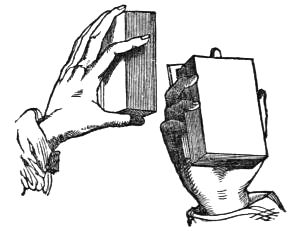
The cards are held in both hands, right hand underneath and left above, as in the engraving, where, as the bottom card is to be raised to the top, the little finger is seen between that card and those above it. By a quick movement of the right hand, the bottom card is slipped away towards the left, and is placed upon the top card, under shadow of the left hand, which is raised for the moment to allow of its passage.
This movement must be assiduously practiced before it is exhibited in public, as nothing looks more awkward than to see it clumsily performed, in which case two or three cards generally tumble on the floor.
2. TO TELL A CARD BY ITS BACK.
While shuffling the pack, cast a glance at the bottom card, make the pass, and bring it to the top. Continue to shuffle, and lay upon it by degrees as many cards as you like, say six. Then lay the pack on the table, face downwards, and divide it into seven heaps, beginning at the bottom, and leave the seventh heap larger than any of the others.
When you have done this, take one card from the top of the seventh heap, appear to calculate, and lay it, face upwards, on one of the other heaps. Do so with five more cards, thus leaving your slipped card at the top of the seventh heap. You then announce that by the aid of the six cards you will name the seventh. You name it accordingly, after carefully studying the other cards, and on asking a spectator to take it up, it will be seen that you are right.
If you place five cards above the slipped card, you will lay out six heaps, and if eight cards, there will of course be nine heaps.
3. THE CARD NAMED WITHOUT BEING SEEN.
As in the last trick, cast a glance at the bottom card, say the ace of spades. Lay out the pack in as many heaps as you like, noting where that one is laid which contains that bottom card. Ask any one to take up the top card of any heap, look at it, and replace it. You then gather up the heaps apparently by chance, but you take care to put the heap containing the bottom card upon the card which has been chosen. You then give any one the cards to cut, and on counting them over, the card that immediately follows the ace of spades is the card chosen.
If by any accident the two cards should be separated when cut, the upper card of the pack is the chosen one, and can be picked out with seeming care.
4. THE CARD TOLD BY THE OPERA GLASS.
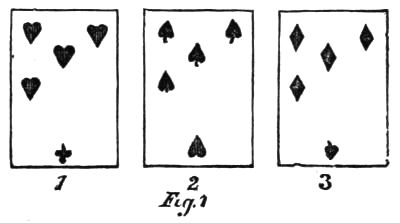
Make out a table, such as is given in Fig. 1, and place it in an opera-glass, so that the figures will be visible when you look through it. For convenience, I have made mine as seen in Fig. 2, the numbers 1, 2, 3 in each series being understood. The best plan is to write the numbers, or cut them out of a book, and paste them on a circular piece of cardboard, which must then be soaked in oil, so as to make it semi-transparent. The light will then easily pierce through it, and the figures will be better visible than if it were opaque.
It will be seen that Fig. 2 contains as much matter as Fig. 1, and that two thirds of the figures are saved by it.
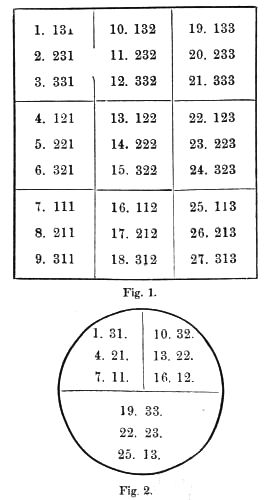
These preliminaries being arranged, tell any one to take any twenty-seven cards out of a pack, and to think of any one of them. Deal them into three heaps, and ask him in which heap it is, and what number from the top he would like it to come after the third deal. Suppose he chooses it to be the twenty-sixth card, you take up your opera-glass and look for the number 26. This you will find last but one, arranged thus—26 213 The meaning is, that if the chosen card is to be the twenty-sixth, the heap in which it was found must be for the first time placed second, the second time first, and the last time third. So you pick up the cards, taking care to keep that heap number two. You again deal them in three heaps, and this time you place the heap in which is the chosen card at the top, being number one. Deal them a third time, and on gathering up the heaps, place it at the bottom.
Then, on counting from the top, the chosen card will be found to be the twenty-sixth.
5. THE FOUR KINGS.
Take the four kings out of a pack of cards, and also two other court cards, which are not to be shown. Spread out the kings before the spectators, but conceal the two court cards between the third and fourth kings. Lay the cards face downwards on the table. Take off the bottom card, which is, of course one of the kings; show it as if by accident, and place it on the top. Take the next card, (which is one of the court cards,) and place that in the middle of the pack. Take the third card, (i. e., the second court card,) and place that also near the middle of the pack. There will then be one king at the top and three at the bottom. Ask any one to cut the cards, and to examine them, when he will find all four kings together in the middle of the pack.
It is better to use court cards to place between the third and fourth kings, because if the cards should slip aside, they would not be so readily distinguished as common cards.
6. THE FOUR ACCOMPLICES.
Let a person draw four cards from the pack, and tell him to think of one of them. When he returns you the four cards, dexterously place two of them under the pack, and two on the top. Under those at the bottom you place four cards of any sort, and then, taking eight or ten from the bottom cards, you spread them on the table, and ask the person if the card he fixed on be among them. If he say no, you are sure it is one of the two cards on the top. You then pass two cards to the bottom, and drawing off the lowest of them, you ask if that be not his card. If he again say no, you take that card up, and bid him draw his card from the bottom of the pack. If the person say his card is among those you first drew from the bottom, you must dexterously take up the four cards that you put under them, and placing those on the top, let the other two be the bottom cards of the pack, which draw in the manner before described.
7. TO TELL THE CARD THOUGHT OF IN A CIRCLE OF TEN.
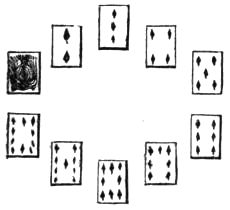
Place the first ten cards of any suit in a circular form, as in the annexed figure; the ace being counted as one. Request a person to think of a number or card, and to touch also any other number or card; desire him to add to the number of the card he touched the number of the cards laid out, that is, ten; then bid him count that sum backward, beginning at the card he touched, and reckoning that card at the number he thought of; when he will thus end it at the card or number he first thought of, and thereby enable you to ascertain what that was. For example, suppose he thought of the number three, and touched the sixth card, if ten be added to six, it will of course make sixteen; and if he count that number from the sixth card, the one touched, in a retrograde order, reckoning three on the sixth, four on the fifth, five on the fourth, six on the third cards, and so on; it will be found to terminate on the third card, which will therefore show you the number the person thought of. When the person is counting the numbers, he should not, of course, call them out aloud.
8. TO GUESS THE CARD THOUGHT OF.
To perform this trick, the number of cards must be divisible by 3, and it is more convenient that the number should be odd. Desire a person to think of a card; place the cards on the table with their faces downward, and, taking them up in order, arrange them in three heaps, with their faces upward, and in such a manner that the first card of the pack shall be first in the first heap, the second the first in the second heap, and the third the first of the third; the fourth the second of the first, and so on. When the heaps are completed, ask the person in which heap the card he thought of is, and when he tells you, place that heap in the middle; then turning up the packet, form three heaps, as before, and again inquire in which heap the card thought of is; form the three heaps afresh, place the heap containing the card thought of again in the center, and ask which of them contains the card. When this is known, place it as before, between the other two, and again form three heaps, asking the same question. Then take up the heaps for the last time, put that containing the card thought of in the middle, and place the packet on the table with the faces downward, turn up the cards till you count half the number of those contained in the packet; twelve, for example, if there be twenty-four, in which case the twelfth card will be the one the person thought of. If the number of the cards be at the same time odd, and divisible by three, such as fifteen, twenty-one, twenty-seven, &c., the trick will be much easier, for the card thought of will always be that in the middle of the heap in which it is found the third time, so that it may be easily distinguished without counting the cards; in reality, nothing is necessary but to remember, while you are arranging the heap for the third time, the card which is the middle one of each. Suppose, for example, that the middle card of the first heap be the ace of spades; that the second be the king of hearts; and that the third be the knave of hearts: if you are told that the heap containing the required card is the third, that card must be the knave of hearts. You may therefore have the cards shuffled, without troubling them any more; and then, looking them over for form's sake, may name the knave of hearts when it occurs.
9. TO TELL THE NUMBER OF CARDS BY THE WEIGHT.
Take a pack of cards, say forty, and privately insert among them two cards rather larger than the others; let the first be the fifteenth, and the other the twenty-sixth, from the top. Seem to shuffle the cards, and cut them at the first long card; poise those you have taken off in your hand, and say, "There must be fifteen cards here;" then cut them at the second long card, and say, "There are but eleven here;" and poising the remainder, exclaim, "And here are fourteen cards." On counting them, the spectators will find your calculations correct.
AUDACITY.
Several tricks may be successfully played by sheer audacity. I once astonished a whole party by holding a pack of cards over my head, and naming each. The fact was, that I was standing exactly opposite a large mirror, in which the cards were reflected, while the spectators, having their backs to the mirror, suspected nothing.
I will give one or two tricks that depend on audacity for success.
10. THE CARD FOUND AT THE SECOND GUESS.
Offer the cards to any one, and let him draw one. You then hold the cards behind your back, and tell him to place his card on the top. Pretend to make a great shuffling, but only turn that card with its back to the others, still keeping it at the top. Then hold up the cards with their faces towards the spectator, and ask him if the bottom card is his. While doing so, you inspect his card at your leisure. He of course denies it, and you begin shuffling again furiously. "Let me do that," he will probably say; so, as you are perfectly acquainted with his card, you let him shuffle as much as he likes, and then, when you get the cards back again, shuffle until his card is at the bottom. Then pass them behind your back, make a ruffling noise with them, and show him his own card at the bottom.
11. THE CARD FOUND UNDER THE HAT.
Have a needle stuck just inside your sleeve. Hand the cards, &c., just as in the preceding trick, and tell the taker to put the card on the top. Take out the needle, and prick a hole nearly through the top left-hand corner. Replace the needle, shuffle the cards, or let any one shuffle them. Place the pack on the table, cover them with a hat, and the marked card will be known by a little raised knob on the right-hand top corner. Draw out card by card, saying whether it is that card or not, until you come to the marked one, which you throw on the table carelessly, and when you are about taking out another card, stop suddenly, and pretend to find, by some magic process, that it is the chosen card.
12. TO CALL THE CARDS OUT OF THE PACK.
Tell the spectators that you will call six cards out of the pack. Secure a card, say the ace of spades, in the palm of your hand. Throw the pack on the table, face downwards, spread out the cards, give one of the spectators your conjuring wand, and tell him, when you name a card to touch one, which you will take up.
First name the ace of spades. He touches a card, which you take up without showing the face of it. This card may be, say the eight of diamonds. Put it into your left hand, and place it upon the ace of spades, which is already there, so that the two look like one card. Then call for the eight of diamonds. Another card is touched, say the queen of clubs. This you put with the others, and, after pretending to calculate, call for the queen of clubs.
Proceed in this manner until six cards have been drawn. Then substitute the last card drawn (which is of course a wrong one) for the ace of spades, and conceal it in the palm of your hand. Then strew the others on the table, and while the eyes of the spectators are fixed upon them, get rid of the card in your left hand.
It is a good plan to ask some one to write down the names of the cards as they are called, and then to have the list called over, in order that every one may see that there has been no mistake.
13. HEADS AND TAILS.
While you are shuffling the cards, contrive to arrange quietly all their heads one way, or as many as possible, rejecting all the diamonds except the king, queen, knave, and seven, and passing them to the bottom. Put the pack upon the table, take off a number of the upper cards, and offer them for some one to choose a card from. While he is looking at it, turn the cards round, and offer them to him, in order that he may replace it. Shuffle the cards, and on looking them over, the chosen card will be standing with its head one way, while the others are reversed.
14. THE SURPRISE.
When you have discovered a card, the following plan will make a striking termination to the trick. Get the card to the bottom of the pack, and tell one of the spectators to hold the cards by one corner as tightly as he can. Give them a sharp rap with your finger, not with your hand, and all the cards will be struck out of his hold, and fall on the floor, except the bottom card, which will remain between his finger and thumb. It has a rather more dashing effect, if you put the chosen card at the top, and strike them upwards, when the whole pack will fly about the room, like a flock of butterflies, only leaving the top card in the person's grasp.
15. THE REVOLUTION.
Another neat way of finishing a trick is as follows. Get the card to the top of the pack; and taking care that all the cards are even, drop the pack on the floor, taking care just as you let go, to slip the top card a little off the rest of the pack. In falling, the resistance of the air will turn the card over, and it will rest with its face upwards on the top of the pack.
16. THE SLIPPED CARD.
Ascertain the bottom card of the pack; hold the cards in your left hand, with their faces downwards. Place your right hand upon them, and with your right fore finger slide them slowly over each other, asking some one to stop any card he chooses, by putting his finger upon it. When he has done so, open the pack at that card, but while opening it, make the pass, and bring the bottom card under the one touched. Hold up the cards, and ask the chooser to be sure of his card; hand all the cards to him, and let him shuffle as much as he chooses. Afterwards discover the card in any manner that you prefer. The following is a good plan.
17. THE NAILED CARD.
Take a flat-headed nail, and file it down until its point is as sharp as a needle, and the head quite flat. The nail should be about half an inch long, or even shorter if anything. Pass the nail through the center of any card, say the ace of spades, and conceal it in your left hand.
Take another pack of cards, get the ace of spades to the bottom, and perform the preceding trick. When the cards are returned, shuffle them about, and exchange the pierced card for the other. Put the pierced card at the bottom of the pack, and throw the cards violently against a door, when the nail will be driven in by the pressure of the other cards against its head, and the chosen card will be seen nailed to the door. The nail should be put through the face of the card, so that when the others fall on the floor, it remains facing the spectators.
18. TO ASCERTAIN THE NUMBER OF POINTS ON THREE UNSEEN CARDS.
In this amusement the ace counts eleven, the court cards ten each, and the others according to the number of their spots.
Ask any one to choose any three cards, and lay them on the table, with their faces downwards. On each of these he must place as many as with the number of the card will make fifteen. He gives you the remaining cards, and when you have them in your hand, you count them over on the pretence of shuffling them, and by deducting four, you will have the number of points on the three cards.
For example, the spectator chooses a four, an eight, and a king. On the four he places eleven cards, on the eight seven, and on the king five. There will then be twenty-six cards left. Deduct from this twenty-six four, and the result will be twenty-two, which is the number of points on the three cards, the king counting ten, added to the eight and the four.
19. TO TELL THE NUMBERS ON TWO UNSEEN CARDS.
As in the preceding trick, the ace counts eleven, and the court cards ten each. Let the person who chooses the two cards lay them on the table with their faces downward, and place on each as many as will make their number twenty-five.
Take the remaining cards and count them, when they will be found to be just as many as the points in the two cards. For example, take an ace and a queen, i. e. eleven and ten, and lay them on the table. On the ace you must put fourteen cards, and on the queen fifteen. There will be then fifteen cards in one heap, and sixteen in the other: these added together make thirty-one cards: these subtracted from the number of cards in the pack, i. e. fifty-two, leave twenty-one, the joint number of the ace and queen.
20. THE KNAVES AND THE CONSTABLE.
Select the four knaves from a pack of cards, and one of the kings to perform the office of constable. Secretly place one of the knaves at the bottom of the pack, and lay the other three, with the constable, down upon the table. Proceed with a tale to the effect that three knaves once were to rob a house; one got in at the parlor window (putting a knave at the bottom of the pack, taking care not to lift the pack so high that the one already at the bottom can be seen); one effected his entrance at the first floor window (putting another knave in the middle of the pack); and the other, by getting on the parapet from a neighboring house, contrived to scramble in at the garret window (placing the third knave at the top of the pack); the constable vowed he would capture them, and closely followed the last knave (putting the king likewise upon the top of the pack). Then request as many of the company to cut the cards as please; and tell them that you have no doubt the constable has succeeded in his object, which will be quite evident, when you spread out the pack in your hands; as the king and three knaves will, if the trick is neatly performed, be found together. A very little practice only is required to enable you to convey a knave or any other card secretly to the bottom of the pack.
21. THE PAIRS RE-PAIRED.
Tell out twenty cards in pairs, and ask ten people to take a pair each, and remember them. Take up the pairs in their order, and lay them on the table in order, according to the accompanying table, which forms a memoria technica, and may be construed, "Mutus gave a name to the Coci," (a people who have yet to be discovered.)
M U T U S[2]
1 2 3 2 4
D E D I T
5 6 5 7 3
N O M E N
8 9 1 6 8
C O C I S
10 9 10 7 4
Arranging these words in your mind on the table, take the first card of the first pair, lay it on M in Mutus, and the second on the M in Nomen. The next pair goes entirely in Mutus, being two U's. The first card of the second pair goes on T in Mutus, and the second on T in Dedit; and so on until all the cards are laid in their places.
Ask each person in succession in which rows his cards are, and you can immediately point them out. For example, if he says the second and third row, you point out the second and fourth cards in those rows, because they both represent the letter E. If another says the first and last rows, you point out the last cards in each, because the cards represent S in Mutus and S in Cocis. It will be seen that the whole table consists of ten letters, each repeated, which will always point out the positions of the pairs if they are put in the places of those letters. Any number of bystanders may choose pairs, and to make the trick more mysterious, the pairs may be placed on the table back upwards.
23. THE QUEENS DIGGING FOR DIAMONDS.
Select from a pack the aces, kings, queens, and knaves, together with four common cards of each suit. Lay down the four queens in a row, and say, "Here are four queens going to dig for diamonds. (Lay a common diamond over each queen.) They each took a spade with them (place a common spade on each diamond) and dug until they were nearly tired. Their four kings, thinking that they might be attacked by robbers, sent four soldiers to keep guard. (Lay an ace on each spade.) Evening came, and the queens had not returned, so the kings, fearing that they might have come to harm, became uneasy and set off themselves. (Place a king on each ace.) They were only just in time, for as they came along, they met their queens being carried off by four villains (lay a knave on each king), who, although only armed with clubs (place a common club on each knave), had overpowered the guards and driven them off. But the four kings, being possessed of bold hearts (lay a common heart over each king), soon vanquished the villains, and bound them." Gather up the cards, place the heaps upon each other and direct some one to cut them. Have them cut four or five times, and continue to do so until a common heart appears at the bottom. Then continue the tale, and say, "The party then returned home in the following order. First the queen, (lay down the top card) with the diamonds which she had found (lay down the second card, which will be a diamond) in one hand, and her spade (the third card will be a spade) in the other, &c., &c." You continue dealing out the cards in that manner, and it will be found that they will be in precisely the same order as when they were taken up.
24. THE TRIPLE DEAL.
Take any twenty-one cards, and ask some person to choose one from them. Lay them out in three heaps, and ask the person who took the card in which heap it is. You may turn your back while he searches. Gather them up and put that heap between the other two. Do this twice more, and the chosen card will always be the eleventh from the top.
25. THE QUADRUPLE DEAL.
This is a variation of the preceding. Take twenty-four cards, and lay them in four heaps. Act as in No. 24, putting the heap in which is the chosen card second. The tenth card will be the one thought of.
26. THE CARD DISCOVERED BY THE TOUCH OR SMELL.
Offer the long card, or any other that you thoroughly well know; and, as the person who has drawn it holds it in his hand, pretend to feel the pips or figures on the under side with your fore finger, or smell it, and then sagaciously declare what card it is.
If it be the long card, you may give the pack to the person who drew it, and allow him either to replace it or not. Then take the pack, and feel whether it be there or not; shuffle the cards in a careless manner, and without looking at it, decide accordingly.
27. THE INGENIOUS CONFEDERACY.
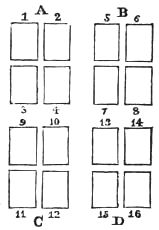
Lay sixteen cards on the table, in four divisions, four cards in each, with their faces upwards. You then state that you will leave the room, and, on your return, will name any one card which may have been touched in your absence, on one of the company (your confederate) pointing out a passage from any author to be read to you, on your return, by any person present. To perform this trick, the cards should be placed in the order in which they appear in the cut inserted on the next page, you previously making your confederate acquainted with your mode of proceeding, which is thus: The cards are supposed to be divided into four classes, as A, B, C, D; you likewise agree to class everything in the world under the four denominations of biped, quadruped, vegetable, and mineral: class A stands for bipeds, B for quadrupeds, C for vegetables, and D for minerals. Each class must now be subdivided in the same manner: in class A, No. 1 is the biped, 2 the quadruped, 3 the vegetable, and 4 the mineral; and so with the other classes. When performing the trick, your confederate must take care to select an appropriate passage. For example, we will suppose the card No. 4 to have been touched, and that a volume of Moore having been presented to your confederate to select from, he gives the following lines to be read:
"Breathes there the slave so lowly, Condemned to chains unholy, Who, could he burst his bonds at first, Would pine beneath them slowly?" &c.
The first word which can be classed as above is slave, you may thus be certain that the card touched is in class A, a slave being a biped. The next word you can fix upon is chains, which being commonly made of some metal, you rank in the mineral class, and know that card No. 4 was the one touched, it being the mineral of the biped class.
Supposing the trick to be repeated, as is very likely, and that a volume of Byron is given to your confederate, who selects the passage commencing—
"Know ye the land, where the cypress and myrtle Are emblems of deeds that are done in their clime?" &c.
you know, "cypress" being the first word that can be classed, the card touched must be in class C (vegetable), and the next word "myrtle" being also a vegetable, the card touched must have been No. 11, which is the vegetable of the vegetable class. Many appropriate passages may be easily selected, and your confederate should select a long passage to be read, as it gives greater scope, and helps to mislead the rest of the company; for should they imagine that the card is discovered by the number of lines read, and they touch the same card again, he can select another passage, desiring them to read only as many lines as they choose.
29. "HOLD IT FAST."
You commence by asking the most athletic person in company whether he is nervous; he will most probably answer in the negative; you then ask whether he thinks he can hold a card tightly. If he answers, No, ask the question of some one else, till you obtain an answer in the affirmative. You then desire the party to stand in the middle of the room, and holding up the pack of cards, you show him the bottom card, and request him to proclaim what card it is; he will say it is the knave of hearts; you then tell him to hold the card tightly at the bottom, and look to the ceiling. While he is looking up, you ask him if he recollects his card; if he says, Yes, desire him to draw it away, and ask him what it is; he will, of course, answer, the knave of hearts; tell him he has made a mistake, for if he look at his card, he will find it to be the knave of spades, which will be the case. You then give him the remainder of the pack, telling him that if he looks over it, he will find the knave of hearts in quite a different situation.
This feat, though it excites much admiration, is very simple. You procure an extra knave of hearts, and cut it in half, keeping the upper part, and throwing away the lower. When commencing your feat, get the knave of spades to the bottom of the pack, and lay over the upper part of it, unperceived, your half knave of hearts; and, under pretence of holding the pack very tight, throw your thumb across the middle of the knave, so that the joining may not be perceived, for the legs of those two knaves are so much alike that there is no danger of detection. You, of course, give him the legs of the knave of spades to hold, and when he has drawn the card away, hold your hand so that the faces of the cards will be turned towards the floor, and take an opportunity of removing the half-knave: you may vary the feat by having a half-knave of spades.
30. THE CHARMED TWELVE.
Let any one take a pack of cards, shuffle, take off the upper card, and, having noticed it, lay it on the table, with its face downward, and put so many cards upon it as will make up twelve with the number of spots on the noted card. For instance: if the card which the person drew was king, queen knave, or ten, bid him lay that card, with its face downward, calling it ten; upon that card let him lay another, calling it eleven, and upon that card, another, calling it twelve; then bid him take off the next uppermost card: suppose it to be nine, let him lay it down on another part of the table, calling it nine, upon it let him lay another, calling it ten, upon the latter another, calling it eleven, and upon that another, calling it twelve; then let him go to the next uppermost card, and so proceed to lay out in heaps, as before, until he has gone through with the whole pack.
If there be any cards at the last, that is, if there be not enough to make up the last noted card, the number twelve, bid him give them to you; then, in order to tell all the number of spots contained in all the bottom cards of the heaps, do thus: from the number of heaps subtract four, multiply the remainder by thirteen, and, to the product, add the number of remaining cards, which he gave you; but if there were but four heaps, then those remaining cards alone will show the number of spots on the four bottom cards. You need not see the cards laid out, nor know the number of cards in each heap, it being sufficient to know the number of heaps, and the number of remaining cards, if there be any, and therefore you may perform this feat as well standing in another room, as if you were present.
31. THE TRICK OF THIRTY-ONE.
A trick often introduced by "sporting men," for the purpose of deceiving and making money by it. It is called "thirty-one." I caution all not to play or bet with a man who introduces it: for, most probably, if he does not propose betting on it at first, he will after he gets you interested, and pretend to teach you all the secrets of it, so that you can play it with him; and perhaps he will let you beat him if you should play in fun; but if you bet, he will surely beat you. It is played with the first six of each suit—the aces in one row, the deuces in another, the threes in another; then the fours, fives and sixes—all laid in rows. The object now will be to turn down cards alternately, and endeavor to make thirty-one points by so turning, or as near to it as possible, without overrunning it; and the man who turns down a card, the spots of which make him thirty-one, or so near it that the other cannot turn down one without overrunning it, wins. This trick is very deceiving, as all other tricks are, and requires much practice to be well understood. The persons using it I have known to attach great importance to it, and say that Mr. Fox, of England, was the first to introduce it; and that it was a favorite amusement of his. The chief point of this celebrated trick is to count so as to end with the following numbers, viz., 3, 10, 17 or 24. For example, we will suppose it your privilege to commence the count: you would commence with 3, and your adversary would add 6, which would make 9; it would then be your policy to add 1, and make 10; then, no matter what number he adds, he cannot prevent you counting 17, which number gives you the command of the trick. We will suppose he add 6, and make 16; then, you add 1, and make 17, then he to add 6, and make 23, you add 1, and make 24, then he cannot possibly add any number to count 31: as the highest number he can add is 6, which would only count 30, so that you can easily add the remaining 1, or ace, and make 31. There are, however, many variations to the trick.
32. TO TELL THE NAMES OF THE CARD BY THE WEIGHT.
You desire any person to cut a pack of cards as often as he pleases, and undertake, by weighing each card for a moment on your finger, not only to tell the color, but the suit and number of spots, and, if a court-card, whether it be king, queen, or knave.
You must have two packs of cards exactly alike: one pack to be constantly in use during the evening in performing your other tricks; the second, or prepared pack, in your pocket, which take an opportunity of exchanging, so that it may be believed that the pack of cards of which you tell the names is the same as that you have been using with your other tricks, and which they must know have been well shuffled.
The manner of preparing your pack (which must be done previously) is by the following line, which you commit to memory, the words in italics forming the key:
Eight Kings threa-tened to save nine fair Ladies for one sick Knave. Eight King three ten two seven nine five Queen four ace six Knave,
You will perceive that this is a kind of artificial memory, formed by the circumstances of the initial letter of the words in the line and the names of the cards being identical, as well as the near resemblance of some of the words. The word "threatened" is divided into two words, in order that it may answer for the three and ten; you should pay attention to this, or you will be very likely to forget the ten altogether, which would set you entirely wrong; you should likewise commit to memory the order in which the suits come viz.: hearts—spades—diamonds—clubs.
You should now separate the different suits, and lay them on the table, face upwards, placing heart first, spades next, diamonds next, and clubs last. Having done so, begin to sort (to yourself), according to your key: take up the eight of hearts, placing it in the left hand with its back to the palm; then the king of spades, which you lay over it, next the three of diamonds, next the ten of clubs, then the two of hearts, and so on, until you finish your line, which will terminate with the knave of hearts. You then take up the eight of spades, and go on in the same way till you come to the knave of spades, when you begin again with the eight of diamonds, and go on until you come to the knave of diamonds, and beginning again with the eight of clubs, you go on until you come to the knave of clubs, which finishes the pack, and which is now ready for use; when you have made your exchange, and brought forward your prepared pack, hand it round to be cut.
You now want to know the first card, as a clue to the rest; and therefore take off the top card, and holding it up between you and the light, you see what the card is, saying at the same time, that the old way of performing the trick was by doing so, but that this was very easily detected.
Having thus obtained a knowledge of the first card, which we will suppose to be the ten of diamonds, you then take the next card on your finger, and while pretending to weigh it, you have time to recollect what is the next word in your key, to ten'd, which is to—you consequently know that this card is a two; you must then recollect what suit comes after diamonds, which is clubs; you, therefore, declare the card you are now weighing on your finger to be the two of clubs; the next will of course be the seven of hearts, the next to that the nine of spades, and so on as long as you please.
TRICKS WITH CARDS, THAT REQUIRE APPARATUS.
I shall only give one or two of these tricks, because, in general, the apparatus required for cards is exceedingly expensive. Those that I shall give require but little apparatus, and any boy with the use of his hands can make it.
33. THE CARDS IN THE VASE.
Make a vase with five divisions, two of which hold an entire pack of cards, and the remaining three are only large enough just to admit one card each, as in the figure. A strong silk thread is fastened at A, passes over the three little compartments, through the bottom of the vase, and running over two pulleys, terminates in the weight at B.
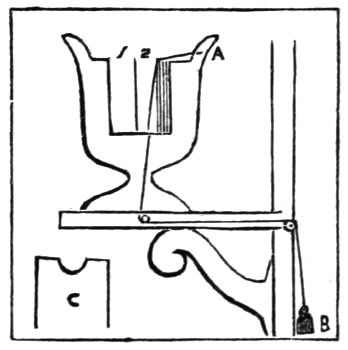
Take three cards, say the ace of spades, the ten of diamonds, and the king of hearts, out of a pack of cards, and put one into each of the little divisions pressing the thread down into the bottom of each division. If the cards are left, the weight will descend, and the string being tightened, will push the cards upwards. So a kind of trigger shelf is made, on which the weight rests. The remainder of the pack you put into division 2.
When you show the trick, you take another pack of cards exactly like that which is already in the vase, and handing it to three persons successively, compel them to choose the ace of spades, the ten of diamonds, and the king of hearts.[3] Let some one shuffle the cards, and when this is done, put the pack into division 1. Tell the spectators that when you have struck three times on the table, the cards will come out of the vase. At the third stroke, loosen the catch on which the weight stands, by means of the string that communicates with your table, and the three cards will rise slowly up. In order to show that the cards have really vanished from the pack, take the pack out of division 2 and let any one examine it.
If you prefer, you can draw the thread yourself, by having a kind of a pedal under your table, to which the other end of the string is attached, instead of being fastened to the weight B. If you prefer the weight, you must have a small shelf for the weight to rest upon, when it has descended sufficiently low, or the cards will be forced entirely out by the thread. C is a representation of one of the divisions, showing the semi-circular cut that is made in them for the convenience of taking out the cards.
34. THE METAMORPHOSIS.
In this most excellent trick you choose from the pack the four eights and the two of diamonds; you put the four eights in your left hand and the two on the table; you take in the two, placing an eight on the table, and they are all twos. You exchange the two for the eight, and they all become black cards; you again exchange the eight for the two, and they all turn red; and after again exchanging, you have, as before, the four eights and the two of diamonds.
The method of accomplishing this trick is as follows: Get three plain white cards, exactly like playing cards, and paint them as in the engraving. Mix them with an ordinary pack, and when you are searching for the four eights, with which you say you are going to perform a trick, take them from the pack, and with them an ordinary eight of clubs and a two of diamonds.
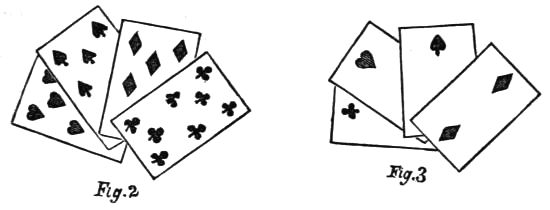
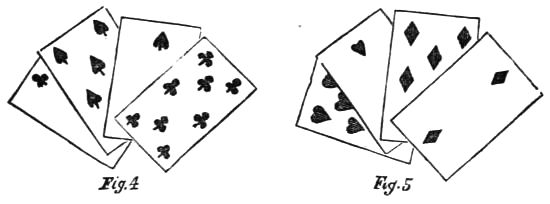
Show the cards as in fig. 2, making the spectators observe that there are the four eights. Put the two of diamonds behind the eight of clubs, and lay the eight on the table. The two must be inserted before the eight is removed, or the mystery of the marking will be apparent. Close the cards, turn them over, and spread them out, when they will appear as in Fig. 3. Take in the eight and lay the two on the table; close the cards, and while shuffling them, turn card No. 2 the other way upwards. The cards will then all appear black, as in Fig. 4. Take in the two and remove the eight, turn them over, and spread them out, when they will appear all red, as in Fig. 5. Finally, take the eight, replacing the two on the table, reverse No. 2, and you will have the four eights and the two of diamonds, just as they were at first. You must invent plenty of talk during your changes. If the spectators say that the cards are double, spread them out, and hold them up to the light, (for the light cannot penetrate through the places where the cards are placed over each other,) and if they are still skeptical, hand them the two of diamonds to look at, and in a moment or two hand them the eight of clubs, asking them whether they would like to examine a black card also. This will effectually disarm suspicion.
35. TO HOLD FOUR KINGS OR FOUR KNAVES IN YOUR HAND, AND TO CHANGE THEM SUDDENLY INTO BLANK CARDS, AND THEN TO FOUR ACES.
It is necessary to have cards made on purpose for this trick; half cards, as they may be properly termed, that is, one half kings or knaves, and the other half aces. When you lay the aces one over the other, of course nothing but the kings or knaves can be seen; and on turning the kings or knaves downward, the four aces will make their appearance. You must have two perfect cards, one a king or knave, to put over one of the aces, else it will be seen; and the other an ace, to lay over the kings or knaves. When you wish to make them all appear blank, lay the cards a little lower, and by hiding the aces, they will appear white on both sides; you may then ask which they wish to have, and may show kings, aces, or knaves, as they are called for.
36. TO CHANGE A CARD IN A PERSON'S HAND.
Cut very neatly the spots from a three of spades. Lay the pierced card on an ace of diamonds, and rub pomatum on the ace of diamonds through the places which the spades occupied. Remove the pierced card, and sprinkle the ace of diamonds with jet powder, which adhering to the pomatum, will transform the card into a three of spades.
Place the transformed card at the bottom of the pack, and show a person what card it is. Make him declare it that every one may hear, then place it on the table, face downwards, and push it over the cloth to the spectator, which action will rub off all the jet powder. Tell him to place his hand on the card. Let a three of spades be at the top of the pack, and an ace of diamonds the second from the bottom. Show another person the ace of diamonds, and ask him to tell the name of the card openly. Put the pack down, face downwards, and in so doing make the pass, and bring the three of spades to the bottom.
Tap the hand of the person who is guarding the card, and then tell him to take up the card and show it to the spectators, when it will be seen to be the ace of diamonds. Simultaneously, you take up the pack, and show the three of spades at the bottom.
37. THE CARD IN THE EGG.
To perform this feat, provide a round hollow stick, about ten inches long and three quarters of an inch in diameter, the hollow being three eighths of an inch in diameter. Also, have another round stick to fit this hollow, and slide in it easily, with a knob to prevent its coming through. Our young readers will clearly understand our meaning, when we say, that in all respects it must resemble a pop-gun, with the single exception that the stick which fits the tube, must be of the full length of the tube exclusively of the knob.
Next steep a card in water for a quarter of an hour, peel off the face of it, and double it twice across, till it becomes one fourth of the length of a card, then roll it up tightly, and thrust it up the tube till it becomes even with the bottom. You then thrust in the stick at the other end of the tube till it just touches the card.
Having thus provided your magic wand, let it lie on the table until you have occasion to make use of it, but be careful not to allow any person handle it.
Now take a pack of cards, and let any person draw one; but be sure to let it be a similar card to the one which you have in the hollow stick. This must be done by forcing. The person who has chosen it will put it into the pack again, and, while you are shuffling, you let it fall into your lap. Then, calling for some eggs, desire the person who drew the card, or any other person in the company, to choose any one of the eggs. When he has done so, ask if there be anything in it? He will answer there is not. Place the egg in a saucer; break it with the wand, and pressing the knob with the palm of your right hand, the card will be driven into the egg. Then show it to the spectators.
A great improvement may be made in this feat, by presenting the person who draws the card with a saucer and a pair of forceps, and instead of his returning the card to the pack, desire him to take it by the corner with the forceps and burn it, but to take care and preserve the ashes; for this purpose you present him with a piece of paper (prepared as hereafter described), which he lights at the candle; but a few seconds after, and before he can set the card on fire, it will suddenly divide in the middle and spring back, burning his fingers if he do not drop it quickly. Have another paper ready and desire him to try that; when he will most likely beg to be excused, and will prefer lighting it with the candle.
When the card is consumed, say that you do not wish to fix upon any particular person in company to choose an egg, lest it might be suspected he was a confederate; therefore, request any two ladies in company to choose each an egg, and having done so, to decide between themselves which shall contain the card; when this is done, take a second saucer, and in it receive the rejected egg, break it with your wand, and show the egg round to the company; at the same time drawing their attention to the fact of those two eggs having been chosen from among a number of others, and of its not being possible for you to have told which of them would be the chosen one.
You now receive the chosen egg in the saucer containing the ashes, and having rolled it about until you have blacked it a little, blow the ashes from around it into the grate; you then break the egg with the same wand, when, on touching the spring, the card will be found in the egg.
The method of preparing the paper mentioned in the above feat is as follows: Take a piece of letter paper, about six inches in length and three quarters of an inch in breadth, fold it longitudinally, and with a knife cut it in the crease about five inches down; then take one of the sides which are still connected at the bottom, and with the back of the knife under it, and the thumb of the right hand over it, curl it outwards as a boy would the tassels of his kite; repeat the same process with the other side, and lay them by for use. When about using them, (but not till then, as the papers will soon lose their curl if stretched,) draw them up so as to make them their original length, and turn the ends over a little, in order that they may remain so; when set on fire, they will burn for a minute or two, until the turn-over is burnt out, when the lighted ends will turn over quickly, burning the fingers of the holder: this part of the trick never fails to excite the greatest merriment.
38. THE FIFTEEN THOUSAND LIVRES.
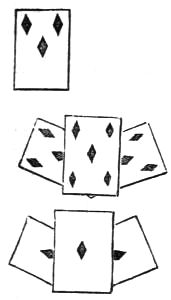
For this trick, prepare two cards like the accompanying engraving; and have a common ace and five of diamonds. Hold down the five of diamonds and the two prepared cards, as shown in the next engraving; and say, "A certain Frenchman left fifteen thousand livres, which are represented by these three cards, to his three sons; the two youngest agreed to leave their five thousand, each of them, in the hands of the elder, that he might improve it." While you are telling this story lay the five on the table, and put the ace in its place; at the same time artfully change the position of the other two cards, so that the three cards appear as in this engraving. Then, resuming the tale, relate that "The eldest brother, instead of improving the money, lost it all by gaming, except three thousand livres, as you here see (laying the ace on the table, and taking up the five). Sorry for having lost the money, he went to the East Indies with these three thousand, and brought back fifteen thousand." Then show the cards in the same position as at first. To render this deception agreeable, it must be performed with dexterity, and should not be repeated, but the cards immediately put in the packet; and you should have five common cards ready to show, if any one desire to see them.
HINTS TO AMATEURS.
The following hints are of considerable importance to the amateur exhibitor.
1. Never acquaint the company beforehand with the particulars of the feat you are about to perform, as it will give them time to discover your mode of operation.
2. Endeavor, as much as possible, to acquire various methods of performing the same feat, in order that if you should be likely to fail in one, or have reason to believe that your operations are suspected, you may be prepared with another.
3. Never yield to the request of any one to repeat the same feat, as you thereby hazard the detection of your mode of operation; but do not absolutely refuse, as that would appear ungracious. Promise to perform it in a different way, and then exhibit another which somewhat resembles it. This maneuver seldom fails to answer the purpose.
4. Never venture on a feat requiring manual dexterity, till you have previously practiced it so often, as to acquire the necessary expertness.
5. As diverting the attention of the company from too closely inspecting your maneuvers is a most important object, you should manage to talk to them during the whole course of your proceedings. It is the plan of vulgar operators to gabble unintelligible jargon, and attribute their feats to some extraordinary and mysterious influence. There are few persons at the present day credulous enough to believe such trash, even among the rustic and most ignorant; but, as the youth of maturer years might inadvertently be tempted to pursue this method, while exhibiting his skill before his younger companions, it may not be deemed superfluous to caution him against such a procedure. He may state, and truly, that everything he exhibits can be accounted for on rational principles, and is only in obedience to the unerring laws of Nature; and although we have just cautioned him against enabling the company themselves to detect his operations, there can be no objection (particularly when the party comprises many younger than himself) to occasionally show by what simple means the most apparently marvelous feats are accomplished.
CURE FOR TROUBLESOME SPECTATORS.
It will sometimes happen at an early stage of the performance, that the ultimate success of the whole is likely to be endangered by a troublesome person, (generally a naughty boy,) who will persist in crying out, "I know how it is done!"—at the same time continually advancing to the table, from which it is, of course, the business of the conjurer to keep his youthful admirers. Should this be the case, the magic whistles may be produced, and the remark made, that now the troublesome boy shall show the company a trick. Having taken up one of the whistles, which has previously been filled with flour or magnesia, dust or soot, proceed to give a few directions, particularly impressing on him the necessity of blowing hard, because the whistle you place in his hand is perforated with a number of holes. The would-be magician is, therefore, excessively mortified, on applying his mouth and blowing hard, to receive the powder in his face. Any turner will make such a whistle, it being nothing more than the usual shaped toy perforated at the top with a number of holes.
THE SECRET OF VENTRILOQUISM.
The main secret of this surprising art simply consists in first making a strong, deep inspiration, by which a considerable quantity of air is introduced into the lungs, to be afterwards acted upon by the flexible powers of the larynx, or cavity situated behind the tongue, and the trachea, or windpipe; thus prepared, the expiration should be slow and gradual. Any person, by practice, can, therefore, obtain more or less expertness in this exercise; in which, though not apparently, the voice is still modified by the mouth and tongue; and it is in the concealment of this aid, that much of the perfection of ventriloquism lies.
But the distinctive character of ventriloquism consists in its imitations being performed by the voice seeming to come from the stomach: hence its name, from venter, the stomach, and loquor, to speak. Although the voice does not actually come from that region, in order to enable the ventriloquist to utter sounds from the larynx without moving the muscles of his face, he strengthens them by a powerful action of the abdominal muscles. Hence, he speaks by means of his stomach; although the throat is the real source from whence the sound proceeds. It should, however, be added, that this speaking distinctly, without any movement of the lips at all, is the highest perfection of ventriloquism, and has but rarely been obtained. Thus, MM. St. Gille and Louis Brabant, two celebrated French ventriloquists, appeared to be absolutely mute while exercising their art, and no change in their countenances could be discovered.
It has lately been shown, that some ventriloquists have acquired by practice the power of exercising the veil of the palate in such a manner, that, by raising or depressing it, they dilate or contract the inner nostrils. If they are closely contracted, the sound produced is weak, dull, and seems to be more or less distant; if, on the contrary, these cavities are widely dilated, the sound will be strengthened, the voice become loud, and apparently close to us.
Another of the secrets of ventriloquism, is the uncertainty with respect to the direction of sounds. Thus, if we place a man and a child in the same angle of uncertainty, and the man speaks with the accent of a child, without any corresponding motion in his mouth or face, we shall necessarily believe that the voice comes from the child. In this case, the belief is strengthened by the imagination; for if we were directed to a statue, as the source from which we were to expect sounds to issue, we should still be deceived, and refer the sounds to the lifeless stone or marble. This illusion will be greatly assisted by the voice being totally different in tone and character from that of the man from whom it really comes. Thus, we see how easy is the deception when the sounds are required to proceed from any given objects, and are such as they actually yield.
The ventriloquists of our time have carried their art still further. They have not only spoken by the muscles of the throat and the abdomen, without moving those of the face, but have so far overcome the uncertainty of sound, as to become acquainted with modifications of distance, obstruction, and other causes, so as to imitate them with the greatest accuracy. Thus, each of these artists has succeeded in carrying on a dialogue; and each, in his own single person and with his own single voice, has represented a scene apparently with several actors. These ventriloquists have likewise possessed such power over their faces and figures that, aided by rapid changes of dress, their personal identity has scarcely been recognized among the range of personations.
Vocal imitations are much less striking and ingenious than the feats of ventriloquism. Extraordinary varieties of voice may be produced, by speaking with a more acute or grave pitch than usual, and by different contractions of the mouth. Thus may be imitated the grinding of cutlery on a wheel, the sawing of wood, the frying of a pancake, the uncorking of a bottle, and the gurgling noise in emptying its contents.