THE MAGIC OF ART.
Reading edition
"Tired at first sight with what the Muse imparts, In fearless youth we tempt the height of arts."
An almost endless source of amusement, combining at the same time a considerable amount of instruction, may be obtained in the following manner. Take a card or piece of pasteboard, or even stiff paper, and draw upon it the form of an egg—an oval in outline. The dimensions of the oval are immaterial, and the experimenter may suit his own fancy in this respect. With a stout needle, or tracing point, prick quite through the outline, for the purposes of tracing. Some of our readers may be unacquainted with the mode of tracing an outline, and it may be advisable to particularize one method among many. Having pricked out the oval upon the card, get a little red or black lead, powdered, and placing the card upon apiece of drawing paper—any white paper will however do—rub it over the pricked-out oval, which will be found to be transferred to the white paper beneath, thus:
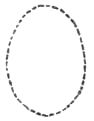
The powder may be applied either with a piece of wool or wadding, or by means of a dry camel's-hair pencil; care should be taken not to let the tracing-powder get beyond the edge of the pricked card, as in that case a soiled, dirty appearance is given to the tracing. The pierced card will serve, if carefully done, for hundreds of tracings, and it is obviously the best plan to take a little extra pains with that in the first instance.
With this traced oval for a basis, (a little further on we shall speak of other figures, to be used singly or in combination with each other) any one with a very little skill will be able to form an infinite number of objects.
The best drawing tool will be found to be an ordinary black lead pencil.
Figs. 1, 2, 3, 4, 5, 6 are very easy results, suggestive also of others. The rules of procedure are the same in all. Leaving the traced-out oval at first in its dotted form, with the pencil you draw a horizontal line as the basis of your figure. Let this and the other lines, which serve merely as the scaffolding of your figure, be done faintly or in dots. Next, draw a line through the center of the oval and perpendicular to the first. These will ensure your making the object square and properly balanced. After this you may draw lines parallel to the others: but these are not so material, although they serve as guides.
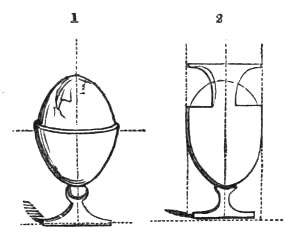
Now the imagination and fancy may step in to produce forms having the oval for a foundation; and not only is a very rational source of amusement opened out, but the opportunity is given to a cultivation of the noble art of design, whether as applied to utility or ornament.
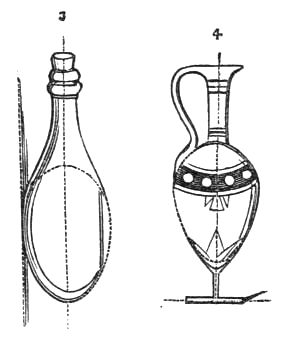
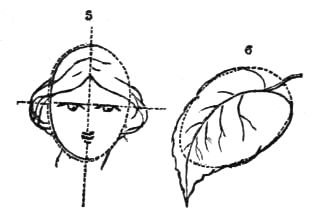
It is obvious to remark that the hand of many an amateur artist will readily be able to form the oval without having recourse to the pierced card; but as this portion of our work is intended for all, we have suggested the above mode as sure to succeed under every circumstance.
Following the same plan in every particular, we subjoin some examples of what may be done with the square.
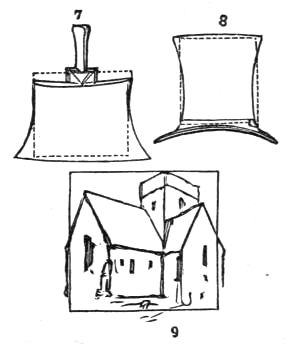
The dotted lines (figs. 7, 8) represent the traced or sketched square and plan lines; the firmer lines suggest objects formed upon that figure. In the same way the thin square outline (fig. 9) suggests the inner sketch of a church.
I stated before that the size of the fundamental oval or square made little difference; but I would recommend my younger readers to get these as large as possible, or convenient. If a large black board, such as is used in most schools, could be obtained, and the tracings prepared proportionably large (pounded chalk being used instead of the black or red powder in transferring the forms thereto), and the designs made upon these with a piece of chalk, so much the better. However, this matters little; and each one will suit his or her own taste in that respect. I now proceed to submit some examples of what may be done with other rudimentary forms.
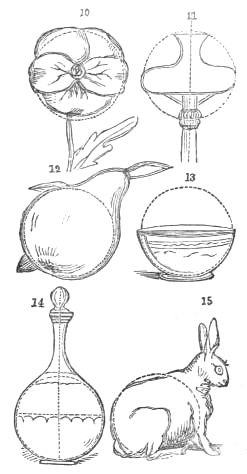
Following the instructions previously given, in place of the square suggested in Figs. 7, 8, 9, describe a circle. This may be done with a pair of compasses, or simply sketched or traced by means of any round object, such as a coin laid flat upon the paper. Figs. 10, 11, 12, 13, 14, 15, are given merely as suggestions, the circle forming an important part of their figure. The mind of the experimenter will immediately revert to other objects—thousands such are to be met with around us—having the circle or the sphere for their basis. And it will be no mean result of my labors, if any number of my younger readers are led thereby to a habit of observation, whereby they will not fail to notice that nearly all natural objects have the curved line for a basis, if they are not actually distinguishable thereby from those that are artificial.
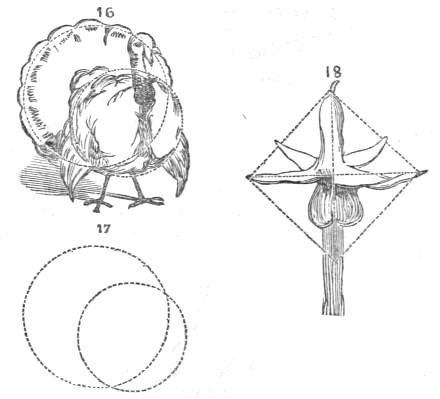
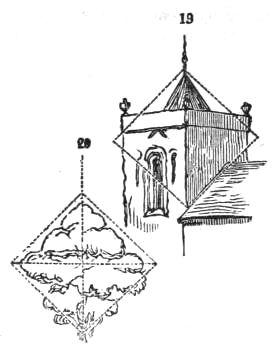
Fig. 16 is drawn upon two circles in combination with each other. The dotted lines of the plan will be readily perceived; but lest there should be any difficulty, they have been drawn separately in Fig. 17. With this duplex figure little skill will be required to present the lord of the farm yard. The three outlines, Figs. 18, 19, 20, are based upon the square turned diamond-wise, and will need no further remark: examples upon this plan may be multiplied easily. Those given will serve as hints in the several directions of flowers, foliage, and landscapes generally.
Before proceeding to show what may easily be done by a simple combination of the figures we have constructed, i. e., the oval, square, and circle, let me introduce another, which enters, by a kind of natural law, into almost all forms or groups of forms, namely, the triangle. Observe in the annexed cut, Fig. 21, how naturally, although unconsciously, the girl seats herself within one.
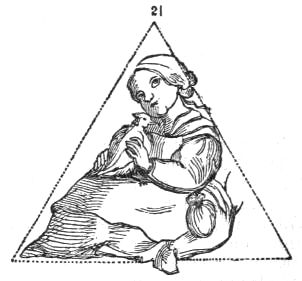
A moment's reflection will show, that from the little nymph in the cut to the great pyramid, everything that rests solidly upon the earth must take the form, more or less, of this broad-based tapering figure. Roofs of houses, churches, and towers, are all triangular in their form, as are all great trees, differing from each other only in the width of their angles.
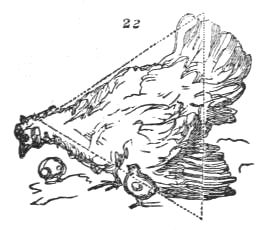
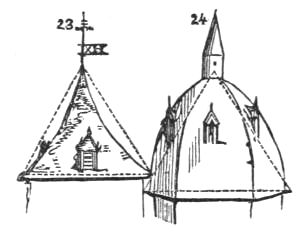
Construct a triangle,[14] and trace it according to former directions, and from the examples, Figs. 22, 23, 24, look around you for others, and make various exercises upon this foundation.
Now, to proceed to something more complicated. Suppose you had either in your mind, or sketched out upon paper, the plan of a garden; that is to say, suppose you had the dimensions of a piece of ground, and intended to lay it out as a garden, allotting so much space to this and that bed, so much to gravel walks, and wanted to see how such an arrangement would look in perspective,—in other words, in reality, for perspective, however alarming it may look in books, with its net-work of lines, cross and across, like an insoluble riddle or a monster cobweb, is nothing more than the actual representation of things as they meet the eye.
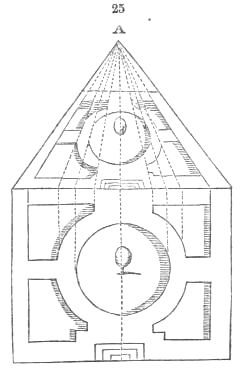
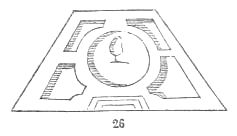
Let your plan be what is shown in the square portion of Fig. 25; at the top of this plan place your triangle, draw a line through the center of the square upwards, until it meets the top A of the triangle. Next draw lines from the corner of the beds parallel to the center line until they meet the base line of the triangle. From thence continue all these lines to the point A. These give you the width of the beds in perspective. The other sides of their figure may be easily enough found. Fig. 26 is the perspective view sought, and is what your experimental drawing would be if, having done the plan and guide-lines in pencil and the rest in pen and ink, you had erased the former with a piece of india rubber.
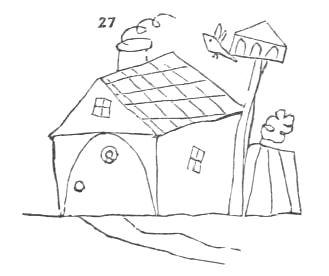
27
I do not know whether my readers regard the matter in the same light, but it appears to the present writer that this little figure—the triangle—is capable of working wonders in the hands of an amateur draughtsman, if only properly used. Of course, those regularly educated, or submitted to a long course of training as artists, are not referred to, but only the general public, which by the by, means nineteen out of every twenty individuals. I ask whether the preceding cut is any exaggeration on the average sort of result attained, not only amongst very juvenile experimenters, but those of maturer age?
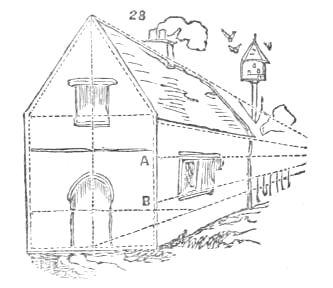
28
Everybody possessed of vision can tell, ordinarily, whether a building or other object is upright, or in the position proper to it, or necessary to its stability. By accustoming the hand to form lines, ovals, circles, squares, and triangles, and by habituating the mind to form comparisons between objects, and these and other figures, a person is put imperceptibly, as it were, in the way of depicting them with accuracy.
To proceed—let us take the above misrepresented country residence, and applying to it the previously given rules, see what we can make of it. We would first draw or trace the parallelogram shown in dotted lines; over this, we place a triangle; then drawing an upright line through the center of both, make that the base of another and lengthened triangle, as shown (see Fig. 28). Thus we get the three lines of the side and roofs; and if we knew the proportionate height of the side window, by marking the same at a, b, and carrying the lines from those points to the apex of the triangle, we get its true perspective dimensions.
The difference between the two results is as great as possible.
In Fig. 29 the triangle placed at the side of the soldier in front gives the perspective of the whole line.
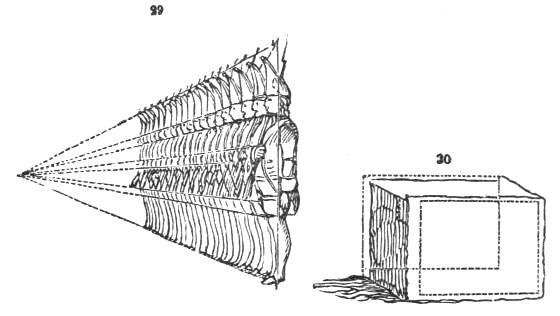
Fig. 30 shows how two parallelograms in combination assist in giving the perspective of a block of stone or bale of goods.
Fig. 31 exhibits the parallelogram and triangle in combination.
Perhaps nothing is more puzzling to the tyro in sketching than the interior of rooms and halls. In Fig. 32 a very easy method is given. Trace the outer parallelogram, and within it, a smaller one; then connect the corners of the two as shown in the cut.
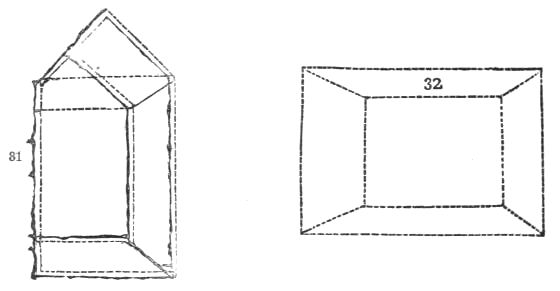
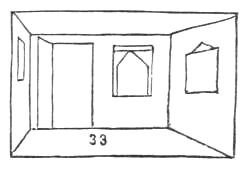
Fig. 33 is the application of the preceding.
By the present paper I intend to let you into a great secret, the secret, namely, of Comic or "Funny" Drawing—a method, in fact, which is at the bottom of all humorous, or caricature sketching. Don't let any one be alarmed, and suppose that it is intended to set you quizzing and caricaturing your friends. Far from it.
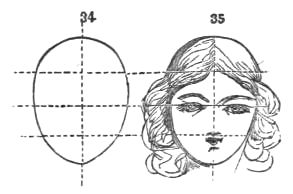
Draw the oval, Fig. 34. Divide it by transverse lines into about equal portions. You have now the basis for a face. Let the central line (across) mark the position of the eyes, the line above that the top of the forehead, the one below the bottom of the nose. By Fig. 35 you will see this worked out, and have what is considered a well proportioned face.
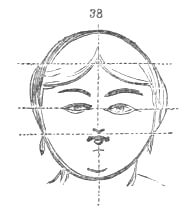
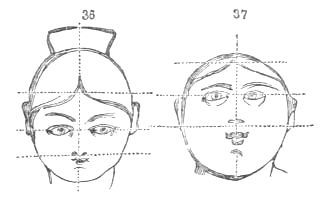
Now oddity of feature or expression is simply the result of a deviation from this regularity; and if, as you will perceive by the other Figs., 36, 37 and 38, these lines are placed higher or lower, or out of their, strictly speaking, proper places, you have, as a necessary result of such disarrangement, oddity, or comicality, which is founded upon irregularity or incongruity in things.
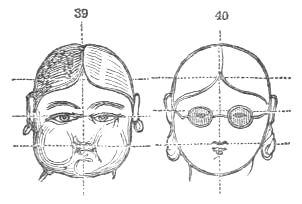
I shall carry out this hint more fully, at present merely pointing out, in reference to the next two figures, how the end is attained by placing a pair of dark spectacles upon a regularly-featured face, or adding a little flesh to the lower portion of that at Fig. 39.
But not to forget the "Art" in the "Sport," let me add, that by sketching the plain oval, and remarking whereabout the lines of their features would cut it, you may, without difficulty, attempt likenesses of your friends and companions.
Now fill your slates or sketch-books with ovals, and try the effects of which the above are but indications. Your imaginations will furnish an endless variety of subjects. The omission of one eye, or its being covered by a shade, or closed while the other stares; the nose slightly on one side, the mouth a little wider than usual—these are all sources of the humorous, which, however, is far from being heightened by ugliness. Indeed, it should be borne in mind, that great distortion or hideousness, so far from contributing to humor, destroys it by raising painful images in the mind. True humor is closely allied to kindness.
Now let us take the simplest elements of the profile or side face. This is also formed upon the oval, with a slight variation. And here we must go a little more into the "Art" than at first sight the "Sport" seems to warrant. You will perceive by Fig. 41 that the oval used for profile purposes is divided as before into four about equal portions, which are appropriated in the same manner. That is to say, the central line across is for the eye, and the other two for the limit of the hair and the bottom of the nose.
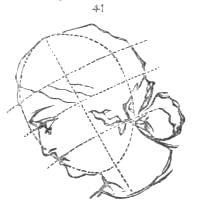
But take notice that portions are cut off—e. g., at the back where the neck is inserted; a little has to be added for forehead, chin, and hair; and some modification takes place about the region of the eye.
Suffice it that the oval forms essentially the basis of the structure of a well proportioned face, such as is shown in the Fig. (41). Draw for yourself, or trace from Fig. 41, a figure for your basis. Next make a number of these tracings upon a clean sheet of drawing paper, and marking them in very lightly, in pencil, proceed as directed in the case of the front face in the last lesson; altering the feature lines, lengthening or shortening the chin, nose, and forehead according to your fancy. This will be a sufficient guide for you, and illustrations of this are accordingly omitted here.
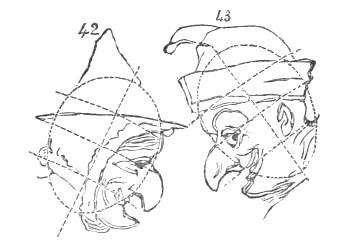
Let us proceed a step further. The last hint only dealt with the depth relatively of the several parts of the face. Now, as to their prominence. How very easily, by means of a few magic touches, which, by this time, you are magicians enough to impart, may you summon up our ancient acquaintance Mother Hubbard, or the modern hero Punch. (See Figs. 42, 43.)
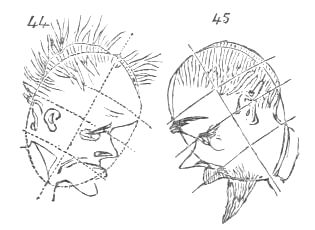
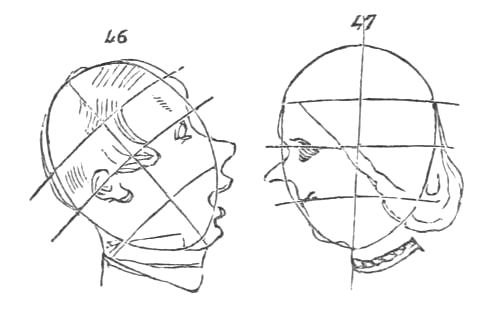
Observe that the peculiarity of these comic physiognomies consists merely in their deviation from the regularly formed head of Fig. 41. They are constructed upon that figure, which may be seen underneath in dotted lines. The variety of ways in which this exercise may be worked is infinite. Subjoined are a few. In Figs. 44 and 45, beards, mustaches, eyebrows, the hair cut absurdly short, or left redundant, joined to the sinking in of the facial angle, produce the effect of comicality. In Figs. 46, 47, the same end is attained by the simplest means, and with even less exaggeration. And here I again repeat, that the less deviation there is from the proper proportions the better.
46
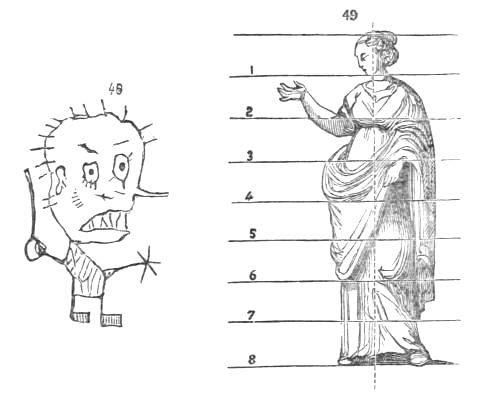
As a pendant to the comical landscape given No. 27 I give you the annexed (Fig. 48).
48
Every one will recognize it as a model drawing—such as is to be found upon walls, and occasionally upon the margins of school-books. This the artist (!) intends from a comic drawing. Of course it is no such thing.
We will new take up the grandest object of art the Human Figure. In designing the human figure, there are three principal rules to be observed:
First, the standard height of the human body may be reckoned as eight times the length of the face. Dividing the entire length by eight, as shown in the annexed diagram (Fig. 49), it will be perceived that the face comprises one of the spaces: the second reaching to the chest: the third, to above the hips; the fourth cuts the entire length into two equal parts; the fifth extends to the center of the thigh: the sixth, to the knee joint; the seventh to half way down the leg; and the eighth, to the sole of the foot.
The second rule is, that no part of the body, viewed laterally, is more than twice the thickness of the head. In very young children, however, the rule is, that where the head will go, any part of the body will follow, as the experience of most people has tested.
The third rule concerns the center of gravity. By reference to the fig. (49), a vertical line will be perceived, drawn through the center of the figure. Whenever the body is at rest upon its legs, standing at ease, as one may say, this imaginary line must always pass through its center.
We shall see more about this hereafter, at present confining ourselves to the consideration of the first two rules These must be considered as only generally true.
50
They have, however, to be well considered in connection with our present subject; for as we said with the face, any great deviation from them leads to oddity, and is at the root of caricature drawing.
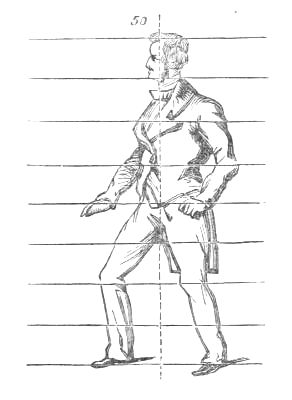
Trace out, or sketch out any size, the figures (Fig. 49 and 50), or any others for yourselves: or taking any well drawn figure in a print which may not be too costly to use so, draw with a black lead pencil upon the print similar lines to those in the figures, that is to say, divide its length into eight parts, first dropping a central line perpendicular to the ground.
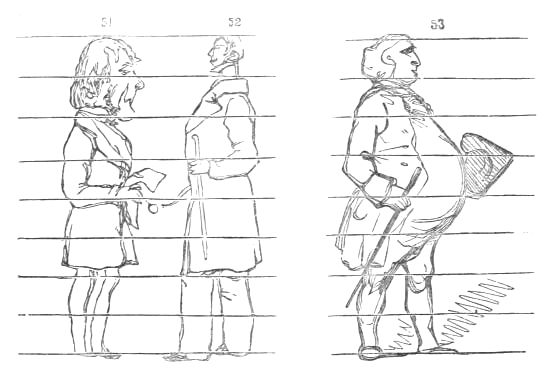
You will thus test the accuracy of the rule, and familiarize yourself with the proportions of the figure. Then, for the purpose of comic drawing, you will vary these proportions. A face too long or too short, a body too large or too small for the legs, or legs otherwise disproportionate to the rest of the body, will yield the desired results. It will be seen by the Figs. 51 and 52 that their oddity has been arrived at simply by this rule, or by the deviation from the strict rule of proportion.
51
Fig. 53 is given in illustration of the remarks upon the second rule. The form is correct enough as regards height, and deviates in the matter of lateral proportion.
We now come to consider the third principle—that of the center of gravity.
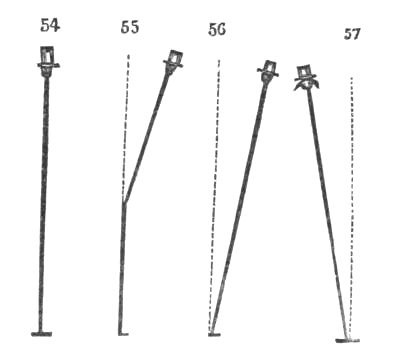
Observe in the annexed figures how the first (Fig. 54) being at rest, commends itself to the reason like a mathematical demonstration. The next diagram shows a partial deviation from the center of gravity, is in a false position, and we begin either to pity or to laugh—poor diagram! The two following figures are other cases of the same sort—we feel instinctively for them—they are very far gone. Try this rule upon your slates or sketching blocks; and after that we will go on to the next subject. In the diagrams (Figs. 58, 59), the same principle is enforced. The first is at rest, because the line passing through the center of the figure is a vertical line. In the next figure, that line being out of the vertical, the balance is disturbed, and the figure topples; so with the next. This is so plain that argument is not needed to demonstrate it.
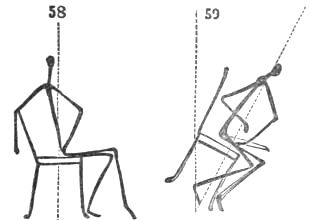
Try this also for yourselves as before. Nor need we confine our experiments to figures comparatively at rest: forms in every variety of action come under the same rule—it is a law of nature. There is a central line drawn through the whole system of the universe, through every tree, and plant, and stone, and every upright thing, could we but see it.
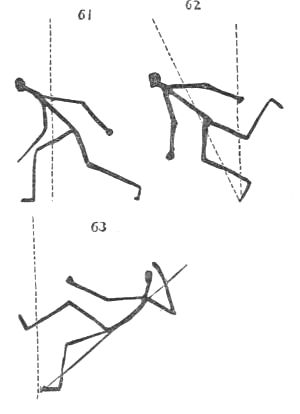
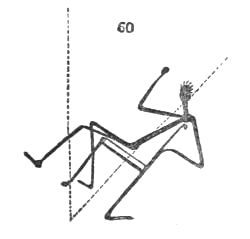
The first of the following figures is in full action, but it may go on for ever, as its balance is not in any way disturbed. The second is fast hastening to its fall. The third is much nearer still to that consummation.
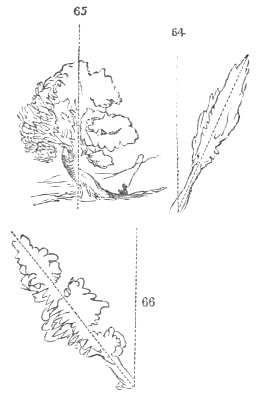
It will suggest itself to every reader to apply the rule to other objects than the human figure. Trees in the positions of Figs. 64 and 65 are never seen unless through some violent accident; they may bend, and twist, and meander, but taking the objects as a whole, a central line, vertical to the horizon, will be detected, as shown in Fig. 65.
If we turn our attention in any direction upon natural objects, the clouds, the earth, the sea, flowers, trees, or animal bodies, we cannot fail to see that a curved line is always to be made out in their forms. Indeed, just so far as they are graceful and pleasing objects to the eye, this curved line is distinguishable. On the contrary, square lines offend the eye when met with under such circumstances. It is almost impossible indeed to imagine a square cloud, a square flower, or a square horse. When we see a square headed man, we are not impressed in his favor. We may have met with representations of natural objects, such as rocks, hill tops, mountain precipices, and the like, which had a square or nearly square appearance; but such things are almost always presented to our view as phenomena—i. e. things violating the regular order or general rule of nature. This curved line, which is the line of beauty, must pervade all nature; it is the natural law; and we cannot sufficiently admire the truth that that which is most necessary is also most beautiful.
Does any one ask what particular reference these observations have to "Art in Sport?" Let us say that they alone can properly understand what is comic who have learned to appreciate what is not comic. The distance between the sublime and the ridiculous is said to be very small—only one step. At any rate, the student who best understands the first will best appreciate the second. Socrates did not disdain to write an essay upon this subject, insisting that the very same qualities were essential in the comic and the tragic artist. But this is digressive.
67
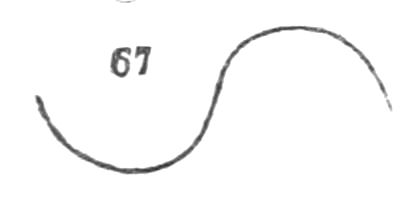
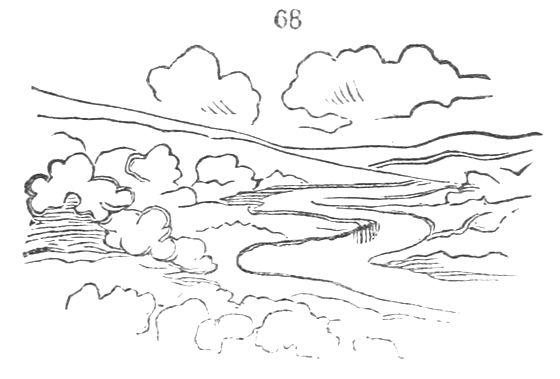
Let us resume: In the annexed figure (67) you perceive the curved line. In proportion as you are able to make this perfectly, you will succeed in drawing gracefully. I must presume that very many of my readers will have no difficulty in copying the few natural objects suggested below. Practice upon your slate or board the figure (67) until you can do it easily. Then, for the purposes of "sport," proceed as follows. You wish to produce a droll "bit" of landscape. Take any simple view, such as submitted in Fig. 68.
68
In this you will readily discover, as I said above, the curved, graceful lines of beauty—in the clouds, the outline of the distant hills, the foliage, the meandering stream. Let me advise you to practice this lesson somewhat perseveringly; apart from the new source of amusement which it is the object of these papers to open up, a beautiful lesson could be impressed upon the mind. Nothing is more calculated to refine the mind, to ennoble the thoughts, than to withdraw one's self from the artificial world, and to gaze upon the fresh face of nature. And if we are able to do this intelligently—in other words, if, having learned the alphabet, we are able to peruse as it were the book of nature—the delight and the advantage is proportionably increased. Now turn to the example shown in Fig. 69. What do we see? The lines of beauty have given place to others less pleasing to the eye, and (except as a source of merriment) less acceptable to the mind. Fig. 69 is a comic landscape; how it has become so must be clearly apparent.
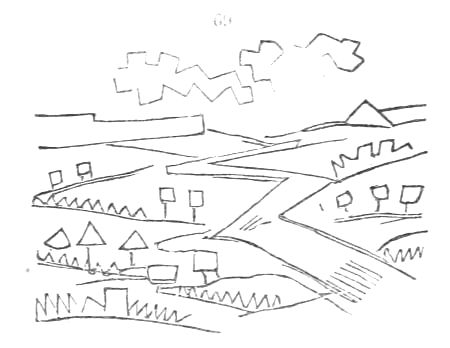
In Fig. 70, the same process is carried out, and the result is similar.
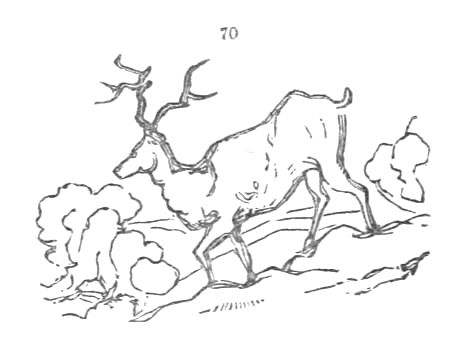
I hope that I shall not be understood to mean, that in order to be graceful everything must be round, or that everything round is graceful, or that every square object is ungraceful; or, again, that by making any curved line into a square or straight one the end we propose is to be obtained. Doubtless many round things are ungraceful, as many others composed entirely of straight lines at various angles to each other are exceedingly graceful. But what is meant is this: that natural objects, in which, left to themselves, the curved line predominates, are made odd and comic-looking when drawn upon the square.
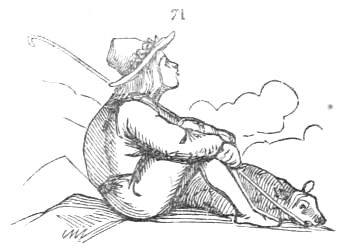
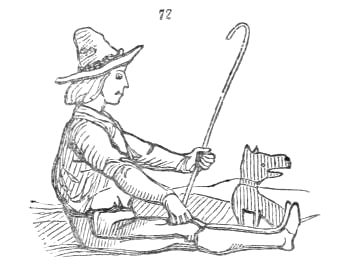
In Fig. 71, not only the lines of the shepherd's form are curved lines, and, therefore, conducive in a degree to its general pleasing character, but the attitude is formed upon a curved line. This will be perceived clearer by reference to the next figure, (72,) in which, without using a single straight line in the parts of the form, the oddity is attained by making the whole attitude stiff and angular.
The student will find no difficulty in multiplying examples for himself: those given will suffice as hints. We must now proceed to show how comic designs may be made and applied to the slides of magic lanterns. The proper course of procedure is as follows:
Procure a piece of clear common window glass, without specks or scratches; let this be made perfectly clean. Prepare your design, which should be made the exact size you intend it to be painted upon the glass; color it; and when quite dry, place it beneath your slide of glass, to which it might be fastened at the corners by means of a little gum or varnish. Now commence to paint upon the glass an exact fac simile of the design, which, of course, you see clearly enough through the glass.
Common camel's hair brushes will do; those made of sable are, however, much better; but the first will suffice for ordinary purposes.
The colors necessary are what are called silica colors, and are procurable of most artist's color makers.
It will be necessary to let your first colors dry before putting on your shades; and it is desirable not to work in too hot a room, as the nature of the varnish with which you work is to dry very rapidly.
Bear in mind too, that upon glass you cannot wash in a tint. Broad surfaces, such as skies, must be stippled in, as in painting upon ivory.
In originating this paper on "The Magic of Art," the author did not propose to himself to give a complete treatise, but simply to point out, by some very easy processes, at source of amusement and instruction, available to almost every intelligent reader. It is hoped that, in this subject, he has not entirely failed, and that all will find some entertainment from,
