AMUSEMENTS IN ELECTRICITY, GALVANISM AND MAGNETISM.
Reading edition
THE ORIGIN OF GALVANISM.
Electricity is one of the most active principles in nature. It exists in all bodies, and is exhibited by various means, one of which, and the most generally employed, is friction; but the bodies rubbed together must consist of different substances; for, if they are alike, electricity will not be evolved. Some substances, such as soot, charcoal, iron, gold, silver, copper, and other metals, water, &c., are called good conductors, because they transfer with great facility to other bodies the electric fluid, which glides over the surface with the velocity of light; while others, such as silk, wool, hair, feathers, dry paper, leather, glass, wax, &c., are called non-conductors, because they resist the progress of the fluid, which accumulates all the time the friction continues. It is from these media that are obtained the usual phenomena of electricity, as exhibited in the experiments which we shall hereafter describe. Its effects are felt in almost every part of nature; the awful lightning is the exhibition of the electric fluid, which accumulates in the clouds, and which is discharged when the heavy lurid masses come in contact with each other; the mysterious sweeping whirlwind, the terrific rising and rolling of the sand in the desert wilds of Africa, and the beautiful yet evanescent Aurora Borealis of the northern climes, are amongst a few of its effects.
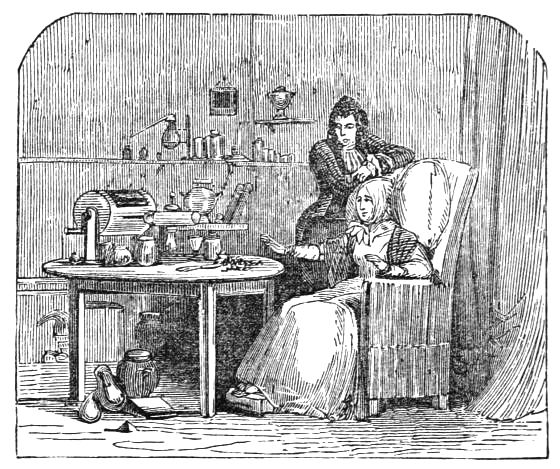
The next branch of the science of Electricity is GALVANISM, or, as it is sometimes called, Voltaic Electricity; it is obtained through the simple contact of different conducting bodies with each other. It was first discovered at Bologna, in the year 1791, by the lady of Louis Galvani, an Italian philosopher of great merit, and professor of anatomy; from whom, indeed, the science received its name. His wife being possessed of a penetrating understanding, and passionately loving him, took a lively interest in the science which so much occupied his attention. At the time the incident we are about to narrate took place, she was in a declining state of health, and taking soup made of frogs, by way of restorative. Some of these animals, skinned for the purpose, happened to be lying on the table of Galvani's laboratory, where also stood an electrical machine, when the point of a knife was unintentionally brought into contact with the nerves of one of the frog's legs, which lay close to the conductor of the machine, and immediately the muscles of the limb were violently agitated. Madame Galvani having observed the phenomenon, instantly informed her husband of it, and this incident led to the experiments and interesting discoveries which will transmit his name to the latest posterity.
The uses of Galvanic Electricity for scientific purposes are incalculable; and its phenomena are so various and extraordinary, as to render the study of this science exceedingly interesting. Through means of a galvanic battery, substances are decomposed, colors changed, water is made inflammable, and motion is given to lifeless bodies.
The experiments we give on Galvanism show the effect of the combination which forms what is called a simple galvanic circle, by means of two metals, zinc and silver, or zinc and copper, and water.
Galvanic action is always accompanied by chemical action, and all that is necessary to disturb the galvanic fluid is to unite two metals together, and subject them to the action of a fluid, which will act chemically upon one of them, differently to what it does upon the other.
A galvanic circle may also be formed of one metal, and two different fluids, which have a different action upon the metal.
Magnetism is a modification of electricity: at least, there is sufficient evidence that these causes are intimately connected, if not identical; but philosophers are as yet ignorant of its nature.
The property designated by the word magnetism is found in an iron ore of a certain composition, and of a dark gray color and peculiar luster. This ore alone is the local habitation of magnetism, whilst all others are subject to its influence, or to be attracted by it. Still, so little difference is there between the magnetic ore, or loadstone, and those which do not possess the property, that only practiced mineralogists can discern one from the other; and an experienced eye may see two ores join each other by the principle of attraction, without knowing in which resides the power, until another ore, non-magnetic, is brought within the sphere of attraction, when it will adhere only to that which contains the principle.
This singular property of the loadstone is imparted to other metallic substances, by rubbing and keeping them close together for some length of time: if a metal be of a hard texture like steel, it retains the magnetic principle permanently; but if soft, it loses the power as soon as separated from the magnet. The metals thus prepared, acquire the same directive and attractive power as the loadstone or natural magnet, and are employed for purposes of the utmost importance.
We proceed to give the youthful amateur the opportunity of exemplifying the principles of electricity, galvanism, and magnetism, by several simple experiments.
EXPERIMENTS IN ELECTRICITY.
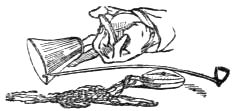
1.—Lay a watch down upon a table, and on its face balance a tobacco-pipe very carefully. Next take a wine-glass, rub it quickly with a silk handkerchief, and hold it for half a minute before the fire; then apply it near to the end of the pipe, and the latter, attracted by the electricity evolved by the friction and warmth in the former, will immediately follow it; and by carrying the glass around, always in front of the pipe, the latter will continue its rotatory motion; the watch-glass being the center or pivot on which it acts.
2.—Warm a glass tube, rub it with a warm flannel, and then bring a downy feather near it. On the first moment of contact, the feather will adhere to the glass, but soon after will fly rapidly from it, and you may drive it about the room by holding the glass between it and the surrounding objects; should it, however, come in contact with anything not under the influence of electricity, it will instantly fly back to the glass.
3.—A stick of sealing-wax rubbed against a warm piece of flannel or cloth, acquires the property of attracting light substances, such as small pieces of paper, lint, &c., if instantly applied at the distance of about an inch.
4.—Suspend two small pith balls, by fine silken threads of about six inches in length, in such a manner, that when at rest they may hang in contact with each other; on applying a piece of sealing wax, excited as in the former experiment, they will repel each other.
5.—Take a piece of common brown paper, about the size of an octavo book, hold it before the fire till quite dry and hot, then draw it briskly under the arm several times, so as to rub it on both sides at once by the coat. The paper will be found so powerfully electrical, that if placed against a wainscoted or papered wall of a room, it will remain there for some minutes without falling.
6.—And if, while the paper adheres to the wall, a light fleecy feather be placed against it, it will be attracted to the paper, in the same way as the paper is attracted to the wall.
7.—If the paper be again warmed, and drawn under the arm as before, and hung up by a thread attached to one corner of it, it will hold up several feathers on each side; should these fall off from different sides at the same time, they will cling together very strongly; and if after a minute they be all shaken off, they will fly to one another in a very singular manner.
8.—Warm and excite the paper as before, lay it on a table, and place upon it a ball made of elder pith, about the size of a pea; the ball will immediately run across the paper, and if a needle be pointed towards it, it will again run to another part, and so on for a considerable time.
9.—Support a pane of glass, previously warmed, upon two books, one at each end, and place some bran underneath; then rub the upper side of the glass with a black silk handkerchief, or a piece of flannel, and the bran will dance up and down under it with much rapidity.
10.—Place your left hand upon the throat of a cat, and with the middle finger and the thumb, press slightly the bones of the animal's shoulders; then, if the right hand be gently passed along the back, perceptible shocks of electricity will be felt in the left hand. Shocks may also be obtained by touching the tips of the ears after rubbing the back. If the color of the cat be black, and the experiment be made in a dark room, the electric sparks may be very plainly seen. Very distinct charges of electricity may also be obtained by touching the tips of the ears after applying friction to the back, and the same may be obtained from the foot. Placing the cat on your knees, apply the right hand to the back; the left fore paw resting on the palm of your left hand, apply the thumb to the upper side of the paw, so as to extend the claws, and by this means, bring your fore finger into contact with one of the bones of the leg, where it joins the paw; when, from the knob or end of this bone, the finger slightly pressing on it, you may feel distinctly successive shocks, similar to those obtained from the ears. It is, perhaps, unnecessary to add, that, in order to this experiment being conveniently performed, the experimenter must be on good terms with the cat.
ELECTRICAL SHOCK FROM A SHEET OF PAPER.
Place an iron japanned tea tray on a dry, clean, beaker glass; then take a sheet of foolscap writing paper, and hold it close to the fire until all its hygrometric moisture is dissipated, but not so as to scorch it; in this state it is one of the finest electrics we have. Hold one end down on a table with the finger and thumb, and give it about a dozen strokes with a large piece of India rubber from the left to the right, beginning at the top. Now take it up by two of the corners and bring it over the tray, and it will fall down on it like a stone; if one finger be now brought under the tray, a sensible shock will be felt. Now lay a needle on the tray with its point projecting outwards, remove the paper, and a star sign of the negative electricity will be seen: return the paper, and the positive brush will appear. In fact, it forms a very extemporaneous electrophorus, which will give a spark an inch long, and strong enough to set fire to some combustible bodies, and to exhibit all the electric phenomena not requiring coated surfaces. If four beaker glasses are placed on the floor, and a book laid on them, a person may stand on them insulated; if he then holds the tray vertically, the paper will adhere strongly to it, and sparks may be drawn from any part of his body; or he may draw sparks from any other person, as the case may be; or he may set fire to some inflammable bodies, by touching them with a piece of ice.
LIGHT UNDER WATER.
Rub two pieces of fine lump sugar together in the dark, and a bright electric light will be produced. The same effect, but in a more intense degree, may be produced with two pieces of silex or quartz, the white quartz being best for this purpose. The same effect may also be witnessed by rubbing the pieces of quartz together, under water.
SIMPLE MEANS OF PRODUCING ELECTRICITY.
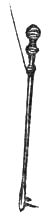
To show the nature of electrical action, rub a piece of sealing-wax or amber upon the coat sleeve, and it will be found that while warm by the friction, it attracts light bodies, such as straws or small pieces of paper. In our experiments we have shown that if a clean glass tube be rubbed several times through a silken or leather cloth, and presented to any substance, it will immediately attract or repel them; and if a poker suspended by a dry silk string be presented to its upper end, then the lower end of the poker will exhibit the same phenomena as the tube itself, which shows that the electrical fluid passes through the metal. But if for a metallic body a stick of glass or sealing wax be substituted, these phenomena will not occur, which proves that the electrical fluid does not pass through these substances.
By this it will be perceived that besides the class of bodies called electrics, there is another which we call conductors. These bodies cannot be excited themselves, but have the power of transmitting the electric fluid through them. These bodies comprise all the metals, some metal and metallic ores; the fluids of animal bodies; water, and other fluids, except oil; ice, snow, earthy substances, smoke, steam, and even a vacuum.
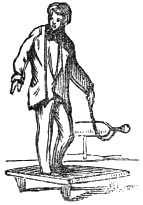
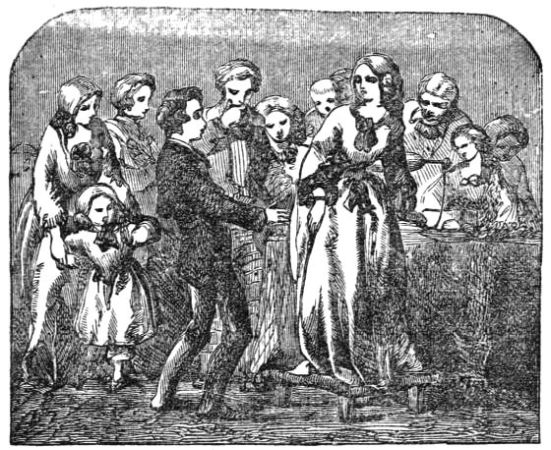
When any electrified conductor is wholly surrounded by non-conductors, so that the electric fluid cannot pass from the conductor along conductors to the earth, it is said to be insulated. Thus the human body is a conductor of electricity; but if a person standing on a glass stool (as represented in the drawing) be charged with electricity, the electric fluid cannot pass from him to the earth, and he is said to be positively electrified, because he has more than his natural share; he is also insulated, and if he be touched by another person standing on the ground, sparks will be exhibited at the point of contact, where also the person touching will feel a pricking sensation.
ATTRACTION AND REPULSION EXHIBITED.
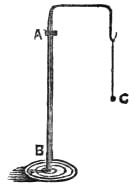
In order to illustrate certain remarkable facts in this science of an amusing character, attention must be directed to the figure A B, which is a metal stand; C is a small piece of cork or pith, which is suspended from the hook by a dry silken thread. Having rubbed an electron, as a dry rod of glass, and presented it to C, the ball will be instantaneously attracted to the glass, and will adhere to it. After they remain in contact for a few seconds, if the glass be withdrawn without being touched by the fingers, and again presented to the ball, the latter will be repelled instead of attracted, as in the first instance. By being touched with the finger, the ball can be deprived of its electricity, and if, after this has been done, we present a piece of sealing-wax in place of the glass formerly employed, the very same phenomena will take place. On the first application the ball will be attracted, and on the second repelled.
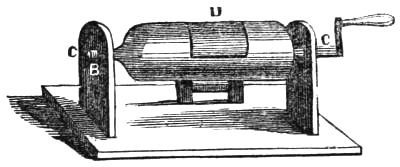
Before the young reader can perform any very important experiments with electricity, he must become possessed of an ELECTRICAL MACHINE, which is an instrument contrived for the purpose of rubbing together the surfaces of electrics and non-electrics. They generally consist of a cylinder, or plate of glass, and a piece of silk for it to rub against, covered with an amalgam, the method of preparing which we shall hereafter describe.
HOW TO MAKE AN ELECTRICAL MACHINE.
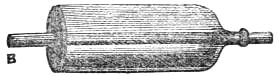
It is very easy to make a glass machine of the cylindrical form, if the maker cannot afford to buy one. First procure a common wine bottle of good dimensions, and thickish glass Drill a hole through its bottom, by igniting a piece of worsted tied round round it, dipped in turpentine, which will do this. Through this hole and the mouth pass a spindle, as represented in the cut. The end of B should be squared to fix a handle on, and the spindle should be fixed firmly in the bottle. The bottle is then to be fixed in a frame, in the following manner: The end of the spindle C passes through a hole at B; and the other end at C has the handle for turning the machine.
CUSHION.
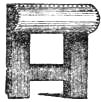
Next make a cushion of wash-leather, stuffed with wool, and fastened to the top of a frame of the following figure. This frame is to be of such a height that the cushion shall press against the sides of the bottle, and a piece of black silk is sewn on to the top of the cushion, and hangs over the bottle D. The cushion should be smeared with an amalgam, formed by melting together in the bowl of a tobacco pipe, one part of tin with two of zinc; to which, while fluid, should be added six parts of mercury. These should be stirred about till quite cold, and then reduced to a fine powder in a mortar, and mixed with a sufficient quantity of lard to form a thickish paste. When all is done, the machine is complete.
CONDUCTOR.
The electricity being generated by the friction produced between the rubber and the bottle from the motion imparted by the handle, it is necessary to draw it off for use. This is performed by what is called a conductor. This is made in the following manner: At right angles to one end of a cylinder of wood, about two inches and a half in diameter, and six inches long, fix a small wooden cylinder about three quarters of an inch in diameter, and three inches long, rounded at both ends—the other end of the larger cylinder is also to be rounded. Cover the whole with tinfoil, and mount it on a stand on a glass rod. When used, it is to be placed with the even piece in a line even with, and about half an inch from the bottle, and it should be of such a height as to come just below the silk apron. When it is wished to charge a Leyden jar, it is to be placed at the round end of the conductor. By these simple means a great variety of pleasing experiments may be performed; but to show the various phenomena connected with this interesting study, we shall now describe an electrical machine of the newest construction, and perform our experiments with it.
THE PLATE ELECTRICAL MACHINE.
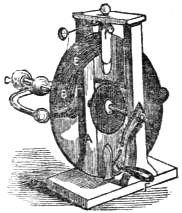
Formerly the electrical machine was made in the form of a cylinder, but now it consists of a plate A, as seen in the engraving. The plate is turned by the handle F, through the rubber B B, which diffuses the excitement over the glass. The points or balls at each side of the plate carry off a constant stream of positive electricity to the prime conductor C. Negative electricity is generated by insulating the conductor to which the cushion is attached, and continuing the prime conductor with the ground, so as to carry off the fluid collected from the plate.
HOW TO DRAW SPARKS FROM THE TIP OF THE NOSE.
If the person who works the machine be supported on a stool having glass legs, and connected with the conductor by means of a glass rod, the electricity will pass from the conductor to him, and as it cannot get away, owing to the glass on which he stands being a non-conductor, any person on touching him can draw the electricity from him, which will exhibit itself in small sparks as it passes to the person who touches him. If touched on the nose, sparks of fire will issue from it.
HOW TO GET A JAR FULL OF ELECTRICITY.
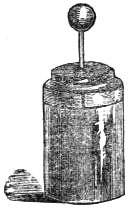
A most useful piece of electrical apparatus is called the Leyden jar, here represented. It is employed for the purpose of obtaining a quantity of electricity, which may be applied to any substance. It consists of a glass jar, coated both inside and without, four fifths of the way up, with tinfoil. A knob rises through a wooden top, communicating with the inside of the jar. When it is wished to charge the jar, this knob is applied to the prime conductor of the electrical machine when in action, and a quantity of electricity being given off, the jar will remain charged with it till a connection is made, by some good conductor of electricity, between the knob and the outside tinfoil. A piece of brass chain must hang from the stem that carries the knob, and connect it with the interior of the jar.
THE ELECTRICAL BATTERY.
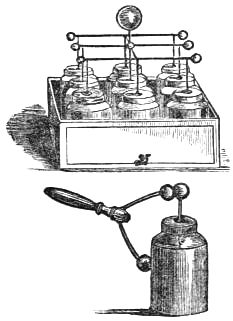
If several of these jars be united, an enormous quantity of electricity can be collected; but in arranging them, all the interior coatings must be made to communicate by metallic rods, and a similar union must be effected among the exterior coatings. When thus arranged, the whole series may be charged as if they formed but one jar.
For the purpose of making a direct communication between the inner or outer coatings of a jar or battery, by which a discharge is effected, an instrument called a discharging rod is employed. It consists of two bent metallic rods, terminating at one end by brass balls, and connected at another by a joint which is fixed to the end of a glass handle, and which, acting like a pair of compasses, allows of the balls being separated at certain distances. When opened to the proper degree, one of the balls is made to touch the exterior coating, and the other ball is then brought into contact with the knob of the jar, when a discharge is effected; while the glass handle secures the person holding it from the effects of the shock.
DANCING BALLS AND DOLLS.
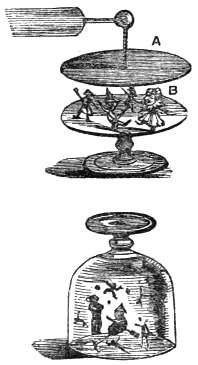
Get two round pieces of wood, A B, and coat them with tin foil, or two pieces of metal plate; attach one of them to the prime conductor by a chain, and let it hang about two or three inches from the knob. Place some pith balls upon the bottom piece of wood B, and bring it under the other. Immediately this is done, and the upper piece is charged by electricity from the machine, the pith balls will jump up and down, and from one to the other with great rapidity. If some of the pith be formed into little figures, they will also dance and leap about in the most grotesque manner. The same may be made to dance by merely holding the inside of a dry glass tumbler to the prime conductor for a few minutes, while the machine is in action, and then whelming it over them, when they will jump about to the no small astonishment of the spectators, as the cause of their motion is not quite so apparent.
THE ELECTRICAL KISS.
This amusing experiment is performed by means of the electrical stool. Let any lady challenge a gentleman not acquainted with the experiment, to favor her with a salute. The lady thereupon mounts the glass stool, and takes hold of a chain connected with the prime conductor. The machine being then put in motion, the gentleman approaches the lady, and immediately he attempts to imprint the seal of soft affection upon her coral lips, a spark will fly in his face, which generally deters him from his rash and wicked intention.
RINGING BELLS.
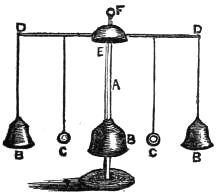
Bells may be made to ring by electricity in the following manner. Let three small bells be suspended from a brass wire D D, and supported by a glass pillar A, passing through bell B to the bell E. The electrical apparatus being attached to the knob F the electricity passes down the wires D D to the bells, which are then positively electrified, and attract the clappers C C, that are negatively so, in consequence of being insulated by the silken strings, which are not conductors. The bells therefore attract the clappers till they are charged, when they strike against the center bell to discharge themselves, and thus a peal is rung on the bells until the electricity is driven off.
WORKING POWER OF ELECTRICITY.
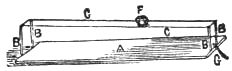
This may be shown in a variety of ways. The subjoined machine will exhibit the principle upon which many ingenious toys may be made by the young philosopher. In the figure A is a wooden board or stand, B B B B, four pillars having fine wires, C C, stretched above. On these rest the rotatory wire or wheel F, having its points turned the reverse way. By means of a chain attached to the conductor, and to the instrument at B, the electricity passes over the pillar B, up the wire C into the wheel, and off at the points, which causes it to be turned round on an inclined plane till it reaches the top.
THE ELECTRIFIED WIG.
While a person is on the electrical stool, if he be charged with much electricity,
"Each hair will stand on end, Like quills upon the fretful porcupine."
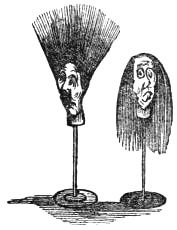
A wooden head, not your own, but a real wooden head, with a wig of streaming hair, and a handsome face to correspond, may be made in the following form, with a wire in the neck to support it by, and fixed in the conductor of an electrical machine. When this is put in motion, the hair will rise up as in figure 2, to astonish even "Whigs," who are seldom astonished by, or deterred from anything.
IMITATION THUNDERCLOUDS.
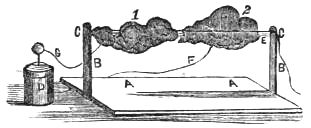
To show the manner in which thunderclouds perform their operations in the air. A A is a wooden stand, on which are erected two uprights, B B; C C are two small pulleys, over which a silken cord can pull easily; E is another silken line stretched across from one upright to another; on these silken cords two pieces of thin cardboard, covered with tin foil, and cut so as to represent clouds, are to be fixed horizontally, and made to communicate by means of thin wires, F and G, one with the inside, and the other with the outside of a charged jar, D. Now, by pulling the loop of the silk line E, the cloud 1 will be brought near the cloud 2; continue this slowly until the clouds (which are furnished with two small brass balls) are within an inch of each other, when a beautiful flash, strongly resembling lightning in miniature, will pass from one cloud to the other, restoring electrical equilibrium.
THE LIGHTNING-STROKE IMITATED.
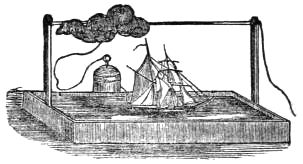
If the jar D be put behind the stand, and the cloud 2 removed, a vessel communicating by means of a wire with the outside of the jar, may be swum in water under the remaining cloud; the mast being made of separate pieces, and but slightly joined together. When the cloud is passed over the vessel, the mast will be struck and shattered to pieces.
THE SPORTSMAN.
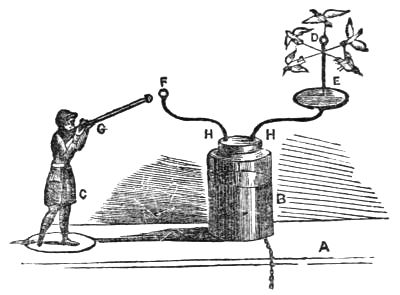
This apparatus is capable of affording much amusement: A is a stand of wood, B is a common Leyden jar, out of which proceed the wires H H, one terminating in ball F, the other in the ball D, to which are attached a number of pith birds, by silken strings; E is a shelf for the birds to rest upon; C is the sportsman; G his gun.
To put this operation in motion, the Leyden jar is to be charged with electricity, by affixing a chain to the bottom part of it, and connecting it with an electrical machine in the usual manner, or by applying it to a prime conductor, when the birds will fly off the knob to which they are fixed, in consequence of their being repelled. If the sportsman and gun be then turned, so that the end of his gun shall touch the knob F, an electric spark will pass from one to the other, a report will be heard, and the birds will fall down as if shot, in consequence of the electricity having been taken from the Leyden jar. There should be a communication between the sportsman and the jar, formed of tinfoil, or some metal, as shown by the dotted line on the stand.
Such are a few of many experiments which may be made by the young experimenter, who is fond of science and has any ingenuity; but should he possess little love of research, no ingenuity, and would like to amuse himself with an electrifying machine of little cost, he may sit himself down to a
BLACK TOM CAT,
and be a Katterfelto at once.