EXPERIMENTS IN GALVANISM.
Reading edition
1. Place a thin plate of zinc upon the upper surface of the tongue, and a half dollar or a piece of silver on the under surface. Allow the metals to remain for a little time in contact with the tongue before they are made to touch each other, that the taste of the metals themselves may not be confounded with the sensation produced by their contact. When the edges of the metals, which project beyond the tongue, are then suffered to touch, a galvanic sensation is produced, which it is difficult accurately to describe.
2. Place a silver teaspoon as high as possible between the gums and the upper lip, and a piece of zinc between the gums and the under lip. On bringing the extremities of the metals into contact, a very vivid sensation, and an effect like a flash of light across the eyes, will be perceived. It is singular that this light is equally vivid in the dark and in the strongest light, and whether the eyes be shut or open.
3. Put a silver cup or mug, filled with water, upon a plate of zinc on a table, and just touch the water with the tip of the tongue; it will be tasteless so long as the zinc plate is not handled, for the body does not form a voltaic circle with the metals. Moisten your hand well, take hold of the plate of zinc, and touch the water with your tongue, when a very peculiar sensation, and an acid taste, will be experienced.
4. Take a piece of copper of about six inches in width, and put upon it a piece of zinc of rather smaller dimensions, inserting a piece of cloth, of the same size as the zinc, between them; place a leech upon the piece of zinc, and though there appear nothing to hinder it from crawling away, yet it will not pass from the zinc to the copper, because its damp body acting as a conductor to the fluid disturbed, as soon as it touches the copper it receives a galvanic shock, and of course retires to its resting-place.
5. Plunge an iron knife into a solution of sulphate of copper (blue-stone); by chemical action, only, it will become covered with metallic copper. Immerse in the same solution a piece of platinum, taking care not to let it touch the iron, and no deposition of copper will take place upon it; but if the upper ends of the metals be brought into contact with each other, a copious deposition of copper will soon settle upon the platinum likewise.
WITH METAL PLATES IN WATER.
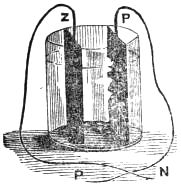
If we take two plates of different kinds of metal, platinum or copper, and zinc, for example, and immerse them in pure water, having wires attached to them above, then if the wire of each is brought into contact in another vessel of water, a galvanic circle will be formed, the water will be slowly decomposed, its oxygen will be fixed on the zinc wire, and at the same time a current of electricity will be transmitted through the liquid to the platinum or copper wire, on the end of which the other element of water, namely, the hydrogen, will make its appearance in the form of minute gas bubbles. The electrical current passes back again into the zinc at the points of its contact with the platinum, and thus a continued current is kept up, and hence it is called a galvanic circle. The moment the circuit is broken by separating the wires, the current ceases, but is again renewed by making them touch either in or out of the water. If a small quantity of sulphuric acid be added to the water, the phenomenon will be more apparent. The end of the wire attached to the piece of platinum or copper is called the positive pole of the battery, and that of the wire attached to the zinc is the negative pole.

The current of electricity here generated will be extremely feeble, but this can be easily increased by multiplying the glasses and the number of the pieces of metal. If we take six such glasses instead of one, partially fill them with dilute sulphuric acid, and put a piece of zinc and copper into each, connecting them by means of copper wire from glass to glass through the whole series, a stronger current of electricity will be the result. The experimenter must be careful not to let the wire and zinc touch each other at the bottom of the tumblers, and must also remember that the copper of glass 1 is connected with the zinc of glass 2, and so on.
TO MAKE A MAGNET BY GALVANISM.
To effect this, make a connection between the poles of the above or any excited battery with the two ends of a wire formed into a spiral coil, by bending common bonnet wire closely round a cylinder, or tube, of about an inch in diameter; into this coil introduce a needle, or piece of steel wire, laying it lengthways down the circles of the coil. In a few minutes after the electric fluid has passed through the spiral wire, and consequently round the needle or wire, the latter will be found to be strongly magnetized, and to possess all the properties of a magnet.
EFFECTS OF GALVANISM ON A MAGNET.
If a galvanic current, or any electric current, be made to pass along a wire, under which and in a line with it a compass is placed, it will be found that the needle will no longer point north and south, but will take a direction nearly across the current, and point almost east and west.
CHANGE OF COLOR BY GALVANISM.
Put a teaspoonful of sulphate of soda into a cup, and dissolve it in hot water; pour a little cabbage blue into the solution, and put a portion into two glasses, connecting them by a piece of linen or cotton cloth previously moistened in the same solution. On putting one of the wires of the galvanic pole into each glass, the acid accumulates in the one, turning the blue to a red, and the alkali in the other, rendering it green. If the wires be now reversed, the acid accumulates eventually in the glass where the alkali appeared, while the alkali passes to the glass where the acid was.
THE GALVANIC SHOCK.
If the ends of the wires of a galvanic battery be placed in separate basins of water, then, on dipping the fingers of each hand in the basin, a smart shock will be felt, with a particular aching accompanied with trembling. With a strong battery this effect is felt as high as the shoulders. The shock will also be felt by simply holding the galvanic wires, one in each hand, provided the hands be moistened with salt and water. Several persons may receive the shock together by joining hands.
FAMILIAR GALVANIC EFFECTS.
Coat the point of your tongue with tin-foil, and its middle part with gold or silver leaf, so that the two metals touch, when a sourish taste will be produced. This simple effect is termed "A Galvanic Tongue."
Ale and porter drink better out of a pewter or tin pot, than from glass or earthenware; because of the galvanic influence of the green copper as used to give the beer a frothy head.
Galvanic experiments may be made with the legs of a frog. A live flounder will answer nearly the same purpose. Lay the fish in a plate, upon a slip of zinc, to which is attached a piece of wire, and put a quarter dollar upon the flounder's back; then touch the quarter dollar with the wire, and at each contact strong muscular contractions will be produced.