TRICKS IN ACOUSTICS.
Reading edition
Acoustics is the science relating to sound and hearing. Sound is heard when any shock or impulse is given to the air, or to any other body which is in contact directly or indirectly with the ear.
DIFFERENCE BETWEEN SOUND AND NOISE.
Noises are made by the cracks of whips, the beating of hammers, the creak of a file or saw, or the hubbub of a multitude. But when a bell is struck, the bow of a violin drawn across the strings, or the wetted finger turned round a musical glass, we have what are properly called sounds.
SOUNDS, HOW PROPAGATED.
Sounds are propagated on all bodies much after the manner that waves are in water, with a velocity of 1,142 feet in a second. Sounds in liquids and in solids are more rapid than in air. Two stones rubbed together may be heard in water at half a mile; solid bodies convey sounds to great distances, and pipes may be made to convey the voice over every part of the house.
VISIBLE VIBRATION.
Provide a glass goblet about two thirds filled with colored water, draw a fiddle bow against its edge, and the surface of the water will exhibit a pleasing figure, composed of fans, four, six, or eight in number, dependent on the dimensions of the vessel, but chiefly on the pitch of the note produced.
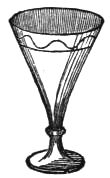
Or, nearly fill a glass with water, draw the bow strongly against its edge, the water will be elevated and depressed; and when the vibration has ceased, and the surface of the water has become tranquil, these elevations will be exhibited in the form of a curved line, passing round the interior surface of the glass, and above the surface of the water. If the action of the bow be strong, the water will be sprinkled on the inside of the glass, above the liquid surface, and this sprinkling will show the curved line very perfectly, as in the engraving. The water should be carefully poured, so that the glass above the liquid be preserved dry; the portion of the glass between the edge and curved line will then be seen partially sprinkled; but, between the level of the water and the curved line, it will have become wholly wetted, thereby indicating the height to which the fluid has been thrown.
TRANSMITTED VIBRATION.
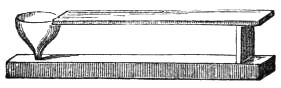
Provide a long, flat glass ruler or rod, as in the engraving, and cement it with mastic to the edge of a drinking glass, fixed into a wooden stand; support the other end of the rod very lightly on a piece of cork, and strew its upper surface with sand; set the glass in vibration by a bow, at a point opposite where the rod meets it, and the motions will be communicated to the rod without any change in their direction. If the apparatus be inverted, and sand be strewed on the under side of the rod, the figures will be seen to correspond with those produced on the upper surface.
DOUBLE VIBRATION.
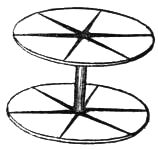
Provide two disks of metal or glass, precisely of the same dimensions, and a glass or metal rod; cement the two disks at their centers to the ends of the rod, as in the engraving, and strew their upper surfaces with sand. Cause one of the disks, viz., the upper one, to vibrate by a bow, and its vibration will be exactly imitated by the lower disk, and the sand strewed over both will arrange itself in precisely the same forms on both disks.
CHAMPAGNE AND SOUND.
Pour sparkling champagne into a glass, until it is half full, when the glass will lose its power of ringing by a stroke upon its edge, and will emit only a disagreeable and puffy sound. Nor will a glass ring while the wine is brisk, and filled with air-bubbles; but as the effervescence subsides, the sound will become clearer and clearer, and when the air-bubbles have entirely disappeared, the glass will ring as usual. If a crumb of bread be thrown into the champagne, and effervescence be reproduced, the glass will again cease to ring. The same experiment will also succeed with soda water, ginger wine, or any other effervescing liquid.
MUSIC OF THE SNAIL.
Place a garden snail upon a pane of glass, and in drawing itself along, it will frequently produce sounds similar to those of musical glasses.
THE TUNING-FORK A FLUTE PLAYER.
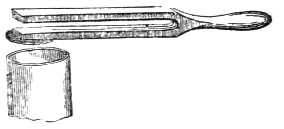
Take a common tuning-fork, and on one of its branches fasten with sealing-wax a circular piece of card, of the size of a small wafer, or sufficient nearly to cover the aperture of a pipe, as the sliding of the upper end of a flute with the mouth stopped: it may be tuned in unison with the loaded tuning-fork (a C fork), by means of the moveable stopper or card, or the fork may be loaded till the unison is perfect. Then set the fork in vibration by a blow on the unloaded branch, and hold the card closely over the mouth of the pipe, as in the engraving, when a note of surprising clearness and strength will be heard. Indeed, a flute may be made to "speak" perfectly well, by holding close to the opening a vibrating tuning-fork, while the fingering proper to the note of the fork is at the same time performed.
MUSICAL BOTTLES.
Provide two glass bottles, and tune them by pouring water into them, so that each corresponds to the sound of a different tuning-fork. Then apply both tuning-forks to the mouth of each bottle alternately, when that sound only will be heard, in each case, which is reciprocated by the unisonant bottle; or, in other words, by that bottle which contains a column of air, susceptible of vibrating in unison with the fork.
THEORY OF WHISPERING.
Apartments of a circular or elliptical form are best calculated for the exhibition of this phenomenon. If a person stand near the wall, with his face turned to it, and whisper a few words, they may be more distinctly heard at nearly the opposite side of the apartment, than if the listener was situated near to the speaker.
THEORY OF THE VOICE.
Provide a species of whistle, common as a child's toy or a sportsman's call, in the form of a hollow cylinder, about three fourths of an inch in diameter, closed at both ends by flat circular plates, with holes in their centers. Hold this toy between the teeth and lips; blow through it, and you may produce sounds varying in pitch with the force with which you blow. If the air be cautiously graduated, all the sounds within the compass of a double octave may be produced from it; and, if great precaution be taken in the management of the wind, tones even yet graver may be brought out. This simple instrument, or toy, has indeed the greatest resemblance to the larynx, which is the organ of voice.
TO TUNE A GUITAR WITHOUT THE ASSISTANCE OF THE EAR.
Make one string to sound, and its vibrations will, with much force, be transferred to the next string: this transference may be seen, by placing a saddle of paper (like an inverted Λ) upon the string, at first in a state of rest. When this string hears the other, the saddle will be shaken, or fall off; when both strings are in harmony, the paper will be very little, or not at all shaken.
PROGRESS OF SOUND.
When a bow is drawn across the strings of a violin, the impulses produced may be rendered evident by fixing a small steel bead upon the bow; when looked at by light, or in sunshine, the bead will seem to form a series of dots during the passage of the bow.
TO MAKE AN ÆOLIAN HARP.
This instrument consists of a long narrow box of very thin pine, about six inches deep, with a circle in the middle of the upper side, of an inch and half in diameter, in which are to be drilled small holes. On this side seven, ten, or more strings of very fine catgut are stretched over bridges at each end like the bridge of a fiddle, and screwed up or relaxed with screw pins. The strings must all be tuned to one and the same note,[9] and the instrument should be placed in a window partly open, in which the width is exactly equal to the length of the harp, with the sash just raised to give the air admission. When the air blows upon these strings with different degrees of force it will excite different tones of sound. Sometimes the blast brings out all the tones in full concert, and sometimes it sinks them to the softest murmurs.
A colossal imitation of the instrument just described was invented at Milan in 1786, by the Abbate Gattoni. He stretched seven strong iron wires, tuned to the notes of the gamut, from the top of a tower sixty feet high, to the house of a Signor Moscate, who was interested in the success of the experiment, and this apparatus, called the "giant's harp," in blowing weather yielded lengthened peals of harmonious music. In a storm this music was sometimes heard at the distance of several miles.
THE INVISIBLE GIRL.
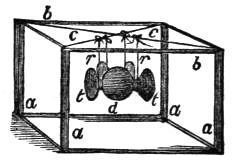
The facility with which the voice circulates through tubes was known to the ancients, and no doubt has afforded the priests of all religions means of deception to the ignorant and credulous. But of late days the light of science dispels all such wicked deceptions. A very clever machine was produced at Paris several years ago, and afterwards exhibited in New York and other cities in the United States, under the name of the "Invisible Girl," since the apparatus was so constructed that the voice of a female at a distance was heard as if it originated from a hollow globe, not more than a foot in diameter. It consisted of a wooden frame something like a tent bedstead, formed by four pillars a a a a, connected by upper cross rails b b, and similar rails below, while it terminated above in four bent wires c c, proceeding at right angles of the frame, and meeting in a central point. The hollow copper ball d, with four trumpets, t t, crossing from it at right angles, hung in the center of the frame, being connected with the wires alone by four narrow ribbons r r. The questions were proposed close to the open mouth of one of these trumpets, and the reply was returned from the same orifice. The means used in the deception were as follows: a pipe or tube was attached to one of the hollow pillars, and carried into another apartment, in which a female was placed; and this tube having been carried up the leg or pillar of the instrument to the cross-rails, had apertures exactly opposite two of the trumpet mouths; so that what was spoken was immediately answered through a very simple mode of communication.
THE MAGIC OF ACOUSTICS.
The science of Acoustics furnished the ancient sorcerers with some of their best deceptions. The imitation of thunder in their subterranean temples could not fail to indicate the presence of a supernatural agent. The golden virgins whose ravishing voices resounded through the temple of Delphos,—the stone from the river Pactolus, whose trumpet notes scared the robber from the treasure which it guarded,—the speaking head which uttered its oracular responses at Lesbos,—and the vocal statue of Memnon, which began at the break of day to accost the rising sun,—were all deceptions derived from science, and from a diligent observation of the phenomena of nature.
Take a long piece of wood, such as the handle of a hair broom, and placing a watch at one end, apply your ear to the other, and the tickings will be distinctly heard.
TO SHOW THAT SOUND DEPENDS ON VIBRATION.
Touch a bell when it is sounding, and the noise ceases; the same may be done to a musical string with the same results. Hold a musical pitchfork to the lips, when it is made to sound, and a quivering motion will be felt from its vibrations. These experiments show that sound is produced by the quick motions and vibrations of different bodies.