TRICKS IN GEOMETRY.
Reading edition
"Let young beginners come and try Their hands at our geometry."
The word Geometry is derived from the Greek, and signifies the art of measuring land. The invention of it is ascribed by some to the Chaldeans and Babylonians, by others to the Egyptians, who were obliged to determine the boundaries of their fields after the inundation of the Nile, by geometrical measurements. According to Cassiodorus, the Egyptians either derived the art from the Babylonians, or invented it after it was known to them. Thales, a Phœnician, who died 548 years B.C., and Pythagoras of Samos, who flourished about 520 B.C., introduced it from Egypt into Greece. In elementary geometry, Euclid of Alexandria, as everybody knows, is particularly distinguished. Archimedes measured the sphere, and after him other philosophers prosecuted the science with the utmost assiduity. In Italy, where the sciences first revived after the dark ages, several mathematicians were distinguished in the 16th century. The French, and after them the Germans, followed; while in England, Hook, Newton, and others, carried the science to the highest pitch of usefulness, and through its aid made the most prodigious discoveries. It is not, however, our province to enter into a long disquisition on the subject, but simply to set before the young reader some of the more curious properties of the science, that he may be excited to study it for himself; and we will promise him that should he devote his mind to its study, he will be amply repaid for any amount of labor he may bestow upon it.
GEOMETRICAL DEFINITIONS.
In geometry a point is said to have neither breadth, length, nor thickness. A line is the distance between two points; parallel lines always keep at the same distance from each other. A right line is what is commonly called a straight line. A curve is a line which continually changes its direction. An angle is the inclination or opening of two lines meeting in a point. A figure is a bounded space, and is either a superficies or a solid. A triangle is a figure with three sides and three angles. A square has four equal sides, and four right angles. A circle is a plane figure bounded by a curved line running into itself. Its diameter is a straight line drawn from one extremity of its circumference to the other, and its center is equally distant from every part of the circumference. A solid is any body which has length, breadth, and thickness; and a sphere is a solid, terminated by a convex surface, every part of which is at an equal distance from a point within, called its center.
THE FIVE GEOMETRICAL SOLIDS.
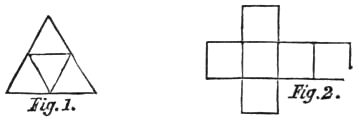
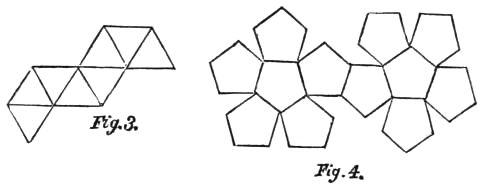
The following figures will show how the five geometrical solids may be cut out of a piece of cardboard. Where the lines are drawn the board is to be partly cut through with a penknife, so as to render the angles of the models as sharp and as straight as possible. The edges which require joining are to be fastened together with a slip of thin paper and gum dissolved in just sufficient water to bring it to the consistence of treacle. Fig. 1 will form a tetrahedron, a figure with four sides, each shaped like an equilateral triangle. Fig. 2 forms a cube or hexahedron. Fig. 3 an octohedron, with eight triangular sides. Fig. 4, a dodecahedron, with twelve sides shaped like pentagons, with five equal sides. Fig. 5, an isocahedron, with twenty sides, formed of equilateral triangles.
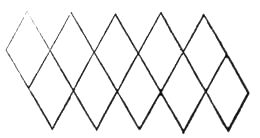
Fig. 5.
HOW TO MAKE FIVE SQUARES INTO A LARGE ONE WITHOUT ANY WASTE OF STUFF.
Suppose you have five squares of cloth, or anything else, as in Fig. 7; find the center of one side of four of these squares, and cut them from that point to the opposite corner, then place the perfect square in the centre, and the other pieces round, as seen in Fig. 8.
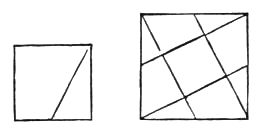
Fig. 7. Fig. 8.
DECEPTIVE VISION.
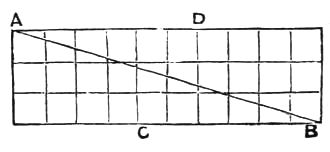
The following sleight shows how easily the eye may be deceived. Take a piece of pasteboard, an inch and a half in width, and five inches in length, and divide it by inked lines into thirty squares, then cut it from corner to corner, so as to form two triangles. After this cut off the top of these triangles at C and D,[13] and arrange the pieces in this manner:—
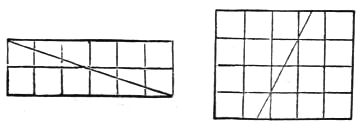
On counting the squares in the first figure, there appear to be thirty, but the other arrangement of the same card seems to contain thirty-two. It does so, however, only in appearance, but it is only a very correct eye that can detect the imperfection.
THE CARPENTER PUZZLED.
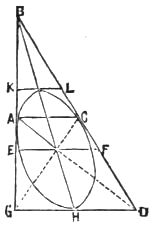
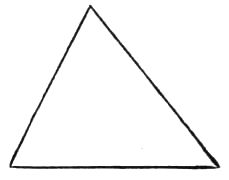
A carpenter having a piece of mahogany of a triangular form, (see Fig.) wished to know how he could make it up to the best advantage. His first idea was to make an oblong square table of it, but he found that if he did so the waste of the wood would be very great. After consideration he discovered that the most economical method of using the wood would be to form it into an oval. To make this oval contain as much wood as possible, he proceeded in the following manner: Let B G D be the triangular piece of wood; take G H one half of the base, and divide the triangle by drawing a line from H to B. Take G H in the compasses, and set it off on one of the sides from G to E, draw the line E F, and the point I will be the center of the oval; draw K L parallel to E F, and at the same distance from the center as the base G. The points A and C are found by dividing the line from E to K and drawing A C, or by drawing the dotted lines D A and G C through the center at I. These points being found, the oval must be completed by the eye of the draughtsman.
THE BRICKLAYER PUZZLED.
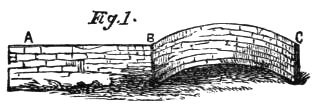
A bricklayer had to construct a wall, whose length in the direction A B C was twenty-four feet. The one half of this wall, namely from B to C, had to be built over a piece of rising ground, so that the base of this part of the wall would necessarily be more than twelve feet. In making out his account he charged more for this half of the wall than for that which was built on level ground from A to B. A geometrician assured him that the square contents of both portions of the wall were exactly alike; which may be proved in the following manner:—
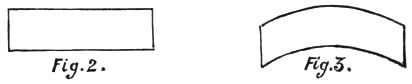
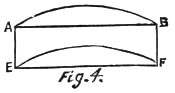
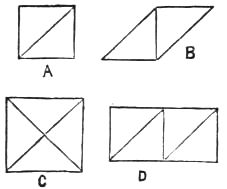
Fig. 4.
Cut two pieces of cardboard, in the form shown in Figs. 2 and 3, to represent the two parts of the wall; lay the piece representing the straight wall on the curved piece, and it will be found that the angles which project at A and B will exactly fill up the spaces at E and F. The piece of board representing the straight wall may thus be found to be exactly sufficient to form a piece equal to that representing the curved wall. You may then lay the curved piece upon the straight one, and reversing the experiment prove that the curved piece is capable of forming a rectangular piece equal to the other.
TRIANGULAR PROBLEM.
Take four square pieces of pasteboard of the same dimensions, and divide them diagonally, that is, by drawing a line from two opposite angles, as in the figures, into eight triangles. Paint seven of these triangles with the prismatic colors, red, orange, yellow, green, blue, indigo, violet, and let the eighth be white. To find how many chequers or regular four-sided figures, different either in form or color, may be made out of these eight triangles.
First, by combining two of these triangles there may be formed, either the triangular square A, or the inclined square B, called a Rhomb. Secondly, by combining four of the triangles the large square C may be formed, or the long square D, called a parallelogram. Now the first two squares, consisting of two parts out of eight, may each of them by the eighth rank of the triangle be taken twenty-eight different ways, which makes fifty-six. And the last two squares, consisting of four parts, may each be taken by the same rank of the triangle seventy times, which makes 140.
TO FORM A SQUARE.
Take a piece of card of the shape and size or proportions of the subjoined, and cut it into three parts, and with these three form a perfect square.
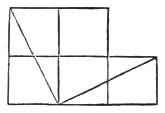
To do this, cut it in the direction of the dotted lines, and it will then be easy to lay down the pieces to form a perfect square.
SQUARING THE CIRCLE.
"Squaring the circle," as it is called, is the puzzle of puzzles, and there are many persons who fancy this can be accomplished, as there are also many who believe that they can discover "perpetual motion."
The meaning of this phrase squaring is scientifically expressed by the term finding the quadrature of the circle; that is, the act of producing a square equal to a given circle; and many persons but slightly acquainted with mathematics have puzzled their brains to effect this object. The Cardinal de Cusa rolled a cylinder over a plane, till the point which was first in contact with the plane touched it again; and then, by a train of reasoning very unmathematical, he endeavored to determine the length of the line thus described. Oliver de Serras worked a circle, and also a triangle equal to an equilateral triangle, inscribed within the circle, and imagined that the former was exactly equal to two of the latter, forgetting that the double of this triangle is equal to the hexagon inscribed within the circle, and therefore smaller than the circle itself. A Frenchman challenged the world, and deposited 10,000 livres as a stake, that he could accomplish the feat. He reduced the problem to the mechanical process of dividing a circle into four quarters, and then turning these with their angles outwards, so as to form a square, which he asserted to be equal to the circle; this however was soon proved to be ridiculous.
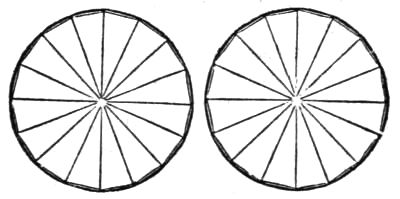
Some persons have taken a piece of pasteboard, and cutting it out into a circular form, and by cutting that circular disc into pieces of a square form and definite dimensions, and fitting the same turned pieces one into the other, have come near to a notion of the superficial area of a circle. But this kind of demonstration is purely mechanical, and is neither geometrical nor scientific, and, is in fact, no demonstration according to mathematics. For if we take the pieces of card, however exactly they may appear to be formed, and examine them with a microscope, we shall soon find that none of them are geometrically true, nor of the same length or breadth, and therefore the conclusion arrived at is a false one.
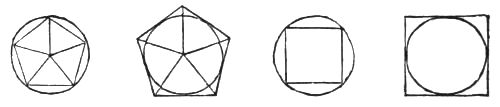
The early mathematicians, in their attempts to solve this problem, generally proceeded on the following plan. If we draw a square exterior to a circle, that is, touching the square in four points, each side of the square being equal to the diameter of the circle, we can soon convince ourselves that the boundary of the square will be greater than the circumference of the circle, and the area of the former greater than that of the latter. But if the square be drawn within the circle, so that only the four corners touch it, then it is equally evident that the circle is larger, both in boundary and area, than the square. By this proceeding, we arrive at the conclusion that a circle is smaller than a square external to it, and larger than one internal to it. Let us next suppose that we draw a regular pentagon, that is, a figure of five equal sides, exterior to the circle, and touching it on five points; then it is evident that as the circle is wholly contained within the pentagon, it must be smaller than that which contains it. But if the pentagon be described within the circle, touching it at the five angular points, then of course the circle is larger than the pentagon which it contains.
Now, in geometry, my young readers must bear in mind, the exact periphery or circumference, and the exact area of any figure bounded by straight lines, may be determined with rigorous accuracy; and if we draw two polygons—say of one hundred sides, one within and one without the circle—we can ascertain the exact area of those polygons, and affirm that the area of a circle is greater than a certain amount, and less than another certain amount. These two amounts, if the number of the sides of the polygon be so large as we here suppose, may be so very nearly alike, that either one will give the area of the circle with great closeness.
By some such means as these Archimedes found that if the diameter of a circle be called 7, then the circumference will be nearly 22; and that if the square of the diameter be 14, then the area of the circle will be equal to about 11; but this computation was slightly in error, and gave to the area of the circle too great a measure by about one three-thousandth part of the whole. At a later period, however, a European mathematician, named Metius, discovered a method which makes an extraordinary approach to accuracy, and is at the same time easily remembered. He found that if the diameter be considered equal to 113, then the circumference would equal 355; or if we multiply the square of the radius by 355, and divide it by 113, the area will be given. Now this method is so very nearly correct, that the area of a circle one foot in diameter is given within the fifty-thousandth part of a square inch.
Other mathematicians have carried the approximation still further. Ludolph Van Ceulen worked it out to 36 places of figures, showing that if the diameter be 1, the circumference will be
3.14,159,265,358,979,323,846,264,338,327,950,288.
or that if the last figure be 8, the result will be a little below the truth, and if 9, a little above it.
Since this, Mr. Sharp, an English mathematician, carried the approximation to 72 places of figures; Mr. John Machin to 100 figures, and eclipsed all others. M. de Lagny worked it out to 128 places of figures, and of the degree of nearness to which this computation brings the proportion, Montucla says, "If we suppose a circle, the diameter of which is a thousand million times greater than the distance between the sun and the earth, the error in the proportion of the circumference would be a thousand million times less than the thickness of a hair."
But after all, none of these computations are quite correct; they all deviate from the truth, and bring us to the conclusion that there are no numbers or collection of numbers which will give the exact ratio of the circumference, or of the area of a circle to its diameter. We offer this explanation on the subject to our young friends that they may not be puzzled by the question; and that should they be asked to square the circle, or hear any one assert that he can do so, they may be able to show that they are "awake" to the question, and know how to explain it.