THE MAGIC OF STRENGTH.
Reading edition
"Not two strong men the enormous weight could raise, Such men as live in these degenerate days."—POPE'S HOMER.
The mechanical knowledge of the ancients was principally theoretical; and though they seem to have executed some minor pieces of mechanism which were sufficient to delude the ignorant, yet there is no reason for believing that they have executed any machinery that was capable of exciting much surprise, either by its ingenuity or its magnitude. The properties of the mechanical powers, however, seem to have been successfully employed in performing feats of strength which were beyond the reach even of strong men, and which could not fail to excite the greatest wonder when exhibited by persons of ordinary size.
Firmus, a native of Seleucia, who was executed by the Emperor Aurelian for espousing the cause of Zenobia, was celebrated for his feats of strength. In his account of the life of Firmus, who lived in the third century, Vopiscus informs us that he could suffer iron to be forged upon an anvil placed upon his breast. In doing this, he lay upon his back, and, resting his feet and shoulders against some support, his whole body formed an arch, as we shall afterward more particularly explain. Until the end of the sixteenth century, the exhibition of such feats does not seem to have been common. About the year 1703, a native of Kent, of the name of Joyce, exhibited such feats of strength in London and other parts of England, that he received the name of the second Samson. His own personal strength was very great; but he had also discovered, without the aid of theory, various positions of his body in which men even of common strength could perform very surprising feats. He drew against horses, and raised enormous weights; but as he actually exhibited his powers in ways which evinced the enormous strength of his own muscles, all his feats were ascribed to the same cause. In the course of eight or ten years, however, his methods were discovered, and many individuals of ordinary strength exhibited a number of his principal performances, though in a manner greatly inferior to Joyce.
Some time afterward, John Charles Van Eckeberg, a native of Harzgerode, in Anhault, traveled through Europe under the appellation of Samson, exhibiting very remarkable examples of his strength. This, we believe, is the same person whose feats are particularly described by Dr. Desaguliers. He was a man of the middle size, and of ordinary strength; and as Dr. Desaguliers was convinced that his feats were exhibitions of skill, and not of strength he was desirous of discovering his methods, and, with this view, he went to see him, accompanied with the Marquis of Tullibardine, Dr. Alexander Stuart, Dr. Pringle, and his own mechanical operator. They placed themselves round the German, so as to be able to observe accurately all that he did, and their success was so great, that they were able to perform most of the feats the same evening by themselves, and almost all the rest when they had provided the proper apparatus. Dr. Desaguliers exhibited some of the experiments before the Royal Society, and has given such a distinct explanation of the principles on which they depend, that we shall endeavor to give a popular account of them.
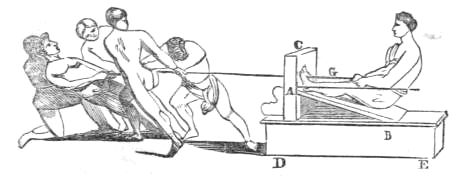
FIG. 1.
1. The performer sat upon an inclined board A B, placed upon a frame C D E, with his feet abutting against the upright board C. Round his loins was placed a strong girdle FG, to the iron ring of which at G was fastened a rope by means of a hook. The rope passed between his legs through a hole in board C, and several men, or two horses, pulling at the other end of the rope, were unable to draw the performer out of his place. His hands at G seemed to pull against the men, but they were of no advantage to him whatever.
2. Another of the German's feats is shown in Fig. 2. Having fixed the rope above mentioned to a strong post at A, and made it pass through a fixed iron eye at B, to the ring in his girdle, he planted his feet against the post at B, and raised himself from the ground by the rope, as shown in the figure. He then suddenly stretched out his legs and broke the rope, falling back on a feather bed at C, spread out to receive him.
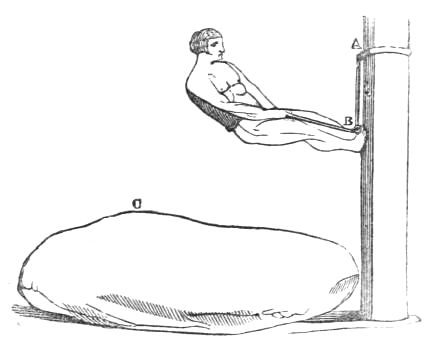
FIG. 2.
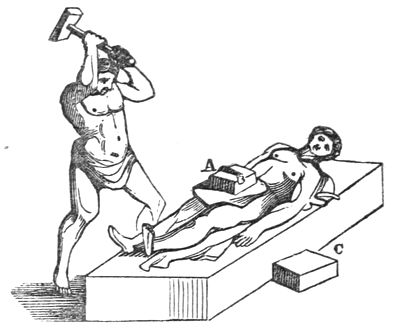
FIG. 3.
3. In imitation of Firmus, he laid himself down on the ground, as shown in Fig. 3, and when an anvil A was placed upon his breast, a man hammered with all his force the piece of iron B, with a sledge hammer, and sometimes two smiths cut in two with chisels a great cold bar of iron laid upon the anvil. At other times a stone of huge dimensions, half of which is shown at C, was laid upon his belly, and broken with a blow of the great hammer.
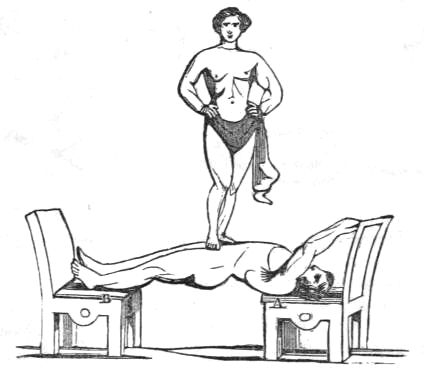
FIG. 4.
4. The performer then placed his shoulders upon one chair, and his heels upon another, as in Fig. 4, forming, with his back-bone, thighs, and legs, an arch springing from its abutments at A and B. One or two men then stood upon his belly, rising up and down while the performer breathed. A stone, one and a half feet long, one foot broad, and half a foot thick, was then laid upon his belly and broken by a sledge hammer, an operation which may be performed with much less danger than when his back touched the ground, as in Fig. 3.
5. His next feat was to lie down on the ground, as in Fig. 5. A man being then placed on his knees, he draws his heels towards his body, and, raising his knees, he lifts up the man gradually, till, having brought his knees perpendicularly under him, as in Fig. 6, he raises his own body up, and, placing his arms around the man's legs, he rises with him, and sets him down on some low table or eminence of the same height as his knees. This feat he sometimes performed with two men in place of one.
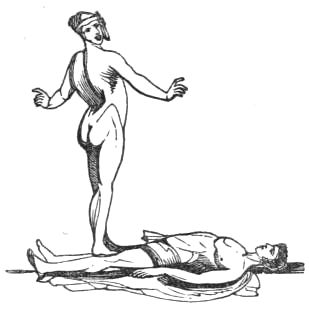
FIG. 5.
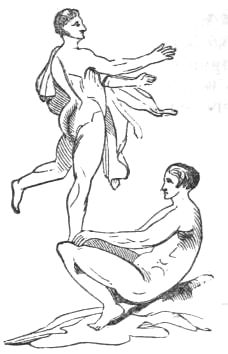
FIG. 6.
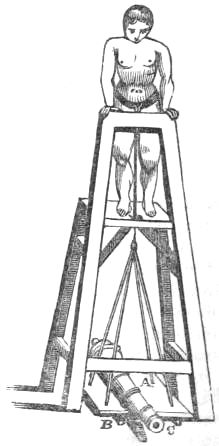
FIG. 7.
6. The last, and apparently the most wonderful, performance of the German, is shown in Fig. 7, where he appears to raise a cannon A, placed upon a scale, the four ropes of the scale being fixed to a rope or chain attached to his girdle, in the manner already described. Previous to the fixing of the ropes, the cannon and scale rest upon two rollers B C, but when all is ready, the two rollers are knocked from beneath the scale, and the cannon is sustained by the strength of his loins.
The German also exhibited his strength in twisting into a screw a flat piece of iron like A, Fig. 8. He first bent the iron into a right angle, as at B, and then wrapping his handkerchief about its broad upper end, he held that end in his left hand, and with his right applied to the other end, twisted about the angular point, as shown at C. Lord Tullibardine succeeded in doing the same thing, and even untwisted one of the irons which the German had twisted.
It would lead into details by no means popular, were I to give a minute explanation of the mechanical principles upon which these feats depend. A few general observations will perhaps be sufficient for ordinary readers. The feats No. 1, 2, and 7, depend entirely on the natural strength of the bones of the pelvis, which form a double arch, which it would require an immense force to break, by any external pressure directed to the center of the arch; and, as the legs and thighs are capable of sustaining four or five thousand pounds when they stand quite upright, the performer has no difficulty in resisting the force of two horses, or of sustaining the weight of a cannon weighing two or three thousand pounds.
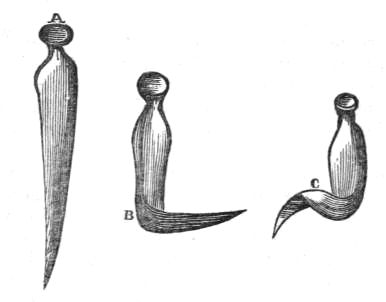
FIG. 8.
The feat of the anvil is certainly a very surprising one. The difficulty, however, really consists in sustaining the anvil; for when this is done, the effect of the hammering is nothing. If the anvil were a thin piece of iron, or even two or three times heavier than the hammer, the performer would be killed by a few blows; but the blows are scarcely felt when the anvil is very heavy, for the more matter the anvil has, the greater is its inertia, and it is the less liable to be struck out of its place; for when it has received by the blow the whole momentum of the hammer, its velocity will be so much less than that of the hammer, as its quantity of matter is greater. When the blow, indeed, is struck, the man feels less of the weight of the anvil than he did before, because, in the reaction of the stone, all the parts of it round about the hammer rise towards the blow. This property is illustrated by the well known experiment of laying a stick with its ends upon two drinking glasses full of water, and striking the stick downwards in the middle with an iron bar. The stick will in this case be broken without breaking the glasses, or spilling the water. But if the stick is struck upwards, as if to throw it up in the air, the glasses will break if the blow be strong, and if the blow is not very quick, the water will be spilled without breaking the glasses.
When the performer supports a man upon his belly, as in Fig. 4, he does it by means of the strong arch formed by his backbone, and the bones of his legs and thighs. If there were room for them, he could bear three or four, or, in their stead, a great stone to be broken with one blow.
A number of feats of real and extraordinary strength were exhibited about a century ago, in London, by Thomas Topham, who was five feet ten inches high, and about thirty-one years of age. He was entirely ignorant of any of the methods for making his strength appear more surprising; and he often performed, by his own natural powers, what he learned had been done by others by artificial means. A distressing example of this occurred in his attempt to imitate the feat of the German Samson by pulling against horses. Ignorant of the method which we have already described, he seated himself on the ground with his feet against two stirrups, and by the weight of his body he succeeded in pulling against a single horse; but in attempting to pull against two horses, he was lifted out of his place, and one of his knees was shattered against the stirrups, so as to deprive him of most of the strength of one of his legs. The following are the feats of real strength which Dr. Desaguliers saw him perform.
1. Having rubbed his fingers with coal-ashes to keep them from slipping, he rolled up a very strong and large pewter plate.
2. Having laid seven or eight short and strong pieces of tobacco-pipe on the first and third fingers, he broke them by the force of his middle finger.
3. He broke the bowl of a strong tobacco-pipe placed between his first and third fingers, by pressing his fingers together sideways.
4. Having thrust such another bowl under his garter, his legs being bent he broke it to pieces by the tendons of his hams, without altering the bending of his leg.
5. He lifted with his teeth, and held in a horizontal position for a considerable time, a table six feet long, with half a hundred weight hanging at the end of it. The feet of the table rested against his knees.
6. Holding in his right hand an iron kitchen poker three feet long and three inches round, he struck upon his bare left arm, between the elbow and the wrist, till he bent the poker nearly to a right angle.
7. Taking a similar poker, and holding the ends of it in his hands, and the middle against the back of his neck, he brought both ends of it together before him, and he then pulled it almost straight again. This last feat was the most difficult, because the muscles which separate the arms horizontally from each other are not so strong as those which bring them together.
8. He broke a rope about two inches in circumference, which was partly wound about a cylinder four inches in diameter, having fastened the other end of it to straps that went over his shoulder.
9. Dr. Desaguliers saw him lift a rolling stone of about 800 pounds' weight with his hands only, standing in a frame above it, and taking hold of a frame fastened to it. Hence Dr. Desaguliers gives the following relative view of the strengths of individuals:
Strength of the weakest men, 125 pounds.
Strength of very strong men, 400
Strength of Topham, 800
The weight of Topham was about 200.
One of the most remarkable and inexplicable experiments relative to the strength of the human frame, which we have ourselves seen and admired, is that in which a heavy man is raised with the greatest facility, when he is lifted up the instant that his own lungs, and those of the persons who raise him, are inflated with air. This experiment was, I believe, first shown in England a few years ago by Major H., who saw it performed in a large party at Venice under the direction of an officer of the American navy. As Major H. performed it more than once in my presence, I shall describe, as nearly as possible, the method which he prescribed. The heaviest person in the party lies down upon two chairs, his legs being supported by the one and his back by the other. Four persons, one at each leg and one at each shoulder, then try to raise him, and they find his dead weight to be very great, from the difficulty they experience in supporting him. When he is replaced in the chairs, each of the four persons takes hold of the body as before, and the person to be lifted gives two signals by clapping his hands. At the first signal he himself and the four lifters begin to draw a long and full breath, and when the inhalation is completed, or the lungs filled, the second signal is given, for raising the person from the chairs. To his own surprise and that of his bearers, he rises with the greatest facility, as if he were no heavier than a feather. On several occasions I have observed that when one of the bearers performs his part ill, by making the inhalation out of time, the part of the body which he tries to raise is left, as it were, behind. As we have repeatedly seen this experiment, and have performed the part both of the load and of the bearer, we can testify how remarkable the effects appear to all parties, and how complete is the conviction, either that the load has been lightened, or the bearer strengthened by the prescribed process.
At Venice, the experiment was performed in a much more imposing manner. The heaviest man in the party was raised and sustained upon the points of the fore fingers of six persons. Major H. declared that the experiment would not succeed if the person lifted were placed upon a board, and the strength of the individuals applied to the board. He conceived it necessary that the bearers should communicate directly with the body to be raised. I have not had an opportunity of making any experiments relative to these curious facts; but whether the general effect is an illusion, or the result of known or of new principles, the subject merits a careful investigation.
Among the remarkable exhibitions of mechanical strength and dexterity, we may enumerate that of supporting pyramids of men. This exhibition is a very ancient one. The simplest form of this feat consists in placing a number of men upon each other's shoulders, so that each row consists of a man fewer till they form a pyramid terminating in a single person, upon whose head a boy is sometimes placed with his feet upwards.