THE MAGIC OF NUMBERS
Reading edition
OR, CURIOUS PROBLEMS IN ARITHMETIC.
As the principal object of this volume is to enable the young reader to learn something in his sports, and to understand what he is doing, we shall, before proceeding to the curious tricks and feats connected with the science of numbers, present him with some arithmetical aphorisms, upon which most of the following examples are founded.
APHORISMS OF NUMBER.
1. If two even numbers be added together, or subtracted from each other, their sum or difference will be an even number.
2. If two uneven numbers be added or subtracted, their sum or difference will be an even number.
3. The sum or difference of an even and an uneven number added or subtracted, will be an uneven number.
4. The product of two even numbers will be an even number, and the product of two uneven numbers will be an uneven number.
5. The product of an even and uneven number will be an even number.
6. If two different numbers be divisible by any one number, their sum and their difference will also be divisible by that number.
7. If several different numbers, divided by 3, be added or multiplied together, their sum and their product will also be divisible by 3.
8. If two numbers, divisible by 9, be added together, the sum of the figures in the amount will be either 9, or a number divisible by 9.
9. If any number be multiplied by 9, or by any other number divisible by 9, the amount of the figures of the product will be either 9, or a number divisible by 9.
10. In every arithmetical progression, if the first and last term be each multiplied by the number of terms, and the sum of the two products be divided by 2, the quotient will be the sum of the series.
11. In every geometric progression, if any two terms be multiplied together, their product will be equal to that term, which answers to the sum of these two indices. Thus, in the series—
1 2 3 4 5
2 4 8 16 32
If the third and fourth terms 8 and 16 be multiplied together, the product 128 will be the seventh term of the series. In like manner, if the fifth term be multiplied into itself, the product will be the tenth term, and if that sum be multiplied into itself, the product will be the twentieth term. Therefore, to find the last, or any other term of a geometric series, it is not necessary to continue the series beyond a few of the first terms.
Previous to the numerical recreations, we shall here describe certain mechanical methods of performing arithmetical calculations, such as are not only in themselves entertaining, but will be found more or less useful to the young reader.
PALPABLE ARITHMETIC.
The blind mathematician, Dr. Saunderson, adopted a very ingenious device for performing arithmetical operations by the sense of touch.
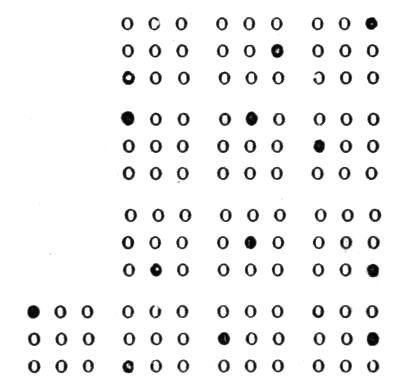
Small cubes of wood were provided, and in one face of each, nine holes were pierced, thus:
1 2 3 o o o
4 5 6 o o o
7 8 9 o o o
These holes represented the nine digits, as in the figure, and to denote any figure, a small peg was inserted into the hole corresponding to it. If the number consisted of several figures, more cubes were used, one for each. A cipher was represented by a peg of different shape from that of the others, and inserted in the central hole.
To perform any arithmetical process, a square board was provided, divided by ridges into recesses of the same width as the cubes, and by this the cubes were retained in the required horizontal and perpendicular lines. Suppose it was necessary to add together the numbers 763, 124, 859, the cubes and pegs would be arranged thus:
THE ABACUS.
This instrument is used for teaching numeration, and the first principles of arithmetic.
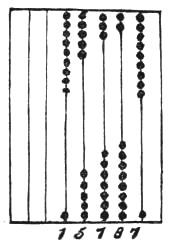
Upon a frame are placed wires, parallel to one another, and at equal distances. Ten small balls are strung upon each wire, being placed as in the margin. The right wire denotes units, the next tens, and so on, the 7th wire being the place of millions. In using the abacus, all the balls are first ranged at one end, and a number of them are then moved to the other end of each wire, to correspond to the figures required. The example given in the margin is 15,781, the height of Mount Blanc.
NAPIER'S RODS.
The object of this contrivance is to render arithmetical multiplication more easy, and to secure its correctness; it was much used by astronomers before the invention of logarithms.
To appreciate the merits of this invention, we must consider the process of multiplication as usually performed. Suppose we had to multiply 8,679 by 8:
8,679 8 ——— 69,432
We first multiply 9 by 8 = 72, and putting down 2 as the first figure in the product, carry the 7 to add to the next product of 7 by 8 = 56; this gives us 63, the 3 being put down as the second figure; 6 is carried to add to the product of 6 by 8, and so on.
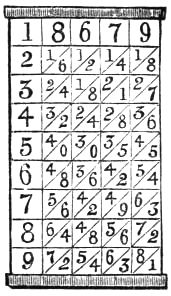
A blunder may be made in each part of this process; for 1st, we might reckon 8 times 9 as some other number than 72; 2d, after multiplying the 7 by the 8, we might add to the resulting 56 some other figure than the 7, which we carried; 3d, we may add 56 to 7 inaccurately, making some other sum of it than the right one, 63. Errors in a long multiplication problem are usually made in one of these three ways, and to prevent such errors, Lord Napier[10] introduced this useful contrivance. Thin strips of card, wood, or bone, 9 times as long as they are broad, are each divided into 9 equal squares, a figure is printed or written on the top square, and in each of the squares underneath is the product of multiplying that figure by 2, 3, 4, &c., up to 9.
To use these in multiplication, select the strips, the top figures of which make the number to be multiplied. For example:
To multiply 8,679 by 8, look at the eighth line of squares from the top, and on that line will be found the product of each of the integers 8, 6, 7, 9, when multiplied by 8. We have then to write down the 2 as the first figure of the product, add 7 and 6 together = 13; write 3 as the next figure, carry 1 to add to the sum of 8 and 5, and so on.
The reason for dividing the figures in each square by a diagonal line, and for placing the left-hand figure higher than the right is, that the eye may be thus assisted in adding the carried figure of one slip to the unit of the next.
To provide for the occurrence of more than one of the same figures in the multiplicand, there should be several slips or rods for each of the digits.
In practice the rods are placed on a flat piece of wood, with two ridges at right angles, by which they are preserved in a proper position.
This instrument can be made useful in "divisions," by making by means of it a table of the product of the divisor, multiplied by each of the numbers 1 to 9.
THE ARITHMETICAL BOOMERANG.
The boomerang is an instrument of peculiar form, used by the natives of New South Wales, for the purpose of killing wild fowl and other small animals. If projected forwards, it at first proceeds in a straight line, but afterwards rises in the air, and after performing sundry peculiar gyrations, returns in the direction of the place where it was thrown.
The term is applied to those arithmetical processes by which you can divine a number thought of by another. You throw forwards the number by means of addition and multiplication, and then, by means of subtraction and division, you bring it back to the original starting point, making it proceed in a track so circuitous as to evade the superficial notice of the tyro.
TO FIND A NUMBER THOUGHT OF.
First Method.
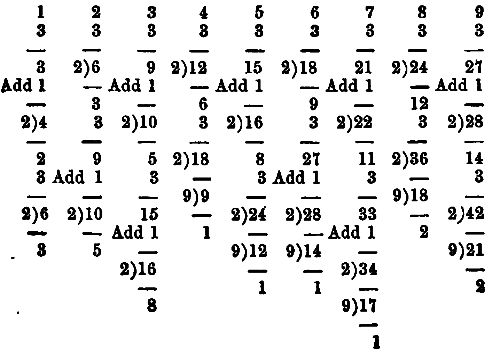
This is an arithmetical trick which, to those who are unacquainted with it, seems very surprising; but, when explained, it is very simple. For instance, ask a person to think of any number under 10. When he says he has done so, desire him to treble that number. Then ask him whether the sum of the number he has thought of (now multiplied by 3) be odd or even; if odd, tell him to add 1 to make the sum even. He is next to halve the sum, and then treble that half. Again ask whether the amount be odd or even. If odd, add 1 (as before) to make it even, and then halve it. Now ask how many nines are contained in the remainder. The secret is, to bear in mind whether the first sum be odd or even; if odd, retain 1 in the memory; if odd a second time, retain 2 more (making in all 3 to be retained in the memory;) to which add 4 for every nine contained in the remainder.
For example, No. 7 is odd the first and also the second time; and the remainder (17) contains one nine; so that 1, added to 2, make 3, and 3, added to 4, make 7, the number thought of. No. 1 is odd the first time (retain 1), and even the second (of which no notice is taken), but the remainder is not equal to nine. No. 2 is even the first and odd the second time (retain 2), but the remainder contains no nine. No. 3 is odd the first and the second time, still there is no nine in the remainder. No. 4 is even both times, and contains one nine. No. 5 is odd the first time and the remainder contains one nine. No. 6 is odd the second time, and contains one nine in the remainder. No. 8 is even both times, and the remainder contains two nines. No notice need be taken of any overplus of a remainder, after being divided by nine.
The following are illustrations of the result with each number:
Second Method.
EXAMPLE.
Let a person think of a number, say 6
1. Let him multiply it by 3 18
2. Add 1 19
3. Multiply by 3 57
4. Add to this the number thought of 63
Let him inform you what is the number produced; it will always end with 3. Strike off the 3, and inform him that he thought of 6.
Third Method.
EXAMPLE.
Suppose the number thought of to be 6
1. Let him double it 12
2. Add 4 16
3. Multiply by 6 80
4. Add 12 92
5. Multiply by 10 920
Let him inform you what is the number produced. You must in every case subtract 320; the remainder is, in this example, 600; strike off the two ciphers, and announce 6 as the number thought of.
Fourth Method.
Desire a person to think of a number, say 6. He must then proceed—
EXAMPLE.
1. To multiply this number by itself 36
2. So take 1 from the number thought of 5
3. To multiply this by itself 25
4. To tell you the difference between this product and the former 11
You must then add 1 to it 12
And halve this number 6
Which will be the number thought of.
Fifth Method.
Desire a person to think of a number, say 6. He must then proceed as follows:
EXAMPLE.
1. Add 1 to it 7
2. Multiply by 3 21
3. Add 1 again 22
4. Add the number thought of 28
Let him tell you the figures produced (28):
5. You then subtract 4 from it 24
6. And divide by 4 6
Which you can say is the number thought of.
Sixth Method.
EXAMPLE.
Suppose the number thought of 6
1. Let him double it 12
2. Desire him to add to this any number you tell him, say 4 16
3. To halve it 8
You can then tell him that if he will subtract from this the number he thought of, the remainder will be, in the case supposed, 2.
Note.—The remainder is always half of the number you tell him to add.
TO DISCOVER TWO OR MORE NUMBERS THAT A PERSON HAS THOUGHT OF.
1st Case.—Where each of the numbers is less than 10. Suppose the numbers thought of were 2, 3, 5.
EXAMPLE.
1. Desire him to double the first number making 4
2. To add 1 to it 5
3. To multiply by 5 25
4. To add the second number 28
There being a third number, repeat this process—
5. To double it 56
6. To add 1 to it 57
7. To multiply by 5 285
8. To add the third number 290
And to proceed in the same manner for as many numbers as were thought of. Let him tell you the last sum produced (in this case 290). Then, if there were two numbers thought of, you must subtract 5; if three, 55; if four, 555. You must here subtract 55, leaving a remainder of 235, which are the numbers thought of, 2, 3 and 5.
2d Case.—Where one or more of the numbers are 10, or more than 10, and where there is an odd number of numbers thought of.
Suppose he fixes upon five numbers, viz. 4, 6, 9, 15, 16.
He must add together the numbers as follows, and tell you the various sums:
1. The sum of the 1st and 2d 10
2. The sum of the 2d and 3d 15
3. The sum of the 3d and 4th 24
4. The sum of the 4th and 5th 31
5. The sum of the 1st and last 20
You must then add together the 1st, 3d and 5th sums, viz. 10 + 24 + 20 = 54, and the 2d and 4th, 15 + 31 = 46; take one from the other, leaving 8. The half of this is the 1st number, 4; if you take this from the sum of the 1st and 2d you will have the 2d number, 6; this taken from the sum of the 2d and 3d will give you the 3d, 9; and so on for the other numbers.
3d Case.—Where one or more of the numbers are 10, or more than 10, and where an even number of numbers has been thought of.
Suppose he fixes on six numbers, viz. 2, 6, 7, 15, 16, 18. He must add together the numbers as follows, and tell you the sum in each case:—
1. The sum of the 1st and 2d 8
2. The sum of the 2d and 3d 13
3. The sum of the 3d and 4th 22
4. The sum of the 4th and 5th 31
5. The sum of the 5th and 6th 34
6. The sum of the 2d and last 24
You must then add together the 2d, 4th and 6th sums, 13 + 31 + 24 = 68, and the 3d and 5th sums, 22 + 34 = 56. Subtract one from the other, leaving 12; the 2d number will be 6, the half of this; take the 2d from the sum of the 1st and 2d you will get the 1st; take the 2nd from the sum of the 2d and 3d, and you will have the 3d, and so on.
HOW MANY COUNTERS HAVE I IN MY HANDS?
A person having an equal number of counters in each hand, it is required to find how many he has altogether.
Suppose he has 16 counters, or 8 in each hand. Desire him to transfer from one hand to the other a certain number of them, and to tell you the number so transferred. Suppose it be 4, the hands now contain 4 and 12. Ask him how many times the smaller number is contained in the larger; in this case it is 3 times. You must then multiply the number transferred, 4, by the 3, making 12, and add the 4, making 16; then divide 16 by the 3 minus 1; this will bring 8, the number in each hand.
In most cases fractions will occur in the process: when 10 counters are in each hand, and if 4 be transferred, the hands will contain 6 and 14.
He will divide 14 by 6 and inform you that the quotient is 22/6 or 21/3.
You multiply 4 by 21/3, which is 91/3.
Add 4 to this, making 131/3, equal to 40/3.
Subtract 1 from 21/3, leaving 11/3 or 4/3.
Divide 40/3 by 4/3 giving 10, the number in each hand.
THE MYSTERIOUS HALVINGS.
To tell the number a person has thought of.
One of the company must fix upon any one of the numbers from 1 to 15; this he keeps secret, as well as the numbers produced by the succeeding operations:
Suppose he fixes on 8
He must add 1 to it, making 9
Triple it 27
Halve it[11]—1st halving—(larger half) 14
Triple it 42
Halve it—2d halving 21
Triple it 63
Halve it—3d halving—(larger half) 32
Triple it 96
Halve it—4th halving. 48
He need not inform you that 48 is the figure produced, but he must let you know in which of the four halvings he was obliged to take a "larger half;" having ascertained this point, you discover the number fixed upon in the following manner. Carry in your mind, or on a slip of paper, the following list of names in which the letter a occurs in one or more of the three syllables of all except the last.
The three syllables are intended to represent the 1st, 2d, and 3d halvings, and the occurrence of the letter A corresponds to the occurrence of a "larger half" in one or more of these three halvings. Having been informed where the larger half was taken, refer to the word which has A in the corresponding syllable, and against it stand two numbers, one of which was the number thought of; and of these two, the right hand number is the correct one if a larger half was taken in the 4th stage, and the left hand one if the, 4th halving was exact.
In the example given, a larger half occurred in the 1st and 3d stage; this points us to Car-ro-way, and the halving in the 4th stage being exact, shows us that 8 was the number fixed upon.
If the 4th halving is exact. If a larger half occurs in the 4th halving.
WAsh-ing-ton 4 12
LA-fAy-ette 2 10
CAr-row-wAy 8 0
MAn-hAt-tAn 6 14
Ger-mA-ny 13 5
Tel-e-grAph 3 11
Bo-nA-pArte 1 9
Long-fel-low 15 7
It will be observed that there is always a difference of 8 between the numbers of the columns, so that it is necessary to recollect only one of them. Perhaps some of our readers who wish to be adepts in this game, would prefer recollecting the above table if put in this form:
2-3 1-2 3 1-2-3 1-3 2 none —————————————— 1 2 3 4 8 13 15
where the upper line denotes the cases in which the "larger half" was taken, and the lower line the numbers of the left hand column above given.
Another Method.
The person having chosen any number from one to fifteen, he is to add twenty-one to that number, and triple the amount. Then,
1st. He is to take half of that triple, and triple that half.
2nd. To take the half of the last triple, and triple that half.
3rd. To take the half of the last triple.
4th. To take the half of the last half.
In this operation there are four distinct cases or stages where the half is to be taken. The three first are denoted by one of the eight following Latin words, each word being composed of three syllables, and the syllables containing the letter i corresponding in numerical order with the cases where the half cannot be taken without a fraction; consequently, in those cases the person who makes the deduction is to add one to the number to be divided. The fourth case shows which of the two numbers corresponding to each word has been chosen. For if the fourth half can be taken without adding one, the number chosen is in the first, or left-hand column; but if not, it is in the second column to the right.
The words. The numbers denoted.
Mi-ser-is 8 0
Ob-tin-git 1 9
Ni-mi-um 2 10
No-tar-i 3 11
In-fer-nos 4 12
Or-di-nes 13 5
Ti-mi-di 6 14
Te-ne-ant 15 7
Example.—Suppose the number chosen to be nine, to which is to be added one, making ten, and which last, being tripled, gives thirty. Then:
1st case. The half of the triple is 15
which tripled, makes 45
2nd case. The half of that triple, 1 being added to make an even number, is 23
and that tripled, makes 69
3rd case. The half of the last triple, 1 being added, is 35
4th case. The half of the last half, 1 being again added, is 18
Here we see, that in the second and third case, one had to be added, and, looking at the table, we find that the only corresponding word having an i in its second and third syllables is Ob-tin-git, which represents the figures one and nine. Then, as one had to be added in the fourth case, we know by the rule, that the figure in the second column, 9, is the one required. Observe, that if no addition be required at any of the four stages, the number thought of will be fifteen; and if one addition only be required at the fourth stage, the number will be seven.
WHO WEARS THE RING?
This is an elegant application of the principles involved in discovering a number fixed upon. The number of persons participating in the game should not exceed nine. One of them puts a ring on one of his fingers, and it is your object to discover—1st. The wearer of the ring. 2d. The hand. 3d. The finger. 4th. The joint.
The company being seated in order the persons must be numbered 1, 2, 3, &c.; the thumb must be termed the first finger, the fore finger being the second; the joint nearest the extremity must be called the first joint; the right hand is one, and the left hand two.
These preliminaries having been arranged, leave the room in order that the ring may be placed unobserved by you. We will suppose that the third person has the ring on the right hand, third finger, and first joint; your object is to discover the figures 3131.
Desire one of the company to perform secretly the following arithmetical operations:
1. Double the number of the person who has the ring; in the case supposed, this will produce 6
2. Add 5 11
3. Multiply by 5 55
4. Add 10 65
5. Add the number denoting the hand 66
6. Multiply by 10 660
7. Add the number of the finger 663
8. Multiply by 10 6630
9. Add the number of the joint 6631
10. Add 35 6666
He must apprise you of the figures now produced, 6666; you will then in all cases subtract from it 3535; in the present instance there will remain 3131, denoting the person No. 3, the hand No. 1, the finger No. 3, and the joint No. 1.
PROBABILITIES.[12]
When we look around us at results happening daily, of the causes of which we are ignorant, we are led to regard them as isolated incidents subject to no law or rule; but could we see and understand the secret workings and connection existing between cause and effect, we might frequently discover that all works by rule. As it is, we may readily mark the boundaries, within which events must happen in very many instances; and do much to estimate their probability. We speak of Chance, as something without plan or design, but taking in a large range, our calculations will approximate closely to the truth. When we throw a copper into the air, the chances of "heads or tails," as the boys say, are equal, and though one or the other may occur most frequently for a few throws, in a large number, say a thousand, the results will be about equally divided. In this case the sides of the coin must be equal in weight, else it will be like the grumbler's bread and butter:
"I never had a piece of bread, Particularly good and wide, But fell upon the sanded floor, And always on the buttered side."
Had he put on less butter, perhaps the sides would have been more equal in weight, and the probability of the buttered side being uppermost would have been increased. Disturbing causes unknown to us, may often shape the result; but in the absence of these, we may pretty accurately estimate our chances.
We see accidents from fire and flood, happening at times and points least expected; but the insurer has learned by observation to estimate probabilities, and by taking a wide range of country and a period of years, he does a comparatively safe business. Death takes the young and the old; but the life insurer has conned the bills of mortality and studied the ages of those who have died, until he can estimate at once the probability of duration of life, and determine what he can afford to pay for an annuity contingent on life, or engage for a present sum, or an annual sum paid for life, to pay the heirs at the death of the insured. In one instance his estimate may fall short, and in another exceed, but the average will be about right.
So, too, the man who deals in lotteries and games of chance, knows the data and calculates carefully the probabilities, and though "luck" may sometimes be against him, his estimates of probabilities are based on mathematical principles, and he is secure in being ultimately the gaining party.
How these chances are calculated, depends on the data in each case, and it is not within the range of our present plan to attempt more than giving a general idea of the subject; and this with any one of ordinary prudence, will be sufficient to prevent all intermeddling with lotteries and every other species of gambling. The probabilities are always against the casual operator, even if all be conducted fairly; what then must they be when fraud and dishonesty are superadded? It is downright swindling!
In lottery schemes generally, fifteen per cent. is reserved as profit, but this is a small part of what may be secured; yet even this amounts to a great deal. If a man were to draw a prize nominally of $100,000, fifteen thousand would be deducted at once, and he would be entitled to only $85,000. It is true that in his good fortune he would not probably regard the abatement, but that does not change the principle.
VARIATIONS.
It is obvious that if we have a number of single things arranged in any order, we may change the arrangement into a variety of forms, and in doing so, we may take all together, or we may take only part at once. For instance, we may arrange the six vowels, a e, i, o, u, y, in a great number of ways, as a e i o u y, a i e o u y, e a i o u y, &c., &c.; or we may form them into groups, as ae, io, uy, ai, eu, oy, &c.; or, we may take three, four, five, or, as above, all at a time; and it is reasonable to suppose that the number of possible changes may, in all cases, be calculated.
When all are taken together, the operation is called Permutation; but if a part only be taken, it is called either a Variation or a Combination; a e, i o, u y, are distinct combinations, and are also considered one of the variations of two of which those six letters are susceptible; e a, o i, y u, are three other variations, but they are the same combinations; for a change of order will constitute a new variation but not a new combination; hence the number of variations will always exceed the number of combinations.
The doctrine of variations and combinations forms the basis of many forms of lotteries, and of other calculations used in practical life.
COMBINATIONS AND PERMUTATIONS.
"Combinations" are the different ways in which a certain number of things can be selected out of a larger number, when taken 1 at a time, 2 at a time, or any other number each time, but without regard to the order in which the selected numbers can be arranged among themselves. The latter is the province of "Permutation," which refers to the different ways in which a number can be selected out of one that is larger, and, in addition to this, to the different ways of grouping these selected numbers.
Thus 4 things can be taken 2 at a time in 6 different ways; for instance, the letters a, b, c, d, can be taken 2 at a time thus, a and b, a and c, a and d, b and c, b and d, c and d; if we regard the order of the selected letters we shall find that these 4 letters are capable of 12 different permutations, as ab, ba, ac, ca, ad, da, bc, cb, bd, db, cd, dc.
If we selected 3 letters at a time we could make 4 different selections, and 24 different changes of grouping.
The rule to compute the number of these different ways is very simple, but sometimes involves a multitude of figures.
To determine the number of permutations, commence with unity, and multiply by the successive terms of the natural series 1, 2, 3, &c., until the highest multiplier shall express the number of individual things. The last product will indicate the number of possible changes.
Example 1. How many changes can be made in the arrangement of 5 grains of corn, all of different colors, laid in a row?
Solution. 1 × 2 × 3 × 4 × 5 = 120, Ans.
This may seem improbable, the number being so great, but if there were but a single grain more, the possible changes would be 720; and another would extend the limit to 5040; and so onward in a constantly increasing ratio. The reason, however, will be obvious on a little scrutiny. If there were but one thing, as a, it would admit of but one position; but if two, as a b, it would admit of two positions, ab, ba. If three things, as a b c, then they will admit of 1 × 2 × 3 = 6 changes, for the last two will admit of two variations, as a b c, a c b, and each of the three may successively be placed first, and two changes made to each of the others, so that 3 × 2 = 6, the number of possible changes. In the same way we may show that if there be four individual things, each one will be first in each of the six changes which the other three will undergo, and consequently, there will be 24 changes in all. In this way we might show that when there are 5 individual things, there will be 5 times as many changes as when there were but 4; and when 6, there will be 6 times as many changes as when there are only 5; and so on ad infinitum, according to the same law.
Example 2. In how many ways may a family of 10 persons seat themselves differently at dinner? Ans. 3,628,800.
When we consider that this would require a period of 9935-55/487 years, the mind is lost in astonishment. The story of the man who bought a horse at a farthing for the first nail in his shoe, a penny for the second, &c., is thrown into the shade; and we incline to doubt whether there is not some mistake; and yet on just such chances as one to all these, do gamblers constantly risk their money!
Example 3. I have written the letters contained in the word N I M R O D on 6 cards; being one letter on each, and having thrown them confusedly into a hat, I am offered $10 to draw the cards successively, so as to spell the name correctly. What is my chance of success worth? Ans. 1 7/18 cents.
Example 4. In order to form a lottery scheme, I have put into the wheel as many cards as I can put 4 letters of the word Charleston on, without having the same letters in the same order upon any two cards. I offer $100 to him who draws the card having on it the first four letters of the said word in their natural order (Char). What is the chance of drawing a prize worth?
There are 10 letters in the word, and the combination is of the 4th class; and, according to the mode of determining combinations with repetitions, we find the whole number of combinations of the 4th class which the word admits of is 210. Then he has one chance in 210 of drawing the letters Char, in some order. The number of permutations of four individual things is 1 × 2 × 3 × 4 = 24, and 210 × 24 = 5040 his chance of drawing them in the right order, and $100 divided by 5040 gives Ans. 1 52/63 cents.
Suppose that the numbers from 1 to 78, inclusive, be placed upon 78 cards, and the cards placed in a wheel by which they are thoroughly mixed; and then 13 cards be successively drawn out, by a person who has no means of choosing, and the numbers on them registered. Suppose also that tickets have been issued, containing each three of the 78 numbers, but no two having all the same numbers, and that he who holds the ticket having on it the first three drawn numbers in their regular order, shall be entitled to $100,000; what would the probability of drawing such a ticket be worth?
Ans. 21 5183/5858 cents.
Note.—It is usual also, to give smaller prizes to the holders of tickets having the numbers in any order, or having any two or one of the drawn numbers. Lotteries may be arranged on a great diversity of plans, and in each the probability of drawing prizes will vary.
A speaks the truth 3 times in 4; B 4 times in 5, and C 6 times in 7. What is the probability of an event which A and B assert, and C denies? Ans. 140/143
Suppose a coin be thrown up, having two faces; what is the probability that the obverse (heads) side will fall upward, and what the reverse?
Here there are only two possible cases, and one favors each of the contingencies the probability of each will be 1/(1 + 1) = 1/2; there being no reason why one side should fall uppermost rather than the other.
What would be the probability of either side presenting upwards twice in two throws?
Here we have 4 possible cases, viz.:
Obverse and reverse; Obverse both times; Reverse and obverse; Reverse both times.
Of the 4 possibilities there is only one which favors the turning up of the obverse twice in succession, and the same is true of the reverse, hence the probability of either is only 1/4.
In like manner we might show that the probability of the obverse presenting upwards three times in succession will be 1/8, or 1/2 × 1/2 × 1/2; the general principle being to multiply successively together the independent probabilities of an event for the fraction expressing the chance of all the events happening.
THE VISITORS TO THE CRYSTAL PALACE.
In a family consisting of 8 young people, it was agreed that 3 at a time should visit the Crystal Palace, and that the visit should be repeated each day as long as a different trio could be selected. In how many days were the possible combinations of 3 out of 8 completed?
We must multiply 8 × 7 × 6, and also 3 × 2 × 1, and divide the product of the former, 336, by the product of the latter, 6; the result is 56, the number of visits, a different three going each time. So much gratified were they with the results of their agreement, that they wished to be allowed another series of visits, to be continued as many days as they could group 3 together in different order when starting. If Paterfamilias had granted such permission he would have had to wait 56 multiplied by 3 × 2 × 1, or 336 days, before this "new series" of visits would have come to a finis.
HOW MANY CHANGES CAN BE GIVEN TO 7 NOTES OF A PIANO?
That is to say, in how many ways can 7 keys be struck in succession, so that there shall be some difference in the order of the notes each time?
The result of multiplying
7 × 6 × 5 × 4 × 3 × 2 × 1
is 5,040, the number of changes.
THE ARITHMETICAL TRIANGLE.
This name has been given to a contrivance said to have originated with the famous Pascal, or to have been perfected by him.
1 2 1 3 3 1 4 6 4 1 5 10 10 5 1 6 15 20 15 6 1 7 21 35 35 21 7 1 8 28 56 70 56 28 8 1 &c. &c.
This peculiar series of numbers is thus formed: Write down the numbers 1, 2, 3, &c., as far as you please, in a vertical row. On the right hand of 2 place 1, add them together, and place 3 under the 1; then 3 added to 3 = 6, which place under the 3; 4 and 6 are 10, which place under the 6, and so on as far as you wish. This is the second vertical row, and the third is formed from the second in a similar way.
This triangle has the property of informing us, without the trouble of calculation, how many combinations can be made, taking any number at a time out of a larger number.
Suppose the question were that just given; how many selections can be made of 3 at a time out of 8? On the horizontal row commencing with 8, look for the third number; this is 56, which is the answer.
HOW MANY DIFFERENT DEALS CAN BE MADE WITH 13 CARDS OUT OF 52?
To discover this we must make a continued multiplication of 52 × 51 × 50 × 49 × 48 × 47 × 46 × 45 × 44 × 43 × 42 × 41 × 40, being 13 terms for the 13 cards, also a continued multiplication of 13 × 12 × 11 × 10 × 9 × 8 × 7 × 6 × 5 × 4 × 3 × 2 × 1, and having found the two products, we must divide one by the other, and the quotient is the number of different deals out of 52 cards. This "sum," that looks so formidable with natural figures, is a very short one by logarithms.
THE THREE GRACES.
Three articles, or three names inscribed on cards, having been distributed between three persons, you are to tell which article or card each person has.
Designate the three persons in your own mind, as 1st, 2d, and 3d, and the three articles, A, E, I. Provide 24 counters, and give 1 to the first person, 2 to the 2d, 3 to the 3d. Place the remaining 18 on the table. Request that the three persons will distribute among themselves the three articles, and that, having done so, the person who has the one which you have secretly denoted by A, will take as many counters as he may have already; the holder of E must take twice as many as he may have; and the holder of I must take four times as many. Then leave the room, in order that the distribution of articles and of counters may be made unobserved by you. We will suppose that the three articles are three cards, on which are the words Clara, Rosa, Emily, which you will yourself secretly denote by the letters A, E, I. Suppose also that in the division the first person has Emily (I), the second has Clara (A), and the third has Rosa (E), then the 1st will take four times as many counters as he has (1), and will therefore take 4; the 2d will take as many as he has (2), and will therefore take 2; the 3d will take 6, being twice as many as he has (3). On the table will be left 6 counters. The distribution having been made, you will return and observe the number of counters on the table, from which you can find who is the holder of each card by the following method.
It is plain that if the cards held by the 1st and 2d can be told, that held by the 3d will be known. It will be found that only six numbers can remain, viz. 1, 2, 3, 5, 6, 7; never 4, and never more than 7. Now the 6 combinations of a, e, and i, here given, represent the articles held by the 1st and 2d persons.
1 2 3 4 5 6 7
ae ea ai — ei ia ie
In the case supposed, 6 counters being on the table, the combination ia indicates that the first person has the card you have called I (Emily), the 2d has A (Clara), so that the 3d has E (Rosa).
In order to recollect the combinations of A, E, and I, it will be best to keep in memory some 7 words which form a sentence, and which contain these vowels in the order just given.
Our young friends can amuse themselves in forming a sentence for themselves, but as examples we supply three.
1 2 3 4 5 6 7
ae ea ai — ei ia ie
James easy admires now reigning with a bride.
Anger, fear, pain may be hid with a smile.
Graceful Emma, charming she reigns in all circles.
Or, if they prefer Latin, they can use the pentameter made up by the inventor of this beautiful pastime:
1 2 3 5 6 7
Salve certa animæ semita vita quies.
ANOTHER METHOD.
The performer must mentally distinguish the articles by the letters A, B, C, and the persons as 1st, 2d, and 3d. The persons having made their choice, give 12 counters to the 1st, 24 to the 2d, and 36 to the 3d. Then request the 1st person to add together the half of the counters of the person who has chosen A, the 3d of the person who has chosen B, and the 4th of those of the person who has chosen C, and then ask the sum, which must be either 23, 24, 25, 27, 28, or 29, as in the following table:
First. Second. Third.
12 24 36
A B C 23
A C B 24
B A C 25
C A B 27
B C A 28
C B A 29
This table shows that if the sum be 25, for example, the 1st person must have chosen B, the 2d A, and the 3d C; or if it be 28, the 1st must have chosen B, the 2d C, and the 3d A.
ANOTHER METHOD.
Three things having been divided between three persons, you are to determine the holder of each.
Call the persons in your own mind 1st, 2d, 3d.
Give to the 1st a card on which you have written the number 12; to the 2d the number 24; to the 3d 36.
The three things you must denote as A, E, I.
To simplify it you may have three cards with a name upon each, of which the initial letters are A, E, I, as Anna, Emma, Isabel.
Request your friends to divide between them the three articles, and then to add together certain parts of the numbers on their cards, as follows:
Whoever has A must supply one half of the number on his card;
Whoever has E must supply one third;
Whoever has I must supply one fourth;
This half, third and fourth having been added together, the sum must be announced to you on your return; and from this number you can tell who has A, who has E, and who has I.
If the No. is the 1st has the 2d has the 3d has
23 A E I
24 A I E
25 E A I
27 I A E
28 E I A
29 I E A
The sum which will be given to you can be one of six only. There are only six ways in which the articles can be divided, and there is a definite number for each of them.
The number 26 can never occur, and to recollect the six which do occur, and which you perceive are consecutive, you need take note only of what the 1st and 2d persons have.
23 24 25 26 27 28 29
ae ai ea — ia ei ie
If you make up a line of good (or bad) English, having the vowels in the order here given, you will find it will aid you in their recollection. We give one as a specimen:
ae ai ea — ia ei ie
Brave dashing sea, like a giant revives itself.
THE FORTUNATE NINTH.
A sharp youth, fresh from school, having gone to visit a good-natured uncle, the latter placed on a table fifteen fine oranges and fifteen apples, and desired his young friend to take half. He, not liking the apples, was about to take the fifteen oranges; but this monopoly of the best fruit being objected to, the old gentleman told him to range all the fruit in a circle, and to take every ninth. The clever fellow ranged them in such a way as that, by taking away every ninth, all the apples were left on the table, and all the oranges were transferred to his capacious pockets. How did he arrange them?
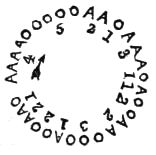
He placed them as in the margin, A representing apples, and O oranges; and it will be found that, by commencing at the four apples, and going round and round the circle, taking away every ninth, all the oranges will be removed, and all the apples will remain.
If we let the vowels a e i o u
denote the figures 1 2 3 4 5,
the arrangement of the figures 4, 5, 2, 1, &c., can be easily recollected by the following line:
Our earth's final fate— enigma ever dark
45 21 3 1 1 2 2 3 1 2 2 1
or,
Our dear Richard's tale begins at the sea.
45 21 3 1 1 2 2 3 1 2 21
Our young friends may find amusement in forming lines for themselves as much superior to these as possible.
THE TEN TENS.
Take ten pieces of card, and upon each write any ten words; there is no restriction as to the initial letter of nine of the words, but the last word on each card must commence with certain letters which you must in your own mind associate with the numbers 1 to 10, so that by knowing the initial letter of the last word on each card, you can determine its number.
Here are ten cards, (call these the Selecting Cards,) which we give by way of example, though our readers will perhaps prefer having words of their own selection.
Jane. Ellen. George. James. Newton.
Mary. Fanny. William. Clement. Davy.
Matilda. Caroline. Frederick. Edward. Morse.
Sarah. Isabel. Robert. Ralph. Fulton.
Rosa. Flora. Edmund. Francis. Franklin.
Elizabeth. Laura. John. Edwin. Arago.
Harriet. Maria. Alfred. Walter. Spurzheim.
Ann. Frances. Albert. Charles. Laplace.
Emily. Edith. Henry. Samuel. Steers.
Emma. Dorothea. Isaac. Theodore. Herschel.
Sister. Rose. Friendship. Putnam. Clay.
Brother. Violet. Happiness. Lafayette. Webster.
Uncle. Lupin. Industry. Steuben. Calhoun.
Aunt. Daisy. Ambition. Scott. Benton.
Grandmother. Tulip. Energy. Taylor. Jefferson.
Grandfather. Peony. Fidelity. Green. Adams.
Nephew. Hyacinth. Affection. Harrison. Madison.
Niece. Pink. Hope. Hamilton. Jackson.
Cousin. Snowdrop. Justice. Wayne. Monroe.
Father. Lily. Order. Washington. Napoleon.
For these the key words are, "Edith Flown," so that the letters
E D I T H F L O W N
Stand for 1 2 3 4 5 6 7 8 9 10
For the success of the game, the key words and the numbers denoted by their letters, must be carefully concealed.
Take ten other cards, which call the "grouped cards," and upon one write down the first word from each of the selecting cards, being careful to write them in the same order. Let another card contain all the words which are second from the top, and so on till all the words have been grouped together. As an example, we give the 1st and 4th grouped cards.
1st. 4th.
Jane. Sarah.
Ellen. Isabel.
George. Robert.
James. Ralph.
Newton. Fulton.
Sister. Aunt.
Rose. Daisy.
Friendship. Ambition.
Putnam. Scott.
Clay. Benton.
The object of the game is to guess which of the words from any of the selecting cards any person may have fixed upon.
Let any one choose a card out of the selecting cards, and after he has fixed upon a word, give it back to you; when receiving it, carefully note the last word upon it, which will give you, by the aid of the key word, the number of the card; this you must keep secret, and you then give him all the grouped cards, and request him to show you the cards which contain the words he fixed upon.
You can then announce the word; for the number of the word from the top on the grouped card is the same as the number of the selecting card, from which he made his choice.
Suppose he made his choice from the card which has Theodore for its last word—this is No. 4; when he shows you the grouped card, which he says contains the selected word, you will know that Ralph, the fourth from the top, is the name he fixed upon.
DIVIDING THE BEER.
During the siege of Sebastopol, when the troops were on "short allowance," a can of eight pints of porter was ordered to be equally divided between two messes; but having only a five pint can, and one which held three pints, it was found impossible to make this division, till one of the clever sappers suggested the following method; and, to understand it, we will put down the contents of each of the three cans at each stage of the process; commencing with
8-pt. 5-pt. 3-pt.
The 8-pint can full, and the others empty, 8 0 0
1. Filled the 5-pint can 3 5 0
2. Filled the 3-pint can from the 5-pint 3 2 3
3. Pour the contents of the 3-pint into the 8-pint 6 2 0
4. Transfer the 2 pints from the 5-pint to the 3-pint 6 0 2
5. Filled the 5-pint from the 8-pint 1 5 2
6. Fill up the 3-pint from the 5-pint 1 4 3
7. Poured the 3 pints into the 8-pint; completing the feat 4 4 0
This was a dexterous expedient of the worthy sapper, the only objections to it being the time the thirty men had to wait, and the resulting flat condition of the beer.
THE DIFFICULT CASE OF WINE.
A gentleman had a bottle containing 12 pints of wine, 6 of which he was desirous of giving to a friend; but he had nothing to measure it, except two other bottles, one of 7 pints, and the other of 5. How did he contrive to put 6 pints into the 7-pint bottle?
12-pt. 7-pt. 6-pt.
Before he commenced, the contents of the bottles were 12 0 0
1. He filled the 5-pint 7 0 5
2. Emptied the 5-pint into the 7-pint 7 5 0
3. Filled again the 5-pint from the 12-pint 2 5 5
4. Filled up the 7-pint from the 5 2 7 3
5. Emptied the 7-pint into the 12-pint 9 0 3
6. Poured the 3 pints from the 5 into the 7 9 3 0
7. Filled the 5-pint from the 12-pint 4 3 5
8. Filled up the 7-pint from the 5-pint 4 7 1
9. Emptied the 7-pint into the 12-pint 11 0 1
10. Poured 1 pint from the 5-pint into the 7-pint 11 1 0
11. Filled the 5-pint from the 12-pint 6 1 5
12. Poured the contents of the 5-pint into the 7-pint 6 6 0
ANOTHER DECIMATION OF FRUIT.
On the next visit of the youth to his uncle, the latter produced thirty apples and ten oranges, and offered him the favorite oranges, if his nephew could arrange them in an oval, so that by taking every twelfth the apples should remain. But this he could not accomplish, and the old gentleman, being well versed in the "Recreations in Science," proceeded to arrange them thus:
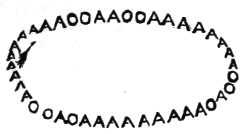
The places which the oranges here occupy can be easily remembered, being Nos. 7, 8, 11, 12, 21, 22, 24, 34, 36, 37.
THE WINE AND THE TABLES.
A certain hotel-keeper was dexterous in contrivances to produce a large appearance with small means. In the dining-room were three tables, between which he could divide 21 bottles, of which 7 only were full, 7 half full, and 7 apparently just emptied, and in such a manner that each table had the same number of bottles, and the same quantity of wine. He did this in two ways:
Table. Full Hf. full. Empty. Table. Full Hf. full. Empty.
1 2 3 2 | 1 3 1 3
2 2 3 2 | 2 3 1 3
3 3 1 3 | 3 1 5 1
He also performed a similar exploit with 24 bottles, 8 full, 8 half-full, and 8 empty:
Table. Full Hf. full. Empty. Table. Full Hf. full. Empty.
1 3 2 3 | 1 2 4 2
2 3 2 2 | 2 2 4 2
3 2 4 2 | 3 4 0 4
Also with 27 bottles, 9 full, 9 half-full, and 9 empty:
Table. Full Hf. full. Empty. Table. Full Hf. full. Empty.
1 2 5 2 | 1 1 7 1

2 3 3 3 | 2 4 1 4
3 4 1 4 | 3 4 1 4
THE THREE TRAVELERS.
Three men met at a caravansary or inn, in Persia; and two of them brought their provision along with them, according to the custom of the country; but the third not having provided any, proposed to the others that they should eat together, and he would pay the value of his proportion. This being agreed to, A produced 5 loaves, and B 3 loaves, all of which the travelers ate together, and C paid 8 pieces of money as the value of his share, with which the others were satisfied, but quarreled about the division of it. Upon this the matter was referred to the judge, who decided impartially. What was his decision?
At first sight it would seem that the money should be divided according to the bread furnished; but we must consider that, as the 3 ate 8 loaves, each one ate 2-2/3 loaves of the bread he furnished. This from 5 would leave 2-1/3 loaves furnished the stranger by A; and 3 - 2-2/3 = 1/3 furnished by B, hence 2-1/3 to 1/3 = 7 to 1, is the ratio in which the money is to be divided. If you imagine A and B to furnish, and C to consume all, then the division will be according to amounts furnished.
WHICH COUNTER HAS BEEN THOUGHT OF OUT OF SIXTEEN?
Take sixteen pieces of card, and number them 1 to 16. Arrange them in two rows, as at A B.
A B C B D M E B F N G B H
1 9 1 9 2 2 2 9 4 2 2 9 6
2 10 3 10 4 4 6 10 8 6 1 10 5
3 11 5 11 6 6 1 11 3 1 4 11 8
4 12 7 12 8 8 5 12 7 5 3 12 7
5 13 13 1 13 4 13
6 14 14 3 14 8 14
7 15 15 5 15 3 15
8 16 16 7 16 7 16
Desire a person to think of one of the numbers, and to tell you in which row it is. Suppose he fixes on 6; he will tell you that the row A contains the number he thought of.
Take up the row A, and arrange the numbers on each side of the row B, as shown at C D, so that the first number of the row A may be the first of the row C, the second of A be the first of D, the third of A be the second of C, and so on.
Ask in which of the rows, C or D, is the number thought of: in the case supposed it is in D.
Take up the rows C D, and put one underneath the other, as at M, taking care that the half-row in which is the number thought of, shall be above the other.
Divide it again into two rows, as at E F, on each side of B, in the same way as before. Ask again in which row it is: it is now in E.
Place one row under the other, as at N, and divide again into two rows, which will now be as G H.
You will be informed that the number is in row H, and you may then announce it to be the top number of that row.
The number thought of will always be at the top of one of the rows after three transpositions. If there were 32 counters it would be at the top after four transpositions.
MAGIC SQUARES.
The name "Magic Square" is given to a square divided into several smaller squares, in which numbers are placed in such a manner that every column of numbers, whether vertical, horizontal, or from corner to corner, shall amount to the same sum.
They are divided into three principal classes: 1st, Those which have an odd number of squares in each band; 2d, Those which have an even number of squares in each band, this even number being divisible exactly by 4; 3d, Where the even number of squares in each band cannot be divided by 4 without a fraction.
ODD MAGIC SQUARES.
Squares of this kind are formed thus. Imagine an exterior line of squares above the magic square you wish to form, and another exterior line on the right hand of it These two imaginary lines are shown in the figure.
Then attend to the two following rules:
1st. In placing the numbers in the squares we must go in an ascending oblique direction from left to right; any number which, by pursuing this direction, would fall into the exterior line, must be carried along that line of squares, whether vertical or horizontal, to the last square. Thus, 1 having been placed in the center of the top line, (see the first table on p. 228,) 2 would fall into the exterior square above the fourth vertical line; it must be therefore carried down to the lowest square of that line; then, ascending obliquely 3 falls into the square, but four falls out of it, to the end of a horizontal line, and it must be carried along that line to the extreme left, and there placed. Resuming our oblique ascension to the right, we place 5, where the reader sees it, and would place 6 in the middle of the top band, but finding it occupied by 1, we look for direction to the 2d Rule, which prescribes that, when in ascending obliquely, we come to a square already occupied, we must place the number, which according to the first rule should go into that occupied square, directly under the last number placed. Thus, in ascending with 4, 5, 6, the 6 must be placed directly under the 5, because the square next to 5 in an oblique direction is "engaged."
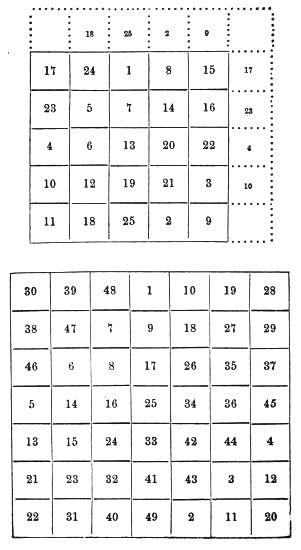
Magic squares of this class, however large in the number of compartments, can be easily filled up by attending to these two rules.
We give opposite, a seven-placed square.
There are various other kinds of magic squares; but explanations of them would be too lengthy for our work.
The invention of these contrivances has been traced back to the early ages of science, and talismanic properties were attributed to them. Modern philosophers have amused themselves in bringing them to perfection, and none has contributed so much as "the model of practical wisdom," Dr. Franklin.
THE SQUARE OF GOTHAM.
The wise men of Gotham, famous for their eccentric blunders, once undertook the management of a school; they arranged their establishment in the form of a square divided into 9 rooms. The playground occupied the center, and 24 scholars the rooms around it, 3 being in each. In spite of the strictness of discipline, it was suspected that the boys were in the habit of playing truant, and it was determined to set a strict watch. To assure themselves that all the boys were on the premises, they visited the rooms, and found three in each, or 9 in each row. Four boys then went out, and the wise men soon after visited the rooms, and finding 9 in each row, thought all was right. The four boys then came back, accompanied by four strangers; and the Gothamites, on their third round, finding still 9 in each row, entertained no suspicion of what had taken place. Then 4 more "chums" were admitted; but the clever men, on examining the establishment a fourth time, still found 9 in each row, and so came to an opinion that their previous suspicions had been unfounded. How was all this possible?
The following figures represent the contents of each room at the four different visits; the first, at the commencement of the watch; the second, when four had gone out; the third, when these 4, accompanied by another 4, had returned; and the fourth, when 4 more had joined them.
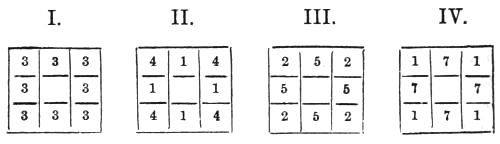
On each change the boys arranged themselves in the rooms in such a manner that, when the corner rooms were counted as a part of two rows, each entire row of three rooms contained the same number of boys. The illusion of the wise men was due to their mistake in counting each corner room twice.
THE MATHEMATICAL BLACKSMITH.
A blacksmith had a stone weighing 40 lbs. A mason coming into the shop, hammer in hand, struck it and broke it into four pieces. "There," says the smith, "you have ruined my weight." "No," says the mason, "I have made it better, for whereas you could before weigh but 40 lbs. with it, now you can weigh every pound from 1 to 40." Required size of the pieces?
Ans. 1, 3, 9, 27; for in any geometrical series proceeding in a triple ratio, each term is 1 more than twice the sum of all the preceding, and the above series might proceed to any extent. In using the weights, they must be put in one or both scales as may be necessary: as to weigh 2, put 1 in one scale, and 3 in the other.
CURIOUS PROPERTIES OF SOME FIGURES.
Select any two numbers you please, and you will find that one of the two, their amount when added together, or their difference, is always 3, or a number divisible by 3.
Thus, if the numbers are 3 and 8, the first number is 3; let the numbers be 1 and 2, their sum is 3; let them be 4 and 7, the difference is 3. Again, 15 and 22, the first number is divisible by 3: 17 and 26, their difference is divisible by 3, &c.
All the odd numbers above 3, that can only be divided by 1, can be divided by 6, by the addition or subtraction of a unit. For instance, 13 can only be divided by 1; but after deducting 1, the remainder can be divided by 6; for example, 5 + 1 = 6 ; 7 - 1 = 6; 17 + 1 = 18; 19 - 1 = 18; 25 - 1 = 24, and so on.
If you multiply 5 by itself, and the quotient again by itself, and the second quotient by itself, the last figure of each quotient will always be 5. Thus 5 × 5 = 25; 25 × 25 = 125; 125 × 125 = 625, &c. Again, if you proceed in the same manner with the figure 6, the last figure will constantly be 6; thus, 6 × 6 = 36; 36 × 36 = 216; 216 × 216 = 1,296, and so on.
To multiply by 2 is the same as to multiply by 10 and divide by 5.
Any number of figures you may wish to multiply by 5, will give the same result if divided by 2—a much quicker operation than the former; but you must remember to annex a cipher to the answer where there is no remainder, and where there is a remainder, annex a 5 to the answer. Thus, multiply 464 by 5, the answer will be 2320; divide the same number by 2, and you have 232, and as there is no remainder you add a cipher. Now, take 357, and multiply by 5—the answer is 1785. On dividing 357 by 2, there is 178, and a remainder; you therefore place 5 at the right of the line, and the result is again 1785.
There is something more curious in the properties of the number 9. Any number multiplied by 9 produces a sum of figures which, added together, continually makes 9. For example, all the first multiples of 9, as 18, 27, 36, 45, 54, 63, 72, 81, sum up 9 each. Each of them multiplied by any number whatever produces a similar result; as 8 times 81 are 648, these added together make 18, 1 and 8 are 9. Multiply 648 by itself, the product is 419,904—the sum of these digits is 27, 2 and 7 are 9. The rule is invariable. Take any number whatever and multiply it by 9; or any multiple of 9, and the sum will consist of figures which, added together, continually number 9. As 17 × 18 = 306, 6 and 3 are 9; 117 × 27 = 3,159, the figures sum up 18, 8 and 1 are 9; 4591 × 72 = 330,552, the figures sum up 18, 8 and 1 are 9. Again, 87,363 × 54 = 4,717,422; added together the product is 27, or 2 and 7 are 9, and so always. If any row of two or more figures be reversed and subtracted from itself, the figures composing the remainder, will, when added horizontally, be a multiple of nine:
42 886 326 24 688 1623 — —— —— 18 – 9 × 2. 198 – 9 × 2. 1638 – 9 × 2.
If a multiplicand be formed of the digits in their regular order, omitting the 8, a multiplier may be found by a rule, which will give a product, each figure of which shall be the same. Thus if 12345679 be given, and it be required to find a multiplier which shall give the product all in 2, that multiplier will be 18: if in 3, the multiplier will be 27: if all 4, it will be 36—and so forth.
12345679 12345679 12345679 18 27 36 ———— ———— ———— 98765432 86419753 74074074 12345679 24691358 37037037 ———— ———— ———— 222222222 333333333 444444444
The rule by which the multiplier is discovered (but which we do not attempt to explain) is this: Multiply the last figure (the 9) of the multiplicand by the figure of which you wish the product to be composed, and that number will be the required multiplier. Thus, when it was required to have the product composed of 2, the 2 multiplied by 9 gives 18, the multiplier: 3 multiplied by 9 gives 27, the multiplier to give the product in 3; &c.
If a figure, with a number of ciphers attached to it, be divided by 9, the quotient will be composed of one figure only, namely, the first figure of the dividend, as—
9)600,000 9)40,000 ————— ———— 66,666–6 4,444–4
{ 9)549 If any sum of figures can be divided by 9 as, {——— { 61
the amount of these figures, when added together, can be divided by 9:—thus, 5, 4, 9, added together, make 18, which is divisible by 9. If the sum 549 is multiplied by any figure, the product can also be divided by 9, as—
} { 3
549 } { 2
6 } { 9
——— } And the amount of the figures of { 4
9)3294 } the product can also be divided by { ——
——— } 9, thus, { 2)18
366 } { ——
} { 9
To multiply by 9, add a cipher, and deduct the sum that is to be multiplied: thus,
43,260 } { 4,326
4,326 } Produces the same result as { 9
—— } { ——
38,934 } { 38,934
In the same manner, to multiply by 99, add two ciphers; by 999, three ciphers, &c. These properties of the figure 9 will enable the young arithmetician to perform an amusing trick, quite sufficient to excite the wonder of the uninitiated.
Any series of numbers that can be divided by 9, as 365, 472,821,754, &c., being shown, a person may be requested to multiply secretly either of these series by any figure he pleases, to strike out one number of the quotient, and to let you know the figures which remain, in any order he likes; you will then, by the assistance of the knowledge of the above properties of 9, easily declare the number which has been erased. Thus, suppose 365,472 are the numbers chosen, and the multiplier is six; if then, 8 is stuck out, the numbers returned to you will be
} 2
} 1
365472 } 9
6 } 2
——— } 3
219232 } 2
} —
} 19
The amount of these numbers is 19; but 19, divided by 9, leaves a remainder of 1; you, therefore, want 8 to complete another 9: 8, then, is the number erased.
The component figures of the product made by the multiplication of every digit into the number 9, when added together, make NINE.
The order of these component figures is reversed after the said number has been multiplied by 5.
The component figures of the amount of the multipliers (viz. 45,) when added together, make NINE.
The amount by the several products, or multiples of 9 (viz. 405,) when divided by 9, gives for a quotient, 45; that is, 4 + 5 = NINE.
The amount of the first product (viz. 9,) when added to the other product, whose respective component figures make 9, is 81; which is the square of NINE.
The said number 81, when added to the above mentioned amount of the several products, or multiples of 9 (viz. 405) makes 486, which, if divided by 9, gives for a quotient 54: that is, 5 + 4 = NINE.
It is also observable, that the number of changes that may be rung on nine bells is 362,880; which figures, added together, make 27; that is, 2 + 7 = NINE.
And the quotient of 362,880, divided by 9, will be 40,320; that is 4 + 0 + 3 + 2 + 0 = NINE.
If number 37 be multiplied by any of the progressive numbers arising from the multiplication of 3 with any of the units, the figures in the quotient will be similar, and the result may be known beforehand by merely inspecting the progressive numbers, thus, 3, 6, 9, 12, 15, 18, 21, 24, 27, &c., are the progressive numbers formed by 3 multiplied by the units 1 to 9; and the result of the multiplication of any of these numbers with 37 may be seen in the following examples:—37 × 3 = 111; 37 × 6 = 222; 37 × 12 = 444; 37 × 24 = 888; by which it appears that the numbers of which the quotient is formed are the same as the units by which number 3 was multiplied to obtain the respective progressive numbers. Thus—3 multiplied by 2 is equal to 6, and 37 multiplied by 9 is equal to 222; so, again, 4 multiplied by 3 produces 12, and 37 multiplied by 12 is equal to 444, and so on.
THE INDUSTRIOUS FROG.
There was a well 30 feet deep, and at the bottom a frog anxious to get out. He got up 3 feet per day, but regularly fell back 2 feet at night. Required the number of days necessary to enable him to get out?
The frog appears to have cleared one foot per day, and at the end of 27 days, he would be 27 feet up, or within 3 feet of the top, and the next day he would get out. He would therefore be 28 days getting out.
THE COUNCIL OF TEN.
Ten cards or counters, numbered from one to ten, or the first ten playing cards of any suit disposed in a circular form may be employed with great convenience for performing this feat. The accompanying figure shows the cards thus arranged, number one, or the ace, designated by A, and the ten by K.
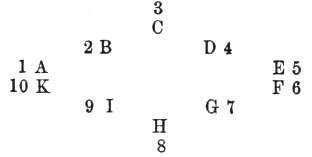
Having placed the cards in the above order, desire a bystander to think of a card or number, and when he has done so, to touch any other card or number. Request him then to add to the number of the card touched the number of the cards employed, which in this case is ten. Then desire him to count the sum in an order contrary to that of the natural numbers, beginning at the card he touched, and assigning it the number of the card he thought of. By counting in this manner, he will end at the number or card he thought of, and consequently you will immediately know it.
Thus, for example, suppose the person had thought of 3 C, and touched 6 F; then, if 10 be added to 6, the sum will be 16; and if that number be counted from F, the number touched, towards E D B C A, and so on, in the retrograde order, counting F three, the number thought of, E five, D six, and so round to sixteen, that number will terminate at C, showing that the person thought of 3, the number which corresponds to C.
A greater or less number of cards or counters may be employed at pleasure; but in every instance the whole number of cards must be added to the number of the card touched.
THE TWO TRAVELERS.
Two travelers trudged along the road together, Talking, as Yankees do, about the weather; When, lo! beside their path the foremost spies Three casks, and loud exclaims "A prize, a prize!" One large, two small, but all of various size. This way and that they gazed, and all around, Each wondering if an owner might be found: But not a soul was there—the coast was clear, So to the barrels they at once drew near, And both agree whatever may be there In friendly partnership they'll fairly share. Two they find empty, but the other full, And straightway from his pocket one doth pull A large clasp-knife. A heavy stone lay handy, And thus in time they found their prize was brandy. 'Tis tasted and approved: their lips they smack, And each pronounces 'tis the famed Cognac. "Won't we have many a jolly night, my boy! May no ill luck our present hopes destroy!" 'Twas fortunate one knew the mathematics, And had a smattering of hydrostatics; Then measured he the casks, and said, "I see This is eight gallons, those are five and three." The question then was how they might divide The brandy, so that each should be supplied With just four gallons, neither less nor more. With eight, and five, and three they puzzle sore, Filled up the five—filled up the three, in vain; At length a happy thought came o'er the brain Of one: 'twas done, and each went home content, And their good dames declared 'twas excellent. With those three casks they made division true; I found the puzzle out, say, friend, can you?
The five-gallon barrel was filled first, and from that the three-gallon barrel, thus leaving two gallons in the five-gallon barrel; the three-gallon barrel was then emptied into the eight-gallon barrel, and the two gallons poured from the five-gallon barrel into the empty three-gallon barrel; the five-gallon barrel was then filled, and one gallon poured into the three-gallon barrel, therefore leaving four gallons in the five-gallon barrel, one gallon in the eight-gallon barrel, and three gallons in the three-gallon barrel, which was then emptied into the eight-gallon barrel. Thus each person had four gallons of brandy in the eight and five-gallon barrels respectively.
ARITHMETICAL PUZZLE.
If from 6 you take 9, and from 9 you take 10; and if 50 from 40 be taken, there will just half a dozen remain.
ANSWER.
From SIX From IX From XL
Take IX Take X Take L
— — —
S I X Remains.
THE MONEY GAME.
A person having in one hand a piece of gold, and in the other a piece of silver, you may tell in which hand he has the gold, and in which the silver, by the following method: Some value, represented by an even number, such as 8, must be assigned to the gold; and a value represented by an odd number, such as three, must be assigned to the silver; after which, desire the person to multiply the number in the right hand by any even number whatever, such as 2, and that in the left by an odd number, as 3; then bid him add together the two products, and if the whole sum be odd, the gold will be in the right hand, and the silver in the left; if the sum be even, the contrary will be the case.
To conceal the artifice better, it will be sufficient to ask whether the sum of the two products can be halved without a remainder; for in that case the total will be even, and in the contrary case odd.
It may be readily seen, that the pieces, instead of being in the two hands of the same person, may be supposed to be in the hands of two persons, one of whom has the even number, or piece of gold, and the other the odd number, or piece of silver. The same operations may then be performed in regard to these two persons, as are performed in regard to the two hands of the same person, calling the one privately the right, and the other the left.
THE PHILOSOPHER'S PUPILS.
To find a number of which the half, fourth, and seventh added to three shall be equal to itself.
This was a favorite problem among the ancient Grecian arithmeticians, who stated the question in the following manner: "Tell us, illustrious Pythagoras, how many pupils frequent thy school?" "One half," replied the philosopher, "study mathematics, one fourth natural philosophy, one seventh observe silence, and there are three females besides."
The answer is, 28: 14 + 7 + 4 + 3 = 28.
TO DISCOVER A SQUARE NUMBER.
A square number is a number produced by the multiplication of any number into itself; thus, 4 multiplied by 4 is equal to 16, and 16 is consequently a square number, 4 being the square root from which it springs. The extraction of the square root of any number takes some time; and after all your labor you may perhaps find that the number is not a square number. To save this trouble, it is worth knowing that every square number ends either with a 1, 4, 5, 6, or 9, or with two cyphers, preceded by one of these numbers.
Another property of a square number is, that if it be divided by 4, the remainder, if any, will be 1—thus, the square of 5 is 25, and 25 divided by 4 leaves a remainder of 1; and again, 16, being a square number, can be divided by 4 without leaving a remainder.
THE SHEEP-FOLD.
A farmer had a pen made of 50 hurdles, capable of holding 100 sheep only; supposing he wanted to make it sufficiently large to hold double that number, how many additional hurdles would he have occasion for?
Answer.—Two. There were 24 hurdles on each side of the pen; a hurdle at the top, and another at the bottom; so that, by moving one of the sides a little back, and placing an additional hurdle at the top and bottom, the size of the pen would be exactly doubled.
COUNTRYWOMAN AND EGGS.
A countrywoman carried eggs to a garrison, where she had three guards to pass, sold to the first guard half the number she had, and half an egg more; to the second, the half of what remained, and half an egg besides; and to the third guard she sold the half of the remainder, and half another egg. When she arrived at the market-place, she had three dozen still to sell; how was this possible, without breaking any of the eggs? It would seem at the first view that this is impossible, for how can half an egg be sold without breaking any of the eggs? The possibility of this seeming impossibility will be evident, when it is considered, that by taking the greater half of an odd number, we take the exact half + 1/2. When the countrywoman passed the first guard, she had 295 eggs; by selling to that guard 148, which is the half + 1/2, she had 147 remaining; to the second guard she disposed of 74, which is the major half of 147; and, of of course, after selling 37 out of 74 to the last guard, she had still three dozen remaining.
HOW TO RUB OUT TWENTY CHALKS AT FIVE TIMES, RUBBING OUT EVERY TIME AN ODD ONE.
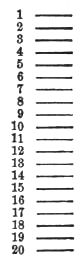
To do this trick, you must make twenty chalks, or long strokes, upon a board, as in the margin:
Then begin and count backwards, as 20, 19, 18, 17, rub out these four; then proceed saying, 16, 15, 14, 13, rub out these four; and begin again, 12, 11, 10, 9, and rub out these; and proceed again, 8, 7, 6, 5, then rub out these; and lastly say, 4, 3, 2, 1, when these four are rubbed out. The whole twenty are rubbed out at five times, and every time an odd one, that is, 17th, 13th, 9th, 5th, and 1st.
This is a trick which, if once seen, may be easily retained; and the puzzle at first is, it not occurring immediately to the mind to begin to rub them out backwards. It is as simple as any thing possibly can be.
THE IMPOSSIBLE TRIANGLE.
The longest side of a triangle is 100 rods; and each of the other sides 50. Required the value of the grass at $5 per acre.
This is a catch question, as a triangle cannot be formed unless any two of the lines are longer than the third.
ODD OR EVEN.
Every odd number multiplied by an odd number produces an odd number; every odd number multiplied by an even number produces an even number; and every even number multiplied by an even number also produces an even number. So, again, an even number added to an even number, and an odd number added to an odd number, produce an even number; while an odd and even number added together produce an odd number.
If any one holds an odd number of counters in one hand, and an even number in the other, it is not difficult to discover in which hand the odd or even number is. Desire the party to multiply the number in the right hand by an even number, and that in the left hand by an odd number, then to add the two sums together, and tell you the last figure of the product; if it is even, the odd number will be in the right hand; and if odd, in the left hand; thus, supposing there are 5 counters in the right hand, and 4 in the left hand, multiply 5 by 2, and 4 by 3, thus: 5 × 2 = 10, 4 × 3 = 12, and then adding 10 to 12, you have 10 + 12 = 22, the last figure of which, 2, is even, and the odd number will consequently be in the right hand.
THE FIGURES, UP TO 100, ARRANGED SO AS TO MAKE 505 IN EACH COLUMN, WHEN COUNTED IN TEN COLUMNS PERPENDICULARLY, AND THE SAME WHEN COUNTED IN TEN FILES HORIZONTALLY.
10 92 93 7 5 96 4 98 99 1
11 19 18 84 85 86 87 13 12 90
71 29 28 77 76 75 24 23 22 80
70 62 63 37 36 35 34 68 69 31
41 52 53 44 46 45 47 58 59 60
51 42 43 54 56 55 57 48 49 50
40 32 33 67 65 66 64 38 39 61
30 79 78 27 26 25 74 73 72 21
81 89 88 14 15 16 17 83 82 20
100 9 8 94 95 6 97 3 2 91
Each of these files, when added up, makes 505.
Each of these ten columns, when added up, makes 505.
THE OLD WOMAN AND HER EGGS.
At a time when eggs were scarce, an old woman who possessed some remarkably good-laying hens, wishing to oblige her neighbors, sent her daughter round with a basket of eggs to three of them; at the first house, which was the squire's, she left half the number of eggs she had and half a one over; at the second she left half of what remained and half an egg over; and at the third she again left half of the remainder, and half a one over; she returned with one egg in her basket, not having broken any. Required—the number she set out with. Ans. 15 eggs.
THE MATHEMATICAL FORTUNE TELLER.
Procure six cards, and having ruled them the same as the following diagrams, write in the figures neatly and legibly.
It is required to tell the number thought by any person, the numbers being contained in the cards, and such numbers not to exceed 60. How is this done?
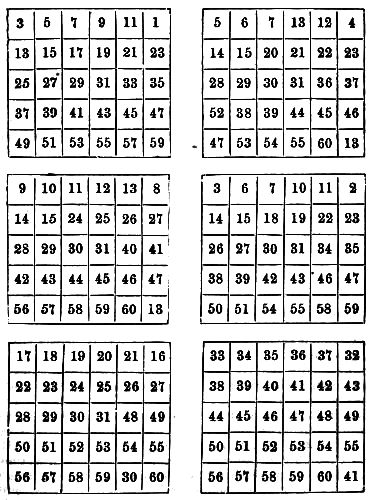
Request the person to give you the cards containing the number, and then add the right hand upper corner figures together, which will give the correct answer. For example: suppose 10 is the number thought of, the cards with 2 and 8 in the corners will be given, which makes the answer 10, and so on with the others.
THE DICE GUESSED UNSEEN.
A pair of dice being thrown, to find the number of points on each die without seeing them. Tell the person who cast the dice to double the number of points upon one of them, and add 5 to it; then to multiply the sum produced by 5, and to add to the product the number of points upon the other die. This being done, desire him to tell you the amount, and, having thrown out 25, the remainder will be a number consisting of two figures, the first of which, to the left, is the number of points on the first die, and the second figure, to the right, the number on the other. Thus:
Suppose the number of points of the first die which comes up to be 2, and that of the other 3; then, if to four, the double of the points of the first, there be added 5, and the sum produced, 9, be multiplied by 5, the product will be 45; to which, if 3, the number of points on the other die, be added, 48 will be produced, from which, if 25 be subtracted, 23 will remain; the first figure of which is 2, the number of points on the first die, and the second figure 3, the number on the other.
THE SOVEREIGN AND THE SAGE.
A sovereign being desirous to confer a liberal reward on one of his courtiers, who had performed some very important service, desired him to ask whatever he thought proper, assuring him it should be granted. The courtier, who was well acquainted with the science of numbers, only requested that the monarch would give him a quantity of wheat equal to that which would arise from one grain doubled sixty-three times successively. The value of the reward was immense; for it will be found by calculation that the sixty-fourth term of the double progression divided by 1, 2, 4, 8, 16, 32, &c., is 9223372036854775808. But the sum of all the terms of a double progression, beginning with 1, may be obtained by doubling the last term, and subtracting from it 1. The number of the grains of wheat, therefore, in the present case, will be 18446744073709551615. Now, if a pint contain 9216 grains of wheat, a gallon will contain 73728; and, as eight gallons make one bushel, if we divide the above result by eight times 73728 we shall have 31274997411295 for the number of the bushels of wheat equal to the above number of grains, a quantity greater than what the whole surface of the earth could produce in several years, and which in value would exceed all the riches, perhaps, on the globe.
THE KNOWING SHEPHERD.
A shepherd was going to market with some sheep, when he met a man who said to him, "Good morning, friend, with your score." "No," said the shepherd, "I have not a score; but if I had as many more, half as many more, and two sheep and a half, I should have just a score." How many sheep had he?
He had 7 sheep: as many more 7; half as many more, 3 1⁄2; and 2 1⁄2; making in all 20.
THE CERTAIN GAME.
Two persons agree to take, alternately, numbers less than a given number, for example, 11, and to add them together till one of them has reached a certain sum, such as 100. By what means can one of them infallibly attain to that number before the other?
The whole artifice in this consists in immediately making choice of the numbers 1, 12, 23, 34, and so on, or of a series which continually increases by 11, up to 100. Let us suppose that the first person, who knows the game, makes choice of 1; it is evident that his adversary, as he must count less than 11, can at most reach 11, by adding 10 to it. The first will then take 1, which will make 12; and whatever number the second may add the first will certainly win, provided he continually add the number which forms the complement of that of his adversary to 11; that is to say, if the latter take 8, he must take 3; if 9, he must take 2; and so on. By following this method he will infallibly attain to 89, and it will then be impossible for the second to prevent him from getting first to 100; for whatever number the second takes he can attain only to 99; after which the first may say—"and 1 makes 100." If the second take 1 after 89, it would make 90, and his adversary would finish by saying—"and 10 make 100." Between two persons who are equally acquainted with the game, he who begins must necessarily win.
THE ASTONISHED FARMER.
A and B took each 30 pigs to market, A sold his at 3 for a dollar, B at 2 for a dollar, and together they received $25. A afterwards took 60 alone, which he sold as before, at 5 for $2, and received, but $24; what became of the other dollar?
This is rather a catch question, the insinuation that the first lot were sold at the rate of five for $2, being only true in part. They commence selling at that rate, but after making ten sales, A's pigs are exhausted, and they have received $20: B still has 10 which he sells at "2 for a dollar" and of course receives $5; whereas had he sold them at the rate of 5 for $2, he would have received but $4. Hence the difficulty is easily settled.
MAGICAL CENTURY.
If the number 11 be multiplied by any one of the nine digits, the two figures of the product will always be alike, as appears in the following example:—
11 11 11 11 11 11 11 11 11
1 2 3 4 5 6 7 8 9
— — — — — — — — —
11 22 33 44 55 66 77 88 99
— — — — — — — — —
Now, if another person and yourself have fifty counters a-piece, and agree never to stake more than ten at a time, you may tell him that if he permit you to stake first, you always complete the even century before him.
In order to succeed, you must first stake 1, and remembering the order of the above series, constantly add to what he stakes as many as will make one more than the numbers 11, 22, 33, &c., of which it is composed, till you come to 89, after which your opponent cannot possibly reach the even century himself, or prevent you from reaching it.
If your opponent has no knowledge of numbers, you may stake any other number first, under 10, provided you subsequently take care to secure one of the last terms, 56, 67, 78, &c.; or you may even let him stake first, if you take care afterward to secure one of these numbers.
This exercise may be performed with other numbers; but, in order to succeed, you must divide the number to be attained by a number which is a unit greater than what you can stake each time, and the remainder will then be the number you must first stake. Suppose, for example, the number to be attained be 52 (making use of a pack of cards instead of counters), and that you are never to add more than 6; then, dividing 52 by 7, the remainder, which is 3, will be the number which you must first stake; and whatever your opponent stakes, you must add as much to it as will make it equal to 7, the number by which you divided, and so in continuation.