TRICKS IN MECHANICS.
Reading edition
"These are machinations comical."—FORD.
There is no subject of such importance as Mechanics, as its principles are founded upon the properties of matter and the laws of motion; and in knowing something of these, the tyro will lay the foundation of all substantial knowledge.
The properties of matter are the following: Solidity (or Impenetrability), Divisibility, Mobility, Elasticity, Brittleness, Malleability, Ductility, and Tenacity.
The laws of motion are as follow:
1. Every body continues in a state of rest or of uniform rectilineal motion, unless affected by some extraneous force.
2. The change of motion is always proportionate to the impelling force.
3. Action and reaction are always equal and contrary.
EXPERIMENT OF THE LAW OF MOTION.
In shooting at "taw," if the marble be struck "plump," as it is called, it moves forward exactly in the same line of direction; but if struck sideways, it will move in an oblique direction, and its course will be in a line situated between the direction of its former motion and that of the force impressed. This is called the resolution of forces.
BALANCING.
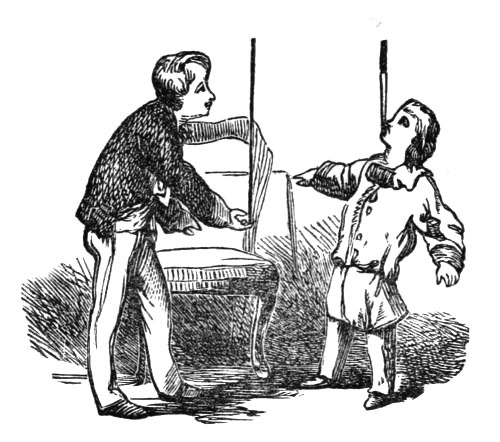
The center of gravity in a body is that part about which all the other parts equally balance each other. In balancing a stick upon the finger, or upon the chin, it is necessary only to keep the chin or finger exactly under the point which is called the center of gravity.
THE PRANCING HORSE.
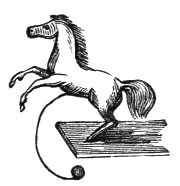
Cut out the figure of a horse, and having fixed a curved iron wire to the under part of its body, place a small ball of lead upon it. Place the hind legs of the horse on the table, and it will rock to and fro. If the ball be removed, the horse would immediately tumble, because unsupported, the center of gravity being in the front of the prop; but upon the ball being replaced, the center of gravity immediately changes its position, and is brought under the prop, and the horse is again in equilibrio.
TO CONSTRUCT A FIGURE, WHICH, BEING PLACED UPON A CURVED SURFACE, AND INCLINED IN ANY POSITION, SHALL, WHEN LEFT TO ITSELF, RETURN TO ITS FORMER POSITION.
The feet of the figure rest on a curved pivot, which is sustained by two loaded balls below; for the weight of these balls being much greater than that of the figure, their effect is to bring the center of gravity of the whole beneath the point on which it rests; consequently the equilibrium will resist any slight force to disturb it.
TO MAKE A CARRIAGE RUN IN AN INVERTED POSITION WITHOUT FALLING.
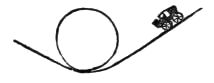
It is pretty well known to most boys, that if a tumbler of water be placed within a broad wooden hoop, the whole may be whirled round without falling, owing to the centrifugal force. On the same principle, if a small carriage be placed on an iron band or rail, it will ascend the curve, become inverted, and descend again, without falling.
TO CAUSE A CYLINDER TO ROLL BY ITS OWN WEIGHT UP HILL.
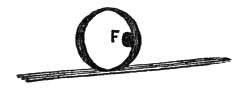
Procure a coffee canister, and loading it at F with a piece of lead, which may be fixed in with solder, the position of the center of gravity is thus altered. If a cylinder so constructed be placed on an inclined plane, and the loaded part above, it will roll up hill without assistance.
THE BALANCED STICK.
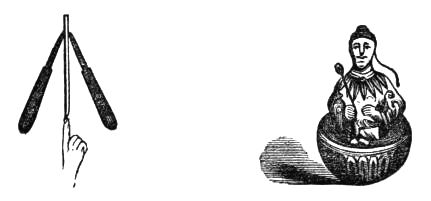
Procure a piece of wood, about nine inches in length and about half an inch in thickness, and thrust into its upper end the blades of two penknives, on either side one. Place the other end upon the tip of the fore-finger, and it will keep its place without falling.
THE CHINESE MANDARIN.
Construct out of the pith of elder a little mandarin; then provide a base for it to sit in, like a kettle-drum. Into this put some heavy substance, such as half a leaden bullet; fasten the figure to this, and in whatever position it may be placed, it will, when left to itself, immediately return to its upright position.
TO MAKE A QUARTER DOLLAR TURN ON ITS EDGE ON THE POINT OF A NEEDLE.
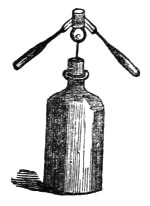
Take a bottle, with a cork in its neck, and in it, in a perpendicular position, a middle-sized needle. Fix a quarter dollar into another cork, by cutting a nick in it; and stick into the same cork two small table-forks, opposite each other, with the handles inclining downwards. If the rim of the quarter dollar be now poised on the point of the needle, it may easily be made to spin round without falling, as the center of gravity is below the the center of suspension.
THE SELF-BALANCED PAIL.
You lay a stick across the table, letting one third of it project over the edge; and you undertake to hang a pail of water on it, without either fastening the stick on the table, or letting the pail rest on any support; and this feat the laws of gravitation will enable you literally to accomplish.
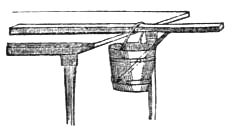
You take the pail of water, and hang it by the handle upon the projecting end of the stick, in such a manner that the handle may rest on it in an inclined position, with the middle of the pail within the edge of the table. That it may be fixed in this situation, place another stick with one of its ends resting against the side at the bottom of the pail, and its other end against the first stick, where there should be a notch to retain it. By these means, the pail will remain fixed in that situation, without being able to incline to either side; nor can the stick slide along the table, or move along its edge, without raising the center of gravity of the pail, and the water it contains.
TO LIFT A BOTTLE WITH A STRAW.
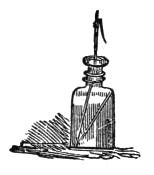
Take a straw, and having bent the thicker end of it in a sharp angle, as in figure subjoined, put this hooked end into the bottle, so that the bent part may rest against its side; you may then take the other end, and lift up the bottle by it, without breaking the straw, and this will be the more readily accomplished as the angular part of the straw approaches nearer to that which comes out of the bottle. It is necessary, in order to succeed in this feat, to be particularly careful in choosing a stout straw, which is neither broken nor bruised; if it have been previously bent or damaged, it is unfit for the purpose of performing this trick, as it will be too weak in the part so bent, or damaged, to support the bottle.
THE DANCING PEA.
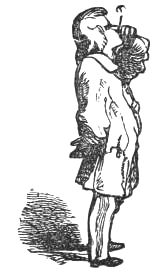
If you stick through a pea, or small ball of pith, two pins[8] at right angles, and defend the points with pieces of sealing wax, it may be kept in equilibrio at a short distance from the end of a straight tube by means of a current of breath from the mouth, which imparts a rotary motion to the pea.
THE TOPER'S TRIPOD.
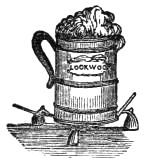
Place three tobacco pipes in the position shown in the engraving, the mouth of the bowls downwards, and the lower end of the stems upon the stem just by the bowls. This tripod, if carefully put together, will support considerably more than a pot of ale.
OBLIQUITY OF MOTION.
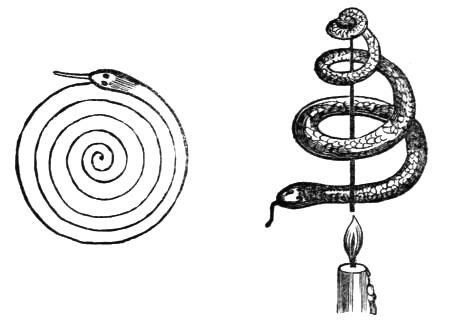
Cut a piece of pasteboard into the following shape, and describe on it a spiral line; cut this out with a penknife, and then suspend it on a large skewer or pin, as seen in the engraving. If the whole be now placed on a warm stove, or over the flame of a candle or lamp, it will revolve with considerable velocity. The card, after being cut into the spiral, may be made to represent a snake or dragon, and when in motion will produce a very pleasing effect.
THE BRIDGE OF KNIVES.
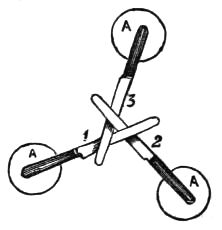
Place three glasses, A A A, in the form of a triangle, and arrange three knives upon them, as shown in the figure, the blade of No. 1 over that of No. 2, and that over No. 3, which rests on No. 1. The bridge so made will be self-supported.
SAND IN THE HOUR-GLASS.
It is a remarkable fact, that the flow of sand in the hour-glass is perfectly equable, whatever may be the quantity in the glass; that is, the sand runs no faster when the upper half of the glass is quite full than when it is nearly empty. It would, however, be natural enough to conclude that, when full of sand, it would be more swiftly urged through the aperture, than when the glass was only a quarter full, and near the close of the hour.
The fact of the even flow of sand may be proved by a very simple experiment. Provide some silver sand, dry it over or before the fire, and pass it through a tolerably fine sieve. Then take a tube, of any length or diameter, closed at one end, in which make a small hole, say the eighth of an inch; stop this with a peg, and fill up the tube with the sifted sand. Hold the tube steadily, or fix it to a wall, or frame, at any height from a table; remove the peg, and permit the sand to flow in any measure for any given time, and note the quantity. Then, let the tube be emptied, and only half or a quarter filled with the sand; measure again, for a like time, and the same quantity of sand will flow: even if you press the sand in the tube with a ruler or stick, the flow of the sand through the hole will not be increased.
The above is explained by the fact, that when the sand is poured into the tube, it fills it with a succession of conical heaps, and that all the weight which the bottom of the tube sustains is only that of the heap which first falls upon it; as the succeeding heaps do not press downwards, but only against the sides or walls of the tube.
RESISTANCE OF SAND.
From the above experiment it may be concluded, that it is extremely difficult to thrust sand out of a tube by means of a fitting plug or piston; and this, upon trial, is found to be the case. Fit a piston to a tube (exactly like a boy's pop-gun,) pour some sand in, and try with the utmost strength of the arm to push out the sand. It will be found impossible to do this: rather than the sand should be shot out, the tube will burst at the sides.